

A national experiment reveals where a growth mindset improves achievement
Open accessThe DOI matches its Crossref record; 44 of the 44 references it cites were found in a registry or an index; 16 of the 56 sources its claims cite were checked for support.
Abstract
A short online growth mindset intervention improved grades among lower-achieving students and increased advanced mathematics enrollment in a nationally representative U.S. sample.
Overview
CoChat Summary
TL;DR
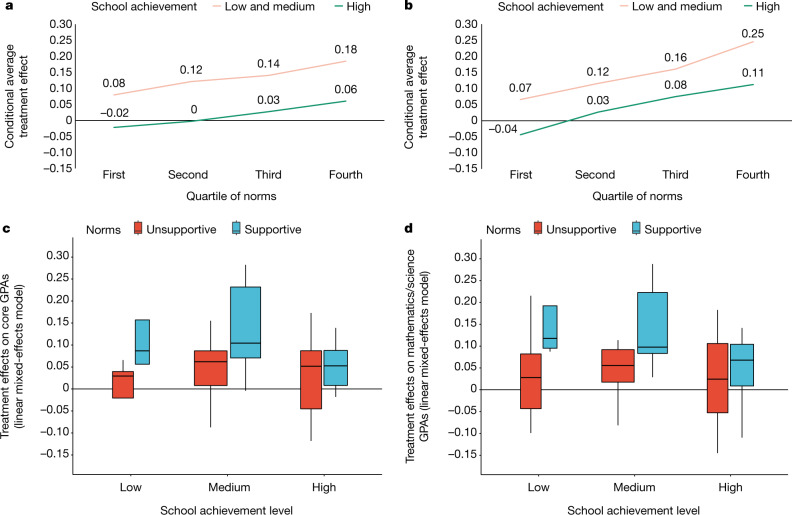
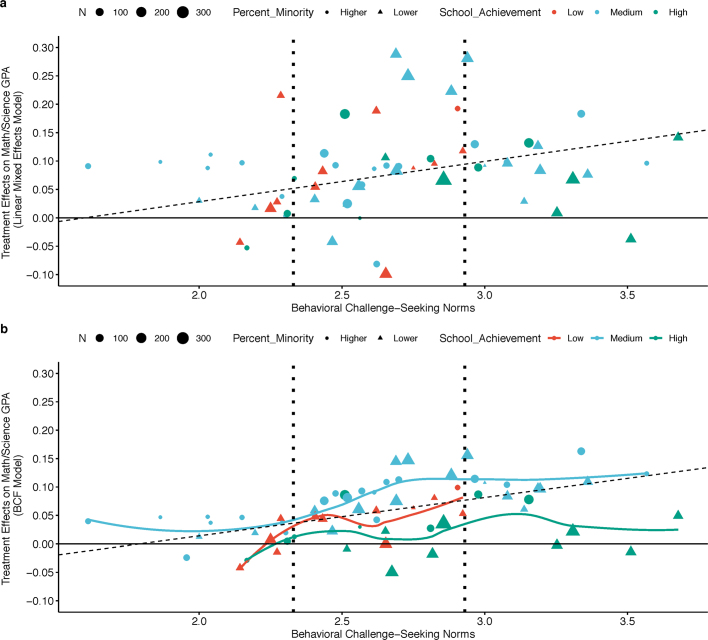
A short, online growth mindset intervention in a nationally representative sample of U.S. secondary students improved outcomes for lower-achieving students and increased advanced mathematics enrollment overall. Its grade effects were strongest in schools whose peer norms supported challenge-seeking, suggesting context matters for sustaining benefits.
Key findings
- Among lower-achieving adolescents, the intervention reduced fixed-mindset beliefs by B = −0.38 and had an effect size of 0.33 (n = 5,650 students, k = 65 schools, P < 0.001).
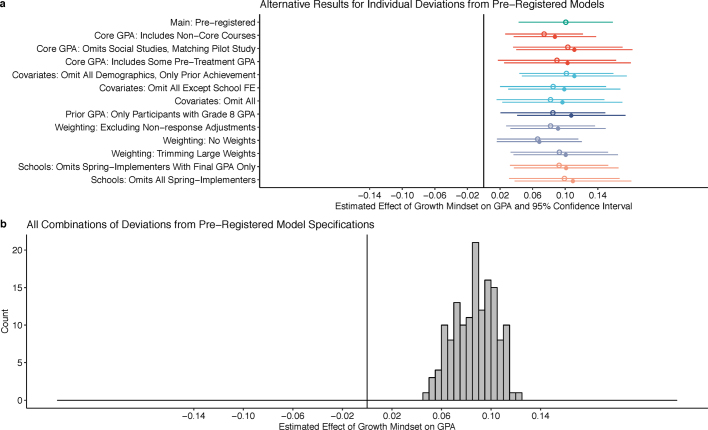
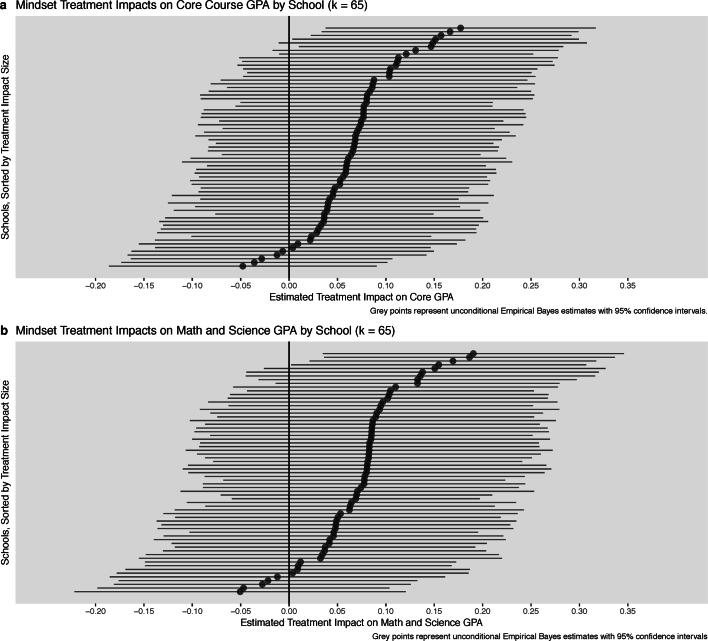
- Lower-achieving adolescents earned higher end-of-year core GPA when assigned to the intervention: B = 0.10 grade points, effect size 0.11, n = 6,320, k = 65, P = 0.001.
- The same GPA conclusion held for mathematics and science GPAs, with B = 0.10.
- Across the full cohort, the intervention increased tenth-grade advanced mathematics enrollment by 3 percentage points, from 33% to 36% (n = 6,690, k = 41, P = 0.001), and overall reduced the share of students below GPA 2.0 from 46% to 41%.
Methods
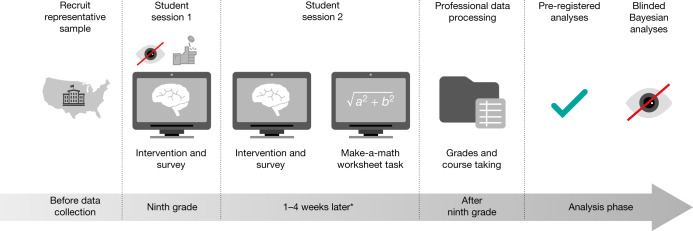
- Randomized, effectiveness-trial design: 12,490 ninth-grade adolescents in 65 regular public schools were individually randomized within schools in the National Study of Learning Mindsets.
- Intervention: two self-administered online sessions of about 25 minutes each, delivered roughly 20 days apart during school hours; control was a similar brain-functions program that did not address intelligence beliefs.
- Main analysis: intention-to-treat cluster-robust fixed-effects linear regression for average effects, mixed-effects models for cross-school heterogeneity, and a blinded Bayesian causal forest robustness analysis.
Limitations
- The paper states that the moderation results cannot support causal conclusions about school norms because norms were measured, not manipulated.
- Advanced mathematics enrollment analyses were exploratory because they were not pre-registered.
- Evident from the text: school-level heterogeneity analyses are limited by the observational nature of the moderators and by only 65 schools contributing to the main analyses.
Model-written summary. Check it against the paper before relying on it.
Integrity signals
Registry
Cites
Statistics
Figures
Verification
Claims the paper makes
15 Valid · 0 Not valid · 17 Not checked · 46 Own results and interpretations
The cited sources support only part of this claim — read each source’s verdict below.
In the paper
“When such students underperform in or opt out of rigorous coursework, they are far less likely to leave secondary school prepared for college or university or for advanced courses in college or university8,9.”
§ A national experiment reveals where a growth mindset improves achievement > Main
What the sources say
- Not checked — no full text of the sourcecites [8] Adelman, C. The Toolbox Revisited: Paths to Degree Completion from High School through College (US Department of Education, 2006).
- Partly supportedcites [9] Schiller KS Schmidt WH Muller C Houang R Hidden disparities: how courses and curricula shape opportunities in mathematics during high school Equity Excell. Educ. 2010 43 414 433 10.1080/10665684.2010.517062 23554547 PMC3612550 sourceExperimental — accuracy not yet measured
The ‘Course Enrollments as Opportunities to Learn’ section (page unavailable) says that mathematics course sequencing affects how far students progress in high school and that mathematics success has consequences for post-secondary schooling. The ‘Dimensions of Learning Opportunities’ section (page unavailable) also discusses undergraduates’ need for remedial courses. But the paper does not establish that students who underperform in or opt out of rigorous coursework are ‘far less likely’ to leave school prepared for college or advanced college courses. (LLM, conf=0.83)
plainstates an association- Asserted: passes — The authors put it forward as true.
- Checkable: passes — It can be checked against evidence.
- Load-bearing: passes — The paper’s conclusions depend on it.
- Based: passes — The paper gives a reason why it holds.
The cited sources support only part of this claim — read each source’s verdict below.
In the paper
“most interventions that are effective in initial efficacy trials go on to show weaker or no effects when they are scaled up in effectiveness trials that deliver treatments under everyday conditions to more heterogeneous samples21–23.”
§ A national experiment reveals where a growth mindset improves achievement > A focus on heterogeneity
What the sources say
- Not checked — no full text of the sourcecites [21] Greenberg MT Abenavoli R Universal interventions: fully exploring their impacts and potential to produce population-level impacts J. Res. Educ. Eff. 2017 10 40 67 source
- Not checked — no full text of the sourcecites [22] Allcott H Site selection bias in program evaluation Q. J. Econ. 2015 130 1117 1165 10.1093/qje/qjv015 source
- Partly supportedcites [23] Singal AG Higgins PDR Waljee AK A primer on effectiveness and efficacy trials Clin. Transl. Gastroenterol. 2014 5 e45 10.1038/ctg.2013.13 24384867 PMC3912314 sourceExperimental — accuracy not yet measured
The Introduction says efficacy trials can overestimate effects in clinical practice, and Study Design describes effectiveness trials as using more heterogeneous populations in routine settings, sometimes without a witnessed effect. The paper does not establish that *most* interventions with positive initial efficacy results subsequently show weaker or no effects in effectiveness trials. (LLM, conf=0.86)
plainstates a cause- Asserted: passes — The authors put it forward as true.
- Checkable: passes — It can be checked against evidence.
- Load-bearing: passes — The paper’s conclusions depend on it.
- Based: passes — The paper gives a reason why it holds.
The cited sources support only part of this claim — read each source’s verdict below.
In the paper
“Beliefs—and particularly beliefs that affect how students make sense of ongoing challenges—are important during high-stakes developmental turning points such as pubertal maturation43,44 or the transition to secondary school6.”
§ A national experiment reveals where a growth mindset improves achievement > Discussion
What the sources say
- Supportedcites [43] Yeager DS Dahl RE Dweck CS Why interventions to influence adolescent behavior often fail but could succeed Perspect. Psychol. Sci. 2018 13 101 122 10.1177/1745691617722620 29232535 PMC5758430 source
The Discussion (page unavailable) says adolescents’ beliefs about whether social traits can change shape how they interpret and cope with social adversity, using a new high school student as an example. The paper also links adolescents’ heightened sensitivity to status and respect to pubertal maturation and school transitions (Abstract, page unavailable). Together, these passages support the attributed point about the importance of beliefs during those developmental turning points. (LLM, conf=0.87)
- Partly supportedcites [44] Dahl RE Allen NB Wilbrecht L Suleiman AB Importance of investing in adolescence from a developmental science perspective Nature 2018 554 441 450 10.1038/nature25770 29469094 sourceExperimental — accuracy not yet measured
The Conclusion (p. 13) describes pubertal maturation as a dynamic period of learning and adaptation, and the Policy and intervention section (p. 10) identifies puberty as an important window for formative learning experiences. This supports the significance of the pubertal turning point, but the paper does not establish the claim about beliefs that shape how students interpret ongoing challenges. The transition to secondary school is attached to a different citation and is not assessed here. (LLM, conf=0.82)
- Not checked — no full text of the sourcecites [6] Crosnoe, R. Fitting In, Standing Out: Navigating the Social Challenges of high School to Get an Education (Cambridge Univ. Press, 2011). source
plainstates an association- Asserted: passes — The authors put it forward as true.
- Checkable: passes — It can be checked against evidence.
- Load-bearing: unclear — It is unclear whether the paper’s conclusions depend on it.
- Based: passes — The paper gives a reason why it holds.
- Supported
The cited sources support only part of this claim — read each source’s verdict below.
In the paper
“previously low-achieving students are the group that shows the steepest decline in grades during the transition to secondary school19”
§ A national experiment reveals where a growth mindset improves achievement > Main
What the sources say
- Partly supportedcites [19] Benner AD The transition to high school: current knowledge, future directions Educ. Psychol. Rev. 2011 23 299 328 10.1007/s10648-011-9152-0 21966178 PMC3182155 sourceExperimental — accuracy not yet measured
The Academic performance and engagement passage (page unavailable) reports that grades generally decline from middle to high school. The feeder-pattern passage (page unavailable) says low-performing students struggled more under a particular transition condition, but it does not establish that previously low-achieving students have the steepest grade decline of all groups. (LLM, conf=0.84)
plainstates an association- Asserted: passes — The authors put it forward as true.
- Checkable: passes — It can be checked against evidence.
- Load-bearing: passes — The paper’s conclusions depend on it.
- Based: passes — The paper gives a reason why it holds.
- Partly supported
The sources with a verdict support this claim; the rest weren’t checked yet, have no full text we could read, or their verdicts aren’t rated yet.
In the paper
“Nonetheless, previous randomized evaluations, including a pre-registered replication, found that online growth mindset interventions improved grades for the targeted group of students in secondary education who previously showed lower achievement13,16,18.”
§ A national experiment reveals where a growth mindset improves achievement > Main
What the sources say
- Supportedcites [13] Yeager DS Using design thinking to improve psychological interventions: the case of the growth mindset during the transition to high school J. Educ. Psychol. 2016 108 374 391 10.1037/edu0000098 27524832 PMC4981081 source
The Focus of the Present Investigation describes a prior randomized online evaluation in which lower-achieving high school students improved their GPA. The Study 2 Results report a pre-registered analysis showing a grade benefit for previously lower-achieving ninth graders, and the General Discussion calls it a rigorous replication. (LLM, conf=0.93)
- Not checked — no full text of the sourcecites [16] Paunesku D Mind-set interventions are a scalable treatment for academic underachievement Psychol. Sci. 2015 26 784 793 10.1177/0956797615571017 25862544 source
- Not checked — no full text of the sourcecites [18] Good C Aronson J Inzlicht M Improving adolescents’ standardized test performance: an intervention to reduce the effects of stereotype threat J. Appl. Dev. Psychol. 2003 24 645 662 10.1016/j.appdev.2003.09.002 source
plainstates a cause- Asserted: passes — The authors put it forward as true.
- Checkable: passes — It can be checked against evidence.
- Load-bearing: passes — The paper’s conclusions depend on it.
- Based: passes — The paper gives a reason why it holds.
- Supported
25 more claims · 2 with their cited sources checked
Create a free account to see all 78 claims and to verify the 6 references still open.
- Probably not a substantial claim. 38
- It may state two separate claims as one. 23
Claims other papers make about this one
Each is checked against this paper’s own text: does it say what the citing paper says it does?
The cited source doesn’t support the claim as written.
In the citing paper
“As another example, Yeager et al. (2019) only reported the results of the 50% of students performing below their school's median.They stated this was in part because lower-achieving students may have more academic difficulties and therefore may benefit more from a growth mindset intervention than higher-achieving students.Yet, they did not report a test of whether the treatment effect for lower-”
From Do growth mindset interventions impact students’ academic achievement? A systematic review and meta-analysis with recommendations for best practices. (2023) · cites this paper as Yeager et al. (2019)
Checked by a reasoning model — may be wrong.
Experimental — accuracy not yet measuredThe source backs part of the claim, not all of it — or backs it for a different population, condition or comparison.
In the citing paper
“For example, growth mindset interventions have been shown to help students alter their fixed mindset in a way that allows them to take a longer term perspective (Cassidy, 2015;Rhew et al., 2018;Yeager et al., 2019).”
From The impact of growth mindset training on entrepreneurial action among necessity entrepreneurs: Evidence from a randomized control trial (2023) · cites this paper as Yeager et al., 2019
Experimental — accuracy not yet measuredThe source backs part of the claim, not all of it — or backs it for a different population, condition or comparison.
In the citing paper
“The intervention offered greater benefits to lower achieving students if they attended schools whose students had an overall higher orientation towards growth mindset”
From Tackling Educational Inequalities with Social Psychology: Identities, Contexts, and Interventions (2021) · cites this paper as Yeager et al., 2019
Experimental — accuracy not yet measuredThe source backs part of the claim, not all of it — or backs it for a different population, condition or comparison.
In the citing paper
“Studies have shown that a growth mindset is associated with improved achievement; moreover, even short interventions can foster an increased growth mindset (Blackwell et al., 2007;Yeager et al., 2019).”
From Impacts of Standards-Based Grading on Students’ Mindset and Test Anxiety (2022) · cites this paper as Yeager et al., 2019
Experimental — accuracy not yet measuredThe source backs part of the claim, not all of it — or backs it for a different population, condition or comparison.
In the citing paper
“While scholars have examined growth mindset in both a poverty context (e.g., Burnette et al., 2018;Yeager et al., 2019) and an entrepreneurship context (e.g., Burnette et al., 2019), to the best of our knowledge none of these studies have examined both of these contexts together, nor have they been studied outside of the context of formal education settings.”
From The impact of growth mindset training on entrepreneurial action among necessity entrepreneurs: Evidence from a randomized control trial (2023) · cites this paper as Yeager et al., 2019
Experimental — accuracy not yet measured
5 more claims about this paper
Create a free account to see every claim other papers make about this one.
Statistics that don’t add up
Each reported p-value recomputed from its test statistic and degrees of freedom, each partial η² from its F, and each ratio, mean difference or B printed with a p checked against its own confidence interval.
Rated minor: it would not touch a result — a value no result rests on, a p-value that stays on the same side of the significance level, or a conflict that is clerical, resolved elsewhere in the paper, or outside its own findings.
In the paper
“B = −0.07 (95% confidence interval = 0.02, 0.13), s.e. = 0.03, z = −2.76, n = 6,320, k = 65, P = 0.006”
§ A national experiment reveals where a growth mindset improves achievement > Moderation by school achievement level
Statistics recomputed
Every reported test result, recomputed from its test statistic and degrees of freedom. A result shows as not adding up only once an independent check has confirmed it.
- Consistentz = 2.26reported p = .024 · recomputed p = .024
“z = 2.26, p = .024”
Self-check
Percentages, sums and reported differences re-computed from the paper’s own numbers.
Self-check results appear here once an independent check has confirmed them.
Citations
Cites
Our future: a Lancet commission on adolescent health and wellbeing
Patton, G. C., Sawyer, S. M., Santelli, J. S., Ross, D. A., Afifi, R., Allen, N. B., Arora, M., Azzopardi, P., Baldwin, W., Bonell, C., et al. (2016) · The Lancet · doi:10.1016/s0140-6736(16)00579-1 · Cited by 3,785
Blackwell, L. S., Trzesniewski, K. H., & Dweck, C. S. (2007) · Child Development · doi:10.1111/j.1467-8624.2007.00995.x · Cited by 3,784
Self-citationAronson, J., Fried, C. B., & Good, C. (2002) · Journal of Experimental Social Psychology · doi:10.1006/jesp.2001.1491 · Cited by 1,889
(2006) · US Department of Education · Cited by 1,586
Expectations of brilliance underlie gender distributions across academic disciplines
Leslie, S.-J., Cimpian, A., Meyer, M., & Freeland, E. (2015) · Science · doi:10.1126/science.1261375 · Cited by 1,516
Mind-sets matter: A meta-analytic review of implicit theories and self-regulation.
Burnette, J. L., O'Boyle, E. H., VanEpps, E. M., Pollack, J. M., & Finkel, E. J. (2013) · Psychological Bulletin · doi:10.1037/a0029531 · Cited by 1,367
Social-Psychological Interventions in Education: They’re Not Magic
Yeager, D. S., & Walton, G. M. (2011) · Review of Educational Research · doi:10.3102/0034654311405999 · Cited by 1,345
Self-citationMindsets: A View From Two Eras
Dweck, C. S., & Yeager, D. S. (2019) · Perspectives on Psychological Science · doi:10.1177/1745691618804166 · Cited by 1,259
Self-citationImportance of investing in adolescence from a developmental science perspective
Dahl, R. E., Allen, N. B., Wilbrecht, L., & Suleiman, A. B. (2018) · Nature · doi:10.1038/nature25770 · Cited by 1,196
Skills, education, and the rise of earnings inequality among the “other 99 percent”
Autor, D. H. (2014) · Science · doi:10.1126/science.1251868 · Cited by 1,160
Research works printed but not linked: 1
- Tipton, E., Yeager, D. S., Iachan, R. & Schneider, B. in Experimental Methods in Survey Research: Techniques that Combine Random Sampling with Random Assignment (ed. Lavrakas, P. J.) (Wiley, 2019).
Cited by
Items 401–500 of 1,523
An implicit measure of growth mindset uniquely predicts post-failure learning behavior
Sik, K., Cummins, J. D., & Job, V. (2024) · Scientific Reports · doi:10.1038/s41598-024-52916-5 · Cited by 19
“An extensive amount of research has documented that people’s explicit growth mindset can be promoted by various forms of persuasive messages 3,5,49–51 .”
BackgroundThe mediating effect of growth mindset in the relationship between adolescents’ optimism and grit
Pyo, D., Kwak, K., & Kim, Y. (2024) · Current Psychology · doi:10.1007/s12144-024-05656-8 · Cited by 26
“Beside this, Yeager et al. (2019) reported that in a large sample of US adolescents ( n = 12,490), growth mindset intervention improved performance of underachiev-ing students and could lead to an overall increase in enrollment in mathematics courses.”
Gilbert, J. B., Miratrix, L. W., Joshi, M., & Domingue, B. W. (2024) · Journal of Educational and Behavioral Statistics · doi:10.3102/10769986241240085 · Cited by 24
“Many methods have been proposed to address these problems, such as pre-registration (Olken, 2015) and machine learning approaches (Chernozhukov et al., 2022; Wager & Athey, 2018; Wallace et al., 2023; Yeager et al., 2019).”
Zheng, Q., & Wang, W. (2024) · Current Psychology · doi:10.1007/s12144-024-05974-x · Cited by 18
“A growth mindset encompasses the belief held by individuals that personal characteristics, particularly intellectual abilities, can be shaped and enhanced through development (Dweck, 2000; Yeager et al., 2019).”
InfluentialMcJames, N., O’Shea, A., Goh, Y. C., & Parnell, A. C. (2024) · Journal of the Royal Statistical Society Series A (Statistics in Society) · doi:10.1093/jrsssa/qnae049 · Cited by 28
Teachers’ mindset meaning system: achievement goals, beliefs and classroom practices
Lüftenegger, M., & Muth, J. (2024) · Social Psychology of Education · doi:10.1007/s11218-024-09952-w · Cited by 22
“…in the school context was conducted on students and found positive consequences of holding a growth mindset versus a fixed mindset for adaptive achievement goals, competence self-perceptions, well-being, and performance (Chen & Tutwiler, 2017; Lüftenegger et al., 2015 , 2021; Yeager et al., 2019).”
Testing a weekly utility value intervention in college physics and chemistry courses
Beymer, P. N., & Rosenzweig, E. Q. (2025) · Contemporary Educational Psychology · doi:10.1016/j.cedpsych.2025.102348 · Cited by 16
Compagnoni, M., Sieber, V., & Job, V. (2020) · Frontiers in Psychology · doi:10.3389/fpsyg.2020.601724 · Cited by 15
Rigolizzo, M., & Zhu, Z. (2021) · Human Resource Development Quarterly · doi:10.1002/hrdq.21425 · Cited by 16
Zhang, J. (2022) · Sustainability · doi:10.3390/su14073811 · Cited by 30
Török, L., Szabó, Z. P., & Orosz, G. (2022) · Scientific Reports · doi:10.1038/s41598-022-11547-4 · Cited by 24
Evaluation of the Use of Growth Mindset in the CS Classroom
Kwak, D., Morreale, P. A., Hug, S. T., Kumar, Y., Chu, J., Huang, C., Li, J. J., & Wang, P. (2022) · ACM Technical Symposium on Computer Science Education (SIGCSE) · doi:10.1145/3478431.3499365 · Cited by 19
“Prior work on growth mindset in educational settings has identified the use of growth mindset to move students away from deficit thinking and towards strengths-based thinking [7-9].”
BackgroundGutshall, C. A. (2020) · European Journal of Psychology and Educational Research · doi:10.12973/ejper.3.1.39 · Cited by 18
“Yeager et al. (2019); and Snipes et al., (2012) summarize the general findings by stating, “Improving a student’s orientation toward learning and her beliefs about the nature of intelligence sparks a positive recursive process that fundamentally changes what she absorbs from the available learning…”
BackgroundMaking Entrepreneurs: Returns to Training Youth in Hard Versus Soft Business Skills
Chioda, L., Contreras-Loya, D., Gertler, P., & Carney, D. (2021) · National Bureau of Economic Research · doi:10.3386/w28845 · Cited by 34
“Programs targeting the development of youth’s socio-emotional skills have led to improvements in education outcomes (Yeager et al., 2019; Alan and Ertac, 2018; Alan et al., 2019) and have shown promise as effective prevention strategies against crime and antisocial behavior (Blattman et al., 2017;…”
BackgroundDo socializers’ mindset beliefs matter for student mindset and achievement? A meta-analysis
Fong, C. J., Muenks, K. M., Fathi, Z., Adelugba, S. F., O’Grady, M. C., Lin, S., & Goldstein, M. G. (2025) · Learning and Individual Differences · doi:10.1016/j.lindif.2025.102709 · Cited by 16
The impact of the pandemic and school closures on non-cognitive characteristics: Evidence from PISA
Pena, J. W. Q., Volante, L., & Witte, K. D. (2025) · International Journal of Educational Research Open · doi:10.1016/j.ijedro.2025.100489 · Cited by 18
Caniëls, M. C. J., Adamska, K. M., van Oortmerssen, L. A., & van Assen, M. F. (2021) · Current Psychology · doi:10.1007/s12144-021-01572-3 · Cited by 18
“Moreover, mindset interventions were designed to stimulate the development of a growth mindset among students (Yeager et al., 2019; Sisk et al., 2018).”
BackgroundFootball: Exploring passion, grit and mindset in elite and junior players
Loftesnes, J. M., Grassini, S., Hagerup, A. C., Dybendal, B. H., & Sigmundsson, H. (2021) · New Ideas in Psychology · doi:10.1016/j.newideapsych.2021.100899 · Cited by 14
Reading Struggle Stories of Role Models Can Improve Students' Growth Mindsets
Du, X., Yuan, S., Ying, L., & Bai, X. (2021) · Frontiers in Psychology · doi:10.3389/fpsyg.2021.747039 · Cited by 17
Good, K., & Shaw, A. (2022) · Child Development · doi:10.1111/cdev.13711 · Cited by 15
Gál, É., Tóth‐Király, I., & Orosz, G. (2022) · Frontiers in Psychology · doi:10.3389/fpsyg.2022.852638 · Cited by 26
Motivation in context: A multilevel examination of growth orientation across one year
Bostwick, K. C. P., Martin, A. J., Collie, R. J., & Durksen, T. L. (2022) · Journal of Applied Developmental Psychology · doi:10.1016/j.appdev.2022.101435 · Cited by 12
Chen, P., Teo, D. W. H., Foo, D. X. Y., Derry, H. A., Hayward, B., Schulz, K. W., Hayward, C., McKay, T. A., & Ong, D. C. (2022) · npj Science of Learning · doi:10.1038/s41539-022-00135-w · Cited by 16
Holden, L. R., Haughbrook, R., & Hart, S. A. (2022) · New Directions for Child and Adolescent Development · doi:10.1002/cad.20485 · Cited by 14
Broda, M., Ross, E., Sorhagen, N. S., & Ekholm, E. (2023) · Frontiers in Psychology · doi:10.3389/fpsyg.2023.1140924 · Cited by 27
Using Reappraisal to Improve Outcomes for STEM Teachers and Students
Cohen, L. D., Gross, J. J., & Rubinsten, O. (2023) · Journal of Cognition · doi:10.5334/joc.313 · Cited by 16
Ghosh, A., Cohen, K. A., Jans, L. K., Busch, C. A., McDanal, R., Yang, Y., Cooper, K. M., & Schleider, J. L. (2023) · JMIR Mental Health · doi:10.2196/48926 · Cited by 19
“Other trials have found positive outcomes for brief ( ≤ 3 sessions) interventions on academic achievement [36-38].”
BackgroundKaya, S., Eryılmaz, N., & Yüksel, D. (2024) · SAGE Open · doi:10.1177/21582440231225870 · Cited by 18
“One of the strengths of the mindset lies in its critical role in impacting achievement (Yeager et al., 2019).”
BackgroundGalla, B. M. (2024) · Child Development Perspectives · doi:10.1111/cdep.12508 · Cited by 20
Emotion malleability beliefs matter in emotion regulation: a comprehensive review and meta-analysis
Kim, Y., Kim, S., & Yoon, S. (2024) · Cognition & Emotion · doi:10.1080/02699931.2024.2334833 · Cited by 19
“…intense manipulations of malleability beliefs (e.g. two 25-min online sessions in which various aspects of malleability beliefs of intelligence were discussed; Yeager et al., 2019) showed significant decreases in negative affect and psychological distress (see Burnette et al., 2023 for review).”
Muradoglu, M., Porter, T., Trzesniewski, K. H., & Cimpian, A. (2024) · PLoS ONE · doi:10.1371/journal.pone.0311205 · Cited by 28
Bauer, C. A., Walton, G. M., Job, V., & Stephens, N. K. (2024) · Social Psychological and Personality Science · doi:10.1177/19485506241284806 · Cited by 18
“Targeted online interventions can achieve similar effects on academic performance, 0.10 ł d ł .25 (Bauer et al., 2021; Yeager et al., 2016, 2019).”
BackgroundInfluentialSelf-citationEmotion regulation contagion drives reduction in negative intergroup emotions
Pinus, M., Cao, Y., Halperin, E., Coman, A., Gross, J. J., & Goldenberg, A. (2025) · Nature Communications · doi:10.1038/s41467-025-56538-x · Cited by 28
“A variety of interventions, such as growth mindset 41 , social belonging 42 , and health behaviors 43 , could bene fi t from thinking about their impact at the collective rather than individual level.”
Meng, Y., Sun, Y., Yang, L., & Mydin, Y. O. (2025) · Behavioral Sciences · doi:10.3390/bs15050621 · Cited by 33
“While growth mindset has been extensively studied in relation to academic achievement and motivation (Yeager et al., 2019; Macnamara & Burgoyne, 2023; J. Zhang et al., 2024; W. Zhao et al., 2024), recent research highlights its significant role in fostering psychological well-being across diverse…”
The Impact of Mindset on Self-Tracking Experience
Hancı, E., Ruijten, P. A. M., Lacroix, J. P. W., & IJsselsteijn, W. A. (2021) · Frontiers in Digital Health · doi:10.3389/fdgth.2021.676742 · Cited by 16
“We have decided to combine all items into one construct, but we agree with (4, 5) that further research is needed to fully understand the workings of the concept.”
BackgroundResultWho will teach the teachers? Examining implicit bias in the educator workforce
Worrell, F. C. (2021) · Learning and Instruction · doi:10.1016/j.learninstruc.2021.101518 · Cited by 18
Ding, H., & Liu, J. (2022) · Current Psychology · doi:10.1007/s12144-022-03400-8 · Cited by 20
Effects of Mothers’ Mindset and Perceived Child Competence on Their Learning Involvement
Sheffler, P., & Cheung, C. S.-S. (2022) · The Journal of Experimental Education · doi:10.1080/00220973.2022.2137096 · Cited by 18
“…children ’ s increased engagement, academic achievement, and other educational outcomes (Blackwell et al., 2007; Paunesku et al., 2015; Wilkins, 2014; Yeager et al., 2019, but see also Fabert, 2014), though it is important to acknowledge the need for further research into potential moderators of…”
BackgroundApplying a synergistic mindsets intervention to an esports context
Behnke, M., Lakens, D., Petrova, K., Chwiłkowska, P., Jęśko-Białek, S., Kłoskowski, M., Krzyżaniak, W. L., Maciejewski, P. A., Kaczmarek, L. D., Szymański, K., et al. (2024) · Royal Society Open Science · doi:10.1098/rsos.240691 · Cited by 17
“The content was modelled after the control condition used in prior large-scale growth mindset experiments [9,94] and created with the design-thinking method [95].”
MethodKaufman, T. M. L., Lee, H. Y., Benner, A. D., & Yeager, D. S. (2020) · Journal of Research on Adolescence · doi:10.1111/jora.12558 · Cited by 15
“Although effects of implicit theories have been shown across multiple domains including intelligence, social and moral behaviors, internalizing and externalizing coping outcomes, and stress, health, and well-being, to date the literature on implicit theories has predominantly focused on individual social–cognitive and…”
InfluentialSelf-citationJoseph, G. P., Segovia, N. A., Wright, R. C., Mueller, C. M., & Tileston, K. R. (2020) · Spine Deformity · doi:10.1007/s43390-020-00243-w · Cited by 11
Li, M., Wang, Y., Stone, H., & Turki, N. (2021) · Education Sciences · doi:10.3390/educsci11030095 · Cited by 26
“This procedure was used in a national study on understanding students’ learning mindset [20] and was similar to the stoichiometry instruction study [19].”
MethodHow Experiments with Children Inform Economics
List, J. A., Petrie, R., & Samek, A. S. (2021) · National Bureau of Economic Research · doi:10.3386/w28825 · Cited by 24
A review of music performance anxiety in the lens of stress models
Twitchell, A., Journault, A., Singh, K. K., & Jamieson, J. (2025) · Frontiers in Psychology · doi:10.3389/fpsyg.2025.1576391 · Cited by 16
“This approach combines (1) growth mindsets—the belief that ability develops through effort, strategy, and support (Yeager et al., 2019)—with (2) stress-can-be-enhancing mindsets, which frame stress as beneficial for performance (Crum et al., 2013; Jamieson et al., 2010).”
Sustaining growth needs contextual supports: The mindset × ecological-system approach to motivation
Lou, N. M. (2025) · Studies in Second Language Learning and Teaching · doi:10.14746/ssllt.48250 · Cited by 21
Cai, Y., & Liu, H. (2025) · Behavioral Sciences · doi:10.3390/bs15101304 · Cited by 14
“It is also a hallmark of the growth language mindset (Dweck, 2017; H. Liu et al., 2025c; Yeager et al., 2019; Burnette et al., 2013), whose positive effects have been found to outweigh those of self-efficacy (Bai & Wang, 2020; Bai et al., 2025).”
Gál, É., Tóth‐Király, I., Szamosközi, I., & Orosz, G. (2020) · Journal of College Student Retention Research Theory & Practice · doi:10.1177/1521025120961322 · Cited by 14
“Furthermore, creating school and classroom norms which advocate the adoption of intellectual challenges might lead to sustained benefits (Yeager et al., 2019).”
BackgroundWhat Is the Role of Motivation in Social and Emotional Learning?
Getty, S. R., Barron, K. E., & Hulleman, C. S. (2021) · Emerald Group Publishing Limited eBooks · doi:10.1108/s0749-742320210000021002 · Cited by 15
Self-citationTrajectories of implicit theories of intelligence and emotional intelligence in secondary school
Costa, A., & Faria, L. (2022) · Social Psychology of Education · doi:10.1007/s11218-022-09695-6 · Cited by 17
“ibility of students’ educational trajectories (Yeager et al., 2019), whether in terms of alternative vocational courses or students’ autonomy to define their educational paths.”
BackgroundInfluentialMindsets and self-efficacy beliefs among individuals with type 2 diabetes
Lo, C. J., Lee, L., Yu, W., Tai, E. S., Yew, T. W., & Ding, I. L. (2023) · Scientific Reports · doi:10.1038/s41598-023-47617-4 · Cited by 19
“…mindsets have been well researched in the domains of education and intelligence (e.g., GM has been observed to improve academic achievement 13,14 ) and, increasingly, in health-related domains (e.g., weight management 15 , smoking addictions 16 , healthier eating intentions 17 ), there has…”
Mohamoud, A. M. (2024) · Multidisciplinary Journal of Horseed International University (MJHIU) · doi:10.59336/7adj0850 · Cited by 37
Sağlam, M. H., & Göktentürk, T. (2024) · Learning and Individual Differences · doi:10.1016/j.lindif.2024.102513 · Cited by 16
Steinberg, J. S., Fitzpatrick, O. M., Khurana, S., Kim, M. Y., Mair, P., Schleider, J. L., Hatzenbuehler, M. L., & Weisz, J. R. (2024) · Journal of Clinical Child & Adolescent Psychology · doi:10.1080/15374416.2024.2384026 · Cited by 21
Kattoum, R. N., Montenegro‐Montenegro, E., & Baillie, M. T. (2024) · Journal of Chemical Education · doi:10.1021/acs.jchemed.3c00971 · Cited by 13
A single‐session growth mindset intervention among Chinese junior secondary school students
Cheng, Y., Zhao, S., Jin, L., Wang, Y., & Lin, D. (2024) · Applied Psychology Health and Well-Being · doi:10.1111/aphw.12596 · Cited by 14
Palikara, O., Bonneville‐Roussy, A., & Allen, K. (2025) · School Mental Health · doi:10.1007/s12310-024-09725-y · Cited by 21
“…that individual-level interventions exist for some of the factors examined in this study, such as motivation (see Lazowski & Hulleman, 2016; Yeager et al., 2019), evidence-based interventions specifically targeting students’ sense of school belonging remain limited (Allen et al., 2022a, b;…”
Zhao, Q., Gong, L., & Chen, T. (2021) · Social Psychology of Education · doi:10.1007/s11218-021-09671-6 · Cited by 14
“, 2018) and in low-achieving schools (Yeager et al., 2019).”
Thx 4 the msg: Assessing the Impact of Texting on Student Engagement and Persistence
Tippetts, M. M., Davis, B., Nalbone, S., & Zick, C. D. (2022) · Research in Higher Education · doi:10.1007/s11162-022-09678-8 · Cited by 16
“However, more recent research also identifies non-socioeconomic factors, such as, self-efficacy and a sense of belonging, as significant persistence indicators (Fishbane & Fletcher, 2016; Page et al., 2020; Stewart et al., 2015; Stiles & Wilcox, 2016; Tinto, 2015; Yeager et al., 2019).”
BackgroundBalan, A., & Sjöwall, D. (2022) · Scandinavian Journal of Educational Research · doi:10.1080/00313831.2022.2042733 · Cited by 19
“A recent, large-scale one-hour growth mindset intervention demonstrated how school grades were a ff ected (Yeager et al., 2019), while a previous meta-analysis and a study investigating key premises of mindset theory raised doubt about the e ff ectiveness of growth mindset interventions (Burgoyne et…”
BackgroundChiu, M.-S., Lin, F.-L., Yang, K., Hasumi, T., Wu, T.-J., & Lin, P.-S. (2022) · Eurasia Journal of Mathematics Science and Technology Education · doi:10.29333/ejmste/12579 · Cited by 19
Toro, J. D., & Wang, M. (2023) · Developmental Science · doi:10.1111/desc.13380 · Cited by 17
Reflecting on their mission increases preservice teachers’ growth mindsets
Heyder, A., Steinmayr, R., & Cimpian, A. (2023) · Learning and Instruction · doi:10.1016/j.learninstruc.2023.101770 · Cited by 18
Students’ Beliefs About the Nature of Intelligence (Mindset)
de Kraker-Pauw, E., van Wesel, F., Krabbendam, L., & van Atteveldt, N. (2020) · Journal of Adolescent Research · doi:10.1177/0743558420967113 · Cited by 15
“…across challenging school transitions (Yeager & Dweck, 2012) and incremental mindset interventions were shown to improve general test scores (Paunesku et al., 2015; Yeager et al., 2019), although a recent meta-analysis shows these effects are small and not always replicated (Sisk et al., 2018).”
BackgroundCan Grit be Taught? Lessons from a Nationwide Field Experiment with Middle-School Students
Petroska-Beshka, V., Santos, I. V., Carneiro, P., Eskreis-Winkler, L., Boudet, A. M. M., Berniell, I., Krekel, C., Arias, O. S., & Duckworth, A. L. (2021) · World Bank, Washington, DC eBooks · doi:10.1596/1813-9450-9831 · Cited by 14
“This is likely due to the higher salience of psychological barriers, such as stereotype threat, among those groups (see Cohen et al. (2009), Good et al. (2003), or Yeager and Dweck (2012), for example).”
Self-citationPeer Mindset Culture as a Developmental Context for Belonging
Seo, E., Clapper, M., Hecht, C. A., Crosnoe, R. L., & Yeager, D. S. (2025) · Educational Psychology Review · doi:10.1007/s10648-025-10082-8 · Cited by 15
“A common approach in mindset intervention research is to focus on the beliefs of individual students, helping them internalize the idea that abilities can grow with effort and support (e.g., Paunesku et al., 2015; Yeager et al., 2019).”
Self-citationSoutter, M., & Clark, S. (2021) · Journal of Education · doi:10.1177/00220574211037747 · Cited by 22
Primary school teachers' emotions, implicit beliefs, and self-efficacy during the COVID-19 pandemic
Nicolosi, S., Alba, M., & Pitrolo, C. (2023) · Frontiers in Sports and Active Living · doi:10.3389/fspor.2022.1064072 · Cited by 13
“A multitude of studies have investigated students’ implicit theories, the impact of teachers in orienting the learning context towards growth or fixed mindsets, and how specific interventions can modify strong and established beliefs into incremental positions (24, 27, 28).”
BackgroundQuintana, R. (2023) · International Journal of Educational Research · doi:10.1016/j.ijer.2023.102179 · Cited by 11
“For example, a national experiment showed that modifying students ’ mindset beliefs (i.e., beliefs about the nature of intelligence) improved academic outcomes (Yeager et al., 2019).”
BackgroundCoderoni, S., Esposti, R., & Varacca, A. (2023) · Land Economics · doi:10.3368/le.100.2.060622-0043r1 · Cited by 15
“In this respect, we follow the work of Yeager et al. (2019), Hahn, Murray, and Carvalho (2020), Woody, Carvalho, and Murray (2021) and (and partially Lee, Bargagli-Stoffi, and Do-minici 2020), who suggest eliciting the rel-vant subgroups by partitioning the IATE maximum a posteriori (MAP)…”
MethodThe Recursive Cycle of Perceived Mindset and Psychological Distress in College
Kroeper, K. M., Hildebrand, L. K., Jiang, T., Hernandez-Colmenares, A., Brown, K., Wilk, A. V., Spencer, S. J., Heckler, A. F., & Fujita, K. (2024) · Social Psychological and Personality Science · doi:10.1177/19485506241247384 · Cited by 12
“…norms, values, policies, and practices (Murphy & Dweck, 2010; Murphy & Reeves, 2019), and they are created and sustained by various actors in the classroom environment, such as instructors, teaching assistants, and even peers (Muenks et al., 2021; Muenks & Yan, 2024; Yeager et al., 2019, 2022).”
Wu, Y.-C., Shen, S.-F., Chen, L., & Tung, H. (2024) · Journal of Medical Internet Research · doi:10.2196/53450 · Cited by 17
Hecht, C. A., Buontempo, J., Boylan, R., Crosnoe, R. L., & Yeager, D. S. (2024) · Journal of Research on Adolescence · doi:10.1111/jora.13002 · Cited by 15
Self-citationCreating a resilient pedagogy: Character strengths intervention for aspiring educators
Janapati, G., & Vijayalakshmi, V. (2024) · Acta Psychologica · doi:10.1016/j.actpsy.2024.104465 · Cited by 23
The Impact of Working-Memory Training on Children’s Cognitive and Noncognitive Skills
Berger, E., Fehr, E., Hermes, H., Schunk, D., & Winkel, K. (2024) · Journal of Political Economy · doi:10.1086/732884 · Cited by 30
A unified account of why optimism declines in childhood
Leonard, J., & Sommerville, J. A. (2024) · Nature Reviews Psychology · doi:10.1038/s44159-024-00384-z · Cited by 27
“Indeed, rigorous work has shown that growth mindset interventions (which arguably increase optimism) only work to the extent that school environments reflect these belief systems 176,177 .”
A transparency statement improves trust in community-police interactions
Dobson, K. S. H., Dittmann, A. G., & Yeager, D. S. (2025) · Nature Communications · doi:10.1038/s41467-024-55709-6 · Cited by 28
Self-citationDuckworth, A. L., Ko, A. C., Milkman, K. L., Kay, J., Dimant, E., Gromet, D. M., Halpern, A., Jung, Y., Paxson, M. K., Zumaran, R. A. S., et al. (2025) · Proceedings of the National Academy of Sciences · doi:10.1073/pnas.2418616122 · Cited by 16
“Likewise, learning that intelligence can grow improves math grades, especially for underperforming students ( 5 ).”
Self-citationThe secret language of peers: How peer behaviours signal mindset and influence classroom experiences
Seo, E., Lee, S. Y., Muenks, K. M., & Yan, Y. (2025) · British Journal of Educational Psychology · doi:10.1111/bjep.12759 · Cited by 15
Cherewick, M., Lebu, S., Su, C., Richards, L., Njau, P., & Dahl, R. E. (2021) · Frontiers in Public Health · doi:10.3389/fpubh.2021.623283 · Cited by 15
Passion a key for success: Exploring motivational factors in football players
Sigmundsson, H., Dybendal, B. H., Loftesnes, J. M., Ólafsson, B., & Grassini, S. (2022) · New Ideas in Psychology · doi:10.1016/j.newideapsych.2022.100932 · Cited by 20
– The IAFOR International Conference on Education – Hawaii 2022 Official Conference Proceedings
(2022) · IAFOR International Conference on Education, official conference proceedings · doi:10.22492/issn.2189-1036.2022 · Cited by 17
How Mindsets, Academic Performance, and Gender Predict Finnish Students’ Educational Aspirations
Laurell, J., Gholami, K., Tirri, K. A., & Hakkarainen, K. (2022) · Education Sciences · doi:10.3390/educsci12110809 · Cited by 24
Chiu, C., Tong, Y., Lee, S.-L., & Chan, H. (2023) · Journal of Pacific Rim Psychology · doi:10.1177/18344909231166106 · Cited by 11
“However, recent studies (Jia et al., 2021; Sun et al., 2021; Yeager et al., 2019, 2021) suggest that some cultural factors could signi fi cantly reduce the psychological bene fi ts of growth mindset interventions, despite these interventions being capable of strengthening students ’ growth mindset .”
BackgroundReading instruction causes changes in category-selective visual cortex
Yeatman, J. D., McCloy, D., Caffarra, S., Clarke, M. D., Ender, S., Gijbels, L., Joo, S. J., Kubota, E. C., Kuhl, P. K., Larson, E., et al. (2024) · Brain Research Bulletin · doi:10.1016/j.brainresbull.2024.110958 · Cited by 15
John‐Henderson, N. A., & Mueller, C. M. (2020) · PLoS ONE · doi:10.1371/journal.pone.0242902 · Cited by 11
Measure Learning Environments, Not Just Students, to Support Learning and Development
Paunesku, D., & Farrington, C. A. (2020) · Teachers College Record The Voice of Scholarship in Education · doi:10.1177/016146812012201404 · Cited by 14
“Such a highly targeted intervention may necessitate more advanced training in psychology—and still fail if the environment conflicts with the intervention (Yeager & Walton, 2011; Yeager et al., 2019).”
BackgroundSelf-citationGaspard, H., Parrisius, C., Piesch, H., et al. (2020) · doi:10.31234/osf.io/ahj3m · Cited by 10
Self-citationDeveloping and Validating a Growth Mindset Scale for Young Children (GM-C)Preprint
Muradoglu, M., Porter, T., Trzesniewski, K. H., & Cimpian, A. (2022) · doi:10.31234/osf.io/fgw8t · Cited by 9
It’s my luck: impostor fears, the context, gender and achievement-related traits
Kumar, S., Kailasapathy, P., & Sedari Mudiyanselage, A. (2022) · Personnel Review · doi:10.1108/pr-03-2021-0149 · Cited by 9
Bereczki, E. O., & Nagy, P. (2023) · The Journal of Creative Behavior · doi:10.1002/jocb.599 · Cited by 12
Moderators of the big‐fish‐little‐pond effect in educational settings: A scoping review
Stockus, C. A., & Zell, E. (2023) · Social and Personality Psychology Compass · doi:10.1111/spc3.12860 · Cited by 11
Decisional Regret Surrounding Dialysis Initiation: A Comparative Analysis
Pawar, A. S., Thorsteinsdottir, B., Whitman, S., Pine, K., Lee, A. W., Suárez, N. R. E., Lee, P. O., Thota, A. D., Lorenz, E. C., Beck, A. T., et al. (2023) · Kidney Medicine · doi:10.1016/j.xkme.2023.100785 · Cited by 10
Zorzetto, D., Bargagli-Stoffi, F. J., Canale, A., & Dominici, F. (2024) · Biometrics · doi:10.1093/biomtc/ujae025 · Cited by 11
“Such techniques have been employed for heterogeneous group discovery in a number of relevant applications (see, e.g., Yeager et al., 2019; Delaney et al., 2023; Bargagli Stoffi et al., 2023).”
MethodLei, W., Hu, W., Guo, H., & Dai, D. Y. (2024) · Psychology in the Schools · doi:10.1002/pits.23227 · Cited by 12
Green, Z. A., & Rizwan, S. (2024) · Learning and Individual Differences · doi:10.1016/j.lindif.2024.102495 · Cited by 12
Peretz‐Lange, R., Gonzalez, G. D. S., & Hess, Y. D. (2024) · Social and Personality Psychology Compass · doi:10.1111/spc3.12993 · Cited by 12
The four Cs of physician leadership: A key to academic physician success
Collins, R. T., Purkey, N. J., Singh, M., DeSantis, A. D., & Sanford, R. (2024) · Qualitative Research in Medicine & Healthcare · doi:10.4081/qrmh.2024.11519 · Cited by 11
“…department vice chair, suggested the most important trait for a leader “might be this growth mindset concept,”—the outlook that one’s abilities can be developed with effort over time (Yeager et al., 2019)—because “the ability to evolve, and improve and to change [...] is so important to a leader.””
BackgroundSigmundsson, H., Hauge, H., Leversen, J. S. R., & Haga, M. (2024) · Frontiers in Education · doi:10.3389/feduc.2024.1438280 · Cited by 14
Fong, C. J., Fathi, Z., Adelugba, S. F., García, A. J., Garza, M., & Pinto, G. L. (2024) · Social Psychology of Education · doi:10.1007/s11218-024-10007-3 · Cited by 12
“A substantial body of literature supports how students’ mindset beliefs are impor - tant psychological precursors to their effort and perseverance when faced with dif - ficulties (Dweck, 1999; Yeager et al., 2019; Yeager & Dweck, 2012).”
Beyond intelligence: Exploring the role of growth mindsets in the domain of social–emotional skills
Zhang, J., Wang, F., & King, R. B. (2025) · British Journal of Educational Psychology · doi:10.1111/bjep.70037 · Cited by 17
“Prior studies have indicated that relatively simple and cost-effective growth mindset interventions can have long-lasting effects (Yeager et al., 2019).”
Metadata
- Authors
- Yeager, D. S., Hanselman, P., Walton, G. M., Murray, J. S., Crosnoe, R., Muller, C., Tipton, E., Schneider, B., Hulleman, C. S., Hinojosa, C. P., Paunesku, D., Romero, C., Flint, K., Roberts, A., Trott, J., Iachan, R., Buontempo, J., Yang, S. M., Carvalho, C. M., Hahn, P. R., Gopalan, M., Mhatre, P., Ferguson, R., Duckworth, A. L., & Dweck, C. S.
- Affiliations
- The University of Texas at Austin (US)
- University of California, Irvine (US)
- Stanford University (US)
- Northwestern University (US)
- Michigan State University (US)
- University of Virginia (US)
- University of Chicago (US)
- ICF International (United States) (US)
- Arizona State University (US)
- Pennsylvania State University (US)
- Harvard University (US)
- University of Pennsylvania (US)
- Corresponding author
- Yeager, David S.
- Hanselman, Paul
- ORCID
- Yeager, David S.
- Hanselman, Paul
- Walton, Gregory M.
- Murray, Jared S.
- Crosnoe, Robert
- Muller, Chandra
- Tipton, Elizabeth
- Schneider, Barbara
- Hulleman, Chris S.
- Hinojosa, Cintia P.
- Paunesku, David
- Roberts, Alice
- Iachan, Ronaldo
- Buontempo, Jenny
- Carvalho, Carlos M.
- Gopalan, Maithreyi
- Mhatre, Pratik
- Duckworth, Angela L.
- Dweck, Carol S.
- Venue
- Nature
- Published
- 2019-08-07
- Volume
- 573
- Issue
- 7774
- Pages
- 364-369
- ISSN
- 0028-0836 (ISSN-L)
- 1476-4687
- PMC
- PMC6786290
- OpenAlex
- W2964722401
- Semantic Scholar
- f9fb223742fce060785d7f59861d0341d149cb04
- Cited by
- 1,513
- References
- 43
- Citations by year
- 2026: 203 · 2025: 211 · 2024: 219 · 2023: 325 · 2022: 202 · 2021: 200 · 2020: 131 · 2019: 20
- FWCI
- 163.13
- Type
- journal article
- Language
- en
- Open access
- hybrid
- doi.org
- Licence
- cc-by
- creativecommons.org/licenses/by/4.0 (tdm)
- creativecommons.org/licenses/by/4.0 (vor)
- Locations
- Nature (publishedVersion, cc-by)
- PubMed Central (publishedVersion, cc-by)
- PubMed (publishedVersion)
- RePEc: Research Papers in Economics (submittedVersion)
- eScholarship (California Digital Library) (submittedVersion, cc-by)
- Funders
- National Science Foundation (1761179)
- William T. Grant Foundation
- Houston Endowment
- Spencer Foundation
- University of Texas at Austin
- Raikes Foundation
- National Institutes of Health
- Center for Advanced Study in the Behavioral Sciences, Stanford University
- National Institute of Child Health and Human Development (10.13039/100000071, HD042849)
- Center for Advanced Study, University of Illinois at Urbana-Champaign
- Eunice Kennedy Shriver National Institute of Child Health and Human Development (R24HD042849, R01HD084772, P2CHD042849)
- Topics
- Social Sciences › Psychology › Developmental and Educational Psychology › Education, Achievement, and Giftedness
- Social Sciences › Psychology › Social Psychology › Grit, Self-Efficacy, and Motivation
- Social Sciences › Education › School Choice and Performance
- Keywords
- growth mindset, academic performance, adolescents, online intervention, peer norms, secondary education, school context, scalable interventions, preregistration, Bayesian analysis
- MeSH terms
- Psychosocial Support Systems, Academic Success, Adolescent, United Kingdom, Humans, Students
About these checks
Registry, retraction, Cites and statistics results are computed, not judged, with one exception: a printed reference that no index lists is read once by a model before it counts as a citation error. Claims are extracted by a model and kept only when their quote appears verbatim in the text; each cited source is then checked, with a model’s help, for whether it says what the claim relies on. Those verdicts can be wrong — read the claim’s quote and the cited source before relying on one.
The claim verdicts this report counts are experimental: their accuracy is not yet measured.
A language model drew the claims from the paper on 2026-09-28, under version 3 of the claim definition (model deepseek-v4.1-flash, prompt extract-v3).
A second model labelled each claim on 2026-09-28 (model jev-1.13-20260917, definition revision gold-guideline-v0.2).
Cited sources are checked with a language model’s help (gpt-6-sol).
Statistics and arithmetic are recomputed, not judged.
Confidence bands are shown only for fields calibrated on our annotated test set. None is calibrated yet, so no band is shown.
What counts as a claim ›How we measure confidence ›How we check this ›
Are you an author, or do you see a problem with this page? Request a review
Data sources
Bibliographic data: Semantic Scholar, OpenAlex, Crossref.
Contains information from the Semantic Scholar Academic Graph Datasets, made available under the ODC Attribution License (ODC-BY 1.0).
Semantic Scholar’s data is described in: Kinney, R., et al. (2023). The Semantic Scholar Open Data Platform. arXiv:2301.10140.
