

The DOI matches its Crossref record; 97 of the 97 references it cites were found in a registry or an index; 14 of the 59 sources its claims cite were checked for support.
Learning loss due to school closures during the COVID-19 pandemic
Open accessAbstract
Significance: School closures have been a common tool in the battle against COVID-19. Yet, their costs and benefits remain insufficiently known. We use a natural experiment that occurred as national examinations in The Netherlands took place before and after lockdown to evaluate the impact of school closures on students’ learning. The Netherlands is interesting as a “best-case” scenario, with a short lockdown, equitable school funding, and world-leading rates of broadband access. Despite favorable conditions, we find that students made little or no progress while learning from home. Learning loss was most pronounced among students from disadvantaged homes.
Overview
AI snapshot
Written from the paper’s full text.
TL;DR
Using Dutch national assessments taken before and after an 8-week COVID-19 school closure, this study finds that primary students made little or no progress while learning from home. The Netherlands is a “best-case” setting, yet average learning loss was 3.16 percentile points (0.08 SD), with larger losses among students from disadvantaged homes.
Key findings
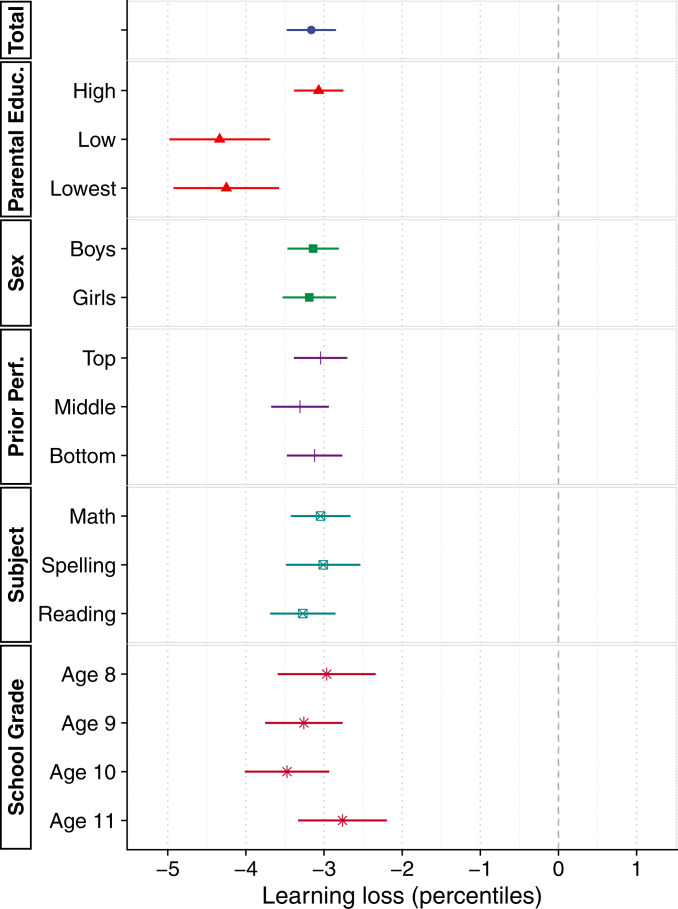
- In the baseline difference-in-differences estimate for a composite of math, spelling, and reading, students lost on average 3.16 percentile points, equivalent to 0.08 SD; raw differences ranged from −0.76 percentiles in spelling to −2.15 percentiles in math.
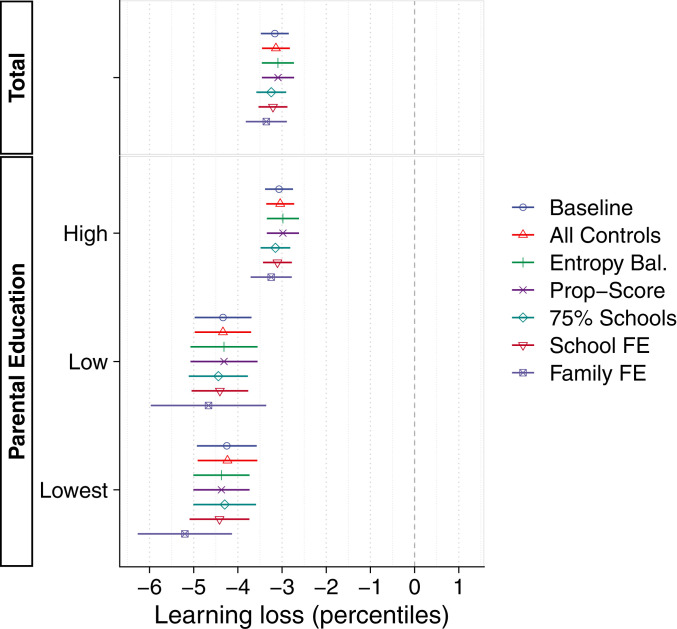
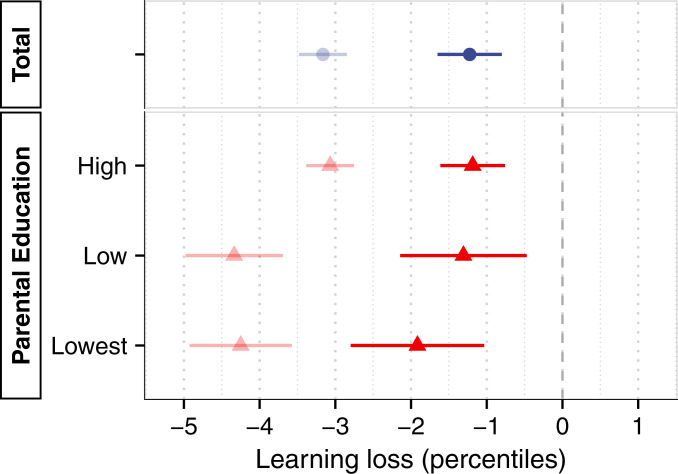
- Losses were concentrated among students from less-educated homes: the two lowest parental-education categories, together 8% of the population, suffered losses 40% larger than average (high, −3.07; low, −4.34; lowest, −4.25); within-family estimates showed a gap of 60% (high, −3.25; low, −4.67; lowest, −5.20).
- There was little evidence that effects differed by sex, school grade, subject, or prior performance, but school-level variation was considerable, with some schools seeing losses of 10 percentile points or more and others no losses or small gains.
- On a learning-readiness test not tied to curricular content, effects shrank by nearly two-thirds (main effect −1.19 vs. −3.16), suggesting most of the drop reflects knowledge learned; 3.16 percentiles translates to 7.9 to 10.5 weeks of lost learning depending on the benchmark.
Methods
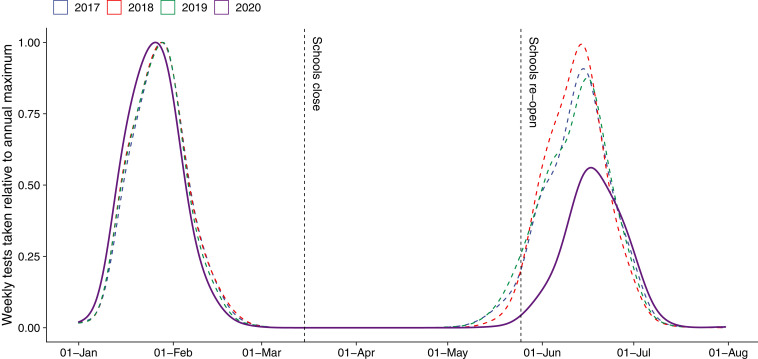
- Natural experiment/difference-in-differences design using biannual national standardized tests in The Netherlands from 2017 to 2020, covering 15% of Dutch primary schools (n ≈ 350,000) and students aged 8 to 11 years (grades 4 to 7); 2020 tests occurred just before and after 8 weeks of nationwide closures starting March 16.
- Main outcomes were math, spelling, reading, and a composite score, plus an oral reading fluency/learning-readiness test; scores were transformed to percentiles, with baseline models adjusting for a linear year trend and days between tests and clustering standard errors at the school level.
- Robustness included placebo analyses, year exclusions, loss-to-follow-up adjustments via regression, propensity-score and maximum-entropy weighting, school and family fixed effects, and a specification curve analysis of more than 2,000 alternative models.
Limitations
- The paper states that only time will tell whether students rebound, remain stable, or fall farther behind; test scores do not capture psychosocial development or societal and parental costs; and results may underestimate the full costs of school closures.
- The paper notes that The Netherlands is a best-case scenario due to short closures, high technological preparedness, and equitable school funding, making the estimates a likely lower bound; the short closure also gave little time to adapt, and remote learning might improve with time.
- The text makes evident that the sample covers 15% of primary schools, loss to follow-up is addressed but only a subset of students took tests after lockdown, and the within-family fixed-effects specification reduces the sample by approximately 60% and shifts it toward larger families.
Model-written summary. Check it against the paper before relying on it.
Integrity signals
Registry
Cites
Statistics
Figures
Verification
Claims the paper makes
23 Own result · 16 Own method · 12 Own interpretation · 10 No full text of the sources · 9 Sources not found · 4 Partly supported · 4 Not checked yet · 3 No basis given · 2 Supported so far · accuracy not yet measured
The cited sources support only part of this claim — read each source’s verdict below.
In the paper
“In their projections of learning loss due to the pandemic, the World Bank assumes a yearly progress of 0.40 SD (46).”
§ Learning loss due to school closures during the COVID-19 pandemic > Discussion
What the sources say
- Partly supportedcites [46] J. P. Azevedo, A. Hasan, D. Goldemberg, S. A. Iqbal, K. Geven (2020) Simulating the potential impacts of COVID-19 school closures on schooling and learning outcomes: A set of global estimates. World Bank Policy Research Working Paper (9284). https://openknowledge.worldbank.org/handle/10986/33945. Accessed 9 February 2021. sourceExperimental — accuracy not yet measured
The Empirical methodology (p. 15) says the projections assume learning gains of 0.2–0.5 SD from one grade to the next, depending on country income. Annex A.1 (p. 44) specifies 40 PISA points, equivalent to 0.40 SD, as the baseline for upper-middle-income countries—not as a universal yearly rate. (LLM, conf=0.90)
plain- Asserted: passes — The authors put it forward as true.
- Checkable: passes — It can be checked against evidence.
- Load-bearing: passes — The paper’s conclusions depend on it.
- Based: passes — The paper gives a reason why it holds.
- Partly supported
The cited sources support only part of this claim — read each source’s verdict below.
In the paper
“Our results show that learning loss was particularly pronounced for students from disadvantaged homes, confirming the fears held by many that school closures would cause socioeconomic gaps to widen (51 –55).”
§ Learning loss due to school closures during the COVID-19 pandemic > Discussion
What the sources say
- Supportedcites [51] E. A. Hanushek, L. Woessmann, The Economic Impacts of Learning Losses (Organisation for Economic Co-operation and Development OECD, 2020). source
The Summary of closure experiences says that school closures have widened gaps in skill development and warns that they may increase inequality. Section 4, “Distributional issues,” says the negative impact was greater for students from disadvantaged households. The citing authors’ claim about what their own results show is not attributed to this source. (LLM, conf=0.92)
- Supportedcites [52] F. Agostinelli, M. Doepke, G. Sorrenti, F. Zilibotti, When the Great Equalizer Shuts Down: Schools, Peers, and Parents in Pandemic Times (National Bureau of Economic Research, 2020). PMC8735857 35017763 source
The Conclusions state that the paper’s analysis finds higher educational inequality and that learning gaps grow during the pandemic. This supports the cited concern that school closures would widen socioeconomic gaps; the citing authors’ own learning-loss results are not attributed to this source. (LLM, conf=0.93)
- Partly supportedcites [53] A. Bacher-Hicks, J. Goodman, C. Mulhern, Inequality in household adaptation to schooling shocks: Covid-induced online learning engagement in real time. J. Publ. Econ. 193, 104345 (2020). PMC8486492 34629567 sourceExperimental — accuracy not yet measured
The Introduction reports that school closures widened socioeconomic gaps in searches for online learning resources. The Discussion says this pattern suggests academic gaps will be wider in future school years, but the paper does not establish that closures had already widened learning-loss gaps; its measured outcome is primarily search engagement. (LLM, conf=0.86)
- Supportedcites [54] Z. Parolin, E. K. Lee, Large socio-economic, geographic and demographic disparities exist in exposure to school closures. Nat. Hum. Beh., 10.1038/s41562-021-01087-8. (2021). PMC8060162 33737734 source
The Discussion says that disadvantaged students’ greater exposure to school closures and distance learning may exacerbate socio-economic gaps in learning outcomes. This supports the cited concern that closures could widen those gaps; the citing authors attribute the observed learning loss to their own results, not to this source. (LLM, conf=0.90)
- Supportedcites [55] D. H. Bailey, G. J. Duncan, R. J. Murnane, N. A. Yeung (2021) Achievement gaps in the wake of COVID-19 (EdWorkingPaper No. 21-346, Annenberg Institute at Brown University). https://www.edworkingpapers.com/ai21-346. Accessed 9 February 2021. source
The Discussion reports researchers’ prediction that COVID-19 would markedly increase achievement gaps between children from low- and higher-income families. The Abstract identifies these as forecasts, supporting the cited ‘fears’; the claim that results confirm them refers to the citing authors’ own results, not to this source. (LLM, conf=0.90)
boosteddirect- Asserted: passes — The authors put it forward as true.
- Checkable: passes — It can be checked against evidence.
- Load-bearing: passes — The paper’s conclusions depend on it.
- Based: passes — The paper gives a reason why it holds.
- Supported
The cited sources support only part of this claim — read each source’s verdict below.
In the paper
“Nevertheless, the magnitude of our findings appears to validate scenarios projected by bodies such as the European Commission (34) and the World Bank (46).”
§ Learning loss due to school closures during the COVID-19 pandemic > Discussion
What the sources say
- Not matchedcites [34] G. Di Pietro, F. Biagi, P. Costa, Z. Karpinski, J. Mazza, The Likely Impact of COVID-19 on Education: Reflections Based on the Existing Literature and Recent International Datasets (Publications Office of the European Union, 2020).
Couldn’t be matched to a paper in Crossref, so it can’t be checked.
- Supportedcites [46] J. P. Azevedo, A. Hasan, D. Goldemberg, S. A. Iqbal, K. Geven (2020) Simulating the potential impacts of COVID-19 school closures on schooling and learning outcomes: A set of global estimates. World Bank Policy Research Working Paper (9284). https://openknowledge.worldbank.org/handle/10986/33945. Accessed 9 February 2021. source
The citation to this paper is attached to the World Bank scenarios, not to the European Commission or the citing authors’ judgment that their findings validate them. The Conclusion (p. 35) presents optimistic, intermediate, and pessimistic global scenarios for the effects of COVID-19 school closures on schooling and learning. (LLM, conf=0.91)
hedgedcorrelational- Asserted: passes — The authors put it forward as true.
- Checkable: passes — It can be checked against evidence.
- Load-bearing: unclear — It is unclear whether the paper’s conclusions depend on it.
- Based: passes — The paper gives a reason why it holds.
- Not matched
The sources with a verdict support this claim; the rest weren’t checked yet, have no full text we could read, or their verdicts aren’t rated yet.
In the paper
“Moreover, we match treatment and control groups on a wider range of individual- and school-level characteristics using reweighting on the propensity of treatment (68) and maximum-entropy balancing (69).”
§ Learning loss due to school closures during the COVID-19 pandemic > Materials and Methods > Propensity Score and Entropy Weighting.
What the sources say
- Supportedcites [68] G. W. Imbens, J. M. Wooldridge, Recent developments in the econometrics of program evaluation. J. Econ. Lit. 47, 5– 86 (2009). source
Section 5.4 explains that adjusting for the propensity score accounts for differences in covariates between treated and control units. Section 5.6 describes weighting observations by their propensity of treatment or non-treatment. Citation (68) supports the propensity-reweighting method; the sentence cites a different source for maximum-entropy balancing. (LLM, conf=0.88)
- Not checked — no full text of the sourcecites [69] J. Hainmueller, Entropy balancing for causal effects: A multivariate reweighting method to produce balanced samples in observational studies. Polit. Anal., 20, 25– 46 (2012). source
plaincorrelational- Asserted: passes — The authors put it forward as true.
- Checkable: passes — It can be checked against evidence.
- Load-bearing: passes — The paper’s conclusions depend on it.
- Based: passes — The paper gives a reason why it holds.
- Supported
A result the paper reports from its own data — it cites no other source for it, so there is none to check. The quote shows it is in the paper.
In the paper
“The largest gap in effect sizes between educational backgrounds is found in our within-family analysis, estimated at 60% (parental education: high, −3.25; low, −4.67; lowest, −5.20).”
§ Learning loss due to school closures during the COVID-19 pandemic > Results > Adjusting for Loss to Follow-up.
hedgedcorrelational- Asserted: passes — The authors put it forward as true.
- Checkable: passes — It can be checked against evidence.
- Load-bearing: unclear — It is unclear whether the paper’s conclusions depend on it.
- Based: passes — The paper gives a reason why it holds.
A result the paper reports from its own data — it cites no other source for it, so there is none to check. The quote shows it is in the paper.
In the paper
“Those in the two lowest categories of parental education—together accounting for 8% of the population ( SI Appendix, section 5.1)—suffered losses 40% larger than the average student (estimates by parental education: high, −3.07; low, −4.34; lowest, −4.25).”
§ Learning loss due to school closures during the COVID-19 pandemic > Results > Baseline Specification.
plaincorrelational- Asserted: passes — The authors put it forward as true.
- Checkable: passes — It can be checked against evidence.
- Load-bearing: passes — The paper’s conclusions depend on it.
- Based: passes — The paper gives a reason why it holds.
A result the paper reports from its own data — it cites no other source for it, so there is none to check. The quote shows it is in the paper.
In the paper
“Disregarding the trend and instead assuming a counterfactual where achievement had stayed flat between 2019 and 2020, the estimated treatment effect shrinks by 21% to −2.51 percentiles ( SI Appendix, section 7.11).”
§ Learning loss due to school closures during the COVID-19 pandemic > Results > Specification Curve Analysis.
hedgeddirect- Asserted: passes — The authors put it forward as true.
- Checkable: passes — It can be checked against evidence.
- Load-bearing: passes — The paper’s conclusions depend on it.
- Based: passes — The paper gives a reason why it holds.
A result the paper reports from its own data — it cites no other source for it, so there is none to check. The quote shows it is in the paper.
In the paper
“In contrast, we find little evidence that the effect differs by sex, school grade, subject, or prior performance.”
§ Learning loss due to school closures during the COVID-19 pandemic > Results > Baseline Specification.
hedged- Asserted: passes — The authors put it forward as true.
- Checkable: passes — It can be checked against evidence.
- Load-bearing: unclear — It is unclear whether the paper’s conclusions depend on it.
- Based: passes — The paper gives a reason why it holds.
A result the paper reports from its own data — it cites no other source for it, so there is none to check. The quote shows it is in the paper.
In the paper
“The placebo estimate closest to zero is found in the version of our preferred specification that includes family fixed effects.”
§ Learning loss due to school closures during the COVID-19 pandemic > Results > Specification Curve Analysis.
plain- Asserted: passes — The authors put it forward as true.
- Checkable: passes — It can be checked against evidence.
- Load-bearing: unclear — It is unclear whether the paper’s conclusions depend on it.
- Based: passes — The paper gives a reason why it holds.
A result the paper reports from its own data — it cites no other source for it, so there is none to check. The quote shows it is in the paper.
In the paper
“Therefore, adjusting for these covariates makes little difference to our results ( SI Appendix, section 7.1).”
§ Learning loss due to school closures during the COVID-19 pandemic > Results > Adjusting for Loss to Follow-up.
plain- Asserted: passes — The authors put it forward as true.
- Checkable: passes — It can be checked against evidence.
- Load-bearing: unclear — It is unclear whether the paper’s conclusions depend on it.
- Based: passes — The paper gives a reason why it holds.
- Probably not a substantial claim. 19
- It may state two separate claims as one. 30
- The quote only partly states this claim. 1
The sources with a verdict support this claim; the rest weren’t checked yet, have no full text we could read, or their verdicts aren’t rated yet.
In the paper
“Dynamic models of learning stress how small losses can accumulate into large disadvantages with time (56 –58).”
§ Learning loss due to school closures during the COVID-19 pandemic > Discussion
What the sources say
- Not checked — no full text of the sourcecites [56] T. A. DiPrete, G. M. Eirich, Cumulative advantage as a mechanism for inequality: A review of theoretical and empirical developments. Annu. Rev. Sociol. 32, 271– 297 (2006). source
- Supportedcites [57] M. Kaffenberger, Modelling the long-run learning impact of the Covid-19 learning shock: Actions to (more than) mitigate loss. Int. J. Educ. Dev. 81, 102326 (2021). 33716394 PMC7923185 source
The Introduction reports that the model projects a one-third reduction in grade 3 learning to become a full-year deficit by grade 10, and a one-half reduction to become a 1.5-year deficit. These projections support the claim that an initial learning loss can lead to a larger disadvantage over time. (LLM, conf=0.92)
- Supportedcites [58] N. Fuchs-Schündeln, D. Krueger, A. Ludwig, I. Popova, The Long-Term Distributional and Welfare Effects of COVID-19 School Closures (National Bureau of Economic Research, 2020). source
The Introduction (page unavailable) explains that an initial shortfall in children’s human capital reduces the productivity of later investments, leading to less investment and worse educational and earnings outcomes. Section 4.1.1 (page unavailable) likewise says that reduced accumulation at younger ages translates into lower human capital and investment in the future. (LLM, conf=0.90)
plaindirect- Asserted: passes — The authors put it forward as true.
- Checkable: passes — It can be checked against evidence.
- Load-bearing: fails — The paper’s conclusions may not depend on it.
- Based: passes — The paper gives a reason why it holds.
Probably not a substantial claim. The paper’s conclusions may not depend on it.
The cited sources support only part of this claim — read each source’s verdict below.
In the paper
“Test scores do not consider children’s psychosocial development (63, 64), either societal costs due to productivity decline or heightened pressure among parents (65, 66).”
§ Learning loss due to school closures during the COVID-19 pandemic > Discussion
What the sources say
- Partly supportedcites [63] A. Gassman-Pines, C. M. Gibson-Davis, E. O. Ananat, How economic downturns affect children’s development: An interdisciplinary perspective on pathways of influence. Child Dev. Perspect. 9, 233– 238 (2015). 31327980 PMC6641565 sourceExperimental — accuracy not yet measured
The section on economic and psychological effects on continuously employed individuals reports increased financial and psychological stress within families and greater parental distress during downturns, supporting the point about pressure on parents. The paper also discusses children’s emotional well-being separately from test scores, but it does not say that test scores omit societal costs from declining productivity or explicitly assess what test scores capture. No page number was available in our copy. (LLM, conf=0.82)
- Could not verifycites [64] L. Shanahan, Emotional distress in young adults during the COVID-19 pandemic: Evidence of risk and resilience from a longitudinal cohort study. Psychol. Med., 10.1017/S003329172000241X (2020). PMC7338432 32571438 sourceExperimental — accuracy not yet measured
The Methods (Measures; page unavailable) assess economic and lifestyle disruptions among young adults, and the Discussion (page unavailable) links those disruptions to emotional distress. Neither passage addresses what test scores omit, societal costs from declining productivity, or heightened pressure on parents. Searches for those specific points found no supporting passage in our copy. (LLM, conf=0.73)
- Partly supportedcites [65] C. Collins, L. C. Landivar, L. Ruppanner, W. J. Scarborough, COVID-19 and the gender gap in work hours. Gender Work. Organ. 28, 101– 12. (2020). PMC7361447 32837019 sourceExperimental — accuracy not yet measured
The Introduction describes acute time and financial pressures on working parents, and the Results (section 4.1; page unavailable) report that mothers reduced paid work hours amid childcare and homeschooling demands. These passages support heightened parental pressure and reduced work time, but the paper does not assess test scores or establish societal costs from a decline in productivity. (LLM, conf=0.84)
- Partly supportedcites [66] P. Biroli (2020) “ Family life in lockdown” (IZA Discussion Paper 13398, Institute of Labor Economics, Bonn, Germany). sourceExperimental — accuracy not yet measured
The Results section (Family Cooperation and Tensions; page unavailable) reports increased household tension associated with changes in childcare and other household tasks during lockdown, supporting the point about pressure on parents. The paper does not establish societal costs from declining productivity or state that test scores omit these effects. (LLM, conf=0.82)
plain- Asserted: passes — The authors put it forward as true.
- Checkable: passes — It can be checked against evidence.
- Load-bearing: unclear — It is unclear whether the paper’s conclusions depend on it.
- Based: passes — The paper gives a reason why it holds.
It may state two separate claims as one.
- Partly supported
A result the paper reports from its own data — it cites no other source for it, so there is none to check. The quote shows it is in the paper.
In the paper
“Doing so identifies the control for pretreatment trends as the most influential, followed by the control for test timing and the inclusion of school and family fixed effects.”
§ Learning loss due to school closures during the COVID-19 pandemic > Results > Specification Curve Analysis.
plaindirect- Asserted: passes — The authors put it forward as true.
- Checkable: passes — It can be checked against evidence.
- Load-bearing: passes — The paper’s conclusions depend on it.
- Based: passes — The paper gives a reason why it holds.
It may state two separate claims as one.
A result the paper reports from its own data — it cites no other source for it, so there is none to check. The quote shows it is in the paper.
In the paper
“However, the fixed-effects specification shifts the sample toward larger families, and effects in this subsample are similar using our baseline specification ( SI Appendix, section 7.7).”
§ Learning loss due to school closures during the COVID-19 pandemic > Results > Adjusting for Loss to Follow-up.
plaincorrelational- Asserted: passes — The authors put it forward as true.
- Checkable: passes — It can be checked against evidence.
- Load-bearing: unclear — It is unclear whether the paper’s conclusions depend on it.
- Based: passes — The paper gives a reason why it holds.
It may state two separate claims as one.
A result the paper reports from its own data — it cites no other source for it, so there is none to check. The quote shows it is in the paper.
In the paper
“Excluding adjustment for testing date decreases the effect size by 12%, while including fixed effects increases it by 1.6% (school level) or 6.3% (family level).”
§ Learning loss due to school closures during the COVID-19 pandemic > Results > Specification Curve Analysis.
plaindirect- Asserted: passes — The authors put it forward as true.
- Checkable: passes — It can be checked against evidence.
- Load-bearing: unclear — It is unclear whether the paper’s conclusions depend on it.
- Based: passes — The paper gives a reason why it holds.
It may state two separate claims as one.
A result the paper reports from its own data — it cites no other source for it, so there is none to check. The quote shows it is in the paper.
In the paper
“We validate these benchmarks in our data by exploiting variation in testing dates during comparison years and show that test scores improve by 0.30 to 0.40 percentiles per week, equivalent to 0.31 to 0.41 SD annually ( SI Appendix, section 4.3).”
§ Learning loss due to school closures during the COVID-19 pandemic > Discussion
plaincorrelational- Asserted: passes — The authors put it forward as true.
- Checkable: passes — It can be checked against evidence.
- Load-bearing: passes — The paper’s conclusions depend on it.
- Based: passes — The paper gives a reason why it holds.
It may state two separate claims as one.
A result the paper reports from its own data — it cites no other source for it, so there is none to check. The quote shows it is in the paper.
In the paper
“Students lost on average 3.16 percentile points in the national distribution, equivalent to 0.08 standard deviations (SD) ( SI Appendix, section 4.3).”
§ Learning loss due to school closures during the COVID-19 pandemic > Results > Baseline Specification.
plaindirect- Asserted: passes — The authors put it forward as true.
- Checkable: passes — It can be checked against evidence.
- Load-bearing: passes — The paper’s conclusions depend on it.
- Based: passes — The paper gives a reason why it holds.
It may state two separate claims as one.
A result the paper reports from its own data — it cites no other source for it, so there is none to check. The quote shows it is in the paper.
In the paper
“In SI Appendix, Table S3, we show that the treatment sample is not skewed on sex, parental education, or prior performance.”
§ Learning loss due to school closures during the COVID-19 pandemic > Results > Adjusting for Loss to Follow-up.
plain- Asserted: passes — The authors put it forward as true.
- Checkable: passes — It can be checked against evidence.
- Load-bearing: passes — The paper’s conclusions depend on it.
- Based: passes — The paper gives a reason why it holds.
It may state two separate claims as one.
A result the paper reports from its own data — it cites no other source for it, so there is none to check. The quote shows it is in the paper.
In the paper
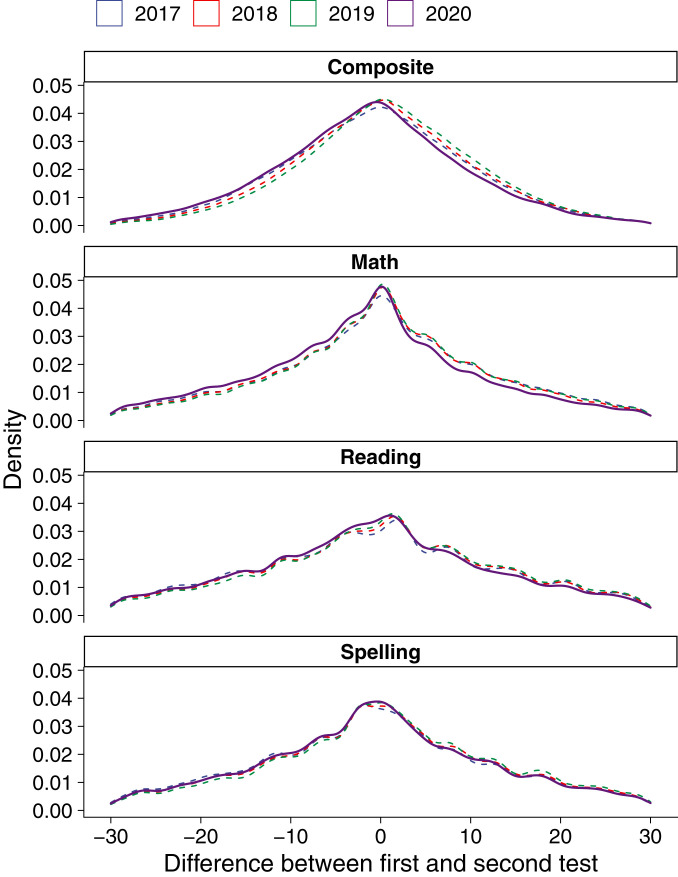
“This graph reveals a raw difference ranging from −0.76 percentiles in spelling to −2.15 percentiles in math.”
§ Learning loss due to school closures during the COVID-19 pandemic > Results
plain- Asserted: passes — The authors put it forward as true.
- Checkable: passes — It can be checked against evidence.
- Load-bearing: unclear — It is unclear whether the paper’s conclusions depend on it.
- Based: passes — The paper gives a reason why it holds.
The quote only partly states this claim.
A result the paper reports from its own data — it cites no other source for it, so there is none to check. The quote shows it is in the paper.
In the paper
“These losses are evident throughout the age range we study and across all of the three subject areas: math, spelling, and reading.”
§ Learning loss due to school closures during the COVID-19 pandemic > Discussion
plaincorrelational- Asserted: passes — The authors put it forward as true.
- Checkable: passes — It can be checked against evidence.
- Load-bearing: passes — The paper’s conclusions depend on it.
- Based: passes — The paper gives a reason why it holds.
It may state two separate claims as one.
A result the paper reports from its own data — it cites no other source for it, so there is none to check. The quote shows it is in the paper.
In the paper
“We also reestimate our main specification dropping comparison years one at a time ( SI Appendix, section 7.3). These results are estimated with less precision but otherwise in line with those of our main analysis.”
§ Learning loss due to school closures during the COVID-19 pandemic > Results > Placebo Analysis and Year Exclusions.
plain- Asserted: passes — The authors put it forward as true.
- Checkable: passes — It can be checked against evidence.
- Load-bearing: unclear — It is unclear whether the paper’s conclusions depend on it.
- Based: passes — The paper gives a reason why it holds.
It may state two separate claims as one.
The paper states this without a source or data behind it here, so there is nothing to check it against. The quote shows it is in the paper.
In the paper
“Our estimated treatment effect translates into 3.16/35 = 0.09 percentiles or 0.002 SD per school day and is thus on the lower end of that range.*”
§ Learning loss due to school closures during the COVID-19 pandemic > Discussion
plaindirect- Asserted: passes — The authors put it forward as true.
- Checkable: passes — It can be checked against evidence.
- Load-bearing: unclear — It is unclear whether the paper’s conclusions depend on it.
- Based: passes — The paper gives a reason why it holds.
It may state two separate claims as one.
In the paper
“These groups make up, respectively, 92, 4, and 4% of the student body and our sample ( SI Appendix, section 5.1).”
§ Learning loss due to school closures during the COVID-19 pandemic > Materials and Methods > Parental Education.
What the sources say
- Not matchedcites SI Appendix, section 5.1
Couldn’t be matched to a paper in Crossref, so it can’t be checked.
plain- Asserted: passes — The authors put it forward as true.
- Checkable: passes — It can be checked against evidence.
- Load-bearing: fails — The paper’s conclusions may not depend on it.
- Based: passes — The paper gives a reason why it holds.
Probably not a substantial claim. The paper’s conclusions may not depend on it. It may state two separate claims as one.
- Not matched
In the paper
“This literature reports reductions in achievement ranging from 0.001 to 0.010 SD per school day lost (10).”
§ Learning loss due to school closures during the COVID-19 pandemic > Discussion
What the sources say
- Not checked — no full text of the sourcecites [10] M. Kuhfeld, Projecting the potential impacts of COVID-19 school closures on academic achievement. Educ. Res. 49, 549– 565 (2020). source
plaindirect- Asserted: passes — The authors put it forward as true.
- Checkable: passes — It can be checked against evidence.
- Load-bearing: passes — The paper’s conclusions depend on it.
- Based: passes — The paper gives a reason why it holds.
Probably not a substantial claim.
A conclusion the paper draws from its own results — it cites no other source for it, so there is none to check. The quote shows it is in the paper.
In the paper
“Using the smaller benchmark, learning loss exceeds the period of school closures (3.16/0.30 = 10.5 wk), implying that students regressed during this time.”
§ Learning loss due to school closures during the COVID-19 pandemic > Discussion
plaindirect- Asserted: passes — The authors put it forward as true.
- Checkable: passes — It can be checked against evidence.
- Load-bearing: unclear — It is unclear whether the paper’s conclusions depend on it.
- Based: passes — The paper gives a reason why it holds.
It may state two separate claims as one.
A conclusion the paper draws from its own results — it cites no other source for it, so there is none to check. The quote shows it is in the paper.
In the paper
“Using the larger benchmark, a treatment effect of 3.16 percentiles would translate into 3.16/0.40 = 7.9 wk of lost learning—nearly exactly the same period that schools in The Netherlands remained closed.”
§ Learning loss due to school closures during the COVID-19 pandemic > Discussion
hedgeddirect- Asserted: passes — The authors put it forward as true.
- Checkable: passes — It can be checked against evidence.
- Load-bearing: unclear — It is unclear whether the paper’s conclusions depend on it.
- Based: passes — The paper gives a reason why it holds.
It may state two separate claims as one.
A conclusion the paper draws from its own results — it cites no other source for it, so there is none to check. The quote shows it is in the paper.
In the paper
“However, failure to adjust for pretreatment trends generates placebo estimates that are biased in a positive direction and is thus likely to underestimate treatment effects.”
§ Learning loss due to school closures during the COVID-19 pandemic > Results > Specification Curve Analysis.
hedgeddirect- Asserted: passes — The authors put it forward as true.
- Checkable: passes — It can be checked against evidence.
- Load-bearing: passes — The paper’s conclusions depend on it.
- Based: passes — The paper gives a reason why it holds.
It may state two separate claims as one.
What the paper did — it cites no source for this, so there is none to check. The quote shows it is in the paper.
In the paper
“Hypotheses and analysis protocols for this study were preregistered ( SI Appendix, section 4.1).”
§ Learning loss due to school closures during the COVID-19 pandemic > Study Setting
plain- Asserted: passes — The authors put it forward as true.
- Checkable: passes — It can be checked against evidence.
- Load-bearing: fails — The paper’s conclusions may not depend on it.
- Based: passes — The paper gives a reason why it holds.
Probably not a substantial claim. The paper’s conclusions may not depend on it.
None of the sources cited for this claim have been checked yet.
In the paper
“The Netherlands is interesting as a “best-case” scenario, with a short lockdown, equitable school funding, and world-leading rates of broadband access.”
- Also stated in: § Study Setting · hedged
“For these reasons, The Netherlands presents a “best-case” scenario, providing a likely lower bound on learning loss elsewhere in Europe and the world.”
§ Learning loss due to school closures during the COVID-19 pandemic > Abstract
What the sources say
- Not matchedcites [30] H. A. Patrinos, “ School choice in the Netherlands” (CESifo DICE Report 2/2011, ifo Institute for Economic Research, Munich, Germany, 2011).
Couldn’t be matched to a paper in Crossref, so it can’t be checked.
- Not checked — no full text of the sourcecites [31] H. F. Ladd, E. B. Fiske, Weighted student funding in The Netherlands: A model for the US? J. Pol. Anal. Manag. 30, 470– 498 (2011). source
- Not matchedcites [33] Statistics Netherlands (CBS), The Netherlands leads Europe in internet access. https://www.cbs.nl/en-gb/news/2018/05/the-Netherlands-leads-europe-in-internet-access. Accessed 9 February 2021.
Couldn’t be matched to a paper in Crossref, so it can’t be checked.
- Not matchedcites [34] G. Di Pietro, F. Biagi, P. Costa, Z. Karpinski, J. Mazza, The Likely Impact of COVID-19 on Education: Reflections Based on the Existing Literature and Recent International Datasets (Publications Office of the European Union, 2020).
Couldn’t be matched to a paper in Crossref, so it can’t be checked.
- Not matchedcites [36] Johns Hopkins Coronavirus Resource Center, COVID-19 case tracker. https://coronavirus.jhu.edu/data. Accessed 9 February 2021.
Couldn’t be matched to a paper in Crossref, so it can’t be checked.
- Not matchedcites [37] P. Tullis, Dutch cooperation made an ‘intelligent lockdown’ a success. Bloomberg Businessweek (4 June 2020).
Couldn’t be matched to a paper in Crossref, so it can’t be checked.
plaincorrelational- Asserted: passes — The authors put it forward as true.
- Checkable: passes — It can be checked against evidence.
- Load-bearing: passes — The paper’s conclusions depend on it.
- Based: passes — The paper gives a reason why it holds.
It may state two separate claims as one.
- Also stated in: § Study Setting · hedged
A conclusion the paper draws from its own results — it cites no other source for it, so there is none to check. The quote shows it is in the paper.
In the paper
“which would indicate that remote learning operated at 50% efficiency.”
§ Learning loss due to school closures during the COVID-19 pandemic > Discussion
hedgeddirect- Asserted: passes — The authors put it forward as true.
- Checkable: passes — It can be checked against evidence.
- Load-bearing: fails — The paper’s conclusions may not depend on it.
- Based: passes — The paper gives a reason why it holds.
Probably not a substantial claim. The paper’s conclusions may not depend on it.
What the paper did — it cites no source for this, so there is none to check. The quote shows it is in the paper.
In the paper
“In our baseline specification, we adjust for a linear trend in year and the time elapsed between testing dates and cluster standard errors at the school level.”
§ Learning loss due to school closures during the COVID-19 pandemic > Results
plain- Asserted: passes — The authors put it forward as true.
- Checkable: passes — It can be checked against evidence.
- Load-bearing: passes — The paper’s conclusions depend on it.
- Based: passes — The paper gives a reason why it holds.
Probably not a substantial claim. It may state two separate claims as one.
What the paper did — it cites no source for this, so there is none to check. The quote shows it is in the paper.
In the paper
“Moreover, we restrict analysis to schools where at least 75% of students took their tests after lockdown ( SI Appendix, section 7.5).”
§ Learning loss due to school closures during the COVID-19 pandemic > Results > Adjusting for Loss to Follow-up.
plain- Asserted: passes — The authors put it forward as true.
- Checkable: passes — It can be checked against evidence.
- Load-bearing: fails — The paper’s conclusions may not depend on it.
- Based: passes — The paper gives a reason why it holds.
Probably not a substantial claim. The paper’s conclusions may not depend on it.
A claim is checked only against the cited paper’s full text, never its abstract, and none is available for its sources.
In the paper
“Although early influential studies also found that summer is a time when socioeconomic learning gaps widen, this finding has failed to replicate in more recent studies (8, 9) or in European samples (48, 49).”
§ Learning loss due to school closures during the COVID-19 pandemic > Discussion
What the sources say
- Not checked — no full text of the sourcecites [8] P. T. von Hippel, C. Hamrock, Do test score gaps grow before, during, or between the school years?: Measurement artifacts and what we can know in spite of them. Soc. Sci. 6, 43 (2019). source
- Not checked — no full text of the sourcecites [9] M. Kuhfeld, Surprising new evidence on summer learning loss. Phi Delta Kappan 101, 25– 29 (2019). source
- Not checked — no full text of the sourcecites [48] P. Verachtert, J. Van Damme, P. Onghena, P. Ghesquière, A seasonal perspective on school effectiveness: Evidence from a Flemish longitudinal study in kindergarten and first grade. Sch. Effect. Sch. Improv. 20, 215– 233 (2009). source
- Not checked — no full text of the sourcecites [49] F. Meyer, K. Meissel, S. McNaughton, Patterns of literacy learning in German primary schools over the summer and the influence of home literacy practices. J. Res. Read. 40, 233– 253 (2017). source
plain- Asserted: passes — The authors put it forward as true.
- Checkable: passes — It can be checked against evidence.
- Load-bearing: unclear — It is unclear whether the paper’s conclusions depend on it.
- Based: passes — The paper gives a reason why it holds.
It may state two separate claims as one.
What the paper did — it cites no source for this, so there is none to check. The quote shows it is in the paper.
In the paper
“Our study represents one of the first attempts to quantify learning loss from COVID-19 using externally validated tests, a representative sample, and techniques that allow for causal inference.”
§ Learning loss due to school closures during the COVID-19 pandemic > Abstract
plain- Asserted: passes — The authors put it forward as true.
- Checkable: passes — It can be checked against evidence.
- Load-bearing: passes — The paper’s conclusions depend on it.
- Based: passes — The paper gives a reason why it holds.
It may state two separate claims as one.
In the paper
“The country is close to the Organization for Economic Cooperation and Development (OECD) average in school spending and reading performance, but among its top performers in math (32).”
§ Learning loss due to school closures during the COVID-19 pandemic > Study Setting
What the sources say
- Not matchedcites [32] A. Schleicher, PISA 2018: Insights and Interpretations (OECD Publishing, 2018).
Couldn’t be matched to a paper in Crossref, so it can’t be checked.
plain- Asserted: passes — The authors put it forward as true.
- Checkable: passes — It can be checked against evidence.
- Load-bearing: passes — The paper’s conclusions depend on it.
- Based: passes — The paper gives a reason why it holds.
It may state two separate claims as one.
- Not matched
A conclusion the paper draws from its own results — it cites no other source for it, so there is none to check. The quote shows it is in the paper.
In the paper
“The short duration of school closures gave students, educators, and parents little time to adapt.”
§ Learning loss due to school closures during the COVID-19 pandemic > Discussion
plaindirect- Asserted: passes — The authors put it forward as true.
- Checkable: passes — It can be checked against evidence.
- Load-bearing: fails — The paper’s conclusions may not depend on it.
- Based: passes — The paper gives a reason why it holds.
Probably not a substantial claim. The paper’s conclusions may not depend on it.
In the paper
“To identify the model components that exert the most influence on the magnitude of estimates we assessed more than 2,000 alternative models in a specification curve analysis (44) ( SI Appendix, section 7.13).”
§ Learning loss due to school closures during the COVID-19 pandemic > Results > Specification Curve Analysis.
What the sources say
- Not checked — no full text of the sourcecites [44] U. Simonsohn, J. P. Simmons, L. D. Nelson, Specification curve analysis. Nat. Hum. Behav. 4, 1208– 1214 (2020). 32719546 source
plain- Asserted: passes — The authors put it forward as true.
- Checkable: passes — It can be checked against evidence.
- Load-bearing: passes — The paper’s conclusions depend on it.
- Based: passes — The paper gives a reason why it holds.
Probably not a substantial claim.
A claim is checked only against the cited paper’s full text, never its abstract, and none is available for its sources.
In the paper
“Despite favorable conditions, survey evidence from lockdown indicates high levels of dissatisfaction with remote learning (38) and considerable disparities in help with schoolwork and learning resources (39).”
§ Learning loss due to school closures during the COVID-19 pandemic > Study Setting
What the sources say
- Not checked — no full text of the sourcecites [38] M. de Haas, R. Faber, M. Hamersma, How COVID-19 and the Dutch ‘intelligent lockdown’ changed activities, work and travel behaviour: Evidence from longitudinal data in the Netherlands. Transport. Res. Interdisciplinary Perspect. 6. 100150 (2020). PMC7284275 34171019 source
- Not checked — no full text of the sourcecites [39] T Bol, Inequality in homeschooling during the corona crisis in the Netherlands. First results from the LISS Panel. SocArXiv [Preprint] (2020). 10.31235/osf.io/hf32q (Accessed 9 February 2021). source
hedged- Asserted: passes — The authors put it forward as true.
- Checkable: passes — It can be checked against evidence.
- Load-bearing: passes — The paper’s conclusions depend on it.
- Based: passes — The paper gives a reason why it holds.
It may state two separate claims as one.
A conclusion the paper draws from its own results — it cites no other source for it, so there is none to check. The quote shows it is in the paper.
In the paper
“The high degree of school autonomy in The Netherlands is also likely to have created considerable variation in the pandemic response, possibly explaining the wide school-level variation in estimated learning loss ( SI Appendix, section 7.9).”
§ Learning loss due to school closures during the COVID-19 pandemic > Discussion
hedgedconditional- Asserted: passes — The authors put it forward as true.
- Checkable: passes — It can be checked against evidence.
- Load-bearing: unclear — It is unclear whether the paper’s conclusions depend on it.
- Based: passes — The paper gives a reason why it holds.
It may state two separate claims as one.
What the paper did — it cites no source for this, so there is none to check. The quote shows it is in the paper.
In the paper
“Our difference-in-differences design discards those students who did not take the tests, which might lead to bias if their performance trajectories differ from those we observe.”
§ Learning loss due to school closures during the COVID-19 pandemic > Results > Adjusting for Loss to Follow-up.
hedgedconditional- Asserted: passes — The authors put it forward as true.
- Checkable: passes — It can be checked against evidence.
- Load-bearing: passes — The paper’s conclusions depend on it.
- Based: passes — The paper gives a reason why it holds.
Probably not a substantial claim. It may state two separate claims as one.
In the paper
“Early estimates suggest that grades 3 to 8 students more than 6 mo into the pandemic underperformed by 7.5 percentile points in math but saw no loss in reading achievement (28).”
§ Learning loss due to school closures during the COVID-19 pandemic > Discussion
What the sources say
- Not matchedcites [28] M. Kuhfeld, B. Tarasawa, A. Johnson, E. Ruzek, K. Lewis, “ Learning during COVID-19: Initial findings on students’ reading and math achievement and growth” (NWEA Brief, Portland, OR, 2020).
Couldn’t be matched to a paper in Crossref, so it can’t be checked.
hedged- Asserted: passes — The authors put it forward as true.
- Checkable: passes — It can be checked against evidence.
- Load-bearing: unclear — It is unclear whether the paper’s conclusions depend on it.
- Based: passes — The paper gives a reason why it holds.
It may state two separate claims as one.
- Not matched
What the paper did — it cites no source for this, so there is none to check. The quote shows it is in the paper.
In the paper
“We do so using a difference-in-differences design ( SI Appendix, section 4.2) and address loss to follow-up using various techniques: regression adjustment, rebalancing on propensity scores and maximum-entropy weights, and fixed-effects designs that compare students within the same schools and families.”
§ Learning loss due to school closures during the COVID-19 pandemic > Study Setting
plain- Asserted: passes — The authors put it forward as true.
- Checkable: passes — It can be checked against evidence.
- Load-bearing: passes — The paper’s conclusions depend on it.
- Based: passes — The paper gives a reason why it holds.
Probably not a substantial claim. It may state two separate claims as one.
The paper states this without a source or data behind it here, so there is nothing to check it against. The quote shows it is in the paper.
In the paper
“Following school reopenings, tests were taken in person under normal conditions and with minimal social distancing.”
§ Learning loss due to school closures during the COVID-19 pandemic > Results > Knowledge Learned vs. Transitory Influences.
plain- Asserted: passes — The authors put it forward as true.
- Checkable: passes — It can be checked against evidence.
- Load-bearing: passes — The paper’s conclusions depend on it.
- Based: passes — The paper gives a reason why it holds.
Probably not a substantial claim.
A claim is checked only against the cited paper’s full text, never its abstract, and none is available for its sources.
In the paper
“Studies of school days lost due to other causes are mixed—some find durable effects and spillovers to adult earnings (59, 60), while others report a fadeout of effects over time (61, 62).”
§ Learning loss due to school closures during the COVID-19 pandemic > Discussion
What the sources say
- Not checked — no full text of the sourcecites [59] A. Ichino, R. Winter-Ebmer, The long-run educational cost of World War II. J. Labor Econ. 22, 57– 87 (2004). source
- Not checked — no full text of the sourcecites [60] D. Jaume, A. Willén, The long-run effects of teacher strikes: Evidence from Argentina. J. Labor Econ. 37, 1097– 1139 (2019). source
- Not checked — no full text of the sourcecites [61] S. Cattan, D. Kamhöfer, M. Karlsson, T. Nilsson “ The short- and long-term effects of student absence: Evidence from Sweden” (IZA Discussion Paper 10995, Institute of Labor Economics, Bonn, Germany, 2017). source
- Not checked — no full text of the sourcecites [62] B. Sacerdote, When the saints go marching out: Long-term outcomes for student evacuees from hurricanes Katrina and Rita. Am. Econ. J. Appl. Econ. 4, 109– 135 (2012). source
plaincorrelational- Asserted: passes — The authors put it forward as true.
- Checkable: passes — It can be checked against evidence.
- Load-bearing: unclear — It is unclear whether the paper’s conclusions depend on it.
- Based: passes — The paper gives a reason why it holds.
It may state two separate claims as one.
None of the sources cited for this claim could be matched to a paper in Crossref, so there is nothing to check it against.
In the paper
“School closures were short in comparative perspective ( SI Appendix, section 1), and the first wave of the pandemic had less of an impact than in other European countries (36, 37).”
§ Learning loss due to school closures during the COVID-19 pandemic > Study Setting
What the sources say
- Not matchedcites [36] Johns Hopkins Coronavirus Resource Center, COVID-19 case tracker. https://coronavirus.jhu.edu/data. Accessed 9 February 2021.
Couldn’t be matched to a paper in Crossref, so it can’t be checked.
- Not matchedcites [37] P. Tullis, Dutch cooperation made an ‘intelligent lockdown’ a success. Bloomberg Businessweek (4 June 2020).
Couldn’t be matched to a paper in Crossref, so it can’t be checked.
plain- Asserted: passes — The authors put it forward as true.
- Checkable: passes — It can be checked against evidence.
- Load-bearing: passes — The paper’s conclusions depend on it.
- Based: passes — The paper gives a reason why it holds.
It may state two separate claims as one.
- Not matched
A claim is checked only against the cited paper’s full text, never its abstract, and none is available for its sources.
In the paper
“Social distancing measures may have altered factors such as seating arrangements or indoor climate that in turn can influence student performance (41 –43).”
§ Learning loss due to school closures during the COVID-19 pandemic > Results > Knowledge Learned vs. Transitory Influences.
What the sources say
- Not checked — no full text of the sourcecites [41] M. J. Mendell, G. A. Heath, Do indoor pollutants and thermal conditions in schools influence student performance?: A critical review of the literature. Indoor Air 15, 27– 52 (2005). 15660567 source
- Not checked — no full text of the sourcecites [42] P. D. Marshall, M. Losonczy-Marshall, Classroom ecology: Relations between seating location, performance, and attendance. Psychol. Rep. 107, 567– 577 (2010). 21117484 source
- Not checked — no full text of the sourcecites [43] R. J. Park, J. Goodman, A. P. Behrer, Learning is inhibited by heat exposure, both internationally and within the United States. Nat. Hum. Behav. 5, 19– 27 (2020). 33020588 source
hedgedconditional- Asserted: passes — The authors put it forward as true.
- Checkable: passes — It can be checked against evidence.
- Load-bearing: fails — The paper’s conclusions may not depend on it.
- Based: passes — The paper gives a reason why it holds.
Probably not a substantial claim. The paper’s conclusions may not depend on it.
None of the sources cited for this claim could be matched to a paper in Crossref, so there is nothing to check it against.
In the paper
“No other country has higher rates of broadband penetration (33, 34), and efforts were made early in the pandemic to ensure access to home learning devices (35).”
§ Learning loss due to school closures during the COVID-19 pandemic > Study Setting
What the sources say
- Not matchedcites [33] Statistics Netherlands (CBS), The Netherlands leads Europe in internet access. https://www.cbs.nl/en-gb/news/2018/05/the-Netherlands-leads-europe-in-internet-access. Accessed 9 February 2021.
Couldn’t be matched to a paper in Crossref, so it can’t be checked.
- Not matchedcites [34] G. Di Pietro, F. Biagi, P. Costa, Z. Karpinski, J. Mazza, The Likely Impact of COVID-19 on Education: Reflections Based on the Existing Literature and Recent International Datasets (Publications Office of the European Union, 2020).
Couldn’t be matched to a paper in Crossref, so it can’t be checked.
- Not matchedcites [35] F. M. Reimers, A. Schleicher, A Framework to Guide an Education Response to the COVID-19 Pandemic of 2020 (OECD Publishing, 2020).
Couldn’t be matched to a paper in Crossref, so it can’t be checked.
plain- Asserted: passes — The authors put it forward as true.
- Checkable: passes — It can be checked against evidence.
- Load-bearing: passes — The paper’s conclusions depend on it.
- Based: passes — The paper gives a reason why it holds.
It may state two separate claims as one.
- Not matched
None of the sources cited for this claim have been checked yet.
In the paper
“The Dutch school system combines centralized and equitable school funding with a high degree of autonomy in school management (30, 31).”
§ Learning loss due to school closures during the COVID-19 pandemic > Study Setting
What the sources say
- Not matchedcites [30] H. A. Patrinos, “ School choice in the Netherlands” (CESifo DICE Report 2/2011, ifo Institute for Economic Research, Munich, Germany, 2011).
Couldn’t be matched to a paper in Crossref, so it can’t be checked.
- Not checked — no full text of the sourcecites [31] H. F. Ladd, E. B. Fiske, Weighted student funding in The Netherlands: A model for the US? J. Pol. Anal. Manag. 30, 470– 498 (2011). source
plain- Asserted: passes — The authors put it forward as true.
- Checkable: passes — It can be checked against evidence.
- Load-bearing: passes — The paper’s conclusions depend on it.
- Based: passes — The paper gives a reason why it holds.
It may state two separate claims as one.
- Not matched
What the paper did — it cites no source for this, so there is none to check. The quote shows it is in the paper.
In the paper
“Next, we balance treatment and control groups on a wider set of covariates, including at the school level, using maximum-entropy weights and the estimated propensity of treatment ( SI Appendix, section 7.4).”
§ Learning loss due to school closures during the COVID-19 pandemic > Results > Adjusting for Loss to Follow-up.
plain- Asserted: passes — The authors put it forward as true.
- Checkable: passes — It can be checked against evidence.
- Load-bearing: fails — The paper’s conclusions may not depend on it.
- Based: passes — The paper gives a reason why it holds.
Probably not a substantial claim. The paper’s conclusions may not depend on it.
What the paper did — it cites no source for this, so there is none to check. The quote shows it is in the paper.
In the paper
“This step reduces the size of our sample by approximately 60%, as not every student has a sibling attending a sampled school within the years that we are able to observe.”
§ Learning loss due to school closures during the COVID-19 pandemic > Materials and Methods > School and Family Fixed Effects.
plaindirect- Asserted: passes — The authors put it forward as true.
- Checkable: passes — It can be checked against evidence.
- Load-bearing: fails — The paper’s conclusions may not depend on it.
- Based: passes — The paper gives a reason why it holds.
Probably not a substantial claim. The paper’s conclusions may not depend on it.
A conclusion the paper draws from its own results — it cites no other source for it, so there is none to check. The quote shows it is in the paper.
In the paper
“We interpret it as a test of learning readiness.”
§ Learning loss due to school closures during the COVID-19 pandemic > Materials and Methods > Test Scores.
plain- Asserted: passes — The authors put it forward as true.
- Checkable: passes — It can be checked against evidence.
- Load-bearing: passes — The paper’s conclusions depend on it.
- Based: passes — The paper gives a reason why it holds.
Probably not a substantial claim.
In the paper
“The first one is the student monitoring system, which provides our test score data (40). This system comprises a series of mandatory tests that are taken twice a year throughout a child’s primary school education (ages 6 to 12 y).”
§ Learning loss due to school closures during the COVID-19 pandemic > Materials and Methods
What the sources say
- Not checked — no full text of the sourcecites [40] K. F. Vlug, Because every pupil counts: The success of the pupil monitoring system in The Netherlands. Educ. Inf. Technol. 2, 287– 306 (1997). source
plain- Asserted: passes — The authors put it forward as true.
- Checkable: passes — It can be checked against evidence.
- Load-bearing: passes — The paper’s conclusions depend on it.
- Based: passes — The paper gives a reason why it holds.
It may state two separate claims as one.
What the paper did — it cites no source for this, so there is none to check. The quote shows it is in the paper.
In the paper
“Throughout our analyses, we adjust confidence intervals for clustering on schools using robust standard errors.”
§ Learning loss due to school closures during the COVID-19 pandemic > Materials and Methods > Difference-in-Differences Analysis.
plain- Asserted: passes — The authors put it forward as true.
- Checkable: passes — It can be checked against evidence.
- Load-bearing: fails — The paper’s conclusions may not depend on it.
- Based: passes — The paper gives a reason why it holds.
Probably not a substantial claim. The paper’s conclusions may not depend on it.
In the paper
“Nationally standardized tests are taken across three main subjects: math, spelling, and reading ( SI Appendix, section 3.1).”
§ Learning loss due to school closures during the COVID-19 pandemic > Materials and Methods > Test Scores.
What the sources say
- Not matchedcites SI Appendix, section 3.1
Couldn’t be matched to a paper in Crossref, so it can’t be checked.
plainn = 3- Asserted: passes — The authors put it forward as true.
- Checkable: passes — It can be checked against evidence.
- Load-bearing: fails — The paper’s conclusions may not depend on it.
- Based: passes — The paper gives a reason why it holds.
Probably not a substantial claim. The paper’s conclusions may not depend on it.
- Not matched
In the paper
“The sample covers 15% of all primary schools and is broadly representative of the national student body ( SI Appendix, section 5.1).”
§ Learning loss due to school closures during the COVID-19 pandemic > Materials and Methods
What the sources say
- Not matchedcites SI Appendix, section 5.1
Couldn’t be matched to a paper in Crossref, so it can’t be checked.
plain- Asserted: passes — The authors put it forward as true.
- Checkable: passes — It can be checked against evidence.
- Load-bearing: passes — The paper’s conclusions depend on it.
- Based: passes — The paper gives a reason why it holds.
It may state two separate claims as one.
- Not matched
A conclusion the paper draws from its own results — it cites no other source for it, so there is none to check. The quote shows it is in the paper.
In the paper
“In the terminology of the test producer, its goal is to assess “technical reading ability”—likely a mix of reading ability, cognitive processing, and verbal fluency.”
§ Learning loss due to school closures during the COVID-19 pandemic > Materials and Methods > Test Scores.
hedged- Asserted: passes — The authors put it forward as true.
- Checkable: passes — It can be checked against evidence.
- Load-bearing: passes — The paper’s conclusions depend on it.
- Based: passes — The paper gives a reason why it holds.
Probably not a substantial claim.
The paper relies on this without support.
Students across The Netherlands take the same examination within a given year.
“Students across The Netherlands take the same examination within a given year.”
The paper relies on this without support.
The norm for transforming test results to percentile scores is the same across years, so absolute changes in performance over time are preserved.
“Test results are transformed to percentile scores, but the norm for transformation is the same across years so absolute changes in performance over time are preserved.”
The paper relies on this without support.
The oral reading fluency assessment does not test for the retention of curricular content.
“As this part of the assessment does not test for the retention of curricular content, we would expect it to be less affected by school closures, which is indeed what we find.”
The authors state this as an assumption.
Percentiles were drawn from an underlying normal distribution.
“Assuming that percentiles were drawn from an underlying normal distribution, we use the following formula to convert between one and the other: d=Φ−10.50+δ100, [3] where δ is the treatment effect on the percentile scale, and Φ−1 is the inverse cumulative standard normal distribution.”
The paper relies on this without support.
In the absence of the pandemic, the rate of progress in 2020 would have followed the same trend as in prior years.
“We analyze the rate of progress in 2020 to that in previous years using a difference-in-differences design.”
The paper relies on this without support.
Comprehension of the words is not needed and students and parents are discouraged to prepare for the oral reading fluency test.
“Crucially, comprehension of the words is not needed and students and parents are discouraged to prepare for it.”
The paper relies on this without support.
The test producer's translation keys are based on smaller samples than the study's sample.
“However, as these keys are actually based on smaller samples than that at our disposal, we further impose a uniform distribution in our sample within cells defined by subject, grade, and testing occasion: midyear vs. end of year.”
Claims other papers make about this one
Each is checked against this paper’s own text: does it say what the citing paper says it does?
The source backs part of the claim, not all of it — or backs it for a different population, condition or comparison.
In the citing paper
“School attendance is foundational to young people’s educational attainment, social development, and future life opportunities (Engzell et al., 2021; McDonald et al., 2022).”
From Beyond the Classroom: Strengthening Pupil Engagement, Attendance and Belonging through Alternative Education and Community Partnerships (2025) · cites this paper as Engzell et al., 2021
Experimental — accuracy not yet measuredThe source backs part of the claim, not all of it — or backs it for a different population, condition or comparison.
In the citing paper
“The impact is 40 percent larger among those in the least educated homes, suggesting that the pandemic not only increased educational inequality, but that disadvantaged children's skills actually deteriorated.”
From Educational Inequality* (2022) · cites this paper as Engzell, Frey, and Verhagen (2021)
Experimental — accuracy not yet measuredThe source backs part of the claim, not all of it — or backs it for a different population, condition or comparison.
In the citing paper
“Results from Engzell, Frey, and Verhagen (2021) for an eight-week school closure imply that this gap would further increase by around 0.05 of a standard deviation.”
From Educational Inequality* (2022) · cites this paper as Engzell, Frey, and Verhagen (2021)
Experimental — accuracy not yet measuredThe cited source says what the claim attributes to it.
In the citing paper
“Engzell et al. [6] found that the time-measured learning loss in relation to the progress that would be achieved in a normal school year corresponds to a period of 7.9 to 10.5 weeks of non-learning [6] (p. 10).”
From Effects of Pandemic-Related School Closures on Pupils’ Performance and Learning in Selected Countries: A Rapid Review (2021) · cites this paper as [6]
The cited source says what the claim attributes to it.
In the citing paper
“Engzell, Frey, and Verhagen (2021) find that in the Netherlands, eight weeks of online rather than in-person learning led to 0.08 of a standard deviation lower test scores for students aged eight to eleven.”
From Educational Inequality* (2022) · cites this paper as Engzell, Frey, and Verhagen (2021)
The cited source says what the claim attributes to it.
In the citing paper
“However, the learning loss was up to 60% greater among students from disadvantaged backgrounds (i.e., students from less-educated households), indicating the disproportionate impact of the pandemic on student learning.”
From Impacts of the COVID-19 Pandemic on Student Learning and Opportunity Gaps Across the 2020–2021 School Year: A National Survey of Teachers (2022) · cites this paper as Engzell et al. (2021)
The cited source says what the claim attributes to it.
In the citing paper
“Several studies have demonstrated that student achievement has been lower during the pandemic compared to prior to the pandemic, with estimates ranging from three percentile points in the Netherlands (Engzell et al., 2021) to more than half of a school year in the U.S. state of Illinois (Streich et al., 2021).”
From Impacts of the COVID-19 Pandemic on Student Learning and Opportunity Gaps Across the 2020–2021 School Year: A National Survey of Teachers (2022) · cites this paper as Engzell et al., 2021
The cited source says what the claim attributes to it.
In the citing paper
“Results indicated a learning loss equivalent to 3 percentile points despite the relatively short lockdown.”
From Impacts of the COVID-19 Pandemic on Student Learning and Opportunity Gaps Across the 2020–2021 School Year: A National Survey of Teachers (2022) · cites this paper as Engzell et al. (2021)
In the citing paper
“The authors also noted that access to technology alone is not enough to guarantee quality distance learning [6] (p. 11).”
From Effects of Pandemic-Related School Closures on Pupils’ Performance and Learning in Selected Countries: A Rapid Review (2021) · cites this paper as [6]
In the citing paper
“Overall, a learning loss of 3 percentile points or 0.08 standard deviations was determined, whereby the losses in the case of pupils from less educated parents turned out to be 60% greater [6] (p. 1).”
From Effects of Pandemic-Related School Closures on Pupils’ Performance and Learning in Selected Countries: A Rapid Review (2021) · cites this paper as [6]
In the citing paper
“With a sample size of n = 286,515, a significant difference in mean values was found when comparing the control group and the test group.The group of pupils that was tested after the school closures showed significantly worse test values than a comparison group that did not experience any school closures [6] (p. 85).”
From Effects of Pandemic-Related School Closures on Pupils’ Performance and Learning in Selected Countries: A Rapid Review (2021) · cites this paper as [6]
In the citing paper
“Engzell and colleagues quantified the learning loss, taking into account all the differences measured by them, with an overall negative effect of -0.08 standard deviations [6] (p. 1).”
From Effects of Pandemic-Related School Closures on Pupils’ Performance and Learning in Selected Countries: A Rapid Review (2021) · cites this paper as [6]
In the citing paper
“The test values of the group of pupils that were tested after the school closures (test group, M = -1.28,SD = 11.83), were on average significantly lower than those of the comparison group (control group, M = 0.28, SD = 10.99) that had not experienced any school closures [6] (p. 85).”
From Effects of Pandemic-Related School Closures on Pupils’ Performance and Learning in Selected Countries: A Rapid Review (2021) · cites this paper as [6]
In the citing paper
“Also, with regard to the area of spelling, a significantly lower test mean value was reported for the test group (M = 0.71, SD = 17.07, n = 58,627) compared to the control group (M = 0.05, SD = 17.27, n = 284,499) (p.85).”
From Effects of Pandemic-Related School Closures on Pupils’ Performance and Learning in Selected Countries: A Rapid Review (2021) · cites this paper as [6]
In the citing paper
“As pointed out by Engzell et al. (2021), non-causal methods fail to account for trends in student progress prior to the outbreak of Covid-19 and, hence, by assuming a counterfactual where achievement has stayed flat, they generate estimates of learning deficits that are biased downwards.”
From The impact of Covid-19 on student achievement: Evidence from a recent meta-analysis (2023) · cites this paper as Engzell et al. (2021)
In the citing paper
“there is a large consensus that it did not affect students equally.”
From The impact of Covid-19 on student achievement: Evidence from a recent meta-analysis (2023) · cites this paper as Engzell et al., 2021
In the citing paper
“several studies (see, for example, Engzell et al., 2021; Hevia et al., 2022) showed that Covid-19 had a detrimental effect especially on the achievement of students from less advantaged backgrounds.”
From The impact of Covid-19 on student achievement: Evidence from a recent meta-analysis (2023) · cites this paper as Engzell et al., 2021
In the citing paper
“The pandemic has also interrupted education and has adversely affected children’s social and emotional development and mental health.16-19”
From Evaluation of the BNT162b2 Covid-19 Vaccine in Children 5 to 11 Years of Age (2022) · cites this paper as [17]
In the citing paper
“Covid-19–associated school closures and quarantines also have social and economic costs for families and caregivers.16-19”
From Evaluation of the BNT162b2 Covid-19 Vaccine in Children 5 to 11 Years of Age (2022) · cites this paper as [17]
Citations
Cites
Statistical power analysis for the behavioral sciences
Cohen, J. (1990) · Computers Environment and Urban Systems · doi:10.1016/0198-9715(90)90050-4 · Cited by 65,417
The central role of the propensity score in observational studies for causal effects
ROSENBAUM, P. R., & RUBIN, D. B. (1983) · Biometrika · doi:10.1093/biomet/70.1.41 · Cited by 31,241
(2001) · RePEc: Research Papers in Economics · Cited by 27,577
Statistical Power Analysis for the Behavioral Sciences
Cohen, J. (2013) · doi:10.4324/9780203771587 · Cited by 25,373
The Psychological Impact of Quarantine and How to Reduce It: Rapid Review of the Evidence
Brooks, S. K., Webster, R. K., Smith, L. E., Woodland, L., Wessely, S., Greenberg, N., & Rubin, G. J. (2020) · doi:10.2139/ssrn.3532534 · Cited by 16,394
The psychological impact of quarantine and how to reduce it: Rapid review of the evidence
Brooks, S. K., Webster, R. K., Smith, L. E., Woodland, L., Wessely, S., Greenberg, N., & Rubin, G. J. (2020) · The Lancet · doi:10.1016/s0140-6736(20)30460-8 · Cited by 16,378
Multilevel analysis : an introduction to basic and advanced multilevel modeling
Snijders, T. A. B., & Bosker, R. (1999) · Cited by 6,830
Hainmueller, J. (2012) · Political Analysis · doi:10.1093/pan/mpr025 · Cited by 6,026
Recent Developments in the Econometrics of Program Evaluation
Imbens, G. W., & Wooldridge, J. M. (2009) · Journal of Economic Literature · doi:10.1257/jel.47.1.5 · Cited by 4,926
Viner, R. M., Russell, S. J., Croker, H., Packer, J., Ward, J., Stansfield, C., Mytton, O., Bonell, C., & Booy, R. (2020) · The Lancet Child & Adolescent Health · doi:10.1016/s2352-4642(20)30095-x · Cited by 2,213
Cited by
Sorted by citations
Items 1,301–1,400 of 1,570
Rafanti, E., Yuhana, Y., & Pujiastuti, H. (2023) · Proximal Jurnal Penelitian Matematika dan Pendidikan Matematika · doi:10.30605/proximal.v6i2.2755
Facial Recognition-Based Automatic Attendance Management System Using Deep Learning
Nath, S. P., Borah, M., Das, D., et al. (2023) · Lecture notes in electrical engineering · doi:10.1007/978-981-99-3481-2_41
LEARNING LOSS: WHY IS COLLABORATION BETWEEN EDUCATORS AND PARENTS IMPORTANT?
Rediani, N. N., & Kaize, B. R. (2023) · Indonesian Journal of Educational Development (IJED) · doi:10.59672/ijed.v4i3.3202
“The phenomenon of learning loss, or the loss of learning opportunities, has become more apparent and serious during the COVID-19 pandemic (Angrist et al., 2021; Ardington et al., 2021; Donnelly & Patrinos, 2021; Engzell et al., 2021; Kuhfeld et al., 2020; Sabates et al., 2021; Vit, 2023).”
BackgroundUlya, D. H., Raharjo, & Ikhrom (2023) · PEDAGOGIA Jurnal Pendidikan · doi:10.21070/pedagogia.v13i1.1555
“The results of (Engzell et al., 2021) study show that students are minimum, or there is no, progress during long distance learning and demonstrate greater losses in countries with weak infrastructure or longer school closure.”
BackgroundAqilla, Y. A. R. S., Putra, M. J. A., & Zufriady, Z. (2023) · ARZUSIN · doi:10.58578/arzusin.v4i1.2209
Effect of CLWD-Flipped Classroom on Student Learning Outcomes: A Quasi-Experimental Study
Putra, A. P., Utami, N. H., & Kaspul, K. (2023) · Jurnal Penelitian Pendidikan IPA · doi:10.29303/jppipa.v9i11.4411
The Impact of ‘WEBTOON’ as a Digital Reading Tool for EFL High School Students
Tacuri, M. D. G. (2023) · Runas Journal of Education and Culture · doi:10.46652/runas.v5i9.152
“Even in the Netherlands, which was a country with a relatively short lockdown, students performed lower in their national examinations according to a quantitative analysis (Engzell et al., 2021).”
BackgroundBecerra-Klix, R., & Carrasco, M. (2023) · World Engineering Education Forum - Global Engineering Deans Council (WEEF-GEDC) · doi:10.1109/weef-gedc59520.2023.10344039
Journal on Education in Emergencies: Volume 9, Number 1 (Complete)
Thompson, N., Colón, S., Burde, D., Arlini, S. M., Chefchaouni, N. C., Chia, J., Gordon, M., Shrestha, N., Østby, G., Gjerløw, H., et al. (2023) · Journal on Education in Emergencies · doi:10.33682/kbsk-pke2
Financial relaxation of Islamic rural banks and private schools resilience during COVID-19
Riduwan, R., Nuryana, Z., Wahyudi, R., et al. (2023) · International Journal of Evaluation and Research in Education (IJERE) · doi:10.11591/ijere.v13i1.26903
“During the pandemic, many schools face multidimensional educational challenges not only regarding the teaching-learning process but also their financing [8].”
BackgroundLópez‐Ordosgoitia, R., Feo, R. E. L., & Grajales, M. M. B. (2023) · doi:10.31876/rcs.v29i4.41254 · Cited by 3
Sena, B. D. S., Ramos, N. C. D. C., & Barbosa, A. F. D. S. R. (2023) · Health Residencies Journal - HRJ · doi:10.51723/hrj.v4i21.847
“Iniciou-se o lockdown , em que as escolas e demais atividades co-letivas passaram a ser remotas 2 , ambientes coletivos internos, áreas de lazer como clubes, parques, entre outros, foram interditados e as pessoas foram orienta-das a manter o isolamento ou distanciamento social 3,4,5 .”
BackgroundRahman, M. N. A., Wang, X., Shaharom, M. S. N., et al. (2023) · Education 3-13 · doi:10.1080/03004279.2023.2290126
“…of the COVID-19 pandemic on young children is not limited to the negative impact of school closures on young children’s academic performance, mental health, and well-being now, but may also be manifested in the years to come (Benner and Mistry 2020; Engzell, Frey, and Verhagen 2021; Lee 2020).”
Counseling Loss as a New Variable in the Education Production Function
Hornor, T., & Westberry, L. A. (2023) · International Journal of Education Policy and Leadership · doi:10.22230/ijepl.2023v19n2a1321
Osiągnięcia szkolne i kondycja psychiczna uczniów w warunkach zdalnej edukacji wczesnoszkolnej
Kulawska, E. (2023) · Forum Pedagogiczne · doi:10.21697/fp.2023.2.13
Seli, F. Y., Rusnaini, R., & Suryono, H. (2023) · International Journal of Multicultural and Multireligious Understanding · doi:10.18415/ijmmu.v10i12.5172
“This research has encouraged the Indonesian government to make policies to overcome the potential for learning loss and learning gaps during the pandemic (Engzell et al., 2021).”
BackgroundMin, M., Nelson, R. A., & Bellows, E. (2023) · International Journal on Studies in Education · doi:10.46328/ijonse.182
“Recent studies have reported that school disruptions have negatively affected most students’ academic growth (Clark et al., 2020; Doz & Doz, 2023; Engzell et al., 2021; Schult et al., 2022).”
BackgroundMedia literacy and parent’s acceptance of the COVID-19 vaccination for children
Ambikapathy, M., & Hamid, M. K. A. (2024) · Environment and Social Psychology · doi:10.54517/esp.v9i3.1789
“Finding imply that students with online learning made little or no progress while learning at home [2] .”
BackgroundAlogiliy, M. A., Masri, A. A. A., Hijazi, D. A., & Alrishan, A. M. H. (2023) · Perspectives of science and education · doi:10.32744/pse.2023.6.44
“Engzell et al. [25] stated that Concerns regarding the impact on kids' education have arisen as a result of the COVID-19 pandemic's temporary suspension of in-person classroom sessions.”
BackgroundResultShannon Archuleta, M. P. H., Allison‐Burbank, J. D., Allison Ingalls, M. P. H., Renae Begay, M. P. H., Grass, R., PhD, F. L., Begaye, V., Howe, L., Tsosie, A., Keryte, A. P., et al. (2024) · Journal of School Health · doi:10.1111/josh.13419 · Cited by 1
RetractedOrmaza-Murillo, M. P., Intriago, R. M. Q., Cedeño, A. I. Z., Paz, K. S. H., & Zambrano, V. S. V. (2024) · Revista Educación las Américas · doi:10.35811/rea.v13i1.246
Fitzpatrick, E., & Deters, J. R. (2024) · ASEE Annual Conference & Exposition · doi:10.18260/1-2--42573
Effectiveness of Body Movements to Enjoy Online Classes
Date, T., Sasakura, M., Iwata, K., et al. (2024) · Journal of Information Processing · doi:10.2197/ipsjjip.32.84
How Videoconferencing and its Affordances Transformed Teaching in Schools During COVID-19 Pandemic
Dickhaut, E., Li, M. M., & Janson, A. (2023) · Hawaii International Conference on System Sciences (HICSS) · doi:10.24251/hicss.2023.782
“For the first time, many people were required to work from home and had to face many social and technical challenges almost daily (Engzell et al., 2021).”
BackgroundResultDiferencias de género en el rendimiento lector de preescolares que asisten a escuelas vulnerables
Barriga, C. A., & Sepúlveda, F. (2024) · Páginas de Educación · doi:10.22235/pe.v17i1.3558
“…obligado de las escuelas afectó el aprendizaje de los alumnos (Coskun & Kara, 2022), especialmente en niños de enseñanza básica (Tomasik et al., 2021) y de aquellos con un bajo NSE (Coskun & Kara, 2022; Engzell et al., 2021), lo que provocó un menor rendimiento académico (Chetty et al., 2020).”
BackgroundAtawi, R. A. (2024) · International Journal of Instruction · doi:10.29333/iji.2024.1724a
“On the other hand, children experienced social and physical isolation at home (Bessell, 2022; Engzell et al., 2021; Vlachos et al., 2021).”
BackgroundOlson, H. A., Ozernov‐Palchik, O., Arechiga, X. M., & Gabrieli, J. D. E. (2024) · PsyArXiv (OSF Preprints) · doi:10.31234/osf.io/w89ea
Chan, J. Y., Byrne, C., Jerusal, J., Liu, A. S., & Ottmar, E. (2023) · Proceedings. · doi:10.22318/icls2023.108154
Dai, H., & Ma, G. (2024) · Research in Social Stratification and Mobility · doi:10.1016/j.rssm.2024.100916
Francis, Z. K., Dufort, E. M., Albanese, B. A., Chung, W. M., Lee, E. H., Moore, Z., Mascola, L., Pan, E., Pedati, C., Turabelidze, G., et al. (2024) · Pediatric Clinics of North America · doi:10.1016/j.pcl.2024.01.016
The Role of Asynchronous in Improving Student Achievement
Baron, G., Lorenzo, C., & Benoît, D. (2023) · World Psychology · doi:10.55849/wp.v2i3.404
“The questions that have been included in the questionnaire have been prepared according to the research problem of the asynchronous role in increasing student learning achievement (Engzell et al., 2021; Javaid & Khan, 2021).”
MethodWang, Y., Zhang, C., & Zhang, J. (2024) · SSRN Electronic Journal · doi:10.2139/ssrn.4762935
Khanafiyah, R., & Sofi, M. J. (2024) · Journal of Language Literature and Teaching · doi:10.35529/jllte.v5i3.37-61
Castro, L. C., & Casamayor, C. G. (2024) · EPRA International Journal of Multidisciplinary Research (IJMR) · doi:10.36713/epra16310
The Influence of 'WEBTOON' as a Digital Reading Aid for High School EFL Students
Tacuri, M. D. G., & Espinosa, Á. E. C. (2024) · Runas Journal of Education and Culture · doi:10.46652/runas.v5i10.169
“Even in countries like the Netherlands, where lockdowns were relatively brief, students exhibited lower performance in national exams (Engzell et al., 2021).”
BackgroundO impacto da pandemia COVID-19 na permissividade dos pais: um estudo transversal
Steinbach, M., Kammer, P. V., da Silva, C. A., dos Santos, K. F., de Lima, V. A. S., Massignan, C., & Bolan, M. (2024) · Revista Contexto & Saúde · doi:10.21527/2176-7114.2024.48.14531
Development of Biodiversity E-Booklet Based on Local Wisdom of Jepara Regency
Fahadah, S. E., Rahayuningsih, M., & Martuti, N. K. T. (2023) · Symposium of Biology Education (Symbion) · doi:10.26555/symbion.11743
“The Children Are Not Okay”: Choir Teachers’ Perceptions of Students Post Shutdowns
Rinn, T. J. (2024) · Journal of Music Teacher Education · doi:10.1177/10570837241238355
“…achievement as measured by standardized test scores revealed what some scholars have labeled as learning loss during pandemic school shutdowns (Hammerstein et al., 2021) with some identifying heightened impact on students in lower SES populations (Engzell et al., 2021; Maldonado & De Witte, 2022).”
El Aprendizaje Invertido en la Competencia Matemática una Experiencia en la Educación Básica Peruana
Valverde, G. V. V. (2024) · Ciencia Latina Revista Científica Multidisciplinar · doi:10.37811/cl_rcm.v8i1.10384
Parental beliefs, perceived health risks, and time investment in children
Conti, G., Giannola, M., & Toppeta, A. (2024) · doi:10.1920/wp/ifs.2024.1524
Iyengar, A., Hanon, S., Bruns, R., et al. (2024) · Health Security · doi:10.1089/hs.2023.0060
“32 The learning loss endured by students during COVID-19-related school closures and virtual, asynchronous education has caused significant backsliding among children in the United States, 1,4 and the positive impact of in-person education has become clear.”
The Impact of COVID-19 on Peer Relationships: Insights from Classroom Social NetworksPreprint
Turkum, B., & Agus, Y. (2024) · SSRN Electronic Journal · doi:10.2139/ssrn.4800467
Jk, A. K. R., Listyorini, D. I., Rohman, F., & Affriyenni, Y. (2024) · JPS (Jurnal Pendidikan Sains)/JPS : Jurnal Pendidikan Sains · doi:10.17977/jps.v12i12024p007
Oreopoulos, P., Gibbs, C. R., Jensen, M., & Price, J. (2024) · SSRN Electronic Journal · doi:10.2139/ssrn.4810603
การปรบตวของครในยคดจตอล จาก New Normal ส Next Normal
อันตรเสน, ส. (2023) · Pasaa Paritat Journal · doi:10.58837/chula.ppj.38.2
Social Robots in Primary Schools: An Explorative Security Analysis
Smit, K., Gelder, C. D., & van Meerten, J. (2023) · International Conference on Software and e-Business (ICSEB) · doi:10.1145/3641067.3641069
“As a result, during lockdown periods featuring offline education, children have made little to no academic progress, and this delay mirrors the duration of the lockdown in the same period [4].”
BackgroundFrancis, C. (2024) · SSRN Electronic Journal · doi:10.2139/ssrn.4823268
Branson, N., & Whitelaw, E. (2024) · International Journal of Educational Development · doi:10.1016/j.ijedudev.2024.103062
Soler, S. C. G., González, J. C., & Alvarado, L. K. A. (2024) · Education Economics · doi:10.1080/09645292.2024.2356231
“…Kuzmanic et al. 2023; Lichand et al. 2021; Saavedra and Gropello 2021), whose parents are least educated (Donnelly, Patrinos, and Gresham 2021; Engzell, Frey, and Verhagen 2021; García and Weiss 2020), and do not have an internet connection or a computer at home (Abadía, Gómez, and Cifuentes…”
Atopic Dermatitis, Sleep, and the COVID-19 Pandemic
Roth, P. V., Drizlionoks, R., Antunes, R. C., Crippa, A. C. D. S., Morgan, M. A. P., & Carvalho, V. O. (2024) · Sleep Science · doi:10.1055/s-0044-1787275 · Cited by 1
Salas, J. L., Wang, X., Tucker, M. C., et al. (2024) · Online Learning · doi:10.24059/olj.v28i2.3435
“…begins to document the effects of remote learning on student learning (Barber et al., 2021), there is an urgency to study any disproportionate impacts on already marginalized or economically underserved communities (Deng & Yang, 2021; Engzell et al., 2021; Goudeau et al., 2021; Soria et al., 2020).”
BackgroundUnlocking Economic Development of Bangladesh: An Aspect of Folk Arts, Culture and EmploymentPreprint
Prithvi, P., Bhowmik, J., & Hossain, M. A. (2024) · SSRN Electronic Journal · doi:10.2139/ssrn.4856588
The impact of educational technologies on learning outcomes in higher business education
Zečević, A., Stakić, Đ., & Damjanović, A. (2024) · Economic Annals · doi:10.2298/eka2441129z
Martínez-Pons, M. (2024) · Estudios sobre Educación · doi:10.15581/004.48.005
Reeping, D. P., Finelli, C., Millunchick, J. M., & Zarandi, F. M. (2024) · European Journal of Engineering Education · doi:10.1080/03043797.2024.2375057 · Cited by 1
“Within this vein, the researchers provide grim results about learning (Donnelly and Patrinos 2022), such as a national study in the Netherlands reporting little to no learning gains across an entire academic year despite a short eight-week lock-down period (Engzell, Frey, and Verhagen 2021).”
Mitigating Failure Rates in Stem Education: The Impact of Learning Assistants Amidst Covid-19Preprint
Feng, L., Zhai, M., Shim, J., et al. (2024) · SSRN Electronic Journal · doi:10.2139/ssrn.4891337
Hidayah, L., Sueb, S., Sholeh, M., & Widodo, G. S. (2023) · International Research-Based Education Journal · doi:10.17977/um043v5i2p182-193
Swargiary, K., & Roy, K. (2024) · SSRN Electronic Journal · doi:10.2139/ssrn.4890686
Lessons Learned from a Research-to-Practice Scale-Up of an Adaptive Math Learning Platform
Feng, M., Brezack, N., Schneider, M., Collins, K., Chan, W., & Lee, M. S. C. (2024) · ACM Conference on Learning @ Scale (L@S) · doi:10.1145/3657604.3664689 · Cited by 1
“Schools envision technology programs as one of the ways to recover from learning loss due to the pandemic [6].”
Youth Demographic Trends and Equity Considerations
Reece, J. (2024) · Routledge eBooks · doi:10.4324/9781003463412-3
Dirnberger, P., Dafert, V., & Zartler, U. (2024) · Frontiers in sociology and social research · doi:10.1007/978-3-031-54442-2_13
Golle, J., Lösche, P., Beißert, H. M., Wieland, A.-K., Rieber, R., Schult, J., Hasselhorn, M., Nagengast, B., & Trautwein, U. (2026) · npj Science of Learning · doi:10.1038/s41539-026-00439-1
“Thelackofhomogeneityobservedineffectswasshowntobeassociated with the subject that was considered, students ’ family background, or initial student achievement 4,17 .”
Analysis of innovative and inquiry biology learning design in in-service teacher students
Miharja, F. J., Fauzi, A., Zaine, L., et al. (2024) · JPBI (Jurnal Pendidikan Biologi Indonesia) · doi:10.22219/jpbi.v10i2.32986
Colvin, M. K., Reesman, J. L., & Glen, T. (2024) · doi:10.1093/9780197762660.003.0004
Colvin, M. K., Reesman, J. L., & Glen, T. (2024) · doi:10.1093/9780197762660.002.0003
Drijvers, P. H. M., Moons, F., Klinger, M., et al. (2024) · Springer international handbooks of education · doi:10.1007/978-3-031-45667-1_33
Volante, L., & Klinger, D. A. (2024) · Springer eBooks · doi:10.1007/978-3-031-55897-9_61
Charland, K., Pannunzio, M., Greenspan-Ardman, E., Saucier, A., Pierce, L., Hamelin, M., Torre, M. B. D., Carbonneau, J., Nguyen, C. T., Serres, G. D., et al. (2024) · BMJ Open · doi:10.1136/bmjopen-2023-081838
Positive Education for Realizing Sustainable Development Goal 4 for All Children
Mariëtte, M. P. K. (2024) · Implementing the UN sustainable development goals - regional perspectives · doi:10.1007/978-3-031-17465-0_5
Teja, B. M. N., & Singh, M. (2024) · Child & Youth Services · doi:10.1080/0145935x.2024.2402979
“In the Netherlands, for instance, which did not experience prolonged lockdowns, had adequate broadband connectivity, and equitable school funding, the children showed “little or no progress” (Engzell et al., 2021, p. 1).”
Measuring the Impact of the COVID-19 Pandemic on Learning Loss: Evidence from Ho Municipality, Ghana
Letsu, R., Bigool, M., & Tchouchu, E. (2024) · Coronaviruses · doi:10.2174/0126667975312802240916044305
Reconstructing School Life during the COVID-19 Pandemic
KAGAWA, M. (2023) · Japanese Sociological Review · doi:10.4057/jsr.74.246
Projecting the impact of COVID-19 on education and intergenerational mobility in Sub-Saharan Africa
Neidhöfer, G., Lustig, N. C., & Larroulet, P. (2024) · The Journal of Economic Inequality · doi:10.1007/s10888-024-09648-3
“…time and technology—and is aimed to capture the higher capabilities of parents with higher levels of education to support their children’s education when schools are closed, as evidenced in several empirical studies (e.g. Engzell et al. 2021; Jaume and Wil-len 2019; Maldonado and De Witte 2022).”
The Netherlands: Comprehension of Basic Skills and Covid-19
Haelermans, C., & Baumann, S. (2024) · Evaluating education: Normative systems and institutional practices · doi:10.1007/978-3-031-69284-0_8
How It Started Is Not How It Ended
Hosek, V. A. (2024) · Advances in educational marketing, administration, and leadership book series · doi:10.4018/979-8-3693-3695-3.ch004
Progress of error typology and self-correction in schoolchildren’s text reading
Alves, L. M., Martins-Reis, V. D. O., Freire, L. D. S. C., et al. (2024) · Revista CEFAC · doi:10.1590/1982-0216/20242664624
Evolução da tipologia dos erros e autocorreção na leitura textual em escolares
Alves, L. M., Martins-Reis, V. D. O., Freire, L. D. S. C., et al. (2024) · Revista CEFAC · doi:10.1590/1982-0216/20242664624s
First-Year College Students’ Meaning Making of the Pandemic’s Impacts on Their Academics
Vélez, G., Herteen, M., Rainey, E. A., Nemanich, S. T., & Jessup‐Anger, J. E. (2024) · Journal of Adolescent Research · doi:10.1177/07435584241291584
“…was relatively uniform experience, as the pandemic continued, adolescents ended up having divergent school experiences as political dynamics, resources, and differential local impacts of the disease affected which schools opened when, and how they opened (Engzell et al., 2021; Golden et al., 2023).”
Kalliyil, M., & Sahoo, S. (2024) · SSRN Electronic Journal · doi:10.2139/ssrn.5007629
Kalliyil, M., & Sahoo, S. (2024) · SSRN Electronic Journal · doi:10.2139/ssrn.5011862
Sahu, T. N., Sen, N., & Maity, S. (2024) · Education and Urban Society · doi:10.1177/00131245241293141
“According to Engzell et al. (2021a) despite favorable conditions, students made insignificant or no progress while learning from home and learning loss was the most pronounced outcome among disadvantaged students.”
InfluentialMontes‐Rojas, G., & Losada, Ó. H. C. (2024) · Revista Finanzas y Política Económica · doi:10.14718/revfinanzpolitecon.v16.n2.2024.3
COVID-19 Incidence and Age Eligibility for Elementary School
Lin, E., Bilinski, A., Collender, P. A., Lee, V., Sud, S. R., León, T. M., White, L. A., Remais, J. V., & Head, J. R. (2024) · JAMA Network Open · doi:10.1001/jamanetworkopen.2024.44836
Jara, K. T., Hernández, J. I., Mouter, N., et al. (2024) · Social Science & Medicine · doi:10.1016/j.socscimed.2024.117581
The Great Mathematics Teacher: Student Perspectives in Technology-Based Learning
Putranto, S. (2024) · Jurnal Math Educator Nusantara Wahana Publikasi Karya Tulis Ilmiah di Bidang Pendidikan Matematika · doi:10.29407/jmen.v10i2.22320
Alimohammadi, Y., Johari, R., Scheinker, D., et al. (2024) · SSRN Electronic Journal · doi:10.2139/ssrn.5032683
Remote Learning During the Covid-19 Pandemic: Evidence from a Three-Level Survey of Italian SchoolsPreprint
Caria, A., Liberto, A. D., & Pau, S. (2024) · SSRN Electronic Journal · doi:10.2139/ssrn.5065250
Lessons from the Virtual Delivery of Building Information Modelling Modules in the COVID-19 Era
Abanda, F. H., Almukhtar, A., & Austin, M. (2025) · Buildings · doi:10.3390/buildings15020215
Nisa, W. M., & Tyas, R. A. (2025) · Jurnal Pendidikan Matematika dan IPA · doi:10.26418/jpmipa.v16i1.55294
Collegiate Student-Athletes' Psychological Distress and Counseling Use during COVID-19
Slavin, L. E. (2022) · University of North Texas Digital Library (University of North Texas) · doi:10.12794/metadc1944247
Masumoto, Y., Kawasaki, H., Matsuyama, R., Tsunematsu, M., & Kakehashi, M. (2025) · PLoS ONE · doi:10.1371/journal.pone.0317017
Salsabila, C. Y., & Tyas, D. N. (2024) · JPI (Jurnal Pendidikan Indonesia) · doi:10.23887/jpiundiksha.v13i2.75317
“Other studies also reveal that inadequate infrastructure and facilities in distance learning or limited face-to-face learning also cause learning loss in students (Engzell et al., 2021; Turner et al., 2020).”
Jones, T. M., Hwang, S. H. J., Metzger, A. N., Bailey, J. A., Deng, J., Cirolia, A., Stone, S., & Shapiro, V. B. (2026) · Contemporary School Psychology · doi:10.1007/s40688-026-00600-y
Lucero, A. (2025) · Science Journal of Applied Mathematics and Statistics · doi:10.11648/j.sjams.20251301.13
- Retracted
COVID-19 and Parenting Challenges with Food Insecurity and Educational Vulnerability
Jagannathan, R., Camasso, M. J., & Delacalle, M. (2025) · Journal of Latinos and Education · doi:10.1080/15348431.2025.2471322
“Engzell et al. (2021) analyze data from 350,000 students during the 2017–2020 period on national standardized test scores and employ a before-after comparison to show that even with a short period of lockdown (2 months) student learning was severely affected with the loss amounting to a fifth of a…”
Force majeure impact on citizen science: Perspective from an EU funded project
Shah, H., Pocs, M., Vallverdú, J., Hinsenkamp, M., Ignat, T., & Zhitomirsky‐Geffet, M. (2025) · Open Research Europe · doi:10.12688/openreseurope.19184.1
“Mindful of the effect of online sessions on different individuals’ learning Engzell et al. (2021), as already explained, CSI-COP’s free short informal learning resource, the MOOC, was packed with interactivity, web links to follow up for more online material on data protection, and after…”
Metadata
- Authors
- Engzell, P., Frey, A., & Verhagen, M. D.
- Affiliations
- Stockholm University (SE)
- University of Oxford (GB)
- Corresponding author
- Engzell, Per
- Frey, Arun
- Verhagen, Mark D.
- Venue
- Proceedings of the National Academy of Sciences
- Publisher
- National Academy of Sciences
- Published
- 2021-04-07
- Volume
- 118
- Issue
- 17
- ISSN
- 0027-8424 (ISSN-L)
- 1091-6490
- PMC
- PMC8092566
- OpenAlex
- W3143968054
- Cited by
- 1,848
- References
- 75
- Citations by year
- 2026: 154 · 2025: 211 · 2024: 312 · 2023: 476 · 2022: 456 · 2021: 231
- FWCI
- 562.67
- Type
- journal article
- Language
- en
- Open access
- hybrid
- doi.org
- Licence
- Locations
- Proceedings of the National Academy of Sciences (publishedVersion, cc-by)
- PubMed Central (publishedVersion, cc-by)
- PubMed (publishedVersion)
- UCL Discovery (University College London) (submittedVersion, cc-by)
- RePEc: Research Papers in Economics (submittedVersion)
- SocArXiv (OSF Preprints) (submittedVersion, cc-by-nc-nd)
- SocArXiv (OSF Preprints) (submittedVersion)
- Zenodo (CERN European Organization for Nuclear Research) (submittedVersion, cc-by)
- Funders
- Leverhulme Trust
- University of Oxford
- Vetenskapsrådet (2016-07099)
- Forskningsrådet om Hälsa, Arbetsliv och Välfärd (2016-07099)
- Organisation de Coopération et de Développement Économiques
- Economic and Social Research Council
- Topics
- Social Sciences › Education › Education during COVID-19 pandemic
- Social Sciences › Education › School Choice and Performance
- Social Sciences › Economics, Econometrics and Finance › Economics and Econometrics › COVID-19 Pandemic Impacts
- Keywords
- learning loss, school closures, COVID-19 pandemic, lockdown, national examinations, academic performance, home background, parental education, home-based learning, educational inequality
- MeSH terms
- COVID-19, SARS-CoV-2, Child, Female, Humans, Learning, Male, Netherlands, Quarantine, Schools, Pandemics
About these checks
Registry, retraction, Cites and statistics results are computed, not judged, with one exception: a printed reference that no index lists is read once by a model before it counts as a citation error. Claims are extracted by a model and kept only when their quote appears verbatim in the text; each cited source is then checked, with a model’s help, for whether it says what the claim relies on. Those verdicts can be wrong — read the claim’s quote and the cited source before relying on one.
A language model drew the claims from the paper on 2026-10-07, under version 3 of the claim definition (model deepseek-v4.1-flash, prompt extract-v3).
A second model labelled each claim on 2026-10-07 (model jev-1.13-20260917, definition revision gold-guideline-v0.2).
Cited sources are checked with a language model’s help (gpt-6-sol).
Statistics and arithmetic are recomputed, not judged.
Confidence bands are shown only for fields calibrated on our annotated test set. None is calibrated yet, so no band is shown.
What counts as a claim ›How we measure confidence ›How we check this ›
Are you an author, or do you see a problem with this page? Request a review
