

The echo chamber effect on social media
Open accessThe DOI matches its Crossref record; 68 of the 69 references it cites were found in a registry or an index; 16 of the 38 sources its claims cite were checked for support.
Abstract
Significance: We explore the key differences between the main social media platforms and how they are likely to influence information spreading and the formation of echo chambers. To assess the different dynamics, we perform a comparative analysis on more than 100 million pieces of content concerning controversial topics (e.g., gun control, vaccination, abortion) from Gab, Facebook, Reddit, and Twitter. The analysis focuses on two main dimensions: 1) homophily in the interaction networks and 2) bias in the information diffusion toward like-minded peers. Our results show that the aggregation in homophilic clusters of users dominates online dynamics. However, a direct comparison of news consumption on Facebook and Reddit shows higher segregation on Facebook.
Overview
CoChat Summary
TL;DR
This paper compares echo-chamber dynamics across Gab, Facebook, Reddit, and Twitter using more than 100 million pieces of content and more than 1 million active users. It finds homophilic clustering dominates online dynamics, with Facebook and Twitter showing stronger segregation and like-minded information diffusion than Reddit and Gab, and Facebook showing higher news-consumption segregation than Reddit.
Key findings
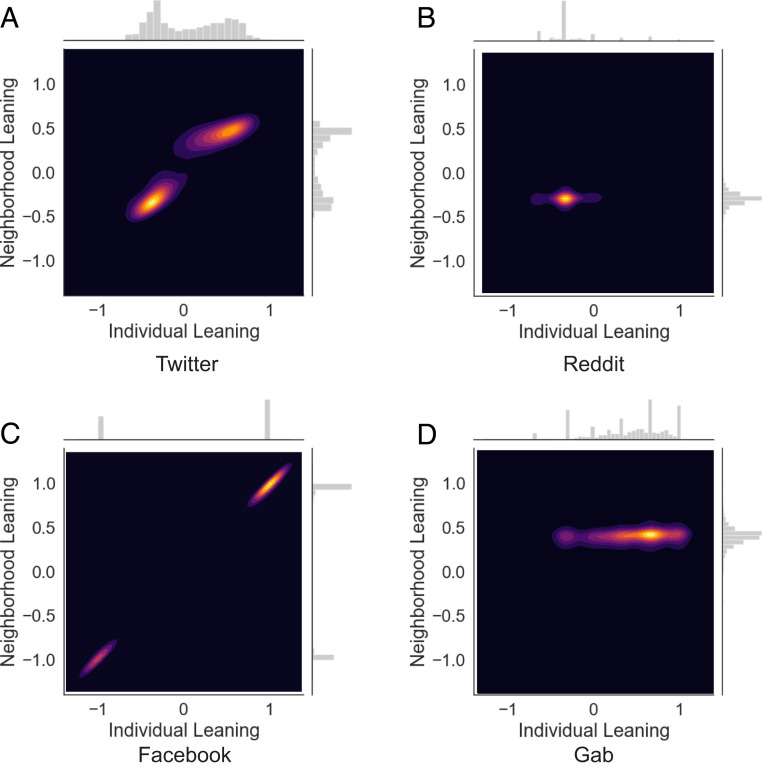
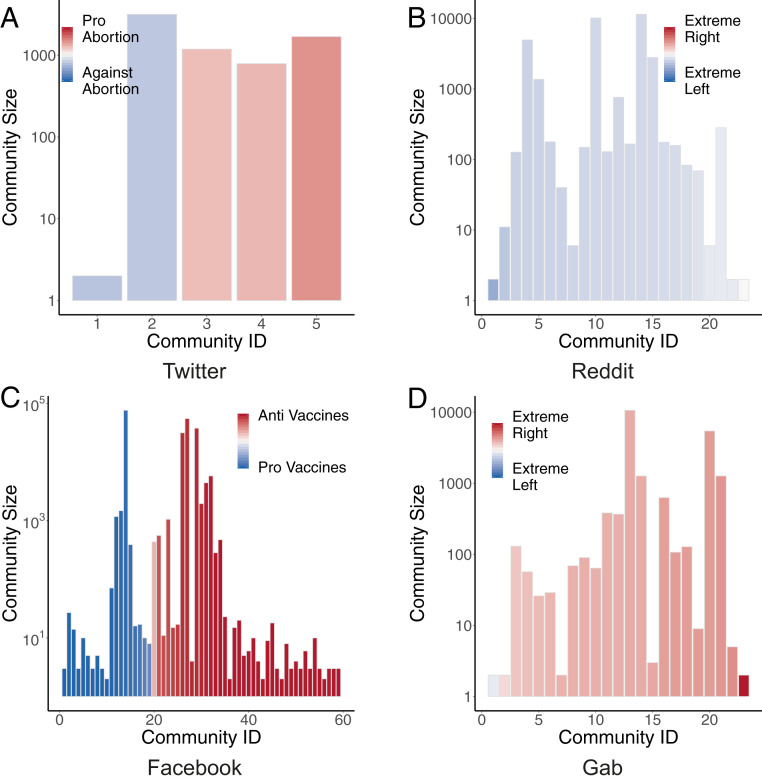
- Across the four platforms, “aggregation in homophilic clusters of users dominates online dynamics,” but platforms differ: Facebook and Twitter show homophilic clustering, while Reddit and Gab form a single community biased left or right rather than two opposing clusters.
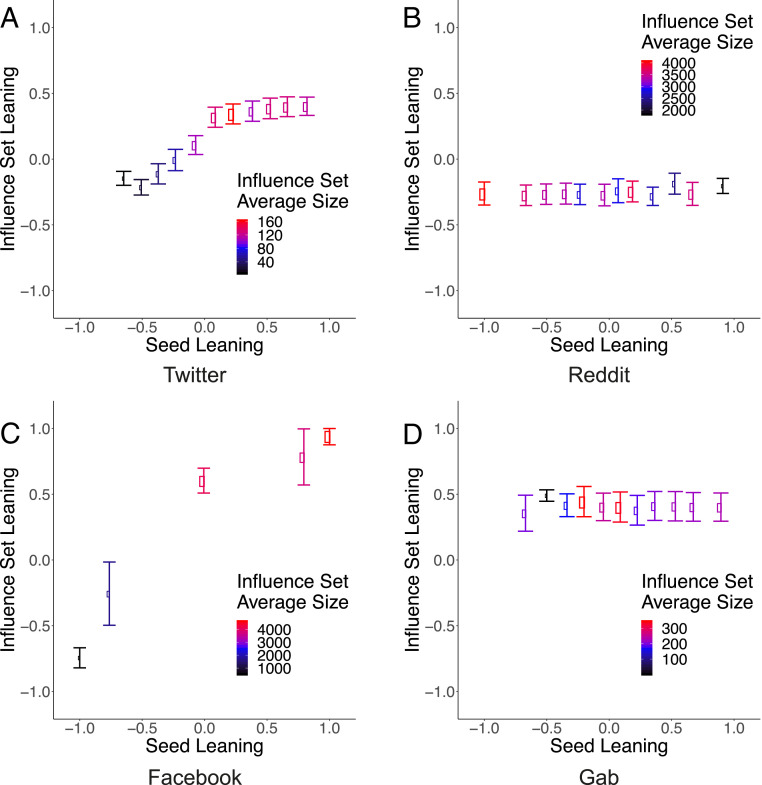
- Information diffusion is biased toward like-minded users on Facebook and Twitter, where the average leaning of a user’s influence set approximates the seed user’s leaning; on Reddit and Gab, the average leaning of the influence set does not depend on the seed user’s leaning.
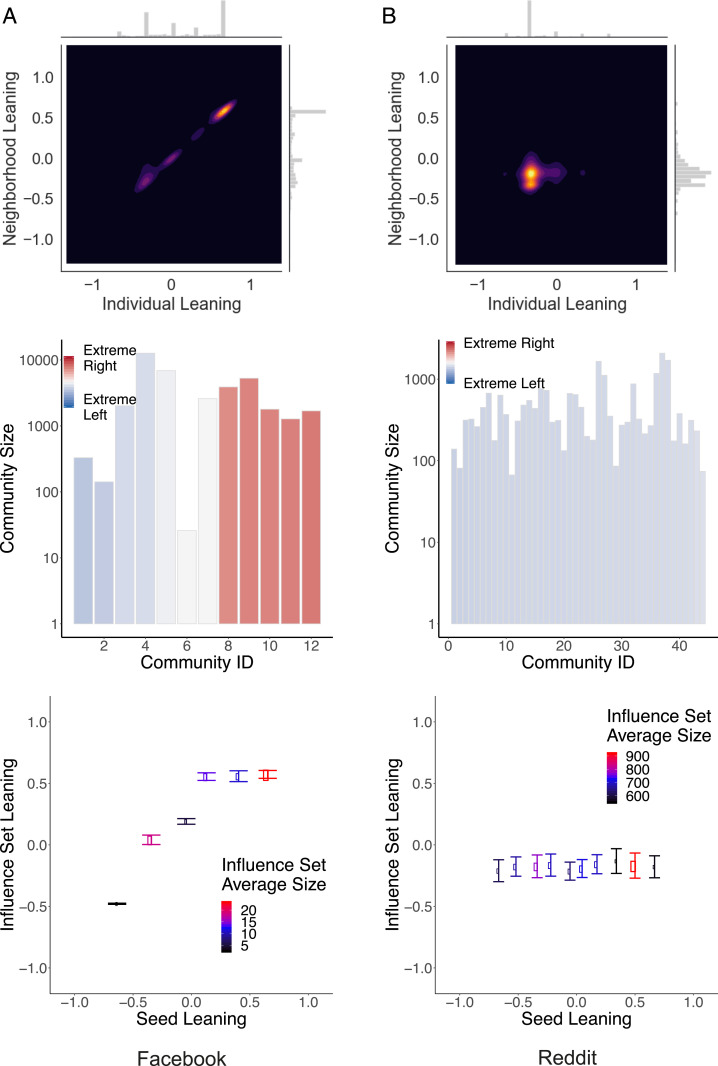
- In a direct comparison on news consumption, Facebook shows higher segregation than Reddit across all three measures: user-neighbor leaning correlation, community leaning, and SIR influence-set leaning.
- The study analyzes more than 100 million unique pieces of content and more than 1 million active users, with news outlets labeled using 2,190 media sources from Media Bias/Fact Check.
Methods
- Comparative analysis of Gab, Facebook, Reddit, and Twitter datasets on controversial topics including gun control, Obamacare, abortion, vaccines, science versus conspiracy, and news; main selected datasets were Abortion (Twitter), Vaccines (Facebook), Politics (Reddit), and Gab as a whole.
- Echo chambers were operationalized through two dimensions: homophily in interaction networks and bias in information diffusion toward like-minded peers. User leaning was inferred from linked news outlets, likes, or content, and interaction networks were built from follows, comments, cocomments, submissions, or replies depending on platform.
- Analyses included correlation between user leaning and average neighbor leaning, Louvain community detection, and SIR simulations to measure influence sets; SIR recovery rate was fixed at ν = 0.2, with dataset-specific infection ratios.
Limitations
- The paper states that the next envisioned step is to address the temporal dimension of echo chambers and how platform-specific social feedback mechanisms impact their formation.
- Evident from the text: leaning coverage varies strongly by platform, from 0.90–1.00 for Twitter/Facebook datasets to 0.15–0.20 for Reddit and 0.13 for Gab, so leaning-based conclusions for Reddit and Gab rest on a small classified fraction of users.
- Evident from the text: datasets differ by platform and topic, and the direct cross-platform comparison on a common topic is limited to news consumption on Facebook and Reddit; the authors also note that Reddit/Gab results could mean either no echo-chamber effect or observation inside a single echo chamber.
Model-written summary. Check it against the paper before relying on it.
Integrity signals
Registry
Cites
Statistics
Figures
Verification
Claims the paper makes
8 Valid · 1 Not valid · 7 Not checked · 38 Own results and interpretations
The cited sources support only part of this claim — read each source’s verdict below.
In the paper
“Selective exposure (19) and confirmation bias (20) (i.e., the tendency to seek information adhering to preexisting opinions) may explain the emergence of echo chambers on social media (1, 17, 21, 22).”
§ The echo chamber effect on social media > Abstract
What the sources say
- Supportedcites [1] M. Del Vicario, The spreading of misinformation online. Proc. Natl. Acad. Sci. U.S.A. 113, 554– 559 (2016). 26729863 PMC4725489 source
The Abstract says selective exposure generates homogeneous clusters, which it calls echo chambers. The Results and Discussion section says users select content matching a narrative and suggests confirmation bias determines echo-chamber formation. Page numbers are not provided in our copy. (LLM, conf=0.94)
- Partly supportedcites [17] K. Garimella, G. De Francisci Morales, A. Gionis, M. Mathioudakis, “ The effect of collective attention on controversial debates on social media” in WebSci ’17: 9th International ACM Web Science Conference (Association for Computing Machinery, New York, NY, 2017), pp. 43– 52. sourceExperimental — accuracy not yet measured
The Introduction reports that users mostly interact within their own side and endorse opinions from that side’s core. Related Work reports that users spread information faster when it agrees with their position. These passages are consistent with selective exposure, but the paper does not identify confirmation bias or establish that either tendency causes echo chambers to emerge. (LLM, conf=0.82)
- Supportedcites [21] M. Del Vicario, Echo chambers: Emotional contagion and group polarization on Facebook. Sci. Rep. 6, 37825 (2016). 27905402 PMC5131349 source
The Abstract says social-media disintermediation encourages users to select information that fits their beliefs (confirmation bias) and form like-minded groups (echo chambers). The Conclusions likewise describe Facebook as suited to the emergence of echo chambers. This supports the proposed explanation, without claiming it is the only cause. (LLM, conf=0.93)
- Supportedcites [22] A. Bessi, Science vs conspiracy: Collective narratives in the age of misinformation. PloS One 10, e0118093 (2015). 25706981 PMC4338055 source
The Introduction (page unavailable) says users consuming opposing information tend to form isolated clusters and describes polarized users whose likes are almost exclusively on one category of pages. The Conclusions (page unavailable) link information evaluation to existing beliefs. Together, these passages support the hedged explanation that selective exposure and confirmation bias may contribute to echo chambers. (LLM, conf=0.86)
hedgedstates a possible cause- Asserted: passes — The authors put it forward as true.
- Checkable: passes — It can be checked against evidence.
- Load-bearing: passes — The paper’s conclusions depend on it.
- Based: passes — The paper gives a reason why it holds.
- Supported
The cited sources support only part of this claim — read each source’s verdict below.
In the paper
“Our attention span remains limited (9, 10), and feed algorithms might limit our selection process by suggesting contents similar to the ones we are usually exposed to (11–13).”
§ The echo chamber effect on social media > Abstract
What the sources say
- Not checked — no full text of the sourcecites [11] A. L. Schmidt, Anatomy of news consumption on Facebook. Proc. Natl. Acad. Sci. U.S.A. 114, 3035– 3039 (2017). 28265082 PMC5373354 source
- Partly supportedcites [12] M. Cinelli, The COVID-19 social media infodemic. Sci. Rep. 10, 16598 (2020). 33024152 PMC7538912 sourceExperimental — accuracy not yet measured
The Introduction (page not provided) says algorithms take users’ preferences and attitudes into account when promoting content, and that users tend to seek information aligned with their worldviews. It does not say that feed algorithms suggest content similar to what users have previously seen or thereby limit their selection. (LLM, conf=0.82)
- Not checked — no full text of the sourcecites [13] E. Bakshy, S. Messing, L. A. Adamic, Exposure to ideologically diverse news and opinion on Facebook. Science 348, 1130– 1132 (2015). 25953820 source
hedgedstates a possible cause- Asserted: passes — The authors put it forward as true.
- Checkable: passes — It can be checked against evidence.
- Load-bearing: passes — The paper’s conclusions depend on it.
- Based: passes — The paper gives a reason why it holds.
Every source the paper cites for this claim was checked and supports it.
In the paper
“Online polarization, for instance, may foster misinformation spreading (1, 8).”
§ The echo chamber effect on social media > Abstract
What the sources say
- Supportedcites [1] M. Del Vicario, The spreading of misinformation online. Proc. Natl. Acad. Sci. U.S.A. 113, 554– 559 (2016). 26729863 PMC4725489 source
The Significance section says that homogeneity and polarization are main determinants of rumor-cascade size. The Conclusions also link polarized communities with the proliferation of narratives fueled by unsubstantiated rumors, supporting the hedged claim that online polarization may foster misinformation spreading. (LLM, conf=0.91)
- Supportedcites [8] M. D. Vicario, W. Quattrociocchi, A. Scala, F. Zollo, Polarization and fake news: Early warning of potential misinformation targets. ACM Trans. Web 13, 1– 22 (2019). source
The Introduction states that misinformation spreading on social media is directly related to increasing user polarization and segregation. This supports the citing sentence’s hedged claim that online polarization may foster misinformation spreading. (LLM, conf=0.94)
hedgedstates a possible cause- Asserted: passes — The authors put it forward as true.
- Checkable: passes — It can be checked against evidence.
- Load-bearing: unclear — It is unclear whether the paper’s conclusions depend on it.
- Based: passes — The paper gives a reason why it holds.
- Supported
Every source the paper cites for this claim was checked and supports it.
In the paper
“In network terms, this translates into a node i with a given leaning xi more likely to be connected with nodes with a leaning close to xi (18).”
§ The echo chamber effect on social media > Comparative Analysis > Polarization and Homophily in the Interaction Networks.
What the sources say
- Supportedcites [18] W. Cota, S. C. Ferreira, R. Pastor-Satorras, M. Starnini, Quantifying echo chamber effects in information spreading over political communication networks. EPJ Data Sci. 8, 35 (2019). source
The paper’s “Topological evidence of echo chambers” section says that a node with political position Pᵢ is connected with nodes whose positions are close to Pᵢ. It also reports a strong correlation between users’ positions and their neighbors’ average positions, supporting the citing sentence’s probabilistic paraphrase. (LLM, conf=0.94)
hedgedstates an association- Asserted: passes — The authors put it forward as true.
- Checkable: passes — It can be checked against evidence.
- Load-bearing: passes — The paper’s conclusions depend on it.
- Based: passes — The paper gives a reason why it holds.
- Supported
A result the paper reports from its own data — it cites no other source for it, so there is none to check. The quote shows it is in the paper.
In the paper
“Furthermore, the almost total absence of communities with leaning very close to 0 confirms the polarized state of the systems.”
§ The echo chamber effect on social media > Comparative Analysis > Polarization and Homophily in the Interaction Networks.
boostedstates a cause- Asserted: passes — The authors put it forward as true.
- Checkable: passes — It can be checked against evidence.
- Load-bearing: passes — The paper’s conclusions depend on it.
- Based: passes — The paper gives a reason why it holds.
- Rests on 4 assumptions not shown here.
32 more claims
Create a free account to see all 54 claims and to verify the 2 references still open.
- It may state two separate claims as one. 9
- Probably not a substantial claim. 9
Claims other papers make about this one
Each is checked against this paper’s own text: does it say what the citing paper says it does?
The source backs part of the claim, not all of it — or backs it for a different population, condition or comparison.
In the citing paper
“engagement with political content online is generally associated with high levels of ingroup bias; that is, it is far more likely to be shared within the political ingroup than in the outgroup (18, 19, 16).”
From Troll and divide: the language of online polarization (2022) · cites this paper as [16]
Experimental — accuracy not yet measuredThe source backs part of the claim, not all of it — or backs it for a different population, condition or comparison.
In the citing paper
“This challenge is reflected in research on”
From Machine culture (2023) · cites this paper as [142]
Experimental — accuracy not yet measuredThe source backs part of the claim, not all of it — or backs it for a different population, condition or comparison.
In the citing paper
“Thus, combating social media's echo chamber effect through an active exposure to diverse perspectives and networks also represents a viable individual-level strategy for addressing the deepfake problem (Cinelli et al., 2021; Gillani et al., 2018).”
From Deepfakes: Deceptions, mitigations, and opportunities (2023) · cites this paper as Cinelli et al., 2021
Experimental — accuracy not yet measuredThe source backs part of the claim, not all of it — or backs it for a different population, condition or comparison.
In the citing paper
“Even without being designed to shift opinions, it has been found that algorithms may contribute to political polarization by reinforcing divisive opinions [9, 24, 32].”
From Co-Writing with Opinionated Language Models Affects Users’ Views (2023) · cites this paper as [32]
Experimental — accuracy not yet measuredThe source backs part of the claim, not all of it — or backs it for a different population, condition or comparison.
In the citing paper
“On Reddit, studies find minimal evidence of echo chambers due to platform features encouraging cross-cutting exposure [17,61,63].”
From A systematic review of echo chamber research: comparative analysis of conceptualizations, operationalizations, and varying outcomes (2025) · cites this paper as [17]
Experimental — accuracy not yet measured
5 more claims about this paper
Create a free account to see every claim other papers make about this one.
Citations
Cites
Fast unfolding of communities in large networks
Blondel, V. D., Guillaume, J.-L., Lambiotte, R., & Lefebvre, E. (2008) · Journal of Statistical Mechanics: Theory and Experiment · doi:10.1088/1742-5468/2008/10/p10008 · Cited by 21,424 · cited 1×
“We detected communities by applying the Louvain algorithm (41), removing singleton communities with only one user.”
MethodThe spread of true and false news online
Vosoughi, S., Roy, D., & Aral, S. (2018) · Science · doi:10.1126/science.aap9559 · Cited by 8,847 · cited 1×
“A recent study (7) limited to Twitter claimed that fake news travels faster than real news.”
BackgroundConfirmation Bias: A Ubiquitous Phenomenon in Many Guises
Nickerson, R. S. (1998) · Review of General Psychology · doi:10.1037/1089-2680.2.2.175 · Cited by 7,267 · cited 1×
“Selective exposure (19) and confirmation bias (20) (i.e., the tendency to seek information adhering to preexisting opinions) may explain the emergence of echo chambers on social media (1, 17, 21, 22).”
BackgroundInfectious Diseases of Humans: Dynamics and Control
Anderson, R. M., & May, R. M. (1991) · doi:10.1093/oso/9780198545996.001.0001 · Cited by 6,179
Lazer, D. M. J., Baum, M. A., Benkler, Y., Berinsky, A. J., Greenhill, K. M., Menczer, F., Metzger, M. J., Nyhan, B., Pennycook, G., Rothschild, D., et al. (2018) · Science · doi:10.1126/science.aao2998 · Cited by 4,160
Degroot, M. H. (1974) · Journal of the American Statistical Association · doi:10.1080/01621459.1974.10480137 · Cited by 4,004 · cited 1×
“For instance, if opinions are assumed to be embedded in a onedimensional space (38), x ∈ [−1,+1] without loss of generality, as usual for controversial topics, then polarization is characterized by two well-separated peaks in P(x ), for positive and negative opinions.”
BackgroundExposure to ideologically diverse news and opinion on Facebook
Bakshy, E., Messing, S., & Adamic, L. A. (2015) · Science · doi:10.1126/science.aaa1160 · Cited by 3,245 · cited 2×
“Our attention span remains limited (9, 10), and feed algorithms might limit our selection process by suggesting contents similar to the ones we are usually exposed to (11–13).”
BackgroundThe spreading of misinformation online
Del Vicario, M., Bessi, A., Zollo, F., Petroni, F., Scala, A., Caldarelli, G., Stanley, H. E., & Quattrociocchi, W. (2016) · Proceedings of the National Academy of Sciences · doi:10.1073/pnas.1517441113 · Cited by 2,407 · cited 2×
“, the tendency to seek information adhering to preexisting opinions) may explain the emergence of echo chambers on social media (1, 17, 21, 22).”
BackgroundSelf-citationThe COVID-19 social media infodemic
Cinelli, M., Quattrociocchi, W., Galeazzi, A., Valensise, C. M., Brugnoli, E., Schmidt, A. L., Zola, P., Zollo, F., & Scala, A. (2020) · Scientific Reports · doi:10.1038/s41598-020-73510-5 · Cited by 2,313
Self-citationFilter Bubbles, Echo Chambers, and Online News Consumption
Flaxman, S., Goel, S., & Rao, J. M. (2016) · Public Opinion Quarterly · doi:10.1093/poq/nfw006 · Cited by 1,992
Research works printed but not linked: 2
- R. M. Anderson, R. M. May, Infectious Diseases in Humans (Oxford University Press, Oxford, United Kingdom, 1992).
- M. Cinelli, G. De Francisci Morales, A. Galeazzi, W. Quattrociocchi, M. Starnini, The echo chamber effect on social media. Open Science Framework. https://osf.io/x92br/?view_only=cdcc87d30e404e01b6ae316db15e3375. Deposited 22 January 2021. PMC7936330 33622786
Cited by
Items 501–600 of 2,063
Online Hate: Behavioural Dynamics and Relationship with MisinformationPreprint
Cinelli, M., Pelicon, A., Mozetič, I., Quattrociocchi, W., Novak, P. K., & Zollo, F. (2021) · arXiv (Cornell University) · doi:10.48550/arxiv.2105.14005 · Cited by 8
Self-citationBinstok, N., Gould, E. D., & Kaplan, T. R. (2024) · Journal of the European Economic Association · doi:10.1093/jeea/jvae013 · Cited by 12
Moslehpour, M., Tiwari, A. K., & Faez, S. (2024) · International Journal of Emerging Markets · doi:10.1108/ijoem-08-2022-1250 · Cited by 10
Vaccination homophily in ego contact networks during the COVID-19 pandemic
Stefkovics, Á., Albert, F., Ligeti, A. S., Dávid, B., Rudas, S., & Koltai, J. (2024) · Scientific Reports · doi:10.1038/s41598-024-65986-2 · Cited by 9
La era del patriarcado de vigilancia: ciberviolencia, manosfera y democracia
Suárez, Á. G. (2024) · Asparkía Investigació feminista · doi:10.6035/asparkia.7857 · Cited by 12
Simulating Social Network with LLM Agents: An Analysis of Information Propagation and Echo Chambers
Zheng, W., & Tang, X. (2024) · Communications in computer and information science · doi:10.1007/978-981-96-0178-3_5 · Cited by 20
Hu, Y., Zhu, J., & Tang, C. (2025) · Engineering Applications of Artificial Intelligence · doi:10.1016/j.engappai.2025.110044 · Cited by 8
Daruwala, N. A. (2025) · Frontiers in Communication · doi:10.3389/fcomm.2025.1565289 · Cited by 10
Bojić, L., Matthes, J., Samala, A. D., & Čabarkapa, M. (2025) · Information Communication & Society · doi:10.1080/1369118x.2025.2520005 · Cited by 24
“Highly tailored content delivery reinforces pre-existing beliefs and preferences, fostering "echo chambers" where like-minded interactions and confirmation biases thrive (Cinelli et al., 2021).”
Gombar, M., & Boban, M. (2025) · International Convention on Information and Communication Technology, Electronics and Microelectronics · doi:10.1109/mipro65660.2025.11131918 · Cited by 16
“This can include mechanisms highlighting counter-narratives challenging polarised or emotionally charged content [8], [19].”
Li, J., Zhang, J., Xu, X., Xiao, L., Ling, Y., Liu, S., Gao, Y., Zhao, L., & Jia, H. (2025) · Digital Health · doi:10.1177/20552076251398464 · Cited by 18
“25 Our study also identi fi ed substantial thematic disparities beyond the quality-engagement gap.”
Controlling Segregation in Social Network Dynamics as an Edge Formation Game
Luo, R., Nettasinghe, B., & Krishnamurthy, V. (2022) · IEEE Transactions on Network Science and Engineering · doi:10.1109/tnse.2022.3162789 · Cited by 13
“Impacts of segregation in social networks include limiting the exposure to diverse perspectives [3], amplifying economic inequality [4], and reinforcing user’s purchase interests in e-commerce [5].”
BackgroundReliability of News and Toxicity in Twitter Conversations
Quattrociocchi, A., Etta, G., Avalle, M., Cinelli, M., & Quattrociocchi, W. (2022) · Lecture notes in computer science · doi:10.1007/978-3-031-19097-1_15 · Cited by 14
Self-citationStudents’ perceptions of the impacts of peer ideas in inquiry learning
Matuk, C. F., & Linn, M. C. (2023) · Instructional Science · doi:10.1007/s11251-022-09607-3 · Cited by 15
“This direction is particularly relevant in social media environments, in which confirmation bias and the echo chamber effect can encourage inordinate focus on reinforcing ideas (Cinelli et al., 2021).”
BackgroundRealtime user ratings as a strategy for combatting misinformation: an experimental study
Stein, J., Frey, V., & van de Rijt, A. (2023) · Scientific Reports · doi:10.1038/s41598-023-28597-x · Cited by 10
“These scenarios represent ideal-types and maximize our treatment as extreme cases of a continuum along which more and less segregated real-world online communities are positioned 30,32 .”
BackgroundDecentralised content moderation
Friedl, P., & Morgan, J. (2024) · Internet Policy Review · doi:10.14763/2024.2.1754 · Cited by 9
The Influence of Audio Stories on Enhancing Digital Literacy In Early Childhood: A Survey Study
Bisma, N., Desmita, D., Diyenti, A. K., Karim, N. A., Zalzabila, Z., Yulia, N., Warmansyah, J., & Sulong, K. (2023) · Indonesian Journal of Early Childhood Educational Research (IJECER) · doi:10.31958/ijecer.v2i2.11526 · Cited by 31
Pierri, F. (2024) · EPJ Data Science · doi:10.1140/epjds/s13688-024-00501-1 · Cited by 14
Information cocooning and polarization of opinions in a mobile population
Dong, J., Dai, Q., Li, H., & Yang, J. (2024) · Physica A Statistical Mechanics and its Applications · doi:10.1016/j.physa.2024.130322 · Cited by 9
Mindfulness Intervention for Health Information Avoidance in Older Adults: Mixed Methods Study
Gu, C., Qian, L., & Zhuo, X. (2025) · JMIR Public Health and Surveillance · doi:10.2196/69554 · Cited by 11
“Health information similarity refers to the consistency or resemblance in the content and structure of health information encountered on digital platforms, often driven by personalized recommendation algorithms tailored to users’ preferences and behaviors [48,49].”
Pendulating or resonating? A case of echo-chambers in twitter
Gupta, V., Dass, P., & Arora, R. (2022) · Journal of Discrete Mathematical Sciences and Cryptography · doi:10.1080/09720529.2021.2019442 · Cited by 10
“Previously, several researchers and analysts mostly concentrated on examining the primary points of distinction between various social media sites such as Reddit, Twitter, and others [1].”
BackgroundFOMO (fate of online media only) in infectious disease modeling: a review of compartmental models
Sooknanan, J., & Seemungal, T. (2022) · International Journal of Dynamics and Control · doi:10.1007/s40435-022-00994-6 · Cited by 7
“Other rapid spreaders include social media influencers and search engine algorithms, which curate, recommend and promote content [67].”
BackgroundAI Facilitated Isolations? The Impact of Recommendation-based Influence Diffusion in Human Society
Hu, Y., Wu, S., Jiang, C., Li, W., Bai, Q., & Roehrer, E. (2022) · International Joint Conference on Artificial Intelligence · doi:10.24963/ijcai.2022/705 · Cited by 20
The Usage and Impact of ICTs during the Covid-19 Pandemic
Yang, S., Zhu, X. A., & Fichman, P. (2023) · Routledge eBooks · doi:10.4324/9781003231769 · Cited by 11
Haensch, A., Dragovic, N., Börgers, C., & Boghosian, B. M. (2023) · Journal of Artificial Societies and Social Simulation · doi:10.18564/jasss.5027 · Cited by 11
Schawe, H., Beiró, M. G., Alvarez-Hamelin, J. I., Kotzinos, D., & Hernández, L. (2023) · Scientific Reports · doi:10.1038/s41598-023-30367-8 · Cited by 10
Social Media as a Tool of Building Reputation and Identity of National Parks
Korená, K., & Pártlová, P. (2023) · Communication Today · doi:10.34135/communicationtoday.2023.vol.14.no.1.8 · Cited by 11
Antunes, E., Amaral, I., Simões, R. B., et al. (2023) · Youth · doi:10.3390/youth3040070 · Cited by 7
Wazzan, A., & Aldamen, Y. (2023) · Journalism and Media · doi:10.3390/journalmedia4040064 · Cited by 14
“Users can communicate in a variety of ways on different platforms, ranging from retweets and mentions on Twitter to likes and comments in groups on Facebook, resulting in quite varied social dynamics (Cinelli et al. 2021).”
BackgroundPolarización y odio contra la Ley Trans de España en TikTok
Ribeiro, J. C., García-Estévez, N., & Ballesteros-Aguayo, L. (2024) · Revista ICONO14 · doi:10.7195/ri14.v22i1.2088 · Cited by 15
Online Fake News Opinion Spread and Belief Change: A Systematic Review
Altoe, F., Moreira, C., Pinto, H. S., & Jorge, J. A. (2024) · Human Behavior and Emerging Technologies · doi:10.1155/2024/1069670 · Cited by 17
Young, M. J., Silk, M. J., Pritchard, A. J., & Fefferman, N. H. (2022) · Physical review. E · doi:10.1103/physreve.105.044315 · Cited by 6
“echo chambers into which important information may be less able to penetrate [10]).”
BackgroundLe, B., Spina, D., Scholer, F., & Chia, H. X. (2022) · Communications in computer and information science · doi:10.1007/978-3-031-09316-6_5 · Cited by 9
“Moreover, the phenomenon of echo chambers – where information access systems such as search engines or recommender systems reinforce existing preferences of users in a feedback loop [1, 5, 8, 9] – is particularly problematic in this context.”
BackgroundDevrim-Lanpir, A., Güzeldere, H. K. B., & ÇİNTESUN, E. E. (2021) · Research Square · doi:10.21203/rs.3.rs-441898/v1 · Cited by 8
Mobile Communication Technology and National Identity in Sub-Saharan AfricaPreprint
Choi, D. D., Laughlin, B., & Schultz, A. (2021) · OSF Preprints (OSF Preprints) · doi:10.31219/osf.io/k4djn · Cited by 8
“Our intuition is motivated by the extant literature on the polarizing potential of internet-based social media in consolidated democracies of North America and Europe (Lelkes, Sood and Iyengar, 2017; Cinelli et al., 2021).”
BackgroundIs it the Message or the Messenger? Examining Movement in Immigration Beliefs
Afrouzi, H., Arteaga, C., & Weisburst, E. (2023) · National Bureau of Economic Research · doi:10.3386/w31385 · Cited by 11
Motivated Information Acquisition and Social Norm FormationPreprint
Dimant, E., Galeotti, F., & Villeval, M. (2023) · Social Science Research Network · doi:10.2139/ssrn.4525398 · Cited by 6
Affective and interactional polarization align across countriesPreprint
Falkenberg, M., Zollo, F., Quattrociocchi, W., Pfeffer, J., & Baronchelli, A. (2023) · PsyArXiv (OSF Preprints) · doi:10.31234/osf.io/ngsb6 · Cited by 16
Self-citationHong, X., Pan, L., Xu, M., & Chen, Q. (2025) · Information Technology and People · doi:10.1108/itp-08-2024-0984 · Cited by 12
Chen, S., Jiahui, S., Qiaojie, J., & Yang, S. (2024) · Acta Psychologica Sinica · doi:10.3724/sp.j.1041.2024.00759 · Cited by 10
Climate action on Twitter: perceived barriers for actions and actors, and sentiments during COP26
Wang, X., Judge, M., & Steg, L. (2025) · Environmental Research Communications · doi:10.1088/2515-7620/ad7fbc · Cited by 8
Seven Challenges for Risk Communication in Today’s Digital Era: The Emergency Manager’s Perspective
Ross, A. D., Siebeneck, L. K., Wu, H., Kopczynski, S., Nepal, S., & Sauceda, M. (2024) · Sustainability · doi:10.3390/su162411306 · Cited by 16
“Furthermore, algorithms used by social media platforms and search engines often personalize content based on users’ preferences and behaviors, creating filter bubbles and echo chambers [67].”
Baldelli, M., Mattera, M., & Renou‐Wilson, F. (2025) · European Journal of Education · doi:10.1111/ejed.70056 · Cited by 6
Burkhardt, A. (2025) · RaumFragen: Stadt - Region - Landschaft · doi:10.1007/978-3-031-74846-2_6 · Cited by 7
Iqbal, M., Singh, K., Khan, S., Osho, O., Sidnam-Mauch, E., Bannister, N. A., Caine, K. E., & Knijnenburg, B. P. (2025) · Computers and Education Artificial Intelligence · doi:10.1016/j.caeai.2025.100425 · Cited by 16
AIgemony: power dynamics, dominant narratives, and colonisation
Bahrami, N. (2025) · AI and Ethics · doi:10.1007/s43681-025-00734-4 · Cited by 11
Media choice and audience perceptions: Evidence from visual framing of immigration in news stories
Gasparyan, O., & Сироткина, Е. (2025) · PLoS ONE · doi:10.1371/journal.pone.0331219 · Cited by 10
“Within these spaces, political content concentrates in emotionally aligned clusters, which amplifies polarization and reduces cross-cutting diffusion [56,57].”
Shen, C., & Cheng, J. (2025) · Tourism Geographies · doi:10.1080/14616688.2025.2564275 · Cited by 13
“While algorithmic curation person-alizes content, it also generates echo chambers and filter bubbles (cinelli et al., 2021), intensifying discourse polarization and rapidly amplifying public sentiment (constantinides, 2014). consequently, governments are pressured to adapt through governance…”
CycRW: Cycle-graph random walks for identifying high-impact spreaders in complex networks
Shi, W., Fan, T., Zhou, Y., et al. (2025) · Information Processing & Management · doi:10.1016/j.ipm.2025.104510 · Cited by 6
Exploring nutritional myths and fake news: Impact and counteractions
Capocasa, M., Venier, D., Venier, B., & Chiarla, C. (2026) · Clinical Nutrition ESPEN · doi:10.1016/j.clnesp.2026.102947 · Cited by 13
Wang, Q., Li, H., Su, H., Yang, L., & Diao, M. (2026) · Sustainable Cities and Society · doi:10.1016/j.scs.2026.107223 · Cited by 8
Few voices, strong echo: Measuring follower homogeneity of politicians’ Twitter accounts
Rusche, F. (2024) · New Media & Society · doi:10.1177/14614448221099860 · Cited by 6
“…shows that users are nonetheless confronted with information that does not conform with their opinions (Barberá, 2015; Boutyline and Willer, 2017; Cinelli et al., 2021; Dubois and Blank, 2018; Eady et al., 2019; Flaxman et al., 2016; Lawrence et al., 2010; Lee et al., 2014; Vaccari et al., 2016;…”
BackgroundMoral Narratives Around the Vaccination Debate on Facebook
Beiró, M. G., D'Ignazi, J., Bustos, V. P., Prado, M. F., & Kalimeri, K. (2023) · International World Wide Web Conference (WWW) · doi:10.1145/3543507.3583865 · Cited by 28
“SM users are subject to confirmation bias and selective exposure, interacting only with like-minded peers in the so-called echo-chamber effect [9].”
BackgroundSyahputra, I., Riyanto, W. F., Pratiwi, F. D., & Virga, R. L. (2023) · Media Asia · doi:10.1080/01296612.2023.2246726 · Cited by 19
“Internet users favor information that aligns with their belief and they come together as a group that is based around a common narrative within an echo chamber (Auxier & Vitak, 2019; Cinelli et al., 2020; Colleoni et al., 2014; Gr € omping, 2014; Vicario, 2016).”
BackgroundPolarized opinion states in static networks driven by limited information horizons
Pérez-Martínez, H., Mingueza, F. B., Soriano‐Paños, D., Gómez‐Gardeñes, J., & Floría, L. M. (2023) · Chaos Solitons & Fractals · doi:10.1016/j.chaos.2023.113917 · Cited by 10
“they can produce an increase of partisan media consumption [16, 17] and the formation of echo chambers [18, 19] that fuel radicalization processes [20].”
BackgroundDu, J., & Zhu, X. (2023) · Journal of Environmental Policy & Planning · doi:10.1080/1523908x.2023.2269381 · Cited by 7
“…chambers ’ in various controversial issues (e.g. gun control, vaccination, abortion) and various online platforms (e.g. Face-book, Twitter, Reddit), as a result of selective exposure, dissonance avoidance, and ideological segregation (Bail et al., 2018; Cinelli et al., 2021; King et al., 2017).”
BackgroundThe adaptive community-response (ACR) method for collecting misinformation on social media
Kauk, J., Kreysa, H., Scherag, A., & Schweinberger, S. R. (2024) · Journal Of Big Data · doi:10.1186/s40537-024-00894-w · Cited by 6
“Social media play a determining role in the amplification of misinformation (see, e.g., [3, 4, 17, 37, 73]), thus challenging researchers to better understand the dynamics and mechanisms underlying the spread of misinformation, despite its complex and multifaceted nature [39, 40, 64].”
BackgroundLikelihood-Based Methods Improve Parameter Estimation in Opinion Dynamics Models
Lenti, J., Monti, C., & Morales, G. D. F. (2024) · ACM International Conference on Web Search and Data Mining (WSDM) · doi:10.1145/3616855.3635785 · Cited by 18
“The interest in opinion dynamics in particular has been recently renewed due to the emergence of phenomena such as polarization, filter bubbles, and echo chambers on social media [6, 14, 22, 43].”
BackgroundSelf-citationEmpowered Mini-Publics: A Shortcut or Democratically Legitimate?
Lee, S. M. (2024) · Journal of Deliberative Democracy · doi:10.16997/jdd.1501 · Cited by 7
Deng, Y., Chen, Z., He, C., Lu, Z., & Li, B. (2024) · CHI Conference on Human Factors in Computing Systems · doi:10.1145/3613904.3642194 · Cited by 22
“This might facilitate intergroup connections and promote a sense of identification [11, 32], with the potential risk of limited viewpoint diversity and echo chamber effects [30].”
Asynchronous opinion dynamics in social networks
Berenbrink, P., Hoefer, M., Kaaser, D., Lenzner, P., Rau, M., & Schmand, D. (2024) · Distributed Computing · doi:10.1007/s00446-024-00467-3 · Cited by 7
“Co-evolutionary opinion formation helps to analyze and explain current phenomena like filter bubbles in the Internet [48] and social media echo chambers [22] that inhibit opinion exchange and amplify extreme views.”
Exploring Reddit Community Structure: Bridges, Gateways and Highways
Sawicki, J., & Ganzha, M. (2024) · Electronics · doi:10.3390/electronics13101935 · Cited by 7
Zero-sum beliefs and the avoidance of political conversations
Boland, F. K., & Davidai, S. (2024) · Communications Psychology · doi:10.1038/s44271-024-00095-4 · Cited by 15
Puey, F. C., Ortega, C. G., & Rodríguez, J. (2024) · VISUAL REVIEW International Visual Culture Review / Revista Internacional de Cultura Visual · doi:10.62161/revvisual.v16.5261 · Cited by 10
Ponce, M. L., Ibáñez, D. B., & Gonzales, H. M. S. (2024) · Revista ICONO14 · doi:10.7195/ri14.v22i2.2078 · Cited by 15
The influence of coordinated behavior on toxicity
Loru, E., Cinelli, M., Tesconi, M., & Quattrociocchi, W. (2024) · Online Social Networks and Media · doi:10.1016/j.osnem.2024.100289 · Cited by 12
“Problems include the fast spread of false information [7, 8, 9, 10, 11], more division among groups [12, 13, 14, 15, 16], and harmful behaviors online [17, 18, 19].”
BackgroundSelf-citationEcho chamber formation sharpened by priority users
Ferraz de Arruda, H., Andrade Oliveira, K., & Moreno, Y. (2024) · iScience · doi:10.1016/j.isci.2024.111098 · Cited by 6
Wen, P., Wu, J., Wu, Y., & Fu, Y. (2024) · Technology in Society · doi:10.1016/j.techsoc.2024.102784 · Cited by 10
How social media can undermine democracy
Gradwohl, R., Heller, Y., & Hillman, A. L. (2024) · European Journal of Political Economy · doi:10.1016/j.ejpoleco.2024.102634 · Cited by 10
Communication accommodation for de-escalating consumer tensions in online brand communities
Dineva, D., Daunt, K. L., & Bacile, T. J. (2025) · Journal of Business Research · doi:10.1016/j.jbusres.2025.115281 · Cited by 13
“This is because social media algorithms that drive online brand communities (OBC) engagement are designed to promote controversial and often negative content (Cinelli et al., 2021).”
Understanding Loneliness Through Analysis of Twitter and Reddit Data: Comparative Study
Shah, H. A., & Househ, M. S. (2025) · Interactive Journal of Medical Research · doi:10.2196/49464 · Cited by 8
“Cinelli et al [17] used Gab, Facebook, Reddit, and Twitter to assess the difference of opinion across different platforms.”
A shifting baseline theory of debates over potential lynx and wolf reintroductions to Scotland
Whitehead, T., & Hare, D. (2025) · AMBIO · doi:10.1007/s13280-025-02186-w · Cited by 13
“The rise of misinformation has also been accelerated by social media and the development of echo chambers within society, limiting people’s exposure to diverse perspectives and reinforcing a shared narrative supported by a group of like-minded people (Cinelli et al. 2021).”
Successive Cohorts of Twitter Users Show Increasing Activity and Shrinking Content Horizons
Wolf, F., Lorenz-Spreen, P., & Lehmann, S. (2022) · Journal of Quantitative Description Digital Media · doi:10.51685/jqd.2022.014 · Cited by 9
“This finding mirrors previous findings of politically homophilous ties in social media networks (Mosleh et al., 2021) and the formation of topical groups therein (Cinelli et al., 2021).”
ResultDiscord in the voter model for complex networks
Vendeville, A., Zhou, S., & Guedj, B. (2024) · Physical review. E · doi:10.1103/physreve.109.024312 · Cited by 7
Extremist language in anti-COVID-19 conspiracy discourse on Facebook
Marko, K. (2022) · Critical Discourse Studies · doi:10.1080/17405904.2022.2110134 · Cited by 13
“…in online contexts cannot be underestimated, as it can trigger the echo chamber e ff ect, which ‘ can act as a mechanism to reinforce an existing opinion within a group and, as a result, move the entire group toward more extreme positions ’ (Cinelli et al., 2021, p. 1; see also Brodnig, 2021).”
BackgroundEthics: What is the Research Scenario in the Brazilian Symposium WebMedia?
Carvalho, L. P., Suzano, J. A., Santoro, F. M., Oliveira, J., & Pimentel, M. D. G. C. (2022) · Brazilian Symposium on Multimedia and the Web · doi:10.1145/3539637.3557932 · Cited by 8
“Echo chambers may increase social and political polarization, and extremism [19].”
BackgroundWill You Take the Knee? Italian Twitter Echo Chambers’ Genesis During EURO 2020
Buongiovanni, C., Candusso, R., Cerretini, G., Febbe, D., Morini, V., & Rossetti, G. (2023) · Studies in computational intelligence · doi:10.1007/978-3-031-21127-0_3 · Cited by 12
Political Bot Bias in the Perception of Online Discourse
Schweitzer, S., Dobson, K. S. H., & Waytz, A. G. (2023) · Social Psychological and Personality Science · doi:10.1177/19485506231156020 · Cited by 9
“A common explanation for polarization’s rise is that social media has sorted people into ideological echo chambers (Pariser, 2011; Sunstein, 2018), primarily exposing people to like-minded ideas and excluding opposing viewpoints (Cinelli et al., 2021; Quattrociocchi et al., 2016; Sunstein, 2002).”
BackgroundArt, Affect, and Social Media in the ‘No Dakota Access Pipeline’ Movement
Lee, R. (2023) · Theory Culture & Society · doi:10.1177/02632764221146715 · Cited by 7
“#NoDAPL, building on the Idle No More movement for Indigenous sovereignty, drew heavily on social media use, particularly Twitter.”
BackgroundInfluentialBioethics and artificial intelligence: between deliberation on values and rational choice theory
Bustamante, B. J. P., Riaño-Moreno, J. C., Clavijo-Montoya, H. A., Cárdenas-Galindo, M. A., & Campos-Figueredo, W. D. (2023) · Frontiers in Robotics and AI · doi:10.3389/frobt.2023.1140901 · Cited by 12
“Algorithms function as groups of rules that validate preferences that are immune to critics (uncritical/legitimate character) and configure amplification spaces of their narratives, so-called echo chambers (Cinelli et al., 2021).”
BackgroundTowards a Personalized Online Fake News Taxonomy
Altoe, F., & Pinto, H. S. (2023) · ACM Conference on User Modeling, Adaptation and Personalization (UMAP) · doi:10.1145/3565472.3592963 · Cited by 7
“Studies have shown how the echo chamber effect created by social media [13] have contributed to develop what has been dubbed “affective polarization” [45], which could be argued as the pathos of modern society.”
BackgroundSocial Media Literacy to Confront Far-Right Content: Saying “No” to Neutrality
Burnham, S. L. F., & Arbeit, M. R. (2023) · Human Development · doi:10.1159/000531765 · Cited by 7
“Although social media platforms and their algorithms can create echo chambers and silo social media users into different content areas (Cinelli et al., 2021), users exercise agency over whether or not to interact with content presented to them.”
BackgroundModeling communication asymmetry and content personalization in online social networks
Galante, F., Vassio, L., Garetto, M., & Leonardi, E. (2023) · Online Social Networks and Media · doi:10.1016/j.osnem.2023.100269 · Cited by 10
“And, in turn, it can lead to the formation of echo chambers [2], where people who share a similar point of view interact with each other while being isolated from the rest of the users.”
BackgroundMethodInfluentialPolarizing Feedback Loops on Twitter: Congressional Tweets during the 2022 Midterm Elections
Rafail, P., O’Connell, W. E., & Sager, E. (2024) · Socius Sociological Research for a Dynamic World · doi:10.1177/23780231241228924 · Cited by 8
“Polarizing speech is widespread in politics but is particularly pervasive on social media because of algorithms that create political and ideological echo chambers that squeeze out contrary viewpoints (Cinelli et al. 2021).”
Opinion dynamics on biased dynamical networks: Beyond rare opinion updating
Wang, X., & Wu, B. (2024) · Chaos An Interdisciplinary Journal of Nonlinear Science · doi:10.1063/5.0192642 · Cited by 8
Hate-sharing: A case study of its prevalence and impact on Gab
Weigel, M., & Gitomer, A. (2024) · New Media & Society · doi:10.1177/14614448241245349 · Cited by 16
“Quantitative social scientists have frequently used URL-sharing as a signal of influence, agreement, and/or social proximity (e.g. Cinelli et al., 2021; Garimella et al., 2018; Peterson et al., 2021).”
Construction of Environmental Activism in the Digital Age: Challenges and Opportunities
Saikia, P. P., & Hazarika, S. (2024) · Springer studies in media and political communication · doi:10.1007/978-3-031-55408-7_8 · Cited by 9
Impact of NGOs’ undercover videos on citizens’ emotions and pro-social behaviors
Espinosa, R., Borau, S., & Treich, N. (2024) · Scientific Reports · doi:10.1038/s41598-024-68335-5 · Cited by 8
“We postulate that activists might have a distorted optimistic view of general altruism towards animals, which could result from several behavioral factors (e.g., false consensus effect 71 , majority illusion 72 , echo chamber 73 , projection bias 74 ).”
Post-Truth Dönem ve Twıtter Kullanıcılarının Hakikate Bakışı Üzerine Bir Araştırma
Yıldırım, E., & MAZICI, E. T. (2021) · Erciyes Akademi · doi:10.48070/erciyesakademi.970746 · Cited by 6
Quoting is not Citing: Disentangling Affiliation and Interaction on Twitter
Roth, C., St-Onge, J., & Herms, K. (2022) · Studies in computational intelligence · doi:10.1007/978-3-030-93409-5_58 · Cited by 11
“The socio-semantic assortativity of online networks is now a classical result: at the macro level, social clusters are often semantically homogeneous, exhibiting for instance similar political leanings [1,16]; at the micro level of users, links form more frequently between semantically similar dyads [24,7].”
BackgroundVertrauen in die Politik während der Corona-Krise
Jäckle, S., & Wagschal, U. (2022) · dms – der moderne staat – Zeitschrift für Public Policy Recht und Management · doi:10.3224/dms.v15i1.04 · Cited by 11
Hiraoka, K., Nagata, T., Mori, T., Ando, H., Hino, A., Tateishi, S., Tsuji, M., Matsuda, S., Fujino, Y., & for the CORoNaWork project (2022) · Environmental Health and Preventive Medicine · doi:10.1265/ehpm.21-00284 · Cited by 6
“This is because of the echo chamber effect, whereby an individual’s opinions are amplified and strengthened by continuously seeing and hearing similar opinions [17, 18].”
BackgroundTecno-nacionalismo y nacionalismo digital en la cuarta revolución industrial
Gayozzo, P. (2022) · Teknokultura Revista de Cultura Digital y Movimientos Sociales · doi:10.5209/tekn.80449 · Cited by 6
Is It the Message or the Messenger? Examining Movement in Immigration Beliefs
Afrouzi, H., Arteaga, C., & Weisburst, E. (2023) · Journal of Political Economy Microeconomics · doi:10.1086/728365 · Cited by 12
Lack of evidence for correlation between COVID-19 infodemic and vaccine acceptancePreprint
Valensise, C. M., Cinelli, M., Nadini, M., Galeazzi, A., Peruzzi, A., Etta, G., Zollo, F., Baronchelli, A., & Quattrociocchi, W. (2021) · arXiv (Cornell University) · doi:10.48550/arxiv.2107.07946 · Cited by 22
“Furthermore, recent studies provided evidence for the effect of feed algorithms in bursting polarisation of social dynamics [14, 15].”
BackgroundSelf-citationInfodemics on Youtube: Reliability of Content and Echo Chambers on COVID-19 (Preprint)Preprint
Marco, N. D., Cinelli, M., & Quattrociocchi, W. (2021) · doi:10.2196/preprints.32258 · Cited by 7
Self-citationYu, X., Wojcieszak, M., & Casas, A. (2021) · doi:10.31219/osf.io/rhmb9 · Cited by 5
“The new gay plague”: analysis of public attitudes toward monkeypoxPreprint
Shah, T. (2022) · medRxiv · doi:10.1101/2022.11.01.22281797 · Cited by 7
“Because modern media curates and filters content based on users’ engagement history and opinions (Cinelli et al., 2021), individuals develop attitudes about the cognitive and implied attributes of the information presented to them (Messing & Westwood, 2022).”
BackgroundOakey, A., Grote, M., Pilko, A., Krol, J., Blakesley, A., Cherrett, T., Martinez-Sykora, A., & Anvari, B. (2025) · npj Sustainable Mobility and Transport · doi:10.1038/s44333-025-00050-8 · Cited by 6
“The problem has been further exacerbated by some academic research 55,56 , developing an effect similar to an echochambercommonly seen on social media 57 .”
The Democratic Citizen, Political Plasticity and National Development: A Psychological Perspective
Moghaddam, F. M., Salas-Schweikart, R., & Schneider, M. (2023) · Psychology and Developing Societies · doi:10.1177/09713336231180961 · Cited by 6
Metadata
- Authors
- Cinelli, M., De Francisci Morales, G., Galeazzi, A., Quattrociocchi, W., & Starnini, M.
- Affiliations
- Ca' Foscari University of Venice (IT)
- Institute for Scientific Interchange (ISI) Foundation, 10126 Torino, Italy;
- University of Brescia (IT)
- University of Oslo (NO)
- Institute for Scientific Interchange (IT)
- Corresponding author
- Quattrociocchi, Walter
- ORCID
- Venue
- Proceedings of the National Academy of Sciences
- Publisher
- National Academy of Sciences
- Published
- 2021-02-23
- Volume
- 118
- Issue
- 9
- ISSN
- 0027-8424 (ISSN-L)
- 1091-6490
- PMC
- PMC7936330
- OpenAlex
- W3133423348
- Cited by
- 2,092
- References
- 62
- Citations by year
- 2026: 488 · 2025: 516 · 2024: 387 · 2023: 351 · 2022: 256 · 2021: 90
- FWCI
- 375.62
- Type
- journal article
- Language
- en
- Open access
- hybrid
- doi.org
- Licence
- Locations
- Proceedings of the National Academy of Sciences (publishedVersion, cc-by)
- PubMed Central (publishedVersion, cc-by)
- PubMed (publishedVersion)
- UPCommons institutional repository (Universitat Politècnica de Catalunya) (submittedVersion, cc-by)
- IRIS Research product catalog (Sapienza University of Rome) (submittedVersion)
- Padua Research Archive (University of Padova) (submittedVersion, cc-by)
- Topics
- Social Sciences › Sociology and Political Science › Misinformation and Its Impacts
- Social Sciences › Communication › Social Media and Politics
- Physical Sciences › Physics and Astronomy › Statistical and Nonlinear Physics › Complex Network Analysis Techniques
- Keywords
- echo chambers, social media, homophily, information dissemination, algorithmic curation, controversial issues, Facebook, Twitter, Reddit, Gab, news consumption
- MeSH terms
- Abortion, Legal, Gun Violence, Communication, Humans, Politics, Social Change, Vaccination, Bias, Information Dissemination, Narration, Patient Protection and Affordable Care Act, Social Networking, Social Media
About these checks
Registry, retraction, Cites and statistics results are computed, not judged, with one exception: a printed reference that no index lists is read once by a model before it counts as a citation error. Claims are extracted by a model and kept only when their quote appears verbatim in the text; each cited source is then checked, with a model’s help, for whether it says what the claim relies on. Those verdicts can be wrong — read the claim’s quote and the cited source before relying on one.
The claim verdicts this report counts are experimental: their accuracy is not yet measured.
A language model drew the claims from the paper on 2026-10-10, under version 3 of the claim definition (model deepseek-v4.1-flash, prompt extract-v3).
A second model labelled each claim on 2026-10-10 (model jev-1.13-20260917, definition revision gold-guideline-v0.2).
Cited sources are checked with a language model’s help (gpt-6-sol).
Statistics and arithmetic are recomputed, not judged.
Confidence bands are shown only for fields calibrated on our annotated test set. None is calibrated yet, so no band is shown.
What counts as a claim ›How we measure confidence ›How we check this ›
Are you an author, or do you see a problem with this page? Request a review
Data sources
Bibliographic data: Semantic Scholar, OpenAlex, Crossref.
Contains information from the Semantic Scholar Academic Graph Datasets, made available under the ODC Attribution License (ODC-BY 1.0).
Semantic Scholar’s data is described in: Kinney, R., et al. (2023). The Semantic Scholar Open Data Platform. arXiv:2301.10140.
