

A scoping review of artificial intelligence in medical education: BEME Guide No. 84
Open accessThe DOI matches its Crossref record; 305 of the 310 references it cites were found in a registry or an index; 12 of the 157 sources its claims cite were checked for support.
Abstract
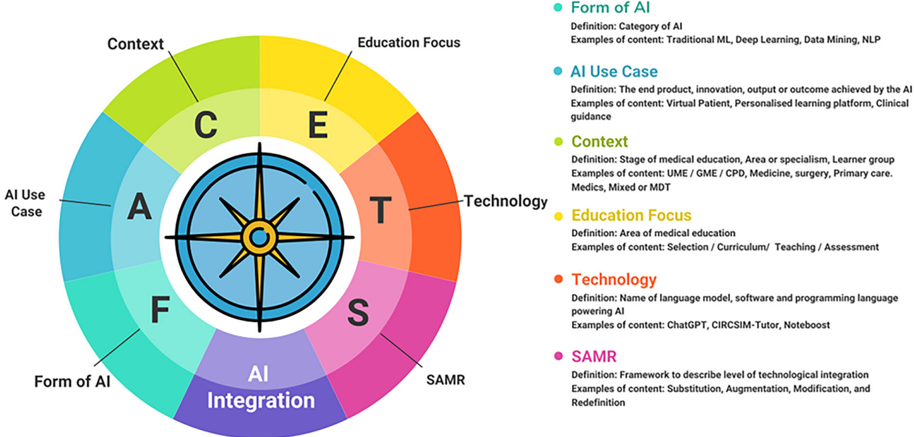
BACKGROUND: Artificial Intelligence (AI) is rapidly transforming healthcare, and there is a critical need for a nuanced understanding of how AI is reshaping teaching, learning, and educational practice in medical education. This review aimed to map the literature regarding AI applications in medical education, core areas of findings, potential candidates for formal systematic review and gaps for future research. METHODS: This rapid scoping review, conducted over 16 weeks, employed Arksey and O'Malley's framework and adhered to STORIES and BEME guidelines. A systematic and comprehensive search across PubMed/MEDLINE, EMBASE, and MedEdPublish was conducted without date or language restrictions. Publications included in the review spanned undergraduate, graduate, and continuing medical education, encompassing both original studies and perspective pieces. Data were charted by multiple author pairs and synthesized into various thematic maps and charts, ensuring a broad and detailed representation of the current landscape. RESULTS: The review synthesized 278 publications, with a majority (68%) from North American and European regions. The studies covered diverse AI applications in medical education, such as AI for admissions, teaching, assessment, and clinical reasoning. The review highlighted AI's varied roles, from augmenting traditional educational methods to introducing innovative practices, and underscores the urgent need for ethical guidelines in AI's application in medical education. CONCLUSION: The current literature has been charted. The findings underscore the need for ongoing research to explore uncharted areas and address potential risks associated with AI use in medical education. This work serves as a foundational resource for educators, policymakers, and researchers in navigating AI's evolving role in medical education. A framework to support future high utility reporting is proposed, the FACETS framework.
Overview
CoChat Summary
TL;DR
This BEME scoping review maps 278 publications on artificial intelligence in medical education, finding a publication surge since 2018 and diverse applications across admissions, teaching, assessment, clinical reasoning, and large language model exam performance. It proposes the FACETS framework and calls for ethical guidelines and further research.
Key findings
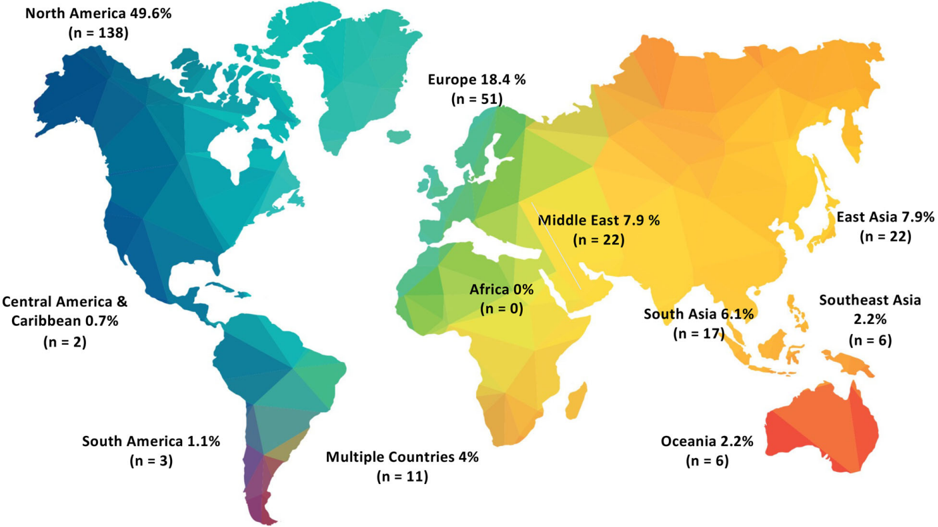
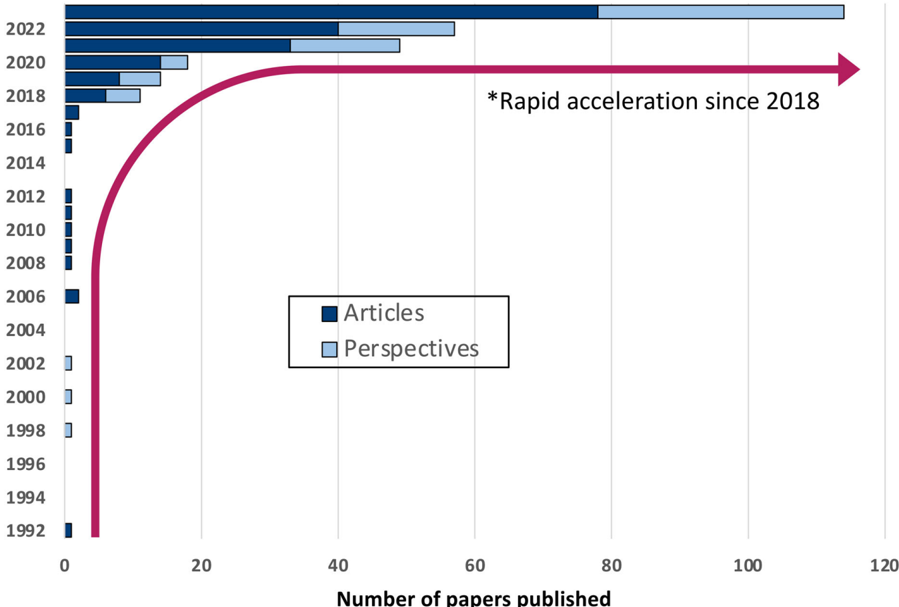
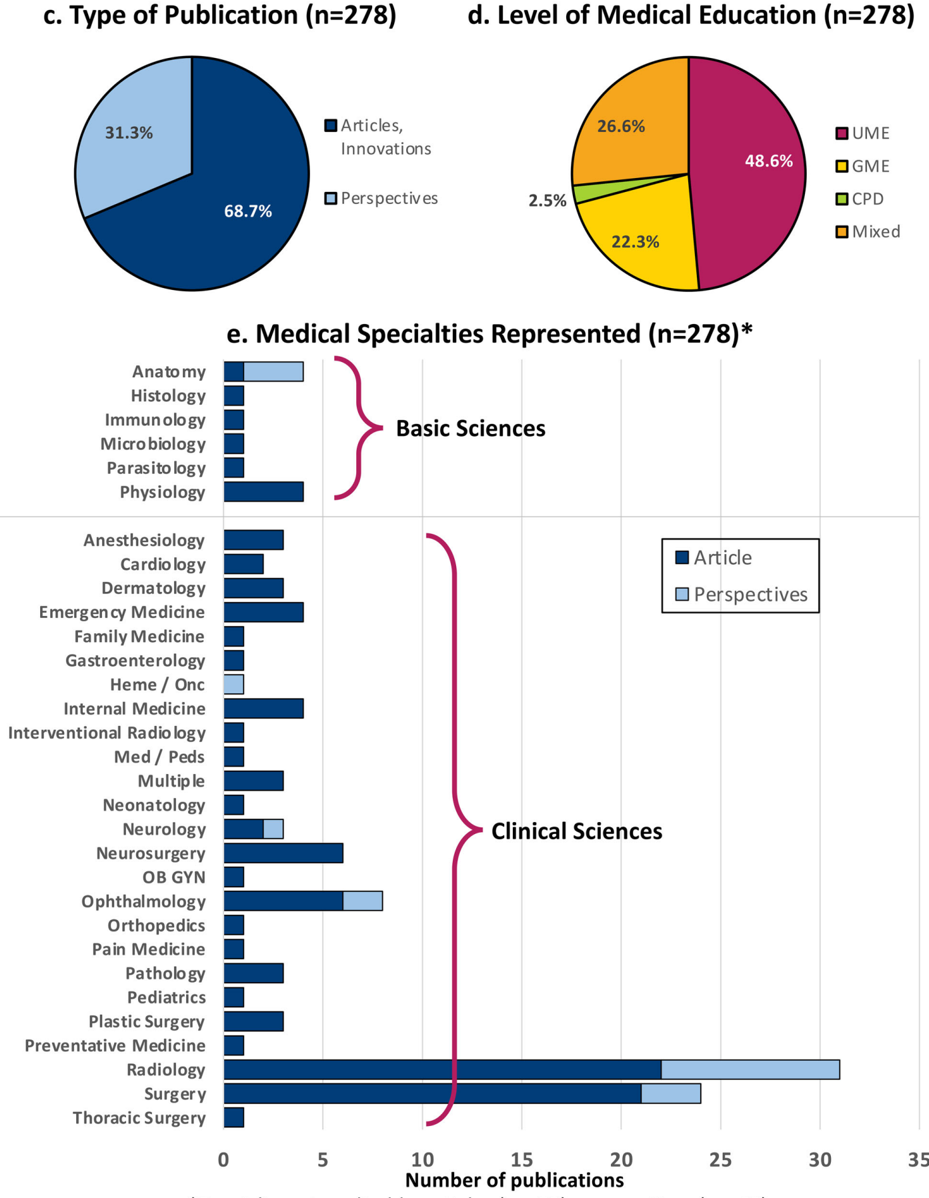
- The review included 278 publications: 191 (68.7%) articles/innovations and 87 (31.3%) perspectives. Geographic distribution was predominantly Anglo-North American (n = 138, 49.6%) and European (n = 51, 18.4%); no studies were identified from Africa. The earliest publication was in 1992, with a surge from 2018 onward and 114 publications as of August 2023.
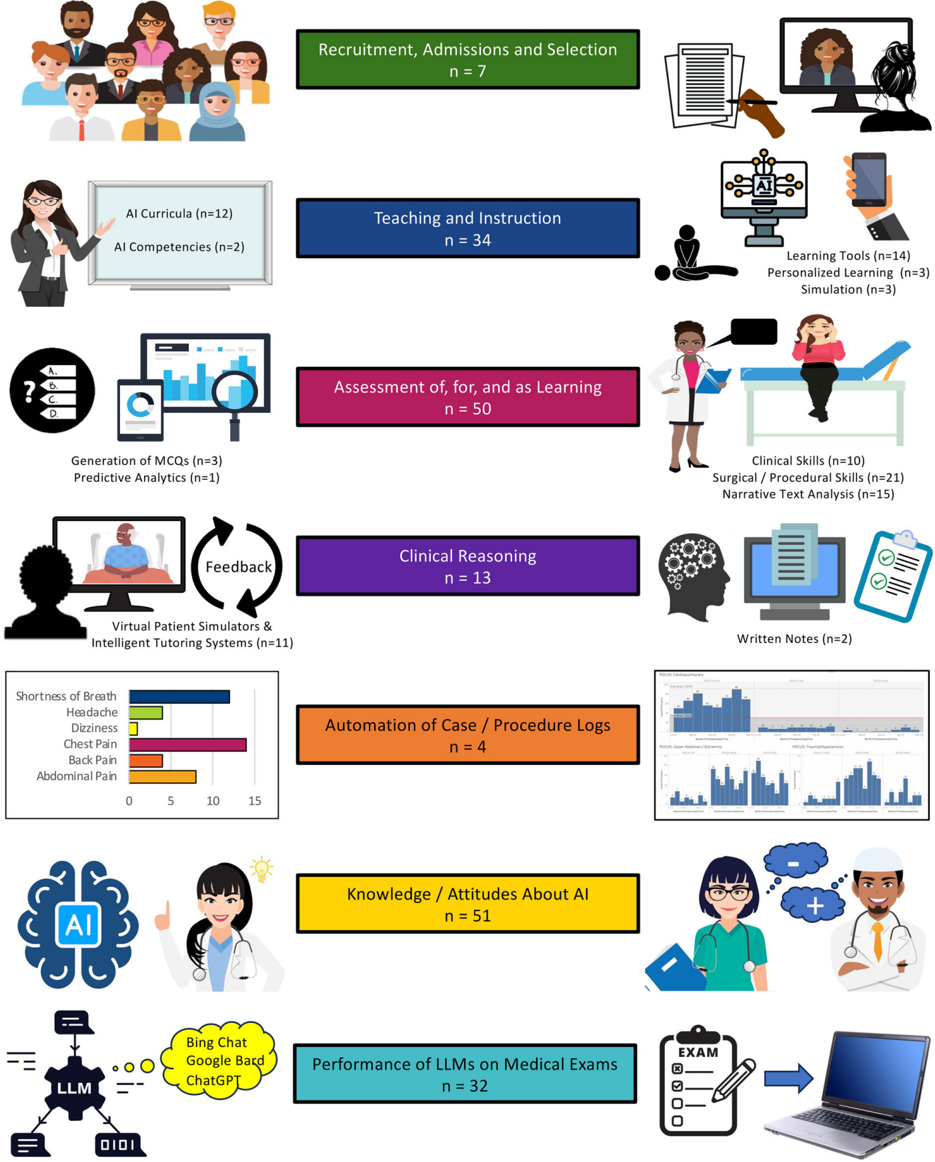
- AI applications included assessment (n = 50, 26.2%), knowledge/attitudes about AI (n = 51, 26.7%), teaching about AI or AI-augmented instruction (n = 34, 17.8%), LLM performance on medical exams (n = 32, 16.8%), clinical reasoning (n = 13, 6.8%), admissions/selection (n = 7, 3.6%), and automation of case/procedure logs (n = 4, 2.1%).
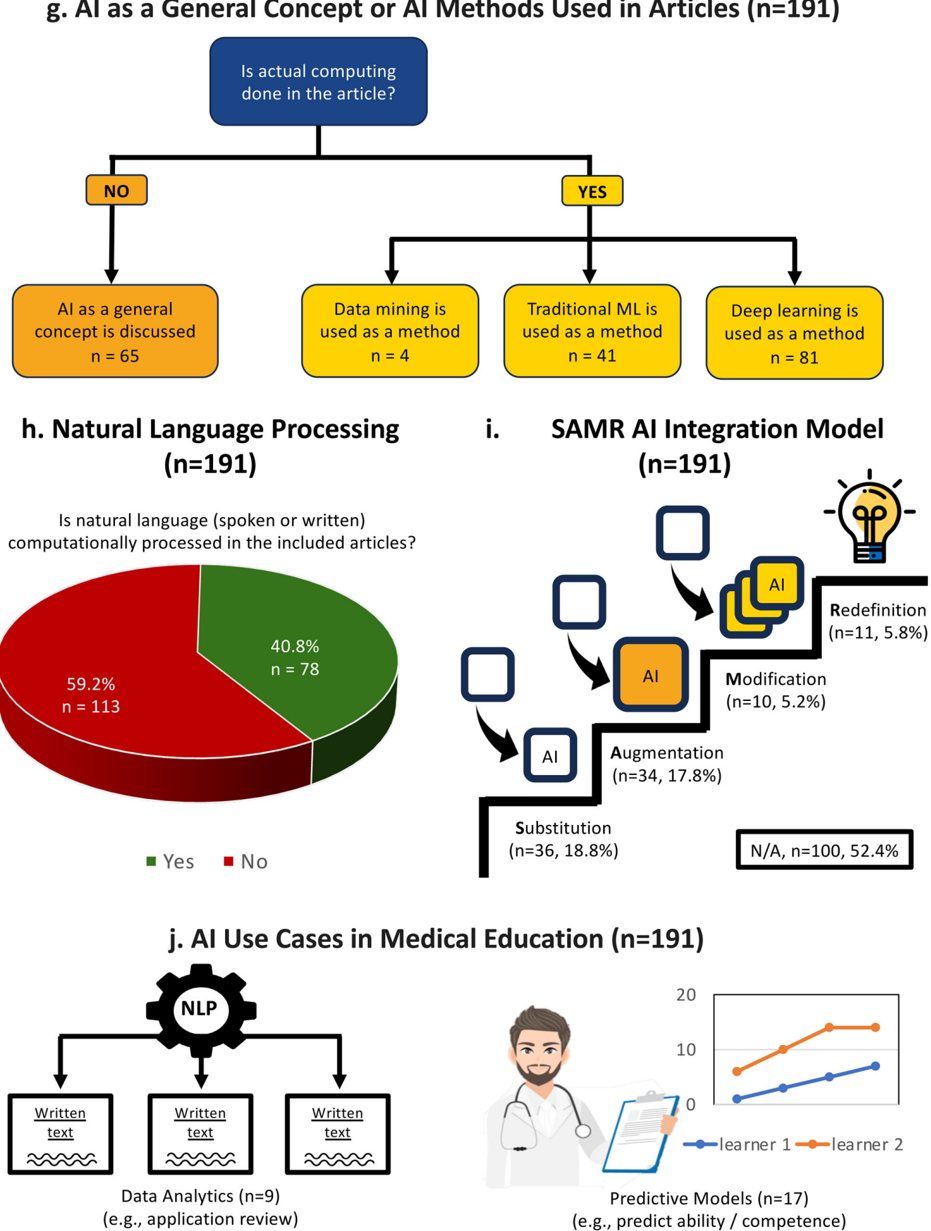
- Technical use varied: AI was treated as a general concept without computation in 65 studies (34%); traditional ML in 41 (21.5%), deep learning in 81 (42.4%), NLP in 78 (40.8%), and data mining in 4 (2.1%). Under SAMR, AI was substitution in 36 (18.8%), augmentation in 34 (17.8%), modification in 10 (5.2%), redefinition in 11 (5.8%), and not applicable in 100 (52.4%).
- LLM performance was variable: models scored at or above passing thresholds on some local, national, and specialty licensure exams but performed modestly or poorly on others; newer models generally outperformed older ones, though not universally, and performance was often better on English or translated questions (e.g., 22% accuracy in French vs. 73% in Italian). The review proposes the FACETS framework for future reporting.
Methods
- Rapid scoping review conducted over 16 weeks, guided by Arksey and O’Malley’s framework refined by Levac et al., and reported per STORIES, BEME guidance, and PRISMA-ScR.
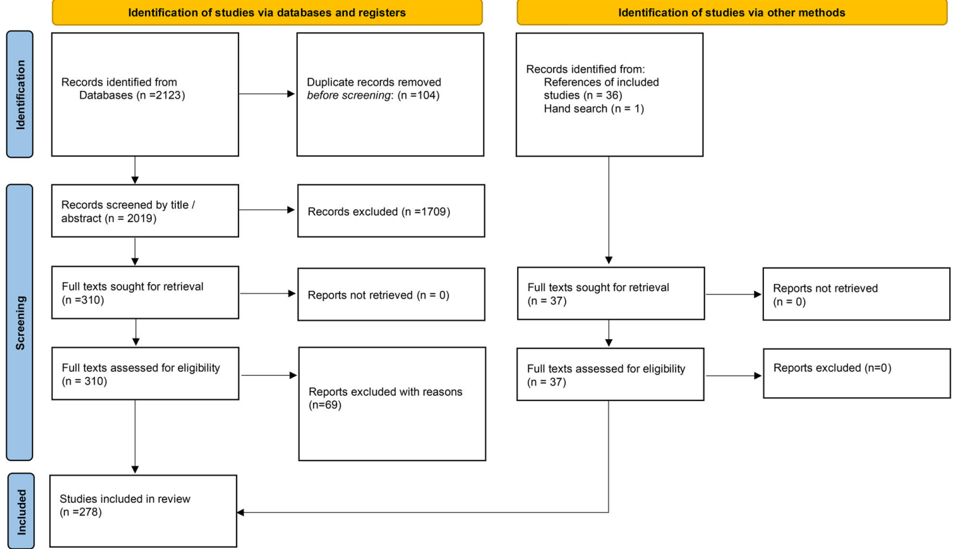
- Searched PubMed/MEDLINE, EMBASE, and MedEdPublish without date or language restrictions. The database search yielded 2,123 publications; after duplicate removal, 2,019 remained; title/abstract screening narrowed to 310; full-text review excluded 70; 241 were included; hand-searching added 37, yielding 278 total. Screening was by author pairs with discrepancies resolved by consensus or third author; inter-rater reliability was j = 0.86.
- Data were charted by multiple author pairs using a piloted extraction form. Articles/innovations and perspectives were charted separately and synthesized into thematic maps, charts, and narrative accounts; perspectives were categorized into five groups.
Limitations
- The paper states that the scoping tradition does not synthesize evidence; there was subjectivity in categorizing studies; terminology was inconsistent; the search was iterated and studies may have been missed; inclusion of perspective articles may be perceived as diluting empirical strength; and the sixth stage of the Arksey and O’Malley framework (external expert consultation) was not performed, though author-team experts fulfilled this role.
- The text also makes evident that the rapid 16-week timeframe and evolving AI literature may have limited comprehensiveness, and no studies were identified from Africa, indicating a geographic evidence gap.
Model-written summary. Check it against the paper before relying on it.
Integrity signals
Registry
Cites
Statistics
Figures



Verification
Claims the paper makes
9 Valid · 7 Not valid · 81 Not checked · 98 Own results and interpretations
A result the paper reports from its own data — it cites no other source for it, so there is none to check. The quote shows it is in the paper.
In the paper
“Other regions produced only a handful of studies and no studies were identified from Africa.”
§ A scoping review of artificial intelligence in medical education: BEME Guide No. 84 > Overview
plain- Asserted: passes — The authors put it forward as true.
- Checkable: passes — It can be checked against evidence.
- Load-bearing: unclear — It is unclear whether the paper’s conclusions depend on it.
- Based: passes — The paper gives a reason why it holds.
A result the paper reports from its own data — it cites no other source for it, so there is none to check. The quote shows it is in the paper.
In the paper
“A substantial portion (n ¼ 51, 26.7%) investigated knowledge or attitudes about AI in medicine (A109-A159), and the performance of large language models (LLMs) on medical questions or exams was evaluated in 32 (16.8%) of the studies (A160-A191.”
§ A scoping review of artificial intelligence in medical education: BEME Guide No. 84 > Articles and innovations included in the review
plain- Asserted: passes — The authors put it forward as true.
- Checkable: passes — It can be checked against evidence.
- Load-bearing: unclear — It is unclear whether the paper’s conclusions depend on it.
- Based: passes — The paper gives a reason why it holds.
A result the paper reports from its own data — it cites no other source for it, so there is none to check. The quote shows it is in the paper.
In the paper
“Most included publications fall under the category of articles or innovations (n ¼ 191, 68.7%), as defined above, with the remainder being perspectives (n ¼ 87, 31.3%).”
§ A scoping review of artificial intelligence in medical education: BEME Guide No. 84 > Overview
plainn = 191- Asserted: passes — The authors put it forward as true.
- Checkable: passes — It can be checked against evidence.
- Load-bearing: unclear — It is unclear whether the paper’s conclusions depend on it.
- Based: passes — The paper gives a reason why it holds.
In the paper
“Another study (A3) compared faculty scoring of medical student performance evaluations (MSPEs) to a machine learning (ML) model's scores.The ML model was unable to successfully rank MSPEs using commercially available sentiment analysis programs, largely because all MSPEs were highly positive.”
§ A scoping review of artificial intelligence in medical education: BEME Guide No. 84 > AI use in admissions and selection for medical school and residency
What the sources say
- Not matchedcites A3
This doesn’t read as a citation we can look up.
plainstates a cause- Asserted: passes — The authors put it forward as true.
- Checkable: passes — It can be checked against evidence.
- Load-bearing: unclear — It is unclear whether the paper’s conclusions depend on it.
- Based: passes — The paper gives a reason why it holds.
- Not matched
In the paper
“A total of thirty-three articles addressed teaching about or instruction with AI (A8-41).”
§ A scoping review of artificial intelligence in medical education: BEME Guide No. 84 > Teaching about AI and AI-augmented instruction
What the sources say
- Not matchedcites A8-41
This doesn’t read as a citation we can look up.
plain- Asserted: passes — The authors put it forward as true.
- Checkable: passes — It can be checked against evidence.
- Load-bearing: unclear — It is unclear whether the paper’s conclusions depend on it.
- Based: passes — The paper gives a reason why it holds.
- Not matched
55 more claims
Create a free account to see all 195 claims and to verify the 4 references still open.
- Probably not a substantial claim. 86
- It may state two separate claims as one. 84
- The quote only partly states this claim. 2
Claims other papers make about this one
Each is checked against this paper’s own text: does it say what the citing paper says it does?
The cited source doesn’t support the claim as written.
In the citing paper
“In fact, 161 reports on the use of AI in UGME were published from 2023 until April 2024, none of which were part of Gordon et al.’s analysis.”
From Artificial intelligence in undergraduate medical education: an updated scoping review (2025) · cites this paper as [8]
Checked by a reasoning model — may be wrong.
Experimental — accuracy not yet measuredThe source backs part of the claim, not all of it — or backs it for a different population, condition or comparison.
In the citing paper
“Concurrently, the scholarly literature concerning its application in medical education has expanded substantially, thereby fueling the demand for its integration into medical curricula [8, 9].”
From Artificial intelligence in undergraduate medical education: an updated scoping review (2025) · cites this paper as [8]
Experimental — accuracy not yet measuredThe source backs part of the claim, not all of it — or backs it for a different population, condition or comparison.
In the citing paper
“There is an increasing recognition that AI-related skills—such as computational thinking, data ethics, and interdisciplinary collaboration—cannot be taught as optional extras. They must be integrated into the fundamental structure of medical training [8–10].”
From Institutionalizing convergence education for medical artificial intelligence (2025) · cites this paper as [9]
Experimental — accuracy not yet measuredThe source backs part of the claim, not all of it — or backs it for a different population, condition or comparison.
In the citing paper
“Reviews and guidance documents on AI implementation in medical education consistently point to fragmented efforts and limited evidence.”
From Principles for Responsible AI in Health Professions Education, Research, and Care: Health CARE-AI (Contextual, Accountable, Responsible, and Equitable Artificial Intelligence) Framework Delphi Consensus Study (2026) · cites this paper as [2]
Experimental — accuracy not yet measuredThe cited source says what the claim attributes to it.
In the citing paper
“Despite enthusiasm about integrating AI in HPE and the increased amount of research on this topic, there is a lack of basic literacy and understanding of AI technology among HPE students [6, 17–20].”
From Shaping the future: perspectives on the Integration of Artificial Intelligence in health profession education: a multi-country survey (2024) · cites this paper as [18]
13 more claims about this paper
Create a free account to see every claim other papers make about this one.
Self-check
Percentages, sums and reported differences re-computed from the paper’s own numbers.
Each contradiction between two passages listed here was confirmed by an independent check.
Rated minor: it would not touch a result — a value no result rests on, a p-value that stays on the same side of the significance level, or a conflict that is clerical, resolved elsewhere in the paper, or outside its own findings.
In the paper
“East Asian (n ¼ 22, 7.9%), Middle Eastern (n ¼ 22, 7.6%), and South Asian (n ¼ 17, 6.1%)”
§ A scoping review of artificial intelligence in medical education: BEME Guide No. 84 > Overview
Reported 7.6 · recomputed 7.913669
Rated minor: it would not touch a result — a value no result rests on, a p-value that stays on the same side of the significance level, or a conflict that is clerical, resolved elsewhere in the paper, or outside its own findings.
In the paper
§ A scoping review of artificial intelligence in medical education: BEME Guide No. 84 > Articles and innovations included in the review
“34 (17.8%)focused on teaching about AI or AI-augmented instruction (A8-A41)”
§ A scoping review of artificial intelligence in medical education: BEME Guide No. 84 > Teaching about AI and AI-augmented instruction
“A total of thirty-three articles addressed teaching about or instruction with AI (A8-41).Of these, 12 focused on AI as a learning tool, 11 on curriculum development, three on AI use for personalized education, five on the use of AI in medical simulation, and two on AI educational competencies.”
Citations
Cites
PRISMA Extension for Scoping Reviews (PRISMA-ScR): Checklist and Explanation
Tricco, A. C., Lillie, E., Zarin, W., O'Brien, K. K., Colquhoun, H., Levac, D., Moher, D., Peters, M. D. J., Horsley, T., Weeks, L., et al. (2018) · Annals of Internal Medicine · doi:10.7326/m18-0850 · Cited by 43,565 · cited 1×
“We also conformed to the PRISMA-ScR reporting standards (Tricco et al. 2018), drawing on support from Peters et al. (2020, 2022) to offset the absence of specialized reporting standards for scoping reviews in health professions education.”
MethodScoping studies: towards a methodological framework
Arksey, H., & O'Malley, L. (2005) · International Journal of Social Research Methodology · doi:10.1080/1364557032000119616 · Cited by 36,742 · cited 2×
“Our methodology was guided by Arksey and O ’ Malley ’ s (2005) scoping review framework, which was refined by Levac et al. (2010).”
BackgroundMethodScoping studies: advancing the methodology
Levac, D., Colquhoun, H., & O'Brien, K. K. (2010) · Implementation Science · doi:10.1186/1748-5908-5-69 · Cited by 15,268 · cited 3×
“Our methodology was guided by Arksey and O ’ Malley ’ s (2005) scoping review framework, which was refined by Levac et al. (2010).”
BackgroundMethodUpdated methodological guidance for the conduct of scoping reviews
Peters, M. D. J., Marnie, C., Tricco, A. C., Pollock, D., Munn, Z., Alexander, L., McInerney, P., Godfrey, C. M., & Khalil, H. (2020) · JBI Evidence Synthesis · doi:10.11124/jbies-20-00167 · Cited by 9,046 · cited 1×
“We also conformed to the PRISMA-ScR reporting standards (Tricco et al. 2018), drawing on support from Peters et al. (2020, 2022) to offset the absence of specialized reporting standards for scoping reviews in health professions education.”
MethodKung, T. H., Cheatham, M., Medenilla, A., Sillos, C., De Leon, L., Elepaño, C., Madriaga, M., Aggabao, R., Diaz-Candido, G., Maningo, J., et al. (2023) · PLOS Digital Health · doi:10.1371/journal.pdig.0000198 · Cited by 4,115
Kung, T. H., Cheatham, M., ChatGPT, Medenilla, A., Sillos, C., De Leon, L., Elepaño, C., Madriaga, M., Aggabao, R., Diaz-Candido, G., et al. (2022) · doi:10.1101/2022.12.19.22283643 · Cited by 4,115
Teaching thematic analysis: Overcoming challenges and developing strategies for effective learning
Clarke, V., & Braun, V. (2013) · UWE Research Repository (UWE Bristol) · Cited by 2,820
Cultural Shock: Adjustment to New Cultural Environments
Oberg, K. (1960) · Practical Anthropology · doi:10.1177/009182966000700405 · Cited by 2,706
Gilson, A., Safranek, C. W., Huang, T., Socrates, V., Chi, L., Taylor, R. A., & Chartash, D. (2023) · JMIR Medical Education · doi:10.2196/45312 · Cited by 2,078
Best practice guidance and reporting items for the development of scoping review protocols
Peters, M. D. J., Godfrey, C., McInerney, P., Khalil, H., Larsen, P., Marnie, C., Pollock, D., Tricco, A. C., & Munn, Z. (2022) · JBI Evidence Synthesis · doi:10.11124/jbies-21-00242 · Cited by 1,444
Dave, T., Athaluri, S. A., & Singh, S. (2023) · Frontiers in Artificial Intelligence · doi:10.3389/frai.2023.1169595 · Cited by 1,204
Eysenbach, G. (2023) · JMIR Medical Education · doi:10.2196/46885 · Cited by 840
Theoretical models of culture shock and adaptation in international students in higher education
Zhou, Y., Jindal-Snape, D., Topping, K., & Todman, J. (2008) · Studies in Higher Education · doi:10.1080/03075070701794833 · Cited by 755 · cited 1×
“When considering the impact at such a broad environmental level, our analysis, viewed through the conceptual lens of Oberg ’ s theory of ‘ culture shock ’ (Oberg 1960; Zhou et al. 2008), aligns with the theory ’ s four phases: Honeymoon, Frustration, Adaptation, and Acceptance.”
MethodMedical students' attitude towards artificial intelligence: a multicentre survey
Pinto dos Santos, D., Giese, D., Brodehl, S., Chon, S. H., Staab, W., Kleinert, R., Maintz, D., & Baeßler, B. (2019) · European Radiology · doi:10.1007/s00330-018-5601-1 · Cited by 754
Large Language Models in Medical Education: Opportunities, Challenges, and Future Directions
Abd-alrazaq, A., AlSaad, R., Alhuwail, D., Ahmed, A., Healy, P. M., Latifi, S., Aziz, S., Damseh, R., Alabed Alrazak, S., & Sheikh, J. (2023) · JMIR Medical Education · doi:10.2196/48291 · Cited by 722
Jin, D., Pan, E., Oufattole, N., Weng, W.-H., Fang, H., & Szolovits, P. (2021) · Applied Sciences · doi:10.3390/app11146421 · Cited by 718
Jin, D., Pan, E., Oufattole, N., Weng, W.-H., Fang, H., & Szolovits, P. (2021) · doi:10.20944/preprints202105.0498.v1 · Cited by 718
Introducing artificial intelligence training in medical education
Paranjape, K., Schinkel, M., Nannan Panday, R., Car, J., & Nanayakkara, P. (2019) · JMIR Medical Education · doi:10.2196/16048 · Cited by 634
ChatGPT - Reshaping medical education and clinical management
Khan, R. A., Jawaid, M., Khan, A. R., & Sajjad, M. (2023) · Pakistan Journal of Medical Sciences · doi:10.12669/pjms.39.2.7653 · Cited by 628
Boscardin, C. K., Gin, B., Golde, P. B., & Hauer, K. E. (2024) · Academic Medicine · doi:10.1097/acm.0000000000005439 · Cited by 620
The rise of ChatGPT : Exploring its potential in medical education
Lee, H. (2024) · Anatomical Sciences Education · doi:10.1002/ase.2270 · Cited by 596
Medical Education Must Move From the Information Age to the Age of Artificial Intelligence
Wartman, S. A., & Combs, C. D. (2018) · Academic Medicine · doi:10.1097/acm.0000000000002044 · Cited by 585
Evaluating the Performance of ChatGPT in Ophthalmology
Antaki, F., Touma, S., Milad, D., El-Khoury, J., & Duval, R. (2023) · Ophthalmology Science · doi:10.1016/j.xops.2023.100324 · Cited by 563
Antaki, F., Touma, S., Milad, D., El-Khoury, J., & Duval, R. (2023) · doi:10.1101/2023.01.22.23284882 · Cited by 563
Artificial Intelligence Illuminated
Coppin, B. (2004) · Cited by 514
Sit, C., Srinivasan, R., Amlani, A., Muthuswamy, K., Azam, A., Monzon, L., & Poon, D. S. (2020) · Insights into Imaging · doi:10.1186/s13244-019-0830-7 · Cited by 507
Artificial intelligence in medical education
Masters, K. (2019) · Medical Teacher · doi:10.1080/0142159x.2019.1595557 · Cited by 469
Karaca, O., Çalışkan, S. A., & Demir, K. (2021) · BMC Medical Education · doi:10.1186/s12909-021-02546-6 · Cited by 377
Artificial intelligence in medical education: a cross-sectional needs assessment
Civaner, M. M., Uncu, Y., Bulut, F., Chalil, E. G., & Tatli, A. (2022) · BMC Medical Education · doi:10.1186/s12909-022-03852-3 · Cited by 363
Gong, B., Nugent, J. P., Guest, W., Parker, W., Chang, P. J., Khosa, F., & Nicolaou, S. (2019) · Academic Radiology · doi:10.1016/j.acra.2018.10.007 · Cited by 325
Artificial Intelligence in Undergraduate Medical Education: A Scoping Review
Lee, J., Wu, A. S., Li, D., & Kulasegaram, K. (. (2021) · Academic Medicine · doi:10.1097/acm.0000000000004291 · Cited by 324
Machine learning and medical education
Kolachalama, V. B., & Garg, P. S. (2018) · npj Digital Medicine · doi:10.1038/s41746-018-0061-1 · Cited by 320
Ethical use of Artificial Intelligence in Health Professions Education: AMEE Guide No. 158
Masters, K. (2023) · Medical Teacher · doi:10.1080/0142159x.2023.2186203 · Cited by 302
Gordon, M., Patricio, M., Horne, L., Muston, A., Alston, S. R., Pammi, M., Thammasitboon, S., Park, S., Pawlikowska, T., Rees, E. L., et al. (2020) · Medical Teacher · doi:10.1080/0142159x.2020.1807484 · Cited by 297 · cited 1×
“Despite the expedited process, we ensured systematicity, and maintained integrity and methodological precision, in line with prior publications (Gordon et al. 2020; Daniel et al. 2021).”
ResultSelf-citationMirchi, N., Bissonnette, V., Yilmaz, R., Ledwos, N., Winkler-Schwartz, A., & Del Maestro, R. F. (2020) · PLOS ONE · doi:10.1371/journal.pone.0229596 · Cited by 296
Fazlollahi, A. M., Bakhaidar, M., Alsayegh, A., Yilmaz, R., Winkler-Schwartz, A., Mirchi, N., Langleben, I., Ledwos, N., Sabbagh, A. J., Bajunaid, K., et al. (2022) · JAMA Network Open · doi:10.1001/jamanetworkopen.2021.49008 · Cited by 285
Huh, S. (2023) · Journal of Educational Evaluation for Health Professions · doi:10.3352/jeehp.2023.20.1 · Cited by 278
Wang, Z., & Majewicz Fey, A. (2018) · International Journal of Computer Assisted Radiology and Surgery · doi:10.1007/s11548-018-1860-1 · Cited by 275
Performance of ChatGPT and GPT-4 on Neurosurgery Written Board Examinations
Ali, R., Tang, O. Y., Connolly, I. D., Zadnik Sullivan, P. L., Shin, J. H., Fridley, J. S., Asaad, W. F., Cielo, D., Oyelese, A. A., Doberstein, C. E., et al. (2023) · Neurosurgery · doi:10.1227/neu.0000000000002632 · Cited by 273
ChatGPT passing USMLE shines a spotlight on the flaws of medical education
Mbakwe, A. B., Lourentzou, I., Celi, L. A., Mechanic, O. J., & Dagan, A. (2023) · PLOS Digital Health · doi:10.1371/journal.pdig.0000205 · Cited by 273
Performance of GPT-3.5 and GPT-4 on the Japanese Medical Licensing Examination: Comparison Study
Takagi, S., Watari, T., Erabi, A., & Sakaguchi, K. (2023) · JMIR Medical Education · doi:10.2196/48002 · Cited by 271
A Systematic Review on Healthcare Analytics: Application and Theoretical Perspective of Data Mining
Islam, M. S., Hasan, M. M., Wang, X., Germack, H. D., & Noor-E-Alam, M. (2018) · Healthcare · doi:10.3390/healthcare6020054 · Cited by 267 · cited 1×
“Whereas ML is concerned with assessing the ability of machines to make prospective decisions on heretofore-unseen data, DM instead tries to glean insights from full, known sets of previously collected data (Islam et al. 2018).”
BackgroundReimagining Medical Education in the Age of AI
(2019) · AMA Journal of Ethics · doi:10.1001/amajethics.2019.146 · Cited by 263
Wood, E. A., Ange, B. L., & Miller, D. D. (2021) · Journal of Medical Education and Curricular Development · doi:10.1177/23821205211024078 · Cited by 261
Ahuja, A. S., Polascik, B. W., Doddapaneni, D., Byrnes, E. S., & Sridhar, J. (2023) · Integrative Medicine Research · doi:10.1016/j.imr.2022.100917 · Cited by 256
On the Prospects for a (Deep) Learning Health Care System
Naylor, C. D. (2018) · JAMA · doi:10.1001/jama.2018.11103 · Cited by 250 · cited 1×
“However, these ‘ pre-trained ’ models can be ‘ customized ’ to new domains, such as MedEd, cheaply (Naylor 2018).”
BackgroundDaniel, M., Gordon, M., Patricio, M., Hider, A., Pawlik, C., Bhagdev, R., Ahmad, S., Alston, S., Park, S., Pawlikowska, T., et al. (2021) · Medical Teacher · doi:10.1080/0142159x.2020.1864310 · Cited by 246 · cited 1×
“Despite the expedited process, we ensured systematicity, and maintained integrity and methodological precision, in line with prior publications (Gordon et al. 2020; Daniel et al. 2021).”
ResultSelf-citationWhat do medical students actually need to know about artificial intelligence?
McCoy, L. G., Nagaraj, S., Morgado, F., Harish, V., Das, S., & Celi, L. A. (2020) · npj Digital Medicine · doi:10.1038/s41746-020-0294-7 · Cited by 240
Rojek, A. E., Khanna, R., Yim, J. W. L., Gardner, R., Lisker, S., Hauer, K. E., Lucey, C., & Sarkar, U. (2019) · Journal of General Internal Medicine · doi:10.1007/s11606-019-04889-9 · Cited by 240
The Role of Large Language Models in Medical Education: Applications and Implications
Safranek, C. W., Sidamon-Eristoff, A. E., Gilson, A., & Chartash, D. (2023) · JMIR Medical Education · doi:10.2196/50945 · Cited by 233
Bisdas, S., Topriceanu, C.-C., Zakrzewska, Z., Irimia, A.-V., Shakallis, L., Subhash, J., Casapu, M.-M., Leon-Rojas, J., Pinto dos Santos, D., Andrews, D. M., et al. (2021) · Frontiers in Public Health · doi:10.3389/fpubh.2021.795284 · Cited by 232
Conducting a best evidence systematic review. Part 1: From idea to data coding. BEME Guide No. 13
Hammick, M., Dornan, T., & Steinert, Y. (2010) · Medical Teacher · doi:10.3109/01421590903414245 · Cited by 230 · cited 1×
“In terms of reporting, we adhered to the STORIES statement (STructured apprOach to the Reporting In health-care education of Evidence Synthesis) (Gordon and Gibbs 2014) and BEME guidance (Hammick et al. 2010).”
MethodThe Advent of Generative Language Models in Medical Education
Karabacak, M., Ozkara, B. B., Margetis, K., Wintermark, M., & Bisdas, S. (2023) · JMIR Medical Education · doi:10.2196/48163 · Cited by 208
Ahmed, Z., Bhinder, K. K., Tariq, A., Tahir, M. J., Mehmood, Q., Tabassum, M. S., Malik, M., Aslam, S., Asghar, M. S., & Yousaf, Z. (2022) · Annals of Medicine & Surgery · doi:10.1016/j.amsu.2022.103493 · Cited by 208
Artificial intelligence for precision education in radiology
Duong, M. T., Rauschecker, A. M., Rudie, J. D., Chen, P.-H., Cook, T. S., Bryan, R. N., & Mohan, S. (2019) · The British Journal of Radiology · doi:10.1259/bjr.20190389 · Cited by 205
1. Introduction of machine learning
(2020) · Machine Learning and Visual Perception · doi:10.1515/9783110595567-002 · Cited by 202
Oh, N., Choi, G.-S., & Lee, W. Y. (2023) · Annals of Surgical Treatment and Research · doi:10.4174/astr.2023.104.5.269 · Cited by 201
What should medical students know about artificial intelligence in medicine?
Park, S. H., Do, K.-H., Kim, S., Park, J. H., & Lim, Y.-S. (2019) · Journal of Educational Evaluation for Health Professions · doi:10.3352/jeehp.2019.16.18 · Cited by 196
Cheung, B. H. H., Lau, G. K. K., Wong, G. T. C., Lee, E. Y. P., Kulkarni, D., Seow, C. S., Wong, R., & Co, M. T.-H. (2023) · PLOS ONE · doi:10.1371/journal.pone.0290691 · Cited by 195
Applicability of ChatGPT in Assisting to Solve Higher Order Problems in Pathology
Sinha, R. K., Deb Roy, A., Kumar, N., & Mondal, H. (2023) · Cureus · doi:10.7759/cureus.35237 · Cited by 187
Moldt, J.-A., Festl-Wietek, T., Madany Mamlouk, A., Nieselt, K., Fuhl, W., & Herrmann-Werner, A. (2023) · Medical Education Online · doi:10.1080/10872981.2023.2182659 · Cited by 186
Swed, S., Alibrahim, H., Elkalagi, N. K. H., Nasif, M. N., Rais, M. A., Nashwan, A. J., Aljabali, A., Elsayed, M., Sawaf, B., Albuni, M. K., et al. (2022) · Frontiers in Artificial Intelligence · doi:10.3389/frai.2022.1011524 · Cited by 185
Banerjee, M., Chiew, D., Patel, K. T., Johns, I., Chappell, D., Linton, N., Cole, G. D., Francis, D. P., Szram, J., Ross, J., et al. (2021) · BMC Medical Education · doi:10.1186/s12909-021-02870-x · Cited by 168
Medical Student Perspectives on the Impact of Artificial Intelligence on the Practice of Medicine
Park, C. J., Yi, P. H., & Siegel, E. L. (2021) · Current Problems in Diagnostic Radiology · doi:10.1067/j.cpradiol.2020.06.011 · Cited by 167
Needs, Challenges, and Applications of Artificial Intelligence in Medical Education Curriculum
Grunhut, J., Marques, O., & Wyatt, A. T. M. (2022) · JMIR Medical Education · doi:10.2196/35587 · Cited by 166
Grunhut, J., Wyatt, A. T., & Marques, O. (2021) · Journal of Medical Education and Curricular Development · doi:10.1177/23821205211036836 · Cited by 161
ChatGPT Performs on the Chinese National Medical Licensing Examination
Wang, X., Gong, Z., Wang, G., Jia, J., Xu, Y., Zhao, J., Fan, Q., Wu, S., Hu, W., & Li, X. (2023) · Journal of Medical Systems · doi:10.1007/s10916-023-01961-0 · Cited by 157
Humar, P., Asaad, M., Bengur, F. B., & Nguyen, V. (2023) · Aesthetic Surgery Journal · doi:10.1093/asj/sjad130 · Cited by 155
Investigating Students’ Perceptions towards Artificial Intelligence in Medical Education
Buabbas, A. J., Miskin, B., Alnaqi, A. A., Ayed, A. K., Shehab, A. A., Syed-Abdul, S., & Uddin, M. (2023) · Healthcare · doi:10.3390/healthcare11091298 · Cited by 152
STORIES statement: Publication standards for healthcare education evidence synthesis
Gordon, M., & Gibbs, T. (2014) · BMC Medicine · doi:10.1186/s12916-014-0143-0 · Cited by 146 · cited 1×
“In terms of reporting, we adhered to the STORIES statement (STructured apprOach to the Reporting In health-care education of Evidence Synthesis) (Gordon and Gibbs 2014) and BEME guidance (Hammick et al. 2010).”
MethodSelf-citationMehta, N., Harish, V., Bilimoria, K., Morgado, F., Ginsburg, S., Law, M., & Das, S. (2021) · MedEdPublish · doi:10.15694/mep.2021.000075.1 · Cited by 145
Jha, N., Shankar, P. R., Al-Betar, M. A., Mukhia, R., Hada, K., & Palaian, S. (2022) · Advances in Medical Education and Practice · doi:10.2147/amep.s368519 · Cited by 143
Machine Learning Definition and Basics
Rebala, G., Ravi, A., & Churiwala, S. (2019) · Springer eBooks · doi:10.1007/978-3-030-15729-6_1 · Cited by 140 · cited 2×
“Examples: logistic regression, support vector machines, decision trees, K-nearest neighbors, gradient boosted machines (Gopinath and Churiwala 2019).”
BackgroundMethodSuchman, K., Garg, S., & Trindade, A. J. (2023) · American Journal of Gastroenterology · doi:10.14309/ajg.0000000000002320 · Cited by 139
Pucchio, A., Rathagirishnan, R., Caton, N., Gariscsak, P. J., Del Papa, J., Nabhen, J. J., Vo, V., Lee, W., & Moraes, F. Y. (2022) · BMC Medical Education · doi:10.1186/s12909-022-03896-5 · Cited by 138
Collado-Mesa, F., Alvarez, E., & Arheart, K. (2018) · Journal of the American College of Radiology · doi:10.1016/j.jacr.2017.12.021 · Cited by 137
ChatGPT takes on the European Exam in Core Cardiology: an artificial intelligence success story?
Skalidis, I., Cagnina, A., Luangphiphat, W., Mahendiran, T., Muller, O., Abbe, E., & Fournier, S. (2023) · European Heart Journal - Digital Health · doi:10.1093/ehjdh/ztad029 · Cited by 128
The need for health AI ethics in medical school education
Katznelson, G., & Gerke, S. (2021) · Advances in Health Sciences Education · doi:10.1007/s10459-021-10040-3 · Cited by 125
AI and Medical Education — A 21st-Century Pandora’s Box
Cooper, A., & Rodman, A. (2023) · New England Journal of Medicine · doi:10.1056/nejmp2304993 · Cited by 124
Lee, D., Yu, H. W., Kwon, H., Kong, H., Lee, K. E., & Kim, H. C. (2020) · Journal of Clinical Medicine · doi:10.3390/jcm9061964 · Cited by 124
Guerra, G. A., Hofmann, H., Sobhani, S., Hofmann, G., Gomez, D., Soroudi, D., Hopkins, B. S., Dallas, J., Pangal, D. J., Cheok, S., et al. (2023) · World Neurosurgery · doi:10.1016/j.wneu.2023.08.042 · Cited by 123
ChatGPT in medical school: how successful is AI in progress testing?
Friederichs, H., Friederichs, W. J., & März, M. (2023) · Medical Education Online · doi:10.1080/10872981.2023.2220920 · Cited by 122
Teaching, Learning and Assessing Anatomy with Artificial Intelligence: The Road to a Better Future
Abdellatif, H., Al Mushaiqri, M., Albalushi, H., Al-Zaabi, A. A., Roychoudhury, S., & Das, S. (2022) · International Journal of Environmental Research and Public Health · doi:10.3390/ijerph192114209 · Cited by 120
van Hoek, J., Huber, A., Leichtle, A., Härmä, K., Hilt, D., von Tengg-Kobligk, H., Heverhagen, J., & Poellinger, A. (2019) · European Journal of Radiology · doi:10.1016/j.ejrad.2019.108742 · Cited by 120
Ooi, S., Makmur, A., Soon, Y., Fook-Chong, S., Liew, C., Sia, D., Ting, Y., & Lim, C. (2021) · Singapore Medical Journal · doi:10.11622/smedj.2019141 · Cited by 118
Loh, E. (2024) · BMJ Leader · doi:10.1136/leader-2023-000797 · Cited by 116
Das, D., Kumar, N., Longjam, L. A., Sinha, R., Deb Roy, A., Mondal, H., & Gupta, P. (2023) · Cureus · doi:10.7759/cureus.36034 · Cited by 116
Artificial intelligence in medical education curriculum: An e-Delphi study for competencies
Çalışkan, S. A., Demir, K., & Karaca, O. (2022) · PLOS ONE · doi:10.1371/journal.pone.0271872 · Cited by 115
Li, S., Miles, K., George, R., Ertubey, C., Pype, P. F., & Liu, J. (2023) · Medical Teacher · doi:10.1080/0142159x.2023.2174419 · Cited by 114
Competencies for the Use of Artificial Intelligence in Primary Care
Liaw, W., Kueper, J. K., Lin, S., Bazemore, A., & Kakadiaris, I. (2022) · The Annals of Family Medicine · doi:10.1370/afm.2887 · Cited by 113
Initial impressions of ChatGPT for anatomy education
Mogali, S. R. (2024) · Anatomical Sciences Education · doi:10.1002/ase.2261 · Cited by 113
(2022) · doi:10.2196/34973 · Cited by 113
Implications of artificial intelligence for medical education
Rampton, V., Mittelman, M., & Goldhahn, J. (2020) · The Lancet Digital Health · doi:10.1016/s2589-7500(20)30023-6 · Cited by 112
A Systematic Review of Natural Language Processing in Healthcare
Department of Computer Science, A. C. O. E., Iroju, O. G., & Olaleke, J. O. (2015) · International Journal of Information Technology and Computer Science · doi:10.5815/ijitcs.2015.08.07 · Cited by 111 · cited 1×
“ChatGPT, for example, is NLP/ML (specifically deep learning), because it is a deep machine-learning artificial neural network which processes natural language (Iroju and Olaleke 2015). used a comprehensive search strategy with both controlled vocabulary (e.g. MeSH terms) and keywords.”
BackgroundRevolutionizing Medical Education: Can ChatGPT Boost Subjective Learning and Expression?
Seetharaman, R. (2023) · Journal of Medical Systems · doi:10.1007/s10916-023-01957-w · Cited by 106
Ejaz, H., McGrath, H., Wong, B. L., Guise, A., Vercauteren, T., & Shapey, J. (2022) · DIGITAL HEALTH · doi:10.1177/20552076221089099 · Cited by 105
Western Australian medical students’ attitudes towards artificial intelligence in healthcare
Stewart, J., Lu, J., Gahungu, N., Goudie, A., Fegan, P. G., Bennamoun, M., Sprivulis, P., & Dwivedi, G. (2023) · PLOS ONE · doi:10.1371/journal.pone.0290642 · Cited by 104
Practical Applications of ChatGPT in Undergraduate Medical Education
Tsang, R. (2023) · Journal of Medical Education and Curricular Development · doi:10.1177/23821205231178449 · Cited by 104
Roos, J., Kasapovic, A., Jansen, T., & Kaczmarczyk, R. (2023) · JMIR Medical Education · doi:10.2196/46482 · Cited by 98
Schneider, M., Bartko, P., Geller, W., Dannenberg, V., König, A., Binder, C., Goliasch, G., Hengstenberg, C., & Binder, T. (2021) · The International Journal of Cardiovascular Imaging · doi:10.1007/s10554-020-02046-6 · Cited by 98
Tajmir, S. H., & Alkasab, T. K. (2018) · Academic Radiology · doi:10.1016/j.acra.2018.03.007 · Cited by 94
Grounded in reality: artificial intelligence in medical education
Krive, J., Isola, M., Chang, L., Patel, T., Anderson, M., & Sreedhar, R. (2023) · JAMIA Open · doi:10.1093/jamiaopen/ooad037 · Cited by 93
Are physicians and medical students ready for artificial intelligence applications in healthcare?
AlZaabi, A., AlMaskari, S., & AalAbdulsalam, A. (2023) · DIGITAL HEALTH · doi:10.1177/20552076231152167 · Cited by 93
Surgical data science and artificial intelligence for surgical education
Ward, T. M., Mascagni, P., Madani, A., Padoy, N., Perretta, S., & Hashimoto, D. A. (2021) · Journal of Surgical Oncology · doi:10.1002/jso.26496 · Cited by 92
Bin Dahmash, A., Alabdulkareem, M., Alfutais, A., Kamel, A. M., Alkholaiwi, F., Alshehri, S., Al Zahrani, Y., & Almoaiqel, M. (2020) · BJR|Open · doi:10.1259/bjro.20200037 · Cited by 92
Doumat, G., Daher, D., Ghanem, N.-N., & Khater, B. (2022) · Frontiers in Artificial Intelligence · doi:10.3389/frai.2022.1015418 · Cited by 91
Liu, D. S., Sawyer, J., Luna, A., Aoun, J., Wang, J., Boachie, L., Halabi, S., & Joe, B. (2022) · JMIR Medical Education · doi:10.2196/38325 · Cited by 90
Giannos, P. (2023) · BMJ Neurology Open · doi:10.1136/bmjno-2023-000451 · Cited by 89
Busch, F., Adams, L. C., & Bressem, K. K. (2023) · Medical Science Educator · doi:10.1007/s40670-023-01815-x · Cited by 88
Tran, A. Q., Nguyen, L. H., Nguyen, H. S. A., Nguyen, C. T., Vu, L. G., Zhang, M., Vu, T. M. T., Nguyen, S. H., Tran, B. X., Latkin, C. A., et al. (2021) · Frontiers in Public Health · doi:10.3389/fpubh.2021.755644 · Cited by 87
Artificial intelligence-based education assists medical students’ interpretation of hip fracture
Cheng, C.-T., Chen, C.-C., Fu, C.-Y., Chaou, C.-H., Wu, Y.-T., Hsu, C.-P., Chang, C.-C., Chung, I.-F., Hsieh, C.-H., Hsieh, M.-J., et al. (2020) · Insights into Imaging · doi:10.1186/s13244-020-00932-0 · Cited by 87
Li, X., Jiang, M. Y.-C., Jong, M. S.-Y., Zhang, X., & Chai, C.-S. (2022) · International Journal of Environmental Research and Public Health · doi:10.3390/ijerph19148733 · Cited by 87
Evaluating the performance of ChatGPT in medical physiology university examination of phase I MBBS
Mahila, S., Jaleel, I., & Surapaneni, K. M. (2023) · AJP Advances in Physiology Education · doi:10.1152/advan.00036.2023 · Cited by 83
Bakshi, S. K., Lin, S. R., Ting, D. S. W., Chiang, M. F., & Chodosh, J. (2021) · British Journal of Ophthalmology · doi:10.1136/bjophthalmol-2020-316845 · Cited by 81
Blease, C., Kharko, A., Bernstein, M., Bradley, C., Houston, M., Walsh, I., Hägglund, M., DesRoches, C., & Mandl, K. D. (2022) · BMJ Health & Care Informatics · doi:10.1136/bmjhci-2021-100480 · Cited by 81
Proof of Concept: Using ChatGPT to Teach Emergency Physicians How to Break Bad News
Webb, J. J. (2023) · Cureus · doi:10.7759/cureus.38755 · Cited by 80
AI in medical education—another grand challenge for medical informatics
Lillehaug, S.-I., & Lajoie, S. P. (1998) · Artificial Intelligence in Medicine · doi:10.1016/s0933-3657(97)00054-7 · Cited by 78
Masters, K. (2023) · Medical Teacher · doi:10.1080/0142159x.2023.2208731 · Cited by 76
Meo, S. A., Al-Masri, A. A., Alotaibi, M., Meo, M. Z. S., & Meo, M. O. S. (2023) · Healthcare · doi:10.3390/healthcare11142046 · Cited by 74
Artificial Intelligence and Radiology Education
Tejani, A. S., Elhalawani, H., Moy, L., Kohli, M., & Kahn, C. E. (2023) · Radiology: Artificial Intelligence · doi:10.1148/ryai.220084 · Cited by 74
Gillissen, A., Kochanek, T., Zupanic, M., & Ehlers, J. (2022) · Healthcare · doi:10.3390/healthcare10040723 · Cited by 74
Agarwal, M., Sharma, P., & Goswami, A. (2023) · Cureus · doi:10.7759/cureus.40977 · Cited by 72
Panthier, C., & Gatinel, D. (2023) · Journal Français d'Ophtalmologie · doi:10.1016/j.jfo.2023.05.006 · Cited by 72
Woo, C. W., Evens, M. W., Freedman, R., Glass, M., Shim, L. S., Zhang, Y., Zhou, Y., & MICHAEL, J. A. (2005) · Artificial Intelligence in Medicine · doi:10.1016/j.artmed.2005.10.004 · Cited by 72
Maicher, K. R., Zimmerman, L., Wilcox, B., Liston, B., Cronau, H., Macerollo, A., Jin, L., Jaffe, E., White, M., Fosler-Lussier, E., et al. (2019) · Medical Teacher · doi:10.1080/0142159x.2019.1616683 · Cited by 72
Weidener, L., & Fischer, M. (2023) · JMIR Medical Education · doi:10.2196/46428 · Cited by 70
The future surgical training paradigm: Virtual reality and machine learning in surgical education
Rogers, M. P., DeSantis, A. J., Janjua, H., Barry, T. M., & Kuo, P. C. (2021) · Surgery · doi:10.1016/j.surg.2020.09.040 · Cited by 70
The Emerging Role of Generative Artificial Intelligence in Medical Education, Research, and Practice
Shoja, M. M., Van de Ridder, J. M. M., & Rajput, V. (2023) · Cureus · doi:10.7759/cureus.40883 · Cited by 69
Kiyasseh, D., Laca, J., Haque, T. F., Miles, B. J., Wagner, C., Donoho, D. A., Anandkumar, A., & Hung, A. J. (2023) · Communications Medicine · doi:10.1038/s43856-023-00263-3 · Cited by 69
Alonso-Silverio, G. A., Pérez-Escamirosa, F., Bruno-Sanchez, R., Ortiz-Simon, J. L., Muñoz-Guerrero, R., Minor-Martinez, A., & Alarcón-Paredes, A. (2018) · Surgical Innovation · doi:10.1177/1553350618777045 · Cited by 68
Qualitative exploration of digital chatbot use in medical education: A pilot study
Kaur, A., Singh, S., Chandan, J. S., Robbins, T., & Patel, V. (2021) · DIGITAL HEALTH · doi:10.1177/20552076211038151 · Cited by 67
Kawka, M., Gall, T., Fang, C., Liu, R., & Jiao, L. R. (2021) · Intelligent Surgery · doi:10.1016/j.isurg.2021.03.001 · Cited by 67
Furlan, R., Gatti, M., Menè, R., Shiffer, D., Marchiori, C., Giaj Levra, A., Saturnino, V., Brunetta, E., & Dipaola, F. (2021) · JMIR Medical Informatics · doi:10.2196/24073 · Cited by 67
Rahimzadeh, V., Kostick-Quenet, K., Blumenthal Barby, J., & McGuire, A. L. (2023) · The American Journal of Bioethics · doi:10.1080/15265161.2023.2233358 · Cited by 66
Burk-Rafel, J., Reinstein, I., Feng, J., Kim, M. B., Miller, L. H., Cocks, P. M., Marin, M., & Aphinyanaphongs, Y. (2021) · Academic Medicine · doi:10.1097/acm.0000000000004317 · Cited by 65 · cited 1×
“Educators have also become more excited by AI, as recent landmark works have highlighted the power of AI to enhance assessment (e.g. Schaye et al. 2022), and make educational processes such as admissions and selection more efficient (e.g. Burk-Rafel et al. 2021).”
BackgroundPRAG: Paninian Retrieval-Augmented Generation for Safety-Critical Medical Question Answering
Jin, D., Pan, E., Oufattole, N., Weng, W., Fang, H., & Peter Szolovits, B. (2020) · arXiv (Cornell University) · doi:10.48550/arxiv.2009.13081 · Cited by 63
Medical students need artificial intelligence and machine learning training
Pucchio, A., Eisenhauer, E. A., & Moraes, F. Y. (2021) · Nature Biotechnology · doi:10.1038/s41587-021-00846-2 · Cited by 61
ChatGPT and the future of medical education
Feng, S., & Shen, Y. (2023) · Academic Medicine · doi:10.1097/acm.0000000000005242 · Cited by 61
Dumić-Čule, I., Orešković, T., Brkljačić, B., Kujundžić Tiljak, M., & Orešković, S. (2020) · Croatian Medical Journal · doi:10.3325/cmj.2020.61.457 · Cited by 61
Alfertshofer, M., Hoch, C. C., Funk, P. F., Hollmann, K., Wollenberg, B., Knoedler, S., & Knoedler, L. (2024) · Annals of Biomedical Engineering · doi:10.1007/s10439-023-03338-3 · Cited by 60
Impact of artificial intelligence on US medical students' choice of radiology
Reeder, K., & Lee, H. (2022) · Clinical Imaging · doi:10.1016/j.clinimag.2021.09.018 · Cited by 60
Medical Students’ Knowledge and Attitude Towards Artificial Intelligence: An Online Survey
Al Saad, M. M., Shehadeh, A., Alanazi, S., Alenezi, M., Abu alez, A., Eid, H., Alfaouri, M. S., Aldawsari, S., & Alenezi, R. (2022) · The Open Public Health Journal · doi:10.2174/18749445-v15-e2203290 · Cited by 60
Using a Machine Learning Architecture to Create an AI-Powered Chatbot for Anatomy Education
Li, Y. S., Lam, C. S. N., & See, C. (2021) · Medical Science Educator · doi:10.1007/s40670-021-01405-9 · Cited by 59
Impact of Artificial Intelligence on Medical Education in Ophthalmology
Valikodath, N. G., Cole, E., Ting, D. S. W., Campbell, J. P., Pasquale, L. R., Chiang, M. F., Chan, R. V. P., & on behalf of the American Academy of Ophthalmology Task Force on Artificial Intelligence (2021) · Translational Vision Science & Technology · doi:10.1167/tvst.10.7.14 · Cited by 59
Insights from teaching artificial intelligence to medical students in Canada
Hu, R., Fan, K. Y., Pandey, P., Hu, Z., Yau, O., Teng, M., Wang, P., Li, T., Ashraf, M., & Singla, R. (2022) · Communications Medicine · doi:10.1038/s43856-022-00125-4 · Cited by 58
Machine Learning: The Next Paradigm Shift in Medical Education
James, C. A., Wheelock, K. M., & Woolliscroft, J. O. (2021) · Academic Medicine · doi:10.1097/acm.0000000000003943 · Cited by 58
Wiggins, W. F., Caton, M. T., Magudia, K., Glomski, S.-H. A., George, E., Rosenthal, M. H., Gaviola, G. C., & Andriole, K. P. (2020) · Radiology: Artificial Intelligence · doi:10.1148/ryai.2020200057 · Cited by 56
Aye, AI! ChatGPT passes multiple-choice family medicine exam
Morreel, S., Mathysen, D., & Verhoeven, V. (2023) · Medical Teacher · doi:10.1080/0142159x.2023.2187684 · Cited by 56
On Artificial Intelligence and Deep Learning Within Medical Education
Carin, L. (2020) · Academic Medicine · doi:10.1097/acm.0000000000003630 · Cited by 56
Artificial intelligence in medical education: Are we ready for it?
Imran, N., & Jawaid, M. (2020) · Pakistan Journal of Medical Sciences · doi:10.12669/pjms.36.5.3042 · Cited by 56
Lower, K., Seth, I., Lim, B., & Seth, N. (2023) · Indian Journal of Orthopaedics · doi:10.1007/s43465-023-00967-7 · Cited by 56
Automatically rating trainee skill at a pediatric laparoscopic suturing task
Oquendo, Y. A., Riddle, E. W., Hiller, D., Blinman, T. A., & Kuchenbecker, K. J. (2018) · Surgical Endoscopy · doi:10.1007/s00464-017-5873-6 · Cited by 56
Smartpathk: a platform for teaching glomerulopathies using machine learning
Aldeman, N. L. S., de Sá Urtiga Aita, K. M., Machado, V. P., da Mata Sousa, L. C. D., Coelho, A. G. B., da Silva, A. S., da Silva Mendes, A. P., de Oliveira Neres, F. J., & do Monte, S. J. H. (2021) · BMC Medical Education · doi:10.1186/s12909-021-02680-1 · Cited by 56
Sarraf, D., Vasiliu, V., Imberman, B., & Lindeman, B. (2021) · The American Journal of Surgery · doi:10.1016/j.amjsurg.2021.09.034 · Cited by 56
Gibbons, C., Richards, S., Valderas, J. M., & Campbell, J. (2017) · Journal of Medical Internet Research · doi:10.2196/jmir.6533 · Cited by 55
Xie, Y., Seth, I., Hunter‐Smith, D. J., Rozen, W. M., & Seifman, M. A. (2024) · ANZ Journal of Surgery · doi:10.1111/ans.18666 · Cited by 55
Ayub, I., Hamann, D., Hamann, C. R., & Davis, M. J. (2023) · Cureus · doi:10.7759/cureus.43717 · Cited by 53
The cases for and against artificial intelligence in the medical school curriculum
Ngo, B., Nguyen, D., & vanSonnenberg, E. (2022) · Radiology: Artificial Intelligence · doi:10.1148/ryai.220074 · Cited by 53
Human visual explanations mitigate bias in AI-based assessment of surgeon skills
Kiyasseh, D., Laca, J., Haque, T. F., Otiato, M., Miles, B. J., Wagner, C., Donoho, D. A., Trinh, Q.-D., Anandkumar, A., & Hung, A. J. (2023) · npj Digital Medicine · doi:10.1038/s41746-023-00766-2 · Cited by 53
Wang, M., Sun, Z., Jia, M., Wang, Y., Wang, H., Zhu, X., Chen, L., & Ji, H. (2022) · BMC Medical Informatics and Decision Making · doi:10.1186/s12911-022-01797-7 · Cited by 52
Mehta, N., Harish, V., Bilimoria, K., et al. (2021) · medRxiv · doi:10.1101/2021.01.14.21249830 · Cited by 52
ARTIFICIAL INTELLIGENCE: MEDICAL STUDENT S ATTITUDE IN DISTRICT PESHAWAR PAKISTAN
Abid, S., Awan, B., Ismail, T., Sarwar, N., Sarwar, G., Tariq, M., Naz, S., Ahmed, A., Farhan, M., Uzair, M., et al. (2019) · Pakistan Journal of Public Health · doi:10.32413/pjph.v9i1.295 · Cited by 51
Harnessing the Power of Big Data to Improve Graduate Medical Education: Big Idea or Bust?
Arora, V. M. (2018) · Academic Medicine · doi:10.1097/acm.0000000000002209 · Cited by 49
El Saadawi, G. M., Tseytlin, E., Legowski, E., Jukic, D., Castine, M., Fine, J., Gormley, R., & Crowley, R. S. (2008) · Advances in Health Sciences Education · doi:10.1007/s10459-007-9081-3 · Cited by 48
Performance of ChatGPT on free-response, clinical reasoning exams
Strong, E., DiGiammarino, A., Weng, Y., Basaviah, P., Hosamani, P., Kumar, A., Nevins, A., Kugler, J., Hom, J., & Chen, J. H. (2023) · medRxiv · doi:10.1101/2023.03.24.23287731 · Cited by 48
Ötleş, E., Kendrick, D. E., Solano, Q. P., Schuller, M., Ahle, S. L., Eskender, M. H., Carnes, E., & George, B. C. (2021) · Academic Medicine · doi:10.1097/acm.0000000000004153 · Cited by 48
Natural Language Processing and Assessment of Resident Feedback Quality
Solano, Q. P., Hayward, L., Chopra, Z., Quanstrom, K., Kendrick, D., Abbott, K. L., Kunzmann, M., Ahle, S., Schuller, M., Ötleş, E., et al. (2021) · Journal of Surgical Education · doi:10.1016/j.jsurg.2021.05.012 · Cited by 48
Denny, J. C., Spickard, A., Speltz, P., Porier, R., Rosenstiel, D., & Powers, J. S. (2015) · Journal of Biomedical Informatics · doi:10.1016/j.jbi.2015.06.004 · Cited by 48
The Evolving Importance of Artificial Intelligence and Radiology in Medical Trainee Education
Fischetti, C., Bhatter, P., Frisch, E., Sidhu, A., Helmy, M., Lungren, M., & Duhaime, E. (2022) · Academic Radiology · doi:10.1016/j.acra.2021.03.023 · Cited by 47
Menon, A., Gaglani, S. M., Haynes, M. R., & Tackett, S. A. (2017) · Medical Teacher · doi:10.1080/0142159x.2017.1324949 · Cited by 46
Qian, X., Jingying, H., Xian, S., Zhao, Y., Wu, L., Baorui, C., Guo, W., Yefeng, Z., Zhang, Q., Chunyan, C., et al. (2022) · Frontiers in Public Health · doi:10.3389/fpubh.2022.1025271 · Cited by 46
Can ChatGPT pass the thoracic surgery exam?
Gencer, A., & Aydin, S. (2023) · The American Journal of the Medical Sciences · doi:10.1016/j.amjms.2023.08.001 · Cited by 46
Kumah-Crystal, Y., Mankowitz, S., Embi, P., & Lehmann, C. U. (2023) · Journal of the American Medical Informatics Association · doi:10.1093/jamia/ocad104 · Cited by 44
Schaye, V., Guzman, B., Burk-Rafel, J., Marin, M., Reinstein, I., Kudlowitz, D., Miller, L., Chun, J., & Aphinyanaphongs, Y. (2022) · Journal of General Internal Medicine · doi:10.1007/s11606-022-07526-0 · Cited by 44 · cited 1×
“Educators have also become more excited by AI, as recent landmark works have highlighted the power of AI to enhance assessment (e.g. Schaye et al. 2022), and make educational processes such as admissions and selection more efficient (e.g. Burk-Rafel et al. 2021).”
BackgroundWhat could we make of AI in plastic surgery education
Koljonen, V. (2023) · Journal of Plastic, Reconstructive & Aesthetic Surgery · doi:10.1016/j.bjps.2023.04.055 · Cited by 44
The potential of latent semantic analysis for machine grading of clinical case summaries
Kintsch, W. (2002) · Journal of Biomedical Informatics · doi:10.1016/s1532-0464(02)00004-7 · Cited by 44
How will artificial intelligence change medical training?
Kundu, S. (2021) · Communications Medicine · doi:10.1038/s43856-021-00003-5 · Cited by 43
Impact of the Rise of Artificial Intelligence in Radiology: What Do Students Think?
Barreiro-Ares, A., Morales-Santiago, A., Sendra-Portero, F., & Souto-Bayarri, M. (2023) · International Journal of Environmental Research and Public Health · doi:10.3390/ijerph20021589 · Cited by 42
Hedderich, D. M., Keicher, M., Wiestler, B., Gruber, M. J., Burwinkel, H., Hinterwimmer, F., Czempiel, T., Spiro, J. E., Pinto dos Santos, D., Heim, D., et al. (2021) · Healthcare · doi:10.3390/healthcare9101278 · Cited by 42
Tsopra, R., Peiffer-Smadja, N., Charlier, C., Campeotto, F., Lemogne, C., Ruszniewski, P., Vivien, B., & Burgun, A. (2023) · International Journal of Medical Informatics · doi:10.1016/j.ijmedinf.2022.104980 · Cited by 42
An Artificial Intelligence Training Workshop for Diagnostic Radiology Residents
Hu, R., Rizwan, A. P., Hu, Z., Li, A., Chung, A. D., & Kwan, B. Y. M. (2023) · Radiology Artificial Intelligence · doi:10.1148/ryai.220170 · Cited by 42
Self-citationDesigning and building OSCEBot ® for virtual OSCE – Performance evaluation
Pereira, D. S. M., Falcão, F., Nunes, A., Santos, N., Costa, P., & Pêgo, J. M. (2023) · Medical Education Online · doi:10.1080/10872981.2023.2228550 · Cited by 42
Hamza, D. M., Hauer, K. E., Oswald, A., van Melle, E., Ladak, Z., Zuna, I., Assefa, M. E., Pelletier, G. N., Sebastianski, M., Keto-Lambert, D., et al. (2023) · Medical Teacher · doi:10.1080/0142159x.2023.2168525 · Cited by 41 · cited 1×
“…is mirrored in the diverse origin of publications with almost a third from regions outside of the traditional North American or European academic hubs, more than found in most recently published BEME reviews (Daniel et al. 2022; Doyle et al. 2023; Hamza et al. 2023; Li S et al. 2023).”
BackgroundFinding the Place of ChatGPT in Medical Education
van de Ridder, J. M. M., Shoja, M. M., & Rajput, V. (2023) · Academic Medicine · doi:10.1097/acm.0000000000005254 · Cited by 41
The impact of Chat Generative Pre-trained Transformer (ChatGPT) on medical education
Heng, J. J. Y., Teo, D. B., & Tan, L. F. (2023) · Postgraduate Medical Journal · doi:10.1093/postmj/qgad058 · Cited by 40
Natheir, S., Christie, S., Yilmaz, R., Winkler-Schwartz, A., Bajunaid, K. M., Sabbagh, A. J., Werthner, P., Fares, J., Azarnoush, H., & Maestro, R. F. D. (2022) · Computers in Biology and Medicine · doi:10.1016/j.compbiomed.2022.106286 · Cited by 40
Nagaraj, M. B., Namazi, B., Sankaranarayanan, G., & Scott, D. J. (2023) · Surgical Endoscopy · doi:10.1007/s00464-022-09509-y · Cited by 40
Moglia, A., Morelli, L., D’Ischia, R., Fatucchi, L. M., Pucci, V., Berchiolli, R., Ferrari, M., & Cuschieri, A. (2022) · Surgical Endoscopy · doi:10.1007/s00464-021-08999-6 · Cited by 40
Oliven, A., Nave, R., Gilad, D., & Barch, A. (2011) · Studies in Health Technology and Informatics · doi:10.3233/978-1-60750-806-9-233 · Cited by 40
Machine learning to extract communication and history‐taking skills in OSCE transcripts
Jani, K. H., Jones, K. A., Jones, G. W., Amiel, J., Barron, B., & Elhadad, N. (2020) · Medical Education · doi:10.1111/medu.14347 · Cited by 39
Perceptions and attitudes of medical students regarding artificial intelligence in dermatology
Cho, S. I., Han, B., Hur, K., & Mun, J. ‐. (2021) · Journal of the European Academy of Dermatology and Venereology · doi:10.1111/jdv.16812 · Cited by 39
Challenges of Radiology education in the era of artificial intelligence
Gorospe‐Sarasúa, L., Muñoz-Olmedo, J. M., Sendra‐Portero, F., & de Luis-García, R. (2022) · Radiología (English Edition) · doi:10.1016/j.rxeng.2020.10.012 · Cited by 39
A smarter perspective: Learning with and from AI-cases
Arbelaez Ossa, L., Rost, M., Lorenzini, G., Shaw, D. M., & Elger, B. S. (2023) · Artificial Intelligence in Medicine · doi:10.1016/j.artmed.2022.102458 · Cited by 39
Borchert, R. J., Hickman, C. R., Pepys, J., & Sadler, T. J. (2023) · JMIR Medical Education · doi:10.2196/48978 · Cited by 39
Dr. ChatGPT: Utilizing Artificial Intelligence in Surgical Education
Lebhar, M. S., Velazquez, A. E., Goza, S. D., & Hoppe, I. C. (2023) · The Cleft Palate-Craniofacial Journal · doi:10.1177/10556656231193966 · Cited by 39
Medical students’ perceptions of the impact of artificial intelligence in radiology
Galán, G. C., & Sendra‐Portero, F. (2022) · Radiología (English Edition) · doi:10.1016/j.rxeng.2021.03.008 · Cited by 39
Cross, J., Robinson, R., Devaraju, S., Vaughans, A., Hood, R., Kayalackakom, T., Honnavar, P., Naik, S., & Sebastian, R. (2023) · Cureus · doi:10.7759/cureus.41399 · Cited by 38
A machine learning approach to predict surgical learning curves
Gao, Y., Kruger, U., Intes, X., Schwaitzberg, S., & De, S. (2020) · Surgery · doi:10.1016/j.surg.2019.10.008 · Cited by 38
Ebina, K., Abe, T., Hotta, K., Higuchi, M., Furumido, J., Iwahara, N., Kon, M., Miyaji, K., Shibuya, S., Lingbo, Y., et al. (2022) · Langenbeck's Archives of Surgery · doi:10.1007/s00423-022-02505-9 · Cited by 38
Keir, G., Hu, W., Filippi, C. G., Ellenbogen, L., & Woldenberg, R. (2023) · JAMIA Open · doi:10.1093/jamiaopen/ooad011 · Cited by 37
Cited by
Feigerlova, E., Hani, H., & Hothersall-Davies, E. (2025) · BMC Medical Education · doi:10.1186/s12909-025-06719-5 · Cited by 166
Mapping the use of artificial intelligence in medical education: a scoping review
Rincón, E. H. H., Jimenez, D., Aguilar, L. A. C., Flórez, J. M. P., Tapia, Á. E. R., & Peñuela, C. L. J. (2025) · BMC Medical Education · doi:10.1186/s12909-025-07089-8 · Cited by 145
“…and Natural Language Processing to grade and provide feedback on clinical cases, and AI-powered Chatbots that help students review medical literature, prepare for exams like the United States Medical Licensing Examination (USMLE), and develop critical thinking and communication skills [14].”
Pham, T. D., Karunaratne, N., Exintaris, B., Liu, D., Lay, T., Yuriev, E., & Lim, A. (2025) · Medical Education · doi:10.1111/medu.15746 · Cited by 100
“2,18,19 22 GenAI has disrupted traditional educational approaches, necessitating their reassessment to ensure effective and responsible use of GenAI.”
Ahsan, Z. (2025) · BMC Medical Education · doi:10.1186/s12909-025-07744-0 · Cited by 143
“Techniques like machine learning, natural language processing (NLP), neural networks, and large language models (LLMs) are being utilized to create virtual patient simulations, automate assessments, provide personalized learning feedback, and predict learner outcomes [2].”
Izquierdo-Condoy, J. S., Arias-Intriago, M., Tello-De-la-Torre, A., Busch, F., & Ortiz-Prado, E. (2025) · Journal of Medical Internet Research · doi:10.2196/76340 · Cited by 87
Metadata
- Authors
- Gordon, M., Daniel, M., Ajiboye, A., Uraiby, H., Xu, N. Y., Bartlett, R., Hanson, J., Haas, M., Spadafore, M., Grafton-Clarke, C., Gasiea, R. Y., Michie, C., Corral, J., Kwan, B., Dolmans, D., & Thammasitboon, S.
- Affiliations
- University of Lancashire (GB)
- University of California San Diego (US)
- University Hospitals of Leicester NHS Trust (GB)
- Washington University in St. Louis (US)
- University of Michigan (US)
- University of East Anglia
- Blackpool Teaching Hospitals NHS Foundation Trust (GB)
- University of Nevada, Reno (US)
- Maastricht University (NL)
- Baylor College of Medicine (US)
- Corresponding author
- Gordon, Morris
- ORCID
- Venue
- Medical Teacher
- Publisher
- Informa UK Limited
- Published
- 2024-02-29
- Volume
- 46
- Issue
- 4
- Pages
- 446-470
- ISSN
- 0142-159X (ISSN-L)
- 1466-187X
- OpenAlex
- W4392769984
- Semantic Scholar
- a222625d335b1ff3beda12ff8d029df8702c9861
- Cited by
- 679
- References
- 306
- Citations by year
- 2026: 395 · 2025: 238 · 2024: 43
- FWCI
- 12.88
- Type
- journal article
- Language
- en
- Open access
- hybrid
- doi.org
- Licence
- Locations
- Medical Teacher (publishedVersion, cc-by-nc-nd)
- PubMed (publishedVersion)
- CLOK (University of Central Lancashire) (submittedVersion)
- Digital Commons-TMC (Texas Medical Center) (submittedVersion)
- Digital Commons@Becker (Washington University School of Medicine) (submittedVersion, cc-by-nc-nd)
- Research Publications (Maastricht University) (submittedVersion, cc-by-nc-nd)
- eScholarship (California Digital Library) (submittedVersion)
- Topics
- Health Sciences › Medicine › Health Informatics › Artificial Intelligence in Healthcare and Education
- Social Sciences › Education › Innovations in Medical Education
- Social Sciences › Education › Artificial Intelligence in Education
- Keywords
- artificial intelligence, medical education, AI-assisted assessment, clinical reasoning, AI ethics, reporting framework, continuing medical education, undergraduate medical education, graduate medical education
- MeSH terms
- Artificial Intelligence, Education, Medical, Humans, Learning, Teaching
About these checks
Registry, retraction, Cites and statistics results are computed, not judged, with one exception: a printed reference that no index lists is read once by a model before it counts as a citation error. Claims are extracted by a model and kept only when their quote appears verbatim in the text; each cited source is then checked, with a model’s help, for whether it says what the claim relies on. Those verdicts can be wrong — read the claim’s quote and the cited source before relying on one.
The claim verdicts this report counts are experimental: their accuracy is not yet measured.
A language model drew the claims from the paper on 2026-10-05, under version 3 of the claim definition (model deepseek-v4.1-flash, prompt extract-v3).
A second model labelled each claim on 2026-10-05 (model jev-1.13-20260917, definition revision gold-guideline-v0.2).
Statistics and arithmetic are recomputed, not judged.
Confidence bands are shown only for fields calibrated on our annotated test set. None is calibrated yet, so no band is shown.
What counts as a claim ›How we measure confidence ›How we check this ›
Are you an author, or do you see a problem with this page? Request a review
Data sources
Bibliographic data: Semantic Scholar, OpenAlex, Crossref.
Contains information from the Semantic Scholar Academic Graph Datasets, made available under the ODC Attribution License (ODC-BY 1.0).
Semantic Scholar’s data is described in: Kinney, R., et al. (2023). The Semantic Scholar Open Data Platform. arXiv:2301.10140.
