

The DOI matches its Crossref record; 263 of the 263 references it cites were found in a registry or an index; none of the 200 sources its claims cite is checked for support yet.
Exoplanet Biosignatures: A Framework for Their Assessment
Open accessAbstract
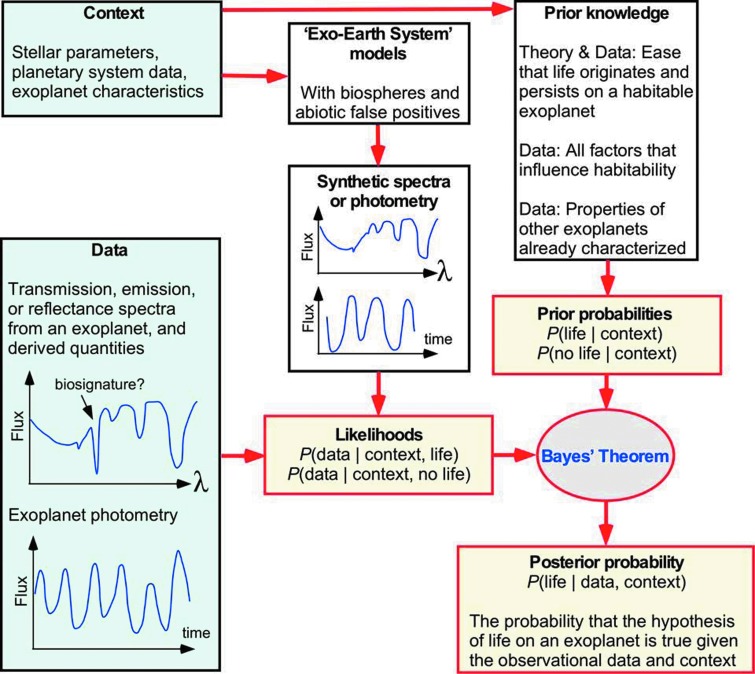
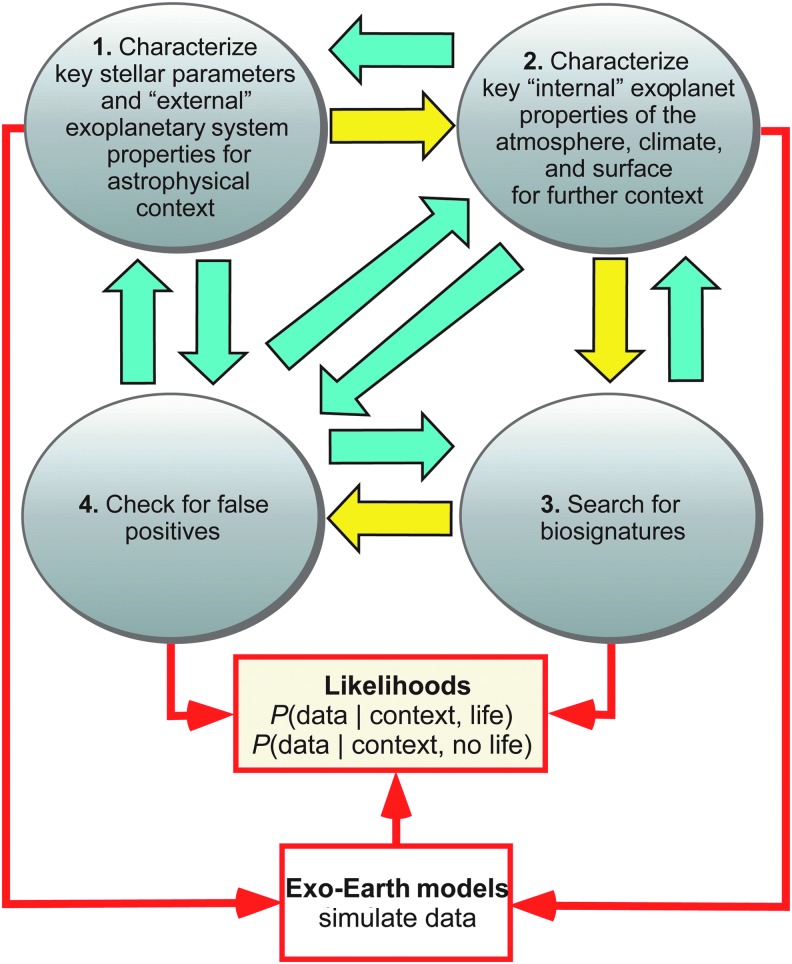
Finding life on exoplanets from telescopic observations is an ultimate goal of exoplanet science. Life produces gases and other substances, such as pigments, which can have distinct spectral or photometric signatures. Whether or not life is found with future data must be expressed with probabilities, requiring a framework of biosignature assessment. We present a framework in which we advocate using biogeochemical "Exo-Earth System" models to simulate potential biosignatures in spectra or photometry. Given actual observations, simulations are used to find the Bayesian likelihoods of those data occurring for scenarios with and without life. The latter includes "false positives" wherein abiotic sources mimic biosignatures. Prior knowledge of factors influencing planetary inhabitation, including previous observations, is combined with the likelihoods to give the Bayesian posterior probability of life existing on a given exoplanet. Four components of observation and analysis are necessary. (1) Characterization of stellar (e.g., age and spectrum) and exoplanetary system properties, including "external" exoplanet parameters (e.g., mass and radius), to determine an exoplanet's suitability for life. (2) Characterization of "internal" exoplanet parameters (e.g., climate) to evaluate habitability. (3) Assessment of potential biosignatures within the environmental context (components 1-2), including corroborating evidence. (4) Exclusion of false positives. We propose that resulting posterior Bayesian probabilities of life's existence map to five confidence levels, ranging from "very likely" (90-100%) to "very unlikely" (<10%) inhabited. Key Words: Bayesian statistics-Biosignatures-Drake equation-Exoplanets-Habitability-Planetary science. Astrobiology 18, 709-738.
Overview
AI snapshot
Written from the paper’s full text.
TL;DR
The paper proposes a Bayesian framework for assessing exoplanet biosignatures, combining prior knowledge about habitability with likelihoods of spectral or photometric data under scenarios with and without life. It outlines four observational/analytical components and maps posterior probabilities of life to five qualitative confidence levels.
Key findings
- The framework’s central quantity is \(P(\text{life} \mid \text{data, context})\), calculated from priors \(P(\text{life} \mid C)\) and likelihoods \(P(D \mid C, \text{life})\) and \(P(D \mid C, \text{no life})\), where the latter includes abiotic false positives.
- In an illustrative example with prior \(P(\text{life} \mid C)=0.5\), \(P(D \mid C,\text{life})=0.80\), and \(P(D \mid C,\text{no life})=0.25\), the posterior is \(0.76 \equiv 76\%\).
- The authors propose five confidence levels for life detection: Level 1 “very likely inhabited” 90–100%, Level 2 “likely inhabited” 66–100%, Level 3 “about as likely as not inhabited” 33–66%, Level 4 “likely uninhabited” 0–33%, and Level 5 “very likely uninhabited” 0–10%.
- The four required components are: (1) stellar and external exoplanetary system properties, (2) internal exoplanet atmosphere/climate/surface properties, (3) search for potential biosignatures in data, and (4) exclusion of false positives.
Methods
- Conceptual and statistical framework paper, not an empirical exoplanet observation study; it develops Bayes’ theorem for biosignature assessment and discusses required observations and models.
- It advocates using biogeochemical “Exo-Earth System” models to simulate potential biosignatures in spectra or photometry and to estimate Bayesian likelihoods with and without life.
- It reviews desirable stellar, planetary, atmospheric, and surface parameters; candidate gaseous and surface biosignatures; and false-positive scenarios, with illustrative examples rather than new data analysis.
Limitations
- The paper states that current knowledge of priors such as \(P(\text{life} \mid \text{Earth-like})\) is highly uncertain, ranging from life being very common to very rare, and that extraterrestrial life has not yet been detected.
- It states that many false-positive scenarios and surface biosignature assessments remain unresolved; for example, “a quantitative framework for evaluating surface biosignatures remains unclear,” and the confidence-level examples are “purely illustrative.”
- Evident from the text: the framework is not tested on real exoplanet data, relies on future models and observations, and its posterior probabilities cannot yet be quantified for specific exoplanets without detailed calculations.
Model-written summary. Check it against the paper before relying on it.
Integrity signals
Registry
Cites
Statistics
Figures
Verification
Claims the paper makes
116 Not checked yet · 104 Own interpretation · 46 No basis given
In the paper
“Consequently, the distinction between inhabitation and habitability can become blurred (Goldblatt, 2016).”
§ Exoplanet Biosignatures: A Framework for Their Assessment > 2. A Bayesian Framework for Biosignature Assessment and Life Detection
What the sources say
- Not checked yetcites Goldblatt, 2016
plaincorrelational- Asserted: passes — The authors put it forward as true.
- Checkable: passes — It can be checked against evidence.
- Load-bearing: passes — The paper’s conclusions depend on it.
- Based: passes — The paper gives a reason why it holds.
In the paper
“The probability P(life | context) shown in Figure 1 refers to a particular exoplanet under observation but is related to the term fl in the Drake equation that applies to an ensemble of exoplanets (Des Marais, 2015).”
§ Exoplanet Biosignatures: A Framework for Their Assessment > 2. A Bayesian Framework for Biosignature Assessment and Life Detection
What the sources say
- Not checked yetcites Des Marais, 2015
plaincorrelational- Asserted: passes — The authors put it forward as true.
- Checkable: passes — It can be checked against evidence.
- Load-bearing: unclear — It is unclear whether the paper’s conclusions depend on it.
- Based: passes — The paper gives a reason why it holds.
None of the sources cited for this claim have been checked yet.
In the paper
“Regarding habitability, the ubiquitous concept of the HZ is built upon the assumption that P(life | C) is higher where the context is an exoplanet orbiting within a certain range of star–planet distances (Kasting et al., 1993; Kasting, 1997; Kopparapu et al., 2013).”
§ Exoplanet Biosignatures: A Framework for Their Assessment > 2. A Bayesian Framework for Biosignature Assessment and Life Detection
What the sources say
- Not checked yetcites Kasting et al., 1993
- Not checked yetcites Kasting, 1997
- Not checked yetcites Kopparapu et al., 2013
plaincorrelational- Asserted: passes — The authors put it forward as true.
- Checkable: passes — It can be checked against evidence.
- Load-bearing: passes — The paper’s conclusions depend on it.
- Based: passes — The paper gives a reason why it holds.
In the paper
“On Earth, the biosphere modulates all the major atmospheric gases, such as O2 and N2, and most trace gases with the exception of noble gases (e.g., Catling and Kasting, 2017).”
§ Exoplanet Biosignatures: A Framework for Their Assessment > 2. A Bayesian Framework for Biosignature Assessment and Life Detection
What the sources say
- Not checked yetcites Catling and Kasting, 2017
plaindirect- Asserted: passes — The authors put it forward as true.
- Checkable: passes — It can be checked against evidence.
- Load-bearing: passes — The paper’s conclusions depend on it.
- Based: passes — The paper gives a reason why it holds.
A conclusion the paper draws from its own results — it cites no other source for it, so there is none to check. The quote shows it is in the paper.
In the paper
“This Bayesian insight cautions us that exoplanet data might be overoptimistically interpreted to indicate the presence of life, if life is actually very rare in the galaxy.”
§ Exoplanet Biosignatures: A Framework for Their Assessment > 2. A Bayesian Framework for Biosignature Assessment and Life Detection
hedgedconditional- Asserted: passes — The authors put it forward as true.
- Checkable: passes — It can be checked against evidence.
- Load-bearing: passes — The paper’s conclusions depend on it.
- Based: passes — The paper gives a reason why it holds.
None of the sources cited for this claim have been checked yet.
In the paper
“The conventional limits of the HZ are calculated with an Earth-like climate assumed to arise from a CO2–H2O-rich atmosphere.”
§ Exoplanet Biosignatures: A Framework for Their Assessment > 2. A Bayesian Framework for Biosignature Assessment and Life Detection
What the sources say
- Not checked yetcites Kasting et al., 1993
- Not checked yetcites Kasting, 1997
- Not checked yetcites Kopparapu et al., 2013
plaindirect- Asserted: passes — The authors put it forward as true.
- Checkable: passes — It can be checked against evidence.
- Load-bearing: unclear — It is unclear whether the paper’s conclusions depend on it.
- Based: passes — The paper gives a reason why it holds.
In the paper
“The possibility of false positives—when a planet without life produces a spectral or photometric feature that mimics a biosignature—is a lesson learned from consideration of oxygen and ozone (O3) as biosignatures (Meadows et al., 2018, in this issue).”
- Also stated in: § Abstract · plain
“The latter includes “false positives” wherein abiotic sources mimic biosignatures.”
§ Exoplanet Biosignatures: A Framework for Their Assessment > 1. Introduction
What the sources say
- Not checked yetcites Meadows et al., 2018
plaindirect- Asserted: passes — The authors put it forward as true.
- Checkable: passes — It can be checked against evidence.
- Load-bearing: passes — The paper’s conclusions depend on it.
- Based: passes — The paper gives a reason why it holds.
- Also stated in: § Abstract · plain
In the paper
“Furthermore, some environmental contextual parameters on the planet may be modulated by life, for example, the bulk atmospheric composition and resulting climate.”
§ Exoplanet Biosignatures: A Framework for Their Assessment > 2. A Bayesian Framework for Biosignature Assessment and Life Detection
What the sources say
- Not checked yetcites Catling and Kasting, 2017
hedgedconditional- Asserted: passes — The authors put it forward as true.
- Checkable: passes — It can be checked against evidence.
- Load-bearing: passes — The paper’s conclusions depend on it.
- Based: passes — The paper gives a reason why it holds.
A conclusion the paper draws from its own results — it cites no other source for it, so there is none to check. The quote shows it is in the paper.
In the paper
“This posterior probability would be low and dominated by the small prior, P(life | C), unless the probability of a false positive is very small.”
§ Exoplanet Biosignatures: A Framework for Their Assessment > 2. A Bayesian Framework for Biosignature Assessment and Life Detection
hedgeddirect- Asserted: passes — The authors put it forward as true.
- Checkable: passes — It can be checked against evidence.
- Load-bearing: passes — The paper’s conclusions depend on it.
- Based: passes — The paper gives a reason why it holds.
- The authors state this as an assumption: For the framework, the presence of life is treated as a binary variable: a remotely detectable surface biosphere is either present or absent.
In the paper
“the probabilities P(M-stars), P(K-stars), etc. are the observed occurrence probabilities in our galaxy of main sequence stellar types, which sum to unity: 0.76 for M-stars, 0.12 for K-stars, 0.076 for G-stars, 0.03 for F-stars, 0.006 for A-stars, 0.0013 for B-stars, and ∼10−5 for O-stars (Ledrew, 2001).”
§ Exoplanet Biosignatures: A Framework for Their Assessment > 2. A Bayesian Framework for Biosignature Assessment and Life Detection
What the sources say
- Not checked yetcites Ledrew, 2001
plain- Asserted: passes — The authors put it forward as true.
- Checkable: passes — It can be checked against evidence.
- Load-bearing: unclear — It is unclear whether the paper’s conclusions depend on it.
- Based: passes — The paper gives a reason why it holds.
- Probably not a substantial claim. 98
- It may state two separate claims as one. 68
None of the sources cited for this claim have been checked yet.
In the paper
“Nonetheless, given the present stage of understanding and lack of data, the possibilities for P(life | Earth-like) range from life being very common to very rare, as has been much discussed in the literature”
§ Exoplanet Biosignatures: A Framework for Their Assessment > 2. A Bayesian Framework for Biosignature Assessment and Life Detection
What the sources say
- Not checked yetcites Carter, 1983
- Not checked yetcites Spiegel and Turner, 2012
- Not checked yetcites Scharf and Cronin, 2016
plain- Asserted: passes — The authors put it forward as true.
- Checkable: fails — It may be too vague to check against evidence.
- Load-bearing: fails — The paper’s conclusions may not depend on it.
- Based: passes — The paper gives a reason why it holds.
Probably not a substantial claim. It may be too vague to check against evidence. The paper’s conclusions may not depend on it.
None of the sources cited for this claim have been checked yet.
In the paper
“This assumption has been questioned because thick H2-rich atmospheres can provide warming far beyond the conventional HZ, even in interstellar space (Stevenson, 1999; Pierrehumbert and Gaidos, 2011; Seager, 2013).”
§ Exoplanet Biosignatures: A Framework for Their Assessment > 2. A Bayesian Framework for Biosignature Assessment and Life Detection
What the sources say
- Not checked yetcites Stevenson, 1999
- Not checked yetcites Pierrehumbert and Gaidos, 2011
- Not checked yetcites Seager, 2013
plaindirect- Asserted: passes — The authors put it forward as true.
- Checkable: passes — It can be checked against evidence.
- Load-bearing: fails — The paper’s conclusions may not depend on it.
- Based: passes — The paper gives a reason why it holds.
Probably not a substantial claim. The paper’s conclusions may not depend on it.
A conclusion the paper draws from its own results — it cites no other source for it, so there is none to check. The quote shows it is in the paper.
In the paper
“As we shall see, Bayes' theorem quickly reveals our current ignorance about life on exoplanets.”
§ Exoplanet Biosignatures: A Framework for Their Assessment > 2. A Bayesian Framework for Biosignature Assessment and Life Detection
boosteddirect- Asserted: passes — The authors put it forward as true.
- Checkable: passes — It can be checked against evidence.
- Load-bearing: passes — The paper’s conclusions depend on it.
- Based: fails — The paper may give no reason why it holds.
Probably not a substantial claim. The paper may give no reason why it holds.
A conclusion the paper draws from its own results — it cites no other source for it, so there is none to check. The quote shows it is in the paper.
In the paper
“A related quantity can be derived from our formalism, which is the “base rate” frequency of occurrence of inhabited exoplanets around all main sequence stars in the galaxy”
- Also stated in: § 2. A Bayesian Framework for Biosignature Assessment and Life Detection · hedged
“Rather than a single exoplanet, this derived quantity would require multiple nondetections of life or even detections of multiple biospheres to be quantified, each observation causing an adjustment of priors.”
§ Exoplanet Biosignatures: A Framework for Their Assessment > 2. A Bayesian Framework for Biosignature Assessment and Life Detection
plaindirect- Asserted: passes — The authors put it forward as true.
- Checkable: passes — It can be checked against evidence.
- Load-bearing: unclear — It is unclear whether the paper’s conclusions depend on it.
- Based: passes — The paper gives a reason why it holds.
It may state two separate claims as one.
- Also stated in: § 2. A Bayesian Framework for Biosignature Assessment and Life Detection · hedged
A conclusion the paper draws from its own results — it cites no other source for it, so there is none to check. The quote shows it is in the paper.
In the paper
“Hidden or cryptic biospheres are not practical candidates for life detection on exoplanets, so their consideration is not relevant to the empirical perspective of this article.”
§ Exoplanet Biosignatures: A Framework for Their Assessment > 2. A Bayesian Framework for Biosignature Assessment and Life Detection
plain- Asserted: passes — The authors put it forward as true.
- Checkable: fails — It may be too vague to check against evidence.
- Load-bearing: passes — The paper’s conclusions depend on it.
- Based: fails — The paper may give no reason why it holds.
Probably not a substantial claim. It may be too vague to check against evidence. The paper may give no reason why it holds. It may state two separate claims as one.
In the paper
“Specifically, in the Drake equation, fl is defined as “the fraction of… [habitable] planets on which life actually develops” (Drake, 1965).”
§ Exoplanet Biosignatures: A Framework for Their Assessment > 2. A Bayesian Framework for Biosignature Assessment and Life Detection
What the sources say
- Not checked yetcites Drake, 1965
plain- Asserted: passes — The authors put it forward as true.
- Checkable: passes — It can be checked against evidence.
- Load-bearing: fails — The paper’s conclusions may not depend on it.
- Based: passes — The paper gives a reason why it holds.
Probably not a substantial claim. The paper’s conclusions may not depend on it.
None of the sources cited for this claim have been checked yet.
In the paper
“In assessing biosignatures, we face the problem of assigning a probability to whether an exoplanet is inhabited based on remote observations that will always be limited, especially given that in situ observations of even the nearest exoplanets are very far in the future (e.g., Lubin, 2016; Heller and Hippke, 2017; Manchester and Loeb, 2017).”
§ Exoplanet Biosignatures: A Framework for Their Assessment > 2. A Bayesian Framework for Biosignature Assessment and Life Detection
What the sources say
- Not checked yetcites Lubin, 2016
- Not checked yetcites Heller and Hippke, 2017
- Not checked yetcites Manchester and Loeb, 2017
plain- Asserted: passes — The authors put it forward as true.
- Checkable: passes — It can be checked against evidence.
- Load-bearing: passes — The paper’s conclusions depend on it.
- Based: passes — The paper gives a reason why it holds.
It may state two separate claims as one.
A conclusion the paper draws from its own results — it cites no other source for it, so there is none to check. The quote shows it is in the paper.
In the paper
“However, the conventional HZ provides a guide based on real prior knowledge about CO2–H2O-rich planets from a real world—the Earth—whereas habitable H2-rich worlds remain hypothetical speculations.”
§ Exoplanet Biosignatures: A Framework for Their Assessment > 2. A Bayesian Framework for Biosignature Assessment and Life Detection
plain- Asserted: passes — The authors put it forward as true.
- Checkable: passes — It can be checked against evidence.
- Load-bearing: passes — The paper’s conclusions depend on it.
- Based: passes — The paper gives a reason why it holds.
It may state two separate claims as one.
A conclusion the paper draws from its own results — it cites no other source for it, so there is none to check. The quote shows it is in the paper.
In the paper
“Thus, this estimate would be significantly improved if we actually detect any life elsewhere or found environments on exoplanets to support the HZ concept.”
§ Exoplanet Biosignatures: A Framework for Their Assessment > 2. A Bayesian Framework for Biosignature Assessment and Life Detection
hedgeddirect- Asserted: passes — The authors put it forward as true.
- Checkable: passes — It can be checked against evidence.
- Load-bearing: unclear — It is unclear whether the paper’s conclusions depend on it.
- Based: passes — The paper gives a reason why it holds.
It may state two separate claims as one.
A conclusion the paper draws from its own results — it cites no other source for it, so there is none to check. The quote shows it is in the paper.
In the paper
“we expect that a reduced set of those variables—the so-called marginal variables in Bayesian statistics—will be important, whereas nuisance variables can be discarded, that is, “marginalized out.””
§ Exoplanet Biosignatures: A Framework for Their Assessment > 2. A Bayesian Framework for Biosignature Assessment and Life Detection
hedgeddirect- Asserted: passes — The authors put it forward as true.
- Checkable: passes — It can be checked against evidence.
- Load-bearing: fails — The paper’s conclusions may not depend on it.
- Based: fails — The paper may give no reason why it holds.
Probably not a substantial claim. The paper’s conclusions may not depend on it. The paper may give no reason why it holds. It may state two separate claims as one.
A conclusion the paper draws from its own results — it cites no other source for it, so there is none to check. The quote shows it is in the paper.
In the paper
“The Earth is inhabited. Consequently, P(life | Earth-like) > 0, which is an aspect of empirical astronomy to which we now turn.”
§ Exoplanet Biosignatures: A Framework for Their Assessment > 2. A Bayesian Framework for Biosignature Assessment and Life Detection
plainSingle case- Asserted: passes — The authors put it forward as true.
- Checkable: passes — It can be checked against evidence.
- Load-bearing: passes — The paper’s conclusions depend on it.
- Based: passes — The paper gives a reason why it holds.
It may state two separate claims as one.
A conclusion the paper draws from its own results — it cites no other source for it, so there is none to check. The quote shows it is in the paper.
In the paper
“The prior conditional probabilities P(life | M-stars), etc. are currently unknown, except we know that P(life | G-stars) is nonzero because life exists on Earth.”
§ Exoplanet Biosignatures: A Framework for Their Assessment > 2. A Bayesian Framework for Biosignature Assessment and Life Detection
plainSingle case- Asserted: passes — The authors put it forward as true.
- Checkable: passes — It can be checked against evidence.
- Load-bearing: passes — The paper’s conclusions depend on it.
- Based: passes — The paper gives a reason why it holds.
It may state two separate claims as one.
The paper states this without a source or data behind it here, so there is nothing to check it against. The quote shows it is in the paper.
In the paper
“Because extraterrestrial life has not yet been detected, the present state of scientific knowledge about the a priori probability of life occurring in the C-type that is an Earth-like, habitable exoplanet is based on two broad approaches: (1) consideration of the origin and persistence of life on a planet from laboratory and theoretical studies and (2) the fact that detectable life exists on Earth”
§ Exoplanet Biosignatures: A Framework for Their Assessment > 2. A Bayesian Framework for Biosignature Assessment and Life Detection
plaindirect- Asserted: passes — The authors put it forward as true.
- Checkable: passes — It can be checked against evidence.
- Load-bearing: passes — The paper’s conclusions depend on it.
- Based: passes — The paper gives a reason why it holds.
It may state two separate claims as one.
A conclusion the paper draws from its own results — it cites no other source for it, so there is none to check. The quote shows it is in the paper.
In the paper
“In reality, of course, the probabilities shown in Figure 1 will not be single numbers but functions of numerous parameters.”
§ Exoplanet Biosignatures: A Framework for Their Assessment > 2. A Bayesian Framework for Biosignature Assessment and Life Detection
plaincorrelational- Asserted: passes — The authors put it forward as true.
- Checkable: passes — It can be checked against evidence.
- Load-bearing: fails — The paper’s conclusions may not depend on it.
- Based: passes — The paper gives a reason why it holds.
Probably not a substantial claim. The paper’s conclusions may not depend on it.
None of the sources cited for this claim have been checked yet.
In the paper
“Measurements such as the surface temperature or the detection of liquid water on the surface would provide direct confirmation that an exoplanet is habitable”
- Also stated in: § 3.2. Component 2: the “internal” properties of the exoplanet atmosphere, climate, and surface · plain
“after the conventional definition of a habitable planet as one with a solid surface that has an extensive covering of liquid water”
§ Exoplanet Biosignatures: A Framework for Their Assessment > 3. Input Components in a Framework of Observing Exoplanet Biosignatures > 3.2. Component 2: the “internal” properties of the exoplanet atmosphere, climate, and surface
What the sources say
- Not checked yetcites Robinson, 2018
- Not checked yetcites Kasting et al., 1993
plaindirect- Asserted: passes — The authors put it forward as true.
- Checkable: passes — It can be checked against evidence.
- Load-bearing: unclear — It is unclear whether the paper’s conclusions depend on it.
- Based: passes — The paper gives a reason why it holds.
It may state two separate claims as one.
- Also stated in: § 3.2. Component 2: the “internal” properties of the exoplanet atmosphere, climate, and surface · plain
A conclusion the paper draws from its own results — it cites no other source for it, so there is none to check. The quote shows it is in the paper.
In the paper
“Other data given in Table 2 would increase confidence that the exoplanet is Earth-like in detail rather than just similar in size and mass, like Venus.”
§ Exoplanet Biosignatures: A Framework for Their Assessment > 3. Input Components in a Framework of Observing Exoplanet Biosignatures > 3.2. Component 2: the “internal” properties of the exoplanet atmosphere, climate, and surface
hedgeddirect- Asserted: passes — The authors put it forward as true.
- Checkable: passes — It can be checked against evidence.
- Load-bearing: fails — The paper’s conclusions may not depend on it.
- Based: passes — The paper gives a reason why it holds.
Probably not a substantial claim. The paper’s conclusions may not depend on it.
The paper states this without a source or data behind it here, so there is nothing to check it against. The quote shows it is in the paper.
In the paper
“A potentially inhabited exoplanet is embedded within the environment of its host star, so knowledge of the properties of the host star is critical for understanding exoplanet habitability.”
§ Exoplanet Biosignatures: A Framework for Their Assessment > 3. Input Components in a Framework of Observing Exoplanet Biosignatures > 3.1. Component 1: stellar properties and “external” properties of the exoplanetary system
plaindirect- Asserted: passes — The authors put it forward as true.
- Checkable: passes — It can be checked against evidence.
- Load-bearing: passes — The paper’s conclusions depend on it.
- Based: fails — The paper may give no reason why it holds.
Probably not a substantial claim. The paper may give no reason why it holds. It may state two separate claims as one.
A conclusion the paper draws from its own results — it cites no other source for it, so there is none to check. The quote shows it is in the paper.
In the paper
“Among basic physical properties, the exoplanet mass and radius provide the mean density of the exoplanet and the gravitational acceleration at the surface, g, which are very useful contextual parameters for the likelihoods and priors shown in Figure 1.”
§ Exoplanet Biosignatures: A Framework for Their Assessment > 3. Input Components in a Framework of Observing Exoplanet Biosignatures > 3.1. Component 1: stellar properties and “external” properties of the exoplanetary system
plaindirect- Asserted: passes — The authors put it forward as true.
- Checkable: passes — It can be checked against evidence.
- Load-bearing: passes — The paper’s conclusions depend on it.
- Based: passes — The paper gives a reason why it holds.
Probably not a substantial claim.
A conclusion the paper draws from its own results — it cites no other source for it, so there is none to check. The quote shows it is in the paper.
In the paper
“the prior, P (life | C), would increase if we knew that an exoplanet surface has an ocean.”
§ Exoplanet Biosignatures: A Framework for Their Assessment > 3. Input Components in a Framework of Observing Exoplanet Biosignatures > 3.2. Component 2: the “internal” properties of the exoplanet atmosphere, climate, and surface
hedgeddirect- Asserted: passes — The authors put it forward as true.
- Checkable: passes — It can be checked against evidence.
- Load-bearing: fails — The paper’s conclusions may not depend on it.
- Based: fails — The paper may give no reason why it holds.
Probably not a substantial claim. The paper’s conclusions may not depend on it. The paper may give no reason why it holds.
In the paper
“so knowledge of the stellar rotation rate would help characterize the shortwave emission of a host star, particularly the large Lyman-α output at 121 nm”
- Also stated in: § 3.1. Component 1: stellar properties and “external” properties of the exoplanetary system · plain
“which produces photons that drive photolysis reactions in planetary atmospheres, and feeds into estimated data likelihoods shown in Figure 1.”
§ Exoplanet Biosignatures: A Framework for Their Assessment > 3. Input Components in a Framework of Observing Exoplanet Biosignatures > 3.1. Component 1: stellar properties and “external” properties of the exoplanetary system
What the sources say
- Not checked yetcites Linsky et al., 2013
plainconditional- Asserted: passes — The authors put it forward as true.
- Checkable: passes — It can be checked against evidence.
- Load-bearing: unclear — It is unclear whether the paper’s conclusions depend on it.
- Based: passes — The paper gives a reason why it holds.
It may state two separate claims as one.
- Also stated in: § 3.1. Component 1: stellar properties and “external” properties of the exoplanetary system · plain
The paper states this without a source or data behind it here, so there is nothing to check it against. The quote shows it is in the paper.
In the paper
“Clearly, the exoplanet effective blackbody temperature Teff can be calculated if the Bond albedo and incoming stellar flux are known.”
§ Exoplanet Biosignatures: A Framework for Their Assessment > 3. Input Components in a Framework of Observing Exoplanet Biosignatures > 3.2. Component 2: the “internal” properties of the exoplanet atmosphere, climate, and surface
boosteddirect- Asserted: passes — The authors put it forward as true.
- Checkable: passes — It can be checked against evidence.
- Load-bearing: fails — The paper’s conclusions may not depend on it.
- Based: passes — The paper gives a reason why it holds.
Probably not a substantial claim. The paper’s conclusions may not depend on it.
A conclusion the paper draws from its own results — it cites no other source for it, so there is none to check. The quote shows it is in the paper.
In the paper
“Knowledge of the rotation rate of an exoplanet is highly desirable for a basic model of climate and habitability, and is context that would affect both likelihoods and priors in shown Figure 1.”
§ Exoplanet Biosignatures: A Framework for Their Assessment > 3. Input Components in a Framework of Observing Exoplanet Biosignatures > 3.1. Component 1: stellar properties and “external” properties of the exoplanetary system
hedgedcorrelational- Asserted: passes — The authors put it forward as true.
- Checkable: passes — It can be checked against evidence.
- Load-bearing: fails — The paper’s conclusions may not depend on it.
- Based: passes — The paper gives a reason why it holds.
Probably not a substantial claim. The paper’s conclusions may not depend on it. It may state two separate claims as one.
In the paper
“On Earth, deep-sea hyperthermophilic microbes can grow at 121°C and survive up to 130°C (Kashefi and Lovley, 2003).”
§ Exoplanet Biosignatures: A Framework for Their Assessment > 3. Input Components in a Framework of Observing Exoplanet Biosignatures > 3.2. Component 2: the “internal” properties of the exoplanet atmosphere, climate, and surface
What the sources say
- Not checked yetcites Kashefi and Lovley, 2003
plain- Asserted: passes — The authors put it forward as true.
- Checkable: passes — It can be checked against evidence.
- Load-bearing: passes — The paper’s conclusions depend on it.
- Based: passes — The paper gives a reason why it holds.
It may state two separate claims as one.
A conclusion the paper draws from its own results — it cites no other source for it, so there is none to check. The quote shows it is in the paper.
In the paper
“Knowing about other planets and their properties in an extrasolar system could be important for deducing the formation history of the star–planet system, the possible orbital evolutionary path of the exoplanet of interest, and providing information that bears on climate stability.”
§ Exoplanet Biosignatures: A Framework for Their Assessment > 3. Input Components in a Framework of Observing Exoplanet Biosignatures > 3.1. Component 1: stellar properties and “external” properties of the exoplanetary system
hedgedconditional- Asserted: passes — The authors put it forward as true.
- Checkable: passes — It can be checked against evidence.
- Load-bearing: unclear — It is unclear whether the paper’s conclusions depend on it.
- Based: passes — The paper gives a reason why it holds.
It may state two separate claims as one.
A conclusion the paper draws from its own results — it cites no other source for it, so there is none to check. The quote shows it is in the paper.
In the paper
“Stellar and exoplanetary system external properties described for “component 1” provide context for understanding an exoplanet's habitability, but direct measurements concerning an exoplanet's “internal” properties are also needed to assess habitability, including bulk atmospheric composition and structure, climate, and surface state”
§ Exoplanet Biosignatures: A Framework for Their Assessment > 3. Input Components in a Framework of Observing Exoplanet Biosignatures > 3.2. Component 2: the “internal” properties of the exoplanet atmosphere, climate, and surface
plaindirect- Asserted: passes — The authors put it forward as true.
- Checkable: passes — It can be checked against evidence.
- Load-bearing: passes — The paper’s conclusions depend on it.
- Based: passes — The paper gives a reason why it holds.
It may state two separate claims as one.
A conclusion the paper draws from its own results — it cites no other source for it, so there is none to check. The quote shows it is in the paper.
In the paper
“This Bayesian insight reveals how critical it is to evaluate the plausibility of a false positive detection of life.”
§ Exoplanet Biosignatures: A Framework for Their Assessment > 2. A Bayesian Framework for Biosignature Assessment and Life Detection
boosted- Asserted: passes — The authors put it forward as true.
- Checkable: fails — It may be too vague to check against evidence.
- Load-bearing: passes — The paper’s conclusions depend on it.
- Based: passes — The paper gives a reason why it holds.
Probably not a substantial claim. It may be too vague to check against evidence.
None of the sources cited for this claim have been checked yet.
In the paper
“On the modern Earth, values of parameters in Eq. 13 are S* = 1361 W/m2 (Kopp and Lean, 2011), AB = 0.3 (Palle et al., 2003; Stephens et al., 2015), Teff = 255 K, Tsurfe = 288 K, and ΔTgreenhouse = 33 K (Schmidt et al., 2010).”
§ Exoplanet Biosignatures: A Framework for Their Assessment > 3. Input Components in a Framework of Observing Exoplanet Biosignatures > 3.2. Component 2: the “internal” properties of the exoplanet atmosphere, climate, and surface
What the sources say
- Not checked yetcites Kopp and Lean, 2011
- Not checked yetcites Palle et al., 2003
- Not checked yetcites Stephens et al., 2015
plain- Asserted: passes — The authors put it forward as true.
- Checkable: passes — It can be checked against evidence.
- Load-bearing: fails — The paper’s conclusions may not depend on it.
- Based: passes — The paper gives a reason why it holds.
Probably not a substantial claim. The paper’s conclusions may not depend on it. It may state two separate claims as one.
The paper states this without a source or data behind it here, so there is nothing to check it against. The quote shows it is in the paper.
In the paper
“In this carbonate–silicate hypothesis, a trend is predicted wherein HZ planets near the inner radius of the HZ should have relatively low pCO2, whereas HZ planets near the outer radius of the HZ should have higher pCO2.”
§ Exoplanet Biosignatures: A Framework for Their Assessment > 3. Input Components in a Framework of Observing Exoplanet Biosignatures > 3.2. Component 2: the “internal” properties of the exoplanet atmosphere, climate, and surface
plaincorrelational- Asserted: passes — The authors put it forward as true.
- Checkable: passes — It can be checked against evidence.
- Load-bearing: passes — The paper’s conclusions depend on it.
- Based: passes — The paper gives a reason why it holds.
It may state two separate claims as one.
None of the sources cited for this claim have been checked yet.
In the paper
“Moreover, the extremes of Bond albedo in the solar system are comets at ∼0.04 and Enceladus at 0.89 (Howett et al., 2010; Encrenaz, 2014).”
§ Exoplanet Biosignatures: A Framework for Their Assessment > 3. Input Components in a Framework of Observing Exoplanet Biosignatures > 3.2. Component 2: the “internal” properties of the exoplanet atmosphere, climate, and surface
What the sources say
- Not checked yetcites Howett et al., 2010
- Not checked yetcites Encrenaz, 2014
plain- Asserted: passes — The authors put it forward as true.
- Checkable: passes — It can be checked against evidence.
- Load-bearing: fails — The paper’s conclusions may not depend on it.
- Based: passes — The paper gives a reason why it holds.
Probably not a substantial claim. The paper’s conclusions may not depend on it. It may state two separate claims as one.
A conclusion the paper draws from its own results — it cites no other source for it, so there is none to check. The quote shows it is in the paper.
In the paper
“Hence, the bulk atmospheric composition could affect thermal phase curves, and thus likelihoods of photometric data with and without life (Fig. 1).”
§ Exoplanet Biosignatures: A Framework for Their Assessment > 3. Input Components in a Framework of Observing Exoplanet Biosignatures > 3.2. Component 2: the “internal” properties of the exoplanet atmosphere, climate, and surface
hedgedconditional- Asserted: passes — The authors put it forward as true.
- Checkable: passes — It can be checked against evidence.
- Load-bearing: unclear — It is unclear whether the paper’s conclusions depend on it.
- Based: passes — The paper gives a reason why it holds.
It may state two separate claims as one.
The paper states this without a source or data behind it here, so there is nothing to check it against. The quote shows it is in the paper.
In the paper
“Furthermore, bulk composition fixes the specific heat capacity at constant pressure cp, which sets the dry adiabatic lapse rate Γad (decline of temperature with altitude in the convective part of a dry troposphere), given by Γad = g/cp.”
§ Exoplanet Biosignatures: A Framework for Their Assessment > 3. Input Components in a Framework of Observing Exoplanet Biosignatures > 3.2. Component 2: the “internal” properties of the exoplanet atmosphere, climate, and surface
plaindirect- Asserted: passes — The authors put it forward as true.
- Checkable: passes — It can be checked against evidence.
- Load-bearing: fails — The paper’s conclusions may not depend on it.
- Based: fails — The paper may give no reason why it holds.
Probably not a substantial claim. The paper’s conclusions may not depend on it. The paper may give no reason why it holds.
The paper states this without a source or data behind it here, so there is nothing to check it against. The quote shows it is in the paper.
In the paper
“The bulk atmospheric composition must be known to apply an equation of state.”
§ Exoplanet Biosignatures: A Framework for Their Assessment > 3. Input Components in a Framework of Observing Exoplanet Biosignatures > 3.2. Component 2: the “internal” properties of the exoplanet atmosphere, climate, and surface
plaindirect- Asserted: passes — The authors put it forward as true.
- Checkable: passes — It can be checked against evidence.
- Load-bearing: passes — The paper’s conclusions depend on it.
- Based: passes — The paper gives a reason why it holds.
Probably not a substantial claim.
In the paper
“On a tidally locked body, atmospheres with bigger molar mass tend to have larger day–night temperature differences, narrower super-rotating jets, and smaller zonal wind speeds with more latitudinal variation (Zhang and Showman, 2017).”
§ Exoplanet Biosignatures: A Framework for Their Assessment > 3. Input Components in a Framework of Observing Exoplanet Biosignatures > 3.2. Component 2: the “internal” properties of the exoplanet atmosphere, climate, and surface
What the sources say
- Not checked yetcites Zhang and Showman, 2017
plaindirect- Asserted: passes — The authors put it forward as true.
- Checkable: passes — It can be checked against evidence.
- Load-bearing: passes — The paper’s conclusions depend on it.
- Based: passes — The paper gives a reason why it holds.
It may state two separate claims as one.
None of the sources cited for this claim have been checked yet.
In the paper
““Carbon planets,” which are hypothesized to form in C-rich and O-poor protoplanetary disks, would also have solid surfaces but are predicted to be water-poor and uninhabitable to life as we know it (Bond et al., 2010; Carter-Bond et al., 2012; Elser et al., 2012; Moriarty et al., 2014).”
§ Exoplanet Biosignatures: A Framework for Their Assessment > 3. Input Components in a Framework of Observing Exoplanet Biosignatures > 3.2. Component 2: the “internal” properties of the exoplanet atmosphere, climate, and surface
What the sources say
- Not checked yetcites Bond et al., 2010
- Not checked yetcites Carter-Bond et al., 2012
- Not checked yetcites Elser et al., 2012
hedgeddirect- Asserted: passes — The authors put it forward as true.
- Checkable: passes — It can be checked against evidence.
- Load-bearing: unclear — It is unclear whether the paper’s conclusions depend on it.
- Based: passes — The paper gives a reason why it holds.
It may state two separate claims as one.
The paper states this without a source or data behind it here, so there is nothing to check it against. The quote shows it is in the paper.
In the paper
“Planet formation models suggest that high C/O ratio disks could produce planets with iron cores, mantles of SiC or TiC, and diamond or graphite crusts.”
§ Exoplanet Biosignatures: A Framework for Their Assessment > 3. Input Components in a Framework of Observing Exoplanet Biosignatures > 3.2. Component 2: the “internal” properties of the exoplanet atmosphere, climate, and surface
hedgedconditional- Asserted: passes — The authors put it forward as true.
- Checkable: passes — It can be checked against evidence.
- Load-bearing: fails — The paper’s conclusions may not depend on it.
- Based: passes — The paper gives a reason why it holds.
Probably not a substantial claim. The paper’s conclusions may not depend on it.
The paper states this without a source or data behind it here, so there is nothing to check it against. The quote shows it is in the paper.
In the paper
“Along with gravity, the bulk composition also determines the atmospheric scale height”
§ Exoplanet Biosignatures: A Framework for Their Assessment > 3. Input Components in a Framework of Observing Exoplanet Biosignatures > 3.2. Component 2: the “internal” properties of the exoplanet atmosphere, climate, and surface
plaindirect- Asserted: passes — The authors put it forward as true.
- Checkable: passes — It can be checked against evidence.
- Load-bearing: fails — The paper’s conclusions may not depend on it.
- Based: passes — The paper gives a reason why it holds.
Probably not a substantial claim. The paper’s conclusions may not depend on it.
None of the sources cited for this claim have been checked yet.
In the paper
“On Earth, environmental feedbacks on CO2 maintain long-term habitability over ∼1 m.y. timescales through the carbonate–silicate geochemical cycle (Walker et al., 1981; Kasting and Catling, 2003; Krissansen-Totton and Catling, 2017; Krissansen-Totton et al., 2018a).”
§ Exoplanet Biosignatures: A Framework for Their Assessment > 3. Input Components in a Framework of Observing Exoplanet Biosignatures > 3.2. Component 2: the “internal” properties of the exoplanet atmosphere, climate, and surface
What the sources say
- Not checked yetcites Walker et al., 1981
- Not checked yetcites Kasting and Catling, 2003
- Not checked yetcites Krissansen-Totton and Catling, 2017
plaindirect- Asserted: passes — The authors put it forward as true.
- Checkable: passes — It can be checked against evidence.
- Load-bearing: fails — The paper’s conclusions may not depend on it.
- Based: passes — The paper gives a reason why it holds.
Probably not a substantial claim. The paper’s conclusions may not depend on it.
A conclusion the paper draws from its own results — it cites no other source for it, so there is none to check. The quote shows it is in the paper.
In the paper
“If such planets exist, reactions with carbon of any water delivered to the planet during accretion could preclude the presence of liquid water, although liquid hydrocarbons on the surface might be possible.”
§ Exoplanet Biosignatures: A Framework for Their Assessment > 3. Input Components in a Framework of Observing Exoplanet Biosignatures > 3.2. Component 2: the “internal” properties of the exoplanet atmosphere, climate, and surface
hedgedconditional- Asserted: passes — The authors put it forward as true.
- Checkable: passes — It can be checked against evidence.
- Load-bearing: unclear — It is unclear whether the paper’s conclusions depend on it.
- Based: passes — The paper gives a reason why it holds.
It may state two separate claims as one.
None of the sources cited for this claim have been checked yet.
In the paper
“However, glint alone just indicates a liquid, rather than water per se. For example, hydrocarbon lakes on Titan produce glint (Stephan et al., 2010; Soderblom et al., 2012).”
§ Exoplanet Biosignatures: A Framework for Their Assessment > 3. Input Components in a Framework of Observing Exoplanet Biosignatures > 3.2. Component 2: the “internal” properties of the exoplanet atmosphere, climate, and surface
What the sources say
- Not checked yetcites Stephan et al., 2010
- Not checked yetcites Soderblom et al., 2012
plaindirect- Asserted: passes — The authors put it forward as true.
- Checkable: passes — It can be checked against evidence.
- Load-bearing: passes — The paper’s conclusions depend on it.
- Based: passes — The paper gives a reason why it holds.
It may state two separate claims as one.
In the paper
“With some knowledge of composition, the strength of weak bands can also be used to estimate pressure, for example, in early remote sensing of the solar system, the CO2 content found from the weak 1.6 μm band of CO2 was used to estimate the surface pressure on Mars (Owen and Kuiper, 1964).”
§ Exoplanet Biosignatures: A Framework for Their Assessment > 3. Input Components in a Framework of Observing Exoplanet Biosignatures > 3.2. Component 2: the “internal” properties of the exoplanet atmosphere, climate, and surface
What the sources say
- Not checked yetcites Owen and Kuiper, 1964
plaindirectSingle case- Asserted: passes — The authors put it forward as true.
- Checkable: passes — It can be checked against evidence.
- Load-bearing: unclear — It is unclear whether the paper’s conclusions depend on it.
- Based: passes — The paper gives a reason why it holds.
It may state two separate claims as one.
A conclusion the paper draws from its own results — it cites no other source for it, so there is none to check. The quote shows it is in the paper.
In the paper
“A 1/λ4 slope (where λ is wavelength) of the continuum in the UV-visible part of the spectrum could indicate Rayleigh scattering of particular molecular or aerosol species and possible transparency of an atmosphere (i.e., high single scattering albedo) caused by the haze-free chemistry of an oxidizing atmosphere.”
§ Exoplanet Biosignatures: A Framework for Their Assessment > 3. Input Components in a Framework of Observing Exoplanet Biosignatures > 3.2. Component 2: the “internal” properties of the exoplanet atmosphere, climate, and surface
hedgedconditional- Asserted: passes — The authors put it forward as true.
- Checkable: passes — It can be checked against evidence.
- Load-bearing: unclear — It is unclear whether the paper’s conclusions depend on it.
- Based: passes — The paper gives a reason why it holds.
It may state two separate claims as one.
The paper states this without a source or data behind it here, so there is nothing to check it against. The quote shows it is in the paper.
In the paper
“Clouds indicate the presence of a volatile phase, which could be water if spectra are consistent with liquid water drops or water ice particles.”
§ Exoplanet Biosignatures: A Framework for Their Assessment > 3. Input Components in a Framework of Observing Exoplanet Biosignatures > 3.2. Component 2: the “internal” properties of the exoplanet atmosphere, climate, and surface
hedgedcorrelational- Asserted: passes — The authors put it forward as true.
- Checkable: passes — It can be checked against evidence.
- Load-bearing: unclear — It is unclear whether the paper’s conclusions depend on it.
- Based: passes — The paper gives a reason why it holds.
It may state two separate claims as one.
None of the sources cited for this claim have been checked yet.
In the paper
“Hazes could be the photochemical products of volcanic or biogenic gases, which in certain chemical cases could indicate a volcanically active body (Kaltenegger et al., 2010; Misra et al., 2015) or a potentially inhabited early Earth-like body (Arney et al., 2016), respectively.”
§ Exoplanet Biosignatures: A Framework for Their Assessment > 3. Input Components in a Framework of Observing Exoplanet Biosignatures > 3.2. Component 2: the “internal” properties of the exoplanet atmosphere, climate, and surface
What the sources say
- Not checked yetcites Kaltenegger et al., 2010
- Not checked yetcites Misra et al., 2015
- Not checked yetcites Arney et al., 2016
hedgedconditional- Asserted: passes — The authors put it forward as true.
- Checkable: passes — It can be checked against evidence.
- Load-bearing: unclear — It is unclear whether the paper’s conclusions depend on it.
- Based: passes — The paper gives a reason why it holds.
It may state two separate claims as one.
None of the sources cited for this claim have been checked yet.
In the paper
“Another potential antibiosignature is the coexistence of abundant H2 and CO2. These gases are a redox couple for microbial CH4 production, which molecular phylogenetic studies suggest may be one of the most primitive metabolisms on Earth (Weiss et al., 2016; Wolfe and Fournier, 2018).”
§ Exoplanet Biosignatures: A Framework for Their Assessment > 3. Input Components in a Framework of Observing Exoplanet Biosignatures > 3.2. Component 2: the “internal” properties of the exoplanet atmosphere, climate, and surface
What the sources say
- Not checked yetcites Weiss et al., 2016
- Not checked yetcites Wolfe and Fournier, 2018
hedgeddirect- Asserted: passes — The authors put it forward as true.
- Checkable: passes — It can be checked against evidence.
- Load-bearing: passes — The paper’s conclusions depend on it.
- Based: passes — The paper gives a reason why it holds.
It may state two separate claims as one.
The paper states this without a source or data behind it here, so there is nothing to check it against. The quote shows it is in the paper.
In the paper
“Surface barometric pressure is an indicator of habitability (as sufficient pressure is required to prevent the rapid sublimation of any surface liquid water), and, when combined with g, gives the total atmospheric mass.”
§ Exoplanet Biosignatures: A Framework for Their Assessment > 3. Input Components in a Framework of Observing Exoplanet Biosignatures > 3.2. Component 2: the “internal” properties of the exoplanet atmosphere, climate, and surface
plaindirect- Asserted: passes — The authors put it forward as true.
- Checkable: passes — It can be checked against evidence.
- Load-bearing: unclear — It is unclear whether the paper’s conclusions depend on it.
- Based: passes — The paper gives a reason why it holds.
It may state two separate claims as one.
None of the sources cited for this claim have been checked yet.
In the paper
“One antibiosignature candidate is carbon monoxide (CO) (Zahnle et al., 2008; Gao et al., 2015), which has absorptions at 4.67 (strong), 2.34 (weak), and 1.58 μm (very weak) (Wang et al., 2016).”
§ Exoplanet Biosignatures: A Framework for Their Assessment > 3. Input Components in a Framework of Observing Exoplanet Biosignatures > 3.2. Component 2: the “internal” properties of the exoplanet atmosphere, climate, and surface
What the sources say
- Not checked yetcites Zahnle et al., 2008
- Not checked yetcites Gao et al., 2015
- Not checked yetcites Wang et al., 2016
plain- Asserted: passes — The authors put it forward as true.
- Checkable: passes — It can be checked against evidence.
- Load-bearing: unclear — It is unclear whether the paper’s conclusions depend on it.
- Based: passes — The paper gives a reason why it holds.
It may state two separate claims as one.
In the paper
“In general, the width of pressure-broadened molecular absorption bands can help to constrain atmospheric pressure, but is degenerate with composition, which also affects broadening (Chamberlain and Hunten, 1987, pp 175–176).”
§ Exoplanet Biosignatures: A Framework for Their Assessment > 3. Input Components in a Framework of Observing Exoplanet Biosignatures > 3.2. Component 2: the “internal” properties of the exoplanet atmosphere, climate, and surface
What the sources say
- Not checked yetcites Chamberlain and Hunten, 1987
plaincorrelational- Asserted: passes — The authors put it forward as true.
- Checkable: passes — It can be checked against evidence.
- Load-bearing: unclear — It is unclear whether the paper’s conclusions depend on it.
- Based: passes — The paper gives a reason why it holds.
It may state two separate claims as one.
A conclusion the paper draws from its own results — it cites no other source for it, so there is none to check. The quote shows it is in the paper.
In the paper
“We should expect a habitable exoplanet with surficial liquid water to have substantial gas-phase H2O in its atmosphere as a result of evaporation and so numerous H2O vapor absorption bands should be present.”
§ Exoplanet Biosignatures: A Framework for Their Assessment > 3. Input Components in a Framework of Observing Exoplanet Biosignatures > 3.2. Component 2: the “internal” properties of the exoplanet atmosphere, climate, and surface
plaindirect- Asserted: passes — The authors put it forward as true.
- Checkable: passes — It can be checked against evidence.
- Load-bearing: passes — The paper’s conclusions depend on it.
- Based: passes — The paper gives a reason why it holds.
It may state two separate claims as one.
The paper states this without a source or data behind it here, so there is nothing to check it against. The quote shows it is in the paper.
In the paper
“Clouds and hazes are observed on all planets in the solar system with thick atmospheres, although planets such as Earth are much less cloudy than giant planets.”
§ Exoplanet Biosignatures: A Framework for Their Assessment > 3. Input Components in a Framework of Observing Exoplanet Biosignatures > 3.2. Component 2: the “internal” properties of the exoplanet atmosphere, climate, and surface
plaincorrelational- Asserted: passes — The authors put it forward as true.
- Checkable: passes — It can be checked against evidence.
- Load-bearing: fails — The paper’s conclusions may not depend on it.
- Based: passes — The paper gives a reason why it holds.
Probably not a substantial claim. The paper’s conclusions may not depend on it. It may state two separate claims as one.
The paper states this without a source or data behind it here, so there is nothing to check it against. The quote shows it is in the paper.
In the paper
“Oxidizing atmospheres can contain widespread H2SO4 aerosols but not Titan-like global organic hazes.”
§ Exoplanet Biosignatures: A Framework for Their Assessment > 3. Input Components in a Framework of Observing Exoplanet Biosignatures > 3.2. Component 2: the “internal” properties of the exoplanet atmosphere, climate, and surface
plain- Asserted: passes — The authors put it forward as true.
- Checkable: passes — It can be checked against evidence.
- Load-bearing: unclear — It is unclear whether the paper’s conclusions depend on it.
- Based: unclear — It is unclear why the paper says it holds.
It may state two separate claims as one.
In the paper
“Finally, for the specific case of tidally locked rocky exoplanets, the day–night temperature gradient depends on surface pressure, equilibrium temperature, and composition”
§ Exoplanet Biosignatures: A Framework for Their Assessment > 3. Input Components in a Framework of Observing Exoplanet Biosignatures > 3.2. Component 2: the “internal” properties of the exoplanet atmosphere, climate, and surface
What the sources say
- Not checked yetcites Koll and Abbot, 2016
plaindirect- Asserted: passes — The authors put it forward as true.
- Checkable: passes — It can be checked against evidence.
- Load-bearing: unclear — It is unclear whether the paper’s conclusions depend on it.
- Based: passes — The paper gives a reason why it holds.
It may state two separate claims as one.
A conclusion the paper draws from its own results — it cites no other source for it, so there is none to check. The quote shows it is in the paper.
In the paper
“The vegetation red edge remains the only well-accepted surface biosignature and is caused by red absorbance by chlorophyll a in plant leaves and scattering in the NIR where the pigment does not absorb.”
§ Exoplanet Biosignatures: A Framework for Their Assessment > 3. Input Components in a Framework of Observing Exoplanet Biosignatures > 3.3. Component 3: search for potential biosignatures in the spectral data
boosteddirect- Asserted: passes — The authors put it forward as true.
- Checkable: passes — It can be checked against evidence.
- Load-bearing: unclear — It is unclear whether the paper’s conclusions depend on it.
- Based: unclear — It is unclear why the paper says it holds.
It may state two separate claims as one.
None of the sources cited for this claim have been checked yet.
In the paper
“The most popular metric is the normalized difference vegetation index (NDVI) = (RNIR − RRED)/(RNIR + RRED) (Huete et al., 1994; Myneni et al., 1995; Myneni et al., 1997; Tucker et al., 2005), where RRED is the surface reflectance in the red band and RNIR is the reflectance in the NIR band.”
§ Exoplanet Biosignatures: A Framework for Their Assessment > 3. Input Components in a Framework of Observing Exoplanet Biosignatures > 3.3. Component 3: search for potential biosignatures in the spectral data
What the sources say
- Not checked yetcites Huete et al., 1994
- Not checked yetcites Myneni et al., 1995
- Not checked yetcites Tucker et al., 2005
plain- Asserted: passes — The authors put it forward as true.
- Checkable: passes — It can be checked against evidence.
- Load-bearing: fails — The paper’s conclusions may not depend on it.
- Based: passes — The paper gives a reason why it holds.
Probably not a substantial claim. The paper’s conclusions may not depend on it.
The paper states this without a source or data behind it here, so there is nothing to check it against. The quote shows it is in the paper.
In the paper
“The Earth-observing satellites Moderate Resolution Imaging Spectrometer (MODIS) and the Landsat Thematic Mapper (TM), which were designed to map vegetation, use a 630–690 nm red band.”
§ Exoplanet Biosignatures: A Framework for Their Assessment > 3. Input Components in a Framework of Observing Exoplanet Biosignatures > 3.3. Component 3: search for potential biosignatures in the spectral data
plain- Asserted: passes — The authors put it forward as true.
- Checkable: passes — It can be checked against evidence.
- Load-bearing: fails — The paper’s conclusions may not depend on it.
- Based: passes — The paper gives a reason why it holds.
Probably not a substantial claim. The paper’s conclusions may not depend on it.
None of the sources cited for this claim have been checked yet.
In the paper
“Similar retrievals are being considered for the search for biosignatures on Earth-like worlds (von Paris et al., 2013; Barstow and Irwin, 2016; Barstow et al., 2016).”
§ Exoplanet Biosignatures: A Framework for Their Assessment > 3. Input Components in a Framework of Observing Exoplanet Biosignatures > 3.3. Component 3: search for potential biosignatures in the spectral data
What the sources say
- Not checked yetcites von Paris et al., 2013
- Not checked yetcites Barstow and Irwin, 2016
- Not checked yetcites Barstow et al., 2016
plain- Asserted: passes — The authors put it forward as true.
- Checkable: passes — It can be checked against evidence.
- Load-bearing: fails — The paper’s conclusions may not depend on it.
- Based: passes — The paper gives a reason why it holds.
Probably not a substantial claim. The paper’s conclusions may not depend on it.
A conclusion the paper draws from its own results — it cites no other source for it, so there is none to check. The quote shows it is in the paper.
In the paper
“However, in general, a redox reaction as a source of metabolic energy, whether derived from environmental chemical gradients or from excitation of electrons by photons, is a universal aspect of chemistry that should apply to life anywhere.”
§ Exoplanet Biosignatures: A Framework for Their Assessment > 3. Input Components in a Framework of Observing Exoplanet Biosignatures > 3.3. Component 3: search for potential biosignatures in the spectral data
plain- Asserted: passes — The authors put it forward as true.
- Checkable: passes — It can be checked against evidence.
- Load-bearing: passes — The paper’s conclusions depend on it.
- Based: fails — The paper may give no reason why it holds.
Probably not a substantial claim. The paper may give no reason why it holds.
The paper states this without a source or data behind it here, so there is nothing to check it against. The quote shows it is in the paper.
In the paper
“The abundance of a potentially biogenic gas can be determined most simply in the UV, visible or NIR where reflected light dominates over thermal emission from a planetary atmosphere and surface, so that thermal IR can be ignored.”
§ Exoplanet Biosignatures: A Framework for Their Assessment > 3. Input Components in a Framework of Observing Exoplanet Biosignatures > 3.3. Component 3: search for potential biosignatures in the spectral data
plaindirect- Asserted: passes — The authors put it forward as true.
- Checkable: passes — It can be checked against evidence.
- Load-bearing: fails — The paper’s conclusions may not depend on it.
- Based: fails — The paper may give no reason why it holds.
Probably not a substantial claim. The paper’s conclusions may not depend on it. The paper may give no reason why it holds.
The paper states this without a source or data behind it here, so there is nothing to check it against. The quote shows it is in the paper.
In the paper
“For the NIR band, plant leaves have an NIR reflectance plateau across ∼760–1100 nm; however, this range is also impacted by water absorbance bands.”
§ Exoplanet Biosignatures: A Framework for Their Assessment > 3. Input Components in a Framework of Observing Exoplanet Biosignatures > 3.3. Component 3: search for potential biosignatures in the spectral data
plaincorrelational- Asserted: passes — The authors put it forward as true.
- Checkable: passes — It can be checked against evidence.
- Load-bearing: fails — The paper’s conclusions may not depend on it.
- Based: passes — The paper gives a reason why it holds.
Probably not a substantial claim. The paper’s conclusions may not depend on it. It may state two separate claims as one.
A conclusion the paper draws from its own results — it cites no other source for it, so there is none to check. The quote shows it is in the paper.
In the paper
“Thus, iterative procedures would fit a spectrum to a line or multiple lines to estimate the gas abundance(s) if the spectral resolution and signal-to-noise are sufficient.”
§ Exoplanet Biosignatures: A Framework for Their Assessment > 3. Input Components in a Framework of Observing Exoplanet Biosignatures > 3.3. Component 3: search for potential biosignatures in the spectral data
hedgedconditional- Asserted: passes — The authors put it forward as true.
- Checkable: passes — It can be checked against evidence.
- Load-bearing: fails — The paper’s conclusions may not depend on it.
- Based: passes — The paper gives a reason why it holds.
Probably not a substantial claim. The paper’s conclusions may not depend on it.
The paper states this without a source or data behind it here, so there is nothing to check it against. The quote shows it is in the paper.
In the paper
“Most currently accepted biosignatures consist of spectral evidence of a biogenic gas molecule.”
§ Exoplanet Biosignatures: A Framework for Their Assessment > 3. Input Components in a Framework of Observing Exoplanet Biosignatures > 3.3. Component 3: search for potential biosignatures in the spectral data
plain- Asserted: passes — The authors put it forward as true.
- Checkable: passes — It can be checked against evidence.
- Load-bearing: fails — The paper’s conclusions may not depend on it.
- Based: fails — The paper may give no reason why it holds.
Probably not a substantial claim. The paper’s conclusions may not depend on it. The paper may give no reason why it holds.
- Rests on an assumption: Earth's biosphere and its biosignatures are suitable analogs for interpreting potential exoplanet biosignatures.
The paper states this without a source or data behind it here, so there is nothing to check it against. The quote shows it is in the paper.
In the paper
“For the red, the band is best centered around the peak pigment absorbance at 650–680 nm.”
§ Exoplanet Biosignatures: A Framework for Their Assessment > 3. Input Components in a Framework of Observing Exoplanet Biosignatures > 3.3. Component 3: search for potential biosignatures in the spectral data
plain- Asserted: passes — The authors put it forward as true.
- Checkable: passes — It can be checked against evidence.
- Load-bearing: fails — The paper’s conclusions may not depend on it.
- Based: passes — The paper gives a reason why it holds.
Probably not a substantial claim. The paper’s conclusions may not depend on it.
The paper states this without a source or data behind it here, so there is nothing to check it against. The quote shows it is in the paper.
In the paper
“MODIS and Landsat TM precisely target a 780–900 nm NIR band to avoid overlap with the red edge and with water.”
§ Exoplanet Biosignatures: A Framework for Their Assessment > 3. Input Components in a Framework of Observing Exoplanet Biosignatures > 3.3. Component 3: search for potential biosignatures in the spectral data
plaindirect- Asserted: passes — The authors put it forward as true.
- Checkable: passes — It can be checked against evidence.
- Load-bearing: fails — The paper’s conclusions may not depend on it.
- Based: passes — The paper gives a reason why it holds.
Probably not a substantial claim. The paper’s conclusions may not depend on it.
The paper states this without a source or data behind it here, so there is nothing to check it against. The quote shows it is in the paper.
In the paper
“If unsaturated and saturated lines of a constituent are measured, “curve of growth” laboratory data (of the increasing absorption with mass path of absorber) can be used to find the column abundance of the gas, N0.”
§ Exoplanet Biosignatures: A Framework for Their Assessment > 3. Input Components in a Framework of Observing Exoplanet Biosignatures > 3.3. Component 3: search for potential biosignatures in the spectral data
plaindirect- Asserted: passes — The authors put it forward as true.
- Checkable: passes — It can be checked against evidence.
- Load-bearing: passes — The paper’s conclusions depend on it.
- Based: passes — The paper gives a reason why it holds.
Probably not a substantial claim.
A conclusion the paper draws from its own results — it cites no other source for it, so there is none to check. The quote shows it is in the paper.
In the paper
“Among phototrophs, the red edge is not unique in expressing these functions but it is widespread over Earth's surface and lacks any strong false positives for life.”
§ Exoplanet Biosignatures: A Framework for Their Assessment > 3. Input Components in a Framework of Observing Exoplanet Biosignatures > 3.3. Component 3: search for potential biosignatures in the spectral data
plain- Asserted: passes — The authors put it forward as true.
- Checkable: passes — It can be checked against evidence.
- Load-bearing: passes — The paper’s conclusions depend on it.
- Based: unclear — It is unclear why the paper says it holds.
It may state two separate claims as one.
The paper states this without a source or data behind it here, so there is nothing to check it against. The quote shows it is in the paper.
In the paper
“In the general case, an effective airmass will depend on an exoplanet's phase (e.g., full or quarter disk illumination) and the way brightness varies across the disk.”
§ Exoplanet Biosignatures: A Framework for Their Assessment > 3. Input Components in a Framework of Observing Exoplanet Biosignatures > 3.3. Component 3: search for potential biosignatures in the spectral data
plaincorrelational- Asserted: passes — The authors put it forward as true.
- Checkable: passes — It can be checked against evidence.
- Load-bearing: fails — The paper’s conclusions may not depend on it.
- Based: fails — The paper may give no reason why it holds.
Probably not a substantial claim. The paper’s conclusions may not depend on it. The paper may give no reason why it holds.
The paper states this without a source or data behind it here, so there is nothing to check it against. The quote shows it is in the paper.
In the paper
“Earth-observing satellites quantify the red edge by using the contrast between visible and NIR spectral regions.”
§ Exoplanet Biosignatures: A Framework for Their Assessment > 3. Input Components in a Framework of Observing Exoplanet Biosignatures > 3.3. Component 3: search for potential biosignatures in the spectral data
plaindirect- Asserted: passes — The authors put it forward as true.
- Checkable: passes — It can be checked against evidence.
- Load-bearing: fails — The paper’s conclusions may not depend on it.
- Based: passes — The paper gives a reason why it holds.
Probably not a substantial claim. The paper’s conclusions may not depend on it.
A conclusion the paper draws from its own results — it cites no other source for it, so there is none to check. The quote shows it is in the paper.
In the paper
“For gases, a distinct spectral feature or number of features would identify the presence of a potential biogenic gas and further analysis would deduce a concentration or column abundance of the molecule in an exoplanet atmosphere.”
§ Exoplanet Biosignatures: A Framework for Their Assessment > 3. Input Components in a Framework of Observing Exoplanet Biosignatures > 3.3. Component 3: search for potential biosignatures in the spectral data
hedgeddirect- Asserted: passes — The authors put it forward as true.
- Checkable: passes — It can be checked against evidence.
- Load-bearing: passes — The paper’s conclusions depend on it.
- Based: fails — The paper may give no reason why it holds.
Probably not a substantial claim. The paper may give no reason why it holds. It may state two separate claims as one.
None of the sources cited for this claim have been checked yet.
In the paper
“The lack of SO2 and HCl spectral absorption has been used as evidence for absence of volcanic activity on Mars (Hartogh et al., 2010; Krasnopolsky, 2012; Khayat et al., 2017).”
§ Exoplanet Biosignatures: A Framework for Their Assessment > 3. Input Components in a Framework of Observing Exoplanet Biosignatures > 3.2. Component 2: the “internal” properties of the exoplanet atmosphere, climate, and surface
What the sources say
- Not checked yetcites Hartogh et al., 2010
- Not checked yetcites Krasnopolsky, 2012
- Not checked yetcites Khayat et al., 2017
plaindirect- Asserted: passes — The authors put it forward as true.
- Checkable: passes — It can be checked against evidence.
- Load-bearing: fails — The paper’s conclusions may not depend on it.
- Based: passes — The paper gives a reason why it holds.
Probably not a substantial claim. The paper’s conclusions may not depend on it.
The paper states this without a source or data behind it here, so there is nothing to check it against. The quote shows it is in the paper.
In the paper
“In principle, if the line width ΔνL comes from pressure broadening, then, assuming temperature T is known or can be estimated, one can calculate a total pressure p and a volume mixing ratio of a biosignature gas, ci = pi/p, where pi is the partial pressure of the absorbing gas, defined by the ideal gas law and Dalton's law:”
§ Exoplanet Biosignatures: A Framework for Their Assessment > 3. Input Components in a Framework of Observing Exoplanet Biosignatures > 3.3. Component 3: search for potential biosignatures in the spectral data
plainconditional- Asserted: passes — The authors put it forward as true.
- Checkable: passes — It can be checked against evidence.
- Load-bearing: fails — The paper’s conclusions may not depend on it.
- Based: passes — The paper gives a reason why it holds.
Probably not a substantial claim. The paper’s conclusions may not depend on it.
The paper states this without a source or data behind it here, so there is nothing to check it against. The quote shows it is in the paper.
In the paper
“In a more modern treatment, we know enough about the spectral structure of bands to account for line saturation and overlap explicitly to determine gas abundances from the spectrum of multiple lines.”
§ Exoplanet Biosignatures: A Framework for Their Assessment > 3. Input Components in a Framework of Observing Exoplanet Biosignatures > 3.3. Component 3: search for potential biosignatures in the spectral data
boosteddirect- Asserted: passes — The authors put it forward as true.
- Checkable: passes — It can be checked against evidence.
- Load-bearing: fails — The paper’s conclusions may not depend on it.
- Based: fails — The paper may give no reason why it holds.
Probably not a substantial claim. The paper’s conclusions may not depend on it. The paper may give no reason why it holds.
A conclusion the paper draws from its own results — it cites no other source for it, so there is none to check. The quote shows it is in the paper.
In the paper
“The colors of other pigments may be fortuitous without a clear function with respect to light interactions.”
§ Exoplanet Biosignatures: A Framework for Their Assessment > 3. Input Components in a Framework of Observing Exoplanet Biosignatures > 3.3. Component 3: search for potential biosignatures in the spectral data
hedged- Asserted: passes — The authors put it forward as true.
- Checkable: passes — It can be checked against evidence.
- Load-bearing: fails — The paper’s conclusions may not depend on it.
- Based: fails — The paper may give no reason why it holds.
Probably not a substantial claim. The paper’s conclusions may not depend on it. The paper may give no reason why it holds.
A conclusion the paper draws from its own results — it cites no other source for it, so there is none to check. The quote shows it is in the paper.
In the paper
“A quantitative framework for evaluating surface biosignatures remains unclear.”
§ Exoplanet Biosignatures: A Framework for Their Assessment > 3. Input Components in a Framework of Observing Exoplanet Biosignatures > 3.3. Component 3: search for potential biosignatures in the spectral data
plain- Asserted: passes — The authors put it forward as true.
- Checkable: passes — It can be checked against evidence.
- Load-bearing: passes — The paper’s conclusions depend on it.
- Based: fails — The paper may give no reason why it holds.
Probably not a substantial claim. The paper may give no reason why it holds.
A conclusion the paper draws from its own results — it cites no other source for it, so there is none to check. The quote shows it is in the paper.
In the paper
“However, the prominent wavelength bands will rely on molecular energy transduction constraints and the efficiencies, which result from contingent evolutionary pathways, including competitive survival strategies.”
§ Exoplanet Biosignatures: A Framework for Their Assessment > 3. Input Components in a Framework of Observing Exoplanet Biosignatures > 3.3. Component 3: search for potential biosignatures in the spectral data
plaindirect- Asserted: passes — The authors put it forward as true.
- Checkable: passes — It can be checked against evidence.
- Load-bearing: fails — The paper’s conclusions may not depend on it.
- Based: fails — The paper may give no reason why it holds.
Probably not a substantial claim. The paper’s conclusions may not depend on it. The paper may give no reason why it holds.
A conclusion the paper draws from its own results — it cites no other source for it, so there is none to check. The quote shows it is in the paper.
In the paper
“If detected, seasonal variations would be especially informative.”
§ Exoplanet Biosignatures: A Framework for Their Assessment > 3. Input Components in a Framework of Observing Exoplanet Biosignatures > 3.3. Component 3: search for potential biosignatures in the spectral data
hedged- Asserted: passes — The authors put it forward as true.
- Checkable: fails — It may be too vague to check against evidence.
- Load-bearing: fails — The paper’s conclusions may not depend on it.
- Based: fails — The paper may give no reason why it holds.
Probably not a substantial claim. It may be too vague to check against evidence. The paper’s conclusions may not depend on it. The paper may give no reason why it holds.
A conclusion the paper draws from its own results — it cites no other source for it, so there is none to check. The quote shows it is in the paper.
In the paper
“Clearly, pigments whose role is light harvesting and screening of ionizing radiation or excess light must have a spectral absorbance that depends on the available light.”
§ Exoplanet Biosignatures: A Framework for Their Assessment > 3. Input Components in a Framework of Observing Exoplanet Biosignatures > 3.3. Component 3: search for potential biosignatures in the spectral data
boosteddirect- Asserted: passes — The authors put it forward as true.
- Checkable: passes — It can be checked against evidence.
- Load-bearing: passes — The paper’s conclusions depend on it.
- Based: fails — The paper may give no reason why it holds.
Probably not a substantial claim. The paper may give no reason why it holds.
None of the sources cited for this claim have been checked yet.
In the paper
“Similar arguments about CH4:H2 ratios have also been applied to life within the solar system, on both Enceladus (Waite et al., 2017) and Mars (Sholes et al., 2017).”
§ Exoplanet Biosignatures: A Framework for Their Assessment > 3. Input Components in a Framework of Observing Exoplanet Biosignatures > 3.3. Component 3: search for potential biosignatures in the spectral data
What the sources say
- Not checked yetcites Waite et al., 2017
- Not checked yetcites Sholes et al., 2017
plain- Asserted: passes — The authors put it forward as true.
- Checkable: passes — It can be checked against evidence.
- Load-bearing: fails — The paper’s conclusions may not depend on it.
- Based: passes — The paper gives a reason why it holds.
Probably not a substantial claim. The paper’s conclusions may not depend on it.
A conclusion the paper draws from its own results — it cites no other source for it, so there is none to check. The quote shows it is in the paper.
In the paper
“Except for chirality and the terrestrial vegetation red edge, the uniqueness of the other surface spectral signatures and potential for false positives have yet to be scrutinized.”
§ Exoplanet Biosignatures: A Framework for Their Assessment > 3. Input Components in a Framework of Observing Exoplanet Biosignatures > 3.3. Component 3: search for potential biosignatures in the spectral data
plain- Asserted: passes — The authors put it forward as true.
- Checkable: passes — It can be checked against evidence.
- Load-bearing: passes — The paper’s conclusions depend on it.
- Based: fails — The paper may give no reason why it holds.
Probably not a substantial claim. The paper may give no reason why it holds. It may state two separate claims as one.
In the paper
“Also, some pigments adapt colors in real time to fluctuating colors of light (Kehoe and Gutu, 2006).”
§ Exoplanet Biosignatures: A Framework for Their Assessment > 3. Input Components in a Framework of Observing Exoplanet Biosignatures > 3.3. Component 3: search for potential biosignatures in the spectral data
What the sources say
- Not checked yetcites Kehoe and Gutu, 2006
plaindirect- Asserted: passes — The authors put it forward as true.
- Checkable: passes — It can be checked against evidence.
- Load-bearing: fails — The paper’s conclusions may not depend on it.
- Based: passes — The paper gives a reason why it holds.
Probably not a substantial claim. The paper’s conclusions may not depend on it.
None of the sources cited for this claim have been checked yet.
In the paper
“Biogenic surface spectral features are also the result of ecological signaling (Schwieterman et al., 2015a), community signatures (Parenteau et al., 2015), chiral molecules (Sparks et al., 2009; Sparks et al., 2012), and the bidirectional reflectance distribution function that accounts for angle-dependent reflectivity (Doughty and Wolf, 2010).”
§ Exoplanet Biosignatures: A Framework for Their Assessment > 3. Input Components in a Framework of Observing Exoplanet Biosignatures > 3.3. Component 3: search for potential biosignatures in the spectral data
What the sources say
- Not checked yetcites Schwieterman et al., 2015a
- Not checked yetcites Parenteau et al., 2015
- Not checked yetcites Sparks et al., 2009
plaindirect- Asserted: passes — The authors put it forward as true.
- Checkable: passes — It can be checked against evidence.
- Load-bearing: unclear — It is unclear whether the paper’s conclusions depend on it.
- Based: passes — The paper gives a reason why it holds.
It may state two separate claims as one.
None of the sources cited for this claim have been checked yet.
In the paper
“Moreover, chlorophyll pigments have recently been discovered in cyanobacteria, tuned to absorb in the far red/NIR as long ∼0.77 μm (Chen, 2014; Li and Chen, 2015).”
§ Exoplanet Biosignatures: A Framework for Their Assessment > 3. Input Components in a Framework of Observing Exoplanet Biosignatures > 3.3. Component 3: search for potential biosignatures in the spectral data
What the sources say
- Not checked yetcites Chen, 2014
- Not checked yetcites Li and Chen, 2015
plain- Asserted: passes — The authors put it forward as true.
- Checkable: passes — It can be checked against evidence.
- Load-bearing: fails — The paper’s conclusions may not depend on it.
- Based: passes — The paper gives a reason why it holds.
Probably not a substantial claim. The paper’s conclusions may not depend on it.
A conclusion the paper draws from its own results — it cites no other source for it, so there is none to check. The quote shows it is in the paper.
In the paper
“Color variations on a rotating planet might provide circumstantial support for life and would be additional photometric “data” shown in Figure 1.”
§ Exoplanet Biosignatures: A Framework for Their Assessment > 3. Input Components in a Framework of Observing Exoplanet Biosignatures > 3.3. Component 3: search for potential biosignatures in the spectral data
hedgedconditional- Asserted: passes — The authors put it forward as true.
- Checkable: passes — It can be checked against evidence.
- Load-bearing: fails — The paper’s conclusions may not depend on it.
- Based: fails — The paper may give no reason why it holds.
Probably not a substantial claim. The paper’s conclusions may not depend on it. The paper may give no reason why it holds. It may state two separate claims as one.
In the paper
“They found that the red edge detectability ranged from 1% to 12% in observations and models.”
§ Exoplanet Biosignatures: A Framework for Their Assessment > 3. Input Components in a Framework of Observing Exoplanet Biosignatures > 3.3. Component 3: search for potential biosignatures in the spectral data
What the sources say
- Not checked yetcites Arnold (2008)
plain- Asserted: passes — The authors put it forward as true.
- Checkable: passes — It can be checked against evidence.
- Load-bearing: fails — The paper’s conclusions may not depend on it.
- Based: passes — The paper gives a reason why it holds.
Probably not a substantial claim. The paper’s conclusions may not depend on it.
None of the sources cited for this claim have been checked yet.
In the paper
“Pigments that absorb in the visible include, for example, cytochromes (∼0.40 μm), carotenoids (0.28–0.55 μm), cyanobacterial and chloroplast accessory pigments (0.40–0.74 μm), bacteriochlorophyll pigments (0.74–1.03 μm), and retinal pigments (0.53–0.63 μm) (DasSarma, 2006; Hegde et al., 2015).”
§ Exoplanet Biosignatures: A Framework for Their Assessment > 3. Input Components in a Framework of Observing Exoplanet Biosignatures > 3.3. Component 3: search for potential biosignatures in the spectral data
What the sources say
- Not checked yetcites DasSarma, 2006
- Not checked yetcites Hegde et al., 2015
hedged- Asserted: passes — The authors put it forward as true.
- Checkable: passes — It can be checked against evidence.
- Load-bearing: fails — The paper’s conclusions may not depend on it.
- Based: passes — The paper gives a reason why it holds.
Probably not a substantial claim. The paper’s conclusions may not depend on it. It may state two separate claims as one.
A conclusion the paper draws from its own results — it cites no other source for it, so there is none to check. The quote shows it is in the paper.
In the paper
“Biological denitrification produces N2O, but (on Earth, at least) it also produces even more N2, so that the presence of the two gases together might support the idea that N2O is biological.”
§ Exoplanet Biosignatures: A Framework for Their Assessment > 3. Input Components in a Framework of Observing Exoplanet Biosignatures > 3.3. Component 3: search for potential biosignatures in the spectral data
hedgedconditional- Asserted: passes — The authors put it forward as true.
- Checkable: passes — It can be checked against evidence.
- Load-bearing: fails — The paper’s conclusions may not depend on it.
- Based: fails — The paper may give no reason why it holds.
Probably not a substantial claim. The paper’s conclusions may not depend on it. The paper may give no reason why it holds. It may state two separate claims as one.
A conclusion the paper draws from its own results — it cites no other source for it, so there is none to check. The quote shows it is in the paper.
In the paper
“Moreover, some pigments may be stratified and tuned depending on the environmental conditions.”
§ Exoplanet Biosignatures: A Framework for Their Assessment > 3. Input Components in a Framework of Observing Exoplanet Biosignatures > 3.3. Component 3: search for potential biosignatures in the spectral data
hedgedconditional- Asserted: passes — The authors put it forward as true.
- Checkable: passes — It can be checked against evidence.
- Load-bearing: fails — The paper’s conclusions may not depend on it.
- Based: passes — The paper gives a reason why it holds.
Probably not a substantial claim. The paper’s conclusions may not depend on it.
The paper states this without a source or data behind it here, so there is nothing to check it against. The quote shows it is in the paper.
In the paper
“On the current Earth, the ratio CO2:CH4:H2 is ∼400:1.8:0.5, where the numbers are in ppmv.”
§ Exoplanet Biosignatures: A Framework for Their Assessment > 3. Input Components in a Framework of Observing Exoplanet Biosignatures > 3.3. Component 3: search for potential biosignatures in the spectral data
plain- Asserted: passes — The authors put it forward as true.
- Checkable: passes — It can be checked against evidence.
- Load-bearing: fails — The paper’s conclusions may not depend on it.
- Based: fails — The paper may give no reason why it holds.
Probably not a substantial claim. The paper’s conclusions may not depend on it. The paper may give no reason why it holds.
None of the sources cited for this claim have been checked yet.
In the paper
“In addition, if CH4:CO2 ratios exceed ∼0.1, and there is adequate UV flux from the star, an organic haze is produced (Trainer et al., 2006; Haqq-Misra et al., 2008; Arney et al., 2016), which may decrease biological productivity through an antigreenhouse effect on the climate (Haqq-Misra et al., 2008).”
§ Exoplanet Biosignatures: A Framework for Their Assessment > 3. Input Components in a Framework of Observing Exoplanet Biosignatures > 3.3. Component 3: search for potential biosignatures in the spectral data
What the sources say
- Not checked yetcites Trainer et al., 2006
- Not checked yetcites Haqq-Misra et al., 2008
- Not checked yetcites Arney et al., 2016
hedgedconditional- Asserted: passes — The authors put it forward as true.
- Checkable: passes — It can be checked against evidence.
- Load-bearing: unclear — It is unclear whether the paper’s conclusions depend on it.
- Based: passes — The paper gives a reason why it holds.
It may state two separate claims as one.
None of the sources cited for this claim have been checked yet.
In the paper
“A methodology to quantify thermodynamic chemical disequilibrium has been established and could be applied (Krissansen-Totton et al., 2016a, 2018b).”
§ Exoplanet Biosignatures: A Framework for Their Assessment > 3. Input Components in a Framework of Observing Exoplanet Biosignatures > 3.3. Component 3: search for potential biosignatures in the spectral data
What the sources say
- Not checked yetcites Krissansen-Totton et al., 2016a
- Not checked yetcites Krissansen-Totton et al., 2018b
hedged- Asserted: passes — The authors put it forward as true.
- Checkable: passes — It can be checked against evidence.
- Load-bearing: passes — The paper’s conclusions depend on it.
- Based: passes — The paper gives a reason why it holds.
It may state two separate claims as one.
A conclusion the paper draws from its own results — it cites no other source for it, so there is none to check. The quote shows it is in the paper.
In the paper
“Alternatively (or additionally), the inference of surficial liquid water could come from abundant H2O vapor lines in the spectrum, evidence of glint, or polarized reflected light (discussed in section 3.3.2).”
§ Exoplanet Biosignatures: A Framework for Their Assessment > 3. Input Components in a Framework of Observing Exoplanet Biosignatures > 3.3. Component 3: search for potential biosignatures in the spectral data
hedgedcorrelational- Asserted: passes — The authors put it forward as true.
- Checkable: passes — It can be checked against evidence.
- Load-bearing: fails — The paper’s conclusions may not depend on it.
- Based: fails — The paper may give no reason why it holds.
Probably not a substantial claim. The paper’s conclusions may not depend on it. The paper may give no reason why it holds. It may state two separate claims as one.
A conclusion the paper draws from its own results — it cites no other source for it, so there is none to check. The quote shows it is in the paper.
In the paper
“On an oxidized world, photosynthesis requires CO2 as a chemical substrate, so detection of CO2 would support the possibility that O2 is a biosignature.”
§ Exoplanet Biosignatures: A Framework for Their Assessment > 3. Input Components in a Framework of Observing Exoplanet Biosignatures > 3.3. Component 3: search for potential biosignatures in the spectral data
hedgedconditional- Asserted: passes — The authors put it forward as true.
- Checkable: passes — It can be checked against evidence.
- Load-bearing: unclear — It is unclear whether the paper’s conclusions depend on it.
- Based: passes — The paper gives a reason why it holds.
It may state two separate claims as one.
A conclusion the paper draws from its own results — it cites no other source for it, so there is none to check. The quote shows it is in the paper.
In the paper
“The most fundamental evidence supporting inhabitation would be a surface emission temperature, Tsurfe, that allows stable liquid water on an exoplanet, which would increase the prior P(life | C) and improve modeling of the data likelihoods shown in Figure 1.”
§ Exoplanet Biosignatures: A Framework for Their Assessment > 3. Input Components in a Framework of Observing Exoplanet Biosignatures > 3.3. Component 3: search for potential biosignatures in the spectral data
hedgeddirect- Asserted: passes — The authors put it forward as true.
- Checkable: passes — It can be checked against evidence.
- Load-bearing: passes — The paper’s conclusions depend on it.
- Based: fails — The paper may give no reason why it holds.
Probably not a substantial claim. The paper may give no reason why it holds. It may state two separate claims as one.
- Rests on an assumption: The Bayesian framework with priors and likelihoods can be meaningfully applied to exoplanet biosignature assessment.
In the paper
“In contrast, a small amount of CH4 in a hydrogen-rich atmosphere (a high H2:CH4 ratio) could result from abiotic chemistry, as found today on the giant planets of the solar system (Irwin, 2009), and the interpretation of CH4 as a biosignature would be doubtful because such atmospheres could be primordial.”
§ Exoplanet Biosignatures: A Framework for Their Assessment > 3. Input Components in a Framework of Observing Exoplanet Biosignatures > 3.3. Component 3: search for potential biosignatures in the spectral data
What the sources say
- Not checked yetcites Irwin, 2009
hedgedconditional- Asserted: passes — The authors put it forward as true.
- Checkable: passes — It can be checked against evidence.
- Load-bearing: passes — The paper’s conclusions depend on it.
- Based: passes — The paper gives a reason why it holds.
It may state two separate claims as one.
None of the sources cited for this claim have been checked yet.
In the paper
“To calculate chemical disequilibrium properly for an Exo-Earth, one must consider all fluid phases because the largest source of disequilibrium in Earth's atmosphere–ocean system is attributable to the coexistence of N2, O2, and liquid water, as quantified by Krissansen-Totton et al. (2016a) and qualitatively noted by, for example, Lewis and Randall (1923, pp 567–568) and Emerson and Hedges (2008,”
§ Exoplanet Biosignatures: A Framework for Their Assessment > 3. Input Components in a Framework of Observing Exoplanet Biosignatures > 3.3. Component 3: search for potential biosignatures in the spectral data
What the sources say
- Not checked yetcites Krissansen-Totton et al., 2016a
- Not checked yetcites Lewis and Randall (1923)
- Not checked yetcites Emerson and Hedges (2008)
plaindirect- Asserted: passes — The authors put it forward as true.
- Checkable: passes — It can be checked against evidence.
- Load-bearing: passes — The paper’s conclusions depend on it.
- Based: passes — The paper gives a reason why it holds.
It may state two separate claims as one.
None of the sources cited for this claim have been checked yet.
In the paper
“There is not yet a consensus on why the vegetation red edge is red, although some argue that chlorophyll a evolved to exploit the large number of photons in the red part of the Sun's spectrum convolved with the free energy that each converted photon contributes and transmission of Earth's atmosphere (Bjorn, 1976; Milo, 2009; Marosvolgyi and van Gorkom, 2010; Björn and Ghiradella, 2015).”
§ Exoplanet Biosignatures: A Framework for Their Assessment > 3. Input Components in a Framework of Observing Exoplanet Biosignatures > 3.3. Component 3: search for potential biosignatures in the spectral data
What the sources say
- Not checked yetcites Bjorn, 1976
- Not checked yetcites Milo, 2009
- Not checked yetcites Marosvolgyi and van Gorkom, 2010
hedged- Asserted: passes — The authors put it forward as true.
- Checkable: passes — It can be checked against evidence.
- Load-bearing: fails — The paper’s conclusions may not depend on it.
- Based: passes — The paper gives a reason why it holds.
Probably not a substantial claim. The paper’s conclusions may not depend on it. It may state two separate claims as one.
A conclusion the paper draws from its own results — it cites no other source for it, so there is none to check. The quote shows it is in the paper.
In the paper
“Of course, considerable work still needs to be done to understand the coevolution of biogeochemical cycles and atmospheric composition on Earth, which is being addressed by using “Earth System” models.”
§ Exoplanet Biosignatures: A Framework for Their Assessment > 3. Input Components in a Framework of Observing Exoplanet Biosignatures > 3.3. Component 3: search for potential biosignatures in the spectral data
plain- Asserted: passes — The authors put it forward as true.
- Checkable: passes — It can be checked against evidence.
- Load-bearing: fails — The paper’s conclusions may not depend on it.
- Based: passes — The paper gives a reason why it holds.
Probably not a substantial claim. The paper’s conclusions may not depend on it. It may state two separate claims as one.
In the paper
“Such temporal variations occur on Earth (e.g., Schlesinger and Bernhardt, 2013, Chap. 11).”
§ Exoplanet Biosignatures: A Framework for Their Assessment > 3. Input Components in a Framework of Observing Exoplanet Biosignatures > 3.3. Component 3: search for potential biosignatures in the spectral data
What the sources say
- Not checked yetcites Schlesinger and Bernhardt, 2013
plain- Asserted: passes — The authors put it forward as true.
- Checkable: passes — It can be checked against evidence.
- Load-bearing: fails — The paper’s conclusions may not depend on it.
- Based: passes — The paper gives a reason why it holds.
Probably not a substantial claim. The paper’s conclusions may not depend on it.
A conclusion the paper draws from its own results — it cites no other source for it, so there is none to check. The quote shows it is in the paper.
In the paper
“Since organisms can have more than one strategy for survival, and we cannot measure environmental variables like pH remotely, constraining the suitable environments for these alternative biosignatures is a matter of more research.”
§ Exoplanet Biosignatures: A Framework for Their Assessment > 3. Input Components in a Framework of Observing Exoplanet Biosignatures > 3.3. Component 3: search for potential biosignatures in the spectral data
plaindirect- Asserted: passes — The authors put it forward as true.
- Checkable: fails — It may be too vague to check against evidence.
- Load-bearing: fails — The paper’s conclusions may not depend on it.
- Based: passes — The paper gives a reason why it holds.
Probably not a substantial claim. It may be too vague to check against evidence. The paper’s conclusions may not depend on it. It may state two separate claims as one.
A conclusion the paper draws from its own results — it cites no other source for it, so there is none to check. The quote shows it is in the paper.
In the paper
“A general procedue for excluding false positives of biogenic processes might include the following steps. First, it is necessary to identify a plausible abiotic source. Second, the abiotic source must be detected or supported by corroborating evidence.”
§ Exoplanet Biosignatures: A Framework for Their Assessment > 3. Input Components in a Framework of Observing Exoplanet Biosignatures > 3.4. Component 4: Excluding explicit false positives
hedgedconditional- Asserted: passes — The authors put it forward as true.
- Checkable: passes — It can be checked against evidence.
- Load-bearing: passes — The paper’s conclusions depend on it.
- Based: passes — The paper gives a reason why it holds.
Probably not a substantial claim.
A conclusion the paper draws from its own results — it cites no other source for it, so there is none to check. The quote shows it is in the paper.
In the paper
“Other pigments may be related to nano- or microstructure and be purely evolutionary contingent.”
§ Exoplanet Biosignatures: A Framework for Their Assessment > 3. Input Components in a Framework of Observing Exoplanet Biosignatures > 3.3. Component 3: search for potential biosignatures in the spectral data
hedgedconditional- Asserted: passes — The authors put it forward as true.
- Checkable: fails — It may be too vague to check against evidence.
- Load-bearing: fails — The paper’s conclusions may not depend on it.
- Based: fails — The paper may give no reason why it holds.
Probably not a substantial claim. It may be too vague to check against evidence. The paper’s conclusions may not depend on it. The paper may give no reason why it holds.
In the paper
“Zahnle and Catling (2017) note the tendency of oxygen to photochemically buffer H:O loss at 2:1 ratio at high escape rates.”
§ Exoplanet Biosignatures: A Framework for Their Assessment > 3. Input Components in a Framework of Observing Exoplanet Biosignatures > 3.4. Component 4: Excluding explicit false positives
What the sources say
- Not checked yetcites Zahnle and Catling (2017)
plaindirect- Asserted: passes — The authors put it forward as true.
- Checkable: passes — It can be checked against evidence.
- Load-bearing: fails — The paper’s conclusions may not depend on it.
- Based: passes — The paper gives a reason why it holds.
Probably not a substantial claim. The paper’s conclusions may not depend on it.
None of the sources cited for this claim have been checked yet.
In the paper
“Considerable research has been devoted to identifying abiotic sources of O2 and its photochemical product O3 (Hu et al., 2012b; Tian et al., 2014; Domagal-Goldman et al., 2014; Wordsworth and Pierrehumbert, 2014; Gao et al., 2015; Harman et al. 2015).”
§ Exoplanet Biosignatures: A Framework for Their Assessment > 3. Input Components in a Framework of Observing Exoplanet Biosignatures > 3.4. Component 4: Excluding explicit false positives
What the sources say
- Not checked yetcites Hu et al., 2012b
- Not checked yetcites Tian et al., 2014
- Not checked yetcites Domagal-Goldman et al., 2014
plain- Asserted: passes — The authors put it forward as true.
- Checkable: passes — It can be checked against evidence.
- Load-bearing: fails — The paper’s conclusions may not depend on it.
- Based: passes — The paper gives a reason why it holds.
Probably not a substantial claim. The paper’s conclusions may not depend on it.
A conclusion the paper draws from its own results — it cites no other source for it, so there is none to check. The quote shows it is in the paper.
In the paper
“For example, a better constraint of one particular parameter could remove degeneracies (i.e., where two or more parameters have similar overall effects) and produce a better model fit to the spectrum.”
§ Exoplanet Biosignatures: A Framework for Their Assessment > 3. Input Components in a Framework of Observing Exoplanet Biosignatures > 3.3. Component 3: search for potential biosignatures in the spectral data
hedgeddirect- Asserted: passes — The authors put it forward as true.
- Checkable: passes — It can be checked against evidence.
- Load-bearing: fails — The paper’s conclusions may not depend on it.
- Based: passes — The paper gives a reason why it holds.
Probably not a substantial claim. The paper’s conclusions may not depend on it. It may state two separate claims as one.
The paper states this without a source or data behind it here, so there is nothing to check it against. The quote shows it is in the paper.
In the paper
“The latter is because ETI machines can exist on an airless moon or planet.”
§ Exoplanet Biosignatures: A Framework for Their Assessment > 3. Input Components in a Framework of Observing Exoplanet Biosignatures > 3.3. Component 3: search for potential biosignatures in the spectral data
plain- Asserted: passes — The authors put it forward as true.
- Checkable: passes — It can be checked against evidence.
- Load-bearing: passes — The paper’s conclusions depend on it.
- Based: fails — The paper may give no reason why it holds.
Probably not a substantial claim. The paper may give no reason why it holds.
A conclusion the paper draws from its own results — it cites no other source for it, so there is none to check. The quote shows it is in the paper.
In the paper
“False positives need to be evaluated, as noted in Figure 2, and quantified by a likelihood P(D | C, no life) in our framework (Fig. 1).”
§ Exoplanet Biosignatures: A Framework for Their Assessment > 3. Input Components in a Framework of Observing Exoplanet Biosignatures > 3.4. Component 4: Excluding explicit false positives
plain- Asserted: passes — The authors put it forward as true.
- Checkable: passes — It can be checked against evidence.
- Load-bearing: passes — The paper’s conclusions depend on it.
- Based: passes — The paper gives a reason why it holds.
Probably not a substantial claim.
- Rests on an assumption: The Bayesian framework with priors and likelihoods can be meaningfully applied to exoplanet biosignature assessment.
In the paper
“Bacteria such as the radiotolerant Deinococcus radiodurans manufacture antioxidant carotenoids, such as deinoxanthin, in response to UV, and extraterrestrial microbe-like life may have similar physiological response (Tian and Hua, 2010).”
§ Exoplanet Biosignatures: A Framework for Their Assessment > 3. Input Components in a Framework of Observing Exoplanet Biosignatures > 3.3. Component 3: search for potential biosignatures in the spectral data
What the sources say
- Not checked yetcites Tian and Hua, 2010
hedgedconditional- Asserted: passes — The authors put it forward as true.
- Checkable: passes — It can be checked against evidence.
- Load-bearing: fails — The paper’s conclusions may not depend on it.
- Based: passes — The paper gives a reason why it holds.
Probably not a substantial claim. The paper’s conclusions may not depend on it. It may state two separate claims as one.
The paper states this without a source or data behind it here, so there is nothing to check it against. The quote shows it is in the paper.
In the paper
“A short lifetime (∼10 years) and an inferred large flux into the atmosphere are the case for CH4 in Earth's current O2-rich atmosphere.”
§ Exoplanet Biosignatures: A Framework for Their Assessment > 3. Input Components in a Framework of Observing Exoplanet Biosignatures > 3.3. Component 3: search for potential biosignatures in the spectral data
plaincorrelational- Asserted: passes — The authors put it forward as true.
- Checkable: passes — It can be checked against evidence.
- Load-bearing: fails — The paper’s conclusions may not depend on it.
- Based: fails — The paper may give no reason why it holds.
Probably not a substantial claim. The paper’s conclusions may not depend on it. The paper may give no reason why it holds. It may state two separate claims as one.
A conclusion the paper draws from its own results — it cites no other source for it, so there is none to check. The quote shows it is in the paper.
In the paper
“In the future, an Exo-Earth System model could be configured in the form of an inverse fit to spectra or photometry data from exoplanets (Fig. 1).”
§ Exoplanet Biosignatures: A Framework for Their Assessment > 3. Input Components in a Framework of Observing Exoplanet Biosignatures > 3.3. Component 3: search for potential biosignatures in the spectral data
hedged- Asserted: fails — The authors may not put it forward as true.
- Checkable: passes — It can be checked against evidence.
- Load-bearing: fails — The paper’s conclusions may not depend on it.
- Based: fails — The paper may give no reason why it holds.
Probably not a substantial claim. The authors may not put it forward as true. The paper’s conclusions may not depend on it. The paper may give no reason why it holds.
A conclusion the paper draws from its own results — it cites no other source for it, so there is none to check. The quote shows it is in the paper.
In the paper
“The latter would necessarily use radiative transfer; models could also include atmospheric and ocean dynamics.”
§ Exoplanet Biosignatures: A Framework for Their Assessment > 3. Input Components in a Framework of Observing Exoplanet Biosignatures > 3.3. Component 3: search for potential biosignatures in the spectral data
hedgeddirect- Asserted: passes — The authors put it forward as true.
- Checkable: passes — It can be checked against evidence.
- Load-bearing: fails — The paper’s conclusions may not depend on it.
- Based: fails — The paper may give no reason why it holds.
Probably not a substantial claim. The paper’s conclusions may not depend on it. The paper may give no reason why it holds. It may state two separate claims as one.
A conclusion the paper draws from its own results — it cites no other source for it, so there is none to check. The quote shows it is in the paper.
In the paper
“An investigation of covariance of uncertain parameters in such a fit would show which parameters we need to know better from future observations to improve confidence that the spectrum really represents biology.”
§ Exoplanet Biosignatures: A Framework for Their Assessment > 3. Input Components in a Framework of Observing Exoplanet Biosignatures > 3.3. Component 3: search for potential biosignatures in the spectral data
hedgeddirect- Asserted: passes — The authors put it forward as true.
- Checkable: passes — It can be checked against evidence.
- Load-bearing: fails — The paper’s conclusions may not depend on it.
- Based: passes — The paper gives a reason why it holds.
Probably not a substantial claim. The paper’s conclusions may not depend on it.
A conclusion the paper draws from its own results — it cites no other source for it, so there is none to check. The quote shows it is in the paper.
In the paper
“Ultimately, such forward models would be used to generate a synthetic reflectance or transmission spectrum and Bayesian likelihoods, P(D | C, life) and P(D | C, no life) (Fig. 1).”
§ Exoplanet Biosignatures: A Framework for Their Assessment > 3. Input Components in a Framework of Observing Exoplanet Biosignatures > 3.3. Component 3: search for potential biosignatures in the spectral data
hedgeddirect- Asserted: passes — The authors put it forward as true.
- Checkable: passes — It can be checked against evidence.
- Load-bearing: passes — The paper’s conclusions depend on it.
- Based: fails — The paper may give no reason why it holds.
Probably not a substantial claim. The paper may give no reason why it holds.
- Rests on an assumption: The Bayesian framework with priors and likelihoods can be meaningfully applied to exoplanet biosignature assessment.
A conclusion the paper draws from its own results — it cites no other source for it, so there is none to check. The quote shows it is in the paper.
In the paper
“If just gaseous components are known for an exoplanet, it may be possible to estimate their kinetic instability, that is, residence time against photochemical destruction, and deduce whether a large, potentially biogenic source is needed.”
§ Exoplanet Biosignatures: A Framework for Their Assessment > 3. Input Components in a Framework of Observing Exoplanet Biosignatures > 3.3. Component 3: search for potential biosignatures in the spectral data
hedgedconditional- Asserted: passes — The authors put it forward as true.
- Checkable: passes — It can be checked against evidence.
- Load-bearing: passes — The paper’s conclusions depend on it.
- Based: unclear — It is unclear why the paper says it holds.
It may state two separate claims as one.
None of the sources cited for this claim have been checked yet.
In the paper
“It is notable that neutral O2 is undetectable on Venus, the one case of a postrunaway greenhouse in our solar system, where oxygen must have been either lost efficiently (Zahnle and Kasting, 1986; Zahnle et al., 1988) or taken up by a magma ocean (Hamano et al., 2013), which may also occur on exoplanets (Schaefer et al., 2016).”
§ Exoplanet Biosignatures: A Framework for Their Assessment > 3. Input Components in a Framework of Observing Exoplanet Biosignatures > 3.4. Component 4: Excluding explicit false positives
What the sources say
- Not checked yetcites Zahnle and Kasting, 1986
- Not checked yetcites Zahnle et al., 1988
- Not checked yetcites Hamano et al., 2013
plaindirectSingle case- Asserted: passes — The authors put it forward as true.
- Checkable: passes — It can be checked against evidence.
- Load-bearing: unclear — It is unclear whether the paper’s conclusions depend on it.
- Based: passes — The paper gives a reason why it holds.
It may state two separate claims as one.
In the paper
“In one such case, oceans are hypothesized to vaporize and be lost from HZ planets in the luminous premain sequence phases of M dwarfs, leaving behind very O2-rich atmospheres (Luger and Barnes, 2015).”
§ Exoplanet Biosignatures: A Framework for Their Assessment > 3. Input Components in a Framework of Observing Exoplanet Biosignatures > 3.4. Component 4: Excluding explicit false positives
What the sources say
- Not checked yetcites Luger and Barnes, 2015
hedgedconditional- Asserted: fails — The authors may not put it forward as true.
- Checkable: passes — It can be checked against evidence.
- Load-bearing: fails — The paper’s conclusions may not depend on it.
- Based: passes — The paper gives a reason why it holds.
Probably not a substantial claim. The authors may not put it forward as true. The paper’s conclusions may not depend on it.
A conclusion the paper draws from its own results — it cites no other source for it, so there is none to check. The quote shows it is in the paper.
In the paper
“However, relatively little attention has been given to abiotic scenarios where other candidate biosignature gases could be significant.”
§ Exoplanet Biosignatures: A Framework for Their Assessment > 3. Input Components in a Framework of Observing Exoplanet Biosignatures > 3.4. Component 4: Excluding explicit false positives
plain- Asserted: passes — The authors put it forward as true.
- Checkable: passes — It can be checked against evidence.
- Load-bearing: fails — The paper’s conclusions may not depend on it.
- Based: fails — The paper may give no reason why it holds.
Probably not a substantial claim. The paper’s conclusions may not depend on it. The paper may give no reason why it holds.
A conclusion the paper draws from its own results — it cites no other source for it, so there is none to check. The quote shows it is in the paper.
In the paper
“The aforementioned discussion of non-ETI biosignatures indicates the obvious need to understand the biogeochemistry of exoplanets to interpret biosignatures through calculations of data likelihoods and interpret the context for a Bayesian prior, P(life | C), needed for the overall biosignature framework (Fig. 1).”
§ Exoplanet Biosignatures: A Framework for Their Assessment > 3. Input Components in a Framework of Observing Exoplanet Biosignatures > 3.3. Component 3: search for potential biosignatures in the spectral data
hedgeddirect- Asserted: passes — The authors put it forward as true.
- Checkable: passes — It can be checked against evidence.
- Load-bearing: passes — The paper’s conclusions depend on it.
- Based: passes — The paper gives a reason why it holds.
Probably not a substantial claim.
- Rests on an assumption: The Bayesian framework with priors and likelihoods can be meaningfully applied to exoplanet biosignature assessment.
A conclusion the paper draws from its own results — it cites no other source for it, so there is none to check. The quote shows it is in the paper.
In the paper
“With data of sufficient fidelity, a Bayesian fit would allow for quantitative constraints on possible gas fluxes that are needed to support a potential biosignature gas.”
§ Exoplanet Biosignatures: A Framework for Their Assessment > 3. Input Components in a Framework of Observing Exoplanet Biosignatures > 3.3. Component 3: search for potential biosignatures in the spectral data
hedgedconditional- Asserted: passes — The authors put it forward as true.
- Checkable: passes — It can be checked against evidence.
- Load-bearing: fails — The paper’s conclusions may not depend on it.
- Based: passes — The paper gives a reason why it holds.
Probably not a substantial claim. The paper’s conclusions may not depend on it.
- Rests on an assumption: Future exoplanet observations can achieve sufficient spectral resolution and signal-to-noise to detect and quantify biosignature gases and surface features.
A conclusion the paper draws from its own results — it cites no other source for it, so there is none to check. The quote shows it is in the paper.
In the paper
“Thus, how much CH4 can be produced abiotically on an exoplanet as a false positive remains a matter of research.”
§ Exoplanet Biosignatures: A Framework for Their Assessment > 3. Input Components in a Framework of Observing Exoplanet Biosignatures > 3.4. Component 4: Excluding explicit false positives
plain- Asserted: passes — The authors put it forward as true.
- Checkable: passes — It can be checked against evidence.
- Load-bearing: fails — The paper’s conclusions may not depend on it.
- Based: passes — The paper gives a reason why it holds.
Probably not a substantial claim. The paper’s conclusions may not depend on it.
- Rests on an assumption: The geological process of serpentinization produces H2 when liquid H2O oxidizes iron in rocks.
- Rests on an assumption: More than 90% of CH4 on Earth has a direct biogenic source or comes indirectly from biology through thermal breakdown of old organic matter.
In the paper
“For example, as reviewed by Meadows et al. (2018, in this issue), several theoretical studies have suggested that abiotic, bulk O2 could be present under certain hypothesized circumstances.”
§ Exoplanet Biosignatures: A Framework for Their Assessment > 3. Input Components in a Framework of Observing Exoplanet Biosignatures > 3.4. Component 4: Excluding explicit false positives
What the sources say
- Not checked yetcites Meadows et al. (2018)
hedgedconditional- Asserted: passes — The authors put it forward as true.
- Checkable: passes — It can be checked against evidence.
- Load-bearing: passes — The paper’s conclusions depend on it.
- Based: passes — The paper gives a reason why it holds.
Probably not a substantial claim.
A conclusion the paper draws from its own results — it cites no other source for it, so there is none to check. The quote shows it is in the paper.
In the paper
“A positive SETI signal provides certainty about the presence of ETI, by definition, but does not necessarily indicate that a biosphere or that biosignature gases are present.”
§ Exoplanet Biosignatures: A Framework for Their Assessment > 3. Input Components in a Framework of Observing Exoplanet Biosignatures > 3.3. Component 3: search for potential biosignatures in the spectral data
plain- Asserted: passes — The authors put it forward as true.
- Checkable: fails — It may be too vague to check against evidence.
- Load-bearing: fails — The paper’s conclusions may not depend on it.
- Based: passes — The paper gives a reason why it holds.
Probably not a substantial claim. It may be too vague to check against evidence. The paper’s conclusions may not depend on it. It may state two separate claims as one.
In the paper
“suggesting that CH4 may have arisen in earlier experiments from organic contamination (McCollom, 2016).”
§ Exoplanet Biosignatures: A Framework for Their Assessment > 3. Input Components in a Framework of Observing Exoplanet Biosignatures > 3.4. Component 4: Excluding explicit false positives
What the sources say
- Not checked yetcites McCollom, 2016
hedgedconditional- Asserted: passes — The authors put it forward as true.
- Checkable: passes — It can be checked against evidence.
- Load-bearing: fails — The paper’s conclusions may not depend on it.
- Based: passes — The paper gives a reason why it holds.
Probably not a substantial claim. The paper’s conclusions may not depend on it.
In the paper
“It has also been proposed that O2 could build up abiotically on highly irradiated planets as a result of escape of hydrogen from water photolysis (Luger and Barnes, 2015).”
§ Exoplanet Biosignatures: A Framework for Their Assessment > 3. Input Components in a Framework of Observing Exoplanet Biosignatures > 3.4. Component 4: Excluding explicit false positives
What the sources say
- Not checked yetcites Luger and Barnes, 2015
hedgeddirect- Asserted: passes — The authors put it forward as true.
- Checkable: passes — It can be checked against evidence.
- Load-bearing: fails — The paper’s conclusions may not depend on it.
- Based: passes — The paper gives a reason why it holds.
Probably not a substantial claim. The paper’s conclusions may not depend on it.
A conclusion the paper draws from its own results — it cites no other source for it, so there is none to check. The quote shows it is in the paper.
In the paper
“The extent to which purely hypothetical ideas about O2 buildup are realized remains to be determined, but their possibility demands caution.”
§ Exoplanet Biosignatures: A Framework for Their Assessment > 3. Input Components in a Framework of Observing Exoplanet Biosignatures > 3.4. Component 4: Excluding explicit false positives
hedged- Asserted: passes — The authors put it forward as true.
- Checkable: fails — It may be too vague to check against evidence.
- Load-bearing: fails — The paper’s conclusions may not depend on it.
- Based: passes — The paper gives a reason why it holds.
Probably not a substantial claim. It may be too vague to check against evidence. The paper’s conclusions may not depend on it. It may state two separate claims as one.
A conclusion the paper draws from its own results — it cites no other source for it, so there is none to check. The quote shows it is in the paper.
In the paper
“For example, a null SETI signal detected at 100 Ma from Earth by an ETI civilization observing our planet remotely should not have affected their priors for the existence of non-ETI life on Earth at all because a null SETI signal excludes ETI only.”
§ Exoplanet Biosignatures: A Framework for Their Assessment > 3. Input Components in a Framework of Observing Exoplanet Biosignatures > 3.3. Component 3: search for potential biosignatures in the spectral data
plain- Asserted: passes — The authors put it forward as true.
- Checkable: passes — It can be checked against evidence.
- Load-bearing: fails — The paper’s conclusions may not depend on it.
- Based: passes — The paper gives a reason why it holds.
Probably not a substantial claim. The paper’s conclusions may not depend on it.
A conclusion the paper draws from its own results — it cites no other source for it, so there is none to check. The quote shows it is in the paper.
In the paper
“A model could incorporate how the interior thermal evolution of a planet couples to mantle processes and outgassing of volcanic and metamorphic gases.”
§ Exoplanet Biosignatures: A Framework for Their Assessment > 3. Input Components in a Framework of Observing Exoplanet Biosignatures > 3.3. Component 3: search for potential biosignatures in the spectral data
hedgedcorrelational- Asserted: passes — The authors put it forward as true.
- Checkable: fails — It may be too vague to check against evidence.
- Load-bearing: fails — The paper’s conclusions may not depend on it.
- Based: fails — The paper may give no reason why it holds.
Probably not a substantial claim. It may be too vague to check against evidence. The paper’s conclusions may not depend on it. The paper may give no reason why it holds.
A conclusion the paper draws from its own results — it cites no other source for it, so there is none to check. The quote shows it is in the paper.
In the paper
“For exoplanets, we conceive of “Exo-Earth System” models, as mentioned earlier, that would couple a surface biosphere to atmospheric chemistry and climate.”
§ Exoplanet Biosignatures: A Framework for Their Assessment > 3. Input Components in a Framework of Observing Exoplanet Biosignatures > 3.3. Component 3: search for potential biosignatures in the spectral data
hedgedcorrelational- Asserted: passes — The authors put it forward as true.
- Checkable: passes — It can be checked against evidence.
- Load-bearing: passes — The paper’s conclusions depend on it.
- Based: fails — The paper may give no reason why it holds.
Probably not a substantial claim. The paper may give no reason why it holds.
A conclusion the paper draws from its own results — it cites no other source for it, so there is none to check. The quote shows it is in the paper.
In the paper
“Hence, exoplanet priors for ETI are potentially completely different to the habitable requirements for a non-ETI biosphere that produces gas or pigment biosignatures; ETI priors are also subject to considerably more speculation, given unknown evolutionary and sociological factors.”
§ Exoplanet Biosignatures: A Framework for Their Assessment > 3. Input Components in a Framework of Observing Exoplanet Biosignatures > 3.3. Component 3: search for potential biosignatures in the spectral data
hedged- Asserted: passes — The authors put it forward as true.
- Checkable: unclear — It is unclear whether it could be checked against evidence.
- Load-bearing: passes — The paper’s conclusions depend on it.
- Based: passes — The paper gives a reason why it holds.
It may state two separate claims as one.
In the paper
“Similarly, initial reports of ammonia and methane in the NIR reflection spectrum of the polar caps of Mars observed by the Mariner 7 flyby were subsequently shown to be due to solid CO2 at the surface (Herr and Pimentel, 1969).”
§ Exoplanet Biosignatures: A Framework for Their Assessment > 3. Input Components in a Framework of Observing Exoplanet Biosignatures > 3.4. Component 4: Excluding explicit false positives
What the sources say
- Not checked yetcites Herr and Pimentel, 1969
plaindirect- Asserted: passes — The authors put it forward as true.
- Checkable: passes — It can be checked against evidence.
- Load-bearing: fails — The paper’s conclusions may not depend on it.
- Based: passes — The paper gives a reason why it holds.
Probably not a substantial claim. The paper’s conclusions may not depend on it.
The paper states this without a source or data behind it here, so there is nothing to check it against. The quote shows it is in the paper.
In the paper
“Pigments and surface biosignatures (Table 5) represent potentially confirmatory biosignatures.”
§ Exoplanet Biosignatures: A Framework for Their Assessment > 5. Conclusions
hedged- Asserted: passes — The authors put it forward as true.
- Checkable: passes — It can be checked against evidence.
- Load-bearing: passes — The paper’s conclusions depend on it.
- Based: fails — The paper may give no reason why it holds.
Probably not a substantial claim. The paper may give no reason why it holds.
In the paper
“Their set of five basic probability levels are very likely 90–100%, likely 66–100%, about as likely as not 33–66%, unlikely 0–33%, and very unlikely 0–10% (Stocker et al., 2013, their Box TS.1).”
§ Exoplanet Biosignatures: A Framework for Their Assessment > 4. A Proposed System of Confidence Levels of Life Detection on Exoplanets
What the sources say
- Not checked yetcites Stocker et al., 2013
plain- Asserted: passes — The authors put it forward as true.
- Checkable: passes — It can be checked against evidence.
- Load-bearing: fails — The paper’s conclusions may not depend on it.
- Based: passes — The paper gives a reason why it holds.
Probably not a substantial claim. The paper’s conclusions may not depend on it. It may state two separate claims as one.
In the paper
“Hypothetical planets that lack noncondensable N2 (if that is cosmochemically plausible) and build up O2 from water vapor destruction and loss (Wordsworth and Pierrehumbert, 2014) would lack the N4 dimer signatures and may have strong O4.”
§ Exoplanet Biosignatures: A Framework for Their Assessment > 3. Input Components in a Framework of Observing Exoplanet Biosignatures > 3.4. Component 4: Excluding explicit false positives
What the sources say
- Not checked yetcites Wordsworth and Pierrehumbert, 2014
hedgedconditional- Asserted: passes — The authors put it forward as true.
- Checkable: passes — It can be checked against evidence.
- Load-bearing: passes — The paper’s conclusions depend on it.
- Based: passes — The paper gives a reason why it holds.
It may state two separate claims as one.
In the paper
“Subsequent work showed that the Sinton bands were due to terrestrial water with deuterium, HDO (Rea et al., 1965).”
§ Exoplanet Biosignatures: A Framework for Their Assessment > 3. Input Components in a Framework of Observing Exoplanet Biosignatures > 3.4. Component 4: Excluding explicit false positives
What the sources say
- Not checked yetcites Rea et al., 1965
plaindirect- Asserted: passes — The authors put it forward as true.
- Checkable: passes — It can be checked against evidence.
- Load-bearing: fails — The paper’s conclusions may not depend on it.
- Based: passes — The paper gives a reason why it holds.
Probably not a substantial claim. The paper’s conclusions may not depend on it.
The paper states this without a source or data behind it here, so there is nothing to check it against. The quote shows it is in the paper.
In the paper
“Covariances of parameters identified in inverse modeling with a chemical-radiative atmospheric forward model would help prioritize which parameters are most important for follow-up observations.”
§ Exoplanet Biosignatures: A Framework for Their Assessment > 5. Conclusions
hedgedconditional- Asserted: passes — The authors put it forward as true.
- Checkable: fails — It may be too vague to check against evidence.
- Load-bearing: fails — The paper’s conclusions may not depend on it.
- Based: fails — The paper may give no reason why it holds.
Probably not a substantial claim. It may be too vague to check against evidence. The paper’s conclusions may not depend on it. The paper may give no reason why it holds.
In the paper
“When an exoplanet hosts a moon with its own atmosphere, a single spectrum that includes both moon and exoplanet could end up resembling a mixture of both atmospheres and perhaps could generate chemical disequilibrium false positives (Rein et al., 2014).”
§ Exoplanet Biosignatures: A Framework for Their Assessment > 3. Input Components in a Framework of Observing Exoplanet Biosignatures > 3.4. Component 4: Excluding explicit false positives
What the sources say
- Not checked yetcites Rein et al., 2014
hedgedconditional- Asserted: passes — The authors put it forward as true.
- Checkable: passes — It can be checked against evidence.
- Load-bearing: unclear — It is unclear whether the paper’s conclusions depend on it.
- Based: passes — The paper gives a reason why it holds.
It may state two separate claims as one.
The paper states this without a source or data behind it here, so there is nothing to check it against. The quote shows it is in the paper.
In the paper
“The biogenic nature of such molecules must be assessed through the environmental context deduced through components 1 and 2 and also any corroborating evidence such as other information on atmospheric composition.”
§ Exoplanet Biosignatures: A Framework for Their Assessment > 5. Conclusions
plain- Asserted: passes — The authors put it forward as true.
- Checkable: passes — It can be checked against evidence.
- Load-bearing: passes — The paper’s conclusions depend on it.
- Based: passes — The paper gives a reason why it holds.
Probably not a substantial claim.
The paper states this without a source or data behind it here, so there is nothing to check it against. The quote shows it is in the paper.
In the paper
“These include the thermal emittance and Bond albedo, which are needed to estimate the surface temperature (i.e., whether liquid water is stable on the surface) as opposed to merely being in a HZ.”
§ Exoplanet Biosignatures: A Framework for Their Assessment > 5. Conclusions
plaindirect- Asserted: passes — The authors put it forward as true.
- Checkable: passes — It can be checked against evidence.
- Load-bearing: passes — The paper’s conclusions depend on it.
- Based: passes — The paper gives a reason why it holds.
Probably not a substantial claim.
In the paper
“Here, O2 may be formed abiotically by collision of energetic water ions with oxygen-containing minerals on the comet's surface (Yao and Giapis, 2017).”
§ Exoplanet Biosignatures: A Framework for Their Assessment > 3. Input Components in a Framework of Observing Exoplanet Biosignatures > 3.4. Component 4: Excluding explicit false positives
What the sources say
- Not checked yetcites Yao and Giapis, 2017
hedgedconditionalSingle case- Asserted: passes — The authors put it forward as true.
- Checkable: passes — It can be checked against evidence.
- Load-bearing: fails — The paper’s conclusions may not depend on it.
- Based: passes — The paper gives a reason why it holds.
Probably not a substantial claim. The paper’s conclusions may not depend on it.
In the paper
“For example, clathrates in cold regions could melt and input methane into an atmosphere (Levi et al., 2014).”
§ Exoplanet Biosignatures: A Framework for Their Assessment > 3. Input Components in a Framework of Observing Exoplanet Biosignatures > 3.4. Component 4: Excluding explicit false positives
What the sources say
- Not checked yetcites Levi et al., 2014
hedgedconditional- Asserted: passes — The authors put it forward as true.
- Checkable: passes — It can be checked against evidence.
- Load-bearing: fails — The paper’s conclusions may not depend on it.
- Based: passes — The paper gives a reason why it holds.
Probably not a substantial claim. The paper’s conclusions may not depend on it.
The paper states this without a source or data behind it here, so there is nothing to check it against. The quote shows it is in the paper.
In the paper
“Models of atmospheric composition and climate are an important part of such an assessment.”
§ Exoplanet Biosignatures: A Framework for Their Assessment > 5. Conclusions
plaincorrelational- Asserted: passes — The authors put it forward as true.
- Checkable: passes — It can be checked against evidence.
- Load-bearing: passes — The paper’s conclusions depend on it.
- Based: passes — The paper gives a reason why it holds.
Probably not a substantial claim.
The paper states this without a source or data behind it here, so there is nothing to check it against. The quote shows it is in the paper.
In the paper
“but time-variable photometry may also be useful (Fig. 1).”
§ Exoplanet Biosignatures: A Framework for Their Assessment > 5. Conclusions
hedgedconditional- Asserted: passes — The authors put it forward as true.
- Checkable: passes — It can be checked against evidence.
- Load-bearing: fails — The paper’s conclusions may not depend on it.
- Based: fails — The paper may give no reason why it holds.
Probably not a substantial claim. The paper’s conclusions may not depend on it. The paper may give no reason why it holds.
The paper states this without a source or data behind it here, so there is nothing to check it against. The quote shows it is in the paper.
In the paper
“If high accuracy is known at the upper and lower bounds of probabilities, the IPCC also recommends “virtually certain” for 99–100%, “extremely likely” for 95–100%, “extremely unlikely” for 0–5% probability, and “exceptionally unlikely” for 0–1%.”
§ Exoplanet Biosignatures: A Framework for Their Assessment > 4. A Proposed System of Confidence Levels of Life Detection on Exoplanets
plain- Asserted: passes — The authors put it forward as true.
- Checkable: passes — It can be checked against evidence.
- Load-bearing: fails — The paper’s conclusions may not depend on it.
- Based: passes — The paper gives a reason why it holds.
Probably not a substantial claim. The paper’s conclusions may not depend on it. It may state two separate claims as one.
The paper relies on this without support.
Life produces gases and other substances, such as pigments, that can have distinct spectral or photometric signatures.
“Life produces gases and other substances, such as pigments, which can have distinct spectral or photometric signatures.”
The authors state this as an assumption.
For the framework, the presence of life is treated as a binary variable: a remotely detectable surface biosphere is either present or absent.
“We take the presence of life to mean the existence of a surface biosphere that is remotely detectable, which we treat as a binary variable, that is, either an exoplanet biosphere is present or it is not.”
“Because we assume that a biosphere is either present on an exoplanet or absent, it follows that these two are priors are related by”
The authors state this as an assumption.
P(life|O-stars) is negligible.
“Most people would also consider it reasonable to assume that P(life | O-stars) is negligible because O-stars have main sequence lifetimes that range from less than one to a few million years (Weidner and Vink, 2010).”
The authors state this as an assumption.
In the absence of other information, a prior of P(life | Earth-like) = 0.5 is a practical starting point for an Earth-like planet in the HZ of a Sun-like star.
“in the absence of any other information, if we found an Earth-like planet in the HZ of a Sun-like star, a starting point—based on empirical data of our current solar system—might be to assume a prior of P(life | Earth-like) = 0.5”
The paper relies on this without support.
Earth's biosphere and its biosignatures are suitable analogs for interpreting potential exoplanet biosignatures.
“Most currently accepted biosignatures consist of spectral evidence of a biogenic gas molecule.”
The paper relies on this without support.
The Bayesian framework with priors and likelihoods can be meaningfully applied to exoplanet biosignature assessment.
“Environmental information could be used to improve estimates of data likelihoods or alter the priors shown in Figure 1, whereas new biosignature data would add to the “data” box of Figure 1.”
The paper relies on this without support.
Future exoplanet observations can achieve sufficient spectral resolution and signal-to-noise to detect and quantify biosignature gases and surface features.
“With data of sufficient fidelity, a Bayesian fit would allow for quantitative constraints on possible gas fluxes that are needed to support a potential biosignature gas.”
The paper relies on this without support.
The geological process of serpentinization produces H2 when liquid H2O oxidizes iron in rocks.
“The geological process of serpentinization produces H2 when liquid H2O oxidizes iron in rocks.”
The paper relies on this without support.
More than 90% of CH4 on Earth has a direct biogenic source or comes indirectly from biology through thermal breakdown of old organic matter.
“More than 90% of CH4 on Earth has a direct biogenic source or comes indirectly from biology through thermal breakdown of old organic matter”
Claims other papers make about this one
Each is checked against this paper’s own text: does it say what the citing paper says it does?
In the citing paper
“In the Archean, high CH4 should be readily detectable (35), and CO2 has abundant absorption features (36).”
From Disequilibrium biosignatures over Earth history and implications for detecting exoplanet life (2018) · cites this paper as [36]
Self-check
Percentages, sums and reported differences re-computed from the paper’s own numbers.
Each contradiction between two passages listed here was confirmed by an independent check.
Rated major: it would touch a result — a value a result rests on, reported and recomputed p-values on opposite sides of the significance level, two passages that conflict with no sign which is right, or a cited work retracted before this paper was published.
In the paper
§ Exoplanet Biosignatures: A Framework for Their Assessment > 3. Input Components in a Framework of Observing Exoplanet Biosignatures > 3.2. Component 2: the “internal” properties of the exoplanet atmosphere, climate, and surface
“| Organic haze | Continuum opacity in visible-NIR | Indicates a reducing atmosphere with CO2/CH4 < 0.1 |”
§ Exoplanet Biosignatures: A Framework for Their Assessment > 3. Input Components in a Framework of Observing Exoplanet Biosignatures > 3.3. Component 3: search for potential biosignatures in the spectral data
“if CH4:CO2 ratios exceed ∼0.1, and there is adequate UV flux from the star, an organic haze is produced”
Citations
Cites
Inverse Methods for Atmospheric Sounding: Theory and Practice
Rodgers, C. D. (2000) · Series on Atmospheric, Oceanic and Planetary Physics · doi:10.1142/3171 · Cited by 3,057
The rise of oxygen in Earth's early ocean and atmosphere
Lyons, T. W., Reinhard, C. T., & Planavsky, N. J. (2014) · Nature · doi:10.1038/nature13068 · Cited by 2,810 · cited 1×
“For example, in the case of Earth, O2 was not detectable in our atmosphere until about halfway through Earth’s history (Lyons et al., 2014).”
BackgroundHabitable Zones around Main Sequence Stars
Kasting, J. F., Whitmire, D. P., & Reynolds, R. T. (1993) · Icarus · doi:10.1006/icar.1993.1010 · Cited by 2,501 · cited 3×
“Regarding habitability, the ubiquitous concept of the HZ is built upon the assumption that P(life jC) is higher where the context is an exoplanet orbiting within a certain range of star–planet distances (Kasting et al., 1993; Kasting, 1997; Kopparapu et al., 2013).”
BackgroundAn extended AVHRR 8‐km NDVI dataset compatible with MODIS and SPOT vegetation NDVI data
Tucker, C. J., Pinzón, J. E. D., Brown, M. E., Slayback, D. A., Pak, E. W., Mahoney, R. L., Vermote, E. F., & Saleous, N. (2005) · International Journal of Remote Sensing · doi:10.1080/01431160500168686 · Cited by 2,310
A negative feedback mechanism for the long‐term stabilization of Earth's surface temperature
Walker, J. C. G., Hays, P. B., & Kasting, J. F. (1981) · Journal of Geophysical Research: Oceans · doi:10.1029/jc086ic10p09776 · Cited by 2,310
The Planet‐Metallicity Correlation
Fischer, D. A., & Valenti, J. A. (2005) · The Astrophysical Journal · doi:10.1086/428383 · Cited by 1,641
HABITABLE ZONES AROUND MAIN-SEQUENCE STARS: NEW ESTIMATES
Kopparapu, R. K., Ramirez, R., Kasting, J. F., Eymet, V., Robinson, T. D., Mahadevan, S., Terrien, R. C., Domagal-Goldman, S., Meadows, V., & Deshpande, R. (2013) · The Astrophysical Journal · doi:10.1088/0004-637x/765/2/131 · Cited by 1,615 · cited 10×
“Indeed, the most common stars, M dwarfs, have a lower flux in the near-UV than the Sun, so that for the same biogenic CH4 flux as the Earth, the CH4 abundance reaches a higher and more detectable level depending upon the exact SED (Segura et al., 2005; Rugheimer et al., 2015).”
BackgroundInfluentialSelf-citationSeven temperate terrestrial planets around the nearby ultracool dwarf star TRAPPIST-1
Gillon, M., Triaud, A. H. M. J., Demory, B.-O., Jehin, E., Agol, E., Deck, K. M., Lederer, S. M., de Wit, J., Burdanov, A., Ingalls, J. G., et al. (2017) · Nature · doi:10.1038/nature21360 · Cited by 1,555
Rauer, H., Catala, C., Aerts, C., Appourchaux, T. P., Benz, W., Brandeker, A., Christensen-Dalsgaard, J., Deleuil, M., Gizon, L., Goupil, M. J., et al. (2014) · Experimental Astronomy · doi:10.1007/s10686-014-9383-4 · Cited by 1,390
Duchêne, G., & Kraus, A. L. (2013) · Annual Review of Astronomy and Astrophysics · doi:10.1146/annurev-astro-081710-102602 · Cited by 1,353
Optical constants of ice from the ultraviolet to the microwave: A revised compilation
Warren, S. G., & Brandt, R. E. (2008) · Journal of Geophysical Research Atmospheres · doi:10.1029/2007jd009744 · Cited by 1,283
A new, lower value of total solar irradiance: Evidence and climate significance: FRONTIER
Kopp, G., & Lean, J. L. (2011) · Geophysical Research Letters · doi:10.1029/2010gl045777 · Cited by 1,049
The physiology and habitat of the last universal common ancestor
Weiss, M. C., Sousa, F. L., Mrnjavac, N., Neukirchen, S., Roettger, M., Nelson-Sathi, S., & Martin, W. F. (2016) · Nature Microbiology · doi:10.1038/nmicrobiol.2016.116 · Cited by 1,049
Estimation of global leaf area index and absorbed par using radiative transfer models
Myneni, R. B., Rajuru, R. R., Nemani, R., & Running, S. W. (1997) · IEEE Transactions on Geoscience and Remote Sensing · doi:10.1109/36.649788 · Cited by 1,010
Sivia, D. S. (2006) · doi:10.1093/oso/9780198568315.001.0001 · Cited by 1,003
Earth and Mars: evolution of atmospheres and surface temperatures
Sagan, C., & Mullen, G. (1972) · Science · doi:10.1126/science.177.4043.52 · Cited by 942
Clouds in the atmosphere of the super-Earth exoplanet GJ 1214b
Kreidberg, L., Bean, J. L., Désert, J.-M., Benneke, B., Deming, D., Stevenson, K. B., Seager, S., Berta-Thompson, Z. K., Seifahrt, A., & Homeier, D. (2013) · Nature · doi:10.1038/nature12888 · Cited by 938
Ribas, I., Guinan, E. F., Güdel, M., & Audard, M. (2005) · The Astrophysical Journal · doi:10.1086/427977 · Cited by 871
The Eccentric Kozai-Lidov Effect and Its Applications
Naoz, S. (2016) · Annual Review of Astronomy and Astrophysics · doi:10.1146/annurev-astro-081915-023315 · Cited by 848
Fletcher, N. H. (1970) · Cambridge University Press eBooks · doi:10.1017/cbo9780511735639 · Cited by 827
Somero, G. N. (1995) · Annual Review of Physiology · doi:10.1146/annurev.ph.57.030195.000355 · Cited by 821
Extending the Upper Temperature Limit for Life
Kashefi, K., & Lovley, D. R. (2003) · Science · doi:10.1126/science.1086823 · Cited by 799
Principles of Planetary Climate
Pierrehumbert, R. T. (2010) · Cambridge University Press eBooks · doi:10.1017/cbo9780511780783 · Cited by 789
Giant Planet Occurrence in the Stellar Mass-Metallicity Plane
Johnson, J. A., Aller, K. M., Howard, A. W., & Crepp, J. R. (2010) · Publications of the Astronomical Society of the Pacific · doi:10.1086/655775 · Cited by 782
Development of vegetation and soil indices for MODIS-EOS
HUETE, A. R., Justice, C., & Liu, H. (1994) · Remote Sensing of Environment · doi:10.1016/0034-4257(94)90018-3 · Cited by 767
The Phanerozoic Carbon Cycle: CO2 and O2
Berner, R. A. (2004) · doi:10.1093/oso/9780195173338.001.0001 · Cited by 679 · cited 1×
“Such models are corroborated through geochemical and isotopic paleoclimate proxies over geologic time (Berner, 2004; Mackenzie and Lerman, 2006; Kump et al., 2010; Langmuir and Broecker, 2012).”
BackgroundPallavicini, R., Golub, L., Rosner, R., Vaiana, G. S., Ayres, T. R., & Linsky, J. L. (1981) · The Astrophysical Journal · doi:10.1086/159152 · Cited by 657
Exoplanet Biosignatures: A Review of Remotely Detectable Signs of Life
Schwieterman, E. W., Kiang, N. Y., Parenteau, M. N., Harman, C. E., DasSarma, S., Fisher, T. M., Arney, G. N., Hartnett, H. E., Reinhard, C. T., Olson, S. L., et al. (2018) · Astrobiology · doi:10.1089/ast.2017.1729 · Cited by 630
Self-citationEtiope, G., & Sherwood Lollar, B. (2013) · Reviews of Geophysics · doi:10.1002/rog.20011 · Cited by 620 · cited 1×
“Fischer–Tropsch reactions could cause subsequent abiotic reduction of inorganic carbon into methane and other abiotic organic compounds (Berndt et al., 1996; Etiope and Lollar, 2013; Guzman-Marmolejo et al., 2013).”
BackgroundOptical Constants of Sulfuric Acid; Application to the Clouds of Venus?
Palmer, K. F., & Williams, D. (1975) · Applied Optics · doi:10.1364/ao.14.000208 · Cited by 606
Extreme Water Loss and Abiotic O 2 Buildup on Planets Throughout the Habitable Zones of M Dwarfs
Luger, R., & Barnes, R. (2015) · Astrobiology · doi:10.1089/ast.2014.1231 · Cited by 585
Cassini finds molecular hydrogen in the Enceladus plume: Evidence for hydrothermal processes
Waite, J. H., Glein, C. R., Perryman, R. S., Teolis, B. D., Magee, B. A., Miller, G., Grimes, J., Perry, M. E., Miller, K. E., Bouquet, A., et al. (2017) · Science · doi:10.1126/science.aai8703 · Cited by 580
Evidence from fluid inclusions for microbial methanogenesis in the early Archaean era
Ueno, Y., Yamada, K., Yoshida, N., Maruyama, S., & Isozaki, Y. (2006) · Nature · doi:10.1038/nature04584 · Cited by 572
Evolution of a Habitable Planet
Kasting, J. F., & Catling, D. C. (2003) · Annual Review of Astronomy and Astrophysics · doi:10.1146/annurev.astro.41.071601.170049 · Cited by 566
Self-citationBiosignatures from Earth-Like Planets Around M Dwarfs
Segura, A., Kasting, J. F., Meadows, V., Cohen, M., Scalo, J., Crisp, D., Butler, R. A. H., & Tinetti, G. (2005) · Astrobiology · doi:10.1089/ast.2005.5.706 · Cited by 524
Self-citationA search for life on Earth from the Galileo spacecraft
Sagan, C., Thompson, W. R., Carlson, R., Gurnett, D., & Hord, C. (1993) · Nature · doi:10.1038/365715a0 · Cited by 507
Benneke, B., & Seager, S. (2012) · The Astrophysical Journal · doi:10.1088/0004-637x/753/2/100 · Cited by 453
A Physical Basis for Life Detection Experiments
LOVELOCK, J. E. (1965) · Nature · doi:10.1038/207568a0 · Cited by 446
Titan's atmosphere and climate
Hörst, S. M. (2017) · Journal of Geophysical Research Planets · doi:10.1002/2016je005240 · Cited by 432
Rayleigh scattering in the transit spectrum of HD 189733b
Etangs, A. L. D., Pont, F. J., Vidal‐Madjar, A., & Sing, D. K. (2008) · Astronomy and Astrophysics · doi:10.1051/0004-6361:200809388 · Cited by 412
Ragsdale, S. W. (2004) · Critical Reviews in Biochemistry and Molecular Biology · doi:10.1080/10409230490496577 · Cited by 405
Emergence of two types of terrestrial planet on solidification of magma ocean
Hamano, K., Abe, Y., & Genda, H. (2013) · Nature · doi:10.1038/nature12163 · Cited by 402 · cited 2×
“, 1988) or taken up by a magma ocean (Hamano et al., 2013), which may also occur on exoplanets (Schaefer et al.”
BackgroundThe Early Faint Sun Paradox: Organic Shielding of Ultraviolet-Labile Greenhouse Gases
Sagan, C., & Chyba, C. (1997) · Science · doi:10.1126/science.276.5316.1217 · Cited by 396
Ozone Concentrations and Ultraviolet Fluxes on Earth-Like Planets Around Other Stars
Segura, A., Krelove, K., Kasting, J. F., Sommerlatt, D., Meadows, V., Crisp, D., Cohen, M., & Mlawer, E. (2003) · Astrobiology · doi:10.1089/153110703322736024 · Cited by 379
Self-citationHow Earth's atmosphere evolved to an oxic state: A status report
Catling, D. C., & Claire, M. W. (2005) · Earth and Planetary Science Letters · doi:10.1016/j.epsl.2005.06.013 · Cited by 376
Self-citationThe anthropic principle and its implications for biological evolution
Carter, B. (1983) · Philosophical Transactions of the Royal Society of London. Series A, Mathematical and Physical Sciences · doi:10.1098/rsta.1983.0096 · Cited by 375 · cited 1×
“Nonetheless, given the present stage of understanding and lack of data, the possibilities for P(life jEarth-like) range from life being very common to very rare, as has been much discussed in the literature (e.g., Carter, 1983; Spiegel and Turner, 2012; Scharf and Cronin, 2016; Walker, 2017).”
BackgroundLine, M. R., Wolf, A. S., Zhang, X., Knutson, H. A., Kammer, J. A., Ellison, E., Deroo, P., Crisp, D., & Yung, Y. L. (2013) · The Astrophysical Journal · doi:10.1088/0004-637x/775/2/137 · Cited by 370
Self-citationA Revised, Hazy Methane Greenhouse for the Archean Earth
Haqq-Misra, J. D., Domagal-Goldman, S. D., Kasting, P. J., & Kasting, J. F. (2008) · Astrobiology · doi:10.1089/ast.2007.0197 · Cited by 357
Self-citationChemical Oceanography and the Marine Carbon Cycle
Emerson, S., & Hedges, J. I. (2008) · Cambridge University Press eBooks · doi:10.1017/cbo9780511793202 · Cited by 353
Constraining the climate and ocean pH of the early Earth with a geological carbon cycle model
Krissansen-Totton, J., Arney, G. N., & Catling, D. C. (2018) · Proceedings of the National Academy of Sciences · doi:10.1073/pnas.1721296115 · Cited by 348
Self-citationTHE COMPOSITIONAL DIVERSITY OF EXTRASOLAR TERRESTRIAL PLANETS. I. IN SITU SIMULATIONS
Bond, J. C., O'Brien, D. P., & Lauretta, D. S. (2010) · The Astrophysical Journal · doi:10.1088/0004-637x/715/2/1050 · Cited by 343
Was Venus the first habitable world of our solar system?
Way, M. J., C, A. D. D. G., Kiang, N. Y.-L., Sohl, L. E., Grinspoon, D. H., Aleinov, I., Kelley, M., & Clune, T. (2016) · Geophysical Research Letters · doi:10.1002/2016gl069790 · Cited by 342
Self-citationAtmospheric Evolution on Inhabited and Lifeless Worlds
Catling, D. C., & Kasting, J. F. (2017) · doi:10.1017/9781139020558 · Cited by 342
Self-citationA featureless transmission spectrum for the Neptune-mass exoplanet GJ 436b
Knutson, H. A., Benneke, B., Deming, D., & Homeier, D. (2013) · Nature · doi:10.1038/nature12887 · Cited by 341
Exoplanet Biosignatures: Understanding Oxygen as a Biosignature in the Context of Its Environment
Meadows, V., Reinhard, C. T., Arney, G., Parenteau, M. N., Schwieterman, E. W., Domagal-Goldman, S. D., Lincowski, A., Stapelfeldt, K. R., Rauer, H., DasSarma, S., et al. (2018) · Astrobiology · doi:10.1089/ast.2017.1727 · Cited by 341
Self-citationVegetation's Red Edge: A Possible Spectroscopic Biosignature of Extraterrestrial Plants
Seager, S., Turner, E. L., Schafer, J., & Ford, E. B. (2005) · Astrobiology · doi:10.1089/ast.2005.5.372 · Cited by 340
Prebiotic chemistry and atmospheric warming of early Earth by an active young Sun
Airapetian, V., Glocer, A., Gronoff, G., Hébrard, É., & Danchi, W. C. (2016) · Nature Geoscience · doi:10.1038/ngeo2719 · Cited by 336
The Pale Orange Dot: The Spectrum and Habitability of Hazy Archean Earth
Arney, G., Domagal-Goldman, S. D., Meadows, V. S., Wolf, E. T., Schwieterman, E., Charnay, B., Claire, M., Hébrard, E., & Trainer, M. G. (2016) · Astrobiology · doi:10.1089/ast.2015.1422 · Cited by 327 · cited 5×
“1, and there is adequate UV flux from the star, an organic haze is produced (Trainer et al., 2006; Haqq-Misra et al., 2008; Arney et al., 2016), which may decrease biological productivity through an antigreenhouse effect on the climate (Haqq-Misra et al.”
BackgroundMethodInfluentialSelf-citationSpectral Signatures of Photosynthesis. I. Review of Earth Organisms
Kiang, N. Y., Siefert, J., Govindjee, & Blankenship, R. E. (2007) · Astrobiology · doi:10.1089/ast.2006.0105 · Cited by 327 · cited 4×
“ple, light-harvesting pigments should absorb at wavelengths where there is available light and with sufficient energy per photon to perform the necessary tasks of charge separation or proton pumping (Kiang et al. 2007b; Stomp et al. 2007). Bacteria such as the radiotolerant Deinococcus radiodurans manufacture anti-oxi…”
BackgroundInfluentialSelf-citationStephens, G. L., O'Brien, D., Webster, P. J., Pilewski, P., Kato, S., & Li, J. (2015) · Reviews of Geophysics · doi:10.1002/2014rg000449 · Cited by 324
Stellar Multiplicity and the Initial Mass Function: Most Stars Are Single
Lada, C. J. (2006) · The Astrophysical Journal · doi:10.1086/503158 · Cited by 320
Possible ecosystems and the search for life on Europa
Chyba, C. F., & Phillips, C. B. (2001) · Proceedings of the National Academy of Sciences · doi:10.1073/pnas.98.3.801 · Cited by 318
Evolution of a steam atmosphere during earth's accretion
Zahnle, K. J., Kasting, J. F., & Pollack, J. B. (1988) · Icarus · doi:10.1016/0019-1035(88)90031-0 · Cited by 309
Catling, D. C., Glein, C. R., Zahnle, K. J., & McKay, C. P. (2005) · Astrobiology · doi:10.1089/ast.2005.5.415 · Cited by 307 · cited 2×
“Some have argued, on the grounds of redox balance, that the long timescale for the Earth’s atmospheric oxygenation was a result of a slow global ‘‘redox titration’’ of materials in the Earth’s crust (Catling and Claire, 2005; Catling et al., 2005; Zahnle and Catling, 2014), which some hypotheses relate to gradual tect…”
BackgroundSelf-citationInterferometric observations of rapidly rotating stars
van Belle, G. (2012) · The Astronomy and Astrophysics Review · doi:10.1007/s00159-012-0051-2 · Cited by 300
Zahnle, K., Schaefer, L., & Fegley, B. (2010) · Cold Spring Harbor Perspectives in Biology · doi:10.1101/cshperspect.a004895 · Cited by 298
HYDROGEN GREENHOUSE PLANETS BEYOND THE HABITABLE ZONE
Pierrehumbert, R., & Gaidos, E. (2011) · The Astrophysical Journal · doi:10.1088/2041-8205/734/1/l13 · Cited by 295
Raven, J. A., Giordano, M., Beardall, J., & MABERLY, S. C. (2012) · Philosophical Transactions of the Royal Society B Biological Sciences · doi:10.1098/rstb.2011.0212 · Cited by 291
Fortney, J. J. (2005) · Monthly Notices of the Royal Astronomical Society · doi:10.1111/j.1365-2966.2005.09587.x · Cited by 288
PHOTOCHEMISTRY IN TERRESTRIAL EXOPLANET ATMOSPHERES. I. PHOTOCHEMISTRY MODEL AND BENCHMARK CASES
Hu, R., Seager, S., & Bains, W. (2012) · The Astrophysical Journal · doi:10.1088/0004-637x/761/2/166 · Cited by 285
Self-citationOrganic haze on Titan and the early Earth
Trainer, M. G., Pavlov, A. A., DeWitt, H. L., Jimenez, J. L., McKay, C. P., Toon, O. B., & Tolbert, M. A. (2006) · Proceedings of the National Academy of Sciences · doi:10.1073/pnas.0608561103 · Cited by 280
Kiang, N. Y., Segura, A., Tinetti, G., Jee, G., Blankenship, R. E., Cohen, M., Siefert, J., Crisp, D., & Meadows, V. S. (2007) · Astrobiology · doi:10.1089/ast.2006.0108 · Cited by 279
Self-citationSpectral Evolution of an Earth‐like Planet
Kaltenegger, L., Traub, W. A., & Jucks, K. W. (2007) · The Astrophysical Journal · doi:10.1086/510996 · Cited by 274
INFERENCE OF INHOMOGENEOUS CLOUDS IN AN EXOPLANET ATMOSPHERE
Demory, B.-O., de Wit, J., Lewis, N. K., Fortney, J. J., Zsom, A., Seager, S., Knutson, H. A., Heng, K., Madhusudhan, N., Gillon, M., et al. (2013) · The Astrophysical Journal Letters · doi:10.1088/2041-8205/776/2/l25 · Cited by 274
Seager, S. (2013) · Science · doi:10.1126/science.1232226 · Cited by 269
Earth-like worlds on eccentric orbits: excursions beyond the habitable zone
Williams, D. M., & Pollard, D. (2002) · International Journal of Astrobiology · doi:10.1017/s1473550402001064 · Cited by 266
Optical remote sensing of vegetation: Modeling, caveats, and algorithms
Myneni, R. B., Maggion, S., Iaquinta, J., Privette, J. L., Gobron, N., Pinty, B., KIMES, D. S., Verstraete, M. M., & Williams, D. L. (1995) · Remote Sensing of Environment · doi:10.1016/0034-4257(94)00073-v · Cited by 265
Attribution of the present‐day total greenhouse effect
Schmidt, G. A., Ruedy, R. A., Miller, R. L., & Lacis, A. A. (2010) · Journal of Geophysical Research Atmospheres · doi:10.1029/2010jd014287 · Cited by 264
Colourful coexistence of red and green picocyanobacteria in lakes and seas
Stomp, M., Huisman, J., Vörös, L., Pick, F. R., Laamanen, M., Haverkamp, T. H. A., & Stal, L. J. (2007) · Ecology Letters · doi:10.1111/j.1461-0248.2007.01026.x · Cited by 262
Chlorophyll Modifications and Their Spectral Extension in Oxygenic Photosynthesis
Chen, M. (2014) · Annual Review of Biochemistry · doi:10.1146/annurev-biochem-072711-162943 · Cited by 255
STRONG DEPENDENCE OF THE INNER EDGE OF THE HABITABLE ZONE ON PLANETARY ROTATION RATE
Yang, J., Boué, G., Fabrycky, D. C., & Abbot, D. S. (2014) · The Astrophysical Journal Letters · doi:10.1088/2041-8205/787/1/l2 · Cited by 255
Responding to Color: The Regulation of Complementary Chromatic Adaptation
Kehoe, D. M., & Gutu, A. (2006) · Annual Review of Plant Biology · doi:10.1146/annurev.arplant.57.032905.105215 · Cited by 253
ROTATION AND WINDS OF EXOPLANET HD 189733 b MEASURED WITH HIGH-DISPERSION TRANSMISSION SPECTROSCOPY
Brogi, M., de Kok, R. J., Albrecht, S. H., Snellen, I. A. G., Birkby, J., & Schwarz, H. (2016) · The Astrophysical Journal · doi:10.3847/0004-637x/817/2/106 · Cited by 250
Abiotic methane formation during experimental serpentinization of olivine
McCollom, T. M. (2016) · Proceedings of the National Academy of Sciences · doi:10.1073/pnas.1611843113 · Cited by 241
Zahnle, K. J., & Catling, D. C. (2017) · The Astrophysical Journal · doi:10.3847/1538-4357/aa7846 · Cited by 240
Self-citationALIEN MAPS OF AN OCEAN-BEARING WORLD
Cowan, N. B., Agol, E., Meadows, V., Robinson, T. D., Livengood, T. A., Deming, D., Lisse, C. M., A’Hearn, M. F., Wellnitz, D. D., Seager, S., et al. (2009) · The Astrophysical Journal · doi:10.1088/0004-637x/700/2/915 · Cited by 226
Self-citationABIOTIC OXYGEN-DOMINATED ATMOSPHERES ON TERRESTRIAL HABITABLE ZONE PLANETS
Wordsworth, R., & Pierrehumbert, R. (2014) · The Astrophysical Journal · doi:10.1088/2041-8205/785/2/l20 · Cited by 222 · cited 3×
“Hypothetical planets that lack noncondensable N2 (if that is cosmochemically plausible) and build up O2 from water vapor destruction and loss (Wordsworth and Pierrehumbert, 2014) would lack the N4 dimer signatures and may have strong O4.”
BackgroundThe Origin and Nature of Life on Earth: The Emergence of the Fourth Geosphere
Smith, E., & Morowitz, H. J. (2016) · doi:10.1017/cbo9781316348772 · Cited by 215
Characterization of extrasolar terrestrial planets from diurnal photometric variability
Ford, E. B., Seager, S., & Turner, E. L. (2001) · Nature · doi:10.1038/35091009 · Cited by 212
Hydrolytic stability of biomolecules at high temperatures and its implication for life at 250 °C
White, R. H. (1984) · Nature · doi:10.1038/310430a0 · Cited by 210
ABIOTIC O2LEVELS ON PLANETS AROUND F, G, K, AND M STARS: POSSIBLE FALSE POSITIVES FOR LIFE?
Harman, C. E., Schwieterman, E. W., Schottelkotte, J. C., & Kasting, J. F. (2015) · The Astrophysical Journal · doi:10.1088/0004-637x/812/2/137 · Cited by 210
Carotenoid biosynthesis in extremophilic Deinococcus–Thermus bacteria
Tian, B., & Hua, Y. (2010) · Trends in Microbiology · doi:10.1016/j.tim.2010.07.007 · Cited by 208
Line, M. R., Knutson, H. A., Wolf, A. S., & Yung, Y. L. (2014) · The Astrophysical Journal · doi:10.1088/0004-637x/783/2/70 · Cited by 207
Mass fractionation during transonic escape and implications for loss of water from Mars and Venus
Zahnle, K. J., & Kasting, J. F. (1986) · Icarus · doi:10.1016/0019-1035(86)90051-5 · Cited by 206
Earth as an Extrasolar Planet: Earth Model Validation Using EPOXI Earth Observations
Robinson, T. D., Meadows, V., Crisp, D., Deming, D., A’Hearn, M. F., Charbonneau, D., Livengood, T. A., Seager, S., Barry, R. K., Hearty, T., et al. (2011) · Astrobiology · doi:10.1089/ast.2011.0642 · Cited by 204
Self-citationBiogeochemical modelling of the rise in atmospheric oxygen
CLAIRE, M. W., CATLING, D. C., & ZAHNLE, K. J. (2006) · Geobiology · doi:10.1111/j.1472-4669.2006.00084.x · Cited by 200
Self-citationABIOTIC OZONE AND OXYGEN IN ATMOSPHERES SIMILAR TO PREBIOTIC EARTH
Domagal-Goldman, S. D., Segura, A., Claire, M. W., Robinson, T. D., & Meadows, V. S. (2014) · The Astrophysical Journal · doi:10.1088/0004-637x/792/2/90 · Cited by 198
Self-citationShields, A. L., Meadows, V., Bitz, C. M., Pierrehumbert, R. T., Joshi, M., & Robinson, T. D. (2013) · Astrobiology · doi:10.1089/ast.2012.0961 · Cited by 197
Self-citationLife-sustaining planets in interstellar space?
Stevenson, D. J. (1999) · Nature · doi:10.1038/21811 · Cited by 193
Exoplanet Biosignatures: Observational Prospects
Fujii, Y., Angerhausen, D., Deitrick, R., Domagal-Goldman, S., Grenfell, J. L., Hori, Y., Kane, S. R., Pallé, E., Rauer, H., Siegler, N., et al. (2018) · Astrobiology · doi:10.1089/ast.2017.1733 · Cited by 193
Self-citationUsing Biogenic Sulfur Gases as Remotely Detectable Biosignatures on Anoxic Planets
Domagal-Goldman, S. D., Meadows, V. S., Claire, M. W., & Kasting, J. F. (2011) · Astrobiology · doi:10.1089/ast.2010.0509 · Cited by 191
Self-citationWhy the atmosphere became oxygenated: A proposal
Holland, H. D. (2009) · Geochimica et Cosmochimica Acta · doi:10.1016/j.gca.2009.05.070 · Cited by 191 · cited 2×
“…Earth’s atmospheric oxygenation was a result of a slow global ‘‘redox titration’’ of materials in the Earth’s crust (Catling and Claire, 2005; Catling et al., 2005; Zahnle and Catling, 2014), which some hypotheses relate to gradual tectonic and/or mantle evolution (Holland, 2009; Kasting, 2013).”
BackgroundHigh stellar FUV/NUV ratio and oxygen contents in the atmospheres of potentially habitable planets
Tian, F., France, K., Linsky, J. L., Mauas, P. J. D., & Vieytes, M. C. (2014) · Earth and Planetary Science Letters · doi:10.1016/j.epsl.2013.10.024 · Cited by 183
Habitable worlds with JWST: transit spectroscopy of the TRAPPIST-1 system?
Barstow, J. K., & Irwin, P. G. J. (2016) · Monthly Notices of the Royal Astronomical Society Letters · doi:10.1093/mnrasl/slw109 · Cited by 183
PREDICTIONS OF THE ATMOSPHERIC COMPOSITION OF GJ 1132b
Schaefer, L., Wordsworth, R., Berta-Thompson, Z. K., & Sasselov, D. (2016) · The Astrophysical Journal · doi:10.3847/0004-637x/829/2/63 · Cited by 183
EFFECT OF UV RADIATION ON THE SPECTRAL FINGERPRINTS OF EARTH-LIKE PLANETS ORBITING M STARS
Rugheimer, S., Kaltenegger, L., Segura, A., Linsky, J. L., & Mohanty, S. (2015) · The Astrophysical Journal · doi:10.1088/0004-637x/809/1/57 · Cited by 181
Disequilibrium biosignatures over Earth history and implications for detecting exoplanet life
Krissansen-Totton, J., Olson, S., & Catling, D. C. (2018) · Science Advances · doi:10.1126/sciadv.aao5747 · Cited by 177
Self-citationSchlesinger, W. H. (2013) · Oxford Bibliographies in Ecology · doi:10.1093/obo/9780199830060-0111 · Cited by 175
Earth's air pressure 2.7 billion years ago constrained to less than half of modern levels
Som, S. M., Buick, R., Hagadorn, J. W., Blake, T. S., Perreault, J. M., Harnmeijer, J. P., & Catling, D. C. (2016) · Nature Geoscience · doi:10.1038/ngeo2713 · Cited by 173 · cited 1×
“This disequilibrium is biogenic because current levels of both atmospheric N2 and O2 would not persist in the absence of biogenic fluxes of both gases (e.g., Som et al., 2016; Stüeken et al., 2016).”
BackgroundSelf-citationReflections on O 2 as a Biosignature in Exoplanetary Atmospheres
Meadows, V. S. (2017) · Astrobiology · doi:10.1089/ast.2016.1578 · Cited by 173
${\mathcal{T}}$-REx. II. RETRIEVAL OF EMISSION SPECTRA
Waldmann, I. P., Rocchetto, M., Tinetti, G., Barton, E. J., Yurchenko, S. N., & Tennyson, J. (2015) · The Astrophysical Journal · doi:10.1088/0004-637x/813/1/13 · Cited by 172
Kaspi, Y., & Showman, A. P. (2015) · The Astrophysical Journal · doi:10.1088/0004-637x/804/1/60 · Cited by 172
Detecting the glint of starlight on the oceans of distant planets
Williams, D. M., & Gaidos, E. J. (2008) · Icarus · doi:10.1016/j.icarus.2008.01.002 · Cited by 166
Spectropolarimetric signatures of Earth-like extrasolar planets
Stam, D. M. (2008) · Astronomy and Astrophysics · doi:10.1051/0004-6361:20078358 · Cited by 166
Abiotic nitrous oxide emission from the hypersaline Don Juan Pond in Antarctica
Samarkin, V. A., Madigan, M. T., Bowles, M. W., Casciotti, K. L., Priscu, J. C., McKay, C. P., & Joye, S. B. (2010) · Nature Geoscience · doi:10.1038/ngeo847 · Cited by 163
Photochemical instability of the ancient Martian atmosphere
Zahnle, K. J., Haberle, R. M., Catling, D. C., & Kasting, J. F. (2008) · Journal of Geophysical Research Atmospheres · doi:10.1029/2008je003160 · Cited by 163
Self-citationKopparapu, R., Wolf, E., Haqq-Misra, J., Yang, J., Kasting, J., Meadows, V., Terrien, R., & Mahadevan, S. (2016) · The Astrophysical Journal · doi:10.3847/0004-637x/819/1/84 · Cited by 162
HABITABLE CLIMATES: THE INFLUENCE OF ECCENTRICITY
Dressing, C. D., Spiegel, D. S., Scharf, C. A., Kristen Menou, A., & Raymond, S. N. (2010) · The Astrophysical Journal · doi:10.1088/0004-637x/721/2/1295 · Cited by 161
Stable Isotopes and Iron Oxide Mineral Products as Markers of Chemodenitrification.
Jones, L. C., Peters, B. D., Lezama-Pacheco, J. S., Casciotti, K. L., & Fendorf, S. E. (2015) · Environmental Science & Technology · doi:10.1021/es504862x · Cited by 161
Horizontal gene transfer constrains the timing of methanogen evolution
Wolfe, J. M., & Fournier, G. P. (2018) · Nature Ecology & Evolution · doi:10.1038/s41559-018-0513-7 · Cited by 160
Tidal Venuses: Triggering a Climate Catastrophe via Tidal Heating
Barnes, R., Mullins, K., Goldblatt, C., Meadows, V. S., Kasting, J. F., & Heller, R. (2013) · Astrobiology · doi:10.1089/ast.2012.0851 · Cited by 158
DETECTING OCEANS ON EXTRASOLAR PLANETS USING THE GLINT EFFECT
Robinson, T. D., Meadows, V. S., & Crisp, D. (2010) · The Astrophysical Journal Letters · doi:10.1088/2041-8205/721/1/l67 · Cited by 152
Self-citationThermodynamics and the recognition of alien biospheres
Lovelock, J. E. (1975) · Proceedings of the Royal Society B Biological Sciences · doi:10.1098/rspb.1975.0051 · Cited by 150
Krissansen‐Totton, J., & Catling, D. C. (2017) · Nature Communications · doi:10.1038/ncomms15423 · Cited by 147
Self-citationWhat caused the rise of atmospheric O2?
Kasting, J. F. (2013) · Chemical Geology · doi:10.1016/j.chemgeo.2013.05.039 · Cited by 144
Specular reflection on Titan: Liquids in Kraken Mare
Stephan, K., Ralf Jaumann, E., Brown, R. H., Soderblom, J. M., Soderblom, L. A., Barnes, J. W., Sotin, C., Griffith, C. A., Kirk, R. L., Baines, K. H., et al. (2010) · Geophysical Research Letters · doi:10.1029/2009gl042312 · Cited by 143
Spectral Fingerprints of Earth-like Planets Around FGK Stars
Rugheimer, S., Kaltenegger, L., Zsom, A., Segura, A., & Sasselov, D. (2013) · Astrobiology · doi:10.1089/ast.2012.0888 · Cited by 143
Howett, C. J. A., Spencer, J. R., Pearl, J. C., & Segura, M. E. (2009) · Icarus · doi:10.1016/j.icarus.2009.07.016 · Cited by 141
Detection of circular polarization in light scattered from photosynthetic microbes
Sparks, W., Hough, J., Germer, T., Chen, F., DasSarma, S., DasSarma, P., Robb, F., Manset, N., Kolokolova, L., Reid, N., et al. (2009) · Proceedings of the National Academy of Sciences of the United States of America · doi:10.1073/pnas.0810215106 · Cited by 138
Self-citationHabitable Zone Lifetimes of Exoplanets around Main Sequence Stars
Rushby, A. J., Claire, M. W., Osborn, H., & Watson, A. J. (2013) · Astrobiology · doi:10.1089/ast.2012.0938 · Cited by 138
Self-citationCosmic Ray Impact on Extrasolar Earth-Like Planets in Close-in Habitable Zones
Grießmeier, J. ‐., Stadelmann, A., Motschmann, U., Belisheva, N. K., Lammer, H., & Biernat, H. K. (2005) · Astrobiology · doi:10.1089/ast.2005.5.587 · Cited by 137
THEORETICAL SPECTRA OF TERRESTRIAL EXOPLANET SURFACES
Hu, R., Ehlmann, B. L., & Seager, S. (2012) · The Astrophysical Journal · doi:10.1088/0004-637x/752/1/7 · Cited by 137
Exoplanet Biosignatures: Future Directions
Walker, S. I., Bains, W., Cronin, L., DasSarma, S., Danielache, S. O., Domagal-Goldman, S. D., Kaçar, B., Kiang, N. Y.-L., Lenardic, A., Reinhard, C. T., et al. (2018) · Astrobiology · doi:10.1089/ast.2017.1738 · Cited by 137
Self-citationSTABILITY OF CO 2 ATMOSPHERES ON DESICCATED M DWARF EXOPLANETS
Gao, P., Hu, R., Robinson, T. D., Li, C., & Yung, Y. L. (2015) · The Astrophysical Journal · doi:10.1088/0004-637x/806/2/249 · Cited by 135
Self-citationSeager, S. (2010) · Princeton University Press eBooks · doi:10.2307/j.ctvcm4gvv · Cited by 133
THE RADIO SEARCH FOR INTELLIGENT EXTRATERRESTRIAL LIFE
Drake, F. D. (1965) · Elsevier eBooks · doi:10.1016/b978-1-4832-0047-7.50015-0 · Cited by 132
On Detecting Biospheres from Chemical Thermodynamic Disequilibrium in Planetary Atmospheres
Krissansen-Totton, J., Bergsman, D. S., & Catling, D. C. (2016) · Astrobiology · doi:10.1089/ast.2015.1327 · Cited by 132
Self-citationBayesian analysis of the astrobiological implications of life’s early emergence on Earth
Spiegel, D. S., & Turner, E. L. (2012) · Proceedings of the National Academy of Sciences · doi:10.1073/pnas.1111694108 · Cited by 132
New insight into the atmospheric chloromethane budget gained using stable carbon isotope ratios
Keppler, F., Harper, D. B., Röckmann, T., Moore, R. M., & Hamilton, J. T. G. (2005) · Atmospheric chemistry and physics · doi:10.5194/acp-5-2403-2005 · Cited by 132
Effects of Extreme Obliquity Variations on the Habitability of Exoplanets
Armstrong, J. C., Barnes, R., Domagal-Goldman, S., Breiner, J., Quinn, T. R., & Meadows, V. S. (2014) · Astrobiology · doi:10.1089/ast.2013.1129 · Cited by 130
Self-citationClouds and Hazes in Exoplanet Atmospheres
Marley, M. S., Ackerman, A. S., Cuzzi, J. N., & Kitzmann, D. (2013) · University of Arizona Press eBooks · doi:10.2458/azu_uapress_9780816530595-ch15 · Cited by 126
Europa, tidally heated oceans, and habitable zones around giant planets
REYNOLDS, R. T., McKay, C. P., & Kasting, J. F. (1987) · Advances in Space Research · doi:10.1016/0273-1177(87)90364-4 · Cited by 126
Grenfell, J. L., Stracke, B., von Paris, P., Patzer, B., Titz, R., Segura, A., & Rauer, H. (2006) · Planetary and Space Science · doi:10.1016/j.pss.2006.09.002 · Cited by 124
THE IMPACT OF NON-UNIFORM THERMAL STRUCTURE ON THE INTERPRETATION OF EXOPLANET EMISSION SPECTRA
Feng, Y. K., Line, M. R., Fortney, J. J., Stevenson, K. B., Bean, J. L., Kreidberg, L., & Parmentier, V. (2016) · The Astrophysical Journal · doi:10.3847/0004-637x/829/1/52 · Cited by 123
Tides and the Evolution of Planetary Habitability
Barnes, R., Raymond, S. N., Jackson, B., & Greenberg, R. (2008) · Astrobiology · doi:10.1089/ast.2007.0204 · Cited by 122
Oxidant abundances in rainwater and the evolution of atmospheric oxygen
Kasting, J. F., Holland, H. D., & Pinto, J. P. (1985) · Journal of Geophysical Research Atmospheres · doi:10.1029/jd090id06p10497 · Cited by 122
COMPUTING INTRINSIC LYα FLUXES OF F5 V TO M5 V STARS
Linsky, J. L., France, K., & Ayres, T. (2013) · The Astrophysical Journal · doi:10.1088/0004-637x/766/2/69 · Cited by 120
EXPLORING BIASES OF ATMOSPHERIC RETRIEVALS IN SIMULATED JWST TRANSMISSION SPECTRA OF HOT JUPITERS
Rocchetto, M., Waldmann, I. P., Vénot, O., Lagage, P.-O., & Tinetti, G. (2016) · The Astrophysical Journal · doi:10.3847/1538-4357/833/1/120 · Cited by 117
DETERMINATION OF THE INTERIOR STRUCTURE OF TRANSITING PLANETS IN MULTIPLE-PLANET SYSTEMS
Batygin, K., Bodenheimer, P. H., & Laughlin, G. (2009) · The Astrophysical Journal · doi:10.1088/0004-637x/704/1/l49 · Cited by 115
Further Evidence of Vegetation on Mars
Sinton, W. M. (1959) · Science · doi:10.1126/science.130.3384.1234 · Cited by 113
Owen, T. (1980) · Astrophysics and space science library · doi:10.1007/978-94-009-9115-6_17 · Cited by 112
Search for methane and upper limits to ethane and SO2 on Mars
Krasnopolsky, V. (2012) · Icarus · doi:10.1016/j.icarus.2011.10.019 · Cited by 112
Schwieterman, E. W., Meadows, V. S., Domagal-Goldman, S. D., Deming, D., Arney, G. N., Luger, R., Harman, C. E., Misra, A., & Barnes, R. (2016) · The Astrophysical Journal Letters · doi:10.3847/2041-8205/819/1/l13 · Cited by 111
Self-citationGaidos, E. J. (2004) · New Astronomy · doi:10.1016/j.newast.2004.04.009 · Cited by 109
ELEVEN MULTIPLANET SYSTEMS FROM K2 CAMPAIGNS 1 AND 2 AND THE MASSES OF TWO HOT SUPER-EARTHS
Sinukoff, E., Howard, A. W., Petigura, E. A., Schlieder, J. E., Crossfield, I. J. M., Ciardi, D. R., Fulton, B. J., Isaacson, H., Aller, K. M., Baranec, C., et al. (2016) · The Astrophysical Journal · doi:10.3847/0004-637x/827/1/78 · Cited by 109
A BIOMASS-BASED MODEL TO ESTIMATE THE PLAUSIBILITY OF EXOPLANET BIOSIGNATURE GASES
Seager, S., Bains, W., & Hu, R. (2013) · The Astrophysical Journal · doi:10.1088/0004-637x/775/2/104 · Cited by 108
Self-citationΠάλλη, Ε., Ford, E. B., Seager, S., Montañés-Rodríguez, P., & Vázquez, M. (2008) · The Astrophysical Journal · doi:10.1086/528677 · Cited by 108
Hydrogen Consumption by Methanogens on the Early Earth
Kral, T. A., Brink, K. M., Miller, S. L., & McKay, C. P. (1998) · Origins of life and evolution of the biosphere · doi:10.1023/a:1006552412928 · Cited by 107
Time variability of Martian bolometric albedo
Pleskot, L. K., & Miner, E. D. (1981) · Icarus · doi:10.1016/0019-1035(81)90013-0 · Cited by 107
Titan solar occultation observations reveal transit spectra of a hazy world
Robinson, T. D., Maltagliati, L., Marley, M. S., & Fortney, J. J. (2014) · Proceedings of the National Academy of Sciences · doi:10.1073/pnas.1403473111 · Cited by 107
Self-citationHabitability of planets on eccentric orbits: Limits of the mean flux approximation
Bolmont, É., Libert, A.-S., Leconte, J., & Selsis, F. (2016) · Astronomy and Astrophysics · doi:10.1051/0004-6361/201628073 · Cited by 106
LIGHT SCATTERING FROM EXOPLANET OCEANS AND ATMOSPHERES
Zugger, M. E., Kasting, J. F., Williams, D. M., Kane, T. J., & Philbrick, C. R. (2010) · The Astrophysical Journal · doi:10.1088/0004-637x/723/2/1168 · Cited by 105
The masses, and the mass discrepancy of O-type stars
Weidner, C., & Vink, J. S. (2010) · Astronomy and Astrophysics · doi:10.1051/0004-6361/201014491 · Cited by 104
Experimental study of carbonate formation in oceanic peridotite
Grozeva, N. G., Klein, F., Seewald, J. S., & Sylva, S. P. (2017) · Geochimica et Cosmochimica Acta · doi:10.1016/j.gca.2016.10.052 · Cited by 104
A Coupled Ecosystem-Climate Model for Predicting the Methane Concentration in the Archean Atmosphere
Kasting, J. F., Pavlov, A. A., & Siefert, J. L. (2001) · Origins of Life and Evolution of Biospheres · doi:10.1023/a:1010600401718 · Cited by 102
Joshi, M., & Haberle, R. M. (2011) · Astrobiology · doi:10.1089/ast.2011.0668 · Cited by 100
DETECTING AND CONSTRAINING N2ABUNDANCES IN PLANETARY ATMOSPHERES USING COLLISIONAL PAIRS
Schwieterman, E. W., Robinson, T. D., Meadows, V. S., Misra, A., & Domagal-Goldman, S. (2015) · The Astrophysical Journal · doi:10.1088/0004-637x/810/1/57 · Cited by 100 · cited 8×
“from phototrophic light-driven transmembrane proton translocation, to photoreactive, phototactic, photoprotective and photorepair systems, respiration components, and photosynthetic reaction centers (Schwieterman et al. 2015a). The absorption maxima of these can vary from the UV to the NIR (0.1-2.5 µm). Pigments that…”
BackgroundInfluentialSelf-citationGiant Planets of Our Solar System
Irwin, P. G. J. (2009) · Springer eBooks · doi:10.1007/978-3-540-85158-5 · Cited by 98
TEMPERATURE STRUCTURE AND ATMOSPHERIC CIRCULATION OF DRY TIDALLY LOCKED ROCKY EXOPLANETS
Koll, D. D. B., & Abbot, D. S. (2016) · The Astrophysical Journal · doi:10.3847/0004-637x/825/2/99 · Cited by 98
Effects of Bulk Composition on the Atmospheric Dynamics on Close-in Exoplanets
Zhang, X., & Showman, A. P. (2017) · The Astrophysical Journal · doi:10.3847/1538-4357/836/1/73 · Cited by 98
Mardling, R. A. (2010) · Monthly Notices of the Royal Astronomical Society · doi:10.1111/j.1365-2966.2010.16814.x · Cited by 96
Astrobiology and the Possibility of Life on Earth and Elsewhere…
Cottin, H., Kotler, J. M., Bartik, K., Cleaves, H. J., Cockell, C. S., Vera, J.-P. P. D., Ehrenfreund, P., Leuko, S., ten Kate, I. L., Martins, Z., et al. (2015) · Space Science Reviews · doi:10.1007/s11214-015-0196-1 · Cited by 96
Abiotic Production of Methane in Terrestrial Planets
Guzmán-Marmolejo, A., Segura, A., & Escobar-Briones, E. (2013) · Astrobiology · doi:10.1089/ast.2012.0817 · Cited by 96
Novel chlorophylls and new directions in photosynthesis research
Li, Y., & Chen, M. (2015) · Functional Plant Biology · doi:10.1071/fp14350 · Cited by 96
CHEMISTRY IN AN EVOLVING PROTOPLANETARY DISK: EFFECTS ON TERRESTRIAL PLANET COMPOSITION
Moriarty, J., Madhusudhan, N., & Fischer, D. (2014) · The Astrophysical Journal · doi:10.1088/0004-637x/787/1/81 · Cited by 95
Origins of life: a problem for physics, a key issues review
Walker, S. I. (2017) · Reports on Progress in Physics · doi:10.1088/1361-6633/aa7804 · Cited by 94 · cited 1×
“Nonetheless, given the present stage of understanding and lack of data, the possibilities for P(life jEarth-like) range from life being very common to very rare, as has been much discussed in the literature (e.g., Carter, 1983; Spiegel and Turner, 2012; Scharf and Cronin, 2016; Walker, 2017).”
BackgroundGLOBAL MAPPING OF EARTH-LIKE EXOPLANETS FROM SCATTERED LIGHT CURVES
Kawahara, H., & Fujii, Y. (2010) · The Astrophysical Journal · doi:10.1088/0004-637x/720/2/1333 · Cited by 92
Hartogh, P., Jarchow, C., Lellouch, E., de Val-Borro, M., Rengel, M., Moreno, R., Medvedev, A., Sagawa, H., Swinyard, B., Cavali'e, T., et al. (2010) · Astronomy and Astrophysics · doi:10.1051/0004-6361/201015160 · Cited by 91
The search for signs of life on exoplanets at the interface of chemistry and planetary science
Seager, S., & Bains, W. (2015) · Science Advances · doi:10.1126/sciadv.1500047 · Cited by 91
Self-citationSpectroscopic Evidence for Vegetation on Mars.
Sinton, W. M. (1957) · The Astrophysical Journal · doi:10.1086/146393 · Cited by 87
Properties of an Earth-Like Planet Orbiting a Sun-Like Star: Earth Observed by the EPOXI Mission
Livengood, T. A., Deming, D., A’Hearn, M. F., Charbonneau, D., Hewagama, T., Lisse, C. M., McFadden, L. A., Meadows, V., Robinson, T. D., Seager, S., et al. (2011) · Astrobiology · doi:10.1089/ast.2011.0614 · Cited by 87
Self-citationBean, J. L., Abbot, D. S., & Kempton, E. M.-R. (2017) · The Astrophysical Journal Letters · doi:10.3847/2041-8213/aa738a · Cited by 86
Using Dimers to Measure Biosignatures and Atmospheric Pressure for Terrestrial Exoplanets
Misra, A., Meadows, V., Claire, M., & Crisp, D. (2014) · Astrobiology · doi:10.1089/ast.2013.0990 · Cited by 84
Self-citationSolar and thermal radiation in the Venus atmosphere
Moroz, V. I., Ekonomov, A. P., Moshkin, B. E., Revercomb, H. E., Sromovsky, L. A., Schofield, J. T., Spänkuch, D., Taylor, F. W., & Tomasko, M. G. (1985) · Advances in Space Research · doi:10.1016/0273-1177(85)90202-9 · Cited by 82
Earthshine and the Earth's albedo: 2. Observations and simulations over 3 years
Πάλλη, Ε., Goode, P. R., Yurchyshyn, V. B., Qiu, J., Hickey, J., Montañés-Rodríguez, P., Chu, M. C., Kolbe, E., Brown, C. T., & Koonin, S. E. (2003) · Journal of Geophysical Research Atmospheres · doi:10.1029/2003jd003611 · Cited by 82
McCollom, T. M., & Donaldson, C. T. (2016) · Astrobiology · doi:10.1089/ast.2015.1382 · Cited by 82
Dorn, C., Hinkel, N. R., & Venturini, J. (2016) · Astronomy and Astrophysics · doi:10.1051/0004-6361/201628749 · Cited by 81
ATMOSPHERIC RETRIEVAL ANALYSIS OF THE DIRECTLY IMAGED EXOPLANET HR 8799b
Lee, J.-M., Heng, K., & Irwin, P. (2013) · The Astrophysical Journal · doi:10.1088/0004-637x/778/2/97 · Cited by 80
Dynamical Stability of Earth‐like Planetary Orbits in Binary Systems
David, E., Quintana, E. V., Fatuzzo, M., & Adams, F. C. (2003) · Publications of the Astronomical Society of the Pacific · doi:10.1086/376395 · Cited by 78
Nonphotosynthetic Pigments as Potential Biosignatures
Schwieterman, E. W., Cockell, C. S., & Meadows, V. (2015) · Astrobiology · doi:10.1089/ast.2014.1178 · Cited by 77
Atmospheric Circulation of Terrestrial Exoplanets
Showman, A., Wordsworth, R., Merlis, T., & Kaspi, Y. (2013) · University of Arizona Press eBooks · doi:10.2458/azu_uapress_9780816530595-ch12 · Cited by 75
Stüeken, E. E., Kipp, M. A., Koehler, M. C., Schwieterman, E. W., Johnson, B., & Buick, R. (2016) · Astrobiology · doi:10.1089/ast.2016.1537 · Cited by 73
DETECTING VOLCANISM ON EXTRASOLAR PLANETS
Kaltenegger, L., Henning, W. G., & Sasselov, D. D. (2010) · The Astronomical Journal · doi:10.1088/0004-6256/140/5/1370 · Cited by 72
HABITABLE ZONES AROUND LOW MASS STARS AND THE SEARCH FOR EXTRATERRESTRIAL LIFE
Kasting, J. F. (1997) · Origins of Life and Evolution of Biospheres · doi:10.1023/a:1006586517202 · Cited by 72
Infrared Absorptions near Three Microns Recorded over the Polar Cap of Mars
Herr, K. C., & Pimentel, G. C. (1969) · Science · doi:10.1126/science.166.3904.496 · Cited by 71
Constraining the atmosphere of GJ 1214b using an optimal estimation technique
Barstow, J. K., Aigrain, S., Irwin, P. G. J., Fletcher, L. N., & Lee, J.-M. (2013) · Monthly Notices of the Royal Astronomical Society · doi:10.1093/mnras/stt1204 · Cited by 71
THE COMPOSITIONAL DIVERSITY OF EXTRASOLAR TERRESTRIAL PLANETS. II. MIGRATION SIMULATIONS
Bond, J. C., O'Brien, D. P., & Raymond, S. N. (2012) · The Astrophysical Journal · doi:10.1088/0004-637x/760/1/44 · Cited by 71
Oakley, P. H. H., & Cash, W. (2009) · The Astrophysical Journal · doi:10.1088/0004-637x/700/2/1428 · Cited by 69
THE ATMOSPHERIC CIRCULATION AND OBSERVABLE PROPERTIES OF NON-SYNCHRONOUSLY ROTATING HOT JUPITERS
Rauscher, E., & Kempton, E. M.-R. (2014) · The Astrophysical Journal · doi:10.1088/0004-637x/790/1/79 · Cited by 68
WHAT ARE LITTLE WORLDS MADE OF? STELLAR ABUNDANCES AND THE BUILDING BLOCKS OF PLANETS
Gaidos, E. J. (2015) · The Astrophysical Journal · doi:10.1088/0004-637x/804/1/40 · Cited by 67
Research works printed but not linked: 25
- Beichman C.A., 2007, Protostars and Planets V, 915
- Bjorn L.O., 1976, Photosynthetica, 10, 121
- Chamberlain J.W., 1987, Theory of Planetary Atmospheres
- DasSarma S., 2006, Microbe, 1, 120
- Drossart P., 1993, Planet Space Sci, 41, 551
- Koonin E.V., 2012, The Logic of Chance: The Nature and Origin of Biological Evolution
- Kump L.R., 2010, The Earth System
- Ledrew G., 2001, J Roy Astron Soc Can, 95, 32
- Lewis G.N., 1923, Thermodynamics and the Free energy of Chemical Substances
- Lubin P., 2016, J Br Interplanet Soc, 69, 40
- Mackenzie F.T., 2006, Carbon in the Geobiosphere: Earth's Outer Shell
- Monod J., 1971, Chance and Necessity: An Essay on the Natural Philosophy of Modern Biology
- Owen T.C., 1964, Commun Lunar Planet Lab, 32, 113
- Parenteau M.N., 2015, Astrobiology Science Conference
- Qiu J., 2003, J Geophys Res Atmos, 108
- Sagan C., 1994, Pale Blue Dot: A Vision of the Human Future in Space
- Shklovskii I.S., 1966, Intelligent Life in the Universe
- Slonczewski J.L., 2010, Microbe, 5, 110
- Stocker T.F., 2013, Contribution of Working Group I to the Fifth Assessment Report of the Intergovernmental Panel on Climate Change
- Stone J.V., 2013, Bayes' Rule: A Tutorial Introduction to Bayesian Analysis
- Twomey S., 1996, Introduction to the Mathematics of Inversion in Remote Sensing and Indirect Measurements
- Wang J., 2015, Astron J, 149
- Williams D.M., 1996, Circumstellar Habitable Zones, 43
- Wozniak B., 2007, Light Absorption in Sea Water
- Zahnle K., 2010, CSH Perspect Biol, 2, a004895
Cited by
Sorted by citations
Exoplanet Biosignatures: A Review of Remotely Detectable Signs of Life
Schwieterman, E. W., Kiang, N. Y., Parenteau, M. N., Harman, C. E., DasSarma, S., Fisher, T. M., Arney, G. N., Hartnett, H. E., Reinhard, C. T., Olson, S. L., et al. (2018) · Astrobiology · doi:10.1089/ast.2017.1729 · Cited by 630
Self-citationExoplanetary Atmospheres: Key Insights, Challenges, and Prospects
Madhusudhan, N. (2019) · Annual Review of Astronomy and Astrophysics · doi:10.1146/annurev-astro-081817-051846 · Cited by 352
Exoplanet Biosignatures: Understanding Oxygen as a Biosignature in the Context of Its Environment
Meadows, V., Reinhard, C. T., Arney, G., Parenteau, M. N., Schwieterman, E. W., Domagal-Goldman, S. D., Lincowski, A., Stapelfeldt, K. R., Rauer, H., DasSarma, S., et al. (2018) · Astrobiology · doi:10.1089/ast.2017.1727 · Cited by 341
Self-citationCarbon-bearing Molecules in a Possible Hycean Atmosphere
Madhusudhan, N., Sarkar, S., Constantinou, S., Holmberg, M., Piette, A. A. A., & Moses, J. I. (2023) · The Astrophysical Journal Letters · doi:10.3847/2041-8213/acf577 · Cited by 282
Impact of space weather on climate and habitability of terrestrial-type exoplanets
Airapetian, V. S., Barnes, R., Cohen, O., Collinson, G. A., Danchi, W. C., Dong, C., C, A. D. D. G., France, K., Garcia-Sage, K., Glocer, A., et al. (2019) · International Journal of Astrobiology · doi:10.1017/s1473550419000132 · Cited by 288
Metadata
- Authors
- Catling, D. C., Krissansen-Totton, J., Kiang, N. Y., Crisp, D., Robinson, T. D., DasSarma, S., Rushby, A. J., Del Genio, A., Bains, W., & Domagal-Goldman, S.
- Affiliations
- University of Washington (US)
- Astrobiology Program, Department of Earth and Space Sciences, University of Washington, Seattle, Washington.
- Goddard Institute for Space Studies (US)
- California Institute of Technology (US)
- University of California, Santa Cruz (US)
- University of Maryland, Baltimore (US)
- Ames Research Center (US)
- NASA Goddard Institute for Space Studies, New York, New York.
- Massachusetts Institute of Technology (US)
- Goddard Space Flight Center (US)
- Corresponding author
- Catling, David C.
- Venue
- Astrobiology
- Publisher
- SAGE Publications
- Published
- 2018-06
- Volume
- 18
- Issue
- 6
- Pages
- 709-738
- ISSN
- 1531-1074 (ISSN-L)
- 1557-8070
- PMC
- PMC6049621
- OpenAlex
- W2949593113
- Cited by
- 225
- References
- 258
- Citations by year
- 2026: 17 · 2025: 30 · 2024: 21 · 2023: 30 · 2022: 29 · 2021: 28 · 2020: 16 · 2019: 27 · 2018: 25
- FWCI
- 12.86
- Type
- journal article
- Language
- en
- Open access
- hybrid
- doi.org
- Licence
- cc-by-nc
- Locations
- Astrobiology (publishedVersion, cc-by-nc)
- Europe PMC (PubMed Central) (publishedVersion, other-oa)
- PubMed Central (publishedVersion, cc-by-nc)
- PubMed (publishedVersion)
- arXiv (Cornell University) (submittedVersion)
- arXiv (Cornell University)
- Funders
- National Aeronautics and Space Administration (NNX15AR63H, NNX15AM07G, Exobiology grant NNX15AM07G)
- Universities Space Research Association
- University of Oxford
- NASA Astrobiology Institute (NNX15AM07G)
- Ames Research Center
- Topics
- Physical Sciences › Physics and Astronomy › Astronomy and Astrophysics › Space Science and Extraterrestrial Life
- Physical Sciences › Physics and Astronomy › Astronomy and Astrophysics › Stellar, planetary, and galactic studies
- Physical Sciences › Earth and Planetary Sciences › Space and Planetary Science › Planetary Science and Exploration
- Keywords
- exoplanet biosignatures, habitability, false positives, Drake equation, exoplanet characterization, planetary climate
- MeSH terms
- Origin of Life, Bayes Theorem, Extraterrestrial Environment, Planets, Exobiology
About these checks
Registry, retraction, Cites and statistics results are computed, not judged, with one exception: a printed reference that no index lists is read once by a model before it counts as a citation error. Claims are extracted by a model and kept only when their quote appears verbatim in the text; each cited source is then checked, with a model’s help, for whether it says what the claim relies on. Those verdicts can be wrong — read the claim’s quote and the cited source before relying on one.
A language model drew the claims from the paper on 2026-10-10, under version 3 of the claim definition (model deepseek-v4.1-flash, prompt extract-v3).
A second model labelled each claim on 2026-10-10 (model jev-1.13-20260917, definition revision gold-guideline-v0.2).
Statistics and arithmetic are recomputed, not judged.
Confidence bands are shown only for fields calibrated on our annotated test set. None is calibrated yet, so no band is shown.
What counts as a claim ›How we measure confidence ›How we check this ›
Are you an author, or do you see a problem with this page? Request a review
