

Time-restricted feeding plus resistance training in active females: a randomized trial
Open accessThe DOI matches its Crossref record; 56 of the 56 references it cites were found in a registry or an index.
Abstract
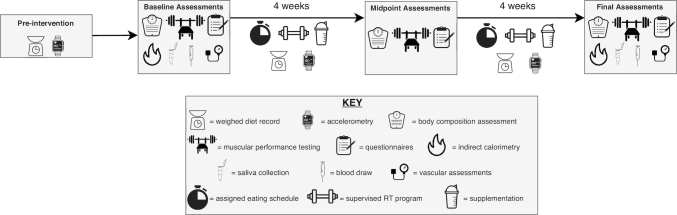
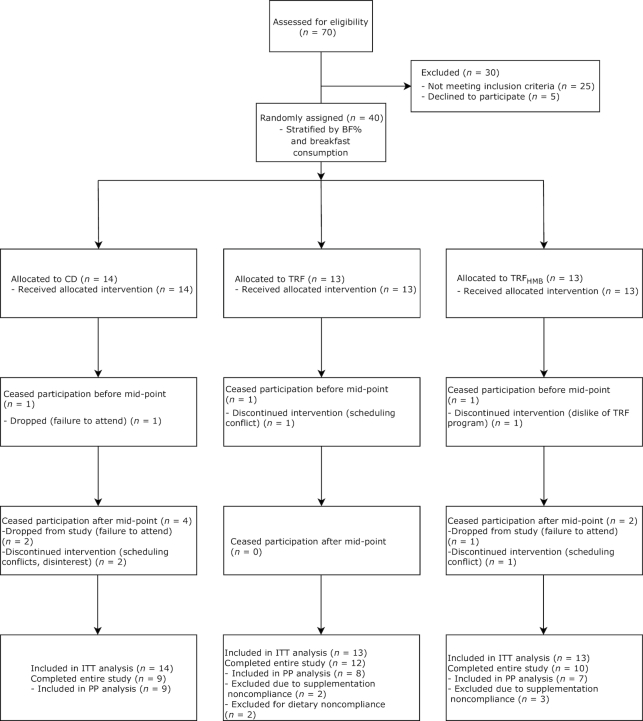
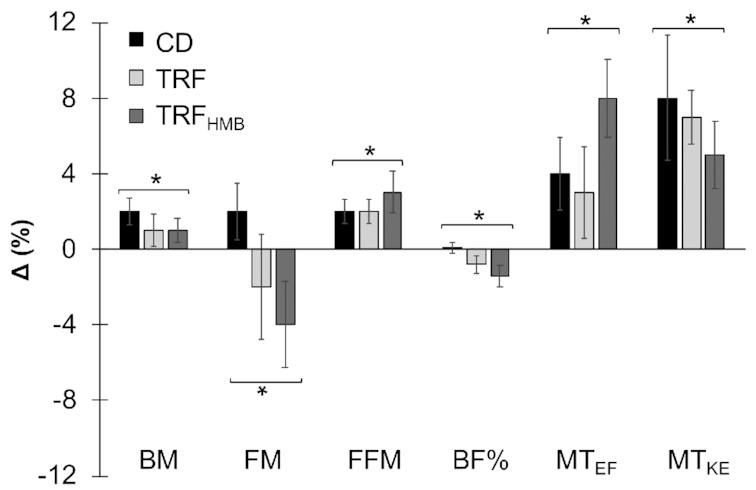
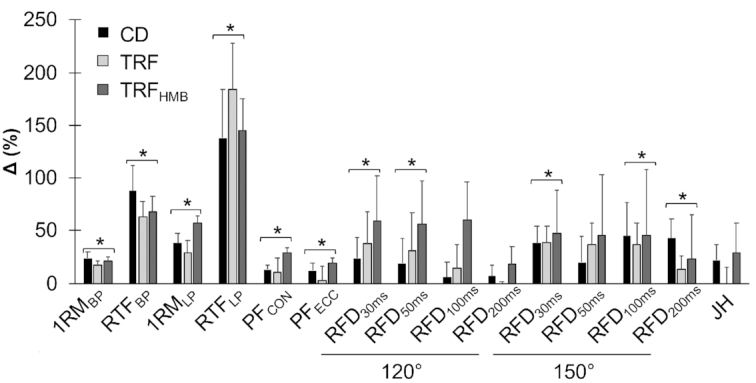
BACKGROUND: A very limited amount of research has examined intermittent fasting (IF) programs, such as time-restricted feeding (TRF), in active populations. OBJECTIVE: Our objective was to examine the effects of TRF, with or without β-hydroxy β-methylbutyrate (HMB) supplementation, during resistance training (RT). METHODS: This study employed a randomized, placebo-controlled, reduced factorial design and was double-blind with respect to supplementation in TRF groups. Resistance-trained females were randomly assigned to a control diet (CD), TRF, or TRF plus 3 g/d HMB (TRFHMB). TRF groups consumed all calories between 1200 h and 2000 h, whereas the CD group ate regularly from breakfast until the end of the day. All groups completed 8 wk of supervised RT and consumed supplemental whey protein. Body composition, muscular performance, dietary intake, physical activity, and physiological variables were assessed. Data were analyzed prior to unblinding using mixed models and both intention-to-treat (ITT) and per protocol (PP) frameworks. RESULTS: Forty participants were included in ITT, and 24 were included in PP. Energy and protein intake (1.6 g/kg/d) did not differ between groups despite different feeding durations (TRF and TRFHMB: ∼7.5 h/d; CD: ∼13 h/d). Comparable fat-free mass (FFM) accretion (+2% to 3% relative to baseline) and skeletal muscle hypertrophy occurred in all groups. Differential effects on fat mass (CD: +2%; TRF: -2% to -4%; TRFHMB: -4% to -7%) were statistically significant in the PP analysis, but not ITT. Muscular performance improved without differences between groups. No changes in physiological variables occurred in any group, and minimal side effects were reported. CONCLUSIONS: IF, in the form of TRF, did not attenuate RT adaptations in resistance-trained females. Similar FFM accretion, skeletal muscle hypertrophy, and muscular performance improvements can be achieved with dramatically different feeding programs that contain similar energy and protein content during RT. Supplemental HMB during fasting periods of TRF did not definitively improve outcomes. This study was prospectively registered at clinicaltrials.gov as NCT03404271.
Overview
The claims and statistics of this paper haven’t been checked yet.
Free: it reads the open-access text and checks the first 5 claims that cite a source we can check. Create a free account to check every claim.
Integrity signals
Registry
Cites
Statistics
Figures
Verification
Claims the paper makes
The claims and statistics of this paper haven’t been checked yet.
Free: it reads the open-access text and checks the first 5 claims that cite a source we can check. Create a free account to check every claim.
Claims other papers make about this one
Each is checked against this paper’s own text: does it say what the citing paper says it does?
The source backs part of the claim, not all of it — or backs it for a different population, condition or comparison.
In the citing paper
“Some studies have explored combining fasting with exercise, including resistance training, reporting the effectiveness of preserving [32, 85, 86] or even increasing [73] lean body mass while achieving weight loss simultaneously”
From Comparing caloric restriction regimens for effective weight management in adults: a systematic review and network meta-analysis (2024) · cites this paper as [73]
Experimental — accuracy not yet measuredThe cited source says what the claim attributes to it.
In the citing paper
“Among them, four trials [34, 35, 57, 73] documented no adverse events throughout the intervention period.”
From Comparing caloric restriction regimens for effective weight management in adults: a systematic review and network meta-analysis (2024) · cites this paper as [73]
Self-check
Percentages, sums and reported differences re-computed from the paper’s own numbers.
The self-check needs the paper’s full text.
Citations
Cites
The Pittsburgh Sleep Quality Index: a new instrument for psychiatric practice and research
Buysse, D. J., Reynolds, C. F., Monk, T. H., Berman, S. R., & Kupfer, D. J. (1989) · Psychiatry Research · doi:10.1016/0165-1781(89)90047-4 · Cited by 35,234 · cited 1×
“Additionally, participants completed the Mood and Feelings Questionnaire (49), the Pittsburgh Sleep Quality Index (50), the Three-Factor Eating Questionnaire Revised 18-item version (51), and a menstrual cycle questionnaire at each morning laboratory assessment session.”
MethodFriedewald, W. T., Levy, R. I., & Fredrickson, D. S. (1972) · Clinical Chemistry · doi:10.1093/clinchem/18.6.499 · Cited by 32,423 · cited 1×
“Total cholesterol, triglycerides, and HDL cholesterol were assessed using enzymatic colorimetric assays (40–42), and VLDL and non-HDL cholesterol were calculated (VLDL = triglycerides/5 (43); non-HDL = total cholesterol – HDL).”
Method‘Small Changes' to Diet and Physical Activity Behaviors for Weight Management
Hills, A. P., Byrne, N. M., Lindstrom, R., & Hill, J. O. (2013) · Obesity Facts · doi:10.1159/000345030 · Cited by 9,493
Physical Activity in the United States Measured by Accelerometer
TROIANO, R. P., BERRIGAN, D., DODD, K. W., MÂSSE, L. C., TILERT, T., & MCDOWELL, M. (2008) · Medicine & Science in Sports & Exercise · doi:10.1249/mss.0b013e31815a51b3 · Cited by 7,638 · cited 1×
“, no movement), with an allowance ≤2 min of interruption with activity counts <100 per minute (21).”
BackgroundAntihyperlipidemic and Biochemical Activities of Mcy Protein in Streptozotocin Induced Diabetic Rats
Marella, S., Maddirela, D. R., Badri, K. R., Jyothi Kumar, M. V., & Chippada, A. (2015) · Cellular Physiology and Biochemistry · doi:10.1159/000373954 · Cited by 5,938
Calibration of the Computer Science and Applications, Inc. accelerometer
FREEDSON, P. S., MELANSON, E., & SIRARD, J. (1998) · Medicine & Science in Sports & Exercise · doi:10.1097/00005768-199805000-00021 · Cited by 3,825 · cited 1×
“Physical activity energy expenditure (PAEE; kcal/min) was estimated for each minute of wear time using the Freedson’s prediction equation (22) for activity counts >1951 counts/min and the Williams Work-Energy equation for activity counts ≤1951 counts/min (23).”
MethodAdjustment for total energy intake in epidemiologic studies
Willett, W., Howe, G., & Kushi, L. (1997) · The American Journal of Clinical Nutrition · doi:10.1093/ajcn/65.4.1220s · Cited by 3,758 · cited 1×
“wear time for each participant using a least-square adjustment method (24) due to the possibility of misclassification influencing daily PAEE.”
MethodBioelectrical impedance analysis?part I: review of principles and methods
KYLE, U. (2004) · Clinical Nutrition · doi:10.1016/j.clnu.2004.06.004 · Cited by 3,200 · cited 1×
“, bioelectrical impedance analysis (30)].”
(1995) · International Journal of Methods in Psychiatric Research · Cited by 1,847
Essentials of Strength Training and Conditioning
Baechle, T. R., & Earle, R. (1994) · Cited by 1,535
Sutton, E. F., Beyl, R., Early, K. S., Cefalu, W. T., Ravussin, E., & Peterson, C. M. (2018) · Cell Metabolism · doi:10.1016/j.cmet.2018.04.010 · Cited by 1,531
Impact of intermittent fasting on health and disease processes
Mattson, M. P., Longo, V. D., & Harvie, M. (2017) · Ageing Research Reviews · doi:10.1016/j.arr.2016.10.005 · Cited by 1,187
Assessment of the cortisol awakening response: Expert consensus guidelines
Stalder, T., Kirschbaum, C., Kudielka, B. M., Adam, E. K., Pruessner, J. C., Wüst, S., Dockray, S., Smyth, N., Evans, P., Hellhammer, D. H., et al. (2016) · Psychoneuroendocrinology · doi:10.1016/j.psyneuen.2015.10.010 · Cited by 967 · cited 1×
“Three saliva samples were collected during both the preintervention period and the final week of the intervention for assessment of CAR [the characteristic increase in cortisol concentrations upon waking (48)].”
MethodCompher, C., Frankenfield, D., Keim, N., & Roth-Yousey, L. (2006) · Journal of the American Dietetic Association · doi:10.1016/j.jada.2006.02.009 · Cited by 923
Gill, S., & Panda, S. (2015) · Cell Metabolism · doi:10.1016/j.cmet.2015.09.005 · Cited by 894
Martin, S. S., Blaha, M. J., Elshazly, M. B., Toth, P. P., Kwiterovich, P. O., Blumenthal, R. S., & Jones, S. R. (2013) · JAMA · doi:10.1001/jama.2013.280532 · Cited by 883 · cited 1×
“LDL cholesterol was calculated using the Martin–Hopkins equation (44).”
MethodInternational Society of Sports Nutrition Position Stand: protein and exercise
Jäger, R., Kerksick, C. M., Campbell, B. I., Cribb, P. J., Wells, S. D., Skwiat, T. M., Purpura, M., Ziegenfuss, T. N., Ferrando, A. A., Arent, S. M., et al. (2017) · Journal of the International Society of Sports Nutrition · doi:10.1186/s12970-017-0177-8 · Cited by 873
Flipping the Metabolic Switch: Understanding and Applying the Health Benefits of Fasting
Anton, S. D., Moehl, K., Donahoo, W. T., Marosi, K., Lee, S. A., Mainous, A. G., Leeuwenburgh, C., & Mattson, M. P. (2018) · Obesity · doi:10.1002/oby.22065 · Cited by 756 · cited 1×
“Several forms of IF have been described, including time-restricted feeding (TRF), alternate-day fasting (ADF), alternate-day modified fasting, and periodic fasting (2).”
BackgroundMoro, T., Tinsley, G., Bianco, A., Marcolin, G., Pacelli, Q. F., Battaglia, G., Palma, A., Gentil, P., Neri, M., & Paoli, A. (2016) · Journal of Translational Medicine · doi:10.1186/s12967-016-1044-0 · Cited by 732 · cited 9×
“Additionally, body volume was estimated from DXA LST, FM, and BMC using the equation developed by Wilson et al. (25) for General Electric DXA scanners: BV (L) = 0.933∗LST + 1.150∗FM + −0.438∗BMC + 1.504 (1) BIS was utilized to obtain total body water estimates.”
BackgroundMethodInfluentialSelf-citationInternational Society of Sports Nutrition position stand: protein and exercise
Campbell, B., Kreider, R. B., Ziegenfuss, T., La Bounty, P., Roberts, M., Burke, D., Landis, J., Lopez, H., & Antonio, J. (2007) · Journal of the International Society of Sports Nutrition · doi:10.1186/1550-2783-4-8 · Cited by 716
de Lauzon, B., Romon, M., Deschamps, V., Lafay, L., Borys, J.-M., Karlsson, J., Ducimetière, P., & Charles, M. A. (2004) · The Journal of Nutrition · doi:10.1093/jn/134.9.2372 · Cited by 687 · cited 1×
“Additionally, participants completed the Mood and Feelings Questionnaire (49), the Pittsburgh Sleep Quality Index (50), the Three-Factor Eating Questionnaire Revised 18-item version (51), and a menstrual cycle questionnaire at each morning laboratory assessment session.”
MethodWilkinson, D. J., Hossain, T., Hill, D. S., Phillips, B. E., Crossland, H., Williams, J., Loughna, P., Churchward‐Venne, T. A., Breen, L., Phillips, S. M., et al. (2013) · The Journal of Physiology · doi:10.1113/jphysiol.2013.253203 · Cited by 484 · cited 2×
“Due to its ability to influence muscle protein balance (15), the leucine metabolite β-hydroxy β-methylbutyrate (HMB) has been hypothesized to exert favorable effects on skeletal muscle in exercising and/or energy-restricted individuals (16– 18).”
BackgroundAccuracy of weighed dietary records in studies of diet and health.
Livingstone, M. B., Prentice, A. M., Strain, J. J., Coward, W. A., Black, A. E., Barker, M. E., McKenna, P. G., & Whitehead, R. G. (1990) · BMJ · doi:10.1136/bmj.300.6726.708 · Cited by 455 · cited 1×
“Although weighed diet records revealed no significant differences between groups for energy or macronutrient intake, the shortcomings of self-reported dietary intake are well-established, and resultant nutrient intake estimates should be viewed with substantial caution (59, 60).”
BackgroundPERMEABILITY AND IMPERMEABILITY OF CELL MEMBRANES FOR IONS
Cole, K. S. (1940) · Cold Spring Harbor Symposia on Quantitative Biology · doi:10.1101/sqb.1940.008.01.013 · Cited by 418 · cited 1×
“BIS utilizes Cole modeling (28) and mixture theories (29) to predict body fluids rather than regression equations used by other impedance methods [e.”
MethodHeilbronn, L. K., Smith, S. R., Martin, C. K., Anton, S. D., & Ravussin, E. (2005) · The American Journal of Clinical Nutrition · doi:10.1093/ajcn/81.1.69 · Cited by 393 · cited 1×
“Additionally, as the aforementioned investigations were conducted in male participants only, and potential sex differences in responses to IF have been reported (11, 12), an examination of IF plus RT in females is warranted.”
BackgroundStote, K. S., Baer, D. J., Spears, K., Paul, D. R., Harris, G. K., Rumpler, W. V., Strycula, P., Najjar, S. S., Ferrucci, L., Ingram, D. K., et al. (2007) · The American Journal of Clinical Nutrition · doi:10.1093/ajcn/85.4.981 · Cited by 392
Effects of intermittent fasting on body composition and clinical health markers in humans
Tinsley, G. M., & La Bounty, P. M. (2015) · Nutrition Reviews · doi:10.1093/nutrit/nuv041 · Cited by 382 · cited 1×
“Intermittent fasting (IF) is a broad term encompassing eating patterns with regularly occurring periods of food abstention longer than a typical overnight fast (1).”
BackgroundSelf-citationThe role of leucine and its metabolites in protein and energy metabolism
Duan, Y., Li, F., Li, Y., Tang, Y., Kong, X., Feng, Z., Anthony, T. G., Watford, M., Hou, Y., Wu, G., et al. (2016) · Amino Acids · doi:10.1007/s00726-015-2067-1 · Cited by 350 · cited 1×
“The branched-chain amino acid leucine is known to stimulate protein synthesis through the mechanistic target of rapamycin (mTOR) signaling pathway and produces metabolites that may modulate its physiological effects (14, 57, 58).”
BackgroundBhutani, S., Klempel, M. C., Kroeger, C. M., Trepanowski, J. F., & Varady, K. A. (2013) · Obesity · doi:10.1002/oby.20353 · Cited by 349 · cited 1×
“(6) found that 12 wk of ADF plus endurance exercise produced greater improvements in body composition and blood lipids than ADF or exercise alone in lightly active obese adults.”
BackgroundHarris, L., Hamilton, S., Azevedo, L. B., Olajide, J., De Brún, C., Waller, G., Whittaker, V., Sharp, T., Lean, M., Hankey, C., et al. (2018) · JBI Database of Systematic Reviews and Implementation Reports · doi:10.11124/jbisrir-2016-003248 · Cited by 319
Time‐restricted feeding in young men performing resistance training: A randomized controlled trial †
Tinsley, G. M., Forsse, J. S., Butler, N. K., Paoli, A., Bane, A. A., La Bounty, P. M., Morgan, G. B., & Grandjean, P. W. (2017) · European Journal of Sport Science · doi:10.1080/17461391.2016.1223173 · Cited by 307 · cited 8×
“(7) employed an 8-wk TRF program with a 4-h feeding period for 4 d per week and ad libitum feeding plus RT for 3 d per week in young recreationally active males.”
BackgroundMethodResultInfluentialSelf-citationSawaya, A., Tucker, K., Tsay, R., Willett, W., Saltzman, E., Dallal, G., & Roberts, S. (1996) · The American Journal of Clinical Nutrition · doi:10.1093/ajcn/63.4.491 · Cited by 254 · cited 1×
“Although weighed diet records revealed no significant differences between groups for energy or macronutrient intake, the shortcomings of self-reported dietary intake are well-established, and resultant nutrient intake estimates should be viewed with substantial caution (59, 60).”
BackgroundTime-restricted feeding and risk of metabolic disease: A review of human and animal studies
Rothschild, J., Hoddy, K. K., Jambazian, P., & Varady, K. A. (2014) · Nutrition Reviews · doi:10.1111/nure.12104 · Cited by 241
Seimon, R. V., Roekenes, J. A., Zibellini, J., Zhu, B., Gibson, A. A., Hills, A. P., Wood, R. E., King, N. A., Byrne, N. M., & Sainsbury, A. (2015) · Molecular and Cellular Endocrinology · doi:10.1016/j.mce.2015.09.014 · Cited by 202
Dietary protein requirements and adaptive advantages in athletes
Phillips, S. M. (2012) · British Journal Of Nutrition · doi:10.1017/s0007114512002516 · Cited by 199 · cited 3×
“4 g/kg/d) and suboptimal for active individuals (9, 10).”
BackgroundInfluentialInternational Society of Sports Nutrition Position Stand: beta-hydroxy-beta-methylbutyrate (HMB)
Wilson, J. M., Fitschen, P. J., Campbell, B., Wilson, G. J., Zanchi, N., Taylor, L., Wilborn, C., Kalman, D. S., Stout, J. R., Hoffman, J. R., et al. (2013) · Journal of the International Society of Sports Nutrition · doi:10.1186/1550-2783-10-6 · Cited by 196
Six-compartment body composition model: Inter-method comparisons of total body fat measurement
Wang, Z., Deurenberg, P., Guo, S., Pietrobelli, A., Wang, J., Jr, R. P., & Heymsfield, S. (1998) · International Journal of Obesity · doi:10.1038/sj.ijo.0800590 · Cited by 195 · cited 1×
“9582 to yield an estimate of bone mineral (27).”
BackgroundGlucose Tolerance and Skeletal Muscle Gene Expression in Response to Alternate Day Fasting
Heilbronn, L. K., Civitarese, A. E., Bogacka, I., Smith, S. R., Hulver, M., & Ravussin, E. (2005) · Obesity Research · doi:10.1038/oby.2005.61 · Cited by 175 · cited 1×
“Additionally, as the aforementioned investigations were conducted in male participants only, and potential sex differences in responses to IF have been reported (11, 12), an examination of IF plus RT in females is warranted.”
BackgroundUse of Diagnostic Ultrasound for Assessing Muscle Size
BEMBEN, M. G. (2002) · Journal of Strength and Conditioning Research · doi:10.1519/00124278-200202000-00016 · Cited by 174
Wang, Z., Pi-Sunyer, F. X., Kotler, D. P., Wielopolski, L., Withers, R. T., Pierson, R. N., & Heymsfield, S. B. (2002) · The American Journal of Clinical Nutrition · doi:10.1093/ajcn/76.5.968 · Cited by 151 · cited 1×
“(31) was utilized for estimation of whole-body FM:”
MethodMeylan, C. M. P., Nosaka, K., Green, J., & Cronin, J. B. (2010) · Journal of Sports Sciences · doi:10.1080/02640411003628048 · Cited by 108
The impact of exercise and nutrition on the regulation of skeletal muscle mass
McGlory, C., van Vliet, S., Stokes, T., Mittendorfer, B., & Phillips, S. M. (2019) · The Journal of Physiology · doi:10.1113/jp275443 · Cited by 101 · cited 2×
“As IF necessitates prolonged periods without stimulation of muscle protein synthesis and suppression of muscle protein breakdown via dietary amino acids (13), it represents an opportunity to investigate this question.”
BackgroundIntermittent energy restriction and weight loss: a systematic review
Davis, C. S., Clarke, R. E., Coulter, S. N., Rounsefell, K. N., Walker, R. E., Rauch, C. E., Huggins, C. E., & Ryan, L. (2016) · European Journal of Clinical Nutrition · doi:10.1038/ejcn.2015.195 · Cited by 94
Jenkins, N. D. M., Miller, J. M., Buckner, S. L., Cochrane, K. C., Bergstrom, H. C., Hill, E. C., Smith, C. M., Housh, T. J., & Cramer, J. T. (2015) · Ultrasound in Medicine & Biology · doi:10.1016/j.ultrasmedbio.2015.01.017 · Cited by 89 · cited 1×
“Elbow flexor measurements took place at 66% of the distance from the acromion of the scapula to the cubital fossa, and knee extensor measurements took place at 50% of the distance from the anterior superior iliac spine to the superior border of the patella (32, 33).”
BackgroundNg, B. K., Liu, Y. E., Wang, W., Kelly, T. L., Wilson, K. E., Schoeller, D. A., Heymsfield, S. B., & Shepherd, J. A. (2018) · The American Journal of Clinical Nutrition · doi:10.1093/ajcn/nqy158 · Cited by 73 · cited 1×
“Body composition was assessed using a modified 4C model (25, 26) produced from DXA and bioimpedance spectroscopy (BIS) data.”
MethodGraybeal, A. J., Moore, M. L., Cruz, M. R., & Tinsley, G. M. (2020) · Journal of Strength and Conditioning Research · doi:10.1519/jsc.0000000000002831 · Cited by 59
Self-citationSilva, V. R., Belozo, F. L., Micheletti, T. O., Conrado, M., Stout, J. R., Pimentel, G. D., & Gonzalez, A. M. (2017) · Nutrition Research · doi:10.1016/j.nutres.2017.07.008 · Cited by 56
Wilson, J. P., Strauss, B. J., Fan, B., Duewer, F. W., & Shepherd, J. A. (2013) · The American Journal of Clinical Nutrition · doi:10.3945/ajcn.112.048074 · Cited by 45 · cited 2×
“Body composition was assessed using a modified 4C model (25, 26) produced from DXA and bioimpedance spectroscopy (BIS) data.”
MethodSanchez-Martinez, J., Santos-Lozano, A., Garcia-Hermoso, A., Sadarangani, K. P., & Cristi-Montero, C. (2018) · Journal of Science and Medicine in Sport · doi:10.1016/j.jsams.2017.11.003 · Cited by 45
Rittig, N. F., Bach, E., Thomsen, H. H., Møller, A. B., Hansen, J., Johannsen, M., Jensen, E., Serena, A., Jørgensen, J. O. L., Richelsen, B., et al. (2016) · Clinical Nutrition · doi:10.1016/j.clnu.2016.05.004 · Cited by 44
DAWSON, B., VLADICH, T., & BLANKSBY, B. A. (2002) · Journal of Strength and Conditioning Research · doi:10.1519/00124278-200211000-00001 · Cited by 41
Harry, J. R., Barker, L., James, R., & Dufek, J. S. (2017) · The Journal of Strength and Conditioning Research · doi:10.1519/jsc.0000000000002343 · Cited by 31 · cited 1×
“Take-off was defined as the time when the summed vertical GRF decreased below a 20 N threshold (35).”
BackgroundSelf-citationPalmer, T. B., Pineda, J. G., & Durham, R. M. (2017) · Journal of Applied Biomechanics · doi:10.1123/jab.2017-0213 · Cited by 26 · cited 1×
“Isometric and isokinetic squats were performed using a mechanized squat device (Exerbotics eSq) (36, 37).”
Methodβ-Hydroxy-β-methylbutyrate (HMB) and prevention of muscle wasting
Hasselgren, P.-O. (2013) · Metabolism · doi:10.1016/j.metabol.2013.09.015 · Cited by 24
Tinsley, G. M., Givan, A. H., Graybeal, A. J., Villarreal, M. I., & Cross, A. G. (2018) · British Journal Of Nutrition · doi:10.1017/s0007114517003907 · Cited by 19 · cited 3×
“The branched-chain amino acid leucine is known to stimulate protein synthesis through the mechanistic target of rapamycin (mTOR) signaling pathway and produces metabolites that may modulate its physiological effects (14, 57, 58).”
BackgroundSelf-citationConsistency of Peak and Mean Concentric and Eccentric Force Using a Novel Squat Testing Device
Stock, M. S., & Luera, M. J. (2014) · Journal of Applied Biomechanics · doi:10.1123/jab.2013-0191 · Cited by 12 · cited 1×
“Isometric and isokinetic squats were performed using a mechanized squat device (Exerbotics eSq) (36, 37).”
Method
Research works printed but not linked: 1
- Hanai T Electrical Properties of Emulsions, Emulsion Science. London; New York: Academic Press; 1968.
Cited by
Cienfuegos, S., Gabel, K., Kalam, F., Ezpeleta, M., Wiseman, E., Pavlou, V., Lin, S., Oliveira, M. L., & Varady, K. A. (2020) · Cell Metabolism · doi:10.1016/j.cmet.2020.06.018 · Cited by 597
Chow, L. S., Manoogian, E. N. C., Alvear, A., Fleischer, J. G., Thor, H., Dietsche, K., Wang, Q., Hodges, J. S., Esch, N., Malaeb, S., et al. (2020) · Obesity · doi:10.1002/oby.22756 · Cited by 359
“Indeed, studies incorporating TRE with resistance training and either unrestricted intake (10), TRE with slight caloric restriction (200-250 kcal/d) and randomized whey protein supplementation (11), or TRE with instructions to maintain isoenergetic intake (34) have demonstrated preserved or increased lean mass.”
BackgroundResultClinical application of intermittent fasting for weight loss: progress and future directions
Varady, K. A., Cienfuegos, S., Ezpeleta, M., & Gabel, K. (2022) · Nature Reviews Endocrinology · doi:10.1038/s41574-022-00638-x · Cited by 357
Time-restricted eating for the prevention and management of metabolic diseases
Manoogian, E. N. C., Chow, L. S., Taub, P. R., Laferrère, B., & Panda, S. (2022) · Endocrine Reviews · doi:10.1210/endrev/bnab027 · Cited by 344
“TRE clinical trials range from a 4- to 12-hour daily eating window (20-12 hours fasting) with most (30/39 studies reported) using an 8- to 10-hour daily eating window (1614 hours fasting) (77, 88, 91, 94, 96, 117, 121-128, 131, 132, 134-137, 139-143).”
MethodIntermittent Fasting and Metabolic Health
Vasim, I., Majeed, C. N., & DeBoer, M. D. (2022) · Nutrients · doi:10.3390/nu14030631 · Cited by 285
Metadata
- Authors
- Tinsley, G. M., Moore, M. L., Graybeal, A. J., Paoli, A., Kim, Y., Gonzales, J. U., Harry, J. R., VanDusseldorp, T. A., Kennedy, D. N., & Cruz, M. R.
- Affiliations
- Texas Tech University (US)
- University of Padua (IT)
- Kennesaw State University (US)
- Corresponding author
- Tinsley, Grant M
- ORCID
- Venue
- The American Journal of Clinical Nutrition
- Publisher
- Elsevier BV
- Published
- 2019-09
- Volume
- 110
- Issue
- 3
- Pages
- 628-640
- ISSN
- 0002-9165 (ISSN-L)
- PMC
- PMC6735806
- OpenAlex
- W2953470221
- Cited by
- 221
- References
- 56
- Citations by year
- 2026: 22 · 2025: 26 · 2024: 33 · 2023: 37 · 2022: 31 · 2021: 38 · 2020: 29 · 2019: 5
- FWCI
- 17.66
- Type
- journal article
- Language
- en
- Open access
- hybrid
- doi.org
- Licence
- cc-by-nc
- www.elsevier.com/tdm/userlicense/1.0/ (tdm)
- creativecommons.org/licenses/by-nc/4.0/ (vor)
- Locations
- American Journal of Clinical Nutrition (publishedVersion, cc-by-nc)
- Europe PMC (PubMed Central) (publishedVersion, cc-by-nc)
- PubMed Central (publishedVersion, cc-by-nc)
- PubMed (publishedVersion)
- DigitalCommons - Kennesaw State University (Kennesaw State University) (submittedVersion, cc-by-nc)
- Padua Research Archive (University of Padova) (submittedVersion)
- Funders
- MTI Biotech Inc.
- Texas Tech University
- Topics
- Health Sciences › Medicine › Physiology (medical) › Dietary Effects on Health
- Health Sciences › Nursing › Nutrition and Dietetics › Muscle metabolism and nutrition
- Health Sciences › Medicine › Orthopedics and Sports Medicine › Sports Performance and Training
- Keywords
- time-restricted feeding, intermittent fasting, resistance training, body composition, fat-free mass, fat mass, skeletal muscle hypertrophy, muscle performance, whey protein, protein intake, energy intake
- MeSH terms
- Adult, Body Composition, Female, Humans, Time Factors, Resistance Training, Young Adult, Meals
About these checks
Registry, retraction, Cites and statistics results are computed, not judged, with one exception: a printed reference that no index lists is read once by a model before it counts as a citation error. Claims are extracted by a model and kept only when their quote appears verbatim in the text; each cited source is then checked, with a model’s help, for whether it says what the claim relies on. Those verdicts can be wrong — read the claim’s quote and the cited source before relying on one.
Statistics and arithmetic are recomputed, not judged.
Confidence bands are shown only for fields calibrated on our annotated test set. None is calibrated yet, so no band is shown.
What counts as a claim ›How we measure confidence ›How we check this ›
Are you an author, or do you see a problem with this page? Request a review
Data sources
Bibliographic data: Semantic Scholar, OpenAlex, Crossref.
Contains information from the Semantic Scholar Academic Graph Datasets, made available under the ODC Attribution License (ODC-BY 1.0).
Semantic Scholar’s data is described in: Kinney, R., et al. (2023). The Semantic Scholar Open Data Platform. arXiv:2301.10140.
