

The DOI matches its Crossref record; 74 of the 75 references it cites were found in a registry or an index; 4 of the 48 sources its claims cite were checked for support.
Hippocampal and Retrosplenial Goal Distance Coding After Long-term Consolidation of a Real-World Environment
Open accessPublished version of a preprint
Abstract
Abstract Recent research indicates the hippocampus may code the distance to the goal during navigation of newly learned environments. It is unclear however, whether this also pertains to highly familiar environments where extensive systems-level consolidation is thought to have transformed mnemonic representations. Here we recorded fMRI while University College London and Imperial College London students navigated virtual simulations of their own familiar campus (> 2 years of exposure) and the other campus learned days before scanning. Posterior hippocampal activity tracked the proximity to the goal in the newly learned campus, but not in the familiar campus. By contrast retrosplenial cortex tracked the distance to the goal in the familiar campus, but not in the recently learned campus. These responses were abolished when participants were guided to their goal by external cues. These results open new avenues of research on navigation and consolidation of spatial information and help advance models of how neural circuits support navigation in novel and highly familiar environments. Significance Statement Historically, research on the hippocampal formation has focused on its role in long-term memory and navigation – often in isolation. No study to date has directly compared realistic navigation within familiar with recently learned environments, nor has it been explored how the neural substrates, along with computational codes, may change. In this study, we show for the first time, a shift from hippocampal to cortical coding of distance to a goal during active navigation. This study bridges the gap between memory consolidation and navigation, and paves the way for more functional and realistic understanding of the hippocampus.
Overview
AI snapshot
Written from the paper’s full text.
TL;DR
In a within-subject fMRI study, students navigated virtual simulations of their own long-familiar university campus and a campus learned days earlier. The right posterior hippocampus tracked goal distance in the recently learned campus and in familiar environments only when many turns lay ahead, whereas retrosplenial cortex tracked goal distance only in the familiar campus.
Key findings
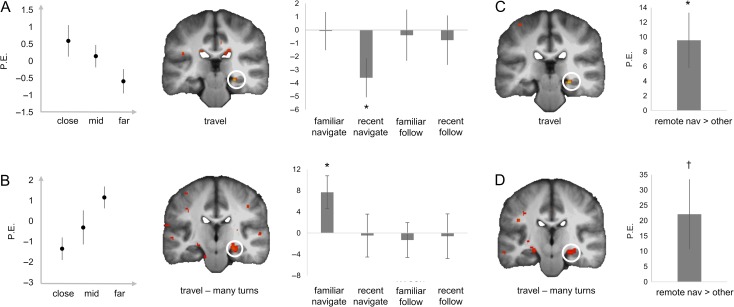
- During travel in the recently learned campus, right midposterior hippocampal activity showed a significant negative correlation with path distance to the goal, increasing with proximity to the goal; this was absent in the familiar campus and in control routes.
- In the familiar campus, hippocampal activity showed a significant positive correlation with path distance, but only when the upcoming route contained many turns (≥3); there was no significant correlation with few turns (<3).
- Retrosplenial cortex showed a significant positive correlation with path distance during travel in the familiar campus, greatest when participants were farthest from the goal; this was absent in the recent campus and control conditions.
- Behaviorally, participants were more accurate at decision points in the familiar campus (M = 89.9%, SD = 11%) than the recent campus (M = 80.4%, SD = 13%; t[24] = 3.6, P = 0.002) and responded faster in the familiar campus (1.19 ± 0.4 s vs. 1.39 ± 0.5 s; t[24] = −4.7, P < 0.001). They reported more planning at decision points in the recent environment (22%) than the familiar environment (8%; t < −2.9, P < 0.006).
Methods
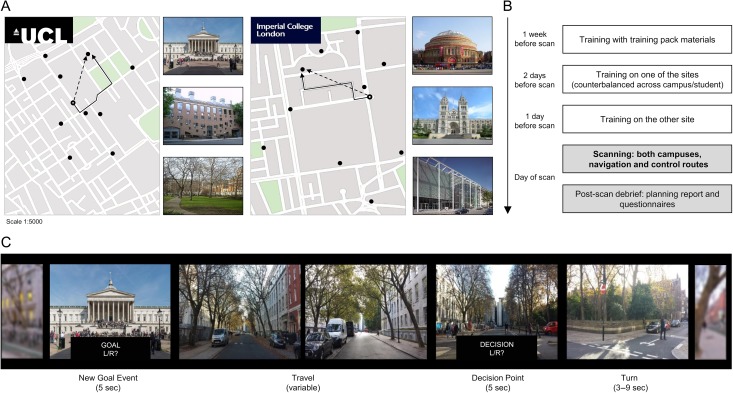
- Final sample: 25 students (12 UCL, 13 Imperial; mean age 23 years, range 20–26; 12 males, 13 females) who had studied at their own campus for at least 2 years and had little or no familiarity with the other campus.
- Participants learned 10 goal locations, 18 streets, and 8 start points in both environments, including a guided real-world tour of both campuses in the days before scanning; fMRI used virtual Google Street View-based routes with active navigation and control “follow” blocks.
- fMRI analysis used SPM12 with a priori small-volume correction masks for right mid/posterior hippocampus and retrosplenial cortex; path distance, Euclidean distance, and egocentric goal direction were modeled as parametric regressors, with focus on Travel Periods and Decision Points.
Limitations
- The paper states that scanner coverage made it impossible to assess entorhinal cortex contributions to distance coding, unlike Howard et al. (2014).
- The paper states that ecological validity required lower trial numbers per condition, though the two main periods of interest had >20 events per condition; control analyses separating travel midpoints replicated the hippocampal effect only with mid-hippocampal small-volume correction and did not replicate the retrosplenial effect, instead finding precuneus/parietal–occipital sulcus effects.
- Evident from the text: the study used a modest sample (n = 25), a 1.5 T scanner, virtual rather than real-world navigation, and only two campus environments; path distance and Euclidean distance were highly correlated, and the authors note that environment structure, size, and visual detail may influence the direction of hippocampal goal-distance coding.
Model-written summary. Check it against the paper before relying on it.
Integrity signals
Registry
Cites
Statistics
Figures

Verification
Claims the paper makes
36 Own result · 24 Not checked yet · 14 Own method · 13 Own interpretation · 2 No basis given · 1 Supported · 1 Supported so far
Every source the paper cites for this claim was checked and supports it.
In the paper
“Consistent with this argument, prior fMRI studies using recently encountered environments containing less perceptual detail found that the hippocampal activity increased with proximity to the goal (Viard et al. 2011; Sherrill et al. 2013).”
§ Hippocampal and Retrosplenial Goal Distance Coding After Long-term Consolidation of a Real-World Environment > Discussion > Representation of the Distance to the Goal: Hippocampus
What the sources say
- Supportedcites Viard et al. 2011 source
The Parametric effects of goal proximity section reports that bilateral anterior hippocampal activation increased as the start location moved closer to the goal. Materials and Methods describes a simple virtual room viewed during each trial’s encoding phase and then from a different position at test, consistent with a recently encountered, visually sparse environment. The paper does not itself make an explicit comparison of perceptual detail with other studies. (LLM, conf=0.88)
- Supportedcites Sherrill et al. 2013 source
The Virtual environment section describes a sparse virtual setting with no distinguishing landmarks or goal markers, and Experimental training says participants practiced in it the day before scanning. The parametric-analysis sections report posterior hippocampal activity tracking goal proximity; the proximity measure was coded to increase as participants approached the goal. Page numbers are unavailable in our copy. (LLM, conf=0.88)
plaincorrelational- Asserted: passes — The authors put it forward as true.
- Checkable: passes — It can be checked against evidence.
- Load-bearing: passes — The paper’s conclusions depend on it.
- Based: passes — The paper gives a reason why it holds.
- Supported
A result the paper reports from its own data — it cites no other source for it, so there is none to check. The quote shows it is in the paper.
In the paper
“All of these responses were abolished when participants were guided to their goal by external cues.”
§ Hippocampal and Retrosplenial Goal Distance Coding After Long-term Consolidation of a Real-World Environment > Abstract
plaindirect- Asserted: passes — The authors put it forward as true.
- Checkable: passes — It can be checked against evidence.
- Load-bearing: passes — The paper’s conclusions depend on it.
- Based: passes — The paper gives a reason why it holds.
- Rests on an assumption: The crucial difference between the familiar and recent environments was the long-term (>2 year) prior knowledge of one campus, after both campuses were intensively trained in the preceding days.
A result the paper reports from its own data — it cites no other source for it, so there is none to check. The quote shows it is in the paper.
In the paper
“However, there was no correlation between planning and accuracy (all r>−0.16, P > 0.1).”
§ Hippocampal and Retrosplenial Goal Distance Coding After Long-term Consolidation of a Real-World Environment > Results
plain- Asserted: passes — The authors put it forward as true.
- Checkable: passes — It can be checked against evidence.
- Load-bearing: unclear — It is unclear whether the paper’s conclusions depend on it.
- Based: passes — The paper gives a reason why it holds.
- Rests on an assumption: Participants' debriefing reports accurately reflect their planning during scanning.
A result the paper reports from its own data — it cites no other source for it, so there is none to check. The quote shows it is in the paper.
In the paper
“Posterior hippocampal activity tracked the distance to the goal in the newly learned campus”
§ Hippocampal and Retrosplenial Goal Distance Coding After Long-term Consolidation of a Real-World Environment > Abstract
plaincorrelational- Asserted: passes — The authors put it forward as true.
- Checkable: passes — It can be checked against evidence.
- Load-bearing: passes — The paper’s conclusions depend on it.
- Based: passes — The paper gives a reason why it holds.
- Rests on an assumption: The crucial difference between the familiar and recent environments was the long-term (>2 year) prior knowledge of one campus, after both campuses were intensively trained in the preceding days.
A result the paper reports from its own data — it cites no other source for it, so there is none to check. The quote shows it is in the paper.
In the paper
“There were no clear differences when comparing familiar to recent navigation (Fig. S2 and Supplementary Results).”
§ Hippocampal and Retrosplenial Goal Distance Coding After Long-term Consolidation of a Real-World Environment > Results > fMRI Results
boosted- Asserted: passes — The authors put it forward as true.
- Checkable: passes — It can be checked against evidence.
- Load-bearing: unclear — It is unclear whether the paper’s conclusions depend on it.
- Based: passes — The paper gives a reason why it holds.
A result the paper reports from its own data — it cites no other source for it, so there is none to check. The quote shows it is in the paper.
In the paper
“as well as in familiar environments when the future route contained many turns”
§ Hippocampal and Retrosplenial Goal Distance Coding After Long-term Consolidation of a Real-World Environment > Abstract
plaincorrelational- Asserted: passes — The authors put it forward as true.
- Checkable: passes — It can be checked against evidence.
- Load-bearing: passes — The paper’s conclusions depend on it.
- Based: passes — The paper gives a reason why it holds.
- Rests on an assumption: The crucial difference between the familiar and recent environments was the long-term (>2 year) prior knowledge of one campus, after both campuses were intensively trained in the preceding days.
A result the paper reports from its own data — it cites no other source for it, so there is none to check. The quote shows it is in the paper.
In the paper
“participants did report more planning at Decisions Points in the recent environment (familiar: 8%, recent: 22%, t<−2.9, P < 0.006).”
§ Hippocampal and Retrosplenial Goal Distance Coding After Long-term Consolidation of a Real-World Environment > Results
plaincorrelational- Asserted: passes — The authors put it forward as true.
- Checkable: passes — It can be checked against evidence.
- Load-bearing: unclear — It is unclear whether the paper’s conclusions depend on it.
- Based: passes — The paper gives a reason why it holds.
- Rests on an assumption: Participants' debriefing reports accurately reflect their planning during scanning.
A result the paper reports from its own data — it cites no other source for it, so there is none to check. The quote shows it is in the paper.
In the paper
“A global mask involving the sum of a priori regions for remote memory did not reveal any significant clusters, but targeted ROIs for hippocampus and retrosplenial cortex did reveal significant effects and are reported below.”
§ Hippocampal and Retrosplenial Goal Distance Coding After Long-term Consolidation of a Real-World Environment > Results > fMRI Results
plain- Asserted: passes — The authors put it forward as true.
- Checkable: passes — It can be checked against evidence.
- Load-bearing: unclear — It is unclear whether the paper’s conclusions depend on it.
- Based: passes — The paper gives a reason why it holds.
A result the paper reports from its own data — it cites no other source for it, so there is none to check. The quote shows it is in the paper.
In the paper
“Participants responded more quickly in their familiar environment (Familiar = 1.19 ± 0.4 s, Recent = 1.39 ± 0.5 s, t[24] = −4.7, P < 0.001)”
§ Hippocampal and Retrosplenial Goal Distance Coding After Long-term Consolidation of a Real-World Environment > Results
plaincorrelational- Asserted: passes — The authors put it forward as true.
- Checkable: passes — It can be checked against evidence.
- Load-bearing: unclear — It is unclear whether the paper’s conclusions depend on it.
- Based: passes — The paper gives a reason why it holds.
A result the paper reports from its own data — it cites no other source for it, so there is none to check. The quote shows it is in the paper.
In the paper
“reaction times scaled with distance to the goal along the future path (across subjects and junctions, both environments r[124]>0.24, P < 0.01, Table S2).”
§ Hippocampal and Retrosplenial Goal Distance Coding After Long-term Consolidation of a Real-World Environment > Results
plaincorrelational- Asserted: passes — The authors put it forward as true.
- Checkable: passes — It can be checked against evidence.
- Load-bearing: passes — The paper’s conclusions depend on it.
- Based: passes — The paper gives a reason why it holds.
A result the paper reports from its own data — it cites no other source for it, so there is none to check. The quote shows it is in the paper.
In the paper
“By contrast retrosplenial cortex only tracked the distance to the goal in the familiar campus.”
§ Hippocampal and Retrosplenial Goal Distance Coding After Long-term Consolidation of a Real-World Environment > Abstract
plaincorrelational- Asserted: passes — The authors put it forward as true.
- Checkable: passes — It can be checked against evidence.
- Load-bearing: passes — The paper’s conclusions depend on it.
- Based: passes — The paper gives a reason why it holds.
- Rests on an assumption: The crucial difference between the familiar and recent environments was the long-term (>2 year) prior knowledge of one campus, after both campuses were intensively trained in the preceding days.
A result the paper reports from its own data — it cites no other source for it, so there is none to check. The quote shows it is in the paper.
In the paper
“A global mask involving the sum of a priori regions for remote memory did not reveal any significant clusters, but targeted ROIs for hippocampus and retrosplenial cortex did reveal significant effects and are reported below.”
§ Hippocampal and Retrosplenial Goal Distance Coding After Long-term Consolidation of a Real-World Environment > Results > fMRI Results
plain- Asserted: passes — The authors put it forward as true.
- Checkable: passes — It can be checked against evidence.
- Load-bearing: passes — The paper’s conclusions depend on it.
- Based: passes — The paper gives a reason why it holds.
A result the paper reports from its own data — it cites no other source for it, so there is none to check. The quote shows it is in the paper.
In the paper
“RTs at Decision Points in recent environments correlated with amount of planning at Decision Points (both familiar and recent; r = 0.42, P < 0.033), such that less planning at DPs meant quicker responses.”
§ Hippocampal and Retrosplenial Goal Distance Coding After Long-term Consolidation of a Real-World Environment > Results
plaincorrelational- Asserted: passes — The authors put it forward as true.
- Checkable: passes — It can be checked against evidence.
- Load-bearing: unclear — It is unclear whether the paper’s conclusions depend on it.
- Based: passes — The paper gives a reason why it holds.
- Rests on an assumption: Participants' debriefing reports accurately reflect their planning during scanning.
A result the paper reports from its own data — it cites no other source for it, so there is none to check. The quote shows it is in the paper.
In the paper
“We also found that participants who planned more in familiar environments also planned more in recent ones (r = 0.6, P = 0.001).”
§ Hippocampal and Retrosplenial Goal Distance Coding After Long-term Consolidation of a Real-World Environment > Results
plaincorrelational- Asserted: passes — The authors put it forward as true.
- Checkable: passes — It can be checked against evidence.
- Load-bearing: unclear — It is unclear whether the paper’s conclusions depend on it.
- Based: passes — The paper gives a reason why it holds.
- Rests on an assumption: Participants' debriefing reports accurately reflect their planning during scanning.
A result the paper reports from its own data — it cites no other source for it, so there is none to check. The quote shows it is in the paper.
In the paper
“This response was absent in the recent environment and during the control conditions (Fig. 3A, right panel).”
§ Hippocampal and Retrosplenial Goal Distance Coding After Long-term Consolidation of a Real-World Environment > Results > Retrosplenial Cortex Codes Distance to the Goal During Travel in Familiar Environments
plain- Asserted: passes — The authors put it forward as true.
- Checkable: passes — It can be checked against evidence.
- Load-bearing: passes — The paper’s conclusions depend on it.
- Based: passes — The paper gives a reason why it holds.
A result the paper reports from its own data — it cites no other source for it, so there is none to check. The quote shows it is in the paper.
In the paper
“During Travel Periods when navigating the recently learned environment, we found a significant negative correlation with the distance to the goal in the right midposterior hippocampus (Fig. 2A and Table S4), indicating that hippocampal activity increased with proximity to the goal.”
§ Hippocampal and Retrosplenial Goal Distance Coding After Long-term Consolidation of a Real-World Environment > Results > Right Hippocampal Activity is Correlated With Distance to the Goal During Travel Periods of Navigation in Recently Learned Environments and When Many Turns Lie Ahead in Familiar Environments
hedgedcorrelational- Asserted: passes — The authors put it forward as true.
- Checkable: passes — It can be checked against evidence.
- Load-bearing: passes — The paper’s conclusions depend on it.
- Based: passes — The paper gives a reason why it holds.
A result the paper reports from its own data — it cites no other source for it, so there is none to check. The quote shows it is in the paper.
In the paper
“For Travel periods with many upcoming turns (≥3) in the familiar environments there was a significant hippocampal cluster, positively correlated with path distance in the Travel events with many turns (Fig. 2B).”
§ Hippocampal and Retrosplenial Goal Distance Coding After Long-term Consolidation of a Real-World Environment > Results > Right Hippocampal Activity is Correlated With Distance to the Goal During Travel Periods of Navigation in Recently Learned Environments and When Many Turns Lie Ahead in Familiar Environments
plaincorrelational- Asserted: passes — The authors put it forward as true.
- Checkable: passes — It can be checked against evidence.
- Load-bearing: passes — The paper’s conclusions depend on it.
- Based: passes — The paper gives a reason why it holds.
A result the paper reports from its own data — it cites no other source for it, so there is none to check. The quote shows it is in the paper.
In the paper
“Both the hippocampal and retrosplenial effects were absent from the New Street Entry only models”
§ Hippocampal and Retrosplenial Goal Distance Coding After Long-term Consolidation of a Real-World Environment > Results > Control Analyses for Effects of Path Distance During Travel Periods
plain- Asserted: passes — The authors put it forward as true.
- Checkable: passes — It can be checked against evidence.
- Load-bearing: passes — The paper’s conclusions depend on it.
- Based: passes — The paper gives a reason why it holds.
A result the paper reports from its own data — it cites no other source for it, so there is none to check. The quote shows it is in the paper.
In the paper
“During Travel Periods of navigation routes in the familiar environment we observed a significant positive correlation with distance in the retrosplenial cortex (Fig. 3 and Table S4), indicating the activity was greatest when participants were farthest from their goal.”
§ Hippocampal and Retrosplenial Goal Distance Coding After Long-term Consolidation of a Real-World Environment > Results > Retrosplenial Cortex Codes Distance to the Goal During Travel in Familiar Environments
hedgedcorrelational- Asserted: passes — The authors put it forward as true.
- Checkable: passes — It can be checked against evidence.
- Load-bearing: passes — The paper’s conclusions depend on it.
- Based: passes — The paper gives a reason why it holds.
A result the paper reports from its own data — it cites no other source for it, so there is none to check. The quote shows it is in the paper.
In the paper
“Even at liberal thresholds, activity in our other predicted ROIs (anterior cingulate cortex, caudate and parahippocampal cortices) was not significantly correlated with distance to the goal during Travel Periods in either recent or familiar environments (Fig. S3).”
§ Hippocampal and Retrosplenial Goal Distance Coding After Long-term Consolidation of a Real-World Environment > Results > Retrosplenial Cortex Codes Distance to the Goal During Travel in Familiar Environments
plain- Asserted: passes — The authors put it forward as true.
- Checkable: passes — It can be checked against evidence.
- Load-bearing: passes — The paper’s conclusions depend on it.
- Based: passes — The paper gives a reason why it holds.
A result the paper reports from its own data — it cites no other source for it, so there is none to check. The quote shows it is in the paper.
In the paper
“This effect was absent in the familiar environment and the control routes (Fig. 2A, right panel).”
§ Hippocampal and Retrosplenial Goal Distance Coding After Long-term Consolidation of a Real-World Environment > Results > Right Hippocampal Activity is Correlated With Distance to the Goal During Travel Periods of Navigation in Recently Learned Environments and When Many Turns Lie Ahead in Familiar Environments
plain- Asserted: passes — The authors put it forward as true.
- Checkable: passes — It can be checked against evidence.
- Load-bearing: passes — The paper’s conclusions depend on it.
- Based: passes — The paper gives a reason why it holds.
A result the paper reports from its own data — it cites no other source for it, so there is none to check. The quote shows it is in the paper.
In the paper
“Moreover, right posterior hippocampal activity was significantly more correlated with proximity to the goal during navigation in the recently learned environment than in the other conditions combined (Fig. 2C and Table S4).”
§ Hippocampal and Retrosplenial Goal Distance Coding After Long-term Consolidation of a Real-World Environment > Results > Right Hippocampal Activity is Correlated With Distance to the Goal During Travel Periods of Navigation in Recently Learned Environments and When Many Turns Lie Ahead in Familiar Environments
plaincorrelational- Asserted: passes — The authors put it forward as true.
- Checkable: passes — It can be checked against evidence.
- Load-bearing: passes — The paper’s conclusions depend on it.
- Based: passes — The paper gives a reason why it holds.
A result the paper reports from its own data — it cites no other source for it, so there is none to check. The quote shows it is in the paper.
In the paper
“Retrosplenial activity was significantly more correlated with the distance to the goal in familiar navigation routes than in the other conditions combined (Fig. 3B and Table S4).”
§ Hippocampal and Retrosplenial Goal Distance Coding After Long-term Consolidation of a Real-World Environment > Results > Retrosplenial Cortex Codes Distance to the Goal During Travel in Familiar Environments
plaincorrelational- Asserted: passes — The authors put it forward as true.
- Checkable: passes — It can be checked against evidence.
- Load-bearing: passes — The paper’s conclusions depend on it.
- Based: passes — The paper gives a reason why it holds.
A result the paper reports from its own data — it cites no other source for it, so there is none to check. The quote shows it is in the paper.
In the paper
“We did not find any evidence for coding in the hippocampus for recent navigation, which may be due to the reduced power (overall fewer samples), or perhaps that given the visualization of the task, the goal was not actually visible on each panorama image and as such it wasn’t as clear as it would have been if it were a continuous movie stream.”
§ Hippocampal and Retrosplenial Goal Distance Coding After Long-term Consolidation of a Real-World Environment > Results > Control Analyses for Effects of Path Distance During Travel Periods
hedged- Asserted: passes — The authors put it forward as true.
- Checkable: passes — It can be checked against evidence.
- Load-bearing: unclear — It is unclear whether the paper’s conclusions depend on it.
- Based: passes — The paper gives a reason why it holds.
A result the paper reports from its own data — it cites no other source for it, so there is none to check. The quote shows it is in the paper.
In the paper
“We also found more generally that the hippocampus was more active when the goal was far away at Decision Points during navigation of recent environments (see Supplementary Results, Fig. S6).”
§ Hippocampal and Retrosplenial Goal Distance Coding After Long-term Consolidation of a Real-World Environment > Results > Spatial Coding at Decision Points
plaincorrelational- Asserted: passes — The authors put it forward as true.
- Checkable: passes — It can be checked against evidence.
- Load-bearing: unclear — It is unclear whether the paper’s conclusions depend on it.
- Based: passes — The paper gives a reason why it holds.
A result the paper reports from its own data — it cites no other source for it, so there is none to check. The quote shows it is in the paper.
In the paper
“In addition, we also ran a model in which the number of upcoming turns was included as a parametric regressor for Travel (instead of PD), and found no effects in either recent or familiar environments.”
§ Hippocampal and Retrosplenial Goal Distance Coding After Long-term Consolidation of a Real-World Environment > Results > Control Analyses for Effects of Path Distance During Travel Periods
plain- Asserted: passes — The authors put it forward as true.
- Checkable: passes — It can be checked against evidence.
- Load-bearing: unclear — It is unclear whether the paper’s conclusions depend on it.
- Based: passes — The paper gives a reason why it holds.
A conclusion the paper draws from its own results — it cites no other source for it, so there is none to check. The quote shows it is in the paper.
In the paper
“underscore the notion that the hippocampus continues to play a role in navigation when detailed processing of the environment is needed for navigation.”
§ Hippocampal and Retrosplenial Goal Distance Coding After Long-term Consolidation of a Real-World Environment > Abstract
plainconditional- Asserted: passes — The authors put it forward as true.
- Checkable: passes — It can be checked against evidence.
- Load-bearing: passes — The paper’s conclusions depend on it.
- Based: passes — The paper gives a reason why it holds.
- Rests on an assumption: The crucial difference between the familiar and recent environments was the long-term (>2 year) prior knowledge of one campus, after both campuses were intensively trained in the preceding days.
- Rests on an assumption: Extensive systems-level consolidation has transformed mnemonic representations in highly familiar environments.
The paper states this without a source or data behind it here, so there is nothing to check it against. The quote shows it is in the paper.
In the paper
“Crucially, however, neither study directly compared navigation in familiar with recently learned environments.”
§ Hippocampal and Retrosplenial Goal Distance Coding After Long-term Consolidation of a Real-World Environment > Introduction
plain- Asserted: passes — The authors put it forward as true.
- Checkable: passes — It can be checked against evidence.
- Load-bearing: passes — The paper’s conclusions depend on it.
- Based: passes — The paper gives a reason why it holds.
The paper states this without a source or data behind it here, so there is nothing to check it against. The quote shows it is in the paper.
In the paper
“Only 2 prior fMRI experiments have examined navigation of familiar environments.”
§ Hippocampal and Retrosplenial Goal Distance Coding After Long-term Consolidation of a Real-World Environment > Introduction
plain- Asserted: passes — The authors put it forward as true.
- Checkable: passes — It can be checked against evidence.
- Load-bearing: passes — The paper’s conclusions depend on it.
- Based: passes — The paper gives a reason why it holds.
None of the sources cited for this claim have been checked yet.
In the paper
“Neuropsychological evidence indicates that complex spatial memories acquired years in the past can become independent of the hippocampus (Teng and Squire 1999; Rosenbaum et al. 2000, 2005; Maguire et al. 2006; Herdman et al. 2015).”
§ Hippocampal and Retrosplenial Goal Distance Coding After Long-term Consolidation of a Real-World Environment > Introduction
What the sources say
hedged- Asserted: passes — The authors put it forward as true.
- Checkable: passes — It can be checked against evidence.
- Load-bearing: passes — The paper’s conclusions depend on it.
- Based: passes — The paper gives a reason why it holds.
In the paper
“The other study involved residents of Toronto mentally navigating this city and found no increased activity in the hippocampus (Rosenbaum et al. 2004).”
§ Hippocampal and Retrosplenial Goal Distance Coding After Long-term Consolidation of a Real-World Environment > Introduction
What the sources say
- Not checked yetcites Rosenbaum et al. 2004 source
plain- Asserted: passes — The authors put it forward as true.
- Checkable: passes — It can be checked against evidence.
- Load-bearing: passes — The paper’s conclusions depend on it.
- Based: passes — The paper gives a reason why it holds.
What the paper did — it cites no source for this, so there is none to check. The quote shows it is in the paper.
In the paper
“Therefore, we will focus only on Travel periods and Decision Points, as they have a sufficient number of events (>20 per condition). We opted for such a design to increase ecological validity of the task, which necessitates lower trial numbers per condition, however, the 2 main periods of interest were sufficiently powered.”
§ Hippocampal and Retrosplenial Goal Distance Coding After Long-term Consolidation of a Real-World Environment > Methods > Task Design
plain- Asserted: passes — The authors put it forward as true.
- Checkable: passes — It can be checked against evidence.
- Load-bearing: passes — The paper’s conclusions depend on it.
- Based: passes — The paper gives a reason why it holds.
A conclusion the paper draws from its own results — it cites no other source for it, so there is none to check. The quote shows it is in the paper.
In the paper
“Thus, when navigating highly familiar environments and the route ahead will require multiple decisions the hippocampus appears to be engaged in coding the distance to the goal.”
§ Hippocampal and Retrosplenial Goal Distance Coding After Long-term Consolidation of a Real-World Environment > Results > Right Hippocampal Activity is Correlated With Distance to the Goal During Travel Periods of Navigation in Recently Learned Environments and When Many Turns Lie Ahead in Familiar Environments
hedgedcorrelational- Asserted: passes — The authors put it forward as true.
- Checkable: passes — It can be checked against evidence.
- Load-bearing: passes — The paper’s conclusions depend on it.
- Based: passes — The paper gives a reason why it holds.
What the paper did — it cites no source for this, so there is none to check. The quote shows it is in the paper.
In the paper
“Note egocentric goal direction was also highly correlated with path distance (Table S1).”
§ Hippocampal and Retrosplenial Goal Distance Coding After Long-term Consolidation of a Real-World Environment > Results > Spatial Coding at Decision Points
plaincorrelational- Asserted: passes — The authors put it forward as true.
- Checkable: passes — It can be checked against evidence.
- Load-bearing: unclear — It is unclear whether the paper’s conclusions depend on it.
- Based: passes — The paper gives a reason why it holds.
A conclusion the paper draws from its own results — it cites no other source for it, so there is none to check. The quote shows it is in the paper.
In the paper
“A probable determinant of the relationship between hippocampal activity and goal distance is variation in the structure of the environment.”
§ Hippocampal and Retrosplenial Goal Distance Coding After Long-term Consolidation of a Real-World Environment > Discussion > Representation of the Distance to the Goal: Hippocampus
hedgedconditional- Asserted: passes — The authors put it forward as true.
- Checkable: passes — It can be checked against evidence.
- Load-bearing: passes — The paper’s conclusions depend on it.
- Based: passes — The paper gives a reason why it holds.
- Rests on an assumption: The environment used by Howard et al. (2014) contained more junctions than the environments used in the present study, so most routes in that study likely required many turns.
- Rests on an assumption: Soho contains many more distinct landmarks than the campuses used in the present study.
A conclusion the paper draws from its own results — it cites no other source for it, so there is none to check. The quote shows it is in the paper.
In the paper
“For example, an environment with many intersections would likely require more planning and retrieval of the space, placing greater demands on the neural regions responsible for coding the path to the goal when far from the goal.”
§ Hippocampal and Retrosplenial Goal Distance Coding After Long-term Consolidation of a Real-World Environment > Discussion > Representation of the Distance to the Goal: Hippocampus
hedgedconditional- Asserted: passes — The authors put it forward as true.
- Checkable: passes — It can be checked against evidence.
- Load-bearing: passes — The paper’s conclusions depend on it.
- Based: passes — The paper gives a reason why it holds.
- Rests on an assumption: The environment used by Howard et al. (2014) contained more junctions than the environments used in the present study, so most routes in that study likely required many turns.
In the paper
“The observation that this was specific to navigation routes and not present in control routes is consistent with prior evidence (Howard et al. 2014) that such distance tracking is not automatic and requires goal-directed navigation.”
§ Hippocampal and Retrosplenial Goal Distance Coding After Long-term Consolidation of a Real-World Environment > Discussion > Representation of the Distance to the Goal: Hippocampus
What the sources say
- Not checked yetcites Howard et al. 2014 source
plaincorrelational- Asserted: passes — The authors put it forward as true.
- Checkable: passes — It can be checked against evidence.
- Load-bearing: passes — The paper’s conclusions depend on it.
- Based: passes — The paper gives a reason why it holds.
A conclusion the paper draws from its own results — it cites no other source for it, so there is none to check. The quote shows it is in the paper.
In the paper
“emphasizing that the correlation with PD was specific to the Travel periods.”
§ Hippocampal and Retrosplenial Goal Distance Coding After Long-term Consolidation of a Real-World Environment > Results > Control Analyses for Effects of Path Distance During Travel Periods
plaincorrelational- Asserted: passes — The authors put it forward as true.
- Checkable: passes — It can be checked against evidence.
- Load-bearing: passes — The paper’s conclusions depend on it.
- Based: passes — The paper gives a reason why it holds.
In the paper
“and the posterior locus agrees with the view that posterior hippocampus processes fine detail, such as spatial metric information (Poppenk et al. 2013).”
§ Hippocampal and Retrosplenial Goal Distance Coding After Long-term Consolidation of a Real-World Environment > Discussion > Functional Differentiation Within the Hippocampus
What the sources say
- Not checked yetcites Poppenk et al. 2013 source
plaincorrelational- Asserted: passes — The authors put it forward as true.
- Checkable: passes — It can be checked against evidence.
- Load-bearing: unclear — It is unclear whether the paper’s conclusions depend on it.
- Based: passes — The paper gives a reason why it holds.
A conclusion the paper draws from its own results — it cites no other source for it, so there is none to check. The quote shows it is in the paper.
In the paper
“Finally, in agreement with the proposal of MTT/TTT that the hippocampus would play a greater role in the processing of detailed memories after extensive consolidation, we found that hippocampal activity tracked the distance to the goal in the familiar environments when detailed information about the future route was required.”
§ Hippocampal and Retrosplenial Goal Distance Coding After Long-term Consolidation of a Real-World Environment > Discussion > Systems Consolidation of Spatial Representations
plaincorrelational- Asserted: passes — The authors put it forward as true.
- Checkable: passes — It can be checked against evidence.
- Load-bearing: passes — The paper’s conclusions depend on it.
- Based: passes — The paper gives a reason why it holds.
None of the sources cited for this claim have been checked yet.
In the paper
“Several amnesic case studies have displayed impressive retention of spatial memories for environments learned before the onset of extensive hippocampal damage (Teng and Squire 1999; Rosenbaum et al. 2000; Maguire et al. 2006; Herdman et al. 2015).”
§ Hippocampal and Retrosplenial Goal Distance Coding After Long-term Consolidation of a Real-World Environment > Discussion > Representation of the Distance to the Goal: Retrosplenial Cortex
What the sources say
boosted- Asserted: passes — The authors put it forward as true.
- Checkable: passes — It can be checked against evidence.
- Load-bearing: passes — The paper’s conclusions depend on it.
- Based: passes — The paper gives a reason why it holds.
A conclusion the paper draws from its own results — it cites no other source for it, so there is none to check. The quote shows it is in the paper.
In the paper
“Here we find evidence to support this proposal, revealing that the retrosplenial cortex specifically tracks the distance to the goal when the environment is familiar, but not when it has only recently been learned in the preceding days.”
§ Hippocampal and Retrosplenial Goal Distance Coding After Long-term Consolidation of a Real-World Environment > Discussion > Representation of the Distance to the Goal: Retrosplenial Cortex
boostedcorrelational- Asserted: passes — The authors put it forward as true.
- Checkable: passes — It can be checked against evidence.
- Load-bearing: passes — The paper’s conclusions depend on it.
- Based: passes — The paper gives a reason why it holds.
A conclusion the paper draws from its own results — it cites no other source for it, so there is none to check. The quote shows it is in the paper.
In the paper
“Our findings favor MTT/TTT.”
§ Hippocampal and Retrosplenial Goal Distance Coding After Long-term Consolidation of a Real-World Environment > Discussion > Systems Consolidation of Spatial Representations
plain- Asserted: passes — The authors put it forward as true.
- Checkable: passes — It can be checked against evidence.
- Load-bearing: passes — The paper’s conclusions depend on it.
- Based: passes — The paper gives a reason why it holds.
None of the sources cited for this claim have been checked yet.
In the paper
“It is also consistent with reports of disorientation in highly familiar environments after retrosplenial lesions (Aguirre and D’Esposito 1999; Maguire et al. 2001; Spiers and Maguire 2007b).”
§ Hippocampal and Retrosplenial Goal Distance Coding After Long-term Consolidation of a Real-World Environment > Discussion > Systems Consolidation of Spatial Representations
What the sources say
- Not checked yetcites Aguirre and D’Esposito 1999
- Not checked yetcites Maguire et al. 2001 source
- Not checked yetcites Spiers and Maguire 2007b
plaincorrelational- Asserted: passes — The authors put it forward as true.
- Checkable: passes — It can be checked against evidence.
- Load-bearing: unclear — It is unclear whether the paper’s conclusions depend on it.
- Based: passes — The paper gives a reason why it holds.
A conclusion the paper draws from its own results — it cites no other source for it, so there is none to check. The quote shows it is in the paper.
In the paper
“In summary, our fMRI study provides the first comparison of active navigation of both a recently learned and a highly familiar environment.”
§ Hippocampal and Retrosplenial Goal Distance Coding After Long-term Consolidation of a Real-World Environment > Conclusion
plain- Asserted: passes — The authors put it forward as true.
- Checkable: passes — It can be checked against evidence.
- Load-bearing: passes — The paper’s conclusions depend on it.
- Based: passes — The paper gives a reason why it holds.
- Probably not a substantial claim. 25
- It may state two separate claims as one. 28
- The quote only partly states this claim. 1
The sources with a verdict support this claim; the rest weren’t checked yet, have no full text we could read, or their verdicts aren’t rated yet.
In the paper
“In recently learned environments, the hippocampus has been shown to encode the distance to the goal (Spiers and Maguire 2007b; Viard et al. 2011; Sherrill et al. 2013; Howard et al. 2014; Chrastil et al. 2015; Balaguer et al. 2016; Spiers et al. 2017)”
§ Hippocampal and Retrosplenial Goal Distance Coding After Long-term Consolidation of a Real-World Environment > Introduction
What the sources say
- Not checked yetcites Spiers and Maguire 2007b
- Supportedcites Viard et al. 2011 source
Materials and Methods describes a virtual room shown at the start of each trial, followed by a route choice from a new start position. In “Parametric effects of goal proximity,” bilateral anterior hippocampal activation increased as the start position moved closer to the goal, supporting the claim for this recently presented environment. (LLM, conf=0.90)
- Supportedcites Sherrill et al. 2013 source
The Parametric analysis of proximity to goal section reports that activity in both posterior hippocampi was modulated by distance to the goal during navigation. The Experimental training section describes participants viewing a map with the goal marked immediately before navigating, supporting the claim’s recently learned setting. Page numbers were not available in our copy. (LLM, conf=0.91)
plaincorrelational- Asserted: passes — The authors put it forward as true.
- Checkable: passes — It can be checked against evidence.
- Load-bearing: passes — The paper’s conclusions depend on it.
- Based: passes — The paper gives a reason why it holds.
Probably not a substantial claim.
A result the paper reports from its own data — it cites no other source for it, so there is none to check. The quote shows it is in the paper.
In the paper
“In the familiar environment participants were on average 48% and 86% accurate on street names and landmarks, respectively.”
§ Hippocampal and Retrosplenial Goal Distance Coding After Long-term Consolidation of a Real-World Environment > Results
plain- Asserted: passes — The authors put it forward as true.
- Checkable: passes — It can be checked against evidence.
- Load-bearing: passes — The paper’s conclusions depend on it.
- Based: passes — The paper gives a reason why it holds.
It may state two separate claims as one.
A result the paper reports from its own data — it cites no other source for it, so there is none to check. The quote shows it is in the paper.
In the paper
“Thus, there was a significant effect of environment (F[1,24] = 140.8,P < 0.001), type of information probed (F[1,24] = 48.9,P < 0.001), and interaction (F[1,24] = 14.8, P = 0.001).”
§ Hippocampal and Retrosplenial Goal Distance Coding After Long-term Consolidation of a Real-World Environment > Results
plaincorrelational- Asserted: passes — The authors put it forward as true.
- Checkable: passes — It can be checked against evidence.
- Load-bearing: passes — The paper’s conclusions depend on it.
- Based: passes — The paper gives a reason why it holds.
It may state two separate claims as one.
A result the paper reports from its own data — it cites no other source for it, so there is none to check. The quote shows it is in the paper.
In the paper
“Behavioral results revealed that participants were able to orient themselves and make correct decisions at Decision Points in both environments, albeit better so in their familiar campus”
§ Hippocampal and Retrosplenial Goal Distance Coding After Long-term Consolidation of a Real-World Environment > Results
plaincorrelational- Asserted: passes — The authors put it forward as true.
- Checkable: passes — It can be checked against evidence.
- Load-bearing: passes — The paper’s conclusions depend on it.
- Based: passes — The paper gives a reason why it holds.
It may state two separate claims as one.
A result the paper reports from its own data — it cites no other source for it, so there is none to check. The quote shows it is in the paper.
In the paper
“Familiar: M = 89.9%, SD = 11%; Recent: M = 80.4%, SD = 13%, paired sample t-test: t[24] = 3.6, P = 0.002”
§ Hippocampal and Retrosplenial Goal Distance Coding After Long-term Consolidation of a Real-World Environment > Results
plain- Asserted: passes — The authors put it forward as true.
- Checkable: passes — It can be checked against evidence.
- Load-bearing: passes — The paper’s conclusions depend on it.
- Based: passes — The paper gives a reason why it holds.
It may state two separate claims as one.
A result the paper reports from its own data — it cites no other source for it, so there is none to check. The quote shows it is in the paper.
In the paper
“There was no correlation between the scores on these 2 questionnaires, between these scores and performance in the scanner, or to the amount of planning reported.”
§ Hippocampal and Retrosplenial Goal Distance Coding After Long-term Consolidation of a Real-World Environment > Results
plain- Asserted: passes — The authors put it forward as true.
- Checkable: passes — It can be checked against evidence.
- Load-bearing: unclear — It is unclear whether the paper’s conclusions depend on it.
- Based: passes — The paper gives a reason why it holds.
It may state two separate claims as one.
A result the paper reports from its own data — it cites no other source for it, so there is none to check. The quote shows it is in the paper.
In the paper
“A categorical analysis of different event types and task blocks revealed more activity in lateral and medial parietal areas in familiar environments when actively navigating (“navigation” condition) compared with just following along a route (“control” condition), whereas recent environments did not show such a distinction (Fig. S1).”
§ Hippocampal and Retrosplenial Goal Distance Coding After Long-term Consolidation of a Real-World Environment > Results > fMRI Results
plaincorrelational- Asserted: passes — The authors put it forward as true.
- Checkable: passes — It can be checked against evidence.
- Load-bearing: unclear — It is unclear whether the paper’s conclusions depend on it.
- Based: passes — The paper gives a reason why it holds.
It may state two separate claims as one.
A result the paper reports from its own data — it cites no other source for it, so there is none to check. The quote shows it is in the paper.
In the paper
“Conversely, for the recent campus, they were only 10% accurate on the street names, and 22% for landmarks.”
§ Hippocampal and Retrosplenial Goal Distance Coding After Long-term Consolidation of a Real-World Environment > Results
plain- Asserted: passes — The authors put it forward as true.
- Checkable: passes — It can be checked against evidence.
- Load-bearing: passes — The paper’s conclusions depend on it.
- Based: passes — The paper gives a reason why it holds.
It may state two separate claims as one.
A result the paper reports from its own data — it cites no other source for it, so there is none to check. The quote shows it is in the paper.
In the paper
“When examining Travel midpoints only, we replicated the right hippocampal effect in recent navigation, though this only survived a mid-hippocampal SVC (Table S4)”
§ Hippocampal and Retrosplenial Goal Distance Coding After Long-term Consolidation of a Real-World Environment > Results > Control Analyses for Effects of Path Distance During Travel Periods
plaincorrelational- Asserted: passes — The authors put it forward as true.
- Checkable: passes — It can be checked against evidence.
- Load-bearing: unclear — It is unclear whether the paper’s conclusions depend on it.
- Based: passes — The paper gives a reason why it holds.
It may state two separate claims as one.
A result the paper reports from its own data — it cites no other source for it, so there is none to check. The quote shows it is in the paper.
In the paper
“There was no significant correlation between hippocampal activity and path distance when there were few turns (<3) in familiar environments or either type of Travel event in the recent environments or during the control routes.”
§ Hippocampal and Retrosplenial Goal Distance Coding After Long-term Consolidation of a Real-World Environment > Results > Right Hippocampal Activity is Correlated With Distance to the Goal During Travel Periods of Navigation in Recently Learned Environments and When Many Turns Lie Ahead in Familiar Environments
plain- Asserted: passes — The authors put it forward as true.
- Checkable: passes — It can be checked against evidence.
- Load-bearing: passes — The paper’s conclusions depend on it.
- Based: passes — The paper gives a reason why it holds.
It may state two separate claims as one.
A result the paper reports from its own data — it cites no other source for it, so there is none to check. The quote shows it is in the paper.
In the paper
“however we did not replicate the retrosplenial cortex in familiar navigation routes, but there was a positive correlation of PD in the precuneus and parietal–occipital sulcus (Table S4).”
§ Hippocampal and Retrosplenial Goal Distance Coding After Long-term Consolidation of a Real-World Environment > Results > Control Analyses for Effects of Path Distance During Travel Periods
plaincorrelational- Asserted: passes — The authors put it forward as true.
- Checkable: passes — It can be checked against evidence.
- Load-bearing: unclear — It is unclear whether the paper’s conclusions depend on it.
- Based: passes — The paper gives a reason why it holds.
It may state two separate claims as one.
In the paper
“However, while Howard et al. (2014) found a positive correlation between posterior right hippocampal activity and distance, we observed a negative correlation in the recently learned environments.”
§ Hippocampal and Retrosplenial Goal Distance Coding After Long-term Consolidation of a Real-World Environment > Discussion > Representation of the Distance to the Goal: Hippocampus
What the sources say
- Not checked yetcites Howard et al. 2014 source
plaincorrelational- Asserted: passes — The authors put it forward as true.
- Checkable: passes — It can be checked against evidence.
- Load-bearing: passes — The paper’s conclusions depend on it.
- Based: passes — The paper gives a reason why it holds.
It may state two separate claims as one.
A result the paper reports from its own data — it cites no other source for it, so there is none to check. The quote shows it is in the paper.
In the paper
“During the navigation task in recent environments we found the mid hippocampus was more active the further away, and less directly ahead the goal was (see Table S4 for details of activation).”
§ Hippocampal and Retrosplenial Goal Distance Coding After Long-term Consolidation of a Real-World Environment > Results > Spatial Coding at Decision Points
plaincorrelational- Asserted: passes — The authors put it forward as true.
- Checkable: passes — It can be checked against evidence.
- Load-bearing: passes — The paper’s conclusions depend on it.
- Based: passes — The paper gives a reason why it holds.
It may state two separate claims as one.
A conclusion the paper draws from its own results — it cites no other source for it, so there is none to check. The quote shows it is in the paper.
In the paper
“underscoring the notion that participants did indeed have better knowledge about their own campus, and mainly its landmarks.”
§ Hippocampal and Retrosplenial Goal Distance Coding After Long-term Consolidation of a Real-World Environment > Results
boosted- Asserted: passes — The authors put it forward as true.
- Checkable: passes — It can be checked against evidence.
- Load-bearing: passes — The paper’s conclusions depend on it.
- Based: passes — The paper gives a reason why it holds.
It may state two separate claims as one.
None of the sources cited for this claim have been checked yet.
In the paper
“Candidate neocortical regions include the retrosplenial cortex (Takahashi et al. 1997; Epstein et al. 2007), parahippocampal cortex (Rosenbaum et al. 2004; Bohbot et al. (2015), for extensive reviews see Spiers and Maguire 2007b; Epstein 2008; Ranganath and Ritchey 2012; Miller et al. 2014), and the anterior cingulate cortex (Teixeira et al. 2006).”
§ Hippocampal and Retrosplenial Goal Distance Coding After Long-term Consolidation of a Real-World Environment > Introduction
What the sources say
plaincorrelational- Asserted: passes — The authors put it forward as true.
- Checkable: passes — It can be checked against evidence.
- Load-bearing: passes — The paper’s conclusions depend on it.
- Based: passes — The paper gives a reason why it holds.
Probably not a substantial claim.
What the paper did — it cites no source for this, so there is none to check. The quote shows it is in the paper.
In the paper
“The order in which participants were trained on the campuses was counterbalanced across participants and familiarity”
§ Hippocampal and Retrosplenial Goal Distance Coding After Long-term Consolidation of a Real-World Environment > Methods > Training
plain- Asserted: passes — The authors put it forward as true.
- Checkable: passes — It can be checked against evidence.
- Load-bearing: passes — The paper’s conclusions depend on it.
- Based: passes — The paper gives a reason why it holds.
Probably not a substantial claim.
What the paper did — it cites no source for this, so there is none to check. The quote shows it is in the paper.
In the paper
“The order of routes within campuses was counterbalanced, while either navigation and control conditions, or routes between campuses were interleaved across participants.”
§ Hippocampal and Retrosplenial Goal Distance Coding After Long-term Consolidation of a Real-World Environment > Methods > Task Design
plain- Asserted: passes — The authors put it forward as true.
- Checkable: passes — It can be checked against evidence.
- Load-bearing: fails — The paper’s conclusions may not depend on it.
- Based: passes — The paper gives a reason why it holds.
Probably not a substantial claim. The paper’s conclusions may not depend on it. It may state two separate claims as one.
In the paper
“Current models argue that through systems consolidation, neocortical regions may come to code such information in extensively learned environments (Spiers and Maguire 2007b).”
§ Hippocampal and Retrosplenial Goal Distance Coding After Long-term Consolidation of a Real-World Environment > Introduction
What the sources say
- Not checked yetcites Spiers and Maguire 2007b
hedgedconditional- Asserted: passes — The authors put it forward as true.
- Checkable: passes — It can be checked against evidence.
- Load-bearing: passes — The paper’s conclusions depend on it.
- Based: passes — The paper gives a reason why it holds.
Probably not a substantial claim.
What the paper did — it cites no source for this, so there is none to check. The quote shows it is in the paper.
In the paper
“The order in which participants were trained on the campuses was counterbalanced across participants and familiarity, and was done to ensure that the familiar campus was also recently visited in its entirety, thereby removing any confounding effects of just the recency of exposure (rather than the age of the memory itself).”
§ Hippocampal and Retrosplenial Goal Distance Coding After Long-term Consolidation of a Real-World Environment > Methods > Training
plaindirect- Asserted: passes — The authors put it forward as true.
- Checkable: passes — It can be checked against evidence.
- Load-bearing: passes — The paper’s conclusions depend on it.
- Based: passes — The paper gives a reason why it holds.
Probably not a substantial claim. It may state two separate claims as one.
None of the sources cited for this claim have been checked yet.
In the paper
“the standard consolidation theory (SCT) argues that initially the hippocampus is involved in processing the spatial memories, and that over time the representations in neocortical regions are strengthened, reducing the demand on the hippocampus (Squire 1992; Squire and Zola-Morgan 1998).”
§ Hippocampal and Retrosplenial Goal Distance Coding After Long-term Consolidation of a Real-World Environment > Introduction
What the sources say
- Not checked yetcites Squire 1992 source
- Not checked yetcites Squire and Zola-Morgan 1998
plaindirect- Asserted: fails — The authors may not put it forward as true.
- Checkable: passes — It can be checked against evidence.
- Load-bearing: passes — The paper’s conclusions depend on it.
- Based: passes — The paper gives a reason why it holds.
Probably not a substantial claim. The authors may not put it forward as true. It may state two separate claims as one.
In the paper
“In a subsequent longitudinal, fMRI study, Hirshhorn, Grady, Rosenbaum, Winocur, and Moscovitch (2012) showed that participants who were newly arrived to a city, initially relied on the hippocampus for navigation but after 6 months could navigate without evidence of hippocampal involvement.”
§ Hippocampal and Retrosplenial Goal Distance Coding After Long-term Consolidation of a Real-World Environment > Introduction
What the sources say
- Not checked yetcites Hirshhorn, Grady, Rosenbaum, Winocur, and Moscovitch (2012)
plain- Asserted: passes — The authors put it forward as true.
- Checkable: passes — It can be checked against evidence.
- Load-bearing: passes — The paper’s conclusions depend on it.
- Based: passes — The paper gives a reason why it holds.
It may state two separate claims as one.
In the paper
“One study involving London taxi drivers navigating a virtual simulation of London (UK) reported that the hippocampus is engaged at the start of navigating this highly familiar environment (Spiers and Maguire 2006).”
§ Hippocampal and Retrosplenial Goal Distance Coding After Long-term Consolidation of a Real-World Environment > Introduction
What the sources say
- Not checked yetcites Spiers and Maguire 2006 source
plaincorrelational- Asserted: passes — The authors put it forward as true.
- Checkable: passes — It can be checked against evidence.
- Load-bearing: fails — The paper’s conclusions may not depend on it.
- Based: passes — The paper gives a reason why it holds.
Probably not a substantial claim. The paper’s conclusions may not depend on it.
In the paper
“with MTT/TTT predicting that the hippocampus, and in particular the posterior hippocampus, would play a more important role if detailed processing is required (Poppenk et al. 2013).”
§ Hippocampal and Retrosplenial Goal Distance Coding After Long-term Consolidation of a Real-World Environment > Introduction
What the sources say
- Not checked yetcites Poppenk et al. 2013 source
hedgedconditional- Asserted: passes — The authors put it forward as true.
- Checkable: passes — It can be checked against evidence.
- Load-bearing: fails — The paper’s conclusions may not depend on it.
- Based: passes — The paper gives a reason why it holds.
Probably not a substantial claim. The paper’s conclusions may not depend on it.
What the paper did — it cites no source for this, so there is none to check. The quote shows it is in the paper.
In the paper
“No participants had any abrupt motion changes over 4 mm.”
§ Hippocampal and Retrosplenial Goal Distance Coding After Long-term Consolidation of a Real-World Environment > Methods > fMRI Scanning and Preprocessing
plain- Asserted: passes — The authors put it forward as true.
- Checkable: passes — It can be checked against evidence.
- Load-bearing: fails — The paper’s conclusions may not depend on it.
- Based: passes — The paper gives a reason why it holds.
Probably not a substantial claim. The paper’s conclusions may not depend on it.
What the paper did — it cites no source for this, so there is none to check. The quote shows it is in the paper.
In the paper
“Therefore, we entered path distance independently as a parametric regressor in our analyses, as this was the main focus of our task. However, we also checked our results when including ED along with PD, to establish the robustness of our findings, even with highly correlated regressors.”
§ Hippocampal and Retrosplenial Goal Distance Coding After Long-term Consolidation of a Real-World Environment > Methods > Spatial Parameters
plain- Asserted: passes — The authors put it forward as true.
- Checkable: passes — It can be checked against evidence.
- Load-bearing: fails — The paper’s conclusions may not depend on it.
- Based: passes — The paper gives a reason why it holds.
Probably not a substantial claim. The paper’s conclusions may not depend on it. It may state two separate claims as one.
What the paper did — it cites no source for this, so there is none to check. The quote shows it is in the paper.
In the paper
“We included ED in the models investigating parametric effects of PD. We replicated the PD results, emphasizing the robustness of these effects (see Table S4), despite highly correlated parametric regressors (see Table S1).”
§ Hippocampal and Retrosplenial Goal Distance Coding After Long-term Consolidation of a Real-World Environment > Results > Control Analyses for Effects of Path Distance During Travel Periods
plaincorrelational- Asserted: passes — The authors put it forward as true.
- Checkable: passes — It can be checked against evidence.
- Load-bearing: unclear — It is unclear whether the paper’s conclusions depend on it.
- Based: passes — The paper gives a reason why it holds.
It may state two separate claims as one. The quote only partly states this claim.
What the paper did — it cites no source for this, so there is none to check. The quote shows it is in the paper.
In the paper
“All results reported are displayed at P = 0.005 uncorrected”
§ Hippocampal and Retrosplenial Goal Distance Coding After Long-term Consolidation of a Real-World Environment > Results > fMRI Results
plain- Asserted: passes — The authors put it forward as true.
- Checkable: passes — It can be checked against evidence.
- Load-bearing: fails — The paper’s conclusions may not depend on it.
- Based: passes — The paper gives a reason why it holds.
Probably not a substantial claim. The paper’s conclusions may not depend on it.
In the paper
“The hippocampus mask was a combination of right mid and posterior sections (a priori based on the results of Howard et al. 2014).”
§ Hippocampal and Retrosplenial Goal Distance Coding After Long-term Consolidation of a Real-World Environment > Methods > fMRI Analysis
What the sources say
- Not checked yetcites Howard et al. 2014 source
plain- Asserted: passes — The authors put it forward as true.
- Checkable: passes — It can be checked against evidence.
- Load-bearing: fails — The paper’s conclusions may not depend on it.
- Based: passes — The paper gives a reason why it holds.
Probably not a substantial claim. The paper’s conclusions may not depend on it.
What the paper did — it cites no source for this, so there is none to check. The quote shows it is in the paper.
In the paper
“We collected 26 datasets, but one participant was excluded due to below chance performance during the fMRI session, resulting in the final sample of 25 subjects”
§ Hippocampal and Retrosplenial Goal Distance Coding After Long-term Consolidation of a Real-World Environment > Methods > Participants
plaindirectn = 25- Asserted: passes — The authors put it forward as true.
- Checkable: passes — It can be checked against evidence.
- Load-bearing: fails — The paper’s conclusions may not depend on it.
- Based: passes — The paper gives a reason why it holds.
Probably not a substantial claim. The paper’s conclusions may not depend on it. It may state two separate claims as one.
What the paper did — it cites no source for this, so there is none to check. The quote shows it is in the paper.
In the paper
“Small-volume correction (P < 0.05) was performed using anatomical masks (as described in detail in the Methods section).”
§ Hippocampal and Retrosplenial Goal Distance Coding After Long-term Consolidation of a Real-World Environment > Results > fMRI Results
plain- Asserted: passes — The authors put it forward as true.
- Checkable: passes — It can be checked against evidence.
- Load-bearing: passes — The paper’s conclusions depend on it.
- Based: passes — The paper gives a reason why it holds.
Probably not a substantial claim.
What the paper did — it cites no source for this, so there is none to check. The quote shows it is in the paper.
In the paper
“The retrosplenial mask was based on the anatomical restrosplenial cortex specifically (BA 29/30).”
§ Hippocampal and Retrosplenial Goal Distance Coding After Long-term Consolidation of a Real-World Environment > Methods > fMRI Analysis
plain- Asserted: passes — The authors put it forward as true.
- Checkable: passes — It can be checked against evidence.
- Load-bearing: fails — The paper’s conclusions may not depend on it.
- Based: passes — The paper gives a reason why it holds.
Probably not a substantial claim. The paper’s conclusions may not depend on it.
What the paper did — it cites no source for this, so there is none to check. The quote shows it is in the paper.
In the paper
“To control for potential differences in brain activation due to reaction time differences in the familiarity condition, we included a trial-by-trial inverse efficiency score (RT/mean accuracy) as a regressor when modeling the Decision Points.”
§ Hippocampal and Retrosplenial Goal Distance Coding After Long-term Consolidation of a Real-World Environment > Results
plain- Asserted: passes — The authors put it forward as true.
- Checkable: passes — It can be checked against evidence.
- Load-bearing: fails — The paper’s conclusions may not depend on it.
- Based: passes — The paper gives a reason why it holds.
Probably not a substantial claim. The paper’s conclusions may not depend on it.
In the paper
“making it impossible to assess the contribution of the entorhinal cortex to the coding of distance, as was reported in Howard et al.”
§ Hippocampal and Retrosplenial Goal Distance Coding After Long-term Consolidation of a Real-World Environment > Methods > fMRI Scanning and Preprocessing
What the sources say
- Not checked yetcites Howard et al.
plaindirect- Asserted: passes — The authors put it forward as true.
- Checkable: passes — It can be checked against evidence.
- Load-bearing: fails — The paper’s conclusions may not depend on it.
- Based: passes — The paper gives a reason why it holds.
Probably not a substantial claim. The paper’s conclusions may not depend on it.
In the paper
“such distance tracking is not automatic and requires goal-directed navigation.”
§ Hippocampal and Retrosplenial Goal Distance Coding After Long-term Consolidation of a Real-World Environment > Discussion > Representation of the Distance to the Goal: Hippocampus
What the sources say
- Not checked yetcites Howard et al. 2014 source
plaindirect- Asserted: passes — The authors put it forward as true.
- Checkable: passes — It can be checked against evidence.
- Load-bearing: passes — The paper’s conclusions depend on it.
- Based: passes — The paper gives a reason why it holds.
It may state two separate claims as one.
None of the sources cited for this claim have been checked yet.
In the paper
“The correlation of hippocampal activity to distance to goal during travel periods in navigation routes in the recently learned environment agrees with prior fMRI reports of similar coding (Viard et al. 2011; Sherrill et al. 2013; Howard et al. 2014; Balaguer et al. 2016) and supports models which argue the hippocampus computes information about the future path to goal for navigational guidance (Er”
§ Hippocampal and Retrosplenial Goal Distance Coding After Long-term Consolidation of a Real-World Environment > Discussion > Representation of the Distance to the Goal: Hippocampus
What the sources say
plaincorrelational- Asserted: passes — The authors put it forward as true.
- Checkable: passes — It can be checked against evidence.
- Load-bearing: passes — The paper’s conclusions depend on it.
- Based: passes — The paper gives a reason why it holds.
It may state two separate claims as one.
What the paper did — it cites no source for this, so there is none to check. The quote shows it is in the paper.
In the paper
“Two subjects did not have segments long enough (this depended on the routes they were given and some routes had shorter “goal approach” segments) and were not included in the analysis.”
§ Hippocampal and Retrosplenial Goal Distance Coding After Long-term Consolidation of a Real-World Environment > Results > Control Analyses for Effects of Path Distance During Travel Periods
plainn = 2- Asserted: passes — The authors put it forward as true.
- Checkable: passes — It can be checked against evidence.
- Load-bearing: fails — The paper’s conclusions may not depend on it.
- Based: passes — The paper gives a reason why it holds.
Probably not a substantial claim. The paper’s conclusions may not depend on it.
A conclusion the paper draws from its own results — it cites no other source for it, so there is none to check. The quote shows it is in the paper.
In the paper
“Firstly, we observed evidence for continued hippocampal engagement in an environment learned 2 years prior to testing, which is at odds with SCT.”
§ Hippocampal and Retrosplenial Goal Distance Coding After Long-term Consolidation of a Real-World Environment > Discussion > Systems Consolidation of Spatial Representations
plaincorrelational- Asserted: passes — The authors put it forward as true.
- Checkable: passes — It can be checked against evidence.
- Load-bearing: passes — The paper’s conclusions depend on it.
- Based: passes — The paper gives a reason why it holds.
It may state two separate claims as one.
None of the sources cited for this claim have been checked yet.
In the paper
“Recent evidence indicates that turns in a path and the familiarity with an environment can also impact on representations of distance (Bonasia et al. 2016; Jafarpour and Spiers 2016; Brunec et al. 2017).”
§ Hippocampal and Retrosplenial Goal Distance Coding After Long-term Consolidation of a Real-World Environment > Discussion > Representation of the Distance to the Goal: Hippocampus
What the sources say
hedgedcorrelational- Asserted: passes — The authors put it forward as true.
- Checkable: passes — It can be checked against evidence.
- Load-bearing: fails — The paper’s conclusions may not depend on it.
- Based: passes — The paper gives a reason why it holds.
Probably not a substantial claim. The paper’s conclusions may not depend on it. It may state two separate claims as one.
In the paper
“It has remained unclear which brain regions are responsible for spatial processing in highly familiar environments (Spiers and Maguire 2007b).”
§ Hippocampal and Retrosplenial Goal Distance Coding After Long-term Consolidation of a Real-World Environment > Discussion > Representation of the Distance to the Goal: Retrosplenial Cortex
What the sources say
- Not checked yetcites Spiers and Maguire 2007b
plain- Asserted: passes — The authors put it forward as true.
- Checkable: passes — It can be checked against evidence.
- Load-bearing: passes — The paper’s conclusions depend on it.
- Based: passes — The paper gives a reason why it holds.
Probably not a substantial claim.
None of the sources cited for this claim have been checked yet.
In the paper
“Prior neuropsychological research has consistently indicated the dominance of the right hemisphere in processing spatial information (Spiers et al. 2001; Burgess et al. 2001, 2002)”
§ Hippocampal and Retrosplenial Goal Distance Coding After Long-term Consolidation of a Real-World Environment > Discussion > Functional Differentiation Within the Hippocampus
What the sources say
boostedcorrelational- Asserted: passes — The authors put it forward as true.
- Checkable: passes — It can be checked against evidence.
- Load-bearing: fails — The paper’s conclusions may not depend on it.
- Based: passes — The paper gives a reason why it holds.
Probably not a substantial claim. The paper’s conclusions may not depend on it.
In the paper
“Our findings are broadly consistent with fMRI evidence that retrosplenial cortex activity is positively correlated with the distance back to the start of a simple circular journey (Chrastil et al. 2015).”
§ Hippocampal and Retrosplenial Goal Distance Coding After Long-term Consolidation of a Real-World Environment > Discussion > Representation of the Distance to the Goal: Retrosplenial Cortex
What the sources say
- Not checked yetcites Chrastil et al. 2015 source
hedgedcorrelational- Asserted: passes — The authors put it forward as true.
- Checkable: passes — It can be checked against evidence.
- Load-bearing: fails — The paper’s conclusions may not depend on it.
- Based: passes — The paper gives a reason why it holds.
Probably not a substantial claim. The paper’s conclusions may not depend on it.
A conclusion the paper draws from its own results — it cites no other source for it, so there is none to check. The quote shows it is in the paper.
In the paper
“Secondly, we found a transformation in the direction of the correlation between the hippocampus and the distance to the goal during travel periods when familiar environments were compared with recently learned environment. This reversal suggests that the computations and/or the type of information that is represented in the hippocampus changes with consolidation.”
§ Hippocampal and Retrosplenial Goal Distance Coding After Long-term Consolidation of a Real-World Environment > Discussion > Systems Consolidation of Spatial Representations
hedgedcorrelational- Asserted: passes — The authors put it forward as true.
- Checkable: passes — It can be checked against evidence.
- Load-bearing: passes — The paper’s conclusions depend on it.
- Based: passes — The paper gives a reason why it holds.
It may state two separate claims as one.
None of the sources cited for this claim have been checked yet.
In the paper
“Dominant accounts of memory consolidation, SCT, and MTT/TTT, both claim that with the passage of time and experience, performance on some tasks becomes independent of the hippocampus and comes to rely on extra-hippocampal structures such as the retrosplenial cortex (Marr 1971; Alvarez and Squire 1994; Frankland and Bontempi 2005; Winocur and Moscovitch 2011; Sekeres et al. 2018).”
§ Hippocampal and Retrosplenial Goal Distance Coding After Long-term Consolidation of a Real-World Environment > Discussion > Systems Consolidation of Spatial Representations
What the sources say
plaindirect- Asserted: passes — The authors put it forward as true.
- Checkable: passes — It can be checked against evidence.
- Load-bearing: passes — The paper’s conclusions depend on it.
- Based: passes — The paper gives a reason why it holds.
Probably not a substantial claim. It may state two separate claims as one.
In the paper
“One brain region posited as supporting this long-term knowledge has been the retrosplenial cortex (Spiers and Maguire 2007b).”
§ Hippocampal and Retrosplenial Goal Distance Coding After Long-term Consolidation of a Real-World Environment > Discussion > Representation of the Distance to the Goal: Retrosplenial Cortex
What the sources say
- Not checked yetcites Spiers and Maguire 2007b
hedgedcorrelational- Asserted: passes — The authors put it forward as true.
- Checkable: passes — It can be checked against evidence.
- Load-bearing: passes — The paper’s conclusions depend on it.
- Based: passes — The paper gives a reason why it holds.
Probably not a substantial claim.
None of the sources cited for this claim have been checked yet.
In the paper
“Our observation that retrosplenial cortex only comes to code the distance to the goal after extended experience with the environment is consistent with several past studies which have observed increased activity in the retrosplenial cortex with the acquisition of spatial knowledge about an environment (Wolbers and Büchel 2005; Auger et al. 2012, 2015).”
§ Hippocampal and Retrosplenial Goal Distance Coding After Long-term Consolidation of a Real-World Environment > Discussion > Systems Consolidation of Spatial Representations
What the sources say
- Not checked yetcites Wolbers and Büchel 2005
- Not checked yetcites Auger et al. 2012 source
- Not checked yetcites Auger et al. 2015
plaincorrelational- Asserted: passes — The authors put it forward as true.
- Checkable: passes — It can be checked against evidence.
- Load-bearing: unclear — It is unclear whether the paper’s conclusions depend on it.
- Based: passes — The paper gives a reason why it holds.
It may state two separate claims as one.
A conclusion the paper draws from its own results — it cites no other source for it, so there is none to check. The quote shows it is in the paper.
In the paper
“Our data supports models in which there is change in demand on brain regions with extended consolidation of the memories of an environment, with the retrosplenial cortex specifically tracking the distance to the goal in familiar environments and the hippocampus tracking goal distance in recent environments and also familiar environments when the future route contains many turns.”
§ Hippocampal and Retrosplenial Goal Distance Coding After Long-term Consolidation of a Real-World Environment > Conclusion
plaincorrelational- Asserted: passes — The authors put it forward as true.
- Checkable: passes — It can be checked against evidence.
- Load-bearing: passes — The paper’s conclusions depend on it.
- Based: passes — The paper gives a reason why it holds.
It may state two separate claims as one.
The paper relies on this without support.
The crucial difference between the familiar and recent environments was the long-term (>2 year) prior knowledge of one campus, after both campuses were intensively trained in the preceding days.
“ensuring that the crucial difference between the 2 environments was the long-term (>2 year) prior knowledge of one of them.”
The paper relies on this without support.
The virtual simulation of the campuses using Google Maps Street View panoramas is a valid model of real-world navigation that engages the same spatial representations as real-world navigation.
“The task in the scanner was designed to simulate walking through the campuses, by using panorama images from Google Maps Street View”
The paper relies on this without support.
Extensive systems-level consolidation has transformed mnemonic representations in highly familiar environments.
“where extensive systems-level consolidation is thought to have transformed mnemonic representations.”
The paper relies on this without support.
Participants' debriefing reports accurately reflect their planning during scanning.
“Participants were instructed to report what they remembered thinking during the navigation, not what they should have done”
The paper relies on this without support.
The environment used by Howard et al. (2014) contained more junctions than the environments used in the present study, so most routes in that study likely required many turns.
“Notably, the environment used by Howard et al. (2014) (Soho, London, UK) contained more junctions to navigate across compared with the environments we used, thus most routes examined would likely have required many turns.”
The paper relies on this without support.
Soho contains many more distinct landmarks than the campuses used in the present study.
“Soho contains many more distinct landmarks than the campuses we used.”
Claims other papers make about this one
Each is checked against this paper’s own text: does it say what the citing paper says it does?
In the citing paper
“Such a representation might take a schematic form, such that similar distances across different environments are processed similarly or by the same neural populations in the RSC 153,154 .”
From From cognitive maps to spatial schemas (2023) · cites this paper as [153]
In the citing paper
“In our recent research, the RSC was found to code distance to goals in well-known, real-world environments, but not in recently learned environments 153 .”
From From cognitive maps to spatial schemas (2023) · cites this paper as [153]
Self-check
Percentages, sums and reported differences re-computed from the paper’s own numbers.
Each contradiction between two passages listed here was confirmed by an independent check.
Rated minor: it would not touch a result — a value no result rests on, a p-value that stays on the same side of the significance level, or a conflict that is clerical, resolved elsewhere in the paper, or outside its own findings.
In the paper
§ Hippocampal and Retrosplenial Goal Distance Coding After Long-term Consolidation of a Real-World Environment > Methods > Task Design
“Each route had multiple New Goal Locations.”
§ Hippocampal and Retrosplenial Goal Distance Coding After Long-term Consolidation of a Real-World Environment > Methods > Task Design
“The routes (trials) lasted around 3 min each, with an average of 3 NGEs per route (range: 1–6).”
Citations
Cites
Memory and the hippocampus: A synthesis from findings with rats, monkeys, and humans.
Squire, L. R. (1992) · Psychological Review · doi:10.1037/0033-295x.99.2.195 · Cited by 5,376
Memory - A century of consolidation
McGaugh, J. L. (2000) · Science · doi:10.1126/science.287.5451.248 · Cited by 4,250
Simple memory: a theory for archicortex
Marr, D. (1971) · Philosophical Transactions of the Royal Society of London. B, Biological Sciences · doi:10.1098/rstb.1971.0078 · Cited by 2,771
The Medial Temporal Lobe and Recognition Memory
Eichenbaum, H., Yonelinas, A. P., & Ranganath, C. (2007) · Annual Review of Neuroscience · doi:10.1146/annurev.neuro.30.051606.094328 · Cited by 2,580
The human hippocampus and spatial and episodic memory
Burgess, N., Maguire, E. A., & O'Keefe, J. (2002) · Neuron · doi:10.1016/s0896-6273(02)00830-9 · Cited by 2,401
The organization of recent and remote memories
Frankland, P. W., & Bontempi, B. (2005) · Nature Reviews Neuroscience · doi:10.1038/nrn1607 · Cited by 2,138
Memory consolidation, retrograde amnesia and the hippocampal complex
Nadel, L., & Moscovitch, M. (1997) · Current Opinion in Neurobiology · doi:10.1016/s0959-4388(97)80010-4 · Cited by 1,924
Self-citationFleming, S. M., & Lau, H. C. (2014) · Frontiers in Human Neuroscience · doi:10.3389/fnhum.2014.00443 · Cited by 1,408
Two cortical systems for memory-guided behaviour
Ranganath, C., & Ritchey, M. (2012) · Nature Reviews Neuroscience · doi:10.1038/nrn3338 · Cited by 1,377
Ventromedial hypothalamic neurons control a defensive emotion state
Kunwar, P. S., Zelikowsky, M., Remedios, R., Cai, H., Balban, M. Y., Meister, M., & Anderson, D. J. (2015) · eLife · doi:10.7554/elife.06633 · Cited by 1,130
Research works printed but not linked: 1
- Tulving, 1998, Episodic and declarative memory: role of the hippocampus, Hippocampus, 8, 198, 10.1002/(sici)1098-1063(1998)8:3<198::aid-hipo2>3.0.co;2-g · DOI · Paper page
Cited by
Sorted by citations
The cognitive map in humans: spatial navigation and beyond
Epstein, R. A., Patai, E. Z., Julian, J. B., & Spiers, H. J. (2017) · Nature Neuroscience · doi:10.1038/nn.4656 · Cited by 921
Self-citationResponsible AI—two frameworks for ethical design practice
Peters, D., Vold, K., Robinson, D., & Calvo, R. A. (2020) · IEEE Transactions on Technology and Society · doi:10.1109/tts.2020.2974991 · Cited by 293
“Over-reliance on technology has been cited as a contributor to atrophy of skills in many different contexts (e.g., [61] and [62])—a concern that dates back at least as far as Plato’s discussion of the diminishing effects that writing would have on memory [63].”
BackgroundStructuring knowledge with cognitive maps and cognitive graphs
Peer, M., Brunec, I. K., Newcombe, N. S., & Epstein, R. A. (2021) · Trends in Cognitive Sciences · doi:10.1016/j.tics.2020.10.004 · Cited by 283
Retrosplenial cortex and its role in spatial cognition
Mitchell, A. S., Czajkowski, R., Zhang, N., Jeffery, K. J., & Nelson, A. J. D. (2018) · Brain and Neuroscience Advances · doi:10.1177/2398212818757098 · Cited by 290
Egocentric boundary vector tuning of the retrosplenial cortex
Alexander, A. S., Carstensen, L. C., Hinman, J. R., Raudies, F., Chapman, G. W., & Hasselmo, M. E. (2020) · Science Advances · doi:10.1126/sciadv.aaz2322 · Cited by 208
Metadata
- Authors
- Patai, E. Z., Javadi, A.-H., Ozubko, J. D., O’Callaghan, A., Ji, S., Robin, J., Grady, C., Winocur, G., Rosenbaum, R. S., Moscovitch, M., & Spiers, H. J.
- Affiliations
- University College London (GB)
- University of Kent (GB)
- SUNY Geneseo (US)
- University of Toronto (CA)
- York University (CA)
- Corresponding author
- Spiers, Hugo J
- ORCID
- Venue
- Cerebral Cortex
- Publisher
- Oxford University Press (OUP)
- Published
- 2019-02-20
- Volume
- 29
- Issue
- 6
- Pages
- 2748-2758
- ISSN
- 1047-3211 (ISSN-L)
- 1460-2199
- PMC
- PMC6519689
- OpenAlex
- W2923481172
- Cited by
- 102
- References
- 75
- Citations by year
- 2026: 10 · 2025: 11 · 2024: 17 · 2023: 14 · 2022: 12 · 2021: 15 · 2020: 9 · 2019: 6
- FWCI
- 6.11
- Type
- journal article
- Language
- en
- Open access
- hybrid
- doi.org
- Licence
- Locations
- Cerebral Cortex (publishedVersion, cc-by)
- bioRxiv (Cold Spring Harbor Laboratory) (acceptedVersion)
- PubMed Central (publishedVersion, cc-by)
- PubMed (publishedVersion)
- Kent Academic Repository (University of Kent) (submittedVersion)
- UCL Discovery (University College London) (submittedVersion)
- Funders
- HJS
- James S. McDonnell Foundation
- Canadian Institute of Health Research (# 49566)
- MM and SR
- Topics
- Life Sciences › Neuroscience › Cognitive Neuroscience › Memory and Neural Mechanisms
- Social Sciences › Psychology › Experimental and Cognitive Psychology › Spatial Cognition and Navigation
- Life Sciences › Neuroscience › Cognitive Neuroscience › Memory Processes and Influences
- Keywords
- hippocampus, retrosplenial cortex, spatial navigation, systems consolidation, familiar environment, virtual navigation, external cues, route complexity, spatial memory
- MeSH terms
- Brain Mapping, Female, Goals, Hippocampus, Humans, Magnetic Resonance Imaging, Male, Temporal Lobe, Young Adult, Spatial Memory, Spatial Learning, Spatial Navigation
About these checks
Registry, retraction, Cites and statistics results are computed, not judged, with one exception: a printed reference that no index lists is read once by a model before it counts as a citation error. Claims are extracted by a model and kept only when their quote appears verbatim in the text; each cited source is then checked, with a model’s help, for whether it says what the claim relies on. Those verdicts can be wrong — read the claim’s quote and the cited source before relying on one.
A language model drew the claims from the paper on 2026-10-09, under version 3 of the claim definition (model deepseek-v4.1-flash, prompt extract-v3).
A second model labelled each claim on 2026-10-09 (model jev-1.13-20260917, definition revision gold-guideline-v0.2).
Cited sources are checked with a language model’s help (gpt-6-sol).
Statistics and arithmetic are recomputed, not judged.
Confidence bands are shown only for fields calibrated on our annotated test set. None is calibrated yet, so no band is shown.
What counts as a claim ›How we measure confidence ›How we check this ›
Are you an author, or do you see a problem with this page? Request a review
