

The Archean atmosphere
Open accessThe DOI matches its Crossref record; 286 of the 286 references it cites were found in a registry or an index; 98 of the 330 sources its claims cite were checked for support.
Abstract
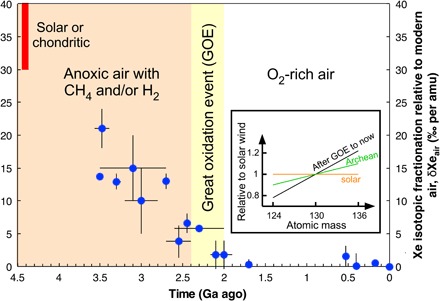
times modern amounts, respectively. The greenhouse gas concentrations were sufficient to offset a fainter Sun. Climate moderation by the carbon cycle suggests average surface temperatures between 0° and 40°C, consistent with occasional glaciations. Isotopic mass fractionation of atmospheric xenon through the Archean until atmospheric oxygenation is best explained by drag of xenon ions by hydrogen escaping rapidly into space. These data imply that substantial loss of hydrogen oxidized the Earth. Despite these advances, detailed understanding of the coevolving solid Earth, biosphere, and atmosphere remains elusive, however.
Overview
CoChat Summary
TL;DR
This review synthesizes proxies and models for the Archean atmosphere (4–2.5 Ga), concluding it was anoxic with negligible O2 and likely enriched in CO2 and CH4, with N2 as a bulk gas and a mostly moderate climate. It highlights major uncertainties in gas levels and the role of life, especially oxygenic photosynthesis and the later Great Oxidation Event.
Key findings
- O2 was extremely low: sulfur mass-independent fractionation indicates ground-level O2 <10−6 PAL (<0.2 ppmv for 1-bar air) before 2.4 Ga, while local “oxygen oases” are estimated at 0.001–0.017 mM O2 (0.4–7% of present).
- N2 and pressure were likely not much higher than today: fluid inclusions give pN2 <1.0 bar at 3.3 Ga and <1.1 bar at 3.5–3.0 Ga; vesicles imply 0.23 ± 0.23 bar at 2.7 Ga; raindrop imprints give a probable limit of <0.52–1.2 bar.
- CO2 and CH4 were important greenhouse gases: paleosol estimates include 0.03–0.15 bar CO2 at 2.77 Ga, 0.02–0.75 bar at 2.75 Ga, and 0.05–0.15 bar at 2.46 Ga; CH4 >20 ppmv is required for S-MIF, and xenon isotopes suggest >~5000 ppmv at ~3.5 Ga.
- Climate was probably mostly moderate: with a Sun 25–30% fainter at 4 Ga, carbonate-silicate models give 0–40°C and seawater pH 6.4–7.4; glacial rocks at 3.5, 2.9, and 2.7 Ga argue against a persistently hot Archean.
Methods
- This is a review/synthesis, not a primary study; it covers the Archean eon from 4 to 2.5 Ga and draws on proxies from rocks, minerals, fluid inclusions, paleosols, raindrop imprints, vesicles, and isotopic records including S-MIF, Xe, N, and C.
- The paper compiles constraints in Table 1 and figures, compares proxy estimates with photochemical, climate, and carbon-cycle models, and discusses the Hadean context and the Great Oxidation Event.
Limitations
- The paper states that limited proxy data leave major uncertainties about exact atmospheric gas levels over time; direct evidence for Archean CO2 remains scanty; when and whether an organic haze formed is uncertain; and knowledge of Archean climatic variability is meager.
- Several proxies are debated: raindrop paleopressure has been criticized but defended; putative Archean biomarkers suffer contamination; some O2 “whiffs” are disputed as post-GOE alteration; siderite is omitted as a pCO2 proxy because it appears diagenetic; and an alternative Xe explanation via organic hazes is considered problematic.
- Evident from the text: as a review, its conclusions depend on cited studies and models, and many constraints are indirect, model-dependent, or permissive rather than definitive.
Model-written summary. Check it against the paper before relying on it.
Integrity signals
Registry
Cites
Statistics
Figures



Verification
Claims the paper makes
78 Valid · 10 Not valid · 121 Not checked · 87 Own results and interpretations
Some cited sources support this claim and some don’t — read each source’s verdict below.
In the paper
“However, observations are unsupportive: Fast mass loss only happens in the first ~200 Ma after Sun-like stars form (207, 208).”
§ The Archean atmosphere > THE ARCHEAN CLIMATE > The Faint Young Sun problem
What the sources say
- Disputedcites [207] Wood B. E., Muller H. R., Zank G. P., Linsky J. L., Redfield S., New mass-loss measurements from astrospheric Lyman-alpha absorption. Astrophys. J. 628, L143– L146 (2005). sourceExperimental — accuracy not yet measured
Figure 3(b) and its accompanying discussion (page not provided) place the inferred weakening of the solar wind at about 0.7 Gyr when looking back toward younger ages. The paper therefore does not confine strong mass loss to the first ~200 million years; it suggests a different age pattern, with especially active, younger stars having weaker winds than the trend would predict. (LLM, conf=0.86)
Checked by a reasoning model — may be wrong.
- Partly supportedcites [208] Minton D. A., Malhotra R., Assessing the massive young sun hypothesis to solve the warm young Earth puzzle. Astrophys. J. 660, 1700– 1706 (2007). sourceExperimental — accuracy not yet measured
Section 3 (Stellar Winds of Sun-like Stars; page unavailable) says observations indicate that stellar-wind flux decreases on a timescale of order 10^8 years and do not support the prolonged mass loss required by the hypothesis. It does not establish a cutoff at approximately 200 million years or say that fast mass loss happens only before then; the Introduction also cautions that the observations cannot rule out a different history for the Sun. (LLM, conf=0.86)
plain- Asserted: passes — The authors put it forward as true.
- Checkable: passes — It can be checked against evidence.
- Load-bearing: passes — The paper’s conclusions depend on it.
- Based: passes — The paper gives a reason why it holds.
- Disputed
The sources with a verdict support this claim; the rest weren’t checked yet, have no full text we could read, or their verdicts aren’t rated yet.
In the paper
“At 4 Ga ago, solar luminosity was 25 to 30% lower than today (12, 13)”
§ The Archean atmosphere > INTRODUCTION: BACKGROUND TO ARCHEAN EARTH
What the sources say
- Not checked — no full text of the sourcecites [12] Gough D. O., Solar interior structure and luminosity variations. Sol. Phys. 74, 21– 34 (1981). source
- Supportedcites [13] Bahcall J. N., Pinsonneault M. H., Basu S., Solar models: Current epoch and time dependences, neutrinos, and helioseismological properties. Astrophys. J. 555, 990– 1012 (2001). source
Table 2 (§3.1) gives the Sun’s present age as 4.57 billion years and its luminosity at solar age 0.6 billion years as 0.744 of today’s. Four billion years ago corresponds to solar age about 0.57 billion years, when luminosity was therefore about 26% lower than today. (LLM, conf=0.94)
plain- Asserted: passes — The authors put it forward as true.
- Checkable: passes — It can be checked against evidence.
- Load-bearing: passes — The paper’s conclusions depend on it.
- Based: passes — The paper gives a reason why it holds.
The sources with a verdict support this claim; the rest weren’t checked yet, have no full text we could read, or their verdicts aren’t rated yet.
In the paper
“Liquid water under a fainter Sun likely implies more abundant greenhouse gases than today (14, 15).”
§ The Archean atmosphere > INTRODUCTION: BACKGROUND TO ARCHEAN EARTH
What the sources say
- Not checked — no full text of the sourcecites [14] Sagan C., Mullen G., Earth and Mars: Evolution of atmospheres and surface temperatures. Science 177, 52– 56 (1972). 17756316 source
- Supportedcites [15] Feulner G., The faint young Sun problem. Rev. Geophys. 50, RG2006 (2012). source
Section 5.5, paragraph 102 (page unavailable), calls an enhanced greenhouse effect the most likely solution to the faint young Sun problem, while acknowledging uncertainty about the gases involved. Section 2.2 discusses the cooling expected under a fainter Sun. Together, these support the claim’s qualified inference that liquid water on early Earth likely required more greenhouse warming than today. (LLM, conf=0.90)
hedgedstates a possible cause- Asserted: passes — The authors put it forward as true.
- Checkable: passes — It can be checked against evidence.
- Load-bearing: passes — The paper’s conclusions depend on it.
- Based: passes — The paper gives a reason why it holds.
Every source the paper cites for this claim was checked and supports it.
In the paper
“Iron formations (IFs), which are marine chemical sedimentary rocks rich in iron and silica [15 to 40 weight % (wt %) Fe and 40 to 60 wt % SiO2], indicate that the deep Archean ocean contained Fe2+(aq) and so was anoxic [e.g., (72)].”
§ The Archean atmosphere > WHAT WAS THE ARCHEAN ATMOSPHERE MADE OF? > Negligible Archean O2 but oxygen oases after oxygenic photosynthesis evolved
What the sources say
- Supportedcites [72] Konhauser K. O., Planavsky N. J., Hardisty D. S., Robbins L. J., Warchola T. J., Haugaard R., Lalonde S. V., Partin C. A., Oonk P. B. H., Tsikos H., Lyons T. W., Bekker A., Johnson C. M., Iron formations: A global record of neoarchaean to palaeoproterozoic environmental history. Earth Sci. Rev. 172, 140– 177 (2017). source
Section 2.1 links Archaean iron-formation deposition to the transport of dissolved Fe(II) under less oxidising conditions. Section 2.6 states that deep waters remained anoxic during iron-formation deposition, and Section 4 calls the Archaean deep-ocean state ferruginous (anoxic). Page numbers are unavailable in our copy. (LLM, conf=0.92)
hedgedstates a cause- Asserted: passes — The authors put it forward as true.
- Checkable: passes — It can be checked against evidence.
- Load-bearing: passes — The paper’s conclusions depend on it.
- Based: passes — The paper gives a reason why it holds.
- Supported
The cited sources support only part of this claim — read each source’s verdict below.
In the paper
“However, consumption of CO2 in the weathering of impact ejecta by carbonic acid suggests a cool early Hadean surface near 0°C under the faint Sun (35, 36).”
§ The Archean atmosphere > A BRIEF OVERVIEW OF THE ENVIRONMENT BEFORE THE ARCHEAN
What the sources say
- Not checked — no full text of the sourcecites [35] Sleep N. H., Zahnle K., Carbon dioxide cycling and implications for climate on ancient Earth. J. Geophys. Res. 106, 1373– 1399 (2001). source
- Partly supportedcites [36] Kadoya S., Krissansen-Totton J., Catling D. C., Probable cold and alkaline surface environment of the Hadean earth caused by impact ejecta weathering. Geochem. Geophys. Geosyst. 21, e2019GC008734 (2019). sourceExperimental — accuracy not yet measured
The Introduction says carbonic-acid weathering of impact ejecta lowers atmospheric CO₂, and Results §4.1 links that consumption to a probably cold climate at 4.3 Ga. The specific temperature is less well supported: the Conclusions give a modeled value of 259.2 K (about −14°C), with substantial uncertainty, rather than a temperature near 0°C. No page numbers are available in our copy. (LLM, conf=0.83)
hedgedstates a cause- Asserted: passes — The authors put it forward as true.
- Checkable: passes — It can be checked against evidence.
- Load-bearing: unclear — It is unclear whether the paper’s conclusions depend on it.
- Based: passes — The paper gives a reason why it holds.
182 more claims · 47 with their cited sources checked
Create a free account to see all 296 claims and to verify the 3 references still open.
- It may state two separate claims as one. 65
- Probably not a substantial claim. 62
- The quote only partly states this claim. 1
Claims other papers make about this one
Each is checked against this paper’s own text: does it say what the citing paper says it does?
The cited source says what the claim attributes to it.
In the citing paper
“liquid water was already present at the surface during the Hadean (4.56 Ga to ≈ 4.0 Ga 1 ) and Archean eons ( ≈ 4.0 Ga to 2.4 Ga)”
From The young Sun's XUV-activity as a constraint for lower CO2-limits in the Earth's Archean atmosphere (2021) · cites this paper as Catling and Zahnle, 2020
Self-check
Percentages, sums and reported differences re-computed from the paper’s own numbers.
Each contradiction between two passages listed here was confirmed by an independent check.
Rated minor: it would not touch a result — a value no result rests on, a p-value that stays on the same side of the significance level, or a conflict that is clerical, resolved elsewhere in the paper, or outside its own findings.
In the paper
§ The Archean atmosphere > CONCLUSIONS AND OUTLOOK
“The secular decline of CO2 is a feedback effect in the geological carbon cycle induced by decreasing solar luminosity.”
§ The Archean atmosphere > INTRODUCTION: BACKGROUND TO ARCHEAN EARTH
“In addition to a gradual increase in solar luminosity, slow changes in the solid Earth over time provided boundary conditions for atmospheric evolution.”
Rated minor: it would not touch a result — a value no result rests on, a p-value that stays on the same side of the significance level, or a conflict that is clerical, resolved elsewhere in the paper, or outside its own findings.
In the paper
§ The Archean atmosphere > WHAT WAS THE ARCHEAN ATMOSPHERE MADE OF?
“Surface barometric pressure | <0.52–1.1 bar | 2.7 Ga | Maximum fossil raindrop imprint size (57)”
§ The Archean atmosphere > WHAT WAS THE ARCHEAN ATMOSPHERE MADE OF? > Nitrogen gases in the Archean
“the largest size of 2.7-Ga-old fossil raindrop imprints provides a conservative limit of paleopressure of <2.1 bar and a probable limit of <0.52 to 1.2 bar (57).”
Citations
Cites
Items 201–286 of 286
Wille, M., Nebel, O., Van Kranendonk, M. J., Schoenberg, R., Kleinhanns, I. C., & Ellwood, M. J. (2013) · Chemical Geology · doi:10.1016/j.chemgeo.2012.12.018 · Cited by 86 · cited 1×
“, (80, 81)], and Se (82) indicates an anoxic Archean atmosphere.”
BackgroundKendall, B., Creaser, R. A., Reinhard, C. T., Lyons, T. W., & Anbar, A. D. (2015) · Science Advances · doi:10.1126/sciadv.1500777 · Cited by 86 · cited 1×
“Critics argue that the data derive from post-GOE alteration (114, 115) [but see (116)].”
BackgroundBiological regulation of atmospheric chemistry en route to planetary oxygenation
Izon, G., Zerkle, A. L., Williford, K. H., Farquhar, J., Poulton, S. W., & Claire, M. W. (2017) · Proceedings of the National Academy of Sciences · doi:10.1073/pnas.1618798114 · Cited by 86
Mallik, A., Li, Y., & Wiedenbeck, M. (2018) · Earth and Planetary Science Letters · doi:10.1016/j.epsl.2017.11.045 · Cited by 85
A case for low atmospheric oxygen levels during Earth's middle history
Planavsky, N. J., Cole, D. B., Isson, T. T., Reinhard, C. T., Crockford, P. W., Sheldon, N. D., & Lyons, T. W. (2018) · Emerging Topics in Life Sciences · doi:10.1042/etls20170161 · Cited by 84 · cited 14×
“C. Scott, T. W. Lyons, A. Bekker, Y. Shen, S. W. Poulton, X. Chu, A. D. Anbar, Tracing the stepwise oxygenation of the Proterozoic ocean.”
BackgroundInfluentialGeological nitrogen cycle and atmospheric N2 over Phanerozoic time
Berner, R. A. (2006) · Geology · doi:10.1130/g22470.1 · Cited by 84
Dating phototrophic microbial lineages with reticulate gene histories
Magnabosco, C., Moore, K. R., Wolfe, J. M., & Fournier, G. P. (2018) · Geobiology · doi:10.1111/gbi.12273 · Cited by 83
Silica: Role in the Buffering of Natural Waters
Garrels, R. M. (1965) · Science · doi:10.1126/science.148.3666.69 · Cited by 82 · cited 1×
“Second, “reverse weathering” (RW) reactions have been proposed (176).”
BackgroundThe evolution of the global selenium cycle: Secular trends in Se isotopes and abundances
Stüeken, E. E., Buick, R., Bekker, A., Catling, D. C., Foriel, J., Guy, B. M., Kah, L. C., Machel, H. G., Montañez, I. P., & Poulton, S. W. (2015) · Geochimica et Cosmochimica Acta · doi:10.1016/j.gca.2015.04.033 · Cited by 81 · cited 1×
“, (80, 81)], and Se (82) indicates an anoxic Archean atmosphere.”
BackgroundSelf-citationKnauth, L. P. (2005) · Elsevier eBooks · doi:10.1016/b978-0-444-52019-7.50007-3 · Cited by 81
Cloud Feedback: A Stabilizing Effect for the Early Earth?
Rossow, W. B., Henderson-Sellers, A., & Weinreich, S. K. (1982) · Science · doi:10.1126/science.217.4566.1245 · Cited by 78
Atmospheric nitrogen evolution on Earth and Venus
Wordsworth, R. D. (2016) · Earth and Planetary Science Letters · doi:10.1016/j.epsl.2016.04.002 · Cited by 78 · cited 2×
“In theHadean, pN2 either started high and then diminished (143) or was initially low if nitrogen partitioned into a very reducing magma ocean (39).”
BackgroundThe 18 O/ 16 O Ratio of 2-Billion-Year-Old Seawater Inferred from Ancient Oceanic Crust
Holmden, C., & Muehlenbachs, K. (1993) · Science · doi:10.1126/science.259.5102.1733 · Cited by 77
Warm Archaean oceans reconstructed from oxygen isotope composition of early-life remnants
Tartèse, R., Chaussidon, M., Gurenko, A., Delarue, F., & Robert, F. (2017) · Geochemical Perspectives Letters · doi:10.7185/geochemlet.1706 · Cited by 77
Reducing greenhouses and the temperature history of Earth and Mars
SAGAN, C. (1977) · Nature · doi:10.1038/269224a0 · Cited by 76
Faint young Sun paradox remains
Goldblatt, C., & Zahnle, K. J. (2011) · Nature · doi:10.1038/nature09961 · Cited by 75
Self-citationReconstructed ancestral enzymes suggest long-term cooling of Earth’s photic zone since the Archean
Garcia, A. K., Schopf, J. W., Yokobori, S.-I., Akanuma, S., & Yamagishi, A. (2017) · Proceedings of the National Academy of Sciences · doi:10.1073/pnas.1702729114 · Cited by 75
Krissansen-Totton, J., & Catling, D. C. (2020) · Earth and Planetary Science Letters · doi:10.1016/j.epsl.2020.116181 · Cited by 75
Self-citationStüeken, E. E., Kipp, M. A., Koehler, M. C., Schwieterman, E. W., Johnson, B., & Buick, R. (2016) · Astrobiology · doi:10.1089/ast.2016.1537 · Cited by 73
A warm or a cold early Earth? New insights from a 3-D climate-carbon model
Charnay, B., Le Hir, G., Fluteau, F., Forget, F., & Catling, D. C. (2017) · Earth and Planetary Science Letters · doi:10.1016/j.epsl.2017.06.029 · Cited by 73
Self-citationXenon isotopic constraints on the history of volatile recycling into the mantle
Parai, R., & Mukhopadhyay, S. (2018) · Nature · doi:10.1038/s41586-018-0388-4 · Cited by 73 · cited 1×
“An alternative explanation from trapping of Xe in organic hazes (201) has the problem that weathering or microbial processing of buried organics would release xenon and modulate the Xe isotopes in post-Archean air, which is not observed (202).”
BackgroundTransient surface ocean oxygenation recorded in the ∼2.66-Ga Jeerinah Formation, Australia
Koehler, M. C., Buick, R., Kipp, M. A., Stüeken, E. E., & Zaloumis, J. (2018) · Proceedings of the National Academy of Sciences · doi:10.1073/pnas.1720820115 · Cited by 72
Kadoya, S., Krissansen‐Totton, J., & Catling, D. C. (2020) · Geochemistry, Geophysics, Geosystems · doi:10.1029/2019gc008734 · Cited by 72 · cited 19×
“I. J. Sackmann, A. I. Boothroyd, Our Sun.”
BackgroundInfluentialSelf-citationClouds and the Faint Young Sun Paradox
Goldblatt, C., & Zahnle, K. J. (2011) · Climate of the Past · doi:10.5194/cp-7-203-2011 · Cited by 71 · cited 1×
“However, no plausible combination of few low clouds (which tend to reflect sunlight) and many high, icy clouds (which tend to warm the surface with downwelling infrared) solves the FYS problem (211).”
BackgroundSelf-citationSalinity of the Archaean oceans from analysis of fluid inclusions in quartz
Marty, B., Avice, G., Bekaert, D. V., & Broadley, M. W. (2018) · Comptes Rendus. Géoscience · doi:10.1016/j.crte.2017.12.002 · Cited by 69 · cited 1×
“0 Ga F rom seawater fluid inclusions in quartz (50)”
BackgroundAssessing the Massive Young Sun Hypothesis to Solve the Warm Young Earth Puzzle
Minton, D. A., & Malhotra, R. (2007) · The Astrophysical Journal · doi:10.1086/514331 · Cited by 67 · cited 1×
“However, observations are unsupportive: Fast mass loss only happens in the first ~200 Ma after Sun-like stars form (207, 208).”
Backgroundde Wit, M. J., & Furnes, H. (2016) · Science Advances · doi:10.1126/sciadv.1500368 · Cited by 67
Geboy, N. J., Kaufman, A. J., Walker, R. J., Misi, A., de Oliviera, T. F., Miller, K. E., Azmy, K., Kendall, B., & Poulton, S. W. (2013) · Precambrian Research · doi:10.1016/j.precamres.2013.10.010 · Cited by 66
Ancient micrometeorites suggestive of an oxygen-rich Archaean upper atmosphere
Tomkins, A. G., Bowlt, L., Genge, M., Wilson, S., Brand, H. E. A., & Wykes, J. L. (2016) · Nature · doi:10.1038/nature17678 · Cited by 66
Clouds and the Faint Young Sun ParadoxPreprint
Goldblatt, C., & Zahnle, K. (2013) · Cited by 66
Self-citationEffects of primitive photosynthesis on Earth’s early climate system
Ozaki, K., Tajika, E., Hong, P. K., Nakagawa, Y., & Reinhard, C. T. (2018) · Nature Geoscience · doi:10.1038/s41561-017-0031-2 · Cited by 65
Weathering of quartz as an Archean climatic indicator
Sleep, N. H., & Hessler, A. M. (2006) · Earth and Planetary Science Letters · doi:10.1016/j.epsl.2005.11.020 · Cited by 64
Nitrogen solubility in the deep mantle and the origin of Earth's primordial nitrogen budget
Yoshioka, T., Wiedenbeck, M., Shcheka, S., & Keppler, H. (2018) · Earth and Planetary Science Letters · doi:10.1016/j.epsl.2018.02.021 · Cited by 64 · cited 1×
“Estimates of nitrogen bound in today’s solid Earth range a few to ~40 bar equivalent (37, 38), which allows for considerable N2 in the Hadean atmosphere unless N was incorporated into a reducing, deep layer of magma—a magma ocean—formed after the Moon-forming impact ~4.”
BackgroundMaking Evolutionary Sense of Gaia
Doolittle, W. F. (2019) · Trends in Ecology & Evolution · doi:10.1016/j.tree.2019.05.001 · Cited by 61 · cited 1×
“However, debate continues about if and how adaptive evolution of the biosphere can produce a more stable climate than an abiotic Earth (221, 222).”
BackgroundRasmussen, B., & Muhling, J. R. (2018) · Precambrian Research · doi:10.1016/j.precamres.2017.12.017 · Cited by 59
Triple oxygen isotope mass balance for the Earth's oceans with application to Archean cherts
Sengupta, S., & Pack, A. (2018) · Chemical Geology · doi:10.1016/j.chemgeo.2018.07.012 · Cited by 59 · cited 1×
“Last, the triple O isotope composition of Archean cherts cannot be reconciled with equilibrium precipitation from seawater and requires alteration (239).”
BackgroundKurzweil, F., Wille, M., Schoenberg, R., Taubald, H., & Van Kranendonk, M. J. (2015) · Geochimica et Cosmochimica Acta · doi:10.1016/j.gca.2015.05.009 · Cited by 57
The terrestrial record of Late Heavy Bombardment
Lowe, D. R., & Byerly, G. R. (2018) · New Astronomy Reviews · doi:10.1016/j.newar.2018.03.002 · Cited by 56 · cited 1×
“The lunar record implies a decay of terrestrial impact bombardment extending into the Archean (20, 21).”
BackgroundCoupled noble gas–hydrocarbon evolution of the early Earth atmosphere upon solar UV irradiation
Hébrard, E., & Marty, B. (2014) · Earth and Planetary Science Letters · doi:10.1016/j.epsl.2013.10.022 · Cited by 54 · cited 1×
“An alternative explanation from trapping of Xe in organic hazes (201) has the problem that weathering or microbial processing of buried organics would release xenon and modulate the Xe isotopes in post-Archean air, which is not observed (202).”
BackgroundThe Pongola Supergroup in Swaziland
Nhleko, N. (2009) · Cited by 54
Environmental Adaptation from the Origin of Life to the Last Universal Common Ancestor
Cantine, M. D., & Fournier, G. P. (2018) · Origins of Life and Evolution of Biospheres · doi:10.1007/s11084-017-9542-5 · Cited by 54 · cited 1×
“However, other more convincing reconstructions and biochemical considerations suggest a mesophilic (<50°C) common ancestor (242, 243).”
BackgroundGeologic and Geochemical Constraints on Earth's Early Atmosphere
Farquhar, J., Zerkle, A. L., & Bekker, A. (2014) · Treatise on Geochemistry · doi:10.1016/b978-0-08-095975-7.01304-8 · Cited by 53
The effect of widespread early aerobic marine ecosystems on methane cycling and the Great Oxidation
Daines, S. J., & Lenton, T. M. (2016) · Earth and Planetary Science Letters · doi:10.1016/j.epsl.2015.11.021 · Cited by 53
Constraints on ocean carbonate chemistry and pCO2 in the Archaean and Palaeoproterozoic
Blättler, C. L., Kump, L. R., Fischer, W. W., Paris, G., Kasbohm, J. J., & Higgins, J. A. (2017) · Nature Geoscience · doi:10.1038/ngeo2844 · Cited by 53
EarthN: A New Earth System Nitrogen Model
Johnson, B. W., & Goldblatt, C. (2018) · Geochemistry, Geophysics, Geosystems · doi:10.1029/2017gc007392 · Cited by 51
Thomazo, C., Nisbet, E. G., Grassineau, N. V., Peters, M., & Strauss, H. (2013) · Geochimica et Cosmochimica Acta · doi:10.1016/j.gca.2013.06.036 · Cited by 49
Ammonium as a biomarker in Precambrian metasediments
Boyd, S. R. (2001) · Precambrian Research · doi:10.1016/s0301-9268(00)00162-5 · Cited by 48 · cited 1×
“8Ga ago are ammonium enriched (146, 147), which probably came from porewater ammonium (NH4 ) derived from degraded organics (Table 1) (148, 149), and these data have been used to argue that Archean N2 was sequestered into solid phases after an early advent of biological nitrogen fixation (56, 150).”
MethodEnvironmental control on microbial diversification and methane production in the Mesoarchean
Stüeken, E. E., & Buick, R. (2018) · Precambrian Research · doi:10.1016/j.precamres.2017.11.003 · Cited by 47
Harman, C. E., Pavlov, A. A., Babikov, D., & Kasting, J. F. (2018) · Earth and Planetary Science Letters · doi:10.1016/j.epsl.2018.05.041 · Cited by 47 · cited 1×
“2020;6 : eaax1420 26 February 2020 that dominantly imparted S-MIF are debated: They include polysulfur formation (61), SO2 photolysis, and other reactions (46, 59).”
BackgroundEarly solar mass loss: A potential solution to the weak sun paradox
Graedel, T. E., Sackmann, I. ‐., & Boothroyd, A. I. (1991) · Geophysical Research Letters · doi:10.1029/91gl02314 · Cited by 46
Sedimentary sulfur isotopes and Neoarchean ocean oxygenation
Fakhraee, M., Crowe, S. A., & Katsev, S. (2018) · Science Advances · doi:10.1126/sciadv.1701835 · Cited by 44
Using raindrops to constrain past atmospheric density
Kavanagh, L., & Goldblatt, C. (2015) · Earth and Planetary Science Letters · doi:10.1016/j.epsl.2014.12.032 · Cited by 43 · cited 1×
“[Criticism of the raindrop paleopressure constraint (137) is refuted in (138).”
BackgroundHigh ammonium contents in the 3800 Ma Isua supracrustal rocks, central West Greenland
Honma, H. (1996) · Geochimica et Cosmochimica Acta · doi:10.1016/0016-7037(96)00083-x · Cited by 43 · cited 1×
“8Ga ago are ammonium enriched (146, 147), which probably came from porewater ammonium (NH4 ) derived from degraded organics (Table 1) (148, 149), and these data have been used to argue that Archean N2 was sequestered into solid phases after an early advent of biological nitrogen fixation (56, 150).”
MethodHCN Production via Impact Ejecta Reentry During the Late Heavy Bombardment
Parkos, D., Pikus, A., Alexeenko, A., & Melosh, H. J. (2018) · Journal of Geophysical Research: Planets · doi:10.1002/2017je005393 · Cited by 42
Environmental niches and metabolic diversity in Neoarchean lakes
Stüeken, E. E., Buick, R., Anderson, R. E., Baross, J. A., Planavsky, N. J., & Lyons, T. W. (2017) · Geobiology · doi:10.1111/gbi.12251 · Cited by 40
Atmospheric CO 2 levels from 2.7 billion years ago inferred from micrometeorite oxidation
Lehmer, O. R., Catling, D. C., Buick, R., Brownlee, D. E., & Newport, S. (2020) · Science Advances · doi:10.1126/sciadv.aay4644 · Cited by 39
Self-citationSubduction and atmospheric escape of Earth's seawater constrained by hydrogen isotopes
Kurokawa, H., Foriel, J., Laneuville, M., Houser, C., & Usui, T. (2018) · Earth and Planetary Science Letters · doi:10.1016/j.epsl.2018.06.016 · Cited by 37 · cited 1×
“5% lighter than today, which could be explained by rapidArchean escape of hydrogen and isotopic fractionation (185, 186).”
BackgroundStauffer, B., Flückiger, J., Monnin, E., Schwander, J., Barnola, J.-M., & Chappellaz, J. (2002) · Annals of Glaciology · doi:10.3189/172756402781816861 · Cited by 34
Can thin cirrus clouds in the tropics provide a solution to the faint young Sun paradox?
Rondanelli, R., & Lindzen, R. S. (2010) · Journal of Geophysical Research: Atmospheres · doi:10.1029/2009jd012050 · Cited by 34
Flannery, D. T., Allwood, A. C., & Van Kranendonk, M. J. (2016) · Precambrian Research · doi:10.1016/j.precamres.2016.09.021 · Cited by 34
Nitrogen in Ancient Mud: A Biosignature?
Stüeken, E. E. (2016) · Astrobiology · doi:10.1089/ast.2016.1478 · Cited by 32 · cited 2×
“8 Ga F rom the N content of biotites (originally clays), derived from adsorption of dissolved NH4 (aq) (148)”
Method(2014) · doi:10.18520/cs/v106/i3/387-396 · Cited by 30
Terrestrial methane fluxes and Proterozoic climate
Zhao, M., Reinhard, C. T., & Planavsky, N. J. (2017) · Geology · doi:10.1130/g39502.1 · Cited by 30
Oxidised micrometeorites as evidence for low atmospheric pressure on the early Earth
Rimmer, P. B., Shorttle, O., & Rugheimer, S. (2019) · Geochemical Perspectives Letters · doi:10.7185/geochemlet.1903 · Cited by 30 · cited 1×
“7-Ga-old iron-nickel micrometeorites has been used to argue for O2 near-modern levels above ~75-km altitude (83, 84).”
MethodSiderite cannot be used as CO2 sensor for Archaean atmospheres
Gäb, F., Ballhaus, C., Siemens, J., Heuser, A., Lissner, M., Geisler, T., & Garbe-Schönberg, D. (2017) · Geochimica et Cosmochimica Acta · doi:10.1016/j.gca.2017.07.027 · Cited by 28
Estimates of atmospheric O2 in the Paleoproterozoic from paleosols
Kanzaki, Y., & Murakami, T. (2015) · Geochimica et Cosmochimica Acta · doi:10.1016/j.gca.2015.11.022 · Cited by 27
The thermodynamic effect of atmospheric mass on early Earth's temperature
Chemke, R., Kaspi, Y., & Halevy, I. (2016) · Geophysical Research Letters · doi:10.1002/2016gl071279 · Cited by 25 · cited 1×
“In general, a fasterArchean rotation rate reduces heat transport from equator to pole (212, 213), particularly if the atmosphere had less mass (248).”
BackgroundOrganic Carbon Cycling and the Lithosphere
Derry, L. A. (2014) · Treatise on Geochemistry · doi:10.1016/b978-0-08-095975-7.01014-7 · Cited by 24
Cammack, J. N., Spicuzza, M. J., Cavosie, A. J., Van Kranendonk, M. J., Hickman, A. H., Kozdon, R., Orland, I. J., Kitajima, K., & Valley, J. W. (2018) · Precambrian Research · doi:10.1016/j.precamres.2017.11.005 · Cited by 24
16 Good Golly, Why Moly? THE STABLE ISOTOPE GEOCHEMISTRY OF MOLYBDENUM
Kendall, B., Dahl, T. W., & Anbar, A. D. (2017) · De Gruyter eBooks · doi:10.1515/9783110545630-017 · Cited by 24
On Gaia: A Critical Investigation of the Relationship between Life and Earth
Tyrrell, T. (2013) · doi:10.23943/princeton/9780691121581.001.0001 · Cited by 22
On Gaia: A Critical Investigation of the Relationship between Life and Earth
Tyrrell, T. (2013) · Princeton University Press eBooks · doi:10.1515/9781400847914 · Cited by 21
Eolianite Grain Size Distributions as a Proxy for Large Changes in Planetary Atmospheric Density
Goosmann, E. A., Catling, D. C., Som, S. M., Altermann, W., & Buick, R. (2018) · Journal of Geophysical Research: Planets · doi:10.1029/2018je005723 · Cited by 18
Self-citationCarbonate chemostratigraphy of the Vazante Group, Brazil: A probable Tonian age
de Alvarenga, C. J. S., Oliveira, G. D., Vieira, L. C., Santos, R. V., Baptista, M. C., & Dantas, E. L. (2019) · Precambrian Research · doi:10.1016/j.precamres.2019.105378 · Cited by 18
Constraints on hydrogen levels in the Archean atmosphere based on detrital magnetite
Kadoya, S., & Catling, D. C. (2019) · Geochimica et Cosmochimica Acta · doi:10.1016/j.gca.2019.07.041 · Cited by 16 · cited 2×
“7-Ga ago would have dissolved at high pH2 via microbial reduction of Fe(3) + to soluble Fe(2) + using H2 (199), providing an upper limit of pH2 ≤ 10 −2 bar (200).”
BackgroundSelf-citationPaleoclimates, ocean depth, and the oxygen isotopic composition of seawater
Kasting, J. F., Howard, M. T., Wallmann, K., Veizer, J., Shield, G., & Jaffrés, J. B. D. (2006) · Geochimica et Cosmochimica Acta · doi:10.1016/j.gca.2006.06.623 · Cited by 13
Holland, H. D., & Turekian, K. K. (2003) · Treatise on Geochemistry · doi:10.1016/b0-08-043751-6/08102-0 · Cited by 12
Photochemistry of Methane in the Earth's Early Atmosphere
Kasting, J. F., Zahnle, K. J., & Walker, J. C. G. (1983) · Developments in precambrian geology · doi:10.1016/s0166-2635(08)70239-1 · Cited by 10
Self-citationSilicate weathering in anoxic marine sediments
Wallmann, K., Aloisi, G., Haeckel, M., et al. (2008) · Mineralogical Magazine · doi:10.1180/minmag.2008.072.1.363 · Cited by 10
Schlesinger, W. H., & Bernhardt, E. S. (2013) · Biogeochemistry · doi:10.1016/b978-0-12-385874-0.00001-7 · Cited by 8
11. Hadean Zircon Petrochronology
Harrison, T. M., Bell, E. A., & Boehnke, P. (2017) · De Gruyter eBooks · doi:10.1515/9783110561890-012 · Cited by 8
Schütz, M. K., Bildstein, O., Schlegel, M. L., & Libert, M. (2015) · Chemical Geology · doi:10.1016/j.chemgeo.2015.10.039 · Cited by 4 · cited 1×
“7-Ga ago would have dissolved at high pH2 via microbial reduction of Fe(3) + to soluble Fe(2) + using H2 (199), providing an upper limit of pH2 ≤ 10 −2 bar (200).”
Evolution of a Habitable Planet
Kasting, J. F., & Kirschvink, J. L. (2012) · Cambridge University Press eBooks · doi:10.1017/cbo9780511902574.010 · Cited by 4
EarthN: a new model of the Earth system nitrogen cyclePreprint
Johnson, B., & Goldblatt, C. (2018) · doi:10.1002/essoar.b4a58a1e1119f5a9.3251d653d5ec49a9.1
19 Uranium Isotope Fractionation
Andersen, M. B., Stirling, C. H., & Weyer, S. (2017) · Non-Traditional Stable Isotopes · doi:10.1515/9783110545630-020
Author Correction: Microbial life and biogeochemical cycling on land 3,220 million years ago
Homann, M., Sansjofre, P., Zuilen, M. V., Heubeck, C., Gong, J., Killingsworth, B., Foster, I. S., Airo, A., Kranendonk, M. J. V., Ader, M., et al. (2018) · Nature Geoscience · doi:10.1038/s41561-018-0253-y
Research works printed but not linked: 8
- D. C. Catling in Treatise on Geochemistry H. D. Holland K. K. Turekian Eds. (Elsevier 2014) vol. 8 pp. 191–233.
- K. J. Zahnle D. C. Catling in Special Paper 504: Early Earth's Atmosphere and Surface Environment G. H. Shaw Ed. (Geological Soc. of America 2014) pp. 37–48.
- J. F. Kasting in Special Paper 504: Early Earth’s Atmosphere and Surface Environment G. H. Shaw Ed. (Geological Society of America 2014) pp. 19–28.
- N. J. Page in Earth’s Pre-Pleistocene Glacial Record M. J. Hambrey N. B. Harland Eds. (Cambridge Univ. Press 1981) pp. 821–823.
- R. T. Gregory in Stable Isotope Geochemistry: A Tribute to Samuel Epstein H. P. Taylor J. R. O'Neil I. R. Kaplan Eds. (Min. Soc. America 1991) pp. 65–76.
- A. Knoll in The Cyanobacteria: Molecular Biology Genetics and Evolution A. Herrero E. Flores Eds. (Caister Academic Press 2008) pp. 1–19.
- D. C. Catling, K. J. Zahnle, C. P. McKay, What caused the second rise of O2 in the late Proterozoic? Methane, sulfate. and irreversible oxidation. Astrobiology 2, 569 (2002).
- J. W. Murray K. Stewart S. Kassakian M. Krynytzky D. DiJulio in The Black Sea Flood Question: Changes in Coastline Climate and Human Settlement V. Yanko-Hombach A. S. Gilbert N. Panin P. M. Dolukhanov Eds. (Springer Netherlands 2007) pp. 1–21.
Cited by
Secular Evolution of Continents and the Earth System
Cawood, P. A., Chowdhury, P., Mulder, J. A., Hawkesworth, C. J., Capitanio, F. A., Gunawardana, P. M., & Nebel, O. (2022) · Reviews of Geophysics · doi:10.1029/2022rg000789 · Cited by 265
Solar energy conversion by photosystem II: principles and structures
Shevela, D., Kern, J. F., Govindjee, G., & Messinger, J. (2023) · Photosynthesis Research · doi:10.1007/s11120-022-00991-y · Cited by 194
“Current estimates range from ~ 3.5 billion years ago (or even earlier) to the time points close to the GOE (Farquhar et al.”
BackgroundInfluentialSignatures of early microbial life from the Archean (4 to 2.5 Ga) eon
Lepot, K. (2020) · Earth-Science Reviews · doi:10.1016/j.earscirev.2020.103296 · Cited by 179
“…activity through hydrothermal fluid and volcanic emissions and their transformation products, as well as the alteration of the early crust (or proto-crust) before and during the Archean (Huston and Logan, 2004; Kump and Barley, 2007; Arndt and Nisbet, 2012; Kasting, 2019; Catling and Zahnle, 2020).”
InfluentialThe Great Oxidation Event preceded a Paleoproterozoic “snowball Earth”
Warke, M. R., Di Rocco, T., Zerkle, A. L., Lepland, A., Prave, A. R., Martin, A. P., Ueno, Y., Condon, D. J., & Claire, M. W. (2020) · Proceedings of the National Academy of Sciences · doi:10.1073/pnas.2003090117 · Cited by 159
Day–night cloud asymmetry prevents early oceans on Venus but not on Earth
Turbet, M., Bolmont, É., Chaverot, G., Ehrenreich, D., Leconte, J., & Marcq, E. (2021) · Nature · doi:10.1038/s41586-021-03873-w · Cited by 176
Metadata
- Authors
- Catling, D. C., & Zahnle, K. J.
- Affiliations
- University of Washington (US)
- Ames Research Center (US)
- Corresponding author
- Catling, David C.
- Venue
- Science Advances
- Published
- 2020-02-28
- Volume
- 6
- Issue
- 9
- Pages
- eaax1420-eaax1420
- ISSN
- 2375-2548 (ISSN-L)
- PMC
- PMC7043912
- OpenAlex
- W3007909729
- Cited by
- 568
- References
- 278
- Citations by year
- 2026: 98 · 2025: 104 · 2024: 95 · 2023: 96 · 2022: 84 · 2021: 59 · 2020: 32
- FWCI
- 8.70
- Type
- journal article
- Language
- en
- Open access
- gold
- doi.org
- Licence
- cc-by
- Locations
- Science Advances (publishedVersion, cc-by)
- Europe PMC (PubMed Central) (publishedVersion, cc-by)
- PubMed Central (publishedVersion, cc-by)
- PubMed (publishedVersion)
- Funders
- National Science Foundation (1338810)
- Simons Foundation (511570)
- NASA Astrobiology Institute (NNA13AA93A, 80NSSC18K0829)
- Leverhulme Trust (VP2-2016-041)
- NASA Exobiology (NNX15AL23G)
- Topics
- Physical Sciences › Earth and Planetary Sciences › Paleontology › Paleontology and Stratigraphy of Fossils
- Physical Sciences › Earth and Planetary Sciences › Geochemistry and Petrology › Geological and Geochemical Analysis
- Physical Sciences › Earth and Planetary Sciences › Space and Planetary Science › Astro and Planetary Science
- Keywords
- Archean atmosphere, greenhouse gases, carbon cycle, surface temperature, glaciation, atmospheric xenon, hydrogen escape, atmospheric oxygenation, early Earth climate
About these checks
Registry, retraction, Cites and statistics results are computed, not judged, with one exception: a printed reference that no index lists is read once by a model before it counts as a citation error. Claims are extracted by a model and kept only when their quote appears verbatim in the text; each cited source is then checked, with a model’s help, for whether it says what the claim relies on. Those verdicts can be wrong — read the claim’s quote and the cited source before relying on one.
The claim verdicts this report counts are experimental: their accuracy is not yet measured.
A language model drew the claims from the paper on 2026-10-10, under version 3 of the claim definition (model deepseek-v4.1-flash, prompt extract-v3).
A second model labelled each claim on 2026-10-10 (model jev-1.13-20260917, definition revision gold-guideline-v0.2).
Cited sources are checked with a language model’s help (gpt-6-sol).
Statistics and arithmetic are recomputed, not judged.
Confidence bands are shown only for fields calibrated on our annotated test set. None is calibrated yet, so no band is shown.
What counts as a claim ›How we measure confidence ›How we check this ›
Are you an author, or do you see a problem with this page? Request a review
Data sources
Bibliographic data: Semantic Scholar, OpenAlex, Crossref.
Contains information from the Semantic Scholar Academic Graph Datasets, made available under the ODC Attribution License (ODC-BY 1.0).
Semantic Scholar’s data is described in: Kinney, R., et al. (2023). The Semantic Scholar Open Data Platform. arXiv:2301.10140.
