

Glove-based sensors for multimodal monitoring of natural sweat
Open accessThe DOI matches its Crossref record; 50 of the 50 references it cites were found in a registry or an index.
Abstract
Functionalized glove sensors allow natural sweat analysis without requiring exercise or iontophoretic stimulation.
Overview
The claims and statistics of this paper haven’t been checked yet.
Free: it reads the open-access text and checks the first 5 claims that cite a source we can check. Create a free account to check every claim.
Integrity signals
Registry
Cites
Statistics
Figures
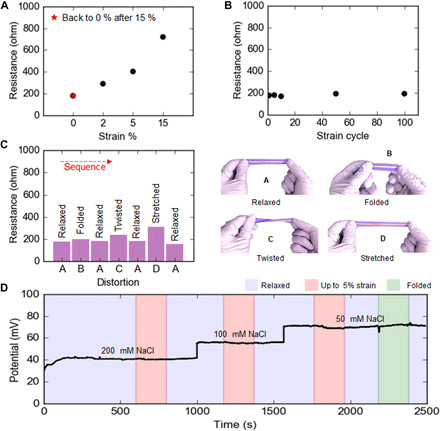
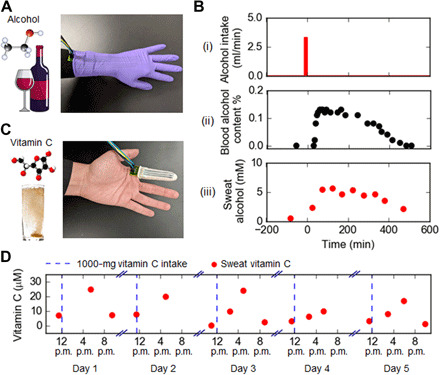
Verification
Claims the paper makes
The claims and statistics of this paper haven’t been checked yet.
Free: it reads the open-access text and checks the first 5 claims that cite a source we can check. Create a free account to check every claim.
Claims other papers make about this one
Each is checked against this paper’s own text: does it say what the citing paper says it does?
The source backs part of the claim, not all of it — or backs it for a different population, condition or comparison.
In the citing paper
“For instance, sweat secretion rates can be lower than 10 nL min−1 cm−2 at low secretion sites such as arm and leg, and can reach on the order of 100 nL min−1 cm−2 at high secretion areas like the palm and foot29,30.”
From A wearable patch for continuous analysis of thermoregulatory sweat at rest (2021) · cites this paper as [30]
Experimental — accuracy not yet measuredThe source backs part of the claim, not all of it — or backs it for a different population, condition or comparison.
In the citing paper
“Humans’ sweat secretion rates at rest vary across different body locations on average.”
From A wearable patch for continuous analysis of thermoregulatory sweat at rest (2021) · cites this paper as [30]
Experimental — accuracy not yet measuredThe source backs part of the claim, not all of it — or backs it for a different population, condition or comparison.
In the citing paper
“Regions like the fingertips and hands are established to have relatively higher resting sweating rates, for which our simulations indicate a time lag of around 3 min30.”
From A wearable patch for continuous analysis of thermoregulatory sweat at rest (2021) · cites this paper as [30]
Experimental — accuracy not yet measured
Self-check
Percentages, sums and reported differences re-computed from the paper’s own numbers.
The self-check needs the paper’s full text.
Citations
Cites
Fully integrated wearable sensor arrays for multiplexed in situ perspiration analysis
Gao, W., Emaminejad, S., Nyein, H. Y. Y., Challa, S., Chen, K., Peck, A., Fahad, H. M., Ota, H., Shiraki, H., Kiriya, D., et al. (2016) · Nature · doi:10.1038/nature16521 · Cited by 5,087 · cited 5×
“The chloride sensor and Ag/AgCl reference electrode are fabricated by depositing Ag/AgCl conductive ink over the Au electrode heads, while the PVB reference involves deposition of a thick layer of PVB solution (saturated with NaCl) over Ag/AgCl ink, as demonstrated in our previous work (3).”
MethodInfluentialSelf-citationWearable biosensors for healthcare monitoring
Kim, J., Campbell, A. S., de Ávila, B. E.-F., & Wang, J. (2019) · Nature Biotechnology · doi:10.1038/s41587-019-0045-y · Cited by 3,373 · cited 1×
“Furthermore, lower sweat rates reduce dilution of secreted analytes, better preserving equilibrium correlations between biomarkers in the sweat gland and those in surrounding interstitial fluid or blood (18, 20, 21).”
BackgroundBariya, M., Nyein, H. Y. Y., & Javey, A. (2018) · Nature Electronics · doi:10.1038/s41928-018-0043-y · Cited by 1,486
Self-citationA soft, wearable microfluidic device for the capture, storage, and colorimetric sensing of sweat
Koh, A., Kang, D., Xue, Y., Lee, S., Pielak, R. M., Kim, J., Hwang, T., Min, S., Banks, A., Bastien, P., et al. (2016) · Science Translational Medicine · doi:10.1126/scitranslmed.aaf2593 · Cited by 1,308
A laser-engraved wearable sensor for sensitive detection of uric acid and tyrosine in sweat
Yang, Y., Song, Y., Bo, X., Min, J., Pak, O. S., Zhu, L., Wang, M., Tu, J., Kogan, A., Zhang, H., et al. (2020) · Nature Biotechnology · doi:10.1038/s41587-019-0321-x · Cited by 1,270
Lee, H., Song, C., Hong, Y. S., Kim, M., Cho, H. R., Kang, T., Shin, K., Choi, S. H., Hyeon, T., & Kim, D.-H. (2017) · Science Advances · doi:10.1126/sciadv.1601314 · Cited by 1,118
Vitamin C pharmacokinetics: Implications for oral and intravenous use
Padayatty, S. J., Sun, H., Wang, Y., Riordan, H. D., Hewitt, S. M., Katz, A., Wesley, R. A., & Levine, M. (2004) · Annals of Internal Medicine · doi:10.7326/0003-4819-140-7-200404060-00010 · Cited by 992
Emaminejad, S., Gao, W., Wu, E., Davies, Z. A., Yin Yin Nyein, H., Challa, S., Ryan, S. P., Fahad, H. M., Chen, K., Shahpar, Z., et al. (2017) · Proceedings of the National Academy of Sciences · doi:10.1073/pnas.1701740114 · Cited by 839
Self-citationBandodkar, A. J., Gutruf, P., Choi, J., Lee, K., Sekine, Y., Reeder, J. T., Jeang, W. J., Aranyosi, A. J., Lee, S. P., Model, J. B., et al. (2019) · Science Advances · doi:10.1126/sciadv.aav3294 · Cited by 761
Accessing analytes in biofluids for peripheral biochemical monitoring
Heikenfeld, J., Jajack, A., Feldman, B., Granger, S. W., Gaitonde, S., Begtrup, G., & Katchman, B. A. (2019) · Nature Biotechnology · doi:10.1038/s41587-019-0040-3 · Cited by 758
Sonner, Z., Wilder, E., Heikenfeld, J., Kasting, G., Beyette, F., Swaile, D., Sherman, F., Joyce, J., Hagen, J., Kelley-Loughnane, N., et al. (2015) · Biomicrofluidics · doi:10.1063/1.4921039 · Cited by 724 · cited 1×
“Furthermore, lower sweat rates reduce dilution of secreted analytes, better preserving equilibrium correlations between biomarkers in the sweat gland and those in surrounding interstitial fluid or blood (18, 20, 21).”
BackgroundWearable Electrochemical Sensors and Biosensors: A Review
Windmiller, J. R., & Wang, J. (2013) · Electroanalysis · doi:10.1002/elan.201200349 · Cited by 696
A Wearable Electrochemical Platform for Noninvasive Simultaneous Monitoring of Ca2+ and pH
Nyein, H. Y. Y., Gao, W., Shahpar, Z., Emaminejad, S., Challa, S., Chen, K., Fahad, H. M., Tai, L.-C., Ota, H., Davis, R. W., et al. (2016) · ACS Nano · doi:10.1021/acsnano.6b04005 · Cited by 669
Self-citationNoninvasive Alcohol Monitoring Using a Wearable Tattoo-Based Iontophoretic-Biosensing System
Kim, J., Jeerapan, I., Imani, S., Cho, T. N., Bandodkar, A., Cinti, S., Mercier, P. P., & Wang, J. (2016) · ACS Sensors · doi:10.1021/acssensors.6b00356 · Cited by 599
Taylor, N. A., & Machado-Moreira, C. A. (2013) · Extreme Physiology & Medicine · doi:10.1186/2046-7648-2-4 · Cited by 490
Martín, A., Kim, J., Kurniawan, J. F., Sempionatto, J. R., Moreto, J. R., Tang, G., Campbell, A. S., Shin, A., Lee, M. Y., Liu, X., et al. (2017) · ACS Sensors · doi:10.1021/acssensors.7b00729 · Cited by 475
Mechanisms of reversible stretchability of thin metal films on elastomeric substrates
Lacour, S. P., Chan, D., Wagner, S., Li, T., & Suo, Z. (2006) · Applied Physics Letters · doi:10.1063/1.2201874 · Cited by 413 · cited 1×
“This behavior arises because the nitrile glove is originally extended over the sample holder during gold evaporation, forming a percolating network of Au clusters or ligaments, rough surface features that connect over fine cracks to ensure electrical conductivity of the relaxed nitrile, as demonstrated previously for…”
BackgroundWearable Microsensor Array for Multiplexed Heavy Metal Monitoring of Body Fluids
Gao, W., Nyein, H. Y. Y., Shahpar, Z., Fahad, H. M., Chen, K., Emaminejad, S., Gao, Y., Tai, L.-C., Ota, H., Wu, E., et al. (2016) · ACS Sensors · doi:10.1021/acssensors.6b00287 · Cited by 391 · cited 5×
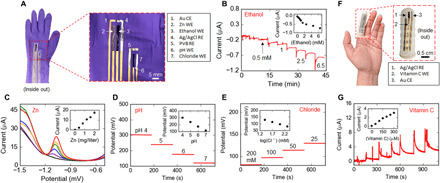
“Overall, the performance of these sensors on the glove’s soft, nitrile substrate is similar to what has been previously demonstrated by our group and others on more planar, rigid polyethylene terephthalate (PET) (3, 10, 33, 38).”
BackgroundMethodInfluentialSelf-citationNyein, H. Y. Y., Bariya, M., Kivimäki, L., Uusitalo, S., Liaw, T. S., Jansson, E., Ahn, C. H., Hangasky, J. A., Zhao, J., Lin, Y., et al. (2019) · Science Advances · doi:10.1126/sciadv.aaw9906 · Cited by 388 · cited 1×
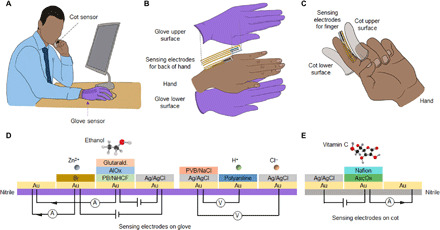
“For the alcohol sensor, electrodeposition of Au nanodendrites is followed by cyclic voltammetry to deposit two interdigitated layers each of Prussian Blue mediator and nickel hexacyanoferrate (NiHCF) stabilizer, as demonstrated in previous work (4, 51).”
MethodSelf-citationGender-linked differences in human skin
Giacomoni, P. U., Mammone, T., & Teri, M. (2009) · Journal of Dermatological Science · doi:10.1016/j.jdermsci.2009.06.001 · Cited by 314 · cited 1×
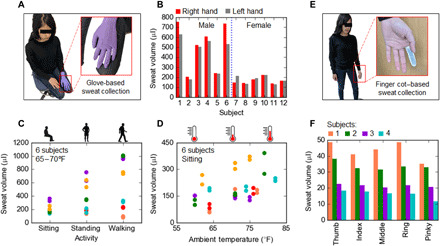
“The males produce an average of 475 l of sweat on each hand, while the females produce an average of 180 l of sweat on each hand, consistent with known biological differences (27).”
BackgroundMethylxanthine Drug Monitoring with Wearable Sweat Sensors
Tai, L., Gao, W., Chao, M., Bariya, M., Ngo, Q. P., Shahpar, Z., Nyein, H. Y. Y., Park, H., Sun, J., Jung, Y., et al. (2018) · Advanced Materials · doi:10.1002/adma.201707442 · Cited by 310
Self-citationZhang, Y., Guo, H., Kim, S. B., Wu, Y., Ostojich, D., Park, S. H., Wang, X., Weng, Z., Li, R., Bandodkar, A. J., et al. (2019) · Lab on a Chip · doi:10.1039/c9lc00103d · Cited by 250
Lin, Y., Bariya, M., Nyein, H. Y. Y., Kivimäki, L., Uusitalo, S., Jansson, E., Ji, W., Yuan, Z., Happonen, T., Liedert, C., et al. (2019) · Advanced Functional Materials · doi:10.1002/adfm.201902521 · Cited by 185 · cited 1×
“For the alcohol sensor, electrodeposition of Au nanodendrites is followed by cyclic voltammetry to deposit two interdigitated layers each of Prussian Blue mediator and nickel hexacyanoferrate (NiHCF) stabilizer, as demonstrated in previous work (4, 51).”
MethodSelf-citationNeural control of sweat secretion: a review
Hu, Y., Converse, C., Lyons, M. C., & Hsu, W. H. (2018) · British Journal of Dermatology · doi:10.1111/bjd.15808 · Cited by 181
A wearable patch for continuous monitoring of sweat electrolytes during exertion
Alizadeh, A., Burns, A., Lenigk, R., Gettings, R., Ashe, J., Porter, A., McCaul, M., Barrett, R., Diamond, D., White, P., et al. (2018) · Lab on a Chip · doi:10.1039/c8lc00510a · Cited by 180
Wearable Sweat Band for Noninvasive Levodopa Monitoring
Tai, L.-C., Liaw, T. S., Lin, Y., Nyein, H. Y. Y., Bariya, M., Ji, W., Hettick, M., Zhao, C., Zhao, J., Hou, L., et al. (2019) · Nano Letters · doi:10.1021/acs.nanolett.9b02478 · Cited by 177
Self-citationAdrega, T., & Lacour, S. P. (2010) · Journal of Micromechanics and Microengineering · doi:10.1088/0960-1317/20/5/055025 · Cited by 157
Hauke, A., Simmers, P., Ojha, Y. R., Cameron, B. D., Ballweg, R., Zhang, T., Twine, N., Brothers, M., Gomez, E., & Heikenfeld, J. (2018) · Lab on a Chip · doi:10.1039/c8lc01082j · Cited by 156
Zhao, J., Nyein, H. Y. Y., Hou, L., Lin, Y., Bariya, M., Ahn, C. H., Ji, W., Fan, Z., & Javey, A. (2021) · Advanced Materials · doi:10.1002/adma.202006444 · Cited by 144
Self-citationGamella, M., Campuzano, S., Manso, J., Rivera, G. G. D., López-Colino, F., Reviejo, A. J., & Pingarrón, J. M. (2014) · Analytica Chimica Acta · doi:10.1016/j.aca.2013.09.020 · Cited by 140
The regional distribution of sweating
Weiner, J. S. (1945) · The Journal of Physiology · doi:10.1113/jphysiol.1945.sp004103 · Cited by 115 · cited 1×
“As a demonstration, we pattern gold and bismuth electrodes on the glove surface contacting the back of the hand—a region with particularly high sweating rates—and functionalize them into electrochemical sensors for sweat alcohol, zinc, chloride, and pH (24).”
BackgroundLin, S., Wang, B., Zhao, Y., Shih, R., Cheng, X., Yu, W., Hojaiji, H., Lin, H., Hoffman, C., Ly, D., et al. (2020) · ACS Sensors · doi:10.1021/acssensors.9b01727 · Cited by 114
Simmers, P., Li, S. K., Kasting, G. B., & Heikenfeld, J. C. (2017) · Journal of Dermatological Science · doi:10.1016/j.jdermsci.2017.10.013 · Cited by 107
Sonner, Z., Wilder, E., Gaillard, T., Kasting, G., & Heikenfeld, J. (2017) · Lab on a Chip · doi:10.1039/c7lc00364a · Cited by 89
THE EXCRETION OF TRACE METALS IN HUMAN SWEAT
COHN, J. R., & EMMETT, E. A. (1979) · Toxicology and Occupational Medicine · doi:10.1016/b978-0-444-00288-4.50036-0 · Cited by 78 · cited 1×
“Zinc is targeted because heavy metals are commonly excreted in sweat, and while Zn is important for the immune system, it can be harmful when body levels are consistently elevated (32, 33).”
BackgroundSimultaneous lancet-free monitoring of alcohol and glucose from low-volumes of perspired human sweat
Bhide, A., Muthukumar, S., Saini, A., & Prasad, S. (2018) · Scientific Reports · doi:10.1038/s41598-018-24543-4 · Cited by 76 · cited 1×
“S2 to accommodate expected sweat alcohol levels (36, 37).”
BackgroundEffect of induced metabolic alkalosis on sweat composition in men
Patterson, M. J., Galloway, S. D. R., & Nimmo, M. A. (2002) · Acta Physiologica Scandinavica · doi:10.1046/j.1365-201x.2002.00927.x · Cited by 75 · cited 1×
“Sweat chloride and pH can together indicate the body’s acid/base balance and are further targeted to demonstrate that the glove sensor can support diverse electrochemical detection schemes (34, 35).”
BackgroundSweat Ethanol Concentrations are Highly Correlated with Co‐Existing Blood Values in Humans
Buono, M. J. (1999) · Experimental Physiology · doi:10.1111/j.1469-445x.1999.01798.x · Cited by 74 · cited 1×
“An alcohol sensor is included in the glove because sweat alcohol has been shown to correlate with blood alcohol concentration (BAC), potentially allowing the glove sensor to inform users of their body’s alcohol absorption and warn against overdose (10, 31).”
BackgroundModified iodine-paper technique for the standardized determination of sweat gland activation
Gagnon, D., Ganio, M. S., Lucas, R. A. I., Pearson, J., Crandall, C. G., & Kenny, G. P. (2012) · Journal of Applied Physiology · doi:10.1152/japplphysiol.01508.2011 · Cited by 65 · cited 3×
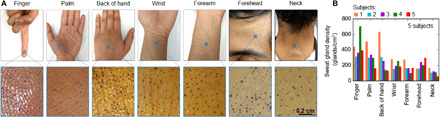
“Imaging sweat glands and characterizing their densities Two methods were used to image sweat glands using bromophenol dye and iodine patches, respectively, as demonstrated in previous work (25, 26).”
MethodCai, J., Čížek, K., Long, B., McAferty, K., Campbell, C. G., Allee, D. R., Vogt, B. D., Belle, J. L., & Wang, J. (2008) · Sensors and Actuators B Chemical · doi:10.1016/j.snb.2008.10.027 · Cited by 54
Collins, K. J., Sargent, F., & Weiner, J. S. (1959) · The Journal of Physiology · doi:10.1113/jphysiol.1959.sp006309 · Cited by 53
The skin’s role in human thermoregulation and comfort
Arens, E. A., & Zhang, H. (2006) · CRC Press eBooks · doi:10.1201/9781439824351.ch16 · Cited by 53
Fishberg, E. H., & Bierman, W. (1932) · Journal of Biological Chemistry · doi:10.1016/s0021-9258(18)76198-x · Cited by 43 · cited 1×
“Sweat chloride and pH can together indicate the body’s acid/base balance and are further targeted to demonstrate that the glove sensor can support diverse electrochemical detection schemes (34, 35).”
BackgroundFlexible thick-film glucose biosensor: Influence of mechanical bending on the performance
Chuang, M., Yang, Y.-L., Tseng, T.-F., Chou, T., Lou, S.-L., & Wang, J. (2009) · Talanta · doi:10.1016/j.talanta.2009.11.029 · Cited by 37
Enhancing glucose flux into sweat by increasing paracellular permeability of the sweat gland
Jajack, A., Brothers, M., Kasting, G., & Heikenfeld, J. (2018) · PLOS ONE · doi:10.1371/journal.pone.0200009 · Cited by 35
Biomechanical performance of powder-free examination gloves
Fisher, M., Reddy, V. R., Williams, F. M., Lin, K. Y. K., Thacker, J. G., & Edlich, R. F. (1999) · Journal of Emergency Medicine · doi:10.1016/s0736-4679(99)00133-x · Cited by 23
Shields, J. B., Johnson, B. C., Hamilton, T. S., & Mitchell, H. H. (1945) · Journal of Biological Chemistry · doi:10.1016/s0021-9258(17)41548-1 · Cited by 22 · cited 1×
“Vitamin C is chosen to target as its presence in sweat could indicate levels of daily intake or vitamin deficiency (39, 40).”
BackgroundSWEATING-PHYSIOLOGY AND PATHOPHYSIOLOGY
Frewin, D. B., & Downey, J. A. (1976) · Australasian Journal of Dermatology · doi:10.1111/j.1440-0960.1976.tb00794.x · Cited by 19 · cited 1×
“Since the nitrile gloves do not directly laminate the skin to suffocate any sweat glands and do not produce substantial local heating to raise core temperature or overcome the body’s natural radiative and insensible evaporation mechanisms of heat loss, these large accumulated volumes are due to the body’s natural ther…”
BackgroundTashiro, G., Wada, M., & Sakurai, M. (1961) · Journal of Investigative Dermatology · doi:10.1038/jid.1961.2 · Cited by 10 · cited 3×
“Imaging sweat glands and characterizing their densities Two methods were used to image sweat glands using bromophenol dye and iodine patches, respectively, as demonstrated in previous work (25, 26).”
MethodWissler, E. H. (2018) · Springer eBooks · doi:10.1007/978-3-662-57397-6_5 · Cited by 2
Research works printed but not linked: 1
- Benet L. Z., Kroetz D., Sheiner L., Hardman J., Limbird L., Pharmacokinetics: The dynamics of drug absorption, distribution, metabolism, and elimination. Goodman Gilman’s Pharmacol. Basis Ther. 3, e27 (1996).
Cited by
Skin-Interfaced Wearable Sweat Sensors for Precision Medicine
Min, J., Tu, J., Xu, C., Lukas, H., Shin, S., Yang, Y., Solomon, S. A., Mukasa, D., & Gao, W. (2023) · Chemical Reviews · doi:10.1021/acs.chemrev.2c00823 · Cited by 712
Wearable chemical sensors for biomarker discovery in the omics era
Sempionatto, J. R., Lasalde-Ramírez, J. A., Mahato, K., Wang, J., & Gao, W. (2022) · Nature Reviews Chemistry · doi:10.1038/s41570-022-00439-w · Cited by 613
Flexible Electronics and Devices as Human–Machine Interfaces for Medical Robotics
Heng, W., Solomon, S., & Gao, W. (2022) · Advanced Materials · doi:10.1002/adma.202107902 · Cited by 609
A wearable patch for continuous analysis of thermoregulatory sweat at rest
Nyein, H. Y. Y., Bariya, M., Tran, B., Ahn, C. H., Brown, B. J., Ji, W., Davis, N., & Javey, A. (2021) · Nature Communications · doi:10.1038/s41467-021-22109-z · Cited by 437
Self-citationFritea, L., Banica, F., Costea, T., Moldovan, L., Dobjanschi, L., Muresan, M., & Cavalu, S. (2021) · Materials · doi:10.3390/ma14216319 · Cited by 311
“The fingertips, palm, and back of hand possess some of the highest sweat gland densities on the body, being accessible sites for monitoring natural sweat, and hence, glove-based sensing platforms (nitrile gloves and finger cots) are attractive for in situ detection of diverse biomarkers, including electrolytes and xen…”
Background
Metadata
- Authors
- Bariya, M., Li, L., Ghattamaneni, R., Ahn, C. H., Nyein, H. Y. Y., Tai, L.-C., & Javey, A.
- Affiliations
- Lawrence Berkeley National Laboratory (US)
- University of California, Berkeley (US)
- Corresponding author
- Bariya, Mallika
- Li, Lu
- Javey, Ali
- ORCID
- Venue
- Science Advances
- Published
- 2020-08-28
- Volume
- 6
- Issue
- 35
- Pages
- eabb8308-eabb8308
- ISSN
- 2375-2548 (ISSN-L)
- PMC
- PMC7455190
- OpenAlex
- W3082300378
- Semantic Scholar
- 748d4ab48219592a24b242e499f93df2342bd502
- Cited by
- 154
- References
- 50
- Citations by year
- 2026: 15 · 2025: 26 · 2024: 28 · 2023: 28 · 2022: 29 · 2021: 26 · 2020: 2
- FWCI
- 6.68
- Type
- journal article
- Language
- en
- Open access
- gold
- doi.org
- Licence
- Locations
- Science Advances (publishedVersion, cc-by-nc)
- PubMed Central (publishedVersion, cc-by-nc)
- PubMed (publishedVersion)
- OSTI OAI (U.S. Department of Energy Office of Scientific and Technical Information) (submittedVersion)
- Rare & Special e-Zone (The Hong Kong University of Science and Technology) (submittedVersion)
- eScholarship (California Digital Library) (submittedVersion)
- eScholarship (California Digital Library) (submittedVersion, cc-by-nc)
- Funders
- Bakar fellowship
- NSF Nanomanufacturing Systems for Mobile Computing and Mobile Energy Technologies
- Berkeley Sensor and Actuator Center
- Topics
- Physical Sciences › Engineering › Biomedical Engineering › Advanced Sensor and Energy Harvesting Materials
- Physical Sciences › Chemistry › Analytical Chemistry › Electrochemical sensors and biosensors
- Physical Sciences › Engineering › Biomedical Engineering › Non-Invasive Vital Sign Monitoring
- Keywords
- sweat collection, sweat biomarkers, electrolytes, xenobiotics, non-invasive health monitoring, wearable sensors, nitrile gloves, sweat evaporation
About these checks
Registry, retraction, Cites and statistics results are computed, not judged, with one exception: a printed reference that no index lists is read once by a model before it counts as a citation error. Claims are extracted by a model and kept only when their quote appears verbatim in the text; each cited source is then checked, with a model’s help, for whether it says what the claim relies on. Those verdicts can be wrong — read the claim’s quote and the cited source before relying on one.
Statistics and arithmetic are recomputed, not judged.
Confidence bands are shown only for fields calibrated on our annotated test set. None is calibrated yet, so no band is shown.
What counts as a claim ›How we measure confidence ›How we check this ›
Are you an author, or do you see a problem with this page? Request a review
Data sources
Bibliographic data: Semantic Scholar, OpenAlex, Crossref.
Contains information from the Semantic Scholar Academic Graph Datasets, made available under the ODC Attribution License (ODC-BY 1.0).
Semantic Scholar’s data is described in: Kinney, R., et al. (2023). The Semantic Scholar Open Data Platform. arXiv:2301.10140.
