

Positive and Negative Affect Schedule (PANAS): psychometric properties of the online Spanish version in a clinical sample with emotional disorders
Open accessThe DOI matches its Crossref record; 89 of the 95 references it cites were found in a registry or an index.
Abstract
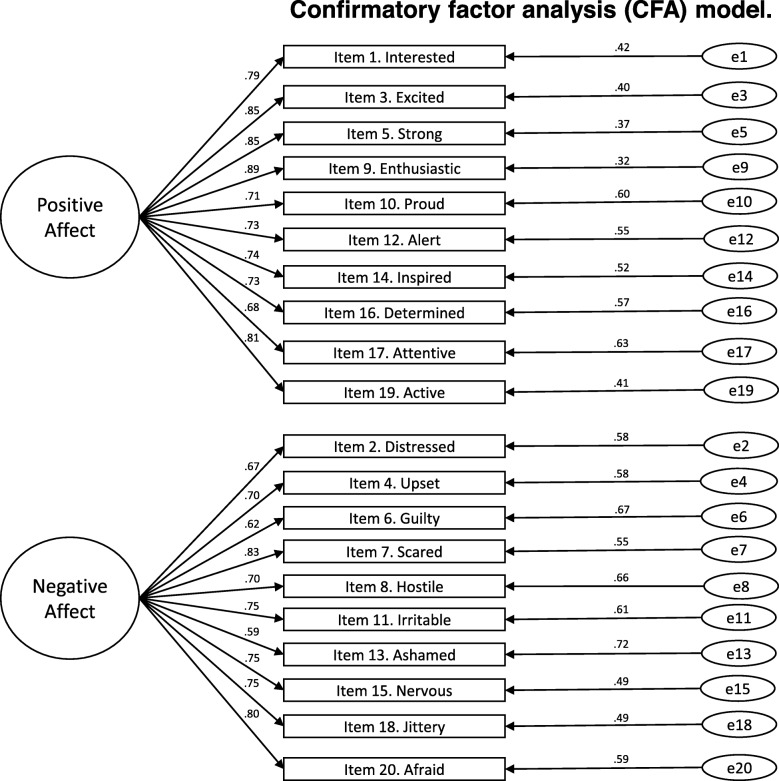
Background: The Positive and Negative Affect Schedule (PANAS) is the most widely and frequently used scale to assess positive and negative affect. The PANAS has been validated in several languages, and it has shown excellent psychometric properties in the general population and some clinical samples, such as forensic samples, substance users, and adult women with fibromyalgia. Nevertheless, the psychometric properties of the scale have not yet been examined in clinical samples with anxiety, depressive, and adjustment disorders. In addition, the proliferation of Internet-based treatments has led to the development of a wide range of assessments conducted online with digital versions of pen and paper self-report questionnaires. However, no validations have been carried out to analyze the psychometric properties of the online version of the PANAS. The present study investigates the psychometric properties of the online Spanish version of the PANAS in a clinical sample of individuals with emotional disorders. Methods: The sample was composed of 595 Spanish adult volunteers with a diagnosis of depressive disorder (n = 237), anxiety disorder (n = 284), or adjustment disorder (n = 74). Factor structure, construct validity, internal consistency, and sensitivity to change were analyzed. Results: Confirmatory factor analysis yielded a latent structure of two independent factors, consistent with previous validations of the instrument. The analyses showed adequate convergent and discriminant validity, good internal consistency as well as sensitivity to change. Conclusions: Overall, the results obtained in this study show that the online version of the PANAS has adequate psychometric properties for the assessment of positive and negative affect in a Spanish clinical population.
Overview
The claims and statistics of this paper haven’t been checked yet.
Free: it reads the open-access text and checks the first 5 claims that cite a source we can check. Create a free account to check every claim.
Integrity signals
Registry
Cites
Statistics
Figures
Verification
Claims the paper makes
The claims and statistics of this paper haven’t been checked yet.
Free: it reads the open-access text and checks the first 5 claims that cite a source we can check. Create a free account to check every claim.
Claims other papers make about this one
Each is checked against this paper’s own text: does it say what the citing paper says it does?
The cited source says what the claim attributes to it.
In the citing paper
“The scale has adequate convergent and discriminant validity, good internal consistency, and sensitivity to change. Cronbach's alpha is 0.91 for the PANAS-PA and 0.87 for the PANAS-NA.”
From Efficacy of an internet-based psychological intervention for problem gambling and gambling disorder: Study protocol for a randomized controlled trial (2021) · cites this paper as Díaz-García et al., 2020
Self-check
Percentages, sums and reported differences re-computed from the paper’s own numbers.
The self-check needs the paper’s full text.
Citations
Cites
Statistical Power Analysis for the Behavioral Sciences
Muller, K. (1989) · Technometrics · doi:10.1080/00401706.1989.10488618 · Cited by 99,167
Statistical power analysis for the behavioral sciences
(1990) · Computers, Environment and Urban Systems · doi:10.1016/0198-9715(90)90050-4 · Cited by 65,269
The PHQ-9: Validity of a brief depression severity measure
Kroenke, K., Spitzer, R. L., & Williams, J. B. W. (2001) · Journal of General Internal Medicine · doi:10.1046/j.1525-1497.2001.016009606.x · Cited by 44,910
Development and validation of brief measures of positive and negative affect: The PANAS scales.
Watson, D., Clark, L. A., & Tellegen, A. (1988) · Journal of Personality and Social Psychology · doi:10.1037/0022-3514.54.6.1063 · Cited by 32,433
(1998) · The Journal of Clinical Psychiatry · Cited by 19,139
Fredrickson, B. L. (2001) · American Psychologist · doi:10.1037//0003-066x.56.3.218 · Cited by 18,025
Russell, J. A. (1980) · Journal of Personality and Social Psychology · doi:10.1037/h0077714 · Cited by 16,334
An inventory for measuring clinical anxiety: Psychometric properties.
Beck, A. T., Epstein, N., Brown, G., & Steer, R. A. (1988) · Journal of Consulting and Clinical Psychology · doi:10.1037/0022-006x.56.6.893 · Cited by 14,407
Kessler, R. C., Chiu, W. T., Demler, O., & Walters, E. E. (2005) · Archives of General Psychiatry · doi:10.1001/archpsyc.62.6.617 · Cited by 12,052
Quality criteria were proposed for measurement properties of health status questionnaires
Terwee, C. B., Bot, S. D. M., de Boer, M. R., van der Windt, D. A. W. M., Knol, D. L., Dekker, J., Bouter, L. M., & de Vet, H. C. W. (2007) · Journal of Clinical Epidemiology · doi:10.1016/j.jclinepi.2006.03.012 · Cited by 10,764
(1998) · PubMed · Cited by 10,216
Cicchetti, D. V. (1994) · Psychological Assessment · doi:10.1037/1040-3590.6.4.284 · Cited by 9,349 · cited 1×
“In addition, Cicchetti (1994) [72] suggested the following guidelines for assessing the clinical relevance of alpha coefficients: unacceptable for coefficients lower than .7, fair for the .7–.8 range, good for the .8–.9 range, and excellent for values over .9.”
Marsh, H. W., Hau, K.-T., & Wen, Z. (2004) · Structural Equation Modeling: A Multidisciplinary Journal · doi:10.1207/s15328007sem1103_2 · Cited by 6,691
The mini international neuropsychiatric interview
Lecrubier, Y., Sheehan, D., Hergueta, T., & Weiller, E. (1998) · European Psychiatry · doi:10.1016/s0924-9338(99)80239-9 · Cited by 5,872
The Structure of Psychological Well-Being.
Mechanic, D., & Bradburn, N. M. (1970) · American Sociological Review · doi:10.2307/2093340 · Cited by 4,923 · cited 2×
“Bradburn [9], PA and NA have been described as two independent unipolar dimensions of affect that include all the affective states with a positive valence (joy, enthusiasm, crush, etc.”
BackgroundLecrubier, Y., Sheehan, D., Weiller, E., Amorim, P., Bonora, I., Sheehan, K. H., Janavs, J., & Dunbar, G. (1997) · European Psychiatry · doi:10.1016/s0924-9338(97)83296-8 · Cited by 3,513
Normal personality assessment in clinical practice: the NEO personality inventory
Costa, P. T., & McCrae, R. R. (1992) · Psychological Assessment · doi:10.1037/1040-3590.4.1.5 · Cited by 3,414
The Oxford Handbook of Positive Psychology
(2009) · doi:10.1093/oxfordhb/9780195187243.001.0001 · Cited by 2,696
Morris, S. B., & DeShon, R. P. (2002) · Psychological Methods · doi:10.1037/1082-989x.7.1.105 · Cited by 2,502
Individual-patient monitoring in clinical practice: are available health status surveys adequate?
McHorney, C. A., & Tarlov, A. R. (1995) · Quality of Life Research · doi:10.1007/bf01593882 · Cited by 2,206
(2012) · SpringerReference · doi:10.1007/springerreference_179754 · Cited by 2,089
Nonnormaland Categorical Data in Structural Equation Modeling
Finney, S. J., & DiStefano, C. (2013) · Structural Equation Modeling · doi:10.1108/978-1-62396-246-320251015 · Cited by 1,855
(1985) · Cited by 1,630
Toward a unified treatment for emotional disorders
Barlow, D. H., Allen, L. B., & Choate, M. L. (2004) · Behavior Therapy · doi:10.1016/s0005-7894(04)80036-4 · Cited by 1,430
Internet-Based and Other Computerized Psychological Treatments for Adult Depression: A Meta-Analysis
Andersson, G., & Cuijpers, P. (2009) · Cognitive Behaviour Therapy · doi:10.1080/16506070903318960 · Cited by 1,368
Andrews, G., Cuijpers, P., Craske, M. G., McEvoy, P., & Titov, N. (2010) · PLoS ONE · doi:10.1371/journal.pone.0013196 · Cited by 1,311
Toward a consensual structure of mood
Watson, D., & Tellegen, A. (1985) · Psychological Bulletin · doi:10.1037//0033-2909.98.2.219 · Cited by 1,170
Watson, D., & Clark, L. A. (1992) · Journal of Personality · doi:10.1111/j.1467-6494.1992.tb00980.x · Cited by 1,154
Multifaceted conceptions of fit in structural equation models
Tanaka, J. S. (1993) · Medical Entomology and Zoology · Cited by 941
The Nature, Diagnosis, and Treatment of Neuroticism: Back to the Future
Barlow, D. H., Sauer-Zavala, S., Carl, J. R., Bullis, J. R., & Ellard, K. K. (2014) · Clinical Psychological Science · doi:10.1177/2167702613505532 · Cited by 850
Beck, A. T., Ward, C. H., Mendelson, M., Mock, J., & Erbauch, J. (2011) · PsycTESTS Dataset · doi:10.1037/t00741-000 · Cited by 815
The structure of mood change: An idiographic/nomothetic analysis.
Zevon, M. A., & Tellegen, A. (1982) · Journal of Personality and Social Psychology · doi:10.1037//0022-3514.43.1.111 · Cited by 740
Brown, T. A., & Barlow, D. H. (2009) · Psychological Assessment · doi:10.1037/a0016608 · Cited by 639
Levels of Analysis and the Organization of Affect
Rosenberg, E. L. (1998) · Review of General Psychology · doi:10.1037//1089-2680.2.3.247 · Cited by 563
Toward a unified treatment for emotional disorders - republished Article
Barlow, D. H., Allen, L. B., & Choate, M. L. (2016) · Behavior Therapy · doi:10.1016/j.beth.2016.11.005 · Cited by 536
Hunsley, J., & Mash, E. J. (2007) · Annual Review of Clinical Psychology · doi:10.1146/annurev.clinpsy.3.022806.091419 · Cited by 528
(1999) · Psicothema · Cited by 507
Factorial and Construct Validity of the Italian Positive and Negative Affect Schedule (PANAS)
Terracciano, A., McCrae, R. R., & Costa, P. T., Jr. (2003) · European Journal of Psychological Assessment · doi:10.1027//1015-5759.19.2.131 · Cited by 476
DeVellis, R. F. (2006) · Medical Care · doi:10.1097/01.mlr.0000245426.10853.30 · Cited by 459
Oxford handbook of positive psychology, 2nd ed.
Lopez, S. J., & Snyder, C. R. R. (2009) · Cited by 450
Gross, J. J., Sutton, S. K., & Ketelaar, T. (1998) · Personality and Social Psychology Bulletin · doi:10.1177/0146167298243005 · Cited by 414 · cited 1×
“Affect plays a central role in human experience [1], and the term has been used to refer to anything emotional, that is, feelings, preferences, emotions, moods, and affective traits [2, 3].”
BackgroundWatson, D., & Naragon-Gainey, K. (2010) · Clinical Psychology Review · doi:10.1016/j.cpr.2009.11.002 · Cited by 349
Changing moods: the psychology of mood and mood regulation
(1997) · Choice Reviews Online · doi:10.5860/choice.34-4770 · Cited by 330 · cited 1×
“, feeling good-bad, liking-disliking a situation) [4].”
Gaudreau, P., Sanchez, X., & Blondin, J.-P. (2006) · European Journal of Psychological Assessment · doi:10.1027/1015-5759.22.4.240 · Cited by 319
Carlbring, P., Brunt, S., Bohman, S., Austin, D., Richards, J., Öst, L.-G., & Andersson, G. (2007) · Computers in Human Behavior · doi:10.1016/j.chb.2005.05.002 · Cited by 319
Watson, D., Clark, L. A., & Tellegen, A. (1984) · Journal of Personality and Social Psychology · doi:10.1037//0022-3514.47.1.127 · Cited by 285
Robles, R., & Páez, F. (2003) · LA Referencia (Red Federada de Repositorios Institucionales de Publicaciones Científicas) · Cited by 273
Sanz, J., García‐Vera, M. P., Espinosa, R., Fortún, M., & Vazquez, C. V. (2005) · DOAJ (DOAJ: Directory of Open Access Journals) · Cited by 269
Verhoeven, F., van Gemert-Pijnen, L., Dijkstra, K., Nijland, N., Seydel, E., & Steehouder, M. (2007) · Journal of Medical Internet Research · doi:10.2196/jmir.9.5.e37 · Cited by 252
Sanz, J., Perdigón, A. L., & Vázquez, C. (2003) · DOAJ (DOAJ: Directory of Open Access Journals) · Cited by 235
Hedman, E., Ljótsson, B., Rück, C., Furmark, T., Carlbring, P., Lindefors, N., & Andersson, G. (2010) · Computers in Human Behavior · doi:10.1016/j.chb.2010.01.010 · Cited by 220
Vallejo, M. A., Jordán, C. M., Díaz, M. I., Comeche, M. I., & Ortega, J. (2007) · Journal of Medical Internet Research · doi:10.2196/jmir.9.1.e2 · Cited by 214
Merz, E. L., Malcarne, V. L., Roesch, S. C., Ko, C. M., Emerson, M., Roma, V. G., & Sadler, G. R. (2013) · Journal of Affective Disorders · doi:10.1016/j.jad.2013.08.011 · Cited by 177
Magán, I., Sanz, J., & García-Vera, M. P. (2008) · The Spanish Journal of Psychology · doi:10.1017/s1138741600004637 · Cited by 173
Muñoz-Navarro, R., Cano-Vindel, A., Medrano, L. A., Schmitz, F., Ruiz-Rodríguez, P., Abellán-Maeso, C., Font-Payeras, M. A., & Hermosilla-Pasamar, A. M. (2017) · BMC Psychiatry · doi:10.1186/s12888-017-1450-8 · Cited by 168
Sanz, J., Navarro, M. E., & Vázquez, C. (2003) · Dialnet (Universidad de la Rioja) · Cited by 156
Hoyle, R. H., & Gottfredson, N. C. (2015) · Prevention Science · doi:10.1007/s11121-014-0489-8 · Cited by 155
Aluja, A., Garcı́a, O., Rossier, J., & Garcı́a, L. F. (2005) · Personality and Individual Differences · doi:10.1016/j.paid.2004.05.014 · Cited by 150
Leue, A., & Beauducel, A. (2011) · Psychological Assessment · doi:10.1037/a0021400 · Cited by 146
Norman, S. B., Campbell-Sills, L., Hitchcock, C. A., Sullivan, S., Rochlin, A., Wilkins, K. C., & Stein, M. B. (2011) · Journal of Psychiatric Research · doi:10.1016/j.jpsychires.2010.06.011 · Cited by 140
Teilegen, A. (2019) · Anxiety and the Anxiety Disorders · doi:10.4324/9780203728215-49 · Cited by 135
Positive and Negative Affect Schedule: A study of validity and reliability.
Gençöz, T. (2000) · OpenMETU (Middle East Technical University) · Cited by 132
Assessing Positive and Negative Affect via Self-Report
Gray, E. K., & Watson, D. (2007) · Handbook of Emotion Elicitation and Assessment · doi:10.1093/oso/9780195169157.003.0012 · Cited by 131
Zalta, A. K., Held, P., Smith, D. L., Klassen, B. J., Lofgreen, A. M., Normand, P. S., Brennan, M. B., Rydberg, T. S., Boley, R. A., Pollack, M. H., et al. (2018) · BMC Psychiatry · doi:10.1186/s12888-018-1816-6 · Cited by 131
Gyollai, Á., Simor, P., Köteles, F. G., & Demetrovics, Z. (2011) · PubMed · Cited by 129
van Ballegooijen, W., Riper, H., Cuijpers, P., van Oppen, P., & Smit, J. H. (2016) · BMC Psychiatry · doi:10.1186/s12888-016-0735-7 · Cited by 114
Gilbert, K. E., Nolen-Hoeksema, S., & Gruber, J. (2013) · Behaviour Research and Therapy · doi:10.1016/j.brat.2013.08.004 · Cited by 112
(2003) · Ansiedad y Estrés · Cited by 111
A methodological review of meta-analyses of the effectiveness of clinical psychology treatments
Rubio‐Aparicio, M., Marín‐Martínez, F., Sánchez‐Meca, J., & López-López, J. A. (2017) · Behavior Research Methods · doi:10.3758/s13428-017-0973-8 · Cited by 110
Lucas, R. E., Diener, E., & Larsen, R. J. (2003) · American Psychological Association eBooks · doi:10.1037/10612-013 · Cited by 107
Prospects and Limitations of Psychological Testing on the Internet
Barak, A., & English, N. (2002) · Journal of Technology in Human Services · doi:10.1300/j017v19n02_06 · Cited by 102
Lucas, R. E., Diener, E., & Larsen, R. J. (2009) · Social indicators research series · doi:10.1007/978-90-481-2354-4_7 · Cited by 99
Moriondo, M., Palma, P., Medrano, L. A., & Murillo, P. (2011) · Universitas Psychologica · doi:10.11144/javeriana.upsy11-1.aeap · Cited by 95
Interformat Reliability of Digital Psychiatric Self-Report Questionnaires: A Systematic Review
Alfonsson, S., Maathz, P., & Hursti, T. (2014) · Journal of Medical Internet Research · doi:10.2196/jmir.3395 · Cited by 94
Serafini, K., Malin-Mayor, B., Nich, C., Hunkele, K., & Carroll, K. M. (2016) · The American Journal of Drug and Alcohol Abuse · doi:10.3109/00952990.2015.1133632 · Cited by 92
Romero-Sanchiz, P., Nogueira-Arjona, R., García-Ruiz, A., Luciano, J. V., García Campayo, J., Gili, M., Botella, C., Baños, R., Castro, A., López-Del-Hoyo, Y., et al. (2017) · PLOS ONE · doi:10.1371/journal.pone.0172741 · Cited by 78
Self-citationMontero-Marín, J., Araya, R., Pérez-Yus, M. C., Mayoral, F., Gili, M., Botella, C., Baños, R., Castro, A., Romero-Sanchiz, P., López-Del-Hoyo, Y., et al. (2016) · Journal of Medical Internet Research · doi:10.2196/jmir.5695 · Cited by 75
Self-citationOn the replication of factor structures of the Positive and Negative Affect Schedule (PANAS)
Seib‐Pfeifer, L., Pugnaghi, G., Beauducel, A., & Leue, A. (2016) · Personality and Individual Differences · doi:10.1016/j.paid.2016.11.053 · Cited by 74
Mira, A., Bretón-López, J., García-Palacios, A., Quero, S., Baños, R. M., & Botella, C. (2017) · Neuropsychiatric Disease and Treatment · doi:10.2147/ndt.s130994 · Cited by 71
Self-citationThe Positive and Negative Affect Schedule: Psychometric Properties of the Korean Version
Lim, Y.-J., Yu, B.-H., Kim, D.-K., & Kim, J.-H. (2010) · Psychiatry Investigation · doi:10.4306/pi.2010.7.3.163 · Cited by 63
Caycho‐Rodríguez, T., Ventura‐León, J., Cadena, C. H. G., Tomás, J. M., Domínguez-Vergara, J., Daniel, L., & Gallegos, W. L. A. (2018) · Psychosocial Intervention · doi:10.5093/pi2018a6 · Cited by 58
González-Robles, A., Mira, A., Miguel, C., Molinari, G., Díaz-García, A., García-Palacios, A., Bretón-López, J. M., Quero, S., Baños, R. M., & Botella, C. (2018) · PLOS ONE · doi:10.1371/journal.pone.0206516 · Cited by 51
Self-citationPositive and Negative Affect Schedule: Psychometric Properties for the Brazilian Portuguese Version
Pires, P., Filgueiras, A., Ribas, R., & Santana, C. (2013) · The Spanish Journal of Psychology · doi:10.1017/sjp.2013.60 · Cited by 50
Psychometric evaluation of a hindi version of positive-negative affect schedule
Pandey, R., & Srivastava, N. (2008) · Industrial Psychiatry Journal · Cited by 42
Estévez‐López, F., Pulido‐Martos, M., Armitage, C. J., Wearden, A. J., Álvarez‐Gallardo, I. C., Grajera, M. J. A., Girela‐Rejón, M. J., Carbonell‐Baeza, A., Aparicio, V. A., Geenen, R., et al. (2016) · PeerJ · doi:10.7717/peerj.1822 · Cited by 33
Quadri, N., Wild, D. S., Skerritt, B., Muehlhausen, W., & O’Donohoe, P. (2013) · Value in Health · doi:10.1016/j.jval.2013.03.230 · Cited by 27
Díaz-García, A., González-Robles, A., Fernández-Álvarez, J., García-Palacios, A., Baños, R. M., & Botella, C. (2017) · BMC Psychiatry · doi:10.1186/s12888-017-1297-z · Cited by 22
Self-citationRachyla, I., Pérez-Ara, M., Molés, M., Campos, D., Mira, A., Botella, C., & Quero, S. (2018) · BMC Psychiatry · doi:10.1186/s12888-018-1751-6 · Cited by 22
Self-citationCastro, A., García-Palacios, A., García-Campayo, J., Mayoral, F., Botella, C., García-Herrera, J. M., Pérez-Yus, M.-C., Vives, M., Baños, R. M., Roca, M., et al. (2015) · BMC Psychiatry · doi:10.1186/s12888-015-0475-0 · Cited by 17
Self-citationAkhter, N. (2017) · PubMed · Cited by 9
Research works printed but not linked: 3
- Sanz J García-Vera MP Espinosa R Fortún M Vázquez C Adaptación española del Inventario para la Depresión de Beck-II (BDI-II): 3. Propiedades psicométricas en pacientes con trastornos psicológicos Clínica y Salud 2005 16 2 121 142
- Muthén LK Muthén BO Statistical Analysis With Latent Variables User’s Guide 1998
- Nunnally J Bernstein I Psychometric Theory 3rd edition 1994 New York MacGraw-Hill
Cited by
Social support and mental health: the mediating role of perceived stress
Acoba, E. F. (2024) · Frontiers in Psychology · doi:10.3389/fpsyg.2024.1330720 · Cited by 458
Affect Recall Bias: Being Resilient by Distorting Reality
Colombo, D., Suso-Ribera, C., Fernández-Álvarez, J., Cipresso, P., Garcia-Palacios, A., Riva, G., & Botella, C. (2020) · Cognitive Therapy and Research · doi:10.1007/s10608-020-10122-3 · Cited by 159
“2013; Diener and Seligman 2002; Lyubomirsky et al.”
Self-citationDialectical emotions in a dark heritage site: A study at the Auschwitz Death Camp
Oren, G., Shani, A., & Poria, Y. (2020) · Tourism Management · doi:10.1016/j.tourman.2020.104194 · Cited by 135
Multi-Modal Physiological Data Fusion for Affect Estimation Using Deep Learning
Hssayeni, M. D., & Ghoraani, B. (2021) · IEEE Access · doi:10.1109/access.2021.3055933 · Cited by 64
“Specifically, the positive affects (PA) and negative affect (NA) give physicians valuable information about mood and anxiety disorders [1].”
BackgroundRocliffe, P., Adamakis, M., O’Keeffe, B. T., Walsh, L., Bannon, A., García‐González, L., Chambers, F. C., Stylianou, M., Sherwin, I., McNamara, P., et al. (2023) · Adolescent Research Review · doi:10.1007/s40894-023-00220-0 · Cited by 102
“Similar to wellbeing, a sport education model embedded within typical physical education class was found to positively affect indicators of adolescent positive mental health, such as positive and negative affect (Luna et al., 2019; Diaz-Garcia et al., 2020).”
Metadata
- Authors
- Díaz-García, A., González-Robles, A., Mor, S., Mira, A., Quero, S., García-Palacios, A., Baños, R. M., & Botella, C.
- Affiliations
- Universitat Jaume I (ES)
- Universitat de València (ES)
- Venue
- BMC Psychiatry
- Published
- 2020-02-10
- Volume
- 20
- Issue
- 1
- Pages
- 56-56
- ISSN
- 1471-244X (ISSN-L)
- PMC
- PMC7008531
- OpenAlex
- W3012668448
- Cited by
- 207
- References
- 95
- Citations by year
- 2026: 24 · 2025: 45 · 2024: 31 · 2023: 31 · 2022: 35 · 2021: 32 · 2020: 9
- FWCI
- 25.88
- Type
- journal article
- Language
- en
- Open access
- gold
- doi.org
- Licence
- cc-by
- creativecommons.org/licenses/by/4.0/ (tdm)
- creativecommons.org/licenses/by/4.0/ (vor)
- Locations
- BMC Psychiatry (publishedVersion, cc-by)
- Europe PMC (PubMed Central) (publishedVersion, cc-by)
- PubMed Central (publishedVersion, cc-by)
- PubMed (publishedVersion)
- LA Referencia (Red Federada de Repositorios Institucionales de Publicaciones Científicas) (publishedVersion, other-oa)
- Zaguan (University of Zaragoza Repository) (publishedVersion, cc-by)
- Repositori UJI (Universitat Jaume I) (submittedVersion, cc-by-sa)
- DOAJ (DOAJ: Directory of Open Access Journals) (submittedVersion, cc-by-sa)
- Funders
- Centro de Investigación Biomédica en Red-Fisiopatología de la Obesidad y Nutrición
- Ministerio de Economía y Competitividad (BES-2015-072360)
- Topics
- Social Sciences › Psychology › Experimental and Cognitive Psychology › Anxiety, Depression, Psychometrics, Treatment, Cognitive Processes
- Social Sciences › Psychology › Experimental and Cognitive Psychology › Mental Health Research Topics
- Social Sciences › Decision Sciences › Management Science and Operations Research › Psychometric Methodologies and Testing
- Keywords
- PANAS, Spanish translation, psychometric validation, positive affect, negative affect, emotional disorders, depressive disorders, anxiety disorders, adjustment disorder, factor structure, construct validity, sensitivity to change, online assessment
- MeSH terms
- Adjustment Disorders, Adult, Affect, Anxiety Disorders, Depressive Disorder, Factor Analysis, Statistical, Female, Health Surveys, Humans, Language, Male, Psychometrics, Spain, Reproducibility of Results
About these checks
Registry, retraction, Cites and statistics results are computed, not judged, with one exception: a printed reference that no index lists is read once by a model before it counts as a citation error. Claims are extracted by a model and kept only when their quote appears verbatim in the text; each cited source is then checked, with a model’s help, for whether it says what the claim relies on. Those verdicts can be wrong — read the claim’s quote and the cited source before relying on one.
Statistics and arithmetic are recomputed, not judged.
Confidence bands are shown only for fields calibrated on our annotated test set. None is calibrated yet, so no band is shown.
What counts as a claim ›How we measure confidence ›How we check this ›
Are you an author, or do you see a problem with this page? Request a review
Data sources
Bibliographic data: Semantic Scholar, OpenAlex, Crossref.
Contains information from the Semantic Scholar Academic Graph Datasets, made available under the ODC Attribution License (ODC-BY 1.0).
Semantic Scholar’s data is described in: Kinney, R., et al. (2023). The Semantic Scholar Open Data Platform. arXiv:2301.10140.
