

Acceptability of healthcare interventions: an overview of reviews and development of a theoretical framework
Open accessThe DOI matches its Crossref record; 76 of the 78 references it cites were found in a registry or an index.
Abstract
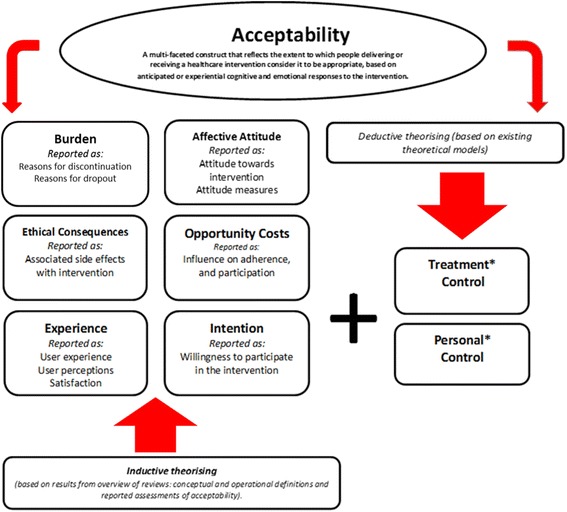
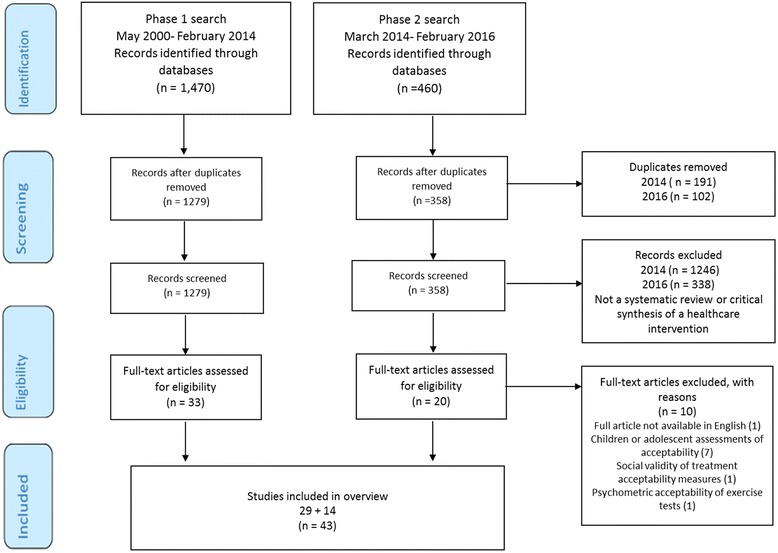
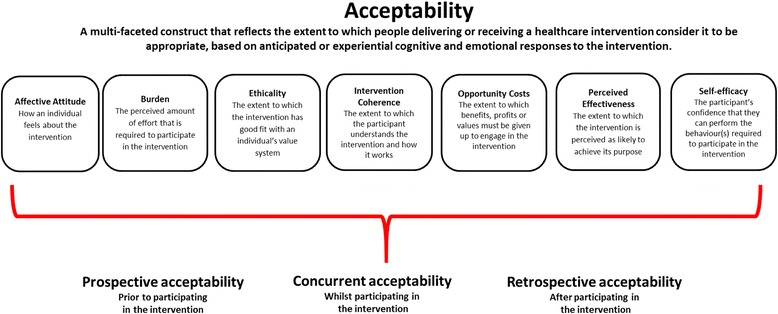
BACKGROUND: It is increasingly acknowledged that 'acceptability' should be considered when designing, evaluating and implementing healthcare interventions. However, the published literature offers little guidance on how to define or assess acceptability. The purpose of this study was to develop a multi-construct theoretical framework of acceptability of healthcare interventions that can be applied to assess prospective (i.e. anticipated) and retrospective (i.e. experienced) acceptability from the perspective of intervention delivers and recipients. METHODS: Two methods were used to select the component constructs of acceptability. 1) An overview of reviews was conducted to identify systematic reviews that claim to define, theorise or measure acceptability of healthcare interventions. 2) Principles of inductive and deductive reasoning were applied to theorise the concept of acceptability and develop a theoretical framework. Steps included (1) defining acceptability; (2) describing its properties and scope and (3) identifying component constructs and empirical indicators. RESULTS: From the 43 reviews included in the overview, none explicitly theorised or defined acceptability. Measures used to assess acceptability focused on behaviour (e.g. dropout rates) (23 reviews), affect (i.e. feelings) (5 reviews), cognition (i.e. perceptions) (7 reviews) or a combination of these (8 reviews). From the methods described above we propose a definition: Acceptability is a multi-faceted construct that reflects the extent to which people delivering or receiving a healthcare intervention consider it to be appropriate, based on anticipated or experienced cognitive and emotional responses to the intervention. The theoretical framework of acceptability (TFA) consists of seven component constructs: affective attitude, burden, perceived effectiveness, ethicality, intervention coherence, opportunity costs, and self-efficacy. CONCLUSION: Despite frequent claims that healthcare interventions have assessed acceptability, it is evident that acceptability research could be more robust. The proposed definition of acceptability and the TFA can inform assessment tools and evaluations of the acceptability of new or existing interventions.
Overview
The claims and statistics of this paper haven’t been checked yet.
Free: it reads the open-access text and checks the first 5 claims that cite a source we can check. Create a free account to check every claim.
Integrity signals
Registry
Cites
Statistics
Figures
Verification
Claims the paper makes
The claims and statistics of this paper haven’t been checked yet.
Free: it reads the open-access text and checks the first 5 claims that cite a source we can check. Create a free account to check every claim.
Claims other papers make about this one
Each is checked against this paper’s own text: does it say what the citing paper says it does?
The source backs part of the claim, not all of it — or backs it for a different population, condition or comparison.
In the citing paper
“Sekhon and colleagues [16] identified 7 component constructs of acceptability, but studies are generally designed to address only some of these components and vary by the components chosen.”
From Acceptability of Digital Mental Health Interventions for Depression and Anxiety: Systematic Review (2024) · cites this paper as [16]
Experimental — accuracy not yet measuredThe source backs part of the claim, not all of it — or backs it for a different population, condition or comparison.
In the citing paper
“Interviews followed a semi-structured schedule, taking into consideration elements of the TDF [24], and TFA [23]. Once drafted, interview schedules were reviewed by the EQUITy Lived Experience Advisory Panel (LEAP).”
From 'I didn't know what to expect': Exploring patient perspectives to identify targets for change to improve telephone-delivered psychological interventions (2020) · cites this paper as [23]
Experimental — accuracy not yet measuredThe source backs part of the claim, not all of it — or backs it for a different population, condition or comparison.
In the citing paper
“It has been increasingly acknowledged that consideration of patient acceptability using theories of behaviour change are key to effective evaluation, design and implementation of healthcare interventions [23–25] .”
From 'I didn't know what to expect': Exploring patient perspectives to identify targets for change to improve telephone-delivered psychological interventions (2020) · cites this paper as [23]
Experimental — accuracy not yet measuredThe cited source says what the claim attributes to it.
In the citing paper
“Overall, relating to the acceptability model by Sekhon et al. (2017), the main problems regarding acceptability centred around the dimensions burden, opportunity cost and self-efficacy, since participants found the intervention overly demanding when suffering from mental health symptoms and that they required more support to from a therapist to make use of the treatment material.”
From Investigating the potential of a novel internet-based cognitive behavioural intervention for Dari and Farsi speaking refugee youth: A feasibility study (2022) · cites this paper as Sekhon et al. (2017)
The cited source says what the claim attributes to it.
In the citing paper
“The TFA provided a structured theory around which to explore patient acceptability of specific elements of telephone-delivered treatment, without presuming acceptability based on patients’ behaviour [23].”
From 'I didn't know what to expect': Exploring patient perspectives to identify targets for change to improve telephone-delivered psychological interventions (2020) · cites this paper as [23]
2 more claims about this paper
Create a free account to see every claim other papers make about this one.
Self-check
Percentages, sums and reported differences re-computed from the paper’s own numbers.
The self-check needs the paper’s full text.
Citations
Cites
Using thematic analysis in psychology
Braun, V., & Clarke, V. (2006) · Qualitative Research in Psychology · doi:10.1191/1478088706qp063oa · Cited by 194,414 · cited 1×
“All extracted data were analysed by applying the thematic synthesis approach [30].”
MethodThe theory of planned behavior
Ajzen, I. (1991) · Organizational Behavior and Human Decision Processes · doi:10.1016/0749-5978(91)90020-t · Cited by 90,587
Preferred Reporting Items for Systematic Reviews and Meta-Analyses: the PRISMA statement
Moher, D., Liberati, A., Tetzlaff, J., Altman, D. G., & for the PRISMA Group (2009) · BMJ · doi:10.1136/bmj.b2535 · Cited by 83,823
Preferred reporting items for systematic reviews and meta-analyses: the PRISMA Statement.
(2009) · PubMed Central · Cited by 44,859
Self-efficacy: Toward a unifying theory of behavioral change
Bandura, A. (1977) · Psychological Review · doi:10.1037/0033-295x.84.2.191 · Cited by 43,925
Cochrane Handbook for Systematic Reviews of Interventions: Cochrane Book Series
(2008) · doi:10.1002/9780470712184 · Cited by 25,048 · cited 1×
“The Cochrane Tool of Quality Assessment was applied most frequently [39] (18 reviews: 62%).”
MethodAssessing the quality of reports of randomized clinical trials: Is blinding necessary?
Jadad, A. R., Moore, R. A., Carroll, D., Jenkinson, C., Reynolds, D. J. M., Gavaghan, D. J., & McQuay, H. J. (1996) · Controlled Clinical Trials · doi:10.1016/0197-2456(95)00134-4 · Cited by 17,582 · cited 2×
“Other assessments tools applied included the Jadad Scale [40] (three reviews: 10%), the”
MethodStructural Equations with Latent Variables.
Clogg, C. C., & Bollen, K. A. (1991) · Contemporary Sociology · doi:10.2307/2072165 · Cited by 17,442
Structural Equations with Latent Variables
Bollen, K. A. (1989) · Wiley series in probability and statistics · doi:10.1002/9781118619179 · Cited by 17,277 · cited 1×
“The inconsistency in defining concepts can impede the development of valid assessment instruments [20].”
BackgroundHealth Behavior and Health Education: Theory, Research, and Practice
(1992) · Annals of Internal Medicine · doi:10.7326/0003-4819-116-4-350_1 · Cited by 13,207
Research works printed but not linked: 1
- Hox JJ From theoretical concept to survey question. 1997): Survey Measurement and Process Quality 1997 New York ua Wiley 45 69
Cited by
Items 1,001–1,015 of 1,015
Mukpradab, S., Cussen, J., Ranse, K., Songwathana, P., & Marshall, A. P. (2023) · Journal of Clinical Nursing · doi:10.1111/jocn.16685 · Cited by 12
Shapley‐Quinn, M. K., Song, M., Chen, B. A., Devlin, B., Luecke, E. H., Brown, J. E., Blithe, D., Achilles, S. L., & van der Straten, A. (2023) · Frontiers in Reproductive Health · doi:10.3389/frph.2023.1147628 · Cited by 11
Goorevich, A., Boucher, C., Schneider, J., Silva-Breen, H. L., Matheson, E. L., Tinoco, A., & LaVoi, N. M. (2023) · International Sport Coaching Journal · doi:10.1123/iscj.2023-0035 · Cited by 8
Romaniuk, M., Saunders-Dow, E., Brown, K., & Batterham, P. J. (2024) · BMC Psychology · doi:10.1186/s40359-024-02097-7 · Cited by 7
“A non-controlled, within-subjects longitudinal design was employed with a Feasibility and Acceptability evaluation framework informed by Bowen and colleagues [40] and Sekhon and colleagues [41].”
MethodSeery, C., Cochrane, R. H., Mulcahy, M., Kilbride, K., Wrigley, M., & Bramham, J. (2025) · Internet Interventions · doi:10.1016/j.invent.2025.100807 · Cited by 7
“Sekhon and colleagues propose a framework of acceptability comprising prospective acceptability, concurrent acceptability, and retrospective acceptability.”
Prest, K., Wilson, E., Vassiliadou, I., Ali, S., Lakhanpaul, M., Morris, C., Tann, C., Harniess, P., Lewis‐Jackson, S., Kuper, H., et al. (2024) · Child: Care, Health and Development · doi:10.1111/cch.13303 · Cited by 7
“Topic guides were informed by intervention science frameworks, namely the Theoretical Framework of Acceptability (TFA) and Bowen's feasibility framework (Bowen et al., 2009; Sekhon et al., 2017).”
Technological Interventions for Pain Management
Suso-Ribera, C., Castilla, D., Martínez-Borba, V., Jaén, I., Botella, C., Baños, R. M., & García-Palacios, A. (2022) · Comprehensive Clinical Psychology · doi:10.1016/b978-0-12-818697-8.00009-1 · Cited by 6
Humphries, H., Msimango, L., Tshawe, Z., Gcelu, N., Ferreira, K., Pienaar, J., van der Elst, E. M., Giovenco, D., Operario, D., Sanders, E. J., et al. (2026) · Transactions of The Royal Society of Tropical Medicine and Hygiene · doi:10.1093/trstmh/traf143 · Cited by 6
Mathis, E. T., Hawkins, J., Charlot-Swilley, D., Spencer, T., Lingo, K. J., Trachtenberg, D., McPherson, S. K. L., Domitrovich, C. E., Shapiro, A., Williams, J. C., et al. (2024) · Mindfulness · doi:10.1007/s12671-024-02320-x · Cited by 5
“Acceptability is the degree to which an intervention is perceived as favorable and effective by participants (Sekhon et al., 2017).”
Bell, L. V., Cornish, P., Flusk, D., Garland, S. N., & Rash, J. A. (2020) · BMJ Open · doi:10.1136/bmjopen-2019-033350 · Cited by 5
Exposure Therapy Acceptability Among Pregnant Latinas With Anxiety: A Qualitative Content Analysis
Ponting, C., Ong, E., Dunkel Schetter, C., & Chavira, D. A. (2025) · Cultural Diversity & Ethnic Minority Psychology · doi:10.1037/cdp0000589 · Cited by 3
Balayah, Z., Stavropoulou, C., Scarbrough, H., Nigam, A., & Ziemann, A. (2025) · Frontiers in Health Services · doi:10.3389/frhs.2025.1373429 · Cited by 2
“…(i.e., conditions needed to implement a speci fi c innovation) ( “ readiness level ” (20); perceptual outcomes, such as —“ acceptability ” (10, 33) and “ appropriateness ” and “ feasibility ” (10), which are known to predict adoption (15); and “ non-adoption ”— de fi ned as a “ passive…”
Pinto, C., Norton, S., Cubi-Molla, P., Hurt, C., Chowdhury, S., Dooley, N., Safwi, A., Brown, J., Volpato, R., Stumpf, S., et al. (2025) · Aging & Mental Health · doi:10.1080/13607863.2025.2478508 · Cited by 2
“Acceptability of the intervention was assessed via a short 8-item questionnaire that was adapted based on the Theoretical Framework of Acceptability (TFA) (Sekhon et al., 2017), along with space for open-ended responses if participants wanted to give further feedback.”
Wood, L., Williams, C., Pinfold, V., Nolan, F., Morrison, A. P., Morant, N., Lloyd-Evans, B., Lewis, G., Lay, B., Jones, R., et al. (2021) · doi:10.21203/rs.3.rs-270658/v1 · Cited by 1
Wyatt, M. A., Pisarski, E. E., Nalumansi, A., Kasiita, V., Kamusiime, B., Nalukwago, G. K., Thomas, D., Muwonge, T. R., Mujugira, A., Heffron, R., et al. (2024) · PLOS Global Public Health · doi:10.1371/journal.pgph.0002916 · Cited by 1
Metadata
- Authors
- Sekhon, M., Cartwright, M., & Francis, J. J.
- Affiliations
- City, University of London (GB)
- Corresponding author
- Sekhon, Mandeep
- Venue
- BMC Health Services Research
- Published
- 2017-01-26
- Volume
- 17
- Issue
- 1
- Pages
- 88-88
- ISSN
- 1472-6963 (ISSN-L)
- PMC
- PMC5267473
- OpenAlex
- W2582406074
- Cited by
- 3,938
- References
- 78
- Citations by year
- 2026: 620 · 2025: 701 · 2024: 683 · 2023: 518 · 2022: 535 · 2021: 349 · 2020: 349 · 2019: 118 · 2018: 56 · 2017: 6
- FWCI
- 234.94
- Type
- journal article
- Language
- en
- Open access
- gold
- doi.org
- Licence
- cc-by
- Locations
- BMC Health Services Research (publishedVersion, cc-by)
- Europe PMC (PubMed Central) (publishedVersion, cc-by)
- PubMed Central (publishedVersion, cc-by)
- PubMed (publishedVersion)
- Research Repository (Kingston University London) (acceptedVersion)
- City Research Online (City University London) (acceptedVersion)
- St George's Online Research Archive (St George's University of London) (acceptedVersion)
- Minerva Access (University of Melbourne) (submittedVersion, cc-by)
- Research Portal (King's College London) (submittedVersion, cc-by)
- Topics
- Health Sciences › Health Professions › General Health Professions › Health Policy Implementation Science
- Social Sciences › Economics, Econometrics and Finance › Economics and Econometrics › Health Systems, Economic Evaluations, Quality of Life
- Health Sciences › Nursing › Research and Theory › Health Education and Validation
- Keywords
- theoretical framework, affective attitudes, perceived burden, perceived effectiveness, ethicality, intervention coherence, opportunity cost, self-efficacy, dropout rates
- MeSH terms
- Humans, Models, Theoretical, Patient Acceptance of Health Care, Prospective Studies, Retrospective Studies, Review Literature as Topic, Consensus
About these checks
Registry, retraction, Cites and statistics results are computed, not judged, with one exception: a printed reference that no index lists is read once by a model before it counts as a citation error. Claims are extracted by a model and kept only when their quote appears verbatim in the text; each cited source is then checked, with a model’s help, for whether it says what the claim relies on. Those verdicts can be wrong — read the claim’s quote and the cited source before relying on one.
Statistics and arithmetic are recomputed, not judged.
Confidence bands are shown only for fields calibrated on our annotated test set. None is calibrated yet, so no band is shown.
What counts as a claim ›How we measure confidence ›How we check this ›
Are you an author, or do you see a problem with this page? Request a review
Data sources
Bibliographic data: Semantic Scholar, OpenAlex, Crossref.
Contains information from the Semantic Scholar Academic Graph Datasets, made available under the ODC Attribution License (ODC-BY 1.0).
Semantic Scholar’s data is described in: Kinney, R., et al. (2023). The Semantic Scholar Open Data Platform. arXiv:2301.10140.
