

The DOI matches its Crossref record; 87 of the 89 references it cites were found in a registry or an index; 6 of the 131 sources its claims cite were checked for support.
Explaining adults’ mental health help-seeking through the lens of the theory of planned behavior: a scoping review
Open accessAbstract
Background: Despite evidence-based efficacy, mental health services are underutilized due to low rates of help-seeking, leaving unmet mental health needs a global concern. The Theory of Planned Behavior (TPB) has been applied to understand the help-seeking process and in the development of behavior change interventions. The aim of this scoping review was to map the literature on the TPB as applied to mental health help-seeking in adults aged >18 years. Methods: This scoping review was conducted based on the methodology presented by Arksey and O’Malley (2005). Six databases (CINAHL, PsycINFO, MEDLINE, ProQuest Health and Medicine, ProQuest Dissertations and Theses, Web of Science) and two grey literature sources (OpenGrey, Google Scholar) were systematically searched in February 2018 and updated in March 2020. Studies that explicitly discussed the TPB in the context of mental health help-seeking were initially selected; only studies that explored formal help-seeking for mental health problems and were published in English were retained. Data were extracted using Microsoft Excel. Results: Initially, 8898 records were identified. Of these, 49 met the selection criteria and were included: 32 were journal articles and 17 were theses. Forty-three papers reported on non-intervention studies and seven articles reported on TPB-based interventions. Most studies ( n = 39) identified predictors of help-seeking intentions. Attitudes and perceived behavioral control were significant predictors of intentions in 35 and 34 studies, respectively. Subjective norms were a significant predictor of intentions in 23 studies. Few studies aimed to predict help-seeking behavior ( n = 8). Intentions and perceived behavioral control were significant predictors of behavior in seven and six studies, respectively. Only six TPB-based interventions were identified, all used digital technology to influence help-seeking, with mixed results. Conclusions: The present scoping review identified a considerable evidence base on the TPB for predicting mental health help-seeking intentions. Attitudes and perceived behavioral control were frequently found to be significant predictors of help-seeking intentions. Knowledge on the TPB for predicting mental health help-seeking behavior, and on TPB-based interventions, is limited. Thus, the role of the TPB in developing help-seeking interventions remains unclear. Recommendations are presented to address such research gaps and inform policy and practice.
Overview
AI snapshot
Written from the paper’s full text.
TL;DR
This scoping review mapped 49 articles applying the Theory of Planned Behavior (TPB) to adult mental health help-seeking. It found considerable evidence for predicting help-seeking intentions, especially via attitudes and perceived behavioral control, but limited evidence for predicting behavior and for TPB-based interventions.
Key findings
- The review included 49 articles: 32 journal articles and 17 theses; 43 reported non-intervention studies and 7 reported TPB-based interventions.
- Among 39 studies identifying predictors of help-seeking intentions, attitudes were significant in 35 (90%), perceived behavioral control in 34 (87%), and subjective norms in 23 (59%); variance explained in intentions ranged from 7 to 93%.
- Among 8 studies examining help-seeking behavior, intentions were significant in 7 (88%) and perceived behavioral control in 6 (75%); variance explained in behavior ranged from 3 to 61% for traditional models and 10 to 63% for extended models.
- Six unique TPB-based interventions were identified, all using digital technology, with mixed results; one improved intentions and behavior, while others showed changes in TPB predictors without corresponding improvements in intentions or behavior, or no effect.
Methods
- Scoping review conducted using Arksey and O’Malley’s five-stage methodology and reported with PRISMA-ScR; protocol published on the Open Science Framework.
- Searched six databases (CINAHL, PsycINFO, MEDLINE, ProQuest Health and Medicine, ProQuest Dissertations and Theses, Web of Science) and two grey literature sources (OpenGrey, Google Scholar) in February 2018, updated March 2020; included English-language studies of adults >18 years on formal mental health help-seeking that explicitly discussed the TPB.
- Data were extracted in Microsoft Excel; two researchers independently screened titles/abstracts and full texts, with a third senior reviewer resolving conflicts; results were organized descriptively into non-intervention and intervention studies.
Limitations
- The authors state that they may not have located all relevant studies or may have misclassified papers; three included studies did not define participant age and may have included participants <18 years.
- The authors also note a paucity of standardized TPB questionnaires, and that measures such as the ATSPPHS and IASMHS only loosely reflect TPB constructs, limiting confidence in measurement.
- Evident from the text: most non-intervention studies were cross-sectional (38 of 43), most studies were conducted in North America (n = 27, 55%), college students were the most targeted population (n = 16, 33%), only three studies explored prediction of future behavior, and all six TPB-based interventions used digital technology, mostly targeting young adults.
Model-written summary. Check it against the paper before relying on it.
Integrity signals
Registry
Cites
Statistics
Figures
Verification
Claims the paper makes
71 Not checked yet · 38 Own result · 13 Own method · 12 Own interpretation · 7 No basis given · 2 Supported so far · 1 Supported · 1 Partly supported · accuracy not yet measured
The cited sources support only part of this claim — read each source’s verdict below.
In the paper
“There are many factors that influence help-seeking including stigma, attitudes, knowledge, financial resources, perceived need, and structural barriers/facilitators [12, 17–19].”
§ Explaining adults’ mental health help-seeking through the lens of the theory of planned behavior: a scoping review > Background
What the sources say
- Not checked yetcites [12] Bonabi H, Müller M, Ajdacic-Gross V, Eisele J, Rodgers S, Seifritz E, et al. Mental health literacy, attitudes to help seeking, and perceived need as predictors of mental health service use: a longitudinal study. J Nerv Ment Dis. 2016;204(4):321–4. source
- Partly supportedcites [17] Schnyder N, Panczak R, Groth N, Schultze-Lutter F. Association between mental health-related stigma and active help-seeking: systematic review and meta-analysis. Br J Psychiatry. 2017;210(4):261–8. sourceExperimental — accuracy not yet measured
The paper’s introductory passage (indexed under Abstract; page unavailable) identifies stigma, attitudes, low mental health literacy, low perceived need, and financial factors as influences on help-seeking. It does not establish the additional claim about structural barriers and facilitators; its reference list includes a review with those words in its title, but that alone does not substantiate the point. (LLM, conf=0.86)
- Partly supportedcites [18] Staiger T, Waldmann T, Rüsch N, Krumm S. Barriers and facilitators of help-seeking among unemployed persons with mental health problems: a qualitative study. BMC Health Serv Res. 2017;17(1):1–9. https://doi.org/10.1186/s12913-017-1997-6. sourceExperimental — accuracy not yet measured
The Discussion and Conclusions identify stigma, attitudes toward treatment, knowledge, awareness of one’s need for help, and health-care structures as factors in help-seeking among unemployed people with mental health problems. The passages do not identify financial resources as a factor; searches for financial resources and financial barriers did not find support for that part of the claim. (LLM, conf=0.87)
- Partly supportedcites [19] Umubyeyi A, Mogren I, Ntaganira J, Krantz G. Help-seeking behaviours, barriers to care and self-efficacy for seeking mental health care: a population-based study in Rwanda. Soc Psychiatry Psychiatr Epidemiol. 2016;51(1):81–92. sourceExperimental — accuracy not yet measured
The Methods (Measurements) and Results (Barriers to care) identify stigma, knowledge, attitudes, costs and structural access barriers as reasons for not seeking care. The Methods also measure perceived need for help. The paper does not identify structural facilitators as a factor, so that part of the list is not supported by this source. (LLM, conf=0.82)
plaindirect- Asserted: passes — The authors put it forward as true.
- Checkable: passes — It can be checked against evidence.
- Load-bearing: unclear — It is unclear whether the paper’s conclusions depend on it.
- Based: passes — The paper gives a reason why it holds.
None of the sources cited for this claim have been checked yet.
In the paper
“Additionally, three studies (7%) explored help-seeking for suicidality as well as other emotional or mental health problems [54, 66, 80].”
§ Explaining adults’ mental health help-seeking through the lens of the theory of planned behavior: a scoping review > Results > TPB-based non-intervention studies
What the sources say
- Not checked yetcites [54] Skogstad P, Deane FP, Spicer J. Social-cognitive determinants of help-seeking for mental health problems among prison inmates. Crim Behav Ment Health. 2006;16(1):43–59 Available from: http://doi.wiley.com/10.1002/cbm.54. source
- Not checked yetcites [66] Mills JL. Does the theory of planned behavior predict intentions to seek help for suicidality? (Publication No. 3461849) [Doctoral dissertation, Marshall University]. ProQuest Dissertations and Theses Global.; 2010.
- Not checked yetcites [80] Karras E, Stokes CM, Warfield SC, Elder H, Stephens B, Bossarte RM. The use of theory-based formative research to design suicide prevention messaging for U.S. veterans in midlife. Health Educ Behav. 2018;45(6):1016–24 Available from: http://journals.sagepub.com/doi/10.1177/1090198118769344. source
plain- Asserted: passes — The authors put it forward as true.
- Checkable: passes — It can be checked against evidence.
- Load-bearing: unclear — It is unclear whether the paper’s conclusions depend on it.
- Based: passes — The paper gives a reason why it holds.
A result the paper reports from its own data — it cites no other source for it, so there is none to check. The quote shows it is in the paper.
In the paper
“Three papers were solely psychometric evaluations, which examined the validity and reliability of attitudinal mental health help-seeking scales.”
§ Explaining adults’ mental health help-seeking through the lens of the theory of planned behavior: a scoping review > Results > TPB-based non-intervention studies
plain- Asserted: passes — The authors put it forward as true.
- Checkable: passes — It can be checked against evidence.
- Load-bearing: unclear — It is unclear whether the paper’s conclusions depend on it.
- Based: passes — The paper gives a reason why it holds.
A result the paper reports from its own data — it cites no other source for it, so there is none to check. The quote shows it is in the paper.
In the paper
“The type of mental health problem was rarely defined in the literature, most commonly referred to as a psychological problem or mental health problem/concern (n studies = 21, 49%).”
§ Explaining adults’ mental health help-seeking through the lens of the theory of planned behavior: a scoping review > Results > TPB-based non-intervention studies
plainn = 21- Asserted: passes — The authors put it forward as true.
- Checkable: passes — It can be checked against evidence.
- Load-bearing: unclear — It is unclear whether the paper’s conclusions depend on it.
- Based: passes — The paper gives a reason why it holds.
None of the sources cited for this claim have been checked yet.
In the paper
“Five of the cross-sectional papers included a psychometric study or elicitation study, which designed and/or evaluated measures to assess TPB variables, for use in the main cross-sectional study [36, 50, 53, 54, 59].”
§ Explaining adults’ mental health help-seeking through the lens of the theory of planned behavior: a scoping review > Results > TPB-based non-intervention studies
What the sources say
- Not checked yetcites [36] Bohon LM, Cotter KA, Kravitz RL, Cello PC, Fernandez y Garcia E. The theory of planned behavior as it predicts potential intention to seek mental health services for depression among college students. J Am Coll Health. 2016;64(8):593–603. source
- Not checked yetcites [50] Mak HW, Davis JM. The application of the theory of planned behavior to help-seeking intention in a Chinese society. Soc Psychiatry Psychiatr Epidemiol. 2014;49(9):1501–15. source
- Not checked yetcites [53] Schomerus G, Matschinger H, Angermeyer MC. Attitudes that determine willingness to seek psychiatric help for depression: a representative population survey applying the theory of planned behaviour. Psychol Med. 2009;39(11):1855–65. source
- Not checked yetcites [54] Skogstad P, Deane FP, Spicer J. Social-cognitive determinants of help-seeking for mental health problems among prison inmates. Crim Behav Ment Health. 2006;16(1):43–59 Available from: http://doi.wiley.com/10.1002/cbm.54. source
- Not checked yetcites [59] Clansy CD. The relationship between mental health ministries in the African Amercian church and professional mental health help-seeking. (Publication No. 9822860) [Doctoral dissertation, Saint Louis University]. ProQuest Dissertations and Theses Global.; 1998.
plain- Asserted: passes — The authors put it forward as true.
- Checkable: passes — It can be checked against evidence.
- Load-bearing: unclear — It is unclear whether the paper’s conclusions depend on it.
- Based: passes — The paper gives a reason why it holds.
A result the paper reports from its own data — it cites no other source for it, so there is none to check. The quote shows it is in the paper.
In the paper
“Of the 43 non-intervention papers, 38 were cross-sectional studies that aimed to identify predictors of mental health help-seeking intentions and/or behaviors.”
§ Explaining adults’ mental health help-seeking through the lens of the theory of planned behavior: a scoping review > Results > TPB-based non-intervention studies
plain- Asserted: passes — The authors put it forward as true.
- Checkable: passes — It can be checked against evidence.
- Load-bearing: unclear — It is unclear whether the paper’s conclusions depend on it.
- Based: passes — The paper gives a reason why it holds.
In the paper
“one paper presented baseline data from a randomized controlled trial examining students’ intentions to seek help and actual counselling usage [58].”
§ Explaining adults’ mental health help-seeking through the lens of the theory of planned behavior: a scoping review > Results > TPB-based non-intervention studies
What the sources say
- Not checked yetcites [58] Chang KF. An intervention to increase counseling service usage among female college students. (Publication No. 3540311) [Doctoral dissertation, University of California]. ProQuest Dissertations and Theses Global.; 2012.
plain- Asserted: passes — The authors put it forward as true.
- Checkable: passes — It can be checked against evidence.
- Load-bearing: unclear — It is unclear whether the paper’s conclusions depend on it.
- Based: passes — The paper gives a reason why it holds.
In the paper
“one paper was an experimental between-group design, which aimed to influence intentions to seek help for depression through evoking positive emotions using nostalgic messages [62]”
§ Explaining adults’ mental health help-seeking through the lens of the theory of planned behavior: a scoping review > Results > TPB-based non-intervention studies
What the sources say
- Not checked yetcites [62] Hussain SA. Bittersweet nature of nostalgia and its impact on depression related help-seeking. (Publication No. 10843189) [Doctoral dissertation, Michigan State University]. ProQuest Dissertations and Theses Global; 2018.
plain- Asserted: passes — The authors put it forward as true.
- Checkable: passes — It can be checked against evidence.
- Load-bearing: unclear — It is unclear whether the paper’s conclusions depend on it.
- Based: passes — The paper gives a reason why it holds.
In the paper
“An additional paper examined help-seeking behavior but did not utilize the full TPB model [60].”
§ Explaining adults’ mental health help-seeking through the lens of the theory of planned behavior: a scoping review > Results > TPB-based non-intervention studies
What the sources say
- Not checked yetcites [60] Farmer CS. Understanding poor help-seeking rates for major depressive disorder. [Doctoral dissertation, University of Exeter]. Open Research Exeter; 2013. Available from: https://ore.exeter.ac.uk/repository/handle/10871/14620
plain- Asserted: passes — The authors put it forward as true.
- Checkable: passes — It can be checked against evidence.
- Load-bearing: unclear — It is unclear whether the paper’s conclusions depend on it.
- Based: passes — The paper gives a reason why it holds.
The paper states this without a source or data behind it here, so there is nothing to check it against. The quote shows it is in the paper.
In the paper
“As only formal mental health help-seeking was included, most studies reported the source of help as mental health services, psychological/psychiatric help, mental health professional, or a combination of these terms (n studies = 27, 63%).”
§ Explaining adults’ mental health help-seeking through the lens of the theory of planned behavior: a scoping review > Results > TPB-based non-intervention studies
plainn = 27- Asserted: passes — The authors put it forward as true.
- Checkable: passes — It can be checked against evidence.
- Load-bearing: unclear — It is unclear whether the paper’s conclusions depend on it.
- Based: passes — The paper gives a reason why it holds.
A result the paper reports from its own data — it cites no other source for it, so there is none to check. The quote shows it is in the paper.
In the paper
“There were eight articles that examined factors, which influence mental health help-seeking behavior.”
§ Explaining adults’ mental health help-seeking through the lens of the theory of planned behavior: a scoping review > Results > TPB-based non-intervention studies
plain- Asserted: passes — The authors put it forward as true.
- Checkable: passes — It can be checked against evidence.
- Load-bearing: unclear — It is unclear whether the paper’s conclusions depend on it.
- Based: passes — The paper gives a reason why it holds.
A result the paper reports from its own data — it cites no other source for it, so there is none to check. The quote shows it is in the paper.
In the paper
“The variance in mental health help-seeking intentions explained by the TPB ranged from 7 to 93% for both the traditional and extended models.”
§ Explaining adults’ mental health help-seeking through the lens of the theory of planned behavior: a scoping review > Results > TPB-based non-intervention studies
plaincorrelational- Asserted: passes — The authors put it forward as true.
- Checkable: passes — It can be checked against evidence.
- Load-bearing: passes — The paper’s conclusions depend on it.
- Based: passes — The paper gives a reason why it holds.
None of the sources cited for this claim have been checked yet.
In the paper
“Furthermore, two articles (25%) found perceived behavioral control to be a significant predictor of behavior in the traditional TPB model, but not when the model was extended to include other variables [47, 83].”
§ Explaining adults’ mental health help-seeking through the lens of the theory of planned behavior: a scoping review > Results > TPB-based non-intervention studies
What the sources say
- Not checked yetcites [47] Li W, Denson LA, Dorstyn DS. Help-seeking intentions and behaviors among mainland Chinese college students: integrating the theory of planned behavior and behavioral model of health services use. Int J Adv Couns. 2017;39(2):125–48. source
- Not checked yetcites [83] Li W, Denson LA, Dorstyn DS. Understanding Australian university students’ mental health help-seeking: an empirical and theoretical investigation. Aust J Psychol. 2018;70(1):30–40. source
plain- Asserted: passes — The authors put it forward as true.
- Checkable: passes — It can be checked against evidence.
- Load-bearing: unclear — It is unclear whether the paper’s conclusions depend on it.
- Based: passes — The paper gives a reason why it holds.
None of the sources cited for this claim have been checked yet.
In the paper
“Two of the articles (25%), which did not support perceived behavioral control as a predictor of help-seeking behavior only examined one component of this construct, control factors, which may account for the insignificant findings [55, 64].”
§ Explaining adults’ mental health help-seeking through the lens of the theory of planned behavior: a scoping review > Results > TPB-based non-intervention studies
What the sources say
- Not checked yetcites [55] Stecker T, Fortney J, Hamilton F, Sherbourne CD, Ajzen I. Engagement in mental health treatment among veterans returning from Iraq. Patient Prefer Adherence. 2010;4:45–9. source
- Not checked yetcites [64] Lee AM-S. Understanding the help-seeking process among second generation Chinese Canadians using the theory of planned behaviour: what is the role of culture? [Doctoral dissertation, University of Ottawa]. University of Ottawa digital repository; 2016. https://doi.org/10.20381/ruor-5103. source
hedgedconditional- Asserted: passes — The authors put it forward as true.
- Checkable: passes — It can be checked against evidence.
- Load-bearing: unclear — It is unclear whether the paper’s conclusions depend on it.
- Based: passes — The paper gives a reason why it holds.
In the paper
“In this paper, intentions were found to be a significant direct predictor of prospective help-seeking”
§ Explaining adults’ mental health help-seeking through the lens of the theory of planned behavior: a scoping review > Results > TPB-based non-intervention studies
What the sources say
- Not checked yetcites [60] Farmer CS. Understanding poor help-seeking rates for major depressive disorder. [Doctoral dissertation, University of Exeter]. Open Research Exeter; 2013. Available from: https://ore.exeter.ac.uk/repository/handle/10871/14620
plaindirect- Asserted: passes — The authors put it forward as true.
- Checkable: passes — It can be checked against evidence.
- Load-bearing: unclear — It is unclear whether the paper’s conclusions depend on it.
- Based: passes — The paper gives a reason why it holds.
The paper states this without a source or data behind it here, so there is nothing to check it against. The quote shows it is in the paper.
In the paper
“The influence of subjective norms on intentions, that is, perceived social pressures to seek help, was less consistent, which may be due to differences in cultural norms and beliefs.”
§ Explaining adults’ mental health help-seeking through the lens of the theory of planned behavior: a scoping review > Discussion
plain- Asserted: passes — The authors put it forward as true.
- Checkable: passes — It can be checked against evidence.
- Load-bearing: passes — The paper’s conclusions depend on it.
- Based: passes — The paper gives a reason why it holds.
None of the sources cited for this claim have been checked yet.
In the paper
“In the present review, we found subjective norms were not statistically significant predictors of help-seeking intentions in some studies conducted in the USA [36, 55].”
§ Explaining adults’ mental health help-seeking through the lens of the theory of planned behavior: a scoping review > Discussion
What the sources say
- Not checked yetcites [36] Bohon LM, Cotter KA, Kravitz RL, Cello PC, Fernandez y Garcia E. The theory of planned behavior as it predicts potential intention to seek mental health services for depression among college students. J Am Coll Health. 2016;64(8):593–603. source
- Not checked yetcites [55] Stecker T, Fortney J, Hamilton F, Sherbourne CD, Ajzen I. Engagement in mental health treatment among veterans returning from Iraq. Patient Prefer Adherence. 2010;4:45–9. source
plain- Asserted: passes — The authors put it forward as true.
- Checkable: passes — It can be checked against evidence.
- Load-bearing: passes — The paper’s conclusions depend on it.
- Based: passes — The paper gives a reason why it holds.
A result the paper reports from its own data — it cites no other source for it, so there is none to check. The quote shows it is in the paper.
In the paper
“The seven articles comprised six unique interventions, which used the TPB model to improve intentions or behavior to seek professional help.”
§ Explaining adults’ mental health help-seeking through the lens of the theory of planned behavior: a scoping review > Results > TPB-based interventions
plaindirect- Asserted: passes — The authors put it forward as true.
- Checkable: passes — It can be checked against evidence.
- Load-bearing: unclear — It is unclear whether the paper’s conclusions depend on it.
- Based: passes — The paper gives a reason why it holds.
A result the paper reports from its own data — it cites no other source for it, so there is none to check. The quote shows it is in the paper.
In the paper
“This body of research typically applied the TPB to predict mental health help-seeking intentions (n = 39).”
- Also stated in: § Conclusions · plain
“As a result of mapping the evidence base, we have identified a considerable body of research on the TPB for predicting mental health help-seeking intentions.”
§ Explaining adults’ mental health help-seeking through the lens of the theory of planned behavior: a scoping review > Discussion
plainn = 39- Asserted: passes — The authors put it forward as true.
- Checkable: passes — It can be checked against evidence.
- Load-bearing: passes — The paper’s conclusions depend on it.
- Based: passes — The paper gives a reason why it holds.
- Also stated in: § Conclusions · plain
None of the sources cited for this claim have been checked yet.
In the paper
“One study demonstrated improvements in mental health help-seeking intentions and behavior after intervention.”
§ Explaining adults’ mental health help-seeking through the lens of the theory of planned behavior: a scoping review > Results > TPB-based interventions
boosteddirect- Asserted: passes — The authors put it forward as true.
- Checkable: passes — It can be checked against evidence.
- Load-bearing: unclear — It is unclear whether the paper’s conclusions depend on it.
- Based: passes — The paper gives a reason why it holds.
None of the sources cited for this claim have been checked yet.
In the paper
“Two studies, both using video interventions on attending counseling, demonstrated significant improvements in all three TPB predictor variables (attitudes, subjective norms, and perceived behavioral control) immediately after the intervention [58, 85].”
§ Explaining adults’ mental health help-seeking through the lens of the theory of planned behavior: a scoping review > Results > TPB-based interventions
What the sources say
- Not checked yetcites [58] Chang KF. An intervention to increase counseling service usage among female college students. (Publication No. 3540311) [Doctoral dissertation, University of California]. ProQuest Dissertations and Theses Global.; 2012.
- Not checked yetcites [85] Hartong JM. Help seeking and the theory of planned behavior in college students: experiment and model testing. (Publication No. 3490121) [Doctoral dissertation, Ball State University]. ProQuest Dissertations and Theses Global; 2011.
boosteddirect- Asserted: passes — The authors put it forward as true.
- Checkable: passes — It can be checked against evidence.
- Load-bearing: unclear — It is unclear whether the paper’s conclusions depend on it.
- Based: passes — The paper gives a reason why it holds.
In the paper
“Another study that designed a web-based psychoeducational tool for USA veterans reported an increase in willingness to consider mental health treatment post-intervention [30].”
§ Explaining adults’ mental health help-seeking through the lens of the theory of planned behavior: a scoping review > Results > TPB-based interventions
What the sources say
- Not checked yetcites [30] Whealin JM, Kuhn E, Pietrzak RH. Applying behavior change theory to technology promoting veteran mental health care seeking. Psychol Serv. 2014;11(4):486–94. source
plaindirect- Asserted: passes — The authors put it forward as true.
- Checkable: passes — It can be checked against evidence.
- Load-bearing: unclear — It is unclear whether the paper’s conclusions depend on it.
- Based: passes — The paper gives a reason why it holds.
In the paper
“Chang [58] also conducted a follow-up and found sustained improvements in subjective norms and perceived behavioral control at 4-weeks post-intervention.”
§ Explaining adults’ mental health help-seeking through the lens of the theory of planned behavior: a scoping review > Results > TPB-based interventions
What the sources say
- Not checked yetcites [58] Chang KF. An intervention to increase counseling service usage among female college students. (Publication No. 3540311) [Doctoral dissertation, University of California]. ProQuest Dissertations and Theses Global.; 2012.
plaindirect- Asserted: passes — The authors put it forward as true.
- Checkable: passes — It can be checked against evidence.
- Load-bearing: unclear — It is unclear whether the paper’s conclusions depend on it.
- Based: passes — The paper gives a reason why it holds.
In the paper
“Participants with and without mental health problems were typically included, which aligns with an early intervention approach to mental health care [87].”
§ Explaining adults’ mental health help-seeking through the lens of the theory of planned behavior: a scoping review > Discussion
What the sources say
- Not checked yetcites [87] Wilson CJ, Bushnell JA, Caputi P. Early access and help seeking: practice implications and new initiatives. Early Interv Psychiatry. 2011;5(Suppl 1):34–9. source
plain- Asserted: passes — The authors put it forward as true.
- Checkable: passes — It can be checked against evidence.
- Load-bearing: unclear — It is unclear whether the paper’s conclusions depend on it.
- Based: passes — The paper gives a reason why it holds.
None of the sources cited for this claim have been checked yet.
In the paper
“In both studies, changes in predictor variables did not translate to improvements in intentions or behavior.”
§ Explaining adults’ mental health help-seeking through the lens of the theory of planned behavior: a scoping review > Results > TPB-based interventions
plain- Asserted: passes — The authors put it forward as true.
- Checkable: passes — It can be checked against evidence.
- Load-bearing: passes — The paper’s conclusions depend on it.
- Based: passes — The paper gives a reason why it holds.
None of the sources cited for this claim have been checked yet.
In the paper
“In studies conducted in non-western cultures such as South Asia and among Chinese populations, social pressures were found to significantly predict help-seeking intentions [21, 73].”
§ Explaining adults’ mental health help-seeking through the lens of the theory of planned behavior: a scoping review > Discussion
What the sources say
- Not checked yetcites [21] Mo PKH, Mak WWS. Help-seeking for mental health problems among Chinese: the application and extension of the theory of planned behavior. Soc Psychiatry Psychiatr Epidemiol. 2009;44(8):675–84. source
- Not checked yetcites [73] Chandrasekara WS. Help seeking attitudes towards mental health problems and actual help seeking behavior. Res J Soc Sci Manag. 2016;5(9):45–53 Available from: https://www.researchgate.net/publication/342926067_Help_Seeking_Attitudes_towards_Mental_Health_Problems_and_Actual_Help_Seeking_Behavior.
plaincorrelational- Asserted: passes — The authors put it forward as true.
- Checkable: passes — It can be checked against evidence.
- Load-bearing: passes — The paper’s conclusions depend on it.
- Based: passes — The paper gives a reason why it holds.
The paper states this without a source or data behind it here, so there is nothing to check it against. The quote shows it is in the paper.
In the paper
“The findings from each study were mixed.”
§ Explaining adults’ mental health help-seeking through the lens of the theory of planned behavior: a scoping review > Results > TPB-based interventions
plain- Asserted: passes — The authors put it forward as true.
- Checkable: passes — It can be checked against evidence.
- Load-bearing: unclear — It is unclear whether the paper’s conclusions depend on it.
- Based: passes — The paper gives a reason why it holds.
A result the paper reports from its own data — it cites no other source for it, so there is none to check. The quote shows it is in the paper.
In the paper
“Intentions and perceived behavioral control were significant predictors of behavior in most of these studies, supporting the TPB framework.”
- Also stated in: § Conclusions · plain
“Less attention was paid to help-seeking behavior; however, among the eight studies that explored help-seeking behavior, intentions and perceived behavioral control were found to be significant predictors of help-seeking behavior, which further supports the TPB in this context.”
§ Explaining adults’ mental health help-seeking through the lens of the theory of planned behavior: a scoping review > Discussion
plaincorrelationaln = 8- Asserted: passes — The authors put it forward as true.
- Checkable: passes — It can be checked against evidence.
- Load-bearing: passes — The paper’s conclusions depend on it.
- Based: passes — The paper gives a reason why it holds.
- Also stated in: § Conclusions · plain
None of the sources cited for this claim have been checked yet.
In the paper
“We only located three studies, which explored the ability of the TPB to predict future behavior [29, 55, 75].”
§ Explaining adults’ mental health help-seeking through the lens of the theory of planned behavior: a scoping review > Discussion
What the sources say
- Not checked yetcites [29] Tomczyk S, Schomerus G, Stolzenburg S, Muehlan H, Schmidt S. Ready, willing and able? An investigation of the theory of planned behaviour in help-seeking for a community sample with current untreated depressive symptoms. Prev Sci. 2020;21(6):749–60. source
- Not checked yetcites [55] Stecker T, Fortney J, Hamilton F, Sherbourne CD, Ajzen I. Engagement in mental health treatment among veterans returning from Iraq. Patient Prefer Adherence. 2010;4:45–9. source
- Not checked yetcites [75] Damghanian M, Alijanzadeh M. Theory of planned behavior, self-stigma, and perceived barriers explains the behavior of seeking mental health services for people at risk of affective disorders. Soc Heal Behav. 2018;1(2):54–61 Available from: https://www.shbonweb.com/article.asp?issn=2589-9767;year=2018;volume=1;issue=2;spage=54;epage=61;aulast=Damghanian. source
plain- Asserted: passes — The authors put it forward as true.
- Checkable: passes — It can be checked against evidence.
- Load-bearing: passes — The paper’s conclusions depend on it.
- Based: passes — The paper gives a reason why it holds.
The paper states this without a source or data behind it here, so there is nothing to check it against. The quote shows it is in the paper.
In the paper
“Of the studies that did predict help-seeking behavior, past and/or present behaviors were commonly used as the outcome.”
§ Explaining adults’ mental health help-seeking through the lens of the theory of planned behavior: a scoping review > Discussion
plainn = 8- Asserted: passes — The authors put it forward as true.
- Checkable: passes — It can be checked against evidence.
- Load-bearing: passes — The paper’s conclusions depend on it.
- Based: passes — The paper gives a reason why it holds.
None of the sources cited for this claim have been checked yet.
In the paper
“Many authors have created their own measures or adapted previous measures to fit their study contexts [21, 53, 78].”
§ Explaining adults’ mental health help-seeking through the lens of the theory of planned behavior: a scoping review > Discussion > Strengths and limitations
What the sources say
- Not checked yetcites [21] Mo PKH, Mak WWS. Help-seeking for mental health problems among Chinese: the application and extension of the theory of planned behavior. Soc Psychiatry Psychiatr Epidemiol. 2009;44(8):675–84. source
- Not checked yetcites [53] Schomerus G, Matschinger H, Angermeyer MC. Attitudes that determine willingness to seek psychiatric help for depression: a representative population survey applying the theory of planned behaviour. Psychol Med. 2009;39(11):1855–65. source
- Not checked yetcites [78] Hess TR, Tracey TJG. Psychological help-seeking intention among college students across three problem areas. J Couns Dev. 2013;91(3):321–30. source
plain- Asserted: passes — The authors put it forward as true.
- Checkable: passes — It can be checked against evidence.
- Load-bearing: passes — The paper’s conclusions depend on it.
- Based: passes — The paper gives a reason why it holds.
A result the paper reports from its own data — it cites no other source for it, so there is none to check. The quote shows it is in the paper.
In the paper
“Fewer studies applied the TPB to predict mental health help-seeking behavior (n = 8).”
- Also stated in: § Conclusions · plain
“Less attention was paid to help-seeking behavior; however, among the eight studies that explored help-seeking behavior, intentions and perceived behavioral control were found to be significant predictors of help-seeking behavior, which further supports the TPB in this context.”
§ Explaining adults’ mental health help-seeking through the lens of the theory of planned behavior: a scoping review > Discussion
plainn = 8- Asserted: passes — The authors put it forward as true.
- Checkable: passes — It can be checked against evidence.
- Load-bearing: passes — The paper’s conclusions depend on it.
- Based: passes — The paper gives a reason why it holds.
- Also stated in: § Conclusions · plain
A conclusion the paper draws from its own results — it cites no other source for it, so there is none to check. The quote shows it is in the paper.
In the paper
“The present scoping review identified a considerable evidence base on the TPB for predicting mental health help-seeking intentions.”
§ Explaining adults’ mental health help-seeking through the lens of the theory of planned behavior: a scoping review > Abstract > Conclusions
plaincorrelational- Asserted: passes — The authors put it forward as true.
- Checkable: passes — It can be checked against evidence.
- Load-bearing: passes — The paper’s conclusions depend on it.
- Based: passes — The paper gives a reason why it holds.
A conclusion the paper draws from its own results — it cites no other source for it, so there is none to check. The quote shows it is in the paper.
In the paper
“Attitudes and perceived behavioral control were frequently found to be significant predictors of help-seeking intentions.”
§ Explaining adults’ mental health help-seeking through the lens of the theory of planned behavior: a scoping review > Abstract > Conclusions
plaincorrelational- Asserted: passes — The authors put it forward as true.
- Checkable: passes — It can be checked against evidence.
- Load-bearing: passes — The paper’s conclusions depend on it.
- Based: passes — The paper gives a reason why it holds.
A conclusion the paper draws from its own results — it cites no other source for it, so there is none to check. The quote shows it is in the paper.
In the paper
“Thus, the role of the TPB in developing help-seeking interventions remains unclear.”
§ Explaining adults’ mental health help-seeking through the lens of the theory of planned behavior: a scoping review > Abstract > Conclusions
plain- Asserted: passes — The authors put it forward as true.
- Checkable: passes — It can be checked against evidence.
- Load-bearing: passes — The paper’s conclusions depend on it.
- Based: passes — The paper gives a reason why it holds.
None of the sources cited for this claim have been checked yet.
In the paper
“The utility of the TPB to explain factors that contribute to decision-making, and how behavior change occurs, is thought to be particularly useful in understanding mental health issues, the help-seeking process, and developing interventions to facilitate mental health behavior change [28–30].”
§ Explaining adults’ mental health help-seeking through the lens of the theory of planned behavior: a scoping review > Background
What the sources say
- Not checked yetcites [28] Conner M, Heywood-everett S. Addressing mental health problems with the theory of planned behaviour. Psychol Health Med. 1998;3(1):87–95. source
- Not checked yetcites [29] Tomczyk S, Schomerus G, Stolzenburg S, Muehlan H, Schmidt S. Ready, willing and able? An investigation of the theory of planned behaviour in help-seeking for a community sample with current untreated depressive symptoms. Prev Sci. 2020;21(6):749–60. source
- Not checked yetcites [30] Whealin JM, Kuhn E, Pietrzak RH. Applying behavior change theory to technology promoting veteran mental health care seeking. Psychol Serv. 2014;11(4):486–94. source
hedgedcorrelational- Asserted: passes — The authors put it forward as true.
- Checkable: passes — It can be checked against evidence.
- Load-bearing: passes — The paper’s conclusions depend on it.
- Based: passes — The paper gives a reason why it holds.
In the paper
“There is also evidence supporting attitudes and intentions as influential to mental health help-seeking behavior, further substantiating the relevance of the TPB in this area [33].”
§ Explaining adults’ mental health help-seeking through the lens of the theory of planned behavior: a scoping review > Background
What the sources say
- Not checked yetcites [33] Ten Have M, De Graaf R, Ormel J, Vilagut G, Kovess V, Alonso J. Are attitudes towards mental health help-seeking associated with service use? Results from the European study of epidemiology of mental disorders. Soc Psychiatry Psychiatr Epidemiol. 2010;45(2):153–63. source
plaincorrelational- Asserted: passes — The authors put it forward as true.
- Checkable: passes — It can be checked against evidence.
- Load-bearing: passes — The paper’s conclusions depend on it.
- Based: passes — The paper gives a reason why it holds.
In the paper
“Perceived behavioral control, which is the perceived opportunities, skills, and resources needed to perform a behavior, can influence behavior directly or indirectly as it affects intentions [24].”
§ Explaining adults’ mental health help-seeking through the lens of the theory of planned behavior: a scoping review > Background
What the sources say
- Not checked yetcites [24] Ajzen I. The theory of planned behavior. Organ Behav Hum Decis Process. 1991;50(2):179–211. source
plaindirect- Asserted: passes — The authors put it forward as true.
- Checkable: passes — It can be checked against evidence.
- Load-bearing: passes — The paper’s conclusions depend on it.
- Based: passes — The paper gives a reason why it holds.
In the paper
“the body of research applying the TPB to understand mental health help-seeking continues to gain momentum, and the TPB has been favored as the most common approach to frame help-seeking in the literature [16].”
§ Explaining adults’ mental health help-seeking through the lens of the theory of planned behavior: a scoping review > Background
What the sources say
- Not checked yetcites [16] Rickwood D, Thomas K, Bradford S. Help-seeking measures in mental health: a rapid review. New South Wales: The Sax Institute; 2012. Available from: https://www.saxinstitute.org.au/wp-content/uploads/02_Help-seeking-measures-in-mental-health.pdf.
plain- Asserted: passes — The authors put it forward as true.
- Checkable: passes — It can be checked against evidence.
- Load-bearing: passes — The paper’s conclusions depend on it.
- Based: passes — The paper gives a reason why it holds.
None of the sources cited for this claim have been checked yet.
In the paper
“Indeed, cultural factors such as race, ethnicity, and religion have been shown to influence help-seeking intentions and behavior.”
§ Explaining adults’ mental health help-seeking through the lens of the theory of planned behavior: a scoping review > Discussion
What the sources say
- Not checked yetcites [50] Mak HW, Davis JM. The application of the theory of planned behavior to help-seeking intention in a Chinese society. Soc Psychiatry Psychiatr Epidemiol. 2014;49(9):1501–15. source
- Not checked yetcites [64] Lee AM-S. Understanding the help-seeking process among second generation Chinese Canadians using the theory of planned behaviour: what is the role of culture? [Doctoral dissertation, University of Ottawa]. University of Ottawa digital repository; 2016. https://doi.org/10.20381/ruor-5103. source
boostedcorrelational- Asserted: passes — The authors put it forward as true.
- Checkable: passes — It can be checked against evidence.
- Load-bearing: unclear — It is unclear whether the paper’s conclusions depend on it.
- Based: passes — The paper gives a reason why it holds.
A conclusion the paper draws from its own results — it cites no other source for it, so there is none to check. The quote shows it is in the paper.
In the paper
“The influence of subjective norms on intentions, that is, perceived social pressures to seek help, was less consistent, which may be due to differences in cultural norms and beliefs.”
§ Explaining adults’ mental health help-seeking through the lens of the theory of planned behavior: a scoping review > Discussion
hedgedconditional- Asserted: passes — The authors put it forward as true.
- Checkable: passes — It can be checked against evidence.
- Load-bearing: passes — The paper’s conclusions depend on it.
- Based: passes — The paper gives a reason why it holds.
In the paper
“This may be reflective of the collectivistic nature of these societies, which traditionally encourage interconnectedness with others [88].”
§ Explaining adults’ mental health help-seeking through the lens of the theory of planned behavior: a scoping review > Discussion
What the sources say
- Not checked yetcites [88] Cohen AB, Wu MS, Miller J. Religion and culture: individualism and collectivism in the east and west. J Cross Cult Psychol. 2016;47(9):1236–49. source
hedgedconditional- Asserted: passes — The authors put it forward as true.
- Checkable: passes — It can be checked against evidence.
- Load-bearing: unclear — It is unclear whether the paper’s conclusions depend on it.
- Based: passes — The paper gives a reason why it holds.
A conclusion the paper draws from its own results — it cites no other source for it, so there is none to check. The quote shows it is in the paper.
In the paper
“It is both difficult and premature to draw conclusions as to the role of the TPB as a framework for developing behavior change interventions for mental health help-seeking, due to the variation in predictor variables examined, lack of diversity in populations, and limited ways in which the interventions were delivered.”
§ Explaining adults’ mental health help-seeking through the lens of the theory of planned behavior: a scoping review > Discussion
plain- Asserted: passes — The authors put it forward as true.
- Checkable: passes — It can be checked against evidence.
- Load-bearing: passes — The paper’s conclusions depend on it.
- Based: passes — The paper gives a reason why it holds.
In the paper
“Additionally, there is a widely recognized intention–behavior gap, where positive intentions are not always antecedent for actual behavior [91].”
§ Explaining adults’ mental health help-seeking through the lens of the theory of planned behavior: a scoping review > Discussion
What the sources say
- Not checked yetcites [91] Sheeran P, Webb TL. The intention–behavior gap. Soc Personal Psychol Compass. 2016;10(9):503–18. source
boosted- Asserted: passes — The authors put it forward as true.
- Checkable: passes — It can be checked against evidence.
- Load-bearing: passes — The paper’s conclusions depend on it.
- Based: passes — The paper gives a reason why it holds.
In the paper
“Background factors such as age, race, ethnicity, and social class are associated with different behavioral beliefs, behavioral intentions, and prevalence rates of behaviors [94].”
§ Explaining adults’ mental health help-seeking through the lens of the theory of planned behavior: a scoping review > Discussion
What the sources say
- Not checked yetcites [94] Fishbein M, Ajzen I. Predicting and changing behavior: the reasoned action approach. New York: Psychology Press; 2010.
plaincorrelational- Asserted: passes — The authors put it forward as true.
- Checkable: passes — It can be checked against evidence.
- Load-bearing: passes — The paper’s conclusions depend on it.
- Based: passes — The paper gives a reason why it holds.
What the paper did — it cites no source for this, so there is none to check. The quote shows it is in the paper.
In the paper
“A further limitation is the paucity of TPB-based standardized questionnaires on mental health help-seeking, which restricts our confidence in the accurate measurement of TPB variables.”
§ Explaining adults’ mental health help-seeking through the lens of the theory of planned behavior: a scoping review > Discussion > Strengths and limitations
plaindirect- Asserted: passes — The authors put it forward as true.
- Checkable: passes — It can be checked against evidence.
- Load-bearing: passes — The paper’s conclusions depend on it.
- Based: passes — The paper gives a reason why it holds.
What the paper did — it cites no source for this, so there is none to check. The quote shows it is in the paper.
In the paper
“As we cannot be certain, these three studies were included in this review to ensure we did not falsely exclude relevant papers.”
§ Explaining adults’ mental health help-seeking through the lens of the theory of planned behavior: a scoping review > Discussion > Strengths and limitations
plaindirect- Asserted: passes — The authors put it forward as true.
- Checkable: passes — It can be checked against evidence.
- Load-bearing: unclear — It is unclear whether the paper’s conclusions depend on it.
- Based: passes — The paper gives a reason why it holds.
- The authors state this as an assumption: The age of participants in Miller [65] was >18 years because the sample comprised lawyers.
A conclusion the paper draws from its own results — it cites no other source for it, so there is none to check. The quote shows it is in the paper.
In the paper
“This is a key gap in the evidence related to predicting whether people would seek help for mental health problems if a future need arose.”
§ Explaining adults’ mental health help-seeking through the lens of the theory of planned behavior: a scoping review > Discussion
plain- Asserted: passes — The authors put it forward as true.
- Checkable: passes — It can be checked against evidence.
- Load-bearing: passes — The paper’s conclusions depend on it.
- Based: passes — The paper gives a reason why it holds.
A conclusion the paper draws from its own results — it cites no other source for it, so there is none to check. The quote shows it is in the paper.
In the paper
“Intentions and perceived behavioral control were significant predictors of behavior in most of these studies, supporting the TPB framework.”
- Also stated in: § Conclusions · plain
“Less attention was paid to help-seeking behavior; however, among the eight studies that explored help-seeking behavior, intentions and perceived behavioral control were found to be significant predictors of help-seeking behavior, which further supports the TPB in this context.”
§ Explaining adults’ mental health help-seeking through the lens of the theory of planned behavior: a scoping review > Discussion
plaincorrelationaln = 8- Asserted: passes — The authors put it forward as true.
- Checkable: passes — It can be checked against evidence.
- Load-bearing: passes — The paper’s conclusions depend on it.
- Based: passes — The paper gives a reason why it holds.
- Also stated in: § Conclusions · plain
None of the sources cited for this claim have been checked yet.
In the paper
“Whilst we aimed to include only those studies relevant to adults, defined as people aged 18 years and over, there were three studies which did not define the age of participants [65, 66, 68].”
§ Explaining adults’ mental health help-seeking through the lens of the theory of planned behavior: a scoping review > Discussion > Strengths and limitations
What the sources say
- Not checked yetcites [65] Miller JR. Attitudes and beliefs lawyers have about seeking professional mental health services. (Publication No. 3141098) [Doctoral dissertation, Marquette University]. ProQuest Dissertations and Theses Global.; 2004.
- Not checked yetcites [66] Mills JL. Does the theory of planned behavior predict intentions to seek help for suicidality? (Publication No. 3461849) [Doctoral dissertation, Marshall University]. ProQuest Dissertations and Theses Global.; 2010.
- Not checked yetcites [68] Rathbone J. Understanding psychological help-seeking behaviour: the application of the theory of planned behaviour to medical professionals in training. (Publication No. 10137130) [Doctoral dissertation, University of Leicester]. ProQuest Dissertations and Theses Global.; 2014.
plain- Asserted: passes — The authors put it forward as true.
- Checkable: passes — It can be checked against evidence.
- Load-bearing: unclear — It is unclear whether the paper’s conclusions depend on it.
- Based: passes — The paper gives a reason why it holds.
A conclusion the paper draws from its own results — it cites no other source for it, so there is none to check. The quote shows it is in the paper.
In the paper
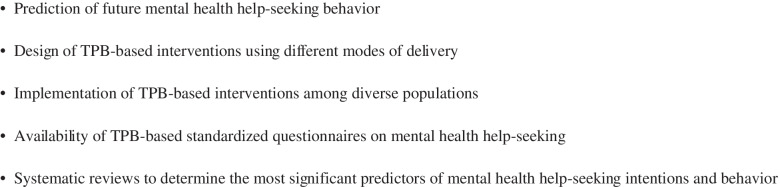
“The evidence base for TPB-based interventions to improve mental health help-seeking is in its early stages, and there appears to be a number of gaps in the literature that limit our understanding of the applicability of the TPB in this context and warrant further research.”
§ Explaining adults’ mental health help-seeking through the lens of the theory of planned behavior: a scoping review > Conclusions
hedged- Asserted: passes — The authors put it forward as true.
- Checkable: passes — It can be checked against evidence.
- Load-bearing: passes — The paper’s conclusions depend on it.
- Based: passes — The paper gives a reason why it holds.
What the paper did — it cites no source for this, so there is none to check. The quote shows it is in the paper.
In the paper
“Additionally, we applied a strict inclusion and exclusion criteria, which may have resulted in the exclusion of closely related studies.”
§ Explaining adults’ mental health help-seeking through the lens of the theory of planned behavior: a scoping review > Discussion > Strengths and limitations
hedgedconditional- Asserted: passes — The authors put it forward as true.
- Checkable: passes — It can be checked against evidence.
- Load-bearing: unclear — It is unclear whether the paper’s conclusions depend on it.
- Based: passes — The paper gives a reason why it holds.
What the paper did — it cites no source for this, so there is none to check. The quote shows it is in the paper.
In the paper
“We, therefore, cannot detect whether intentions to seek help were influenced by the components of the TPB or the overlapping or related constructs inherent in this measure.”
§ Explaining adults’ mental health help-seeking through the lens of the theory of planned behavior: a scoping review > Discussion > Strengths and limitations
plain- Asserted: passes — The authors put it forward as true.
- Checkable: passes — It can be checked against evidence.
- Load-bearing: passes — The paper’s conclusions depend on it.
- Based: passes — The paper gives a reason why it holds.
- Probably not a substantial claim. 46
- It may state two separate claims as one. 66
Every source the paper cites for this claim was checked and supports it.
In the paper
“This process was followed, and the scoping review is reported based on the Preferred Reporting Items for Systematic reviews and Meta-Analyses extension for Scoping Reviews (PRISMA-ScR) checklist (see Additional file 1) [41].”
§ Explaining adults’ mental health help-seeking through the lens of the theory of planned behavior: a scoping review > Methods
What the sources say
- Supportedcites [41] Tricco AC, Lillie E, Zarin W, O’Brien KK, Colquhoun H, Levac D, et al. PRISMA extension for scoping reviews (PRISMA-ScR): checklist and explanation. Ann Intern Med. 2018;169(7):467–73. source
Section 3.7 presents the PRISMA-ScR checklist in Table 1, and the Discussion identifies it as guidance for reporting scoping reviews. The citation identifies the checklist the citing authors say they used; it does not need to independently verify their compliance. (LLM, conf=0.94)
plain- Asserted: passes — The authors put it forward as true.
- Checkable: passes — It can be checked against evidence.
- Load-bearing: fails — The paper’s conclusions may not depend on it.
- Based: passes — The paper gives a reason why it holds.
Probably not a substantial claim. The paper’s conclusions may not depend on it.
- Supported
The sources with a verdict support this claim; the rest weren’t checked yet, have no full text we could read, or their verdicts aren’t rated yet.
In the paper
“Seeking help from a professional is considered optimal for the receipt of evidence-based treatments [23, 32].”
§ Explaining adults’ mental health help-seeking through the lens of the theory of planned behavior: a scoping review > Background
What the sources say
- Not checked yetcites [23] Gulliver A, Griffiths KM, Christensen H, Brewer JL. A systematic review of help-seeking interventions for depression, anxiety and general psychological distress. BMC Psychiatry. 2012;12(81):1–12.
- Supportedcites [32] Brown JSL, Evans-Lacko S, Aschan L, Henderson MJ, Hatch SL, Hotopf M. Seeking informal and formal help for mental health problems in the community: a secondary analysis from a psychiatric morbidity survey in South London. BMC Psychiatry. 2014;14(1):1–15. source
The Background links formal help to access to effective treatment and says that when informal help prevents access to formal help, evidence-based treatments may not be used. This supports the claim that professional help is a route to receiving evidence-based treatment. (LLM, conf=0.86)
plain- Asserted: passes — The authors put it forward as true.
- Checkable: passes — It can be checked against evidence.
- Load-bearing: fails — The paper’s conclusions may not depend on it.
- Based: passes — The paper gives a reason why it holds.
Probably not a substantial claim. The paper’s conclusions may not depend on it.
The sources with a verdict support this claim; the rest weren’t checked yet, have no full text we could read, or their verdicts aren’t rated yet.
In the paper
“Finally, an online navigation tool for young adults designed to match participants with appropriate services did not demonstrate improvements in help-seeking intentions; changes in other TPB variables were not assessed [37, 38].”
§ Explaining adults’ mental health help-seeking through the lens of the theory of planned behavior: a scoping review > Results > TPB-based interventions
What the sources say
- Not checked yetcites [37] Kauer S, Buhagiar K, Sanci L. Facilitating mental health help seeking in young adults: the underlying theory and development of an online navigation tool. Adv Ment Health. 2017;15(1):71–87. https://doi.org/10.1080/18387357.2016.1237856. source
- Supportedcites [38] Kauer SD, Buhagiar K, Blake V, Cotton S, Sanci L. Facilitating mental health help-seeking by young adults with a dedicated online program: a feasibility study of Link. BMJ Open. 2017;7(7):1–12. source
The Abstract (Results; page unavailable) reports no observable differences between the Link and comparison arms in any outcome measure, and Methods (Measures; page unavailable) identifies help-seeking intention as a measured outcome. Link is described in the Abstract (Intervention) as matching young adults to appropriate services. Methods lists other outcomes, including barriers and help-seeking perceptions, but does not identify assessments of the other Theory of Planned Behaviour variables. (LLM, conf=0.87)
plain- Asserted: passes — The authors put it forward as true.
- Checkable: passes — It can be checked against evidence.
- Load-bearing: unclear — It is unclear whether the paper’s conclusions depend on it.
- Based: passes — The paper gives a reason why it holds.
It may state two separate claims as one.
A result the paper reports from its own data — it cites no other source for it, so there is none to check. The quote shows it is in the paper.
In the paper
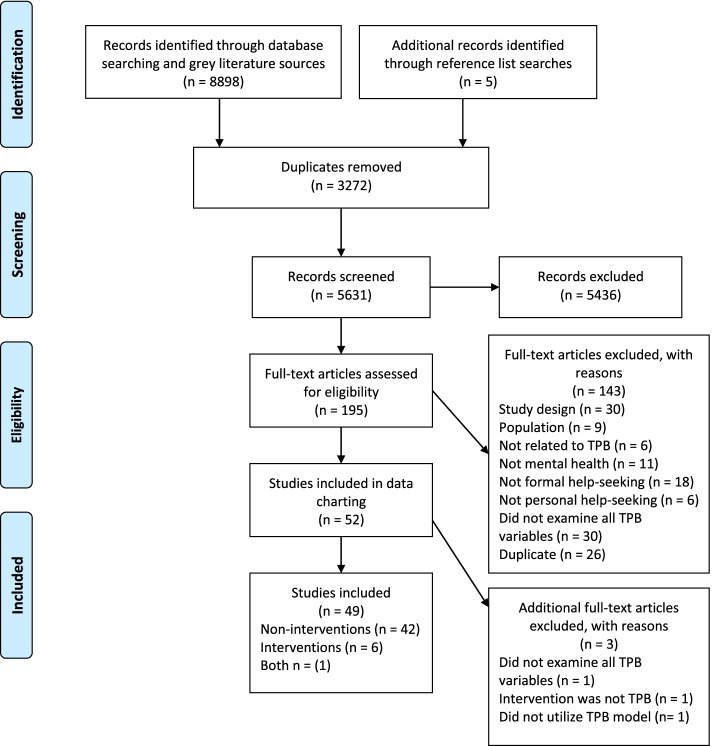
“After the removal of duplicates, 5626 records were screened for eligibility.”
§ Explaining adults’ mental health help-seeking through the lens of the theory of planned behavior: a scoping review > Results
plain- Asserted: passes — The authors put it forward as true.
- Checkable: passes — It can be checked against evidence.
- Load-bearing: fails — The paper’s conclusions may not depend on it.
- Based: passes — The paper gives a reason why it holds.
Probably not a substantial claim. The paper’s conclusions may not depend on it.
A result the paper reports from its own data — it cites no other source for it, so there is none to check. The quote shows it is in the paper.
In the paper
“There were 8898 records identified through the literature searches.”
- Also stated in: § Results · plain
“Initially, 8898 records were identified.”
§ Explaining adults’ mental health help-seeking through the lens of the theory of planned behavior: a scoping review > Results
plain- Asserted: passes — The authors put it forward as true.
- Checkable: passes — It can be checked against evidence.
- Load-bearing: fails — The paper’s conclusions may not depend on it.
- Based: passes — The paper gives a reason why it holds.
Probably not a substantial claim. The paper’s conclusions may not depend on it.
- Also stated in: § Results · plain
A result the paper reports from its own data — it cites no other source for it, so there is none to check. The quote shows it is in the paper.
In the paper
“There were 5436 records excluded at the title and abstract stage, 143 articles excluded after full-text screening and three articles excluded after data extraction.”
§ Explaining adults’ mental health help-seeking through the lens of the theory of planned behavior: a scoping review > Results
plain- Asserted: passes — The authors put it forward as true.
- Checkable: passes — It can be checked against evidence.
- Load-bearing: fails — The paper’s conclusions may not depend on it.
- Based: passes — The paper gives a reason why it holds.
Probably not a substantial claim. The paper’s conclusions may not depend on it. It may state two separate claims as one.
A result the paper reports from its own data — it cites no other source for it, so there is none to check. The quote shows it is in the paper.
In the paper
“The most commonly targeted populations were students (n studies = 14, 33%; n participants = 5588), followed by armed forces or emergency service workers (n studies = 7, 16%; n participants = 1900) and community samples (n studies = 10, 23%; n participants = 7231).”
§ Explaining adults’ mental health help-seeking through the lens of the theory of planned behavior: a scoping review > Results > TPB-based non-intervention studies
plainn = 14- Asserted: passes — The authors put it forward as true.
- Checkable: passes — It can be checked against evidence.
- Load-bearing: unclear — It is unclear whether the paper’s conclusions depend on it.
- Based: passes — The paper gives a reason why it holds.
It may state two separate claims as one.
None of the sources cited for this claim have been checked yet.
In the paper
“Two journal articles reported on the same sample [77, 79]”
§ Explaining adults’ mental health help-seeking through the lens of the theory of planned behavior: a scoping review > Results > TPB-based non-intervention studies
What the sources say
- Not checked yetcites [77] Hyland P, Boduszek D, Shevlin M, Adamson G. Investigating the latent structure of the theory of planned behavior and its effectiveness in explaining intentions to participate in counseling among a sample of police officers. J Police Crim Psychol. 2012;27(2):129–40. source
- Not checked yetcites [79] Hyland PE, McLaughlin CG, Boduszek D, Prentice GR. Intentions to participate in counselling among front-line, at-risk Irish government employees: an application of the theory of planned behaviour. Br J Guid Couns. 2012;40(3):279–99. source
plainn = 2- Asserted: passes — The authors put it forward as true.
- Checkable: passes — It can be checked against evidence.
- Load-bearing: fails — The paper’s conclusions may not depend on it.
- Based: passes — The paper gives a reason why it holds.
Probably not a substantial claim. The paper’s conclusions may not depend on it.
A result the paper reports from its own data — it cites no other source for it, so there is none to check. The quote shows it is in the paper.
In the paper
“In terms of the populations, most targeted college students (n studies = 16, 33%; n participants = 6048), followed by community samples (n studies = 12, 25%; n participants = 7305), both students and community samples (n studies = 1, 2%; n students = 320; n community adults = 208), armed forces or emergency service workers (n studies = 8, 16%; n participants = 1910), older adults (n studies = 2, 4”
§ Explaining adults’ mental health help-seeking through the lens of the theory of planned behavior: a scoping review > Results > Characteristics of studies
plainn = 16- Asserted: passes — The authors put it forward as true.
- Checkable: passes — It can be checked against evidence.
- Load-bearing: unclear — It is unclear whether the paper’s conclusions depend on it.
- Based: passes — The paper gives a reason why it holds.
It may state two separate claims as one.
A result the paper reports from its own data — it cites no other source for it, so there is none to check. The quote shows it is in the paper.
In the paper
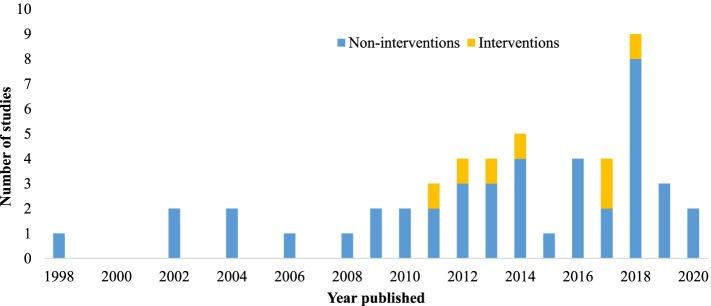
“Forty-three papers reported on non-intervention studies and seven articles reported on TPB-based interventions.”
§ Explaining adults’ mental health help-seeking through the lens of the theory of planned behavior: a scoping review > Abstract > Results
plain- Asserted: passes — The authors put it forward as true.
- Checkable: passes — It can be checked against evidence.
- Load-bearing: unclear — It is unclear whether the paper’s conclusions depend on it.
- Based: passes — The paper gives a reason why it holds.
It may state two separate claims as one.
A result the paper reports from its own data — it cites no other source for it, so there is none to check. The quote shows it is in the paper.
In the paper
“Most studies were conducted in North America (n = 27, 55%), followed by Europe (n = 9, 19%), Asia (n = 8, 16%), Oceania (n = 4, 8%), and Africa (n = 1, 2%).”
§ Explaining adults’ mental health help-seeking through the lens of the theory of planned behavior: a scoping review > Results > Characteristics of studies
plainn = 27- Asserted: passes — The authors put it forward as true.
- Checkable: passes — It can be checked against evidence.
- Load-bearing: fails — The paper’s conclusions may not depend on it.
- Based: passes — The paper gives a reason why it holds.
Probably not a substantial claim. The paper’s conclusions may not depend on it. It may state two separate claims as one.
In the paper
“one thesis reported pre-intervention cross-sectional data and intervention data and thus was included in both sections [58]”
§ Explaining adults’ mental health help-seeking through the lens of the theory of planned behavior: a scoping review > Results > TPB-based non-intervention studies
What the sources say
- Not checked yetcites [58] Chang KF. An intervention to increase counseling service usage among female college students. (Publication No. 3540311) [Doctoral dissertation, University of California]. ProQuest Dissertations and Theses Global.; 2012.
plain- Asserted: passes — The authors put it forward as true.
- Checkable: passes — It can be checked against evidence.
- Load-bearing: fails — The paper’s conclusions may not depend on it.
- Based: passes — The paper gives a reason why it holds.
Probably not a substantial claim. The paper’s conclusions may not depend on it.
In the paper
“The third paper developed and tested the Mental Help-Seeking Attitudes Scale (MHSAS) [76].”
§ Explaining adults’ mental health help-seeking through the lens of the theory of planned behavior: a scoping review > Results > TPB-based non-intervention studies
What the sources say
- Not checked yetcites [76] Hammer JH, Parent MC, Spiker DA. Mental help seeking attitudes scale (MHSAS): development, reliability, validity, and comparison with the ATSPPH-SF and IASMHS-PO. J Couns Psychol. 2018;65(1):74–85. source
plain- Asserted: passes — The authors put it forward as true.
- Checkable: passes — It can be checked against evidence.
- Load-bearing: fails — The paper’s conclusions may not depend on it.
- Based: passes — The paper gives a reason why it holds.
Probably not a substantial claim. The paper’s conclusions may not depend on it.
None of the sources cited for this claim have been checked yet.
In the paper
“Depression was the only mental health problem to be examined independently, with eight studies (19%) focusing only on help-seeking for depression, and one study (2%) focusing on depression and suicidal thoughts [35, 36, 48, 53, 58, 60, 62, 72].”
§ Explaining adults’ mental health help-seeking through the lens of the theory of planned behavior: a scoping review > Results > TPB-based non-intervention studies
What the sources say
- Not checked yetcites [35] Zorrilla MM, Modeste N, Gleason PC, Sealy DA, Banta JE, Trieu SL. Depression and help-seeking intention among young adults: the theory of planned behavior. Am J Health Educ. 2019;50(4):236–44. https://doi.org/10.1080/19325037.2019.1616014. source
- Not checked yetcites [36] Bohon LM, Cotter KA, Kravitz RL, Cello PC, Fernandez y Garcia E. The theory of planned behavior as it predicts potential intention to seek mental health services for depression among college students. J Am Coll Health. 2016;64(8):593–603. source
- Not checked yetcites [48] Logsdon MC, Morrison D, Myers JA, Capps J, Masterson KM. Intention to seek depression treatment in Latina immigrant mothers. Issues Ment Health Nurs. 2018;39(11):962–6 Available from: https://www.tandfonline.com/doi/full/10.1080/01612840.2018.1479905. source
- Not checked yetcites [53] Schomerus G, Matschinger H, Angermeyer MC. Attitudes that determine willingness to seek psychiatric help for depression: a representative population survey applying the theory of planned behaviour. Psychol Med. 2009;39(11):1855–65. source
- Not checked yetcites [58] Chang KF. An intervention to increase counseling service usage among female college students. (Publication No. 3540311) [Doctoral dissertation, University of California]. ProQuest Dissertations and Theses Global.; 2012.
- Not checked yetcites [60] Farmer CS. Understanding poor help-seeking rates for major depressive disorder. [Doctoral dissertation, University of Exeter]. Open Research Exeter; 2013. Available from: https://ore.exeter.ac.uk/repository/handle/10871/14620
- Not checked yetcites [62] Hussain SA. Bittersweet nature of nostalgia and its impact on depression related help-seeking. (Publication No. 10843189) [Doctoral dissertation, Michigan State University]. ProQuest Dissertations and Theses Global; 2018.
- Not checked yetcites [72] Woods KC. The strong black woman archetype and intentions to seek therapy for depression: a cultural application of the theory of planned behavior. (Publication No. 3599504) [Doctoral dissertation, Michigan State University]. ProQuest Dissertations and Theses Global.; 2013.
plain- Asserted: passes — The authors put it forward as true.
- Checkable: passes — It can be checked against evidence.
- Load-bearing: unclear — It is unclear whether the paper’s conclusions depend on it.
- Based: passes — The paper gives a reason why it holds.
It may state two separate claims as one.
In the paper
“These studies included all participants irrespective of their mental health status, with the exception of one paper which included only dysphoric individuals [60].”
§ Explaining adults’ mental health help-seeking through the lens of the theory of planned behavior: a scoping review > Results > TPB-based non-intervention studies
What the sources say
- Not checked yetcites [60] Farmer CS. Understanding poor help-seeking rates for major depressive disorder. [Doctoral dissertation, University of Exeter]. Open Research Exeter; 2013. Available from: https://ore.exeter.ac.uk/repository/handle/10871/14620
plain- Asserted: passes — The authors put it forward as true.
- Checkable: passes — It can be checked against evidence.
- Load-bearing: unclear — It is unclear whether the paper’s conclusions depend on it.
- Based: passes — The paper gives a reason why it holds.
It may state two separate claims as one.
The paper states this without a source or data behind it here, so there is nothing to check it against. The quote shows it is in the paper.
In the paper
“A further 5 articles were identified through reference list searches and screened.”
§ Explaining adults’ mental health help-seeking through the lens of the theory of planned behavior: a scoping review > Results
plain- Asserted: passes — The authors put it forward as true.
- Checkable: passes — It can be checked against evidence.
- Load-bearing: fails — The paper’s conclusions may not depend on it.
- Based: passes — The paper gives a reason why it holds.
Probably not a substantial claim. The paper’s conclusions may not depend on it.
In the paper
“One psychometric study also reported on predictors of help-seeking intentions [84].”
§ Explaining adults’ mental health help-seeking through the lens of the theory of planned behavior: a scoping review > Results > TPB-based non-intervention studies
What the sources say
- Not checked yetcites [84] Hyland P, Boduszek D, Dhingra K, Shevlin M, Maguire R, Morley K. A test of the inventory of attitudes towards seeking mental health services. Br J Guid Couns. 2015;43(4):397–412. source
plaincorrelational- Asserted: passes — The authors put it forward as true.
- Checkable: passes — It can be checked against evidence.
- Load-bearing: fails — The paper’s conclusions may not depend on it.
- Based: passes — The paper gives a reason why it holds.
Probably not a substantial claim. The paper’s conclusions may not depend on it.
A result the paper reports from its own data — it cites no other source for it, so there is none to check. The quote shows it is in the paper.
In the paper
“Most studies included all participants with and without symptoms of mental health problems (n studies = 42, 86%; n participants = 17371), three studies (6%; n participants = 1542) only included participants with psychological symptomatology, two studies (4%; n participants = 160) targeted people who screened positive for a mental disorder, one study (2%; n participants = 400) included dysphoric”
§ Explaining adults’ mental health help-seeking through the lens of the theory of planned behavior: a scoping review > Results > Characteristics of studies
plainn = 17,371- Asserted: passes — The authors put it forward as true.
- Checkable: passes — It can be checked against evidence.
- Load-bearing: unclear — It is unclear whether the paper’s conclusions depend on it.
- Based: passes — The paper gives a reason why it holds.
It may state two separate claims as one.
A result the paper reports from its own data — it cites no other source for it, so there is none to check. The quote shows it is in the paper.
In the paper
“Of these, 28 (65%) were journal articles and 15 (35%) were theses.”
§ Explaining adults’ mental health help-seeking through the lens of the theory of planned behavior: a scoping review > Results > TPB-based non-intervention studies
plain- Asserted: passes — The authors put it forward as true.
- Checkable: passes — It can be checked against evidence.
- Load-bearing: fails — The paper’s conclusions may not depend on it.
- Based: passes — The paper gives a reason why it holds.
Probably not a substantial claim. The paper’s conclusions may not depend on it. It may state two separate claims as one.
A result the paper reports from its own data — it cites no other source for it, so there is none to check. The quote shows it is in the paper.
In the paper
“Most of the non-intervention studies were conducted in North America (n = 23, 53%), followed by Europe (n = 9, 21%), Asia (n = 8, 19%), Oceania (n = 2, 5%), and Africa (n studies = 1, 2%).”
§ Explaining adults’ mental health help-seeking through the lens of the theory of planned behavior: a scoping review > Results > TPB-based non-intervention studies
plainn = 23- Asserted: passes — The authors put it forward as true.
- Checkable: passes — It can be checked against evidence.
- Load-bearing: unclear — It is unclear whether the paper’s conclusions depend on it.
- Based: passes — The paper gives a reason why it holds.
It may state two separate claims as one.
A result the paper reports from its own data — it cites no other source for it, so there is none to check. The quote shows it is in the paper.
In the paper
“Of these, 42 (86%) were non-intervention studies, six (12%) were intervention studies, and one paper (2%) reported on both cross-sectional data and an intervention”
§ Explaining adults’ mental health help-seeking through the lens of the theory of planned behavior: a scoping review > Results > Characteristics of studies
plain- Asserted: passes — The authors put it forward as true.
- Checkable: passes — It can be checked against evidence.
- Load-bearing: unclear — It is unclear whether the paper’s conclusions depend on it.
- Based: passes — The paper gives a reason why it holds.
It may state two separate claims as one.
None of the sources cited for this claim have been checked yet.
In the paper
“Two centered on the reliability and validity of the Inventory of Attitudes towards Seeking Mental Health Services (IASMHS) [49, 84].”
§ Explaining adults’ mental health help-seeking through the lens of the theory of planned behavior: a scoping review > Results > TPB-based non-intervention studies
What the sources say
- Not checked yetcites [49] Mackenzie CS, Knox VJ, Gekoski WL, Macaulay HL. An adaptation and extension of the Attitudes Toward Seeking Professional Psychological Help Scale. J Appl Soc Psychol. 2004;34(11):2410–33. source
- Not checked yetcites [84] Hyland P, Boduszek D, Dhingra K, Shevlin M, Maguire R, Morley K. A test of the inventory of attitudes towards seeking mental health services. Br J Guid Couns. 2015;43(4):397–412. source
plain- Asserted: passes — The authors put it forward as true.
- Checkable: passes — It can be checked against evidence.
- Load-bearing: fails — The paper’s conclusions may not depend on it.
- Based: passes — The paper gives a reason why it holds.
Probably not a substantial claim. The paper’s conclusions may not depend on it.
In the paper
“One study reported on post-intervention data only and was included under non-intervention studies as the intervention was not based on the TPB [62].”
§ Explaining adults’ mental health help-seeking through the lens of the theory of planned behavior: a scoping review > Results > TPB-based non-intervention studies
What the sources say
- Not checked yetcites [62] Hussain SA. Bittersweet nature of nostalgia and its impact on depression related help-seeking. (Publication No. 10843189) [Doctoral dissertation, Michigan State University]. ProQuest Dissertations and Theses Global; 2018.
plain- Asserted: passes — The authors put it forward as true.
- Checkable: passes — It can be checked against evidence.
- Load-bearing: fails — The paper’s conclusions may not depend on it.
- Based: passes — The paper gives a reason why it holds.
Probably not a substantial claim. The paper’s conclusions may not depend on it.
A result the paper reports from its own data — it cites no other source for it, so there is none to check. The quote shows it is in the paper.
In the paper
“The 49 articles that were chosen were published between 1998 and 2020; 32 (65%) were journal articles and 17 (35%) were theses.”
§ Explaining adults’ mental health help-seeking through the lens of the theory of planned behavior: a scoping review > Results > Characteristics of studies
plain- Asserted: passes — The authors put it forward as true.
- Checkable: passes — It can be checked against evidence.
- Load-bearing: fails — The paper’s conclusions may not depend on it.
- Based: passes — The paper gives a reason why it holds.
Probably not a substantial claim. The paper’s conclusions may not depend on it. It may state two separate claims as one.
A result the paper reports from its own data — it cites no other source for it, so there is none to check. The quote shows it is in the paper.
In the paper
“This process resulted in the inclusion of 49 articles.”
- Also stated in: § Results · plain
“Of these, 49 met the selection criteria and were included: 32 were journal articles and 17 were theses.”
§ Explaining adults’ mental health help-seeking through the lens of the theory of planned behavior: a scoping review > Results
plain- Asserted: passes — The authors put it forward as true.
- Checkable: passes — It can be checked against evidence.
- Load-bearing: fails — The paper’s conclusions may not depend on it.
- Based: passes — The paper gives a reason why it holds.
Probably not a substantial claim. The paper’s conclusions may not depend on it.
- Also stated in: § Results · plain
A result the paper reports from its own data — it cites no other source for it, so there is none to check. The quote shows it is in the paper.
In the paper
“Seven of the eight articles (88%) found intentions to be a significant predictor of mental health help-seeking behavior, and six of the eight (75%) articles found perceived behavioral control to be a significant predictor of behavior.”
- Also stated in: § Results · plain
“Intentions and perceived behavioral control were significant predictors of behavior in seven and six studies, respectively.”
§ Explaining adults’ mental health help-seeking through the lens of the theory of planned behavior: a scoping review > Results > TPB-based non-intervention studies
plaincorrelationaln = 8- Asserted: passes — The authors put it forward as true.
- Checkable: passes — It can be checked against evidence.
- Load-bearing: passes — The paper’s conclusions depend on it.
- Based: passes — The paper gives a reason why it holds.
It may state two separate claims as one.
- Also stated in: § Results · plain
A result the paper reports from its own data — it cites no other source for it, so there is none to check. The quote shows it is in the paper.
In the paper
“From the 39 studies that identified predictors of mental health help-seeking intentions, attitudes was a significant predictor of intentions in 35 (90%) studies, perceived behavioral control was a significant predictor of intentions in 34 (87%) studies, and subjective norms was a significant predictor of intentions in 23 (59%) studies.”
- Also stated in: § Results · plain
“Attitudes and perceived behavioral control were significant predictors of intentions in 35 and 34 studies, respectively. Subjective norms were a significant predictor of intentions in 23 studies.”
§ Explaining adults’ mental health help-seeking through the lens of the theory of planned behavior: a scoping review > Results > TPB-based non-intervention studies
plaincorrelationaln = 39- Asserted: passes — The authors put it forward as true.
- Checkable: passes — It can be checked against evidence.
- Load-bearing: passes — The paper’s conclusions depend on it.
- Based: passes — The paper gives a reason why it holds.
It may state two separate claims as one.
- Also stated in: § Results · plain
The paper states this without a source or data behind it here, so there is nothing to check it against. The quote shows it is in the paper.
In the paper
“Overall, the variance in mental health help-seeking behavior explained by the TPB ranged from 3 to 61% for the traditional models and 10 to 63% for the extended models.”
§ Explaining adults’ mental health help-seeking through the lens of the theory of planned behavior: a scoping review > Results > TPB-based non-intervention studies
plaincorrelational- Asserted: passes — The authors put it forward as true.
- Checkable: passes — It can be checked against evidence.
- Load-bearing: passes — The paper’s conclusions depend on it.
- Based: passes — The paper gives a reason why it holds.
It may state two separate claims as one.
A result the paper reports from its own data — it cites no other source for it, so there is none to check. The quote shows it is in the paper.
In the paper
“Overall, 39 studies identified predictors of mental health help-seeking; 31 studies identified predictors of mental health help-seeking intentions only, and eight studies identified predictors of intentions and behavior.”
§ Explaining adults’ mental health help-seeking through the lens of the theory of planned behavior: a scoping review > Results > TPB-based non-intervention studies
plain- Asserted: passes — The authors put it forward as true.
- Checkable: passes — It can be checked against evidence.
- Load-bearing: unclear — It is unclear whether the paper’s conclusions depend on it.
- Based: passes — The paper gives a reason why it holds.
It may state two separate claims as one.
A result the paper reports from its own data — it cites no other source for it, so there is none to check. The quote shows it is in the paper.
In the paper
“Only six TPB-based interventions were identified, all used digital technology to influence help-seeking, with mixed results.”
§ Explaining adults’ mental health help-seeking through the lens of the theory of planned behavior: a scoping review > Abstract > Results
plain- Asserted: passes — The authors put it forward as true.
- Checkable: passes — It can be checked against evidence.
- Load-bearing: unclear — It is unclear whether the paper’s conclusions depend on it.
- Based: passes — The paper gives a reason why it holds.
It may state two separate claims as one.
A result the paper reports from its own data — it cites no other source for it, so there is none to check. The quote shows it is in the paper.
In the paper
“Additional terminology included counseling (n studies = 7, 17%), treatment (n studies = 5, 12%), cyber-counseling (n studies = 1, 2%), therapy for depression (n studies = 1, 2%), psychotherapy (n studies = 1, 2%), and prison psychologist (n studies = 1, 2%).”
§ Explaining adults’ mental health help-seeking through the lens of the theory of planned behavior: a scoping review > Results > TPB-based non-intervention studies
plainn = 7- Asserted: passes — The authors put it forward as true.
- Checkable: passes — It can be checked against evidence.
- Load-bearing: fails — The paper’s conclusions may not depend on it.
- Based: passes — The paper gives a reason why it holds.
Probably not a substantial claim. The paper’s conclusions may not depend on it. It may state two separate claims as one.
A result the paper reports from its own data — it cites no other source for it, so there is none to check. The quote shows it is in the paper.
In the paper
“Some studies (n = 13, 33%) used traditional models of the TPB to explore help-seeking, whereby only the original TPB variables (attitudes, subjective norms, perceived behavioral control, intentions, and where applicable, behavior) were included in the model. Other studies (n = 19, 49%) used extended models of the TPB, in which the original TPB variables and additional variables were included in”
§ Explaining adults’ mental health help-seeking through the lens of the theory of planned behavior: a scoping review > Results > TPB-based non-intervention studies
plainn = 19- Asserted: passes — The authors put it forward as true.
- Checkable: passes — It can be checked against evidence.
- Load-bearing: unclear — It is unclear whether the paper’s conclusions depend on it.
- Based: passes — The paper gives a reason why it holds.
It may state two separate claims as one.
In the paper
“and direct relationships were also found between attitudes and prospective help-seeking, and subjective norms and current help-seeking.”
§ Explaining adults’ mental health help-seeking through the lens of the theory of planned behavior: a scoping review > Results > TPB-based non-intervention studies
What the sources say
- Not checked yetcites [60] Farmer CS. Understanding poor help-seeking rates for major depressive disorder. [Doctoral dissertation, University of Exeter]. Open Research Exeter; 2013. Available from: https://ore.exeter.ac.uk/repository/handle/10871/14620
plaincorrelational- Asserted: passes — The authors put it forward as true.
- Checkable: passes — It can be checked against evidence.
- Load-bearing: unclear — It is unclear whether the paper’s conclusions depend on it.
- Based: passes — The paper gives a reason why it holds.
It may state two separate claims as one.
None of the sources cited for this claim have been checked yet.
In the paper
“Six studies (14%) also specified physicians/general practitioners within their definition [49, 55, 57, 67, 71, 75].”
§ Explaining adults’ mental health help-seeking through the lens of the theory of planned behavior: a scoping review > Results > TPB-based non-intervention studies
What the sources say
- Not checked yetcites [49] Mackenzie CS, Knox VJ, Gekoski WL, Macaulay HL. An adaptation and extension of the Attitudes Toward Seeking Professional Psychological Help Scale. J Appl Soc Psychol. 2004;34(11):2410–33. source
- Not checked yetcites [55] Stecker T, Fortney J, Hamilton F, Sherbourne CD, Ajzen I. Engagement in mental health treatment among veterans returning from Iraq. Patient Prefer Adherence. 2010;4:45–9. source
- Not checked yetcites [57] Westerhof GJ, Maessen M, De Bruijn R, Smets B. Intentions to seek (preventive) psychological help among older adults: an application of the theory of planned behaviour. Aging Ment Health. 2008;12(3):317–22. source
- Not checked yetcites [67] O’Flaherty R. Factors affecting psychological help-seeking in men. [Doctoral dissertation, University of Warwick]. Warwick Research Archive Portal http://wrap.warwick.ac.uk/96714; 2017.
- Not checked yetcites [71] Walther AT. Factors affecting intentions to seek professional mental health services. (Publication No. MQ73099) [Masters thesis, Queen’s University]. ProQuest Dissertations and Theses Global.; 2002.
- Not checked yetcites [75] Damghanian M, Alijanzadeh M. Theory of planned behavior, self-stigma, and perceived barriers explains the behavior of seeking mental health services for people at risk of affective disorders. Soc Heal Behav. 2018;1(2):54–61 Available from: https://www.shbonweb.com/article.asp?issn=2589-9767;year=2018;volume=1;issue=2;spage=54;epage=61;aulast=Damghanian. source
plain- Asserted: passes — The authors put it forward as true.
- Checkable: passes — It can be checked against evidence.
- Load-bearing: fails — The paper’s conclusions may not depend on it.
- Based: passes — The paper gives a reason why it holds.
Probably not a substantial claim. The paper’s conclusions may not depend on it.
A result the paper reports from its own data — it cites no other source for it, so there is none to check. The quote shows it is in the paper.
In the paper
“Seven articles were identified on TPB-based interventions; four were journal articles and three were theses [30, 37–39, 58, 85, 86].”
§ Explaining adults’ mental health help-seeking through the lens of the theory of planned behavior: a scoping review > Results > TPB-based interventions
plain- Asserted: passes — The authors put it forward as true.
- Checkable: passes — It can be checked against evidence.
- Load-bearing: unclear — It is unclear whether the paper’s conclusions depend on it.
- Based: passes — The paper gives a reason why it holds.
It may state two separate claims as one.
A result the paper reports from its own data — it cites no other source for it, so there is none to check. The quote shows it is in the paper.
In the paper
“All six interventions used digital technology: two interventions were short videos on seeking counseling services, three were web-based tools, and one was a theory-guided multimedia presentation.”
§ Explaining adults’ mental health help-seeking through the lens of the theory of planned behavior: a scoping review > Results > TPB-based interventions
plain- Asserted: passes — The authors put it forward as true.
- Checkable: passes — It can be checked against evidence.
- Load-bearing: unclear — It is unclear whether the paper’s conclusions depend on it.
- Based: passes — The paper gives a reason why it holds.
It may state two separate claims as one.
A result the paper reports from its own data — it cites no other source for it, so there is none to check. The quote shows it is in the paper.
In the paper
“Most studies were conducted in western countries (North America and Europe), with college students and community samples the most common populations targeted.”
§ Explaining adults’ mental health help-seeking through the lens of the theory of planned behavior: a scoping review > Discussion
plain- Asserted: passes — The authors put it forward as true.
- Checkable: passes — It can be checked against evidence.
- Load-bearing: unclear — It is unclear whether the paper’s conclusions depend on it.
- Based: passes — The paper gives a reason why it holds.
It may state two separate claims as one.
A result the paper reports from its own data — it cites no other source for it, so there is none to check. The quote shows it is in the paper.
In the paper
“The target population were mainly young adults (n studies = 5, n participants = 704), one study targeted USA war veterans (n participants = 10), and one study focused on adolescent mothers with a mean age of 18 (n participants = 289).”
§ Explaining adults’ mental health help-seeking through the lens of the theory of planned behavior: a scoping review > Results > TPB-based interventions
plainn = 704- Asserted: passes — The authors put it forward as true.
- Checkable: passes — It can be checked against evidence.
- Load-bearing: unclear — It is unclear whether the paper’s conclusions depend on it.
- Based: passes — The paper gives a reason why it holds.
It may state two separate claims as one.
In the paper
“Logsdon et al. [39] employed a pre-post design to evaluate an Internet-based depression intervention encouraging adolescent mothers to seek depression treatment and found a statistically significant increase in both intentions to seek treatment and actually receiving treatment over time in the intervention group compared to the control group.”
§ Explaining adults’ mental health help-seeking through the lens of the theory of planned behavior: a scoping review > Results > TPB-based interventions
What the sources say
- Not checked yetcites [39] Logsdon MC, Myers J, Rushton J, Gregg JL, Josephson AM, Davis DW, et al. Efficacy of an internet-based depression intervention to improve rates of treatment in Adolescent mothers. Arch Womens Ment Health. 2018;21(3):273–85. source
plaindirect- Asserted: passes — The authors put it forward as true.
- Checkable: passes — It can be checked against evidence.
- Load-bearing: unclear — It is unclear whether the paper’s conclusions depend on it.
- Based: passes — The paper gives a reason why it holds.
It may state two separate claims as one.
A result the paper reports from its own data — it cites no other source for it, so there is none to check. The quote shows it is in the paper.
In the paper
“Of the 49 articles included, the earliest paper identified was published in 1998, with a rise in the number of studies since 2008, indicating growing interest in this field.”
§ Explaining adults’ mental health help-seeking through the lens of the theory of planned behavior: a scoping review > Discussion
plaincorrelational- Asserted: passes — The authors put it forward as true.
- Checkable: passes — It can be checked against evidence.
- Load-bearing: unclear — It is unclear whether the paper’s conclusions depend on it.
- Based: passes — The paper gives a reason why it holds.
It may state two separate claims as one.
In the paper
“Furthermore, Lindsley’s [86] guided multimedia presentation on treatment seeking reported findings consistent with overall improvements in TPB predictor variables after intervention; however, this declined over time and no differences between the experimental and control group were found.”
§ Explaining adults’ mental health help-seeking through the lens of the theory of planned behavior: a scoping review > Results > TPB-based interventions
What the sources say
- Not checked yetcites [86] Lindsley TW. A multimedia intervention to increase the likelihood that university students in need will utilize counseling services. (Publication No. 3606867) [Doctoral dissertation, Utah State University]. ProQuest Dissertations and Theses Global; 2013.
plain- Asserted: passes — The authors put it forward as true.
- Checkable: passes — It can be checked against evidence.
- Load-bearing: unclear — It is unclear whether the paper’s conclusions depend on it.
- Based: passes — The paper gives a reason why it holds.
It may state two separate claims as one.
A result the paper reports from its own data — it cites no other source for it, so there is none to check. The quote shows it is in the paper.
In the paper
“Three of the interventions were evaluated in randomized controlled trials, two were evaluated in pre-post studies, and one was assessed using a randomized post-test-only design.”
§ Explaining adults’ mental health help-seeking through the lens of the theory of planned behavior: a scoping review > Results > TPB-based interventions
plain- Asserted: passes — The authors put it forward as true.
- Checkable: passes — It can be checked against evidence.
- Load-bearing: unclear — It is unclear whether the paper’s conclusions depend on it.
- Based: passes — The paper gives a reason why it holds.
It may state two separate claims as one.
A result the paper reports from its own data — it cites no other source for it, so there is none to check. The quote shows it is in the paper.
In the paper
“Of the theoretical factors, which influence mental health help-seeking intentions, attitudes and perceived behavioral control were frequently found to be significant predictors of help-seeking intentions, and subjective norms were found to be a significant predictor in more than half of the studies.”
- Also stated in: § Conclusions · hedged
“Attitudes and perceived behavioral control, in particular, appear to be well-cited factors influencing people’s intentions to seek or not seek help.”
§ Explaining adults’ mental health help-seeking through the lens of the theory of planned behavior: a scoping review > Discussion
plaincorrelationaln = 39- Asserted: passes — The authors put it forward as true.
- Checkable: passes — It can be checked against evidence.
- Load-bearing: passes — The paper’s conclusions depend on it.
- Based: passes — The paper gives a reason why it holds.
It may state two separate claims as one.
- Also stated in: § Conclusions · hedged
A result the paper reports from its own data — it cites no other source for it, so there is none to check. The quote shows it is in the paper.
In the paper
“Most studies found the TPB accounted for a large amount of variance in intentions; however, the range in variance explained was large.”
§ Explaining adults’ mental health help-seeking through the lens of the theory of planned behavior: a scoping review > Discussion
plaincorrelationaln = 39- Asserted: passes — The authors put it forward as true.
- Checkable: passes — It can be checked against evidence.
- Load-bearing: passes — The paper’s conclusions depend on it.
- Based: passes — The paper gives a reason why it holds.
It may state two separate claims as one.
A result the paper reports from its own data — it cites no other source for it, so there is none to check. The quote shows it is in the paper.
In the paper
“In the present scoping review, most non-intervention studies (67%) used extended models or both traditional and extended models to conceptualize help-seeking intentions; however, the variances explained by these models were comparable to traditional TPB models.”
§ Explaining adults’ mental health help-seeking through the lens of the theory of planned behavior: a scoping review > Discussion
plain- Asserted: passes — The authors put it forward as true.
- Checkable: passes — It can be checked against evidence.
- Load-bearing: passes — The paper’s conclusions depend on it.
- Based: passes — The paper gives a reason why it holds.
It may state two separate claims as one.
None of the sources cited for this claim have been checked yet.
In the paper
“In some extended and modified models of the TPB, variables such as adherence to Asian values, shame/izzat, and a Strong Black Woman ideal were included and were shown to significantly predict help-seeking intentions [22, 47, 72].”
§ Explaining adults’ mental health help-seeking through the lens of the theory of planned behavior: a scoping review > Discussion
What the sources say
- Not checked yetcites [22] Pilkington A, Msetfi RM, Watson R. Factors affecting intention to access psychological services amongst British Muslims of South Asian origin. Ment Heal Relig Cult. 2012;15(1):1–22. source
- Not checked yetcites [47] Li W, Denson LA, Dorstyn DS. Help-seeking intentions and behaviors among mainland Chinese college students: integrating the theory of planned behavior and behavioral model of health services use. Int J Adv Couns. 2017;39(2):125–48. source
- Not checked yetcites [72] Woods KC. The strong black woman archetype and intentions to seek therapy for depression: a cultural application of the theory of planned behavior. (Publication No. 3599504) [Doctoral dissertation, Michigan State University]. ProQuest Dissertations and Theses Global.; 2013.
plaincorrelational- Asserted: passes — The authors put it forward as true.
- Checkable: passes — It can be checked against evidence.
- Load-bearing: unclear — It is unclear whether the paper’s conclusions depend on it.
- Based: passes — The paper gives a reason why it holds.
It may state two separate claims as one.
A result the paper reports from its own data — it cites no other source for it, so there is none to check. The quote shows it is in the paper.
In the paper
“Of the seven studies we located on TPB-based interventions to improve mental health help-seeking, six used digital technology, mostly to target young adults.”
§ Explaining adults’ mental health help-seeking through the lens of the theory of planned behavior: a scoping review > Discussion
plain- Asserted: passes — The authors put it forward as true.
- Checkable: passes — It can be checked against evidence.
- Load-bearing: passes — The paper’s conclusions depend on it.
- Based: passes — The paper gives a reason why it holds.
It may state two separate claims as one.
In the paper
“Furthermore, national data from Australia and Canada indicate a little over half of the people who experienced emotional distress in 2013 and 2016 received treatment; however, many people (37% in Australia and 30% in Canada) reported that they did not want treatment [11].”
§ Explaining adults’ mental health help-seeking through the lens of the theory of planned behavior: a scoping review > Background
What the sources say
- Not checked yetcites [11] Corscadden L, Callander EJ, Topp SM. Who experiences unmet need for mental health services and what other barriers to accessing health care do they face? Findings from Australia and Canada. Int J Health Plann Manage. 2019;34(2):761–72. source
hedged- Asserted: passes — The authors put it forward as true.
- Checkable: passes — It can be checked against evidence.
- Load-bearing: fails — The paper’s conclusions may not depend on it.
- Based: passes — The paper gives a reason why it holds.
Probably not a substantial claim. The paper’s conclusions may not depend on it. It may state two separate claims as one.
A conclusion the paper draws from its own results — it cites no other source for it, so there is none to check. The quote shows it is in the paper.
In the paper
“Knowledge on the TPB for predicting mental health help-seeking behavior, and on TPB-based interventions, is limited.”
§ Explaining adults’ mental health help-seeking through the lens of the theory of planned behavior: a scoping review > Abstract > Conclusions
plain- Asserted: passes — The authors put it forward as true.
- Checkable: passes — It can be checked against evidence.
- Load-bearing: passes — The paper’s conclusions depend on it.
- Based: passes — The paper gives a reason why it holds.
It may state two separate claims as one.
None of the sources cited for this claim have been checked yet.
In the paper
“Recent prevalence estimates indicate 10.7% of the world’s population live with a mental health disorder, and the number of years lived with a mental health disorder has increased by 13.5% from 2007 to 2017”
§ Explaining adults’ mental health help-seeking through the lens of the theory of planned behavior: a scoping review > Background
What the sources say
- Not checked yetcites [1] James SL, Abate D, Abate KH, Abay SM, Abbafati C, Abbasi N, et al. Global, regional, and national incidence, prevalence, and years lived with disability for 354 diseases and injuries for 195 countries and territories, 1990-2017: a systematic analysis for the Global Burden of Disease Study 2017. Lancet. 2018;392(10159):1789–858. source
- Not checked yetcites [2] Ritchie H, Roser M. Mental health. Our World in Data; 2018. Available from: https://ourworldindata.org/mental-health
- Not checked yetcites [3] Whiteford HA, Ferrari AJ, Degenhardt L, Feigin V, Vos T. The global burden of mental, neurological and substance use disorders: an analysis from the global burden of disease study 2010. PLoS One. 2015;10(2):1–14. source
hedged- Asserted: passes — The authors put it forward as true.
- Checkable: passes — It can be checked against evidence.
- Load-bearing: fails — The paper’s conclusions may not depend on it.
- Based: passes — The paper gives a reason why it holds.
Probably not a substantial claim. The paper’s conclusions may not depend on it. It may state two separate claims as one.
In the paper
“For example, results of the World Mental Health Surveys conducted across 21 countries revealed only 27.6% of people with anxiety disorders received treatment over the course of one year, and less than one in 10 received adequate treatment [10].”
§ Explaining adults’ mental health help-seeking through the lens of the theory of planned behavior: a scoping review > Background
What the sources say
- Not checked yetcites [10] Alonso J, Liu Z, Evans-Lacko S, Sadikova E, Sampson N, Chatterji S, et al. Treatment gap for anxiety disorders is global: results of the World Mental Health Surveys in 21 countries. Depress Anxiety. 2018;35(3):195–208. source
plain- Asserted: passes — The authors put it forward as true.
- Checkable: passes — It can be checked against evidence.
- Load-bearing: fails — The paper’s conclusions may not depend on it.
- Based: passes — The paper gives a reason why it holds.
Probably not a substantial claim. The paper’s conclusions may not depend on it. It may state two separate claims as one.
In the paper
“People in low- and middle-income countries were the least likely to receive treatment (13.1%).”
§ Explaining adults’ mental health help-seeking through the lens of the theory of planned behavior: a scoping review > Background
What the sources say
- Not checked yetcites [10] Alonso J, Liu Z, Evans-Lacko S, Sadikova E, Sampson N, Chatterji S, et al. Treatment gap for anxiety disorders is global: results of the World Mental Health Surveys in 21 countries. Depress Anxiety. 2018;35(3):195–208. source
plain- Asserted: passes — The authors put it forward as true.
- Checkable: passes — It can be checked against evidence.
- Load-bearing: fails — The paper’s conclusions may not depend on it.
- Based: passes — The paper gives a reason why it holds.
Probably not a substantial claim. The paper’s conclusions may not depend on it.
None of the sources cited for this claim have been checked yet.
In the paper
“Unmet mental health needs not only extend the period in which someone lives with the burden of ill mental health, but are also associated with greater levels of disability, reduced quality of life, and an increased likelihood of suicidal ideation and suicide attempts [4, 5].”
§ Explaining adults’ mental health help-seeking through the lens of the theory of planned behavior: a scoping review > Background
What the sources say
- Not checked yetcites [4] Ali MM, Lackey S, Mutter R, McKeon R. The relationship between perceived unmet mental health care needs and suicidal ideation and attempt. Adm Policy Ment Heal Ment Heal Serv Res. 2018;45(5):709–15. https://doi.org/10.1007/s10488-018-0856-z. source
- Not checked yetcites [5] Alonso J, Codony M, Kovess V, Angermeyer MC, Katz SJ, Haro JM, et al. Population level of unmet need for mental healthcare in Europe. Br J Psychiatry. 2007;190(4):299–306 Available from: https://www.cambridge.org/core/product/identifier/S0007125000171776/type/journal_article. source
plaincorrelational- Asserted: passes — The authors put it forward as true.
- Checkable: passes — It can be checked against evidence.
- Load-bearing: fails — The paper’s conclusions may not depend on it.
- Based: passes — The paper gives a reason why it holds.
Probably not a substantial claim. The paper’s conclusions may not depend on it. It may state two separate claims as one.
In the paper
“Subjective norms, defined as perceived social pressures from significant others to perform a behavior, also influence a person’s intentions and behavior [26].”
§ Explaining adults’ mental health help-seeking through the lens of the theory of planned behavior: a scoping review > Background
What the sources say
- Not checked yetcites [26] Conner M, Sparks P. Theory of planned behaviour and health behaviour. In: Conner M, Norman P, editors. Predicting Health Behaviour. 2nd ed. Maidenhead: Open University Press; 2005. p. 170–222.
plaindirect- Asserted: passes — The authors put it forward as true.
- Checkable: passes — It can be checked against evidence.
- Load-bearing: passes — The paper’s conclusions depend on it.
- Based: passes — The paper gives a reason why it holds.
Probably not a substantial claim.
In the paper
“Moreover, Zorrilla et al. [35] explored predictors of help-seeking intentions among young adults in the USA and found attitudes was a strong, significant predictor of help-seeking intention for mental health services, followed by perceived behavioral control and subjective norms.”
§ Explaining adults’ mental health help-seeking through the lens of the theory of planned behavior: a scoping review > Background
What the sources say
- Not checked yetcites [35] Zorrilla MM, Modeste N, Gleason PC, Sealy DA, Banta JE, Trieu SL. Depression and help-seeking intention among young adults: the theory of planned behavior. Am J Health Educ. 2019;50(4):236–44. https://doi.org/10.1080/19325037.2019.1616014. source
boostedcorrelational- Asserted: passes — The authors put it forward as true.
- Checkable: passes — It can be checked against evidence.
- Load-bearing: unclear — It is unclear whether the paper’s conclusions depend on it.
- Based: passes — The paper gives a reason why it holds.
It may state two separate claims as one.
In the paper
“The current scoping review was based on the methodology outlined by Arksey and O’Malley [40].”
§ Explaining adults’ mental health help-seeking through the lens of the theory of planned behavior: a scoping review > Methods
What the sources say
- Not checked yetcites [40] Arksey H, O’Malley L. Scoping studies: towards a methodological framework. Int J Soc Res Methodol. 2005;8(1):19–32. source
plain- Asserted: passes — The authors put it forward as true.
- Checkable: passes — It can be checked against evidence.
- Load-bearing: passes — The paper’s conclusions depend on it.
- Based: passes — The paper gives a reason why it holds.
Probably not a substantial claim.
In the paper
“For example, Tomczyk et al. [29] found attitudes, subjective norms, and self-efficacy (a component of perceived behavioral control), significantly influence intentions, and intentions significantly predict behavior, among people with untreated depressive symptoms in Germany.”
§ Explaining adults’ mental health help-seeking through the lens of the theory of planned behavior: a scoping review > Background
What the sources say
- Not checked yetcites [29] Tomczyk S, Schomerus G, Stolzenburg S, Muehlan H, Schmidt S. Ready, willing and able? An investigation of the theory of planned behaviour in help-seeking for a community sample with current untreated depressive symptoms. Prev Sci. 2020;21(6):749–60. source
plaindirect- Asserted: passes — The authors put it forward as true.
- Checkable: passes — It can be checked against evidence.
- Load-bearing: unclear — It is unclear whether the paper’s conclusions depend on it.
- Based: passes — The paper gives a reason why it holds.
It may state two separate claims as one.
In the paper
“Conversely, Bohon et al. [36] found partial support for the influence of TPB variables on help-seeking, with attitudes and perceived behavioral control significantly predictive of intentions to seek help, but not subjective norms.”
§ Explaining adults’ mental health help-seeking through the lens of the theory of planned behavior: a scoping review > Background
What the sources say
- Not checked yetcites [36] Bohon LM, Cotter KA, Kravitz RL, Cello PC, Fernandez y Garcia E. The theory of planned behavior as it predicts potential intention to seek mental health services for depression among college students. J Am Coll Health. 2016;64(8):593–603. source
plaincorrelational- Asserted: passes — The authors put it forward as true.
- Checkable: passes — It can be checked against evidence.
- Load-bearing: fails — The paper’s conclusions may not depend on it.
- Based: passes — The paper gives a reason why it holds.
Probably not a substantial claim. The paper’s conclusions may not depend on it. It may state two separate claims as one.
In the paper
“Thus, the TPB proposes that attitudes, subjective norms, and perceived behavioral control influence behavioral intentions, which predict behavior [24].”
§ Explaining adults’ mental health help-seeking through the lens of the theory of planned behavior: a scoping review > Background
What the sources say
- Not checked yetcites [24] Ajzen I. The theory of planned behavior. Organ Behav Hum Decis Process. 1991;50(2):179–211. source
plaindirect- Asserted: passes — The authors put it forward as true.
- Checkable: passes — It can be checked against evidence.
- Load-bearing: passes — The paper’s conclusions depend on it.
- Based: passes — The paper gives a reason why it holds.
Probably not a substantial claim. It may state two separate claims as one.
None of the sources cited for this claim have been checked yet.
In the paper
“Researchers have noted that many people with mental health problems go undiagnosed and untreated, often due to a lack of knowledge about mental health disorders and their treatments, as well as a lack of help-seeking for mental health problems [12, 13].”
§ Explaining adults’ mental health help-seeking through the lens of the theory of planned behavior: a scoping review > Background
What the sources say
- Not checked yetcites [12] Bonabi H, Müller M, Ajdacic-Gross V, Eisele J, Rodgers S, Seifritz E, et al. Mental health literacy, attitudes to help seeking, and perceived need as predictors of mental health service use: a longitudinal study. J Nerv Ment Dis. 2016;204(4):321–4. source
- Not checked yetcites [13] Tay JL, Tay YF, Klainin-Yobas P. Mental health literacy levels. Arch Psychiatr Nurs. 2018;32(5):757–63. https://doi.org/10.1016/j.apnu.2018.04.007. source
plaindirect- Asserted: passes — The authors put it forward as true.
- Checkable: passes — It can be checked against evidence.
- Load-bearing: passes — The paper’s conclusions depend on it.
- Based: passes — The paper gives a reason why it holds.
It may state two separate claims as one.
None of the sources cited for this claim have been checked yet.
In the paper
“This has led to a widely recognized mental health treatment gap, whereby more individuals are diagnosed with mental health problems than those who receive treatment [14, 15].”
§ Explaining adults’ mental health help-seeking through the lens of the theory of planned behavior: a scoping review > Background
What the sources say
- Not checked yetcites [14] Kohn R, Saxena S, Levav I, Saraceno B. The treatment gap in mental health care. Bull World Health Organ. 2004;82(11):858–66.
- Not checked yetcites [15] Wainberg ML, Scorza P, Shultz JM, Helpman L, Mootz JJ, Johnson KA, et al. Challenges and opportunities in global mental health: a research-to-practice perspective. Curr Psychiatry Rep. 2017;19(5):28–44 Available from: http://link.springer.com/10.1007/s11920-017-0780-z. source
boosted- Asserted: passes — The authors put it forward as true.
- Checkable: passes — It can be checked against evidence.
- Load-bearing: fails — The paper’s conclusions may not depend on it.
- Based: passes — The paper gives a reason why it holds.
Probably not a substantial claim. The paper’s conclusions may not depend on it.
None of the sources cited for this claim have been checked yet.
In the paper
“By considering the role of perceived behavioral control, the TPB includes non-motivational factors that influence behavior, thereby overcoming criticisms of the TRA [26, 27].”
§ Explaining adults’ mental health help-seeking through the lens of the theory of planned behavior: a scoping review > Background
What the sources say
- Not checked yetcites [26] Conner M, Sparks P. Theory of planned behaviour and health behaviour. In: Conner M, Norman P, editors. Predicting Health Behaviour. 2nd ed. Maidenhead: Open University Press; 2005. p. 170–222.
- Not checked yetcites [27] Ajzen I. Attitudes, personality and behavior. Maidenhead: Open University Press; 1988.
plaindirect- Asserted: passes — The authors put it forward as true.
- Checkable: passes — It can be checked against evidence.
- Load-bearing: passes — The paper’s conclusions depend on it.
- Based: passes — The paper gives a reason why it holds.
It may state two separate claims as one.
None of the sources cited for this claim have been checked yet.
In the paper
“The literature indicates that despite the effectiveness of evidence-based mental health treatments, most people do not seek help, or delay seeking help, which has significant personal, social, and economic costs [14, 16].”
§ Explaining adults’ mental health help-seeking through the lens of the theory of planned behavior: a scoping review > Background
What the sources say
- Not checked yetcites [14] Kohn R, Saxena S, Levav I, Saraceno B. The treatment gap in mental health care. Bull World Health Organ. 2004;82(11):858–66.
- Not checked yetcites [16] Rickwood D, Thomas K, Bradford S. Help-seeking measures in mental health: a rapid review. New South Wales: The Sax Institute; 2012. Available from: https://www.saxinstitute.org.au/wp-content/uploads/02_Help-seeking-measures-in-mental-health.pdf.
hedged- Asserted: passes — The authors put it forward as true.
- Checkable: passes — It can be checked against evidence.
- Load-bearing: passes — The paper’s conclusions depend on it.
- Based: passes — The paper gives a reason why it holds.
It may state two separate claims as one.
In the paper
“The theory posits that attitudes towards a behavior influence a person’s plan or intention to act, and subsequently, the action or behavior itself [25].”
§ Explaining adults’ mental health help-seeking through the lens of the theory of planned behavior: a scoping review > Background
What the sources say
- Not checked yetcites [25] Ajzen I, Fishbein M. Understanding attitudes and predicting social behavior. Englewood Cliffs: Prentice-Hall; 1980.
plaindirect- Asserted: passes — The authors put it forward as true.
- Checkable: passes — It can be checked against evidence.
- Load-bearing: passes — The paper’s conclusions depend on it.
- Based: passes — The paper gives a reason why it holds.
Probably not a substantial claim. It may state two separate claims as one.
In the paper
“The TPB is an extension of Ajzen and Fishbein’s Theory of Reasoned Action (TRA) and suggests people make conscious decisions to act, or not act, based on their attitudes, subjective norms, and perceived behavioral control [24].”
§ Explaining adults’ mental health help-seeking through the lens of the theory of planned behavior: a scoping review > Background
What the sources say
- Not checked yetcites [24] Ajzen I. The theory of planned behavior. Organ Behav Hum Decis Process. 1991;50(2):179–211. source
hedgeddirect- Asserted: passes — The authors put it forward as true.
- Checkable: passes — It can be checked against evidence.
- Load-bearing: passes — The paper’s conclusions depend on it.
- Based: passes — The paper gives a reason why it holds.
Probably not a substantial claim. It may state two separate claims as one.
None of the sources cited for this claim have been checked yet.
In the paper
“Recent research has attempted to improve rates of mental health help-seeking through TPB-based interventions [37–39], however these are yet to be reviewed.”
§ Explaining adults’ mental health help-seeking through the lens of the theory of planned behavior: a scoping review > Background
What the sources say
- Not checked yetcites [37] Kauer S, Buhagiar K, Sanci L. Facilitating mental health help seeking in young adults: the underlying theory and development of an online navigation tool. Adv Ment Health. 2017;15(1):71–87. https://doi.org/10.1080/18387357.2016.1237856. source
- Not checked yetcites [38] Kauer SD, Buhagiar K, Blake V, Cotton S, Sanci L. Facilitating mental health help-seeking by young adults with a dedicated online program: a feasibility study of Link. BMJ Open. 2017;7(7):1–12. source
- Not checked yetcites [39] Logsdon MC, Myers J, Rushton J, Gregg JL, Josephson AM, Davis DW, et al. Efficacy of an internet-based depression intervention to improve rates of treatment in Adolescent mothers. Arch Womens Ment Health. 2018;21(3):273–85. source
plain- Asserted: passes — The authors put it forward as true.
- Checkable: passes — It can be checked against evidence.
- Load-bearing: passes — The paper’s conclusions depend on it.
- Based: passes — The paper gives a reason why it holds.
It may state two separate claims as one.
In the paper
“The inclusion of perceived behavioral control as an antecedent to intentions and behavior is the main difference between the TPB and the TRA.”
§ Explaining adults’ mental health help-seeking through the lens of the theory of planned behavior: a scoping review > Background
What the sources say
- Not checked yetcites [24] Ajzen I. The theory of planned behavior. Organ Behav Hum Decis Process. 1991;50(2):179–211. source
plain- Asserted: passes — The authors put it forward as true.
- Checkable: passes — It can be checked against evidence.
- Load-bearing: fails — The paper’s conclusions may not depend on it.
- Based: passes — The paper gives a reason why it holds.
Probably not a substantial claim. The paper’s conclusions may not depend on it.
What the paper did — it cites no source for this, so there is none to check. The quote shows it is in the paper.
In the paper
“The reviewers met during the title and abstract screening and at the conclusion of this stage to discuss and resolve conflicts regarding the inclusion of articles.”
§ Explaining adults’ mental health help-seeking through the lens of the theory of planned behavior: a scoping review > Methods > Study selection
plain- Asserted: passes — The authors put it forward as true.
- Checkable: passes — It can be checked against evidence.
- Load-bearing: fails — The paper’s conclusions may not depend on it.
- Based: passes — The paper gives a reason why it holds.
Probably not a substantial claim. The paper’s conclusions may not depend on it.
What the paper did — it cites no source for this, so there is none to check. The quote shows it is in the paper.
In the paper
“A third senior reviewer was consulted to resolve conflicts regarding the inclusion of articles, and a final decision was reached once a consensus was achieved.”
§ Explaining adults’ mental health help-seeking through the lens of the theory of planned behavior: a scoping review > Methods > Study selection
plain- Asserted: passes — The authors put it forward as true.
- Checkable: passes — It can be checked against evidence.
- Load-bearing: fails — The paper’s conclusions may not depend on it.
- Based: passes — The paper gives a reason why it holds.
Probably not a substantial claim. The paper’s conclusions may not depend on it. It may state two separate claims as one.
In the paper
“For example, the belief that seeing a mental health professional will be helpful, and beliefs regarding potential costs of mental health consultations, influence help-seeking intentions [53].”
§ Explaining adults’ mental health help-seeking through the lens of the theory of planned behavior: a scoping review > Discussion
What the sources say
- Not checked yetcites [53] Schomerus G, Matschinger H, Angermeyer MC. Attitudes that determine willingness to seek psychiatric help for depression: a representative population survey applying the theory of planned behaviour. Psychol Med. 2009;39(11):1855–65. source
plaindirect- Asserted: passes — The authors put it forward as true.
- Checkable: passes — It can be checked against evidence.
- Load-bearing: passes — The paper’s conclusions depend on it.
- Based: passes — The paper gives a reason why it holds.
It may state two separate claims as one.
In the paper
“Participants with and without mental health problems were typically included, which aligns with an early intervention approach to mental health care [87].”
§ Explaining adults’ mental health help-seeking through the lens of the theory of planned behavior: a scoping review > Discussion
What the sources say
- Not checked yetcites [87] Wilson CJ, Bushnell JA, Caputi P. Early access and help seeking: practice implications and new initiatives. Early Interv Psychiatry. 2011;5(Suppl 1):34–9. source
plaincorrelational- Asserted: passes — The authors put it forward as true.
- Checkable: passes — It can be checked against evidence.
- Load-bearing: fails — The paper’s conclusions may not depend on it.
- Based: passes — The paper gives a reason why it holds.
Probably not a substantial claim. The paper’s conclusions may not depend on it.
In the paper
“For example, western cultures are typically individualistic and therefore, people from these cultures may be more motivated to act according to their own goals and beliefs [88].”
§ Explaining adults’ mental health help-seeking through the lens of the theory of planned behavior: a scoping review > Discussion
What the sources say
- Not checked yetcites [88] Cohen AB, Wu MS, Miller J. Religion and culture: individualism and collectivism in the east and west. J Cross Cult Psychol. 2016;47(9):1236–49. source
hedgedconditional- Asserted: passes — The authors put it forward as true.
- Checkable: passes — It can be checked against evidence.
- Load-bearing: fails — The paper’s conclusions may not depend on it.
- Based: passes — The paper gives a reason why it holds.
Probably not a substantial claim. The paper’s conclusions may not depend on it. It may state two separate claims as one.
What the paper did — it cites no source for this, so there is none to check. The quote shows it is in the paper.
In the paper
“A standard data charting form was developed and pilot-tested in Microsoft Excel before data extraction.”
§ Explaining adults’ mental health help-seeking through the lens of the theory of planned behavior: a scoping review > Methods > Charting the data
plain- Asserted: passes — The authors put it forward as true.
- Checkable: passes — It can be checked against evidence.
- Load-bearing: fails — The paper’s conclusions may not depend on it.
- Based: passes — The paper gives a reason why it holds.
Probably not a substantial claim. The paper’s conclusions may not depend on it.
What the paper did — it cites no source for this, so there is none to check. The quote shows it is in the paper.
In the paper
“All titles and abstracts retrieved through the literature searches were reviewed independently by two researchers to identify studies that met the inclusion criteria.”
§ Explaining adults’ mental health help-seeking through the lens of the theory of planned behavior: a scoping review > Methods > Study selection
plain- Asserted: passes — The authors put it forward as true.
- Checkable: passes — It can be checked against evidence.
- Load-bearing: fails — The paper’s conclusions may not depend on it.
- Based: passes — The paper gives a reason why it holds.
Probably not a substantial claim. The paper’s conclusions may not depend on it.
A conclusion the paper draws from its own results — it cites no other source for it, so there is none to check. The quote shows it is in the paper.
In the paper
“This indicates that across population groups, a person’s favorable or unfavorable evaluation towards using mental health-related services, and their perceived resources, skills, and opportunities to access services, influence their intentions to seek help.”
§ Explaining adults’ mental health help-seeking through the lens of the theory of planned behavior: a scoping review > Discussion
hedgeddirectn = 39- Asserted: passes — The authors put it forward as true.
- Checkable: passes — It can be checked against evidence.
- Load-bearing: passes — The paper’s conclusions depend on it.
- Based: passes — The paper gives a reason why it holds.
It may state two separate claims as one.
What the paper did — it cites no source for this, so there is none to check. The quote shows it is in the paper.
In the paper
“Once the relevant studies had been selected, the full-text was retrieved and read independently by two researchers to determine eligibility for inclusion, based on the criteria described above.”
§ Explaining adults’ mental health help-seeking through the lens of the theory of planned behavior: a scoping review > Methods > Study selection
plain- Asserted: passes — The authors put it forward as true.
- Checkable: passes — It can be checked against evidence.
- Load-bearing: fails — The paper’s conclusions may not depend on it.
- Based: passes — The paper gives a reason why it holds.
Probably not a substantial claim. The paper’s conclusions may not depend on it.
None of the sources cited for this claim have been checked yet.
In the paper
“For example, mental health problems are commonly stigmatized in Chinese societies, which hinders people’s intentions to seek help for fear of social rejection [50, 64].”
§ Explaining adults’ mental health help-seeking through the lens of the theory of planned behavior: a scoping review > Discussion
What the sources say
- Not checked yetcites [50] Mak HW, Davis JM. The application of the theory of planned behavior to help-seeking intention in a Chinese society. Soc Psychiatry Psychiatr Epidemiol. 2014;49(9):1501–15. source
- Not checked yetcites [64] Lee AM-S. Understanding the help-seeking process among second generation Chinese Canadians using the theory of planned behaviour: what is the role of culture? [Doctoral dissertation, University of Ottawa]. University of Ottawa digital repository; 2016. https://doi.org/10.20381/ruor-5103. source
plaindirect- Asserted: passes — The authors put it forward as true.
- Checkable: passes — It can be checked against evidence.
- Load-bearing: fails — The paper’s conclusions may not depend on it.
- Based: passes — The paper gives a reason why it holds.
Probably not a substantial claim. The paper’s conclusions may not depend on it. It may state two separate claims as one.
What the paper did — it cites no source for this, so there is none to check. The quote shows it is in the paper.
In the paper
“The scoping review protocol was drafted using Arksey and O’Malley’s five-stage process and was published on the Open Science Framework on 9th November 2017 (https://osf.io/73c5a/).”
§ Explaining adults’ mental health help-seeking through the lens of the theory of planned behavior: a scoping review > Methods > Review protocol
plain- Asserted: passes — The authors put it forward as true.
- Checkable: passes — It can be checked against evidence.
- Load-bearing: fails — The paper’s conclusions may not depend on it.
- Based: passes — The paper gives a reason why it holds.
Probably not a substantial claim. The paper’s conclusions may not depend on it. It may state two separate claims as one.
None of the sources cited for this claim have been checked yet.
In the paper
“This is of concern, given recommendations from researchers to use the TPB to promote behavioral change across populations, and the various approaches which can be trialed to facilitate the greatest change in behavior, e.g., persuasive communications, face-to-face discussions, and observational modeling [42, 92, 93].”
§ Explaining adults’ mental health help-seeking through the lens of the theory of planned behavior: a scoping review > Discussion
What the sources say
- Not checked yetcites [42] Ajzen I, Manstead ASR. Changing health-related behaviours: an approach based on the theory of planned behaviour. In: Hewstone M, Schut HAW, De Wit JBF, Van Den Bos K, Stroeb MS, editors. The scope of social psychology: theory and applications. London: Psychology Press; 2007. p. 43–64.
- Not checked yetcites [92] Fife-Schaw C, Sheeran P, Norman P. Simulating behaviour change interventions based on the theory of planned behaviour: impacts on intention and action. Br J Soc Psychol. 2007;46(1):43–68. source
- Not checked yetcites [93] Ajzen I. Behavioral interventions based on the theory of planned behavior. Amherst: University of Massachusetts Amherst; 2006. Available from: https://people.umass.edu/aizen/pdf/tpb.intervention.pdf.
plainconditional- Asserted: passes — The authors put it forward as true.
- Checkable: passes — It can be checked against evidence.
- Load-bearing: passes — The paper’s conclusions depend on it.
- Based: passes — The paper gives a reason why it holds.
Probably not a substantial claim. It may state two separate claims as one.
In the paper
“Moreover, attitudes towards and beliefs about mental health problems and treatments among diverse groups may differ from dominant Western approaches, and access to culturally appropriate care is often limited [98].”
§ Explaining adults’ mental health help-seeking through the lens of the theory of planned behavior: a scoping review > Discussion
What the sources say
- Not checked yetcites [98] Cross W, Singh C. Dual vulnerabilities: mental illness in a culturally and linguistically diverse society. Contemp Nurse. 2012;42(2):156–66. source
hedgedcorrelational- Asserted: passes — The authors put it forward as true.
- Checkable: passes — It can be checked against evidence.
- Load-bearing: passes — The paper’s conclusions depend on it.
- Based: passes — The paper gives a reason why it holds.
It may state two separate claims as one.
The paper states this without a source or data behind it here, so there is nothing to check it against. The quote shows it is in the paper.
In the paper
“Additionally, validated tools such as the Attitude Toward Seeking Professional Psychological Help Scale (ATSPPHS) and IASMHS have been constructed and applied to mental health help-seeking, but do not necessarily reflect the true nature of the TPB.”
§ Explaining adults’ mental health help-seeking through the lens of the theory of planned behavior: a scoping review > Discussion > Strengths and limitations
hedged- Asserted: passes — The authors put it forward as true.
- Checkable: passes — It can be checked against evidence.
- Load-bearing: passes — The paper’s conclusions depend on it.
- Based: passes — The paper gives a reason why it holds.
It may state two separate claims as one.
In the paper
“By employing a scoping review methodology and a systematic approach to the selection of studies, we conducted a comprehensive and structured review of the literature in line with current recommendations for good practice [99].”
§ Explaining adults’ mental health help-seeking through the lens of the theory of planned behavior: a scoping review > Discussion > Strengths and limitations
What the sources say
- Not checked yetcites [99] Moher D, Liberati A, Tetzlaff J, Altman DG. Preferred reporting items for systematic reviews and meta-analyses: the PRISMA statement. PLoS Med. 2009;6(7):e1000097 Available from: https://dx.plos.org/10.1371/journal.pmed.1000097. source
plain- Asserted: passes — The authors put it forward as true.
- Checkable: passes — It can be checked against evidence.
- Load-bearing: fails — The paper’s conclusions may not depend on it.
- Based: passes — The paper gives a reason why it holds.
Probably not a substantial claim. The paper’s conclusions may not depend on it.
None of the sources cited for this claim have been checked yet.
In the paper
“In Rathbone (2014) and Mills (2010), however, the target samples were college students, and it is, therefore, possible that the mean age of participants in these studies was <18 years [66, 68].”
§ Explaining adults’ mental health help-seeking through the lens of the theory of planned behavior: a scoping review > Discussion > Strengths and limitations
What the sources say
- Not checked yetcites [66] Mills JL. Does the theory of planned behavior predict intentions to seek help for suicidality? (Publication No. 3461849) [Doctoral dissertation, Marshall University]. ProQuest Dissertations and Theses Global.; 2010.
- Not checked yetcites [68] Rathbone J. Understanding psychological help-seeking behaviour: the application of the theory of planned behaviour to medical professionals in training. (Publication No. 10137130) [Doctoral dissertation, University of Leicester]. ProQuest Dissertations and Theses Global.; 2014.
hedged- Asserted: passes — The authors put it forward as true.
- Checkable: passes — It can be checked against evidence.
- Load-bearing: fails — The paper’s conclusions may not depend on it.
- Based: passes — The paper gives a reason why it holds.
Probably not a substantial claim. The paper’s conclusions may not depend on it. It may state two separate claims as one.
A conclusion the paper draws from its own results — it cites no other source for it, so there is none to check. The quote shows it is in the paper.
In the paper
“The current state of knowledge on TPB-based interventions for mental health help-seeking is in its infancy, with few studies published, all within the last decade.”
§ Explaining adults’ mental health help-seeking through the lens of the theory of planned behavior: a scoping review > Discussion
plain- Asserted: passes — The authors put it forward as true.
- Checkable: passes — It can be checked against evidence.
- Load-bearing: passes — The paper’s conclusions depend on it.
- Based: passes — The paper gives a reason why it holds.
It may state two separate claims as one.
In the paper
“Whilst studies have found past behavior to have been a good indicator of future behavior, this is not always the case [24].”
§ Explaining adults’ mental health help-seeking through the lens of the theory of planned behavior: a scoping review > Discussion
What the sources say
- Not checked yetcites [24] Ajzen I. The theory of planned behavior. Organ Behav Hum Decis Process. 1991;50(2):179–211. source
plaincorrelational- Asserted: passes — The authors put it forward as true.
- Checkable: passes — It can be checked against evidence.
- Load-bearing: passes — The paper’s conclusions depend on it.
- Based: passes — The paper gives a reason why it holds.
It may state two separate claims as one.
None of the sources cited for this claim have been checked yet.
In the paper
“The IASMHS was designed to improve upon this measure by including items, which directly target the TPB predictor variables; however, the three subscales of the IASMHS only loosely reflect the TPB and contain other constructs such as mental health literacy, self-disclosure, avoidance coping, or self-concept clarity [49, 76].”
§ Explaining adults’ mental health help-seeking through the lens of the theory of planned behavior: a scoping review > Discussion > Strengths and limitations
What the sources say
- Not checked yetcites [49] Mackenzie CS, Knox VJ, Gekoski WL, Macaulay HL. An adaptation and extension of the Attitudes Toward Seeking Professional Psychological Help Scale. J Appl Soc Psychol. 2004;34(11):2410–33. source
- Not checked yetcites [76] Hammer JH, Parent MC, Spiker DA. Mental help seeking attitudes scale (MHSAS): development, reliability, validity, and comparison with the ATSPPH-SF and IASMHS-PO. J Couns Psychol. 2018;65(1):74–85. source
plain- Asserted: passes — The authors put it forward as true.
- Checkable: passes — It can be checked against evidence.
- Load-bearing: passes — The paper’s conclusions depend on it.
- Based: passes — The paper gives a reason why it holds.
It may state two separate claims as one.
What the paper did — it cites no source for this, so there is none to check. The quote shows it is in the paper.
In the paper
“It is still possible that we did not locate all relevant studies or misclassified relevant papers.”
§ Explaining adults’ mental health help-seeking through the lens of the theory of planned behavior: a scoping review > Discussion > Strengths and limitations
hedged- Asserted: passes — The authors put it forward as true.
- Checkable: passes — It can be checked against evidence.
- Load-bearing: fails — The paper’s conclusions may not depend on it.
- Based: passes — The paper gives a reason why it holds.
Probably not a substantial claim. The paper’s conclusions may not depend on it. It may state two separate claims as one.
None of the sources cited for this claim have been checked yet.
In the paper
“For example, the ATSPPHS has been widely used as a measure of help-seeking attitudes; however, this tool precedes the TPB and its development was not guided by any explicit theoretical framework [49, 76].”
§ Explaining adults’ mental health help-seeking through the lens of the theory of planned behavior: a scoping review > Discussion > Strengths and limitations
What the sources say
- Not checked yetcites [49] Mackenzie CS, Knox VJ, Gekoski WL, Macaulay HL. An adaptation and extension of the Attitudes Toward Seeking Professional Psychological Help Scale. J Appl Soc Psychol. 2004;34(11):2410–33. source
- Not checked yetcites [76] Hammer JH, Parent MC, Spiker DA. Mental help seeking attitudes scale (MHSAS): development, reliability, validity, and comparison with the ATSPPH-SF and IASMHS-PO. J Couns Psychol. 2018;65(1):74–85. source
plain- Asserted: passes — The authors put it forward as true.
- Checkable: passes — It can be checked against evidence.
- Load-bearing: passes — The paper’s conclusions depend on it.
- Based: passes — The paper gives a reason why it holds.
It may state two separate claims as one.
None of the sources cited for this claim have been checked yet.
In the paper
“For example, people from culturally and linguistically diverse groups are less likely to engage mental health services than members of the wider population, due to a lack of knowledge of services and how to access them, communication barriers, financial barriers, racism, and culturally insensitive practices [95–97].”
§ Explaining adults’ mental health help-seeking through the lens of the theory of planned behavior: a scoping review > Discussion
What the sources say
- Not checked yetcites [95] Wohler Y, Dantas JA. Barriers accessing mental health services among culturally and linguistically diverse (CALD) immigrant women in Australia: Policy implications. J Immigr Minor Health. 2017;19(3):697–701 Available from: http://link.springer.com/10.1007/s10903-016-0402-6. source
- Not checked yetcites [96] Le CB, Trinh NH, Li Z, Hou SSY, Progovac AM. Trends in racial-ethnic disparities in access to mental health care, 2004-2012. Psychiatr Serv. 2017;68(1):9–16. source
- Not checked yetcites [97] Thomson MS, Chaze F, George U, Guruge S. Improving immigrant populations’ access to mental health services in Canada: a review of barriers and recommendations. J Immigr Minor Heal. 2015;17(6):1895–905 Available from: http://link.springer.com/10.1007/s10903-015-0175-3. source
plaindirect- Asserted: passes — The authors put it forward as true.
- Checkable: passes — It can be checked against evidence.
- Load-bearing: unclear — It is unclear whether the paper’s conclusions depend on it.
- Based: passes — The paper gives a reason why it holds.
It may state two separate claims as one.
What the paper did — it cites no source for this, so there is none to check. The quote shows it is in the paper.
In the paper
“We chose this approach to strengthen our understanding of the original TPB framework, without modifications.”
§ Explaining adults’ mental health help-seeking through the lens of the theory of planned behavior: a scoping review > Discussion > Strengths and limitations
plaindirect- Asserted: passes — The authors put it forward as true.
- Checkable: passes — It can be checked against evidence.
- Load-bearing: passes — The paper’s conclusions depend on it.
- Based: passes — The paper gives a reason why it holds.
Probably not a substantial claim.
A conclusion the paper draws from its own results — it cites no other source for it, so there is none to check. The quote shows it is in the paper.
In the paper
“The current scoping review provides a broad map of the evidence related to mental health help-seeking, which can inform future research, policy, and practice.”
§ Explaining adults’ mental health help-seeking through the lens of the theory of planned behavior: a scoping review > Conclusions
plain- Asserted: passes — The authors put it forward as true.
- Checkable: fails — It may be too vague to check against evidence.
- Load-bearing: passes — The paper’s conclusions depend on it.
- Based: passes — The paper gives a reason why it holds.
Probably not a substantial claim. It may be too vague to check against evidence.
- Rests on an assumption: The TPB is one of the most prominent theories in the social and behavioral sciences.
What the paper did — it cites no source for this, so there is none to check. The quote shows it is in the paper.
In the paper
“Furthermore, studies that used the IASMHS but did not reference the TPB would not have been identified by our searches but may add to our understanding of mental health help-seeking within a TPB framework.”
§ Explaining adults’ mental health help-seeking through the lens of the theory of planned behavior: a scoping review > Discussion > Strengths and limitations
hedgedconditional- Asserted: passes — The authors put it forward as true.
- Checkable: passes — It can be checked against evidence.
- Load-bearing: unclear — It is unclear whether the paper’s conclusions depend on it.
- Based: passes — The paper gives a reason why it holds.
It may state two separate claims as one.
The paper relies on this without support.
Most research on mental health help-seeking has been exploratory and devoid of a theoretical orientation.
“Still, most of the research on mental health help-seeking has been exploratory and devoid of a theoretical orientation, which has been identified as a gap in the body of knowledge.”
The paper relies on this without support.
There is a need to synthesize what is known about the TPB in the context of mental health help-seeking.
“There is a need to synthesize what is known about the TPB in the context of mental health help-seeking, to facilitate the identification of factors related to mental health help-seeking, which may provide viable targets for intervention to encourage mental health service utilization and potentially reduce the treatment gap.”
The paper relies on this without support.
There is no commonly accepted definition of professional help-seeking.
“Whilst there is no commonly accepted definition of professional help-seeking, Cornally and Mccarthy [31] defined help-seeking as “a problem focused, planned behavior, involving interpersonal interaction with a selected health-care professional”.”
The authors state this as an assumption.
The age of participants in Miller [65] was >18 years because the sample comprised lawyers.
“As the sample in Miller [65] comprised lawyers, it is safe to assume that the age of participants was >18 years.”
The paper relies on this without support.
The TPB is one of the most prominent theories in the social and behavioral sciences.
“As the TPB is one of the most prominent theories in the social and behavioral sciences, the current scoping review was prudent to improve our understanding of the role of the TPB in explaining mental health help-seeking among adults.”
Claims other papers make about this one
Each is checked against this paper’s own text: does it say what the citing paper says it does?
In the citing paper
“Meanwhile, in non-Western societies, social pressures are determinants of therapeutic adherence behaviors [21].”
From Therapeutic Adherence of People with Mental Disorders: An Evolutionary Concept Analysis (2023) · cites this paper as [21]
In the citing paper
“Thus, social effects often explain the public stigma surrounding mental health illnesses, which hampers people’s intent to seek assistance and adhere to therapy regimens for fear of social rejection [21].”
From Therapeutic Adherence of People with Mental Disorders: An Evolutionary Concept Analysis (2023) · cites this paper as [21]
Self-check
Percentages, sums and reported differences re-computed from the paper’s own numbers.
Each contradiction between two passages listed here was confirmed by an independent check.
Rated minor: it would not touch a result — a value no result rests on, a p-value that stays on the same side of the significance level, or a conflict that is clerical, resolved elsewhere in the paper, or outside its own findings.
In the paper
§ Explaining adults’ mental health help-seeking through the lens of the theory of planned behavior: a scoping review > Results > TPB-based non-intervention studies
“Three papers were solely psychometric evaluations, which examined the validity and reliability of attitudinal mental health help-seeking scales.”
§ Explaining adults’ mental health help-seeking through the lens of the theory of planned behavior: a scoping review > Results > TPB-based non-intervention studies
“One psychometric study also reported on predictors of help-seeking intentions [84].”
Rated minor: it would not touch a result — a value no result rests on, a p-value that stays on the same side of the significance level, or a conflict that is clerical, resolved elsewhere in the paper, or outside its own findings.
In the paper
§ Explaining adults’ mental health help-seeking through the lens of the theory of planned behavior: a scoping review > Results > TPB-based non-intervention studies
“Two of the articles (25%), which did not support perceived behavioral control as a predictor of help-seeking behavior only examined one component of this construct, control factors, which may account for the insignificant findings [55, 64].”
§ Explaining adults’ mental health help-seeking through the lens of the theory of planned behavior: a scoping review > Results > TPB-based non-intervention studies
“| Lee (2016b) [82] | ✗a | ✓ |”
Citations
Cites
The theory of planned behavior
Ajzen, I. (1991) · Organizational Behavior and Human Decision Processes · doi:10.1016/0749-5978(91)90020-t · Cited by 90,587
Preferred Reporting Items for Systematic Reviews and Meta-Analyses: the PRISMA statement
Moher, D., Liberati, A., Tetzlaff, J., Altman, D. G., & for the PRISMA Group (2009) · BMJ · doi:10.1136/bmj.b2535 · Cited by 83,823
Preferred Reporting Items for Systematic Reviews and Meta-Analyses: The PRISMA Statement
Moher, D., Liberati, A., Tetzlaff, J., Altman, D. G., & The PRISMA Group (2009) · PLoS Medicine · doi:10.1371/journal.pmed.1000097 · Cited by 64,042
PRISMA Extension for Scoping Reviews (PRISMA-ScR): Checklist and Explanation
Tricco, A. C., Lillie, E., Zarin, W., O'Brien, K. K., Colquhoun, H., Levac, D., Moher, D., Peters, M. D. J., Horsley, T., Weeks, L., et al. (2018) · Annals of Internal Medicine · doi:10.7326/m18-0850 · Cited by 43,565
Scoping studies: towards a methodological framework
Arksey, H., & O'Malley, L. (2005) · International Journal of Social Research Methodology · doi:10.1080/1364557032000119616 · Cited by 36,742
(1980) · Medical Entomology and Zoology · Cited by 25,810
Wang, G., Ma, R., Qiao, G., Wada, K., Aizawa, Y., & Satoh, T. (2015) · Integrative Medicine International · doi:10.1159/000368408 · Cited by 18,762
James, S. L., Abate, D., Abate, K. H., Abay, S. M., Abbafati, C., Abbasi, N., Abbastabar, H., Abd-Allah, F., Abdela, J., Abdelalim, A., et al. (2018) · The Lancet · doi:10.1016/s0140-6736(18)32279-7 · Cited by 13,867
(1988) · Cited by 6,825
The Theory of Planned Behavior: A Review of its Applications to Health-Related Behaviors
Godin, G., & Kok, G. (1996) · American Journal of Health Promotion · doi:10.4278/0890-1171-11.2.87 · Cited by 3,185
Research works printed but not linked: 13
- Ritchie H, Roser M. Mental health. Our World in Data; 2018. Available from: https://ourworldindata.org/mental-health
- Conner M, Sparks P. Theory of planned behaviour and health behaviour. In: Conner M, Norman P, editors. Predicting Health Behaviour. 2nd ed. Maidenhead: Open University Press; 2005. p. 170–222.
- Covidence. Covidence systematic review software. Melbourne: Veritas Health Innovation; n.d. Available from: www.covidence.org.
- Pumpuang W, Seeherunwong A, Vongsirimas N. Factors predicting intention among nursing students to seek professional psychological help. Pacific Rim Int J Nurs Res. 2018;22(3):200–11 Available from: https://he02.tci-thaijo.org/index.php/PRIJNR/article/view/89827.
- Chang KF. An intervention to increase counseling service usage among female college students. (Publication No. 3540311) [Doctoral dissertation, University of California]. ProQuest Dissertations and Theses Global.; 2012.
- Clansy CD. The relationship between mental health ministries in the African Amercian church and professional mental health help-seeking. (Publication No. 9822860) [Doctoral dissertation, Saint Louis University]. ProQuest Dissertations and Theses Global.; 1998.
- Farmer CS. Understanding poor help-seeking rates for major depressive disorder. [Doctoral dissertation, University of Exeter]. Open Research Exeter; 2013. Available from: https://ore.exeter.ac.uk/repository/handle/10871/14620
- Hussain SA. Bittersweet nature of nostalgia and its impact on depression related help-seeking. (Publication No. 10843189) [Doctoral dissertation, Michigan State University]. ProQuest Dissertations and Theses Global; 2018.
- Jarvis J. If we build it will they come? The impact of attitudes, subjective social norms, and perceived behavioral control on help-seeking intentions. (Publication No. 3049630) [Doctoral dissertation, Long Island University]. ProQuest Dissertations and Theses Global.; 2002.
- Walther AT. Factors affecting intentions to seek professional mental health services. (Publication No. MQ73099) [Masters thesis, Queen’s University]. ProQuest Dissertations and Theses Global.; 2002.
- Woods KC. The strong black woman archetype and intentions to seek therapy for depression: a cultural application of the theory of planned behavior. (Publication No. 3599504) [Doctoral dissertation, Michigan State University]. ProQuest Dissertations and Theses Global.; 2013.
- Chandrasekara WS. Help seeking attitudes towards mental health problems and actual help seeking behavior. Res J Soc Sci Manag. 2016;5(9):45–53 Available from: https://www.researchgate.net/publication/342926067_Help_Seeking_Attitudes_towards_Mental_Health_Problems_and_Actual_Help_Seeking_Behavior.
- Kgathi C, Pheko MM. Application of theory of planned behaviour on Batswana men’s psychological help-seeking behaviours. J Couns Dev High Educ South Africa. 2011;2(1):63–75 Available from: https://www.researchgate.net/publication/288653630_Application_of_Theory_of_Planned_Behaviour_on_Batswana_Men’s_Psychological_Help-seeking_Behaviours.
Cited by
Sorted by citations
Mental health misinformation on social media: Review and future directions
Starvaggi, I., Dierckman, C., & Lorenzo-Luaces, L. (2024) · Current Opinion in Psychology · doi:10.1016/j.copsyc.2023.101738 · Cited by 88
Therapeutic Adherence of People with Mental Disorders: An Evolutionary Concept Analysis
Laranjeira, C., Carvalho, D., Valentim, O., Moutinho, L., Morgado, T., Tomás, C., Gomes, J., & Querido, A. (2023) · International Journal of Environmental Research and Public Health · doi:10.3390/ijerph20053869 · Cited by 45
Beyond the individual: Sexual minority help-seeking and the consequences of structural barriers.
Spengler, E. S., Tierney, D., Elledge, L. C., & Grzanka, P. R. (2023) · Journal of Counseling Psychology · doi:10.1037/cou0000657 · Cited by 36
Abdelmonaem, Y. M. M., Osman, M. A., & Karim, N. A. H. A. (2024) · BMC Nursing · doi:10.1186/s12912-024-01910-3 · Cited by 28
Solbakken, L. E., Bergvik, S., & Wynn, R. (2024) · BMC Psychiatry · doi:10.1186/s12888-024-05736-w · Cited by 23
Metadata
- Authors
- Adams, C., Gringart, E., & Strobel, N.
- Affiliations
- Edith Cowan University (AU)
- Corresponding author
- Adams, Claire
- Venue
- Systematic Reviews
- Published
- 2022-08-09
- Volume
- 11
- Issue
- 1
- Pages
- 160-160
- ISSN
- 2046-4053 (ISSN-L)
- PMC
- PMC9361557
- OpenAlex
- W4290729306
- Semantic Scholar
- edf33981f636bdd29e2393847f8b0e02b670585b
- Cited by
- 115
- References
- 89
- Citations by year
- 2026: 42 · 2025: 34 · 2024: 22 · 2023: 14 · 2022: 3
- FWCI
- 2.73
- Type
- journal article
- Language
- en
- Open access
- gold
- doi.org
- Locations
- Systematic Reviews (publishedVersion, cc-by)
- PubMed Central (publishedVersion, cc-by)
- PubMed (publishedVersion)
- Australasian Journal of Paramedicine (submittedVersion, cc-by)
- DOAJ (DOAJ: Directory of Open Access Journals) (submittedVersion, cc-by-sa)
- Topics
- Health Sciences › Medicine › Psychiatry and Mental health › Mental Health Treatment and Access
- Social Sciences › Psychology › Applied Psychology › Behavioral Health and Interventions
- Social Sciences › Psychology › Applied Psychology › Digital Mental Health Interventions
- Keywords
- mental health help-seeking, theory of planned behavior, help-seeking intentions, adults, attitudes, perceived behavioral control, subjective norms, help-seeking interventions, digital interventions, underutilization of mental health services
- MeSH terms
- Adult, Humans, Mental Health, Mental Health Services, Health Behavior, Behavior Control, Intention
About these checks
Registry, retraction, Cites and statistics results are computed, not judged, with one exception: a printed reference that no index lists is read once by a model before it counts as a citation error. Claims are extracted by a model and kept only when their quote appears verbatim in the text; each cited source is then checked, with a model’s help, for whether it says what the claim relies on. Those verdicts can be wrong — read the claim’s quote and the cited source before relying on one.
A language model drew the claims from the paper on 2026-10-09, under version 3 of the claim definition (model deepseek-v4.1-flash, prompt extract-v3).
A second model labelled each claim on 2026-10-09 (model jev-1.13-20260917, definition revision gold-guideline-v0.2).
Cited sources are checked with a language model’s help (gpt-6-sol).
Statistics and arithmetic are recomputed, not judged.
Confidence bands are shown only for fields calibrated on our annotated test set. None is calibrated yet, so no band is shown.
What counts as a claim ›How we measure confidence ›How we check this ›
Are you an author, or do you see a problem with this page? Request a review
