

Burden of Depressive Disorders by Country, Sex, Age, and Year: Findings from the Global Burden of Disease Study 2010
Open accessThe DOI matches its Crossref record; 47 of the 48 references it cites were found in a registry or an index; 16 of the 41 sources its claims cite were checked for support.
Abstract
BACKGROUND: Depressive disorders were a leading cause of burden in the Global Burden of Disease (GBD) 1990 and 2000 studies. Here, we analyze the burden of depressive disorders in GBD 2010 and present severity proportions, burden by country, region, age, sex, and year, as well as burden of depressive disorders as a risk factor for suicide and ischemic heart disease. METHODS AND FINDINGS: Burden was calculated for major depressive disorder (MDD) and dysthymia. A systematic review of epidemiological data was conducted. The data were pooled using a Bayesian meta-regression. Disability weights from population survey data quantified the severity of health loss from depressive disorders. These weights were used to calculate years lived with disability (YLDs) and disability adjusted life years (DALYs). Separate DALYs were estimated for suicide and ischemic heart disease attributable to depressive disorders. Depressive disorders were the second leading cause of YLDs in 2010. MDD accounted for 8.2% (5.9%-10.8%) of global YLDs and dysthymia for 1.4% (0.9%-2.0%). Depressive disorders were a leading cause of DALYs even though no mortality was attributed to them as the underlying cause. MDD accounted for 2.5% (1.9%-3.2%) of global DALYs and dysthymia for 0.5% (0.3%-0.6%). There was more regional variation in burden for MDD than for dysthymia; with higher estimates in females, and adults of working age. Whilst burden increased by 37.5% between 1990 and 2010, this was due to population growth and ageing. MDD explained 16 million suicide DALYs and almost 4 million ischemic heart disease DALYs. This attributable burden would increase the overall burden of depressive disorders from 3.0% (2.2%-3.8%) to 3.8% (3.0%-4.7%) of global DALYs. CONCLUSIONS: GBD 2010 identified depressive disorders as a leading cause of burden. MDD was also a contributor of burden allocated to suicide and ischemic heart disease. These findings emphasize the importance of including depressive disorders as a public-health priority and implementing cost-effective interventions to reduce its burden. Please see later in the article for the Editors' Summary.
Overview
CoChat Summary
TL;DR
Ferrari and colleagues used GBD 2010 to estimate the global burden of major depressive disorder (MDD) and dysthymia by country, region, age, sex, and year. Depressive disorders were a leading cause of non-fatal burden, with MDD ranking 11th for global DALYs and 2nd for global YLDs in 2010.
Key findings
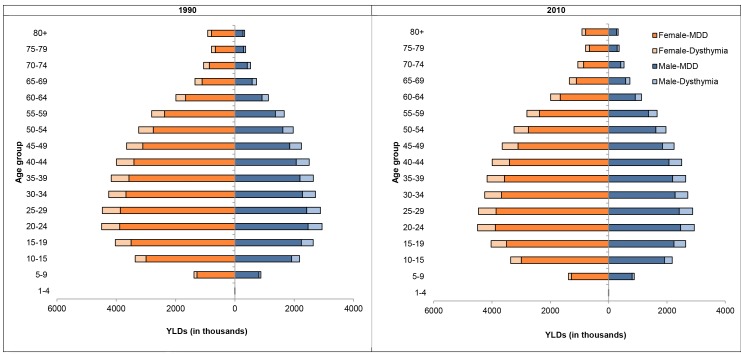
- In 2010, depressive disorders accounted for 3.0% (95% UI 2.2%–3.8%) of global DALYs: MDD 2.5% (1.9%–3.2%) and dysthymia 0.5% (0.3%–0.6%). MDD ranked 11th and dysthymia 51st among global DALY causes; MDD was the 2nd leading cause of YLDs (8.2% of all YLDs) and dysthymia 19th (1.4%).
- Global prevalence was 4.4% (4.1%–4.7%) for MDD, or 298 million cases, and 1.55% (1.5%–1.6%) for dysthymia, or 106 million cases. Prevalence was higher in females than males for both disorders.
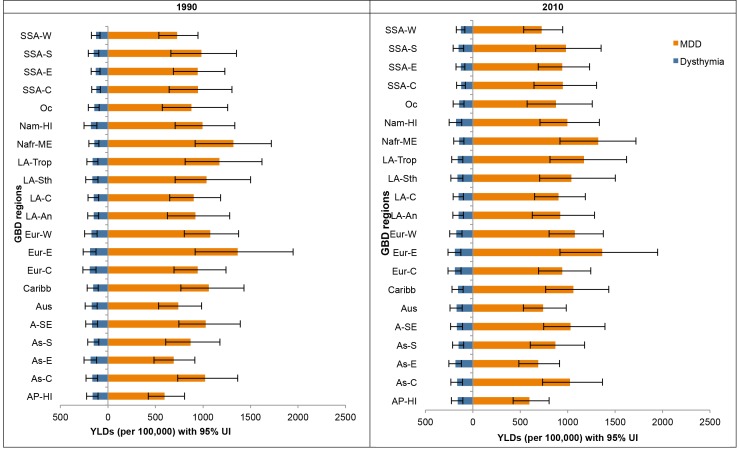
- Depressive disorder YLDs increased 37.5% between 1990 and 2010, driven by population growth (29.6%) and population aging (10.4%), with a −2.5% change due to prevalence.
- Attributable burden analyses found MDD explained an additional 16 million DALYs as a risk factor for suicide, with 46.1% (28.03%–60.8%) of suicide DALYs re-attributed to MDD; 2.9% (1.5%–4.5%) of ischemic heart disease DALYs (3.8 million DALYs, 93.5% YLLs) were attributable to MDD. Adding these increased MDD from 2.5% to 3.4% of global DALYs and depressive disorders from 3.0% to 3.8%, moving MDD from 11th to 8th place.
Methods
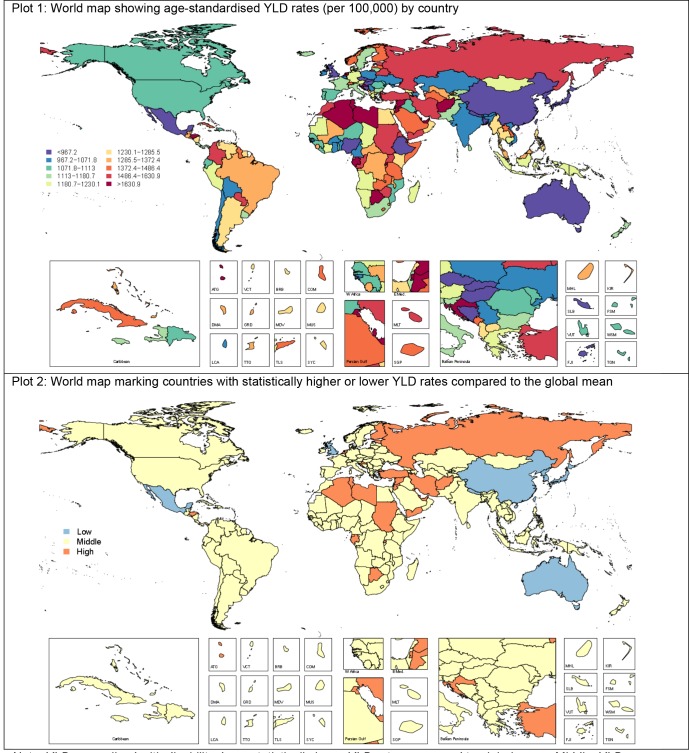
- GBD 2010 systematic review of literature from 1 January 1980 to 31 December 2008, with continued perusal to 31 December 2011, captured prevalence, incidence, remission/duration, and excess mortality for MDD and dysthymia. DisMod-MR, a Bayesian meta-regression tool, modeled prevalence for 187 countries, 21 world regions, males and females, 1990, 2005, and 2010, and 20 age groups.
- YLDs were calculated as prevalent cases multiplied by severity- and comorbidity-adjusted disability weights, without age-weighting or discounting. DALYs were YLDs plus YLLs, but no disorder-specific YLLs were recorded for depressive disorders. Disability weights came from population surveys in Bangladesh, Indonesia, Peru, Tanzania, and the USA (14,710 participants) and an internet survey (16,328 participants); severity distributions came from MEPS, NESARC, and NSMHWB.
- Attributable burden used GBD 2010 comparative risk assessment: meta-analyses of relative risks for MDD as a risk factor for suicide and ischemic heart disease, population attributable fractions, and multiplication by cause-specific DALYs. Time trends were decomposed into population growth, population age/sex structure, and YLD rates.
Limitations
- Stated: no disorder-specific YLLs were available for depressive disorders, and the authors could not quantify burden for all outcomes linked to MDD/dysthymia (e.g., stroke, diabetes, vascular dementia/Alzheimer’s disease), so estimates likely underestimate true burden. Meta-analyses for suicide and ischemic heart disease relied on data from only two countries, with uncertain generalizability.
- Stated: uncertainty may be larger than propagated because study-quality covariates were crude binary variables applied equally across ages and sexes; disability weights and health-state definitions may not represent all participants’ experiences; severity distributions came from three surveys in two high-income countries, limiting global representativeness and making it impossible to quantify treatment effects on severity.
- Evident from the text: country-level estimates often depended on imputation via DisMod-MR when raw epidemiological data were sparse, and regional/country differences were frequently within wide, overlapping uncertainty intervals.
Model-written summary. Check it against the paper before relying on it.
Integrity signals
Registry
Cites
Statistics
Figures
Verification
Claims the paper makes
10 Valid · 0 Not valid · 23 Not checked · 88 Own results and interpretations
Every source the paper cites for this claim was checked and supports it.
In the paper
“Out of the comprehensive list of health outcomes originally investigated for mental disorders [32], there was sufficient evidence for causal effects to quantify the burden attributable to MDD as a risk factor for suicide and ischemic heart disease.”
§ Burden of Depressive Disorders by Country, Sex, Age, and Year: Findings from the Global Burden of Disease Study 2010 > Methods > Calculation of Attributable Burden
What the sources say
- Supportedcites [32] AJ Baxter, 2011, Mental disorders as risk factors: assessing the evidence for the global burden of disease study, BMC Medicine source
The Results section says that, after the second evidence filter, suicide and ischemic heart disease had sufficient evidence for inclusion in attributable-burden estimates. It identifies major depression among the risk factors for suicide; the Abstract’s Results and discussion section identifies major depression as the risk factor for ischemic heart disease. The paper does not provide page numbers for these passages. (LLM, conf=0.90)
plainstates a cause- Asserted: passes — The authors put it forward as true.
- Checkable: passes — It can be checked against evidence.
- Load-bearing: passes — The paper’s conclusions depend on it.
- Based: passes — The paper gives a reason why it holds.
- Supported
The cited sources support only part of this claim — read each source’s verdict below.
In the paper
“Although there is literature linking stroke, diabetes, and vascular dementia/Alzheimer's disease to MDD, there was insufficient evidence at the time of our review for a causal relationship and more studies are needed to support these tentative associations [32].”
§ Burden of Depressive Disorders by Country, Sex, Age, and Year: Findings from the Global Burden of Disease Study 2010 > Discussion
What the sources say
- Partly supportedcites [32] AJ Baxter, 2011, Mental disorders as risk factors: assessing the evidence for the global burden of disease study, BMC Medicine sourceExperimental — accuracy not yet measured
The Abstract’s Results and discussion and the Summary say that evidence linking mental disorders to cardiovascular disease and type 2 diabetes was insufficient for inclusion in the Global Burden of Disease study and that further research was needed. The Discussion’s Temporality section also identifies difficulty establishing which condition came first. The paper does not address vascular dementia or Alzheimer’s disease, and its conclusion about cardiovascular disease and diabetes is broader than a conclusion specifically about MDD and stroke. (LLM, conf=0.87)
plain- Asserted: passes — The authors put it forward as true.
- Checkable: passes — It can be checked against evidence.
- Load-bearing: passes — The paper’s conclusions depend on it.
- Based: passes — The paper gives a reason why it holds.
- Partly supported
Every source the paper cites for this claim was checked and supports it.
In the paper
“This finding was driven by high prevalence estimates with 298 million MDD cases in 2010 [2] and 106 million cases of dysthymia [3].”
§ Burden of Depressive Disorders by Country, Sex, Age, and Year: Findings from the Global Burden of Disease Study 2010 > Discussion
What the sources say
- Supportedcites [2] AJ Ferrari, 2013, The epidemiological modelling of major depressive disorder: application for the Global Burden of Disease Study 2010, PLoS ONE source
The Abstract (Results, p. 1) states 'There were over 298 million cases of MDD globally at any point in time in 2010', matching the cited figure exactly. The Results section 'Final prevalence output' corroborates the underlying components (over 111 million male plus 187 million female prevalent cases in 2010) and the 4.4% global point prevalence for 2010. (LLM, conf=0.95)
plainn = 298- Asserted: passes — The authors put it forward as true.
- Checkable: passes — It can be checked against evidence.
- Load-bearing: unclear — It is unclear whether the paper’s conclusions depend on it.
- Based: passes — The paper gives a reason why it holds.
- Supported
Every source the paper cites for this claim was checked and supports it.
In the paper
“In spite of responses coming from a heterogeneous sample of individuals (e.g., a high proportion of highly educated individuals from the internet-based survey and the opposite from the population-based survey from Tanzania), the strength of the correlation between disability weights was at least 0·9 across all surveys except in Bangladesh where it was 0·75 [17].”
§ Burden of Depressive Disorders by Country, Sex, Age, and Year: Findings from the Global Burden of Disease Study 2010 > Discussion
What the sources say
- Supportedcites [17] JA Salomon, 2012, Common values in assessing health outcomes from disease and injury:disability weights measurement study for the Global Burden of Disease 2010, Lancet source
The Abstract Findings (p.1) state that 'correlations between individual survey results and results from analysis of the pooled dataset were 0·9 or higher in all surveys except in Bangladesh (r=0·75)', and the Results section repeats this ('Pearson's correlation coefficients between individual survey results and the results from the pooled analyses were 0·9 or higher in all cases except Bangladesh'). The heterogeneity framing is also supported: the Discussion notes a high degree of consistency 'across surveys with highly heterogeneous respondents', specifically the self-selected, highly educated web survey versus the representative population sample from Tanzania with the lowest educational attainment. Only minor caveat: the direct web-survey-vs-Tanzania comparison was 0·89, marginally under 0·9, but that is a pairwise survey comparison, not the survey-versus-pooled correlations the claim describes. (LLM, conf=0.92)
plainstates an association- Asserted: passes — The authors put it forward as true.
- Checkable: passes — It can be checked against evidence.
- Load-bearing: passes — The paper’s conclusions depend on it.
- Based: passes — The paper gives a reason why it holds.
- Supported
Every source the paper cites for this claim was checked and supports it.
In the paper
“We found evidence for an elevated risk for mortality in those diagnosed with MDD [2],[25]; however, since a health outcome could only occur once in the GBD cause list, MDD related deaths from suicide and ischemic heart disease were captured under the headings of intentional injuries and cardiovascular disease in the GBD capstone papers [14],[18].”
§ Burden of Depressive Disorders by Country, Sex, Age, and Year: Findings from the Global Burden of Disease Study 2010 > Discussion
What the sources say
- Supportedcites [2] AJ Ferrari, 2013, The epidemiological modelling of major depressive disorder: application for the Global Burden of Disease Study 2010, PLoS ONE source
The Results section (page unavailable), in its discussion of Figure 5, explicitly describes all-cause excess mortality experienced by people with MDD. The Methods section (page unavailable) defines the comparison as deaths among people with MDD versus those without MDD or the general population. (LLM, conf=0.92)
- Supportedcites [25] AJ Baxter, 2011, Factors influencing risk of premature mortality in community cases of depression: a meta-analytic review, Epidemiology Research International source
The paper’s Results, as reported in the Abstract, found significantly higher all-cause mortality risk for major depression (RR 1.92, 95% CI 1.65–2.23). The Discussion likewise reports almost twice the risk of premature mortality for community cases of major depression compared with those without depression. (LLM, conf=0.94)
plainstates an association- Asserted: passes — The authors put it forward as true.
- Checkable: passes — It can be checked against evidence.
- Load-bearing: passes — The paper’s conclusions depend on it.
- Based: passes — The paper gives a reason why it holds.
- Rests on an assumption not shown here.
- Supported
58 more claims · 1 with their cited sources checked
Create a free account to see all 121 claims and to verify the 25 references still open.
- Probably not a substantial claim. 42
- It may state two separate claims as one. 30
Claims other papers make about this one
Each is checked against this paper’s own text: does it say what the citing paper says it does?
The source backs part of the claim, not all of it — or backs it for a different population, condition or comparison.
In the citing paper
“The World Mental Health Survey estimated the annual prevalence of MDD to be 4.4% and the lifetime prevalence to be approximately 10% -15%36,37.”
From Temporal and spatial trend analysis of all-cause depression burden based on Global Burden of Disease (GBD) 2019 study (2024) · cites this paper as [36]
Experimental — accuracy not yet measuredThe source backs part of the claim, not all of it — or backs it for a different population, condition or comparison.
In the citing paper
“This may be attributed to the fact that depression and anxiety are the most common mental disorder around the world [44, 45], and chatbots are reported to be effective in improving social skills for patients with autism [14, 17, 46-48].”
From An overview of the features of chatbots in mental health: A scoping review (2019) · cites this paper as [44]
Experimental — accuracy not yet measuredThe source backs part of the claim, not all of it — or backs it for a different population, condition or comparison.
In the citing paper
“Direct and indirect costs of depression and anxiety make these disorders main contributors to the global burden of disease [42, 43]”
From Mobile Apps for the Management of Comorbid Overweight/Obesity and Depression/Anxiety: A Systematic Review (2020) · cites this paper as [43]
Experimental — accuracy not yet measuredIn the citing paper
“Major depressive disorder ranks among the leading mental health causes of the global burden of disease (104).”
From Vagus Nerve as Modulator of the Brain–Gut Axis in Psychiatric and Inflammatory Disorders (2018) · cites this paper as [104]
Citations
Cites
Diagnostic and Statistical Manual of Mental Disorders
Williams, J. B. W., & First, M. (2013) · Encyclopedia of Social Work · doi:10.1093/acrefore/9780199975839.013.104 · Cited by 109,519
Preferred Reporting Items for Systematic Reviews and Meta-Analyses: the PRISMA statement
Moher, D., Liberati, A., Tetzlaff, J., Altman, D. G., & for the PRISMA Group (2009) · BMJ · doi:10.1136/bmj.b2535 · Cited by 83,823
Preferred Reporting Items for Systematic Reviews and Meta-Analyses: The PRISMA Statement
Moher, D., Liberati, A., Tetzlaff, J., Altman, D. G., & The PRISMA Group (2009) · PLoS Medicine · doi:10.1371/journal.pmed.1000097 · Cited by 64,042
Preferred reporting items for systematic reviews and meta-analyses: the PRISMA Statement.
(2009) · PubMed Central · Cited by 44,859
Preferred Reporting Items for Systematic Reviews and Meta-Analyses: The PRISMA Statement
Moher, D., Liberati, A., Tetzlaff, J., & Altman, D. G. (2009) · Journal of Clinical Epidemiology · doi:10.1016/j.jclinepi.2009.06.005 · Cited by 19,575
Wang, G., Ma, R., Qiao, G., Wada, K., Aizawa, Y., & Satoh, T. (2015) · Integrative Medicine International · doi:10.1159/000368408 · Cited by 18,657
Lozano, R., Naghavi, M., Foreman, K., Lim, S., Shibuya, K., Aboyans, V., Abraham, J., Adair, T., Aggarwal, R., Ahn, S. Y., et al. (2012) · The Lancet · doi:10.1016/s0140-6736(12)61728-0 · Cited by 14,070
Lim, S. S., Vos, T., Flaxman, A. D., Danaei, G., Shibuya, K., Adair-Rohani, H., AlMazroa, M. A., Amann, M., Anderson, H. R., Andrews, K. G., et al. (2012) · The Lancet · doi:10.1016/s0140-6736(12)61766-8 · Cited by 11,805
Self-citationMurray, C. J. L., Vos, T., Lozano, R., Naghavi, M., Flaxman, A. D., Michaud, C., Ezzati, M., Shibuya, K., Salomon, J. A., Abdalla, S., et al. (2012) · The Lancet · doi:10.1016/s0140-6736(12)61689-4 · Cited by 8,888
Self-citationVos, T., Flaxman, A. D., Naghavi, M., Lozano, R., Michaud, C., Ezzati, M., Shibuya, K., Salomon, J. A., Abdalla, S., Aboyans, V., et al. (2012) · The Lancet · doi:10.1016/s0140-6736(12)61729-2 · Cited by 8,291
Self-citation
Cited by
Items 501–600 of 1,039
Attention deficits in adults with Major depressive disorder: A systematic review and meta-analysis
Wang, X., Zhou, H., & Zhu, X. (2020) · Asian Journal of Psychiatry · doi:10.1016/j.ajp.2020.102359 · Cited by 80
Thompson, C., Hamilton, S. P., & Hippman, C. (2014) · Psychiatry Research · doi:10.1016/j.psychres.2014.11.044 · Cited by 62
Prefrontal cortex miR-29b-3p plays a key role in the antidepressant-like effect of ketamine in rats
Wan, Y.-Q., Feng, J.-G., Li, M., Wang, M.-Z., Liu, L., Liu, X., Duan, X.-X., Zhang, C.-X., & Wang, X.-B. (2018) · Experimental & Molecular Medicine · doi:10.1038/s12276-018-0164-4 · Cited by 60
Nguyen, T. T. T., Miyagi, S., Tsujiguchi, H., Kambayashi, Y., Hara, A., Nakamura, H., Suzuki, K., Yamada, Y., Shimizu, Y., & Nakamura, H. (2019) · Nutrients · doi:10.3390/nu11020389 · Cited by 70
Coventry, P. A., Neale, C., Dyke, A., Pateman, R. M., & Cinderby, S. (2019) · International Journal of Environmental Research and Public Health · doi:10.3390/ijerph16152712 · Cited by 75
Huang, Y., & Zhu, M. (2020) · Nature and Science of Sleep · doi:10.2147/nss.s256625 · Cited by 77
Lau, J. T. F., Kim, Y., Wu, A. M. S., Wang, Z. J., Huang, B., & Mo, P. K. H. (2017) · Social Psychiatry and Psychiatric Epidemiology · doi:10.1007/s00127-017-1340-x · Cited by 61
Clinical Psychology Training: Accreditation and Beyond
LEVENSON, R. W. (2017) · Annual Review of Clinical Psychology · doi:10.1146/annurev-clinpsy-021815-093559 · Cited by 67
Dell’Acqua, C., Ghiasi, S., Benvenuti, S. M., Greco, A., Gentili, C., & Valenza, G. (2020) · Journal of Affective Disorders · doi:10.1016/j.jad.2020.12.015 · Cited by 72
Gut Bacteria and Neuropsychiatric Disorders
Dicks, L. M. T., Hurn, D., & Hermanus, D. (2021) · Microorganisms · doi:10.3390/microorganisms9122583 · Cited by 70
The Beneficial Role of Photobiomodulation in Neurodegenerative Diseases
Abijo, A. Z., Lee, C.-Y., Huang, C.-Y., Ho, P., & Tsai, K. (2023) · Biomedicines · doi:10.3390/biomedicines11071828 · Cited by 72
Martin, S., Vincent, A., Taylor, A. W., Atlantis, E., Jenkins, A., Januszewski, A., O’Loughlin, P., & Wittert, G. (2015) · PLOS ONE · doi:10.1371/journal.pone.0137903 · Cited by 59
Hermesdorf, M., Sundermann, B., Feder, S. C., Schwindt, W., Minnerup, J., Arolt, V., Berger, K., Pfleiderer, B., & Wersching, H. (2015) · Human Brain Mapping · doi:10.1002/hbm.23097 · Cited by 63
Hergenrather, K. C., Zeglin, R. J., McGuire-Kuletz, M., & Rhodes, S. D. (2015) · Rehabilitation Research Policy and Education · doi:10.1891/2168-6653.29.3.261 · Cited by 71
Simkhada, R., Wasti, S. P., Gc, V. S., & Lee, A. C. (2017) · Aging & Mental Health · doi:10.1080/13607863.2017.1310803 · Cited by 69
Liu, S., Li, D., Zeng, H.-Y., Kan, L.-Y., Zou, W., Zhang, P., Gu, H., & Tang, X. (2017) · The International Journal of Neuropsychopharmacology · doi:10.1093/ijnp/pyx030 · Cited by 58
Consumption of fruit and vegetables in relation with psychological disorders in Iranian adults
Saghafian, F., Malmir, H., Saneei, P., Keshteli, A. H., Hosseinzadeh‐Attar, M. J., Afshar, H., Siassi, F., Esmaillzadeh, A., & Adibi, P. (2018) · European Journal of Nutrition · doi:10.1007/s00394-018-1652-y · Cited by 65
Sun, H. J., Luo, L., Yuan, X., Zhang, L., He, Y., Yao, S., Wang, J., & Xiao, J. (2018) · Journal of Affective Disorders · doi:10.1016/j.jad.2018.04.061 · Cited by 61
Microglial activation contributes to depressive-like behavior in dopamine D3 receptor knockout mice
Wang, J., Lai, S., Li, G., Zhou, T., Wang, B., Cao, F., Chen, T., Zhang, X., & Chen, Y. (2019) · Brain Behavior and Immunity · doi:10.1016/j.bbi.2019.10.016 · Cited by 64
Factors associated with depression among the Lebanese population: Results of a cross‐sectional study
Obeid, S., Lahoud, N., Haddad, C., Sacre, H., Akel, M., Fares, K., Salameh, P., & Hallit, S. (2020) · Perspectives in Psychiatric Care · doi:10.1111/ppc.12518 · Cited by 59
Breeksema, J. J., Niemeijer, A., Krediet, E., Karsten, T., Kamphuis, J., Vermetten, E., van den Brink, W., & Schoevers, R. (2024) · Scientific Reports · doi:10.1038/s41598-024-53188-9 · Cited by 58
Péquignot, R., Dufouil, C., Prugger, C., Pérès, K., Artéro, S., Tzourio, C., & Empana, J. P. (2016) · Journal of the American Geriatrics Society · doi:10.1111/jgs.13872 · Cited by 61
Theory of Mind in Depressive Disorders: A Review of the Literature
Berecz, H., Tényi, T., & Herold, R. (2016) · Psychopathology · doi:10.1159/000446707 · Cited by 67
Ben‐Azu, B., Emokpae, O., Ajayi, A. M., Jarikre, T. A., Orhode, V., Aderibigbe, A. O., Umukoro, S., & Iwalewa, E. O. (2020) · Brain Research · doi:10.1016/j.brainres.2020.146917 · Cited by 62
Heerlein, K., Young, A. H., Otte, C., Frodl, T., Degraeve, G., Hagedoorn, W., Oliveira-Maia, A. J., Perez Sola, V., Rathod, S., Rosso, G., et al. (2021) · Journal of Affective Disorders · doi:10.1016/j.jad.2020.11.124 · Cited by 56
Hong, R. H., Murphy, J. K., Michalak, E. E., Chakrabarty, T., Wang, Z., Parikh, S., Culpepper, L., Yatham, L. N., Lam, R. W., & Chen, J. (2021) · Neuropsychiatric Disease and Treatment · doi:10.2147/ndt.s283731 · Cited by 55
Meerman, J. J., ter Hark, S. E., Janzing, J., & Coenen, M. J. H. (2022) · Journal of Affective Disorders · doi:10.1016/j.jad.2022.02.015 · Cited by 67
Suicide surveillance and health systems in Nepal: a qualitative and social network analysis
Hagaman, A. K., Maharjan, U., & Kohrt, B. A. (2016) · International Journal of Mental Health Systems · doi:10.1186/s13033-016-0073-7 · Cited by 76
Khan, A. R., Chuhutin, A., Wiborg, O., Kroenke, C. D., Nyengaard, J. R., Hansen, B., & Jespersen, S. N. (2016) · NeuroImage · doi:10.1016/j.neuroimage.2016.07.001 · Cited by 58
Bohman, H., Låftman, S. B., Päären, A., & Jonsson, U. (2017) · BMC Psychiatry · doi:10.1186/s12888-017-1252-z · Cited by 78
Tayyab, M., Shahi, M. H., Farheen, S., M., M. M. P., Khanam, N., Castresana, J. S., & Hossain, M. S. (2017) · Journal of Neuroscience Research · doi:10.1002/jnr.24104 · Cited by 62
Under-diagnosis of mood disorders in Canada
Pelletier, L., O'Donnell, S., Dykxhoorn, J., McRae, L., & Patten, S. B. (2017) · Epidemiology and Psychiatric Sciences · doi:10.1017/s2045796016000329 · Cited by 57
“For instance, the 2010 Global Burden of Disease reported that depressive disorders alone were the second leading cause of years lived with disability globally and in North America (Ferrari et al. 2013).”
BackgroundSelf-citationFullana, N., Gasull-Camós, J., Tarrés-Gatius, M., Castañé, A., Bortolozzi, A., & Artigas, F. (2020) · Neuropharmacology · doi:10.1016/j.neuropharm.2019.107914 · Cited by 57
Duberg, A., Jutengren, G., Hagberg, L., & Möller, M. (2020) · Journal of International Medical Research · doi:10.1177/0300060520902610 · Cited by 94
Mikkelsen, S., Coggon, D., Andersen, J. H., Casey, P., Flachs, E. M., Kolstad, H. A., Mors, O. N., & Bonde, J. P. (2021) · European Journal of Epidemiology · doi:10.1007/s10654-021-00725-9 · Cited by 71
Brunwasser, S. M., & Garber, J. (2016) · Journal of Clinical Child & Adolescent Psychology · doi:10.1080/15374416.2015.1020541 · Cited by 57
Depression among Ethiopian Adults: Cross-Sectional Study
Legas, G., Mulat, H., Nassir, Z., Belete, A., Fekadu, W., & Mekonen, T. (2016) · Psychiatry Journal · doi:10.1155/2016/1468120 · Cited by 67
Zhou, X., Liu, L., Zhang, Y., Pu, J., Yang, L., Zhou, C., Yuan, S., Zhang, H., & Xie, P. (2016) · Neuroscience · doi:10.1016/j.neuroscience.2016.11.038 · Cited by 59
Hylton, E., Wirtz, A. L., Zelaya, C. E., Latkin, C. A., Peryshkina, A., Mogilniy, V., Dzhigun, P., Kostetskaya, I., Galai, N., & Beyrer, C. (2017) · Journal of Urban Health · doi:10.1007/s11524-017-0133-6 · Cited by 70
Kunutsor, S. K., Seidu, S., & Khunti, K. (2018) · Annals of Medicine · doi:10.1080/07853890.2018.1500703 · Cited by 63
Long-term disability in major depressive disorder: a 6-year follow-up study
Iancu, S. C., Wong, Y. M., Rhebergen, D., van Balkom, A. J. L. M., & Batelaan, N. M. (2019) · Psychological Medicine · doi:10.1017/s0033291719001612 · Cited by 64
Economides, M., Ranta, K., Nazander, A., Hilgert, O., Goldin, P. R., Raevuori, A., & Forman-Hoffman, V. (2019) · JMIR mHealth and uHealth · doi:10.2196/14284 · Cited by 56
Benrimoh, D. A., Tanguay-Sela, M., Perlman, K., Israel, S. A., Mehltretter, J., Armstrong, C., Fratila, R., Parikh, S. V., Karp, J. F., Heller, K., et al. (2021) · BJPsych Open · doi:10.1192/bjo.2020.127 · Cited by 66
Costi, S., Soleimani, L., Glasgow, A., Brallier, J., Spivack, J., Schwartz, J., Levitch, C. F., Richards, S., Hoch, M., Stade, E. C., et al. (2019) · Neuropsychopharmacology · doi:10.1038/s41386-019-0365-0 · Cited by 56
Liu, J., Fan, Y., Zeng, L., Liu, B., Ju, Y., Wang, M., Dong, Q., Lu, X., Sun, J., Zhang, L., et al. (2021) · Translational Psychiatry · doi:10.1038/s41398-021-01227-8 · Cited by 61
Jiménez-Fernández, S., Gurpegui, M., Garrote-Rojas, D., Gutiérrez-Rojas, L., Carretero, M. D., & Correll, C. U. (2022) · Journal of Affective Disorders · doi:10.1016/j.jad.2022.07.015 · Cited by 56
Sex Differences in Depression and Anxiety
Pavlidi, P., Kokras, N., & Dalla, C. (2022) · Current topics in behavioral neurosciences · doi:10.1007/7854_2022_375 · Cited by 63
Preclinical Evidence of Rapid-Onset Antidepressant-Like Effect in Radix Polygalae Extract
Shin, I.-J., Son, S. U., Park, H., Kim, Y., Park, S. H., Swanberg, K. M., Shin, J.-Y., Ha, S.-K., Cho, Y., Bang, S. Y., et al. (2014) · PLoS ONE · doi:10.1371/journal.pone.0088617 · Cited by 58
Maske, U., Busch, M. A., Jacobi, F., Beesdo‐Baum, K., Seiffert, I., Wïttchen, H., Riedel-Heller, S. G., & Hapke, U. (2015) · BMC Psychiatry · doi:10.1186/s12888-015-0463-4 · Cited by 67
Health communication research in the digital age: A systematic review
Hu, Y. (2015) · Journal of Communications In Healthcare · doi:10.1080/17538068.2015.1107308 · Cited by 75
Walsh, E. C., Carl, H., Eisenlohr-Moul, T. A., Minkel, J. D., Crowther, A., Moore, T. M., Gibbs, D. E., Petty, C., Bizzell, J., Smoski, M. J., et al. (2016) · Neuropsychopharmacology · doi:10.1038/npp.2016.179 · Cited by 62
Improving Depression Level Estimation by Concurrently Learning Emotion Intensity
Qureshi, S. A., Dias, G. H., Hasanuzzaman, M., & Saha, S. (2020) · IEEE Computational Intelligence Magazine · doi:10.1109/mci.2020.2998234 · Cited by 65
Smith Fawzi, M. C., Andrews, K. G., Fink, G., Danaei, G., McCoy, D. C., Sudfeld, C. R., Peet, E. D., Cho, J., Liu, Y., Finlay, J. E., et al. (2019) · BMJ Global Health · doi:10.1136/bmjgh-2018-001144 · Cited by 55
Callesen, P., Reeves, D., Heal, C., & Wells, A. (2020) · Scientific Reports · doi:10.1038/s41598-020-64577-1 · Cited by 55
White, D., & Tavakoli, S. (2015) · Annals of Clinical Psychiatry · doi:10.1177/104012371502700305 · Cited by 55
Kendrick, T., Stuart, B. L., Newell, C., Geraghty, A. W. A., & Moore, M. V. (2015) · Journal of Affective Disorders · doi:10.1016/j.jad.2015.03.040 · Cited by 64
Dejonckheere, E., Bastian, B., Fried, E. I., Murphy, S. C., & Kuppens, P. (2017) · Depression and Anxiety · doi:10.1002/da.22653 · Cited by 54
The Dietary Inflammatory Index, shift work, and depression: Results from NHANES.
Wirth, M. D., Shivappa, N., Burch, J. B., Hurley, T. G., & Hébert, J. R. (2017) · Health Psychology · doi:10.1037/hea0000514 · Cited by 54
For the CIHR Team in Defining the Burden and Managing the Effects of Psychiatric Comorbidity in Chronic Immunoinflammatory Disease, Marrie, R. A., Walld, R., Bolton, J. M., Sareen, J., Walker, J. R., Patten, S. B., Singer, A., Lix, L. M., Hitchon, C. A., et al. (2017) · BMC Research Notes · doi:10.1186/s13104-017-2958-1 · Cited by 55
Self-citationMaison, C. L., Munhoz, T. N., Santos, I. S., Anselmi, L., Barros, F. C., & Matijasevich, A. (2018) · Social Psychiatry and Psychiatric Epidemiology · doi:10.1007/s00127-018-1516-z · Cited by 69
Ogawa, S., Tsuchimine, S., & Kunugi, H. (2018) · Journal of Psychiatric Research · doi:10.1016/j.jpsychires.2018.08.028 · Cited by 64
Vitiligo and major depressive disorder: A bidirectional population-based cohort study
Vallerand, I. A., Lewinson, R. T., Parsons, L. M., Hardin, J., Haber, R. M., Lowerison, M. W., Barnabe, C., & Patten, S. B. (2019) · Journal of the American Academy of Dermatology · doi:10.1016/j.jaad.2018.11.047 · Cited by 54
Self-citationYang, L., Hu, Y., Silventoinen, K., & Martikainen, P. (2019) · Aging & Mental Health · doi:10.1080/13607863.2019.1569589 · Cited by 60
The effects of processing speed on memory impairment in patients with major depressive disorder
Zaremba, D., Kalthoff, I. S., Förster, K., Redlich, R., Grotegerd, D., Leehr, E. J., Meinert, S., Dohm, K., Bürger, C., Enneking, V., et al. (2019) · Progress in Neuro-Psychopharmacology and Biological Psychiatry · doi:10.1016/j.pnpbp.2019.02.015 · Cited by 67
Tayyab, M., Farheen, S., M., M. M. P., Khanam, N., Hossain, M. S., & Shahi, M. H. (2019) · NeuroMolecular Medicine · doi:10.1007/s12017-019-08538-6 · Cited by 58
Charlson, F. J., Baxter, A. J., Dua, T., Degenhardt, L., Whiteford, H. A., & Vos, T. (2016) · Disease Control Priorities, Third Edition (Volume 4): Mental, Neurological, and Substance Use Disorders · doi:10.1596/978-1-4648-0426-7_ch3 · Cited by 55
Self-citationNeural substrates for anticipation and consumption of social and monetary incentives in depression
He, Z., Zhang, D., Muhlert, N., & Elliott, R. (2019) · Social Cognitive and Affective Neuroscience · doi:10.1093/scan/nsz061 · Cited by 53
Zhang, F., Cao, H., & Baranova, A. V. (2021) · Frontiers in Cardiovascular Medicine · doi:10.3389/fcvm.2021.735136 · Cited by 66
Adolescent depression beyond DSM definition: a network analysis
Manfro, P. H., Pereira, R. B., Rosa, M., Cogo‐Moreira, H., Fisher, H. L., Kohrt, B. A., Mondelli, V., & Kieling, C. (2021) · European Child & Adolescent Psychiatry · doi:10.1007/s00787-021-01908-1 · Cited by 75
Workman, E. R., Haddick, P. C. G., Bush, K., Dilly, G. A., Niere, F., Zemelman, B. V., & Raab-Graham, K. F. (2015) · Molecular Psychiatry · doi:10.1038/mp.2014.165 · Cited by 54
Gálvez, J. F., Keser, Z., Mwangi, B., Ghouse, A. A., Fenoy, A. J., Schulz, P. E., Sanches, M., Quevedo, J., Selvaraj, S., Gajwani, P., et al. (2014) · Progress in Neuro-Psychopharmacology and Biological Psychiatry · doi:10.1016/j.pnpbp.2014.12.003 · Cited by 57
Chowdhury, P. P., Kajese, T., Xu, F. Z., Gamble, S. B., Flegel, D., Pierannunzi, C. A., Garvin, W. S., & Town, M. (2016) · MMWR Surveillance Summaries · doi:10.15585/mmwr.ss6504a1 · Cited by 64
Zhang, X., Tang, Y., Maletić‐Savatić, M., Sheng, J., Zhang, X., Zhu, Y., Zhang, T., Wang, J., Tong, S., Wang, J., et al. (2016) · Journal of Affective Disorders · doi:10.1016/j.jad.2016.05.014 · Cited by 60
Schertz, K. E., Sachdeva, S. S., Kardan, O., Kotabe, H., Wolf, K. L., & Berman, M. G. (2018) · Cognition · doi:10.1016/j.cognition.2018.01.011 · Cited by 59
Amare, A. T., Schubert, K. O., Ayele, F. T., Hsu, Y., Sangkuhl, K., Jenkins, G. D., Whaley, R. M., Barman, P., Batzler, A. J., Altman, R. B., et al. (2018) · Frontiers in Psychiatry · doi:10.3389/fpsyt.2018.00065 · Cited by 57
Musliner, K. L., Liu, X., Gasse, C., Christensen, K. S., Wimberley, T., & Munk‐Olsen, T. (2019) · Acta Psychiatrica Scandinavica · doi:10.1111/acps.13028 · Cited by 54
Effect of probiotic administration on gut microbiota and depressive behaviors in mice
Liu, Q. F., Kim, H.-M., Lim, S., Chung, M.-J., Lim, C., Koo, B., & Kang, S. (2020) · DARU Journal of Pharmaceutical Sciences · doi:10.1007/s40199-020-00329-w · Cited by 68
Brown, C. H., Brincks, A., Huang, S., Perrino, T., Cruden, G., Pantin, H., Howe, G., Young, J. F., Beardslee, W., Montag, S., et al. (2018) · Prevention Science · doi:10.1007/s11121-016-0737-1 · Cited by 53
“…of defense against a disorder that, if untreated, often has lifetime consequences on mental health (Thapar, Collishaw, Pine, & Thapar; Weisz, Sandler, Durlak, & Anton, 2005), physical health (Prince et al., 2007), and disability (Andrews, Sanderson, Corry, & Lapsley, 2000; Ferrari et al., 2013).”
Sharma, A., Satterthwaite, T. D., Vandekar, L., Katchmar, N., Daldal, A., Ruparel, K., Elliott, M. A., Baldassano, C., Thase, M. E., Gur, R. E., et al. (2016) · Psychiatry Research: Neuroimaging · doi:10.1016/j.pscychresns.2016.06.003 · Cited by 53
The long noncoding RNA FEDORA is a cell type– and sex-specific regulator of depression
Issler, O., van der Zee, Y. Y., Ramakrishnan, A., Xia, S.-H., Zinsmaier, A. K., Tan, C., Li, W., Browne, C. J., Walker, D. M., Salery, M., et al. (2022) · Science Advances · doi:10.1126/sciadv.abn9494 · Cited by 51
Zhao, Y., He, Z., Luo, W., Yu, Y., Chen, J., Cai, X., Gao, J., Li, L., Gao, Q. C., Chen, H., et al. (2023) · Journal of Affective Disorders · doi:10.1016/j.jad.2023.01.061 · Cited by 58
Efstathiou, M., Kakaidi, V., Tsitsas, G. D., Mantzoukas, S., Gouva, M., & Dragioti, E. (2025) · International Journal of Nursing Studies · doi:10.1016/j.ijnurstu.2025.104993 · Cited by 80
Burkhouse, K. L., Siegle, G. J., Woody, M. L., Kudinova, A. Y., & Gibb, B. E. (2015) · Journal of Abnormal Psychology · doi:10.1037/abn0000072 · Cited by 58
Altered resting-state functional connectivity in late-life depression: A cross-sectional study
Eyre, H. A., Yang, H., Leaver, A. M., Van Dyk, K., Siddarth, P., Cyr, N. S., Narr, K., Ercoli, L., Baune, B. T., & Lavretsky, H. (2016) · Journal of Affective Disorders · doi:10.1016/j.jad.2015.09.011 · Cited by 53
Duarte, A., Walker, J., Walker, S., Richardson, G., Holm Hansen, C., Martin, P., Murray, G., Sculpher, M., & Sharpe, M. (2015) · Journal of Psychosomatic Research · doi:10.1016/j.jpsychores.2015.10.012 · Cited by 53
Pan, M.-L., Tsao, H.-M., Hsu, C., Wu, K.-M., Hsu, T.-S., Wu, Y.-T., & Hu, G. (2016) · Medicine · doi:10.1097/md.0000000000004833 · Cited by 63
Yu, J. S., Xue, A., Redei, E. E., & Bagheri, N. (2016) · Translational Psychiatry · doi:10.1038/tp.2016.198 · Cited by 63
Bastien, M.-F., & Corbière, M. (2018) · Journal of Occupational Rehabilitation · doi:10.1007/s10926-018-9801-y · Cited by 60
Yu, S., Shen, Z., Lai, R., Feng, F., Guo, B., Wang, Z., Yang, J., Hu, Y., & Gong, L. (2018) · Frontiers in Psychiatry · doi:10.3389/fpsyt.2018.00651 · Cited by 56
Davison, K., Lung, Y., Lin, S., Tong, H., Kobayashi, K. M., & Fuller‐Thomson, E. (2019) · BMC Psychiatry · doi:10.1186/s12888-019-2309-y · Cited by 58
Hitti, F. L., Yang, A. I., Cristancho, M. A., & Baltuch, G. H. (2020) · Journal of Clinical Medicine · doi:10.3390/jcm9092796 · Cited by 58
Bakır-Güngör, B., Hacılar, H., Jabeer, A., Nalbantoğlu, Ö. U., Aran, O., & Yousef, M. (2022) · PeerJ · doi:10.7717/peerj.13205 · Cited by 61
Salamanca-Sanabria, A., Richards, D., & Timulak, L. (2019) · Internet Interventions · doi:10.1016/j.invent.2018.11.005 · Cited by 49
Thomas, J., Barbato, M., Verlinden, M., Gaspar, C., Moussa, M., Ghorayeb, J., Menon, A., Figueiras, M. J., Arora, T., & Bentall, R. P. (2020) · Frontiers in Psychiatry · doi:10.3389/fpsyt.2020.564172 · Cited by 61
Kim, D., Kwon, H., Ha, M., Lim, M. H., & Kim, K. M. (2020) · Journal of Affective Disorders · doi:10.1016/j.jad.2020.12.002 · Cited by 60
Genetic loci shared between major depression and intelligence with mixed directions of effect
Bahrami, S., Shadrin, A. A., Frei, O., O’Connell, K. S., Bettella, F., Krull, F., Fan, C. C., Røssberg, J. I., Hindley, G., Ueland, T., et al. (2021) · Nature Human Behaviour · doi:10.1038/s41562-020-01031-2 · Cited by 62
Schulze, J., Neumann, I., Magid, M., Finzi, E., Sinke, C., Wollmer, M. A., & Krüger, T. H. C. (2021) · Journal of Psychiatric Research · doi:10.1016/j.jpsychires.2021.01.016 · Cited by 83
Down and High: Reflections Regarding Depression and Cannabis
Langlois, C. C., Potvin, S., Khullar, A., & Tourjman, V. (2021) · Frontiers in Psychiatry · doi:10.3389/fpsyt.2021.625158 · Cited by 62
De Berardis, D., Fornaro, M., Orsolini, L., Iasevoli, F., Tomasetti, C., de Bartolomeis, A., Serroni, N., De Lauretis, I., Girinelli, G., Mazza, M., et al. (2017) · CNS Spectrums · doi:10.1017/s1092852916000572 · Cited by 52
Jukić, M. M., Opel, N., Ström, J., Carrillo‐Roa, T., Miksys, S. L., Novalen, M., Renblom, A., Sim, S. C., Peñas‐Lledó, E., Courtet, P., et al. (2016) · Molecular Psychiatry · doi:10.1038/mp.2016.204 · Cited by 58
Metadata
- Authors
- Ferrari, A. J., Charlson, F. J., Norman, R. E., Patten, S. B., Freedman, G., Murray, C. J. L., Vos, T., & Whiteford, H. A.
- Affiliations
- The University of Queensland (AU)
- University of Calgary (CA)
- University of Washington (US)
- Corresponding author
- Ferrari, Alize J.
- ORCID
- Venue
- PLoS Medicine
- Publisher
- Public Library of Science (PLoS)
- Published
- 2013-11-05
- Volume
- 10
- Issue
- 11
- Pages
- e1001547
- ISSN
- 1549-1277 (ISSN-L)
- 1549-1676
- PMC
- PMC3818162
- OpenAlex
- W2171340584
- Cited by
- 3,115
- References
- 48
- Citations by year
- 2026: 109 · 2025: 165 · 2024: 177 · 2023: 226 · 2022: 250 · 2021: 339 · 2020: 286 · 2019: 303 · 2018: 309 · 2017: 321 · 2016: 262 · 2015: 248 · 2014: 110 · 2013: 5
- FWCI
- 311.80
- Type
- journal article
- Language
- en
- Open access
- gold
- doi.org
- Locations
- PLoS Medicine (publishedVersion, cc-by)
- Europe PMC (PubMed Central) (publishedVersion, cc-by)
- PubMed Central (publishedVersion, cc-by)
- PubMed (publishedVersion)
- QUT ePrints (Queensland University of Technology) (submittedVersion, other-oa)
- DOAJ (DOAJ: Directory of Open Access Journals) (submittedVersion, cc-by-sa)
- Figshare (submittedVersion, cc-by)
- Funders
- Bill and Melinda Gates Foundation
- University of Washington
- Topics
- Health Sciences › Medicine › Psychiatry and Mental health › Mental Health Treatment and Access
- Health Sciences › Medicine › Pharmacology (medical) › Treatment of Major Depression
- Social Sciences › Economics, Econometrics and Finance › Economics and Econometrics › Health Systems, Economic Evaluations, Quality of Life
- Keywords
- depressive disorders, major depressive disorder, dysthymia, global burden of disease, disability-adjusted life years, years lived with disability, suicide, ischemic heart disease, disability weights, sex differences, age differences, temporal trends, regional variation, attributable burden, public health priorities, Global Burden of Disease Study 2010
- MeSH terms
- Adolescent, Adult, Age Factors, Aged, Child, Child, Preschool, Depression, Depressive Disorder, Female, Persons with Disabilities, Health Surveys, Humans, Infant, Male, Middle Aged, Public Health, Risk Factors, Sex Factors, Suicide, Global Health, Myocardial Ischemia, Cost of Illness, Quality-Adjusted Life Years, Young Adult
About these checks
Registry, retraction, Cites and statistics results are computed, not judged, with one exception: a printed reference that no index lists is read once by a model before it counts as a citation error. Claims are extracted by a model and kept only when their quote appears verbatim in the text; each cited source is then checked, with a model’s help, for whether it says what the claim relies on. Those verdicts can be wrong — read the claim’s quote and the cited source before relying on one.
The claim verdicts this report counts are experimental: their accuracy is not yet measured.
A language model drew the claims from the paper on 2026-10-04, under version 3 of the claim definition (model deepseek-v4.1-flash, prompt extract-v3).
A second model labelled each claim on 2026-10-04 (model jev-1.13-20260917, definition revision gold-guideline-v0.2).
Cited sources are checked with a language model’s help (gpt-6-sol and qwen3.8-omni-flash).
Statistics and arithmetic are recomputed, not judged.
Confidence bands are shown only for fields calibrated on our annotated test set. None is calibrated yet, so no band is shown.
What counts as a claim ›How we measure confidence ›How we check this ›
Are you an author, or do you see a problem with this page? Request a review
Data sources
Bibliographic data: Semantic Scholar, OpenAlex, Crossref.
Contains information from the Semantic Scholar Academic Graph Datasets, made available under the ODC Attribution License (ODC-BY 1.0).
Semantic Scholar’s data is described in: Kinney, R., et al. (2023). The Semantic Scholar Open Data Platform. arXiv:2301.10140.
