

Burden of Depressive Disorders by Country, Sex, Age, and Year: Findings from the Global Burden of Disease Study 2010
Open accessThe DOI matches its Crossref record; 47 of the 48 references it cites were found in a registry or an index; 16 of the 41 sources its claims cite were checked for support.
Abstract
BACKGROUND: Depressive disorders were a leading cause of burden in the Global Burden of Disease (GBD) 1990 and 2000 studies. Here, we analyze the burden of depressive disorders in GBD 2010 and present severity proportions, burden by country, region, age, sex, and year, as well as burden of depressive disorders as a risk factor for suicide and ischemic heart disease. METHODS AND FINDINGS: Burden was calculated for major depressive disorder (MDD) and dysthymia. A systematic review of epidemiological data was conducted. The data were pooled using a Bayesian meta-regression. Disability weights from population survey data quantified the severity of health loss from depressive disorders. These weights were used to calculate years lived with disability (YLDs) and disability adjusted life years (DALYs). Separate DALYs were estimated for suicide and ischemic heart disease attributable to depressive disorders. Depressive disorders were the second leading cause of YLDs in 2010. MDD accounted for 8.2% (5.9%-10.8%) of global YLDs and dysthymia for 1.4% (0.9%-2.0%). Depressive disorders were a leading cause of DALYs even though no mortality was attributed to them as the underlying cause. MDD accounted for 2.5% (1.9%-3.2%) of global DALYs and dysthymia for 0.5% (0.3%-0.6%). There was more regional variation in burden for MDD than for dysthymia; with higher estimates in females, and adults of working age. Whilst burden increased by 37.5% between 1990 and 2010, this was due to population growth and ageing. MDD explained 16 million suicide DALYs and almost 4 million ischemic heart disease DALYs. This attributable burden would increase the overall burden of depressive disorders from 3.0% (2.2%-3.8%) to 3.8% (3.0%-4.7%) of global DALYs. CONCLUSIONS: GBD 2010 identified depressive disorders as a leading cause of burden. MDD was also a contributor of burden allocated to suicide and ischemic heart disease. These findings emphasize the importance of including depressive disorders as a public-health priority and implementing cost-effective interventions to reduce its burden. Please see later in the article for the Editors' Summary.
Overview
CoChat Summary
TL;DR
Ferrari and colleagues used GBD 2010 to estimate the global burden of major depressive disorder (MDD) and dysthymia by country, region, age, sex, and year. Depressive disorders were a leading cause of non-fatal burden, with MDD ranking 11th for global DALYs and 2nd for global YLDs in 2010.
Key findings
- In 2010, depressive disorders accounted for 3.0% (95% UI 2.2%–3.8%) of global DALYs: MDD 2.5% (1.9%–3.2%) and dysthymia 0.5% (0.3%–0.6%). MDD ranked 11th and dysthymia 51st among global DALY causes; MDD was the 2nd leading cause of YLDs (8.2% of all YLDs) and dysthymia 19th (1.4%).
- Global prevalence was 4.4% (4.1%–4.7%) for MDD, or 298 million cases, and 1.55% (1.5%–1.6%) for dysthymia, or 106 million cases. Prevalence was higher in females than males for both disorders.
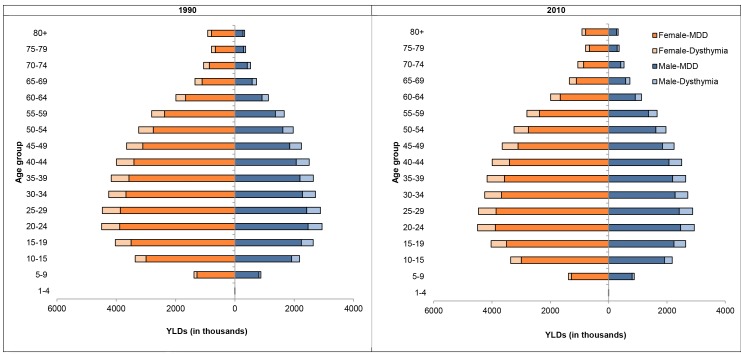
- Depressive disorder YLDs increased 37.5% between 1990 and 2010, driven by population growth (29.6%) and population aging (10.4%), with a −2.5% change due to prevalence.
- Attributable burden analyses found MDD explained an additional 16 million DALYs as a risk factor for suicide, with 46.1% (28.03%–60.8%) of suicide DALYs re-attributed to MDD; 2.9% (1.5%–4.5%) of ischemic heart disease DALYs (3.8 million DALYs, 93.5% YLLs) were attributable to MDD. Adding these increased MDD from 2.5% to 3.4% of global DALYs and depressive disorders from 3.0% to 3.8%, moving MDD from 11th to 8th place.
Methods
- GBD 2010 systematic review of literature from 1 January 1980 to 31 December 2008, with continued perusal to 31 December 2011, captured prevalence, incidence, remission/duration, and excess mortality for MDD and dysthymia. DisMod-MR, a Bayesian meta-regression tool, modeled prevalence for 187 countries, 21 world regions, males and females, 1990, 2005, and 2010, and 20 age groups.
- YLDs were calculated as prevalent cases multiplied by severity- and comorbidity-adjusted disability weights, without age-weighting or discounting. DALYs were YLDs plus YLLs, but no disorder-specific YLLs were recorded for depressive disorders. Disability weights came from population surveys in Bangladesh, Indonesia, Peru, Tanzania, and the USA (14,710 participants) and an internet survey (16,328 participants); severity distributions came from MEPS, NESARC, and NSMHWB.
- Attributable burden used GBD 2010 comparative risk assessment: meta-analyses of relative risks for MDD as a risk factor for suicide and ischemic heart disease, population attributable fractions, and multiplication by cause-specific DALYs. Time trends were decomposed into population growth, population age/sex structure, and YLD rates.
Limitations
- Stated: no disorder-specific YLLs were available for depressive disorders, and the authors could not quantify burden for all outcomes linked to MDD/dysthymia (e.g., stroke, diabetes, vascular dementia/Alzheimer’s disease), so estimates likely underestimate true burden. Meta-analyses for suicide and ischemic heart disease relied on data from only two countries, with uncertain generalizability.
- Stated: uncertainty may be larger than propagated because study-quality covariates were crude binary variables applied equally across ages and sexes; disability weights and health-state definitions may not represent all participants’ experiences; severity distributions came from three surveys in two high-income countries, limiting global representativeness and making it impossible to quantify treatment effects on severity.
- Evident from the text: country-level estimates often depended on imputation via DisMod-MR when raw epidemiological data were sparse, and regional/country differences were frequently within wide, overlapping uncertainty intervals.
Model-written summary. Check it against the paper before relying on it.
Integrity signals
Registry
Cites
Statistics
Figures
Verification
Claims the paper makes
10 Valid · 0 Not valid · 23 Not checked · 88 Own results and interpretations
Every source the paper cites for this claim was checked and supports it.
In the paper
“Out of the comprehensive list of health outcomes originally investigated for mental disorders [32], there was sufficient evidence for causal effects to quantify the burden attributable to MDD as a risk factor for suicide and ischemic heart disease.”
§ Burden of Depressive Disorders by Country, Sex, Age, and Year: Findings from the Global Burden of Disease Study 2010 > Methods > Calculation of Attributable Burden
What the sources say
- Supportedcites [32] AJ Baxter, 2011, Mental disorders as risk factors: assessing the evidence for the global burden of disease study, BMC Medicine source
The Results section says that, after the second evidence filter, suicide and ischemic heart disease had sufficient evidence for inclusion in attributable-burden estimates. It identifies major depression among the risk factors for suicide; the Abstract’s Results and discussion section identifies major depression as the risk factor for ischemic heart disease. The paper does not provide page numbers for these passages. (LLM, conf=0.90)
plainstates a cause- Asserted: passes — The authors put it forward as true.
- Checkable: passes — It can be checked against evidence.
- Load-bearing: passes — The paper’s conclusions depend on it.
- Based: passes — The paper gives a reason why it holds.
- Supported
The cited sources support only part of this claim — read each source’s verdict below.
In the paper
“Although there is literature linking stroke, diabetes, and vascular dementia/Alzheimer's disease to MDD, there was insufficient evidence at the time of our review for a causal relationship and more studies are needed to support these tentative associations [32].”
§ Burden of Depressive Disorders by Country, Sex, Age, and Year: Findings from the Global Burden of Disease Study 2010 > Discussion
What the sources say
- Partly supportedcites [32] AJ Baxter, 2011, Mental disorders as risk factors: assessing the evidence for the global burden of disease study, BMC Medicine sourceExperimental — accuracy not yet measured
The Abstract’s Results and discussion and the Summary say that evidence linking mental disorders to cardiovascular disease and type 2 diabetes was insufficient for inclusion in the Global Burden of Disease study and that further research was needed. The Discussion’s Temporality section also identifies difficulty establishing which condition came first. The paper does not address vascular dementia or Alzheimer’s disease, and its conclusion about cardiovascular disease and diabetes is broader than a conclusion specifically about MDD and stroke. (LLM, conf=0.87)
plain- Asserted: passes — The authors put it forward as true.
- Checkable: passes — It can be checked against evidence.
- Load-bearing: passes — The paper’s conclusions depend on it.
- Based: passes — The paper gives a reason why it holds.
- Partly supported
Every source the paper cites for this claim was checked and supports it.
In the paper
“This finding was driven by high prevalence estimates with 298 million MDD cases in 2010 [2] and 106 million cases of dysthymia [3].”
§ Burden of Depressive Disorders by Country, Sex, Age, and Year: Findings from the Global Burden of Disease Study 2010 > Discussion
What the sources say
- Supportedcites [2] AJ Ferrari, 2013, The epidemiological modelling of major depressive disorder: application for the Global Burden of Disease Study 2010, PLoS ONE source
The Abstract (Results, p. 1) states 'There were over 298 million cases of MDD globally at any point in time in 2010', matching the cited figure exactly. The Results section 'Final prevalence output' corroborates the underlying components (over 111 million male plus 187 million female prevalent cases in 2010) and the 4.4% global point prevalence for 2010. (LLM, conf=0.95)
plainn = 298- Asserted: passes — The authors put it forward as true.
- Checkable: passes — It can be checked against evidence.
- Load-bearing: unclear — It is unclear whether the paper’s conclusions depend on it.
- Based: passes — The paper gives a reason why it holds.
- Supported
Every source the paper cites for this claim was checked and supports it.
In the paper
“In spite of responses coming from a heterogeneous sample of individuals (e.g., a high proportion of highly educated individuals from the internet-based survey and the opposite from the population-based survey from Tanzania), the strength of the correlation between disability weights was at least 0·9 across all surveys except in Bangladesh where it was 0·75 [17].”
§ Burden of Depressive Disorders by Country, Sex, Age, and Year: Findings from the Global Burden of Disease Study 2010 > Discussion
What the sources say
- Supportedcites [17] JA Salomon, 2012, Common values in assessing health outcomes from disease and injury:disability weights measurement study for the Global Burden of Disease 2010, Lancet source
The Abstract Findings (p.1) state that 'correlations between individual survey results and results from analysis of the pooled dataset were 0·9 or higher in all surveys except in Bangladesh (r=0·75)', and the Results section repeats this ('Pearson's correlation coefficients between individual survey results and the results from the pooled analyses were 0·9 or higher in all cases except Bangladesh'). The heterogeneity framing is also supported: the Discussion notes a high degree of consistency 'across surveys with highly heterogeneous respondents', specifically the self-selected, highly educated web survey versus the representative population sample from Tanzania with the lowest educational attainment. Only minor caveat: the direct web-survey-vs-Tanzania comparison was 0·89, marginally under 0·9, but that is a pairwise survey comparison, not the survey-versus-pooled correlations the claim describes. (LLM, conf=0.92)
plainstates an association- Asserted: passes — The authors put it forward as true.
- Checkable: passes — It can be checked against evidence.
- Load-bearing: passes — The paper’s conclusions depend on it.
- Based: passes — The paper gives a reason why it holds.
- Supported
Every source the paper cites for this claim was checked and supports it.
In the paper
“We found evidence for an elevated risk for mortality in those diagnosed with MDD [2],[25]; however, since a health outcome could only occur once in the GBD cause list, MDD related deaths from suicide and ischemic heart disease were captured under the headings of intentional injuries and cardiovascular disease in the GBD capstone papers [14],[18].”
§ Burden of Depressive Disorders by Country, Sex, Age, and Year: Findings from the Global Burden of Disease Study 2010 > Discussion
What the sources say
- Supportedcites [2] AJ Ferrari, 2013, The epidemiological modelling of major depressive disorder: application for the Global Burden of Disease Study 2010, PLoS ONE source
The Results section (page unavailable), in its discussion of Figure 5, explicitly describes all-cause excess mortality experienced by people with MDD. The Methods section (page unavailable) defines the comparison as deaths among people with MDD versus those without MDD or the general population. (LLM, conf=0.92)
- Supportedcites [25] AJ Baxter, 2011, Factors influencing risk of premature mortality in community cases of depression: a meta-analytic review, Epidemiology Research International source
The paper’s Results, as reported in the Abstract, found significantly higher all-cause mortality risk for major depression (RR 1.92, 95% CI 1.65–2.23). The Discussion likewise reports almost twice the risk of premature mortality for community cases of major depression compared with those without depression. (LLM, conf=0.94)
plainstates an association- Asserted: passes — The authors put it forward as true.
- Checkable: passes — It can be checked against evidence.
- Load-bearing: passes — The paper’s conclusions depend on it.
- Based: passes — The paper gives a reason why it holds.
- Rests on an assumption not shown here.
- Supported
58 more claims · 1 with their cited sources checked
Create a free account to see all 121 claims and to verify the 25 references still open.
- Probably not a substantial claim. 42
- It may state two separate claims as one. 30
Claims other papers make about this one
Each is checked against this paper’s own text: does it say what the citing paper says it does?
The source backs part of the claim, not all of it — or backs it for a different population, condition or comparison.
In the citing paper
“The World Mental Health Survey estimated the annual prevalence of MDD to be 4.4% and the lifetime prevalence to be approximately 10% -15%36,37.”
From Temporal and spatial trend analysis of all-cause depression burden based on Global Burden of Disease (GBD) 2019 study (2024) · cites this paper as [36]
Experimental — accuracy not yet measuredThe source backs part of the claim, not all of it — or backs it for a different population, condition or comparison.
In the citing paper
“This may be attributed to the fact that depression and anxiety are the most common mental disorder around the world [44, 45], and chatbots are reported to be effective in improving social skills for patients with autism [14, 17, 46-48].”
From An overview of the features of chatbots in mental health: A scoping review (2019) · cites this paper as [44]
Experimental — accuracy not yet measuredThe source backs part of the claim, not all of it — or backs it for a different population, condition or comparison.
In the citing paper
“Direct and indirect costs of depression and anxiety make these disorders main contributors to the global burden of disease [42, 43]”
From Mobile Apps for the Management of Comorbid Overweight/Obesity and Depression/Anxiety: A Systematic Review (2020) · cites this paper as [43]
Experimental — accuracy not yet measuredIn the citing paper
“Major depressive disorder ranks among the leading mental health causes of the global burden of disease (104).”
From Vagus Nerve as Modulator of the Brain–Gut Axis in Psychiatric and Inflammatory Disorders (2018) · cites this paper as [104]
Citations
Cites
Diagnostic and Statistical Manual of Mental Disorders
Williams, J. B. W., & First, M. (2013) · Encyclopedia of Social Work · doi:10.1093/acrefore/9780199975839.013.104 · Cited by 109,519
Preferred Reporting Items for Systematic Reviews and Meta-Analyses: the PRISMA statement
Moher, D., Liberati, A., Tetzlaff, J., Altman, D. G., & for the PRISMA Group (2009) · BMJ · doi:10.1136/bmj.b2535 · Cited by 83,823
Preferred Reporting Items for Systematic Reviews and Meta-Analyses: The PRISMA Statement
Moher, D., Liberati, A., Tetzlaff, J., Altman, D. G., & The PRISMA Group (2009) · PLoS Medicine · doi:10.1371/journal.pmed.1000097 · Cited by 64,042
Preferred reporting items for systematic reviews and meta-analyses: the PRISMA Statement.
(2009) · PubMed Central · Cited by 44,859
Preferred Reporting Items for Systematic Reviews and Meta-Analyses: The PRISMA Statement
Moher, D., Liberati, A., Tetzlaff, J., & Altman, D. G. (2009) · Journal of Clinical Epidemiology · doi:10.1016/j.jclinepi.2009.06.005 · Cited by 19,575
Wang, G., Ma, R., Qiao, G., Wada, K., Aizawa, Y., & Satoh, T. (2015) · Integrative Medicine International · doi:10.1159/000368408 · Cited by 18,657
Lozano, R., Naghavi, M., Foreman, K., Lim, S., Shibuya, K., Aboyans, V., Abraham, J., Adair, T., Aggarwal, R., Ahn, S. Y., et al. (2012) · The Lancet · doi:10.1016/s0140-6736(12)61728-0 · Cited by 14,070
Lim, S. S., Vos, T., Flaxman, A. D., Danaei, G., Shibuya, K., Adair-Rohani, H., AlMazroa, M. A., Amann, M., Anderson, H. R., Andrews, K. G., et al. (2012) · The Lancet · doi:10.1016/s0140-6736(12)61766-8 · Cited by 11,805
Self-citationMurray, C. J. L., Vos, T., Lozano, R., Naghavi, M., Flaxman, A. D., Michaud, C., Ezzati, M., Shibuya, K., Salomon, J. A., Abdalla, S., et al. (2012) · The Lancet · doi:10.1016/s0140-6736(12)61689-4 · Cited by 8,888
Self-citationVos, T., Flaxman, A. D., Naghavi, M., Lozano, R., Michaud, C., Ezzati, M., Shibuya, K., Salomon, J. A., Abdalla, S., Aboyans, V., et al. (2012) · The Lancet · doi:10.1016/s0140-6736(12)61729-2 · Cited by 8,291
Self-citation
Cited by
Items 101–200 of 1,039
Baranov, V., Bhalotra, S., Biroli, P., & Maselko, J. (2020) · American Economic Review · doi:10.1257/aer.20180511 · Cited by 210
Association of neural and emotional impacts of reward prediction errors with major depression
Rutledge, R. B., Moutoussis, M., Smittenaar, P., Zeidman, P., Taylor, T., Hrynkiewicz, L., Lam, J., Skandali, N., Siegel, J. Z., Ousdal, O. T., et al. (2017) · JAMA Psychiatry · doi:10.1001/jamapsychiatry.2017.1713 · Cited by 209
“b Antidepressant medications included bupropion hydrochloride (1 participant), citalopram hydrobromide (10), fluoxetine hydrochloride (8), mirtazapine (3), nortriptyline hydrochloride (1), quetiapine fumarate (1), sertraline hydrochloride (8), and venlafaxine (2).”
BackgroundBorsini, A., Wallis, A. S. J., Zunszain, P., Pariante, C. M., & Kempton, M. J. (2020) · Cognitive, Affective, & Behavioral Neuroscience · doi:10.3758/s13415-020-00804-6 · Cited by 207
Depression as a systemic syndrome: mapping the feedback loops of major depressive disorder
Wittenborn, A. K., Rahmandad, H., Rick, J., & Hosseinichimeh, N. (2016) · Psychological Medicine · doi:10.1017/s0033291715002044 · Cited by 207
Luo, Y., Kataoka, Y., Ostinelli, E. G., Cipriani, A., & Furukawa, T. A. (2020) · Frontiers in Psychiatry · doi:10.3389/fpsyt.2020.00035 · Cited by 206
Du, X., & Pang, T. Y. (2015) · Frontiers in Psychiatry · doi:10.3389/fpsyt.2015.00032 · Cited by 205
Moreland, J. J., Coxe, K. A., & Yang, J. (2018) · Journal of Sport and Health Science · doi:10.1016/j.jshs.2017.04.009 · Cited by 206
Monoaminergic system and depression
Perez-Caballero, L., Torres-Sanchez, S., Romero-López-Alberca, C., González-Saiz, F., Mico, J. A., & Berrocoso, E. (2019) · Cell and Tissue Research · doi:10.1007/s00441-018-2978-8 · Cited by 204
Long-term morbidity in bipolar-I, bipolar-II, and unipolar major depressive disorders
Forte, A., Baldessarini, R. J., Tondo, L., Vázquez, G. H., Pompili, M., & Girardi, P. (2015) · Journal of Affective Disorders · doi:10.1016/j.jad.2015.02.011 · Cited by 203
Global prevalence of depression in HIV/AIDS: a systematic review and meta-analysis
Rezaei, S., Ahmadi, S., Rahmati, J., Hosseinifard, H., Dehnad, A., Aryankhesal, A., Shabaninejad, H., Ghasemyani, S., Alihosseini, S., Bragazzi, N. L., et al. (2019) · BMJ Supportive & Palliative Care · doi:10.1136/bmjspcare-2019-001952 · Cited by 203
Lowther, K., Selman, L., Harding, R., & Higginson, I. J. (2014) · International Journal of Nursing Studies · doi:10.1016/j.ijnurstu.2014.01.015 · Cited by 196
Dong, M., Wang, S.-B., Li, Y., Xu, D.-D., Ungvari, G. S., Ng, C. H., Chow, I. H. I., & Xiang, Y.-T. (2018) · Journal of Affective Disorders · doi:10.1016/j.jad.2017.07.043 · Cited by 196
Leão, A. M., Gomes, I. P., Ferreira, M. J. M., & Cavalcanti, L. P. D. G. (2018) · Revista Brasileira de Educação Médica · doi:10.1590/1981-52712015v42n4rb20180092 · Cited by 195
“Variáveis Biomedicina N (%) Enfermagem N (%) Fisioterapia N (%) Medicina N (%) Odontologia N (%) Total N (%) Forma de ingresso no curso Outros 3 (6,2) 6 (15,0) 5 (6,0) 6 (4,1) 3 (1,9) 23 (4,8) Vestibular 45 (93,8) 34 (85,0) 79 (94,0) 141 (95,9) 154 (98,1) 453 (95,2) Curso como primeira opção Não 33 (68,8) 6 (15,4) 39…”
Bupropion: a systematic review and meta-analysis of effectiveness as an antidepressant
Patel, K., Allen, S., Haque, M. N., Angelescu, I., Baumeister, D., & Tracy, D. K. (2016) · Therapeutic Advances in Psychopharmacology · doi:10.1177/2045125316629071 · Cited by 194
“Only studies evaluating effectiveness through validated measures were included, namely the following: Hamilton Depression Rating Scale (HDRS/HAM-D: (Hamilton, 1960); Montgomery Asberg Depression Rating Scale (MADRS: (Montgomery & Asberg, 1979); Inventory for Depressive Symptomology (IDS: (Rush et al., 1986); Structure…”
BackgroundResultInfluentialLong-term safety and tolerability of cariprazine as adjunctive therapy in major depressive disorder
Vieta, E., Earley, W. R., Burgess, M. V., Durgam, S., Chen, C., Zhong, Y., Barabássy, Á., & Németh, G. (2019) · International Clinical Psychopharmacology · doi:10.1097/yic.0000000000000246 · Cited by 191
Examining the role of neuroinflammation in major depression
Furtado, M., & Katzman, M. A. (2015) · Psychiatry Research · doi:10.1016/j.psychres.2015.06.009 · Cited by 192
Praharso, N. F., Tear, M. J., & Cruwys, T. (2017) · Psychiatry Research · doi:10.1016/j.psychres.2016.11.039 · Cited by 192
Taylor, A. E., Fluharty, M. E., Bjørngaard, J. H., Gabrielsen, M. E., Skorpen, F., Marioni, R. E., Campbell, A., Engmann, J., Mirza, S. S., Loukola, A., et al. (2014) · BMJ Open · doi:10.1136/bmjopen-2014-006141 · Cited by 187
Daskalopoulou, M., George, J., Walters, K., Osborn, D. P., Batty, G. D., Stogiannis, D., Rapsomaniki, E., Pujades-Rodriguez, M., Denaxas, S., Udumyan, R., et al. (2016) · PLOS ONE · doi:10.1371/journal.pone.0153838 · Cited by 185
Oertel-Knöchel, V., Mehler, P., Thiel, C., Steinbrecher, K., Malchow, B., Tesky, V., Ademmer, K., Prvulovic, D., Banzer, W., Zopf, Y., et al. (2014) · European Archives of Psychiatry and Clinical Neuroscience · doi:10.1007/s00406-014-0485-9 · Cited by 185
Charlson, F. J., Baxter, A. J., Dua, T., Degenhardt, L., Whiteford, H. A., & Vos, T. (2015) · Epidemiology and Psychiatric Sciences · doi:10.1017/s2045796014000687 · Cited by 185
Self-citationDepression as a Glial-Based Synaptic Dysfunction
Rial, D., Lemos, C., Pinheiro, H., Duarte, J. M., Gonçalves, F. Q., Real, J. I., Prediger, R. D., Gonçalves, N., Gomes, C. A., Canas, P. M., et al. (2016) · Frontiers in Cellular Neuroscience · doi:10.3389/fncel.2015.00521 · Cited by 182
Shafiee, M., Arekhi, S., Omranzadeh, A., & Sahebkar, A. (2018) · Journal of Affective Disorders · doi:10.1016/j.jad.2017.11.020 · Cited by 182
Perlman, K., Benrimoh, D., Israel, S., Rollins, C., Brown, E., Tunteng, J.-F., You, R., You, E., Tanguay-Sela, M., Snook, E., et al. (2019) · Journal of Affective Disorders · doi:10.1016/j.jad.2018.09.067 · Cited by 182
Depression: from psychopathology to pathophysiology
Belzung, C., Willner, P., & Philippot, P. (2015) · Current Opinion in Neurobiology · doi:10.1016/j.conb.2014.08.013 · Cited by 180
Connolly, C. G., Ho, T. C., Blom, E. H., LeWinn, K. Z., Sacchet, M. D., Tymofiyeva, O., Simmons, A. N., & Yang, T. T. (2017) · Journal of Affective Disorders · doi:10.1016/j.jad.2016.09.026 · Cited by 177
“Major depressive disorder (MDD) is one of the world's major causes of disability (Ferrari et al., 2013).”
BackgroundNeural Substrates of Depression and Resilience
Han, M.-H., & Nestler, E. J. (2017) · Neurotherapeutics · doi:10.1007/s13311-017-0527-x · Cited by 173
Anguera, J. A., Jordan, J. T., Castaneda, D., Gazzaley, A., & Areán, P. A. (2016) · BMJ Innovations · doi:10.1136/bmjinnov-2015-000098 · Cited by 172
“15 It is the leading cause of disability world-wide, 16 17 and the enrolment of depressed individuals into clinical trials is difficult.”
Wetherall, K., Robb, K. A., & O'Connor, R. C. (2019) · Journal of Affective Disorders · doi:10.1016/j.jad.2018.12.045 · Cited by 172
“It can be debilitating, with fi ndings from the Global Burden of Disease Study indicating that depression is the second leading cause of years lived with a disability (Ferrari et al., 2013).”
BackgroundInfluentialNoninvasive brain stimulation treatments for addiction and major depression
Dunlop, K., Hanlon, C. A., & Downar, J. (2017) · Annals of the New York Academy of Sciences · doi:10.1111/nyas.12985 · Cited by 171
Duration of untreated depression influences clinical outcomes and disability
Ghio, L., Gotelli, S., Cervetti, A., Respino, M., Natta, W., Marcenaro, M., Serafini, G., Vaggi, M., Amore, M., & Belvederi Murri, M. (2015) · Journal of Affective Disorders · doi:10.1016/j.jad.2015.01.014 · Cited by 171
Tavakoli, P., Vollmer-Conna, U., Hadzi-Pavlovic, D., & Grimm, M. C. (2021) · Public Health Reviews · doi:10.3389/phrs.2021.1603990 · Cited by 168
Intrinsic connectomes are a predictive biomarker of remission in major depressive disorder
Korgaonkar, M. S., Goldstein-Piekarski, A. N., Fornito, A., & Williams, L. M. (2020) · Molecular Psychiatry · doi:10.1038/s41380-019-0574-2 · Cited by 163
Mushavi, R. C., Burns, B. F. O., Kakuhikire, B., Owembabazi, M., Vořechovská, D., McDonough, A. Q., Cooper-Vince, C. E., Baguma, C., Rasmussen, J. D., Bangsberg, D. R., et al. (2020) · Social Science & Medicine · doi:10.1016/j.socscimed.2019.112561 · Cited by 164
Thase, M. E., Youakim, J. M., Skuban, A., Hobart, M., Zhang, P., McQuade, R. D., Nyilas, M., Carson, W. H., Sanchez, R., & Eriksson, H. (2015) · The Journal of Clinical Psychiatry · doi:10.4088/jcp.14m09689 · Cited by 165
Interoception and gender: What aspects should we pay attention to?
Grabauskaitė, A., Baranauskas, M., & Griškova-Bulanova, I. (2017) · Consciousness and Cognition · doi:10.1016/j.concog.2016.11.002 · Cited by 167
“…important aspect of these conditions is related to the different prevalence rates between genders: anorexia nervosa (Nagl et al., 2016), depression (Ferrari et al., 2013), sensitivity to pain (Bartley & Fillingim, 2013; Weiss et al., 2014) are more prevalent in females, and alexithymia – in males…”
Association of total zinc, iron, copper and selenium intakes with depression in the US adults
Li, Z., Wang, W., Xin, X., Song, X., & Zhang, D. (2018) · Journal of Affective Disorders · doi:10.1016/j.jad.2017.12.004 · Cited by 166
Tolahunase, M. R., Sagar, R., Faiq, M., & Dada, R. (2018) · Restorative Neurology and Neuroscience · doi:10.3233/rnn-170810 · Cited by 167
Roberts, H., van Lissa, C., Hagedoorn, P., Kellar, I., & Helbich, M. (2019) · Environmental Research · doi:10.1016/j.envres.2019.108606 · Cited by 165
Schuch, F. B., Vancampfort, D., Rosenbaum, S., Richards, J., Ward, P. B., & Stubbs, B. (2016) · Psychiatry Research · doi:10.1016/j.psychres.2016.04.054 · Cited by 165
Burden attributable to child maltreatment in Australia
Moore, S. E., Scott, J. G., Ferrari, A. J., Mills, R., Dunne, M. P., Erskine, H. E., Devries, K. M., Degenhardt, L., Vos, T., Whiteford, H. A., et al. (2015) · Child Abuse & Neglect · doi:10.1016/j.chiabu.2015.05.006 · Cited by 165
Self-citationBarrera, A. Z., Wickham, R. E., & Muñoz, R. F. (2015) · Internet Interventions · doi:10.1016/j.invent.2015.06.002 · Cited by 145
“It is the leading cause of disability among women (Ferrari et al., 2013) and, compared to men, women are at higher risk of experiencing major depression during their lifetime (14.0% vs. 7.3%; Steel et al., 2014).”
BackgroundInfluentialPan, P. M., Sato, J. R., Salum, G. A., Rohde, L. A., Gadelha, A., Zugman, A., Mari, J., Jackowski, A., Picon, F., Miguel, E. C., et al. (2017) · American Journal of Psychiatry · doi:10.1176/appi.ajp.2017.17040430 · Cited by 156
Lu, Y., Ho, C. S., Liu, X., Chua, A. N., Wang, W., McIntyre, R. S., & Ho, R. C. (2017) · PLOS ONE · doi:10.1371/journal.pone.0186700 · Cited by 164
Karlsson, A., & Håkansson, A. (2018) · Journal of Behavioral Addictions · doi:10.1556/2006.7.2018.112 · Cited by 163
Early life shocks and mental health: The long-term effect of war in Vietnam
Singhal, S. (2019) · Journal of Development Economics · doi:10.1016/j.jdeveco.2018.06.002 · Cited by 159
Mental disorders in adults with congenital heart disease: Unmet needs and impact on quality of life
Westhoff-Bleck, M., Briest, J., Fraccarollo, D., Hilfiker-Kleiner, D., Winter, L., Maske, U., Busch, M. A., Bleich, S., Bauersachs, J., & Kahl, K. G. (2016) · Journal of Affective Disorders · doi:10.1016/j.jad.2016.06.047 · Cited by 161
Liu, J., Liu, Y., Ma, W., Tong, Y., & Zheng, J. (2024) · Scientific Reports · doi:10.1038/s41598-024-62381-9 · Cited by 160
Dietary zinc and iron intake and risk of depression: a meta-analysis
Li, Z., Li, B., Song, X., & Zhang, D. (2017) · Psychiatry Research · doi:10.1016/j.psychres.2017.02.006 · Cited by 156
Segal, Z. V., Dimidjian, S., Beck, A., Boggs, J. M., Vanderkruik, R., Metcalf, C. A., Gallop, R., Felder, J. N., & Levy, J. (2020) · JAMA Psychiatry · doi:10.1001/jamapsychiatry.2019.4693 · Cited by 159
Depressive symptom trajectories in late adolescence and early adulthood: A systematic review
Schubert, K. O., Clark, S. R., Van, L. K., Collinson, J. L., & Baune, B. T. (2017) · Australian & New Zealand Journal of Psychiatry · doi:10.1177/0004867417700274 · Cited by 156
The burden of mental health in lymphatic filariasis
Ton, T. G. N., Mackenzie, C. D., & Molyneux, D. H. (2015) · Infectious Diseases of Poverty · doi:10.1186/s40249-015-0068-7 · Cited by 177
The long-run effect of maternity leave benefits on mental health: Evidence from European countries
Avendaño, M., Berkman, L. F., Brugiavini, A., & Pasini, G. (2015) · Social Science & Medicine · doi:10.1016/j.socscimed.2015.02.037 · Cited by 204
Therapeutic Strategies for Treatment of Inflammation-related Depression
Adzic, M., Brkic, Z., Mitic, M., Francija, E., Jovicic, M. J., Radulovic, J., & Maric, N. P. (2018) · Current Neuropharmacology · doi:10.2174/1570159x15666170828163048 · Cited by 156
Sex-Specific Role for the Long Non-coding RNA LINC00473 in Depression
Issler, O., van der Zee, Y. Y., Ramakrishnan, A., Wang, J., Tan, C., Loh, Y.-H. E., Purushothaman, I., Walker, D. M., Lorsch, Z. S., Hamilton, P. J., et al. (2020) · Neuron · doi:10.1016/j.neuron.2020.03.023 · Cited by 156
Mechanistic Insights into the Link between Gut Dysbiosis and Major Depression: An Extensive Review
Sonali, S., Ray, B., Ahmed Tousif, H., Rathipriya, A. G., Sunanda, T., Mahalakshmi, A. M., Rungratanawanich, W., Essa, M. M., Qoronfleh, M. W., Chidambaram, S. B., et al. (2022) · Cells · doi:10.3390/cells11081362 · Cited by 156
Clark, T. T., Salas-Wright, C. P., Vaughn, M. G., & Whitfield, K. E. (2015) · Addictive Behaviors · doi:10.1016/j.addbeh.2014.08.006 · Cited by 155
Seidler, A., Hegewald, J., Seidler, A. L., Schubert, M., Wagner, M., Dröge, P., Haufe, E., Schmitt, J., Swart, E., & Zeeb, H. (2016) · Environmental Research · doi:10.1016/j.envres.2016.10.017 · Cited by 184
Self-objectification and depression: An integrative systematic review
Jones, B. A., & Griffiths, K. M. (2014) · Journal of Affective Disorders · doi:10.1016/j.jad.2014.09.011 · Cited by 184
When the Social Becomes Non-Human: Young People's Perception of Social Support in Chatbots
Bae Brandtzæg, P. B., Skjuve, M., Kristoffer Dysthe, K. K., & Følstad, A. (2021) · Proceedings of the 2021 CHI Conference on Human Factors in Computing Systems · doi:10.1145/3411764.3445318 · Cited by 153
Bertollo, A. G., Santos, C. F., Bagatini, M. D., & Ignácio, Z. M. (2025) · Frontiers in Neuroscience · doi:10.3389/fnins.2025.1541075 · Cited by 212
Gibbs, A., Dunkle, K., & Jewkes, R. (2018) · PLOS ONE · doi:10.1371/journal.pone.0194885 · Cited by 152
Cardiovascular disease in the Eastern Mediterranean region: epidemiology and risk factor burden
Turk-Adawi, K. I., Sarrafzadegan, N., Fadhil, I., Taubert, K. A., Sadeghi, M., WENGER, N. K., Tan, N. S., & Grace, S. L. (2017) · Nature Reviews Cardiology · doi:10.1038/nrcardio.2017.138 · Cited by 176
Wei, C.-L., Wang, S., Yen, J.-T., Cheng, Y.-F., Liao, C.-L., Hsu, C.-C., Wu, C.-C., & Tsai, Y.-C. (2019) · Brain Research · doi:10.1016/j.brainres.2019.01.025 · Cited by 150
“According to the Global Burden of Disease studies, MDD is a leading cause of burden (Ferrari et al., 2013).”
Differences in the burden of psychiatric comorbidity in MS vs the general population
Marrie, R. A., Fisk, J. D., Tremlett, H., Wolfson, C., Warren, S., Tennakoon, A., Leung, S., & Patten, S. B. (2015) · Neurology · doi:10.1212/wnl.0000000000002174 · Cited by 150
Self-citationChan, Y.-Y., Lo, W.-Y., Yang, S.-N., Chen, Y.-H., & Lin, J.-G. (2015) · Journal of Affective Disorders · doi:10.1016/j.jad.2015.01.048 · Cited by 148
We Feel: Mapping Emotion on Twitter
Larsen, M. E., Boonstra, T. W., Batterham, P. J., ODea, B., Paris, C., & Christensen, H. (2015) · IEEE Journal of Biomedical and Health Informatics · doi:10.1109/jbhi.2015.2403839 · Cited by 148
von Glischinski, M., von Brachel, R., & Hirschfeld, G. H. F. (2018) · Quality of Life Research · doi:10.1007/s11136-018-2050-x · Cited by 173
Shin, C., Kim, Y., Park, S., Yoon, S., Ko, Y.-H., Kim, Y.-K., Kim, S.-H., Jeon, S. W., & Han, C. (2017) · Journal of Korean Medical Science · doi:10.3346/jkms.2017.32.11.1861 · Cited by 147
Childhood adversities and depression in adulthood: Current findings and future directions.
Liu, R. T. (2017) · Clinical Psychology: Science and Practice · doi:10.1111/cpsp.12190 · Cited by 147
Heart rate variability (HRV): From brain death to resonance breathing at 6 breaths per minute
Schwerdtfeger, A. R., Schwarz, G., Pfurtscheller, K., Thayer, J. F., Jarczok, M. N., & Pfurtscheller, G. (2020) · Clinical Neurophysiology · doi:10.1016/j.clinph.2019.11.013 · Cited by 144
Trends in Disease Burden in Germany
Plass, D., Vos, T., Hornberg, C., Scheidt-Nave, C., Zeeb, H., & Krämer, A. (2014) · Deutsches Ärzteblatt international · doi:10.3238/arztebl.2014.0629 · Cited by 145
Self-citationLaurance, J., Henderson, S., Howitt, P. J., Matar, M., Al Kuwari, H., Edgman-Levitan, S., & Darzi, A. (2014) · Health Affairs · doi:10.1377/hlthaff.2014.0375 · Cited by 145
The Effectiveness of Aromatherapy for Depressive Symptoms: A Systematic Review
Sánchez-Vidaña, D. I., Ngai, S. P. C., He, W., Chow, J. K.-W., Lau, B. W.-M., & Tsang, H. W. H. (2017) · Evidence-based Complementary and Alternative Medicine · doi:10.1155/2017/5869315 · Cited by 188
Wu, A. C., Donnelly-McLay, D., Weisskopf, M. G., McNeely, E., Betancourt, T. S., & Allen, J. G. (2016) · Environmental Health · doi:10.1186/s12940-016-0200-6 · Cited by 179
Change in the global burden of depression from 1990-2019 and its prediction for 2030
Zhang, Y., Jia, X., Yang, Y., Sun, N., Shi, S., & Wang, W. (2024) · Journal of Psychiatric Research · doi:10.1016/j.jpsychires.2024.07.054 · Cited by 187
Use of machine learning approach to predict depression in the elderly in China: A longitudinal study
Su, D., Zhang, X., He, K., & Chen, Y. (2020) · Journal of Affective Disorders · doi:10.1016/j.jad.2020.12.160 · Cited by 156
Baune, B. T., Brignone, M., & Larsen, K. G. (2018) · International Journal of Neuropsychopharmacology · doi:10.1093/ijnp/pyx070 · Cited by 140
“As of 2010, the World Health Organization has listed MDD as the second leading cause of disability worldwide, and it is expected to become the leading cause of disease burden in high-income countries by 2030 (Mathers and Loncar, 2006; Ferrari et al., 2013).”
BackgroundKirmayer, L. J., Gómez-Carrillo, A., & Veissière, S. P. L. (2017) · Social Science & Medicine · doi:10.1016/j.socscimed.2017.04.034 · Cited by 175
Hunt, C., Macedo e Cordeiro, T., Suchting, R., de Dios, C., Cuellar Leal, V. A., Soares, J. C., Dantzer, R., Teixeira, A. L., & Selvaraj, S. (2020) · Neuroscience & Biobehavioral Reviews · doi:10.1016/j.neubiorev.2020.08.010 · Cited by 139
Neuropeptide and small transmitter coexistence: Fundamental studies and relevance to mental illness
Hökfelt, T., Barde, S., Xu, Z.-Q. D., Kuteeva, E., Rüegg, J., Le Maitre, E., Risling, M., Kehr, J., Ihnatko, R., Theodorsson, E., et al. (2018) · Frontiers in Neural Circuits · doi:10.3389/fncir.2018.00106 · Cited by 139
Burton, C., Szentagotai Tatar, A., McKinstry, B., Matheson, C., Matu, S., Moldovan, R., Macnab, M., Farrow, E., David, D., Pagliari, C., et al. (2016) · Journal of Telemedicine and Telecare · doi:10.1177/1357633x15609793 · Cited by 125
The centrality of social ties to climate migration and mental health
Torres, J. M., & Casey, J. A. (2017) · BMC Public Health · doi:10.1186/s12889-017-4508-0 · Cited by 139
Allen, A. P., Naughton, M., Dowling, J., Walsh, A., Ismail, F., Shorten, G., Scott, L., McLoughlin, D. M., Cryan, J. F., Dinan, T. G., et al. (2015) · Journal of Affective Disorders · doi:10.1016/j.jad.2015.06.033 · Cited by 138
Charlson, F. J., Moran, A. E., Freedman, G., Norman, R. E., Stapelberg, N. J., Baxter, A. J., Vos, T., & Whiteford, H. A. (2013) · BMC Medicine · doi:10.1186/1741-7015-11-250 · Cited by 138
Self-citationStein, D. J., Vasconcelos, M. F., Albrechet-Souza, L., Ceresér, K. M. M., & de Almeida, R. M. M. (2017) · Frontiers in Behavioral Neuroscience · doi:10.3389/fnbeh.2017.00207 · Cited by 137
Gut-derived systemic inflammation as a driver of depression in chronic liver disease
Kronsten, V. T., Tranah, T. H., Pariante, C., & Shawcross, D. L. (2022) · Journal of Hepatology · doi:10.1016/j.jhep.2021.11.008 · Cited by 137
Sampath, D., Sathyanesan, M., & Newton, S. (2017) · Neuropsychiatric Disease and Treatment · doi:10.2147/ndt.s136122 · Cited by 136
Whiteford, H. A., Ferrari, A. J., Degenhardt, L., Feigin, V., & Vos, T. (2016) · Disease Control Priorities, Third Edition (Volume 4): Mental, Neurological, and Substance Use Disorders · doi:10.1596/978-1-4648-0426-7_ch2 · Cited by 137
Self-citationEstimating the global treatment rates for depression: a systematic review and meta-analysis
Mekonen, T., Chan, G. C. K., Connor, J. P., Hides, L., & Leung, J. (2021) · Journal of Affective Disorders · doi:10.1016/j.jad.2021.09.038 · Cited by 137
Reduced default mode network suppression during a working memory task in remitted major depression
Bartova, L., Meyer, B. M., Diers, K., Rabl, U., Scharinger, C., Popovic, A., Pail, G., Kalcher, K., Boubela, R. N., Huemer, J., et al. (2015) · Journal of Psychiatric Research · doi:10.1016/j.jpsychires.2015.02.025 · Cited by 135
Alexander, L., Gaskin, P. L. R., Sawiak, S. J., Fryer, T. D., Hong, Y. T., Cockcroft, G. J., Clarke, H. F., & Roberts, A. C. (2019) · Neuron · doi:10.1016/j.neuron.2018.11.021 · Cited by 120
“Major depressive disorder (MDD) is a common and debilitating condition that contributes significantly to global disease burden (Ferrari et al., 2013).”
BackgroundHornstein, S., Zantvoort, K., Lueken, U., Funk, B., & Hilbert, K. (2023) · Frontiers in Digital Health · doi:10.3389/fdgth.2023.1170002 · Cited by 134
Caldieraro, M. A., & Cassano, P. (2018) · Journal of Affective Disorders · doi:10.1016/j.jad.2018.09.048 · Cited by 144
Towards a chatbot for digital counselling
Cameron, G., Cameron, D., Megaw, G., Bond, R., Mulvenna, M., O’Neill, S., Armour, C., & McTear, M. (2017) · Electronic Workshops in Computing · doi:10.14236/ewic/hci2017.24 · Cited by 129
Targeted lipidomics reveal derangement of ceramides in major depression and bipolar disorder
Brunkhorst-Kanaan, N., Klatt-Schreiner, K., Hackel, J., Schröter, K., Trautmann, S., Hahnefeld, L., Wicker, S., Reif, A., Thomas, D., Geisslinger, G., et al. (2019) · Metabolism · doi:10.1016/j.metabol.2019.04.002 · Cited by 131
Teng, S., Guo, Z., Peng, H., Xing, G., Chen, H., He, B., McClure, M. A., & Mu, Q. (2017) · European Psychiatry · doi:10.1016/j.eurpsy.2016.11.002 · Cited by 130
Chen, X., Lu, B., Li, H., Li, X., Wang, Y., Castellanos, F. X., Cao, L., Chen, N.-X., Chen, W., Cheng, Y., et al. (2022) · Psychoradiology · doi:10.1093/psyrad/kkac005 · Cited by 160
Opie, R. S., O'Neil, A., Jacka, F. N., Pizzinga, J., & Itsiopoulos, C. (2018) · Nutritional Neuroscience · doi:10.1080/1028415x.2017.1312841 · Cited by 130
Stubbs, B., Koyanagi, A., Schuch, F. B., Firth, J., Rosenbaum, S., Veronese, N., Solmi, M., Mugisha, J., & Vancampfort, D. (2016) · Acta Psychiatrica Scandinavica · doi:10.1111/acps.12654 · Cited by 128
“Depression is estimated to affect 350 million people worldwide and was the second leading cause of global disability in 2010 (1).”
BackgroundInfluential
Metadata
- Authors
- Ferrari, A. J., Charlson, F. J., Norman, R. E., Patten, S. B., Freedman, G., Murray, C. J. L., Vos, T., & Whiteford, H. A.
- Affiliations
- The University of Queensland (AU)
- University of Calgary (CA)
- University of Washington (US)
- Corresponding author
- Ferrari, Alize J.
- ORCID
- Venue
- PLoS Medicine
- Publisher
- Public Library of Science (PLoS)
- Published
- 2013-11-05
- Volume
- 10
- Issue
- 11
- Pages
- e1001547
- ISSN
- 1549-1277 (ISSN-L)
- 1549-1676
- PMC
- PMC3818162
- OpenAlex
- W2171340584
- Cited by
- 3,115
- References
- 48
- Citations by year
- 2026: 109 · 2025: 165 · 2024: 177 · 2023: 226 · 2022: 250 · 2021: 339 · 2020: 286 · 2019: 303 · 2018: 309 · 2017: 321 · 2016: 262 · 2015: 248 · 2014: 110 · 2013: 5
- FWCI
- 311.80
- Type
- journal article
- Language
- en
- Open access
- gold
- doi.org
- Locations
- PLoS Medicine (publishedVersion, cc-by)
- Europe PMC (PubMed Central) (publishedVersion, cc-by)
- PubMed Central (publishedVersion, cc-by)
- PubMed (publishedVersion)
- QUT ePrints (Queensland University of Technology) (submittedVersion, other-oa)
- DOAJ (DOAJ: Directory of Open Access Journals) (submittedVersion, cc-by-sa)
- Figshare (submittedVersion, cc-by)
- Funders
- Bill and Melinda Gates Foundation
- University of Washington
- Topics
- Health Sciences › Medicine › Psychiatry and Mental health › Mental Health Treatment and Access
- Health Sciences › Medicine › Pharmacology (medical) › Treatment of Major Depression
- Social Sciences › Economics, Econometrics and Finance › Economics and Econometrics › Health Systems, Economic Evaluations, Quality of Life
- Keywords
- depressive disorders, major depressive disorder, dysthymia, global burden of disease, disability-adjusted life years, years lived with disability, suicide, ischemic heart disease, disability weights, sex differences, age differences, temporal trends, regional variation, attributable burden, public health priorities, Global Burden of Disease Study 2010
- MeSH terms
- Adolescent, Adult, Age Factors, Aged, Child, Child, Preschool, Depression, Depressive Disorder, Female, Persons with Disabilities, Health Surveys, Humans, Infant, Male, Middle Aged, Public Health, Risk Factors, Sex Factors, Suicide, Global Health, Myocardial Ischemia, Cost of Illness, Quality-Adjusted Life Years, Young Adult
About these checks
Registry, retraction, Cites and statistics results are computed, not judged, with one exception: a printed reference that no index lists is read once by a model before it counts as a citation error. Claims are extracted by a model and kept only when their quote appears verbatim in the text; each cited source is then checked, with a model’s help, for whether it says what the claim relies on. Those verdicts can be wrong — read the claim’s quote and the cited source before relying on one.
The claim verdicts this report counts are experimental: their accuracy is not yet measured.
A language model drew the claims from the paper on 2026-10-04, under version 3 of the claim definition (model deepseek-v4.1-flash, prompt extract-v3).
A second model labelled each claim on 2026-10-04 (model jev-1.13-20260917, definition revision gold-guideline-v0.2).
Cited sources are checked with a language model’s help (gpt-6-sol and qwen3.8-omni-flash).
Statistics and arithmetic are recomputed, not judged.
Confidence bands are shown only for fields calibrated on our annotated test set. None is calibrated yet, so no band is shown.
What counts as a claim ›How we measure confidence ›How we check this ›
Are you an author, or do you see a problem with this page? Request a review
Data sources
Bibliographic data: Semantic Scholar, OpenAlex, Crossref.
Contains information from the Semantic Scholar Academic Graph Datasets, made available under the ODC Attribution License (ODC-BY 1.0).
Semantic Scholar’s data is described in: Kinney, R., et al. (2023). The Semantic Scholar Open Data Platform. arXiv:2301.10140.
