

Burden of Depressive Disorders by Country, Sex, Age, and Year: Findings from the Global Burden of Disease Study 2010
Open accessThe DOI matches its Crossref record; 47 of the 48 references it cites were found in a registry or an index; 16 of the 41 sources its claims cite were checked for support.
Abstract
BACKGROUND: Depressive disorders were a leading cause of burden in the Global Burden of Disease (GBD) 1990 and 2000 studies. Here, we analyze the burden of depressive disorders in GBD 2010 and present severity proportions, burden by country, region, age, sex, and year, as well as burden of depressive disorders as a risk factor for suicide and ischemic heart disease. METHODS AND FINDINGS: Burden was calculated for major depressive disorder (MDD) and dysthymia. A systematic review of epidemiological data was conducted. The data were pooled using a Bayesian meta-regression. Disability weights from population survey data quantified the severity of health loss from depressive disorders. These weights were used to calculate years lived with disability (YLDs) and disability adjusted life years (DALYs). Separate DALYs were estimated for suicide and ischemic heart disease attributable to depressive disorders. Depressive disorders were the second leading cause of YLDs in 2010. MDD accounted for 8.2% (5.9%-10.8%) of global YLDs and dysthymia for 1.4% (0.9%-2.0%). Depressive disorders were a leading cause of DALYs even though no mortality was attributed to them as the underlying cause. MDD accounted for 2.5% (1.9%-3.2%) of global DALYs and dysthymia for 0.5% (0.3%-0.6%). There was more regional variation in burden for MDD than for dysthymia; with higher estimates in females, and adults of working age. Whilst burden increased by 37.5% between 1990 and 2010, this was due to population growth and ageing. MDD explained 16 million suicide DALYs and almost 4 million ischemic heart disease DALYs. This attributable burden would increase the overall burden of depressive disorders from 3.0% (2.2%-3.8%) to 3.8% (3.0%-4.7%) of global DALYs. CONCLUSIONS: GBD 2010 identified depressive disorders as a leading cause of burden. MDD was also a contributor of burden allocated to suicide and ischemic heart disease. These findings emphasize the importance of including depressive disorders as a public-health priority and implementing cost-effective interventions to reduce its burden. Please see later in the article for the Editors' Summary.
Overview
CoChat Summary
TL;DR
Ferrari and colleagues used GBD 2010 to estimate the global burden of major depressive disorder (MDD) and dysthymia by country, region, age, sex, and year. Depressive disorders were a leading cause of non-fatal burden, with MDD ranking 11th for global DALYs and 2nd for global YLDs in 2010.
Key findings
- In 2010, depressive disorders accounted for 3.0% (95% UI 2.2%–3.8%) of global DALYs: MDD 2.5% (1.9%–3.2%) and dysthymia 0.5% (0.3%–0.6%). MDD ranked 11th and dysthymia 51st among global DALY causes; MDD was the 2nd leading cause of YLDs (8.2% of all YLDs) and dysthymia 19th (1.4%).
- Global prevalence was 4.4% (4.1%–4.7%) for MDD, or 298 million cases, and 1.55% (1.5%–1.6%) for dysthymia, or 106 million cases. Prevalence was higher in females than males for both disorders.
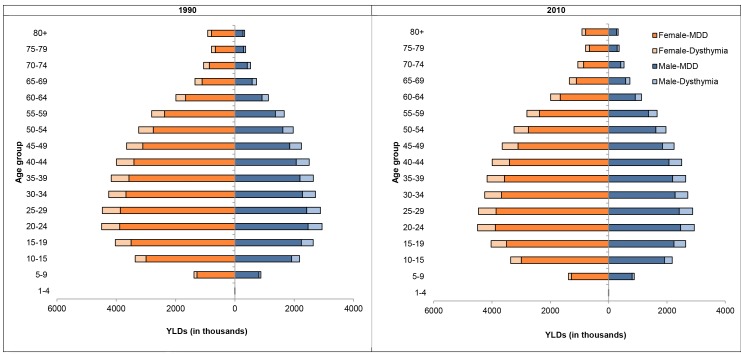
- Depressive disorder YLDs increased 37.5% between 1990 and 2010, driven by population growth (29.6%) and population aging (10.4%), with a −2.5% change due to prevalence.
- Attributable burden analyses found MDD explained an additional 16 million DALYs as a risk factor for suicide, with 46.1% (28.03%–60.8%) of suicide DALYs re-attributed to MDD; 2.9% (1.5%–4.5%) of ischemic heart disease DALYs (3.8 million DALYs, 93.5% YLLs) were attributable to MDD. Adding these increased MDD from 2.5% to 3.4% of global DALYs and depressive disorders from 3.0% to 3.8%, moving MDD from 11th to 8th place.
Methods
- GBD 2010 systematic review of literature from 1 January 1980 to 31 December 2008, with continued perusal to 31 December 2011, captured prevalence, incidence, remission/duration, and excess mortality for MDD and dysthymia. DisMod-MR, a Bayesian meta-regression tool, modeled prevalence for 187 countries, 21 world regions, males and females, 1990, 2005, and 2010, and 20 age groups.
- YLDs were calculated as prevalent cases multiplied by severity- and comorbidity-adjusted disability weights, without age-weighting or discounting. DALYs were YLDs plus YLLs, but no disorder-specific YLLs were recorded for depressive disorders. Disability weights came from population surveys in Bangladesh, Indonesia, Peru, Tanzania, and the USA (14,710 participants) and an internet survey (16,328 participants); severity distributions came from MEPS, NESARC, and NSMHWB.
- Attributable burden used GBD 2010 comparative risk assessment: meta-analyses of relative risks for MDD as a risk factor for suicide and ischemic heart disease, population attributable fractions, and multiplication by cause-specific DALYs. Time trends were decomposed into population growth, population age/sex structure, and YLD rates.
Limitations
- Stated: no disorder-specific YLLs were available for depressive disorders, and the authors could not quantify burden for all outcomes linked to MDD/dysthymia (e.g., stroke, diabetes, vascular dementia/Alzheimer’s disease), so estimates likely underestimate true burden. Meta-analyses for suicide and ischemic heart disease relied on data from only two countries, with uncertain generalizability.
- Stated: uncertainty may be larger than propagated because study-quality covariates were crude binary variables applied equally across ages and sexes; disability weights and health-state definitions may not represent all participants’ experiences; severity distributions came from three surveys in two high-income countries, limiting global representativeness and making it impossible to quantify treatment effects on severity.
- Evident from the text: country-level estimates often depended on imputation via DisMod-MR when raw epidemiological data were sparse, and regional/country differences were frequently within wide, overlapping uncertainty intervals.
Model-written summary. Check it against the paper before relying on it.
Integrity signals
Registry
Cites
Statistics
Figures
Verification
Claims the paper makes
10 Valid · 0 Not valid · 23 Not checked · 88 Own results and interpretations
Every source the paper cites for this claim was checked and supports it.
In the paper
“Out of the comprehensive list of health outcomes originally investigated for mental disorders [32], there was sufficient evidence for causal effects to quantify the burden attributable to MDD as a risk factor for suicide and ischemic heart disease.”
§ Burden of Depressive Disorders by Country, Sex, Age, and Year: Findings from the Global Burden of Disease Study 2010 > Methods > Calculation of Attributable Burden
What the sources say
- Supportedcites [32] AJ Baxter, 2011, Mental disorders as risk factors: assessing the evidence for the global burden of disease study, BMC Medicine source
The Results section says that, after the second evidence filter, suicide and ischemic heart disease had sufficient evidence for inclusion in attributable-burden estimates. It identifies major depression among the risk factors for suicide; the Abstract’s Results and discussion section identifies major depression as the risk factor for ischemic heart disease. The paper does not provide page numbers for these passages. (LLM, conf=0.90)
plainstates a cause- Asserted: passes — The authors put it forward as true.
- Checkable: passes — It can be checked against evidence.
- Load-bearing: passes — The paper’s conclusions depend on it.
- Based: passes — The paper gives a reason why it holds.
- Supported
The cited sources support only part of this claim — read each source’s verdict below.
In the paper
“Although there is literature linking stroke, diabetes, and vascular dementia/Alzheimer's disease to MDD, there was insufficient evidence at the time of our review for a causal relationship and more studies are needed to support these tentative associations [32].”
§ Burden of Depressive Disorders by Country, Sex, Age, and Year: Findings from the Global Burden of Disease Study 2010 > Discussion
What the sources say
- Partly supportedcites [32] AJ Baxter, 2011, Mental disorders as risk factors: assessing the evidence for the global burden of disease study, BMC Medicine sourceExperimental — accuracy not yet measured
The Abstract’s Results and discussion and the Summary say that evidence linking mental disorders to cardiovascular disease and type 2 diabetes was insufficient for inclusion in the Global Burden of Disease study and that further research was needed. The Discussion’s Temporality section also identifies difficulty establishing which condition came first. The paper does not address vascular dementia or Alzheimer’s disease, and its conclusion about cardiovascular disease and diabetes is broader than a conclusion specifically about MDD and stroke. (LLM, conf=0.87)
plain- Asserted: passes — The authors put it forward as true.
- Checkable: passes — It can be checked against evidence.
- Load-bearing: passes — The paper’s conclusions depend on it.
- Based: passes — The paper gives a reason why it holds.
- Partly supported
Every source the paper cites for this claim was checked and supports it.
In the paper
“This finding was driven by high prevalence estimates with 298 million MDD cases in 2010 [2] and 106 million cases of dysthymia [3].”
§ Burden of Depressive Disorders by Country, Sex, Age, and Year: Findings from the Global Burden of Disease Study 2010 > Discussion
What the sources say
- Supportedcites [2] AJ Ferrari, 2013, The epidemiological modelling of major depressive disorder: application for the Global Burden of Disease Study 2010, PLoS ONE source
The Abstract (Results, p. 1) states 'There were over 298 million cases of MDD globally at any point in time in 2010', matching the cited figure exactly. The Results section 'Final prevalence output' corroborates the underlying components (over 111 million male plus 187 million female prevalent cases in 2010) and the 4.4% global point prevalence for 2010. (LLM, conf=0.95)
plainn = 298- Asserted: passes — The authors put it forward as true.
- Checkable: passes — It can be checked against evidence.
- Load-bearing: unclear — It is unclear whether the paper’s conclusions depend on it.
- Based: passes — The paper gives a reason why it holds.
- Supported
Every source the paper cites for this claim was checked and supports it.
In the paper
“In spite of responses coming from a heterogeneous sample of individuals (e.g., a high proportion of highly educated individuals from the internet-based survey and the opposite from the population-based survey from Tanzania), the strength of the correlation between disability weights was at least 0·9 across all surveys except in Bangladesh where it was 0·75 [17].”
§ Burden of Depressive Disorders by Country, Sex, Age, and Year: Findings from the Global Burden of Disease Study 2010 > Discussion
What the sources say
- Supportedcites [17] JA Salomon, 2012, Common values in assessing health outcomes from disease and injury:disability weights measurement study for the Global Burden of Disease 2010, Lancet source
The Abstract Findings (p.1) state that 'correlations between individual survey results and results from analysis of the pooled dataset were 0·9 or higher in all surveys except in Bangladesh (r=0·75)', and the Results section repeats this ('Pearson's correlation coefficients between individual survey results and the results from the pooled analyses were 0·9 or higher in all cases except Bangladesh'). The heterogeneity framing is also supported: the Discussion notes a high degree of consistency 'across surveys with highly heterogeneous respondents', specifically the self-selected, highly educated web survey versus the representative population sample from Tanzania with the lowest educational attainment. Only minor caveat: the direct web-survey-vs-Tanzania comparison was 0·89, marginally under 0·9, but that is a pairwise survey comparison, not the survey-versus-pooled correlations the claim describes. (LLM, conf=0.92)
plainstates an association- Asserted: passes — The authors put it forward as true.
- Checkable: passes — It can be checked against evidence.
- Load-bearing: passes — The paper’s conclusions depend on it.
- Based: passes — The paper gives a reason why it holds.
- Supported
Every source the paper cites for this claim was checked and supports it.
In the paper
“We found evidence for an elevated risk for mortality in those diagnosed with MDD [2],[25]; however, since a health outcome could only occur once in the GBD cause list, MDD related deaths from suicide and ischemic heart disease were captured under the headings of intentional injuries and cardiovascular disease in the GBD capstone papers [14],[18].”
§ Burden of Depressive Disorders by Country, Sex, Age, and Year: Findings from the Global Burden of Disease Study 2010 > Discussion
What the sources say
- Supportedcites [2] AJ Ferrari, 2013, The epidemiological modelling of major depressive disorder: application for the Global Burden of Disease Study 2010, PLoS ONE source
The Results section (page unavailable), in its discussion of Figure 5, explicitly describes all-cause excess mortality experienced by people with MDD. The Methods section (page unavailable) defines the comparison as deaths among people with MDD versus those without MDD or the general population. (LLM, conf=0.92)
- Supportedcites [25] AJ Baxter, 2011, Factors influencing risk of premature mortality in community cases of depression: a meta-analytic review, Epidemiology Research International source
The paper’s Results, as reported in the Abstract, found significantly higher all-cause mortality risk for major depression (RR 1.92, 95% CI 1.65–2.23). The Discussion likewise reports almost twice the risk of premature mortality for community cases of major depression compared with those without depression. (LLM, conf=0.94)
plainstates an association- Asserted: passes — The authors put it forward as true.
- Checkable: passes — It can be checked against evidence.
- Load-bearing: passes — The paper’s conclusions depend on it.
- Based: passes — The paper gives a reason why it holds.
- Rests on an assumption not shown here.
- Supported
58 more claims · 1 with their cited sources checked
Create a free account to see all 121 claims and to verify the 25 references still open.
- Probably not a substantial claim. 42
- It may state two separate claims as one. 30
Claims other papers make about this one
Each is checked against this paper’s own text: does it say what the citing paper says it does?
The source backs part of the claim, not all of it — or backs it for a different population, condition or comparison.
In the citing paper
“The World Mental Health Survey estimated the annual prevalence of MDD to be 4.4% and the lifetime prevalence to be approximately 10% -15%36,37.”
From Temporal and spatial trend analysis of all-cause depression burden based on Global Burden of Disease (GBD) 2019 study (2024) · cites this paper as [36]
Experimental — accuracy not yet measuredThe source backs part of the claim, not all of it — or backs it for a different population, condition or comparison.
In the citing paper
“This may be attributed to the fact that depression and anxiety are the most common mental disorder around the world [44, 45], and chatbots are reported to be effective in improving social skills for patients with autism [14, 17, 46-48].”
From An overview of the features of chatbots in mental health: A scoping review (2019) · cites this paper as [44]
Experimental — accuracy not yet measuredThe source backs part of the claim, not all of it — or backs it for a different population, condition or comparison.
In the citing paper
“Direct and indirect costs of depression and anxiety make these disorders main contributors to the global burden of disease [42, 43]”
From Mobile Apps for the Management of Comorbid Overweight/Obesity and Depression/Anxiety: A Systematic Review (2020) · cites this paper as [43]
Experimental — accuracy not yet measuredIn the citing paper
“Major depressive disorder ranks among the leading mental health causes of the global burden of disease (104).”
From Vagus Nerve as Modulator of the Brain–Gut Axis in Psychiatric and Inflammatory Disorders (2018) · cites this paper as [104]
Citations
Cites
Diagnostic and Statistical Manual of Mental Disorders
Williams, J. B. W., & First, M. (2013) · Encyclopedia of Social Work · doi:10.1093/acrefore/9780199975839.013.104 · Cited by 109,519
Preferred Reporting Items for Systematic Reviews and Meta-Analyses: the PRISMA statement
Moher, D., Liberati, A., Tetzlaff, J., Altman, D. G., & for the PRISMA Group (2009) · BMJ · doi:10.1136/bmj.b2535 · Cited by 83,823
Preferred Reporting Items for Systematic Reviews and Meta-Analyses: The PRISMA Statement
Moher, D., Liberati, A., Tetzlaff, J., Altman, D. G., & The PRISMA Group (2009) · PLoS Medicine · doi:10.1371/journal.pmed.1000097 · Cited by 64,042
Preferred reporting items for systematic reviews and meta-analyses: the PRISMA Statement.
(2009) · PubMed Central · Cited by 44,859
Preferred Reporting Items for Systematic Reviews and Meta-Analyses: The PRISMA Statement
Moher, D., Liberati, A., Tetzlaff, J., & Altman, D. G. (2009) · Journal of Clinical Epidemiology · doi:10.1016/j.jclinepi.2009.06.005 · Cited by 19,575
Wang, G., Ma, R., Qiao, G., Wada, K., Aizawa, Y., & Satoh, T. (2015) · Integrative Medicine International · doi:10.1159/000368408 · Cited by 18,657
Lozano, R., Naghavi, M., Foreman, K., Lim, S., Shibuya, K., Aboyans, V., Abraham, J., Adair, T., Aggarwal, R., Ahn, S. Y., et al. (2012) · The Lancet · doi:10.1016/s0140-6736(12)61728-0 · Cited by 14,070
Lim, S. S., Vos, T., Flaxman, A. D., Danaei, G., Shibuya, K., Adair-Rohani, H., AlMazroa, M. A., Amann, M., Anderson, H. R., Andrews, K. G., et al. (2012) · The Lancet · doi:10.1016/s0140-6736(12)61766-8 · Cited by 11,805
Self-citationMurray, C. J. L., Vos, T., Lozano, R., Naghavi, M., Flaxman, A. D., Michaud, C., Ezzati, M., Shibuya, K., Salomon, J. A., Abdalla, S., et al. (2012) · The Lancet · doi:10.1016/s0140-6736(12)61689-4 · Cited by 8,888
Self-citationVos, T., Flaxman, A. D., Naghavi, M., Lozano, R., Michaud, C., Ezzati, M., Shibuya, K., Salomon, J. A., Abdalla, S., Aboyans, V., et al. (2012) · The Lancet · doi:10.1016/s0140-6736(12)61729-2 · Cited by 8,291
Self-citation
Cited by
Items 801–900 of 1,039
Liang, X., Tang, J., Chao, F., Zhang, Y., Chen, L., Wang, F., Tan, C., Luo, Y., Xiao, Q., Zhang, L., et al. (2019) · Behavioural Brain Research · doi:10.1016/j.bbr.2019.112115 · Cited by 37
Psychosocial Safety Climate: A New Work Stress Theory and Implications for Method
Dollard, M. F., Dormann, C., & Idris, M. A. (2019) · Springer eBooks · doi:10.1007/978-3-030-20319-1_1 · Cited by 72
Segal, L., Twizeyemariya, A., Zarnowiecki, D., Niyonsenga, T., Bogomolova, S., Wilson, A., O’Dea, K., & Parletta, N. (2020) · Nutritional Neuroscience · doi:10.1080/1028415x.2018.1556896 · Cited by 37
Efficacy and tolerability of treatments for bipolar depression
Vázquez, G. H., Holtzman, J. N., Tondo, L., & Baldessarini, R. J. (2015) · Journal of Affective Disorders · doi:10.1016/j.jad.2015.05.016 · Cited by 43
Duffy, S. L., Lagopoulos, J., Cockayne, N. L., Lewis, S. J. G., Hickie, I. B., Hermens, D. F., & Naismith, S. L. (2015) · Nutrition · doi:10.1016/j.nut.2015.04.019 · Cited by 38
Borchardt, V., Lord, A., Li, M., van der Meer, J. N., Heinze, H., Bogerts, B., Breakspear, M. J., & Walter, M. (2016) · Human Brain Mapping · doi:10.1002/hbm.23111 · Cited by 41
Sex differences in sleep, anhedonia, and HPA axis activity in a rat model of chronic social defeat
Page, G. G., Opp, M. R., & Kozachik, S. L. (2016) · Neurobiology of Stress · doi:10.1016/j.ynstr.2016.03.002 · Cited by 37
Tsuboi, H., Hirai, H., & Kondo, K. (2016) · BioPsychoSocial Medicine · doi:10.1186/s13030-016-0064-6 · Cited by 43
Association between major depressive disorder and odor identification impairment
Khil, L., Rahe, C., Wellmann, J., Baune, B. T., Wersching, H., & Berger, K. (2016) · Journal of Affective Disorders · doi:10.1016/j.jad.2016.06.022 · Cited by 38
Antidepressant-like effects of acupuncture involved the ERK signaling pathway in rats
Zhang, X., Song, Y., Bao, T., Yu, M., Xu, M., Guo, Y., Wang, Y., Zhang, C., & Zhao, B. (2016) · BMC Complementary and Alternative Medicine · doi:10.1186/s12906-016-1356-x · Cited by 42
Use of Buprenorphine in treatment of refractory depression—A review of current literature
Stanciu, C. N., Glass, O., & Penders, T. M. (2017) · Asian Journal of Psychiatry · doi:10.1016/j.ajp.2017.01.015 · Cited by 39
Restivo, M. R., McKinnon, M. C., Frey, B. N., Hall, G. B., Syed, W., & Taylor, V. H. (2017) · PLOS ONE · doi:10.1371/journal.pone.0176898 · Cited by 36
Novick, D., Montgomery, W. S., Vorstenbosch, E., Moneta, M. V., Dueñas, H., & Haro, J. M. (2017) · Patient Preference and Adherence · doi:10.2147/ppa.s138750 · Cited by 48
Depression Severity Estimation from Multiple Modalities
Stepanov, E. A., Lathuilière, S., Chowdhury, S. A., Ghosh, A., Vieriu, R.-L., Sebe, N., & Riccardi, G. (2018) · IEEE International Conference on e-Health Networking, Applications and Services (Healthcom) · doi:10.1109/healthcom.2018.8531119 · Cited by 54
Werneck, A. O., Oyeyemi, A. L., Szwarcwald, C. L., Vancampfort, D., & da Silva, D. R. P. (2018) · Journal of Affective Disorders · doi:10.1016/j.jad.2018.04.083 · Cited by 42
Ye, J., Cai, S., Cheung, W. M., & Tsang, H. W. H. (2019) · Frontiers in Psychology · doi:10.3389/fpsyg.2019.00574 · Cited by 44
Ben‐Zeev, D., Buck, B., Chu, P. V., Razzano, L. A., Pashka, N. J., & Hallgren, K. A. (2019) · JMIR Mental Health · doi:10.2196/13202 · Cited by 45
Bioactivities of serotonin transporter mediate antidepressant effects of Acorus tatarinowii Schott
Zhang, F.-H., Wang, Z., Liu, Y., Huang, J.-S., Liang, S., Wu, H., & Xu, Y. (2019) · Journal of Ethnopharmacology · doi:10.1016/j.jep.2019.111967 · Cited by 39
Guo, Y., Chang, S., Chan, C. H., Chang, Q., Hsu, C., & YIP, P. S. F. (2019) · Journal of Epidemiology & Community Health · doi:10.1136/jech-2019-212977 · Cited by 40
Marques, A., Gaspar de Matos, M., Bordado, J., Gouveia, É. R., Peralta, M., & Gomez‐Baya, D. (2021) · European Journal of Sport Science · doi:10.1080/17461391.2020.1795273 · Cited by 36
Electric field strength induced by electroconvulsive therapy is associated with clinical outcome
Fridgeirsson, E. A., Deng, Z., Denys, D. A. J. P., van Waarde, J. A., & van Wingen, G. A. (2021) · NeuroImage Clinical · doi:10.1016/j.nicl.2021.102581 · Cited by 46
Emerging roles of long non-coding RNA in depression
Hao, W.-Z., Chen, Q., Wang, L., Tao, G., Gan, H., Deng, L.-J., Huang, J.-Q., & Chen, J.-X. (2022) · Progress in Neuro-Psychopharmacology and Biological Psychiatry · doi:10.1016/j.pnpbp.2022.110515 · Cited by 37
Dynamic Resting-State Network Biomarkers of Antidepressant Treatment Response
Kaiser, R. H., Chase, H. W., Phillips, M. L., Deckersbach, T., Parsey, R. V., Fava, M., McGrath, P. J., Weissman, M. M., Oquendo, M. A., McInnis, M. G., et al. (2022) · Biological Psychiatry · doi:10.1016/j.biopsych.2022.03.020 · Cited by 38
Li, Y., Yu, X., Ma, Y., Su, J., Li, Y., Zhu, S., Bai, T., Wei, Q., Becker, B., Ding, Z., et al. (2022) · Cerebral Cortex · doi:10.1093/cercor/bhac311 · Cited by 36
(2017) · Europe PMC (PubMed Central) · Cited by 148
Jani, B. D., McLean, G., Nicholl, B. I., Barry, S. J. E., Sattar, N., Mair, F. S., & Cavanagh, J. (2015) · Frontiers in Human Neuroscience · doi:10.3389/fnhum.2015.00018 · Cited by 37
Folb, N., Lund, C., Fairall, L. R., Timmerman, V., Levitt, N. S., Steyn, K., & Bachmann, M. O. (2015) · BMC Public Health · doi:10.1186/s12889-015-2509-4 · Cited by 52
Oladeji, B. D., Kola, L., Abiona, T., Montgomery, A. A., Araya, R., & Gureje, O. (2015) · BMC Psychiatry · doi:10.1186/s12888-015-0483-0 · Cited by 36
“The validity of depression diagnosis across cultures and specifically in Nigeria is further supported by the correlations between depression severity and disability, in keeping with findings from other cultures [6-8].”
ResultZhao, Y. J., Tor, P. C., Khoo, A. L., Teng, M., Lim, B. P., & Mok, Y. M. (2018) · Neuromodulation: Technology at the Neural Interface · doi:10.1111/ner.12723 · Cited by 36
Catarino, A., Harper, S., Malcolm, R., Stainthorpe, A., Warren, G., Margoum, M., Hooper, J., Blackwell, A. D., & Welchman, A. E. (2023) · Nature Mental Health · doi:10.1038/s44220-023-00106-z · Cited by 36
Weekend catch-up sleep and depression: results from a nationally representative sample in Korea
Kim, K. M., Han, S. M., Min, I. K., Heo, K., Kim, W., & Chu, M. K. (2021) · Sleep Medicine · doi:10.1016/j.sleep.2021.02.058 · Cited by 38
Liu, D., Liu, B., Lin, T., Liu, G., Yang, G., Qi, D., Qiu, Y., Lu, Y., Yuan, Q., Shuai, S. C., et al. (2022) · Frontiers in Psychiatry · doi:10.3389/fpsyt.2022.1017064 · Cited by 51
Zhu, M., Yu, Q., & He, X. (2023) · Frontiers in Human Neuroscience · doi:10.3389/fnhum.2023.1094592 · Cited by 40
Psychedelics for treatment resistant depression: are they game changers?
Kalfas, M., Taylor, R. H., Tsapekos, D., & Young, A. H. (2023) · Expert Opinion on Pharmacotherapy · doi:10.1080/14656566.2023.2281582 · Cited by 40
Xiang, X., An, R., & Heinemann, A. W. (2017) · The Gerontologist · doi:10.1093/geront/gnw262 · Cited by 41
Cannabis and Depression: A Twin Model Approach to Co-morbidity
Smolkina, M., Morley, K. I., Rijsdijk, F., Agrawal, A., Bergin, J. E., Nelson, E. C., Statham, D., Martin, N. G., & Lynskey, M. T. (2017) · Behavior Genetics · doi:10.1007/s10519-017-9848-0 · Cited by 36
Kunzweiler, C. P., Bailey, R. C., Okall, D. O., Graham, S. M., Mehta, S. D., & Otieno, F. (2017) · AIDS and Behavior · doi:10.1007/s10461-017-1941-0 · Cited by 37
Deschênes, S. S., Burns, R. J., & Schmitz, N. (2018) · Journal of Affective Disorders · doi:10.1016/j.jad.2018.05.029 · Cited by 38
Type 2 diabetes is causally associated with depression: a Mendelian randomization analysis
Xuan, L., Zhao, Z., Xu, J. Y., Hou, Y., Wang, T., Li, M., Lu, J., Xu, Y., Chen, Y., Qi, L., et al. (2018) · Frontiers of Medicine · doi:10.1007/s11684-018-0671-7 · Cited by 37
Inhibition effects of some antidepressant drugs on pentose phosphate pathway enzymes
Özaslan, M. S., Balcı, N., Demir, Y., Gürbüz, M., & Küfrevioğlu, Ö. İ. (2019) · Environmental Toxicology and Pharmacology · doi:10.1016/j.etap.2019.103244 · Cited by 42
Mental Health of Older Adults: A Global Perspective of Inequalities and Inadequacies
Baiyewu, O., Esan, O., & Elugbadebo, O. O. (2021) · Springer eBooks · doi:10.1007/978-3-030-57296-9_119 · Cited by 46
Neural basis of positive and negative emotion regulation in remitted depression
van Kleef, R. S., Marsman, J.-B. C., van Valen, E., Bockting, C., Aleman, A., & van Tol, M. (2022) · NeuroImage Clinical · doi:10.1016/j.nicl.2022.102988 · Cited by 38
A Scoping Review on Biopsychosocial Predictors of Mental Health among Older Adults
Murniati, N., Aufa, B. A., Kusuma, D., & Kamso, S. (2022) · International Journal of Environmental Research and Public Health · doi:10.3390/ijerph191710909 · Cited by 56
Predictive markers of depression in hypertension
Song, X., Zhang, Z., Zhang, R., Wang, M., Lin, D., Li, T., Shao, J., & Ma, X. (2018) · Medicine · doi:10.1097/md.0000000000011768 · Cited by 43
Validation of patient health questionnaire-9 for assessing depression of adults in Bangladesh
Naher, R., Rabby, M. R. A., & Sharif, F. (2021) · Dhaka University Journal of Biological Sciences · doi:10.3329/dujbs.v30i2.54652 · Cited by 38
Guo, Q., Yong, W., Guo, L., Li, X., Ma, X., He, X., Li, J., Zhang, X., & Shang, S. (2023) · Psychiatry Research · doi:10.1016/j.psychres.2023.115611 · Cited by 39
Teychenne, M. J., Abbott, G., Lamb, K. E., Rosenbaum, S., & Ball, K. (2017) · Preventive Medicine · doi:10.1016/j.ypmed.2017.07.005 · Cited by 49
Carrillo‐Roa, T., Labermaier, C., Weber, P. C., Herzog, D. P., Lareau, C. A., Santarelli, S., Wagner, K. V., Rex‐Haffner, M., Harbich, D., Scharf, S. H., et al. (2017) · PLoS Biology · doi:10.1371/journal.pbio.2002690 · Cited by 46
Ciobanu, L. G., Sachdev, P. S., Trollor, J. N., Reppermund, S., Thalamuthu, A., Mather, K. A., Cohen‐Woods, S., Stacey, D., Toben, C. G., Schubert, K. O., et al. (2018) · Journal of Psychiatric Research · doi:10.1016/j.jpsychires.2018.09.017 · Cited by 39
Fiorillo, A., Carpiniello, B., Giorgi, S. D., Pia, S. L., Maina, G., Sampogna, G., Spina, E., Tortorella, A. A. V., & Vita, A. (2018) · Frontiers in Psychiatry · doi:10.3389/fpsyt.2018.00493 · Cited by 39
Lindegaard, T., Brohede, D., Koshnaw, K., Osman, S. S., Johansson, R., & Andersson, G. (2019) · Journal of Clinical Psychology · doi:10.1002/jclp.22753 · Cited by 35
Mendes-Silva, A. P., Fujimura, P. T., Silva, J. R. D. C., Teixeira, A. L., Vieira, E. M., Guedes, P. H. G., Barroso, L. S. S., Nicolau, M. D. S., Ferreira, J. D. R., Bertola, L., et al. (2019) · Journal of Psychiatric Research · doi:10.1016/j.jpsychires.2019.01.019 · Cited by 35
Zhang, J., Yue, Y., Thapa, A., Fang, J., Zhao, S., Shi, W., Yang, Z., Li, Y., & Yuan, Y. (2019) · Journal of Affective Disorders · doi:10.1016/j.jad.2019.03.001 · Cited by 35
Help-Seeking for Mental Health Issues in Professional Rugby League Players
Kola, S., Lewis, K., Rodriguez, A., & Kola-Palmer, D. (2020) · Frontiers in Psychology · doi:10.3389/fpsyg.2020.570690 · Cited by 45
Shared Genetic Liability Between Major Depressive Disorder and Atopic Diseases
Cao, H., Li, S., Baranova, A., & Zhang, F. (2021) · Frontiers in Immunology · doi:10.3389/fimmu.2021.665160 · Cited by 35
Gamble, S., Mawokomatanda, T., Xu, F., Chowdhury, P. P., Pierannunzi, C., Flegel, D., Garvin, W., & Town, M. (2017) · MMWR. Surveillance Summaries · doi:10.15585/mmwr.ss6616a1 · Cited by 35
Sellers, R., Hammerton, G., Harold, G. T., Mahedy, L., Potter, R., Langley, K., Thapar, A., Rice, F. J., Thapar, A., & Collishaw, S. (2016) · Journal of Abnormal Psychology · doi:10.1037/abn0000080 · Cited by 44
Esaki, Y., Kitajima, T., Takeuchi, I., Tsuboi, S., Furukawa, O., Moriwaki, M., Fujita, K., & Iwata, N. (2017) · Chronobiology International · doi:10.1080/07420528.2017.1318893 · Cited by 34
“MDD is the second-ranked cause of disability worldwide (Ferrari et al., 2013) and is associated with impaired quality of life (IsHak et al., 2011), increased mortality risk (Cuijpers & Smit, 2002), and societal burden (Greenberg et al., 2015).”
BackgroundMeditation‐based lifestyle modification in mild to moderate depression—A randomized controlled trial
Bringmann, H. C., Michalsen, A., Jeitler, M., Kessler, C. S., Brinkhaus, B., Brunnhuber, S., & Sedlmeier, P. (2022) · Depression and Anxiety · doi:10.1002/da.23249 · Cited by 34
“This underscores the role of depression as a global key challenge in public health and the necessity of implementing cost‐effective interventions to reduce its disease burden (Ferrari et al., 2013; Friedrich, 2017).”
BackgroundLokkerbol, J., Wijnen, B. F. M., Ruhé, H. G., Spijker, J., Morad, A., Schoevers, R. A., de Boer, M. K., Cuijpers, P. J., & Smit, F. (2020) · Expert Review of Pharmacoeconomics & Outcomes Research · doi:10.1080/14737167.2021.1844566 · Cited by 39
Wang, Y., Wang, C., Zhou, J., Chen, X., Liu, R., Zhang, Z., Feng, Y., Feng, L., Liu, J., Zhou, Y., et al. (2024) · Translational Psychiatry · doi:10.1038/s41398-024-03117-1 · Cited by 35
Stelzhammer, V., Alsaif, M., Chan, M. K., Rahmoune, H., Steeb, H., Guest, P. C., & Bahn, S. (2014) · Journal of Psychiatric Research · doi:10.1016/j.jpsychires.2014.09.022 · Cited by 37
Rosenblat, J. D., Gregory, J. M., Carvalho, A. F., & McIntyre, R. S. (2016) · Current Molecular Medicine · doi:10.2174/1566524016666160126144303 · Cited by 38
Koyanagi, A., Oh, H. Y., Stubbs, B., Haro, J. M., & DeVylder, J. (2016) · Psychological Medicine · doi:10.1017/s0033291716002750 · Cited by 37
Santos, D. D. A. T., Júnior, J. S. V., Meneguci, J., Sasaki, J. E., & Tribess, S. (2017) · Issues in Mental Health Nursing · doi:10.1080/01612840.2016.1263695 · Cited by 41
Shi, Z., Atlantis, E. E., Taylor, A. W., Gill, T. K., Price, K., Appleton, S., Wong, M., & Licinio, J. (2017) · BMJ Open · doi:10.1136/bmjopen-2017-016224 · Cited by 39
Zhu, J., Lin, X., Lin, C., Zhuo, C., & Yu, Y. (2017) · Journal of Affective Disorders · doi:10.1016/j.jad.2017.08.084 · Cited by 37
Adjaye‐Gbewonyo, D., Rebok, G. W., Gallo, J. J., Gross, A. L., & Underwood, C. R. (2018) · Aging & Mental Health · doi:10.1080/13607863.2018.1450839 · Cited by 38
Cassiani-Miranda, C. A., & Scoppetta, O. (2018) · Psychiatry Research · doi:10.1016/j.psychres.2018.08.071 · Cited by 39
Shalbaf, R., Brenner, C. A., Pang, C., Blumberger, D. M., Downar, J. H., Daskalakis, Z. J., Tham, J. C. W., Lam, R. W. M., Farzan, F., & Vila‐Rodriguez, F. (2018) · Frontiers in Pharmacology · doi:10.3389/fphar.2018.01188 · Cited by 36
Mental Health Issues in Madhya Pradesh: Insights from National Mental Health Survey of India 2016
Kokane, A. M., Pakhare, A. P., Gururaj, G., Varghese, M., Benegal, V., Rao, G. N., Arvind, B. A., Shukla, M., Mitra, A., Yadav, K., et al. (2019) · Healthcare · doi:10.3390/healthcare7020053 · Cited by 35
Khaksarian, M., Behzadifar, M., Behzadifar, M., Alipour, M., Jahanpanah, F., Re, T. S., Firenzuoli, F., Zerbetto, R., & Bragazzi, N. L. (2019) · Psychology Research and Behavior Management · doi:10.2147/prbm.s199343 · Cited by 39
Selous, C., Kelly-Irving, M., Maughan, B., Eyre, O., Rice, F., & Collishaw, S. (2020) · Psychological Medicine · doi:10.1017/s003329171900271x · Cited by 34
Use of virtual reality games in people with depression and anxiety
Lin, A. J., Cheng, F. F., & Chen, C. B. (2020) · International Conference on Multimedia and Image Processing (ICMIP) · doi:10.1145/3381271.3381299 · Cited by 41
Standardization of the Korean Version of the Patient Health Questionnaire-4 (PHQ-4)
Kim, H.-W., Shin, C., Lee, S., & Han, C. (2021) · Clinical Psychopharmacology and Neuroscience · doi:10.9758/cpn.2021.19.1.104 · Cited by 42
MicroRNA regulation of prefrontal cortex development and psychiatric risk in adolescence
Morgunova, A., & Flores, C. (2021) · Seminars in Cell and Developmental Biology · doi:10.1016/j.semcdb.2021.04.011 · Cited by 39
Wasil, A. R., Gillespie, S., Park, S. J., Venturo‐Conerly, K. E., Osborn, T. L., DeRubeis, R. J., Weisz, J. R., & Jones, P. J. (2021) · Journal of Affective Disorders · doi:10.1016/j.jad.2021.08.087 · Cited by 39
Lifestyle change recommendations in major depression: Do they work?
Serrano-Ripoll, M. J., Oliván‐Blázquez, B., Vicens-Pons, E., Roca, M., Gili, M., Leiva, A., García‐Campayo, J., Demarzo, M., & García-Toro, M. (2015) · Journal of Affective Disorders · doi:10.1016/j.jad.2015.04.059 · Cited by 46
Mizoue, T., Kochi, T., Akter, S., Eguchi, M., Kurotani, K., Tsuruoka, H., Kuwahara, K., Ito, R., Kabe, I., & Nanri, A. (2015) · Journal of Nutrition · doi:10.3945/jn.114.204115 · Cited by 38
Li, H., Linjuan-Li, & Wang, Y. (2016) · Biochemical and Biophysical Research Communications · doi:10.1016/j.bbrc.2016.09.123 · Cited by 37
Sukhato, K., Lotrakul, M., Dellow, A., Ittasakul, P., Thakkinstian, A., & Anothaisintawee, T. (2017) · BMJ Open · doi:10.1136/bmjopen-2016-014499 · Cited by 34
Batail, J.-M., Xiao, X., Azeez, A., Tischler, C., Kratter, I. H., Bishop, J. H., Saggar, M., & Williams, N. R. (2023) · Translational Psychiatry · doi:10.1038/s41398-023-02537-9 · Cited by 33
Habtamu, K., Medhin, G., Selamu, M., Tirfessa, K., Hanlon, C., & Fekadu, A. (2019) · International Journal of Mental Health Systems · doi:10.1186/s13033-019-0305-8 · Cited by 38
Dua, D., Padhy, S. K., & Grover, S. (2021) · Indian Journal of Psychiatry · doi:10.4103/psychiatry.indianjpsychiatry_246_20 · Cited by 36
Markkula, N., Härkänen, T., Nieminen, T., Peña, S., Mattila, A. K., Koskinen, S. V. P., Saarni, S. I., & Suvisaari, J. (2015) · Journal of Affective Disorders · doi:10.1016/j.jad.2015.10.043 · Cited by 49
Connor, K. M., Ceesay, P., Hutzelmann, J., Snavely, D. B., Krystal, A. D., Trivedi, M. H., Thase, M. E., Lines, C., Herring, W. J., & Michelson, D. (2017) · The International Journal of Neuropsychopharmacology · doi:10.1093/ijnp/pyx033 · Cited by 34
Factors Associated With Prevalent HIV Infection Among Kenyan MSM: The Anza Mapema Study
Kunzweiler, C. P., Bailey, R. C., Okall, D. O., Graham, S. M., Mehta, S. D., & Otieno, F. (2017) · JAIDS Journal of Acquired Immune Deficiency Syndromes · doi:10.1097/qai.0000000000001512 · Cited by 35
Effects of repeated attachment security priming in outpatients with primary depressive disorders
Carnelley, K. B., Bejinaru, M.-M., Otway, L. J., Baldwin, D. S., & Rowe, A. C. (2018) · Journal of Affective Disorders · doi:10.1016/j.jad.2018.02.040 · Cited by 39
Clayborne, Z. M., & Colman, I. (2018) · The Canadian Journal of Psychiatry · doi:10.1177/0706743718772523 · Cited by 38
Mapping stress networks using functional magnetic resonance imaging in awake animals
Dopfel, D., & Zhang, N. (2018) · Neurobiology of Stress · doi:10.1016/j.ynstr.2018.06.002 · Cited by 35
Péquignot, R., Dufouil, C., Pérès, K., Artéro, S., Tzourio, C., & Empana, J. P. (2019) · Journal of the American Geriatrics Society · doi:10.1111/jgs.15731 · Cited by 33
Recent Developments in the Treatment of Depression
Hollon, S. D., Cohen, Z. D., Singla, D. R., & Andrews, P. W. (2019) · Behavior Therapy · doi:10.1016/j.beth.2019.01.002 · Cited by 41
Cuadros, D. F., Tomita, A. M., Vandormael, A. M., Slotow, R., Burns, J. K., & Tanser, F. C. (2019) · Scientific Reports · doi:10.1038/s41598-018-37791-1 · Cited by 39
Prevalence and related factors of postpartum depression among reproductive aged women in Ahvaz, Iran
Afshari, P., Tadayon, M., Abedi, P., & Yazdizadeh, S. (2019) · Health Care For Women International · doi:10.1080/07399332.2019.1578779 · Cited by 39
Paudel, P., Seong, S. H., Shrestha, S., Jung, H. A., & Choi, J. S. (2019) · ACS Omega · doi:10.1021/acsomega.9b02328 · Cited by 32
Listunova, L., Kienzle, J., Bartolovic, M., Jaehn, A., Grützner, T. M., Wolf, R. C., Aschenbrenner, S., Weisbrod, M., & Roesch-Ely, D. (2020) · Journal of Affective Disorders · doi:10.1016/j.jad.2020.07.008 · Cited by 38
Akbari, M., Seydavi, M., Jamshidi, S., Marino, C., & Spada, M. M. (2022) · Addictive Behaviors · doi:10.1016/j.addbeh.2022.107603 · Cited by 42
Civil War in Syria: the psychological effects on journalists
Feinstein, A., & Starr, S. (2015) · Journal of Aggression Conflict and Peace Research · doi:10.1108/jacpr-04-2014-0119 · Cited by 33
Clarke, T., Obšteter, J., Hall, L. S., Hayward, C., Thomson, P. A., Smith, B. H., Padmanabhan, S., Hocking, L. J., Deary, I. J., Porteous, D. J., et al. (2016) · American Journal of Medical Genetics Part B Neuropsychiatric Genetics · doi:10.1002/ajmg.b.32478 · Cited by 31
Kendrick, T., Moore, M. V., Gilbody, S. M., Churchill, R. C., Stuart, B. L., & El-Gohary, M. (2014) · Cochrane Database of Systematic Reviews · doi:10.1002/14651858.cd011119 · Cited by 35
Metadata
- Authors
- Ferrari, A. J., Charlson, F. J., Norman, R. E., Patten, S. B., Freedman, G., Murray, C. J. L., Vos, T., & Whiteford, H. A.
- Affiliations
- The University of Queensland (AU)
- University of Calgary (CA)
- University of Washington (US)
- Corresponding author
- Ferrari, Alize J.
- ORCID
- Venue
- PLoS Medicine
- Publisher
- Public Library of Science (PLoS)
- Published
- 2013-11-05
- Volume
- 10
- Issue
- 11
- Pages
- e1001547
- ISSN
- 1549-1277 (ISSN-L)
- 1549-1676
- PMC
- PMC3818162
- OpenAlex
- W2171340584
- Cited by
- 3,115
- References
- 48
- Citations by year
- 2026: 109 · 2025: 165 · 2024: 177 · 2023: 226 · 2022: 250 · 2021: 339 · 2020: 286 · 2019: 303 · 2018: 309 · 2017: 321 · 2016: 262 · 2015: 248 · 2014: 110 · 2013: 5
- FWCI
- 311.80
- Type
- journal article
- Language
- en
- Open access
- gold
- doi.org
- Locations
- PLoS Medicine (publishedVersion, cc-by)
- Europe PMC (PubMed Central) (publishedVersion, cc-by)
- PubMed Central (publishedVersion, cc-by)
- PubMed (publishedVersion)
- QUT ePrints (Queensland University of Technology) (submittedVersion, other-oa)
- DOAJ (DOAJ: Directory of Open Access Journals) (submittedVersion, cc-by-sa)
- Figshare (submittedVersion, cc-by)
- Funders
- Bill and Melinda Gates Foundation
- University of Washington
- Topics
- Health Sciences › Medicine › Psychiatry and Mental health › Mental Health Treatment and Access
- Health Sciences › Medicine › Pharmacology (medical) › Treatment of Major Depression
- Social Sciences › Economics, Econometrics and Finance › Economics and Econometrics › Health Systems, Economic Evaluations, Quality of Life
- Keywords
- depressive disorders, major depressive disorder, dysthymia, global burden of disease, disability-adjusted life years, years lived with disability, suicide, ischemic heart disease, disability weights, sex differences, age differences, temporal trends, regional variation, attributable burden, public health priorities, Global Burden of Disease Study 2010
- MeSH terms
- Adolescent, Adult, Age Factors, Aged, Child, Child, Preschool, Depression, Depressive Disorder, Female, Persons with Disabilities, Health Surveys, Humans, Infant, Male, Middle Aged, Public Health, Risk Factors, Sex Factors, Suicide, Global Health, Myocardial Ischemia, Cost of Illness, Quality-Adjusted Life Years, Young Adult
About these checks
Registry, retraction, Cites and statistics results are computed, not judged, with one exception: a printed reference that no index lists is read once by a model before it counts as a citation error. Claims are extracted by a model and kept only when their quote appears verbatim in the text; each cited source is then checked, with a model’s help, for whether it says what the claim relies on. Those verdicts can be wrong — read the claim’s quote and the cited source before relying on one.
The claim verdicts this report counts are experimental: their accuracy is not yet measured.
A language model drew the claims from the paper on 2026-10-04, under version 3 of the claim definition (model deepseek-v4.1-flash, prompt extract-v3).
A second model labelled each claim on 2026-10-04 (model jev-1.13-20260917, definition revision gold-guideline-v0.2).
Cited sources are checked with a language model’s help (gpt-6-sol and qwen3.8-omni-flash).
Statistics and arithmetic are recomputed, not judged.
Confidence bands are shown only for fields calibrated on our annotated test set. None is calibrated yet, so no band is shown.
What counts as a claim ›How we measure confidence ›How we check this ›
Are you an author, or do you see a problem with this page? Request a review
Data sources
Bibliographic data: Semantic Scholar, OpenAlex, Crossref.
Contains information from the Semantic Scholar Academic Graph Datasets, made available under the ODC Attribution License (ODC-BY 1.0).
Semantic Scholar’s data is described in: Kinney, R., et al. (2023). The Semantic Scholar Open Data Platform. arXiv:2301.10140.
