

World Health Organization Estimates of the Global and Regional Disease Burden of 22 Foodborne Bacterial, Protozoal, and Viral Diseases, 2010: A Data Synthesis.
Open accessThe DOI matches its Crossref record; 57 of the 58 references it cites were found in a registry or an index; 3 of the 9 sources its claims cite were checked for support.
Abstract
We estimate that the 22 diseases included in our study resulted in two billion cases, over one million deaths, and 78.7 million DALYs in 2010.
Overview
CoChat Summary
## TL;DR
This paper provides the first WHO-led global and regional estimates of the burden of 22 foodborne bacterial, protozoal, and viral diseases in 2010. It estimates 2.0 billion illnesses, 1.09 million deaths, 78.7 million DALYs, and 582 million foodborne cases, with a large share of burden in children under 5.
## Key findings
- The 22 diseases caused an estimated 2.0 billion illnesses (95% UI 1.5–3.0 billion) in 2010; 39% (95% UI 26–53%) were in children <5 years.
- They caused 1.09 million deaths (95% UI 0.89–1.37 million); 34% (95% UI 29–38%) were in children <5 years.
- They caused 78.7 million DALYs (95% UI 65.0–97.7 million); 43% (95% UI 38–48%) were in children <5 years.
- The authors estimate 29% (95% UI 23–36%) of all cases were transmitted by contaminated food, equal to 582 million foodborne cases (95% UI 401–922 million) and 25.2 million foodborne DALYs (95% UI 17.5–37.0 million).
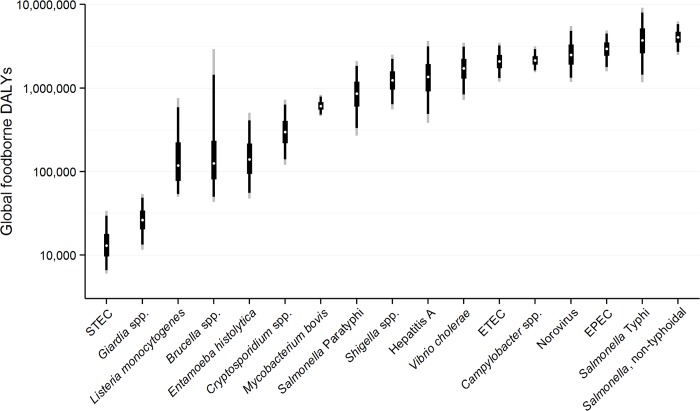
- Norovirus was the leading cause of foodborne illness, with 125 million (95% UI 70–251 million) foodborne cases; Campylobacter spp. caused 96 million (95% UI 52–177 million).
- Of foodborne DALYs, the largest burden came from nontyphoidal S. enterica if iNTS was included: 4.07 million DALYs (95% UI 2.49–6.27 million).
- Foodborne disease mortality and DALY rates were reported as highest in the African region, followed by the South East Asian region.
## Methods
- The study synthesized global and regional burden estimates for 22 foodborne diseases using the WHO FERG Enteric Diseases Task Force framework, combining literature reviews, systematic reviews, cohort studies, surveillance studies, expert consultation, and existing burden-of-disease assessments.
- The team estimated cases, sequelae, deaths, and DALYs for 2010, using pathogen-specific approaches: national estimates where available, a modified CHERG approach for diarrheal diseases in many countries, GBD 2010/IHME data for typhoid, paratyphoid, and hepatitis A, and expert elicitation to estimate the proportion transmitted by food.
- Uncertainty was propagated with Monte Carlo simulations using 10,000 draws per input parameter to generate 95% uncertainty intervals.
## Limitations
- The paper states that a major limitation was data gaps, especially in middle- and high-mortality countries, and that for many regions and pathogens the available data were sparse.
- It also states that only a few sequelae were included, with post-infectious sequelae such as reactive arthritis and irritable bowel syndrome excluded; stillbirths were excluded as well.
- The authors note that they could not fully account for age-specific effects for sequelae and could not separate some effects from comorbidities such as HIV infection.
- The text also makes evident, by its own description, that many estimates relied on expert elicitation for foodborne attribution and on assumptions/substitution where direct data were absent; this increases uncertainty and is part of the paper’s stated limitation.
Model-written summary. Check it against the paper before relying on it.
Integrity signals
Registry
Cites
Statistics
Figures
Verification
Claims the paper makes
3 Valid · 0 Not valid · 4 Not checked · 29 Own results and interpretations
The cited sources support only part of this claim — read each source’s verdict below.
In the paper
“Furthermore, global and regional estimates of the burden of foodborne diseases have not been available [1,2].”
§ World Health Organization Estimates of the Global and Regional Disease Burden of 22 Foodborne Bacterial, Protozoal, and Viral Diseases, 2010: A Data Synthesis > Introduction
What the sources say
- Partly supportedcites [1] Stein C, Kuchenmuller T, Hendrickx S, Prüss-Űstün A, Wolfson L, Engels D, et al The Global Burden of Disease assessments—WHO is responsible? PLoS Negl Trop Dis. 2007; 1: e161 10.1371/journal.pntd.0000161 18160984 PMC2154395 sourceExperimental — accuracy not yet measured
The Foodborne diseases section says that the full extent of the burden is unknown and that no precise, consistent global information existed at the time. It does not specifically address regional estimates, and its wording is narrower than saying no global estimates were available at all. No page number is provided in our copy. (LLM, conf=0.84)
- Not checked — no full text of the sourcecites [2] Tauxe RV, Doyle MP, Kuchenmuller T, Schlundt J, Stein CE. Evolving public health approaches to the global challenge of foodborne infections. Int J Food Microbiol. 2010; 139 Suppl 1: S16– 28. 10.1016/j.ijfoodmicro.2009.10.014 19931203 source
plain- Asserted: passes — The authors put it forward as true.
- Checkable: passes — It can be checked against evidence.
- Load-bearing: passes — The paper’s conclusions depend on it.
- Based: passes — The paper gives a reason why it holds.
- Partly supported
A result the paper reports from its own data — it cites no other source for it, so there is none to check. The quote shows it is in the paper.
In the paper
“Overall, 29% (95% UI 23–36%) of all 22 diseases were estimated to be transmitted by contaminated food equating to 582 million (95% UI 400–922 million) foodborne cases in 2010; 38% (95% UI 24–53%) in children <5 years of age.”
§ World Health Organization Estimates of the Global and Regional Disease Burden of 22 Foodborne Bacterial, Protozoal, and Viral Diseases, 2010: A Data Synthesis > Results > Cases
hedged- Asserted: passes — The authors put it forward as true.
- Checkable: passes — It can be checked against evidence.
- Load-bearing: passes — The paper’s conclusions depend on it.
- Based: passes — The paper gives a reason why it holds.
- Rests on an assumption not shown here.
A result the paper reports from its own data — it cites no other source for it, so there is none to check. The quote shows it is in the paper.
In the paper
“Among the 11 diarrheal diseases, the rate ratio of foodborne cases occurring among children <5 years of age compared to those ≥5 years of age was 6.44 (95%UI 3.15–12.46).”
§ World Health Organization Estimates of the Global and Regional Disease Burden of 22 Foodborne Bacterial, Protozoal, and Viral Diseases, 2010: A Data Synthesis > Results > Cases
plainstates an association- Asserted: passes — The authors put it forward as true.
- Checkable: passes — It can be checked against evidence.
- Load-bearing: unclear — It is unclear whether the paper’s conclusions depend on it.
- Based: passes — The paper gives a reason why it holds.
- Rests on 2 assumptions not shown here.
A result the paper reports from its own data — it cites no other source for it, so there is none to check. The quote shows it is in the paper.
In the paper
“Norovirus was the leading cause of foodborne illness causing 125 million (95% UI 70–251 million) cases, while Campylobacter spp. caused 96 million (95% UI 52–177 million) foodborne illnesses.”
§ World Health Organization Estimates of the Global and Regional Disease Burden of 22 Foodborne Bacterial, Protozoal, and Viral Diseases, 2010: A Data Synthesis > Abstract > Methods and Findings
plainstates a cause- Asserted: passes — The authors put it forward as true.
- Checkable: passes — It can be checked against evidence.
- Load-bearing: unclear — It is unclear whether the paper’s conclusions depend on it.
- Based: passes — The paper gives a reason why it holds.
In the paper
“The FERG estimate for DALYs for nontyphoidal S. enterica combining diarrheal and invasive infections was 4 times greater than GBD 2010 [54].”
§ World Health Organization Estimates of the Global and Regional Disease Burden of 22 Foodborne Bacterial, Protozoal, and Viral Diseases, 2010: A Data Synthesis > Discussion
What the sources say
- Not checked — no full text of the sourcecites [54] Murray CJ, Vos T, Lozano R, Naghavi M, Flaxman AD, Michaud C, et al Disability-adjusted life years (DALYs) for 291 diseases and injuries in 21 regions, 1990–2010: a systematic analysis for the Global Burden of Disease Study 2010. Lancet. 2012; 380: 2197– 2223. 10.1016/S0140-6736(12)61689-4 23245608 source
plain- Asserted: passes — The authors put it forward as true.
- Checkable: passes — It can be checked against evidence.
- Load-bearing: unclear — It is unclear whether the paper’s conclusions depend on it.
- Based: passes — The paper gives a reason why it holds.
16 more claims
Create a free account to see all 36 claims and to verify the 1 reference still open.
- Probably not a substantial claim. 11
- It may state two separate claims as one. 5
Claims other papers make about this one
Each is checked against this paper’s own text: does it say what the citing paper says it does?
The source backs part of the claim, not all of it — or backs it for a different population, condition or comparison.
In the citing paper
“Animal-based foods, like cow milk, can pose a risk for zoonotic enteric pathogen transmission42 although pasteurisation is an effective means for making milk safer.”
From Environmental and behavioural exposure pathways associated with diarrhoea and enteric pathogen detection in 5-month-old, periurban Kenyan infants: a cross-sectional study (2022) · cites this paper as [42]
Experimental — accuracy not yet measured
Citations
Cites
Lozano, R., Naghavi, M., Foreman, K., Lim, S., Shibuya, K., Aboyans, V., Abraham, J., Adair, T., Aggarwal, R., Ahn, S. Y., et al. (2012) · The Lancet · doi:10.1016/s0140-6736(12)61728-0 · Cited by 14,070 · cited 3×
“Twelve of the diseases included in our study were also included in the GBD 2010 study [25,26,54].”
Murray, C. J. L., Vos, T., Lozano, R., Naghavi, M., Flaxman, A. D., Michaud, C., Ezzati, M., Shibuya, K., Salomon, J. A., Abdalla, S., et al. (2012) · The Lancet · doi:10.1016/s0140-6736(12)61689-4 · Cited by 8,888
Foodborne illness acquired in the United States—Major pathogens
Scallan, E., Hoekstra, R. M., Angulo, F. J., Tauxe, R. V., Widdowson, M.-A., Roy, S. L., Jones, J. L., & Griffin, P. M. (2011) · Emerging Infectious Diseases · doi:10.3201/eid1701.p11101 · Cited by 7,657 · cited 1×
“Many different diseases, including those due to bacteria, viruses, parasites, chemicals, and prions, may be transmitted to humans by contaminated food [3].”
Self-citationSelected major risk factors and global and regional burden of disease
Ezzati, M., Lopez, A. D., Rodgers, A., Vander Hoorn, S., & Murray, C. J. (2002) · The Lancet · doi:10.1016/s0140-6736(02)11403-6 · Cited by 3,594
Kotloff, K. L., Nataro, J. P., Blackwelder, W. C., Nasrin, D., Farag, T. H., Panchalingam, S., Wu, Y., Sow, S. O., Sur, D., Breiman, R. F., et al. (2013) · The Lancet · doi:10.1016/s0140-6736(13)60844-2 · Cited by 3,560 · cited 1×
“This approach was facilitated by the availability of estimates of the envelope of diarrheal deaths, along with recent advances in diarrheal disease diagnosis, such as widespread application of polymerase chain reaction (PCR) for norovirus detection [20,49].”
The Global Burden of Nontyphoidal Salmonella Gastroenteritis
Majowicz, S. E., Musto, J., Scallan, E., Angulo, F. J., Kirk, M., O’Brien, S. J., Jones, T. F., Fazil, A., & Hoekstra, R. M. (2010) · Clinical Infectious Diseases · doi:10.1086/650733 · Cited by 2,442
Self-citationGlobal burden of childhood pneumonia and diarrhoea
Walker, C. L. F., Rudan, I., Liu, L., Nair, H., Theodoratou, E., Bhutta, Z. A., O'Brien, K. L., Campbell, H., & Black, R. E. (2013) · The Lancet · doi:10.1016/s0140-6736(13)60222-6 · Cited by 2,356 · cited 2×
“, “envelope” of diarrheal incidence) for 2010 by combining estimates of diarrheal incidence for children<5 years of age and persons 5 years of age [13,36].”
Self-citationThe global burden of typhoid fever.
Crump, J., Luby, S., & Mintz, E. (2004) · Bulletin of the World Health Organization · doi:10.1590/s0042-96862004000500008 · Cited by 2,172
Self-citationThe global burden of typhoid fever.
(2004) · Europe PMC (PubMed Central) · Cited by 1,965
Self-citationSalomon, J. A., Vos, T., Hogan, D. R., Gagnon, M., Naghavi, M., Mokdad, A., Begum, N., Shah, R., Karyana, M., Kosen, S., et al. (2012) · The Lancet · doi:10.1016/s0140-6736(12)61680-8 · Cited by 1,322 · cited 1×
“Disability weights for each clinical outcome for the enteric diseases were taken from the GBD 2010 study [47].”
Cited by
Items 1,201–1,300 of 1,631
Beresford-Jones, B. S., Suyama, S., Clare, S., Soderholm, A. T., Xia, W., Sardar, P., Harcourt, K., Lawley, T. D., & Pedicord, V. A. (2023) · bioRxiv (Cold Spring Harbor Laboratory) · doi:10.1101/2023.07.20.549886 · Cited by 3
Colston, J. M., Devleesschauwer, B., Flynn, T., Schiaffino, F., Revathi, A. A., Hossain, N., Chen, Y. T., Meister, D., Bagherian, A., Binggeli, O., et al. (2026) · medRxiv · doi:10.64898/2026.01.26.26344508 · Cited by 13
Self-citationChoudhury, S., Medina-Lara, A., Bi, A. Z., Ricarte, P., Morrish, N., & Veettil, P. C. (2026) · Foods · doi:10.3390/foods15081381 · Cited by 3
Liu, P., Lou, X., Xie, Z., Shang, C., & Li, D. (2024) · JMIR Formative Research · doi:10.2196/51327 · Cited by 2
O2-dependent incapacitation of the Salmonella pathogenicity island 1 repressor HilE
Walter, S., Schatz, V., Petzold, J., Schmidt, C., Hoffmann, S., Jantsch, J., & Gerlach, R. G. (2025) · Frontiers in Cellular and Infection Microbiology · doi:10.3389/fcimb.2025.1434254 · Cited by 2
Non-typhoidal Salmonella in food animals in Paraguay: predominant serovars and resistance phenotypes
Irrazábal, R., Iriarte, M. V. L., & Álvarez, J. (2025) · Frontiers in Veterinary Science · doi:10.3389/fvets.2025.1521469 · Cited by 4
Jonnagiri, N. P. K. R., Zakarienė, G., Nawaz, N., Gabinaitienė, A., & Stimbirys, A. (2025) · Microorganisms · doi:10.3390/microorganisms13050996 · Cited by 2
“The World Health Organization (WHO) reports that in 2010, about 95 million people became ill from foodborne Campylobacter , based on confirmed case analyses and modeling data from surveillance studies, together with systematic review findings and burden of disease assessments [16].”
Onizawa, E., Westman, M. E., Bogema, D. R., Deutscher, A. T., Eamens, K., Micallef, M. L., McDonogh, T., & Jenkins, C. (2025) · Transboundary and Emerging Diseases · doi:10.1155/tbed/9937941 · Cited by 4
“Non-typhoidal salmonellosis is responsible for more than 150 million cases of gastroenteritis and 57,000 – 155,000 deaths annually [2, 3].”
Gao, J., Zhang, Z., Jiao, Y., Xu, Y., Chen, Y., & Xue, L. (2025) · The Science of The Total Environment · doi:10.1016/j.scitotenv.2025.179854 · Cited by 3
Schaeffer, J., Indio, V., Troja, F., et al. (2025) · Marine Pollution Bulletin · doi:10.1016/j.marpolbul.2025.118417 · Cited by 2
Wang, J., Zheng, W., Li, Y., Xu, J., Jia, X., Miao, L., Wu, J., Zhang, P., An, T., Xu, Y., et al. (2025) · BMC Infectious Diseases · doi:10.1186/s12879-025-11305-7 · Cited by 6
“It is estimated that there are 93.8 million cases and 155,000 deaths annually worldwide [1].”
InfluentialYoshida, T., Monma, C., Ninomiya, Y., et al. (2025) · Communications Biology · doi:10.1038/s42003-025-08519-5 · Cited by 2
Performance validation of deep-learning-based approach in stool examination
Corpuz, K. D. F., Kusolsuk, T., Wongphan, B., Chonsawat, P., Naing, K. M., Boonsang, S., Kittichai, V., Fan, C., Chuwongin, S., & Watthanakulpanich, D. (2025) · Parasites & Vectors · doi:10.1186/s13071-025-06878-w · Cited by 2
“Global estimates indicate 819 million cases of Ascaris lumbricoides , 464 million of Trichuris trichiura , and 438 million of hookworms [1], with approximately 352 million infections attributed to parasitic protozo-ans [2].”
Perry, J., Rakler, T., Arnold, K., Wiseman, A., Satuchne, C., Pima, Y., Moiseeva, G., Maler, I., Yakunin, E., Rokney, A., et al. (2025) · Emerging infectious diseases · doi:10.3201/eid3110.250191 · Cited by 3
Du, X., Yu, H., Zhang, H., et al. (2025) · Frontiers in Big Data · doi:10.3389/fdata.2025.1666962 · Cited by 2
Wang, Y., Li, D., Yu, S., Li, Y., Chen, R., Wang, Z.-R., Zhang, C., Jiang, B., Wen, Y., Tong, J., et al. (2025) · Small · doi:10.1002/smll.202510654 · Cited by 2
Panzenhagen, P., Cabral, C. C., Suffys, P. N., et al. (2017) · Genome Announcements · doi:10.1128/genomea.00197-17 · Cited by 2
“Illness and death from diseases caused by contaminated food are a constant threat to public health and a significant impediment to socioeconomic development worldwide (1).”
BackgroundYasmin, T., Yusuf, M. A., Mowla, M. G., et al. (2020) · Bangladesh Journal of Infectious Diseases · doi:10.3329/bjid.v7i1.48672 · Cited by 2
Kothe, C. I., Zilio, R., Soares, T. P., Aguzzoli, C., Casarin, L. S., & Tondo, E. C. (2020) · SDRP Journal of Food Science & Technology · doi:10.25177/jfst.5.5.ra.10674 · Cited by 2
“Foodborne illnesses are considered an important health concern worldwide [1,2], consequently, strategies to reduce microbial contamination of food re-”
BackgroundGarcia‐Williams, A. G., Logan, N., & Marsh, Z. A. (2021) · Elsevier eBooks · doi:10.1016/b978-0-12-819519-2.00032-3 · Cited by 4
Noroviruses, Sapoviruses, and Astroviruses
Sajewski, E. T., Vinjé, J., Glass, R. I., & Lopman, B. A. (2022) · Springer eBooks · doi:10.1007/978-1-4939-9544-8_20-1 · Cited by 5
Rapid Detection of Salmonella spp from Meat: Loop Mediated Isothermal Amplification (LAMP)
Vittal, R., Raj, J. R. M., & Chakraborty, G. (2022) · Journal of Pure and Applied Microbiology · doi:10.22207/jpam.16.2.13 · Cited by 4
Brooks, M. R., Medley, S., Ponder, M. A., & Alexander, K. A. (2023) · Frontiers in Ecology and Evolution · doi:10.3389/fevo.2023.1070519 · Cited by 3
Yeh, H., Frye, J. G., Jackson, C. R., Read, Q. D., Line, J. E., & Hinton, A. (2023) · Journal of Microbiological Methods · doi:10.1016/j.mimet.2023.106757 · Cited by 3
Casmo, V., Chicumbe, S., Chambisse, R., & Nalá, R. (2023) · Pathogens · doi:10.3390/pathogens12091105 · Cited by 2
“5 billion people, with 450 million people developing diseases associated with intestinal parasites worldwide [2].”
BackgroundMelebari, M. (2023) · Journal of Pure and Applied Microbiology · doi:10.22207/jpam.17.3.57 · Cited by 6
Wang, X., Chen, P., Wang, J., Wang, Y., Yu, M., Wang, X., Li, Q., Zhang, X., & Duan, J. (2023) · Molecular Nutrition & Food Research · doi:10.1002/mnfr.202300337 · Cited by 2
Tsafrir, O., Rohana, H., Bousani, L., Orsan, K., Abozaid, S., Azrad, M., & Peretz, A. (2024) · Epidemiology and Infection · doi:10.1017/s0950268823002005 · Cited by 2
Odetokun, I. A., Adewoye, A. O., Adetona, M. A., Ade-Yusuf, R. O., Raza, A., Ogundijo, O. A., & Ghali-Mohammed, I. (2024) · UMYU Scientifica · doi:10.56919/usci.2432.023 · Cited by 3
Zoonotic Bridge: Unraveling the Role of Wild Birds in Spreading the Bacterial Pathogenic Diseases
Ramzan, M. S., Ahmad, M. I., Bilal, T., Zafar, N., Neelam, N., & Ashraf, M. A. (2024) · Albus Scientia · doi:10.56512/as.2024.2.e240810 · Cited by 3
“Campylobacter , classified within the Epsilon proteobacteria class, stands as a prominent bacterial agent responsible for global foodborne diarrheal infections (Kirk et al., 2015).”
BackgroundQayyum, N., Aziz, F., Ahmed, R., Younas, M. T., Zafar, U., Mahmood, L., Barkat, U., Qayyum, H., Najeeb, M., Nasrullah, N., et al. (2024) · Pakistan Journal of Biotechnology · doi:10.34016/pjbt.2024.21.02.954 · Cited by 2
“Food borne illness and food borne pathogens are primarily caused by microorganisms, leading to economic costs, and morbidity (Kirk et al., 2015).”
BackgroundPleiotropic cellular responses underlying antibiotic tolerance in Campylobacter jejuni
Cho, E., Kim, J., Hur, J. I., Ryu, S., & Jeon, B. (2024) · Frontiers in Microbiology · doi:10.3389/fmicb.2024.1493849 · Cited by 2
Cai, L., Xie, Y., Hu, H., Lv, C., Shao, L., Wang, H., Xu, X., & Zhou, G. (2024) · iScience · doi:10.1016/j.isci.2024.111660 · Cited by 4
“4 NTS comprises numerous serovars, with Salmonella Enteritidis being one of the most commonly implicated pathogens.”
Yeh, H., & Read, Q. D. (2024) · Veterinary Immunology and Immunopathology · doi:10.1016/j.vetimm.2024.110870 · Cited by 2
Batch, V., Kress, M., Gama, A. P., Ng'ong'ola‐Manani, T. A., Chiutsi‐Phiri, G., Corner, P. L., Kumwenda, S., Kaonga, C. C., Kamndaya, M. S., Monjerezi, M., et al. (2025) · Frontiers in Nutrition · doi:10.3389/fnut.2025.1524580 · Cited by 2
Bari, S., Zhang, Y., Patsekin, V., Robinson, J. P., Rajwa, B. P., Gehring, A., Lindsay, J. A., Kulasiri, D., & On, S. L. W. (2025) · Systematic and Applied Microbiology · doi:10.1016/j.syapm.2025.126641 · Cited by 2
Probiotics as Anti-Giardia Defenders: Overview on Putative Control Mechanisms
Alazzaz, J., Chaouch, S., Boucard, A.-S., Bermúdez‐Humarán, L. G., & Florent, I. (2020) · Springer eBooks · doi:10.1007/978-3-030-44826-4_24 · Cited by 3
Mpundu, P., Mbewe, A. R., Muma, J. B., Sitali, G. M., Mubita, C. M., & Munyeme, M. (2021) · Open Journal of Veterinary Medicine · doi:10.4236/ojvm.2021.111001 · Cited by 2
Babu, U. S., Harrison, L. M., Patel, I. R., et al. (2021) · Food Microbiology · doi:10.1016/j.fm.2021.103852 · Cited by 2
Costa, M., Brusa, V., Padola, N. L., Etcheverría, A. I., Sampedro, F., Escámez, P. S. F., Leotta, G. A., & Signorini, M. L. (2021) · Food Science and Technology International · doi:10.1177/10820132211046124 · Cited by 2
“According to the World Health Organization Foodborne Disease Study, STEC infections produce 1.2 million foodborne median cases and 128 deaths annually worldwide (Kirk et al., 2015).”
MethodInfluentialTechnology in Food Microbiology
Batt, C. A. (2016) · Elsevier eBooks · doi:10.1016/b978-0-08-100596-5.03439-9 · Cited by 2
Phylogenetic Analysis of the Antibiotic Resistance Genes in Salmonella Species in silico.
Nahar, N., & Rashid, R. B. (2018) · Journal of Bioanalysis & Biomedicine · doi:10.4172/1948-593x.1000198 · Cited by 3
“Non typhoidal Salmonella enterica was responsible for 56,969 deaths globally in 2010 [10].”
BackgroundDetection of Enteroviruses in Children with Acute Diarrhea
Fazelipour, M., Makvandi, M., Samarbafzadeh, A., Nisi, N., Azaran, A., Jalilian, S., Pirmoradi, R., Nikfar, R., Shamsizadeh, A., & Angali, K. A. (2019) · Archives of Clinical Infectious Diseases · doi:10.5812/archcid.83916 · Cited by 3
Approach to Reporting Inflammatory Bowel Disease Biopsies
Feakins, R. M. (2020) · Cambridge University Press eBooks · doi:10.1017/9781316823026.025 · Cited by 2
Diverticular Disease, Mucosal Prolapse, and Related Conditions
Adamczyk, L. A., & Shepherd, N. A. (2020) · Cambridge University Press eBooks · doi:10.1017/9781316823026.027 · Cited by 2
Forgey, S. J., Englishbey, A. K., Casas, D. E., Jackson, S., Miller, M. F., Echeverry, A., & Brashears, M. M. (2020) · Journal of Food Protection · doi:10.4315/0362-028x.jfp-19-424 · Cited by 3
Okafor-Elenwo, E. J., & Imade, O. S. (2020) · Nigerian Journal of Pure and Applied Sciences · doi:10.48198/njpas/20.a06 · Cited by 2
Kumthip, K., Khamrin, P., Ushijima, H., & Maneekarn, N. (2021) · Infection Genetics and Evolution · doi:10.1016/j.meegid.2021.104725 · Cited by 2
Manahan-Suyom, L., Cuaño, P. M. G. M., & Rivera, W. L. (2021) · Journal of Immunological Methods · doi:10.1016/j.jim.2021.113016 · Cited by 2
Asante, R., Odikro, M. A., Frimpong, J. A., et al. (2021) · Food Control · doi:10.1016/j.foodcont.2021.108671 · Cited by 2
Loughrey, M. B. (2020) · Cambridge University Press eBooks · doi:10.1017/9781316823026.021 · Cited by 2
PREVALENCE OF SALMONELLASTRAINS ISOLATED FROM INDUSTRIAL QUAIL EGGS AND LOCAL DUCK EGGS, IRAN
(2022) · Carpathian Journal of Food Science and Technology · doi:10.34302/crpjfst/2022.14.2.14 · Cited by 2
Vielot, N. A., Zepeda, O., Reyes, Y. I., González, F., Vinjé, J., Becker‐Dreps, S., & Bucardo, F. (2023) · Pathogens · doi:10.3390/pathogens12030505 · Cited by 5
“As norovirus can be transmitted through contaminated food and water [6,7], improved food safety would also likely decrease norovirus burden.”
Background(2023) · Journal of Community Medicine and Public Health Reports · doi:10.38207/jcmphr/2023/mar04010518 · Cited by 2
Pontello, M. M., & Gori, M. (2023) · Sustainable development goals series · doi:10.1007/978-3-031-33851-9_23 · Cited by 2
Wang, J., Zhou, C., & Wang, Y. (2023) · Risk Analysis · doi:10.1111/risa.14233 · Cited by 2
“In the developed world, more than half of all foodborne microbial illness is caused by norovirus (NoV) (Kirk et al., 2015), and the proportion in America is 58% (Scallan et al., 2011), with similar proportions in Canada and the United Kingdom (Gormley et al., 2011; Havelaar et al., 2012).”
BackgroundPENINGKATAN PENGETAHUAN MASYARAKAT TERHADAP DIARE DAN SWAMEDIKASI DIARE
Soegiantoro, D. H., Pay, V. S. D., Uma, W. D., Wahyukurnia, P. T., & Jose, J. J. J. (2022) · J-ABDI Jurnal Pengabdian kepada Masyarakat · doi:10.53625/jabdi.v1i10.1621 · Cited by 3
Ma, J., Liu, J., & Huo, Y. (2024) · Archives of Virology · doi:10.1007/s00705-024-05973-0 · Cited by 2
“Noroviruses (NoVs), which belong to the family Caliciviri-dae , are the foremost cause of acute non-bacterial gastroenteritis globally [1].”
Heimesaat, M. M., Langfeld, L. Q., Schabbel, N., Shayya, N. W., Mousavi, S., & Bereswill, S. (2024) · Biomolecules · doi:10.3390/biom14030290 · Cited by 3
Molecular Detection of Enterotoxin B from Staphylococcus aureus
Sheikhi, F., Zeinoddini, M., Saeedinia, A. R., et al. (2017) · Journal of Infectious Diseases and Diagnosis · doi:10.4172/2576-389x.1000117 · Cited by 2
“The most important bacteria which cause food pollution and therefore result in food poisoning includes: Escherichia coli, Shigella spp, Salmonella spp, Bacillus cereus, Listeria monocytogenes, Enterococcus faecalis, Staphylococcus aureus and Vibrio cholera [5,6].”
BackgroundHardstaff, J., Clough, H. E., Harris, J. P., et al. (2018) · Epidemiology and Infection · doi:10.1017/s0950268818003217 · Cited by 2
“Norovirus (NoV) infection is the commonest cause of diarrhoea and vomiting worldwide [1].”
BackgroundMethodComputational prediction of the bioactivity potential of proteomes based on expert knowledge
Blanco‐Míguez, A., Blanco, G., Gutiérrez‐Jácome, A., Fdez‐Riverola, F., Sánchez, B., & Lourenço, A. M. G. (2019) · Journal of Biomedical Informatics · doi:10.1016/j.jbi.2019.103121 · Cited by 2
Shi, Y., Wang, Y., Tian, Y., et al. (2019) · International Journal of Food Science & Technology · doi:10.1111/ijfs.14169 · Cited by 2
Salmonella, Enteric Fevers, and Salmonellosis
Hasan, R. S., Nordin, A., Shakoor, S., Keenum, I. M., & Vinnerås, B. (2019) · Michigan State University eBooks · doi:10.14321/waterpathogens.27 · Cited by 5
“…disease burden 1990-2010 reported that of all foodborne diseases, diarrheal and invasive infections due to non-typhoidal S. enterica infections resulted in the highest burden, causing 4.07million (95% uncertainty interval (UI) 2.49–6.27 million) Disability-Adjusted Life Years (Kirk et al., 2015).”
BackgroundInfluentialKuhn, K. G., & Ethelberg, S. (2020) · Methods in molecular biology · doi:10.1007/978-1-0716-0791-6_3 · Cited by 3
Data-Driven Prediction of Foodborne Disease Pathogens
Chen, X., & Wang, H. (2021) · Communications in computer and information science · doi:10.1007/978-981-16-5940-9_8 · Cited by 2
CYRI1-mediated inhibition of RAC1 signalling restricts Salmonella Typhimurium infectionPreprint
Yuki, K. E., Marei, H., Fiškin, E., Eva, M. M., Gopal, A. A., Schwartzentruber, J., Majewski, J., Cellier, M. F., Mandl, J. N., Vidal, S. M., et al. (2017) · bioRxiv (Cold Spring Harbor Laboratory) · doi:10.1101/238733 · Cited by 2
Determinants of Food Safety Knowledge among University Students in Pakistan: A Cross-Sectional StudyPreprint
Ullah, A., Ahmad, W., Saeed, F., Sohaib, M., Shahbaz, H. M., Arshad, M. S., & Anjum, F. M. (2020) · doi:10.21203/rs.3.rs-35350/v2 · Cited by 2
Methodological choices in brucellosis burden of disease assessments: A systematic review
Bari, C. D., Venkateswaran, N., Bruce, M., Fastl, C., Huntington, B., Patterson, G. E., Rushton, J., Torgerson, P. R., Pigott, D. M., & Devleesschauwer, B. (2022) · European Journal of Public Health · doi:10.1101/2022.05.10.22274867 · Cited by 3
“In addition, three studies collected the information through previ215 ous literature [14,30,32] and one study used data from syndromic surveillance [26].”
BackgroundMethodInfluentialSelf-citationMinimally Processed Seafood Products and Bacterial and Parasitic Hazards
Brauge, T., Copin, S., Gay, M., & Midelet, G. (2022) · Wiley eBooks · doi:10.1002/9781394173822.ch2 · Cited by 6
Kumwenda, B., Canals, R., Predeus, A. V., et al. (2023) · bioRxiv (Cold Spring Harbor Laboratory) · doi:10.1101/2023.07.11.548493 · Cited by 2
The Global Impact and Management of Foodborne RNA VirusesPreprint
Teixeira, A. I. P. (2024) · Qeios · doi:10.32388/0m7iqn.2 · Cited by 1
Substancje chemiczne w żywności jako zagrożenie zdrowotne
Ochwanowska, E. (2019) · PRZEMYSŁ CHEMICZNY · doi:10.15199/62.2019.10.17 · Cited by 1
Segura, E., Rojas-Sánchez, E., Murillo, C., et al. (2022) · Revista Ciencias Veterinarias · doi:10.15359/rcv.40-2.2 · Cited by 1
“La salmonelosis es una de las enfermedades zoonóticas de mayor relevancia a nivel mundial, con capacidad de afectar animales de todas las edades, principalmente a jóvenes e inmunosupresos (Kirk et al. 2015).”
BackgroundFoodborne Viral Pathogen Big Data: Genomic Analysis
Dallner, M., & Nasheri, N. (2022) · Food microbiology and food safety · doi:10.1007/978-3-031-07179-9_3 · Cited by 1
Saab, M. E., Vanier, G., Sudlovenick, E., Powell, A. L., Simonee, J., Desmarais, G., Muckle, C. A., Fairbrother, J. M., & Daoust, P. (2023) · Zoonoses and Public Health · doi:10.1111/zph.13064 · Cited by 1
Zhao, H. (2024) · IntechOpen eBooks · doi:10.5772/intechopen.113376 · Cited by 1
Lee, T.-A., Chen, C., Chang, Y., Guo, B.-C., Lin, W.-Y., Wu, C.-H., & Wu, H. (2024) · Children · doi:10.3390/children11020171 · Cited by 6
Shalaby, A. G., Aziz, H. A., & Morsy, M. M. (2024) · Egyptian Journal of Veterinary Science · doi:10.21608/ejvs.2024.259612.1760 · Cited by 1
Marciano, M. A. M., da Silva, R. A., Barbosa, M. L., Pinto, P. L. S., Gava, R., & Pereira‐Chioccola, V. L. (2022) · REVISTA DO INSTITUTO ADOLFO LUTZ · doi:10.53393/rial.2022.v.81.37253 · Cited by 1
Utilizing Zebrafish Embryos for Replication of Tulane Virus: A Human Norovirus Surrogate
Chandran, S., & Gibson, K. E. (2024) · Food and Environmental Virology · doi:10.1007/s12560-024-09610-6 · Cited by 2
“Human norovirus (HuNoV) is the leading cause of non-bacterial acute gastroenteritis worldwide (Ahmed et al., 2014; Cannon et al., 2021; Liao et al., 2021), responsible for a significant burden of foodborne illnesses, with approximately 125 million cases annually (Kirk et al., 2015).”
BackgroundRanjbarian, F., Rafie, K., Shankar, K., et al. (2024) · Nucleic Acids Research · doi:10.1093/nar/gkae1073 · Cited by 1
Cazeau, G., Virey, B., Sala, C., Lailler, R., Huneau‐Salaün, A., & Hénaux, V. (2025) · Preventive Veterinary Medicine · doi:10.1016/j.prevetmed.2025.106422 · Cited by 1
Toriro, R., Woolley, S., Hale, I., Bennett, C. J., Phelps, C. J., Nevin, W., Burns, D. S., Edwards, T., Beeching, N. J., O’Shea, M. K., et al. (2025) · Journal of Medical Microbiology · doi:10.1099/jmm.0.001954 · Cited by 1
Enzybiotics: Application in Food Packaging
Villa, T. G., Feijoo-Siota, L., Rama, J. L. R., Sánchez-Pérez, A., & de Miguel, T. (2025) · Elsevier eBooks · doi:10.1016/b978-0-323-90747-7.00044-2 · Cited by 1
Adenoviral vaccines—Infectious disease
Bliss, C. M., Zurbia-Flores, G. M., Wright, D., Douglas, A. D., & Rollier, C. S. (2025) · Elsevier eBooks · doi:10.1016/b978-0-323-89821-8.00019-x · Cited by 1
A systematic review of the methodological considerations in Campylobacter burden of disease studies
Tumulty, M., Bari, C. D., Devleesschauwer, B., Pires, S. M., & Kabir, Z. (2025) · PLoS neglected tropical diseases · doi:10.1371/journal.pntd.0012681 · Cited by 4
“Most studies (n=22) utilised the incidence-based approach to compute YLDs associated with campylobacteriosis [15,26,31,40,42–59], while the GBD study by Vos et al., [41] employed the prevalence-based approach.”
InfluentialSelf-citationIsolation of Bacillus cereus Group from the Fecal Material of Turtles.
Storz, J. L., Bevis, D. L., & McLaughlin, R. W. (2025) · Europe PMC (PubMed Central) · doi:10.17912/micropub.biology.001587 · Cited by 1
Pérez-Toledo, M., & Llibre, A. (2025) · Frontiers in Cellular and Infection Microbiology · doi:10.3389/fcimb.2025.1584777 · Cited by 1
Ma, D., Tian, B., Hengbo, X., Tang, W., Li, M., Yang, L., Song, Y., Cao, K., Zhang, H., Liao, Y., et al. (2025) · Foodborne Pathogens and Disease · doi:10.1177/15353141251359514 · Cited by 3
“F oodborne illnesses constitute a major global public health challenge, accounting for substantial morbidity and mortality worldwide (Kirk et al., 2015; Pires et al., 2021).”
Chen, J., Qi, X., Wang, J., He, Y., Zhang, H., Zhu, B., & Chen, L. (2025) · Food Microbiology · doi:10.1016/j.fm.2025.104905 · Cited by 2
Climate change, hygiene, and health: A research roadmap for climate adaptation
Gerard, J., D’Mello-Guyett, L., Falconer, J., Heylen, C., Kovats, S. R., & Dreibelbis, R. (2026) · PLOS Climate · doi:10.1371/journal.pclm.0000907 · Cited by 3
Chaudhary, R., Singh, N. B., & Nagpal, G. (2025) · Macromolecular Symposia · doi:10.1002/masy.70203 · Cited by 2
Yang, X., Barkley, J. A., Kowalcyk, B. B., & Scharff, R. L. (2025) · The European Journal of Health Economics · doi:10.1007/s10198-025-01853-9 · Cited by 2
Makwana, S., Kumar, A., Rajani, D. P., et al. (2025) · Journal of Biomolecular Structure and Dynamics · doi:10.1080/07391102.2025.2597995 · Cited by 1
“By leveraging precise atomic pharmacophore frequency counts, toxicophore fingerprints, and general chemical attributes, the QikProp module provided a distance-based graph structure profile for evaluating drug-like candidates (Kirk et al., 2015).”
Yusuf, N. G., Aminirad, C. F., Kniel, K. E., Strauss, S. L., Danyluk, M. D., Schneider, K. R., & Montazeri, N. (2025) · Scientific Reports · doi:10.1038/s41598-025-31728-1 · Cited by 1
Westerman, T. L., Scheuerell, E., Nguyen, V. H., Johnson, K., McClelland, M., & Elfenbein, J. R. (2026) · Journal of Bacteriology · doi:10.1128/jb.00431-25 · Cited by 1
“Non-typhoidal Salmonella enterica (NTS) serotypes are a leading cause of bacterial foodborne gastroenteritis (12).”
Yan, S., Xu, G., Ding, X., et al. (2026) · Frontiers in Microbiology · doi:10.3389/fmicb.2025.1761343 · Cited by 1
Raghuram, V., Mafuna, T., Ramnath, V., Gourlé, H., Blom, J., Magwedere, K., Carroll, L. M., & Matle, I. (2026) · Microbial Genomics · doi:10.1099/mgen.0.001633 · Cited by 2
“Despite imposing a disproportionately high burden of illness on sub-Saharan Africa [81, 82], Salmonella WGS efforts are largely concentrated in world regions where the burden of salmonellosis is lower [81, 83, 84].”
Liu, R., He, H., Peng, J., et al. (2026) · Foodborne Pathogens and Disease · doi:10.1177/15353141261426882 · Cited by 1
Metadata
- Authors
- Kirk, M. D., Pires, S. M., Black, R. E., Caipo, M., Crump, J. A., Devleesschauwer, B., Döpfer, D., Fazil, A., Fischer-Walker, C. L., Hald, T., Hall, A. J., Keddy, K. H., Lake, R. J., Lanata, C. F., Torgerson, P. R., Havelaar, A. H., & Angulo, F. J.
- Affiliations
- Australian National University (AU)
- Technical University of Denmark (DK)
- Johns Hopkins University (US)
- Food and Agriculture Organization of the United Nations (IT)
- University of Otago (NZ)
- Ghent University (BE)
- University of Wisconsin–Madison (US)
- Public Health Agency of Canada (CA)
- Centers for Disease Control and Prevention (US)
- University of the Witwatersrand (ZA)
- New Zealand Institute for Public Health and Forensic Science (NZ)
- Instituto de Investigación Nutricional (PE)
- University of Zurich (CH)
- Utrecht University (NL)
- Corresponding author
- Kirk, Martyn D.
- ORCID
- Venue
- PLoS Medicine
- Publisher
- Public Library of Science (PLoS)
- Published
- 2015-12-03
- Volume
- 12
- Issue
- 12
- Pages
- e1001921
- ISSN
- 1549-1277 (ISSN-L)
- 1549-1676
- PMC
- PMC4668831
- OpenAlex
- W2184405267
- Cited by
- 1,625
- References
- 58
- Citations by year
- 2026: 76 · 2025: 120 · 2024: 172 · 2023: 189 · 2022: 168 · 2021: 202 · 2020: 237 · 2019: 158 · 2018: 130 · 2017: 107 · 2016: 60 · 2015: 5
- FWCI
- 12.61
- Type
- journal article
- Language
- en
- Update notices
- correction (2015-12-23)
- Open access
- gold
- doi.org
- Licence
- Locations
- PLoS Medicine (publishedVersion, cc-by)
- Europe PMC (PubMed Central) (publishedVersion, cc-by)
- PubMed Central (publishedVersion, cc-by)
- PubMed (publishedVersion)
- IHI Repository (acceptedVersion)
- Zurich Open Repository and Archive (University of Zurich) (acceptedVersion, cc-by)
- Ghent University Academic Bibliography (Ghent University) (submittedVersion, other-oa)
- DOAJ (DOAJ: Directory of Open Access Journals) (submittedVersion, cc-by-sa)
- Utrecht University Repository (Utrecht University) (submittedVersion, other-oa)
- Figshare (submittedVersion, cc-by)
- ANU Open Research (Australian National University) (submittedVersion)
- Technical University of Denmark, DTU Orbit (Technical University of Denmark, DTU) (submittedVersion, other-oa)
- Rivm (National Institute for Public Health and the Environment) (submittedVersion)
- Zurich Open Repository and Archive (University of Zurich) (submittedVersion, cc-by)
- Zurich Open Repository and Archive (University of Zurich)
- Funders
- Bill and Melinda Gates Foundation
- World Health Organization
- Institute for Health Metrics and Evaluation
- Topics
- Life Sciences › Agricultural and Biological Sciences › Food Science › Salmonella and Campylobacter epidemiology
- Life Sciences › Agricultural and Biological Sciences › Food Science › Food Safety and Hygiene
- Health Sciences › Medicine › Infectious Diseases › Viral gastroenteritis research and epidemiology
- Keywords
- food poisoning, disease burden, disability-adjusted life years, norovirus, Campylobacter, Salmonella, Escherichia coli, Vibrio cholerae, Mycobacterium bovis, invasive non-typhoidal Salmonella, food contamination, diarrheal disease, foodborne parasitic infection
- MeSH terms
- Foodborne Diseases, Humans, Global Health, World Health Organization, Incidence, Prevalence, Cost of Illness, Quality-Adjusted Life Years
About these checks
Registry, retraction, Cites and statistics results are computed, not judged, with one exception: a printed reference that no index lists is read once by a model before it counts as a citation error. Claims are extracted by a model and kept only when their quote appears verbatim in the text; each cited source is then checked, with a model’s help, for whether it says what the claim relies on. Those verdicts can be wrong — read the claim’s quote and the cited source before relying on one.
The claim verdicts this report counts are experimental: their accuracy is not yet measured.
A language model drew the claims from the paper on 2026-10-10, under version 3 of the claim definition (model deepseek-v4.1-flash, prompt extract-v3).
A second model labelled each claim on 2026-10-10 (model jev-1.13-20260917, definition revision gold-guideline-v0.2).
Cited sources are checked with a language model’s help (gpt-6-sol).
Statistics and arithmetic are recomputed, not judged.
Confidence bands are shown only for fields calibrated on our annotated test set. None is calibrated yet, so no band is shown.
What counts as a claim ›How we measure confidence ›How we check this ›
Are you an author, or do you see a problem with this page? Request a review
Data sources
Bibliographic data: Semantic Scholar, OpenAlex, Crossref.
Contains information from the Semantic Scholar Academic Graph Datasets, made available under the ODC Attribution License (ODC-BY 1.0).
Semantic Scholar’s data is described in: Kinney, R., et al. (2023). The Semantic Scholar Open Data Platform. arXiv:2301.10140.
