

World Health Organization Estimates of the Global and Regional Disease Burden of 22 Foodborne Bacterial, Protozoal, and Viral Diseases, 2010: A Data Synthesis.
Open accessThe DOI matches its Crossref record; 57 of the 58 references it cites were found in a registry or an index; 3 of the 9 sources its claims cite were checked for support.
Abstract
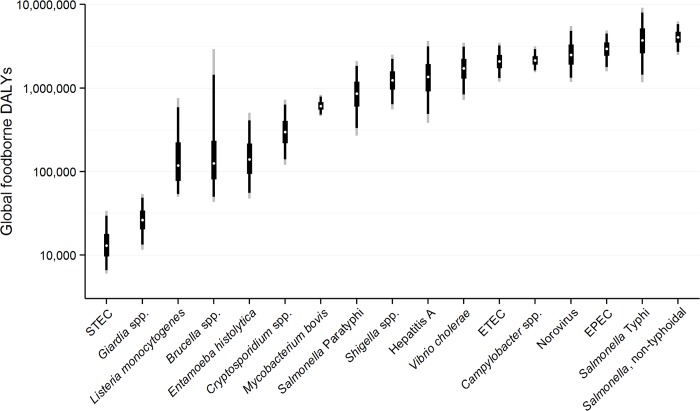
We estimate that the 22 diseases included in our study resulted in two billion cases, over one million deaths, and 78.7 million DALYs in 2010.
Overview
CoChat Summary
## TL;DR
This paper provides the first WHO-led global and regional estimates of the burden of 22 foodborne bacterial, protozoal, and viral diseases in 2010. It estimates 2.0 billion illnesses, 1.09 million deaths, 78.7 million DALYs, and 582 million foodborne cases, with a large share of burden in children under 5.
## Key findings
- The 22 diseases caused an estimated 2.0 billion illnesses (95% UI 1.5–3.0 billion) in 2010; 39% (95% UI 26–53%) were in children <5 years.
- They caused 1.09 million deaths (95% UI 0.89–1.37 million); 34% (95% UI 29–38%) were in children <5 years.
- They caused 78.7 million DALYs (95% UI 65.0–97.7 million); 43% (95% UI 38–48%) were in children <5 years.
- The authors estimate 29% (95% UI 23–36%) of all cases were transmitted by contaminated food, equal to 582 million foodborne cases (95% UI 401–922 million) and 25.2 million foodborne DALYs (95% UI 17.5–37.0 million).
- Norovirus was the leading cause of foodborne illness, with 125 million (95% UI 70–251 million) foodborne cases; Campylobacter spp. caused 96 million (95% UI 52–177 million).
- Of foodborne DALYs, the largest burden came from nontyphoidal S. enterica if iNTS was included: 4.07 million DALYs (95% UI 2.49–6.27 million).
- Foodborne disease mortality and DALY rates were reported as highest in the African region, followed by the South East Asian region.
## Methods
- The study synthesized global and regional burden estimates for 22 foodborne diseases using the WHO FERG Enteric Diseases Task Force framework, combining literature reviews, systematic reviews, cohort studies, surveillance studies, expert consultation, and existing burden-of-disease assessments.
- The team estimated cases, sequelae, deaths, and DALYs for 2010, using pathogen-specific approaches: national estimates where available, a modified CHERG approach for diarrheal diseases in many countries, GBD 2010/IHME data for typhoid, paratyphoid, and hepatitis A, and expert elicitation to estimate the proportion transmitted by food.
- Uncertainty was propagated with Monte Carlo simulations using 10,000 draws per input parameter to generate 95% uncertainty intervals.
## Limitations
- The paper states that a major limitation was data gaps, especially in middle- and high-mortality countries, and that for many regions and pathogens the available data were sparse.
- It also states that only a few sequelae were included, with post-infectious sequelae such as reactive arthritis and irritable bowel syndrome excluded; stillbirths were excluded as well.
- The authors note that they could not fully account for age-specific effects for sequelae and could not separate some effects from comorbidities such as HIV infection.
- The text also makes evident, by its own description, that many estimates relied on expert elicitation for foodborne attribution and on assumptions/substitution where direct data were absent; this increases uncertainty and is part of the paper’s stated limitation.
Model-written summary. Check it against the paper before relying on it.
Integrity signals
Registry
Cites
Statistics
Figures
Verification
Claims the paper makes
3 Valid · 0 Not valid · 4 Not checked · 29 Own results and interpretations
The cited sources support only part of this claim — read each source’s verdict below.
In the paper
“Furthermore, global and regional estimates of the burden of foodborne diseases have not been available [1,2].”
§ World Health Organization Estimates of the Global and Regional Disease Burden of 22 Foodborne Bacterial, Protozoal, and Viral Diseases, 2010: A Data Synthesis > Introduction
What the sources say
- Partly supportedcites [1] Stein C, Kuchenmuller T, Hendrickx S, Prüss-Űstün A, Wolfson L, Engels D, et al The Global Burden of Disease assessments—WHO is responsible? PLoS Negl Trop Dis. 2007; 1: e161 10.1371/journal.pntd.0000161 18160984 PMC2154395 sourceExperimental — accuracy not yet measured
The Foodborne diseases section says that the full extent of the burden is unknown and that no precise, consistent global information existed at the time. It does not specifically address regional estimates, and its wording is narrower than saying no global estimates were available at all. No page number is provided in our copy. (LLM, conf=0.84)
- Not checked — no full text of the sourcecites [2] Tauxe RV, Doyle MP, Kuchenmuller T, Schlundt J, Stein CE. Evolving public health approaches to the global challenge of foodborne infections. Int J Food Microbiol. 2010; 139 Suppl 1: S16– 28. 10.1016/j.ijfoodmicro.2009.10.014 19931203 source
plain- Asserted: passes — The authors put it forward as true.
- Checkable: passes — It can be checked against evidence.
- Load-bearing: passes — The paper’s conclusions depend on it.
- Based: passes — The paper gives a reason why it holds.
- Partly supported
A result the paper reports from its own data — it cites no other source for it, so there is none to check. The quote shows it is in the paper.
In the paper
“Overall, 29% (95% UI 23–36%) of all 22 diseases were estimated to be transmitted by contaminated food equating to 582 million (95% UI 400–922 million) foodborne cases in 2010; 38% (95% UI 24–53%) in children <5 years of age.”
§ World Health Organization Estimates of the Global and Regional Disease Burden of 22 Foodborne Bacterial, Protozoal, and Viral Diseases, 2010: A Data Synthesis > Results > Cases
hedged- Asserted: passes — The authors put it forward as true.
- Checkable: passes — It can be checked against evidence.
- Load-bearing: passes — The paper’s conclusions depend on it.
- Based: passes — The paper gives a reason why it holds.
- Rests on an assumption not shown here.
A result the paper reports from its own data — it cites no other source for it, so there is none to check. The quote shows it is in the paper.
In the paper
“Among the 11 diarrheal diseases, the rate ratio of foodborne cases occurring among children <5 years of age compared to those ≥5 years of age was 6.44 (95%UI 3.15–12.46).”
§ World Health Organization Estimates of the Global and Regional Disease Burden of 22 Foodborne Bacterial, Protozoal, and Viral Diseases, 2010: A Data Synthesis > Results > Cases
plainstates an association- Asserted: passes — The authors put it forward as true.
- Checkable: passes — It can be checked against evidence.
- Load-bearing: unclear — It is unclear whether the paper’s conclusions depend on it.
- Based: passes — The paper gives a reason why it holds.
- Rests on 2 assumptions not shown here.
A result the paper reports from its own data — it cites no other source for it, so there is none to check. The quote shows it is in the paper.
In the paper
“Norovirus was the leading cause of foodborne illness causing 125 million (95% UI 70–251 million) cases, while Campylobacter spp. caused 96 million (95% UI 52–177 million) foodborne illnesses.”
§ World Health Organization Estimates of the Global and Regional Disease Burden of 22 Foodborne Bacterial, Protozoal, and Viral Diseases, 2010: A Data Synthesis > Abstract > Methods and Findings
plainstates a cause- Asserted: passes — The authors put it forward as true.
- Checkable: passes — It can be checked against evidence.
- Load-bearing: unclear — It is unclear whether the paper’s conclusions depend on it.
- Based: passes — The paper gives a reason why it holds.
In the paper
“The FERG estimate for DALYs for nontyphoidal S. enterica combining diarrheal and invasive infections was 4 times greater than GBD 2010 [54].”
§ World Health Organization Estimates of the Global and Regional Disease Burden of 22 Foodborne Bacterial, Protozoal, and Viral Diseases, 2010: A Data Synthesis > Discussion
What the sources say
- Not checked — no full text of the sourcecites [54] Murray CJ, Vos T, Lozano R, Naghavi M, Flaxman AD, Michaud C, et al Disability-adjusted life years (DALYs) for 291 diseases and injuries in 21 regions, 1990–2010: a systematic analysis for the Global Burden of Disease Study 2010. Lancet. 2012; 380: 2197– 2223. 10.1016/S0140-6736(12)61689-4 23245608 source
plain- Asserted: passes — The authors put it forward as true.
- Checkable: passes — It can be checked against evidence.
- Load-bearing: unclear — It is unclear whether the paper’s conclusions depend on it.
- Based: passes — The paper gives a reason why it holds.
16 more claims
Create a free account to see all 36 claims and to verify the 1 reference still open.
- Probably not a substantial claim. 11
- It may state two separate claims as one. 5
Claims other papers make about this one
Each is checked against this paper’s own text: does it say what the citing paper says it does?
The source backs part of the claim, not all of it — or backs it for a different population, condition or comparison.
In the citing paper
“Animal-based foods, like cow milk, can pose a risk for zoonotic enteric pathogen transmission42 although pasteurisation is an effective means for making milk safer.”
From Environmental and behavioural exposure pathways associated with diarrhoea and enteric pathogen detection in 5-month-old, periurban Kenyan infants: a cross-sectional study (2022) · cites this paper as [42]
Experimental — accuracy not yet measured
Citations
Cites
Lozano, R., Naghavi, M., Foreman, K., Lim, S., Shibuya, K., Aboyans, V., Abraham, J., Adair, T., Aggarwal, R., Ahn, S. Y., et al. (2012) · The Lancet · doi:10.1016/s0140-6736(12)61728-0 · Cited by 14,070 · cited 3×
“Twelve of the diseases included in our study were also included in the GBD 2010 study [25,26,54].”
Murray, C. J. L., Vos, T., Lozano, R., Naghavi, M., Flaxman, A. D., Michaud, C., Ezzati, M., Shibuya, K., Salomon, J. A., Abdalla, S., et al. (2012) · The Lancet · doi:10.1016/s0140-6736(12)61689-4 · Cited by 8,888
Foodborne illness acquired in the United States—Major pathogens
Scallan, E., Hoekstra, R. M., Angulo, F. J., Tauxe, R. V., Widdowson, M.-A., Roy, S. L., Jones, J. L., & Griffin, P. M. (2011) · Emerging Infectious Diseases · doi:10.3201/eid1701.p11101 · Cited by 7,657 · cited 1×
“Many different diseases, including those due to bacteria, viruses, parasites, chemicals, and prions, may be transmitted to humans by contaminated food [3].”
Self-citationSelected major risk factors and global and regional burden of disease
Ezzati, M., Lopez, A. D., Rodgers, A., Vander Hoorn, S., & Murray, C. J. (2002) · The Lancet · doi:10.1016/s0140-6736(02)11403-6 · Cited by 3,594
Kotloff, K. L., Nataro, J. P., Blackwelder, W. C., Nasrin, D., Farag, T. H., Panchalingam, S., Wu, Y., Sow, S. O., Sur, D., Breiman, R. F., et al. (2013) · The Lancet · doi:10.1016/s0140-6736(13)60844-2 · Cited by 3,560 · cited 1×
“This approach was facilitated by the availability of estimates of the envelope of diarrheal deaths, along with recent advances in diarrheal disease diagnosis, such as widespread application of polymerase chain reaction (PCR) for norovirus detection [20,49].”
The Global Burden of Nontyphoidal Salmonella Gastroenteritis
Majowicz, S. E., Musto, J., Scallan, E., Angulo, F. J., Kirk, M., O’Brien, S. J., Jones, T. F., Fazil, A., & Hoekstra, R. M. (2010) · Clinical Infectious Diseases · doi:10.1086/650733 · Cited by 2,442
Self-citationGlobal burden of childhood pneumonia and diarrhoea
Walker, C. L. F., Rudan, I., Liu, L., Nair, H., Theodoratou, E., Bhutta, Z. A., O'Brien, K. L., Campbell, H., & Black, R. E. (2013) · The Lancet · doi:10.1016/s0140-6736(13)60222-6 · Cited by 2,356 · cited 2×
“, “envelope” of diarrheal incidence) for 2010 by combining estimates of diarrheal incidence for children<5 years of age and persons 5 years of age [13,36].”
Self-citationThe global burden of typhoid fever.
Crump, J., Luby, S., & Mintz, E. (2004) · Bulletin of the World Health Organization · doi:10.1590/s0042-96862004000500008 · Cited by 2,172
Self-citationThe global burden of typhoid fever.
(2004) · Europe PMC (PubMed Central) · Cited by 1,965
Self-citationSalomon, J. A., Vos, T., Hogan, D. R., Gagnon, M., Naghavi, M., Mokdad, A., Begum, N., Shah, R., Karyana, M., Kosen, S., et al. (2012) · The Lancet · doi:10.1016/s0140-6736(12)61680-8 · Cited by 1,322 · cited 1×
“Disability weights for each clinical outcome for the enteric diseases were taken from the GBD 2010 study [47].”
Cited by
Items 1,401–1,500 of 1,631
Inflammatory Bowel Disease and the Upper Gastrointestinal Tract
Feakins, R. M. (2020) · Cambridge University Press eBooks · doi:10.1017/9781316823026.017
Normal Lower Gastrointestinal Mucosa
Feakins, R. M. (2020) · Cambridge University Press eBooks · doi:10.1017/9781316823026.018
Geboes, K., & Jouret‐Mourin, A. (2020) · Cambridge University Press eBooks · doi:10.1017/9781316823026.020
Non-Neoplastic Diseases of the Anal Canal
Moorghen, M. (2020) · Cambridge University Press eBooks · doi:10.1017/9781316823026.028
Andrews, T., & Campbell, F. (2020) · Cambridge University Press eBooks · doi:10.1017/9781316823026.014
Mei, X., Ma, B., Zhai, X., Zhang, A., Lei, C., Zuo, L., Yang, X., Tang, Y., Gao, Y., Zhou, C., et al. (2020) · Research Square · doi:10.21203/rs.3.rs-101170/v1
SARS CoV-2 nin (COVID-19) biyoinformatik destekli identifikasyonu
Timurkan, M. Ö., & Aydın, H. (2020) · Eurasian journal of veterinary sciences · doi:10.15312/eurasianjvetsci.2020.291
Mei, X., Ma, B., Zhai, X., Zhang, A., Lei, C., Zuo, L., Tang, Y., Yang, X., Gao, Y., Zhou, C., et al. (2020) · Research Square · doi:10.21203/rs.3.rs-77489/v1
Mass spectrometry to detect foodborne contaminants
Maslov, D. R. (2021) · Elsevier eBooks · doi:10.1016/b978-0-12-822360-4.00011-x · Cited by 1
Kelly, D., Jere, K. C., Darby, A. C., et al. (2021) · Access Microbiology · doi:10.1099/acmi.0.000203
“Human noroviruses (HuNoVs) are the main causative agents of acute gastroenteritis in the UK [1, 2], and are a leading cause of non-bacterial gastroenteritis globally [3, 4], responsible for 18 % of all cases of gastroenteritis [5].”
The Impacts of Salmonella Infection on Human Cancer
Kato, I., & Sun, J. (2021) · Physiology in health and disease · doi:10.1007/978-3-030-67951-4_4 · Cited by 1
Zhou, H.-L., Bessey, T. K., Wang, S., et al. (2020) · Research Square · doi:10.21203/rs.3.rs-127428/v1
“However, surveillance for bacterial pathogens must continue, since these bacteria are all foodborne pathogens and can rapidly cause largescale outbreaks in certain circumstances (24).”
BackgroundAleem, A., Firak, G., & Slenker, A. K. (2021) · Cureus · doi:10.7759/cureus.14784
“, and non-typhoidal Salmonella infections [1].”
Medication Discrepancies Involving Hospitalized Children At A High-Complexity Public HospitalPreprint
de Lyra, D. P., Alcântara, T. D. S., Araújo-Neto, F. D. C., Lima, H. F., de Araújo, D. C. S. A., Sanchez, J. M., & de Lyra, D. P. (2020) · doi:10.21203/rs.2.17865/v2
Determinants of Food Safety Knowledge among University Students in Pakistan: A Cross-Sectional StudyPreprint
Ullah, A., Ahmad, W., Saeed, F., Sohaib, M., Shahbaz, H. M., Arshad, M. S., & Anjum, F. M. (2020) · doi:10.21203/rs.3.rs-35350/v1
“Additionally, as per Global Burden of Disease, it is envisaged that millions of humans are subject to food-borne illness largely governed by poor hygiene and food handling practices (Kirk et al. 2015).”
BackgroundAfridi, O. K., Ali, J., & Chang, J. H. (2020) · Research Square · doi:10.21203/rs.2.21973/v1
“Among the various foodborne pathogens, Salmonella, Campylobacter, Listeria, Escherichia, Shigella, Yersinia, and Vibrio are the major microbial genera causing significant morbidity and mortality across the globe [16, 17].”
BackgroundEFFICACY OF SACCHAROMYCES BOULARDII IN THE MANAGEMENT OF ACUTE WATERY DIARRHEA
Munir, M., Shah, S. A., Zaman, S., et al. (2021) · Pakistan Armed Forces Medical Journal · doi:10.51253/pafmj.v71i2.3742
Seribelli, A. A. (2021) · Digital Library of Theses and Dissertations (Universidade de São Paulo) · doi:10.11606/t.60.2021.tde-29092021-052421
Saitta, F., Mazzini, S., Mattio, L. M., Signorelli, M., Dallavalle, S., Pinto, A., & Fessas, D. (2021) · Food & Function · doi:10.1039/d1fo01982a
Руслановна, М. Е., Ushakova, A. Y., Khadisova, M. K., Stashko, T. V., & Antonenko, A. N. (2021) · Meditsinskiy sovet = Medical Council · doi:10.21518/2079-701x-2021-17-163-173
Baker, K. K., Mumma, J. A. O., Simiyu, S. N., Sewell, D. K., Tsai, K. J., Anderson, J., MacDougall, A. M., Dreibelbis, R., & Cumming, O. (2021) · medRxiv · doi:10.1101/2021.11.13.21266307
Подготовка будущего учителя к реализации гендерного подхода
Ринатовна, З. А., & Александровна, А. Л. (2013) · Филология и культура
Carroll, L. M., Pierneef, R., Mathole, A., Atanda, A. C., & Matle, I. (2022) · bioRxiv (Cold Spring Harbor Laboratory) · doi:10.1101/2022.01.18.476746
Ko, D. C. (2021) · Faculty Opinions – Post-Publication Peer Review of the Biomedical Literature · doi:10.3410/f.737872854.793585413
Profiling of humoral immune responses to norovirus in children across EuropePreprint
Villabruna, N., Izquierdo-Lara, R. W., Schapendonk, C. M. E., de Bruin, E., Chandler, F. D., Thao, T. T. N., Westerhuis, B. M., van Beek, J., Sigfrid, L., Giaquinto, C., et al. (2022) · medRxiv · doi:10.1101/2022.02.04.22270402
Ho-Yen, C., & Chang, F. (2020) · Cambridge University Press eBooks · doi:10.1017/9781316823026.016
Feakins, R. M. (2020) · Cambridge University Press eBooks · doi:10.1017/9781316823026.001
Clarke, L., & Feakins, R. M. (2020) · Cambridge University Press eBooks · doi:10.1017/9781316823026.015
Pendyala, B., Patras, A., Gopisetty, V. V. S., et al. (2022) · bioRxiv (Cold Spring Harbor Laboratory) · doi:10.1101/2022.02.22.481446
A quantitative risk metric to support individual sanitary measure reviews in international trade
Ebel, E. D., Kause, J. R., Williams, M. S., Schlosser, W. D., Defibaugh-Chávez, S., & Tameru, B. (2022) · International Journal of Food Microbiology · doi:10.1016/j.ijfoodmicro.2022.109616
Forecasting chronic diseases in Africans – Evidence from an immigrant population cohort experience
Rennert, G., Rennert, H. S., Saliba, W. I., Kebede, A., Yifru, S., Rennert, L. V., & Worku, A. G. (2022) · Journal of Epidemiological Research · doi:10.5430/jer.v8n1p1
Johnson, J. A., Read, T. D., Petit, R. A., Marconi, V. C., Meagley, K. L., Rodriguez‐Barradas, M. C., Beenhouwer, D. O., Brown, S. T., Holodniy, M., Lucero-Obusan, C. A., et al. (2022) · Open Forum Infectious Diseases · doi:10.1093/ofid/ofac125
“Norovirus causes 19–21 million cases of acute gastroenteritis (AGE) in the United States annually [7], with persons >65 years of age at greatest risk for norovirus-associated deaths [8].”
BackgroundSelf-citationFoba, I., & Al, E. (2022) · Revue Malienne d Infectiologie et de Microbiologie · doi:10.53597/remim.v17i1.2229
Medication Discrepancies Involving Hospitalized Children At A High-Complexity Public HospitalPreprint
de Lyra, D. P., Alcântara, T. D. S., Araújo-Neto, F. D. C., Lima, H. F., de Araújo, D. C. S. A., Sanchez, J. M., & de Lyra, D. P. (2019) · doi:10.21203/rs.2.17865/v1
Belaia, O. F., Paevskaya, O. A., Zuevskaya, S. N., et al. (2017) · Epidemiology and Infectious Diseases · doi:10.17816/eid42631
Taylor-Robinson, A. W. (2019) · SM Tropical Medicine Journal · doi:10.36876/smtmj.1019
Seribelli, A. A., da Silva, P., da Cruz, M., et al. (2020) · Research Square · doi:10.21203/rs.3.rs-117208/v1
Mustafa, U.-K., Zacharia, A., & Mushi, V. P. (2020) · doi:10.21203/rs.3.rs-40609/v1
Feakins, R. M. (2020) · Cambridge University Press eBooks · doi:10.1017/9781316823026.029
Healy, J. M., Plumb, I. D., & Bruce, B. B. (2020) · American Public Health Association eBooks · doi:10.2105/ccdmc.3087.115
Wimberly, B. T., Bilodeau, D. Y., Rissland, O. S., & Kieft, J. S. (2022) · bioRxiv (Cold Spring Harbor Laboratory) · doi:10.1101/2022.05.12.491643
Gonzales, J. C. (2022) · Digital Library of Theses and Dissertations (Universidade de São Paulo) · doi:10.11606/t.60.2022.tde-18052022-090320
Alsultan, A. A., & Elhadi, N. (2022) · Research Square · doi:10.21203/rs.3.rs-1807488/v1
Hanna, J. N., Ndip, R. A., Ngemenya, M. N., et al. (2022) · SSRN Electronic Journal · doi:10.2139/ssrn.4094947
Swai, A. Z., Mukasa, O., Mzimbiri, R. I., et al. (2022) · Asian Journal of Pediatric Research · doi:10.9734/ajpr/2022/v9i330267
“Although the number of deaths from this disorder have dropped globally by more than 55% since 2000 [1,2], the effects it imposes on morbidity and mortality are still significant.”
BackgroundTodd, E. C. D. (2022) · Elsevier eBooks · doi:10.1016/b978-0-12-822521-9.00064-2
Pattern of Skin Diseases in Al Baha Region of Saudi Arabia
Zahrani, A. S., Adnan, A. M., Sadeq, A. G., et al. (2022) · International Journal of Life Science and Pharma Research · doi:10.22376/ijpbs/lpr.2022.12.6.sp24.l58-63
Survey of the Intestinal Bacterial Compositions of Three Sympatric Passeriformes Species
Masuda, H., Zarabadi, F. N., & Rifai, L. B. (2022) · Journal of Advances in Microbiology · doi:10.9734/jamb/2022/v22i12689
“Although our study does not allow identification of specific function, some of the members of these genera are known pathogens [45].”
BackgroundAyechu-Muruzabal, V. (2022) · Utrecht University Repository (Utrecht University) · doi:10.33540/1552
Cruz, E., Haeberle, A., Westerman, T. L., Durham, M. E., Suyemoto, M. M., Knodler, L., & Elfenbein, J. R. (2022) · bioRxiv (Cold Spring Harbor Laboratory) · doi:10.1101/2022.11.29.517730
Intolerance and other adverse reactions to foods—Overview
Mulé, P., Gabrielli, S., Nguyen, A., Prosty, C. J., & Ben‐Shoshan, M. (2022) · Elsevier eBooks · doi:10.1016/b978-0-323-96018-2.00013-4
Cepińska, A., Kołodziej, M., Podsiadły, E., & Szajewska, H. (2022) · JPGN Reports · doi:10.1097/pg9.0000000000000268 · Cited by 1
Chitosan nanoparticles as used against food pathogens
Hernández‐Patlan, D., Solís-Cruz, B., Hernández-Velasco, X., & Téllez‐Isaías, G. (2023) · Elsevier eBooks · doi:10.1016/b978-0-12-821663-7.00008-9 · Cited by 1
Multidrug-Resistant Salmonella spp. Isolated from Local Food Markets: Molecular Factors
Magthab, E. A., & Al-Bayati, A. M. S. (2023) · Journal for Research in Applied Sciences and Biotechnology · doi:10.55544/jrasb.2.2.18
Noroviruses, Sapoviruses, and Astroviruses
Sajewski, E. T., Vinjé, J., Glass, R. I., & Lopman, B. A. (2023) · Springer eBooks · doi:10.1007/978-1-4939-9544-8_20-2
Syahrul, F., Wahyuni, C. U., Adi, A. C., et al. (2023) · Journal of Public Health in Africa · doi:10.4081/jphia.2023.2546
Individual and Collective Effect of Lactic Acid Bacteria on Staphylococcus aureus
Tirumalai, P. S., Parihar, H., & Pathak, R. (2023) · Journal of Bacteriology & Mycology Open Access · doi:10.15406/jbmoa.2023.11.00350
Human Microbiome and the Susceptibility to Infections
Anju, V. T., Busi, S., Mohan, M. S., & Dyavaiah, M. (2023) · Springer eBooks · doi:10.1007/978-981-99-1463-0_7 · Cited by 1
Passos, T. F. (2023) · Digital Library of Theses and Dissertations (Universidade de São Paulo) · doi:10.11606/t.75.2023.tde-20062023-095827
Keracunan Permen Lunak pada Siswa Sekolah Dasar di Kota Blitar, Provinsi Jawa Timur
Arinta, S. N., Hidajah, A. C., & Saifudin, N. (2023) · Jurnal Kesehatan Poltekkes Ternate · doi:10.32763/juke.v16i1.850
Gut Microbiota Links With Disease
Ishiguro, E. E., Haskey, N., & Campbell, K. (2023) · Elsevier eBooks · doi:10.1016/b978-0-323-91387-4.00009-0
Antibiotic Resistance of Diverse MLST Campylobacter from Pediatric Patients with Acute DiarrheaPreprint
Hou, S., Mei, P., Shi, R., Chen, K., Pan, X., Chen, S., & Li, J. (2023) · Research Square · doi:10.21203/rs.3.rs-3008510/v1 · Cited by 1
Hua, M.-M., Li, J., Zheng, J., Wang, J.-J., Zhang, Y., Zhang, Z., Cao, X., & Shen, H. (2023) · Research Square · doi:10.21203/rs.3.rs-3220014/v1
Banoo, H., Banoo, K., Parveen, K., et al. (2023) · Research Square · doi:10.21203/rs.3.rs-3253802/v1
Marciano, M. A. M., da Silva, R. A., Barbosa, M. L., et al. (2022) · REVISTA DO INSTITUTO ADOLFO LUTZ · doi:10.53393/rial.2022.v81.37253
Brusa, V., Dolev, S., Signorini, M. L., & Leotta, G. A. (2023) · PLoS ONE · doi:10.1371/journal.pone.0290182
“Sometimes, the available epidemiological data do not discriminate HUS cases from other STEC illnesses (diarrhea, bloody diarrhea, hemorrhagic colitis), making it difficult to interpret and compare information, such as little quantitative information from countries and regions, paucity of data for incidence and DALY es…”
BackgroundRed meat safety from livestock to retail in Tanzania: Policy and practicePreprint
Hrynick, T. A., Davis, M. A., Swai, E. S., Benschop, J., Cleaveland, S., Crump, J. A., French, N. P., Karimuribo, E. D., Kazwala, R. R., Mariki, B., et al. (2023) · Research Square · doi:10.21203/rs.3.rs-3268979/v1
Self-citationTaddese, D., Abdurahaman, M., Debelo, M., et al. (2023) · Research Square · doi:10.21203/rs.3.rs-3268197/v1
Schröder, J. (2023) · CABI eBooks · doi:10.1079/9781800621985.0003
Introduction – Setting the Scene
Schröder, J. M. (2023) · CABI eBooks · doi:10.1079/9781800621985.0001
Cassini, A. (2023) · Utrecht University Repository (Utrecht University) · doi:10.33540/1881
Banah, O. A. (2023) · Queensland University of Technology · doi:10.5204/thesis.eprints.243155
Rafieepoor, M., Mohebbi, S. R., Hosseini, S. M., et al. (2023) · SSRN Electronic Journal · doi:10.2139/ssrn.4576536
Nguyen, T. H., Diaz, O. R., Rajendram, M., et al. (2023) · bioRxiv (Cold Spring Harbor Laboratory) · doi:10.1101/2023.09.27.559620
Arnaboldi, S., Righi, F., Mangeri, L., et al. (2023) · SSRN Electronic Journal · doi:10.2139/ssrn.4579004
Hua, M.-M., Li, J., Zheng, J., Wang, J.-J., Zhang, Y., Zhang, Z., Cao, X., & Shen, H. (2023) · Research Square · doi:10.21203/rs.3.rs-3415768/v1
AS CATEGORIAS DE INCERTEZAS NA INTELIGÊNCIA ARTIFICIAL EM HOSPITAIS: UMA REVISÃO DE LITERATURA
MAGALHÃES, G. H. D., Spínola, M. D. M., Matos, C. C. P., & Gonçalves, R. F. (2023) · Anais ... Encontro Nacional de Engenharia de Produção/Anais do Encontro Nacional de Engenharia de Produção · doi:10.14488/enegep2023_tn_st_404_1987_46298
Understanding Campylobacter coli isolates from the Vietnamese meat production network; a pilot studyPreprint
Lehri, B., Navoly, G., Corser, A., Nasher, F., Willcocks, S., Ngoc, P. T., Wren, B. W., Hương, L. Q., & Stabler, R. A. (2023) · bioRxiv (Cold Spring Harbor Laboratory) · doi:10.1101/2023.11.10.566519
(2023) · Food Science and Technology · doi:10.1002/fsat.3704_5.x
Quantitative Risk Assessment of Campylobacter in Whole Chicken During Retail in Changchun Region
Weiyu, Z., Xin, H., Dandan, N., et al. (2023) · International Journal of Microbiology and Biotechnology · doi:10.11648/j.ijmb.20230804.12
Ranjbarian, F., Rafie, K., Shankar, K., et al. (2023) · bioRxiv (Cold Spring Harbor Laboratory) · doi:10.1101/2023.12.18.572228
“…in liquid nitrogen and stored at -80°C. Enzyme assay of dAK. G. intestinalis dAK was incubated in 50 µl of buffer containing 2 mM ATP, 5 mM MgCl 2 , 0.5 mM DTT, 100 mM potassium acetate and 50 mM Tris-HCl pH 7.5, with various concentrations of [2,8-3 H]-deoxyadenosine at 37 C for 30 minutes.”
BackgroundMethodInfluentialInvestigation of a Clostridium botulinum mass poisoning and lessons learned, Ivory Coast, 2023
Kouassi, D. P., Soumahoro, S. I., Coulibaly, M., et al. (2023) · International Research Journal of Public and Environmental Health · doi:10.15739/irjpeh.24.004
Iliya, Y. (2023) · Journal of Interventional Epidemiology and Public Health · doi:10.37432/jieph.2023.6.2.78
Fakile, O. D., Solana, O. I., & Okolosi, J. E. (2023) · Journal of Food and Agriculture · doi:10.4038/jfa.v16i2.5285
Lawsonia intracellularis: INFECÇÃO E PROFILAXIA
Conrad, N. L., Mazzoleni, I., Costa, A. V., & Leite, F. P. L. (2023) · SCIENCE AND ANIMAL HEALTH · doi:10.15210/sah.v11i1.25860
Le, T. L. A., Ta, T. L., Dinh, T. M., Vũ, T. T., Pham, T. H. G., Bui, T. T. N., Pham, H. V., Nguyen, N. T., Trieu, P. L., Le, T. V. A., et al. (2024) · Problems of Particularly Dangerous Infections · doi:10.21055/0370-1069-2023-4-84-90 · Cited by 1
Prevention and control of milk-borne zoonoses
Choudhary, S., Sharma, P., & Gaur, A. (2024) · Elsevier eBooks · doi:10.1016/b978-0-443-13805-8.00002-8
Animal Models for Infectious Disease Vaccine Development
Al-Humadi, N. H., Wrzesinski, C., & O'Carroll, A. (2024) · Elsevier eBooks · doi:10.1016/b978-0-323-85704-8.00015-3
The Role of Enteric Infection and the Microbiome in Human Health and Disease
Riddle, M. S. (2023) · Springer eBooks · doi:10.1007/978-3-031-46712-7_3 · Cited by 1
Etiology of Acute Febrile Illnesses in Adults in the Defense Community in French Guiana
Velut, G., de Laval, F., Berry, M., et al. (2024) · American Journal of Tropical Medicine and Hygiene · doi:10.4269/ajtmh.22-0638
Waje, T., Iliyasu, C., Yaki, L. M., et al. (2024) · Current Clinical Microbiology Reports · doi:10.1007/s40588-024-00218-9
Global Health Problems in the World under the Conditions of the post-COVIDCrisis
Sarymsakova, B., Potapova, R. K., Duisekova, S., Saurbayeva, G., & Turgambayeva, A. K. (2022) · Journal of Health Development · doi:10.32921/2225-9929-2022-3-48-23-30
Investigation of the parasitic protozoa that cause diarrhea and their effect on GOT, GPT and ALP
Hamza, T. S. (2024) · Wasit Journal of Pure sciences · doi:10.31185/wjps.293
Prevalence and Genomic Characteristics of Becab-Carrying Clostridium Perfringens StrainsPreprint
Fang, M., Yuan, Y., Fox, E. M., et al. (2024) · SSRN Electronic Journal · doi:10.2139/ssrn.4780068
SALMONELLA DISEASE WITH A HEALTH MANAGEMENT PERSPECTIVE
Demiray, E. K. D., & Sayar, B. (2024) · IntechOpen eBooks · doi:10.5772/intechopen.1005026 · Cited by 1
Wang, Z., Chen, R., Xia, F., et al. (2023) · Figshare · doi:10.6084/m9.figshare.24628087
Huang, X., Yang, S., Zhao, J., et al. (2024) · SSRN Electronic Journal · doi:10.2139/ssrn.4821318
Toledo-Herrera, N., Rodriguez, J. S. L., Lozano, R. C., et al. (2024) · doi:10.31235/osf.io/bxmtu
Metadata
- Authors
- Kirk, M. D., Pires, S. M., Black, R. E., Caipo, M., Crump, J. A., Devleesschauwer, B., Döpfer, D., Fazil, A., Fischer-Walker, C. L., Hald, T., Hall, A. J., Keddy, K. H., Lake, R. J., Lanata, C. F., Torgerson, P. R., Havelaar, A. H., & Angulo, F. J.
- Affiliations
- Australian National University (AU)
- Technical University of Denmark (DK)
- Johns Hopkins University (US)
- Food and Agriculture Organization of the United Nations (IT)
- University of Otago (NZ)
- Ghent University (BE)
- University of Wisconsin–Madison (US)
- Public Health Agency of Canada (CA)
- Centers for Disease Control and Prevention (US)
- University of the Witwatersrand (ZA)
- New Zealand Institute for Public Health and Forensic Science (NZ)
- Instituto de Investigación Nutricional (PE)
- University of Zurich (CH)
- Utrecht University (NL)
- Corresponding author
- Kirk, Martyn D.
- ORCID
- Venue
- PLoS Medicine
- Publisher
- Public Library of Science (PLoS)
- Published
- 2015-12-03
- Volume
- 12
- Issue
- 12
- Pages
- e1001921
- ISSN
- 1549-1277 (ISSN-L)
- 1549-1676
- PMC
- PMC4668831
- OpenAlex
- W2184405267
- Cited by
- 1,625
- References
- 58
- Citations by year
- 2026: 76 · 2025: 120 · 2024: 172 · 2023: 189 · 2022: 168 · 2021: 202 · 2020: 237 · 2019: 158 · 2018: 130 · 2017: 107 · 2016: 60 · 2015: 5
- FWCI
- 12.61
- Type
- journal article
- Language
- en
- Update notices
- correction (2015-12-23)
- Open access
- gold
- doi.org
- Licence
- Locations
- PLoS Medicine (publishedVersion, cc-by)
- Europe PMC (PubMed Central) (publishedVersion, cc-by)
- PubMed Central (publishedVersion, cc-by)
- PubMed (publishedVersion)
- IHI Repository (acceptedVersion)
- Zurich Open Repository and Archive (University of Zurich) (acceptedVersion, cc-by)
- Ghent University Academic Bibliography (Ghent University) (submittedVersion, other-oa)
- DOAJ (DOAJ: Directory of Open Access Journals) (submittedVersion, cc-by-sa)
- Utrecht University Repository (Utrecht University) (submittedVersion, other-oa)
- Figshare (submittedVersion, cc-by)
- ANU Open Research (Australian National University) (submittedVersion)
- Technical University of Denmark, DTU Orbit (Technical University of Denmark, DTU) (submittedVersion, other-oa)
- Rivm (National Institute for Public Health and the Environment) (submittedVersion)
- Zurich Open Repository and Archive (University of Zurich) (submittedVersion, cc-by)
- Zurich Open Repository and Archive (University of Zurich)
- Funders
- Bill and Melinda Gates Foundation
- World Health Organization
- Institute for Health Metrics and Evaluation
- Topics
- Life Sciences › Agricultural and Biological Sciences › Food Science › Salmonella and Campylobacter epidemiology
- Life Sciences › Agricultural and Biological Sciences › Food Science › Food Safety and Hygiene
- Health Sciences › Medicine › Infectious Diseases › Viral gastroenteritis research and epidemiology
- Keywords
- food poisoning, disease burden, disability-adjusted life years, norovirus, Campylobacter, Salmonella, Escherichia coli, Vibrio cholerae, Mycobacterium bovis, invasive non-typhoidal Salmonella, food contamination, diarrheal disease, foodborne parasitic infection
- MeSH terms
- Foodborne Diseases, Humans, Global Health, World Health Organization, Incidence, Prevalence, Cost of Illness, Quality-Adjusted Life Years
About these checks
Registry, retraction, Cites and statistics results are computed, not judged, with one exception: a printed reference that no index lists is read once by a model before it counts as a citation error. Claims are extracted by a model and kept only when their quote appears verbatim in the text; each cited source is then checked, with a model’s help, for whether it says what the claim relies on. Those verdicts can be wrong — read the claim’s quote and the cited source before relying on one.
The claim verdicts this report counts are experimental: their accuracy is not yet measured.
A language model drew the claims from the paper on 2026-10-10, under version 3 of the claim definition (model deepseek-v4.1-flash, prompt extract-v3).
A second model labelled each claim on 2026-10-10 (model jev-1.13-20260917, definition revision gold-guideline-v0.2).
Cited sources are checked with a language model’s help (gpt-6-sol).
Statistics and arithmetic are recomputed, not judged.
Confidence bands are shown only for fields calibrated on our annotated test set. None is calibrated yet, so no band is shown.
What counts as a claim ›How we measure confidence ›How we check this ›
Are you an author, or do you see a problem with this page? Request a review
Data sources
Bibliographic data: Semantic Scholar, OpenAlex, Crossref.
Contains information from the Semantic Scholar Academic Graph Datasets, made available under the ODC Attribution License (ODC-BY 1.0).
Semantic Scholar’s data is described in: Kinney, R., et al. (2023). The Semantic Scholar Open Data Platform. arXiv:2301.10140.
