

World Health Organization Estimates of the Global and Regional Disease Burden of 22 Foodborne Bacterial, Protozoal, and Viral Diseases, 2010: A Data Synthesis.
Open accessThe DOI matches its Crossref record; 57 of the 58 references it cites were found in a registry or an index; 3 of the 9 sources its claims cite were checked for support.
Abstract
We estimate that the 22 diseases included in our study resulted in two billion cases, over one million deaths, and 78.7 million DALYs in 2010.
Overview
CoChat Summary
## TL;DR
This paper provides the first WHO-led global and regional estimates of the burden of 22 foodborne bacterial, protozoal, and viral diseases in 2010. It estimates 2.0 billion illnesses, 1.09 million deaths, 78.7 million DALYs, and 582 million foodborne cases, with a large share of burden in children under 5.
## Key findings
- The 22 diseases caused an estimated 2.0 billion illnesses (95% UI 1.5–3.0 billion) in 2010; 39% (95% UI 26–53%) were in children <5 years.
- They caused 1.09 million deaths (95% UI 0.89–1.37 million); 34% (95% UI 29–38%) were in children <5 years.
- They caused 78.7 million DALYs (95% UI 65.0–97.7 million); 43% (95% UI 38–48%) were in children <5 years.
- The authors estimate 29% (95% UI 23–36%) of all cases were transmitted by contaminated food, equal to 582 million foodborne cases (95% UI 401–922 million) and 25.2 million foodborne DALYs (95% UI 17.5–37.0 million).
- Norovirus was the leading cause of foodborne illness, with 125 million (95% UI 70–251 million) foodborne cases; Campylobacter spp. caused 96 million (95% UI 52–177 million).
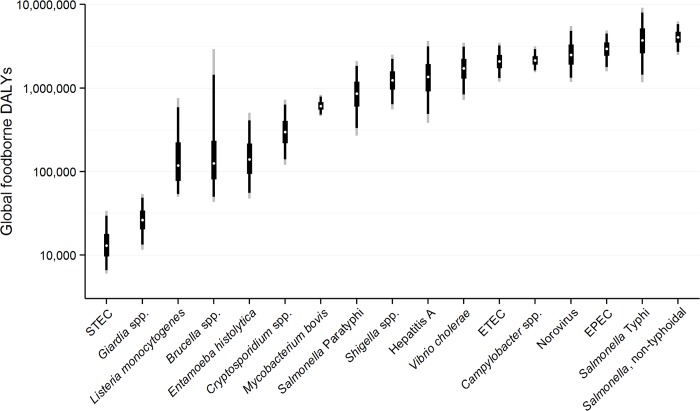
- Of foodborne DALYs, the largest burden came from nontyphoidal S. enterica if iNTS was included: 4.07 million DALYs (95% UI 2.49–6.27 million).
- Foodborne disease mortality and DALY rates were reported as highest in the African region, followed by the South East Asian region.
## Methods
- The study synthesized global and regional burden estimates for 22 foodborne diseases using the WHO FERG Enteric Diseases Task Force framework, combining literature reviews, systematic reviews, cohort studies, surveillance studies, expert consultation, and existing burden-of-disease assessments.
- The team estimated cases, sequelae, deaths, and DALYs for 2010, using pathogen-specific approaches: national estimates where available, a modified CHERG approach for diarrheal diseases in many countries, GBD 2010/IHME data for typhoid, paratyphoid, and hepatitis A, and expert elicitation to estimate the proportion transmitted by food.
- Uncertainty was propagated with Monte Carlo simulations using 10,000 draws per input parameter to generate 95% uncertainty intervals.
## Limitations
- The paper states that a major limitation was data gaps, especially in middle- and high-mortality countries, and that for many regions and pathogens the available data were sparse.
- It also states that only a few sequelae were included, with post-infectious sequelae such as reactive arthritis and irritable bowel syndrome excluded; stillbirths were excluded as well.
- The authors note that they could not fully account for age-specific effects for sequelae and could not separate some effects from comorbidities such as HIV infection.
- The text also makes evident, by its own description, that many estimates relied on expert elicitation for foodborne attribution and on assumptions/substitution where direct data were absent; this increases uncertainty and is part of the paper’s stated limitation.
Model-written summary. Check it against the paper before relying on it.
Integrity signals
Registry
Cites
Statistics
Figures
Verification
Claims the paper makes
3 Valid · 0 Not valid · 4 Not checked · 29 Own results and interpretations
The cited sources support only part of this claim — read each source’s verdict below.
In the paper
“Furthermore, global and regional estimates of the burden of foodborne diseases have not been available [1,2].”
§ World Health Organization Estimates of the Global and Regional Disease Burden of 22 Foodborne Bacterial, Protozoal, and Viral Diseases, 2010: A Data Synthesis > Introduction
What the sources say
- Partly supportedcites [1] Stein C, Kuchenmuller T, Hendrickx S, Prüss-Űstün A, Wolfson L, Engels D, et al The Global Burden of Disease assessments—WHO is responsible? PLoS Negl Trop Dis. 2007; 1: e161 10.1371/journal.pntd.0000161 18160984 PMC2154395 sourceExperimental — accuracy not yet measured
The Foodborne diseases section says that the full extent of the burden is unknown and that no precise, consistent global information existed at the time. It does not specifically address regional estimates, and its wording is narrower than saying no global estimates were available at all. No page number is provided in our copy. (LLM, conf=0.84)
- Not checked — no full text of the sourcecites [2] Tauxe RV, Doyle MP, Kuchenmuller T, Schlundt J, Stein CE. Evolving public health approaches to the global challenge of foodborne infections. Int J Food Microbiol. 2010; 139 Suppl 1: S16– 28. 10.1016/j.ijfoodmicro.2009.10.014 19931203 source
plain- Asserted: passes — The authors put it forward as true.
- Checkable: passes — It can be checked against evidence.
- Load-bearing: passes — The paper’s conclusions depend on it.
- Based: passes — The paper gives a reason why it holds.
- Partly supported
A result the paper reports from its own data — it cites no other source for it, so there is none to check. The quote shows it is in the paper.
In the paper
“Overall, 29% (95% UI 23–36%) of all 22 diseases were estimated to be transmitted by contaminated food equating to 582 million (95% UI 400–922 million) foodborne cases in 2010; 38% (95% UI 24–53%) in children <5 years of age.”
§ World Health Organization Estimates of the Global and Regional Disease Burden of 22 Foodborne Bacterial, Protozoal, and Viral Diseases, 2010: A Data Synthesis > Results > Cases
hedged- Asserted: passes — The authors put it forward as true.
- Checkable: passes — It can be checked against evidence.
- Load-bearing: passes — The paper’s conclusions depend on it.
- Based: passes — The paper gives a reason why it holds.
- Rests on an assumption not shown here.
A result the paper reports from its own data — it cites no other source for it, so there is none to check. The quote shows it is in the paper.
In the paper
“Among the 11 diarrheal diseases, the rate ratio of foodborne cases occurring among children <5 years of age compared to those ≥5 years of age was 6.44 (95%UI 3.15–12.46).”
§ World Health Organization Estimates of the Global and Regional Disease Burden of 22 Foodborne Bacterial, Protozoal, and Viral Diseases, 2010: A Data Synthesis > Results > Cases
plainstates an association- Asserted: passes — The authors put it forward as true.
- Checkable: passes — It can be checked against evidence.
- Load-bearing: unclear — It is unclear whether the paper’s conclusions depend on it.
- Based: passes — The paper gives a reason why it holds.
- Rests on 2 assumptions not shown here.
A result the paper reports from its own data — it cites no other source for it, so there is none to check. The quote shows it is in the paper.
In the paper
“Norovirus was the leading cause of foodborne illness causing 125 million (95% UI 70–251 million) cases, while Campylobacter spp. caused 96 million (95% UI 52–177 million) foodborne illnesses.”
§ World Health Organization Estimates of the Global and Regional Disease Burden of 22 Foodborne Bacterial, Protozoal, and Viral Diseases, 2010: A Data Synthesis > Abstract > Methods and Findings
plainstates a cause- Asserted: passes — The authors put it forward as true.
- Checkable: passes — It can be checked against evidence.
- Load-bearing: unclear — It is unclear whether the paper’s conclusions depend on it.
- Based: passes — The paper gives a reason why it holds.
In the paper
“The FERG estimate for DALYs for nontyphoidal S. enterica combining diarrheal and invasive infections was 4 times greater than GBD 2010 [54].”
§ World Health Organization Estimates of the Global and Regional Disease Burden of 22 Foodborne Bacterial, Protozoal, and Viral Diseases, 2010: A Data Synthesis > Discussion
What the sources say
- Not checked — no full text of the sourcecites [54] Murray CJ, Vos T, Lozano R, Naghavi M, Flaxman AD, Michaud C, et al Disability-adjusted life years (DALYs) for 291 diseases and injuries in 21 regions, 1990–2010: a systematic analysis for the Global Burden of Disease Study 2010. Lancet. 2012; 380: 2197– 2223. 10.1016/S0140-6736(12)61689-4 23245608 source
plain- Asserted: passes — The authors put it forward as true.
- Checkable: passes — It can be checked against evidence.
- Load-bearing: unclear — It is unclear whether the paper’s conclusions depend on it.
- Based: passes — The paper gives a reason why it holds.
16 more claims
Create a free account to see all 36 claims and to verify the 1 reference still open.
- Probably not a substantial claim. 11
- It may state two separate claims as one. 5
Claims other papers make about this one
Each is checked against this paper’s own text: does it say what the citing paper says it does?
The source backs part of the claim, not all of it — or backs it for a different population, condition or comparison.
In the citing paper
“Animal-based foods, like cow milk, can pose a risk for zoonotic enteric pathogen transmission42 although pasteurisation is an effective means for making milk safer.”
From Environmental and behavioural exposure pathways associated with diarrhoea and enteric pathogen detection in 5-month-old, periurban Kenyan infants: a cross-sectional study (2022) · cites this paper as [42]
Experimental — accuracy not yet measured
Citations
Cites
Lozano, R., Naghavi, M., Foreman, K., Lim, S., Shibuya, K., Aboyans, V., Abraham, J., Adair, T., Aggarwal, R., Ahn, S. Y., et al. (2012) · The Lancet · doi:10.1016/s0140-6736(12)61728-0 · Cited by 14,070 · cited 3×
“Twelve of the diseases included in our study were also included in the GBD 2010 study [25,26,54].”
Murray, C. J. L., Vos, T., Lozano, R., Naghavi, M., Flaxman, A. D., Michaud, C., Ezzati, M., Shibuya, K., Salomon, J. A., Abdalla, S., et al. (2012) · The Lancet · doi:10.1016/s0140-6736(12)61689-4 · Cited by 8,888
Foodborne illness acquired in the United States—Major pathogens
Scallan, E., Hoekstra, R. M., Angulo, F. J., Tauxe, R. V., Widdowson, M.-A., Roy, S. L., Jones, J. L., & Griffin, P. M. (2011) · Emerging Infectious Diseases · doi:10.3201/eid1701.p11101 · Cited by 7,657 · cited 1×
“Many different diseases, including those due to bacteria, viruses, parasites, chemicals, and prions, may be transmitted to humans by contaminated food [3].”
Self-citationSelected major risk factors and global and regional burden of disease
Ezzati, M., Lopez, A. D., Rodgers, A., Vander Hoorn, S., & Murray, C. J. (2002) · The Lancet · doi:10.1016/s0140-6736(02)11403-6 · Cited by 3,594
Kotloff, K. L., Nataro, J. P., Blackwelder, W. C., Nasrin, D., Farag, T. H., Panchalingam, S., Wu, Y., Sow, S. O., Sur, D., Breiman, R. F., et al. (2013) · The Lancet · doi:10.1016/s0140-6736(13)60844-2 · Cited by 3,560 · cited 1×
“This approach was facilitated by the availability of estimates of the envelope of diarrheal deaths, along with recent advances in diarrheal disease diagnosis, such as widespread application of polymerase chain reaction (PCR) for norovirus detection [20,49].”
The Global Burden of Nontyphoidal Salmonella Gastroenteritis
Majowicz, S. E., Musto, J., Scallan, E., Angulo, F. J., Kirk, M., O’Brien, S. J., Jones, T. F., Fazil, A., & Hoekstra, R. M. (2010) · Clinical Infectious Diseases · doi:10.1086/650733 · Cited by 2,442
Self-citationGlobal burden of childhood pneumonia and diarrhoea
Walker, C. L. F., Rudan, I., Liu, L., Nair, H., Theodoratou, E., Bhutta, Z. A., O'Brien, K. L., Campbell, H., & Black, R. E. (2013) · The Lancet · doi:10.1016/s0140-6736(13)60222-6 · Cited by 2,356 · cited 2×
“, “envelope” of diarrheal incidence) for 2010 by combining estimates of diarrheal incidence for children<5 years of age and persons 5 years of age [13,36].”
Self-citationThe global burden of typhoid fever.
Crump, J., Luby, S., & Mintz, E. (2004) · Bulletin of the World Health Organization · doi:10.1590/s0042-96862004000500008 · Cited by 2,172
Self-citationThe global burden of typhoid fever.
(2004) · Europe PMC (PubMed Central) · Cited by 1,965
Self-citationSalomon, J. A., Vos, T., Hogan, D. R., Gagnon, M., Naghavi, M., Mokdad, A., Begum, N., Shah, R., Karyana, M., Kosen, S., et al. (2012) · The Lancet · doi:10.1016/s0140-6736(12)61680-8 · Cited by 1,322 · cited 1×
“Disability weights for each clinical outcome for the enteric diseases were taken from the GBD 2010 study [47].”
Cited by
Items 701–800 of 1,631
Risk factors for sporadic cryptosporidiosis: A systematic review and meta-analysis
Kooh, P., Thébault, A., Cadavez, V., et al. (2020) · Microbial Risk Analysis · doi:10.1016/j.mran.2020.100116 · Cited by 14
Estimating the distribution of norovirus in individual oysters
Hunt, K., Doré, B., Keaveney, S., Rupnik, A., & Butler, F. (2020) · International Journal of Food Microbiology · doi:10.1016/j.ijfoodmicro.2020.108785 · Cited by 15
RW-BP100-4D, a Promising Antimicrobial Candidate With Broad-Spectrum Bactericidal Activity
Tong, X., Li, J., Wei, R., Gong, L., Ji, X., He, T., & Wang, R. (2022) · Frontiers in Microbiology · doi:10.3389/fmicb.2021.815980 · Cited by 16
“were the main foodborne pathogens commonly identified in food poisoning incidences (Kirk et al., 2015), and S.”
BackgroundCarroll, L. M., Pierneef, R., Mathole, A., Atanda, A. C., & Matle, I. (2022) · Microbiology Spectrum · doi:10.1128/spectrum.00700-22 · Cited by 16
“cereus” 66 is estimated to be responsible for more than 256,000 illnesses globally each year (18), although 67 this is likely an underestimate, due to the relatively mild and self-limiting nature of the symptoms 68 that often accompany foodborne illness caused by B.”
BackgroundMcClure, M., Nsubuga, J., Montgomery, M. P., Jenkins, E. C., Crosby, A. J., Schoelen, D., Basler, C. A., Ramachandran, S., Lin, Y., Xia, G.-L., et al. (2022) · Food and Environmental Virology · doi:10.1007/s12560-022-09527-y · Cited by 15
Thobani, R., Yousafzai, M. T., Sultana, S., Kazi, A. M., Jan, M., Rafey, A., Khan, A., Irfan, S., Ujjan, I. U., Brown, N., et al. (2022) · Vaccine · doi:10.1016/j.vaccine.2022.06.072 · Cited by 16
Orlando, B. J., Dominik, P. K., Roy, S., Ogbu, C. P., Erramilli, S. K., Kossiakoff, A. A., & Vecchio, A. J. (2022) · Journal of Biological Chemistry · doi:10.1016/j.jbc.2022.102357 · Cited by 12
“2 foodborne illness in the United States causing an estimated ~$400 million annual economic burden; and is the source of a further 4+ million food poisoning cases worldwide—some resulting in death (7, 9-12).”
BackgroundMolecular Identification of Pseudomonas aeruginosa from food borne isolates
Virupakshaiah, D. B. M., & Hemalata, V. B. (2016) · International Journal of Current Microbiology and Applied Sciences · doi:10.20546/ijcmas.2016.506.109 · Cited by 14
Newman, K. L., Bartz, F. E., Johnston, L. M., Moe, C. L., Jaykus, L., & León, J. S. (2017) · Journal of Food Protection · doi:10.4315/0362-028x.jfp-16-365 · Cited by 16
Rojas, J. D., Reynolds, N. D., Pike, B. L., Espinoza, N., Kuroiwa, J. M. Y., Jani, V., Ríos, P., Nunez, R. G., Yori, P. P., Bernal, M., et al. (2019) · American Journal of Tropical Medicine and Hygiene · doi:10.4269/ajtmh.18-0994 · Cited by 14
Kingsbury, J. M., Thom, K., Erskine, H., Olsen, L., & Soboleva, T. K. (2019) · Journal of Food Protection · doi:10.4315/0362-028x.jfp-19-159 · Cited by 14
Wagle, B. R., Donoghue, A. M., & Jesudhasan, P. R. R. (2021) · Frontiers in Microbiology · doi:10.3389/fmicb.2021.725087 · Cited by 14
“Campylobacter jejuni and Campylobacter coli are foodborne pathogens that cause gastroenteritis (campylobacteriosis) in humans and affect around 95 million people annually worldwide (Scallan et al., 2011; Kirk et al., 2015).”
BackgroundKeddy, K. H., Saha, S., Okeke, I. N., Kalule, J. B., Qamar, F. N., & Kariuki, S. (2021) · EBioMedicine · doi:10.1016/j.ebiom.2021.103668 · Cited by 14
“ridium spp (44,843,579 cases and 48,000 deaths) [7], Shigella spp (74,771,591 cases and 63,713 deaths), non-typhoidal Salmonella (15,274,234 cases and 12,531 deaths) [8] and enterotoxigenic Escherichia coli [ETEC] (51,186 cases and 18,669 deaths) [9].”
BackgroundSelf-citation(2020) · European Journal of Medical and Health Sciences · doi:10.34104/ejmhs.02001011 · Cited by 14
“According to a recent study (Kirk et al., 2015) commissioned by the WHO on the global disease burden of food-borne diseases in humans, food-borne illnesses from diarrheal and invasive non-typhoidal Salmonella enterica, resulted in the largest disease burden, highlighting the significant public…”
BackgroundShedding light on microRNA function via microscopy-based screening
Lopes, I. R., Silva, R. J., Caramelo, I., Eulálio, A., & Mano, M. (2018) · Methods · doi:10.1016/j.ymeth.2018.09.011 · Cited by 13
Ahmed, M. J., Hossain, M. I., Bhuiyan, M. I. H., Rahman, M. A., Kaderi, I. J., Nirob, A. I., Rahi, M. A. I., Mamun, M., Alam, K. E., Chowdhury, M. J., et al. (2025) · Poultry Science · doi:10.1016/j.psj.2025.105811 · Cited by 20
Foodborne infections in the Middle East
Habib, I., & Mohamed, M.-Y. I. (2021) · Elsevier eBooks · doi:10.1016/b978-0-12-822417-5.00005-2 · Cited by 14
Profiling of humoral immune responses to norovirus in children across Europe
Villabruna, N., Izquierdo-Lara, R. W., Schapendonk, C. M. E., de Bruin, E., Chandler, F. D., Thao, T. T. N., Westerhuis, B. M., van Beek, J., Sigfrid, L., Giaquinto, C., et al. (2022) · Scientific Reports · doi:10.1038/s41598-022-18383-6 · Cited by 17
“Norovirus is the leading cause of non-bacterial gastroenteritis, resulting in an estimated 685 65 million infections per year and over 200,000 deaths globally (1, 2).”
BackgroundPotential Zoonotic Transmission of Giardia duodenalis between Children and Calves in Bangladesh
Li, J., Karim, M. R., Siddiki, S. H. M. F., et al. (2023) · Transboundary and Emerging Diseases · doi:10.1155/2023/8224587 · Cited by 13
“Annually, 184 million people are estimated to have symptomatic giardiasis, with the majority of infections occurring in developing countries; however, the number of subclinical infections is expected to be much higher [2].”
Grüttner, J., van Rijn, J. M., Geiser, P., Florbrant, A., Webb, D., Hellström, P. M., Sundbom, M., Sellin, M. E., & Svärd, S. G. (2023) · PLoS Pathogens · doi:10.1371/journal.ppat.1011372 · Cited by 15
“~180 million symptomatic human infections are estimated to occur worldwide every year [3], with the number of asymptomatic infections predicted to be even higher [4].”
BackgroundLiu, J., Luo, B., Zhou, Y., Ma, X., Liang, J., Sang, X., Lv, L., Chen, W., Fu, P., Liu, H., et al. (2023) · BMC Public Health · doi:10.1186/s12889-023-15337-z · Cited by 14
Self-citationWang, W., Cui, J. H., Liu, F., Hu, Y., Li, F., Zhou, Z., Deng, X., Dong, Y., Li, S., & Xiao, J. (2023) · Frontiers in Microbiology · doi:10.3389/fmicb.2023.1295769 · Cited by 18
Characterization of a Novel Antimicrobial Peptide Bacipeptin against Foodborne Pathogens
Wei, X., Hu, Y., Sun, C., & Wu, S. (2024) · Journal of Agricultural and Food Chemistry · doi:10.1021/acs.jafc.4c00573 · Cited by 13
Are organics more nutritious than conventional foods? A comprehensive systematic review
Faoro, D. T. D. O., Artuzo, F. D., Borges, J. A. R., Foguesatto, C. R., Dewes, H., & Talamini, E. (2024) · Heliyon · doi:10.1016/j.heliyon.2024.e28288 · Cited by 21
“Data synthesis has been widely used in many scientific areas, like environmental [62] and health sciences [63].”
BackgroundHarun, A. B., Khatri, B., & Karim, M. R. (2024) · Food Control · doi:10.1016/j.foodcont.2024.110575 · Cited by 18
Islam, S., Tanjia, N., Mitra, A. K., Hossain, A., Jasika, M. T., Suhi, S. S., & Hossain, S. J. (2024) · Scientific Reports · doi:10.1038/s41598-024-68099-y · Cited by 39
Cryo-EM structures of Clostridium perfringens enterotoxin bound to its human receptor, claudin-4
Rathnayake, S. S., Erramilli, S. K., Kossiakoff, A. A., et al. (2024) · Structure · doi:10.1016/j.str.2024.09.015 · Cited by 13
Hatam‐Nahavandi, K., Ahmadpour, E., Rezaeian, M., Rahimi, H. M., Meamar, A. R., Badri, M., Eslahi, A. V., Rahdar, H.-A., Sepahi, S., Mirjalali, H., et al. (2024) · Gut Pathogens · doi:10.1186/s13099-024-00666-0 · Cited by 13
“In humans, G. duodenalis infections are estimated to cause 1.84 × 10 8 symptomatic cases annually and 171,100 disability adjusted life years [3].”
InfluentialKaundal, S., Anish, R., Ayyar, B. V., Shanker, S., Kaur, G., Crawford, S. E., Pollet, J. B. K., Stossi, F., Estes, M. K., & Prasad, B. V. V. (2024) · Science Advances · doi:10.1126/sciadv.adp9333 · Cited by 14
“These icosahedral, single-stranded RNA viruses, belonging to the Norovirus genus in the Caliciviridae family account for an estimated ~ 685 million cases and ~ 212,000 deaths globally per year, with an economic impact of $60 billion ( 27 – 31 ).”
Aminoguanidines: New leads for treatment of Giardia duodenalis infection
Abraham, R. J., Abraham, S., Stevens, A. J., Page, S. W., McCluskey, A., Trott, D. J., & O'Handley, R. M. (2019) · International Journal for Parasitology Drugs and Drug Resistance · doi:10.1016/j.ijpddr.2019.04.003 · Cited by 16
Sabour, S., Arzanlou, M., Jeddi, F., et al. (2020) · Journal of Microbiological Methods · doi:10.1016/j.mimet.2020.105982 · Cited by 13
RNA-based thermoregulation of a Campylobacter jejuni zinc resistance determinant
Barnawi, H., Masri, N., Hussain, N., Al-Lawati, B., Mayasari, E., Gulbicka, A., Jervis, A. J., Huang, M.-H., Cavet, J. S., & Linton, D. (2020) · PLoS Pathogens · doi:10.1371/journal.ppat.1009008 · Cited by 15
“The Gram-negative bacterium Campylobacter jejuni is a globally significant cause of gastroenteritis with an estimated annual incidence of 166 million cases [1].”
BackgroundGarcía, S., Vidal, J. E., Heredia, N. L., & Juneja, V. K. (2019) · ASM Press eBooks · doi:10.1128/9781555819972.ch19 · Cited by 15
Arginine glycosylation regulates UDP-GlcNAc biosynthesis in Salmonella enterica
Qaidi, S. E., Scott, N. E., Hays, M. P., et al. (2022) · Scientific Reports · doi:10.1038/s41598-022-09276-9 · Cited by 13
Liu, Z., Yu, Y., Фотіна, Т. І., Петров, Р. В., Klishchova, Z., Fotin, A., & Ma, J. (2022) · Poultry Science · doi:10.1016/j.psj.2022.101981 · Cited by 14
Development of Fluoroquinolone Resistance through Antibiotic Tolerance in Campylobacter jejuni
Park, M., Kim, J., Feinstein, J., Lang, K. S., Ryu, S., & Jeon, B. (2022) · Microbiology Spectrum · doi:10.1128/spectrum.01667-22 · Cited by 15
“gastroenteritis, accounting for 400 to 500 million cases of diarrhea worldwide per year (5).”
BackgroundOncogenic potential of Campylobacter infection in the gastrointestinal tract: narrative review
Kato, I., Minkevitch, J., & Sun, J. (2023) · Scandinavian Journal of Gastroenterology · doi:10.1080/00365521.2023.2228954 · Cited by 15
“…is one of the most common foodborne zoonotic illnesses that cause acute diarrheal diseases in the United States (US) and worldwide [1,2]. in healthy individuals, enteric Campylobacter infection causes self-limiting disease, which clinically indistinguishable from gastroenteritis…”
BackgroundInfluentialPastor, Y., Camacho, A., Gil, A. G., Ramos-Membrive, R., de Ceráin, A. L., Peñuelas, I., Irache, J. M., & Gamazo, C. (2017) · Journal of Medical Microbiology · doi:10.1099/jmm.0.000527 · Cited by 13
Pande, V. V., McWhorter, A. R., & Chousalkar, K. K. (2017) · Avian Pathology · doi:10.1080/03079457.2017.1394979 · Cited by 13
“Non-typhoidal Salmonella infections are one of the main causes of food-borne illness worldwide (Kirk et al., 2015).”
BackgroundTsang, T. K., Chen, T., Longini, I. M., et al. (2018) · Epidemiology · doi:10.1097/ede.0000000000000855 · Cited by 13
Giardiasis: a diagnosis that should be considered regardless of the setting
Escobedo, A. A., Almirall, P., Hanevik, K., Cimerman, S., Rodriguez-Morales, A. J., Almanza, C., & Auza-Santiváñez, J. C. (2018) · Epidemiology and Infection · doi:10.1017/s0950268818001504 · Cited by 22
“Giardia is estimated to cause annually 184 million clinical cases [2] and an associated 171 100 (115 777–257 315) disability-adjusted life years [3].”
BackgroundPattabiraman, V., Katz, L. S., Chen, J. C., McCullough, A. E., & Trees, E. (2018) · PLoS ONE · doi:10.1371/journal.pone.0208735 · Cited by 13
Xu, M. J., Lu, F., Lyu, C., Wu, Q., Zhang, J., Tian, P., Xue, L., Xu, T., & Wang, D. (2021) · BMC Microbiology · doi:10.1186/s12866-020-02084-z · Cited by 16
Sabag-Daigle, A., Sengupta, A., Blunk, H. M., Biswas, P. K., Cron, M. C., Bogard, A. J., Behrman, E. J., Gopalan, V., & Ahmer, B. M. M. (2017) · Journal of Bacteriology · doi:10.1128/jb.00330-17 · Cited by 13
Neck abscess due to Salmonella Choleraesuis: case study and literature review
Sugimoto, R., Suzuki, H., Nei, T., Tashiro, A., Washio, Y., Sonobe, K., Nakamura, Y., Wakayama, N., Inai, S., & Izumiya, H. (2017) · JMM Case Reports · doi:10.1099/jmmcr.0.005109 · Cited by 15
“Human immunodeficiency virus carriers, as well as neonates and young children, are considered to be at especially high risk for NTS bloodstream infections, and vulnerable patients are increasing in number worldwide [6, 7].”
Disability Weights for Osteoporosis and Osteoporotic Fractures in South Korea
Bae, G., Kim, E., Kwon, H.-Y., An, J., Park, J., & Yang, H. (2019) · Journal of Bone Metabolism · doi:10.11005/jbm.2019.26.2.83 · Cited by 14
Omics Methods For the Detection of Foodborne Pathogens
Ellis, D. I., Muhamadali, H., Chisanga, M., & Goodacre, R. (2018) · Elsevier eBooks · doi:10.1016/b978-0-08-100596-5.21793-9 · Cited by 14
dos Santos, A. M. P., Panzenhagen, P., Ferrari, R. G., Portes, A. B., de Jesus, A. C. S., Ochioni, A. C., Rodrigues, D. D. P., Toro, M., Meng, J., Allard, M. W., et al. (2024) · Applied and Environmental Microbiology · doi:10.1128/aem.01579-24 · Cited by 14
“75 million cases per year (1).”
Genome-wide networks reveal emergence of epidemic strains of Salmonella Enteritidis
Svahn, A. J., Chang, S. L., Rockett, R. J., Cliff, O. M., Wang, Q., Arnott, A., Ramsperger, M., Sorrell, T. C., Sintchenko, V., & Prokopenko, M. (2022) · International Journal of Infectious Diseases · doi:10.1016/j.ijid.2022.01.056 · Cited by 12
“Salmonella enterica is estimated to be responsible for the largest foodborne disease burden globally(Kirk et al.,2015).”
BackgroundInfluentialZhang, Z., Li, J., Zhou, R., et al. (2023) · Antibiotics · doi:10.3390/antibiotics12071178 · Cited by 12
“gastroenteritis as well as 57,000 deaths globally per annum [6].”
BackgroundPriya, G. B., Srinivas, K., Shilla, H., & Milton, A. A. P. (2023) · Foods · doi:10.3390/foods12224185 · Cited by 12
“World Health Organization estimates in 2010 placed C. perfringens as the leading causal agent among food-borne intoxications, with 3,998,164 foodborne illnesses [4].”
BackgroundAhamed, S. K. T., Rai, S., Guin, C., Rameez, M. J., Dam, S., Sethuvel, D. P. M., Balaji, V., & Giri, N. (2023) · Frontiers in Microbiology · doi:10.3389/fmicb.2023.1240570 · Cited by 11
von Beek, C., Fahlgren, A., Geiser, P., Martino, M. L. D., Lindahl, O., Prensa, G. I., Méndez-Enríquez, E., Eriksson, J., Hallgren, J., Fällman, M., et al. (2024) · Nature Communications · doi:10.1038/s41467-024-45057-w · Cited by 16
Carvajal, A., Kramer, M. N., & Argüello, H. (2024) · Animals · doi:10.3390/ani14071035 · Cited by 12
“Human salmonellosis, attributed to pork consumption, ranks among the most highly reported foodborne illnesses [12].”
BackgroundMa, B., Wang, D., Chen, X., Wang, Q., Zhang, T., Wen, R., Yang, M., Cui, L., Lei, C., & Wang, H. (2024) · Microbiological Research · doi:10.1016/j.micres.2024.127773 · Cited by 13
Alzhrani, W. F., & Shatwan, I. M. (2024) · Foods · doi:10.3390/foods13142176 · Cited by 19
“Foodborne diseases are estimated to affect 600 million people globally and are associated with increased morbidity and mortality [5].”
BackgroundGao, C., Zhang, W., Gong, D., et al. (2024) · ACS Applied Materials & Interfaces · doi:10.1021/acsami.4c09408 · Cited by 12
In Vitro Culture of Human Norovirus in the Last 20 Years
Cheng, C., Cai, X., Li, J., Zhang, X., Xie, Y., & Zhang, J. (2024) · Biomedicines · doi:10.3390/biomedicines12112442 · Cited by 13
Ayichew, S., Zewdu, A., Megerrsa, B., Sori, T., & Gutema, F. D. (2024) · BMC Microbiology · doi:10.1186/s12866-024-03689-4 · Cited by 15
Emary, K. R. W., Bentsi-Enchill, A. D., Giersing, B. K., Gordon, M. A., Dale, H., Chirwa, E. B., Johnston, P., MacLennan, C. A., Kariuki, S., Excler, J., et al. (2025) · Vaccine · doi:10.1016/j.vaccine.2025.127008 · Cited by 19
Rahman, M. A., Karthikeyan, M., Johnson, I., et al. (2025) · Analytical Biochemistry · doi:10.1016/j.ab.2025.115925 · Cited by 12
Tropical diseases and the gastrointestinal tract: an overlooked connection
Ghazy, R. M., Alshaikhi, S. A., Assiri, H. A. H., Almozaini, A. A., Alhazmi, A. F., Elhasaneen, H. E. M., & Abdo, S. M. (2025) · Frontiers in Tropical Diseases · doi:10.3389/fitd.2025.1612952 · Cited by 13
de Lusignan, S., Shinneman, S., Yonova, I., van Vlymen, J. N., Elliot, A. J., Bolton, F. J., Smith, G., & O’Brien, S. J. (2017) · JMIR Medical Informatics · doi:10.2196/medinform.7641 · Cited by 13
“The World Health Organization (WHO) estimated that foodborne disease from 22 pathogens accounted for 22 diseases resulted in 2 billion cases, over 1 million deaths, and 78.7 million disability-adjusted life years in 2010 [1].”
InfluentialFei, X., Yin, K., Yin, C., Hu, Y., Li, J., Zhou, Z., Tian, Y., Geng, S., Chen, X., Pan, Z., et al. (2018) · Poultry Science · doi:10.3382/ps/pey305 · Cited by 12
Game Meat Consumption and Foodborne Illness in Japan: A Web-Based Questionnaire Survey
Kadohira, M., Phiri, B. J., Hill, G., et al. (2019) · Journal of Food Protection · doi:10.4315/0362-028x.jfp-18-502 · Cited by 12
Chukwu, M. O., Abia, A. L. K., Ubomba‐Jaswa, E., Dewar, J. B., & Obi, C. L. (2020) · Pathogens · doi:10.3390/pathogens9030198 · Cited by 16
Saluja, T., Giri, B. R., Chaudhary, S., Tamrakar, D., Kanodia, P., Palkar, S. H., Vemula, S., Chinaworapong, S., Kim, B., Gupta, B. P., et al. (2021) · Human Vaccines & Immunotherapeutics · doi:10.1080/21645515.2020.1855955 · Cited by 17
Effects of Lactic Acid Bacteria Isolated from Equine on Salmonella-Infected Gut Mouse Model
Pei, L., Liu, J., Huang, Z., Iqbal, ·., & Shen, Y. (2021) · Probiotics and Antimicrobial Proteins · doi:10.1007/s12602-021-09841-0 · Cited by 13
“8 million infections and 155,000 deaths annually worldwide because of this infection [1, 4].”
BackgroundBrucellosis prevalence in yaks in China in 1980–2019: A systematic review and meta-analysis
Zhao, B., Gong, Q., Feng, H.-F., Wang, Q., Shi, J., Song, Y.-H., Liu, F., Shi, K., Zong, Y., Du, R., et al. (2021) · Preventive Veterinary Medicine · doi:10.1016/j.prevetmed.2021.105532 · Cited by 12
Chronic Toxoplasma gondii Infection Potentiates Parkinson’s Disease Course in Mice Model
Firouzeh, N., Ziaali, N., Sheibani, V., Doustimotlagh, A. H., Afgar, A., Zamanpour, M., Keshavarz, H., Shojaee, S., Shafiei, R., Esmaeilpour, K., et al. (2021) · Iranian Journal of Parasitology · doi:10.18502/ijpa.v16i4.7863 · Cited by 16
“Approximately 30%–80% of the world’s human population harbor infection and due to the bulk of the burden disease, it was ranked as the second most important food-borne parasitic disease in Europe (1,2).”
BackgroundFoodborne Pathogens - Recent Advances in Control and Detection
Lamas, A., Franco, C. M., & Regal, P. (2022) · IntechOpen eBooks · doi:10.5772/intechopen.98159 · Cited by 16
Lindqvist, R., Cha, W., Dryselius, R., & Lahti, E. T. (2022) · International Journal of Food Microbiology · doi:10.1016/j.ijfoodmicro.2022.109823 · Cited by 13
Li, L., Wan, X., Olsen, R. H., Xiao, J., Wang, C., Xu, X., Meng, H., & Shi, L. (2022) · Frontiers in Microbiology · doi:10.3389/fmicb.2022.903268 · Cited by 13
“Strains of Salmonella enterica are a common concern in food safety, as they are the leading cause of global bacterial food poisoning outbreaks (Kirk et al., 2015).”
BackgroundElsohaby, I., Kostoulas, P., Elsayed, A. M. A., Ahmed, H. A., El-Diasty, M. M., Wareth, G., Ghanem, F. M., & Arango‐Sabogal, J. C. (2022) · Preventive Veterinary Medicine · doi:10.1016/j.prevetmed.2022.105771 · Cited by 12
Aptamer-functionalized polydiacetylene biosensor for the detection of three foodborne pathogens
Zhong, Y., Wu, J., Pan, X., et al. (2023) · Analytical Sciences · doi:10.1007/s44211-023-00445-y · Cited by 12
Identification and initial characterisation of a protein involved in Campylobacter jejuni cell shape
Esson, D., Gupta, S., Bailey, D. M., Wigley, P., Wedley, A. L., Mather, A. E., Méric, G., Mastroeni, P., Sheppard, S. K., Thomson, N. R., et al. (2017) · Microbial Pathogenesis · doi:10.1016/j.micpath.2017.01.042 · Cited by 14
Jeffs, E. L., Williman, J. A., Martin, N. G., Brunton, C. R., & Walls, T. (2019) · BMC Public Health · doi:10.1186/s12889-018-6229-4 · Cited by 14
Samad, A., Abbas, F., Tanveer, Z., Ahmad, Z., Ahmad, I., Patching, S. G., Nawaz, N., Asmat, T. M., Raziq, A., LAH, A., et al. (2019) · ROMANIAN BIOTECHNOLOGICAL LETTERS · doi:10.25083/rbl/24.2/271.279 · Cited by 18
Chetri, P. B., Shukla, R., & Tripathi, T. (2020) · Scientific Reports · doi:10.1038/s41598-020-70202-y · Cited by 13
Neto, W. S., Leotti, V. B., Pires, S. M., Hald, T., & Corbellini, L. G. (2020) · International Journal of Food Microbiology · doi:10.1016/j.ijfoodmicro.2020.108992 · Cited by 13
Self-citationWesterman, T. L., Sheats, M. K., & Elfenbein, J. R. (2021) · Infection and Immunity · doi:10.1128/iai.00701-20 · Cited by 14
“Nontyphoidal Salmonella (NTS) infections account for the largest disease burden of foodborne illnesses globally (1).”
BackgroundPark, M., Hwang, S., Ryu, S., & Jeon, B. (2021) · Microorganisms · doi:10.3390/microorganisms9061281 · Cited by 14
“are a leading bacterial cause of gastroenteritis worldwide, accounting for approximately 166 million illnesses and 37,600 deaths per year [1].”
BackgroundZhang, Y., Farwin, A., & Ying, J. Y. Y. (2022) · Food Microbiology · doi:10.1016/j.fm.2022.104062 · Cited by 12
Inducible spy Transcription Acts as a Sensor for Envelope Stress of Salmonella typhimurium
Jeong, S. M., Lee, H. J., Park, Y. M., et al. (2017) · Korean Journal for Food Science of Animal Resources · doi:10.5851/kosfa.2017.37.1.134 · Cited by 12
“Although many nontyphoidal serovars are only associated with relatively minor symptoms, they are still responsible for the largest burden of food borne disease in the world (Crump et al., 2015; Kirk et al., 2015).”
BackgroundPulmonary Diseases in Refugees and Migrants in Europe
Olaru, I. D., Broucke, S. V. D., Rosser, A., Salzer, H. J. F., Woltmann, G., Bottieau, E., & Lange, C. G. (2018) · Respiration · doi:10.1159/000486451 · Cited by 12
Saba, C. K. S. (2020) · Preprints.org · doi:10.20944/preprints202005.0369.v1 · Cited by 15
“Africa is ranked first when it comes to deaths associated with diarrhea and related foodborne illnesses (Kirk et al., 2015).”
BackgroundLi, L., Olsen, R. H., Wang, C., Song, A., Xiao, J., Meng, H., Ronco, T., & Shi, L. (2021) · International Journal of Food Microbiology · doi:10.1016/j.ijfoodmicro.2021.109439 · Cited by 14
Srinivas, K., Ghatak, S., Angappan, M., et al. (2023) · Exploratory Animal and Medical Research · doi:10.52635/eamr/13.1.71-84 · Cited by 11
Falcão, R. C., Edwards, M. R., Hurst, M., Fraser, E., & Otterstatter, M. C. (2024) · Foodborne Pathogens and Disease · doi:10.1089/fpd.2023.0075 · Cited by 16
“Salmonella enterica subsp. enterica is responsible for most Salmonella infections in humans (Eng et al., 2015; Kirk et al., 2015).”
BackgroundFood safety and dietary diversity in African urban cities: evidence from Ghana
Dzudzor, M. I., Gerber, N., & Asante, F. A. (2024) · BMC Public Health · doi:10.1186/s12889-024-18297-0 · Cited by 20
“E . coli and Enterococcus faecalis are linked to cholera and diarrhoea [57].”
BackgroundSalmonella Typhimurium exploits host polyamines for assembly of the type 3 secretion machinery
Miki, T., Uemura, T., Kinoshita, M., Ami, Y., Ito, M., Okada, N., Furuchi, T., Kurihara, S., Haneda, T., Minamino, T., et al. (2024) · PLoS Biology · doi:10.1371/journal.pbio.3002731 · Cited by 11
Zhuang, L., Gong, J., Zhang, P., Zhang, D., Zhao, Y., Yang, J., Liu, G., Zhang, Y., & Shen, Q. (2024) · Discover Nano · doi:10.1186/s11671-024-04075-9 · Cited by 14
Somda, N. S., Nyarkoh, R., Tankoano, A., Bonkoungou, O. J. I., Tetteh‐Quarcoo, P. B., & Donkor, E. S. (2025) · BMC Infectious Diseases · doi:10.1186/s12879-024-10266-7 · Cited by 14
Molecular epidemiology of Campylobacter jejuni infection in Israel—a nationwide study
Weinberger, M., Moran‐Gilad, J., Rokney, A., et al. (2016) · Clinical Microbiology and Infection · doi:10.1016/j.cmi.2016.08.014 · Cited by 11
Chaabna, K., & Alali, W. Q. (2017) · BMJ Open · doi:10.1136/bmjopen-2017-017399 · Cited by 11
“6 death and disability-adjusted life years (DALYs) was 54 per 100 000 persons, whereas the median incidence rate in the WHO-defined African Region is 896 illnesses with 1 death and 89 DALYs per 100 000 persons.(2) Countries in the Middle East and North Africa (MENA) region share similar heritage, religion and language.”
BackgroundD’Alessandro, B., Escanda, V. P., Balestrazzi, L., Iriarte, A., Pickard, D., Yim, L., Chabalgoity, J. A., & Betancor, L. (2018) · Microbial Genomics · doi:10.1099/mgen.0.000161 · Cited by 10
“The most recent estimates point to non-typhoid Salmonella as the pathogen causing the greatest burden of food-borne disease globally, which illustrates its importance for public health [1].”
Amin, D. H., & Abolmaaty, A. (2020) · Bulletin of the National Research Centre/Bulletin of the National Research Center · doi:10.1186/s42269-020-00423-8 · Cited by 14
Watson, V. E., Hazen, T. H., Rasko, D. A., Jacob, M. E., Elfenbein, J. R., Stauffer, S. H., & Gookin, J. L. (2020) · Infection and Immunity · doi:10.1128/iai.00619-20 · Cited by 9
Norovirus transmission mitigation strategies during simulated produce harvest and packing
Sobolik, J. S., Newman, K. L., Jaykus, L., Bihn, E. A., & León, J. S. (2021) · International Journal of Food Microbiology · doi:10.1016/j.ijfoodmicro.2021.109365 · Cited by 14
Usefulness of linked data for infectious disease events: a systematic review
Field, E. J., Strathearn, M., Boyd-Skinner, C., & Dyda, A. (2023) · Epidemiology and Infection · doi:10.1017/s0950268823000316 · Cited by 12
Metadata
- Authors
- Kirk, M. D., Pires, S. M., Black, R. E., Caipo, M., Crump, J. A., Devleesschauwer, B., Döpfer, D., Fazil, A., Fischer-Walker, C. L., Hald, T., Hall, A. J., Keddy, K. H., Lake, R. J., Lanata, C. F., Torgerson, P. R., Havelaar, A. H., & Angulo, F. J.
- Affiliations
- Australian National University (AU)
- Technical University of Denmark (DK)
- Johns Hopkins University (US)
- Food and Agriculture Organization of the United Nations (IT)
- University of Otago (NZ)
- Ghent University (BE)
- University of Wisconsin–Madison (US)
- Public Health Agency of Canada (CA)
- Centers for Disease Control and Prevention (US)
- University of the Witwatersrand (ZA)
- New Zealand Institute for Public Health and Forensic Science (NZ)
- Instituto de Investigación Nutricional (PE)
- University of Zurich (CH)
- Utrecht University (NL)
- Corresponding author
- Kirk, Martyn D.
- ORCID
- Venue
- PLoS Medicine
- Publisher
- Public Library of Science (PLoS)
- Published
- 2015-12-03
- Volume
- 12
- Issue
- 12
- Pages
- e1001921
- ISSN
- 1549-1277 (ISSN-L)
- 1549-1676
- PMC
- PMC4668831
- OpenAlex
- W2184405267
- Cited by
- 1,625
- References
- 58
- Citations by year
- 2026: 76 · 2025: 120 · 2024: 172 · 2023: 189 · 2022: 168 · 2021: 202 · 2020: 237 · 2019: 158 · 2018: 130 · 2017: 107 · 2016: 60 · 2015: 5
- FWCI
- 12.61
- Type
- journal article
- Language
- en
- Update notices
- correction (2015-12-23)
- Open access
- gold
- doi.org
- Licence
- Locations
- PLoS Medicine (publishedVersion, cc-by)
- Europe PMC (PubMed Central) (publishedVersion, cc-by)
- PubMed Central (publishedVersion, cc-by)
- PubMed (publishedVersion)
- IHI Repository (acceptedVersion)
- Zurich Open Repository and Archive (University of Zurich) (acceptedVersion, cc-by)
- Ghent University Academic Bibliography (Ghent University) (submittedVersion, other-oa)
- DOAJ (DOAJ: Directory of Open Access Journals) (submittedVersion, cc-by-sa)
- Utrecht University Repository (Utrecht University) (submittedVersion, other-oa)
- Figshare (submittedVersion, cc-by)
- ANU Open Research (Australian National University) (submittedVersion)
- Technical University of Denmark, DTU Orbit (Technical University of Denmark, DTU) (submittedVersion, other-oa)
- Rivm (National Institute for Public Health and the Environment) (submittedVersion)
- Zurich Open Repository and Archive (University of Zurich) (submittedVersion, cc-by)
- Zurich Open Repository and Archive (University of Zurich)
- Funders
- Bill and Melinda Gates Foundation
- World Health Organization
- Institute for Health Metrics and Evaluation
- Topics
- Life Sciences › Agricultural and Biological Sciences › Food Science › Salmonella and Campylobacter epidemiology
- Life Sciences › Agricultural and Biological Sciences › Food Science › Food Safety and Hygiene
- Health Sciences › Medicine › Infectious Diseases › Viral gastroenteritis research and epidemiology
- Keywords
- food poisoning, disease burden, disability-adjusted life years, norovirus, Campylobacter, Salmonella, Escherichia coli, Vibrio cholerae, Mycobacterium bovis, invasive non-typhoidal Salmonella, food contamination, diarrheal disease, foodborne parasitic infection
- MeSH terms
- Foodborne Diseases, Humans, Global Health, World Health Organization, Incidence, Prevalence, Cost of Illness, Quality-Adjusted Life Years
About these checks
Registry, retraction, Cites and statistics results are computed, not judged, with one exception: a printed reference that no index lists is read once by a model before it counts as a citation error. Claims are extracted by a model and kept only when their quote appears verbatim in the text; each cited source is then checked, with a model’s help, for whether it says what the claim relies on. Those verdicts can be wrong — read the claim’s quote and the cited source before relying on one.
The claim verdicts this report counts are experimental: their accuracy is not yet measured.
A language model drew the claims from the paper on 2026-10-10, under version 3 of the claim definition (model deepseek-v4.1-flash, prompt extract-v3).
A second model labelled each claim on 2026-10-10 (model jev-1.13-20260917, definition revision gold-guideline-v0.2).
Cited sources are checked with a language model’s help (gpt-6-sol).
Statistics and arithmetic are recomputed, not judged.
Confidence bands are shown only for fields calibrated on our annotated test set. None is calibrated yet, so no band is shown.
What counts as a claim ›How we measure confidence ›How we check this ›
Are you an author, or do you see a problem with this page? Request a review
Data sources
Bibliographic data: Semantic Scholar, OpenAlex, Crossref.
Contains information from the Semantic Scholar Academic Graph Datasets, made available under the ODC Attribution License (ODC-BY 1.0).
Semantic Scholar’s data is described in: Kinney, R., et al. (2023). The Semantic Scholar Open Data Platform. arXiv:2301.10140.
