

World Health Organization Estimates of the Global and Regional Disease Burden of 22 Foodborne Bacterial, Protozoal, and Viral Diseases, 2010: A Data Synthesis.
Open accessThe DOI matches its Crossref record; 57 of the 58 references it cites were found in a registry or an index; 3 of the 9 sources its claims cite were checked for support.
Abstract
We estimate that the 22 diseases included in our study resulted in two billion cases, over one million deaths, and 78.7 million DALYs in 2010.
Overview
CoChat Summary
## TL;DR
This paper provides the first WHO-led global and regional estimates of the burden of 22 foodborne bacterial, protozoal, and viral diseases in 2010. It estimates 2.0 billion illnesses, 1.09 million deaths, 78.7 million DALYs, and 582 million foodborne cases, with a large share of burden in children under 5.
## Key findings
- The 22 diseases caused an estimated 2.0 billion illnesses (95% UI 1.5–3.0 billion) in 2010; 39% (95% UI 26–53%) were in children <5 years.
- They caused 1.09 million deaths (95% UI 0.89–1.37 million); 34% (95% UI 29–38%) were in children <5 years.
- They caused 78.7 million DALYs (95% UI 65.0–97.7 million); 43% (95% UI 38–48%) were in children <5 years.
- The authors estimate 29% (95% UI 23–36%) of all cases were transmitted by contaminated food, equal to 582 million foodborne cases (95% UI 401–922 million) and 25.2 million foodborne DALYs (95% UI 17.5–37.0 million).
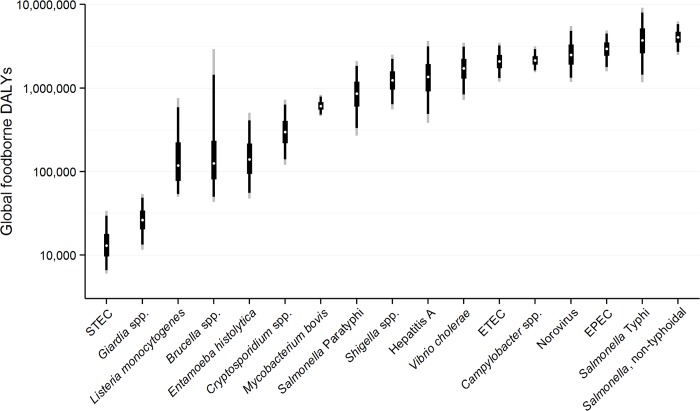
- Norovirus was the leading cause of foodborne illness, with 125 million (95% UI 70–251 million) foodborne cases; Campylobacter spp. caused 96 million (95% UI 52–177 million).
- Of foodborne DALYs, the largest burden came from nontyphoidal S. enterica if iNTS was included: 4.07 million DALYs (95% UI 2.49–6.27 million).
- Foodborne disease mortality and DALY rates were reported as highest in the African region, followed by the South East Asian region.
## Methods
- The study synthesized global and regional burden estimates for 22 foodborne diseases using the WHO FERG Enteric Diseases Task Force framework, combining literature reviews, systematic reviews, cohort studies, surveillance studies, expert consultation, and existing burden-of-disease assessments.
- The team estimated cases, sequelae, deaths, and DALYs for 2010, using pathogen-specific approaches: national estimates where available, a modified CHERG approach for diarrheal diseases in many countries, GBD 2010/IHME data for typhoid, paratyphoid, and hepatitis A, and expert elicitation to estimate the proportion transmitted by food.
- Uncertainty was propagated with Monte Carlo simulations using 10,000 draws per input parameter to generate 95% uncertainty intervals.
## Limitations
- The paper states that a major limitation was data gaps, especially in middle- and high-mortality countries, and that for many regions and pathogens the available data were sparse.
- It also states that only a few sequelae were included, with post-infectious sequelae such as reactive arthritis and irritable bowel syndrome excluded; stillbirths were excluded as well.
- The authors note that they could not fully account for age-specific effects for sequelae and could not separate some effects from comorbidities such as HIV infection.
- The text also makes evident, by its own description, that many estimates relied on expert elicitation for foodborne attribution and on assumptions/substitution where direct data were absent; this increases uncertainty and is part of the paper’s stated limitation.
Model-written summary. Check it against the paper before relying on it.
Integrity signals
Registry
Cites
Statistics
Figures
Verification
Claims the paper makes
3 Valid · 0 Not valid · 4 Not checked · 29 Own results and interpretations
The cited sources support only part of this claim — read each source’s verdict below.
In the paper
“Furthermore, global and regional estimates of the burden of foodborne diseases have not been available [1,2].”
§ World Health Organization Estimates of the Global and Regional Disease Burden of 22 Foodborne Bacterial, Protozoal, and Viral Diseases, 2010: A Data Synthesis > Introduction
What the sources say
- Partly supportedcites [1] Stein C, Kuchenmuller T, Hendrickx S, Prüss-Űstün A, Wolfson L, Engels D, et al The Global Burden of Disease assessments—WHO is responsible? PLoS Negl Trop Dis. 2007; 1: e161 10.1371/journal.pntd.0000161 18160984 PMC2154395 sourceExperimental — accuracy not yet measured
The Foodborne diseases section says that the full extent of the burden is unknown and that no precise, consistent global information existed at the time. It does not specifically address regional estimates, and its wording is narrower than saying no global estimates were available at all. No page number is provided in our copy. (LLM, conf=0.84)
- Not checked — no full text of the sourcecites [2] Tauxe RV, Doyle MP, Kuchenmuller T, Schlundt J, Stein CE. Evolving public health approaches to the global challenge of foodborne infections. Int J Food Microbiol. 2010; 139 Suppl 1: S16– 28. 10.1016/j.ijfoodmicro.2009.10.014 19931203 source
plain- Asserted: passes — The authors put it forward as true.
- Checkable: passes — It can be checked against evidence.
- Load-bearing: passes — The paper’s conclusions depend on it.
- Based: passes — The paper gives a reason why it holds.
- Partly supported
A result the paper reports from its own data — it cites no other source for it, so there is none to check. The quote shows it is in the paper.
In the paper
“Overall, 29% (95% UI 23–36%) of all 22 diseases were estimated to be transmitted by contaminated food equating to 582 million (95% UI 400–922 million) foodborne cases in 2010; 38% (95% UI 24–53%) in children <5 years of age.”
§ World Health Organization Estimates of the Global and Regional Disease Burden of 22 Foodborne Bacterial, Protozoal, and Viral Diseases, 2010: A Data Synthesis > Results > Cases
hedged- Asserted: passes — The authors put it forward as true.
- Checkable: passes — It can be checked against evidence.
- Load-bearing: passes — The paper’s conclusions depend on it.
- Based: passes — The paper gives a reason why it holds.
- Rests on an assumption not shown here.
A result the paper reports from its own data — it cites no other source for it, so there is none to check. The quote shows it is in the paper.
In the paper
“Among the 11 diarrheal diseases, the rate ratio of foodborne cases occurring among children <5 years of age compared to those ≥5 years of age was 6.44 (95%UI 3.15–12.46).”
§ World Health Organization Estimates of the Global and Regional Disease Burden of 22 Foodborne Bacterial, Protozoal, and Viral Diseases, 2010: A Data Synthesis > Results > Cases
plainstates an association- Asserted: passes — The authors put it forward as true.
- Checkable: passes — It can be checked against evidence.
- Load-bearing: unclear — It is unclear whether the paper’s conclusions depend on it.
- Based: passes — The paper gives a reason why it holds.
- Rests on 2 assumptions not shown here.
A result the paper reports from its own data — it cites no other source for it, so there is none to check. The quote shows it is in the paper.
In the paper
“Norovirus was the leading cause of foodborne illness causing 125 million (95% UI 70–251 million) cases, while Campylobacter spp. caused 96 million (95% UI 52–177 million) foodborne illnesses.”
§ World Health Organization Estimates of the Global and Regional Disease Burden of 22 Foodborne Bacterial, Protozoal, and Viral Diseases, 2010: A Data Synthesis > Abstract > Methods and Findings
plainstates a cause- Asserted: passes — The authors put it forward as true.
- Checkable: passes — It can be checked against evidence.
- Load-bearing: unclear — It is unclear whether the paper’s conclusions depend on it.
- Based: passes — The paper gives a reason why it holds.
In the paper
“The FERG estimate for DALYs for nontyphoidal S. enterica combining diarrheal and invasive infections was 4 times greater than GBD 2010 [54].”
§ World Health Organization Estimates of the Global and Regional Disease Burden of 22 Foodborne Bacterial, Protozoal, and Viral Diseases, 2010: A Data Synthesis > Discussion
What the sources say
- Not checked — no full text of the sourcecites [54] Murray CJ, Vos T, Lozano R, Naghavi M, Flaxman AD, Michaud C, et al Disability-adjusted life years (DALYs) for 291 diseases and injuries in 21 regions, 1990–2010: a systematic analysis for the Global Burden of Disease Study 2010. Lancet. 2012; 380: 2197– 2223. 10.1016/S0140-6736(12)61689-4 23245608 source
plain- Asserted: passes — The authors put it forward as true.
- Checkable: passes — It can be checked against evidence.
- Load-bearing: unclear — It is unclear whether the paper’s conclusions depend on it.
- Based: passes — The paper gives a reason why it holds.
16 more claims
Create a free account to see all 36 claims and to verify the 1 reference still open.
- Probably not a substantial claim. 11
- It may state two separate claims as one. 5
Claims other papers make about this one
Each is checked against this paper’s own text: does it say what the citing paper says it does?
The source backs part of the claim, not all of it — or backs it for a different population, condition or comparison.
In the citing paper
“Animal-based foods, like cow milk, can pose a risk for zoonotic enteric pathogen transmission42 although pasteurisation is an effective means for making milk safer.”
From Environmental and behavioural exposure pathways associated with diarrhoea and enteric pathogen detection in 5-month-old, periurban Kenyan infants: a cross-sectional study (2022) · cites this paper as [42]
Experimental — accuracy not yet measured
Citations
Cites
Lozano, R., Naghavi, M., Foreman, K., Lim, S., Shibuya, K., Aboyans, V., Abraham, J., Adair, T., Aggarwal, R., Ahn, S. Y., et al. (2012) · The Lancet · doi:10.1016/s0140-6736(12)61728-0 · Cited by 14,070 · cited 3×
“Twelve of the diseases included in our study were also included in the GBD 2010 study [25,26,54].”
Murray, C. J. L., Vos, T., Lozano, R., Naghavi, M., Flaxman, A. D., Michaud, C., Ezzati, M., Shibuya, K., Salomon, J. A., Abdalla, S., et al. (2012) · The Lancet · doi:10.1016/s0140-6736(12)61689-4 · Cited by 8,888
Foodborne illness acquired in the United States—Major pathogens
Scallan, E., Hoekstra, R. M., Angulo, F. J., Tauxe, R. V., Widdowson, M.-A., Roy, S. L., Jones, J. L., & Griffin, P. M. (2011) · Emerging Infectious Diseases · doi:10.3201/eid1701.p11101 · Cited by 7,657 · cited 1×
“Many different diseases, including those due to bacteria, viruses, parasites, chemicals, and prions, may be transmitted to humans by contaminated food [3].”
Self-citationSelected major risk factors and global and regional burden of disease
Ezzati, M., Lopez, A. D., Rodgers, A., Vander Hoorn, S., & Murray, C. J. (2002) · The Lancet · doi:10.1016/s0140-6736(02)11403-6 · Cited by 3,594
Kotloff, K. L., Nataro, J. P., Blackwelder, W. C., Nasrin, D., Farag, T. H., Panchalingam, S., Wu, Y., Sow, S. O., Sur, D., Breiman, R. F., et al. (2013) · The Lancet · doi:10.1016/s0140-6736(13)60844-2 · Cited by 3,560 · cited 1×
“This approach was facilitated by the availability of estimates of the envelope of diarrheal deaths, along with recent advances in diarrheal disease diagnosis, such as widespread application of polymerase chain reaction (PCR) for norovirus detection [20,49].”
The Global Burden of Nontyphoidal Salmonella Gastroenteritis
Majowicz, S. E., Musto, J., Scallan, E., Angulo, F. J., Kirk, M., O’Brien, S. J., Jones, T. F., Fazil, A., & Hoekstra, R. M. (2010) · Clinical Infectious Diseases · doi:10.1086/650733 · Cited by 2,442
Self-citationGlobal burden of childhood pneumonia and diarrhoea
Walker, C. L. F., Rudan, I., Liu, L., Nair, H., Theodoratou, E., Bhutta, Z. A., O'Brien, K. L., Campbell, H., & Black, R. E. (2013) · The Lancet · doi:10.1016/s0140-6736(13)60222-6 · Cited by 2,356 · cited 2×
“, “envelope” of diarrheal incidence) for 2010 by combining estimates of diarrheal incidence for children<5 years of age and persons 5 years of age [13,36].”
Self-citationThe global burden of typhoid fever.
Crump, J., Luby, S., & Mintz, E. (2004) · Bulletin of the World Health Organization · doi:10.1590/s0042-96862004000500008 · Cited by 2,172
Self-citationThe global burden of typhoid fever.
(2004) · Europe PMC (PubMed Central) · Cited by 1,965
Self-citationSalomon, J. A., Vos, T., Hogan, D. R., Gagnon, M., Naghavi, M., Mokdad, A., Begum, N., Shah, R., Karyana, M., Kosen, S., et al. (2012) · The Lancet · doi:10.1016/s0140-6736(12)61680-8 · Cited by 1,322 · cited 1×
“Disability weights for each clinical outcome for the enteric diseases were taken from the GBD 2010 study [47].”
Cited by
Items 1,301–1,400 of 1,631
Meethai, C., Phothaworn, P., Nale, J. Y., & Wisessombat, S. (2026) · Veterinary Sciences · doi:10.3390/vetsci13050415 · Cited by 1
Sensitive and Robust One-Pot RPA-CRISPR/Cas12a Assay with Elimination of cis -Cleavage
Han, R., Xiao, N., Wu, Z., Zhao, Y., Wang, X., & Tang, X. (2026) · Analytical Chemistry · doi:10.1021/acs.analchem.5c06674 · Cited by 2
Miki, T., Ito, M., Haneda, T., Okada, N., & Kim, Y. (2026) · Gut Microbes Reports · doi:10.1080/29933935.2026.2671472 · Cited by 1
Emergence of azithromycin-resistant extensively drug-resistant Salmonella Kentucky ST314 in Taiwan
Liao, Y.-S., Hong, Y.-P., Wang, Y.-W., Kuo, S.-C., Teng, R.-H., Liang, S.-Y., Wei, H.-L., Chang, J.-H., & Chiou, C. (2026) · Frontiers in Microbiology · doi:10.3389/fmicb.2026.1832575 · Cited by 1
“…of bacterial food-borne illness worldwide and remains a major public health concern due to its global distribution, zoonotic reservoirs, and substantial disease burden in humans (Majowicz et al., 2010; Kirk et al., 2015; GBD 2017 Non-Typhoidal Salmonella Invasive Disease Collaborators, 2019).”
Bhuiyan, M. N. I., Saha, B. K., & Satter, M. A. (2026) · Journal of Food Science and Technology · doi:10.1007/s13197-026-06803-8 · Cited by 3
Hong, Y.-P., Liao, Y.-S., Wang, Y.-W., et al. (2026) · Microbiology Spectrum · doi:10.1128/spectrum.01797-26 · Cited by 1
“Antimicrobial resistance (AMR) in Salmonella has become a critical issue, as it diminishes the effectiveness of treatment options, leading to increased morbidity, mortality, and healthcare costs (1, 2).”
Infections à Campylobacter : épidémiologie, facteurs de virulence, résistance aux antibiotiques
Leflon‐Guibout, V., & Munier, A. (2016) · Journal des Anti-infectieux · doi:10.1016/j.antinf.2016.09.005 · Cited by 1
Isolation of Bacterial RNA from Foods Inoculated with Pathogens
Tyagi, D., Kraft, A. L., & Bergholz, T. M. (2018) · Methods in molecular biology · doi:10.1007/978-1-4939-9000-9_10 · Cited by 1
Mastitis as a rare inflammatory manifestation of brucellosis in human; a case report
Ghiasi, N., Barjasteh, S., Gharebagh, N., et al. (2019) · Immunopathologia Persa · doi:10.15171/ipp.2019.06 · Cited by 1
“Brucellosis similar to many diseases can be influenced by some factors such as socioeconomic status (3) and the involvement severity of society (4,5).”
BackgroundCEMARAN BAKTERI DAN RESIDU PESTISIDA PADA BUAH ANGGUR
Suparman, R., & Athennia, A. (2019) · Jurnal Ilmiah Kesehatan · doi:10.37012/jik.v11i2.108 · Cited by 4
Association between Vitamin D Deficiency and Recurrent Acute Diarrhea in Children
Eldesouky, A. I., Shaffi, M. M. E., Sharaf, S. M., & Mohammed, H. I. S. (2020) · The Egyptian Journal of Hospital Medicine · doi:10.21608/ejhm.2020.85234 · Cited by 3
The Current Status of Norovirus Vaccine Development
Melhem, N. M., Hassan, F. F. A., & Ramadan, M. S. (2019) · Springer eBooks · doi:10.1007/978-3-030-27209-8_7 · Cited by 1
Drug-Induced Gastrointestinal Disease
McCarthy, A. J., & Sheahan, K. D. (2020) · Cambridge University Press eBooks · doi:10.1017/9781316823026.006 · Cited by 1
Infectious Disorders of the Lower Gastrointestinal Tract
Panarelli, N. C. (2020) · Cambridge University Press eBooks · doi:10.1017/9781316823026.019 · Cited by 1
Histology of Gastroesophageal Reflux Disease and Barrett’s Oesophagus
Assarzadegan, N., & Pezhouh, M. K. (2020) · Cambridge University Press eBooks · doi:10.1017/9781316823026.011 · Cited by 2
Gastrointestinal Ischemia and Vascular Disorders
Celli, R., & Zhang, X. (2020) · Cambridge University Press eBooks · doi:10.1017/9781316823026.007 · Cited by 1
Zakażenia przewodu pokarmowego w XXI wieku w Polsce i na świecie
Nowakowska, A., Demkow, U. A., & Podsiadły, E. (2021) · Postępy Higieny i Medycyny Doświadczalnej · doi:10.5604/01.3001.0014.6955 · Cited by 2
Borralho, P. (2020) · Cambridge University Press eBooks · doi:10.1017/9781316823026.008 · Cited by 1
Svrcek, M., & Feakins, R. M. (2020) · Cambridge University Press eBooks · doi:10.1017/9781316823026.009 · Cited by 1
Hausmann, A., & Hardt, W. (2020) · John Wiley & Sons, Inc. eBooks · doi:10.1128/9781683670261.ch3 · Cited by 1
loha, A., Rifat, T. A., Choudhury, M. M. H., et al. (2022) · African Journal of Biological Sciences · doi:10.33472/afjbs.4.4.2022.92-101 · Cited by 1
“Overuse of ciprofloxacin and azithromycin because of their over-the-counter accessibility and oral route of administration along with incomplete treatment contributed to the antibiotic resistance of these drugs in Bangladesh.”
InfluentialZébré, C. A., Attien, P. Y., Sina, H., et al. (2022) · Journal of Advances in Microbiology · doi:10.9734/jamb/2022/v22i12688 · Cited by 1
“As a result, several million people suffer from foodborne illnesses each year [1,2].”
BackgroundChang, S. L., Suster, C. J. E., Rockett, R. J., Svahn, A. J., Cliff, O. M., Arnott, A., Wang, Q., Kim, R. B., Suliman, B., Gall, M. L., et al. (2023) · Physical Biology · doi:10.1088/1478-3975/acd899 · Cited by 1
“Salmonella enterica causes a significant foodborne disease burden globally [1].”
BackgroundGanjeer, T., Patyal, A., Shakya, S., et al. (2023) · Asian Journal of Dairy and Food Research · doi:10.18805/ajdfr.dr-2033 · Cited by 1
Antibiotic treatment to reduce the duration and severity of travellers’ diarrhoea
Toriro, R., Nevin, W., Kuehn, R., Ryan, H., Beeching, N. J., Fletcher, T. E., & Burns, D. (2023) · Cochrane Database of Systematic Reviews · doi:10.1002/14651858.cd015208 · Cited by 1
Esfandiari, N., Farkhani, E. M., Sharifi, L., & Bokaie, S. (2023) · Iranian Journal of Public Health · doi:10.18502/ijph.v52i12.14329 · Cited by 5
“According to WHO, in assessing the burden of 22 foodborne infections, diarrheal and invasive infection caused by Non-typhoid Salmonella had the highest burden (20).”
BackgroundUtilidad del panel gastrointestinal en adultos con diarrea en un hospital de alta complejidad
Morales, X., Kozhakin, D. V. R., Durán-Torres, F., Durán-Torres, M., Barragán, A. M., & Barrera-Garavito, E. C. (2023) · Acta Médica Colombiana · doi:10.36104/amc.2023.2634 · Cited by 1
Sibiya, P. K., Sithole, P. K., Nkwane, S. T., Mphasha, M. H., & Tleane, D. M. R. (2023) · Universal Journal of Public Health · doi:10.13189/ujph.2023.110618 · Cited by 3
Synthesis of Phenylethanoid Nanoparticle and Study of Its Antibacterial Effect
Ibraheem, N. J., Hashim, M. U., Farhood, A. F., & Radhi, Z. A. (2024) · International Journal of Pharmaceutical and Bio-Medical Science · doi:10.47191/ijpbms/v4-i2-04 · Cited by 1
Lee, M. G., Jeong, H. J., Lee, S., et al. (2024) · Journal of Food Hygiene and Safety · doi:10.13103/jfhs.2024.39.1.16 · Cited by 1
Gobena, T., Belina, D., Hald, T., & Pires, S. M. (2024) · INQUIRY The Journal of Health Care Organization Provision and Financing · doi:10.1177/00469580241242784 · Cited by 5
Self-citationKeracunan Permen Lunak pada Siswa Sekolah Dasar di Kota Blitar, Provinsi Jawa Timur
Arinta, S. N., Hidajah, A. C., & Saifudin, N. (2023) · Jurnal Kesehatan Poltekkes Ternate · doi:10.32763/cnyseg44 · Cited by 1
Koide, K., Kim, H., Whelan, M. V. X., et al. (2024) · Microbiology Spectrum · doi:10.1128/spectrum.04322-23 · Cited by 1
A Multidisciplinary Approach in the Management of Infectious Diarrhea in the Emergency Department
Ullah, M. K., Dayam, F., Ahmed, A., Ahmad, S., Munawar, M., Jahangir, S., Daftani, M. H., Ali, Z., Kakar, B., Farooq, A., et al. (2024) · Cureus · doi:10.7759/cureus.67788 · Cited by 2
“These findings concur with the research of Kirk et al. [19], who found that identical pathogen prevalence was seen in diarrheal epidemics globally.”
ResultMicrobiological Risk Assessment of High-Demand Food from Three Major Cities in Ecuador
Llorente, E. S., Mora, F. J. C., Hinojoza, L. C., & Suárez, M. V. (2024) · Bionatura journal : · doi:10.70099/bj/2024.02.01.19 · Cited by 1
Chowdhury, G., Guha, H., Mukhopadhyay, A. K., Das, M., Albert, V., Das, S., Chakraborty, N., Dutta, S., Majumdar, T. K., & Ramamurthy, T. (2024) · The Indian Journal of Medical Research · doi:10.25259/ijmr_179_24 · Cited by 1
“The zoonotic pathogen Salmonella enterica is a leading cause of foodborne infection in humans 1,2 .”
BackgroundYeboah, E. B., Acquah, E. N., Adu-Amankwaa, W., Twum, P., Eshun, E., Asantewaa, R. O., & Ziema, T. (2025) · F1000Research · doi:10.12688/f1000research.159046.1 · Cited by 1
Kogoj, R., Bosilj, M., Šturm, A. C., Korva, M., Smrdel, K. S., Kvas, E., Pirš, M., Lepen, L., & Triglav, T. (2025) · Journal of Biomedical Informatics · doi:10.1016/j.jbi.2025.104841 · Cited by 1
Pant, L. P., Wasti, S. P., Nikolaou, C. K., Pradhan, P., Hurst, G., & Bhattarai, K. K. (2025) · Global Food Security · doi:10.1016/j.gfs.2025.100877 · Cited by 9
Edao, B. M., Upadhyay, I., & Zhang, W. (2025) · Vaccine · doi:10.1016/j.vaccine.2025.127634 · Cited by 1
Zhang, R., Wu, R. A., Yang, T., Li, Z., Ding, T., & Feng, J. (2025) · Journal of Future Foods · doi:10.1016/j.jfutfo.2024.11.027 · Cited by 1
Kürekçi, C., Yipel, M., & Önen, S. P. (2016) · Turkish Journal of Agriculture - Food Science and Technology · doi:10.24925/turjaf.v4i11.968-972.853 · Cited by 1
A review on various attempts for in vitro propagation of human Norovirus
Ghazali, M., Rahim, S. A., & Muhamad, M. (2018) · Biomedical Research - India · doi:10.4066/biomedicalresearch.29-18-928 · Cited by 1
“For instance, the model system developed by University of Michigans (Wobus Group) and Erasmus Medical Center (Koopmans Group) at University of Florida was unsuccessful when repeated by the Vinje research group and University of Florida (Karst Group) at the CDC.”
BackgroundSalute e alimentazione nel Corporate Food Regime
Caruso, F. S., & Pagano, U. (2018) · SALUTE E SOCIETÀ · doi:10.3280/ses2018-003005 · Cited by 1
Tesson, V., Belliot, G., Estienney, M., Wurtzer, S., & Renault, P. (2018) · Environment International · doi:10.1016/j.envint.2018.11.058 · Cited by 2
Quiñones-Muñoz, T. A., Villares-Bueno, A. M., Ramírez, G. H., et al. (2020) · Scientific Reports · doi:10.1038/s41598-020-61313-7 · Cited by 1
Inflammatory Bowel Disease Diagnosis
Feakins, R. M. (2020) · Cambridge University Press eBooks · doi:10.1017/9781316823026.022 · Cited by 1
Mimics of Inflammatory Bowel Disease
Feakins, R. M. (2020) · Cambridge University Press eBooks · doi:10.1017/9781316823026.023 · Cited by 1
Healthy diets as a guide to responsible food systems
Kassam, S., Jenkins, D. J. A., Bristor, D., & Kassam, Z. (2020) · Elsevier eBooks · doi:10.1016/b978-0-12-816410-5.00015-3 · Cited by 3
Bouchriti, Y., Kabbachi, B., Achbani, A., et al. (2021) · E3S Web of Conferences · doi:10.1051/e3sconf/202131901028 · Cited by 1
Behera, T. R. (2021) · JOURNAL OF COMMUNICABLE DISEASES · doi:10.24321/0019.5138.202165 · Cited by 1
Castañeda‐Ruelas, G. M., Guzmán-Uriarte, J. R., Valdez-Torres, J. B., & León‐Félix, J. (2022) · Revista Mexicana de Ciencias Pecuarias · doi:10.22319/rmcp.v13i3.5997 · Cited by 5
“J Bacteriol Parasitol 2014;5(3):1000187.”
BackgroundMuadchim, M., Jijai, S., Thongmak, N., et al. (2023) · AIP conference proceedings · doi:10.1063/5.0115373 · Cited by 1
Highlight the Diseases Generated by Food Pathogens: A Review
Ali, H. A. (2023) · International Journal of Current Science Research and Review · doi:10.47191/ijcsrr/v6-i11-11 · Cited by 1
Review on Prevalence and Antimicrobial Resistance of Poultry Salmonella in Ethiopia
Haile, T. (2023) · International Journal of Zoology and Animal Biology · doi:10.23880/izab-16000542 · Cited by 2
Methods for ascertaining norovirus disease burdens
Allen, D. J., & Harris, J. P. (2017) · Human Vaccines & Immunotherapeutics · doi:10.1080/21645515.2017.1360455 · Cited by 1
“Today, norovirus is recognized as one of the commonest human infections and estimated to be associated with 125 million cases and 35,000 deaths worldwide in 2010.(2) Better epidemiological surveillance and outbreak investigations,(3) coupled”
BackgroundCucić, S. (2017) · The Atrium (University of Guelph) · Cited by 1
High-resolution cryo-EM structures of outbreak strain human norovirus shells reveal size variationsPreprint
Jung, J. B., Grant, T. S., Thomas, D. R., et al. (2019) · bioRxiv (Cold Spring Harbor Laboratory) · doi:10.1101/580167 · Cited by 1
Costa, M. (2019) · El Servicio de Difusión de la Creación Intelectual (National University of La Plata) · doi:10.35537/10915/87511 · Cited by 4
Santo, M. C. C. D. E., Chieff, P. P., de Paula, F. M., França, F. O. D. S., Gomes, F. M. D. S., Castilho, V. L. P., Gonçalves, E. M. N., Luna, E. J. A., Pinto, P. L. S., Pinto, J. R. R., et al. (2021) · Research Square · doi:10.21203/rs.3.rs-800974/v1 · Cited by 1
Lin, C. S., Yen, I. Y., Chan, A., et al. (2021) · bioRxiv (Cold Spring Harbor Laboratory) · doi:10.1101/2021.09.23.461501 · Cited by 1
Hurley, D., Hoffmann, M., Muruvanda, T., Allard, M. W., Brown, E. W., Martins, M., & Fanning, S. (2016) · bioRxiv (Cold Spring Harbor Laboratory) · doi:10.1101/058610 · Cited by 1
Source attribution of campylobacteriosis in Australia circa 2018Preprint
McLure, A., Smith, J. J., Firestone, S. M., Kirk, M., French, N. P., Fearnley, E., Wallace, R. L., Valcanis, M., Bulach, D., Moffatt, C. R. M., et al. (2022) · Research Square · doi:10.21203/rs.3.rs-1743613/v1 · Cited by 1
Self-citationTamber, S. (2022) · Elsevier eBooks · doi:10.1016/b978-0-323-85125-1.00044-2 · Cited by 1
Kim, C., Goucher, G., Tadesse, B. T., et al. (2022) · medRxiv · doi:10.1101/2022.07.22.22277917 · Cited by 1
Mboko, W. P., Chhabra, P., Montmayeur, A. M., Xu, R., Costantini, V., & Vinjé, J. (2023) · bioRxiv (Cold Spring Harbor Laboratory) · doi:10.1101/2023.06.12.544665 · Cited by 1
“Introduction 43 44 Human noroviruses are a leading cause of epidemic and endemic acute gastroenteritis 45 worldwide (1-4).”
BackgroundKaundal, S., Anish, R., Ayyar, B. V., et al. (2023) · bioRxiv (Cold Spring Harbor Laboratory) · doi:10.1101/2023.08.24.554692 · Cited by 1
Raabis, S. M., Westerman, T. L., Cruz, E., et al. (2024) · bioRxiv (Cold Spring Harbor Laboratory) · doi:10.1101/2024.01.10.575057 · Cited by 1
The Global Impact and Management of Foodborne RNA VirusesPreprint
Teixeira, A. I. P. (2024) · Qeios · doi:10.32388/0m7iqn
Jagne, S., Hossain, J., Antoni, M., et al. (2024) · Preprints.org · doi:10.20944/preprints202401.1730.v1 · Cited by 1
Mazhangara, I. R., Jaja, I. F., Falowo, A. B., Oguttu, J. W., Green, E., & Muchenje, V. (2024) · Research Square · doi:10.21203/rs.3.rs-4218292/v1 · Cited by 2
A systematic review of the methodological considerations in Campylobacter burden of disease studiesPreprint
Tumulty, M., Bari, C. D., Devleesschauwer, B., Pires, S. M., & Kabir, Z. (2024) · medRxiv · doi:10.1101/2024.11.08.24316954 · Cited by 2
Self-citationRaghuram, V., Mafuna, T., Ramnath, V., et al. (2025) · medRxiv · doi:10.1101/2025.04.16.25325939 · Cited by 1
Szczepaniak, K., Szewczyk, M., & Pokorska‐Śpiewak, M. (2016) · Pediatria Polska · doi:10.1016/j.pepo.2016.10.008
Introduction: Noroviruses at a Glance
Chan, P. K. S., Kwan, H. S., & Chan, M. C. W. (2017) · Elsevier eBooks · doi:10.1016/b978-0-12-804177-2.00017-8
Bilman, F. B., Cicek, B., Güleşen, R., et al. (2017) · Jundishapur Journal of Microbiology · doi:10.5812/jjm.14144
Masanta, W. O. (2017) · eDiss (Georg-August-Universität Göttingen) · doi:10.53846/goediss-6383
Heard, M. J. (2018) · Frontiers of Biogeography · doi:10.21425/f59436623
“In most cases, the central limitation is a lack of epidemiological data, including location and prevalence rates of different diseases (Murray et al. 2012, Kirk et al. 2015, Aarestrup and Koopmans 2016).”
BackgroundFoodborne Pathogen–Produced Toxins and Their Signal Transduction
Ghosh, A. R. (2018) · Elsevier eBooks · doi:10.1016/b978-0-12-811444-5.00004-x
Introduction to Geoinformatics in Public Health
Bhunia, G. S., & Shit, P. K. (2018) · Springer eBooks · doi:10.1007/978-3-030-01680-7_1
Gastroenteritis Burden in the Adult Community: Prospects for Vaccines
Ansaldi, F. (2019) · Practical issues in geriatrics · doi:10.1007/978-3-030-05159-4_16 · Cited by 2
How to Visualize Depth of Interface Between Risky and Safety in the Food-Driven Intoxication?
Cho, J., Heroux, E., Musa, A., & Kim, H. D. (2018) · Food & Nutrition Journal · doi:10.29011/2575-7091.100078
Induction of temperate phages in Salmonella enterica subsp. enterica using Mitomycin C
Rublenko, N. M., Deryabin, O. M., & Головко, А. М. (2018) · Bulletin Veterinary biotechnology · doi:10.31073/vet_biotech32(1)-30
Retrospective investigation of enteric illnesses in pet animals
Ahmed, M. O., Elnageh, H. R., Ammar, A. E., Abdulkarim, E., Alareid, A., Hiblu, M. A., & Abouzeed, Y. M. (2019) · International Journal of Public Health Science (IJPHS) · doi:10.11591/ijphs.v8i3.14834
Taylor-Robinson, A. W. (2019) · SM Tropical Medicine Journal · doi:10.36876/smjhrt.1019
Zhuang, L., Gong, J., Ji, Y., et al. (2019) · IEEE International Conference on Nanotechnology (IEEE-NANO) · doi:10.1109/nano46743.2019.8993906
“A WHO report indicated that Salmonella ranked first among the 22 important socially harmful pathogens [11, 12].”
BackgroundPan-genomics of food pathogens and its applications
Facimoto, C. T., Balbo, L. C., Chideroli, R. T., & Pereira, U. D. P. (2020) · Elsevier eBooks · doi:10.1016/b978-0-12-817076-2.00007-x
de Souza, L. M., & Sales, W. B. (2020) · Brazilian Journal of Development · doi:10.34117/bjdv6n3-319
Molecular Characterization of Salmonella typhimurium from meat samples in Multan, Pakistan
Parvez, S., Safdar, M., Junejo, Y., et al. (2020) · DergiPark (Istanbul University)
Risk Assessment of Enteric Virus in the Food Supply Chain: A Critical Review
Shaheen, M. N. F. (2019) · Virology & Immunology Journal · doi:10.23880/vij-16000206
Infections of the Oesophagus and Rare Forms of Oesophagitis
Walsh, S. V. (2020) · Cambridge University Press eBooks · doi:10.1017/9781316823026.012
The Value of Gastrointestinal Biopsy
Parisinos, C. A., Sehgal, V., & Parkes, G. C. (2020) · Cambridge University Press eBooks · doi:10.1017/9781316823026.002
Complications of Inflammatory Bowel Disease
Feakins, R. M. (2020) · Cambridge University Press eBooks · doi:10.1017/9781316823026.024
Transplantation, Immunodeficiency, and Immunosuppression
Wong, N. A. C. S. (2020) · Cambridge University Press eBooks · doi:10.1017/9781316823026.005
Radiation and the Gastrointestinal Tract
Feakins, R. M. (2020) · Cambridge University Press eBooks · doi:10.1017/9781316823026.004 · Cited by 2
Assessment of Gastric Biopsies
Andrews, T., & Campbell, F. (2020) · Cambridge University Press eBooks · doi:10.1017/9781316823026.013
Gastrointestinal Involvement by Systemic Disease
Bateman, A. C. (2020) · Cambridge University Press eBooks · doi:10.1017/9781316823026.003
Walsh, S. V., & Feakins, R. M. (2020) · Cambridge University Press eBooks · doi:10.1017/9781316823026.026
Normal Oesophageal, Gastric and Duodenal Mucosa
Feakins, R. M. (2020) · Cambridge University Press eBooks · doi:10.1017/9781316823026.010
Metadata
- Authors
- Kirk, M. D., Pires, S. M., Black, R. E., Caipo, M., Crump, J. A., Devleesschauwer, B., Döpfer, D., Fazil, A., Fischer-Walker, C. L., Hald, T., Hall, A. J., Keddy, K. H., Lake, R. J., Lanata, C. F., Torgerson, P. R., Havelaar, A. H., & Angulo, F. J.
- Affiliations
- Australian National University (AU)
- Technical University of Denmark (DK)
- Johns Hopkins University (US)
- Food and Agriculture Organization of the United Nations (IT)
- University of Otago (NZ)
- Ghent University (BE)
- University of Wisconsin–Madison (US)
- Public Health Agency of Canada (CA)
- Centers for Disease Control and Prevention (US)
- University of the Witwatersrand (ZA)
- New Zealand Institute for Public Health and Forensic Science (NZ)
- Instituto de Investigación Nutricional (PE)
- University of Zurich (CH)
- Utrecht University (NL)
- Corresponding author
- Kirk, Martyn D.
- ORCID
- Venue
- PLoS Medicine
- Publisher
- Public Library of Science (PLoS)
- Published
- 2015-12-03
- Volume
- 12
- Issue
- 12
- Pages
- e1001921
- ISSN
- 1549-1277 (ISSN-L)
- 1549-1676
- PMC
- PMC4668831
- OpenAlex
- W2184405267
- Cited by
- 1,625
- References
- 58
- Citations by year
- 2026: 76 · 2025: 120 · 2024: 172 · 2023: 189 · 2022: 168 · 2021: 202 · 2020: 237 · 2019: 158 · 2018: 130 · 2017: 107 · 2016: 60 · 2015: 5
- FWCI
- 12.61
- Type
- journal article
- Language
- en
- Update notices
- correction (2015-12-23)
- Open access
- gold
- doi.org
- Licence
- Locations
- PLoS Medicine (publishedVersion, cc-by)
- Europe PMC (PubMed Central) (publishedVersion, cc-by)
- PubMed Central (publishedVersion, cc-by)
- PubMed (publishedVersion)
- IHI Repository (acceptedVersion)
- Zurich Open Repository and Archive (University of Zurich) (acceptedVersion, cc-by)
- Ghent University Academic Bibliography (Ghent University) (submittedVersion, other-oa)
- DOAJ (DOAJ: Directory of Open Access Journals) (submittedVersion, cc-by-sa)
- Utrecht University Repository (Utrecht University) (submittedVersion, other-oa)
- Figshare (submittedVersion, cc-by)
- ANU Open Research (Australian National University) (submittedVersion)
- Technical University of Denmark, DTU Orbit (Technical University of Denmark, DTU) (submittedVersion, other-oa)
- Rivm (National Institute for Public Health and the Environment) (submittedVersion)
- Zurich Open Repository and Archive (University of Zurich) (submittedVersion, cc-by)
- Zurich Open Repository and Archive (University of Zurich)
- Funders
- Bill and Melinda Gates Foundation
- World Health Organization
- Institute for Health Metrics and Evaluation
- Topics
- Life Sciences › Agricultural and Biological Sciences › Food Science › Salmonella and Campylobacter epidemiology
- Life Sciences › Agricultural and Biological Sciences › Food Science › Food Safety and Hygiene
- Health Sciences › Medicine › Infectious Diseases › Viral gastroenteritis research and epidemiology
- Keywords
- food poisoning, disease burden, disability-adjusted life years, norovirus, Campylobacter, Salmonella, Escherichia coli, Vibrio cholerae, Mycobacterium bovis, invasive non-typhoidal Salmonella, food contamination, diarrheal disease, foodborne parasitic infection
- MeSH terms
- Foodborne Diseases, Humans, Global Health, World Health Organization, Incidence, Prevalence, Cost of Illness, Quality-Adjusted Life Years
About these checks
Registry, retraction, Cites and statistics results are computed, not judged, with one exception: a printed reference that no index lists is read once by a model before it counts as a citation error. Claims are extracted by a model and kept only when their quote appears verbatim in the text; each cited source is then checked, with a model’s help, for whether it says what the claim relies on. Those verdicts can be wrong — read the claim’s quote and the cited source before relying on one.
The claim verdicts this report counts are experimental: their accuracy is not yet measured.
A language model drew the claims from the paper on 2026-10-10, under version 3 of the claim definition (model deepseek-v4.1-flash, prompt extract-v3).
A second model labelled each claim on 2026-10-10 (model jev-1.13-20260917, definition revision gold-guideline-v0.2).
Cited sources are checked with a language model’s help (gpt-6-sol).
Statistics and arithmetic are recomputed, not judged.
Confidence bands are shown only for fields calibrated on our annotated test set. None is calibrated yet, so no band is shown.
What counts as a claim ›How we measure confidence ›How we check this ›
Are you an author, or do you see a problem with this page? Request a review
Data sources
Bibliographic data: Semantic Scholar, OpenAlex, Crossref.
Contains information from the Semantic Scholar Academic Graph Datasets, made available under the ODC Attribution License (ODC-BY 1.0).
Semantic Scholar’s data is described in: Kinney, R., et al. (2023). The Semantic Scholar Open Data Platform. arXiv:2301.10140.
