

World Health Organization Estimates of the Global and Regional Disease Burden of 22 Foodborne Bacterial, Protozoal, and Viral Diseases, 2010: A Data Synthesis.
Open accessThe DOI matches its Crossref record; 57 of the 58 references it cites were found in a registry or an index; 3 of the 9 sources its claims cite were checked for support.
Abstract
We estimate that the 22 diseases included in our study resulted in two billion cases, over one million deaths, and 78.7 million DALYs in 2010.
Overview
CoChat Summary
## TL;DR
This paper provides the first WHO-led global and regional estimates of the burden of 22 foodborne bacterial, protozoal, and viral diseases in 2010. It estimates 2.0 billion illnesses, 1.09 million deaths, 78.7 million DALYs, and 582 million foodborne cases, with a large share of burden in children under 5.
## Key findings
- The 22 diseases caused an estimated 2.0 billion illnesses (95% UI 1.5–3.0 billion) in 2010; 39% (95% UI 26–53%) were in children <5 years.
- They caused 1.09 million deaths (95% UI 0.89–1.37 million); 34% (95% UI 29–38%) were in children <5 years.
- They caused 78.7 million DALYs (95% UI 65.0–97.7 million); 43% (95% UI 38–48%) were in children <5 years.
- The authors estimate 29% (95% UI 23–36%) of all cases were transmitted by contaminated food, equal to 582 million foodborne cases (95% UI 401–922 million) and 25.2 million foodborne DALYs (95% UI 17.5–37.0 million).
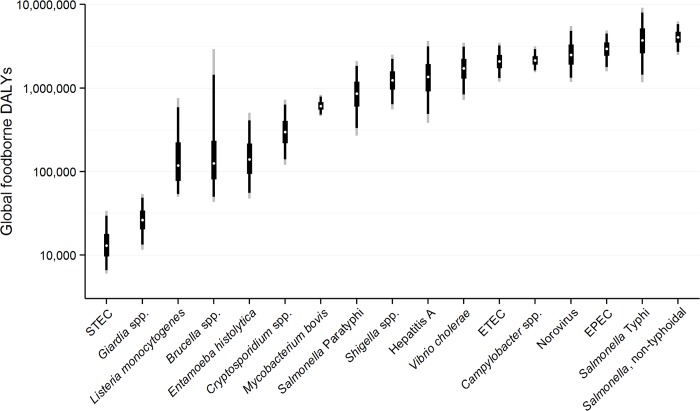
- Norovirus was the leading cause of foodborne illness, with 125 million (95% UI 70–251 million) foodborne cases; Campylobacter spp. caused 96 million (95% UI 52–177 million).
- Of foodborne DALYs, the largest burden came from nontyphoidal S. enterica if iNTS was included: 4.07 million DALYs (95% UI 2.49–6.27 million).
- Foodborne disease mortality and DALY rates were reported as highest in the African region, followed by the South East Asian region.
## Methods
- The study synthesized global and regional burden estimates for 22 foodborne diseases using the WHO FERG Enteric Diseases Task Force framework, combining literature reviews, systematic reviews, cohort studies, surveillance studies, expert consultation, and existing burden-of-disease assessments.
- The team estimated cases, sequelae, deaths, and DALYs for 2010, using pathogen-specific approaches: national estimates where available, a modified CHERG approach for diarrheal diseases in many countries, GBD 2010/IHME data for typhoid, paratyphoid, and hepatitis A, and expert elicitation to estimate the proportion transmitted by food.
- Uncertainty was propagated with Monte Carlo simulations using 10,000 draws per input parameter to generate 95% uncertainty intervals.
## Limitations
- The paper states that a major limitation was data gaps, especially in middle- and high-mortality countries, and that for many regions and pathogens the available data were sparse.
- It also states that only a few sequelae were included, with post-infectious sequelae such as reactive arthritis and irritable bowel syndrome excluded; stillbirths were excluded as well.
- The authors note that they could not fully account for age-specific effects for sequelae and could not separate some effects from comorbidities such as HIV infection.
- The text also makes evident, by its own description, that many estimates relied on expert elicitation for foodborne attribution and on assumptions/substitution where direct data were absent; this increases uncertainty and is part of the paper’s stated limitation.
Model-written summary. Check it against the paper before relying on it.
Integrity signals
Registry
Cites
Statistics
Figures
Verification
Claims the paper makes
3 Valid · 0 Not valid · 4 Not checked · 29 Own results and interpretations
The cited sources support only part of this claim — read each source’s verdict below.
In the paper
“Furthermore, global and regional estimates of the burden of foodborne diseases have not been available [1,2].”
§ World Health Organization Estimates of the Global and Regional Disease Burden of 22 Foodborne Bacterial, Protozoal, and Viral Diseases, 2010: A Data Synthesis > Introduction
What the sources say
- Partly supportedcites [1] Stein C, Kuchenmuller T, Hendrickx S, Prüss-Űstün A, Wolfson L, Engels D, et al The Global Burden of Disease assessments—WHO is responsible? PLoS Negl Trop Dis. 2007; 1: e161 10.1371/journal.pntd.0000161 18160984 PMC2154395 sourceExperimental — accuracy not yet measured
The Foodborne diseases section says that the full extent of the burden is unknown and that no precise, consistent global information existed at the time. It does not specifically address regional estimates, and its wording is narrower than saying no global estimates were available at all. No page number is provided in our copy. (LLM, conf=0.84)
- Not checked — no full text of the sourcecites [2] Tauxe RV, Doyle MP, Kuchenmuller T, Schlundt J, Stein CE. Evolving public health approaches to the global challenge of foodborne infections. Int J Food Microbiol. 2010; 139 Suppl 1: S16– 28. 10.1016/j.ijfoodmicro.2009.10.014 19931203 source
plain- Asserted: passes — The authors put it forward as true.
- Checkable: passes — It can be checked against evidence.
- Load-bearing: passes — The paper’s conclusions depend on it.
- Based: passes — The paper gives a reason why it holds.
- Partly supported
A result the paper reports from its own data — it cites no other source for it, so there is none to check. The quote shows it is in the paper.
In the paper
“Overall, 29% (95% UI 23–36%) of all 22 diseases were estimated to be transmitted by contaminated food equating to 582 million (95% UI 400–922 million) foodborne cases in 2010; 38% (95% UI 24–53%) in children <5 years of age.”
§ World Health Organization Estimates of the Global and Regional Disease Burden of 22 Foodborne Bacterial, Protozoal, and Viral Diseases, 2010: A Data Synthesis > Results > Cases
hedged- Asserted: passes — The authors put it forward as true.
- Checkable: passes — It can be checked against evidence.
- Load-bearing: passes — The paper’s conclusions depend on it.
- Based: passes — The paper gives a reason why it holds.
- Rests on an assumption not shown here.
A result the paper reports from its own data — it cites no other source for it, so there is none to check. The quote shows it is in the paper.
In the paper
“Among the 11 diarrheal diseases, the rate ratio of foodborne cases occurring among children <5 years of age compared to those ≥5 years of age was 6.44 (95%UI 3.15–12.46).”
§ World Health Organization Estimates of the Global and Regional Disease Burden of 22 Foodborne Bacterial, Protozoal, and Viral Diseases, 2010: A Data Synthesis > Results > Cases
plainstates an association- Asserted: passes — The authors put it forward as true.
- Checkable: passes — It can be checked against evidence.
- Load-bearing: unclear — It is unclear whether the paper’s conclusions depend on it.
- Based: passes — The paper gives a reason why it holds.
- Rests on 2 assumptions not shown here.
A result the paper reports from its own data — it cites no other source for it, so there is none to check. The quote shows it is in the paper.
In the paper
“Norovirus was the leading cause of foodborne illness causing 125 million (95% UI 70–251 million) cases, while Campylobacter spp. caused 96 million (95% UI 52–177 million) foodborne illnesses.”
§ World Health Organization Estimates of the Global and Regional Disease Burden of 22 Foodborne Bacterial, Protozoal, and Viral Diseases, 2010: A Data Synthesis > Abstract > Methods and Findings
plainstates a cause- Asserted: passes — The authors put it forward as true.
- Checkable: passes — It can be checked against evidence.
- Load-bearing: unclear — It is unclear whether the paper’s conclusions depend on it.
- Based: passes — The paper gives a reason why it holds.
In the paper
“The FERG estimate for DALYs for nontyphoidal S. enterica combining diarrheal and invasive infections was 4 times greater than GBD 2010 [54].”
§ World Health Organization Estimates of the Global and Regional Disease Burden of 22 Foodborne Bacterial, Protozoal, and Viral Diseases, 2010: A Data Synthesis > Discussion
What the sources say
- Not checked — no full text of the sourcecites [54] Murray CJ, Vos T, Lozano R, Naghavi M, Flaxman AD, Michaud C, et al Disability-adjusted life years (DALYs) for 291 diseases and injuries in 21 regions, 1990–2010: a systematic analysis for the Global Burden of Disease Study 2010. Lancet. 2012; 380: 2197– 2223. 10.1016/S0140-6736(12)61689-4 23245608 source
plain- Asserted: passes — The authors put it forward as true.
- Checkable: passes — It can be checked against evidence.
- Load-bearing: unclear — It is unclear whether the paper’s conclusions depend on it.
- Based: passes — The paper gives a reason why it holds.
16 more claims
Create a free account to see all 36 claims and to verify the 1 reference still open.
- Probably not a substantial claim. 11
- It may state two separate claims as one. 5
Claims other papers make about this one
Each is checked against this paper’s own text: does it say what the citing paper says it does?
The source backs part of the claim, not all of it — or backs it for a different population, condition or comparison.
In the citing paper
“Animal-based foods, like cow milk, can pose a risk for zoonotic enteric pathogen transmission42 although pasteurisation is an effective means for making milk safer.”
From Environmental and behavioural exposure pathways associated with diarrhoea and enteric pathogen detection in 5-month-old, periurban Kenyan infants: a cross-sectional study (2022) · cites this paper as [42]
Experimental — accuracy not yet measured
Citations
Cites
Lozano, R., Naghavi, M., Foreman, K., Lim, S., Shibuya, K., Aboyans, V., Abraham, J., Adair, T., Aggarwal, R., Ahn, S. Y., et al. (2012) · The Lancet · doi:10.1016/s0140-6736(12)61728-0 · Cited by 14,070 · cited 3×
“Twelve of the diseases included in our study were also included in the GBD 2010 study [25,26,54].”
Murray, C. J. L., Vos, T., Lozano, R., Naghavi, M., Flaxman, A. D., Michaud, C., Ezzati, M., Shibuya, K., Salomon, J. A., Abdalla, S., et al. (2012) · The Lancet · doi:10.1016/s0140-6736(12)61689-4 · Cited by 8,888
Foodborne illness acquired in the United States—Major pathogens
Scallan, E., Hoekstra, R. M., Angulo, F. J., Tauxe, R. V., Widdowson, M.-A., Roy, S. L., Jones, J. L., & Griffin, P. M. (2011) · Emerging Infectious Diseases · doi:10.3201/eid1701.p11101 · Cited by 7,657 · cited 1×
“Many different diseases, including those due to bacteria, viruses, parasites, chemicals, and prions, may be transmitted to humans by contaminated food [3].”
Self-citationSelected major risk factors and global and regional burden of disease
Ezzati, M., Lopez, A. D., Rodgers, A., Vander Hoorn, S., & Murray, C. J. (2002) · The Lancet · doi:10.1016/s0140-6736(02)11403-6 · Cited by 3,594
Kotloff, K. L., Nataro, J. P., Blackwelder, W. C., Nasrin, D., Farag, T. H., Panchalingam, S., Wu, Y., Sow, S. O., Sur, D., Breiman, R. F., et al. (2013) · The Lancet · doi:10.1016/s0140-6736(13)60844-2 · Cited by 3,560 · cited 1×
“This approach was facilitated by the availability of estimates of the envelope of diarrheal deaths, along with recent advances in diarrheal disease diagnosis, such as widespread application of polymerase chain reaction (PCR) for norovirus detection [20,49].”
The Global Burden of Nontyphoidal Salmonella Gastroenteritis
Majowicz, S. E., Musto, J., Scallan, E., Angulo, F. J., Kirk, M., O’Brien, S. J., Jones, T. F., Fazil, A., & Hoekstra, R. M. (2010) · Clinical Infectious Diseases · doi:10.1086/650733 · Cited by 2,442
Self-citationGlobal burden of childhood pneumonia and diarrhoea
Walker, C. L. F., Rudan, I., Liu, L., Nair, H., Theodoratou, E., Bhutta, Z. A., O'Brien, K. L., Campbell, H., & Black, R. E. (2013) · The Lancet · doi:10.1016/s0140-6736(13)60222-6 · Cited by 2,356 · cited 2×
“, “envelope” of diarrheal incidence) for 2010 by combining estimates of diarrheal incidence for children<5 years of age and persons 5 years of age [13,36].”
Self-citationThe global burden of typhoid fever.
Crump, J., Luby, S., & Mintz, E. (2004) · Bulletin of the World Health Organization · doi:10.1590/s0042-96862004000500008 · Cited by 2,172
Self-citationThe global burden of typhoid fever.
(2004) · Europe PMC (PubMed Central) · Cited by 1,965
Self-citationSalomon, J. A., Vos, T., Hogan, D. R., Gagnon, M., Naghavi, M., Mokdad, A., Begum, N., Shah, R., Karyana, M., Kosen, S., et al. (2012) · The Lancet · doi:10.1016/s0140-6736(12)61680-8 · Cited by 1,322 · cited 1×
“Disability weights for each clinical outcome for the enteric diseases were taken from the GBD 2010 study [47].”
Cited by
Items 801–900 of 1,631
Consumer attitudes and perceptions towards chilled ready-to-eat foods: a multi-national study
Šmigić, N., Özilgen, S., Gómez‐López, V. M., Osés, S. M., Miloradovic, Z. N., Aleksić, B., Miocinovic, J. B., Možina, S. S., Kunčič, A., Guiné, R. P. F., et al. (2023) · Journal of Consumer Protection and Food Safety · doi:10.1007/s00003-023-01424-1 · Cited by 14
“The World Health Organization (WHO) has estimated the burden of food-borne diseases, with annual incidents of more than 420,000 m cases and 230,000 deaths from diarrheal diseases, caused by consumption of contaminated food and/or water (Kirk et al. 2015).”
BackgroundSource attribution of campylobacteriosis in Australia, 2017–2019
McLure, A., Smith, J. J., Firestone, S. M., Kirk, M., French, N. P., Fearnley, E., Wallace, R. L., Valcanis, M., Bulach, D., Moffatt, C. R. M., et al. (2023) · Risk Analysis · doi:10.1111/risa.14138 · Cited by 10
“Campylobacter infections are a major cause of zoonotic food-borne gastroenteritis worldwide and the leading cause in high-income countries (Li et al., 2019), with a global burden of over 166 million cases and 3.7 million disability adjusted life years circa 2010 (Kirk et al., 2015).”
BackgroundInfluentialSelf-citationThe burden of chronic kidney disease associated with dietary exposure to cadmium in China, 2020
Huang, J., Luo, L., Wang, Y., Yan, S., Li, X., Li, B., Huang, Q., Wang, Y., Zhang, Y., Wei, S., et al. (2023) · Environmental Pollution · doi:10.1016/j.envpol.2023.122434 · Cited by 12
Staphylococcus aureus Enterotoxin B Is a Cofactor of Food Allergy beyond a Superantigen
Yuan, J., Tong, P., Wang, Z., Xu, X., Zhao, X., Meng, X., Wu, Y., Li, X., Gao, J., & Chen, H. (2023) · The Journal of Immunology · doi:10.4049/jimmunol.2200549 · Cited by 12
A quantitative proteomic screen of the Campylobacter jejuni flagellar-dependent secretome
Scanlan, E. M., Yu, L., Maskell, D. J., et al. (2016) · Journal of Proteomics · doi:10.1016/j.jprot.2016.11.009 · Cited by 11
“Contents lists available at ScienceDirect Journal of Proteomics j ourna l homepage: www.e lsev ie r .com/ locate / jp rot A quantitative proteomic screen of the Campylobacter jejuni flagellar-dependent secretome Eoin Scanlan a,1, Lu Yu b, Duncan Maskell a, Jyoti Choudhary b, Andrew Grant a,⁎ a…”
BackgroundDirect Manipulation of T Lymphocytes by Proteins of Gastrointestinal Bacterial Pathogens
Cassady-Cain, R. L., Hope, J. C., & Stevens, M. P. (2018) · Infection and Immunity · doi:10.1128/iai.00683-17 · Cited by 11
Fuche, F. J., Jones, J. A., Ramachandran, G., Higginson, E. E., Simon, R., & Tennant, S. M. (2018) · Human Vaccines & Immunotherapeutics · doi:10.1080/21645515.2018.1491499 · Cited by 11
“7 million cases of illness worldwide in 2010.(1,2) While S.”
BackgroundEscobedo, A. A., Almirall, P., González–Fraile, E., & Ballesteros, J. (2018) · Acta Tropica · doi:10.1016/j.actatropica.2018.08.001 · Cited by 14
Chetri, P. B., Shukla, R., & Tripathi, T. (2019) · Parasitology Research · doi:10.1007/s00436-019-06225-w · Cited by 11
The health and economic impact of acute gastroenteritis in Belgium, 2010–2014
Papadopoulos, T. G., Klamer, S., Jacquinet, S., Catry, B., Litzroth, A., Mortgat, L., Mamouris, P., Rebolledo, J., Vaes, B., Cauteren, D. V., et al. (2019) · Epidemiology and Infection · doi:10.1017/s095026881900044x · Cited by 14
“This is a reflection of the low case fatality ratio of AGE in highincome countries, particularly compared with low-income countries, where mortality remains the dominant contributor to the AGE disease burden [30].”
BackgroundSelf-citationA proposed core genome scheme for analyses of the Salmonella genus
Pearce, M. E., Chattaway, M. A., Grant, K., & Maiden, M. C. J. (2019) · Genomics · doi:10.1016/j.ygeno.2019.02.016 · Cited by 14
“07 million disability adjusted life years (DALYs), which is the highest burden of all foodborne infections [3].”
Rafei, R., Kassaa, I. A., Osman, M., Dabboussi, F., & Hamzé, M. (2019) · British Poultry Science · doi:10.1080/00071668.2019.1645945 · Cited by 11
“According to 2010 estimates from the World Health Organisation (WHO), Campylobacter spp. constituted the second leading source of foodborne illness after norovirus, causing 96 million cases with 37,600 deaths (Kirk et al. 2015).”
BackgroundGood, L. D., Miller, W. G., Niedermeyer, J. A., Osborne, J. A., Siletzky, R. M., Carver, D. K., & Kathariou, S. (2019) · Applied and Environmental Microbiology · doi:10.1128/aem.01579-19 · Cited by 15
Kelley, B. R., Ellis, J. C., Large, A., Schneider, L. G., Jacobson, D., & Johnson, J. G. (2020) · Frontiers in Microbiology · doi:10.3389/fmicb.2020.571064 · Cited by 11
Heidari, S., Torkabad, S. M., & Bonabi, T. N. (2020) · Journal of Nursing and Midwifery Sciences · doi:10.4103/jnms.jnms_16_20 · Cited by 14
Martínez-Sanguiné, A., D’Alessandro, B., Langleib, M., Traglia, G. M., Mónaco, A., Durán, R., Chabalgoity, J. A., Betancor, L., & Yim, L. (2020) · Infection and Immunity · doi:10.1128/iai.00606-20 · Cited by 19
“Salmonella (NTS) causes a burden of 154 million cases per year worldwide (1).”
BackgroundWu, S., Ross, C., Hadi, J. L., & Brightwell, G. (2021) · Food Control · doi:10.1016/j.foodcont.2021.107990 · Cited by 12
Trends of human brucellosis in Central Iran (2010–2018)
Khalilian, M. S., Ramazanpour, J., Hosseini, S. M., Narrei, S., & Zeinalian, M. (2021) · Journal of Research in Medical Sciences · doi:10.4103/jrms.jrms_621_20 · Cited by 11
Win, A. T., Supa-amornkul, S., Orsi, R. H., Carey, J., Wolfgang, W. J., & Chaturongakul, S. (2021) · Frontiers in Microbiology · doi:10.3389/fmicb.2021.720604 · Cited by 11
Maiti, S., Halder, P., Banerjee, S., Dutta, M., Mukhopadhyay, A. K., Dutta, S., & Koley, H. (2022) · Immunobiology · doi:10.1016/j.imbio.2022.152183 · Cited by 14
Sattar, S., Ullah, I., Khanum, S., et al. (2022) · Viruses · doi:10.3390/v14020241 · Cited by 11
“Around 50% of these infections were caused by contaminated food products [8,9].”
BackgroundKrakovka, S., Ranjbarian, F., Luján, L. A., Saura, A., Larsen, N. B., Jiménez-González, A., Reggenti, A., Luján, H. D., Svärd, S. G., & Hofer, A. (2022) · Journal of Biological Chemistry · doi:10.1016/j.jbc.2022.102028 · Cited by 11
“(1) Strong effect against the parasite and prevention of viable cyst formation and thereby transmission.”
BackgroundTrends in the Epidemiology of Campylobacteriosis in Israel (1999–2012)
Bassal, R., Lerner, L., Valinsky, L., et al. (2016) · Foodborne Pathogens and Disease · doi:10.1089/fpd.2015.2096 · Cited by 11
“Campylobacter spp. is responsible for 5–14% of diarrhoeal cases worldwide (Heymann, 2008) and it was estimated that campy-lobacteriosis affected 1,390 (confidence interval [95% CI]: 752– 2,576) subjects per 100,000 globally in 2010 (Kirk et al. , 2015).”
Artificial intelligence applications for strengthening global food safety systems
Abdi, Y. H., Bashir, S., Abdullahi, Y. B., Abdi, M. S., & Ahmed, N. (2025) · Discover Food · doi:10.1007/s44187-025-00678-y · Cited by 17
“Disability-Adjusted Life Years (DALYs) metrics reveal deeper inequities, with the African and Southeast Asian regions experiencing foodborne disease burdens up to 15 times higher than North America per capita, reflecting gaps in infrastructure and regulatory capacity [14, 15].”
Rainey, J. J., Siesel, C., Guo, X., et al. (2022) · PLoS ONE · doi:10.1371/journal.pone.0270586 · Cited by 10
Han, A., Yoon, J., Choi, Y., et al. (2023) · Food Science and Biotechnology · doi:10.1007/s10068-023-01330-0 · Cited by 10
Yun, Y.-S., Park, D. Y., Oh, I., Shin, W., Ahn, G., Ahn, J., & Kim, Y. (2023) · Molecular Biotechnology · doi:10.1007/s12033-023-00985-8 · Cited by 10
“In 2010, the FERG estimated that there were 2.5 million new STEC cases (including those caused by non-food sources) worldwide, resulting in 3330 cases of HUS, 200 cases of ESRD, 269 deaths, and 27,000 disability-adjusted life years (DALYs) of patients [27].”
InfluentialIacono, G. L., Cook, A. J. C., Derks, G., Fleming, L. E., French, N. P., Gillingham, E. L., Villeta, L. C. G., Heaviside, C., Ragione, R. M. L., Leonardi, G. S., et al. (2024) · PLoS Computational Biology · doi:10.1371/journal.pcbi.1011714 · Cited by 11
Bugeza, J. K., Roesel, K., Mugizi, D. R., et al. (2024) · PLoS neglected tropical diseases · doi:10.1371/journal.pntd.0012046 · Cited by 10
Kumwenda, B., Canals, R., Predeus, A. V., Zhu, X., Kröger, C., Pulford, C. V., Wenner, N., Lacharme‐Lora, L., Li, Y., Owen, S. V., et al. (2024) · microLife · doi:10.1093/femsml/uqae005 · Cited by 11
“The diar-rhoeal NTS disease is termed dNTS, and is mainly foodborne, posing a significant burden to public health with ∼ 153 million cases and 57 000 deaths per ann um world wide (Kirk et al. 2015 , Chirwa et al. 2023 ).”
BackgroundWatier-Grillot, S., Boni, M., Tong, C., et al. (2017) · Food and Environmental Virology · doi:10.1007/s12560-017-9312-6 · Cited by 10
“Noroviruses (NoV) are the leading cause of human viral gastroenteritis worldwide, including foodborne illness (Kirk et al. 2015).”
BackgroundCarnero, A. M., Kitayama, K., Diaz, D. A., Garvich, M., Angulo, N. P., Cama, V. A., Gilman, R. H., & Bayer, A. M. (2018) · Zoonoses and Public Health · doi:10.1111/zph.12463 · Cited by 10
Network properties of salmonella epidemics
Cliff, O. M., Sintchenko, V., Sorrell, T. C., Vadlamudi, K., McLean, N., & Prokopenko, M. (2019) · Scientific Reports · doi:10.1038/s41598-019-42582-3 · Cited by 15
Suganuma, K., Hamasaki, T., & Hamaoka, T. (2021) · Poultry Science · doi:10.1016/j.psj.2021.101385 · Cited by 12
High Level of Salmonella Contamination of Leafy Vegetables Sold around the Niayes Zone of Senegal
Sarré, F. B., Dièye, Y., Seck, A. M., Fall, C., & Dieng, M. (2023) · Horticulturae · doi:10.3390/horticulturae9010097 · Cited by 14
Kim, J., Park, M., Ahn, E., Mao, Q., Chen, C., Ryu, S., & Jeon, B. (2023) · Microbiology Spectrum · doi:10.1128/spectrum.03761-22 · Cited by 12
“400 million to 500 million diarrheal cases worldwide per year (1).”
BackgroundTijani, M. K., Köster, P. C., Guadano-Procesi, I., George, I. S., Abodunrin, E., Adeola, A., Dashti, A., Bailo, B., González‐Barrio, D., & Carmena, D. (2023) · Tropical Medicine and Infectious Disease · doi:10.3390/tropicalmed8030152 · Cited by 12
“lamblia) is the etiological agent of giardiasis, a major contributor to the burden of diarrheal disease causing near 190 million symptomatic infections per year globally, adding up to ∼171,100 daily-adjusted life years lost [1].”
Rochín-Medina, J. J., Mendoza-López, I. A., Campo, N. C., Bastidas-Bastidas, P., & Ramírez, K. (2023) · Letters in Applied Microbiology · doi:10.1093/lambio/ovad045 · Cited by 14
Isolation and molecular characterization of the Salmonella Typhimurium orphan phage Arash
Yousefi, M. H., Wagemans, J., Shekarforoush, S. S., Vallino, M., Pozhydaieva, N., Höfer, K., Lavigne, R., & Hosseinzadeh, S. (2023) · BMC Microbiology · doi:10.1186/s12866-023-03056-9 · Cited by 13
Snary, E., Swart, A. N., & Hald, T. M. (2016) · Risk Analysis · doi:10.1111/risa.12605 · Cited by 10
“2 million disability-adjusted life years (DALYs).(3) Controlling Salmonella in the food chain will require”
BackgroundSelf-citationGauvain, M. (2017) · Child Development Perspectives · doi:10.1111/cdep.12255 · Cited by 10
An adult case with shigellosis-associated encephalopathy
Schuster, H. J., Gompelman, M., Ang, W., & Kooter, A. J. (2018) · BMJ Case Reports · doi:10.1136/bcr-2017-222372 · Cited by 10
Furniss, R. C. D., Low, W. W., Mavridou, D. A. I., Dagley, L. F., Webb, A. I., Tate, E. W., & Clements, A. (2018) · Journal of Biological Chemistry · doi:10.1074/jbc.ra118.005114 · Cited by 13
“coli remains a significant cause of gastrointestinal disease throughout the world (26).”
BackgroundLopman, B. A., & Hall, A. J. (2019) · The Lancet Infectious Diseases · doi:10.1016/s1473-3099(18)30798-9 · Cited by 10
Self-citationYang, S., Li, M., Cheng, J., et al. (2019) · International Journal of STD & AIDS · doi:10.1177/0956462418824912 · Cited by 10
Thongkao, K., & Sudjaroen, Y. (2020) · Journal of Advanced Veterinary and Animal Research · doi:10.5455/javar.2020.g397 · Cited by 12
“Significant pathogenic bacteria including Salmonella, Campylobacter, Shigella, Listeria, and Escherichia coli O157:H7 are commonly tracked by the food net and responsible for most of the infection cases [4].”
BackgroundMedley, S., Ponder, M. A., & Alexander, K. A. (2020) · PLoS neglected tropical diseases · doi:10.1371/journal.pntd.0007888 · Cited by 9
“are considered the most common cause of foodborne infections globally, causing an estimated 96 million cases of diarrheal illness in 2010[1].”
BackgroundRuviniyia, K., Abdullah, D. A., Sumita, S., et al. (2020) · Parasitology Research · doi:10.1007/s00436-020-06648-w · Cited by 10
Describing the Epidemiology of Foodborne Outbreaks in New South Wales from 2000 to 2017
Franklin, N., Hope, K. G., Glasgow, K. M., & Glass, K. (2020) · Foodborne Pathogens and Disease · doi:10.1089/fpd.2020.2806 · Cited by 10
Augustin, J.-C., Kooh, P., Mughini‐Gras, L., Guillier, L., Thébault, A., Audiat‐Perrin, F., Cadavez, V., Gonzales‐Barron, U. A., & Sanaa, M. (2020) · Microbial Risk Analysis · doi:10.1016/j.mran.2020.100117 · Cited by 10
Rockett, R. J., Arnott, A., Wang, Q., Howard, P., & Sintchenko, V. (2020) · Journal of Clinical Microbiology · doi:10.1128/jcm.00038-20 · Cited by 9
“spaO Forward primer 4 and 12 Moderate IIIb,50:k:z35 (1)a 1 4 Reverse primer 12 Limited Mbandaka (40), ST413 40 4 Reverse primer 4, 12, and 15 Significant II1,4,[5],12,[27] (1)a 1 4 Reverse primer 3, 5, and 15 Significant Untyped (1), ST237 1 4 Reverse primer 5 and 15 Moderate IIIb,50:k:z35 (1)a 1 4”
InfluentialMolecular Epidemiology of Salmonellosis in Florida, USA, 2017–2018
Singh, N., Li, X., Beshearse, E. M., Blanton, J. L., DeMent, J., & Havelaar, A. H. (2021) · Frontiers in Medicine · doi:10.3389/fmed.2021.656827 · Cited by 12
Self-citationHahn, M. M., González, J. F., Hitt, R., Tucker, L., & Gunn, J. S. (2021) · Infection and Immunity · doi:10.1128/iai.00310-21 · Cited by 11
McGrath, C. J., Laveckis, E., Bell, A., Crost, E. H., Juge, N., & Schüller, S. (2022) · Disease Models & Mechanisms · doi:10.1242/dmm.049365 · Cited by 13
“Enteropathogenic E. coli (EPEC) is a major foodborne pathogen causing an estimated 120,000 deaths per year globally and affecting predominantly children under 5 years of age (Kirk et al., 2015; Lanata et al., 2013).”
Human Norovirus Induces Aquaporin 1 Production by Activating NF-κB Signaling Pathway
Zhang, M., Zhang, B., Chen, R., Li, M., Zheng, Z., Xu, W., Zhang, Y., Gong, S., & Hu, Q. (2022) · Viruses · doi:10.3390/v14040842 · Cited by 10
Iturriza‐Gómara, M., & Cunliffe, N. A. (2020) · Elsevier eBooks · doi:10.1016/b978-0-323-55512-8.00034-x · Cited by 17
Shi, X., Sun, H., Li, H., Wei, S., Jin, J., Zhao, C., Wang, J., & Li, H. (2022) · Frontiers in Public Health · doi:10.3389/fpubh.2022.865828 · Cited by 10
Hijjawi, N., Zahedi, A., & Ryan, U. (2021) · Tropical parasitology · doi:10.4103/tp.tp_106_20 · Cited by 10
Prasertsee, T., Khantaprab, N., Yamsakul, P., et al. (2016) · Asian Pacific Journal of Tropical Disease · doi:10.1016/s2222-1808(15)61054-4 · Cited by 10
Mammalian Cell-Based Immunoassay for Detection of Viable Bacterial Pathogens
Xu, L., Bai, X., Tenguria, S., Liu, Y., Drolia, R., & Bhunia, A. K. (2020) · Frontiers in Microbiology · doi:10.3389/fmicb.2020.575615 · Cited by 11
“3 billion cases of gastroenteritis and 3 million deaths worldwide (Kirk et al., 2015) and 1.”
BackgroundParasites of the Gastrointestinal Tract
Mathison, B. A., & Pritt, B. S. (2021) · Elsevier eBooks · doi:10.1016/b978-0-12-818731-9.00107-5 · Cited by 21
Hoshino, Y., Sakamoto, T., Sudo, N., Ito, M., Haneda, T., Okada, N., & Miki, T. (2022) · Infection and Immunity · doi:10.1128/iai.00184-22 · Cited by 9
“Tm) is a common enteric pathogen that causes foodborne diarrhea globally (12).”
BackgroundGutiérrez, R. L., Riddle, M. S., Porter, C. K., Maciel, M., Poole, S., Laird, R. M., Lane, M., Turiansky, G. W., Jarell, A. D., & Savarino, S. J. (2023) · Microorganisms · doi:10.3390/microorganisms11112689 · Cited by 10
Ed‐Dra, A., Abdallah, E. M., Sulieman, A. M. E., & Anarghou, H. (2024) · Veterinary Research Communications · doi:10.1007/s11259-024-10455-4 · Cited by 11
Liu, H., Zheng, L., Fan, H., & Pang, J. (2024) · mSystems · doi:10.1128/msystems.00586-24 · Cited by 18
“Serotype analyses indicated that Typhimurium was the most prevalent serotype among the eight strains (37.5%), and the serotypes of the remaining strains were Goldcoast, London, Enteritidis, Potsdam, and 1,4,[5],12:i:− (a monophasic variant of S. Typhimurium).”
BackgroundInfluentialAssessing antimicrobial resistance profiles of Salmonella enterica in the pork production system
Prasertsee, T., Prachantasena, S., Tantitaveewattana, P., Chuaythammakit, P., Pascoe, B., & Patchanee, P. (2024) · Journal of Medical Microbiology · doi:10.1099/jmm.0.001894 · Cited by 10
“More than 2600 serological variants of Salmonella enterica have been identified [5], with over 153 million NTS infection cases identified worldwide in 2010 alone and over 56 000 associated deaths [6].”
Ren, X., Yang, D., Yang, Z., et al. (2024) · Microorganisms · doi:10.3390/microorganisms12112157 · Cited by 9
Economic evidence for the control of Salmonella in animal-derived food systems: A scoping review
Papoula‐Pereira, R., Alvseike, O. A., Cenci-Goga, B. T., Grispoldi, L., Nagel-Alne, G. E., Ros‐Lis, J. V., & Thomas, L. F. (2025) · Food Control · doi:10.1016/j.foodcont.2025.111275 · Cited by 12
Martins, I. E., Liverpool‐Tasie, L. S. O., & Obadina, A. O. (2025) · Food Security · doi:10.1007/s12571-025-01531-x · Cited by 12
“LMICs represent 75% of deaths from foodborne illness though they are only 41% of the global population (Havelaar et al., 2015; Grace, 2015a, 2015b; Kirk et al., 2015; Grace, 2023).”
Torres, J., Voisier, A., Berríos, I., Pitto, N., & Durán‐Agüero, S. (2018) · Revista chilena de infectología · doi:10.4067/s0716-10182018000500483 · Cited by 21
Yeh, H., & Awad, A. (2020) · Current Microbiology · doi:10.1007/s00284-020-01965-w · Cited by 9
“7 million Disability-Adjusted Life Years (DALYs) of foodborne diseases were reported in 2010 [4].”
BackgroundLooking Inside the International Food Safety Authorities Network Community Website
Savelli, C. J., & Mateus, C. (2020) · Journal of Food Protection · doi:10.4315/jfp-20-193 · Cited by 9
Single-tube analysis for ultra-fast and visual detection of Salmonella
Zhao, X., Wan, Q., Zhang, J., Duan, Y., Li, Y. H., Ma, J., Shi, C., & Ma, C. (2022) · Analytical and Bioanalytical Chemistry · doi:10.1007/s00216-022-03904-z · Cited by 8
“Salmonella is one of the most common pathogens, causing more symptomatic food poisoning infections than any other pathogens [3], and it is very easy to contaminate foods such as meat, eggs, and dairy products and the surface of vegetables and fruits [4].”
BackgroundPhosa, M., Fasina, F. O., Morar-Leather, D., & Adesiyun, A. A. (2022) · Journal of Food Protection · doi:10.4315/jfp-21-454 · Cited by 12
Jamil, K., Abdulrazack, N., Fakhraldeen, S. A., et al. (2023) · Environmental Monitoring and Assessment · doi:10.1007/s10661-023-10986-4 · Cited by 9
Identification of Small-Molecule Inhibitors of the Salmonella FraB Deglycase Using a Live-Cell Assay
Sabag-Daigle, A., Boulanger, E. F., Thirugnanasambantham, P., Law, J. D., Bogard, A. J., Behrman, E. J., Gopalan, V., & Ahmer, B. M. M. (2023) · Microbiology Spectrum · doi:10.1128/spectrum.04606-22 · Cited by 10
Afrough, P., Bouzari, S., Mousavi, S. F., Karam, M. R. A., Vaziri, F., Fateh, A., Behrouzi, A., Malekan, M., & Siadat, S. D. (2017) · Microbial Pathogenesis · doi:10.1016/j.micpath.2017.09.038 · Cited by 9
“Despite the use of ant ibiotics for its treatment, around 135,000 cases 40 of death have been reported for this disease [5].”
BackgroundXia, J., Pang, J., Tang, Y., et al. (2019) · Applied and Environmental Microbiology · doi:10.1128/aem.00008-19 · Cited by 9
Potential Involvement of Salmonella Infection in Autoimmunity
Ktsoyan, Z. A., Budaghyan, L., Agababova, M., Mnatsakanyan, A. A., Arakelova, K. A., Gevorgyan, Z. U., Sedrakyan, A., Hovhannisyan, A. I., Mkrtchyan, M., Zakharyan, M. K., et al. (2019) · Pathogens · doi:10.3390/pathogens8030096 · Cited by 10
Construction and application of carbohydrate microarrays to detect foodborne bacteria
Jing Hua, H. U., Xiao, Y. S., Shu-An, S. H. A. O., et al. (2020) · Chinese Journal of Natural Medicines · doi:10.1016/s1875-5364(20)30024-8 · Cited by 9
Prevalence of medication discrepancies in pediatric patients transferred between hospital wards
Alcântara, T. D. S., Araújo-Neto, F. D. C., Lima, H. F., de Araújo, D. C. S. A., Sanchez, J. M., Aires‐Moreno, G. T., Silvestre, C. C., & de Lyra, D. P. (2020) · International Journal of Clinical Pharmacy · doi:10.1007/s11096-020-01196-w · Cited by 11
Gharib, A. A. E.-A., El-Aziz, N. A., & Allam, M. E. (2020) · Zagazig Veterinary Journal/Zagazig Veterinary Journal (Online) · doi:10.21608/zvjz.2020.49230.1122 · Cited by 9
Kim, M. R., Han, S., Park, S. R., et al. (2021) · LWT · doi:10.1016/j.lwt.2021.111141 · Cited by 9
Müştak, İ. B., & Müştak, H. K. (2021) · British Poultry Science · doi:10.1080/00071668.2021.1966751 · Cited by 11
Cammarata, R. V., Barrios, M. E., Díaz, S. M., et al. (2021) · Food and Environmental Virology · doi:10.1007/s12560-021-09496-8 · Cited by 9
Goulart, D. B., Beyi, A. F., Wu, Z., Adıgüzel, M. C., Schroeder, A., Singh, K., Xu, C., Meral, M., Dewell, R. D., Dewell, G. A., et al. (2022) · Antibiotics · doi:10.3390/antibiotics11040531 · Cited by 13
González-Morcillo, G., Calderón-Hernanz, B., Hazas, J. I. S.-L. D. L., et al. (2022) · Clinics and Research in Hepatology and Gastroenterology · doi:10.1016/j.clinre.2022.101956 · Cited by 9
Kong, X., Chen, J., Yang, Y., Li, M., Wang, J., Jia, Q., Wang, Y., Yuan, Q., Miao, Y., Zhao, P., et al. (2022) · Journal of Food Safety · doi:10.1111/jfs.13015 · Cited by 12
Molecular identification and differential proteomics of drug resistant Salmonella Typhi
Safi, A.-U.-R., Bendixen, E., Rahman, H., Khattak, B., Wu, W., Ullah, W., Khan, N., Ali, F., Yasin, N., & Qasim, M. (2022) · Diagnostic Microbiology and Infectious Disease · doi:10.1016/j.diagmicrobio.2022.115883 · Cited by 10
Chiou, C., Chen, B.-H., Lauderdale, T.-L. Y., et al. (2023) · Journal of Global Antimicrobial Resistance · doi:10.1016/j.jgar.2023.09.005 · Cited by 9
Wilson, H. L., Kennedy, K., & Moffatt, C. R. M. (2017) · Internal Medicine Journal · doi:10.1111/imj.13625 · Cited by 9
Yang, Y., Wang, P., Xia, P., Yang, B., Dai, P., Hong, T., Li, J., Meng, X., Qaidi, S. E., & Zhu, G. (2020) · Applied Microbiology and Biotechnology · doi:10.1007/s00253-020-10925-0 · Cited by 9
“Salmonella induces infections in humans and a broad range of animals, which remains a serious health problem in human and veterinary medicine (Foley and Lynne 2008; Kirk et al. 2015; Rukambile et al. 2019; Threlfall 2002).”
BackgroundTasse, I., Mengistu, D. A., Belina, D., & Girma, S. (2022) · Microbiology Insights · doi:10.1177/11786361221099876 · Cited by 8
“Hand washing between milking Yes 2 (4) 4.”
BackgroundFord, L., Shah, H. J., Eikmeier, D., Hanna, S., Chen, J. C., Tagg, K. A., Langley, G., Payne, D. C., & Plumb, I. D. (2023) · The Journal of Infectious Diseases · doi:10.1093/infdis/jiad128 · Cited by 8
John, P., Varga, C., Cooke, M. J., & Majowicz, S. E. (2023) · Zoonoses and Public Health · doi:10.1111/zph.13096 · Cited by 9
“Enteric infections remain a significant global public health problem (Kirk et al., 2015a, 2015b).”
BackgroundKumthip, K., Khamrin, P., Thongprachum, A., et al. (2024) · Virologica Sinica · doi:10.1016/j.virs.2024.05.010 · Cited by 8
Campylobacter control strategies at postharvest level
Kim, J., Kim, T.-Y., Lim, M.-C., & Khan, M. S. I. (2024) · Food Science and Biotechnology · doi:10.1007/s10068-024-01644-7 · Cited by 9
“Campylobacter is a major foodborne pathogen worldwide (Dewey-Mattia et al., 2018; European Food Safety Authority and European Centre for Disease Prevention and Control, 2021; Kirk et al., 2015; Lee and Yoon, 2021).”
Sodagari, H. R., Sohail, M. N., & Varga, C. (2024) · Food Control · doi:10.1016/j.foodcont.2024.110701 · Cited by 8
Molecular typing methods to characterize Brucella spp. from animals: A review
Daugaliyeva, А., Daugaliyeva, S. T., Kydyr, N., & Peletto, S. (2024) · Veterinary World · doi:10.14202/vetworld.2024.1778-1788 · Cited by 9
“…melitensis isolates from India were similar to the vaccine strain B. melitensis M5 from China and had no similarity to the vaccine strain B. melitensis Rev.1 [97]. cgSNP analysis in Iran revealed similarities between B. abor - tus isolates and strains from neighboring and Middle Eastern countries.”
MethodResultDelyea, C., Forster, M. D., Luo, S., Dubrule, B. E., Julien, O., & Bhavsar, A. P. (2024) · Biochemistry · doi:10.1021/acs.biochem.4c00380 · Cited by 10
Metadata
- Authors
- Kirk, M. D., Pires, S. M., Black, R. E., Caipo, M., Crump, J. A., Devleesschauwer, B., Döpfer, D., Fazil, A., Fischer-Walker, C. L., Hald, T., Hall, A. J., Keddy, K. H., Lake, R. J., Lanata, C. F., Torgerson, P. R., Havelaar, A. H., & Angulo, F. J.
- Affiliations
- Australian National University (AU)
- Technical University of Denmark (DK)
- Johns Hopkins University (US)
- Food and Agriculture Organization of the United Nations (IT)
- University of Otago (NZ)
- Ghent University (BE)
- University of Wisconsin–Madison (US)
- Public Health Agency of Canada (CA)
- Centers for Disease Control and Prevention (US)
- University of the Witwatersrand (ZA)
- New Zealand Institute for Public Health and Forensic Science (NZ)
- Instituto de Investigación Nutricional (PE)
- University of Zurich (CH)
- Utrecht University (NL)
- Corresponding author
- Kirk, Martyn D.
- ORCID
- Venue
- PLoS Medicine
- Publisher
- Public Library of Science (PLoS)
- Published
- 2015-12-03
- Volume
- 12
- Issue
- 12
- Pages
- e1001921
- ISSN
- 1549-1277 (ISSN-L)
- 1549-1676
- PMC
- PMC4668831
- OpenAlex
- W2184405267
- Cited by
- 1,625
- References
- 58
- Citations by year
- 2026: 76 · 2025: 120 · 2024: 172 · 2023: 189 · 2022: 168 · 2021: 202 · 2020: 237 · 2019: 158 · 2018: 130 · 2017: 107 · 2016: 60 · 2015: 5
- FWCI
- 12.61
- Type
- journal article
- Language
- en
- Update notices
- correction (2015-12-23)
- Open access
- gold
- doi.org
- Licence
- Locations
- PLoS Medicine (publishedVersion, cc-by)
- Europe PMC (PubMed Central) (publishedVersion, cc-by)
- PubMed Central (publishedVersion, cc-by)
- PubMed (publishedVersion)
- IHI Repository (acceptedVersion)
- Zurich Open Repository and Archive (University of Zurich) (acceptedVersion, cc-by)
- Ghent University Academic Bibliography (Ghent University) (submittedVersion, other-oa)
- DOAJ (DOAJ: Directory of Open Access Journals) (submittedVersion, cc-by-sa)
- Utrecht University Repository (Utrecht University) (submittedVersion, other-oa)
- Figshare (submittedVersion, cc-by)
- ANU Open Research (Australian National University) (submittedVersion)
- Technical University of Denmark, DTU Orbit (Technical University of Denmark, DTU) (submittedVersion, other-oa)
- Rivm (National Institute for Public Health and the Environment) (submittedVersion)
- Zurich Open Repository and Archive (University of Zurich) (submittedVersion, cc-by)
- Zurich Open Repository and Archive (University of Zurich)
- Funders
- Bill and Melinda Gates Foundation
- World Health Organization
- Institute for Health Metrics and Evaluation
- Topics
- Life Sciences › Agricultural and Biological Sciences › Food Science › Salmonella and Campylobacter epidemiology
- Life Sciences › Agricultural and Biological Sciences › Food Science › Food Safety and Hygiene
- Health Sciences › Medicine › Infectious Diseases › Viral gastroenteritis research and epidemiology
- Keywords
- food poisoning, disease burden, disability-adjusted life years, norovirus, Campylobacter, Salmonella, Escherichia coli, Vibrio cholerae, Mycobacterium bovis, invasive non-typhoidal Salmonella, food contamination, diarrheal disease, foodborne parasitic infection
- MeSH terms
- Foodborne Diseases, Humans, Global Health, World Health Organization, Incidence, Prevalence, Cost of Illness, Quality-Adjusted Life Years
About these checks
Registry, retraction, Cites and statistics results are computed, not judged, with one exception: a printed reference that no index lists is read once by a model before it counts as a citation error. Claims are extracted by a model and kept only when their quote appears verbatim in the text; each cited source is then checked, with a model’s help, for whether it says what the claim relies on. Those verdicts can be wrong — read the claim’s quote and the cited source before relying on one.
The claim verdicts this report counts are experimental: their accuracy is not yet measured.
A language model drew the claims from the paper on 2026-10-10, under version 3 of the claim definition (model deepseek-v4.1-flash, prompt extract-v3).
A second model labelled each claim on 2026-10-10 (model jev-1.13-20260917, definition revision gold-guideline-v0.2).
Cited sources are checked with a language model’s help (gpt-6-sol).
Statistics and arithmetic are recomputed, not judged.
Confidence bands are shown only for fields calibrated on our annotated test set. None is calibrated yet, so no band is shown.
What counts as a claim ›How we measure confidence ›How we check this ›
Are you an author, or do you see a problem with this page? Request a review
Data sources
Bibliographic data: Semantic Scholar, OpenAlex, Crossref.
Contains information from the Semantic Scholar Academic Graph Datasets, made available under the ODC Attribution License (ODC-BY 1.0).
Semantic Scholar’s data is described in: Kinney, R., et al. (2023). The Semantic Scholar Open Data Platform. arXiv:2301.10140.
