

World Health Organization Estimates of the Global and Regional Disease Burden of 22 Foodborne Bacterial, Protozoal, and Viral Diseases, 2010: A Data Synthesis.
Open accessThe DOI matches its Crossref record; 57 of the 58 references it cites were found in a registry or an index; 3 of the 9 sources its claims cite were checked for support.
Abstract
We estimate that the 22 diseases included in our study resulted in two billion cases, over one million deaths, and 78.7 million DALYs in 2010.
Overview
CoChat Summary
## TL;DR
This paper provides the first WHO-led global and regional estimates of the burden of 22 foodborne bacterial, protozoal, and viral diseases in 2010. It estimates 2.0 billion illnesses, 1.09 million deaths, 78.7 million DALYs, and 582 million foodborne cases, with a large share of burden in children under 5.
## Key findings
- The 22 diseases caused an estimated 2.0 billion illnesses (95% UI 1.5–3.0 billion) in 2010; 39% (95% UI 26–53%) were in children <5 years.
- They caused 1.09 million deaths (95% UI 0.89–1.37 million); 34% (95% UI 29–38%) were in children <5 years.
- They caused 78.7 million DALYs (95% UI 65.0–97.7 million); 43% (95% UI 38–48%) were in children <5 years.
- The authors estimate 29% (95% UI 23–36%) of all cases were transmitted by contaminated food, equal to 582 million foodborne cases (95% UI 401–922 million) and 25.2 million foodborne DALYs (95% UI 17.5–37.0 million).
- Norovirus was the leading cause of foodborne illness, with 125 million (95% UI 70–251 million) foodborne cases; Campylobacter spp. caused 96 million (95% UI 52–177 million).
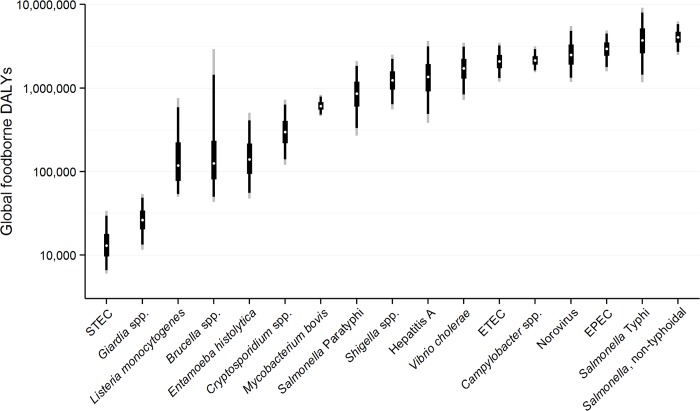
- Of foodborne DALYs, the largest burden came from nontyphoidal S. enterica if iNTS was included: 4.07 million DALYs (95% UI 2.49–6.27 million).
- Foodborne disease mortality and DALY rates were reported as highest in the African region, followed by the South East Asian region.
## Methods
- The study synthesized global and regional burden estimates for 22 foodborne diseases using the WHO FERG Enteric Diseases Task Force framework, combining literature reviews, systematic reviews, cohort studies, surveillance studies, expert consultation, and existing burden-of-disease assessments.
- The team estimated cases, sequelae, deaths, and DALYs for 2010, using pathogen-specific approaches: national estimates where available, a modified CHERG approach for diarrheal diseases in many countries, GBD 2010/IHME data for typhoid, paratyphoid, and hepatitis A, and expert elicitation to estimate the proportion transmitted by food.
- Uncertainty was propagated with Monte Carlo simulations using 10,000 draws per input parameter to generate 95% uncertainty intervals.
## Limitations
- The paper states that a major limitation was data gaps, especially in middle- and high-mortality countries, and that for many regions and pathogens the available data were sparse.
- It also states that only a few sequelae were included, with post-infectious sequelae such as reactive arthritis and irritable bowel syndrome excluded; stillbirths were excluded as well.
- The authors note that they could not fully account for age-specific effects for sequelae and could not separate some effects from comorbidities such as HIV infection.
- The text also makes evident, by its own description, that many estimates relied on expert elicitation for foodborne attribution and on assumptions/substitution where direct data were absent; this increases uncertainty and is part of the paper’s stated limitation.
Model-written summary. Check it against the paper before relying on it.
Integrity signals
Registry
Cites
Statistics
Figures
Verification
Claims the paper makes
3 Valid · 0 Not valid · 4 Not checked · 29 Own results and interpretations
The cited sources support only part of this claim — read each source’s verdict below.
In the paper
“Furthermore, global and regional estimates of the burden of foodborne diseases have not been available [1,2].”
§ World Health Organization Estimates of the Global and Regional Disease Burden of 22 Foodborne Bacterial, Protozoal, and Viral Diseases, 2010: A Data Synthesis > Introduction
What the sources say
- Partly supportedcites [1] Stein C, Kuchenmuller T, Hendrickx S, Prüss-Űstün A, Wolfson L, Engels D, et al The Global Burden of Disease assessments—WHO is responsible? PLoS Negl Trop Dis. 2007; 1: e161 10.1371/journal.pntd.0000161 18160984 PMC2154395 sourceExperimental — accuracy not yet measured
The Foodborne diseases section says that the full extent of the burden is unknown and that no precise, consistent global information existed at the time. It does not specifically address regional estimates, and its wording is narrower than saying no global estimates were available at all. No page number is provided in our copy. (LLM, conf=0.84)
- Not checked — no full text of the sourcecites [2] Tauxe RV, Doyle MP, Kuchenmuller T, Schlundt J, Stein CE. Evolving public health approaches to the global challenge of foodborne infections. Int J Food Microbiol. 2010; 139 Suppl 1: S16– 28. 10.1016/j.ijfoodmicro.2009.10.014 19931203 source
plain- Asserted: passes — The authors put it forward as true.
- Checkable: passes — It can be checked against evidence.
- Load-bearing: passes — The paper’s conclusions depend on it.
- Based: passes — The paper gives a reason why it holds.
- Partly supported
A result the paper reports from its own data — it cites no other source for it, so there is none to check. The quote shows it is in the paper.
In the paper
“Overall, 29% (95% UI 23–36%) of all 22 diseases were estimated to be transmitted by contaminated food equating to 582 million (95% UI 400–922 million) foodborne cases in 2010; 38% (95% UI 24–53%) in children <5 years of age.”
§ World Health Organization Estimates of the Global and Regional Disease Burden of 22 Foodborne Bacterial, Protozoal, and Viral Diseases, 2010: A Data Synthesis > Results > Cases
hedged- Asserted: passes — The authors put it forward as true.
- Checkable: passes — It can be checked against evidence.
- Load-bearing: passes — The paper’s conclusions depend on it.
- Based: passes — The paper gives a reason why it holds.
- Rests on an assumption not shown here.
A result the paper reports from its own data — it cites no other source for it, so there is none to check. The quote shows it is in the paper.
In the paper
“Among the 11 diarrheal diseases, the rate ratio of foodborne cases occurring among children <5 years of age compared to those ≥5 years of age was 6.44 (95%UI 3.15–12.46).”
§ World Health Organization Estimates of the Global and Regional Disease Burden of 22 Foodborne Bacterial, Protozoal, and Viral Diseases, 2010: A Data Synthesis > Results > Cases
plainstates an association- Asserted: passes — The authors put it forward as true.
- Checkable: passes — It can be checked against evidence.
- Load-bearing: unclear — It is unclear whether the paper’s conclusions depend on it.
- Based: passes — The paper gives a reason why it holds.
- Rests on 2 assumptions not shown here.
A result the paper reports from its own data — it cites no other source for it, so there is none to check. The quote shows it is in the paper.
In the paper
“Norovirus was the leading cause of foodborne illness causing 125 million (95% UI 70–251 million) cases, while Campylobacter spp. caused 96 million (95% UI 52–177 million) foodborne illnesses.”
§ World Health Organization Estimates of the Global and Regional Disease Burden of 22 Foodborne Bacterial, Protozoal, and Viral Diseases, 2010: A Data Synthesis > Abstract > Methods and Findings
plainstates a cause- Asserted: passes — The authors put it forward as true.
- Checkable: passes — It can be checked against evidence.
- Load-bearing: unclear — It is unclear whether the paper’s conclusions depend on it.
- Based: passes — The paper gives a reason why it holds.
In the paper
“The FERG estimate for DALYs for nontyphoidal S. enterica combining diarrheal and invasive infections was 4 times greater than GBD 2010 [54].”
§ World Health Organization Estimates of the Global and Regional Disease Burden of 22 Foodborne Bacterial, Protozoal, and Viral Diseases, 2010: A Data Synthesis > Discussion
What the sources say
- Not checked — no full text of the sourcecites [54] Murray CJ, Vos T, Lozano R, Naghavi M, Flaxman AD, Michaud C, et al Disability-adjusted life years (DALYs) for 291 diseases and injuries in 21 regions, 1990–2010: a systematic analysis for the Global Burden of Disease Study 2010. Lancet. 2012; 380: 2197– 2223. 10.1016/S0140-6736(12)61689-4 23245608 source
plain- Asserted: passes — The authors put it forward as true.
- Checkable: passes — It can be checked against evidence.
- Load-bearing: unclear — It is unclear whether the paper’s conclusions depend on it.
- Based: passes — The paper gives a reason why it holds.
16 more claims
Create a free account to see all 36 claims and to verify the 1 reference still open.
- Probably not a substantial claim. 11
- It may state two separate claims as one. 5
Claims other papers make about this one
Each is checked against this paper’s own text: does it say what the citing paper says it does?
The source backs part of the claim, not all of it — or backs it for a different population, condition or comparison.
In the citing paper
“Animal-based foods, like cow milk, can pose a risk for zoonotic enteric pathogen transmission42 although pasteurisation is an effective means for making milk safer.”
From Environmental and behavioural exposure pathways associated with diarrhoea and enteric pathogen detection in 5-month-old, periurban Kenyan infants: a cross-sectional study (2022) · cites this paper as [42]
Experimental — accuracy not yet measured
Citations
Cites
Lozano, R., Naghavi, M., Foreman, K., Lim, S., Shibuya, K., Aboyans, V., Abraham, J., Adair, T., Aggarwal, R., Ahn, S. Y., et al. (2012) · The Lancet · doi:10.1016/s0140-6736(12)61728-0 · Cited by 14,070 · cited 3×
“Twelve of the diseases included in our study were also included in the GBD 2010 study [25,26,54].”
Murray, C. J. L., Vos, T., Lozano, R., Naghavi, M., Flaxman, A. D., Michaud, C., Ezzati, M., Shibuya, K., Salomon, J. A., Abdalla, S., et al. (2012) · The Lancet · doi:10.1016/s0140-6736(12)61689-4 · Cited by 8,888
Foodborne illness acquired in the United States—Major pathogens
Scallan, E., Hoekstra, R. M., Angulo, F. J., Tauxe, R. V., Widdowson, M.-A., Roy, S. L., Jones, J. L., & Griffin, P. M. (2011) · Emerging Infectious Diseases · doi:10.3201/eid1701.p11101 · Cited by 7,657 · cited 1×
“Many different diseases, including those due to bacteria, viruses, parasites, chemicals, and prions, may be transmitted to humans by contaminated food [3].”
Self-citationSelected major risk factors and global and regional burden of disease
Ezzati, M., Lopez, A. D., Rodgers, A., Vander Hoorn, S., & Murray, C. J. (2002) · The Lancet · doi:10.1016/s0140-6736(02)11403-6 · Cited by 3,594
Kotloff, K. L., Nataro, J. P., Blackwelder, W. C., Nasrin, D., Farag, T. H., Panchalingam, S., Wu, Y., Sow, S. O., Sur, D., Breiman, R. F., et al. (2013) · The Lancet · doi:10.1016/s0140-6736(13)60844-2 · Cited by 3,560 · cited 1×
“This approach was facilitated by the availability of estimates of the envelope of diarrheal deaths, along with recent advances in diarrheal disease diagnosis, such as widespread application of polymerase chain reaction (PCR) for norovirus detection [20,49].”
The Global Burden of Nontyphoidal Salmonella Gastroenteritis
Majowicz, S. E., Musto, J., Scallan, E., Angulo, F. J., Kirk, M., O’Brien, S. J., Jones, T. F., Fazil, A., & Hoekstra, R. M. (2010) · Clinical Infectious Diseases · doi:10.1086/650733 · Cited by 2,442
Self-citationGlobal burden of childhood pneumonia and diarrhoea
Walker, C. L. F., Rudan, I., Liu, L., Nair, H., Theodoratou, E., Bhutta, Z. A., O'Brien, K. L., Campbell, H., & Black, R. E. (2013) · The Lancet · doi:10.1016/s0140-6736(13)60222-6 · Cited by 2,356 · cited 2×
“, “envelope” of diarrheal incidence) for 2010 by combining estimates of diarrheal incidence for children<5 years of age and persons 5 years of age [13,36].”
Self-citationThe global burden of typhoid fever.
Crump, J., Luby, S., & Mintz, E. (2004) · Bulletin of the World Health Organization · doi:10.1590/s0042-96862004000500008 · Cited by 2,172
Self-citationThe global burden of typhoid fever.
(2004) · Europe PMC (PubMed Central) · Cited by 1,965
Self-citationSalomon, J. A., Vos, T., Hogan, D. R., Gagnon, M., Naghavi, M., Mokdad, A., Begum, N., Shah, R., Karyana, M., Kosen, S., et al. (2012) · The Lancet · doi:10.1016/s0140-6736(12)61680-8 · Cited by 1,322 · cited 1×
“Disability weights for each clinical outcome for the enteric diseases were taken from the GBD 2010 study [47].”
Cited by
Items 1,501–1,600 of 1,631
Ljungquist, O., Poijes, S., Sunnerhagen, T., & Bläckberg, A. (2024) · Annals of Medicine · doi:10.1080/07853890.2024.2356638 · Cited by 1
Evaluation of Antimicrobial Efficacy of Hydrazide-Hydrazone Derivatives against Food Borne Pathogens
Constant, Z. A., Bertin, T. K., Bakary, C., Coulibali, S., Alexandre, N. N., Ibrahim, K., Rose, K.-N., & Connil, N. (2024) · Microbiology Research Journal International · doi:10.9734/mrji/2024/v34i71455
Microbiological Risk Assessment of High-Demand Food from Three Major Cities in Ecuador
Llorente, E. S., Mora, F. J. C., Hinojosa, L. C., & Suárez, M. V. (2024) · Bionatura journal : · doi:10.21931/bj/2024.02.01.19 · Cited by 1
Bringing Food Safety to the Shoppers
Nordhagen, S., Garsow, A. V., Swartz, H., Alhassan, M. M., & Isyaku, I. (2024) · doi:10.36072/wp.40
Bacteriological profile of ready-to-eat food items in Kathmandu
Arjyal, C., Manandhar, S., & Dulal, S. (2024) · Scientific World · doi:10.3126/sw.v17i17.66451
https://apps.crossref.org/webDeposit/
Leary, J. K. O. (2022) · doi:10.34719/qolt9975
Wang, H., Xie, H., Chen, C., Nengjiu, L. I., Zhen, R., Lu, J., & Li, X. (2024) · Research Square · doi:10.21203/rs.3.rs-4647298/v1
Pleiotropic cellular responses underlying antibiotic tolerance in Campylobacter jejuniPreprint
Cho, E., Kim, J., Hur, J. I., et al. (2024) · bioRxiv (Cold Spring Harbor Laboratory) · doi:10.1101/2024.08.09.607412
Raabis, S. M., Westerman, T. L., Cruz, E., Deblois, C. L., Suen, G., & Elfenbein, J. R. (2024) · Microbiology Spectrum · doi:10.1128/spectrum.00212-24 · Cited by 2
Introduction: Concept, Significance and Properties of Microbial Toxins
Sulieman, A. M. E. (2024) · Springer eBooks · doi:10.1007/978-3-031-62839-9_1
Microbiome-Immune Dynamics: Insights into Infectious Diseases
Rafinezhad, N. (2024) · SVOA Microbiology · doi:10.58624/svoamb.2024.05.048
“…diseases are among the leading causes of death, and according to the Global Burden of Diseases, Injuries, and Risk Factors Study of 2015, infectious diarrhea is a major cause of mortality worldwide, with a significant percentage of these deaths occurring in children under the age of five [13,14].”
BackgroundTarr, G. A. M., Chui, L., Stanford, K., Bumunang, E. W., Zaheer, R., Li, V., Freedman, S. B., Laing, C., & McAllister, T. A. (2024) · eLife · doi:10.7554/elife.97643.1
Molecular epidemiology and evolution of human noroviruses
Tohma, K., & Ushijima, H. (2023) · Uirusu · doi:10.2222/jsv.73.17
Ward, C., Finical, W., Smith, K., et al. (2024) · medRxiv · doi:10.1101/2024.09.25.24314361
Christanseen, S., Walls, D., White, B., Murphy, R. A., & Horgan, K. A. (2024) · Animals · doi:10.3390/ani14213150
Burgess, C. M., Arroyo, C., Bolton, D. J., et al. (2019) · doi:10.1002/9781394322428.ch15
Rouamba, S. S., Tapsoba, F., Kaboré, B., Soubeiga, A. P., Bandé, M., Kabré, E., & Savadogo, A. (2024) · Food and Environmental Virology · doi:10.1007/s12560-024-09621-3 · Cited by 1
“Overall mortality associated with norovirus infection is estimated to be approximately 30% of deaths associated with diarrheal disease (Kirk et al., 2015).”
MENDES, A. M., Forsythe, S. J., & Brandão, M. L. L. (2024) · Food Science and Technology · doi:10.5327/fst.00368
Olunga, B. O., Maina, G. G., Nyangao, J., et al. (2024) · Journal of Biosciences and Medicines · doi:10.4236/jbm.2024.1212038
Tarr, G. A. M., Chui, L., Stanford, K., Bumunang, E. W., Zaheer, R., Li, V., Freedman, S. B., Laing, C., & McAllister, T. A. (2025) · eLife · doi:10.7554/elife.97643.2
Yañez, R. M., Quitón, R., Rojas, E., et al. (2025) · Revista Panamericana de Salud Pública · doi:10.26633/rpsp.2025.5
10.1016/b978-84-9113-949-2.00110-4
(2000) · Time to knit · doi:10.1016/b978-84-9113-949-2.00110-4
Tarr, G. A. M., Chui, L., Stanford, K., Bumunang, E. W., Zaheer, R., Li, V., Freedman, S. B., Laing, C., & McAllister, T. A. (2025) · eLife · doi:10.7554/elife.97643.3
Biomonitoring of Salmonella biofilm
Upadhyay, A., Sharma, S., & Kumar, A. (2025) · Elsevier eBooks · doi:10.1016/b978-0-443-22055-5.00009-3
Namadi, M., Mortazavighahi, A., Habibi, S., et al. (2025) · Iranian Journal of Medical Microbiology · doi:10.30699/ijmm.18.6.364
Mwing’a, G. P., Kimu, P., Beti, M., et al. (2025) · IJID Regions · doi:10.1016/j.ijregi.2025.100661
“Gastrointestinal (GI) infections, such as diarrhea and dysentery, remain major and common public health concerns causing morbidities and mortalities among people of all ages [ 1 ].”
Sawale, M. R., Mehta, H. N., Singh, A., et al. (2025) · SSRN Electronic Journal · doi:10.2139/ssrn.5249361
Bajwa, H. A., Bhowmick, S., & Varga, C. (2025) · SSRN Electronic Journal · doi:10.2139/ssrn.5254505
Watier-Grillot, S., Boudaud, N., Loutreul, J., et al. (2025) · SSRN Electronic Journal · doi:10.2139/ssrn.5269711
Parks, A. R., Will, J., Mathew, L., Massier, S., Hardouin, J., & Escalante‐Semerena, J. C. (2025) · Pathogens · doi:10.3390/pathogens14070616 · Cited by 1
“It is estimated that global salmonellosis cases range from 93.8 to 153 million illnesses and 56,969 to 155,000 deaths per year, demonstrating a significant burden on public health and economic impact [1,2].”
InfluentialOssio, A., Merino-Mascorro, J. Á., León, J. S., Heredia, N. L., & García, S. (2025) · Food and Environmental Virology · doi:10.1007/s12560-025-09651-5
“Human norovirus is the most common cause of acute gas-troenteritis worldwide, with an estimated 685 million cases annually (Kirk et al., 2015).”
Tsuchida, M., Ohno, Y., Hirata, A., Inoshima, Y., & Okada, A. (2026) · Pathogens · doi:10.1101/2025.07.25.666711
Yan, X., Kooh, P., Fédérighi, M., Jury, V., Cappelier, J.-M., & Boué, G. (2025) · Food Research International · doi:10.1016/j.foodres.2025.117150 · Cited by 1
LaPolt, D., Azmeraye, B. M., Kuang, Z., Degefaw, D. M., Teshale, A. M., Alonso, S., Dessie, Y., Lopez, M., Kalayu, A. A., Andargie, G., et al. (2025) · PLOS Global Public Health · doi:10.1371/journal.pgph.0005021
“In Africa, the median incidence rates associated with NTS and Shigella are thought to be much lower than global estimates, despite rates of diarrheal disease being much higher [4].”
Majowicz, S. E. (2023) · The Conversation · doi:10.64628/aam.q46jwhcyc
Chen, Y., He, Z., Chen, Z., et al. (2025) · bioRxiv (Cold Spring Harbor Laboratory) · doi:10.1101/2025.09.02.673672
Fadlalla, I. M. T. (2025) · IntechOpen eBooks · doi:10.5772/intechopen.1011603 · Cited by 4
Watier-Grillot, S., Loutreul, J., Boudaud, N., Sauvageot, C., Thiébaut, E., de Santi, V. P., & Chesnay, A. (2025) · Food Microbiology · doi:10.1016/j.fm.2025.104931 · Cited by 1
Kroh, J. M., Chakravarty, A., Dey, S., et al. (2025) · PLoS ONE · doi:10.1371/journal.pone.0331455
“The T3SS consists of a nanoscale injectisome that is essential in the pathogenesis many Gram-negative bacteria that contribute to millions of infections worldwide [4,5].”
Mekky, A., Issa, M. R., Hashish, A., HASSAN, W. M. M., Wahdan, A., Hisham, I., Enany, S., & Enany, M. E. (2025) · Microbiology Research · doi:10.3390/microbiolres16090209
“Campylobacter is one of the four most important causes of global diarrheal diseases, with an estimated 96 million cases and 37,600 deaths annually, predominantly in developing countries [1].”
Mistari, B., Badgujar, J., Bhavsar, H., et al. (2025) · International Journal of Advanced Research in Science Communication and Technology · doi:10.48175/ijarsct-29750
Muhammad Ismail, M. F. (2021) · International Journal of Biosciences (IJB) · doi:10.12692/ijb/19.2.65-71
Héma, A., Soulama, B. I., Sawadogo, J., Ouedraogo, A. Z., Hien, D., Nébié, I., Houard, S. A., Ouédraogo, A., Tiono, A. B., Sanou, M., et al. (2025) · BMC Microbiology · doi:10.1186/s12866-025-04515-1 · Cited by 3
“The burden of NTS is not evenly distributed, with the highest incidence rates found in sub-Saharan Africa (SSA) [10–12].”
Lee, J. Y., & Kim, J. (2025) · International Journal of Food Science · doi:10.1155/ijfo/6948459
“It was estimated to account for approximately 100 million cases of foodborne illness, with 21,000 deaths recorded worldwide in 2010 [1].”
A metagenomics-based tool for surveillance of bacterial pathogens in environmental samplesPreprint
Xiong, C., Gao, M., & Singh, B. K. (2025) · bioRxiv (Cold Spring Harbor Laboratory) · doi:10.64898/2025.12.16.694782
“…compiled a list of human bacterial pathogens using multiple authoritative sources, including the World Health Organization (WHO)’s recommended list 39,40 , the National Center for Biotechnology Information (NCBI) pathogen detection system (https://www.ncbi.nlm.nih.gov/pathogens/), VFDB 37 , and…”
Yousefi, M. H., Wagemans, J., Shekarforoush, S. S., et al. (2024) · Figshare · doi:10.6084/m9.figshare.26628703
Gu, S., Chen, F.-M., Zhang, C.-S., Zhou, Y.-B., Li, T.-Y., Qiang, N., Zhang, X.-X., Liu, J.-S., Wang, S., Yang, X., et al. (2023) · Figshare · doi:10.6084/m9.figshare.24186172
Zhou, H.-L., Bessey, T., Wang, S.-M., et al. (2021) · Figshare · doi:10.6084/m9.figshare.14670185
Baral, R., Nonvignon, J., Debellut, F., et al. (2020) · Figshare · doi:10.6084/m9.figshare.12258056
Baral, R., Nonvignon, J., Debellut, F., et al. (2020) · Figshare · doi:10.6084/m9.figshare.12258053
Lee, J.-S., Mogasale, V., Marks, F., & Kim, J. (2021) · Figshare · doi:10.6084/m9.figshare.14738855
Baral, R., Nonvignon, J., Debellut, F., et al. (2020) · Figshare · doi:10.6084/m9.figshare.12258038
Gu, S., Chen, F.-M., Zhang, C.-S., Zhou, Y.-B., Li, T.-Y., Qiang, N., Zhang, X.-X., Liu, J.-S., Wang, S., Yang, X., et al. (2023) · Figshare · doi:10.6084/m9.figshare.24186175
Costigan, R., Stoakes, E., Floto, R. A., Parkhill, J., & Grant, A. J. (2022) · Figshare · doi:10.6084/m9.figshare.21285550
Wang, Z., Chen, R., Xia, F., et al. (2024) · Figshare · doi:10.6084/m9.figshare.26643808
Costigan, R., Stoakes, E., Floto, R. A., Parkhill, J., & Grant, A. J. (2022) · Figshare · doi:10.6084/m9.figshare.21285553
Wang, Z., Chen, R., Xia, F., et al. (2024) · Figshare · doi:10.6084/m9.figshare.24628173
Wang, Z., Chen, R., Xia, F., et al. (2024) · Figshare · doi:10.6084/m9.figshare.26643817
Wang, Z., Chen, R., Xia, F., et al. (2024) · Figshare · doi:10.6084/m9.figshare.26643811
Additional file 1 of Food safety and dietary diversity in African urban cities: evidence from Ghana
Dzudzor, M. I., Gerber, N., & Asante, F. A. (2024) · Figshare · doi:10.6084/m9.figshare.26697173
Gu, S., Chen, F.-M., Zhang, C.-S., Zhou, Y.-B., Li, T.-Y., Qiang, N., Zhang, X., Liu, J.-S., Wang, S., Yang, X., et al. (2023) · Figshare · doi:10.6084/m9.figshare.24186184
Baral, R., Nonvignon, J., Debellut, F., et al. (2020) · Figshare · doi:10.6084/m9.figshare.12258044
Lee, J.-S., Mogasale, V., Marks, F., & Kim, J. (2021) · Figshare · doi:10.6084/m9.figshare.14738858
Wang, Z., Chen, R., Xia, F., et al. (2024) · Figshare · doi:10.6084/m9.figshare.26643814
Zhang, H., Zhao, C., Zhang, X., et al. (2023) · Figshare · doi:10.6084/m9.figshare.23167810
Gu, S., Chen, F.-M., Zhang, C.-S., Zhou, Y.-B., Li, T.-Y., Qiang, N., Zhang, X., Liu, J.-S., Wang, S., Yang, X., et al. (2023) · Figshare · doi:10.6084/m9.figshare.24186181
Ahmed, A. D., Hiko, A., Belina, D., et al. (2024) · Figshare · doi:10.6084/m9.figshare.26756599
Gu, S., Chen, F.-M., Zhang, C.-S., Zhou, Y.-B., Li, T.-Y., Qiang, N., Zhang, X., Liu, J.-S., Wang, S., Yang, X., et al. (2023) · Figshare · doi:10.6084/m9.figshare.24186166
Baral, R., Nonvignon, J., Debellut, F., et al. (2020) · Figshare · doi:10.6084/m9.figshare.12258062
Baral, R., Nonvignon, J., Debellut, F., et al. (2020) · Figshare · doi:10.6084/m9.figshare.12258071
Yousefi, M. H., Wagemans, J., Shekarforoush, S. S., et al. (2024) · Figshare · doi:10.6084/m9.figshare.26628700
Gu, S., Chen, F.-M., Zhang, C.-S., Zhou, Y.-B., Li, T.-Y., Qiang, N., Zhang, X.-X., Liu, J.-S., Wang, S., Yang, X.-C., et al. (2023) · Figshare · doi:10.6084/m9.figshare.24186178
Wang, S., Wang, S., Hao, T., et al. (2024) · Figshare · doi:10.6084/m9.figshare.26619877
Gu, S., Chen, F.-M., Zhang, C.-S., Zhou, Y.-B., Li, T.-Y., Qiang, N., Zhang, X.-X., Liu, J.-S., Wang, S., Yang, X., et al. (2023) · Figshare · doi:10.6084/m9.figshare.24186169
Public Health Implications of XDR Typhoid Spread in Pakistan and Roadmap for Resistance Mitigation
Bashir, I., Danish, S., & Bashir, G. (2025) · Science Futures · doi:10.11648/j.scif.20250101.20 · Cited by 1
Prolonged Cholestatic Hepatitis A in an Unvaccinated International Traveler
Bomfim, E. Y. M., Viana, J. V. M., Vanin, G. C., Kajita, M. S., & da Silva, M. V. (2026) · Cureus · doi:10.7759/cureus.101110
“The disease has a universal distribution, with higher incidence in areas lacking basic sanitation [1,2].”
Kox, L. F. F., & Sijm, D. T. H. M. (2026) · Food Risk Assess Europe · doi:10.2903/fr.efsa.2026.fr-0092
Comparison of Methods and Integrated Application for Efficient Campylobacter Detection in Production
Ren, F., Liu, Y., Zhang, S., Zhu, J., Tang, Y., Jiao, X.-A., & Huang, J. (2026) · Foodborne Pathogens and Disease · doi:10.1177/15353141261417555
Chen, S., Qian, H., He, L., Bao, Y., Wang, A., Li, C., Qin, J., Fu, P., Meng, J., & Wang, C. (2026) · Infection and Drug Resistance · doi:10.2147/idr.s570039
Locke, S. R., Reese, D., Meyer, R., Pempek, J. A., Sockett, D. C., Aulik, N. A., & Habing, G. G. (2026) · Zoonoses and Public Health · doi:10.1111/zph.70037
Cachique, L. R., Schiaffino, F., Olórtegui, M. P., Villanueva, K. M., Vasquez, T. N. P., Castro, A., Najarro, J., Cooper, K. K., Mourkas, E., Pascoe, B., et al. (2026) · bioRxiv (Cold Spring Harbor Laboratory) · doi:10.64898/2026.02.06.704332
González-Linares, J. I., Ynfante-Acuña, H., Vara-Allhuirca, S., Quispe-Sanca, D., & Morales-García, W. C. (2026) · Foods · doi:10.3390/foods15040683 · Cited by 1
Ali, M., Thakali, O., Solomon, T. B., et al. (2026) · Environmental Science Water Research & Technology · doi:10.1039/d5ew01033k
Su, L., Lun, H., Li, N., et al. (2026) · Microbiology Spectrum · doi:10.1128/spectrum.02676-25
Jo, M., Heo, Y., Kim, D., & Song, I. (2026) · Journal of Health Informatics and Statistics · doi:10.21032/jhis.2026.51.1.1
Zhang, X., Li, Z., Fu, Y., et al. (2026) · Parasites & Vectors · doi:10.1186/s13071-026-07369-2
“Accordingly, echinococcosis has been prioritized by the World Health Organization (WHO) as a neglected tropical disease and as one of the most significant foodborne zoonoses based on its substantial burden worldwide [3].”
Diversité génomique de Salmonella Derby en France
Sévellec, Y. (2018) · theses.fr (ABES) · doi:10.70675/e0a62331zf8c6z4d98zb61bz6366a048abff · Cited by 2
Santos, T. (2019) · theses.fr (ABES) · doi:10.70675/a06631d0ze166z4a05zb7fcz8316b6779696 · Cited by 2
Saabi, A.-A. A. (2020) · theses.fr (ABES) · doi:10.70675/11a169fdzc516z4e22zbe53z82838a922b80 · Cited by 2
Chassaing, M. (2021) · theses.fr (ABES) · doi:10.70675/dd0848edz7dbfz4112z9ee4z04d7e31b3418 · Cited by 1
Zhanpeng, W., Li, J., Zuo, Y., et al. (2026) · FEMS Microbiology Letters · doi:10.1093/femsle/fnag034
Bajwa, H. U. R., Bhowmick, S., & Varga, C. (2026) · medRxiv · doi:10.64898/2026.04.04.26350168
Karakayali, O., Özdemir, M. A., Özturan, İ. U., et al. (2026) · Foodborne Pathogens and Disease · doi:10.1177/15353141261449289
Tang, F., Chen, Z., Deng, S., Wang, X., Gong, X., Li, R., Xi, L., Li, C., Wang, B., & Luo, W. (2026) · European Journal of Clinical Microbiology & Infectious Diseases · doi:10.1007/s10096-026-05533-1
Chen, D., Shioda, K., Brouwer, A. F., Kraay, A. N. M., Handel, A., Lopman, B. A., McQuade, E. T. R., & Nelson, K. (2026) · Epidemiology · doi:10.1097/ede.0000000000002004 · Cited by 1
Peng, L., Wang, Y., Xu, S., Wang, Z., Li, J., Cao, X., Li, Y., Fang, R., Dong, X., & Li, Z. (2026) · BMC Microbiology · doi:10.1186/s12866-026-05132-2
“Foodborne pathogenic bacteria, such as Staphylococcus aureus ( S. aureus ), Escherichia coli ( E. coli ), and Salmonella , cause foodborne diseases, which pose a great threat to global public health and food safety [6, 7].”
Exploring bet-hedging in Salmonella enterica serovar Typhimurium with a dual reporter strain
Gerber, M., Sivaranjani, M., Vincent, K., Jelfimow, S., Herman, D. J., Palmer, M. B., Nnajide, C. R., Sanderson, H., Sparrow, J., Waddell, B. M., et al. (2026) · mSystems · doi:10.1128/msystems.00177-26
“Salmonella strains that cause gastroenteritis remain one of the top enteric patho gens that cause foodborne illness and death (11).”
Hong, Y.-P., Liao, Y.-S., Wang, Y.-W., et al. (2026) · bioRxiv (Cold Spring Harbor Laboratory) · doi:10.64898/2026.05.19.726213
Saghrouchni, H., Tasdurmazli, S., Kılıç, İ. H., et al. (2026) · Frontiers in Pharmacology · doi:10.3389/fphar.2026.1807000
“In developed countries, it is regarded as the second most significant foodborne pathogen (Kirk et al., 2015).”
Metadata
- Authors
- Kirk, M. D., Pires, S. M., Black, R. E., Caipo, M., Crump, J. A., Devleesschauwer, B., Döpfer, D., Fazil, A., Fischer-Walker, C. L., Hald, T., Hall, A. J., Keddy, K. H., Lake, R. J., Lanata, C. F., Torgerson, P. R., Havelaar, A. H., & Angulo, F. J.
- Affiliations
- Australian National University (AU)
- Technical University of Denmark (DK)
- Johns Hopkins University (US)
- Food and Agriculture Organization of the United Nations (IT)
- University of Otago (NZ)
- Ghent University (BE)
- University of Wisconsin–Madison (US)
- Public Health Agency of Canada (CA)
- Centers for Disease Control and Prevention (US)
- University of the Witwatersrand (ZA)
- New Zealand Institute for Public Health and Forensic Science (NZ)
- Instituto de Investigación Nutricional (PE)
- University of Zurich (CH)
- Utrecht University (NL)
- Corresponding author
- Kirk, Martyn D.
- ORCID
- Venue
- PLoS Medicine
- Publisher
- Public Library of Science (PLoS)
- Published
- 2015-12-03
- Volume
- 12
- Issue
- 12
- Pages
- e1001921
- ISSN
- 1549-1277 (ISSN-L)
- 1549-1676
- PMC
- PMC4668831
- OpenAlex
- W2184405267
- Cited by
- 1,625
- References
- 58
- Citations by year
- 2026: 76 · 2025: 120 · 2024: 172 · 2023: 189 · 2022: 168 · 2021: 202 · 2020: 237 · 2019: 158 · 2018: 130 · 2017: 107 · 2016: 60 · 2015: 5
- FWCI
- 12.61
- Type
- journal article
- Language
- en
- Update notices
- correction (2015-12-23)
- Open access
- gold
- doi.org
- Licence
- Locations
- PLoS Medicine (publishedVersion, cc-by)
- Europe PMC (PubMed Central) (publishedVersion, cc-by)
- PubMed Central (publishedVersion, cc-by)
- PubMed (publishedVersion)
- IHI Repository (acceptedVersion)
- Zurich Open Repository and Archive (University of Zurich) (acceptedVersion, cc-by)
- Ghent University Academic Bibliography (Ghent University) (submittedVersion, other-oa)
- DOAJ (DOAJ: Directory of Open Access Journals) (submittedVersion, cc-by-sa)
- Utrecht University Repository (Utrecht University) (submittedVersion, other-oa)
- Figshare (submittedVersion, cc-by)
- ANU Open Research (Australian National University) (submittedVersion)
- Technical University of Denmark, DTU Orbit (Technical University of Denmark, DTU) (submittedVersion, other-oa)
- Rivm (National Institute for Public Health and the Environment) (submittedVersion)
- Zurich Open Repository and Archive (University of Zurich) (submittedVersion, cc-by)
- Zurich Open Repository and Archive (University of Zurich)
- Funders
- Bill and Melinda Gates Foundation
- World Health Organization
- Institute for Health Metrics and Evaluation
- Topics
- Life Sciences › Agricultural and Biological Sciences › Food Science › Salmonella and Campylobacter epidemiology
- Life Sciences › Agricultural and Biological Sciences › Food Science › Food Safety and Hygiene
- Health Sciences › Medicine › Infectious Diseases › Viral gastroenteritis research and epidemiology
- Keywords
- food poisoning, disease burden, disability-adjusted life years, norovirus, Campylobacter, Salmonella, Escherichia coli, Vibrio cholerae, Mycobacterium bovis, invasive non-typhoidal Salmonella, food contamination, diarrheal disease, foodborne parasitic infection
- MeSH terms
- Foodborne Diseases, Humans, Global Health, World Health Organization, Incidence, Prevalence, Cost of Illness, Quality-Adjusted Life Years
About these checks
Registry, retraction, Cites and statistics results are computed, not judged, with one exception: a printed reference that no index lists is read once by a model before it counts as a citation error. Claims are extracted by a model and kept only when their quote appears verbatim in the text; each cited source is then checked, with a model’s help, for whether it says what the claim relies on. Those verdicts can be wrong — read the claim’s quote and the cited source before relying on one.
The claim verdicts this report counts are experimental: their accuracy is not yet measured.
A language model drew the claims from the paper on 2026-10-10, under version 3 of the claim definition (model deepseek-v4.1-flash, prompt extract-v3).
A second model labelled each claim on 2026-10-10 (model jev-1.13-20260917, definition revision gold-guideline-v0.2).
Cited sources are checked with a language model’s help (gpt-6-sol).
Statistics and arithmetic are recomputed, not judged.
Confidence bands are shown only for fields calibrated on our annotated test set. None is calibrated yet, so no band is shown.
What counts as a claim ›How we measure confidence ›How we check this ›
Are you an author, or do you see a problem with this page? Request a review
Data sources
Bibliographic data: Semantic Scholar, OpenAlex, Crossref.
Contains information from the Semantic Scholar Academic Graph Datasets, made available under the ODC Attribution License (ODC-BY 1.0).
Semantic Scholar’s data is described in: Kinney, R., et al. (2023). The Semantic Scholar Open Data Platform. arXiv:2301.10140.
