

World Health Organization Estimates of the Global and Regional Disease Burden of 22 Foodborne Bacterial, Protozoal, and Viral Diseases, 2010: A Data Synthesis.
Open accessThe DOI matches its Crossref record; 57 of the 58 references it cites were found in a registry or an index; 3 of the 9 sources its claims cite were checked for support.
Abstract
We estimate that the 22 diseases included in our study resulted in two billion cases, over one million deaths, and 78.7 million DALYs in 2010.
Overview
CoChat Summary
## TL;DR
This paper provides the first WHO-led global and regional estimates of the burden of 22 foodborne bacterial, protozoal, and viral diseases in 2010. It estimates 2.0 billion illnesses, 1.09 million deaths, 78.7 million DALYs, and 582 million foodborne cases, with a large share of burden in children under 5.
## Key findings
- The 22 diseases caused an estimated 2.0 billion illnesses (95% UI 1.5–3.0 billion) in 2010; 39% (95% UI 26–53%) were in children <5 years.
- They caused 1.09 million deaths (95% UI 0.89–1.37 million); 34% (95% UI 29–38%) were in children <5 years.
- They caused 78.7 million DALYs (95% UI 65.0–97.7 million); 43% (95% UI 38–48%) were in children <5 years.
- The authors estimate 29% (95% UI 23–36%) of all cases were transmitted by contaminated food, equal to 582 million foodborne cases (95% UI 401–922 million) and 25.2 million foodborne DALYs (95% UI 17.5–37.0 million).
- Norovirus was the leading cause of foodborne illness, with 125 million (95% UI 70–251 million) foodborne cases; Campylobacter spp. caused 96 million (95% UI 52–177 million).
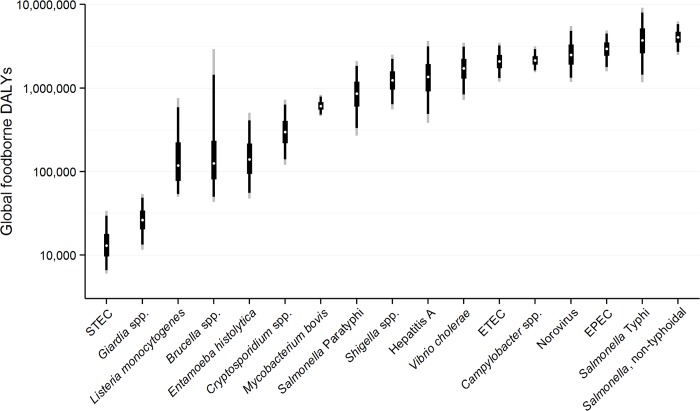
- Of foodborne DALYs, the largest burden came from nontyphoidal S. enterica if iNTS was included: 4.07 million DALYs (95% UI 2.49–6.27 million).
- Foodborne disease mortality and DALY rates were reported as highest in the African region, followed by the South East Asian region.
## Methods
- The study synthesized global and regional burden estimates for 22 foodborne diseases using the WHO FERG Enteric Diseases Task Force framework, combining literature reviews, systematic reviews, cohort studies, surveillance studies, expert consultation, and existing burden-of-disease assessments.
- The team estimated cases, sequelae, deaths, and DALYs for 2010, using pathogen-specific approaches: national estimates where available, a modified CHERG approach for diarrheal diseases in many countries, GBD 2010/IHME data for typhoid, paratyphoid, and hepatitis A, and expert elicitation to estimate the proportion transmitted by food.
- Uncertainty was propagated with Monte Carlo simulations using 10,000 draws per input parameter to generate 95% uncertainty intervals.
## Limitations
- The paper states that a major limitation was data gaps, especially in middle- and high-mortality countries, and that for many regions and pathogens the available data were sparse.
- It also states that only a few sequelae were included, with post-infectious sequelae such as reactive arthritis and irritable bowel syndrome excluded; stillbirths were excluded as well.
- The authors note that they could not fully account for age-specific effects for sequelae and could not separate some effects from comorbidities such as HIV infection.
- The text also makes evident, by its own description, that many estimates relied on expert elicitation for foodborne attribution and on assumptions/substitution where direct data were absent; this increases uncertainty and is part of the paper’s stated limitation.
Model-written summary. Check it against the paper before relying on it.
Integrity signals
Registry
Cites
Statistics
Figures
Verification
Claims the paper makes
3 Valid · 0 Not valid · 4 Not checked · 29 Own results and interpretations
The cited sources support only part of this claim — read each source’s verdict below.
In the paper
“Furthermore, global and regional estimates of the burden of foodborne diseases have not been available [1,2].”
§ World Health Organization Estimates of the Global and Regional Disease Burden of 22 Foodborne Bacterial, Protozoal, and Viral Diseases, 2010: A Data Synthesis > Introduction
What the sources say
- Partly supportedcites [1] Stein C, Kuchenmuller T, Hendrickx S, Prüss-Űstün A, Wolfson L, Engels D, et al The Global Burden of Disease assessments—WHO is responsible? PLoS Negl Trop Dis. 2007; 1: e161 10.1371/journal.pntd.0000161 18160984 PMC2154395 sourceExperimental — accuracy not yet measured
The Foodborne diseases section says that the full extent of the burden is unknown and that no precise, consistent global information existed at the time. It does not specifically address regional estimates, and its wording is narrower than saying no global estimates were available at all. No page number is provided in our copy. (LLM, conf=0.84)
- Not checked — no full text of the sourcecites [2] Tauxe RV, Doyle MP, Kuchenmuller T, Schlundt J, Stein CE. Evolving public health approaches to the global challenge of foodborne infections. Int J Food Microbiol. 2010; 139 Suppl 1: S16– 28. 10.1016/j.ijfoodmicro.2009.10.014 19931203 source
plain- Asserted: passes — The authors put it forward as true.
- Checkable: passes — It can be checked against evidence.
- Load-bearing: passes — The paper’s conclusions depend on it.
- Based: passes — The paper gives a reason why it holds.
- Partly supported
A result the paper reports from its own data — it cites no other source for it, so there is none to check. The quote shows it is in the paper.
In the paper
“Overall, 29% (95% UI 23–36%) of all 22 diseases were estimated to be transmitted by contaminated food equating to 582 million (95% UI 400–922 million) foodborne cases in 2010; 38% (95% UI 24–53%) in children <5 years of age.”
§ World Health Organization Estimates of the Global and Regional Disease Burden of 22 Foodborne Bacterial, Protozoal, and Viral Diseases, 2010: A Data Synthesis > Results > Cases
hedged- Asserted: passes — The authors put it forward as true.
- Checkable: passes — It can be checked against evidence.
- Load-bearing: passes — The paper’s conclusions depend on it.
- Based: passes — The paper gives a reason why it holds.
- Rests on an assumption not shown here.
A result the paper reports from its own data — it cites no other source for it, so there is none to check. The quote shows it is in the paper.
In the paper
“Among the 11 diarrheal diseases, the rate ratio of foodborne cases occurring among children <5 years of age compared to those ≥5 years of age was 6.44 (95%UI 3.15–12.46).”
§ World Health Organization Estimates of the Global and Regional Disease Burden of 22 Foodborne Bacterial, Protozoal, and Viral Diseases, 2010: A Data Synthesis > Results > Cases
plainstates an association- Asserted: passes — The authors put it forward as true.
- Checkable: passes — It can be checked against evidence.
- Load-bearing: unclear — It is unclear whether the paper’s conclusions depend on it.
- Based: passes — The paper gives a reason why it holds.
- Rests on 2 assumptions not shown here.
A result the paper reports from its own data — it cites no other source for it, so there is none to check. The quote shows it is in the paper.
In the paper
“Norovirus was the leading cause of foodborne illness causing 125 million (95% UI 70–251 million) cases, while Campylobacter spp. caused 96 million (95% UI 52–177 million) foodborne illnesses.”
§ World Health Organization Estimates of the Global and Regional Disease Burden of 22 Foodborne Bacterial, Protozoal, and Viral Diseases, 2010: A Data Synthesis > Abstract > Methods and Findings
plainstates a cause- Asserted: passes — The authors put it forward as true.
- Checkable: passes — It can be checked against evidence.
- Load-bearing: unclear — It is unclear whether the paper’s conclusions depend on it.
- Based: passes — The paper gives a reason why it holds.
In the paper
“The FERG estimate for DALYs for nontyphoidal S. enterica combining diarrheal and invasive infections was 4 times greater than GBD 2010 [54].”
§ World Health Organization Estimates of the Global and Regional Disease Burden of 22 Foodborne Bacterial, Protozoal, and Viral Diseases, 2010: A Data Synthesis > Discussion
What the sources say
- Not checked — no full text of the sourcecites [54] Murray CJ, Vos T, Lozano R, Naghavi M, Flaxman AD, Michaud C, et al Disability-adjusted life years (DALYs) for 291 diseases and injuries in 21 regions, 1990–2010: a systematic analysis for the Global Burden of Disease Study 2010. Lancet. 2012; 380: 2197– 2223. 10.1016/S0140-6736(12)61689-4 23245608 source
plain- Asserted: passes — The authors put it forward as true.
- Checkable: passes — It can be checked against evidence.
- Load-bearing: unclear — It is unclear whether the paper’s conclusions depend on it.
- Based: passes — The paper gives a reason why it holds.
16 more claims
Create a free account to see all 36 claims and to verify the 1 reference still open.
- Probably not a substantial claim. 11
- It may state two separate claims as one. 5
Claims other papers make about this one
Each is checked against this paper’s own text: does it say what the citing paper says it does?
The source backs part of the claim, not all of it — or backs it for a different population, condition or comparison.
In the citing paper
“Animal-based foods, like cow milk, can pose a risk for zoonotic enteric pathogen transmission42 although pasteurisation is an effective means for making milk safer.”
From Environmental and behavioural exposure pathways associated with diarrhoea and enteric pathogen detection in 5-month-old, periurban Kenyan infants: a cross-sectional study (2022) · cites this paper as [42]
Experimental — accuracy not yet measured
Citations
Cites
Lozano, R., Naghavi, M., Foreman, K., Lim, S., Shibuya, K., Aboyans, V., Abraham, J., Adair, T., Aggarwal, R., Ahn, S. Y., et al. (2012) · The Lancet · doi:10.1016/s0140-6736(12)61728-0 · Cited by 14,070 · cited 3×
“Twelve of the diseases included in our study were also included in the GBD 2010 study [25,26,54].”
Murray, C. J. L., Vos, T., Lozano, R., Naghavi, M., Flaxman, A. D., Michaud, C., Ezzati, M., Shibuya, K., Salomon, J. A., Abdalla, S., et al. (2012) · The Lancet · doi:10.1016/s0140-6736(12)61689-4 · Cited by 8,888
Foodborne illness acquired in the United States—Major pathogens
Scallan, E., Hoekstra, R. M., Angulo, F. J., Tauxe, R. V., Widdowson, M.-A., Roy, S. L., Jones, J. L., & Griffin, P. M. (2011) · Emerging Infectious Diseases · doi:10.3201/eid1701.p11101 · Cited by 7,657 · cited 1×
“Many different diseases, including those due to bacteria, viruses, parasites, chemicals, and prions, may be transmitted to humans by contaminated food [3].”
Self-citationSelected major risk factors and global and regional burden of disease
Ezzati, M., Lopez, A. D., Rodgers, A., Vander Hoorn, S., & Murray, C. J. (2002) · The Lancet · doi:10.1016/s0140-6736(02)11403-6 · Cited by 3,594
Kotloff, K. L., Nataro, J. P., Blackwelder, W. C., Nasrin, D., Farag, T. H., Panchalingam, S., Wu, Y., Sow, S. O., Sur, D., Breiman, R. F., et al. (2013) · The Lancet · doi:10.1016/s0140-6736(13)60844-2 · Cited by 3,560 · cited 1×
“This approach was facilitated by the availability of estimates of the envelope of diarrheal deaths, along with recent advances in diarrheal disease diagnosis, such as widespread application of polymerase chain reaction (PCR) for norovirus detection [20,49].”
The Global Burden of Nontyphoidal Salmonella Gastroenteritis
Majowicz, S. E., Musto, J., Scallan, E., Angulo, F. J., Kirk, M., O’Brien, S. J., Jones, T. F., Fazil, A., & Hoekstra, R. M. (2010) · Clinical Infectious Diseases · doi:10.1086/650733 · Cited by 2,442
Self-citationGlobal burden of childhood pneumonia and diarrhoea
Walker, C. L. F., Rudan, I., Liu, L., Nair, H., Theodoratou, E., Bhutta, Z. A., O'Brien, K. L., Campbell, H., & Black, R. E. (2013) · The Lancet · doi:10.1016/s0140-6736(13)60222-6 · Cited by 2,356 · cited 2×
“, “envelope” of diarrheal incidence) for 2010 by combining estimates of diarrheal incidence for children<5 years of age and persons 5 years of age [13,36].”
Self-citationThe global burden of typhoid fever.
Crump, J., Luby, S., & Mintz, E. (2004) · Bulletin of the World Health Organization · doi:10.1590/s0042-96862004000500008 · Cited by 2,172
Self-citationThe global burden of typhoid fever.
(2004) · Europe PMC (PubMed Central) · Cited by 1,965
Self-citationSalomon, J. A., Vos, T., Hogan, D. R., Gagnon, M., Naghavi, M., Mokdad, A., Begum, N., Shah, R., Karyana, M., Kosen, S., et al. (2012) · The Lancet · doi:10.1016/s0140-6736(12)61680-8 · Cited by 1,322 · cited 1×
“Disability weights for each clinical outcome for the enteric diseases were taken from the GBD 2010 study [47].”
Cited by
Havelaar, A. H., Kirk, M. D., Torgerson, P. R., Gibb, H. J., Hald, T., Lake, R. J., Praet, N., Bellinger, D. C., de Silva, N. R., Gargouri, N., et al. (2015) · PLoS Medicine · doi:10.1371/journal.pmed.1001923 · Cited by 2,067
“Detailed descriptions of methods to estimate incidence and mortality of all 31 hazards can be found in papers in the collection on enteric diseases [11], parasitic diseases [18], and chemicals and toxins [19].”
BackgroundMethodSelf-citationArtificial Intelligence and Human Trust in Healthcare: Focus on Clinicians
Asan, O., Bayrak, A. E., & Choudhury, A. (2020) · Journal of Medical Internet Research · doi:10.2196/15154 · Cited by 825
The amazing potential of fungi: 50 ways we can exploit fungi industrially
Hyde, K. D., Xu, J., Rapior, S., Jeewon, R., Lumyong, S., Niego, A. G. T., Abeywickrama, P. D., Aluthmuhandiram, J. V. S., Brahamanage, R. S., Brooks, S., et al. (2019) · Fungal Diversity · doi:10.1007/s13225-019-00430-9 · Cited by 811
Torgerson, P. R., Devleesschauwer, B., Praet, N., Speybroeck, N., Willingham, A. L., Kasuga, F., Rokni, M. B., Zhou, X.-N., Fèvre, E. M., Sripa, B., et al. (2015) · PLOS Medicine · doi:10.1371/journal.pmed.1001920 · Cited by 777
“However, details about enteric protozoa are reported in the research article by Kirk et al on foodborne enteric pathogens [5].”
BackgroundMethodResultInfluentialSelf-citationStanaway, J. D., Parisi, A., Sarkar, K., Blacker, B. F., Reiner, R. C., Hay, S. I., Nixon, M. R., Dolecek, C., James, S. L., Mokdad, A. H., et al. (2019) · The Lancet Infectious Diseases · doi:10.1016/s1473-3099(19)30418-9 · Cited by 645
Self-citationWorldwide Epidemiology of Salmonella Serovars in Animal-Based Foods: a Meta-analysis
Ferrari, R. G., Rosario, D. K. A., Cunha-Neto, A., Mano, S. B., Figueiredo, E. E. S., & Conte-Junior, C. A. (2019) · Applied and Environmental Microbiology · doi:10.1128/aem.00591-19 · Cited by 636
Salmonella, food safety and food handling practices
Ehuwa, O., Jaiswal, A. K., & Jaiswal, S. (2021) · Foods · doi:10.3390/foods10050907 · Cited by 551
Antibacterial Properties of Graphene-Based Nanomaterials
Kumar, P., Huo, P., Zhang, R., & Liu, B. (2019) · Nanomaterials · doi:10.3390/nano9050737 · Cited by 512
“The rapid increase in bacteria mediated infectious diseases has been one of the most potential threats to human health and the cause of distressing millions of people around the world [1].”
BackgroundWiertsema, S. P., van Bergenhenegouwen, J., Garssen, J., & Knippels, L. M. J. (2021) · Nutrients · doi:10.3390/nu13030886 · Cited by 512
“The World Health Organization states that infectious enteric disease is one of the main causes of death and, according to the Global Burden of Diseases, Injuries, and Risk Factors Study of 2015, infectious diarrhea is a major cause of death worldwide, with a large percentage of these deaths occurring in the under 5 ag…”
BackgroundThe Vast and Varied Global Burden of Norovirus: Prospects for Prevention and Control
Lopman, B. A., Steele, D., Kirkwood, C. D., & Parashar, U. D. (2016) · PLOS Medicine · doi:10.1371/journal.pmed.1001999 · Cited by 457
“Norovirus was estimated to cause 684 million (95% Uncertainty Interval 491–1,112 million) episodes of diarrheal disease and 212,000 deaths, annually, for all ages and from all modes of transmission [5,10].”
BackgroundKirk, M. D., Pires, S. M., Black, R. E., Caipo, M., Crump, J. A., Devleesschauwer, B., Döpfer, D., Fazil, A., Fischer-Walker, C. L., Hald, T., et al. (2015) · PLOS Medicine · doi:10.1371/journal.pmed.1001940 · Cited by 346
Self-citationAdvances in Paper-Based Analytical Devices
Ozer, T., McMahon, C., & Henry, C. S. (2020) · Annual Review of Analytical Chemistry · doi:10.1146/annurev-anchem-061318-114845 · Cited by 330
“The US Centers for Disease Control and Prevention (CDC) reported that half of adults in the United States are affected by chronic diseases, accounting for 75% of all health care costs (69).”
BackgroundCassini, A., Colzani, E., Pini, A., Mangen, M.-J. J., Plass, D., McDonald, S. A., Maringhini, G., van Lier, A., Haagsma, J. A., Havelaar, A. H., et al. (2018) · Eurosurveillance · doi:10.2807/1560-7917.es.2018.23.16.17-00454 · Cited by 328
“Another burden of disease study based on incidence is the World Health Organization (WHO) Food-borne Disease Burden Epidemiology Reference Group (FERG) [8,49].”
BackgroundSelf-citationCheng, N., Song, Y., Zeinhom, M. M. A., Chang, Y.-C., Sheng, L., Li, H., Du, D., Li, L., Zhu, M.-J., Luo, Y., et al. (2017) · ACS Applied Materials & Interfaces · doi:10.1021/acsami.7b12734 · Cited by 301
Foodborne viruses: Detection, risk assessment, and control options in food processing
Bosch, A., Gkogka, E., Le Guyader, F. S., Loisy-Hamon, F., Lee, A., van Lieshout, L., Marthi, B., Myrmel, M., Sansom, A., Schultz, A. C., et al. (2018) · International Journal of Food Microbiology · doi:10.1016/j.ijfoodmicro.2018.06.001 · Cited by 285
“, 2015) or global (Greig and Ravel, 2009; Matthews et al., 2012; Havelaar et al., 2015; Kirk et al., 2015) surveillance and outbreak studies.”
BackgroundChanging Ocean, Marine Ecosystems, and Dependent Communities
(2022) · The Ocean and Cryosphere in a Changing Climate · doi:10.1017/9781009157964.007 · Cited by 286
The role of gut microbiota in the health and disease of pigs
Fouhse, J. M., Zijlstra, R. T., & Willing, B. P. (2016) · Animal Frontiers · doi:10.2527/af.2016-0031 · Cited by 279
“The pig acts as reservoir for potential foodborne pathogens, in particular Salmonella, which is the leading cause of foodborne illness in humans (Kirk et al., 2015).”
BackgroundThe global burden and epidemiology of invasive non-typhoidal Salmonella infections
Balasubramanian, R., Im, J., Lee, J.-S., Jeon, H. J., Mogeni, O. D., Kim, J. H., Rakotozandrindrainy, R., Baker, S., & Marks, F. (2019) · Human Vaccines & Immunotherapeutics · doi:10.1080/21645515.2018.1504717 · Cited by 261
“However, as the isolation rate of iNTS disease-causing organisms was fairly low, it is likely that the burden of iNTS disease, while not insignificant, does not rival that of sub-Saharan Africa.”
BackgroundMethodInfluentialBurden of foodborne diseases: think global, act local
Pires, S. M., Desta, B. N., Mughini-Gras, L., Mmbaga, B. T., Fayemi, O. E., Salvador, E. M., Gobena, T., Majowicz, S. E., Hald, T., Hoejskov, P. S., et al. (2021) · Current Opinion in Food Science · doi:10.1016/j.cofs.2021.01.006 · Cited by 253
Self-citationHald, T., Aspinall, W., Devleesschauwer, B., Cooke, R., Corrigan, T., Havelaar, A. H., Gibb, H. J., Torgerson, P. R., Kirk, M. D., Angulo, F. J., et al. (2016) · PLOS ONE · doi:10.1371/journal.pone.0145839 · Cited by 242
Self-citationSalmonella infection – prevention and treatment by antibiotics and probiotic yeasts: a review
Gut, A. M., Vasiljevic, T., Yeager, T., & Donkor, O. N. (2018) · Microbiology · doi:10.1099/mic.0.000709 · Cited by 208
Bactericidal effect of graphene oxide and reduced graphene oxide: Influence of shape of bacteria
Sengupta, I., Bhattacharya, P., Talukdar, M., Neogi, S., Pal, S. K., & Chakraborty, S. (2019) · Colloid and Interface Science Communications · doi:10.1016/j.colcom.2018.12.001 · Cited by 199
Cheng, R. A., Eade, C. R., & Wiedmann, M. (2019) · Frontiers in Microbiology · doi:10.3389/fmicb.2019.01368 · Cited by 194
Gut Protozoa: Friends or Foes of the Human Gut Microbiota?
Chabé, M., Lokmer, A., & Ségurel, L. (2017) · Trends in Parasitology · doi:10.1016/j.pt.2017.08.005 · Cited by 188
Detection Methodologies for Pathogen and Toxins: A Review
Alahi, M., & Mukhopadhyay, S. (2017) · Sensors · doi:10.3390/s17081885 · Cited by 188
“However, it is seen from Table 1 [5] using estimates from the WHO [6,7], USA [8], Canada [9], Australia [10,11], England and Wales [12], and The Netherlands [13].”
MethodProgress in Typhoid Fever Epidemiology
Crump, J. A. (2019) · Clinical Infectious Diseases · doi:10.1093/cid/ciy846 · Cited by 186
Self-citationHuman Salmonellosis: A Continuous Global Threat in the Farm-to-Fork Food Safety Continuum
Teklemariam, A. D., Al-Hindi, R. R., Albiheyri, R. S., Alharbi, M. G., Alghamdi, M. A., Filimban, A. A. R., Al Mutiri, A. S., Al-Alyani, A. M., Alseghayer, M. S., Almaneea, A. M., et al. (2023) · Foods · doi:10.3390/foods12091756 · Cited by 186
“The World Health Organization estimated 153 million non-typhoidal Salmonella (NTS) infections worldwide in 2010, of which 56,969 were lethal and nearly half were foodborne [6].”
BackgroundGlobalization and the Changing Epidemiology of Hepatitis A Virus
Jacobsen, K. H. (2018) · Cold Spring Harbor Perspectives in Medicine · doi:10.1101/cshperspect.a031716 · Cited by 184
Resveratrol—Potential Antibacterial Agent against Foodborne Pathogens
Ma, D. S. L., Tan, L. T.-H., Chan, K.-G., Yap, W. H., Pusparajah, P., Chuah, L.-H., Ming, L. C., Khan, T. M., Lee, L.-H., & Goh, B.-H. (2018) · Frontiers in Pharmacology · doi:10.3389/fphar.2018.00102 · Cited by 184
“The highest burden was diarrhea due to infection by non-typhoidal Salmonella enterica (NTS) which resulted in 4.07 million DALYs (Kirk et al., 2015).”
BackgroundInfluentialNordhagen, S., Igbeka, U., Rowlands, H., Shine, R. S., Heneghan, E., & Tench, J. (2021) · World Development · doi:10.1016/j.worlddev.2021.105405 · Cited by 175
Bacterial Biofilms and Their Implications in Pathogenesis and Food Safety
Bai, X., Nakatsu, C. H., & Bhunia, A. K. (2021) · Foods · doi:10.3390/foods10092117 · Cited by 173
“Pathogen transmission through food results in approximately 2 billion cases and over one million annual deaths globally [18].”
BackgroundCRISPR‐Cas‐based detection for food safety problems: Current status, challenges, and opportunities
Li, Y., Man, S., Ye, S., Liu, G., & Ma, L. (2022) · Comprehensive Reviews in Food Science and Food Safety · doi:10.1111/1541-4337.13000 · Cited by 173
Pearce, M. E., Alikhan, N.-F., Dallman, T. J., Zhou, Z., Grant, K., & Maiden, M. C. J. (2018) · International Journal of Food Microbiology · doi:10.1016/j.ijfoodmicro.2018.02.023 · Cited by 169
Yang, M., Liu, X., Luo, Y., Pearlstein, A. J., Wang, S., Dillow, H., Reed, K., Jia, Z., Sharma, A., Zhou, B., et al. (2021) · Nature Food · doi:10.1038/s43016-021-00229-5 · Cited by 158
Treatment-refractory giardiasis: challenges and solutions
Lalle, M., & Hanevik, K. (2018) · Infection and Drug Resistance · doi:10.2147/idr.s141468 · Cited by 159
“Giardia lamblia, Giardia intestinalis), hereinafter referred to as Giardia, is the etiological agent of giardiasis, one of the commonest parasitic diarrheal diseases affecting humans.(1,2) This flagellated protozoan also colonizes the”
Zheng, H., Ma, R., Gao, M., Tian, X., Li, Y., Zeng, L., & Li, R. (2017) · Science Bulletin · doi:10.1016/j.scib.2017.12.012 · Cited by 165
Zoonotic giardiasis: an update
Cai, W., Ryan, U. M., Xiao, L., & Feng, Y. (2021) · Parasitology Research · doi:10.1007/s00436-021-07325-2 · Cited by 166
Food-Borne Disease Prevention and Risk Assessment
Todd, E. C. D. (2020) · International Journal of Environmental Research and Public Health · doi:10.3390/ijerph17145129 · Cited by 194
Devleesschauwer, B., Haagsma, J. A., Angulo, F. J., Bellinger, D. C., Cole, D., Döpfer, D., Fazil, A., Fèvre, E. M., Gibb, H. J., Hald, T., et al. (2015) · PLOS ONE · doi:10.1371/journal.pone.0142498 · Cited by 148
Self-citationBhilwadikar, T., Pounraj, S., Manivannan, S., Rastogi, N. K., & Negi, P. S. (2019) · Comprehensive Reviews in Food Science and Food Safety · doi:10.1111/1541-4337.12453 · Cited by 175
Dai, L., Şahin, O., Grover, M., & Zhang, Q. (2020) · Translational research · doi:10.1016/j.trsl.2020.04.009 · Cited by 177
Biofilms in the Spotlight: Detection, Quantification, and Removal Methods
Rivas, F. G., Ripolles‐Avila, C., Fontecha‐Umaña, F., Ríos‐Castillo, A. G., & Jerez, J. J. R. (2018) · Comprehensive Reviews in Food Science and Food Safety · doi:10.1111/1541-4337.12378 · Cited by 182
Emergence of human-adapted Salmonella enterica is linked to the Neolithization process
Key, F. M., Posth, C., Esquivel-Gomez, L. R., Hübler, R., Spyrou, M. A., Neumann, G. U., Furtwängler, A., Sabin, S., Burri, M., Wissgott, A., et al. (2020) · Nature Ecology & Evolution · doi:10.1038/s41559-020-1106-9 · Cited by 133
Traditional Chinese Medicine: an effective treatment for 2019 novel coronavirus pneumonia (NCP)
Du, H., Hou, X., Yu-Huan, M. I. A. O., et al. (2020) · Chinese Journal of Natural Medicines · doi:10.1016/s1875-5364(20)30022-4 · Cited by 145
“The main concern is the increasing multidrug resistant strains of many species, including Escherichia coli (E.coli) and Salmonella [1] [2] [3] [4] which are common causes of foodborne disease.”
BackgroundPrinted Circuit Board (PCB) Technology for Electrochemical Sensors and Sensing Platforms
Shamkhalichenar, H., Bueche, C. J., & Choi, J. (2020) · Biosensors · doi:10.3390/bios10110159 · Cited by 162
“The detection of interferon-gamma (IFNγ) as a biomarker using the proposed ELISA system was done by electrochemical detection [41,52].”
BackgroundMethodTuglo, L. S., Agordoh, P. D., Tekpor, D., Pan, Z.-Q., Agbanyo, G., & Chu, M. (2021) · Environmental Health and Preventive Medicine · doi:10.1186/s12199-021-00975-9 · Cited by 200
New Technologies for Detection of Enteric Parasites
Ryan, U. M., Paparini, A., & Oskam, C. L. (2017) · Trends in Parasitology · doi:10.1016/j.pt.2017.03.005 · Cited by 158
Smartphone-based biosensors for portable food evaluation
Lu, Y., Shi, Z., & Liu, Q. (2019) · Current Opinion in Food Science · doi:10.1016/j.cofs.2019.09.003 · Cited by 134
Estes, M. K., Ettayebi, K., Tenge, V. R., Murakami, K., Karandikar, U. C., Lin, S., Ayyar, B. V., Cortes-Penfield, N. W., Haga, K., Neill, F. H., et al. (2019) · Viruses · doi:10.3390/v11070638 · Cited by 153
YouTube™ as a source of information on food poisoning
Li, M., Yan, S., Yang, D., Li, B., & Cui, W. (2019) · BMC Public Health · doi:10.1186/s12889-019-7297-9 · Cited by 162
“And it is estimated that there were 582 million foodborne cases in 2010 [3].”
BackgroundMacKenzie, K. D., Palmer, M. B., Köster, W. L., & White, A. P. (2017) · Frontiers in Veterinary Science · doi:10.3389/fvets.2017.00138 · Cited by 145
“In a recent study analyzing the impact of 22 of the world’s most important foodborne pathogens, non-typhoidal, and typhoidal Salmonella were listed #1 and #2 in terms of disability adjusted life years (DALY) (15).”
BackgroundInfluentialKim, J., An, J.-U., Kim, W., Lee, S., & Cho, S. (2017) · Gut Pathogens · doi:10.1186/s13099-017-0218-5 · Cited by 129
“perfringens is still recognized as a foodborne pathogen [44, 45].”
BackgroundPhage Biocontrol Applications in Food Production and Processing
Vikram, A., Woolston, J., & Sulakvelidze, A. (2020) · Current Issues in Molecular Biology · doi:10.21775/cimb.040.267 · Cited by 161
Zhāng, T., Nickerson, R., Zhang, W., Peng, X., Shang, Y., Zhou, Y., Luo, Q., Wen, G., & Cheng, Z. (2024) · One Health · doi:10.1016/j.onehlt.2024.100748 · Cited by 171
“In 2015, the World Health Organization (WHO) released their first ever global estimate of foodborne diseases, where they reported that approximately 600 million cases of foodborne illness, resulting in 420,000 deaths, occur per year [19,39].”
BackgroundA narrative review of norovirus epidemiology, biology, and challenges to vaccine development
Carlson, K. B., Dilley, A., O’Grady, T. J., Johnson, J. A., Lopman, B. A., & Viscidi, E. (2024) · npj Vaccines · doi:10.1038/s41541-024-00884-2 · Cited by 168
Fernández, J., Guerra, B., & Rodicio, M. R. (2018) · Veterinary Sciences · doi:10.3390/vetsci5020040 · Cited by 150
“Non-typhoidal serovars of Salmonella enterica (NTS) are among the most prevalent zoonotic pathogens affecting animals and humans worldwide [1,2].”
BackgroundNew Insights and Enhanced Human Norovirus Cultivation in Human Intestinal Enteroids
Ettayebi, K., Tenge, V. R., Cortes-Penfield, N. W., Crawford, S. E., Neill, F. H., Zeng, X., Yu, X., Ayyar, B. V., Burrin, D. G., Ramani, S., et al. (2021) · mSphere · doi:10.1128/msphere.01136-20 · Cited by 141
Development of nanoparticle-delivery systems for antiviral agents: A review
Delshadi, R., Bahrami, A., McClements, D. J., Moore, M. D., & Williams, L. L. (2021) · Journal of Controlled Release · doi:10.1016/j.jconrel.2021.01.017 · Cited by 144
Ferguson, A., Penney, R. B., & Solo‐Gabriele, H. M. (2017) · International Journal of Environmental Research and Public Health · doi:10.3390/ijerph14030265 · Cited by 146
Yang, Q., Domesle, K. J., & Ge, B. (2018) · Foodborne Pathogens and Disease · doi:10.1089/fpd.2018.2445 · Cited by 143
“In the 2015 World Health Organization (WHO) estimates of the global burden of foodborne diseases, Salmonella ranked first among 22 bacterial, protozoal, and viral agents, reflecting its ubiquitous nature and the severity of illnesses (Kirk et al., 2015).”
BackgroundComparison between digital PCR and real-time PCR in detection of Salmonella typhimurium in milk
Wang, M., Yang, J., Gai, Z., Huo, S., Zhu, J., Li, J., Wang, R., Sheng, X., Shi, G., Shi, F., et al. (2017) · International Journal of Food Microbiology · doi:10.1016/j.ijfoodmicro.2017.12.011 · Cited by 135
A Review on Microbiological Decontamination of Fresh Produce with Nonthermal Plasma
Pignata, C., D'Angelo, D., Fea, E., & Gilli, G. (2017) · Journal of Applied Microbiology · doi:10.1111/jam.13412 · Cited by 121
Heymans, R., Vila, A., Heerwaarden, C. V., Jansen, C. C. C., Castelijn, G. A. A., van der Voort, M., & Biesta-Peters, E. G. (2018) · PLoS ONE · doi:10.1371/journal.pone.0206316 · Cited by 140
Nanomaterial‐based biosensors for sensing key foodborne pathogens: Advances from recent decades
Zhang, R., Belwal, T., Li, L., Lin, X., Xu, Y., & Luo, Z. (2020) · Comprehensive Reviews in Food Science and Food Safety · doi:10.1111/1541-4337.12576 · Cited by 123
Genome Variation and Molecular Epidemiology of Salmonella enterica Serovar Typhimurium Pathovariants
Branchu, P., Bawn, M., & Kingsley, R. A. (2018) · Infection and Immunity · doi:10.1128/iai.00079-18 · Cited by 129
Diarrhoeal disease in children due to contaminated food
Kirk, M. D., Angulo, F. J., Havelaar, A. H., & Black, R. E. (2017) · Bulletin of the World Health Organization · doi:10.2471/blt.16.173229 · Cited by 117
Self-citationFoodborne Illness Acquired in the United States—Major Pathogens, 2019
Walter, E. S., Cui, Z., Tierney, R., Griffin, P. M., Hoekstra, R. M., Payne, D. C., Rose, E. B., Devine, C. J., Namwase, A. S., Mirza, S. A., et al. (2025) · Emerging infectious diseases · doi:10.3201/eid3104.240913 · Cited by 222
“Global estimates have also indicated norovirus as the most frequent cause of foodborne illness ( 19 , 20 ), and similar studies in other countries have reported Campylobacter spp. and nontyphoidal Salmonella as leading causes of bacterial foodborne illness ( Campylobacter spp. caused more…”
Muniandy, S., Teh, S. J., Appaturi, J. N., Thong, K. L., Lai, C. W., Ibrahim, F., & Leo, B. F. (2019) · Bioelectrochemistry · doi:10.1016/j.bioelechem.2019.02.005 · Cited by 115
Knodler, L. A., & Elfenbein, J. R. (2019) · Trends in Microbiology · doi:10.1016/j.tim.2019.05.002 · Cited by 122
Liposomal vaccine formulations as prophylactic agents: design considerations for modern vaccines
Serrano, L. O. D., & Burkhart, D. J. (2017) · Journal of Nanobiotechnology · doi:10.1186/s12951-017-0319-9 · Cited by 121
“histolytica is an anaerobic amoeba and is the etiological agent of amoebiasis, or diarrheal disease commonly transmitted through contaminated water and food sources [119].”
BackgroundCauteren, D. V., Strat, Y. L., Sommen, C., Bruyand, M., Tourdjman, M., Silva, N. J., Couturier, É., Fournet, N., de Valk, H., & Desenclos, J. (2017) · Emerging infectious diseases · doi:10.3201/eid2309.170081 · Cited by 109
“F pathogens are of public health concern worldwide (1).”
BackgroundElnekave, E., Hong, S. L., Mather, A. E., Boxrud, D. J., Taylor, A., Lappi, V. R., Johnson, T. J., Vannucci, F. A., Davies, P. R., Hedberg, C. W., et al. (2017) · Clinical Infectious Diseases · doi:10.1093/cid/cix909 · Cited by 125
“Nontyphoidal Salmonella enterica is a major food-borne pathogen worldwide [1] and causes an estimated one million cases of food-borne salmonellosis in the United States annually [2].”
Norovirus Illnesses in Children and Adolescents
Shah, M. P., & Hall, A. J. (2018) · Infectious Disease Clinics of North America · doi:10.1016/j.idc.2017.11.004 · Cited by 125
“In addition to acquired immunity, innate immunity may be conferred by homozygous mutations in the alpha(1,2) fucosyltransferase (FUT2) gene, which control the expression of histo-blood group antigens on the gut surface epithelium that bind to norovirus.”
BackgroundSelf-citationPopulation structure of human gut bacteria in a diverse cohort from rural Tanzania and Botswana
Hansen, M. E. B., Rubel, M. A., Bailey, A. G., Ranciaro, A., Thompson, S. R., Campbell, M. C., Beggs, W., Dave, J. R., Mokone, G. G., Mpoloka, S. W., et al. (2019) · Genome Biology · doi:10.1186/s13059-018-1616-9 · Cited by 110
“by the globally endemic gastrointestinal parasite Entamoeba in central African rainforest hunter-gatherers [30, 38].”
BackgroundMiki, T., Goto, R., Fujimoto, M., Okada, N., & Hardt, W. (2017) · Cell Host & Microbe · doi:10.1016/j.chom.2016.12.008 · Cited by 118
“Diarrhea caused by infection with enteropathogenic bacteria is of global concern for human health (Havelaar et al., 2015; Kirk et al., 2015).”
Tohma, K., Lepore, C. J., Gao, Y. S., Ford-Siltz, L. A., & Parra, G. I. (2019) · mBio · doi:10.1128/mbio.02202-19 · Cited by 123
Wastewater reuse for irrigation of produce: A review of research, regulations, and risks
Partyka, M. L., & Bond, R. F. (2022) · The Science of The Total Environment · doi:10.1016/j.scitotenv.2022.154385 · Cited by 108
Makinde, O. M., Ayeni, K. I., Sulyok, M., Krska, R., Adeleke, R. A., & Ezekiel, C. N. (2020) · Comprehensive Reviews in Food Science and Food Safety · doi:10.1111/1541-4337.12533 · Cited by 133
Enzyme- and Relative Humidity-Responsive Antimicrobial Fibers for Active Food Packaging
Aytaç, Z., Xu, J., Pillai, S. K. R., Eitzer, B. D., Xu, T., Vaze, N., Ng, K. W., White, J. C., Chan‐Park, M. B. E., Luo, Y., et al. (2021) · ACS Applied Materials & Interfaces · doi:10.1021/acsami.1c12319 · Cited by 113
Castro-Mayorga, J. L., Randazzo, W., Fabra, M. J., Lagaron, J. M., Aznar, R., & Sánchez, G. (2017) · LWT · doi:10.1016/j.lwt.2017.01.065 · Cited by 113
A new era of virus bioinformatics
Ibrahim, B., McMahon, D. P., Hufsky, F., Beer, M., Deng, L., Mercier, P. L., Palmarini, M., Thiel, V., & Marz, M. (2018) · Virus Research · doi:10.1016/j.virusres.2018.05.009 · Cited by 118
“Viruses are the cause of a considerable burden to human and animal health [1].”
BackgroundAntimicrobial activity of resveratrol-derived monomers and dimers against foodborne pathogens
Mattio, L. M., Dallavalle, S., Musso, L., Filardi, R., Franzetti, L., Pellegrino, L., D’Incecco, P., Mora, D., Pinto, A., & Arioli, S. (2019) · Scientific Reports · doi:10.1038/s41598-019-55975-1 · Cited by 108
A water-focused one-health approach for early detection and prevention of viral outbreaks
O’Brien, E., & Xagoraraki, I. (2019) · One Health · doi:10.1016/j.onehlt.2019.100094 · Cited by 113
“One study investigating global foodborne disease burden reported approximately 684 million disease cases and 212,000 deaths due to norovirus globally for the year 2010, the largest for any pa-thogen studied [9].”
Progress on norovirus vaccine research: public health considerations and future directions
Mattison, C. P., Cardemil, C. V., & Hall, A. J. (2018) · Expert Review of Vaccines · doi:10.1080/14760584.2018.1510327 · Cited by 105
Self-citationEvolutionary dynamics of multidrug resistant Salmonella enterica serovar 4,[5],12:i:- in Australia
Ingle, D. J., Ambrose, R. L., Baines, S. L., Duchêne, S., da Silva, A. G., Lee, D. Y. J., Jones, M., Valcanis, M., Taiaroa, G., Ballard, S. A., et al. (2021) · Nature Communications · doi:10.1038/s41467-021-25073-w · Cited by 115
Self-citationParasites in Food: From a Neglected Position to an Emerging Issue
Robertson, L. J. (2018) · Advances in food and nutrition research · doi:10.1016/bs.afnr.2018.04.003 · Cited by 113
“…in recent years to compare different foodborne parasites with risk-ranking exercises and also establishing the actual burden due to foodborne parasites (see, for example, FAO/WHO, 2014; Hald et al., 2016; Havelaar et al., 2015; Kirk et al., 2015; Robertson et al., 2014; Torgerson et al., 2015).”
BackgroundIncidence of non-typhoidal Salmonella invasive disease: A systematic review and meta-analysis
Marchello, C. S., Fiorino, F., Pettini, E., Crump, J. A., Martín, L., Breghi, G., Canals, R., Gordon, M. A., Hanumunthadu, B., Jacobs, J. A., et al. (2021) · Journal of Infection · doi:10.1016/j.jinf.2021.06.029 · Cited by 109
“4,13,14 However, a number of studies have been published since that time.”
Self-citationCamargo, A. C., Woodward, J. J., Call, D. R., & Nero, L. A. (2017) · Foodborne Pathogens and Disease · doi:10.1089/fpd.2016.2274 · Cited by 134
“The WHO evaluated the median rate of listeriosis in different regions in 2010 and estimated that the incidence of listeriosis is similar across different regions (was 0.1/100,000 people in Africa, Eastern Mediterranean, and South-East Asia; 0.2/100,000 people in Europe and the Western Pacific; and 0.3/100,000 people in…”
InfluentialGraphene-based nanomaterials for cancer therapy and anti-infections
Wang, Y., Li, J., Li, X.-B., Shi, J., Jiang, Z., & Zhang, C. Y. (2022) · Bioactive Materials · doi:10.1016/j.bioactmat.2022.01.045 · Cited by 105
Rukambile, E. J., Sintchenko, V., Muscatello, G., Kock, R. A., & Alders, R. (2019) · Zoonoses and Public Health · doi:10.1111/zph.12611 · Cited by 124
“Human campylobacteriosis caused by infection with different species of Campylobacter and non‐typhoid salmonellosis due to infection with Salmonella enterica subsp. enterica are among the top causes of food‐ borne gastroenteritis worldwide (Kirk et al., 2015).”
BackgroundCardoso, M. J., Nicolau, A. I., Borda, D., Nielsen, L., Maia, R. L., Møretrø, T., Ferreira, V., Knøchel, S., Langsrud, S., & Teixeira, P. (2021) · Comprehensive Reviews in Food Science and Food Safety · doi:10.1111/1541-4337.12753 · Cited by 97
“…Food Safety published by Wiley Periodicals LLC on behalf of Institute of Food Technologists tions caused by nontyphoidal Salmonella enterica result in 4.07 million DALYs (Disability Adjusted Life Years), being considered the largest burden of a disease among enteric diseases (Kirk et al., 2015).”
BackgroundInfluentialA Review of the Antibacterial, Fungicidal and Antiviral Properties of Selenium Nanoparticles
Serov, D. A., Khabatova, V. V., Vodeneev, V., Li, R., & Gudkov, S. V. (2023) · Materials · doi:10.3390/ma16155363 · Cited by 117
“In addition, antibiotic-resistant bacteria complicate the course of foodborne illness, which accounts for more than a million deaths and 2 billion hospitalizations worldwide over a period of 20 years [6].”
BackgroundParisi, A., Crump, J. A., Glass, K., Howden, B. P., Furuya‐Kanamori, L., Vilkins, S., Gray, D. J., & Kirk, M. (2018) · Foodborne Pathogens and Disease · doi:10.1089/fpd.2017.2403 · Cited by 108
“There were 596,824 cases of iNTS accounting for 63,312 deaths in 2010 (Kirk et al. , 2015).”
Self-citationJaslow, S. L., Gibbs, K. D., Fricke, W. F., Wang, L., Pittman, K. J., Mammel, M. K., Thaden, J. T., Fowler, V. G., Hammer, G. E., Elfenbein, J. R., et al. (2018) · Cell Reports · doi:10.1016/j.celrep.2018.05.072 · Cited by 90
“3 million disability adjusted life years, the highest burden of any foodborne illness (Kirk et al., 2015; Majowicz et al., 2010).”
BackgroundMarotta, F., Garofolo, G., Marcantonio, L. D., Serafino, G. D., Neri, D., Romantini, R., Sacchini, L., Alessiani, A., Donato, G. D., Nuvoloni, R., et al. (2019) · PLoS ONE · doi:10.1371/journal.pone.0223804 · Cited by 98
Salmonella Typhimurium and Outbreaks of Egg-Associated Disease in Australia, 2001 to 2011
Moffatt, C. R. M., Musto, J., Pingault, N. M., Miller, M., Stafford, R. J., Gregory, J., Polkinghorne, B., & Kirk, M. (2016) · Foodborne Pathogens and Disease · doi:10.1089/fpd.2015.2110 · Cited by 120
“N ontyphoidal Salmonella infections have a considerable global impact on human health, with an estimated 150 million cases resulting from foodborne transmission (Kirk et al. , 2015).”
Self-citationPrinciples of Disease Prevention, Diagnosis, and Control
Collett, S. R., Smith, J. A., Boulianne, M., Owen, R. L., Gingerich, E. N., Singer, R. S., Johnson, T. J., Hofacre, C. L., Berghaus, R. D., & Stewart‐Brown, B. (2019) · Wiley eBooks · doi:10.1002/9781119371199.ch1 · Cited by 129
Campylobacter contamination of broilers: the role of transport and slaughterhouse
Rasschaert, G., Zutter, L. D., Herman, L., & Heyndrickx, M. (2020) · International Journal of Food Microbiology · doi:10.1016/j.ijfoodmicro.2020.108564 · Cited by 90
Mølbak, K., Kirk, M., Olsen, J. E., & Besser, J. (2023) · Elsevier eBooks · doi:10.1016/b978-0-12-822521-9.00090-3 · Cited by 92
Self-citation
Metadata
- Authors
- Kirk, M. D., Pires, S. M., Black, R. E., Caipo, M., Crump, J. A., Devleesschauwer, B., Döpfer, D., Fazil, A., Fischer-Walker, C. L., Hald, T., Hall, A. J., Keddy, K. H., Lake, R. J., Lanata, C. F., Torgerson, P. R., Havelaar, A. H., & Angulo, F. J.
- Affiliations
- Australian National University (AU)
- Technical University of Denmark (DK)
- Johns Hopkins University (US)
- Food and Agriculture Organization of the United Nations (IT)
- University of Otago (NZ)
- Ghent University (BE)
- University of Wisconsin–Madison (US)
- Public Health Agency of Canada (CA)
- Centers for Disease Control and Prevention (US)
- University of the Witwatersrand (ZA)
- New Zealand Institute for Public Health and Forensic Science (NZ)
- Instituto de Investigación Nutricional (PE)
- University of Zurich (CH)
- Utrecht University (NL)
- Corresponding author
- Kirk, Martyn D.
- ORCID
- Venue
- PLoS Medicine
- Publisher
- Public Library of Science (PLoS)
- Published
- 2015-12-03
- Volume
- 12
- Issue
- 12
- Pages
- e1001921
- ISSN
- 1549-1277 (ISSN-L)
- 1549-1676
- PMC
- PMC4668831
- OpenAlex
- W2184405267
- Cited by
- 1,625
- References
- 58
- Citations by year
- 2026: 76 · 2025: 120 · 2024: 172 · 2023: 189 · 2022: 168 · 2021: 202 · 2020: 237 · 2019: 158 · 2018: 130 · 2017: 107 · 2016: 60 · 2015: 5
- FWCI
- 12.61
- Type
- journal article
- Language
- en
- Update notices
- correction (2015-12-23)
- Open access
- gold
- doi.org
- Licence
- Locations
- PLoS Medicine (publishedVersion, cc-by)
- Europe PMC (PubMed Central) (publishedVersion, cc-by)
- PubMed Central (publishedVersion, cc-by)
- PubMed (publishedVersion)
- IHI Repository (acceptedVersion)
- Zurich Open Repository and Archive (University of Zurich) (acceptedVersion, cc-by)
- Ghent University Academic Bibliography (Ghent University) (submittedVersion, other-oa)
- DOAJ (DOAJ: Directory of Open Access Journals) (submittedVersion, cc-by-sa)
- Utrecht University Repository (Utrecht University) (submittedVersion, other-oa)
- Figshare (submittedVersion, cc-by)
- ANU Open Research (Australian National University) (submittedVersion)
- Technical University of Denmark, DTU Orbit (Technical University of Denmark, DTU) (submittedVersion, other-oa)
- Rivm (National Institute for Public Health and the Environment) (submittedVersion)
- Zurich Open Repository and Archive (University of Zurich) (submittedVersion, cc-by)
- Zurich Open Repository and Archive (University of Zurich)
- Funders
- Bill and Melinda Gates Foundation
- World Health Organization
- Institute for Health Metrics and Evaluation
- Topics
- Life Sciences › Agricultural and Biological Sciences › Food Science › Salmonella and Campylobacter epidemiology
- Life Sciences › Agricultural and Biological Sciences › Food Science › Food Safety and Hygiene
- Health Sciences › Medicine › Infectious Diseases › Viral gastroenteritis research and epidemiology
- Keywords
- food poisoning, disease burden, disability-adjusted life years, norovirus, Campylobacter, Salmonella, Escherichia coli, Vibrio cholerae, Mycobacterium bovis, invasive non-typhoidal Salmonella, food contamination, diarrheal disease, foodborne parasitic infection
- MeSH terms
- Foodborne Diseases, Humans, Global Health, World Health Organization, Incidence, Prevalence, Cost of Illness, Quality-Adjusted Life Years
About these checks
Registry, retraction, Cites and statistics results are computed, not judged, with one exception: a printed reference that no index lists is read once by a model before it counts as a citation error. Claims are extracted by a model and kept only when their quote appears verbatim in the text; each cited source is then checked, with a model’s help, for whether it says what the claim relies on. Those verdicts can be wrong — read the claim’s quote and the cited source before relying on one.
The claim verdicts this report counts are experimental: their accuracy is not yet measured.
A language model drew the claims from the paper on 2026-10-10, under version 3 of the claim definition (model deepseek-v4.1-flash, prompt extract-v3).
A second model labelled each claim on 2026-10-10 (model jev-1.13-20260917, definition revision gold-guideline-v0.2).
Cited sources are checked with a language model’s help (gpt-6-sol).
Statistics and arithmetic are recomputed, not judged.
Confidence bands are shown only for fields calibrated on our annotated test set. None is calibrated yet, so no band is shown.
What counts as a claim ›How we measure confidence ›How we check this ›
Are you an author, or do you see a problem with this page? Request a review
Data sources
Bibliographic data: Semantic Scholar, OpenAlex, Crossref.
Contains information from the Semantic Scholar Academic Graph Datasets, made available under the ODC Attribution License (ODC-BY 1.0).
Semantic Scholar’s data is described in: Kinney, R., et al. (2023). The Semantic Scholar Open Data Platform. arXiv:2301.10140.
