

World Health Organization Estimates of the Global and Regional Disease Burden of 22 Foodborne Bacterial, Protozoal, and Viral Diseases, 2010: A Data Synthesis.
Open accessThe DOI matches its Crossref record; 57 of the 58 references it cites were found in a registry or an index; 3 of the 9 sources its claims cite were checked for support.
Abstract
We estimate that the 22 diseases included in our study resulted in two billion cases, over one million deaths, and 78.7 million DALYs in 2010.
Overview
CoChat Summary
## TL;DR
This paper provides the first WHO-led global and regional estimates of the burden of 22 foodborne bacterial, protozoal, and viral diseases in 2010. It estimates 2.0 billion illnesses, 1.09 million deaths, 78.7 million DALYs, and 582 million foodborne cases, with a large share of burden in children under 5.
## Key findings
- The 22 diseases caused an estimated 2.0 billion illnesses (95% UI 1.5–3.0 billion) in 2010; 39% (95% UI 26–53%) were in children <5 years.
- They caused 1.09 million deaths (95% UI 0.89–1.37 million); 34% (95% UI 29–38%) were in children <5 years.
- They caused 78.7 million DALYs (95% UI 65.0–97.7 million); 43% (95% UI 38–48%) were in children <5 years.
- The authors estimate 29% (95% UI 23–36%) of all cases were transmitted by contaminated food, equal to 582 million foodborne cases (95% UI 401–922 million) and 25.2 million foodborne DALYs (95% UI 17.5–37.0 million).
- Norovirus was the leading cause of foodborne illness, with 125 million (95% UI 70–251 million) foodborne cases; Campylobacter spp. caused 96 million (95% UI 52–177 million).
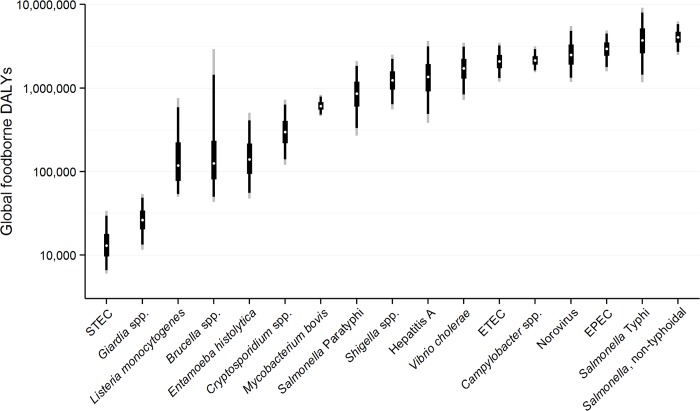
- Of foodborne DALYs, the largest burden came from nontyphoidal S. enterica if iNTS was included: 4.07 million DALYs (95% UI 2.49–6.27 million).
- Foodborne disease mortality and DALY rates were reported as highest in the African region, followed by the South East Asian region.
## Methods
- The study synthesized global and regional burden estimates for 22 foodborne diseases using the WHO FERG Enteric Diseases Task Force framework, combining literature reviews, systematic reviews, cohort studies, surveillance studies, expert consultation, and existing burden-of-disease assessments.
- The team estimated cases, sequelae, deaths, and DALYs for 2010, using pathogen-specific approaches: national estimates where available, a modified CHERG approach for diarrheal diseases in many countries, GBD 2010/IHME data for typhoid, paratyphoid, and hepatitis A, and expert elicitation to estimate the proportion transmitted by food.
- Uncertainty was propagated with Monte Carlo simulations using 10,000 draws per input parameter to generate 95% uncertainty intervals.
## Limitations
- The paper states that a major limitation was data gaps, especially in middle- and high-mortality countries, and that for many regions and pathogens the available data were sparse.
- It also states that only a few sequelae were included, with post-infectious sequelae such as reactive arthritis and irritable bowel syndrome excluded; stillbirths were excluded as well.
- The authors note that they could not fully account for age-specific effects for sequelae and could not separate some effects from comorbidities such as HIV infection.
- The text also makes evident, by its own description, that many estimates relied on expert elicitation for foodborne attribution and on assumptions/substitution where direct data were absent; this increases uncertainty and is part of the paper’s stated limitation.
Model-written summary. Check it against the paper before relying on it.
Integrity signals
Registry
Cites
Statistics
Figures
Verification
Claims the paper makes
3 Valid · 0 Not valid · 4 Not checked · 29 Own results and interpretations
The cited sources support only part of this claim — read each source’s verdict below.
In the paper
“Furthermore, global and regional estimates of the burden of foodborne diseases have not been available [1,2].”
§ World Health Organization Estimates of the Global and Regional Disease Burden of 22 Foodborne Bacterial, Protozoal, and Viral Diseases, 2010: A Data Synthesis > Introduction
What the sources say
- Partly supportedcites [1] Stein C, Kuchenmuller T, Hendrickx S, Prüss-Űstün A, Wolfson L, Engels D, et al The Global Burden of Disease assessments—WHO is responsible? PLoS Negl Trop Dis. 2007; 1: e161 10.1371/journal.pntd.0000161 18160984 PMC2154395 sourceExperimental — accuracy not yet measured
The Foodborne diseases section says that the full extent of the burden is unknown and that no precise, consistent global information existed at the time. It does not specifically address regional estimates, and its wording is narrower than saying no global estimates were available at all. No page number is provided in our copy. (LLM, conf=0.84)
- Not checked — no full text of the sourcecites [2] Tauxe RV, Doyle MP, Kuchenmuller T, Schlundt J, Stein CE. Evolving public health approaches to the global challenge of foodborne infections. Int J Food Microbiol. 2010; 139 Suppl 1: S16– 28. 10.1016/j.ijfoodmicro.2009.10.014 19931203 source
plain- Asserted: passes — The authors put it forward as true.
- Checkable: passes — It can be checked against evidence.
- Load-bearing: passes — The paper’s conclusions depend on it.
- Based: passes — The paper gives a reason why it holds.
- Partly supported
A result the paper reports from its own data — it cites no other source for it, so there is none to check. The quote shows it is in the paper.
In the paper
“Overall, 29% (95% UI 23–36%) of all 22 diseases were estimated to be transmitted by contaminated food equating to 582 million (95% UI 400–922 million) foodborne cases in 2010; 38% (95% UI 24–53%) in children <5 years of age.”
§ World Health Organization Estimates of the Global and Regional Disease Burden of 22 Foodborne Bacterial, Protozoal, and Viral Diseases, 2010: A Data Synthesis > Results > Cases
hedged- Asserted: passes — The authors put it forward as true.
- Checkable: passes — It can be checked against evidence.
- Load-bearing: passes — The paper’s conclusions depend on it.
- Based: passes — The paper gives a reason why it holds.
- Rests on an assumption not shown here.
A result the paper reports from its own data — it cites no other source for it, so there is none to check. The quote shows it is in the paper.
In the paper
“Among the 11 diarrheal diseases, the rate ratio of foodborne cases occurring among children <5 years of age compared to those ≥5 years of age was 6.44 (95%UI 3.15–12.46).”
§ World Health Organization Estimates of the Global and Regional Disease Burden of 22 Foodborne Bacterial, Protozoal, and Viral Diseases, 2010: A Data Synthesis > Results > Cases
plainstates an association- Asserted: passes — The authors put it forward as true.
- Checkable: passes — It can be checked against evidence.
- Load-bearing: unclear — It is unclear whether the paper’s conclusions depend on it.
- Based: passes — The paper gives a reason why it holds.
- Rests on 2 assumptions not shown here.
A result the paper reports from its own data — it cites no other source for it, so there is none to check. The quote shows it is in the paper.
In the paper
“Norovirus was the leading cause of foodborne illness causing 125 million (95% UI 70–251 million) cases, while Campylobacter spp. caused 96 million (95% UI 52–177 million) foodborne illnesses.”
§ World Health Organization Estimates of the Global and Regional Disease Burden of 22 Foodborne Bacterial, Protozoal, and Viral Diseases, 2010: A Data Synthesis > Abstract > Methods and Findings
plainstates a cause- Asserted: passes — The authors put it forward as true.
- Checkable: passes — It can be checked against evidence.
- Load-bearing: unclear — It is unclear whether the paper’s conclusions depend on it.
- Based: passes — The paper gives a reason why it holds.
In the paper
“The FERG estimate for DALYs for nontyphoidal S. enterica combining diarrheal and invasive infections was 4 times greater than GBD 2010 [54].”
§ World Health Organization Estimates of the Global and Regional Disease Burden of 22 Foodborne Bacterial, Protozoal, and Viral Diseases, 2010: A Data Synthesis > Discussion
What the sources say
- Not checked — no full text of the sourcecites [54] Murray CJ, Vos T, Lozano R, Naghavi M, Flaxman AD, Michaud C, et al Disability-adjusted life years (DALYs) for 291 diseases and injuries in 21 regions, 1990–2010: a systematic analysis for the Global Burden of Disease Study 2010. Lancet. 2012; 380: 2197– 2223. 10.1016/S0140-6736(12)61689-4 23245608 source
plain- Asserted: passes — The authors put it forward as true.
- Checkable: passes — It can be checked against evidence.
- Load-bearing: unclear — It is unclear whether the paper’s conclusions depend on it.
- Based: passes — The paper gives a reason why it holds.
16 more claims
Create a free account to see all 36 claims and to verify the 1 reference still open.
- Probably not a substantial claim. 11
- It may state two separate claims as one. 5
Claims other papers make about this one
Each is checked against this paper’s own text: does it say what the citing paper says it does?
The source backs part of the claim, not all of it — or backs it for a different population, condition or comparison.
In the citing paper
“Animal-based foods, like cow milk, can pose a risk for zoonotic enteric pathogen transmission42 although pasteurisation is an effective means for making milk safer.”
From Environmental and behavioural exposure pathways associated with diarrhoea and enteric pathogen detection in 5-month-old, periurban Kenyan infants: a cross-sectional study (2022) · cites this paper as [42]
Experimental — accuracy not yet measured
Citations
Cites
Lozano, R., Naghavi, M., Foreman, K., Lim, S., Shibuya, K., Aboyans, V., Abraham, J., Adair, T., Aggarwal, R., Ahn, S. Y., et al. (2012) · The Lancet · doi:10.1016/s0140-6736(12)61728-0 · Cited by 14,070 · cited 3×
“Twelve of the diseases included in our study were also included in the GBD 2010 study [25,26,54].”
Murray, C. J. L., Vos, T., Lozano, R., Naghavi, M., Flaxman, A. D., Michaud, C., Ezzati, M., Shibuya, K., Salomon, J. A., Abdalla, S., et al. (2012) · The Lancet · doi:10.1016/s0140-6736(12)61689-4 · Cited by 8,888
Foodborne illness acquired in the United States—Major pathogens
Scallan, E., Hoekstra, R. M., Angulo, F. J., Tauxe, R. V., Widdowson, M.-A., Roy, S. L., Jones, J. L., & Griffin, P. M. (2011) · Emerging Infectious Diseases · doi:10.3201/eid1701.p11101 · Cited by 7,657 · cited 1×
“Many different diseases, including those due to bacteria, viruses, parasites, chemicals, and prions, may be transmitted to humans by contaminated food [3].”
Self-citationSelected major risk factors and global and regional burden of disease
Ezzati, M., Lopez, A. D., Rodgers, A., Vander Hoorn, S., & Murray, C. J. (2002) · The Lancet · doi:10.1016/s0140-6736(02)11403-6 · Cited by 3,594
Kotloff, K. L., Nataro, J. P., Blackwelder, W. C., Nasrin, D., Farag, T. H., Panchalingam, S., Wu, Y., Sow, S. O., Sur, D., Breiman, R. F., et al. (2013) · The Lancet · doi:10.1016/s0140-6736(13)60844-2 · Cited by 3,560 · cited 1×
“This approach was facilitated by the availability of estimates of the envelope of diarrheal deaths, along with recent advances in diarrheal disease diagnosis, such as widespread application of polymerase chain reaction (PCR) for norovirus detection [20,49].”
The Global Burden of Nontyphoidal Salmonella Gastroenteritis
Majowicz, S. E., Musto, J., Scallan, E., Angulo, F. J., Kirk, M., O’Brien, S. J., Jones, T. F., Fazil, A., & Hoekstra, R. M. (2010) · Clinical Infectious Diseases · doi:10.1086/650733 · Cited by 2,442
Self-citationGlobal burden of childhood pneumonia and diarrhoea
Walker, C. L. F., Rudan, I., Liu, L., Nair, H., Theodoratou, E., Bhutta, Z. A., O'Brien, K. L., Campbell, H., & Black, R. E. (2013) · The Lancet · doi:10.1016/s0140-6736(13)60222-6 · Cited by 2,356 · cited 2×
“, “envelope” of diarrheal incidence) for 2010 by combining estimates of diarrheal incidence for children<5 years of age and persons 5 years of age [13,36].”
Self-citationThe global burden of typhoid fever.
Crump, J., Luby, S., & Mintz, E. (2004) · Bulletin of the World Health Organization · doi:10.1590/s0042-96862004000500008 · Cited by 2,172
Self-citationThe global burden of typhoid fever.
(2004) · Europe PMC (PubMed Central) · Cited by 1,965
Self-citationSalomon, J. A., Vos, T., Hogan, D. R., Gagnon, M., Naghavi, M., Mokdad, A., Begum, N., Shah, R., Karyana, M., Kosen, S., et al. (2012) · The Lancet · doi:10.1016/s0140-6736(12)61680-8 · Cited by 1,322 · cited 1×
“Disability weights for each clinical outcome for the enteric diseases were taken from the GBD 2010 study [47].”
Cited by
Items 101–200 of 1,631
Jans, C., Meile, L., Kaindi, D. W. M., Kogi‐Makau, W., Lamuka, P., Renault, P., Kreikemeyer, B., Lacroix, C., Hattendorf, J., Zinsstag, J., et al. (2017) · International Journal of Food Microbiology · doi:10.1016/j.ijfoodmicro.2017.03.012 · Cited by 103
“Sub-Saharan Africa and other less developed regions share a significantly higher burden of diseases by zoonotic agents than industrialized countries (Kirk et al., 2015).”
BackgroundInfluentialSalmonella Typhimurium metabolism affects virulence in the host – A mini-review
Herrero-Fresno, A., & Olsen, J. E. (2017) · Food Microbiology · doi:10.1016/j.fm.2017.04.016 · Cited by 98
Bawn, M., Alikhan, N.-F., Thilliez, G. J. A., Kirkwood, M., Wheeler, N. E., Petrovska, L., Dallman, T. J., Adriaenssens, E. M., Hall, N., & Kingsley, R. A. (2020) · PLoS Genetics · doi:10.1371/journal.pgen.1008850 · Cited by 93
Gutema, F. D., Agga, G. E., Abdi, R. D., Zutter, L. D., Duchateau, L., & Gabriël, S. (2019) · Frontiers in Veterinary Science · doi:10.3389/fvets.2019.00102 · Cited by 110
Research advances of DNA aptasensors for foodborne pathogen detection
Wu, W., Yu, C., Wang, Q., et al. (2019) · Critical Reviews in Food Science and Nutrition · doi:10.1080/10408398.2019.1636763 · Cited by 87
“The CDC reported that there were 48,000,000 cases of foodborne illness, including 128,000 cases of inpatient and 3000 cases of death in the USA each year (Kirk et al., 2015).”
BackgroundVikram, A., Tokman, J. I., Woolston, J., et al. (2020) · Journal of Food Protection · doi:10.4315/0362-028x.jfp-19-433 · Cited by 86
Augustin, J.-C., Kooh, P., Bayeux, T., Guillier, L., Meyer, T., Silva, N. J., Villena, I., Sanaa, M., Cerf, O., & on Behalf of the Anses Working Group on Consumer Information on Foodborne Biological Risks (2020) · Foods · doi:10.3390/foods9111644 · Cited by 114
“[18] also estimated that salmonellosis and campylobacteriosis account for approximately 50% of the DALYs for the European region.”
BackgroundMethodInfluentialMolecular imprinting technology for sensing foodborne pathogenic bacteria
Zhang, J., Wang, Y., & Lu, X. (2021) · Analytical and Bioanalytical Chemistry · doi:10.1007/s00216-020-03138-x · Cited by 91
Depuration and Relaying: A Review on Potential Removal of Norovirus from Oysters
McLeod, C., Polo, D., Saux, J. L., & Guyader, F. S. L. (2017) · Comprehensive Reviews in Food Science and Food Safety · doi:10.1111/1541-4337.12271 · Cited by 96
Laing, C., Whiteside, M. D., & Gannon, V. P. J. (2017) · Frontiers in Microbiology · doi:10.3389/fmicb.2017.01345 · Cited by 82
“…caused by S. enterica is done so by subspecies enterica, with the World Health Organization estimating that S. enterica infections from contaminated food alone constitute a loss of 6.43 million disability adjusted life years worldwide, more than any other enteric pathogen (Kirk et al., 2015).”
BackgroundInfluentialMei, X., Zhai, X., Lei, C., Ye, X., Kang, Z.-Z., Wu, X., Xiang, R., Wang, Y., & Wang, H. (2019) · Food Control · doi:10.1016/j.foodcont.2019.04.014 · Cited by 87
Diet-Microbe-Host Interactions That Affect Gut Mucosal Integrity and Infection Resistance
Forgie, A. J., Fouhse, J. M., & Willing, B. P. (2019) · Frontiers in Immunology · doi:10.3389/fimmu.2019.01802 · Cited by 81
Fu, X., Sun, J., Liang, R., Guo, H., Wang, L., & Sun, X. (2021) · Trends in Food Science & Technology · doi:10.1016/j.tifs.2021.07.006 · Cited by 82
Recent advances in human norovirus research and implications for candidate vaccines
Cates, J., Vinjé, J., Parashar, U. D., & Hall, A. J. (2020) · Expert Review of Vaccines · doi:10.1080/14760584.2020.1777860 · Cited by 89
“Worldwide this burden is even greater, with estimates upwards of 684 million illnesses and over 200,000 deaths every year [16].”
BackgroundInfluentialSelf-citationAntimicrobial Properties of Capsaicin: Available Data and Future Research Perspectives
Periferakis, A.-T., Periferakis, A., Periferakis, K., Căruntu, A., Bădărău, I. A., Săvulescu-Fiedler, I., Scheau, C., & Căruntu, C. (2023) · Nutrients · doi:10.3390/nu15194097 · Cited by 100
Benedetto, G. D., Alfini, R., Cescutti, P., Caboni, M., Lanzilao, L., Necchi, F., Saul, A. J., MacLennan, C. A., Rondini, S., & Micoli, F. (2016) · Vaccine · doi:10.1016/j.vaccine.2016.11.089 · Cited by 82
Food-Associated Stress Primes Foodborne Pathogens for the Gastrointestinal Phase of Infection
Horn, N. L., & Bhunia, A. K. (2018) · Frontiers in Microbiology · doi:10.3389/fmicb.2018.01962 · Cited by 87
“The World Health Organization (WHO) estimates approximately 2 billion illnesses resulting in over 1 million deaths caused by 22 major foodborne pathogens (Kirk et al., 2015).”
BackgroundMuhammad, Z., Ramzan, R., Abdelazez, A., Amjad, A., Afzaal, M., Zhang, S., & Pan, S. (2019) · Pathogens · doi:10.3390/pathogens8020071 · Cited by 94
Foodborne viral outbreaks associated with frozen produce
Nasheri, N., Vester, A., & Petronella, N. (2019) · Epidemiology and Infection · doi:10.1017/s0950268819001791 · Cited by 88
“In spite of an effective vaccine, it has been estimated that millions of new HAV infections occur every year [19], which lead to about 90 000 deaths worldwide [20].”
BackgroundReview on the Recent Advances on Typhoid Vaccine Development and Challenges Ahead
Syed, K. A., Saluja, T., Cho, H., Hsiao, A., Shaikh, H., Wartel, T. A., Mogasale, V., Lynch, J. A., Kim, J. H., Excler, J., et al. (2020) · Clinical Infectious Diseases · doi:10.1093/cid/ciaa504 · Cited by 88
Genetic Ablation of Butyrate Utilization Attenuates Gastrointestinal Salmonella Disease
Bronner, D. N., Faber, F., Olsan, E. E., Byndloss, M. X., Sayed, N. A., Xu, G., Yoo, W., Kim, D., Ryu, S., Lebrilla, C. B., et al. (2018) · Cell Host & Microbe · doi:10.1016/j.chom.2018.01.004 · Cited by 81
“This extraintestinal disease is referred to as typhoid fever, when associated with Salmonella enterica serovar ( S. ) Typhi, or as paratyphoid fever, when caused by S. Paratyphi A (Crump et al., 2004; Kirk et al., 2015).”
BackgroundEmerging Novel GII.P16 Noroviruses Associated with Multiple Capsid Genotypes
Barclay, L., Cannon, J. L., Wikswo, M. E., Phillips, A. R., Browne, H., Montmayeur, A. M., Tatusov, R. L., Burke, R. M., Hall, A. J., & Vinjé, J. (2019) · Viruses · doi:10.3390/v11060535 · Cited by 86
Self-citationLiu, Y., Jiang, J., Ed‐Dra, A., Li, X., Peng, X., Xia, L., Guo, Q., Yao, G., & Yue, M. (2021) · Food Research International · doi:10.1016/j.foodres.2021.110198 · Cited by 85
Huang, F., Zhang, Y., Lin, J., & Liu, Y. (2021) · Biosensors · doi:10.3390/bios11060190 · Cited by 84
“At present, pathogenic bacteria mainly include Escherichia coli, Salmonella typhimurium, Listeria monocytogenes, Vibrio parahaemolyticus, Vibrio cholerae, Staphylococcus aureus, and Bacillus cereus [2].”
BackgroundBaral, R., Nonvignon, J., Debellut, F., Agyemang, S. A., Clark, A. D., & Pecenka, C. J. (2020) · BMC Public Health · doi:10.1186/s12889-020-08595-8 · Cited by 92
Climate Change, Foodborne Pathogens and Illness in Higher-Income Countries
LAKE, I. R., & Barker, G. C. (2018) · Current Environmental Health Reports · doi:10.1007/s40572-018-0189-9 · Cited by 102
“int/en/health-topics/ Health-systems/public-health-services/policy/the-10-essential-publichealth-operations) [27] Curr Envir Health Rpt (2018) 5:187–196 191”
BackgroundHeymich, M.-L., Friedlein, U., Trollmann, M. F. W., Schwaiger, K., Böckmann, R. A., & Pischetsrieder, M. (2020) · Food Chemistry · doi:10.1016/j.foodchem.2020.128917 · Cited by 85
Integrating nutrition and food safety in food systems policy and programming
Nordhagen, S., Lambertini, E., DeWaal, C. S., McClafferty, B., & Neufeld, L. M. (2021) · Global Food Security · doi:10.1016/j.gfs.2021.100593 · Cited by 94
Estimating the Burden of Febrile Illnesses
Crump, J. A., & Kirk, M. (2015) · PLoS neglected tropical diseases · doi:10.1371/journal.pntd.0004040 · Cited by 95
Self-citationIsolation and Identification of food borne pathogens from Spoiled food samples
Hemalata, V. B., & Virupakshaiah, D. B. M. (2016) · International Journal of Current Microbiology and Applied Sciences · doi:10.20546/ijcmas.2016.506.108 · Cited by 75
Oh, E., Andrews, K. J., & Jeon, B. (2018) · Frontiers in Microbiology · doi:10.3389/fmicb.2018.01204 · Cited by 85
Speaking the host language: how Salmonella effector proteins manipulate the host
Pillay, T. D., Hettiarachchi, S. U., Gan, J., Diaz-del-Olmo, I., Yu, X., Muench, J. H., Thurston, T. L. M., & Pearson, J. S. (2023) · Microbiology · doi:10.1099/mic.0.001342 · Cited by 77
Hosangadi, D., Smith, P. G., & Giersing, B. K. (2017) · Vaccine · doi:10.1016/j.vaccine.2017.09.083 · Cited by 81
Makvandi, P., Ghomi, M., Ashrafizadeh, M., Tafazoli, A., Agarwal, T., Delfi, M., Akhtari, J., Zare, E. N., Padil, V. V. T., Zarrabi, A., et al. (2020) · Carbohydrate Polymers · doi:10.1016/j.carbpol.2020.116952 · Cited by 82
Shen, W., Chen, H., Geng, J., Wu, R. A., Wang, X., & Ding, T. (2021) · International Journal of Food Microbiology · doi:10.1016/j.ijfoodmicro.2021.109473 · Cited by 79
Lindholm, H. T., Parmar, N., Drurey, C., Poveda, M. C., Vornewald, P. M., Ostrop, J., Díez-Sánchez, A., Maizels, R. M., & Oudhoff, M. J. (2022) · Science Immunology · doi:10.1126/sciimmunol.abl6543 · Cited by 75
Lokmer, A., Cian, A., Froment, A., Gantois, N., Viscogliosi, E., Chabé, M., & Ségurel, L. (2019) · PLOS ONE · doi:10.1371/journal.pone.0211139 · Cited by 71
Burke, R. M., Mattison, C. P., Pindyck, T., Dahl, R. M., Rudd, J., Bi, D., Curns, A. T., Parashar, U. D., & Hall, A. J. (2020) · Clinical Infectious Diseases · doi:10.1093/cid/ciaa438 · Cited by 76
Self-citationVelásquez, P., Montenegro, G., Valenzuela, L. M., Giordano, A., Cabrera‐Barjas, G., & Martín‐Belloso, O. (2021) · Food Hydrocolloids · doi:10.1016/j.foodhyd.2021.107250 · Cited by 80
Upadhyay, A., Arsi, K., Wagle, B. R., Upadhyaya, I., Shrestha, S., Donoghue, A. M., & Donoghue, D. J. (2017) · Frontiers in Microbiology · doi:10.3389/fmicb.2017.00713 · Cited by 80
“The foodborne pathogen Campylobacter is the leading cause of bacterial gastroenteritis in humans resulting in an estimated 96 million annual infections globally (Kirk et al., 2015).”
BackgroundPotential Role of Plant Extracts and Phytochemicals Against Foodborne Pathogens
Ullah, F., Ayaz, M., Sadiq, A., Ullah, F., Hussain, I., Shahid, M. M., Yessimbekov, Z., Adhikari‐Devkota, A., & Devkota, H. P. (2020) · Applied Sciences · doi:10.3390/app10134597 · Cited by 80
Cardoso, M. J., Ferreira, V. B., Trüninger, M., Maia, R. L., & Teixeira, P. (2020) · International Journal of Food Microbiology · doi:10.1016/j.ijfoodmicro.2020.108984 · Cited by 89
Human Campylobacteriosis—A Serious Infectious Threat in a One Health Perspective
Heimesaat, M. M., Backert, S., Alter, T., & Bereswill, S. (2021) · Current topics in microbiology and immunology · doi:10.1007/978-3-030-65481-8_1 · Cited by 89
Zhang, C., Wang, Y., Liu, Z., Bai, M., Wang, J., & Wang, Y. (2022) · Sensors and Actuators B Chemical · doi:10.1016/j.snb.2022.132371 · Cited by 74
Brucellosis and One Health: Inherited and Future Challenges
Moriyón, I., Blasco, J. M., Letesson, J., Massis, F. D., & Moreno, E. (2023) · Microorganisms · doi:10.3390/microorganisms11082070 · Cited by 100
“Based on 29 scattered studies that were judged to be of sufficient quality for data analysis [149], a WHO global estimate suggests that the number of human cases could be between 340,000 and 19,500,000 in 2010, half of which could be foodborne [150].”
BackgroundAyele, Y., Gutema, F. D., Edao, B. M., Girma, R., Tufa, T. B., Beyene, T. J., Tadesse, F., Korsa, M. G., & Beyi, A. F. (2017) · BMC Microbiology · doi:10.1186/s12866-017-1048-9 · Cited by 72
“borne illinesses are responsible for an estimated 600 million cases and 420,000 deaths [2].”
BackgroundHigh-resolution cryo-EM structures of outbreak strain human norovirus shells reveal size variations
Jung, J., Grant, T., Thomas, D. R., Diehnelt, C. W., Grigorieff, N., & Joshua‐Tor, L. (2019) · Proceedings of the National Academy of Sciences · doi:10.1073/pnas.1903562116 · Cited by 77
Zhang, B., Li, H., Pan, W., Chen, Q., Ouyang, Q., & Zhao, J. (2016) · Food Analytical Methods · doi:10.1007/s12161-016-0758-1 · Cited by 72
“Patients with these pathogen infections can cause gastrointestinal disease, fever, diarrhea, abdominal cramps, vomiting, and nausea (Löffler et al. 2010; Miskinyte et al. 2013; Zhang et al. 2015).”
BackgroundReview of Clinically and Epidemiologically Relevant Coagulase-Negative Staphylococci in Africa
Asante, J., Amoako, D. G., Abia, A. L. K., Somboro, A. M., Govinden, U., Bester, L. A., & Essack, S. Y. (2020) · Microbial Drug Resistance · doi:10.1089/mdr.2019.0381 · Cited by 84
Cryptosporidium spp. Diagnosis and Research in the 21st Century
O'Leary, J. K., Sleator, R. D., & Lucey, B. (2021) · Food and Waterborne Parasitology · doi:10.1016/j.fawpar.2021.e00131 · Cited by 98
“This is particularly relevant in light of the human and economic toll exerted by gastrointestinal infection on a global scale, which according to a recent WHO study affected 2 billion people, caused 1 billion deaths and 78.7 million disability adjusted life years in 2010 (Kirk et al., 2015).”
BackgroundInfluentialFood Poisoning Caused by Bacteria (Food Toxins)
Hernández‐Cortez, C., Palma-Martínez, I., Gonzalez-Avila, L. U., Guerrero‐Mandujano, A., Solís, R. C., & Castro‐Escarpulli, G. (2017) · InTech eBooks · doi:10.5772/intechopen.69953 · Cited by 97
McNulty, M. J., Gleba, Y. Y., Tusé, D., Hahn‐Löbmann, S., Giritch, A., Nandi, S., & McDonald, K. A. (2019) · Biotechnology Progress · doi:10.1002/btpr.2896 · Cited by 74
Uses of Bacteriophages as Bacterial Control Tools and Environmental Safety Indicators
Rogovski, P., Cadamuro, R. D., da Silva, R., de Souza, E. B., Bonatto, C., Viancelli, A., Michelon, W., Elmahdy, E. M., Treichel, H., Rodríguez-Làzaro, D., et al. (2021) · Frontiers in Microbiology · doi:10.3389/fmicb.2021.793135 · Cited by 90
Kolawole, A. O., Rocha‐Pereira, J., Elftman, M. D., et al. (2016) · Antiviral Research · doi:10.1016/j.antiviral.2016.05.011 · Cited by 69
Tanmoy, A. M., Westeel, E., Bruyne, K. D., Goris, J., Rajoharison, A., Sajib, M. S. I., van Belkum, A., Saha, S. K., Komurian-Pradel, F., & Endtz, H. P. (2018) · mBio · doi:10.1128/mbio.02112-18 · Cited by 84
“Though the mortality rate remains low ( 1%), 1 in 20 to 25 cases experiences residual disability (5).”
BackgroundAbatcha, M. G., Effarizah, M. E., & Rusul, G. (2018) · Food Control · doi:10.1016/j.foodcont.2018.02.039 · Cited by 81
A novel mouse model of Campylobacter jejuni enteropathy and diarrhea
Giallourou, N., Medlock, G. L., Bolick, D. T., Medeiros, P. H. Q. S., Ledwaba, S. E., Kolling, G. L., Tung, K. S. K., Guerry, P., Swann, J. R., & Guerrant, R. L. (2018) · PLoS Pathogens · doi:10.1371/journal.ppat.1007083 · Cited by 71
Xiang, Y., Li, F., Dong, N., Tian, S., Zhang, H., Du, X., Zhou, X., Xu, X., Yang, H., Xie, J., et al. (2020) · Frontiers in Microbiology · doi:10.3389/fmicb.2020.00801 · Cited by 73
Two-Dimensional Nanomaterials for Photoinduced Antibacterial Applications
Zhao, J., Huang, S., Ravisankar, P., & Zhu, H. (2020) · ACS Applied Bio Materials · doi:10.1021/acsabm.0c00950 · Cited by 75
Sadanandan, S., S, M. V., Ramkumar, K., Pillai, N. P., Anuvinda, P., Sreelekshmi, P. J., Devika, V., Ramanunni, K., Jeevan Sankar, R., & Sreejaya, M. M. (2022) · Food Control · doi:10.1016/j.foodcont.2022.109510 · Cited by 73
Λίγδα, Π., Claerebout, E., Kostopoulou, D., Zdragas, A. G., Casaert, S., Robertson, L. J., & Sotiraki, S. (2020) · Environmental Pollution · doi:10.1016/j.envpol.2020.114766 · Cited by 79
Keisam, S., Tuikhar, N., Ahmed, G., & Jeyaram, K. (2019) · International Journal of Food Microbiology · doi:10.1016/j.ijfoodmicro.2019.02.012 · Cited by 72
Putri, M. S., & Susanna, D. (2021) · Italian Journal of Food Safety · doi:10.4081/ijfs.2021.9215 · Cited by 135
“Globally, it is estimated that 600 million people become ill, 549 million suffer from diarrheal disease, and 420,000 die each year after eating contaminated food (Kirk, 2015) (World Health Organization, 2015).”
BackgroundHerzog, M. K.-M., Cazzaniga, M., Peters, A., Shayya, N. W., Beldi, L., Hapfelmeier, S., Heimesaat, M. M., Bereswill, S., Frankel, G. M., Gahan, C. G. M., et al. (2023) · Gut Microbes · doi:10.1080/19490976.2023.2172667 · Cited by 81
A Systematic Review of the Use of Social Media for Food Safety Risk Communication
Overbey, K. N., Jaykus, L., & Chapman, B. (2017) · Journal of Food Protection · doi:10.4315/0362-028x.jfp-16-345 · Cited by 85
The Salmonella Secreted Effector SarA/SteE Mimics Cytokine Receptor Signaling to Activate STAT3
Gibbs, K. D., Washington, E., Jaslow, S. L., Bourgeois, J. S., Foster, M. W., Guo, R., Brennan, R. G., & Ko, D. C. (2019) · Cell Host & Microbe · doi:10.1016/j.chom.2019.11.012 · Cited by 65
The global burden of neglected zoonotic diseases: Current state of evidence
Bari, C. D., Venkateswaran, N., Fastl, C., Gabriël, S., Grace, D., Havelaar, A. H., Huntington, B., Patterson, G. E., Rushton, J., Speybroeck, N., et al. (2023) · One Health · doi:10.1016/j.onehlt.2023.100595 · Cited by 75
Self-citationAn accessible, efficient and global approach for the large-scale sequencing of bacterial genomes
Perez-Sepulveda, B. M., Heavens, D., Pulford, C. V., Predeus, A. V., Low, R. S., Webster, H. J., Dykes, G. F., Schudoma, C., Rowe, W. P. M., Lipscombe, J., et al. (2021) · Genome biology · doi:10.1186/s13059-021-02536-3 · Cited by 74
“To evaluate our pipeline, we used the model organism Salmonella enterica, a pathogen with a global significance [19].”
MethodNorovirus Binding to Ligands Beyond Histo-Blood Group Antigens
Almand, E. A., Moore, M. D., & Jaykus, L. (2017) · Frontiers in Microbiology · doi:10.3389/fmicb.2017.02549 · Cited by 77
“Keywords: norovirus, histo-blood group antigens, virus–bacteria interaction, transkingdom, enteric virus INTRODUCTION Human noroviruses are a leading cause of viral gastroenteritis worldwide, estimated to account for over 685 million illnesses globally every year (Kirk et al., 2015).”
BackgroundPrevalence and characterization of Salmonella isolated from raw vegetables in China
Yang, X., Wu, Q., Huang, J., Wu, S., Zhang, J., Chen, L., Wei, X., Ye, Y., Li, Y., Wang, J., et al. (2019) · Food Control · doi:10.1016/j.foodcont.2019.106915 · Cited by 65
Xie, S., Jiang, L., Wang, M., Sun, W., Yu, S., Turner, J. R., & Yu, Q. (2020) · Journal of Hazardous Materials · doi:10.1016/j.jhazmat.2020.122262 · Cited by 66
Salmonella Typhimurium discreet-invasion of the murine gut absorptive epithelium
Fattinger, S. A., Böck, D., Martino, M. L. D., Deuring, S., Ventayol, P. S., Ek, V., Furter, M., Kreibich, S., Bosia, F., Müller‐Hauser, A. A., et al. (2020) · PLoS Pathogens · doi:10.1371/journal.ppat.1008503 · Cited by 65
“Salmonella, Shigella, and Escherichia species, cause >600 million cases of intestinal disease annually [1].”
BackgroundPan, H., Paudyal, N., Li, X., Fang, W., & Yue, M. (2018) · Frontiers in Microbiology · doi:10.3389/fmicb.2018.00023 · Cited by 68
“Keywords: Salmonella Newport, antibiotic resistant, food animal, transmission, population structure, random forest INTRODUCTION Foodborne infection is an important cause of morbidity and mortality worldwide (Kirk et al., 2015).”
BackgroundAdult Intestinal Toxemia Botulism
Harris, R. A., Anniballi, F., & Austin, J. W. (2020) · Toxins · doi:10.3390/toxins12020081 · Cited by 67
Powers, T. R., Haeberle, A. L., Predeus, A. V., Hammarlöf, D. L., Cundiff, J. A., Saldaña‐Ahuactzi, Z., Hokamp, K., Hinton, J. C. D., & Knodler, L. A. (2021) · PLoS Pathogens · doi:10.1371/journal.ppat.1009280 · Cited by 66
“Of the foodborne bacterial, protozoal and viral diseases, non-typhoidal Salmonella enterica (NTS) cause the largest burden of illness and death worldwide [4].”
BackgroundNationwide trends and features of human salmonellosis outbreaks in China
Wang, Z., Zhou, H., Liu, Y., Huang, C., Chen, J., Siddique, A., Yin, R., Jia, C., Li, Y., Zhao, G., et al. (2024) · Emerging Microbes & Infections · doi:10.1080/22221751.2024.2372364 · Cited by 70
“Foodborne pathogens are ubiquitous, and due to the complex and expanding farm-to-table production chain, a transmission chain spanning the environment, animals, food, and humans highlights the contemporary value of the One Health concept [42].”
Madison-Antenucci, S., Relich, R., Doyle, L., Espina, N., Fuller, D., Karchmer, T., Lainesse, A., Mortensen, J. E., Pancholi, P., Veros, W., et al. (2016) · Journal of Clinical Microbiology · doi:10.1128/jcm.00765-16 · Cited by 54
“2 million illnesses or 492,000 disability-adjusted life years (2, 3).”
BackgroundAgro-defense: Biosensors for food from healthy crops and animals
Neethirajan, S. R., Ragavan, K. V., & Weng, X. (2017) · Trends in Food Science & Technology · doi:10.1016/j.tifs.2017.12.005 · Cited by 66
Predicting human norovirus infectivity - Recent advances and continued challenges
Manuel, C. S., Moore, M. D., & Jaykus, L. (2018) · Food Microbiology · doi:10.1016/j.fm.2018.06.015 · Cited by 61
Hu, L., Salmen, W., Chen, R., Zhou, Y., Neill, F. H., Crowe, J. E., Atmar, R. L., Estes, M. K., & Prasad, B. V. V. (2022) · Nature Communications · doi:10.1038/s41467-022-28757-z · Cited by 69
Nale, J. Y., Vinner, G. K., López, V. C., Thanki, A. M., Phothaworn, P., Thiennimitr, P., Garcia, A., AbuOun, M., Anjum, M. F., Korbsrisate, S., et al. (2021) · Frontiers in Microbiology · doi:10.3389/fmicb.2020.609955 · Cited by 74
Potts, A. H., Guo, Y., Ahmer, B. M. M., & Romeo, T. (2019) · PLoS ONE · doi:10.1371/journal.pone.0211430 · Cited by 58
Kim, J., Park, H., Kim, J., Kim, J., Jung, J. I., Cho, S., Ryu, S., & Jeon, B. (2019) · Microorganisms · doi:10.3390/microorganisms7100433 · Cited by 58
“Campylobacter is a leading etiological agent of gastroenteritis, accounting for approximately 166 million diarrheal cases globally per year [1].”
BackgroundKariuki, S., Mbae, C., Van Puyvelde, S., Onsare, R., Kavai, S., Wairimu, C., Ngetich, R., Clemens, J., & Dougan, G. (2020) · PLOS Neglected Tropical Diseases · doi:10.1371/journal.pntd.0008440 · Cited by 56
Bai, M., Wang, Y., Zhang, C., Wang, Y., Wei, J., Liao, X., Wang, J., Anfossi, L., & Wang, Y. (2023) · Food Chemistry · doi:10.1016/j.foodchem.2023.136416 · Cited by 62
Rogolino, D., Gatti, A. M., Carcelli, M., Pelosi, G., Bisceglie, F., Restivo, F. M., Degola, F., Buschini, A., Montalbano, S., Feretti, D., et al. (2017) · Scientific Reports · doi:10.1038/s41598-017-11716-w · Cited by 60
Spatiotemporal analysis of brucellosis incidence in Iran from 2011 to 2014 using GIS
Pakzad, R., Pakzad, I., Safiri, S., Shirzadi, M. R., Mohammadpour, M., Behroozi, A., Sullman, M. J. M., & Janati, A. (2017) · International Journal of Infectious Diseases · doi:10.1016/j.ijid.2017.10.017 · Cited by 63
“The disease is strongly influenced by economic, social, and environmental conditions (Dean et al., 2012) and the degree of community involvement (Kamal et al., 2009; Kirk et al., 2015), and it places a heavy financial and health burden on the health systems ciety for Infectious Diseases.”
BackgroundNickerson, K. P., Llanos‐Chea, A., Ingano, L. A. M., Serena, G., Miranda-Ribera, A., Perlman, M., Lima, R. S., Sztein, M. B., Fasano, A., Senger, S., et al. (2021) · Microbiology Spectrum · doi:10.1128/spectrum.00003-21 · Cited by 64
Ban-Cucerzan, A., Imre, K., Morar, A., Marcu, A., Hotea, I., Popa, S. A., Pătrînjan, R.-T., Bucur, I.-M., Gaspar, C. M., Plotuna, A.-M., et al. (2025) · Microorganisms · doi:10.3390/microorganisms13081805 · Cited by 74
Integration of Artificial Intelligence in Biosensors for Enhanced Detection of Foodborne Pathogens
Banicod, R. J. S., Tabassum, N., Jo, D., Javaid, A., Kim, Y., & Khan, F. (2025) · Biosensors · doi:10.3390/bios15100690 · Cited by 79
“Diarrheal disease agents, particularly norovirus and Campylobacter , were the most frequent causes of illness, whereas non-typhoidal Salmonella accounted for the highest number of deaths [6].”
Salmonella Extracellular Matrix Components Influence Biofilm Formation and Gallbladder Colonization
Adcox, H. E., Vasicek, E. M., Dwivedi, V., Hoang, K. V., Turner, J., & Gunn, J. S. (2016) · Infection and Immunity · doi:10.1128/iai.00532-16 · Cited by 60
“Salmonella enterica serovar Typhi, a human-specific pathogen and the etiologic agent of typhoid or enteric fever, is a globally rampant disease agent reported to cause over 20 million infections and 200,000 deaths annually (1, 2).”
BackgroundWHO consultation on ETEC and Shigella burden of disease, Geneva, 6–7th April 2017: Meeting report
Hosangadi, D., Smith, P. G., Kaslow, D. C., & Giersing, B. K. (2018) · Vaccine · doi:10.1016/j.vaccine.2017.10.011 · Cited by 63
Global burden of late-stage chronic kidney disease resulting from dietary exposure to cadmium, 2015
Zang, Y., Devleesschauwer, B., Bolger, P. M., Goodman, E., & Gibb, H. J. (2018) · Environmental Research · doi:10.1016/j.envres.2018.10.005 · Cited by 63
Self-citationElectrochemical nucleic acid sensors: Competent pathways for mobile molecular diagnostics
Bai, H., Wang, Y., Li, X., & Guo, J. (2023) · Biosensors and Bioelectronics · doi:10.1016/j.bios.2023.115407 · Cited by 63
The consequences of Campylobacter infection
O’Brien, S. J. (2016) · Current Opinion in Gastroenterology · doi:10.1097/mog.0000000000000329 · Cited by 62
Risk ranking of foodborne parasites: State of the art
Devleesschauwer, B., Bouwknegt, M., Dorny, P., Gabriël, S., Havelaar, A. H., Quoilin, S., Robertson, L. J., Speybroeck, N., Torgerson, P. R., van der Giessen, J. W. B., et al. (2017) · Food and Waterborne Parasitology · doi:10.1016/j.fawpar.2017.11.001 · Cited by 63
Self-citationTassinari, E., Duffy, G., Bawn, M., Burgess, C. M., McCabe, E. M., Lawlor, P. G., Gardiner, G. E., & Kingsley, R. A. (2019) · Scientific Reports · doi:10.1038/s41598-019-45216-w · Cited by 58
An Atlas of Genetic Variation Linking Pathogen-Induced Cellular Traits to Human Disease
Wang, L., Pittman, K. J., Barker, J. R., Salinas, R., Stanaway, I. B., Williams, G. D., Carroll, R. J., Balmat, T., Ingham, A., Gopalakrishnan, A. M., et al. (2018) · Cell Host & Microbe · doi:10.1016/j.chom.2018.07.007 · Cited by 63
Kim, G., Gan, R., Zhang, D., Farha, A. K., Habimana, O., Mavumengwana, V., Li, H., Wang, X., & Corke, H. (2020) · Pathogens · doi:10.3390/pathogens9030185 · Cited by 69
“2 million people annually die from foodborne diseases caused by pathogens [2].”
BackgroundZhao, X., Hu, M., Zhang, Q., Zhao, C., Zhang, Y., Li, L., Qi, J., Luo, Y., Zhou, D., & Liu, Y. (2020) · Poultry Science · doi:10.1016/j.psj.2020.09.071 · Cited by 63
“Salmonella is a notorious human pathogen that can lead to an estimated 153 million enteric infections and 56,969 diarrheal deaths each year worldwide (Kirk et al., 2015).”
Background
Metadata
- Authors
- Kirk, M. D., Pires, S. M., Black, R. E., Caipo, M., Crump, J. A., Devleesschauwer, B., Döpfer, D., Fazil, A., Fischer-Walker, C. L., Hald, T., Hall, A. J., Keddy, K. H., Lake, R. J., Lanata, C. F., Torgerson, P. R., Havelaar, A. H., & Angulo, F. J.
- Affiliations
- Australian National University (AU)
- Technical University of Denmark (DK)
- Johns Hopkins University (US)
- Food and Agriculture Organization of the United Nations (IT)
- University of Otago (NZ)
- Ghent University (BE)
- University of Wisconsin–Madison (US)
- Public Health Agency of Canada (CA)
- Centers for Disease Control and Prevention (US)
- University of the Witwatersrand (ZA)
- New Zealand Institute for Public Health and Forensic Science (NZ)
- Instituto de Investigación Nutricional (PE)
- University of Zurich (CH)
- Utrecht University (NL)
- Corresponding author
- Kirk, Martyn D.
- ORCID
- Venue
- PLoS Medicine
- Publisher
- Public Library of Science (PLoS)
- Published
- 2015-12-03
- Volume
- 12
- Issue
- 12
- Pages
- e1001921
- ISSN
- 1549-1277 (ISSN-L)
- 1549-1676
- PMC
- PMC4668831
- OpenAlex
- W2184405267
- Cited by
- 1,625
- References
- 58
- Citations by year
- 2026: 76 · 2025: 120 · 2024: 172 · 2023: 189 · 2022: 168 · 2021: 202 · 2020: 237 · 2019: 158 · 2018: 130 · 2017: 107 · 2016: 60 · 2015: 5
- FWCI
- 12.61
- Type
- journal article
- Language
- en
- Update notices
- correction (2015-12-23)
- Open access
- gold
- doi.org
- Licence
- Locations
- PLoS Medicine (publishedVersion, cc-by)
- Europe PMC (PubMed Central) (publishedVersion, cc-by)
- PubMed Central (publishedVersion, cc-by)
- PubMed (publishedVersion)
- IHI Repository (acceptedVersion)
- Zurich Open Repository and Archive (University of Zurich) (acceptedVersion, cc-by)
- Ghent University Academic Bibliography (Ghent University) (submittedVersion, other-oa)
- DOAJ (DOAJ: Directory of Open Access Journals) (submittedVersion, cc-by-sa)
- Utrecht University Repository (Utrecht University) (submittedVersion, other-oa)
- Figshare (submittedVersion, cc-by)
- ANU Open Research (Australian National University) (submittedVersion)
- Technical University of Denmark, DTU Orbit (Technical University of Denmark, DTU) (submittedVersion, other-oa)
- Rivm (National Institute for Public Health and the Environment) (submittedVersion)
- Zurich Open Repository and Archive (University of Zurich) (submittedVersion, cc-by)
- Zurich Open Repository and Archive (University of Zurich)
- Funders
- Bill and Melinda Gates Foundation
- World Health Organization
- Institute for Health Metrics and Evaluation
- Topics
- Life Sciences › Agricultural and Biological Sciences › Food Science › Salmonella and Campylobacter epidemiology
- Life Sciences › Agricultural and Biological Sciences › Food Science › Food Safety and Hygiene
- Health Sciences › Medicine › Infectious Diseases › Viral gastroenteritis research and epidemiology
- Keywords
- food poisoning, disease burden, disability-adjusted life years, norovirus, Campylobacter, Salmonella, Escherichia coli, Vibrio cholerae, Mycobacterium bovis, invasive non-typhoidal Salmonella, food contamination, diarrheal disease, foodborne parasitic infection
- MeSH terms
- Foodborne Diseases, Humans, Global Health, World Health Organization, Incidence, Prevalence, Cost of Illness, Quality-Adjusted Life Years
About these checks
Registry, retraction, Cites and statistics results are computed, not judged, with one exception: a printed reference that no index lists is read once by a model before it counts as a citation error. Claims are extracted by a model and kept only when their quote appears verbatim in the text; each cited source is then checked, with a model’s help, for whether it says what the claim relies on. Those verdicts can be wrong — read the claim’s quote and the cited source before relying on one.
The claim verdicts this report counts are experimental: their accuracy is not yet measured.
A language model drew the claims from the paper on 2026-10-10, under version 3 of the claim definition (model deepseek-v4.1-flash, prompt extract-v3).
A second model labelled each claim on 2026-10-10 (model jev-1.13-20260917, definition revision gold-guideline-v0.2).
Cited sources are checked with a language model’s help (gpt-6-sol).
Statistics and arithmetic are recomputed, not judged.
Confidence bands are shown only for fields calibrated on our annotated test set. None is calibrated yet, so no band is shown.
What counts as a claim ›How we measure confidence ›How we check this ›
Are you an author, or do you see a problem with this page? Request a review
Data sources
Bibliographic data: Semantic Scholar, OpenAlex, Crossref.
Contains information from the Semantic Scholar Academic Graph Datasets, made available under the ODC Attribution License (ODC-BY 1.0).
Semantic Scholar’s data is described in: Kinney, R., et al. (2023). The Semantic Scholar Open Data Platform. arXiv:2301.10140.
