

World Health Organization Estimates of the Global and Regional Disease Burden of 22 Foodborne Bacterial, Protozoal, and Viral Diseases, 2010: A Data Synthesis.
Open accessThe DOI matches its Crossref record; 57 of the 58 references it cites were found in a registry or an index; 3 of the 9 sources its claims cite were checked for support.
Abstract
We estimate that the 22 diseases included in our study resulted in two billion cases, over one million deaths, and 78.7 million DALYs in 2010.
Overview
CoChat Summary
## TL;DR
This paper provides the first WHO-led global and regional estimates of the burden of 22 foodborne bacterial, protozoal, and viral diseases in 2010. It estimates 2.0 billion illnesses, 1.09 million deaths, 78.7 million DALYs, and 582 million foodborne cases, with a large share of burden in children under 5.
## Key findings
- The 22 diseases caused an estimated 2.0 billion illnesses (95% UI 1.5–3.0 billion) in 2010; 39% (95% UI 26–53%) were in children <5 years.
- They caused 1.09 million deaths (95% UI 0.89–1.37 million); 34% (95% UI 29–38%) were in children <5 years.
- They caused 78.7 million DALYs (95% UI 65.0–97.7 million); 43% (95% UI 38–48%) were in children <5 years.
- The authors estimate 29% (95% UI 23–36%) of all cases were transmitted by contaminated food, equal to 582 million foodborne cases (95% UI 401–922 million) and 25.2 million foodborne DALYs (95% UI 17.5–37.0 million).
- Norovirus was the leading cause of foodborne illness, with 125 million (95% UI 70–251 million) foodborne cases; Campylobacter spp. caused 96 million (95% UI 52–177 million).
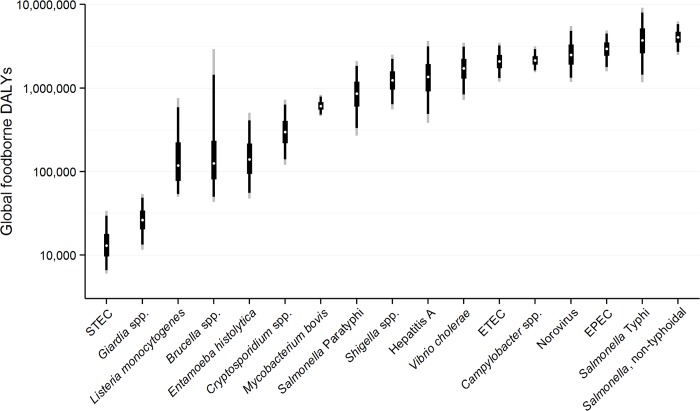
- Of foodborne DALYs, the largest burden came from nontyphoidal S. enterica if iNTS was included: 4.07 million DALYs (95% UI 2.49–6.27 million).
- Foodborne disease mortality and DALY rates were reported as highest in the African region, followed by the South East Asian region.
## Methods
- The study synthesized global and regional burden estimates for 22 foodborne diseases using the WHO FERG Enteric Diseases Task Force framework, combining literature reviews, systematic reviews, cohort studies, surveillance studies, expert consultation, and existing burden-of-disease assessments.
- The team estimated cases, sequelae, deaths, and DALYs for 2010, using pathogen-specific approaches: national estimates where available, a modified CHERG approach for diarrheal diseases in many countries, GBD 2010/IHME data for typhoid, paratyphoid, and hepatitis A, and expert elicitation to estimate the proportion transmitted by food.
- Uncertainty was propagated with Monte Carlo simulations using 10,000 draws per input parameter to generate 95% uncertainty intervals.
## Limitations
- The paper states that a major limitation was data gaps, especially in middle- and high-mortality countries, and that for many regions and pathogens the available data were sparse.
- It also states that only a few sequelae were included, with post-infectious sequelae such as reactive arthritis and irritable bowel syndrome excluded; stillbirths were excluded as well.
- The authors note that they could not fully account for age-specific effects for sequelae and could not separate some effects from comorbidities such as HIV infection.
- The text also makes evident, by its own description, that many estimates relied on expert elicitation for foodborne attribution and on assumptions/substitution where direct data were absent; this increases uncertainty and is part of the paper’s stated limitation.
Model-written summary. Check it against the paper before relying on it.
Integrity signals
Registry
Cites
Statistics
Figures
Verification
Claims the paper makes
3 Valid · 0 Not valid · 4 Not checked · 29 Own results and interpretations
The cited sources support only part of this claim — read each source’s verdict below.
In the paper
“Furthermore, global and regional estimates of the burden of foodborne diseases have not been available [1,2].”
§ World Health Organization Estimates of the Global and Regional Disease Burden of 22 Foodborne Bacterial, Protozoal, and Viral Diseases, 2010: A Data Synthesis > Introduction
What the sources say
- Partly supportedcites [1] Stein C, Kuchenmuller T, Hendrickx S, Prüss-Űstün A, Wolfson L, Engels D, et al The Global Burden of Disease assessments—WHO is responsible? PLoS Negl Trop Dis. 2007; 1: e161 10.1371/journal.pntd.0000161 18160984 PMC2154395 sourceExperimental — accuracy not yet measured
The Foodborne diseases section says that the full extent of the burden is unknown and that no precise, consistent global information existed at the time. It does not specifically address regional estimates, and its wording is narrower than saying no global estimates were available at all. No page number is provided in our copy. (LLM, conf=0.84)
- Not checked — no full text of the sourcecites [2] Tauxe RV, Doyle MP, Kuchenmuller T, Schlundt J, Stein CE. Evolving public health approaches to the global challenge of foodborne infections. Int J Food Microbiol. 2010; 139 Suppl 1: S16– 28. 10.1016/j.ijfoodmicro.2009.10.014 19931203 source
plain- Asserted: passes — The authors put it forward as true.
- Checkable: passes — It can be checked against evidence.
- Load-bearing: passes — The paper’s conclusions depend on it.
- Based: passes — The paper gives a reason why it holds.
- Partly supported
A result the paper reports from its own data — it cites no other source for it, so there is none to check. The quote shows it is in the paper.
In the paper
“Overall, 29% (95% UI 23–36%) of all 22 diseases were estimated to be transmitted by contaminated food equating to 582 million (95% UI 400–922 million) foodborne cases in 2010; 38% (95% UI 24–53%) in children <5 years of age.”
§ World Health Organization Estimates of the Global and Regional Disease Burden of 22 Foodborne Bacterial, Protozoal, and Viral Diseases, 2010: A Data Synthesis > Results > Cases
hedged- Asserted: passes — The authors put it forward as true.
- Checkable: passes — It can be checked against evidence.
- Load-bearing: passes — The paper’s conclusions depend on it.
- Based: passes — The paper gives a reason why it holds.
- Rests on an assumption not shown here.
A result the paper reports from its own data — it cites no other source for it, so there is none to check. The quote shows it is in the paper.
In the paper
“Among the 11 diarrheal diseases, the rate ratio of foodborne cases occurring among children <5 years of age compared to those ≥5 years of age was 6.44 (95%UI 3.15–12.46).”
§ World Health Organization Estimates of the Global and Regional Disease Burden of 22 Foodborne Bacterial, Protozoal, and Viral Diseases, 2010: A Data Synthesis > Results > Cases
plainstates an association- Asserted: passes — The authors put it forward as true.
- Checkable: passes — It can be checked against evidence.
- Load-bearing: unclear — It is unclear whether the paper’s conclusions depend on it.
- Based: passes — The paper gives a reason why it holds.
- Rests on 2 assumptions not shown here.
A result the paper reports from its own data — it cites no other source for it, so there is none to check. The quote shows it is in the paper.
In the paper
“Norovirus was the leading cause of foodborne illness causing 125 million (95% UI 70–251 million) cases, while Campylobacter spp. caused 96 million (95% UI 52–177 million) foodborne illnesses.”
§ World Health Organization Estimates of the Global and Regional Disease Burden of 22 Foodborne Bacterial, Protozoal, and Viral Diseases, 2010: A Data Synthesis > Abstract > Methods and Findings
plainstates a cause- Asserted: passes — The authors put it forward as true.
- Checkable: passes — It can be checked against evidence.
- Load-bearing: unclear — It is unclear whether the paper’s conclusions depend on it.
- Based: passes — The paper gives a reason why it holds.
In the paper
“The FERG estimate for DALYs for nontyphoidal S. enterica combining diarrheal and invasive infections was 4 times greater than GBD 2010 [54].”
§ World Health Organization Estimates of the Global and Regional Disease Burden of 22 Foodborne Bacterial, Protozoal, and Viral Diseases, 2010: A Data Synthesis > Discussion
What the sources say
- Not checked — no full text of the sourcecites [54] Murray CJ, Vos T, Lozano R, Naghavi M, Flaxman AD, Michaud C, et al Disability-adjusted life years (DALYs) for 291 diseases and injuries in 21 regions, 1990–2010: a systematic analysis for the Global Burden of Disease Study 2010. Lancet. 2012; 380: 2197– 2223. 10.1016/S0140-6736(12)61689-4 23245608 source
plain- Asserted: passes — The authors put it forward as true.
- Checkable: passes — It can be checked against evidence.
- Load-bearing: unclear — It is unclear whether the paper’s conclusions depend on it.
- Based: passes — The paper gives a reason why it holds.
16 more claims
Create a free account to see all 36 claims and to verify the 1 reference still open.
- Probably not a substantial claim. 11
- It may state two separate claims as one. 5
Claims other papers make about this one
Each is checked against this paper’s own text: does it say what the citing paper says it does?
The source backs part of the claim, not all of it — or backs it for a different population, condition or comparison.
In the citing paper
“Animal-based foods, like cow milk, can pose a risk for zoonotic enteric pathogen transmission42 although pasteurisation is an effective means for making milk safer.”
From Environmental and behavioural exposure pathways associated with diarrhoea and enteric pathogen detection in 5-month-old, periurban Kenyan infants: a cross-sectional study (2022) · cites this paper as [42]
Experimental — accuracy not yet measured
Citations
Cites
Lozano, R., Naghavi, M., Foreman, K., Lim, S., Shibuya, K., Aboyans, V., Abraham, J., Adair, T., Aggarwal, R., Ahn, S. Y., et al. (2012) · The Lancet · doi:10.1016/s0140-6736(12)61728-0 · Cited by 14,070 · cited 3×
“Twelve of the diseases included in our study were also included in the GBD 2010 study [25,26,54].”
Murray, C. J. L., Vos, T., Lozano, R., Naghavi, M., Flaxman, A. D., Michaud, C., Ezzati, M., Shibuya, K., Salomon, J. A., Abdalla, S., et al. (2012) · The Lancet · doi:10.1016/s0140-6736(12)61689-4 · Cited by 8,888
Foodborne illness acquired in the United States—Major pathogens
Scallan, E., Hoekstra, R. M., Angulo, F. J., Tauxe, R. V., Widdowson, M.-A., Roy, S. L., Jones, J. L., & Griffin, P. M. (2011) · Emerging Infectious Diseases · doi:10.3201/eid1701.p11101 · Cited by 7,657 · cited 1×
“Many different diseases, including those due to bacteria, viruses, parasites, chemicals, and prions, may be transmitted to humans by contaminated food [3].”
Self-citationSelected major risk factors and global and regional burden of disease
Ezzati, M., Lopez, A. D., Rodgers, A., Vander Hoorn, S., & Murray, C. J. (2002) · The Lancet · doi:10.1016/s0140-6736(02)11403-6 · Cited by 3,594
Kotloff, K. L., Nataro, J. P., Blackwelder, W. C., Nasrin, D., Farag, T. H., Panchalingam, S., Wu, Y., Sow, S. O., Sur, D., Breiman, R. F., et al. (2013) · The Lancet · doi:10.1016/s0140-6736(13)60844-2 · Cited by 3,560 · cited 1×
“This approach was facilitated by the availability of estimates of the envelope of diarrheal deaths, along with recent advances in diarrheal disease diagnosis, such as widespread application of polymerase chain reaction (PCR) for norovirus detection [20,49].”
The Global Burden of Nontyphoidal Salmonella Gastroenteritis
Majowicz, S. E., Musto, J., Scallan, E., Angulo, F. J., Kirk, M., O’Brien, S. J., Jones, T. F., Fazil, A., & Hoekstra, R. M. (2010) · Clinical Infectious Diseases · doi:10.1086/650733 · Cited by 2,442
Self-citationGlobal burden of childhood pneumonia and diarrhoea
Walker, C. L. F., Rudan, I., Liu, L., Nair, H., Theodoratou, E., Bhutta, Z. A., O'Brien, K. L., Campbell, H., & Black, R. E. (2013) · The Lancet · doi:10.1016/s0140-6736(13)60222-6 · Cited by 2,356 · cited 2×
“, “envelope” of diarrheal incidence) for 2010 by combining estimates of diarrheal incidence for children<5 years of age and persons 5 years of age [13,36].”
Self-citationThe global burden of typhoid fever.
Crump, J., Luby, S., & Mintz, E. (2004) · Bulletin of the World Health Organization · doi:10.1590/s0042-96862004000500008 · Cited by 2,172
Self-citationThe global burden of typhoid fever.
(2004) · Europe PMC (PubMed Central) · Cited by 1,965
Self-citationSalomon, J. A., Vos, T., Hogan, D. R., Gagnon, M., Naghavi, M., Mokdad, A., Begum, N., Shah, R., Karyana, M., Kosen, S., et al. (2012) · The Lancet · doi:10.1016/s0140-6736(12)61680-8 · Cited by 1,322 · cited 1×
“Disability weights for each clinical outcome for the enteric diseases were taken from the GBD 2010 study [47].”
Cited by
Items 201–300 of 1,631
A review of the top 100 most cited papers on food safety
Onyeaka, H. N., Anumudu, C. K., Okolo, C. A., Anyogu, A., Odeyemi, O. A., & Bassey, A. P. (2022) · Quality Assurance and Safety of Crops & Foods · doi:10.15586/qas.v14i4.1124 · Cited by 57
Miller, R. A., Betteken, M. I., Guo, X., Altier, C., Duhamel, G. E., & Wiedmann, M. (2018) · mBio · doi:10.1128/mbio.00467-18 · Cited by 55
Jones, S. L., Ricke, S. C., Roper, D. K., & Gibson, K. E. (2018) · Critical Reviews in Food Science and Nutrition · doi:10.1080/10408398.2018.1521369 · Cited by 77
Yuki, K. E., Marei, H., Fiškin, E., Eva, M. M., Gopal, A. A., Schwartzentruber, J., Majewski, J., Cellier, M. F., Mandl, J. N., Vidal, S. M., et al. (2019) · Nature Microbiology · doi:10.1038/s41564-019-0484-8 · Cited by 63
Tack, B., Phoba, M.-F., Barbé, B., Mbuyi-Kalonji, L., Hardy, L., Puyvelde, S. V., Ingelbeen, B., Falay, D., Dauly, N., van der Sande, M. A. B., et al. (2020) · PLoS neglected tropical diseases · doi:10.1371/journal.pntd.0008121 · Cited by 67
“By contrast, the most recent calculations of the global NTS burden [37] were lower than previous estimates [3,38].”
ResultTaghipour, A., Ghodsian, S., Jabbari, M., Olfatifar, M., Abdoli, A., & Ghaffarifar, F. (2020) · Transactions of the Royal Society of Tropical Medicine and Hygiene · doi:10.1093/trstmh/traa101 · Cited by 72
Esua, O. J., Chin, N. L., Yusof, Y. A., et al. (2020) · Processes · doi:10.3390/pr8111433 · Cited by 53
Wang, H., Cui, W., Guo, Y., Du, Y., & Zhou, Y. (2021) · JMIR Medical Informatics · doi:10.2196/24924 · Cited by 67
“For example, Norovirus occurs more frequently in autumn and winter [46], and distribution trends of patients’ age of E coli, Salmonella, and Norovirus are concentrated between 0 and 10 years old, which is consistent with a study result that young children are more susceptible to foodborne diseases [5].”
BackgroundResultA Bibliometric Analysis of the Literature on Norovirus Disease from 1991–2021
Ogunsakin, R. E., Ebenezer, O., & Ginindza, T. G. (2022) · International Journal of Environmental Research and Public Health · doi:10.3390/ijerph19052508 · Cited by 59
“In addition, 22 pathogens were selected and explored for their study based on their public health significance and data availability [27].”
BackgroundHefele, M., Stolzer, I., Ruder, B., He, G.-W., Mahapatro, M., Wirtz, S. J., Neurath, M. F., & Günther, C. (2018) · Mucosal Immunology · doi:10.1038/s41385-018-0011-x · Cited by 56
A study on Chinese consumer preferences for food traceability information using best-worst scaling
Liu, C., Li, J., Steele, W., & Fang, X. (2018) · PLoS ONE · doi:10.1371/journal.pone.0206793 · Cited by 72
“Although the full health effects and economic costs of unsafe food are not known, the global impact on health, trade, and development is considered enormous [2,3].”
BackgroundVarga, C., Guerin, M. T., Brash, M. L., Slavić, Ð., Boerlin, P., & Susta, L. (2019) · PLoS ONE · doi:10.1371/journal.pone.0221429 · Cited by 58
A Systematic Review of Beef Meat Quantitative Microbial Risk Assessment Models
Tesson, V., Fédérighi, M., Cummins, E., Mota, J. D. O., Guillou, S., & Boué, G. (2020) · International Journal of Environmental Research and Public Health · doi:10.3390/ijerph17030688 · Cited by 74
“The World Health Organization (WHO) estimated that in 2010, at a global scale and annually, more than 580 million illnesses and 351,000 deaths were associated with food contaminated by enteric pathogens [1].”
BackgroundEntamoeba and Giardia parasites implicated as hosts of CRESS viruses
Kinsella, C. M., Bart, A., Deijs, M., Haaften, P. E. B.-V., Kaczorowska, J., Jebbink, M. F., van Gool, T., Cotten, M. L., & van der Hoek, L. (2020) · Nature Communications · doi:10.1038/s41467-020-18474-w · Cited by 58
Holthaus, D., Betancourt, E. D., Aebischer, T., Seeber, F., & Klotz, C. (2021) · Frontiers in Cellular and Infection Microbiology · doi:10.3389/fcimb.2020.610368 · Cited by 67
An Alternative to Antibiotics: Selected Methods to Combat Zoonotic Foodborne Bacterial Infections
Łojewska, E., & Sakowicz, T. (2021) · Current Microbiology · doi:10.1007/s00284-021-02665-9 · Cited by 63
Abuzeyad, O. H., El‐Khawaga, A. M., Tantawy, H., & El-Sayed, M. A. (2023) · Journal of Molecular Structure · doi:10.1016/j.molstruc.2023.135787 · Cited by 53
Blyth, G. A. D., Connors, L. T., Fodor, C. C., & Cobo, E. R. (2020) · Frontiers in Immunology · doi:10.3389/fimmu.2020.00965 · Cited by 63
Advances in Human Norovirus Vaccine Research
Zhang, M., Fu, M., & Hu, Q. (2021) · Vaccines · doi:10.3390/vaccines9070732 · Cited by 61
Lemon, S. M., & Walker, C. M. (2018) · Cold Spring Harbor Perspectives in Medicine · doi:10.1101/cshperspect.a031823 · Cited by 52
“2) (Koonin et al. 2015).”
If You're Not Confused, You're Not Paying Attention: Ochrobactrum Is Not Brucella
Moreno, E., Middlebrook, E. A., Altamirano-Silva, P., Dahouk, S. A., Araj, G. F., Gorvel, V. A., Arenas-Gamboa, Á. M., Ariza, J., Calvo, E. B., Battelli, G., et al. (2023) · Journal of Clinical Microbiology · doi:10.1128/jcm.00438-23 · Cited by 59
Xu, S., Campisi, E., Li, J., et al. (2021) · International Journal of Food Microbiology · doi:10.1016/j.ijfoodmicro.2021.109068 · Cited by 51
Phage biocontrol for reducing bacterial foodborne pathogens in produce and other foods
Vikram, A., Callahan, M. T., Woolston, J., Sharma, M., & Sulakvelidze, A. (2022) · Current Opinion in Biotechnology · doi:10.1016/j.copbio.2022.102805 · Cited by 58
Nanotechnology-leveraged nucleic acid amplification for foodborne pathogen detection
Deng, R., Bai, J., Yang, H., Ren, Y., He, Q., & Lu, Y. (2024) · Coordination Chemistry Reviews · doi:10.1016/j.ccr.2024.215745 · Cited by 55
Dolowschiak, T., Müller‐Hauser, A. A., Pisan, L. J., Feigelman, R., Felmy, B., Sellin, M. E., Namineni, S., Nguyen, B. D., Wotzka, S. Y., Heikenwälder, M. F., et al. (2016) · Cell Host & Microbe · doi:10.1016/j.chom.2016.06.008 · Cited by 51
“Non-typhoidal salmonellosis (NTS) is among the main causes of bacterial diarrhea worldwide (Kirk et al., 2015).”
BackgroundParallel evolution leading to impaired biofilm formation in invasive Salmonella strains
MacKenzie, K. D., Wang, Y., Musicha, P., Hansen, E. G., Palmer, M. B., Herman, D. J., Feasey, N., & White, A. P. (2019) · PLoS Genetics · doi:10.1371/journal.pgen.1008233 · Cited by 53
“In this paper, we have identified both a genotype and a phenotype that suggest environmental niche specialization that is distinct from lineages of Salmonella Typhimurium and Salmonella Enteritidis associated with industrialized food supply chains in resource-rich settings.”
BackgroundTao, Q., Wu, Q., Zhang, Z., Liu, J., Tian, C., Huang, Z., Malakar, P. K., Pan, Y., & Zhao, Y. (2022) · Frontiers in Microbiology · doi:10.3389/fmicb.2022.906490 · Cited by 56
Impact of UV-C Irradiation on Bacterial Disinfection in a Drinking Water Purification System
Kim, H., Yoon, H., Lee, M., Kim, Y., & Lee, C. J. (2022) · Journal of Microbiology and Biotechnology · doi:10.4014/jmb.2211.11027 · Cited by 66
“and Listeria monocytogenes have been known as representative major waterborne and foodborne pathogens worldwide and their contamination in drinking water could cause waterborne and foodborne illness [23, 24].”
BackgroundMa, Y., Wei, H., Wang, Y., Cheng, X., Cheng, X., Yang, X., Zhang, H., Rong, Z., & Wang, S. (2024) · Journal of Hazardous Materials · doi:10.1016/j.jhazmat.2024.133494 · Cited by 53
Thystrup, C., Majowicz, S. E., Belina, D., Desta, B. N., Fayemi, O. E., Ayolabi, C. I., Hugho, E. A., Buys, E. M., Akanni, G. B., Machava, N. E., et al. (2024) · BMC Public Health · doi:10.1186/s12889-024-19334-8 · Cited by 74
“…, Staphylococcus aureus , enterotoxigenic Escherichia coli (ETEC), enteropathogenic Escherichia coli (EPEC), enteroinvasive Escherichia coli (EIEC), enterohemorrhagic Escherichia coli (EHEC), enteroag-gregative Escherichia coli (EAEC) and Shiga-toxin producing Escherichia coli (STEC) [7, 19–21].”
BackgroundSelf-citationPáez-Avilés, C., Juanola‐Feliu, E., Punter-Villagrasa, J., Zamora, B. D. M., Homs-Corbera, A., Colomer‐Farrarons, J., Miribel‐Català, P. L., & Samitier, J. (2016) · Sensors · doi:10.3390/s16091514 · Cited by 50
“Bacteria-related diseases caused by ingestion of contaminated food or water result in considerable morbidity and mortality representing a significant public health threat in developed and developing countries [1,2].”
BackgroundWang, W., Zhao, L., Hu, Y., Dottorini, T., Fanning, S., Xu, J., & Li, F. (2020) · Antimicrobial Agents and Chemotherapy · doi:10.1128/aac.00092-20 · Cited by 58
Kooh, P., Jury, V., Laurent, S., Audiat‐Perrin, F., Sanaa, M., Tesson, V., Fédérighi, M., & Boué, G. (2020) · Foods · doi:10.3390/foods9111528 · Cited by 66
Baker, K. S., Campos, J., Pichel, M. G., Gaspera, A. D., Duarte-Martínez, F., Chacón, E. C., Bolaños-Acuña, H. M., Guzmán‐Verri, C., Mather, A. E., Velasco, S. D., et al. (2017) · Clinical Microbiology and Infection · doi:10.1016/j.cmi.2017.03.021 · Cited by 49
“Shigella are globally important bacteria, causing more than 190 million diarrhoeal disease cases and 65 796 deaths annually, 18 million and 1023 of which, respectively, occur in the Americas [1,2].”
BackgroundSelf-citationShiga Toxin (Verotoxin)-producingEscherichia coli and Foodborne Disease:A Review
Terajima, J., Izumiya, H., Hara‐Kudo, Y., & Ohnishi, M. (2017) · Food Safety · doi:10.14252/foodsafetyfscj.2016029 · Cited by 72
Odoch, T., Wasteson, Y., L'Abée-Lund, T. M., Muwonge, A., Kankya, C., Nyakarahuka, L., Tegule, S. S., & Skjerve, E. (2017) · BMC Veterinary Research · doi:10.1186/s12917-017-1291-1 · Cited by 60
“Unfortunately, such systematic surveillance neither exist for NTS nor other food-borne pathogens in most developing countries, including Uganda [19].”
BackgroundReddy, A. A. A., Ricart, S., & Cadman, T. (2020) · Food Security · doi:10.1007/s12571-020-01048-5 · Cited by 71
Facing the Human and Animal Brucellosis Conundrums: The Forgotten Lessons
Moreno, E., Blasco, J. M., & Moriyón, I. (2022) · Microorganisms · doi:10.3390/microorganisms10050942 · Cited by 49
“It is worth mentioning that some WHO global estimates suggest a 340,000-19,500,000 range of human cases in 2010 [80] based on only 29 scattered studies judged as being of sufficient quality for data analysis [81].”
BackgroundProtective Cultures in Food Products: From Science to Market
Fischer, S. W., & Titgemeyer, F. (2023) · Foods · doi:10.3390/foods12071541 · Cited by 62
Li, Q., Wang, X., Yin, K., Hu, Y., Xu, H., Xie, X., Xu, L., Fei, X., Chen, X., & Jiao, X. (2017) · International Journal of Food Microbiology · doi:10.1016/j.ijfoodmicro.2017.11.025 · Cited by 48
Typhoidal Salmonella serovars: ecological opportunity and the evolution of a new pathovar
Hiyoshi, H., Tiffany, C. R., Bronner, D. N., & Bäumler, A. J. (2018) · FEMS Microbiology Reviews · doi:10.1093/femsre/fuy024 · Cited by 56
Schofield, P. E., Shaw, T. J., & Pascoe, M. C. (2019) · Journal of Medical Internet Research · doi:10.2196/12382 · Cited by 59
Cerin, E., Nathan, A., Choi, W. K., Ngan, W. W., Yin, S., Thornton, L. E., & Barnett, A. H. (2019) · International Journal of Behavioral Nutrition and Physical Activity · doi:10.1186/s12966-019-0885-3 · Cited by 56
Aik, J., Ong, J., & Ng, L. C. (2020) · International Journal of Hygiene and Environmental Health · doi:10.1016/j.ijheh.2020.113517 · Cited by 60
How Food Affects Colonization Resistance Against Enteropathogenic Bacteria
Kreuzer, M., & Hardt, W. (2020) · Annual Review of Microbiology · doi:10.1146/annurev-micro-020420-013457 · Cited by 49
Hahn, M. M., González, J. F., & Gunn, J. S. (2021) · Frontiers in Cellular and Infection Microbiology · doi:10.3389/fcimb.2021.683081 · Cited by 50
Lu, L., Zhong, H., Xu, M., Su, L., Cao, L., Jia, R., & Xu, J. (2021) · BMC Infectious Diseases · doi:10.1186/s12879-021-06403-1 · Cited by 52
Vaccines against gastroenteritis, current progress and challenges
Seo, H., Duan, Q., & Zhang, W. (2020) · Gut Microbes · doi:10.1080/19490976.2020.1770666 · Cited by 55
Food safety perspectives and practices of consumers and vendors in Nigeria: A review
Nordhagen, S. (2022) · Food Control · doi:10.1016/j.foodcont.2021.108693 · Cited by 47
Chen, Y., Hu, Y., & Lu, X. (2023) · ACS Sensors · doi:10.1021/acssensors.3c00387 · Cited by 48
Trends in microbial control techniques for poultry products
Silva, F., Domingues, F., & Nerín, C. (2016) · Critical Reviews in Food Science and Nutrition · doi:10.1080/10408398.2016.1206845 · Cited by 51
Paytubi, S., de la Cruz, M., Tormo, J. R., Martín, J., González, I., González-Menéndez, V., Genilloud, O., Reyes, F., Vicente, F., Madrid, C., et al. (2017) · Frontiers in Microbiology · doi:10.3389/fmicb.2017.00326 · Cited by 51
“Salmonella enterica serovar Enteritidis is one of the causal agents of salmonellosis, a food-borne disease with high incidence worldwide, affecting tens of millions of human cases, according to WHO (Kirk et al., 2015).”
Backgroundde Vries, S. P. W., Vurayai, M., Holmes, M. A., Gupta, S., Bateman, M., Goldfarb, D. A., Maskell, D. J., Matsheka, M. I., & Grant, A. J. (2018) · PLoS ONE · doi:10.1371/journal.pone.0194481 · Cited by 58
Llanos‐Chea, A., Citorik, R. J., Nickerson, K. P., Ingano, L. A. M., Serena, G., Senger, S., Lu, T. K., Fasano, A., & Faherty, C. S. (2018) · Journal of Pediatric Gastroenterology and Nutrition · doi:10.1097/mpg.0000000000002203 · Cited by 53
“infecting children younger than 5 years of age throughout the globe (1,4,5).”
Torque transmission mechanism of the curved bacterial flagellar hook revealed by cryo-EM
Shibata, S., Matsunami, H., Aizawa, S.-I., & Wolf, M. (2019) · Nature Structural & Molecular Biology · doi:10.1038/s41594-019-0301-3 · Cited by 45
Mbae, C. K., Mwangi, M., Gitau, N., Irungu, T. W., Muendo, F., Wakio, Z., Wambui, R., Kavai, S. M., Onsaŕe, R., Wairimu, C., et al. (2020) · BMC Infectious Diseases · doi:10.1186/s12879-020-05134-z · Cited by 57
Symmetric reconstruction of human norovirus GII.4 Minerva strain VLP in T=4 symmetry
Jung, J., Grant, T., Thomas, D. R., Diehnelt, C. W., Grigorieff, N., & Joshua‐Tor, L. (2019) · Worldwide Protein Data Bank · doi:10.2210/pdb6ouu/pdb · Cited by 44
Leite, F., Singer, R. S., Ward, T., Gebhart, C. J., & Isaacson, R. E. (2018) · Scientific Reports · doi:10.1038/s41598-018-21255-7 · Cited by 53
“In this study, a total of five treatment groups were used: (1) challenged with S.”
MethodImproving livelihoods through postharvest loss management: evidence from Nigeria
Balana, B., Aghadi, C. N., & Ogunniyi, A. I. (2021) · Food Security · doi:10.1007/s12571-021-01196-2 · Cited by 74
Chen, L., Ding, H., Zhu, Y., Guo, Y., Tang, Y., Xie, K., Zhang, G., Dai, G., Gao, Y., & Zhang, T. (2022) · Food Chemistry · doi:10.1016/j.foodchem.2022.135294 · Cited by 45
Genotoxins: The Mechanistic Links between Escherichia coli and Colorectal Cancer
Wang, Y., & Fu, K. (2023) · Cancers · doi:10.3390/cancers15041152 · Cited by 58
“coli are a major cause of foodborne diseases, which lead to severe economic burden, serious morbidity, and mortality worldwide [72].”
BackgroundIturriza‐Gómara, M., & O’Brien, S. J. (2016) · Current Opinion in Infectious Diseases · doi:10.1097/qco.0000000000000299 · Cited by 47
Rajala, E. L., Hoffman, T., Frétin, D., et al. (2017) · PLoS neglected tropical diseases · doi:10.1371/journal.pntd.0005367 · Cited by 45
Rapid detection of foodborne pathogen Listeria monocytogenes by strand exchange amplification
Zhang, M., Wang, X., Han, L., et al. (2018) · Analytical Biochemistry · doi:10.1016/j.ab.2018.01.013 · Cited by 45
Virus–Bacteria Interactions: Implications and Potential for the Applied and Agricultural Sciences
Moore, M. D., & Jaykus, L. (2018) · Viruses · doi:10.3390/v10020061 · Cited by 47
“Human noroviruses are a leading cause of acute viral gastroenteritis globally, and are estimated to cause about 685 million illnesses and over 210 thousand deaths annually [4].”
BackgroundEpidemiologic challenges in norovirus vaccine development
Hallowell, B. D., Parashar, U. D., & Hall, A. J. (2018) · Human Vaccines & Immunotherapeutics · doi:10.1080/21645515.2018.1553594 · Cited by 53
Self-citationDuc, V. M., Nakamoto, Y., Fujiwara, A., Toyofuku, H., Obi, T., & CHUMA, T. (2019) · BMC Veterinary Research · doi:10.1186/s12917-019-1836-6 · Cited by 51
Current State of Development of Biosensors and Their Application in Foodborne Pathogen Detection
Xu, L., Bai, X., & Bhunia, A. K. (2021) · Journal of Food Protection · doi:10.4315/jfp-20-464 · Cited by 45
Epidemiology of brucellosis in cattle and dairy farmers of rural Ludhiana, Punjab
Holt, H., Bedi, J. S., Kaur, P., et al. (2021) · PLoS neglected tropical diseases · doi:10.1371/journal.pntd.0009102 · Cited by 44
Windiasti, G., Feng, J., Ma, L., Hu, Y., Hakeem, M. J., Amoako, K. K., DELAQUIS, P. J., & Lu, X. (2018) · Food Control · doi:10.1016/j.foodcont.2018.08.028 · Cited by 51
“According to the World Health Organization, there were 582 million cases of foodborne illness in 2010 caused by contaminated foods (Kirk et al., 2015).”
BackgroundInfluentialEstimated Dietary Intakes of Toxic Elements from Four Staple Foods in Najran City, Saudi Arabia
Mohamed, H., Haris, P. I., & Brima, E. I. (2017) · International Journal of Environmental Research and Public Health · doi:10.3390/ijerph14121575 · Cited by 47
Wei, Z., Xu, X., Yan, M., Chang, H., Li, Y., Kan, B., & Zeng, M. (2019) · Foodborne Pathogens and Disease · doi:10.1089/fpd.2018.2557 · Cited by 52
“Globally, an estimated * 20%of NTS foodborneillnessesoccurredinchildren < 5 years (Kirk et al. , 2015).”
Williams, A. M., Ladva, C. N., León, J. S., Lopman, B. A., Tangpricha, V., Whitehead, R. D., Armitage, A. E., Wray, K., Morovat, A., Pasricha, S., et al. (2019) · American Journal of Clinical Nutrition · doi:10.1093/ajcn/nqz201 · Cited by 46
“Norovirus is the most common cause of diarrheal disease (16, 17), associated with 18% of diarrheal disease globally (18, 19).”
Preadaptation of pandemic GII.4 noroviruses in unsampled virus reservoirs years before emergence
Ruis, C., Lindesmith, L. C., Mallory, M. L., Brewer-Jensen, P. D., Bryant, J. M., Costantini, V., Monit, C., Vinjé, J., Baric, R. S., Goldstein, R. A., et al. (2020) · Virus Evolution · doi:10.1093/ve/veaa067 · Cited by 49
Tracing the fate of wastewater viruses reveals catchment-scale virome diversity and connectivity
Adriaenssens, E. M., Farkas, K., McDonald, J. E., Jones, D. L., Allison, H. E., & McCarthy, A. J. (2021) · Water Research · doi:10.1016/j.watres.2021.117568 · Cited by 49
Mechanisms of Hepatocellular Injury in Hepatitis A
Wang, M., & Feng, Z. (2021) · Viruses · doi:10.3390/v13050861 · Cited by 43
“Despite the existence of highly effective vaccines, an estimated 47 million infections occurred in 2010, resulting in 94,000 deaths [3].”
BackgroundClermont, O., Condamine, B., Dion, S., Gordon, D. M., & Denamur, É. (2021) · Environmental Microbiology · doi:10.1111/1462-2920.15742 · Cited by 56
Comprehensive strategies for controlling Listeria monocytogenes biofilms on food‐contact surfaces
Hua, Z., & Zhu, M. J. (2024) · Comprehensive Reviews in Food Science and Food Safety · doi:10.1111/1541-4337.13348 · Cited by 50
Kebede, A., Kemal, J., Alemayehu, H., et al. (2016) · International Journal of Bacteriology · doi:10.1155/2016/3714785 · Cited by 43
“According to a recent study [4] commis-”
Galen, J. E., Buskirk, A. D., Tennant, S. M., & Pasetti, M. F. (2016) · EcoSal Plus · doi:10.1128/ecosalplus.esp-0010-2016 · Cited by 54
Wong, G. L., Kwok, R., Hui, A. J., Tse, Y., Ho, K., Lo, A. O., Lam, K. L., Chan, H. C.-H., Lui, R. N.-S., Au, K. H. D., et al. (2017) · Liver International · doi:10.1111/liv.13560 · Cited by 50
The epidemiology of Norovirus in the Middle East and North Africa (MENA) region: a systematic review
Kreidieh, K., Charide, R., Dbaibo, G. S., & Melhem, N. M. (2017) · Virology Journal · doi:10.1186/s12985-017-0877-3 · Cited by 44
Getie, M., Abebe, W., & Tessema, B. (2019) · Antimicrobial Resistance and Infection Control · doi:10.1186/s13756-019-0566-7 · Cited by 57
Saharan, V. V., Verma, P., & Singh, A. P. (2019) · Aquaculture Research · doi:10.1111/are.14471 · Cited by 49
Regalado-Pineda, I. D., Rodarte-Medina, R., Resendiz-Nava, C. N., Saenz-García, C. E., Castañeda-Serrano, P., & Nava, G. M. (2020) · Foods · doi:10.3390/foods9030264 · Cited by 49
“It has been estimated that, worldwide, this pathogen causes ~20 million human cases and ~140,000 deaths per year [1].”
From microbiome composition to functional engineering, one step at a time
Burz, S. D., Čaušević, S., Co, A. D., Dmitrijeva, M., Engel, P., Garrido‐Sanz, D., Greub, G., Hapfelmeier, S., Hardt, W., Hatzimanikatis, V., et al. (2023) · Microbiology and Molecular Biology Reviews · doi:10.1128/mmbr.00063-23 · Cited by 53
“The gut is a portal of infection by a significant number of food-borne enteropa thogenic bacteria, which cause much morbidity and mortality worldwide (298).”
BackgroundSalmonellosis acquired from poultry
Chousalkar, K. K., & Gole, V. C. (2016) · Current Opinion in Infectious Diseases · doi:10.1097/qco.0000000000000296 · Cited by 44
Keeping it cool: Survival of Giardia cysts and Cryptosporidium oocysts on lettuce leaves
Utaaker, K. S., Skjerve, E., & Robertson, L. J. (2017) · International Journal of Food Microbiology · doi:10.1016/j.ijfoodmicro.2017.05.009 · Cited by 49
Parisi, A., Crump, J. A., Stafford, R. J., Glass, K., Howden, B. P., & Kirk, M. (2019) · PLoS neglected tropical diseases · doi:10.1371/journal.pntd.0007187 · Cited by 52
“excluded HIV-associated iNTS disease, estimated 596,824 cases of iNTS accounting for 63,312 deaths in 2010 [7].”
BackgroundSelf-citationUsing Diverse Model Systems to Define Intestinal Epithelial Defenses to Enteric Viral Infections
Segrist, E., & Cherry, S. R. (2020) · Cell Host & Microbe · doi:10.1016/j.chom.2020.02.003 · Cited by 48
“Norovirus is the leading cause of viral gastroenteritis worldwide (Bányai et al., 2018; Kirk et al., 2015).”
BackgroundA review on bovine tuberculosis in India
Refaya, A. K., Bhargavi, G., Mathew, N. C., Rajendran, A., Krishnamoorthy, R., Swaminathan, S., & Palaniyandi, K. (2020) · Tuberculosis · doi:10.1016/j.tube.2020.101923 · Cited by 54
Habib, I., Mohamed, M.-Y. I., & Khan, M. A. (2021) · Foods · doi:10.3390/foods10102369 · Cited by 42
“NTS are among the most common foodborne zoonotic pathogens affecting humans worldwide [10,11].”
BackgroundLiao, Y.-S., Chen, B.-H., Teng, R.-H., Wang, Y.-W., Chang, J.-H., Liang, S.-Y., Tsao, C.-S., Hong, Y.-P., Sung, H.-Y., & Chiou, C. (2021) · Antimicrobial Agents and Chemotherapy · doi:10.1128/aac.01736-21 · Cited by 46
Videira‐Quintela, D., Guillén, F., Martín, O., & Montalvo, G. (2021) · Food Packaging and Shelf Life · doi:10.1016/j.fpsl.2021.100772 · Cited by 47
Upconversion luminescent nanomaterials: A promising new platform for food safety analysis
Hakeem, D. A., Su, S., Mo, Z., & Wen, H. (2021) · Critical Reviews in Food Science and Nutrition · doi:10.1080/10408398.2021.1937039 · Cited by 42
Siddiky, N. A., Sarker, M. S., Khan, S. R., Rahman, M. T., Kafi, A., & Samad, M. A. (2022) · PLoS ONE · doi:10.1371/journal.pone.0254465 · Cited by 50
Cruz, K. C. P., Enekegho, L. O., & Stuart, D. T. (2022) · Frontiers in Bioengineering and Biotechnology · doi:10.3389/fbioe.2022.890479 · Cited by 50
“The World Health Organization (WHO) estimated that 22 foodborne pathogens caused about two billion illnesses, resulting in over one million deaths in 2015 alone (Kirk et al., 2015).”
BackgroundA low pH-based rapid and direct colorimetric sensing of bacteria using unmodified gold nanoparticles
Du, J., Yu, Z., Hu, Z., et al. (2020) · Journal of Microbiological Methods · doi:10.1016/j.mimet.2020.106110 · Cited by 41
Wikswo, M. E., Roberts, V. A., Marsh, Z. A., Manikonda, K., Gleason, B. L., Kambhampati, A. K., Mattison, C. P., Calderwood, L. E., Balachandran, N., Cardemil, C. V., et al. (2021) · Clinical Infectious Diseases · doi:10.1093/cid/ciab771 · Cited by 49
Self-citationFrequent Implication of Multistress-Tolerant Campylobacter jejuni in Human Infections
Oh, E., Chui, L., Bae, J., Li, V. W. T., Ma, A., Mutschall, S. K., Taboada, E. N., McMullen, L. M., & Jeon, B. (2018) · Emerging infectious diseases · doi:10.3201/eid2406.171587 · Cited by 47
“, particularly Campylobacter jejuni, are a leading bacterial cause of gastroenteritis and cause ≈166 million cases of infection worldwide per year (1).”
Background
Metadata
- Authors
- Kirk, M. D., Pires, S. M., Black, R. E., Caipo, M., Crump, J. A., Devleesschauwer, B., Döpfer, D., Fazil, A., Fischer-Walker, C. L., Hald, T., Hall, A. J., Keddy, K. H., Lake, R. J., Lanata, C. F., Torgerson, P. R., Havelaar, A. H., & Angulo, F. J.
- Affiliations
- Australian National University (AU)
- Technical University of Denmark (DK)
- Johns Hopkins University (US)
- Food and Agriculture Organization of the United Nations (IT)
- University of Otago (NZ)
- Ghent University (BE)
- University of Wisconsin–Madison (US)
- Public Health Agency of Canada (CA)
- Centers for Disease Control and Prevention (US)
- University of the Witwatersrand (ZA)
- New Zealand Institute for Public Health and Forensic Science (NZ)
- Instituto de Investigación Nutricional (PE)
- University of Zurich (CH)
- Utrecht University (NL)
- Corresponding author
- Kirk, Martyn D.
- ORCID
- Venue
- PLoS Medicine
- Publisher
- Public Library of Science (PLoS)
- Published
- 2015-12-03
- Volume
- 12
- Issue
- 12
- Pages
- e1001921
- ISSN
- 1549-1277 (ISSN-L)
- 1549-1676
- PMC
- PMC4668831
- OpenAlex
- W2184405267
- Cited by
- 1,625
- References
- 58
- Citations by year
- 2026: 76 · 2025: 120 · 2024: 172 · 2023: 189 · 2022: 168 · 2021: 202 · 2020: 237 · 2019: 158 · 2018: 130 · 2017: 107 · 2016: 60 · 2015: 5
- FWCI
- 12.61
- Type
- journal article
- Language
- en
- Update notices
- correction (2015-12-23)
- Open access
- gold
- doi.org
- Licence
- Locations
- PLoS Medicine (publishedVersion, cc-by)
- Europe PMC (PubMed Central) (publishedVersion, cc-by)
- PubMed Central (publishedVersion, cc-by)
- PubMed (publishedVersion)
- IHI Repository (acceptedVersion)
- Zurich Open Repository and Archive (University of Zurich) (acceptedVersion, cc-by)
- Ghent University Academic Bibliography (Ghent University) (submittedVersion, other-oa)
- DOAJ (DOAJ: Directory of Open Access Journals) (submittedVersion, cc-by-sa)
- Utrecht University Repository (Utrecht University) (submittedVersion, other-oa)
- Figshare (submittedVersion, cc-by)
- ANU Open Research (Australian National University) (submittedVersion)
- Technical University of Denmark, DTU Orbit (Technical University of Denmark, DTU) (submittedVersion, other-oa)
- Rivm (National Institute for Public Health and the Environment) (submittedVersion)
- Zurich Open Repository and Archive (University of Zurich) (submittedVersion, cc-by)
- Zurich Open Repository and Archive (University of Zurich)
- Funders
- Bill and Melinda Gates Foundation
- World Health Organization
- Institute for Health Metrics and Evaluation
- Topics
- Life Sciences › Agricultural and Biological Sciences › Food Science › Salmonella and Campylobacter epidemiology
- Life Sciences › Agricultural and Biological Sciences › Food Science › Food Safety and Hygiene
- Health Sciences › Medicine › Infectious Diseases › Viral gastroenteritis research and epidemiology
- Keywords
- food poisoning, disease burden, disability-adjusted life years, norovirus, Campylobacter, Salmonella, Escherichia coli, Vibrio cholerae, Mycobacterium bovis, invasive non-typhoidal Salmonella, food contamination, diarrheal disease, foodborne parasitic infection
- MeSH terms
- Foodborne Diseases, Humans, Global Health, World Health Organization, Incidence, Prevalence, Cost of Illness, Quality-Adjusted Life Years
About these checks
Registry, retraction, Cites and statistics results are computed, not judged, with one exception: a printed reference that no index lists is read once by a model before it counts as a citation error. Claims are extracted by a model and kept only when their quote appears verbatim in the text; each cited source is then checked, with a model’s help, for whether it says what the claim relies on. Those verdicts can be wrong — read the claim’s quote and the cited source before relying on one.
The claim verdicts this report counts are experimental: their accuracy is not yet measured.
A language model drew the claims from the paper on 2026-10-10, under version 3 of the claim definition (model deepseek-v4.1-flash, prompt extract-v3).
A second model labelled each claim on 2026-10-10 (model jev-1.13-20260917, definition revision gold-guideline-v0.2).
Cited sources are checked with a language model’s help (gpt-6-sol).
Statistics and arithmetic are recomputed, not judged.
Confidence bands are shown only for fields calibrated on our annotated test set. None is calibrated yet, so no band is shown.
What counts as a claim ›How we measure confidence ›How we check this ›
Are you an author, or do you see a problem with this page? Request a review
Data sources
Bibliographic data: Semantic Scholar, OpenAlex, Crossref.
Contains information from the Semantic Scholar Academic Graph Datasets, made available under the ODC Attribution License (ODC-BY 1.0).
Semantic Scholar’s data is described in: Kinney, R., et al. (2023). The Semantic Scholar Open Data Platform. arXiv:2301.10140.
