

World Health Organization Estimates of the Global and Regional Disease Burden of 22 Foodborne Bacterial, Protozoal, and Viral Diseases, 2010: A Data Synthesis.
Open accessThe DOI matches its Crossref record; 57 of the 58 references it cites were found in a registry or an index; 3 of the 9 sources its claims cite were checked for support.
Abstract
We estimate that the 22 diseases included in our study resulted in two billion cases, over one million deaths, and 78.7 million DALYs in 2010.
Overview
CoChat Summary
## TL;DR
This paper provides the first WHO-led global and regional estimates of the burden of 22 foodborne bacterial, protozoal, and viral diseases in 2010. It estimates 2.0 billion illnesses, 1.09 million deaths, 78.7 million DALYs, and 582 million foodborne cases, with a large share of burden in children under 5.
## Key findings
- The 22 diseases caused an estimated 2.0 billion illnesses (95% UI 1.5–3.0 billion) in 2010; 39% (95% UI 26–53%) were in children <5 years.
- They caused 1.09 million deaths (95% UI 0.89–1.37 million); 34% (95% UI 29–38%) were in children <5 years.
- They caused 78.7 million DALYs (95% UI 65.0–97.7 million); 43% (95% UI 38–48%) were in children <5 years.
- The authors estimate 29% (95% UI 23–36%) of all cases were transmitted by contaminated food, equal to 582 million foodborne cases (95% UI 401–922 million) and 25.2 million foodborne DALYs (95% UI 17.5–37.0 million).
- Norovirus was the leading cause of foodborne illness, with 125 million (95% UI 70–251 million) foodborne cases; Campylobacter spp. caused 96 million (95% UI 52–177 million).
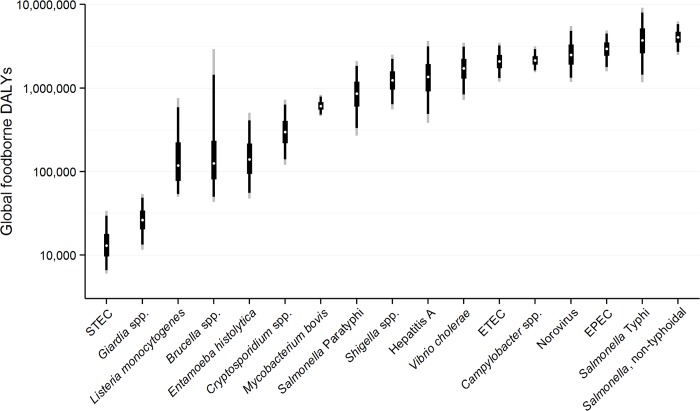
- Of foodborne DALYs, the largest burden came from nontyphoidal S. enterica if iNTS was included: 4.07 million DALYs (95% UI 2.49–6.27 million).
- Foodborne disease mortality and DALY rates were reported as highest in the African region, followed by the South East Asian region.
## Methods
- The study synthesized global and regional burden estimates for 22 foodborne diseases using the WHO FERG Enteric Diseases Task Force framework, combining literature reviews, systematic reviews, cohort studies, surveillance studies, expert consultation, and existing burden-of-disease assessments.
- The team estimated cases, sequelae, deaths, and DALYs for 2010, using pathogen-specific approaches: national estimates where available, a modified CHERG approach for diarrheal diseases in many countries, GBD 2010/IHME data for typhoid, paratyphoid, and hepatitis A, and expert elicitation to estimate the proportion transmitted by food.
- Uncertainty was propagated with Monte Carlo simulations using 10,000 draws per input parameter to generate 95% uncertainty intervals.
## Limitations
- The paper states that a major limitation was data gaps, especially in middle- and high-mortality countries, and that for many regions and pathogens the available data were sparse.
- It also states that only a few sequelae were included, with post-infectious sequelae such as reactive arthritis and irritable bowel syndrome excluded; stillbirths were excluded as well.
- The authors note that they could not fully account for age-specific effects for sequelae and could not separate some effects from comorbidities such as HIV infection.
- The text also makes evident, by its own description, that many estimates relied on expert elicitation for foodborne attribution and on assumptions/substitution where direct data were absent; this increases uncertainty and is part of the paper’s stated limitation.
Model-written summary. Check it against the paper before relying on it.
Integrity signals
Registry
Cites
Statistics
Figures
Verification
Claims the paper makes
3 Valid · 0 Not valid · 4 Not checked · 29 Own results and interpretations
The cited sources support only part of this claim — read each source’s verdict below.
In the paper
“Furthermore, global and regional estimates of the burden of foodborne diseases have not been available [1,2].”
§ World Health Organization Estimates of the Global and Regional Disease Burden of 22 Foodborne Bacterial, Protozoal, and Viral Diseases, 2010: A Data Synthesis > Introduction
What the sources say
- Partly supportedcites [1] Stein C, Kuchenmuller T, Hendrickx S, Prüss-Űstün A, Wolfson L, Engels D, et al The Global Burden of Disease assessments—WHO is responsible? PLoS Negl Trop Dis. 2007; 1: e161 10.1371/journal.pntd.0000161 18160984 PMC2154395 sourceExperimental — accuracy not yet measured
The Foodborne diseases section says that the full extent of the burden is unknown and that no precise, consistent global information existed at the time. It does not specifically address regional estimates, and its wording is narrower than saying no global estimates were available at all. No page number is provided in our copy. (LLM, conf=0.84)
- Not checked — no full text of the sourcecites [2] Tauxe RV, Doyle MP, Kuchenmuller T, Schlundt J, Stein CE. Evolving public health approaches to the global challenge of foodborne infections. Int J Food Microbiol. 2010; 139 Suppl 1: S16– 28. 10.1016/j.ijfoodmicro.2009.10.014 19931203 source
plain- Asserted: passes — The authors put it forward as true.
- Checkable: passes — It can be checked against evidence.
- Load-bearing: passes — The paper’s conclusions depend on it.
- Based: passes — The paper gives a reason why it holds.
- Partly supported
A result the paper reports from its own data — it cites no other source for it, so there is none to check. The quote shows it is in the paper.
In the paper
“Overall, 29% (95% UI 23–36%) of all 22 diseases were estimated to be transmitted by contaminated food equating to 582 million (95% UI 400–922 million) foodborne cases in 2010; 38% (95% UI 24–53%) in children <5 years of age.”
§ World Health Organization Estimates of the Global and Regional Disease Burden of 22 Foodborne Bacterial, Protozoal, and Viral Diseases, 2010: A Data Synthesis > Results > Cases
hedged- Asserted: passes — The authors put it forward as true.
- Checkable: passes — It can be checked against evidence.
- Load-bearing: passes — The paper’s conclusions depend on it.
- Based: passes — The paper gives a reason why it holds.
- Rests on an assumption not shown here.
A result the paper reports from its own data — it cites no other source for it, so there is none to check. The quote shows it is in the paper.
In the paper
“Among the 11 diarrheal diseases, the rate ratio of foodborne cases occurring among children <5 years of age compared to those ≥5 years of age was 6.44 (95%UI 3.15–12.46).”
§ World Health Organization Estimates of the Global and Regional Disease Burden of 22 Foodborne Bacterial, Protozoal, and Viral Diseases, 2010: A Data Synthesis > Results > Cases
plainstates an association- Asserted: passes — The authors put it forward as true.
- Checkable: passes — It can be checked against evidence.
- Load-bearing: unclear — It is unclear whether the paper’s conclusions depend on it.
- Based: passes — The paper gives a reason why it holds.
- Rests on 2 assumptions not shown here.
A result the paper reports from its own data — it cites no other source for it, so there is none to check. The quote shows it is in the paper.
In the paper
“Norovirus was the leading cause of foodborne illness causing 125 million (95% UI 70–251 million) cases, while Campylobacter spp. caused 96 million (95% UI 52–177 million) foodborne illnesses.”
§ World Health Organization Estimates of the Global and Regional Disease Burden of 22 Foodborne Bacterial, Protozoal, and Viral Diseases, 2010: A Data Synthesis > Abstract > Methods and Findings
plainstates a cause- Asserted: passes — The authors put it forward as true.
- Checkable: passes — It can be checked against evidence.
- Load-bearing: unclear — It is unclear whether the paper’s conclusions depend on it.
- Based: passes — The paper gives a reason why it holds.
In the paper
“The FERG estimate for DALYs for nontyphoidal S. enterica combining diarrheal and invasive infections was 4 times greater than GBD 2010 [54].”
§ World Health Organization Estimates of the Global and Regional Disease Burden of 22 Foodborne Bacterial, Protozoal, and Viral Diseases, 2010: A Data Synthesis > Discussion
What the sources say
- Not checked — no full text of the sourcecites [54] Murray CJ, Vos T, Lozano R, Naghavi M, Flaxman AD, Michaud C, et al Disability-adjusted life years (DALYs) for 291 diseases and injuries in 21 regions, 1990–2010: a systematic analysis for the Global Burden of Disease Study 2010. Lancet. 2012; 380: 2197– 2223. 10.1016/S0140-6736(12)61689-4 23245608 source
plain- Asserted: passes — The authors put it forward as true.
- Checkable: passes — It can be checked against evidence.
- Load-bearing: unclear — It is unclear whether the paper’s conclusions depend on it.
- Based: passes — The paper gives a reason why it holds.
16 more claims
Create a free account to see all 36 claims and to verify the 1 reference still open.
- Probably not a substantial claim. 11
- It may state two separate claims as one. 5
Claims other papers make about this one
Each is checked against this paper’s own text: does it say what the citing paper says it does?
The source backs part of the claim, not all of it — or backs it for a different population, condition or comparison.
In the citing paper
“Animal-based foods, like cow milk, can pose a risk for zoonotic enteric pathogen transmission42 although pasteurisation is an effective means for making milk safer.”
From Environmental and behavioural exposure pathways associated with diarrhoea and enteric pathogen detection in 5-month-old, periurban Kenyan infants: a cross-sectional study (2022) · cites this paper as [42]
Experimental — accuracy not yet measured
Citations
Cites
Lozano, R., Naghavi, M., Foreman, K., Lim, S., Shibuya, K., Aboyans, V., Abraham, J., Adair, T., Aggarwal, R., Ahn, S. Y., et al. (2012) · The Lancet · doi:10.1016/s0140-6736(12)61728-0 · Cited by 14,070 · cited 3×
“Twelve of the diseases included in our study were also included in the GBD 2010 study [25,26,54].”
Murray, C. J. L., Vos, T., Lozano, R., Naghavi, M., Flaxman, A. D., Michaud, C., Ezzati, M., Shibuya, K., Salomon, J. A., Abdalla, S., et al. (2012) · The Lancet · doi:10.1016/s0140-6736(12)61689-4 · Cited by 8,888
Foodborne illness acquired in the United States—Major pathogens
Scallan, E., Hoekstra, R. M., Angulo, F. J., Tauxe, R. V., Widdowson, M.-A., Roy, S. L., Jones, J. L., & Griffin, P. M. (2011) · Emerging Infectious Diseases · doi:10.3201/eid1701.p11101 · Cited by 7,657 · cited 1×
“Many different diseases, including those due to bacteria, viruses, parasites, chemicals, and prions, may be transmitted to humans by contaminated food [3].”
Self-citationSelected major risk factors and global and regional burden of disease
Ezzati, M., Lopez, A. D., Rodgers, A., Vander Hoorn, S., & Murray, C. J. (2002) · The Lancet · doi:10.1016/s0140-6736(02)11403-6 · Cited by 3,594
Kotloff, K. L., Nataro, J. P., Blackwelder, W. C., Nasrin, D., Farag, T. H., Panchalingam, S., Wu, Y., Sow, S. O., Sur, D., Breiman, R. F., et al. (2013) · The Lancet · doi:10.1016/s0140-6736(13)60844-2 · Cited by 3,560 · cited 1×
“This approach was facilitated by the availability of estimates of the envelope of diarrheal deaths, along with recent advances in diarrheal disease diagnosis, such as widespread application of polymerase chain reaction (PCR) for norovirus detection [20,49].”
The Global Burden of Nontyphoidal Salmonella Gastroenteritis
Majowicz, S. E., Musto, J., Scallan, E., Angulo, F. J., Kirk, M., O’Brien, S. J., Jones, T. F., Fazil, A., & Hoekstra, R. M. (2010) · Clinical Infectious Diseases · doi:10.1086/650733 · Cited by 2,442
Self-citationGlobal burden of childhood pneumonia and diarrhoea
Walker, C. L. F., Rudan, I., Liu, L., Nair, H., Theodoratou, E., Bhutta, Z. A., O'Brien, K. L., Campbell, H., & Black, R. E. (2013) · The Lancet · doi:10.1016/s0140-6736(13)60222-6 · Cited by 2,356 · cited 2×
“, “envelope” of diarrheal incidence) for 2010 by combining estimates of diarrheal incidence for children<5 years of age and persons 5 years of age [13,36].”
Self-citationThe global burden of typhoid fever.
Crump, J., Luby, S., & Mintz, E. (2004) · Bulletin of the World Health Organization · doi:10.1590/s0042-96862004000500008 · Cited by 2,172
Self-citationThe global burden of typhoid fever.
(2004) · Europe PMC (PubMed Central) · Cited by 1,965
Self-citationSalomon, J. A., Vos, T., Hogan, D. R., Gagnon, M., Naghavi, M., Mokdad, A., Begum, N., Shah, R., Karyana, M., Kosen, S., et al. (2012) · The Lancet · doi:10.1016/s0140-6736(12)61680-8 · Cited by 1,322 · cited 1×
“Disability weights for each clinical outcome for the enteric diseases were taken from the GBD 2010 study [47].”
Cited by
Items 301–400 of 1,631
Tieroshyn, V., Мороз, Л. В., Pryshliak, O. Y., Shostakovich-Koretska, L., Kruglova, O., & Gordienko, L. (2020) · Scientific Reports · doi:10.1038/s41598-020-62386-0 · Cited by 64
NontyphoidalSalmonellaInvasive Disease: Challenges and Solutions
Crump, J. A., Nyirenda, T. S., Mbuyi-Kalonji, L., Phoba, M.-F., Tack, B., Platts-Mills, J. A., Gordon, M. A., & Kariuki, S. (2023) · Open Forum Infectious Diseases · doi:10.1093/ofid/ofad020 · Cited by 51
“Salmonella invasive disease [4, 15, 16], recent interest has included whether the burden of nontyphoidal Salmonella diarrhea in sub-Saharan African countries could strengthen the”
BackgroundSelf-citationGomes, E., Araújo, D., Nogueira, T., Oliveira, R., Silva, S. D. R., Oliveira, L. V. N., Azevedo, N. F., Almeida, C., & Castro, J. (2025) · Frontiers in Cellular and Infection Microbiology · doi:10.3389/fcimb.2025.1593219 · Cited by 58
Zhao, X., Gao, Y., Ye, C., Yang, L., Wang, T., & Chang, W. (2016) · BioMed Research International · doi:10.1155/2016/8183931 · Cited by 41
Differential Survival of Hyper-Aerotolerant Campylobacter jejuni under Different Gas Conditions
Oh, E., McMullen, L. M., Chui, L., et al. (2017) · Frontiers in Microbiology · doi:10.3389/fmicb.2017.00954 · Cited by 40
“Campylobacter is a leading bacterial cause of human gastroenteritis, annually accounting for approximately 166 million diarrheal cases around the world, particularly in developed countries (Kirk et al., 2015).”
BackgroundZhu, A., Zhi, W., Qiu, Y., Wei, L., Tian, J., Pan, Z., Kang, X., Gu, W., & Duan, L. (2018) · Food Control · doi:10.1016/j.foodcont.2018.07.035 · Cited by 46
Enteric Pathogen Diversity in Infant Foods in Low-Income Neighborhoods of Kisumu, Kenya
Tsai, K., Simiyu, S., Mumma, J., Aseyo, R. E., Cumming, O., Dreibelbis, R., & Baker, K. K. (2019) · International Journal of Environmental Research and Public Health · doi:10.3390/ijerph16030506 · Cited by 40
“estimated 582 million cases of illness, death, or disability-adjusted life years each year globally, with young children and Africans bearing most of the foodborne disease burden [2].”
BackgroundSong, J., Li, Q., Everaert, N., Liu, R., Zheng, M., Zhao, G., & Wen, J. (2020) · Journal of Animal Science · doi:10.1093/jas/skz396 · Cited by 45
Benjamin-Chung, J., Crider, Y. S., Mertens, A., Ercumen, A., Pickering, A. J., Lin, A., Steinbaum, L., Swarthout, J., Rahman, M., Parvez, S. M., et al. (2021) · The Lancet Global Health · doi:10.1016/s2214-109x(20)30523-4 · Cited by 39
Metabolic Activation of CsgD in the Regulation of Salmonella Biofilms
Sokaribo, A. S., Hansen, E. G., McCarthy, M. C., Desin, T. S., Waldner, L. L., MacKenzie, K. D., Mutwiri, G., Herman, N. J., Herman, D. J., Wang, Y., et al. (2020) · Microorganisms · doi:10.3390/microorganisms8070964 · Cited by 48
Bioplastic accumulates antibiotic and metal resistance genes in coastal marine sediments
Cesare, A. D., Pinnell, L. J., Brambilla, D., Elli, G., Sabatino, R., Sathicq, M. B., Corno, G., O’Donnell, C. A., & Turner, J. W. (2021) · Environmental Pollution · doi:10.1016/j.envpol.2021.118161 · Cited by 44
Orsi, R. H., Liao, J., Carlin, C. R., & Wiedmann, M. (2023) · mBio · doi:10.1128/mbio.00938-23 · Cited by 60
Fernández-Cassi, X., Timoneda, N., Gonzales-Gustavson, E. A., Abril, J. F., Bofill-Mas, S., & Gironés, R. (2017) · International Journal of Food Microbiology · doi:10.1016/j.ijfoodmicro.2017.06.001 · Cited by 41
Sodagari, H. R., Mohammed, A. B., Wang, P., O’Dea, M. A., Abraham, S., Robertson, I., & Habib, I. (2019) · International Journal of Food Microbiology · doi:10.1016/j.ijfoodmicro.2019.108305 · Cited by 38
Pilar, A. V. C., Petronella, N., Dussault, F., Verster, A. J., Békal, S., Lévesque, R. C., Goodridge, L. D., & Tamber, S. (2020) · BMC Genomics · doi:10.1186/s12864-020-06780-y · Cited by 44
No food security without food safety: Lessons from livestock related research
Vipham, J., Amenu, K., Alonso, S., Ndahetuye, J. B., Zereyesus, Y. A., Nishimwe, K., Bowers, E., Maier, D. E., Sah, K., Havelaar, A. H., et al. (2020) · Global Food Security · doi:10.1016/j.gfs.2020.100382 · Cited by 48
Self-citationGarcía, A., & Fox, J. G. (2021) · Comparative Medicine · doi:10.30802/aalas-cm-20-000054 · Cited by 53
Kim, C., Goucher, G., Tadesse, B. T., Lee, W., Abbas, K., & Kim, J. (2023) · BMC Infectious Diseases · doi:10.1186/s12879-023-08452-0 · Cited by 65
“An estimated 11 to 20 million typhoid fever cases including 128,000 to 161,000 deaths occur each year [1–4] with the majority in low-and middle-income countries (LMICs) [5, 6].”
BackgroundThe, H. C., Pham, P., Thanh, T. H., Phuong, L. V. K., Yen, N. P., Le, S.-N. H., Thuy, D. V., Chau, T. T. H., Phuc, H. L., Ngọc, N. M., et al. (2023) · Communications Biology · doi:10.1038/s42003-023-05365-1 · Cited by 52
“ontyphoidal Salmonella enterica (NTS) rank among the most common bacterial pathogens causing diarrheal diseases worldwide, leading to an estimate of 75 million cases 1 .”
Restaurant Cooking Trends and Increased Risk for Campylobacter Infection
Jones, A. K., Rigby, D., Burton, M. P., Millman, C., Williams, N. J., Jones, T. R., Wigley, P., O’Brien, S. J., & Cross, P. (2016) · Emerging infectious diseases · doi:10.3201/eid2207.151775 · Cited by 38
Salmonella and the Inflammasome: Battle for Intracellular Dominance
Crowley, S. M., Knodler, L. A., & Vallance, B. A. (2016) · Current topics in microbiology and immunology · doi:10.1007/978-3-319-41171-2_3 · Cited by 52
Moura, Q., Fernandes, M. R., da Silva, K. C., et al. (2017) · Virulence · doi:10.1080/21505594.2017.1279779 · Cited by 38
“more harmful, contributing to the increase of morbidity and mortality rates.(5) Moreover, it causes important economic impact due to medical costs, and losses on productivity and marketing of foods of animal origin.”
BackgroundSibanyoni, J. J., & Tabit, F. T. (2018) · Food Control · doi:10.1016/j.foodcont.2018.11.009 · Cited by 38
Fiedoruk, K., Daniluk, T., Rożkiewicz, D. I., Ołdak, E., Prasad, S. V., & Święcicka, I. (2019) · Gut Pathogens · doi:10.1186/s13099-019-0313-x · Cited by 36
Thindwa, D., Chipeta, M. G., Henrion, M., & Gordon, M. A. (2019) · Scientific Reports · doi:10.1038/s41598-019-56688-1 · Cited by 51
Feye, K. M., Rubinelli, P. M., Chaney, W. E., Pavlidis, H. O., Kogut, M. H., & Ricke, S. C. (2020) · Frontiers in Microbiology · doi:10.3389/fmicb.2019.03062 · Cited by 37
“The libraries were assessed for qualitative and quantitative homogeneity, and then sequenced using the Illumina MiSeq platform as previously described (Kozich et al., 2013).”
MethodAdvanced PCR-based molecular diagnosis of gastrointestinal infections: challenges and opportunities
Zboromyrska, Y., & Vilà, J. (2016) · Expert Review of Molecular Diagnostics · doi:10.1586/14737159.2016.1167599 · Cited by 44
The Burden of Zoonoses in Kyrgyzstan: A Systematic Review
Counotte, M. J., Minbaeva, G., Usubalieva, J., Abdykerimov, K. K., & Torgerson, P. R. (2016) · PLoS neglected tropical diseases · doi:10.1371/journal.pntd.0004831 · Cited by 45
“that the relation between some sequelae were not sufficiently proven in middle and high-mortality countries [35].”
BackgroundSelf-citationLi, W., Han, H., Liu, J., et al. (2023) · One Health Advances · doi:10.1186/s44280-023-00001-3 · Cited by 37
“Among the 22 common foodborne diseases, nontyphoidal Salmonella enterica causes the highest burden [1].”
BackgroundWang, J., Li, X., Li, J., et al. (2017) · Veterinary Microbiology · doi:10.1016/j.vetmic.2017.08.024 · Cited by 37
de Jesus, G. S., Micheletti, A. C., Padilha, R. G., de Paula, J. D. S., Alves, F. M., Leal, C. R. B., Garcez, F. R., Garcez, W. S., & Yoshida, N. (2020) · Molecules · doi:10.3390/molecules25143296 · Cited by 43
Benzimidazole based hybrids against complex diseases: A catalogue of the SAR profile
Choudhary, S., Arora, M., Verma, H., Kumar, M., & Silakari, O. (2021) · European Journal of Pharmacology · doi:10.1016/j.ejphar.2021.174027 · Cited by 41
Global research activity on antimicrobial resistance in food-producing animals
Sweileh, W. M. (2021) · Archives of Public Health · doi:10.1186/s13690-021-00572-w · Cited by 47
“The authors found that the burden of foodborne illness was highest in WHO’s African region [31].”
BackgroundKhan, A. U., Melzer, F., Sayour, A. E., Shell, W. S., Linde, J., Abdel‐Glil, M. Y., El-Soally, S. A. G. E., Elschner, M. C., Sayour, H. E. M., Ramadan, E. S., et al. (2021) · Pathogens · doi:10.3390/pathogens10060759 · Cited by 45
“Brucellosis is well controlled in developed countries but is still endemic in the Middle East and Central Asian regions, with high case numbers recorded in humans [3].”
BackgroundSalmonellosis outbreak archive in China: data collection and assembly
Wang, Z., Huang, C., Liu, Y., Chen, J., Yin, R., Jia, C., Kang, X., Zhou, X., Liao, S., Jin, X., et al. (2024) · Scientific Data · doi:10.1038/s41597-024-03085-7 · Cited by 39
Bergwerff, A. A., & Debast, S. B. (2021) · Foods · doi:10.3390/foods10040832 · Cited by 45
“In this list is the all-time highest-scoring food-poisoning organism worldwide causing an estimated 125 million cases of gastro-enteritis in 2010: norovirus [17].”
BackgroundIsolation, characterization and comparison of lytic Epseptimavirus phages targeting Salmonella
Cong, C., Wei, B., Cui, H., Li, X., Yuan, Y., Wang, L., Li, S., & Xu, Y. (2021) · Food Research International · doi:10.1016/j.foodres.2021.110480 · Cited by 38
Campylobacter jejuni/coli Infection: Is It Still a Concern?
Veronese, P., & Dodi, I. (2024) · Microorganisms · doi:10.3390/microorganisms12122669 · Cited by 49
Prado, T., Bruni, A. D. C., Barbosa, M. R. F., Garcia, S. C., Moreno, L. Z., & Sato, M. I. Z. (2018) · The Science of The Total Environment · doi:10.1016/j.scitotenv.2018.07.301 · Cited by 37
Devleesschauwer, B., Pires, S. M., Young, I., Gill, A. O., Majowicz, S. E., & the study team (2019) · Epidemiology and Infection · doi:10.1017/s0950268819001183 · Cited by 38
Self-citationDetecting reports of unsafe foods in consumer product reviews
Maharana, A., Cai, K., Hellerstein, J., Hswen, Y., Munsell, M., Станева, В., Verma, M. E., Vint, C., Wijaya, D. T., & Nsoesie, E. O. (2019) · JAMIA Open · doi:10.1093/jamiaopen/ooz030 · Cited by 53
“The World Health Organization estimates that in 2010, 600 million people experienced illness due to contaminated food, globally.(34) Data from social media, crowdsourced websites, Google searches and business review websites, such as, Yelp have been shown to be useful in monitoring reports of foodborne illness.”
BackgroundSeroprevalence and Molecular Identification of Brucella spp. in Camels in Egypt
Khan, A. U., Sayour, A. E., Melzer, F., et al. (2020) · Microorganisms · doi:10.3390/microorganisms8071035 · Cited by 36
“It is well controlled in many countries but is still endemic in many others with high records in humans in the Middle East and central Asian regions [1].”
BackgroundCrump, J. A., Thomas, K. M., Benschop, J., Knox, M. A., Wilkinson, D. A., Midwinter, A. C., Munyua, P. M., Ochieng, J. B., Bigogo, G., Verani, J. R., et al. (2020) · Clinical Infectious Diseases · doi:10.1093/cid/ciaa1153 · Cited by 44
“While approximately 9% of diarrheal illnesses and 11% of diarrheal deaths in the World Health Organization African region were attributed to NTS [1], NTS have been isolated from <1% of stool samples from infants and children with diarrhea at African sites in one large study of diarrheal disease [6].”
BackgroundResultInfluentialSelf-citationMansour, M.-N., Yaghi, J., Khoury, A. E., Felten, A., Mistou, M., Atoui, A., & Radomski, N. (2020) · International Journal of Food Microbiology · doi:10.1016/j.ijfoodmicro.2020.108831 · Cited by 44
Nordhagen, S., Lee, J., Onuigbo-Chatta, N., Okoruwa, A., Monterrosa, E., Lambertini, E., & Pelto, G. H. (2022) · Foods · doi:10.3390/foods11020225 · Cited by 36
“Currently, foodborne diseases associated with 31 high-risk microbial and chemical hazards are responsible for an estimated 600 million illnesses and 420,000 premature deaths annually [3], mostly among those living in low- and middle-income countries (LMICs) [4,5] who make up about 75% of deaths (but only 41% of the gl…”
BackgroundFerrario, C., Lugli, G. A., Ossiprandi, M. C., Turroni, F., Milani, C., Duranti, S., Mancabelli, L., Mangifesta, M., Alessandri, G., van Sinderen, D., et al. (2017) · International Journal of Food Microbiology · doi:10.1016/j.ijfoodmicro.2017.05.001 · Cited by 41
Norovirus Polymerase Fidelity Contributes to Viral Transmission In Vivo
Arias, A., Thorne, L., Ghurburrun, E., Bailey, D., & Goodfellow, I. (2016) · mSphere · doi:10.1128/msphere.00279-16 · Cited by 35
“Human noroviruses (HuNoVs) are considered the main cause of diarrheal episodes and foodborne gastroenteritis globally (11–13), with an estimated (cid:2) 500 M infections annually and (cid:2) 200,000 associated fatalities (13).”
Watson, V. E., Jacob, M. E., Flowers, J. R., Strong, S. J., DebRoy, C., & Gookin, J. L. (2017) · Journal of Clinical Microbiology · doi:10.1128/jcm.00403-17 · Cited by 38
“cases of diarrhea per year, of which 17 million are diagnosed in children (4).”
BackgroundLangel, S. N., Paim, F. C., Alhamo, M. A., Lager, K. M., Vlasova, A. N., & Saif, L. J. (2019) · Veterinary Research · doi:10.1186/s13567-019-0719-y · Cited by 36
Khalid, T., Hdaifeh, A., Fédérighi, M., Cummins, E., Boué, G., Guillou, S., & Tesson, V. (2020) · Foods · doi:10.3390/foods9111661 · Cited by 46
“and thermotolerant Campylobacter species were the two first-ranked pathogens in almost all cases [1].”
BackgroundSalmen, W., Hu, L., Bok, M., Chaimongkol, N., Ettayebi, K., Sosnovtsev, S. V., Soni, K., Ayyar, B. V., Shanker, S., Neill, F. H., et al. (2023) · Nature Communications · doi:10.1038/s41467-023-42146-0 · Cited by 39
Genomic variations leading to alterations in cell morphology of Campylobacter spp
Esson, D., Mather, A. E., Scanlan, E., Gupta, S., de Vries, S. P. W., Bailey, D. M., Harris, S. R., McKinley, T. J., Méric, G., Berry, S. K., et al. (2016) · Scientific Reports · doi:10.1038/srep38303 · Cited by 37
Salmonella in Animal Feeds: A Scoping Review
Sargeant, J. M., Totton, S. C., Plishka, M., & Vriezen, E. R. (2021) · Frontiers in Veterinary Science · doi:10.3389/fvets.2021.727495 · Cited by 39
Bacteriophages in Infectious Diseases and Beyond—A Narrative Review
Ιωάννου, Π., Baliou, S., & Samonis, G. (2023) · Antibiotics · doi:10.3390/antibiotics12061012 · Cited by 47
“Foodborne illnesses result in hundreds of millions of human infections and hundreds of thousands of deaths every year, posing a significant public health issue [44,45].”
BackgroundVaccine value profile for norovirus
Armah, G. E., Lopman, B. A., Vinjé, J., O’Ryan, M., Lanata, C. F., Groome, M. J., Ovitt, J., Marshall, C., Sajewski, E. T., & Riddle, M. S. (2023) · Vaccine · doi:10.1016/j.vaccine.2023.03.034 · Cited by 37
Self-citationFattinger, S. A., Maurer, L., Geiser, P., Bernard, E. M., Enz, U., Ganguillet, S., Gül, E., Kroon, S., Demarco, B., Mack, V., et al. (2023) · Proceedings of the National Academy of Sciences · doi:10.1073/pnas.2315503120 · Cited by 38
“It has been shown that immune cells employ Gasdermins to promote gut inflammation and defense against several gut pathogens in vivo (11, 15, 43–46).”
Shrestha, S., Malla, B., & Haramoto, E. (2023) · The Science of The Total Environment · doi:10.1016/j.scitotenv.2023.169334 · Cited by 38
Saberi, P., Berrean, B., Thomas, S., Gandhi, M., & Scott, H. M. (2018) · JMIR Formative Research · doi:10.2196/formative.8623 · Cited by 35
Oh, E., Andrews, K. J., McMullen, L. M., & Jeon, B. (2019) · Scientific Reports · doi:10.1038/s41598-019-48373-0 · Cited by 35
Fondness for sugars of enteric viruses confronts them with human glycans genetic diversity
LePendu, J., & Ruvoën‐Clouet, N. (2019) · Human Genetics · doi:10.1007/s00439-019-02090-w · Cited by 41
Anti-Salmonella Potential of New Lactobacillus Strains with the Application in the Poultry Industry
Kowalska, J. D., Nowak, A., Śliżewska, K., Stańczyk, M. B., ŁUKASIAK, M., & Dastych, J. (2020) · Polish Journal of Microbiology · doi:10.33073/pjm-2020-001 · Cited by 43
“In the European Union, salmonellosis is the second most common foodborne disease and S. enterica is the most frequently reported pathogen (Kirk et al. 2015; Bonardi et al. 2016; Shah et al. 2017; European Food Safety Authority (EFSA) and European Centre for Disease Prevention and Control (ECDC)…”
BackgroundTyphoid Outbreaks, 1989–2018: Implications for Prevention and Control
Appiah, G. D., Chung, A., Bentsi-Enchill, A. D., Kim, S. K., Crump, J. A., Mogasale, V., Pellegrino, R. A., Slayton, R. B., & Mintz, E. D. (2020) · American Journal of Tropical Medicine and Hygiene · doi:10.4269/ajtmh.19-0624 · Cited by 45
“87 1992 Al-Mudhnab, Saudi Arabia – 27 – 0 0 88 2004 Jordan – 83 – – 0 51 2004 Karachi, Pakistan 60% 300 – – 3 (1) 15 2016–2017 Hyderabad, Pakistan – 486 98/200 (50) 71/200 (27) 1 (0.”
ResultSelf-citationApplication of Nanopore Sequencing in the Detection of Foodborne Microorganisms
Zhou, Y. L., Ren, M., Zhang, P., Jiang, D., Yao, X., Luo, Y., Yang, Z., & Yin, W. (2022) · Nanomaterials · doi:10.3390/nano12091534 · Cited by 40
Keddy, K. H., Musekiwa, A., Sooka, A., Karstaedt, A., Nana, T., Seetharam, S., Nchabaleng, M., Lekalakala, R., Angulo, F. J., & Klugman, K. P. (2017) · Medicine · doi:10.1097/md.0000000000006448 · Cited by 36
“First, the younger group is predisposed to higher mortality due to foodborne diseases, including salmonellosis.([1]) Second, differences in the HIV rates and presentation with iNTS between these 2 age groups may impact analyses: HIV-infected children surviving beyond 5 years of age was an unusual observation before th…”
BackgroundSelf-citationSalmonella in Foods: A Reemerging Problem
Cesare, A. D. (2018) · Advances in food and nutrition research · doi:10.1016/bs.afnr.2018.02.007 · Cited by 37
Musallam, I. I., Ndour, A. P. N., Yempabou, D., Ngong, C. C., DZOUSSE, M. F., Mouiche, M. M. M., Feussom, J. M. K., Ntirandekura, J., Ntakirutimana, D., Fané, A., et al. (2019) · Acta Tropica · doi:10.1016/j.actatropica.2019.105042 · Cited by 34
“83 million cases of human brucellosis globally (47% of these were identified as foodborne in origin) although the actual figure is likely to be much higher than this, due to widespread under-reporting and misdiagnosis (WHO, 2015; Kirk et al., 2015; Jennings et al., 2007).”
BackgroundKuntala, N., Mareddy, J., Telu, J. R., et al. (2021) · Journal of Heterocyclic Chemistry · doi:10.1002/jhet.4328 · Cited by 33
Panzenhagen, P., Portes, A. B., dos Santos, A. M. P., Duque, S. D. S., & Conte‐Júnior, C. A. (2021) · Genes · doi:10.3390/genes12101538 · Cited by 39
“Campylobacter is the leading cause of bacterial foodborne gastroenteritis in the world [4].”
BackgroundNuclease activity: an exploitable biomarker in bacterial infections
González, J. G., & Hernández, F. J. (2022) · Expert Review of Molecular Diagnostics · doi:10.1080/14737159.2022.2049249 · Cited by 39
“spread waterborne and foodborne pathogens both in lowand high-income countries due to their epidemiological status [5,248,249].”
BackgroundNew insights into the global burden of noroviruses and opportunities for prevention
Hall, A. J., Glass, R. I., & Parashar, U. D. (2016) · Expert Review of Vaccines · doi:10.1080/14760584.2016.1178069 · Cited by 40
“However, while noroviruses are the leading cause of foodborne disease worldwide, direct exposure to contaminated food is estimated to account for 20% of all norovirus cases [10,11].”
Self-citationKey characteristics of foods with an elevated risk for viral enteropathogen contamination
Yeargin, T. A., & Gibson, K. E. (2018) · Journal of Applied Microbiology · doi:10.1111/jam.14113 · Cited by 37
Bindiya, E. S., Johny, T. K., Sasidharan, R. S., et al. (2019) · 3 Biotech · doi:10.1007/s13205-019-1639-2 · Cited by 32
Suther, C., & Moore, M. D. (2019) · Food Science and Human Wellness · doi:10.1016/j.fshw.2019.09.002 · Cited by 34
Hahn, M. M., & Gunn, J. S. (2020) · Microorganisms · doi:10.3390/microorganisms8020253 · Cited by 32
Sharif, N., Nobel, N. U., Sakib, N., Liza, S. M., Khan, S. T., Billah, B., Parvez, M. A. K., Haque, A., Talukder, A. A., & Dey, S. K. (2020) · The Pediatric Infectious Disease Journal · doi:10.1097/inf.0000000000002637 · Cited by 34
“and Vibrio cholerae, are commonly reported.(3) E.”
Phan-Thien, K.-Y., Metaferia, M., Bell, T. L., Bradbury, M. I., Sassi, H. P., van Ogtrop, F., Suslow, T. V., & McConchie, R. (2020) · Letters in Applied Microbiology · doi:10.1111/lam.13302 · Cited by 36
Senevirathne, A., Hewawaduge, C., & Lee, J. H. (2021) · Poultry Science · doi:10.1016/j.psj.2021.101205 · Cited by 34
“There also can be hyper-flagellation, where the JOL2435 bacterial ghosts display both SE and ST flagellin on the cell surface (Legnani-Fajardo et al., 1991; Campod onico et al., 2010).”
BackgroundWang, Z., Guo, K., Liu, Y., Huang, C., & Wu, M. (2021) · Seminars in Cancer Biology · doi:10.1016/j.semcancer.2021.10.004 · Cited by 36
Health and economic burden of Campylobacter
Devleesschauwer, B., Bouwknegt, M., Mangen, M.-J. J., & Havelaar, A. H. (2016) · Elsevier eBooks · doi:10.1016/b978-0-12-803623-5.00002-2 · Cited by 44
“( Kirk et al., 2015).”
InfluentialSelf-citationOverview of the impact of Typhoid and Paratyphoid fever. Utility of Ty21a vaccine (Vivotif®).
Amicizia, D., Arata, L., Zangrillo, F., Panatto, D., & Gasparini, R. (2017) · Journal of preventive medicine and hygiene · doi:10.15167/2421-4248/jpmh2017.58.1.747 · Cited by 34
“million typhoid fever episodes occurred in 2010 [11-14].”
BackgroundHe, F., Wang, H., Du, P., Li, T., Wang, W., Tan, T., Liu, Y., Ma, Y., Wang, Y., & El‐Aty, A. M. A. (2023) · Journal of Pharmaceutical Analysis · doi:10.1016/j.jpha.2023.02.005 · Cited by 31
Paper-Based Diagnostic System Facilitating Escherichia coli Assessments by Duplex Coloration
Kim, H. J., Kwon, C., & Noh, H. (2019) · ACS Sensors · doi:10.1021/acssensors.9b01034 · Cited by 34
The European Union control strategy for Campylobacter spp. in the broiler meat chain
Nastasijević, I., Proscia, F., Bošković, M., Glišić, M., Blagojević, B., Sorgentone, S., Kirbis, A., & Ferri, M. (2020) · Journal of Food Safety · doi:10.1111/jfs.12819 · Cited by 46
Zhang, L., Li, Y., Shao, Y., Hu, Y., Lou, H., Chen, X., Wu, Y., Mei, L., Zhou, B., Zhang, X., et al. (2020) · Frontiers in Microbiology · doi:10.3389/fmicb.2020.01244 · Cited by 31
“Keywords: Campylobacter, poultry, human feces, multidrug resistance, MLST, PFGE INTRODUCTION Campylobacter is a leading cause of sporadic bacterial gastroenteritis worldwide (Kirk et al., 2015; Li et al., 2018).”
BackgroundMa, B., Mei, X., Lei, C., Cui, L., Gao, Y., Kong, L., Zhai, X., & Wang, H. (2020) · mSphere · doi:10.1128/msphere.00725-20 · Cited by 36
“Foodborne diseases are associated with high morbidity and mortality rates worldwide and pose major challenges to food safety and economics (1).”
BackgroundLorenz, B., Ali, N., Bocklitz, T. W., Rösch, P., & Popp, J. (2020) · Analytical and Bioanalytical Chemistry · doi:10.1007/s00216-020-02957-2 · Cited by 31
Household food sources and diarrhoea incidence in poor urban communities, Accra Ghana
Larbi, R. T., Atiglo, D. Y., Peterson, M., Biney, A. A. E., Dodoo, N. D., & Dodoo, F. N.-A. (2021) · PLoS ONE · doi:10.1371/journal.pone.0245466 · Cited by 37
“The same observation is made when presence of infants instead of children in a household is considered in the model; albeit, the existing literature report higher diarrhoea morbidity and mortality among children [6, 20, 36, 52].”
BackgroundXiong, L.-J., Li, Y., Li, J., Yang, J., Shang, L., He, X., Liu, L., Luo, Y., & Xie, X. (2021) · International Journal of Infectious Diseases · doi:10.1016/j.ijid.2021.08.024 · Cited by 35
Giardia duodenalis Virulence — “To Be, or Not To Be”
Argüello-García, R., & Ortega‐Pierres, M. G. (2021) · Current Tropical Medicine Reports · doi:10.1007/s40475-021-00248-z · Cited by 33
Engineering organ-on-a-chip systems to model viral infections
Shahabipour, F., Satta, S., Mahmoodi, M., Sun, A., de Barros, N. R., Li, S., Hsiai, T. K., & Ashammakhi, N. A. (2023) · Biofabrication · doi:10.1088/1758-5090/ac6538 · Cited by 34
Aptamer-Based Technologies for Parasite Detection
Brosseau, N. E., Vallée, I., Mayer‐Scholl, A., Ndao, M., & Karadjian, G. (2023) · Sensors · doi:10.3390/s23020562 · Cited by 34
Xian, X., Wang, L., Wu, X., Tang, X., Zhai, X., Yu, R., Qu, L., & Ye, M. (2023) · BMC Infectious Diseases · doi:10.1186/s12879-023-08799-4 · Cited by 43
“According to the estimation of World Health Organization (WHO), 600 million people world-wide fall ill each year due to the consumption of contaminated food, resulting in 420,000 deaths and a loss of 33 million healthy lives [1, 2].”
MethodXiang, Y., Zhu, K., Min, K., Zhang, Y., Liu, J., Liu, K., Han, Y., Li, X., Du, X., Wang, X., et al. (2024) · Nature Communications · doi:10.1038/s41467-024-50331-y · Cited by 40
Guerra, M. M. M., de Almeida, A. M., & Willingham, A. L. (2016) · Tropical Animal Health and Production · doi:10.1007/s11250-016-1082-x · Cited by 32
Krakovka, S., Ribacke, U., Miyamoto, Y., Eckmann, L., & Svärd, S. G. (2022) · Frontiers in Microbiology · doi:10.3389/fmicb.2022.834008 · Cited by 40
Lee, J., Pelto, G. H., & Nordhagen, S. (2022) · Appetite · doi:10.1016/j.appet.2022.106265 · Cited by 38
The Global Burden of Viral Food-borne Diseases: A Systematic Review
Hashemi, M. B., Salayani, M., Afshari, A., Kafil, H. S., & Noori, S. M. A. (2023) · Current Pharmaceutical Biotechnology · doi:10.2174/1389201024666230221110313 · Cited by 37
Surface modification of food processing and handling gloves for enhanced food safety and hygiene
Oh, J. K., William, R., Zhang, M., Yegin, Y., Min, Y., Castillo, A., Cisneros‐Zevallos, L., & Akbulut, M. E. S. (2016) · Journal of Food Engineering · doi:10.1016/j.jfoodeng.2016.04.018 · Cited by 44
Knowledge and Attitudes towards Handling Eggs in the Home: An Unexplored Food Safety Issue?
Whiley, H., Clarke, B., & Ross, K. (2017) · International Journal of Environmental Research and Public Health · doi:10.3390/ijerph14010048 · Cited by 30
“Global estimates indicating that every year there are just under 600 million cases, including 350,000 fatalities [2].”
BackgroundZheng, J., Luo, Y., Reed, E. A., et al. (2017) · Genome Biology and Evolution · doi:10.1093/gbe/evx065 · Cited by 30
Metadata
- Authors
- Kirk, M. D., Pires, S. M., Black, R. E., Caipo, M., Crump, J. A., Devleesschauwer, B., Döpfer, D., Fazil, A., Fischer-Walker, C. L., Hald, T., Hall, A. J., Keddy, K. H., Lake, R. J., Lanata, C. F., Torgerson, P. R., Havelaar, A. H., & Angulo, F. J.
- Affiliations
- Australian National University (AU)
- Technical University of Denmark (DK)
- Johns Hopkins University (US)
- Food and Agriculture Organization of the United Nations (IT)
- University of Otago (NZ)
- Ghent University (BE)
- University of Wisconsin–Madison (US)
- Public Health Agency of Canada (CA)
- Centers for Disease Control and Prevention (US)
- University of the Witwatersrand (ZA)
- New Zealand Institute for Public Health and Forensic Science (NZ)
- Instituto de Investigación Nutricional (PE)
- University of Zurich (CH)
- Utrecht University (NL)
- Corresponding author
- Kirk, Martyn D.
- ORCID
- Venue
- PLoS Medicine
- Publisher
- Public Library of Science (PLoS)
- Published
- 2015-12-03
- Volume
- 12
- Issue
- 12
- Pages
- e1001921
- ISSN
- 1549-1277 (ISSN-L)
- 1549-1676
- PMC
- PMC4668831
- OpenAlex
- W2184405267
- Cited by
- 1,625
- References
- 58
- Citations by year
- 2026: 76 · 2025: 120 · 2024: 172 · 2023: 189 · 2022: 168 · 2021: 202 · 2020: 237 · 2019: 158 · 2018: 130 · 2017: 107 · 2016: 60 · 2015: 5
- FWCI
- 12.61
- Type
- journal article
- Language
- en
- Update notices
- correction (2015-12-23)
- Open access
- gold
- doi.org
- Licence
- Locations
- PLoS Medicine (publishedVersion, cc-by)
- Europe PMC (PubMed Central) (publishedVersion, cc-by)
- PubMed Central (publishedVersion, cc-by)
- PubMed (publishedVersion)
- IHI Repository (acceptedVersion)
- Zurich Open Repository and Archive (University of Zurich) (acceptedVersion, cc-by)
- Ghent University Academic Bibliography (Ghent University) (submittedVersion, other-oa)
- DOAJ (DOAJ: Directory of Open Access Journals) (submittedVersion, cc-by-sa)
- Utrecht University Repository (Utrecht University) (submittedVersion, other-oa)
- Figshare (submittedVersion, cc-by)
- ANU Open Research (Australian National University) (submittedVersion)
- Technical University of Denmark, DTU Orbit (Technical University of Denmark, DTU) (submittedVersion, other-oa)
- Rivm (National Institute for Public Health and the Environment) (submittedVersion)
- Zurich Open Repository and Archive (University of Zurich) (submittedVersion, cc-by)
- Zurich Open Repository and Archive (University of Zurich)
- Funders
- Bill and Melinda Gates Foundation
- World Health Organization
- Institute for Health Metrics and Evaluation
- Topics
- Life Sciences › Agricultural and Biological Sciences › Food Science › Salmonella and Campylobacter epidemiology
- Life Sciences › Agricultural and Biological Sciences › Food Science › Food Safety and Hygiene
- Health Sciences › Medicine › Infectious Diseases › Viral gastroenteritis research and epidemiology
- Keywords
- food poisoning, disease burden, disability-adjusted life years, norovirus, Campylobacter, Salmonella, Escherichia coli, Vibrio cholerae, Mycobacterium bovis, invasive non-typhoidal Salmonella, food contamination, diarrheal disease, foodborne parasitic infection
- MeSH terms
- Foodborne Diseases, Humans, Global Health, World Health Organization, Incidence, Prevalence, Cost of Illness, Quality-Adjusted Life Years
About these checks
Registry, retraction, Cites and statistics results are computed, not judged, with one exception: a printed reference that no index lists is read once by a model before it counts as a citation error. Claims are extracted by a model and kept only when their quote appears verbatim in the text; each cited source is then checked, with a model’s help, for whether it says what the claim relies on. Those verdicts can be wrong — read the claim’s quote and the cited source before relying on one.
The claim verdicts this report counts are experimental: their accuracy is not yet measured.
A language model drew the claims from the paper on 2026-10-10, under version 3 of the claim definition (model deepseek-v4.1-flash, prompt extract-v3).
A second model labelled each claim on 2026-10-10 (model jev-1.13-20260917, definition revision gold-guideline-v0.2).
Cited sources are checked with a language model’s help (gpt-6-sol).
Statistics and arithmetic are recomputed, not judged.
Confidence bands are shown only for fields calibrated on our annotated test set. None is calibrated yet, so no band is shown.
What counts as a claim ›How we measure confidence ›How we check this ›
Are you an author, or do you see a problem with this page? Request a review
Data sources
Bibliographic data: Semantic Scholar, OpenAlex, Crossref.
Contains information from the Semantic Scholar Academic Graph Datasets, made available under the ODC Attribution License (ODC-BY 1.0).
Semantic Scholar’s data is described in: Kinney, R., et al. (2023). The Semantic Scholar Open Data Platform. arXiv:2301.10140.
