

World Health Organization Estimates of the Global and Regional Disease Burden of 22 Foodborne Bacterial, Protozoal, and Viral Diseases, 2010: A Data Synthesis.
Open accessThe DOI matches its Crossref record; 57 of the 58 references it cites were found in a registry or an index; 3 of the 9 sources its claims cite were checked for support.
Abstract
We estimate that the 22 diseases included in our study resulted in two billion cases, over one million deaths, and 78.7 million DALYs in 2010.
Overview
CoChat Summary
## TL;DR
This paper provides the first WHO-led global and regional estimates of the burden of 22 foodborne bacterial, protozoal, and viral diseases in 2010. It estimates 2.0 billion illnesses, 1.09 million deaths, 78.7 million DALYs, and 582 million foodborne cases, with a large share of burden in children under 5.
## Key findings
- The 22 diseases caused an estimated 2.0 billion illnesses (95% UI 1.5–3.0 billion) in 2010; 39% (95% UI 26–53%) were in children <5 years.
- They caused 1.09 million deaths (95% UI 0.89–1.37 million); 34% (95% UI 29–38%) were in children <5 years.
- They caused 78.7 million DALYs (95% UI 65.0–97.7 million); 43% (95% UI 38–48%) were in children <5 years.
- The authors estimate 29% (95% UI 23–36%) of all cases were transmitted by contaminated food, equal to 582 million foodborne cases (95% UI 401–922 million) and 25.2 million foodborne DALYs (95% UI 17.5–37.0 million).
- Norovirus was the leading cause of foodborne illness, with 125 million (95% UI 70–251 million) foodborne cases; Campylobacter spp. caused 96 million (95% UI 52–177 million).
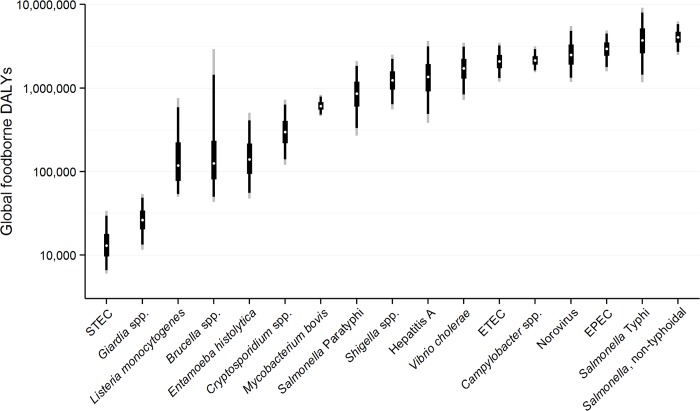
- Of foodborne DALYs, the largest burden came from nontyphoidal S. enterica if iNTS was included: 4.07 million DALYs (95% UI 2.49–6.27 million).
- Foodborne disease mortality and DALY rates were reported as highest in the African region, followed by the South East Asian region.
## Methods
- The study synthesized global and regional burden estimates for 22 foodborne diseases using the WHO FERG Enteric Diseases Task Force framework, combining literature reviews, systematic reviews, cohort studies, surveillance studies, expert consultation, and existing burden-of-disease assessments.
- The team estimated cases, sequelae, deaths, and DALYs for 2010, using pathogen-specific approaches: national estimates where available, a modified CHERG approach for diarrheal diseases in many countries, GBD 2010/IHME data for typhoid, paratyphoid, and hepatitis A, and expert elicitation to estimate the proportion transmitted by food.
- Uncertainty was propagated with Monte Carlo simulations using 10,000 draws per input parameter to generate 95% uncertainty intervals.
## Limitations
- The paper states that a major limitation was data gaps, especially in middle- and high-mortality countries, and that for many regions and pathogens the available data were sparse.
- It also states that only a few sequelae were included, with post-infectious sequelae such as reactive arthritis and irritable bowel syndrome excluded; stillbirths were excluded as well.
- The authors note that they could not fully account for age-specific effects for sequelae and could not separate some effects from comorbidities such as HIV infection.
- The text also makes evident, by its own description, that many estimates relied on expert elicitation for foodborne attribution and on assumptions/substitution where direct data were absent; this increases uncertainty and is part of the paper’s stated limitation.
Model-written summary. Check it against the paper before relying on it.
Integrity signals
Registry
Cites
Statistics
Figures
Verification
Claims the paper makes
3 Valid · 0 Not valid · 4 Not checked · 29 Own results and interpretations
The cited sources support only part of this claim — read each source’s verdict below.
In the paper
“Furthermore, global and regional estimates of the burden of foodborne diseases have not been available [1,2].”
§ World Health Organization Estimates of the Global and Regional Disease Burden of 22 Foodborne Bacterial, Protozoal, and Viral Diseases, 2010: A Data Synthesis > Introduction
What the sources say
- Partly supportedcites [1] Stein C, Kuchenmuller T, Hendrickx S, Prüss-Űstün A, Wolfson L, Engels D, et al The Global Burden of Disease assessments—WHO is responsible? PLoS Negl Trop Dis. 2007; 1: e161 10.1371/journal.pntd.0000161 18160984 PMC2154395 sourceExperimental — accuracy not yet measured
The Foodborne diseases section says that the full extent of the burden is unknown and that no precise, consistent global information existed at the time. It does not specifically address regional estimates, and its wording is narrower than saying no global estimates were available at all. No page number is provided in our copy. (LLM, conf=0.84)
- Not checked — no full text of the sourcecites [2] Tauxe RV, Doyle MP, Kuchenmuller T, Schlundt J, Stein CE. Evolving public health approaches to the global challenge of foodborne infections. Int J Food Microbiol. 2010; 139 Suppl 1: S16– 28. 10.1016/j.ijfoodmicro.2009.10.014 19931203 source
plain- Asserted: passes — The authors put it forward as true.
- Checkable: passes — It can be checked against evidence.
- Load-bearing: passes — The paper’s conclusions depend on it.
- Based: passes — The paper gives a reason why it holds.
- Partly supported
A result the paper reports from its own data — it cites no other source for it, so there is none to check. The quote shows it is in the paper.
In the paper
“Overall, 29% (95% UI 23–36%) of all 22 diseases were estimated to be transmitted by contaminated food equating to 582 million (95% UI 400–922 million) foodborne cases in 2010; 38% (95% UI 24–53%) in children <5 years of age.”
§ World Health Organization Estimates of the Global and Regional Disease Burden of 22 Foodborne Bacterial, Protozoal, and Viral Diseases, 2010: A Data Synthesis > Results > Cases
hedged- Asserted: passes — The authors put it forward as true.
- Checkable: passes — It can be checked against evidence.
- Load-bearing: passes — The paper’s conclusions depend on it.
- Based: passes — The paper gives a reason why it holds.
- Rests on an assumption not shown here.
A result the paper reports from its own data — it cites no other source for it, so there is none to check. The quote shows it is in the paper.
In the paper
“Among the 11 diarrheal diseases, the rate ratio of foodborne cases occurring among children <5 years of age compared to those ≥5 years of age was 6.44 (95%UI 3.15–12.46).”
§ World Health Organization Estimates of the Global and Regional Disease Burden of 22 Foodborne Bacterial, Protozoal, and Viral Diseases, 2010: A Data Synthesis > Results > Cases
plainstates an association- Asserted: passes — The authors put it forward as true.
- Checkable: passes — It can be checked against evidence.
- Load-bearing: unclear — It is unclear whether the paper’s conclusions depend on it.
- Based: passes — The paper gives a reason why it holds.
- Rests on 2 assumptions not shown here.
A result the paper reports from its own data — it cites no other source for it, so there is none to check. The quote shows it is in the paper.
In the paper
“Norovirus was the leading cause of foodborne illness causing 125 million (95% UI 70–251 million) cases, while Campylobacter spp. caused 96 million (95% UI 52–177 million) foodborne illnesses.”
§ World Health Organization Estimates of the Global and Regional Disease Burden of 22 Foodborne Bacterial, Protozoal, and Viral Diseases, 2010: A Data Synthesis > Abstract > Methods and Findings
plainstates a cause- Asserted: passes — The authors put it forward as true.
- Checkable: passes — It can be checked against evidence.
- Load-bearing: unclear — It is unclear whether the paper’s conclusions depend on it.
- Based: passes — The paper gives a reason why it holds.
In the paper
“The FERG estimate for DALYs for nontyphoidal S. enterica combining diarrheal and invasive infections was 4 times greater than GBD 2010 [54].”
§ World Health Organization Estimates of the Global and Regional Disease Burden of 22 Foodborne Bacterial, Protozoal, and Viral Diseases, 2010: A Data Synthesis > Discussion
What the sources say
- Not checked — no full text of the sourcecites [54] Murray CJ, Vos T, Lozano R, Naghavi M, Flaxman AD, Michaud C, et al Disability-adjusted life years (DALYs) for 291 diseases and injuries in 21 regions, 1990–2010: a systematic analysis for the Global Burden of Disease Study 2010. Lancet. 2012; 380: 2197– 2223. 10.1016/S0140-6736(12)61689-4 23245608 source
plain- Asserted: passes — The authors put it forward as true.
- Checkable: passes — It can be checked against evidence.
- Load-bearing: unclear — It is unclear whether the paper’s conclusions depend on it.
- Based: passes — The paper gives a reason why it holds.
16 more claims
Create a free account to see all 36 claims and to verify the 1 reference still open.
- Probably not a substantial claim. 11
- It may state two separate claims as one. 5
Claims other papers make about this one
Each is checked against this paper’s own text: does it say what the citing paper says it does?
The source backs part of the claim, not all of it — or backs it for a different population, condition or comparison.
In the citing paper
“Animal-based foods, like cow milk, can pose a risk for zoonotic enteric pathogen transmission42 although pasteurisation is an effective means for making milk safer.”
From Environmental and behavioural exposure pathways associated with diarrhoea and enteric pathogen detection in 5-month-old, periurban Kenyan infants: a cross-sectional study (2022) · cites this paper as [42]
Experimental — accuracy not yet measured
Citations
Cites
Lozano, R., Naghavi, M., Foreman, K., Lim, S., Shibuya, K., Aboyans, V., Abraham, J., Adair, T., Aggarwal, R., Ahn, S. Y., et al. (2012) · The Lancet · doi:10.1016/s0140-6736(12)61728-0 · Cited by 14,070 · cited 3×
“Twelve of the diseases included in our study were also included in the GBD 2010 study [25,26,54].”
Murray, C. J. L., Vos, T., Lozano, R., Naghavi, M., Flaxman, A. D., Michaud, C., Ezzati, M., Shibuya, K., Salomon, J. A., Abdalla, S., et al. (2012) · The Lancet · doi:10.1016/s0140-6736(12)61689-4 · Cited by 8,888
Foodborne illness acquired in the United States—Major pathogens
Scallan, E., Hoekstra, R. M., Angulo, F. J., Tauxe, R. V., Widdowson, M.-A., Roy, S. L., Jones, J. L., & Griffin, P. M. (2011) · Emerging Infectious Diseases · doi:10.3201/eid1701.p11101 · Cited by 7,657 · cited 1×
“Many different diseases, including those due to bacteria, viruses, parasites, chemicals, and prions, may be transmitted to humans by contaminated food [3].”
Self-citationSelected major risk factors and global and regional burden of disease
Ezzati, M., Lopez, A. D., Rodgers, A., Vander Hoorn, S., & Murray, C. J. (2002) · The Lancet · doi:10.1016/s0140-6736(02)11403-6 · Cited by 3,594
Kotloff, K. L., Nataro, J. P., Blackwelder, W. C., Nasrin, D., Farag, T. H., Panchalingam, S., Wu, Y., Sow, S. O., Sur, D., Breiman, R. F., et al. (2013) · The Lancet · doi:10.1016/s0140-6736(13)60844-2 · Cited by 3,560 · cited 1×
“This approach was facilitated by the availability of estimates of the envelope of diarrheal deaths, along with recent advances in diarrheal disease diagnosis, such as widespread application of polymerase chain reaction (PCR) for norovirus detection [20,49].”
The Global Burden of Nontyphoidal Salmonella Gastroenteritis
Majowicz, S. E., Musto, J., Scallan, E., Angulo, F. J., Kirk, M., O’Brien, S. J., Jones, T. F., Fazil, A., & Hoekstra, R. M. (2010) · Clinical Infectious Diseases · doi:10.1086/650733 · Cited by 2,442
Self-citationGlobal burden of childhood pneumonia and diarrhoea
Walker, C. L. F., Rudan, I., Liu, L., Nair, H., Theodoratou, E., Bhutta, Z. A., O'Brien, K. L., Campbell, H., & Black, R. E. (2013) · The Lancet · doi:10.1016/s0140-6736(13)60222-6 · Cited by 2,356 · cited 2×
“, “envelope” of diarrheal incidence) for 2010 by combining estimates of diarrheal incidence for children<5 years of age and persons 5 years of age [13,36].”
Self-citationThe global burden of typhoid fever.
Crump, J., Luby, S., & Mintz, E. (2004) · Bulletin of the World Health Organization · doi:10.1590/s0042-96862004000500008 · Cited by 2,172
Self-citationThe global burden of typhoid fever.
(2004) · Europe PMC (PubMed Central) · Cited by 1,965
Self-citationSalomon, J. A., Vos, T., Hogan, D. R., Gagnon, M., Naghavi, M., Mokdad, A., Begum, N., Shah, R., Karyana, M., Kosen, S., et al. (2012) · The Lancet · doi:10.1016/s0140-6736(12)61680-8 · Cited by 1,322 · cited 1×
“Disability weights for each clinical outcome for the enteric diseases were taken from the GBD 2010 study [47].”
Cited by
Items 501–600 of 1,631
Peng, H., Zhou, G., Yang, X., Chen, G.-J., Chen, H., Liao, Z., Zhong, Q., Wang, L., Fang, X., & Wang, J. (2022) · International Journal of Molecular Sciences · doi:10.3390/ijms232315159 · Cited by 30
Methodological choices in brucellosis burden of disease assessments: A systematic review
Bari, C. D., Venkateswaran, N., Bruce, M., Fastl, C., Huntington, B., Patterson, G. E., Rushton, J., Torgerson, P. R., Pigott, D. M., & Devleesschauwer, B. (2022) · PLoS neglected tropical diseases · doi:10.1371/journal.pntd.0010468 · Cited by 22
Self-citationCarmona‐Vicente, N., Vila-Vicent, S., Allen, D. J., et al. (2016) · Journal of Virology · doi:10.1128/jvi.01023-16 · Cited by 23
“ally as the main cause of associated foodborne diseases (8, 9).”
BackgroundAn Improved Culture Method for Selective Isolation of Campylobacter jejuni from Wastewater
Kim, J., Oh, E., Banting, G. S., Braithwaite, S. L., Chui, L., Ashbolt, N. J., Neumann, N. F., & Jeon, B. (2016) · Frontiers in Microbiology · doi:10.3389/fmicb.2016.01345 · Cited by 24
“Keywords: Campylobacter jejuni, wastewater, isolation, antibiotics, qRT-PCR INTRODUCTION Campylobacter is the major bacterial cause of foodborne infection, annually accounting for approximately 166 million foodborne illnesses around the world (Kirk et al., 2015).”
BackgroundGoodman, L. B., McDonough, P. L., Anderson, R. R., et al. (2017) · Journal of Veterinary Diagnostic Investigation · doi:10.1177/1040638717728315 · Cited by 23
“represent one of the leading causes of foodborne illness across all regions of the world.(13) A wide range of animals can be affected, including poultry and other birds, horses, cattle, pigs, sheep, goats, dogs, cats, and reptiles.”
BackgroundSalmonella-Mediated Inflammation Eliminates Competitors for Fructose-Asparagine in the Gut
Wu, J., Sabag-Daigle, A., Borton, M., Kop, L. F. M., Szkoda, B. E., Kaiser, B. L. D., Lindemann, S. R., Renslow, R. S., Wei, S., Nicora, C., et al. (2018) · Infection and Immunity · doi:10.1128/iai.00945-17 · Cited by 22
Yin, Y.-L., Zhang, H., Yuan, Y., et al. (2018) · Acta Tropica · doi:10.1016/j.actatropica.2018.03.013 · Cited by 23
Suzuki, H., Hosomi, K., Nasu, A., Kondoh, M., & Kunisawa, J. (2018) · Frontiers in Immunology · doi:10.3389/fimmu.2018.02320 · Cited by 25
Revised Global Typhoid Vaccination Policy
Bentsi-Enchill, A. D., & Hombach, J. (2018) · Clinical Infectious Diseases · doi:10.1093/cid/ciy927 · Cited by 21
Al‐Jawabreh, A., Ereqat, S., Dumaidi, K., et al. (2019) · BMC Public Health · doi:10.1186/s12889-019-8024-2 · Cited by 23
Meta-analysis of the prevalence of the main human pathogens in vegetables, with emphasis on lettuce
Barril, P. A., Oteiza, J. M., Pardo, J., et al. (2022) · Food Research International · doi:10.1016/j.foodres.2022.111727 · Cited by 22
Abidin, A. Z., Norrrahim, M. N. F., Shakrin, N. N. S. M., Ibrahim, B., Abdullah, N., Rashid, J. I. A., Kasim, N. A. M., & Shah, N. A. A. (2024) · Heliyon · doi:10.1016/j.heliyon.2024.e32010 · Cited by 30
Oliulla, H., Mizan, M. F. R., Ashrafudoulla, M., Meghla, N. S., Ha, A. J., Park, S. H., & Ha, S.-D. (2024) · Meat Science · doi:10.1016/j.meatsci.2024.109596 · Cited by 22
Ensuring egg safety: Salmonella survival, control, and virulence in the supply chain
Li, L., McWhorter, A. R., & Chousalkar, K. K. (2024) · Comprehensive Reviews in Food Science and Food Safety · doi:10.1111/1541-4337.70075 · Cited by 30
Zhuang, L., Gong, J., Ji, Y., Tian, P., Kong, F., Bai, H., Gu, N., & Zhang, Y. (2020) · The Analyst · doi:10.1039/c9an02011j · Cited by 22
Risk factors for sporadic campylobacteriosis: A systematic review and meta-analysis
Fravalo, P., Kooh, P., Mughini‐Gras, L., David, J., Thébault, A., Cadavez, V., & Gonzales‐Barron, U. A. (2020) · Microbial Risk Analysis · doi:10.1016/j.mran.2020.100118 · Cited by 26
“were responsible for 166 million (95% uncertainty interval (UI) 92,227,873– 300,877,905) cases of illness in 2010, 37,604 (95% UI 27,738–55,101) deaths and 3,733, 822 (95% UI 2,857,037–5,273,652) Disability Adjusted Life Years (DALYs) (Kirk et al., 2015) worldwide.”
Raghava, S., Mbae, K. M., & Umesha, S. (2020) · Saudi Journal of Biological Sciences · doi:10.1016/j.sjbs.2020.10.034 · Cited by 22
“The overall occurrence of human brucellosis is estimated to go beyond 800,000 cases annually, of which 40% leading to chronic infection (Kirk et al., 2015).”
BackgroundMaiti, S., Howlader, D. R., Halder, P., Bhaumik, U., Dutta, M., Dutta, S., & Koley, H. (2020) · Vaccine · doi:10.1016/j.vaccine.2020.11.040 · Cited by 23
Li, Y.-J., Yang, Y.-F., Zhou, Y., Zhang, R., Liu, C., Liu, H. D., Li, X., Chen, W., Chen, Y., & Wu, Y. (2022) · PLoS ONE · doi:10.1371/journal.pone.0277203 · Cited by 25
“Our estimate of foodborne shigellosis (67 cases/100,000 population) was higher when compared with the United Kingdom (27 cases/100,000 population) [25], Thailand (60 cases/ 100,000 population) [29], and lower compared with Jordan (306 cases/100,000 population) [12], African Region (523 cases/100,000 population), and E…”
BackgroundResultInfluentialMeta-analysis of the prevalence of Giardia duodenalis in sheep and goats in China
Geng, H.-L., Yan, W.-L., Wang, J., et al. (2023) · Microbial Pathogenesis · doi:10.1016/j.micpath.2023.106097 · Cited by 22
Systematic Review of Diagnostic Approaches for Human Giardiasis: Unveiling Optimal Strategies
Vicente, B., Freitas, A. D., Freitas, M., et al. (2024) · Diagnostics · doi:10.3390/diagnostics14040364 · Cited by 22
“Among the causes of intestinal diseases, Giardia is the protozoan most responsible for foodborne illnesses, making it a global concern due to its resulting morbidity and economic repercussions [5].”
BackgroundThe Impact of Oxygen on Bacterial Enteric Pathogens
Wallace, N., Zani, A., Abrams, E. A., & Sun, Y. (2016) · Advances in applied microbiology · doi:10.1016/bs.aambs.2016.04.002 · Cited by 27
Making sense of the cause of Crohn’s – a new look at an old disease
Segal, A. W. (2016) · F1000Research · doi:10.12688/f1000research.9699.2 · Cited by 25
Keddy, K. H., Takuva, S. G., Musekiwa, A., Puren, A. J., Sooka, A., Karstaedt, A., Klugman, K. P., & Angulo, F. J. (2017) · PLoS ONE · doi:10.1371/journal.pone.0173091 · Cited by 25
Self-citationFecal Contamination on Produce from Wholesale and Retail Food Markets in Dhaka, Bangladesh
Harris, A., Islam, M. A., UNICOMB, L. E., Boehm, A. B. B., Luby, S. P., Davis, J., & Pickering, A. J. (2017) · American Journal of Tropical Medicine and Hygiene · doi:10.4269/ajtmh.17-0255 · Cited by 22
“More than 25milliondisability-adjusted life years (DALYs)were attributed to foodborne pathogens globally in 2010.(3) Although surveillance systems in low-income countries struggle to capture high quality data, it is estimated that Africa andSoutheast Asia”
BackgroundWang, W., Baloch, Z., Zou, M., et al. (2018) · Frontiers in Microbiology · doi:10.3389/fmicb.2018.00616 · Cited by 22
“This bacterium is now the leading cause of global bacterial food poisoning out breaks and is associated with increased morbidity and mortality (Kirk et al., 2015).”
BackgroundFarm to fork quantitative microbial risk assessment for norovirus on frozen strawberries
Miranda, R., & Schaffner, D. W. (2018) · Microbial Risk Analysis · doi:10.1016/j.mran.2018.06.002 · Cited by 25
Elnekave, E., Hong, S. L., Lim, S., Hayer, S. S., Boxrud, D. J., Taylor, A., Lappi, V. R., Noyes, N. R., Johnson, T. J., Rovira, A., et al. (2019) · Antimicrobial Agents and Chemotherapy · doi:10.1128/aac.02602-18 · Cited by 25
Harb, A., O’Dea, M. A., Abraham, S., & Habib, I. (2019) · Pathogens · doi:10.3390/pathogens8020060 · Cited by 24
Culturable bacteria resident on lettuce might contribute to accumulation of human noroviruses
Liu, D., Zhang, Z., Liao, N., et al. (2019) · International Journal of Food Microbiology · doi:10.1016/j.ijfoodmicro.2019.108492 · Cited by 22
Zhang, H., Liu, D., Zhang, Z., et al. (2020) · Food Control · doi:10.1016/j.foodcont.2020.107649 · Cited by 22
Brusa, V., Costa, M., Padola, N. L., Etcheverría, A. I., Sampedro, F., Escámez, P. S. F., Leotta, G. A., & Signorini, M. L. (2020) · PLoS ONE · doi:10.1371/journal.pone.0242317 · Cited by 22
“5 million new STEC annual cases from different sources, including foodborne, have been reported globally, which have been responsible for 3,330 HUS cases, 269 deaths and 27,000 disability-adjusted life years [3].”
BackgroundWhen a Stomach Bug Comes Calling
Szewczak, L. (2016) · Cell · doi:10.1016/j.cell.2016.09.019 · Cited by 21
Identification of Bacterial Species That Can Utilize Fructose-Asparagine
Sabag-Daigle, A., Wu, J., Borton, M., Sengupta, A., Gopalan, V., Wrighton, K. C., Wysocki, V. H., & Ahmer, B. M. M. (2017) · Applied and Environmental Microbiology · doi:10.1128/aem.01957-17 · Cited by 21
“Introduction 52 Salmonella enterica is a major contributor to human morbidity and mortality (1-8).”
BackgroundOvercoming the dependent variable problem in studying food policy
Candel, J., & Daugbjerg, C. (2019) · Food Security · doi:10.1007/s12571-019-00991-2 · Cited by 28
Yao, H., Zhao, W., Jiao, D., Schwarz, Š., Zhang, R., Li, X., & Du, X. (2020) · Journal of Antimicrobial Chemotherapy · doi:10.1093/jac/dkaa483 · Cited by 25
Ou, A., Wang, K., Ye, Y., et al. (2021) · Frontiers in Microbiology · doi:10.3389/fmicb.2021.634555 · Cited by 21
“Recently, CPA assays have been used for the detection of E. coli O157:H7, Listeria monocytogenes, Enterobacter sakazakii, Yersinia enterocolitica, and other pathogens (Wang et al., 2014; Zhang et al., 2015; Wang et al., 2018; Xu et al., 2020).”
BackgroundWallace, R. L., Cribb, D. M., Bulach, D., Ingle, D. J., Joensen, K., Nielsen, E. M., Leekitcharoenphon, P., Stingl, K., & Kirk, M. (2021) · Zoonoses and Public Health · doi:10.1111/zph.12853 · Cited by 20
Self-citationIsolation and Identification of Escherichia coli O157:H7 Lytic Bacteriophage from Environment Sewage
Sjahriani, T., Wasito, E. B., & Tyasningsih, W. (2021) · International Journal of Food Science · doi:10.1155/2021/7383121 · Cited by 21
“Shiga toxin producing E. coli causes more than 2.5 million diseases worldwide each year, resulting 269 deaths [11].”
BackgroundInfluentialHost prediction for disease-associated gastrointestinal cressdnaviruses
Kinsella, C. M., Deijs, M., Becker, C., Haaften, P. E. B.-V., van Gool, T., Bart, A., Schäefer, A. S., & van der Hoek, L. (2022) · Virus Evolution · doi:10.1093/ve/veac087 · Cited by 23
Soubeiga, A. P., Kpoda, D. S., Compaoré, M. K. A., Somda, A. B., Kaseko, N., Rouamba, S. S., Ouedraogo, S., Traoré, R., Karfo, P., NEZIEN, D., et al. (2022) · International Journal of Microbiology · doi:10.1155/2022/9640828 · Cited by 29
“According to a recent report, 1 in 10 people become ill from consuming contaminated food, with 420,000 deaths yearly [1].”
BackgroundSaaS sRNA promotes Salmonella intestinal invasion via modulating MAPK inflammatory pathway
Cai, L., Xie, Y., Shao, L., Hu, H., Xu, X., Wang, H., & Zhou, G. (2023) · Gut Microbes · doi:10.1080/19490976.2023.2211184 · Cited by 23
“The terms on which this article has been published allow the posting of the Accepted Manuscript in a repository by the author(s) or with their consent. diseases like bacteremia and meningitis can be observed.3 This wide range of clinical pictures makes Salmonella a continuous threat that leads to high disease burden a…”
BackgroundImpact of food and water-borne diseases on European population health
Cassini, A., Colzani, E., Kramarz, P., Kretzschmar, M., & Takkinen, J. (2016) · Current Opinion in Food Science · doi:10.1016/j.cofs.2016.06.002 · Cited by 26
Hobbs, E. C., Mwape, K. E., Devleesschauwer, B., Damme, I. V., Krit, M., Berkvens, D. L., Zulu, G., Mambwe, M., Chembensofu, M., Trevisan, C., et al. (2019) · PLoS neglected tropical diseases · doi:10.1371/journal.pntd.0007336 · Cited by 20
Self-citationPeptidoglycan reshaping by a noncanonical peptidase for helical cell shape in Campylobacter jejuni
Min, K., An, D. R., Yoon, H., Rana, N., Park, J. S., Kim, J., Lee, M., Hesek, D., Ryu, S., Kim, B. M., et al. (2020) · Nature Communications · doi:10.1038/s41467-019-13934-4 · Cited by 20
Liver virome of healthy pigs reveals diverse small ssDNA viral genomes
Silva, M. S. D., Budaszewski, R. F., Weber, M. N., et al. (2020) · Infection Genetics and Evolution · doi:10.1016/j.meegid.2020.104203 · Cited by 21
Derrick, J., Hollinghurst, P., O’Brien, S. J., Elviss, N. C., Allen, D. J., & Iturriza‐Gómara, M. (2021) · International Journal of Food Microbiology · doi:10.1016/j.ijfoodmicro.2021.109151 · Cited by 24
Wu, X., Ning, C., Key, F. M., Valtueña, A. A., Lankapalli, A. K., Gao, S., Xuan, Y., Zhang, F., Liu, L., Nie, Z., et al. (2021) · PLoS Pathogens · doi:10.1371/journal.ppat.1009886 · Cited by 24
“On a global scale, at least 170 million cases of salmonellosis occur each year, resulting in up to 1 million deaths [2,3].”
Salmonella Outer Protein B Suppresses Colitis Development via Protecting Cell From Necroptosis
Hu, G., Yang, Y., Qin, X., Qi, S., Zhang, J., Yu, S.-X., Du, C., & Chen, W. (2019) · Frontiers in Cellular and Infection Microbiology · doi:10.3389/fcimb.2019.00087 · Cited by 23
“Salmonella enterica is a leading cause of enteric disease in human and animals that is capable of causing a wide range of illnesses ranging from a localized gastroenteritis and lymphadenitis resulting in diarrhea to life-threatening systemic infections (Kirk et al., 2015).”
BackgroundXu, G., Zhou, J., Liu, K., Wang, Y., Tsikari, T., Fang, Q., van den Hil, F. E., Boor, P. P. C., Ayada, I., de Vries, A. C., et al. (2025) · Nature Communications · doi:10.1038/s41467-025-59639-9 · Cited by 27
Han, M., Xiao, S., An, W., Sang, C., Li, H., Ma, J., & Yang, M. (2020) · Water Research · doi:10.1016/j.watres.2020.115698 · Cited by 20
Sindi, A., Badsha, M. B., Nielsen, B. D., & Ünlü, G. (2020) · Microorganisms · doi:10.3390/microorganisms8060849 · Cited by 25
Balta, I., Marcu, A., Linton, M., Kelly, C., Gundogdu, O., Ştef, L., Peț, I., Ward, P., Deshaies, M., Callaway, T. R., et al. (2021) · Gut Pathogens · doi:10.1186/s13099-021-00433-5 · Cited by 20
Osaili, T. M. I., Saeed, B. Q., Taha, S., Adrees, A. O., & Hasan, F. (2022) · Foods · doi:10.3390/foods11030290 · Cited by 27
“Considering their substantial impact, countries all over the world are making great efforts to reduce the impact of foodborne outbreaks [7].”
BackgroundCreutznacher, R., Maaß, T., Dülfer, J., Feldmann, C., Hartmann, V., Lane, M. S., Knickmann, J., Westermann, L. T., Thiede, L., Smith, T. J., et al. (2022) · Communications Biology · doi:10.1038/s42003-022-03497-4 · Cited by 21
“5 4 cooperativity 5 P-domain states (1-5) KD1, GCDCA KD2, GCDCA 3 mM 60 nM + GCDCA + KD, Dimer 1 1 2 2 + GCDCA”
BackgroundInfluentialKong, J., Fan, C., Liao, X., Chen, A., Yang, S., Zhao, L., & Li, H. (2022) · LWT · doi:10.1016/j.lwt.2022.113913 · Cited by 20
Plumb, I. D., Brown, A. C., Stokes, E. K., et al. (2023) · Emerging infectious diseases · doi:10.3201/eid2902.220950 · Cited by 20
“Compared with 4,[5] 4,[5],12:i:- outbreaks with PFGE patterns found in the MDR clade were more likely to be linked to consumption of pork or contact with swine (64% [16/25] vs. 11% [1/9]; p = 0.007) (Table 3).”
BackgroundInfluentialRipon, R. K., Motahara, U., Ahmed, A., Devnath, N., Mahua, F. A., Hashem, R. B., Ishadi, K. S., Alam, A., Sujan, M. S. H., & Sarker, M. S. (2023) · JAC-Antimicrobial Resistance · doi:10.1093/jacamr/dlad059 · Cited by 25
Vaccine value profile for invasive non-typhoidal Salmonella disease
Martin, L. B., Tack, B., Marchello, C. S., Sikorski, M. J., Owusu‐Dabo, E., Nyirenda, T. S., Mogasale, V., & Crump, J. A. (2024) · Vaccine · doi:10.1016/j.vaccine.2024.04.045 · Cited by 26
Self-citationBurkholder, K. M., Fletcher, D. H., Gileau, L., & Kandolo, A. (2019) · Pathogens and Disease · doi:10.1093/femspd/ftz025 · Cited by 23
Kim, J., Shin, H., Park, H., et al. (2019) · Frontiers in Microbiology · doi:10.3389/fmicb.2019.01381 · Cited by 20
Anderson, D. M., Kumar, V. R., Arper, D. L., Kruger, E., Bilir, S. P., & Richardson, J. S. (2019) · PLoS ONE · doi:10.1371/journal.pone.0224700 · Cited by 22
“The World Health Organization (WHO) considers botulism one of the most important foodborne illnesses globally [28] and views outbreaks as public health emergencies [3].”
BackgroundHutter, J. A., Dion, R., Irace‐Cima, A., Fiset, M., Guy, R. A., Dixon, B. R., Aguilar, J. L., Trépanier, J., & Thivierge, K. (2020) · PLoS ONE · doi:10.1371/journal.pone.0228986 · Cited by 22
“are among the most frequently reported pathogenic enteric protozoans in North America and elsewhere in the world [1].”
BackgroundQi, Y., Zhao, W., Wang, T., Pei, F., Yue, M., Feng, L., Liu, X., Wang, X., & Li, H. (2020) · Applied Microbiology and Biotechnology · doi:10.1007/s00253-020-10390-9 · Cited by 23
Chen, J., Karanth, S., & Pradhan, A. K. (2020) · Journal of Agriculture and Food Research · doi:10.1016/j.jafr.2020.100045 · Cited by 21
Varga, C., John, P., Cooke, M. J., & Majowicz, S. E. (2020) · PLoS ONE · doi:10.1371/journal.pone.0235291 · Cited by 21
Li, Y., Huang, T., Bai, C., et al. (2020) · Frontiers in Microbiology · doi:10.3389/fmicb.2020.01859 · Cited by 20
Parmar, N., Burrows, K., Vornewald, P. M., Lindholm, H. T., Zwiggelaar, R. T., Díez-Sánchez, A., Martín-Alonso, M., Fosslie, M., Vallance, B. A., Dahl, J. A., et al. (2021) · PLoS Pathogens · doi:10.1371/journal.ppat.1009476 · Cited by 22
“Gastrointestinal infections remain one of the most common causes for hospitalization worldwide [1].”
BackgroundFreedman, S. B., Xie, J., Lee, B. E., Ali, S., Pang, X.-L., Chui, L., Zhuo, R., Vanderkooi, O. G., Tellier, R., Funk, A. L., et al. (2021) · Clinical Infectious Diseases · doi:10.1093/cid/ciab451 · Cited by 24
Human brucellosis in the Emirate of Abu Dhabi, United Arab Emirates, 2010–2015
Shehhi, N. A., Aziz, F., Hosani, F. I. A., et al. (2016) · BMC Infectious Diseases · doi:10.1186/s12879-016-1900-9 · Cited by 20
Lee, S., Noh, T. G., Choi, J. H., Han, J.-S., Ha, J. Y., Lee, J. Y., & Park, Y. (2017) · Proceedings of SPIE, the International Society for Optical Engineering/Proceedings of SPIE · doi:10.1117/12.2261803 · Cited by 22
de Freitas, R. S. G., da Cunha, D. T., & Stedefeldt, E. (2020) · Risk Analysis · doi:10.1111/risa.13453 · Cited by 20
Baker, K. K., Mumma, J. A. O., Simiyu, S., Sewell, D., Tsai, K., Anderson, J. D., MacDougall, A., Dreibelbis, R., & Cumming, O. (2022) · BMJ Open · doi:10.1136/bmjopen-2021-059878 · Cited by 19
Ndendya, J. Z., Mwasunda, J. A., & Shaban, N. (2025) · Modeling Earth Systems and Environment · doi:10.1007/s40808-025-02326-x · Cited by 19
“Implementing these techniques is critical for limiting the impact of norovirus infections and reducing the frequency and intensity of outbreaks (Kirk et al. 2015).”
Hatam‐Nahavandi, K., Ahmadpour, E., Badri, M., Eslahi, A. V., Anvari, D., Carmena, D., & Xiao, L. (2025) · PLoS neglected tropical diseases · doi:10.1371/journal.pntd.0013021 · Cited by 31
AbdelMoula, S., Sorour, M. T., & Aly, S. A. (2021) · Sustainability · doi:10.3390/su132313125 · Cited by 19
Bai, X., Xu, L., Singh, A. K., Qiu, X., Liu, M., Abu-Zeid, A. S. I., El-Khateib, T., & Bhunia, A. K. (2022) · Foods · doi:10.3390/foods11040569 · Cited by 28
“Globally, foodborne pathogens are responsible for two billion illnesses and over one million deaths annually [1], while in the US, about 48 million illnesses, 128,000 hospitalizations, and 3000 deaths happen annually with an estimated economic burden of about 78 billion dollars [2,3].”
BackgroundChlorine Induces Physiological and Morphological Changes on Chicken Meat Campylobacter Isolates
Weerasooriya, G., McWhorter, A. R., & Chousalkar, K. K. (2020) · Frontiers in Microbiology · doi:10.3389/fmicb.2020.00503 · Cited by 19
Fingerprinting of human noroviruses co-infections in a possible foodborne outbreak by metagenomics
Liu, D., Zhang, Z., Li, S., Wu, Q., Tian, P., Zhang, Z., & Wang, D. (2020) · International Journal of Food Microbiology · doi:10.1016/j.ijfoodmicro.2020.108787 · Cited by 20
Stalujanis, E., Neufeld, J., Stalder, M. G., Belardi, A., Tegethoff, M., & Meinlschmidt, G. (2020) · JMIR mhealth and uhealth · doi:10.2196/20329 · Cited by 21
Norovirus-Specific CD8+ T Cell Responses in Human Blood and Tissues
Pattekar, A., Mayer, L., Lau, C. W., Liu, C., Palko, O., Bewtra, M., Lindesmith, L. C., Brewer-Jensen, P. D., Baric, R. S., Betts, M. R., et al. (2021) · Cellular and Molecular Gastroenterology and Hepatology · doi:10.1016/j.jcmgh.2020.12.012 · Cited by 23
The Viral Janus: Viruses as Aetiological Agents and Treatment Options in Colorectal Cancer
Turkington, C. J. R., Varadan, A. C., Grenier, S. F., & Grasis, J. A. (2021) · Frontiers in Cellular and Infection Microbiology · doi:10.3389/fcimb.2020.601573 · Cited by 20
“Norovirus, for instance, is the leading cause of foodborne gastroenteritis worldwide (Kirk et al., 2015).”
BackgroundRahman, M. A., Paul, P. R., Hoque, N., Islam, S. S., Haque, A. K. M. Z., Sikder, M. H., Matin, A., Yamasaki, S., & Kabir, S. M. L. (2021) · BioMed Research International · doi:10.1155/2021/9229485 · Cited by 21
Khan, A. U., Melzer, F., El-Soally, S. A. G. E., et al. (2019) · Pathogens · doi:10.3390/pathogens8040248 · Cited by 19
“The disease is well controlled in developed countries but is still endemic in many others with the highest records in humans in Middle East and Central Asian regions [3].”
BackgroundRocha, M. D., Chaves, R. D., Freire, L., Pia, A. K. R., Furtado, M. M., Alvarenga, V. O., Crucello, A., Lopes, L. D. S., Santos, A. F. D. M., Rodrigues, D. P., et al. (2022) · International Journal of Food Microbiology · doi:10.1016/j.ijfoodmicro.2022.109695 · Cited by 20
Kowalska, J., Maćkiw, E., Korsak, D., & Postupolski, J. (2024) · Foods · doi:10.3390/foods13203266 · Cited by 18
“According to World Health Organization data, B. cereus s. l. is recognized as a foodborne pathogen, estimated to cause approximately 256,775 cases of foodborne illnesses worldwide each year [31].”
BackgroundDushayeva, L. Z. (2025) · Veterinary World · doi:10.14202/vetworld.2025.3288-3305 · Cited by 28
“Ampicillin-and tetracycline-resistant strains often display superior biofilm-forming capacity [56], with fimbriae-mediated adhesion enhancing resistance and colonization potential, particularly in ESBL-producing isolates [57].”
Zhou, H.-L., Bessey, T. K., Wang, S., et al. (2021) · Gut Pathogens · doi:10.1186/s13099-021-00428-2 · Cited by 18
“However, surveillance for bacterial pathogens must continue, since these bacteria are all foodborne pathogens and can rapidly cause large-scale outbreaks in certain circumstances [24].”
BackgroundIdentification and bioinformatic analysis of invA gene of Salmonella in free range chicken
Mohammed, B. (2022) · Brazilian Journal of Biology · doi:10.1590/1519-6984.263363 · Cited by 23
Sugar-Phosphate Toxicities Attenuate Salmonella Fitness in the Gut
Boulanger, E. F., Sabag-Daigle, A., Baniasad, M., Kokkinias, K., Schwieters, A., Wrighton, K. C., Wysocki, V. H., & Ahmer, B. M. M. (2022) · Journal of Bacteriology · doi:10.1128/jb.00344-22 · Cited by 18
Iwata, T., Watanabe-Yanai, A., Tamamura-Andoh, Y., et al. (2023) · Applied and Environmental Microbiology · doi:10.1128/aem.01701-22 · Cited by 18
“The World Health Organization (WHO) estimated that more than 95 million cases of foodborne illness caused by Campylobacter species occurred worldwide in 2010 (1).”
BackgroundCruz, E., Haeberle, A. L., Westerman, T. L., Durham, M. E., Suyemoto, M. M., Knodler, L. A., & Elfenbein, J. R. (2023) · Infection and Immunity · doi:10.1128/iai.00578-22 · Cited by 21
“Where indicated, the number of generations was determined after 4 h of growth using the following equation: [log10(CFU4h) 2 log10(CFU0h)]/[log10(2)].”
BackgroundMethodTian, C., Yuan, M., Tao, Q., Xu, T., Liu, J., Huang, Z., Wu, Q., Pan, Y., Zhao, Y., & Zhang, Z. (2023) · Antibiotics · doi:10.3390/antibiotics12040638 · Cited by 20
“An estimated 33,110 people die each year in the European Union from antibiotic-resistant infections [6].”
BackgroundFecal Microbial Structure and Metabolic Profile in Post-Weaning Diarrheic Piglets
Zheng, X., Nie, K., Xu, Y., Zhang, H., Xie, F., Xu, L., Zhang, Z., Ding, Y., Yin, Z., & Zhang, X. (2023) · Genes · doi:10.3390/genes14061166 · Cited by 21
“Campylobacter, a highly prevalent commensal bacteria in mammals, is recognized as the most common cause of acute food-borne bacterial diarrhea in humans, and Campylobacter jejuni and Campylobacter coli are responsible for ~85% and ~15% of cases, respectively [35,36].”
BackgroundGu, S.-Y., Chen, F., Zhang, C.-S., Zhou, Y., Li, T., Qiang, N., Zhang, X., Liu, J.-S., Wang, S., Yang, X.-C., et al. (2023) · Infectious Diseases of Poverty · doi:10.1186/s40249-023-01135-7 · Cited by 23
Wang, L., Lv, H., Zhang, X., Zhang, X., Bai, J., You, S., Li, X., Wang, Y., Du, J., Su, Y., et al. (2023) · Heliyon · doi:10.1016/j.heliyon.2023.e23479 · Cited by 18
“According to the strategic target set by the WHO, the number of people with HIV dying from TB, hepatitis B, and hepatitis C should be controlled to 55,000 by 2030 [33], however, the target is exceeded by HIV-TB co-infection alone according to our projections.”
BackgroundEscherichia coli pathotypes and Shigella sero-groups in diarrheic children in Nairobi city, Kenya.
Nyanga, P. L., Onyuka, J., Webale, M. K., Were, T., & Budambula, V. (2017) · Gastroenterology and hepatology from bed to bench. · Cited by 25
Selected Viruses Detected on and in our Food
Bachofen, C. (2018) · Current Clinical Microbiology Reports · doi:10.1007/s40588-018-0087-9 · Cited by 20
An outbreak of norovirus infection caused by ice cubes and a leaking air ventilation valve
Jalava, K., Kauppinen, A., Al‐Hello, H., et al. (2018) · Epidemiology and Infection · doi:10.1017/s095026881800314x · Cited by 18
Characteristics of Campylobacter Gastroenteritis Outbreaks in Australia, 2001 to 2016
Moffatt, C. R. M., Fearnley, E., Bell, R., Wright, R., Gregory, J., Sloan-Gardner, T., Kirk, M., & Stafford, R. J. (2019) · Foodborne Pathogens and Disease · doi:10.1089/fpd.2019.2731 · Cited by 18
“C are an important cause of gastro-enteritis and responsible for an annual global estimate of 96 million (95% UI 52–177 million) cases of foodborne infection (Kirk et al. , 2015).”
Self-citation
Metadata
- Authors
- Kirk, M. D., Pires, S. M., Black, R. E., Caipo, M., Crump, J. A., Devleesschauwer, B., Döpfer, D., Fazil, A., Fischer-Walker, C. L., Hald, T., Hall, A. J., Keddy, K. H., Lake, R. J., Lanata, C. F., Torgerson, P. R., Havelaar, A. H., & Angulo, F. J.
- Affiliations
- Australian National University (AU)
- Technical University of Denmark (DK)
- Johns Hopkins University (US)
- Food and Agriculture Organization of the United Nations (IT)
- University of Otago (NZ)
- Ghent University (BE)
- University of Wisconsin–Madison (US)
- Public Health Agency of Canada (CA)
- Centers for Disease Control and Prevention (US)
- University of the Witwatersrand (ZA)
- New Zealand Institute for Public Health and Forensic Science (NZ)
- Instituto de Investigación Nutricional (PE)
- University of Zurich (CH)
- Utrecht University (NL)
- Corresponding author
- Kirk, Martyn D.
- ORCID
- Venue
- PLoS Medicine
- Publisher
- Public Library of Science (PLoS)
- Published
- 2015-12-03
- Volume
- 12
- Issue
- 12
- Pages
- e1001921
- ISSN
- 1549-1277 (ISSN-L)
- 1549-1676
- PMC
- PMC4668831
- OpenAlex
- W2184405267
- Cited by
- 1,625
- References
- 58
- Citations by year
- 2026: 76 · 2025: 120 · 2024: 172 · 2023: 189 · 2022: 168 · 2021: 202 · 2020: 237 · 2019: 158 · 2018: 130 · 2017: 107 · 2016: 60 · 2015: 5
- FWCI
- 12.61
- Type
- journal article
- Language
- en
- Update notices
- correction (2015-12-23)
- Open access
- gold
- doi.org
- Licence
- Locations
- PLoS Medicine (publishedVersion, cc-by)
- Europe PMC (PubMed Central) (publishedVersion, cc-by)
- PubMed Central (publishedVersion, cc-by)
- PubMed (publishedVersion)
- IHI Repository (acceptedVersion)
- Zurich Open Repository and Archive (University of Zurich) (acceptedVersion, cc-by)
- Ghent University Academic Bibliography (Ghent University) (submittedVersion, other-oa)
- DOAJ (DOAJ: Directory of Open Access Journals) (submittedVersion, cc-by-sa)
- Utrecht University Repository (Utrecht University) (submittedVersion, other-oa)
- Figshare (submittedVersion, cc-by)
- ANU Open Research (Australian National University) (submittedVersion)
- Technical University of Denmark, DTU Orbit (Technical University of Denmark, DTU) (submittedVersion, other-oa)
- Rivm (National Institute for Public Health and the Environment) (submittedVersion)
- Zurich Open Repository and Archive (University of Zurich) (submittedVersion, cc-by)
- Zurich Open Repository and Archive (University of Zurich)
- Funders
- Bill and Melinda Gates Foundation
- World Health Organization
- Institute for Health Metrics and Evaluation
- Topics
- Life Sciences › Agricultural and Biological Sciences › Food Science › Salmonella and Campylobacter epidemiology
- Life Sciences › Agricultural and Biological Sciences › Food Science › Food Safety and Hygiene
- Health Sciences › Medicine › Infectious Diseases › Viral gastroenteritis research and epidemiology
- Keywords
- food poisoning, disease burden, disability-adjusted life years, norovirus, Campylobacter, Salmonella, Escherichia coli, Vibrio cholerae, Mycobacterium bovis, invasive non-typhoidal Salmonella, food contamination, diarrheal disease, foodborne parasitic infection
- MeSH terms
- Foodborne Diseases, Humans, Global Health, World Health Organization, Incidence, Prevalence, Cost of Illness, Quality-Adjusted Life Years
About these checks
Registry, retraction, Cites and statistics results are computed, not judged, with one exception: a printed reference that no index lists is read once by a model before it counts as a citation error. Claims are extracted by a model and kept only when their quote appears verbatim in the text; each cited source is then checked, with a model’s help, for whether it says what the claim relies on. Those verdicts can be wrong — read the claim’s quote and the cited source before relying on one.
The claim verdicts this report counts are experimental: their accuracy is not yet measured.
A language model drew the claims from the paper on 2026-10-10, under version 3 of the claim definition (model deepseek-v4.1-flash, prompt extract-v3).
A second model labelled each claim on 2026-10-10 (model jev-1.13-20260917, definition revision gold-guideline-v0.2).
Cited sources are checked with a language model’s help (gpt-6-sol).
Statistics and arithmetic are recomputed, not judged.
Confidence bands are shown only for fields calibrated on our annotated test set. None is calibrated yet, so no band is shown.
What counts as a claim ›How we measure confidence ›How we check this ›
Are you an author, or do you see a problem with this page? Request a review
Data sources
Bibliographic data: Semantic Scholar, OpenAlex, Crossref.
Contains information from the Semantic Scholar Academic Graph Datasets, made available under the ODC Attribution License (ODC-BY 1.0).
Semantic Scholar’s data is described in: Kinney, R., et al. (2023). The Semantic Scholar Open Data Platform. arXiv:2301.10140.
