

The DOI matches its Crossref record; 81 of the 81 references it cites were found in a registry or an index.
Desire and dread from the nucleus accumbens: cortical glutamate and subcortical GABA differentially generate motivation and hedonic impact in the rat.
Open accessAbstract
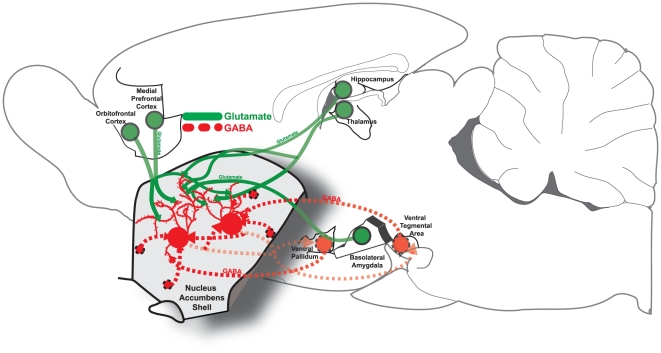
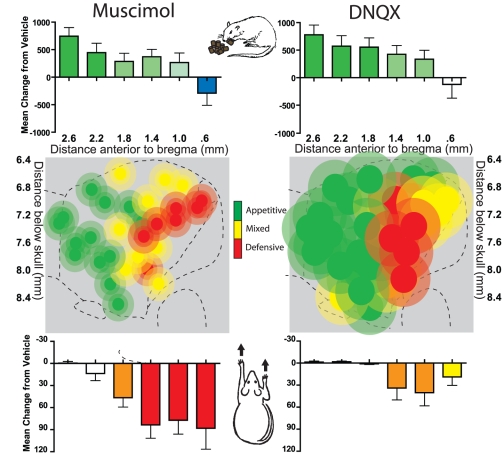
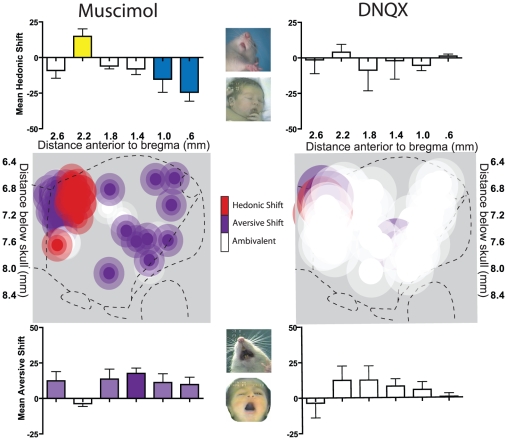
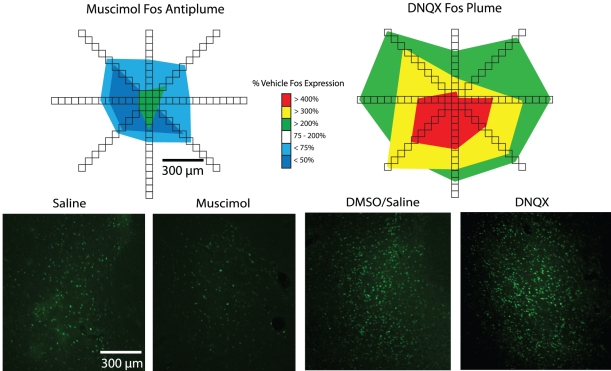
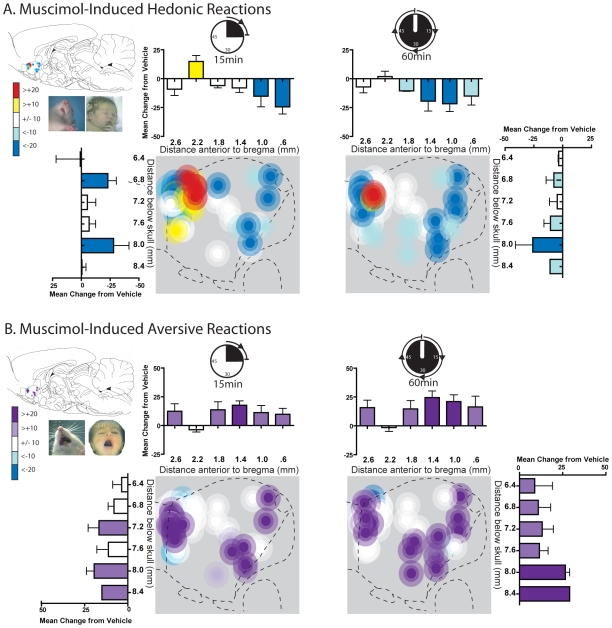
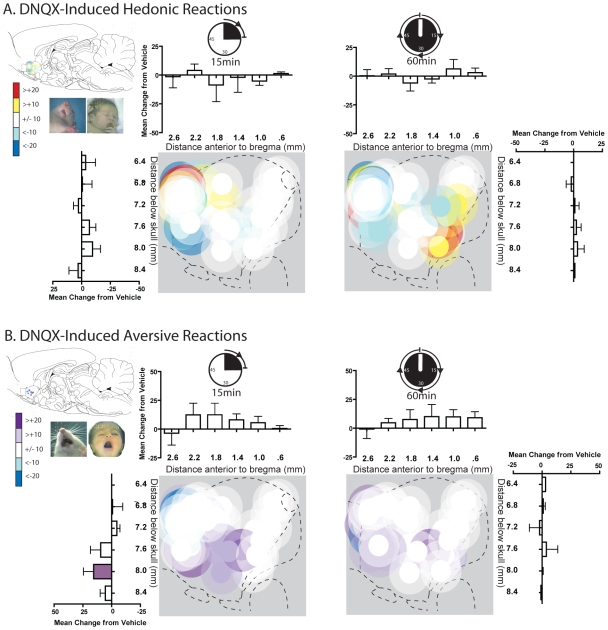
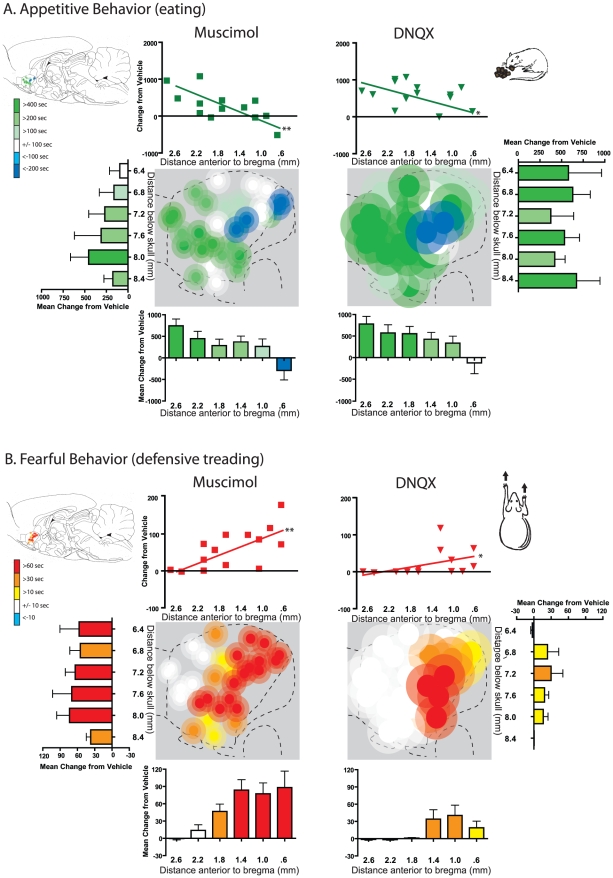
BACKGROUND: GABAergic signals to the nucleus accumbens (NAc) shell arise from predominantly subcortical sources whereas glutamatergic signals arise mainly from cortical-related sources. Here we contrasted GABAergic and glutamatergic generation of hedonics versus motivation processes, as a proxy for comparing subcortical and cortical controls of emotion. Local disruptions of either signals in medial shell of NAc generate intense motivated behaviors corresponding to desire and/or dread, along a rostrocaudal gradient. GABA or glutamate disruptions in rostral shell generate appetitive motivation whereas disruptions in caudal shell elicit fearful motivation. However, GABA and glutamate signals in NAc differ in important ways, despite the similarity of their rostrocaudal motivation gradients. METHODOLOGY/PRINCIPAL FINDINGS: Microinjections of a GABA(A) agonist (muscimol), or of a glutamate AMPA antagonist (DNQX) in medial shell of rats were assessed for generation of hedonic "liking" or "disliking" by measuring orofacial affective reactions to sucrose-quinine taste. Motivation generation was independently assessed measuring effects on eating versus natural defensive behaviors. For GABAergic microinjections, we found that the desire-dread motivation gradient was mirrored by an equivalent hedonic gradient that amplified affective taste "liking" (at rostral sites) versus "disliking" (at caudal sites). However, manipulation of glutamatergic signals completely failed to alter pleasure-displeasure reactions to sensory hedonic impact, despite producing a strong rostrocaudal gradient of motivation. CONCLUSIONS/SIGNIFICANCE: We conclude that the nucleus accumbens contains two functional affective keyboards for amino-acid signals: a motivation-generating keyboard and a hedonic-generating keyboard. Corticolimbic glutamate signals and subcortical GABA signals equivalently engage the motivation keyboard to generate desire and-or dread. Only subcortical GABA signals additionally engage the hedonic keyboard to amplify affective "liking" and "disliking" reactions. We thus suggest that top-down cortical glutamate signals powerfully regulate motivation components, but are relatively unable to penetrate core hedonic components of emotion. That may carry implications of limits to therapeutic regulation of pathological emotions.
Overview
The claims and statistics of this paper haven’t been checked yet.
Run the check — free, no account needed. It reads the open-access text and checks the sources it cites.
Integrity signals
Registry
Cites
Statistics
Figures
Verification
Claims the paper makes
The claims and statistics of this paper haven’t been checked yet.
Run the check — free, no account needed. It reads the open-access text and checks the sources it cites.
Claims other papers make about this one
Each is checked against this paper’s own text: does it say what the citing paper says it does?
In the citing paper
“However, neural mechanisms that generate ‘disgust’ and ‘fear’ reactions are mostly distinct, though they do partly overlap in the posterior shell of nucleus accumbens (Faure et al., 2010; Maren et al., 2013; Ho and Berridge, 2014; Perusini and Fanselow, 2015; Paré and Quirk, 2017).”
From Evolving Concepts of Emotion and Motivation (2018) · cites this paper as Faure et al., 2010
In the citing paper
“In this GABA-related mode, the normally ‘liked’ taste of sucrose instead elicits ‘disgust’ gapes and headshakes from rats, as though the taste were bitter quinine.”
From Evolving Concepts of Emotion and Motivation (2018) · cites this paper as Faure et al., 2010
In the citing paper
“Yet our animal brain-manipulation studies show one interesting overlap in neural generators for intense ‘disgust’ and ‘fear’ reactions in nucleus accumbens, involving a shift in neural mode of function at the same brain location.”
From Evolving Concepts of Emotion and Motivation (2018) · cites this paper as Faure et al., 2010
In the citing paper
“This ‘disgust-plus-fear’ mode is produced when the posterior shell zone receives microinjections of a drug that activates GABA receptors, such as muscimol (Faure et al., 2010; Ho and Berridge, 2014).”
From Evolving Concepts of Emotion and Motivation (2018) · cites this paper as Faure et al., 2010
In the citing paper
“The posterior portion of its medial shell has two ‘fear’ generating neurochemical modes (glutamate AMPA receptor blockade versus GABA receptor activation), and only the GABA mode also generates excessive ‘disgust’.”
From Evolving Concepts of Emotion and Motivation (2018) · cites this paper as Faure et al., 2010
Self-check
Percentages, sums and reported differences re-computed from the paper’s own numbers.
The self-check needs the paper’s full text.
Citations
Cites
The Rat Brain in Stereotaxic Coordinates
Paxinos, G., & Watson, C. (1983) · Elsevier eBooks · doi:10.1016/c2009-0-63235-9 · Cited by 28,585
Core affect and the psychological construction of emotion.
Russell, J. A. (2003) · Psychological Review · doi:10.1037/0033-295x.110.1.145 · Cited by 6,113
AChE-stained horizontal sections of the rat brain in stereotaxic coordinates
Paxinos, G., WATSON, C. R. R., & Emson, P. C. (1980) · Journal of Neuroscience Methods · doi:10.1016/0165-0270(80)90021-7 · Cited by 4,501
Kapur, S. (2003) · American Journal of Psychiatry · doi:10.1176/appi.ajp.160.1.13 · Cited by 2,813
The Neural Basis of Addiction: A Pathology of Motivation and Choice
Kalivas, P. W., & Volkow, N. D. (2005) · American Journal of Psychiatry · doi:10.1176/appi.ajp.162.8.1403 · Cited by 2,757
The Dopamine Hypothesis of Schizophrenia: Version III--The Final Common Pathway
Howes, O. D., & Kapur, S. (2009) · Schizophrenia Bulletin · doi:10.1093/schbul/sbp006 · Cited by 2,693
The human orbitofrontal cortex: linking reward to hedonic experience
Kringelbach, M. L. (2005) · Nature Reviews Neuroscience · doi:10.1038/nrn1747 · Cited by 2,180
Emotion and motivation: the role of the amygdala, ventral striatum, and prefrontal cortex
Cardinal, R. N., Parkinson, J. A., Hall, J., & Everitt, B. J. (2002) · Neuroscience & Biobehavioral Reviews · doi:10.1016/s0149-7634(02)00007-6 · Cited by 2,129
van Os, J., & Kapur, S. (2009) · The Lancet · doi:10.1016/s0140-6736(09)60995-8 · Cited by 1,971
Barrett, L. F., Mesquita, B., Ochsner, K. N., & Gross, J. J. (2007) · Annual Review of Psychology · doi:10.1146/annurev.psych.58.110405.085709 · Cited by 1,425 · cited 1×
“This feature might also conceivably set limits on the range of emotional processes that can be effectively adjusted by cognitive therapies that recruit top-down circuits [45,46,47,48,49,50,51,52].”
BackgroundFunctional Repression of cAMP Response Element in 6-Hydroxydopamine-treated Neuronal Cells
Chalovich, E. M., Zhu, J.-H., Caltagarone, J., Bowser, R., & Chu, C. T. (2006) · Journal of Biological Chemistry · doi:10.1074/jbc.m602632200 · Cited by 1,385
The glutamate homeostasis hypothesis of addiction
Kalivas, P. W. (2009) · Nature Reviews Neuroscience · doi:10.1038/nrn2515 · Cited by 1,350
Affective neuroscience of pleasure: reward in humans and animals
Berridge, K. C., & Kringelbach, M. L. (2008) · Psychopharmacology · doi:10.1007/s00213-008-1099-6 · Cited by 1,254
Self-citationNeural correlates of conscious self-regulation of emotion
Beauregard, M., Lévesque, J., & Bourgouin, P. (2001) · The Journal of Neuroscience · doi:10.1523/jneurosci.21-18-j0001.2001 · Cited by 1,033
Cortico-Basal Ganglia Reward Network: Microcircuitry
Sesack, S. R., & Grace, A. A. (2010) · Neuropsychopharmacology · doi:10.1038/npp.2009.93 · Cited by 985
Glutamate and Schizophrenia: Beyond the Dopamine Hypothesis
Coyle, J. T. (2006) · Cellular and Molecular Neurobiology · doi:10.1007/s10571-006-9062-8 · Cited by 917
Sesack, S. R., & Pickel, V. M. (1992) · Journal of Comparative Neurology · doi:10.1002/cne.903200202 · Cited by 820
Pennartz, C. M. A., Groenewegen, H. J., & LOPESDASILVA, F. (1994) · Progress in Neurobiology · doi:10.1016/0301-0082(94)90025-6 · Cited by 809
Wyvell, C. L., & Berridge, K. C. (2000) · The Journal of Neuroscience · doi:10.1523/jneurosci.20-21-08122.2000 · Cited by 764 · cited 1×
“It may be noteworthy that dopamine in NAc, like glutamate AMPA disruption, fails to enhance ‘liking’ reactions to sensory pleasure even when it elevates ‘wanting’, suggesting a functional similarity between ionotropic glutamate and dopamine actions in NAc [54,55].”
BackgroundSelf-citationBerridge, K. (2000) · Neuroscience & Biobehavioral Reviews · doi:10.1016/s0149-7634(99)00072-x · Cited by 721
Self-citationBerridge, K. C. (2003) · Brain and Cognition · doi:10.1016/s0278-2626(03)00014-9 · Cited by 701
Self-citationThe Brain, Appetite, and Obesity
Berthoud, H., & Morrison, C. D. (2007) · Annual Review of Psychology · doi:10.1146/annurev.psych.59.103006.093551 · Cited by 699
Schoepp, D. D. (2001) · Journal of Pharmacology and Experimental Therapeutics · doi:10.1016/s0022-3565(24)29296-x · Cited by 693
Peciña, S., & Berridge, K. C. (2005) · The Journal of Neuroscience · doi:10.1523/jneurosci.2329-05.2005 · Cited by 671
Self-citationVentral pallidum roles in reward and motivation
Smith, K. S., Tindell, A. J., Aldridge, J. W., & Berridge, K. C. (2009) · Behavioural Brain Research · doi:10.1016/j.bbr.2008.09.038 · Cited by 548
Self-citationSmith, K. S., & Berridge, K. C. (2007) · The Journal of Neuroscience · doi:10.1523/jneurosci.4205-06.2007 · Cited by 450
Self-citationWell–being and affective style: neural substrates and biobehavioural correlates
Davidson, R. J. (2004) · Philosophical Transactions of the Royal Society of London. Series B: Biological Sciences · doi:10.1098/rstb.2004.1510 · Cited by 446 · cited 1×
“This feature might also conceivably set limits on the range of emotional processes that can be effectively adjusted by cognitive therapies that recruit top-down circuits [45,46,47,48,49,50,51,52].”
BackgroundReynolds, S. M., & Berridge, K. C. (2002) · The Journal of Neuroscience · doi:10.1523/jneurosci.22-16-07308.2002 · Cited by 403
Self-citationThe Ventral Pallidum and Hedonic Reward: Neurochemical Maps of Sucrose “Liking” and Food Intake
Smith, K. S., & Berridge, K. C. (2005) · Journal of Neuroscience · doi:10.1523/jneurosci.1902-05.2005 · Cited by 391
Self-citationThe anterior cingulate gyrus and the mechanism of self-regulation
POSNER, M. I., ROTHBART, M. K., SHEESE, B. E., & TANG, Y. (2007) · Cognitive, Affective, & Behavioral Neuroscience · doi:10.3758/cabn.7.4.391 · Cited by 385
Mahler, S. V., Smith, K. S., & Berridge, K. C. (2007) · Neuropsychopharmacology · doi:10.1038/sj.npp.1301376 · Cited by 377
Self-citationGlutamate systems in cocaine addiction
Kalivas, P. W. (2003) · Current Opinion in Pharmacology · doi:10.1016/j.coph.2003.11.002 · Cited by 367
The Structure of Emotion: Evidence From Neuroimaging Studies
Barrett, L. F., & Wager, T. D. (2006) · Current Directions in Psychological Science · doi:10.1111/j.0963-7214.2006.00411.x · Cited by 366
Intrinsic GABAergic neurons in the rat central extended amygdala
Sun, N., & Cassell, M. D. (1993) · The Journal of Comparative Neurology · doi:10.1002/cne.903300308 · Cited by 348
Stratford, T. R., & Kelley, A. E. (1999) · Journal of Neuroscience · doi:10.1523/jneurosci.19-24-11040.1999 · Cited by 316
Glutamatergic signaling by mesolimbic dopamine neurons in the nucleus accumbens
Tecuapetla, F., Patel, J. C., Xenias, H., English, D., Tadros, I., Shah, F., Berlin, J., Deisseroth, K., Rice, M. E., Tepper, J. M., et al. (2010) · The Journal of Neuroscience · doi:10.1523/jneurosci.0265-10.2010 · Cited by 310
Comparison of IPSCs Evoked by Spiny and Fast-Spiking Neurons in the Neostriatum
Koós, T. Z., Tepper, J. M., & Wilson, C. J. (2004) · Journal of Neuroscience · doi:10.1523/jneurosci.2163-04.2004 · Cited by 309
Animal vocal communication a new approach
Owings, D. H., & Morton, E. S. (1998) · Cited by 301
Reynolds, S. M., & Berridge, K. C. (2001) · The Journal of Neuroscience · doi:10.1523/jneurosci.21-09-03261.2001 · Cited by 281
Self-citationZhang, M., Balmadrid, C., & Kelley, A. E. (2003) · Behavioral Neuroscience · doi:10.1037/0735-7044.117.2.202 · Cited by 268
Reynolds, S. M., & Berridge, K. C. (2008) · Nature Neuroscience · doi:10.1038/nn2061 · Cited by 244
Self-citationOwings, D. H., & Morton, E. S. (1998) · Cambridge University Press eBooks · doi:10.1017/cbo9781139167901 · Cited by 229
Mahler, S. V., & Berridge, K. C. (2009) · The Journal of Neuroscience · doi:10.1523/jneurosci.3875-08.2009 · Cited by 223
Self-citationDamásio, A. R. (2004) · Cambridge University Press eBooks · doi:10.1017/cbo9780511806582.004 · Cited by 223
Cromwell, H. C., & Berridge, K. C. (1993) · Brain Research · doi:10.1016/0006-8993(93)90053-p · Cited by 220
Self-citationThe Synaptic Framework for Chemical Signaling in Nucleus Accumbens
Meredith, G. E. (1999) · Annals of the New York Academy of Sciences · doi:10.1111/j.1749-6632.1999.tb09266.x · Cited by 215
The structural basis for mapping behavior onto the ventral striatum and its subdivisions
Meredith, G. E., Baldo, B. A., Andrezjewski, M. E., & Kelley, A. E. (2008) · Brain Structure and Function · doi:10.1007/s00429-008-0175-3 · Cited by 202
Salomons, T. V., Johnstone, T., Backonja, M.-M., Shackman, A. J., & Davidson, R. J. (2007) · Journal of Cognitive Neuroscience · doi:10.1162/jocn.2007.19.6.993 · Cited by 195
Faure, A., Reynolds, S. M., Richard, J. M., & Berridge, K. C. (2008) · The Journal of Neuroscience · doi:10.1523/jneurosci.4961-07.2008 · Cited by 193
Self-citationWolf, J. A., Moyer, J. T., Lazarewicz, M. T., Contreras, D., Benoit‐Marand, M., O’Donnell, P., & Finkel, L. H. (2005) · Journal of Neuroscience · doi:10.1523/jneurosci.2220-05.2005 · Cited by 192
Chapter 1 The cellular framework for chemical signalling in the nucleus accumbens
Meredith, G. E., Pennartz, C. M. A., & Groenewegen, H. J. (1993) · Progress in brain research · doi:10.1016/s0079-6123(08)61335-7 · Cited by 189
Spooren, W. P. J. M., Ballard, T. M., Gasparini, F., Amalric, M., Mutel, V., & Schreiber, R. (2003) · Behavioural Pharmacology · doi:10.1097/01.fbp.0000081783.35927.8f · Cited by 178
Reynolds, S. M., & Berridge, K. C. (2003) · European Journal of Neuroscience · doi:10.1046/j.1460-9568.2003.02642.x · Cited by 163
Self-citationGABAA receptors: structure and function in the basal ganglia
Goetz, T., Arslan, A., Wisden, W., & Wulff, P. (2007) · Progress in brain research · doi:10.1016/s0079-6123(06)60003-4 · Cited by 149
Peciña, S. (1997) · Pharmacology Biochemistry and Behavior · doi:10.1016/s0091-3057(97)00044-0 · Cited by 148
Barch, D. M. (2005) · Schizophrenia Bulletin · doi:10.1093/schbul/sbi040 · Cited by 147
Stratford, T. R., Swanson, C. J., & Kelley, A. E. (1998) · Behavioural Brain Research · doi:10.1016/s0166-4328(97)00140-x · Cited by 137
Neural Response to Emotional Salience in Schizophrenia
Taylor, S. F., Phan, K. L., Britton, J. C., & Liberzon, I. (2005) · Neuropsychopharmacology · doi:10.1038/sj.npp.1300679 · Cited by 136
The evolving theory of basal forebrain functional—anatomical ‘macrosystems’
Zahm, D. S. (2005) · Neuroscience & Biobehavioral Reviews · doi:10.1016/j.neubiorev.2005.06.003 · Cited by 130
Gable, P. A., & Harmon‐Jones, E. (2007) · Psychophysiology · doi:10.1111/j.1469-8986.2007.00627.x · Cited by 126
Hedonic Hotspots: Generating Sensory Pleasure in the Brain
Smith, K. S., Mahler, S. V., Peciña, S., & Berridge, K. C. (2009) · Oxford University Press eBooks · doi:10.1093/oso/9780195331028.003.0003 · Cited by 123
Self-citationChurchill, L., & Kalivas, P. W. (1994) · The Journal of Comparative Neurology · doi:10.1002/cne.903450408 · Cited by 110
Neurochemical modulation of ingestive behavior in the ventral pallidum
Shimura, T., Imaoka, H., & Yamamoto, T. (2006) · European Journal of Neuroscience · doi:10.1111/j.1460-9568.2006.04689.x · Cited by 102
Swanson, L. W. (2005) · The Journal of Comparative Neurology · doi:10.1002/cne.20733 · Cited by 98
Chen, Q., Veenman, L. S., Knopp, K. L., Yan, Z., Medina, L. M., Song, W., Surmeier, D. J., & Reiner, A. J. (1998) · Neuroscience · doi:10.1016/s0306-4522(97)00452-1 · Cited by 86
RAT DEFENSIVE BEHAVIOR: BURYING NOXIOUS FOOD1
Wilkie, D. M., MacLennan, A. J., & Pinel, J. P. J. (1979) · Journal of the Experimental Analysis of Behavior · doi:10.1901/jeab.1979.31-299 · Cited by 82
The Hedonic Brain: A Functional Neuroanatomy of Human Pleasure
Kringelbach, M. L. (2009) · Oxford University Press eBooks · doi:10.1093/oso/9780195331028.003.0014 · Cited by 80
Feelings and Emotions: The Amsterdam Symposium
(2004) · doi:10.1017/cbo9780511806582 · Cited by 79
Critical Role of the Prefrontal Cortex in the Regulation of Hippocampus–Accumbens Information Flow
Belujon, P., & Grace, A. A. (2008) · Journal of Neuroscience · doi:10.1523/jneurosci.2200-08.2008 · Cited by 78
Hippocampal and amygdaloid interactions in the nucleus accumbens
Groenewegen, H. J., Mulder, A. B., Beijer, A. V. J., Wright, C. I., Lopes, F. H. D. S., & Pennartz, C. M. A. (1999) · Psychobiology · doi:10.3758/bf03332111 · Cited by 70
Kiyatkin, E. A., & Rebec, G. V. (1999) · Brain Research · doi:10.1016/s0006-8993(99)01093-8 · Cited by 67
Meredith, G. E., Wouterlood, F. G., & Pattiselanno, A. (1990) · Brain Research · doi:10.1016/0006-8993(90)90476-r · Cited by 66
Ensemble coding in the nucleus accumbens
O’Donnell, P. (1999) · Psychobiology · doi:10.3758/bf03332113 · Cited by 60
Baldo, B. A., Alsene, K. M., Negrón, A., & Kelley, A. E. (2005) · Behavioral Neuroscience · doi:10.1037/0735-7044.119.5.1195 · Cited by 42
Gaba and the Basal Ganglia - From Molecules to Systems
(2007) · Progress in brain research · doi:10.1016/s0079-6123(06)x6000-4 · Cited by 25
McGinty, J. F. (1999) · Cited by 24
Electrophysiological Characterization of AMPA and NMDA Receptors in Rat Dorsal Striatum
Jeun, S. H., Cho, H. S., Kim, K., Li, Q. Z., & Sung, K.-W. (2009) · Korean Journal of Physiology and Pharmacology · doi:10.4196/kjpp.2009.13.3.209 · Cited by 20
Kringelbach, M. L. (2008) · doi:10.1093/oso/9780195322859.001.0001 · Cited by 20
Suwabe, T., Fukami, H., & Bradley, R. M. (2008) · Journal of Neurophysiology · doi:10.1152/jn.01115.2007 · Cited by 13
Behrends, J. C., Lambert, J. D. C., & Jensen, K. (2002) · Pflügers Archiv - European Journal of Physiology · doi:10.1007/s00424-001-0740-6 · Cited by 10
Synaptic Organization of the Amygdalar Input to the Nucleus Accumbens in the Rat
Johnson, L. R., Aylward, R. L. M., & Totterdell, S. (1994) · Advances in behavioral biology · doi:10.1007/978-1-4613-0485-2_10 · Cited by 8
Research works printed but not linked: 1
- H Moore, 2001, Interactions between prefrontal cortical, hippocampal, and amygdalar inputs in regulating the activity of nucleus accumbens neurons., Biological Psychiatry, 49, 34
Cited by
Sorted by citations
Berridge, K. C., & Kringelbach, M. L. (2015) · Neuron · doi:10.1016/j.neuron.2015.02.018 · Cited by 1,730
Self-citationThe neurobiology of anhedonia and other reward-related deficits
Der-Avakian, A., & Markou, A. (2012) · Trends in Neurosciences · doi:10.1016/j.tins.2011.11.005 · Cited by 1,130
The Nucleus Accumbens: An Interface Between Cognition, Emotion, and Action
Floresco, S. B. (2015) · Annual Review of Psychology · doi:10.1146/annurev-psych-010213-115159 · Cited by 938
Disentangling the Roles of Approach, Activation and Valence in Instrumental and Pavlovian Responding
Huys, Q. J. M., Cools, R., Gölzer, M., Friedel, E., Heinz, A., Dolan, R. J., & Dayan, P. (2011) · PLoS Computational Biology · doi:10.1371/journal.pcbi.1002028 · Cited by 436
“Liking” and “wanting” in eating and food reward: Brain mechanisms and clinical implications
Morales, I., & Berridge, K. C. (2020) · Physiology & Behavior · doi:10.1016/j.physbeh.2020.113152 · Cited by 346
Self-citation
Metadata
- Authors
- Faure, A., Richard, J. M., & Berridge, K. C.
- Affiliations
- University of Michigan (US)
- Corresponding author
- Faure, Alexis
- Venue
- PLoS ONE
- Publisher
- Public Library of Science (PLoS)
- Published
- 2010-06-18
- Volume
- 5
- Issue
- 6
- Pages
- e11223
- ISSN
- 1932-6203 (ISSN-L)
- PMC
- PMC2887893
- OpenAlex
- W2084903850
- Cited by
- 114
- References
- 81
- Citations by year
- 2026: 1 · 2025: 6 · 2024: 3 · 2023: 4 · 2022: 4 · 2021: 6 · 2020: 10 · 2019: 10 · 2018: 8 · 2017: 5 · 2016: 6 · 2015: 11 · 2014: 11 · 2013: 7 · 2012: 9
- FWCI
- 3.75
- Type
- journal article
- Language
- en
- Open access
- gold
- doi.org
- Locations
- PLoS ONE (publishedVersion, cc-by)
- PubMed Central (publishedVersion, cc-by)
- PubMed (publishedVersion)
- DOAJ (DOAJ: Directory of Open Access Journals) (submittedVersion, cc-by-sa)
- Funders
- National Institutes of Health
- National Institute of Mental Health (MH-63649, R01MH063649)
- National Institute on Drug Abuse (DA015188, R01DA015188)
- Topics
- Life Sciences › Neuroscience › Cellular and Molecular Neuroscience › Neurotransmitter Receptor Influence on Behavior
- Life Sciences › Neuroscience › Cellular and Molecular Neuroscience › Neuroscience and Neuropharmacology Research
- Life Sciences › Neuroscience › Cognitive Neuroscience › Memory and Neural Mechanisms
- Keywords
- nucleus accumbens shell, GABAergic neurotransmission, glutamatergic signaling, motivation, desire, dread, appetitive motivation, muscimol, DNQX, rostrocaudal gradient, emotion regulation
- MeSH terms
- Animals, Fear, Feeding Behavior, gamma-Aminobutyric Acid, Motivation, Muscimol, Nucleus Accumbens, Quinoxalines, Glutamic Acid, Rats
About these checks
Registry, retraction, Cites and statistics results are computed, not judged, with one exception: a printed reference that no index lists is read once by a model before it counts as a citation error. Claims are extracted by a model and kept only when their quote appears verbatim in the text; each cited source is then checked, with a model’s help, for whether it says what the claim relies on. Those verdicts can be wrong — read the claim’s quote and the cited source before relying on one.
Statistics and arithmetic are recomputed, not judged.
Confidence bands are shown only for fields calibrated on our annotated test set. None is calibrated yet, so no band is shown.
What counts as a claim ›How we measure confidence ›How we check this ›
Are you an author, or do you see a problem with this page? Request a review
