

The DOI matches its Crossref record; 68 of the 68 references it cites were found in a registry or an index.
Functional Connectome of the Fetal Brain
Open accessAbstract
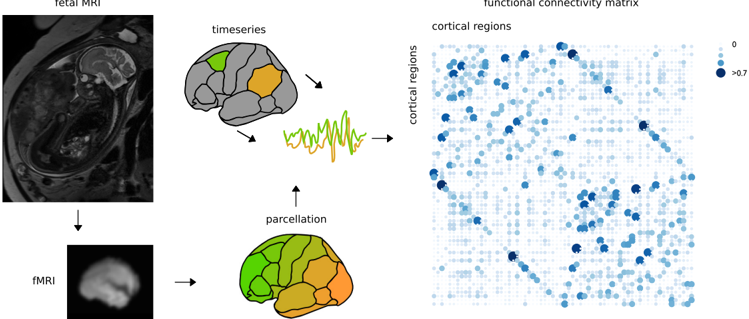
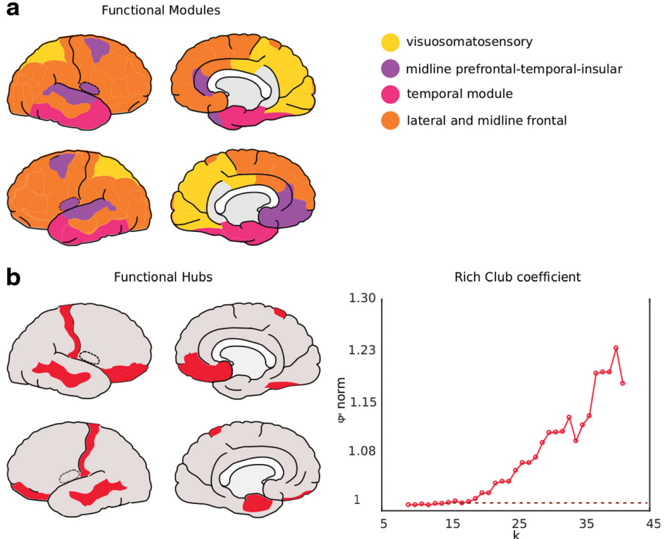
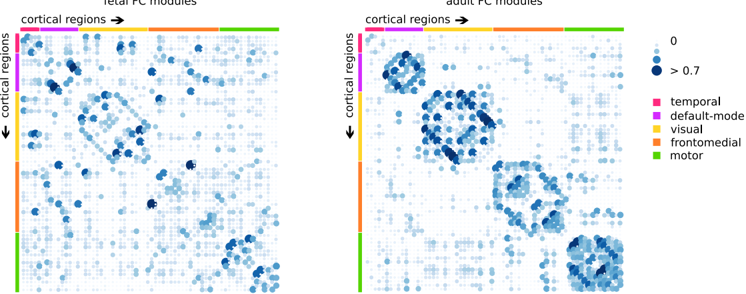
Large-scale functional connectome formation and reorganization is apparent in the second trimester of pregnancy, making it a crucial and vulnerable time window in connectome development. Here we identified which architectural principles of functional connectome organization are initiated before birth, and contrast those with topological characteristics observed in the mature adult brain. A sample of 105 pregnant women participated in human fetal resting-state fMRI studies (fetal gestational age between 20 and 40 weeks). Connectome analysis was used to analyze weighted network characteristics of fetal macroscale brain wiring. We identified efficient network attributes, common functional modules, and high overlap between the fetal and adult brain network. Our results indicate that key features of the functional connectome are present in the second and third trimesters of pregnancy. Understanding the organizational principles of fetal connectome organization may bring opportunities to develop markers for early detection of alterations of brain function. SIGNIFICANCE STATEMENT The fetal to neonatal period is well known as a critical stage in brain development. Rapid neurodevelopmental processes establish key functional neural circuits of the human brain. Prenatal risk factors may interfere with early trajectories of connectome formation and thereby shape future health outcomes. Recent advances in MRI have made it possible to examine fetal brain functional connectivity. In this study, we evaluate the network topography of normative functional network development during connectome genesis in utero. Understanding the developmental trajectory of brain connectivity provides a basis for understanding how the prenatal period shapes future brain function and disease dysfunction.
Overview
The claims and statistics of this paper haven’t been checked yet.
Run the check — free, no account needed. It reads the open-access text and checks the sources it cites.
Integrity signals
Registry
Cites
Statistics
Figures
Verification
Claims the paper makes
The claims and statistics of this paper haven’t been checked yet.
Run the check — free, no account needed. It reads the open-access text and checks the sources it cites.
Claims other papers make about this one
Each is checked against this paper’s own text: does it say what the citing paper says it does?
The source backs part of the claim, not all of it — or backs it for a different population, condition or comparison.
In the citing paper
“Fetal resting-state networks also tend to form clusters or modules; this tendency, called modularity, decreases with advancing gestational age [69, 70].”
From Brain structural and functional outcomes in the offspring of women experiencing psychological distress during pregnancy (2024) · cites this paper as [70]
Experimental — accuracy not yet measuredThe cited source says what the claim attributes to it.
In the citing paper
“Fetal networks, like adults, exhibit efficient small-world organization, suggesting that regions are simultaneously well integrated with topologically distant regions of the brain while forming specialized clusters with their close-by neighbors [69, 70].”
From Brain structural and functional outcomes in the offspring of women experiencing psychological distress during pregnancy (2024) · cites this paper as [70]
Self-check
Percentages, sums and reported differences re-computed from the paper’s own numbers.
The self-check needs the paper’s full text.
Citations
Cites
Complex network measures of brain connectivity: Uses and interpretations
Rubinov, M., & Sporns, O. (2010) · NeuroImage · doi:10.1016/j.neuroimage.2009.10.003 · Cited by 11,522
Power, J. D., Barnes, K. A., Snyder, A. Z., Schlaggar, B. L., & Petersen, S. E. (2012) · NeuroImage · doi:10.1016/j.neuroimage.2011.10.018 · Cited by 7,429
Objective Criteria for the Evaluation of Clustering Methods
Rand, W. M. (1971) · Journal of the American Statistical Association · doi:10.1080/01621459.1971.10482356 · Cited by 6,493
Specificity and Stability in Topology of Protein Networks
Maslov, S., & Sneppen, K. (2002) · Science · doi:10.1126/science.1065103 · Cited by 3,051
Rich-club organization of the human connectome
van den Heuvel, M. P., & Sporns, O. (2011) · The Journal of Neuroscience · doi:10.1523/jneurosci.3539-11.2011 · Cited by 2,354
The influence of head motion on intrinsic functional connectivity MRI
Van Dijk, K. R. A., Sabuncu, M. R., & Buckner, R. L. (2012) · NeuroImage · doi:10.1016/j.neuroimage.2011.07.044 · Cited by 2,344
Functional brain networks develop from a local to distributed organization
Fair, D. A., Cohen, A. L., Power, J. D., Dosenbach, N. U. F., Church, J. A., Miezin, F. M., Schlaggar, B. L., & Petersen, S. E. (2009) · PLoS Computational Biology · doi:10.1371/journal.pcbi.1000381 · Cited by 1,530
Neuronal migration, with special reference to developing human brain: a review
Sidman, R. L., & RAKIC, P. T. (1973) · Brain Research · doi:10.1016/0006-8993(73)90617-3 · Cited by 1,260
Van den Bergh, B. R. H., van den Heuvel, M. I., Lahti, M., Braeken, M., de Rooij, S. R., Entringer, S., Hoyer, D., Roseboom, T., Räikkönen, K., King, S., et al. (2020) · Neuroscience & Biobehavioral Reviews · doi:10.1016/j.neubiorev.2017.07.003 · Cited by 1,181
Natural Scales in Geographical PatternsPreprint
Menezes, T., & Roth, C. (2017) · arXiv (Cornell University) · doi:10.48550/arxiv.1704.01036 · Cited by 1,126
Detecting rich-club ordering in complex networks
Colizza, V., Flammini, A., Serrano, M. A., & Vespignani, A. (2006) · Nature Physics · doi:10.1038/nphys209 · Cited by 1,001
Longitudinal Analysis of Neural Network Development in Preterm Infants
Smyser, C. D., Inder, T. E., Shimony, J. S., Hill, J. E., Degnan, A. J., Snyder, A. Z., & Neil, J. J. (2010) · Cerebral Cortex · doi:10.1093/cercor/bhq035 · Cited by 791
The development of human functional brain networks
Power, J. D., Fair, D. A., Schlaggar, B. L., & Petersen, S. E. (2010) · Neuron · doi:10.1016/j.neuron.2010.08.017 · Cited by 751
Procedural pain and brain development in premature newborns
Brummelte, S., GRUNAU, R. E., Chau, V., Poskitt, K. J., Brant, R., Vinall, J., Gover, A., Synnes, A. R., & Miller, S. P. (2012) · Annals of Neurology · doi:10.1002/ana.22267 · Cited by 735
Gao, W., Zhu, H., Giovanello, K. S., Smith, J. K., Shen, D., Gilmore, J. H., & Lin, W. (2009) · Proceedings of the National Academy of Sciences · doi:10.1073/pnas.0811221106 · Cited by 601
Emergence of resting state networks in the preterm human brain
Doria, V., Beckmann, C. F., Arichi, T., Merchant, N., Groppo, M., Turkheimer, F. E., Counsell, S. J., Murgasova, M., Aljabar, P., Nunes, R. G., et al. (2010) · Proceedings of the National Academy of Sciences · doi:10.1073/pnas.1007921107 · Cited by 574
The development of cerebral connections during the first 20–45 weeks’ gestation
Kostović, I., & Milošević, N. J. (2006) · Seminars in Fetal and Neonatal Medicine · doi:10.1016/j.siny.2006.07.001 · Cited by 568
The functional architecture of the infant brain as revealed by resting-state fMRI
Fransson, P., Åden, U., Blennow, M., & Lagercrantz, H. (2011) · Cerebral Cortex · doi:10.1093/cercor/bhq071 · Cited by 542
van den Heuvel, M. P., de Lange, S. C., Zalesky, A., Seguin, C., Yeo, B. T. T., & Schmidt, R. (2017) · NeuroImage · doi:10.1016/j.neuroimage.2017.02.005 · Cited by 487
Prominence and Control: The Weighted Rich-Club Effect
Opsahl, T., Colizza, V., Panzarasa, P., & Ramasco, J. J. (2008) · Physical Review Letters · doi:10.1103/physrevlett.101.168702 · Cited by 392
The Neonatal Connectome During Preterm Brain Development
van den Heuvel, M. P., Kersbergen, K. J., de Reus, M. A., Keunen, K., Kahn, R. S., Groenendaal, F., de Vries, L. S., & Benders, M. J. N. L. (2015) · Cerebral Cortex · doi:10.1093/cercor/bhu095 · Cited by 386
Self-citationRudolph, M. D., Graham, A. M., Feczko, E., Miranda-Dominguez, O., Rasmussen, J. M., Nardos, R., Entringer, S., Wadhwa, P. D., Buss, C., & Fair, D. A. (2018) · Nature Neuroscience · doi:10.1038/s41593-018-0128-y · Cited by 374
Gholipour, A., Rollins, C. K., Velasco‐Annis, C., Ouaalam, A., Akhondi‐Asl, A., Afacan, O., Ortinau, C. M., Clancy, S., Limperopoulos, C., Yang, E., et al. (2017) · Scientific Reports · doi:10.1038/s41598-017-00525-w · Cited by 366
Rich-club organization of the newborn human brain
Ball, G., Aljabar, P., Zebari, S., Tusor, N., Arichi, T., Merchant, N., Robinson, E. C., Ogundipe, E., Rueckert, D., Edwards, A. D., et al. (2014) · Proceedings of the National Academy of Sciences · doi:10.1073/pnas.1324118111 · Cited by 360
Development of human brain cortical network architecture during infancy
Gao, W., Alcauter, S., Smith, J. K., Gilmore, J. H., & Lin, W. (2015) · Brain Structure and Function · doi:10.1007/s00429-014-0710-3 · Cited by 356
Robustness of community structure in networks
Karrer, B., Levina, E., & Newman, M. E. J. (2008) · Physical Review E · doi:10.1103/physreve.77.046119 · Cited by 350
Serag, A., Aljabar, P., Ball, G., Counsell, S. J., Boardman, J. P., Rutherford, M., Edwards, A. D., Hajnal, J. V., & Rueckert, D. (2011) · NeuroImage · doi:10.1016/j.neuroimage.2011.09.062 · Cited by 316
Temporal and spatial evolution of brain network topology during the first two years of life
Gao, W., Gilmore, J. H., Giovanello, K. S., Smith, J. K., Shen, D., Zhu, H., & Lin, W. (2011) · PLoS ONE · doi:10.1371/journal.pone.0025278 · Cited by 272
Fransson, P., Skiöld, B., Engström, M., Hallberg, B., Mosskin, M., Ådén, U., Lagercrantz, H., & Blennow, M. (2009) · Pediatric Research · doi:10.1203/pdr.0b013e3181b1bd84 · Cited by 248
Chapter 9 Neuronal development in human prefrontal cortex in prenatal and postnatal stages
Mrzljak, L., Uylings, H. B. M., Van Eden, G. G., & Judáš, M. (1991) · Progress in Brain Research · doi:10.1016/s0079-6123(08)62681-3 · Cited by 247
Cross-hemispheric functional connectivity in the human fetal brain
Thomason, M. E., Dassanayake, M. T., Shen, S., Katkuri, Y., Alexis, M., Anderson, A. L., Yeo, L., Mody, S., Hernandez-Andrade, E., Hassan, S. S., et al. (2013) · Science Translational Medicine · doi:10.1126/scitranslmed.3004978 · Cited by 225
Self-citationFunctional connectivity MR imaging reveals cortical functional connectivity in the developing brain
Lin, W., Zhu, Q., Gao, W., Chen, Y., Toh, C.-H., Styner, M., Gerig, G., Smith, J. K., Biswal, B., & Gilmore, J. H. (2008) · American Journal of Neuroradiology · doi:10.3174/ajnr.a1256 · Cited by 222
Thomason, M. E., Grove, L. E., Lozon, T. A., Vila, A. M., Ye, Y., Nye, M. J., Manning, J. H., Pappas, A., Hernandez‐Andrade, E. A., Yeo, L., et al. (2014) · Developmental Cognitive Neuroscience · doi:10.1016/j.dcn.2014.09.001 · Cited by 198
Self-citationCollin, G., & van den Heuvel, M. P. (2013) · The Neuroscientist · doi:10.1177/1073858413503712 · Cited by 198
Cao, M., Yong He, A., Dai, Z., Liao, X., Jeon, T., Ouyang, M., Chalak, L. F., Bi, Y., Rollins, N. K., Dong, Q., et al. (2016) · Cerebral Cortex · doi:10.1093/cercor/bhw038 · Cited by 194
Third Trimester Brain Growth in Preterm Infants Compared With In Utero Healthy Fetuses
Bouyssi-Kobar, M., du Plessis, A. J., McCarter, R., Brossard‐Racine, M., Murnick, J. G., Tinkleman, L., Robertson, R. L., & Limperopoulos, C. (2016) · PEDIATRICS · doi:10.1542/peds.2016-1640 · Cited by 177
Vasung, L., Huang, H., Jovanov‐Milošević, N., Pletikos, M., Mori, S., & Kostović, I. (2010) · Journal of Anatomy · doi:10.1111/j.1469-7580.2010.01260.x · Cited by 169
Scholtens, L. H., Schmidt, R., de Reus, M. A., & van den Heuvel, M. P. (2014) · The Journal of Neuroscience · doi:10.1523/jneurosci.0752-14.2014 · Cited by 160
Weak functional connectivity in the human fetal brain prior to preterm birth
Thomason, M. E., Scheinost, D., Manning, J. H., Grove, L. E., Hect, J. L., Marshall, N. A., Hernandez‐Andrade, E. A., Berman, S., Pappas, A., Yeo, L., et al. (2017) · Scientific Reports · doi:10.1038/srep39286 · Cited by 157
Self-citationCharacteristics, associations and outcome of partial agenesis of the corpus callosum in the fetus
Volpe, P., Paladini, D., Resta, M., Stanziano, A., Salvatore, M., Quarantelli, M., Robertis, V. D., Buonadonna, A. L., Caruso, G., & Gentile, M. (2006) · Ultrasound in Obstetrics and Gynecology · doi:10.1002/uog.2774 · Cited by 140
Watching the fetal brain at ‘rest’
Schöpf, V., Kasprian, G., Brugger, P. C., & Prayer, D. (2012) · International Journal of Developmental Neuroscience · doi:10.1016/j.ijdevneu.2011.10.006 · Cited by 137
Functional Connectivity of the Human Brain in Utero
van den Heuvel, M. I., & Thomason, M. E. (2016) · Trends in Cognitive Sciences · doi:10.1016/j.tics.2016.10.001 · Cited by 131
Self-citationOn development of functional brain connectivity in the young brain
Hoff, G. E. A.-J., van den Heuvel, M. P., Benders, M. J. N. L., Kersbergen, K. J., & de Vries, L. S. (2013) · Frontiers in Human Neuroscience · doi:10.3389/fnhum.2013.00650 · Cited by 114
Self-citationFunctional plasticity before the cradle: A review of neural functional imaging in the human fetus
Anderson, A. L., & Thomason, M. E. (2013) · Neuroscience & Biobehavioral Reviews · doi:10.1016/j.neubiorev.2013.03.013 · Cited by 109
Self-citationHubs in the human fetal brain network
van den Heuvel, M. I., Turk, E., Manning, J. H., Hect, J., Hernandez-Andrade, E., Hassan, S. S., Romero, R., van den Heuvel, M. P., & Thomason, M. E. (2018) · Developmental Cognitive Neuroscience · doi:10.1016/j.dcn.2018.02.001 · Cited by 108
Self-citationArichi, T., Whitehead, K., Barone, G., Pressler, R., Padormo, F., Edwards, A. D., & Lorenzo Fabrizi, D. (2017) · eLife · doi:10.7554/elife.27814 · Cited by 97
Identifying Very Preterm Children at Educational Risk Using a School Readiness Framework
Pritchard, V. E., Bora, S., Austin, N. C., Levin, K. J., & Woodward, L. J. (2014) · PEDIATRICS · doi:10.1542/peds.2013-3865 · Cited by 95
Prenatal Drug Exposure Affects Neonatal Brain Functional Connectivity
Salzwedel, A. P., Grewen, K. M., Vachet, C., Gerig, G., Lin, W., & Gao, W. (2015) · The Journal of Neuroscience · doi:10.1523/jneurosci.4333-14.2015 · Cited by 93
Early Medical and Behavioral Characteristics of NICU Infants Later Classified With ASD
Karmel, B. Z., Gardner, J. M., Meade, L. S., Cohen, I. L., London, E., Flory, M. J., Lennon, E. M., Miroshnichenko, I., Rabinowitz, S. S., Parab, S. M., et al. (2010) · PEDIATRICS · doi:10.1542/peds.2009-2680 · Cited by 93
Preterm birth alters neonatal, functional rich club organization
Scheinost, D., Kwon, S. H., Shen, X., Lacadie, C., Schneider, K. C., Dai, F., Ment, L. R., & Constable, R. T. (2015) · Brain Structure and Function · doi:10.1007/s00429-015-1096-6 · Cited by 91
Functional properties of resting state networks in healthy full-term newborns
De Asis-Cruz, J., Bouyssi-Kobar, M., Evangelou, I., Vezina, G., & Limperopoulos, C. (2015) · Scientific Reports · doi:10.1038/srep17755 · Cited by 85 · cited 4×
“…functional and structural rich-club hubs, increasing global efficiency, as well as structural and functional architectural coupling in the developing (preterm) neonatal brain (Fransson et al., 2011; De Asis-Cruz et al., 2015; van den Heuvel et al., 2015; Scheinost et al., 2016; Cao et al., 2017).”
BackgroundResultInfluentialFerrazzi, G., Deprez, M., Arichi, T., Malamateniou, C., Fox, M. J., Makropoulos, A., Allsop, J. M., Rutherford, M., Malik, S., Aljabar, P., et al. (2014) · NeuroImage · doi:10.1016/j.neuroimage.2014.06.074 · Cited by 84
Functional Connectivity Disruption in Neonates with Prenatal Marijuana Exposure
Grewen, K., Salzwedel, A. P., & Gao, W. (2015) · Frontiers in Human Neuroscience · doi:10.3389/fnhum.2015.00601 · Cited by 72
Development of the optic radiations and visual function after premature birth
Groppo, M., Ricci, D., Bassi, L., Merchant, N. M., Doria, V., Arichi, T., Allsop, J. M., Ramenghi, L. A., Fox, M. J., Cowan, F. M., et al. (2012) · Cortex · doi:10.1016/j.cortex.2012.02.008 · Cited by 64
Smyser, C. D., Kidokoro, H., & Inder, T. E. (2012) · Journal of Paediatrics and Child Health · doi:10.1111/j.1440-1754.2012.02535.x · Cited by 61
de Water, E., Proal, E., Wang, V., Martínez-Medina, S., Schnaas, L., Téllez‐Rojo, M. M., Wright, R. O., Tang, C. Y., & Horton, M. K. (2017) · NeuroToxicology · doi:10.1016/j.neuro.2017.06.006 · Cited by 60
Klebermaß-Schrehof, K., Kuhle, S., Olischar, M., Rücklinger, E., Pollak, A. J., & Weninger, M. (2005) · Neonatology · doi:10.1159/000088912 · Cited by 58
Li, X., Andres, A., Shankar, K., Pivik, R. T., Glasier, C. M., Ramakrishnaiah, R. H., Zhang, Y., Badger, T. M., & Ou, X. (2016) · International Journal of Obesity · doi:10.1038/ijo.2016.166 · Cited by 50
Claessens, N. H. P., Khalili, N., Išgum, I., ter Heide, H., Steenhuis, T. J., Turk, E., Jansen, N. J. G., de Vries, L. S., Breur, J. M. P. J., de Heus, R., et al. (2019) · American Journal of Neuroradiology · doi:10.3174/ajnr.a6021 · Cited by 48
Self-citationLinke, A. C., Wild, C. J., Zubiaurre‐Elorza, L., Herzmann, C., Duffy, H., Han, V. K. M., Lee, D. S. C., & Cusack, R. (2018) · NeuroImage Clinical · doi:10.1016/j.nicl.2018.02.002 · Cited by 48
Salzwedel, A. P., Grewen, K. M., Goldman, B. D., & Gao, W. (2016) · Neurotoxicology and Teratology · doi:10.1016/j.ntt.2016.05.009 · Cited by 46
Brain functional network connectivity development in very preterm infants: The first six months
He, L., & Parikh, N. A. (2016) · Early Human Development · doi:10.1016/j.earlhumdev.2016.06.002 · Cited by 41
Infante, M. A., Moore, E. M., Bischoff‐Grethe, A., Tapert, S. F., Mattson, S. N., & Riley, E. P. (2017) · Alcohol · doi:10.1016/j.alcohol.2017.05.002 · Cited by 33
The relationship between eye movement and vision develops before birth
Schöpf, V., Schlegl, T., András, J., Kasprian, G. J., Woitek, R., Prayer, D., & Langs, G. (2014) · Frontiers in Human Neuroscience · doi:10.3389/fnhum.2014.00775 · Cited by 31
Structured Spontaneity: Building Circuits in the Human Prenatal Brain
Thomason, M. E. (2017) · Trends in Neurosciences · doi:10.1016/j.tins.2017.11.004 · Cited by 18
Self-citationDalapicolla, J., do Prado, J. R., Percequillo, A. R., & Knowles, L. L. (2021) · Journal of Biogeography · doi:10.1111/jbi.14281 · Cited by 13
Fetal functional imaging portrays heterogeneous development of emerging human brain networks
Jakab, A., Schwartz, E., Kasprian, G., Gruber, G. M., Prayer, D., Schöpf, V., & Langs, G. (2014) · Frontiers in Human Neuroscience · doi:10.3389/fnhum.2014.00852 · Cited by 10
Huttenlocher (1997) · doi:10.1002/(sici)1096-9861(19971020)387:2
Research works printed but not linked: 1
- Mantel, 1967, The detection of disease clustering and a generalized regression approach, Cancer Res, 27, 209
Cited by
Sorted by citations
MRI of the Neonatal Brain: A Review of Methodological Challenges and Neuroscientific Advances
Dubois, J., Alison, M., Counsell, S. J., Hertz‐Pannier, L., Hüppi, P. S., & Benders, M. J. N. L. (2021) · Journal of Magnetic Resonance Imaging · doi:10.1002/jmri.27192 · Cited by 226
Self-citationSpontaneous activity in developing thalamic and cortical sensory networks
Martini, F. J., Guillamón-Vivancos, T., Moreno‐Juan, V., Valdeolmillos, M., & López‐Bendito, G. (2021) · Neuron · doi:10.1016/j.neuron.2021.06.026 · Cited by 195
Functional brain connectivity changes across the human life span: From fetal development to old age
Edde, M., Leroux, G., Altena, E., & Chanraud, S. (2021) · Journal of Neuroscience Research · doi:10.1002/jnr.24669 · Cited by 143
Premature Birth and Developmental Programming: Mechanisms of Resilience and Vulnerability
Lammertink, F., Vinkers, C. H., Tataranno, M. L., & Benders, M. J. N. L. (2021) · Frontiers in Psychiatry · doi:10.3389/fpsyt.2020.531571 · Cited by 145
Self-citationWu, Y., De Asis-Cruz, J., & Limperopoulos, C. (2024) · Molecular Psychiatry · doi:10.1038/s41380-024-02449-0 · Cited by 124
“Fetal networks, like adults, exhibit ef fi cient small-world organization, suggesting that regions are simultaneously well integrated with topologically distant regions of the brain while forming specialized clusters with their close-by neighbors [69, 70].”
Background
Metadata
- Authors
- Turk, E., van den Heuvel, M. I., Benders, M. J., de Heus, R., Franx, A., Manning, J. H., Hect, J. L., Hernandez-Andrade, E., Hassan, S. S., Romero, R., Kahn, R. S., Thomason, M. E., & van den Heuvel, M. P.
- Affiliations
- Utrecht University (NL)
- University Medical Center Utrecht (NL)
- United States Department of Health and Human Services (US)
- Icahn School of Medicine at Mount Sinai (US)
- NYU Langone Health (US)
- ORCID
- Venue
- The Journal of Neuroscience
- Publisher
- Society for Neuroscience
- Published
- 2019-11-04
- Volume
- 39
- Issue
- 49
- Pages
- 9716-9724
- ISSN
- 0270-6474 (ISSN-L)
- 1529-2401
- PMC
- PMC6891066
- OpenAlex
- W2985941729
- Cited by
- 176
- References
- 68
- Citations by year
- 2026: 18 · 2025: 31 · 2024: 37 · 2023: 21 · 2022: 30 · 2021: 21 · 2020: 18
- FWCI
- 10.03
- Type
- journal article
- Language
- en
- Open access
- hybrid
- doi.org
- Licence
- Locations
- Journal of Neuroscience (publishedVersion, cc-by-nc-sa)
- PubMed Central (publishedVersion)
- Research portal (Tilburg University) (publishedVersion)
- PubMed (publishedVersion)
- VU Research Portal (publishedVersion, other-oa)
- Data Archiving and Networked Services (DANS) (submittedVersion)
- Utrecht University Repository (Utrecht University) (submittedVersion, other-oa)
- Pure Amsterdam UMC (submittedVersion, other-oa)
- Amsterdam UMC (VU Amsterdam) - Institutional Repository (submittedVersion)
- Utrecht University Repository (Utrecht University) (submittedVersion)
- Funders
- U.S. Department of Health and Human Services (HHSN275201300006C)
- Australian Government
- Nederlandse Organisatie voor Wetenschappelijk Onderzoek (452-16-015)
- National Institutes of Health (HHSN 275201300006C)
- National Institute of Mental Health (R01MH110793)
- National Institute on Drug Abuse (R34DA050287)
- National Institute of Environmental Health Sciences (P30ES020957, R21ES026022)
- National Institute of Child Health and Human Development (HHSN275201300006C)
- Eunice Kennedy Shriver National Institute of Child Health and Human Development (HHSN275201300006C)
- NHLBI Division of Intramural Research
- Topics
- Life Sciences › Neuroscience › Cognitive Neuroscience › Functional Brain Connectivity Studies
- Health Sciences › Medicine › Radiology, Nuclear Medicine and Imaging › Advanced Neuroimaging Techniques and Applications
- Health Sciences › Medicine › Radiology, Nuclear Medicine and Imaging › Advanced MRI Techniques and Applications
- Keywords
- fetal brain, functional connectome, fetal brain development, resting-state functional connectivity, network topology, network efficiency, functional modules, prenatal risk factors, brain development, second trimester
- MeSH terms
- Adult, Atlases as Topic, Brain, Female, Fetus, Gestational Age, Humans, Image Processing, Computer-Assisted, Magnetic Resonance Imaging, Male, Nerve Net, Pregnancy, Pregnancy Trimester, Second, Fetal Development, Connectome
About these checks
Registry, retraction, Cites and statistics results are computed, not judged, with one exception: a printed reference that no index lists is read once by a model before it counts as a citation error. Claims are extracted by a model and kept only when their quote appears verbatim in the text; each cited source is then checked, with a model’s help, for whether it says what the claim relies on. Those verdicts can be wrong — read the claim’s quote and the cited source before relying on one.
Statistics and arithmetic are recomputed, not judged.
Confidence bands are shown only for fields calibrated on our annotated test set. None is calibrated yet, so no band is shown.
What counts as a claim ›How we measure confidence ›How we check this ›
Are you an author, or do you see a problem with this page? Request a review
