

The DOI matches its Crossref record; 41 of the 46 references it cites were found in a registry or an index; none of the 47 sources its claims cite is checked for support yet.
Prevalence and Characteristics of Autism Spectrum Disorder Among Children Aged 8 Years — Autism and Developmental Disabilities Monitoring Network, 11 Sites, United States, 2012
Open accessAbstract
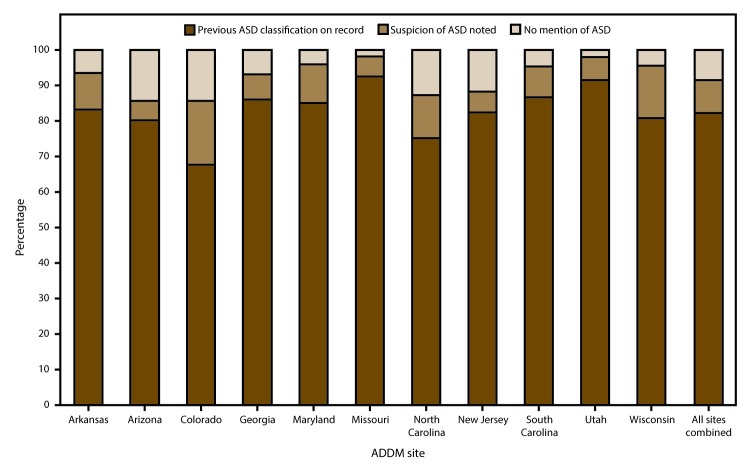
PROBLEM/CONDITION: Autism spectrum disorder (ASD). PERIOD COVERED: 2012. DESCRIPTION OF SYSTEM: The Autism and Developmental Disabilities Monitoring (ADDM) Network is an active surveillance system that provides estimates of the prevalence and characteristics of ASD among children aged 8 years whose parents or guardians reside in 11 ADDM Network sites in the United States (Arkansas, Arizona, Colorado, Georgia, Maryland, Missouri, New Jersey, North Carolina, South Carolina, Utah, and Wisconsin). Surveillance to determine ASD case status is conducted in two phases. The first phase consists of screening and abstracting comprehensive evaluations performed by professional service providers in the community. Data sources identified for record review are categorized as either 1) education source type, including developmental evaluations to determine eligibility for special education services or 2) health care source type, including diagnostic and developmental evaluations. The second phase involves the review of all abstracted evaluations by trained clinicians to determine ASD surveillance case status. A child meets the surveillance case definition for ASD if one or more comprehensive evaluations of that child completed by a qualified professional describes behaviors that are consistent with the Diagnostic and Statistical Manual of Mental Disorders, Fourth Edition, Text Revision diagnostic criteria for any of the following conditions: autistic disorder, pervasive developmental disorder-not otherwise specified (including atypical autism), or Asperger disorder. This report provides ASD prevalence estimates for children aged 8 years living in catchment areas of the ADDM Network sites in 2012, overall and stratified by sex, race/ethnicity, and the type of source records (education and health records versus health records only). In addition, this report describes the proportion of children with ASD with a score consistent with intellectual disability on a standardized intellectual ability test, the age at which the earliest known comprehensive evaluation was performed, the proportion of children with a previous ASD diagnosis, the specific type of ASD diagnosis, and any special education eligibility classification. RESULTS: For 2012, the combined estimated prevalence of ASD among the 11 ADDM Network sites was 14.5 per 1,000 (one in 69) children aged 8 years. Estimated prevalence was significantly higher among boys aged 8 years (23.4 per 1,000) than among girls aged 8 years (5.2 per 1,000). Estimated ASD prevalence was significantly higher among non-Hispanic white children aged 8 years (15.3 per 1,000) compared with non-Hispanic black children (13.1 per 1,000), and Hispanic (10.2 per 1,000) children aged 8 years. Estimated prevalence varied widely among the 11 ADDM Network sites, ranging from 8.2 per 1,000 children aged 8 years (in the area of the Maryland site where only health care records were reviewed) to 24.6 per 1,000 children aged 8 years (in New Jersey, where both education and health care records were reviewed). Estimated prevalence was higher in surveillance sites where education records and health records were reviewed compared with sites where health records only were reviewed (17.1 per 1,000 and 10.4 per 1,000 children aged 8 years, respectively; p<0.05). Among children identified with ASD by the ADDM Network, 82% had a previous ASD diagnosis or educational classification; this did not vary by sex or between non-Hispanic white and non-Hispanic black children. A lower percentage of Hispanic children (78%) had a previous ASD diagnosis or classification compared with non-Hispanic white children (82%) and with non-Hispanic black children (84%). The median age at earliest known comprehensive evaluation was 40 months, and 43% of children had received an earliest known comprehensive evaluation by age 36 months. The percentage of children with an earliest known comprehensive evaluation by age 36 months was similar for boys and girls, but was higher for non-Hispanic white children (45%) compared with non-Hispanic black children (40%) and Hispanic children (39%). INTERPRETATION: Overall estimated ASD prevalence was 14.5 per 1,000 children aged 8 years in the ADDM Network sites in 2012. The higher estimated prevalence among sites that reviewed both education and health records suggests the role of special education systems in providing comprehensive evaluations and services to children with developmental disabilities. Disparities by race/ethnicity in estimated ASD prevalence, particularly for Hispanic children, as well as disparities in the age of earliest comprehensive evaluation and presence of a previous ASD diagnosis or classification, suggest that access to treatment and services might be lacking or delayed for some children. PUBLIC HEALTH ACTION: The ADDM Network will continue to monitor the prevalence and characteristics of ASD among children aged 8 years living in selected sites across the United States. Recomme
Overview
AI snapshot
Written from the paper’s full text.
TL;DR
In 2012, the ADDM Network estimated ASD prevalence among children aged 8 years across 11 U.S. sites at 14.5 per 1,000 (one in 69), with wide variation by site and higher estimates where both education and health records were reviewed. Prevalence was higher among boys and non-Hispanic white children, and although 87% had a developmental concern by age 36 months, the median age at earliest known comprehensive evaluation was 40 months.
Key findings
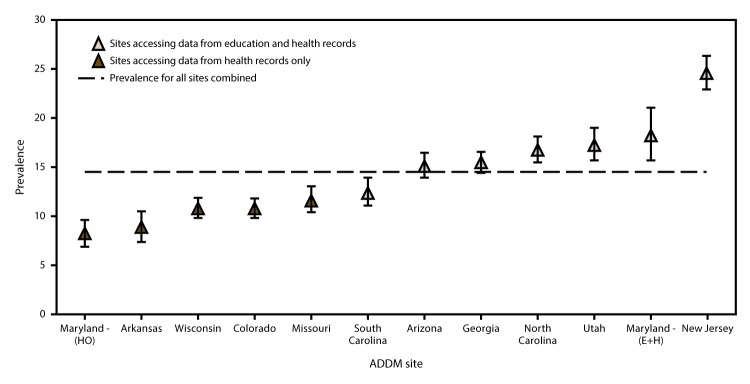
- Combined estimated ASD prevalence was 14.5 per 1,000 (one in 69) children aged 8 years; site estimates ranged from 8.2 per 1,000 (Maryland, health records only) to 24.6 per 1,000 (New Jersey). Sites reviewing education and health records had higher estimated prevalence than health-records-only sites (17.1 vs. 10.4 per 1,000; PR: 1.6; 95% CI: 1.5–1.7; p<0.001).
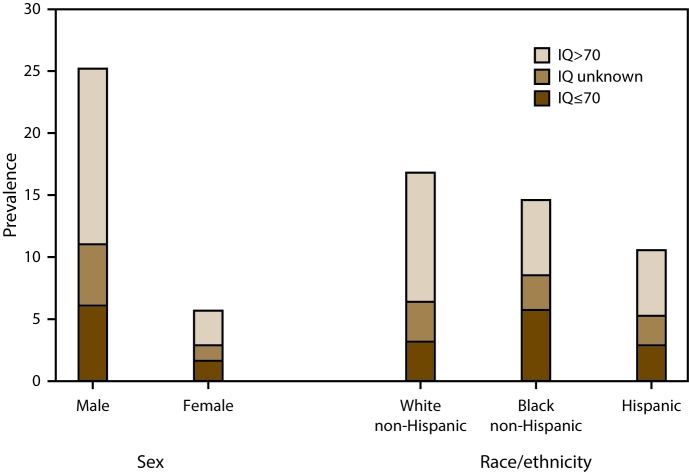
- Estimated prevalence was 23.4 per 1,000 among boys and 5.2 per 1,000 among girls (male-to-female PR: 4.5; 95% CI: 4.2–4.8). By race/ethnicity, estimates were 15.3 per 1,000 for non-Hispanic white, 13.1 for non-Hispanic black, 11.4 for Asian/Pacific Islander, and 10.2 for Hispanic children.
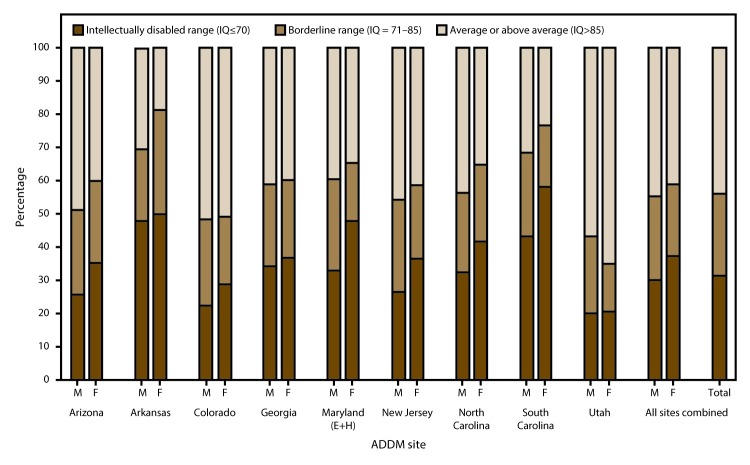
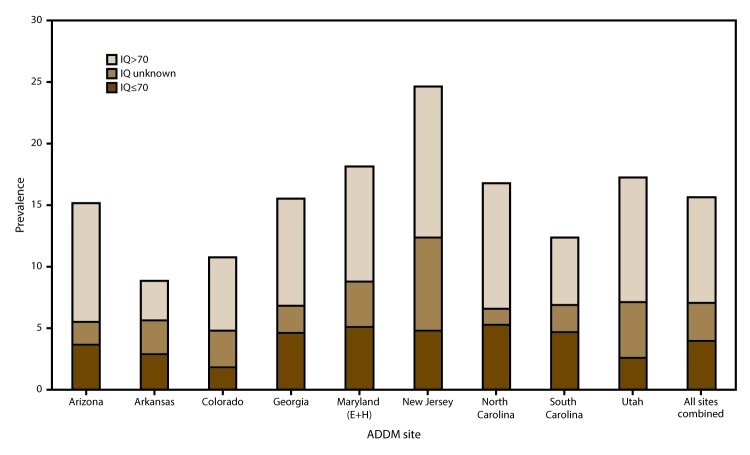
- Among 3,353 children with intellectual ability data in nine areas, 31.4% were in the intellectual disability range (IQ ≤70), 24.6% in the borderline range (IQ 71–85), and 44.1% in the average or above-average range (IQ >85). Estimated prevalence was 3.9 per 1,000 for ASD with intellectual disability and 8.6 per 1,000 for ASD without intellectual disability.
- Overall, 82% had a previous ASD diagnosis or educational classification; 74% had an earliest known DSM-IV-TR ASD diagnosis, including autistic disorder (46%), ASD-NOS/PDD-NOS (44%), and Asperger disorder (10%). The median age at earliest known comprehensive evaluation was 40 months, and 43% had an earliest known comprehensive evaluation by age 36 months.
Methods
- Active, multisite, records-based surveillance in 11 ADDM Network sites among children born in 2004 and aged 8 years in 2012; the surveillance area included 346,978 children aged 8 years.
- Two-phase case ascertainment: screening and abstraction of education and health records, followed by clinician review of composite records against the DSM-IV-TR-based ASD surveillance case definition (autistic disorder, PDD-NOS, or Asperger disorder).
- Prevalence was calculated using NCHS vintage 2014 postcensal bridged-race population estimates and stratified by site, sex, and race/ethnicity; analyses used Pearson chi-square tests, prevalence ratios, and median tests, with clinician-review reliability of 90.4% agreement (κ = 0.8).
Limitations
- The paper states seven limitations: reliance on available source records; varied source-record types across sites and possible underestimation where education records were unavailable; education records generally unavailable for private-school or home-schooled children; surveillance areas not representative of the U.S. or their states; nondecennial population estimates may have error; birth-certificate restriction may not fully eliminate bias from children who moved; and broad race/ethnicity categories, including inability to distinguish Hispanic children by primary household language.
- The paper also notes that prevalence estimates do not reflect the missing-record adjustment, and that 2010–2012 comparisons were restricted to eight sites with comparable surveillance areas and record source types; individual site changes were not clearly explained and may reflect local health-care variation or record-retention changes.
Model-written summary. Check it against the paper before relying on it.
Integrity signals
Registry
Cites
Statistics
Figures
Verification
Claims the paper makes
112 Own result · 26 Own method · 25 Not checked yet · 19 Own interpretation · 7 No basis given
A result the paper reports from its own data — it cites no other source for it, so there is none to check. The quote shows it is in the paper.
In the paper
“but was significantly higher for non-Hispanic white children (45%) compared with non-Hispanic black children (40%; p<0.05) and with Hispanic children (39%; p<0.05)”
§ Prevalence and Characteristics of Autism Spectrum Disorder Among Children Aged 8 Years — Autism and Developmental Disabilities Monitoring Network, 11 Sites, United States, 2012 > Results > Early Developmental Concerns and Earliest Comprehensive Evaluation
plaincorrelationaln = 3,848 ·- Asserted: passes — The authors put it forward as true.
- Checkable: passes — It can be checked against evidence.
- Load-bearing: unclear — It is unclear whether the paper’s conclusions depend on it.
- Based: passes — The paper gives a reason why it holds.
- Rests on an assumption: The ADDM ASD surveillance case criteria accurately identify children with ASD.
A result the paper reports from its own data — it cites no other source for it, so there is none to check. The quote shows it is in the paper.
In the paper
“Estimated prevalence was higher in surveillance sites where education records and health records were reviewed compared with sites where health records only were reviewed (17.1 per 1,000 and 10.4 per 1,000 children aged 8 years, respectively; p<0.05).”
§ Prevalence and Characteristics of Autism Spectrum Disorder Among Children Aged 8 Years — Autism and Developmental Disabilities Monitoring Network, 11 Sites, United States, 2012 > Abstract > Results
hedgedcorrelational- Asserted: passes — The authors put it forward as true.
- Checkable: passes — It can be checked against evidence.
- Load-bearing: passes — The paper’s conclusions depend on it.
- Based: passes — The paper gives a reason why it holds.
A result the paper reports from its own data — it cites no other source for it, so there is none to check. The quote shows it is in the paper.
In the paper
“24.6% were classified in the borderline range (IQ: 71–85)”
§ Prevalence and Characteristics of Autism Spectrum Disorder Among Children Aged 8 Years — Autism and Developmental Disabilities Monitoring Network, 11 Sites, United States, 2012 > Results > Intellectual Ability
plainn = 3,353- Asserted: passes — The authors put it forward as true.
- Checkable: passes — It can be checked against evidence.
- Load-bearing: unclear — It is unclear whether the paper’s conclusions depend on it.
- Based: passes — The paper gives a reason why it holds.
- Rests on an assumption: Children with ASD who had data on intellectual ability are representative of all children with ASD in the nine areas.
A result the paper reports from its own data — it cites no other source for it, so there is none to check. The quote shows it is in the paper.
In the paper
“the percentage was significantly higher for non-Hispanic black children (91%) and for Hispanic children (90%) compared with non-Hispanic white children (86%; p<0.05)”
§ Prevalence and Characteristics of Autism Spectrum Disorder Among Children Aged 8 Years — Autism and Developmental Disabilities Monitoring Network, 11 Sites, United States, 2012 > Results > Early Developmental Concerns and Earliest Comprehensive Evaluation
plaincorrelational- Asserted: passes — The authors put it forward as true.
- Checkable: passes — It can be checked against evidence.
- Load-bearing: unclear — It is unclear whether the paper’s conclusions depend on it.
- Based: passes — The paper gives a reason why it holds.
- Rests on an assumption: The ADDM ASD surveillance case criteria accurately identify children with ASD.
A result the paper reports from its own data — it cites no other source for it, so there is none to check. The quote shows it is in the paper.
In the paper
“The percentage of ASD cases classified in the intellectual disability range was significantly higher among girls compared with boys in all nine areas combined (37% and 30%, respectively; p<0.01).”
§ Prevalence and Characteristics of Autism Spectrum Disorder Among Children Aged 8 Years — Autism and Developmental Disabilities Monitoring Network, 11 Sites, United States, 2012 > Results > Intellectual Ability
plaincorrelationaln = 3,353 ·- Asserted: passes — The authors put it forward as true.
- Checkable: passes — It can be checked against evidence.
- Load-bearing: unclear — It is unclear whether the paper’s conclusions depend on it.
- Based: passes — The paper gives a reason why it holds.
- Rests on an assumption: Children with ASD who had data on intellectual ability are representative of all children with ASD in the nine areas.
A result the paper reports from its own data — it cites no other source for it, so there is none to check. The quote shows it is in the paper.
In the paper
“Estimated ASD prevalence was significantly higher among non-Hispanic white children aged 8 years (15.3 per 1,000) compared with non-Hispanic black children (13.1 per 1,000), and Hispanic (10.2 per 1,000) children aged 8 years.”
§ Prevalence and Characteristics of Autism Spectrum Disorder Among Children Aged 8 Years — Autism and Developmental Disabilities Monitoring Network, 11 Sites, United States, 2012 > Abstract > Results
hedgedcorrelational- Asserted: passes — The authors put it forward as true.
- Checkable: passes — It can be checked against evidence.
- Load-bearing: passes — The paper’s conclusions depend on it.
- Based: passes — The paper gives a reason why it holds.
A result the paper reports from its own data — it cites no other source for it, so there is none to check. The quote shows it is in the paper.
In the paper
“For 2012, the combined estimated prevalence of ASD among the 11 ADDM Network sites was 14.5 per 1,000 (one in 69) children aged 8 years.”
- Also stated in: § Interpretation · hedged
“Overall estimated ASD prevalence was 14.5 per 1,000 children aged 8 years in the ADDM Network sites in 2012.”
§ Prevalence and Characteristics of Autism Spectrum Disorder Among Children Aged 8 Years — Autism and Developmental Disabilities Monitoring Network, 11 Sites, United States, 2012 > Abstract > Results
hedged- Asserted: passes — The authors put it forward as true.
- Checkable: passes — It can be checked against evidence.
- Load-bearing: passes — The paper’s conclusions depend on it.
- Based: passes — The paper gives a reason why it holds.
- Also stated in: § Interpretation · hedged
A result the paper reports from its own data — it cites no other source for it, so there is none to check. The quote shows it is in the paper.
In the paper
“Estimated ASD prevalence was significantly higher among non-Hispanic white children aged 8 years (15.3 per 1,000) compared with non-Hispanic black children (13.1 per 1,000), and Hispanic (10.2 per 1,000) children aged 8 years.”
§ Prevalence and Characteristics of Autism Spectrum Disorder Among Children Aged 8 Years — Autism and Developmental Disabilities Monitoring Network, 11 Sites, United States, 2012 > Abstract > Results
hedgedcorrelational- Asserted: passes — The authors put it forward as true.
- Checkable: passes — It can be checked against evidence.
- Load-bearing: passes — The paper’s conclusions depend on it.
- Based: passes — The paper gives a reason why it holds.
A result the paper reports from its own data — it cites no other source for it, so there is none to check. The quote shows it is in the paper.
In the paper
“A lower percentage of Hispanic children (78%) had a previous ASD diagnosis or classification compared with non-Hispanic white children (82%) and with non-Hispanic black children (84%).”
§ Prevalence and Characteristics of Autism Spectrum Disorder Among Children Aged 8 Years — Autism and Developmental Disabilities Monitoring Network, 11 Sites, United States, 2012 > Abstract > Results
plaincorrelational- Asserted: passes — The authors put it forward as true.
- Checkable: passes — It can be checked against evidence.
- Load-bearing: unclear — It is unclear whether the paper’s conclusions depend on it.
- Based: passes — The paper gives a reason why it holds.
A result the paper reports from its own data — it cites no other source for it, so there is none to check. The quote shows it is in the paper.
In the paper
“for most areas, this percentage did not vary by sex or race/ethnicity”
§ Prevalence and Characteristics of Autism Spectrum Disorder Among Children Aged 8 Years — Autism and Developmental Disabilities Monitoring Network, 11 Sites, United States, 2012 > Results > Intellectual Ability
plainn = 4,189- Asserted: passes — The authors put it forward as true.
- Checkable: passes — It can be checked against evidence.
- Load-bearing: unclear — It is unclear whether the paper’s conclusions depend on it.
- Based: passes — The paper gives a reason why it holds.
- It may state two separate claims as one. 37
- Probably not a substantial claim. 41
A result the paper reports from its own data — it cites no other source for it, so there is none to check. The quote shows it is in the paper.
In the paper
“In the pooled data, the population was 53.3% non-Hispanic white, 21.4% non-Hispanic black, 19.8% Hispanic, 4.8% Asian/Pacific Islander, and 0.6% American Indian/Alaska Native.”
§ Prevalence and Characteristics of Autism Spectrum Disorder Among Children Aged 8 Years — Autism and Developmental Disabilities Monitoring Network, 11 Sites, United States, 2012 > Results > Population Characteristics
plain- Asserted: passes — The authors put it forward as true.
- Checkable: passes — It can be checked against evidence.
- Load-bearing: unclear — It is unclear whether the paper’s conclusions depend on it.
- Based: passes — The paper gives a reason why it holds.
It may state two separate claims as one.
A result the paper reports from its own data — it cites no other source for it, so there is none to check. The quote shows it is in the paper.
In the paper
“The geographic surveillance area for the 11 ADDM Network sites in 2012 included 346,978 children aged 8 years, which comprised 8.5% of the U.S. population of children aged 8 years for that year (Table 1).”
§ Prevalence and Characteristics of Autism Spectrum Disorder Among Children Aged 8 Years — Autism and Developmental Disabilities Monitoring Network, 11 Sites, United States, 2012 > Results > Population Characteristics
plain- Asserted: passes — The authors put it forward as true.
- Checkable: passes — It can be checked against evidence.
- Load-bearing: unclear — It is unclear whether the paper’s conclusions depend on it.
- Based: passes — The paper gives a reason why it holds.
It may state two separate claims as one.
A result the paper reports from its own data — it cites no other source for it, so there is none to check. The quote shows it is in the paper.
In the paper
“Estimated prevalence varied widely among the 11 ADDM Network sites, ranging from 8.2 per 1,000 children aged 8 years (in the area of the Maryland site where only health care records were reviewed) to 24.6 per 1,000 children aged 8 years (in New Jersey, where both education and health care records were reviewed).”
§ Prevalence and Characteristics of Autism Spectrum Disorder Among Children Aged 8 Years — Autism and Developmental Disabilities Monitoring Network, 11 Sites, United States, 2012 > Abstract > Results
hedgedcorrelational- Asserted: passes — The authors put it forward as true.
- Checkable: passes — It can be checked against evidence.
- Load-bearing: passes — The paper’s conclusions depend on it.
- Based: passes — The paper gives a reason why it holds.
It may state two separate claims as one.
A result the paper reports from its own data — it cites no other source for it, so there is none to check. The quote shows it is in the paper.
In the paper
“The estimated prevalence of ASD without intellectual disability was 8.6 per 1,000 and ranged from 3.2 per 1,000 (in Arkansas) to 12.2 per 1,000 (in New Jersey)”
§ Prevalence and Characteristics of Autism Spectrum Disorder Among Children Aged 8 Years — Autism and Developmental Disabilities Monitoring Network, 11 Sites, United States, 2012 > Results > Intellectual Ability
hedgedn = 3,353- Asserted: passes — The authors put it forward as true.
- Checkable: passes — It can be checked against evidence.
- Load-bearing: unclear — It is unclear whether the paper’s conclusions depend on it.
- Based: passes — The paper gives a reason why it holds.
It may state two separate claims as one.
- Rests on an assumption: The ADDM ASD surveillance case criteria accurately identify children with ASD.
- Rests on an assumption: Children with ASD who had data on intellectual ability are representative of all children with ASD in the nine areas.
A result the paper reports from its own data — it cites no other source for it, so there is none to check. The quote shows it is in the paper.
In the paper
“Estimated ASD prevalence was highest in New Jersey (24.6), Maryland (education and health records reviewed, 18.2), Utah (17.3), and North Carolina (16.8).”
§ Prevalence and Characteristics of Autism Spectrum Disorder Among Children Aged 8 Years — Autism and Developmental Disabilities Monitoring Network, 11 Sites, United States, 2012 > Results > Overall ASD Prevalence Estimates
plain- Asserted: passes — The authors put it forward as true.
- Checkable: passes — It can be checked against evidence.
- Load-bearing: unclear — It is unclear whether the paper’s conclusions depend on it.
- Based: passes — The paper gives a reason why it holds.
It may state two separate claims as one.
- Rests on an assumption: The ADDM ASD surveillance case criteria accurately identify children with ASD.
The paper states this without a source or data behind it here, so there is nothing to check it against. The quote shows it is in the paper.
In the paper
“The population distribution of children by race/ethnicity varied by study site.”
§ Prevalence and Characteristics of Autism Spectrum Disorder Among Children Aged 8 Years — Autism and Developmental Disabilities Monitoring Network, 11 Sites, United States, 2012 > Results > Population Characteristics
plaincorrelational- Asserted: passes — The authors put it forward as true.
- Checkable: passes — It can be checked against evidence.
- Load-bearing: fails — The paper’s conclusions may not depend on it.
- Based: passes — The paper gives a reason why it holds.
Probably not a substantial claim. The paper’s conclusions may not depend on it.
A result the paper reports from its own data — it cites no other source for it, so there is none to check. The quote shows it is in the paper.
In the paper
“site-specific male-to-female prevalence ratios ranged from 4.1 (in Colorado) to 6.2 (in Maryland [health records only reviewed]) and were all statistically significant”
§ Prevalence and Characteristics of Autism Spectrum Disorder Among Children Aged 8 Years — Autism and Developmental Disabilities Monitoring Network, 11 Sites, United States, 2012 > Results > Prevalence by Sex and Race/Ethnicity
plaincorrelational- Asserted: passes — The authors put it forward as true.
- Checkable: passes — It can be checked against evidence.
- Load-bearing: unclear — It is unclear whether the paper’s conclusions depend on it.
- Based: passes — The paper gives a reason why it holds.
It may state two separate claims as one.
- Rests on an assumption: The ADDM ASD surveillance case criteria accurately identify children with ASD.
A result the paper reports from its own data — it cites no other source for it, so there is none to check. The quote shows it is in the paper.
In the paper
“Combining data from all nine sites, the estimated prevalence of ASD with intellectual disability was 3.9 per 1,000 and ranged from 1.8 per 1,000 (in Colorado) to 5.3 per 1,000 (in North Carolina)”
- Also stated in: § Discussion · hedged
“The estimated prevalence of ASD with intellectual disability was 3.9 per 1,000 overall and ranged from 1.8 per 1,000 (in Colorado) to 5.3 per 1,000 (in North Carolina).”
§ Prevalence and Characteristics of Autism Spectrum Disorder Among Children Aged 8 Years — Autism and Developmental Disabilities Monitoring Network, 11 Sites, United States, 2012 > Results > Intellectual Ability
hedgedn = 3,353- Asserted: passes — The authors put it forward as true.
- Checkable: passes — It can be checked against evidence.
- Load-bearing: unclear — It is unclear whether the paper’s conclusions depend on it.
- Based: passes — The paper gives a reason why it holds.
It may state two separate claims as one.
- Rests on an assumption: The ADDM ASD surveillance case criteria accurately identify children with ASD.
- Rests on an assumption: Children with ASD who had data on intellectual ability are representative of all children with ASD in the nine areas.
- Also stated in: § Discussion · hedged
A result the paper reports from its own data — it cites no other source for it, so there is none to check. The quote shows it is in the paper.
In the paper
“this did not vary by sex or between non-Hispanic white and non-Hispanic black children.”
§ Prevalence and Characteristics of Autism Spectrum Disorder Among Children Aged 8 Years — Autism and Developmental Disabilities Monitoring Network, 11 Sites, United States, 2012 > Abstract > Results
plain- Asserted: passes — The authors put it forward as true.
- Checkable: passes — It can be checked against evidence.
- Load-bearing: unclear — It is unclear whether the paper’s conclusions depend on it.
- Based: passes — The paper gives a reason why it holds.
It may state two separate claims as one.
A result the paper reports from its own data — it cites no other source for it, so there is none to check. The quote shows it is in the paper.
In the paper
“The percentage of children who were matched to a birth certificate did not vary by sex or race/ethnicity.”
§ Prevalence and Characteristics of Autism Spectrum Disorder Among Children Aged 8 Years — Autism and Developmental Disabilities Monitoring Network, 11 Sites, United States, 2012 > Results > Birth Certificate Linkage
plainn = 5,021- Asserted: passes — The authors put it forward as true.
- Checkable: passes — It can be checked against evidence.
- Load-bearing: fails — The paper’s conclusions may not depend on it.
- Based: passes — The paper gives a reason why it holds.
Probably not a substantial claim. The paper’s conclusions may not depend on it.
A result the paper reports from its own data — it cites no other source for it, so there is none to check. The quote shows it is in the paper.
In the paper
“Across all 11 sites, estimated ASD prevalence might have increased by <1% in four sites (Arizona, Colorado, Missouri, and Wisconsin), by 1%–<2% in three sites (Georgia, North Carolina, and New Jersey) and by 2.0%–3.3% in four sites (Arkansas, Maryland, South Carolina, and Utah).”
§ Prevalence and Characteristics of Autism Spectrum Disorder Among Children Aged 8 Years — Autism and Developmental Disabilities Monitoring Network, 11 Sites, United States, 2012 > Results > Evaluation of the Effect of Missing Records
hedgedconditional- Asserted: passes — The authors put it forward as true.
- Checkable: passes — It can be checked against evidence.
- Load-bearing: unclear — It is unclear whether the paper’s conclusions depend on it.
- Based: passes — The paper gives a reason why it holds.
It may state two separate claims as one.
- Rests on an assumption: The ADDM ASD surveillance case criteria accurately identify children with ASD.
- Rests on an assumption: Missing records would have had a similar ASD case yield to reviewed records, so the estimated potential increase is valid.
A result the paper reports from its own data — it cites no other source for it, so there is none to check. The quote shows it is in the paper.
In the paper
“The median age at earliest known comprehensive evaluation was 40 months, ranging from 30 months (North Carolina) to 48 months (Arkansas)”
§ Prevalence and Characteristics of Autism Spectrum Disorder Among Children Aged 8 Years — Autism and Developmental Disabilities Monitoring Network, 11 Sites, United States, 2012 > Results > Early Developmental Concerns and Earliest Comprehensive Evaluation
plainn = 3,848- Asserted: passes — The authors put it forward as true.
- Checkable: passes — It can be checked against evidence.
- Load-bearing: unclear — It is unclear whether the paper’s conclusions depend on it.
- Based: passes — The paper gives a reason why it holds.
It may state two separate claims as one.
- Rests on an assumption: The ADDM ASD surveillance case criteria accurately identify children with ASD.
A result the paper reports from its own data — it cites no other source for it, so there is none to check. The quote shows it is in the paper.
In the paper
“Despite the similar findings when the population was restricted to these eight sites for 2010 and 2012 (15.1 and 15.2 per 1,000, respectively), there were significant differences in ASD prevalence estimates between 2010 and 2012 for three of these sites.”
§ Prevalence and Characteristics of Autism Spectrum Disorder Among Children Aged 8 Years — Autism and Developmental Disabilities Monitoring Network, 11 Sites, United States, 2012 > Discussion
plain- Asserted: passes — The authors put it forward as true.
- Checkable: passes — It can be checked against evidence.
- Load-bearing: unclear — It is unclear whether the paper’s conclusions depend on it.
- Based: passes — The paper gives a reason why it holds.
It may state two separate claims as one.
A result the paper reports from its own data — it cites no other source for it, so there is none to check. The quote shows it is in the paper.
In the paper
“Prevalence estimates were similar for 2010 and 2012 for children with ASD with intellectual disability and for children with ASD without intellectual disability.”
§ Prevalence and Characteristics of Autism Spectrum Disorder Among Children Aged 8 Years — Autism and Developmental Disabilities Monitoring Network, 11 Sites, United States, 2012 > Results > Comparison of ASD Prevalence Estimates Between 2010 and 2012
plain- Asserted: passes — The authors put it forward as true.
- Checkable: passes — It can be checked against evidence.
- Load-bearing: passes — The paper’s conclusions depend on it.
- Based: passes — The paper gives a reason why it holds.
It may state two separate claims as one.
- Rests on an assumption: The ADDM ASD surveillance case criteria accurately identify children with ASD.
- Rests on an assumption: Children with ASD who had data on intellectual ability are representative of all children with ASD in the nine areas.
A result the paper reports from its own data — it cites no other source for it, so there is none to check. The quote shows it is in the paper.
In the paper
“Although overall estimated ASD prevalence between 2010 and 2012 was similar across the eight sites that were comparable between these 2 years, the same was not true of all of the individual surveillance sites, three of which had significantly different prevalence estimates in 2012 compared with 2010.”
§ Prevalence and Characteristics of Autism Spectrum Disorder Among Children Aged 8 Years — Autism and Developmental Disabilities Monitoring Network, 11 Sites, United States, 2012 > Results > Comparison of ASD Prevalence Estimates Between 2010 and 2012
plain- Asserted: passes — The authors put it forward as true.
- Checkable: passes — It can be checked against evidence.
- Load-bearing: unclear — It is unclear whether the paper’s conclusions depend on it.
- Based: passes — The paper gives a reason why it holds.
It may state two separate claims as one.
- Rests on an assumption: The ADDM ASD surveillance case criteria accurately identify children with ASD.
A result the paper reports from its own data — it cites no other source for it, so there is none to check. The quote shows it is in the paper.
In the paper
“Combined data from these seven areas indicate that 79% of children with ASD had special education records; this percentage ranged from 55% (Utah) to 92% (Arizona).”
§ Prevalence and Characteristics of Autism Spectrum Disorder Among Children Aged 8 Years — Autism and Developmental Disabilities Monitoring Network, 11 Sites, United States, 2012 > Results > Special Education Eligibility
hedged- Asserted: passes — The authors put it forward as true.
- Checkable: passes — It can be checked against evidence.
- Load-bearing: unclear — It is unclear whether the paper’s conclusions depend on it.
- Based: passes — The paper gives a reason why it holds.
It may state two separate claims as one.
- Rests on an assumption: The ADDM ASD surveillance case criteria accurately identify children with ASD.
In the paper
“In 2010, the percentage of children aged 8 years with ASD residing the ADDM catchment area with an earliest known comprehensive evaluation by age 36 months was 43.8% (16), and the 2012 percentage was similar at 43%.”
§ Prevalence and Characteristics of Autism Spectrum Disorder Among Children Aged 8 Years — Autism and Developmental Disabilities Monitoring Network, 11 Sites, United States, 2012 > Discussion
What the sources say
- Not checked yetcites [16] Autism and Developmental Disabilities Monitoring Network Surveillance Year 2010 Principal Investigators, 2014, Prevalence of autism spectrum disorder among children aged 8 years—Autism and Developmental Disabilities Monitoring Network, 11 sites, United States, 2010., MMWR Surveill Summ
plain- Asserted: passes — The authors put it forward as true.
- Checkable: passes — It can be checked against evidence.
- Load-bearing: passes — The paper’s conclusions depend on it.
- Based: passes — The paper gives a reason why it holds.
It may state two separate claims as one.
A conclusion the paper draws from its own results — it cites no other source for it, so there is none to check. The quote shows it is in the paper.
In the paper
“Disparities by race/ethnicity in estimated ASD prevalence, particularly for Hispanic children, as well as disparities in the age of earliest comprehensive evaluation and presence of a previous ASD diagnosis or classification, suggest that access to treatment and services might be lacking or delayed for some children.”
§ Prevalence and Characteristics of Autism Spectrum Disorder Among Children Aged 8 Years — Autism and Developmental Disabilities Monitoring Network, 11 Sites, United States, 2012 > Abstract > Interpretation
hedgedconditional- Asserted: passes — The authors put it forward as true.
- Checkable: passes — It can be checked against evidence.
- Load-bearing: passes — The paper’s conclusions depend on it.
- Based: passes — The paper gives a reason why it holds.
It may state two separate claims as one.
In the paper
“Autism spectrum disorder (ASD) is a developmental disability characterized by social and communication impairments and by restricted interests and repetitive behaviors (1).”
§ Prevalence and Characteristics of Autism Spectrum Disorder Among Children Aged 8 Years — Autism and Developmental Disabilities Monitoring Network, 11 Sites, United States, 2012 > Introduction
What the sources say
- Not checked yetcites [1] American Psychiatric Association. Diagnostic and statistical manual of mental disorders. 4th ed. Text revision. Washington, DC: American Psychiatric Association; 2000.
plain- Asserted: passes — The authors put it forward as true.
- Checkable: passes — It can be checked against evidence.
- Load-bearing: fails — The paper’s conclusions may not depend on it.
- Based: passes — The paper gives a reason why it holds.
Probably not a substantial claim. The paper’s conclusions may not depend on it.
In the paper
“To support and measure progress in early identification, the Healthy People 2020 initiative includes a goal to increase the percentage of children with ASD who receive their first comprehensive evaluation by age 36 months by 10%, from the baseline of 42.7% in 2006 to the goal of 47.0% in 2020 (22).”
§ Prevalence and Characteristics of Autism Spectrum Disorder Among Children Aged 8 Years — Autism and Developmental Disabilities Monitoring Network, 11 Sites, United States, 2012 > Introduction
What the sources say
- Not checked yetcites [22] US Department of Health and Human Services. Healthy people 2020. Washington, DC: US Department of Health and Human Services; 2010. http://www.healthypeople.gov
plain- Asserted: passes — The authors put it forward as true.
- Checkable: passes — It can be checked against evidence.
- Load-bearing: passes — The paper’s conclusions depend on it.
- Based: passes — The paper gives a reason why it holds.
Probably not a substantial claim.
In the paper
“In the second phase of surveillance, referred to as “clinician review,” the abstracted composite evaluation records are deidentified and reviewed systematically by clinicians who have undergone standardized training to determine ASD case status using a coding scheme based on the DSM-IV-TR (1) criteria for ASD.”
§ Prevalence and Characteristics of Autism Spectrum Disorder Among Children Aged 8 Years — Autism and Developmental Disabilities Monitoring Network, 11 Sites, United States, 2012 > Methods > Case Ascertainment
What the sources say
- Not checked yetcites [1] American Psychiatric Association. Diagnostic and statistical manual of mental disorders. 4th ed. Text revision. Washington, DC: American Psychiatric Association; 2000.
plain- Asserted: passes — The authors put it forward as true.
- Checkable: passes — It can be checked against evidence.
- Load-bearing: passes — The paper’s conclusions depend on it.
- Based: passes — The paper gives a reason why it holds.
Probably not a substantial claim.
What the paper did — it cites no source for this, so there is none to check. The quote shows it is in the paper.
In the paper
“In the first phase of case ascertainment, screening and abstraction of source records are monitored for accuracy by means of a 10% random sample of records to check the accuracy of data collection as well as the appropriate selection of the record for abstraction.”
§ Prevalence and Characteristics of Autism Spectrum Disorder Among Children Aged 8 Years — Autism and Developmental Disabilities Monitoring Network, 11 Sites, United States, 2012 > Methods > Quality Assurance
plain- Asserted: passes — The authors put it forward as true.
- Checkable: passes — It can be checked against evidence.
- Load-bearing: fails — The paper’s conclusions may not depend on it.
- Based: passes — The paper gives a reason why it holds.
Probably not a substantial claim. The paper’s conclusions may not depend on it.
What the paper did — it cites no source for this, so there is none to check. The quote shows it is in the paper.
In the paper
“For the majority of children, one clinician reviews the composite record. If a child meets the surveillance case criteria, but the reviewer is uncertain whether ASD is the most appropriate classification, a second, independent review is done. Following the second review, the two reviewers meet and come to a consensus on the child’s case status.”
§ Prevalence and Characteristics of Autism Spectrum Disorder Among Children Aged 8 Years — Autism and Developmental Disabilities Monitoring Network, 11 Sites, United States, 2012 > Methods > Case Ascertainment
plain- Asserted: passes — The authors put it forward as true.
- Checkable: passes — It can be checked against evidence.
- Load-bearing: fails — The paper’s conclusions may not depend on it.
- Based: passes — The paper gives a reason why it holds.
Probably not a substantial claim. The paper’s conclusions may not depend on it. It may state two separate claims as one.
What the paper did — it cites no source for this, so there is none to check. The quote shows it is in the paper.
In the paper
“Among these, the source records of 9,629 (19%) children met the criteria for abstraction and subsequently were reviewed by clinicians.”
§ Prevalence and Characteristics of Autism Spectrum Disorder Among Children Aged 8 Years — Autism and Developmental Disabilities Monitoring Network, 11 Sites, United States, 2012 > Results > Record Review
plainn = 9,629- Asserted: passes — The authors put it forward as true.
- Checkable: passes — It can be checked against evidence.
- Load-bearing: fails — The paper’s conclusions may not depend on it.
- Based: passes — The paper gives a reason why it holds.
Probably not a substantial claim. The paper’s conclusions may not depend on it.
In the paper
“The American Academy of Pediatrics recommends that pediatric health care providers administer two ASD screenings, at ages 18 and 24 months, using a valid and reliable screening tool (21).”
§ Prevalence and Characteristics of Autism Spectrum Disorder Among Children Aged 8 Years — Autism and Developmental Disabilities Monitoring Network, 11 Sites, United States, 2012 > Introduction
What the sources say
- Not checked yetcites [21] Johnson, 2007, Identification and evaluation of children with autism spectrum disorders., Pediatrics source
plain- Asserted: passes — The authors put it forward as true.
- Checkable: passes — It can be checked against evidence.
- Load-bearing: fails — The paper’s conclusions may not depend on it.
- Based: passes — The paper gives a reason why it holds.
Probably not a substantial claim. The paper’s conclusions may not depend on it.
What the paper did — it cites no source for this, so there is none to check. The quote shows it is in the paper.
In the paper
“Subsequently, interrater reliability for clinician reviewers is monitored on an ongoing basis using a blinded, random 10% sample of abstracted records that are scored independently by two reviewers.”
§ Prevalence and Characteristics of Autism Spectrum Disorder Among Children Aged 8 Years — Autism and Developmental Disabilities Monitoring Network, 11 Sites, United States, 2012 > Methods > Quality Assurance
plain- Asserted: passes — The authors put it forward as true.
- Checkable: passes — It can be checked against evidence.
- Load-bearing: fails — The paper’s conclusions may not depend on it.
- Based: passes — The paper gives a reason why it holds.
Probably not a substantial claim. The paper’s conclusions may not depend on it.
What the paper did — it cites no source for this, so there is none to check. The quote shows it is in the paper.
In the paper
“All ADDM Network sites follow the same quality assurance protocol.”
§ Prevalence and Characteristics of Autism Spectrum Disorder Among Children Aged 8 Years — Autism and Developmental Disabilities Monitoring Network, 11 Sites, United States, 2012 > Methods > Quality Assurance
plain- Asserted: passes — The authors put it forward as true.
- Checkable: passes — It can be checked against evidence.
- Load-bearing: passes — The paper’s conclusions depend on it.
- Based: passes — The paper gives a reason why it holds.
Probably not a substantial claim.
What the paper did — it cites no source for this, so there is none to check. The quote shows it is in the paper.
In the paper
“Initial interrater reliability among ASD clinician reviewers was established to a minimum standard of 90% agreement on their decision about whether the child meets the ASD surveillance case definition defined in the ADDM study protocol prior to the beginning of the second phase of case ascertainment.”
§ Prevalence and Characteristics of Autism Spectrum Disorder Among Children Aged 8 Years — Autism and Developmental Disabilities Monitoring Network, 11 Sites, United States, 2012 > Methods > Quality Assurance
plain- Asserted: passes — The authors put it forward as true.
- Checkable: passes — It can be checked against evidence.
- Load-bearing: fails — The paper’s conclusions may not depend on it.
- Based: passes — The paper gives a reason why it holds.
Probably not a substantial claim. The paper’s conclusions may not depend on it.
None of the sources cited for this claim have been checked yet.
In the paper
“This is notable given that the increase in estimated ASD prevalence that has occurred since 2002 has been accompanied by a greater increase in ASD without intellectual disability than ASD with intellectual disability.”
§ Prevalence and Characteristics of Autism Spectrum Disorder Among Children Aged 8 Years — Autism and Developmental Disabilities Monitoring Network, 11 Sites, United States, 2012 > Discussion
What the sources say
- Not checked yetcites [16] Autism and Developmental Disabilities Monitoring Network Surveillance Year 2010 Principal Investigators, 2014, Prevalence of autism spectrum disorder among children aged 8 years—Autism and Developmental Disabilities Monitoring Network, 11 sites, United States, 2010., MMWR Surveill Summ
- Not checked yetcites [17] Autism and Developmental Disabilities Monitoring Network Surveillance Year 2008 Principal Investigators, 2012, Prevalence of autism spectrum disorders—Autism and Developmental Disabilities Monitoring Network, 14 sites, United States, 2008., MMWR Surveill Summ
- Not checked yetcites [18] Autism and Developmental Disabilities Monitoring Network Surveillance Year 2006 Principal Investigators, 2009, Prevalence of autism spectrum disorders—Autism and Developmental Disabilities Monitoring Network, United States, 2006., MMWR Surveill Summ
- Not checked yetcites [19] Autism and Developmental Disabilities Monitoring Network Surveillance Year 2002 Principal Investigators, 2007, Prevalence of autism spectrum disorders—Autism and Developmental Disabilities Monitoring Network, 14 sites, United States, 2002., MMWR Surveill Summ
- Not checked yetcites [20] Autism and Developmental Disabilities Monitoring Network Surveillance Year 2000 Principal Investigators, 2007, Prevalence of autism spectrum disorders—Autism and Developmental Disabilities Monitoring Network, six sites, United States, 2000., MMWR Surveill Summ
plaincorrelational- Asserted: passes — The authors put it forward as true.
- Checkable: passes — It can be checked against evidence.
- Load-bearing: fails — The paper’s conclusions may not depend on it.
- Based: passes — The paper gives a reason why it holds.
Probably not a substantial claim. The paper’s conclusions may not depend on it.
In the paper
“For the 2011–2012 NSCH, the prevalence of parent or caregiver-reported current ASD was 20 per 1,000 children aged 6–17 years (11).”
§ Prevalence and Characteristics of Autism Spectrum Disorder Among Children Aged 8 Years — Autism and Developmental Disabilities Monitoring Network, 11 Sites, United States, 2012 > Discussion
What the sources say
- Not checked yetcites [11] Blumberg, 2013, Changes in prevalence of parent-reported autism spectrum disorder in school-aged U.S. children: 2007 to 2011–2012., Natl Health Stat Report
plain- Asserted: passes — The authors put it forward as true.
- Checkable: passes — It can be checked against evidence.
- Load-bearing: fails — The paper’s conclusions may not depend on it.
- Based: passes — The paper gives a reason why it holds.
Probably not a substantial claim. The paper’s conclusions may not depend on it.
In the paper
“For the 2014 NHIS, the prevalence of parent or caregiver-reported ever ASD was 22.4 per 1,000 children aged 3–17 years (26).”
§ Prevalence and Characteristics of Autism Spectrum Disorder Among Children Aged 8 Years — Autism and Developmental Disabilities Monitoring Network, 11 Sites, United States, 2012 > Discussion
What the sources say
- Not checked yetcites [26] Zablotsky, 2015, Estimated prevalence of autism and other developmental disabilities following questionnaire changes in the 2014 National Health Interview Study., Natl Health Stat Report
plain- Asserted: passes — The authors put it forward as true.
- Checkable: passes — It can be checked against evidence.
- Load-bearing: fails — The paper’s conclusions may not depend on it.
- Based: passes — The paper gives a reason why it holds.
Probably not a substantial claim. The paper’s conclusions may not depend on it.
In the paper
“A previous analysis showed that 13% of parents who reported ever being told that the child had ASD also reported that the child did not currently have ASD; most of these parents attributed the lack of a current ASD diagnosis to new information, suggesting that basing prevalence estimates on ever ASD might overestimate prevalence compared with current ASD (25).”
§ Prevalence and Characteristics of Autism Spectrum Disorder Among Children Aged 8 Years — Autism and Developmental Disabilities Monitoring Network, 11 Sites, United States, 2012 > Discussion
What the sources say
- Not checked yetcites [25] Blumberg, 2015, Diagnosis lost: differences between children who had and who currently have an autism spectrum disorder diagnosis., Autism
hedgedconditional- Asserted: passes — The authors put it forward as true.
- Checkable: passes — It can be checked against evidence.
- Load-bearing: fails — The paper’s conclusions may not depend on it.
- Based: passes — The paper gives a reason why it holds.
Probably not a substantial claim. The paper’s conclusions may not depend on it. It may state two separate claims as one.
A conclusion the paper draws from its own results — it cites no other source for it, so there is none to check. The quote shows it is in the paper.
In the paper
“In addition, changes in record retention associated with migration to electronic health records could limit the availability of historical evaluations at some sources.”
§ Prevalence and Characteristics of Autism Spectrum Disorder Among Children Aged 8 Years — Autism and Developmental Disabilities Monitoring Network, 11 Sites, United States, 2012 > Discussion
hedgedcorrelational- Asserted: passes — The authors put it forward as true.
- Checkable: passes — It can be checked against evidence.
- Load-bearing: fails — The paper’s conclusions may not depend on it.
- Based: fails — The paper may give no reason why it holds.
Probably not a substantial claim. The paper’s conclusions may not depend on it. The paper may give no reason why it holds.
A conclusion the paper draws from its own results — it cites no other source for it, so there is none to check. The quote shows it is in the paper.
In the paper
“Observed differences in estimated ASD prevalence by child characteristics such as sex and race/ethnicity might indicate areas where ASD identification is incomplete and can provide data to inform policies and efforts to improve identification of ASD among subgroups, particularly female and nonwhite children who have historically had lower identified prevalence compared with male and non-Hispanic”
§ Prevalence and Characteristics of Autism Spectrum Disorder Among Children Aged 8 Years — Autism and Developmental Disabilities Monitoring Network, 11 Sites, United States, 2012 > Discussion
hedgedconditional- Asserted: passes — The authors put it forward as true.
- Checkable: passes — It can be checked against evidence.
- Load-bearing: passes — The paper’s conclusions depend on it.
- Based: passes — The paper gives a reason why it holds.
Probably not a substantial claim. It may state two separate claims as one.
What the paper did — it cites no source for this, so there is none to check. The quote shows it is in the paper.
In the paper
“First, data were limited to the information available in the source records.”
§ Prevalence and Characteristics of Autism Spectrum Disorder Among Children Aged 8 Years — Autism and Developmental Disabilities Monitoring Network, 11 Sites, United States, 2012 > Limitations
plain- Asserted: passes — The authors put it forward as true.
- Checkable: passes — It can be checked against evidence.
- Load-bearing: passes — The paper’s conclusions depend on it.
- Based: passes — The paper gives a reason why it holds.
Probably not a substantial claim.
What the paper did — it cites no source for this, so there is none to check. The quote shows it is in the paper.
In the paper
“In particular, data on intellectual ability were not available for all children, and the distribution of intellectual ability among the children with these data might not be generalizable to all children with ASD.”
§ Prevalence and Characteristics of Autism Spectrum Disorder Among Children Aged 8 Years — Autism and Developmental Disabilities Monitoring Network, 11 Sites, United States, 2012 > Limitations
hedged- Asserted: passes — The authors put it forward as true.
- Checkable: passes — It can be checked against evidence.
- Load-bearing: unclear — It is unclear whether the paper’s conclusions depend on it.
- Based: passes — The paper gives a reason why it holds.
It may state two separate claims as one.
None of the sources cited for this claim have been checked yet.
In the paper
“For the Hispanic population, studies have identified lack of awareness of ASD, stigma associated with disability, lack of access to health care services due to noncitizenship or low income, and language barriers as factors that might reduce the identification of ASD among Hispanic children (31–35).”
§ Prevalence and Characteristics of Autism Spectrum Disorder Among Children Aged 8 Years — Autism and Developmental Disabilities Monitoring Network, 11 Sites, United States, 2012 > Discussion
What the sources say
- Not checked yetcites [31] Flores, 2006, Why are Latinos the most uninsured racial/ethnic group of US children? A community-based study of risk factors for and consequences of being an uninsured Latino child., Pediatrics source
- Not checked yetcites [32] Jo, 2015, Age at autism spectrum disorder (ASD) diagnosis by race, ethnicity, and primary household language among children with special health care needs, United States, 2009–2010., Matern Child Health J source
- Not checked yetcites [33] Zuckerman, 2013, Pediatrician identification of Latino children at risk for autism spectrum disorder., Pediatrics source
- Not checked yetcites [34] Zuckerman, 2014, Conceptualization of autism in the Latino community and its relationship with early diagnosis., J Dev Behav Pediatr source
- Not checked yetcites [35] Zuckerman, 2014, Latino parents’ perspectives on barriers to autism diagnosis., Acad Pediatr source
hedgedconditional- Asserted: passes — The authors put it forward as true.
- Checkable: passes — It can be checked against evidence.
- Load-bearing: unclear — It is unclear whether the paper’s conclusions depend on it.
- Based: passes — The paper gives a reason why it holds.
It may state two separate claims as one.
A conclusion the paper draws from its own results — it cites no other source for it, so there is none to check. The quote shows it is in the paper.
In the paper
“However, results from these evaluations might not be reported to the health care provider or included in the health care provider records.”
§ Prevalence and Characteristics of Autism Spectrum Disorder Among Children Aged 8 Years — Autism and Developmental Disabilities Monitoring Network, 11 Sites, United States, 2012 > Discussion
hedged- Asserted: passes — The authors put it forward as true.
- Checkable: passes — It can be checked against evidence.
- Load-bearing: passes — The paper’s conclusions depend on it.
- Based: passes — The paper gives a reason why it holds.
Probably not a substantial claim.
A conclusion the paper draws from its own results — it cites no other source for it, so there is none to check. The quote shows it is in the paper.
In the paper
“Lowering the age at first evaluation is important because when impairments are identified through a comprehensive evaluation, referrals for specific services can be made, often without a formal diagnosis.”
§ Prevalence and Characteristics of Autism Spectrum Disorder Among Children Aged 8 Years — Autism and Developmental Disabilities Monitoring Network, 11 Sites, United States, 2012 > Discussion
plaindirect- Asserted: passes — The authors put it forward as true.
- Checkable: fails — It may be too vague to check against evidence.
- Load-bearing: fails — The paper’s conclusions may not depend on it.
- Based: passes — The paper gives a reason why it holds.
Probably not a substantial claim. It may be too vague to check against evidence. The paper’s conclusions may not depend on it. It may state two separate claims as one.
A conclusion the paper draws from its own results — it cites no other source for it, so there is none to check. The quote shows it is in the paper.
In the paper
“If lower prevalence in non-Hispanic black and Hispanic children indicates that not all non-Hispanic black and Hispanic children with ASD are being evaluated and/or diagnosed in the community, the children who are not identified might not receive ASD-related services and supports, including school supports to facilitate educational progress.”
§ Prevalence and Characteristics of Autism Spectrum Disorder Among Children Aged 8 Years — Autism and Developmental Disabilities Monitoring Network, 11 Sites, United States, 2012 > Discussion
hedgedconditional- Asserted: passes — The authors put it forward as true.
- Checkable: fails — It may be too vague to check against evidence.
- Load-bearing: passes — The paper’s conclusions depend on it.
- Based: passes — The paper gives a reason why it holds.
Probably not a substantial claim. It may be too vague to check against evidence. It may state two separate claims as one.
What the paper did — it cites no source for this, so there is none to check. The quote shows it is in the paper.
In the paper
“Second, the types of source records varied across sites, and the inability to review education records at some sites might have led to an underestimate of ASD prevalence in those sites.”
§ Prevalence and Characteristics of Autism Spectrum Disorder Among Children Aged 8 Years — Autism and Developmental Disabilities Monitoring Network, 11 Sites, United States, 2012 > Limitations
hedgedconditional- Asserted: passes — The authors put it forward as true.
- Checkable: passes — It can be checked against evidence.
- Load-bearing: unclear — It is unclear whether the paper’s conclusions depend on it.
- Based: passes — The paper gives a reason why it holds.
It may state two separate claims as one.
The paper states this without a source or data behind it here, so there is nothing to check it against. The quote shows it is in the paper.
In the paper
“The Individuals with Disabilities Education Act mandates that states and school districts identify, locate, and evaluate all children with disabilities at no cost to the family, so comprehensive evaluations provided through school systems might be more accessible and affordable compared with evaluations performed through the health care system.”
§ Prevalence and Characteristics of Autism Spectrum Disorder Among Children Aged 8 Years — Autism and Developmental Disabilities Monitoring Network, 11 Sites, United States, 2012 > Discussion
hedgedconditional- Asserted: passes — The authors put it forward as true.
- Checkable: passes — It can be checked against evidence.
- Load-bearing: passes — The paper’s conclusions depend on it.
- Based: fails — The paper may give no reason why it holds.
Probably not a substantial claim. The paper may give no reason why it holds. It may state two separate claims as one.
A conclusion the paper draws from its own results — it cites no other source for it, so there is none to check. The quote shows it is in the paper.
In the paper
“ASD surveillance informs providers, particularly public schools, of upcoming service needs, and provides feedback on progress made toward early identification goals.”
§ Prevalence and Characteristics of Autism Spectrum Disorder Among Children Aged 8 Years — Autism and Developmental Disabilities Monitoring Network, 11 Sites, United States, 2012 > Conclusion
plaindirect- Asserted: passes — The authors put it forward as true.
- Checkable: passes — It can be checked against evidence.
- Load-bearing: passes — The paper’s conclusions depend on it.
- Based: fails — The paper may give no reason why it holds.
Probably not a substantial claim. The paper may give no reason why it holds. It may state two separate claims as one.
A conclusion the paper draws from its own results — it cites no other source for it, so there is none to check. The quote shows it is in the paper.
In the paper
“Language differences could affect the administration and interpretation of developmental screening and monitoring, impede communication of parental concerns about a child’s development or a health care provider’s recommendation for further evaluation, and limit access to programs and campaigns aimed at increasing awareness of ASD.”
§ Prevalence and Characteristics of Autism Spectrum Disorder Among Children Aged 8 Years — Autism and Developmental Disabilities Monitoring Network, 11 Sites, United States, 2012 > Discussion
hedgedconditional- Asserted: passes — The authors put it forward as true.
- Checkable: fails — It may be too vague to check against evidence.
- Load-bearing: passes — The paper’s conclusions depend on it.
- Based: passes — The paper gives a reason why it holds.
Probably not a substantial claim. It may be too vague to check against evidence. It may state two separate claims as one.
In the paper
“This methodology was validated, compared with direct examination of children, and the methods were found to result in a prevalence estimate that is likely conservative (41).”
§ Prevalence and Characteristics of Autism Spectrum Disorder Among Children Aged 8 Years — Autism and Developmental Disabilities Monitoring Network, 11 Sites, United States, 2012 > Discussion
What the sources say
- Not checked yetcites [41] Nonkin Avchen, 2011, Evaluation of a records-review surveillance system used to determine the prevalence of autism spectrum disorders., J Autism Dev Disord source
hedgeddirect- Asserted: passes — The authors put it forward as true.
- Checkable: passes — It can be checked against evidence.
- Load-bearing: passes — The paper’s conclusions depend on it.
- Based: passes — The paper gives a reason why it holds.
It may state two separate claims as one.
A result the paper reports from its own data — it cites no other source for it, so there is none to check. The quote shows it is in the paper.
In the paper
“ADDM Network data are used to measure the goal that 47% of children with ASD have a first evaluation by age 36 months; the baseline percentage for this goal is 42.7%, as measured by ADDM Network data in 2006.”
§ Prevalence and Characteristics of Autism Spectrum Disorder Among Children Aged 8 Years — Autism and Developmental Disabilities Monitoring Network, 11 Sites, United States, 2012 > Discussion
plain- Asserted: passes — The authors put it forward as true.
- Checkable: passes — It can be checked against evidence.
- Load-bearing: passes — The paper’s conclusions depend on it.
- Based: passes — The paper gives a reason why it holds.
It may state two separate claims as one.
A conclusion the paper draws from its own results — it cites no other source for it, so there is none to check. The quote shows it is in the paper.
In the paper
“Of note, the age cohort represented here was born in 2004 and therefore the findings regarding the percentage of children with an earliest known evaluation by age 36 months reflect practices during 2004–2007.”
§ Prevalence and Characteristics of Autism Spectrum Disorder Among Children Aged 8 Years — Autism and Developmental Disabilities Monitoring Network, 11 Sites, United States, 2012 > Discussion
plaindirect- Asserted: passes — The authors put it forward as true.
- Checkable: passes — It can be checked against evidence.
- Load-bearing: passes — The paper’s conclusions depend on it.
- Based: passes — The paper gives a reason why it holds.
It may state two separate claims as one.
In the paper
“The early identification of ASD is a priority of the American Academy of Pediatrics, which recommends universal ASD screening at ages 18 and 24 months, and by the U.S. Department of Health and Human Services through the Healthy People 2020 goal of a 10% increase in the percentage of children with ASD who receive their first evaluation by age 36 months (22).”
§ Prevalence and Characteristics of Autism Spectrum Disorder Among Children Aged 8 Years — Autism and Developmental Disabilities Monitoring Network, 11 Sites, United States, 2012 > Discussion
What the sources say
- Not checked yetcites [22] US Department of Health and Human Services. Healthy people 2020. Washington, DC: US Department of Health and Human Services; 2010. http://www.healthypeople.gov
plain- Asserted: passes — The authors put it forward as true.
- Checkable: passes — It can be checked against evidence.
- Load-bearing: passes — The paper’s conclusions depend on it.
- Based: passes — The paper gives a reason why it holds.
Probably not a substantial claim. It may state two separate claims as one.
What the paper did — it cites no source for this, so there is none to check. The quote shows it is in the paper.
In the paper
“Finally, race and ethnicity were defined broadly for this surveillance population, and results for a specific race or ethnic group might not be representative of results for all children in these groups.”
§ Prevalence and Characteristics of Autism Spectrum Disorder Among Children Aged 8 Years — Autism and Developmental Disabilities Monitoring Network, 11 Sites, United States, 2012 > Limitations
hedged- Asserted: passes — The authors put it forward as true.
- Checkable: passes — It can be checked against evidence.
- Load-bearing: fails — The paper’s conclusions may not depend on it.
- Based: passes — The paper gives a reason why it holds.
Probably not a substantial claim. The paper’s conclusions may not depend on it. It may state two separate claims as one.
The paper states this without a source or data behind it here, so there is nothing to check it against. The quote shows it is in the paper.
In the paper
“No intervention has been shown to reduce the prevalence of ASD; however, early treatment might maximize the ability of children to function and participate in their community.”
§ Prevalence and Characteristics of Autism Spectrum Disorder Among Children Aged 8 Years — Autism and Developmental Disabilities Monitoring Network, 11 Sites, United States, 2012 > Conclusion
plain- Asserted: passes — The authors put it forward as true.
- Checkable: passes — It can be checked against evidence.
- Load-bearing: passes — The paper’s conclusions depend on it.
- Based: fails — The paper may give no reason why it holds.
Probably not a substantial claim. The paper may give no reason why it holds.
What the paper did — it cites no source for this, so there is none to check. The quote shows it is in the paper.
In the paper
“Fifth, county-level population counts for children by sex and race/ethnicity are not available by single year of age in nondecennial census years. Population estimates published by the National Center for Health Statistics are used instead.”
§ Prevalence and Characteristics of Autism Spectrum Disorder Among Children Aged 8 Years — Autism and Developmental Disabilities Monitoring Network, 11 Sites, United States, 2012 > Limitations
plain- Asserted: passes — The authors put it forward as true.
- Checkable: passes — It can be checked against evidence.
- Load-bearing: fails — The paper’s conclusions may not depend on it.
- Based: passes — The paper gives a reason why it holds.
Probably not a substantial claim. The paper’s conclusions may not depend on it. It may state two separate claims as one.
What the paper did — it cites no source for this, so there is none to check. The quote shows it is in the paper.
In the paper
“The amount and quality of the data define the potential to determine whether a child meets the ASD surveillance case definition and the extent to which the characteristics of the identified population can be described.”
§ Prevalence and Characteristics of Autism Spectrum Disorder Among Children Aged 8 Years — Autism and Developmental Disabilities Monitoring Network, 11 Sites, United States, 2012 > Limitations
plaindirect- Asserted: passes — The authors put it forward as true.
- Checkable: fails — It may be too vague to check against evidence.
- Load-bearing: passes — The paper’s conclusions depend on it.
- Based: passes — The paper gives a reason why it holds.
Probably not a substantial claim. It may be too vague to check against evidence.
A conclusion the paper draws from its own results — it cites no other source for it, so there is none to check. The quote shows it is in the paper.
In the paper
“The consistently greater ASD prevalence estimated with data from sites that reviewed education and health source type records underscores the role that public schools play in the equitable provision of comprehensive evaluations to children with developmental concerns.”
§ Prevalence and Characteristics of Autism Spectrum Disorder Among Children Aged 8 Years — Autism and Developmental Disabilities Monitoring Network, 11 Sites, United States, 2012 > Discussion
plaindirect- Asserted: passes — The authors put it forward as true.
- Checkable: passes — It can be checked against evidence.
- Load-bearing: passes — The paper’s conclusions depend on it.
- Based: passes — The paper gives a reason why it holds.
Probably not a substantial claim.
In the paper
“A similar male-to-female ASD prevalence ratio was found among school-age children in data from the 2010–2011 NSCH (11).”
§ Prevalence and Characteristics of Autism Spectrum Disorder Among Children Aged 8 Years — Autism and Developmental Disabilities Monitoring Network, 11 Sites, United States, 2012 > Discussion
What the sources say
- Not checked yetcites [11] Blumberg, 2013, Changes in prevalence of parent-reported autism spectrum disorder in school-aged U.S. children: 2007 to 2011–2012., Natl Health Stat Report
plain- Asserted: passes — The authors put it forward as true.
- Checkable: passes — It can be checked against evidence.
- Load-bearing: fails — The paper’s conclusions may not depend on it.
- Based: passes — The paper gives a reason why it holds.
Probably not a substantial claim. The paper’s conclusions may not depend on it.
A conclusion the paper draws from its own results — it cites no other source for it, so there is none to check. The quote shows it is in the paper.
In the paper
“This finding suggests that a number of nonwhite children with ASD are not being identified and evaluated, and for those children who are evaluated, a later age at the first comprehensive evaluation likely delays initiation of services for these children.”
§ Prevalence and Characteristics of Autism Spectrum Disorder Among Children Aged 8 Years — Autism and Developmental Disabilities Monitoring Network, 11 Sites, United States, 2012 > Conclusion
hedgedconditional- Asserted: passes — The authors put it forward as true.
- Checkable: passes — It can be checked against evidence.
- Load-bearing: passes — The paper’s conclusions depend on it.
- Based: passes — The paper gives a reason why it holds.
It may state two separate claims as one.
In the paper
“Previous analyses have suggested that fewer children will meet the behavioral criteria of DSM-5 compared with DSM-IV-TR (43).”
§ Prevalence and Characteristics of Autism Spectrum Disorder Among Children Aged 8 Years — Autism and Developmental Disabilities Monitoring Network, 11 Sites, United States, 2012 > Future Study Directions
What the sources say
- Not checked yetcites [43] Maenner, 2014, Potential impact of DSM-5 criteria on autism spectrum disorder prevalence estimates., JAMA Psychiatry source
hedged- Asserted: passes — The authors put it forward as true.
- Checkable: passes — It can be checked against evidence.
- Load-bearing: fails — The paper’s conclusions may not depend on it.
- Based: passes — The paper gives a reason why it holds.
Probably not a substantial claim. The paper’s conclusions may not depend on it.
In the paper
“In 2013, revised diagnostic criteria for ASD were published by the American Psychiatric Association in the DSM-5 (5).”
§ Prevalence and Characteristics of Autism Spectrum Disorder Among Children Aged 8 Years — Autism and Developmental Disabilities Monitoring Network, 11 Sites, United States, 2012 > Future Study Directions
What the sources say
- Not checked yetcites [5] American Psychiatric Association. Diagnostic and statistical manual of mental disorders. 5th ed. Arlington, VA: American Psychiatric Association; 2013. source
plain- Asserted: passes — The authors put it forward as true.
- Checkable: passes — It can be checked against evidence.
- Load-bearing: passes — The paper’s conclusions depend on it.
- Based: passes — The paper gives a reason why it holds.
Probably not a substantial claim.
What the paper did — it cites no source for this, so there is none to check. The quote shows it is in the paper.
In the paper
“Fourth, the surveillance areas were selected through a competitive process and were not selected to be representative of children aged 8 years in the United States or the state where the surveillance site was located.”
§ Prevalence and Characteristics of Autism Spectrum Disorder Among Children Aged 8 Years — Autism and Developmental Disabilities Monitoring Network, 11 Sites, United States, 2012 > Limitations
plain- Asserted: passes — The authors put it forward as true.
- Checkable: passes — It can be checked against evidence.
- Load-bearing: passes — The paper’s conclusions depend on it.
- Based: passes — The paper gives a reason why it holds.
Probably not a substantial claim. It may state two separate claims as one.
None of the sources cited for this claim have been checked yet.
In the paper
“The higher estimated prevalence among boys might result from sex-specific differences in ASD risk (27,28) or differences in identification of girls with ASD arising from less well-recognized symptom profiles (29), or both.”
§ Prevalence and Characteristics of Autism Spectrum Disorder Among Children Aged 8 Years — Autism and Developmental Disabilities Monitoring Network, 11 Sites, United States, 2012 > Discussion
What the sources say
- Not checked yetcites [27] Lai, 2013, Biological sex affects the neurobiology of autism., Brain source
- Not checked yetcites [28] Werling, 2013, Understanding sex bias in autism spectrum disorder., Proc Natl Acad Sci U S A source
- Not checked yetcites [29] Andersson, 2013, Pre-school children with suspected autism spectrum disorders: do girls and boys have the same profiles?, Res Dev Disabil source
hedgedconditional- Asserted: passes — The authors put it forward as true.
- Checkable: passes — It can be checked against evidence.
- Load-bearing: fails — The paper’s conclusions may not depend on it.
- Based: passes — The paper gives a reason why it holds.
Probably not a substantial claim. The paper’s conclusions may not depend on it. It may state two separate claims as one.
A conclusion the paper draws from its own results — it cites no other source for it, so there is none to check. The quote shows it is in the paper.
In the paper
“Therefore, at least for the initial years following the publication of DSM-5, ASD prevalence estimates that are based on DSM-5 criteria should include the children with a DSM-IV-TR-based diagnosis in order to accurately represent the number of children who are being treated and served for ASD by community providers.”
§ Prevalence and Characteristics of Autism Spectrum Disorder Among Children Aged 8 Years — Autism and Developmental Disabilities Monitoring Network, 11 Sites, United States, 2012 > Future Study Directions
plain- Asserted: passes — The authors put it forward as true.
- Checkable: fails — It may be too vague to check against evidence.
- Load-bearing: passes — The paper’s conclusions depend on it.
- Based: passes — The paper gives a reason why it holds.
Probably not a substantial claim. It may be too vague to check against evidence.
A conclusion the paper draws from its own results — it cites no other source for it, so there is none to check. The quote shows it is in the paper.
In the paper
“Although the overall prevalence estimate is virtually unchanged from surveillance year 2010, prevalence ranged widely across the ADDM Network and prevalence increases were reported at two sites, suggesting that it is premature to conclude that the rising prevalence of ASD observed during the first decade of the 21st century might be slowing.”
§ Prevalence and Characteristics of Autism Spectrum Disorder Among Children Aged 8 Years — Autism and Developmental Disabilities Monitoring Network, 11 Sites, United States, 2012 > Conclusion
hedged- Asserted: passes — The authors put it forward as true.
- Checkable: passes — It can be checked against evidence.
- Load-bearing: passes — The paper’s conclusions depend on it.
- Based: passes — The paper gives a reason why it holds.
It may state two separate claims as one.
None of the sources cited for this claim have been checked yet.
In the paper
“On the basis of evidence linking early treatment to improved outcomes (36–39), it is important that children with developmental concerns be evaluated and referred to services as soon as possible.”
§ Prevalence and Characteristics of Autism Spectrum Disorder Among Children Aged 8 Years — Autism and Developmental Disabilities Monitoring Network, 11 Sites, United States, 2012 > Discussion
What the sources say
- Not checked yetcites [36] Dawson, 2010, Randomized, controlled trial of an intervention for toddlers with autism: the Early Start Denver Model., Pediatrics source
- Not checked yetcites [37] Eapen, 2013, Clinical outcomes of an early intervention program for preschool children with Autism Spectrum Disorder in a community group setting., BMC Pediatr source
- Not checked yetcites [38] Reichow, 2012, Early intensive behavioral intervention (EIBI) for young children with autism spectrum disorders (ASD)., Cochrane Database Syst Rev
- Not checked yetcites [39] Rogers, 2012, Effects of a brief Early Start Denver model (ESDM)-based parent intervention on toddlers at risk for autism spectrum disorders: a randomized controlled trial., J Am Acad Child Adolesc Psychiatry source
plaincorrelational- Asserted: passes — The authors put it forward as true.
- Checkable: fails — It may be too vague to check against evidence.
- Load-bearing: fails — The paper’s conclusions may not depend on it.
- Based: passes — The paper gives a reason why it holds.
Probably not a substantial claim. It may be too vague to check against evidence. The paper’s conclusions may not depend on it.
The paper states this without a source or data behind it here, so there is nothing to check it against. The quote shows it is in the paper.
In the paper
“However, DSM-5 criteria include a provision that children with a well-established diagnosis of one of the three autism spectrum disorder subtypes under DSM-IV-TR criteria are considered to have ASD under DSM-5 criteria.”
§ Prevalence and Characteristics of Autism Spectrum Disorder Among Children Aged 8 Years — Autism and Developmental Disabilities Monitoring Network, 11 Sites, United States, 2012 > Future Study Directions
plain- Asserted: passes — The authors put it forward as true.
- Checkable: passes — It can be checked against evidence.
- Load-bearing: passes — The paper’s conclusions depend on it.
- Based: passes — The paper gives a reason why it holds.
Probably not a substantial claim.
A conclusion the paper draws from its own results — it cites no other source for it, so there is none to check. The quote shows it is in the paper.
In the paper
“No intervention has been shown to reduce the prevalence of ASD; however, early treatment might maximize the ability of children to function and participate in their community.”
§ Prevalence and Characteristics of Autism Spectrum Disorder Among Children Aged 8 Years — Autism and Developmental Disabilities Monitoring Network, 11 Sites, United States, 2012 > Conclusion
hedgedconditional- Asserted: passes — The authors put it forward as true.
- Checkable: fails — It may be too vague to check against evidence.
- Load-bearing: passes — The paper’s conclusions depend on it.
- Based: fails — The paper may give no reason why it holds.
Probably not a substantial claim. It may be too vague to check against evidence. The paper may give no reason why it holds.
A conclusion the paper draws from its own results — it cites no other source for it, so there is none to check. The quote shows it is in the paper.
In the paper
“Initiation of school-based services prior to formal school entry might help to facilitate optimal educational progress.”
§ Prevalence and Characteristics of Autism Spectrum Disorder Among Children Aged 8 Years — Autism and Developmental Disabilities Monitoring Network, 11 Sites, United States, 2012 > Conclusion
hedgedconditional- Asserted: passes — The authors put it forward as true.
- Checkable: fails — It may be too vague to check against evidence.
- Load-bearing: passes — The paper’s conclusions depend on it.
- Based: fails — The paper may give no reason why it holds.
Probably not a substantial claim. It may be too vague to check against evidence. The paper may give no reason why it holds.
The paper relies on this without support.
The ADDM ASD surveillance case criteria accurately identify children with ASD.
“Of these 9,629 children, 5,021 (52%) met the ASD surveillance case criteria.”
The paper relies on this without support.
Children with ASD who had data on intellectual ability are representative of all children with ASD in the nine areas.
“In these nine areas, 3,353 (80%) of 4,189 children with ASD had data on intellectual ability”
The paper relies on this without support.
Missing records would have had a similar ASD case yield to reviewed records, so the estimated potential increase is valid.
“An evaluation of the effect of missing records suggested that estimated ASD prevalence might have increased by 0.1% (in Wisconsin) to 3.3% (in Utah) if missing records had been available for review.”
Claims other papers make about this one
Each is checked against this paper’s own text: does it say what the citing paper says it does?
The source backs part of the claim, not all of it — or backs it for a different population, condition or comparison.
In the citing paper
“Impaired EFs are commonly observed in two prevalent neurodevelopmental disorders8: autism spectrum disorder (ASD, 1 in 68 children diagnosed with ASD9) and attention-deficit/hyperactivity disorder (ADHD, up to 1 in 15 children diagnosed with ADHD10).”
From Heterogeneity of executive functions among comorbid neurodevelopmental disorders (2016) · cites this paper as [9]
Experimental — accuracy not yet measuredIn the citing paper
“This idea is interesting in the context of autism, because most children with ASD begin showing symptoms in this age range and typically receive an ASD diagnosis by age four53.”
From Effect of age and autism spectrum disorder on oxytocin receptor density in the human basal forebrain and midbrain (2018) · cites this paper as [53]
Self-check
Percentages, sums and reported differences re-computed from the paper’s own numbers.
Each contradiction between two passages listed here was confirmed by an independent check.
Rated minor: it would not touch a result — a value no result rests on, a p-value that stays on the same side of the significance level, or a conflict that is clerical, resolved elsewhere in the paper, or outside its own findings.
In the paper
§ Prevalence and Characteristics of Autism Spectrum Disorder Among Children Aged 8 Years — Autism and Developmental Disabilities Monitoring Network, 11 Sites, United States, 2012 > Results > Intellectual Ability
“Nine ADDM Network areas (Arizona, Arkansas, Colorado, Georgia, Maryland [education and health records review area], New Jersey, North Carolina, South Carolina, and Utah) had data on intellectual ability for at least two thirds of ASD cases (range: 68% [Arkansas] to 92% [in North Carolina]).”
§ Prevalence and Characteristics of Autism Spectrum Disorder Among Children Aged 8 Years — Autism and Developmental Disabilities Monitoring Network, 11 Sites, United States, 2012 > Results > Intellectual Ability
“*Includes sites having information on intellectual ability available for ≥70% of children who met the ASD case definition (N = 3,353, excluding unknown IQ).”
Rated minor: it would not touch a result — a value no result rests on, a p-value that stays on the same side of the significance level, or a conflict that is clerical, resolved elsewhere in the paper, or outside its own findings.
In the paper
“A total of 48,304 records for 38,038 children aged 8 years were reviewed from education and health care sources. Among these, the source records of 9,629 (19%) children met the criteria for abstraction”
§ Prevalence and Characteristics of Autism Spectrum Disorder Among Children Aged 8 Years — Autism and Developmental Disabilities Monitoring Network, 11 Sites, United States, 2012 > Results > Record Review
Reported 19 · recomputed 25.31416
Citations
Cites
Diagnostic and Statistical Manual of Mental Disorders
American Psychiatric Association (2013) · doi:10.1176/appi.books.9780890425596 · Cited by 116,369
Baio, J., Wiggins, L., Christensen, D. L., Maenner, M. J., Daniels, J., Warren, Z., Kurzius-Spencer, M., Zahorodny, W., Robinson, C., Rosenberg, et al. (2018) · MMWR. Surveillance Summaries · doi:10.15585/mmwr.ss6706a1 · Cited by 6,078
Self-citationDawson, G., Rogers, S., Munson, J., Smith, M., Winter, J., Greenson, J., Donaldson, A., & Varley, J. (2010) · Pediatrics · doi:10.1542/peds.2009-0958 · Cited by 2,835
Identification and Evaluation of Children With Autism Spectrum Disorders
Johnson, C. P., Myers, S. M., & and the Council on Children With Disabilities (2007) · Pediatrics · doi:10.1542/peds.2007-2361 · Cited by 2,011
Trends in the prevalence of developmental disabilities in US children, 1997-2008
Boyle, C. A., Boulet, S., Schieve, L. A., Cohen, R. A., Blumberg, S. J., Yeargin-Allsopp, M., Visser, S., & Kogan, M. D. (2011) · Pediatrics · doi:10.1542/peds.2010-2989 · Cited by 1,732
Self-citationNaarden Braun, K. V., Lopez, M., White, T., et al. (2023) · Carolina Digital Repository (University of North Carolina at Chapel Hill) · doi:10.17615/y3kk-5x30 · Cited by 1,381
Self-citationPrevalence of Autism in a US Metropolitan Area
Yeargin-Allsopp, M., Rice, C., Karapurkar, T., Doernberg, N., Boyle, C., & Murphy, C. (2003) · JAMA · doi:10.1001/jama.289.1.49 · Cited by 1,248
Self-citationPrevalence of Parent-Reported Diagnosis of Autism Spectrum Disorder Among Children in the US, 2007
Kogan, M. D., Blumberg, S. J., Schieve, L. A., Boyle, C. A., Perrin, J. M., Ghandour, R. M., Singh, G. K., Strickland, B. B., Trevathan, E., & van Dyck, P. C. (2009) · Pediatrics · doi:10.1542/peds.2009-1522 · Cited by 892
Cited by
Sorted by citations
Baio, J., Wiggins, L., Christensen, D. L., Maenner, M. J., Daniels, J., Warren, Z., Kurzius-Spencer, M., Zahorodny, W., Robinson, C., Rosenberg, et al. (2018) · MMWR. Surveillance Summaries · doi:10.15585/mmwr.ss6706a1 · Cited by 6,078
Self-citationMaenner, M. J., Shaw, K. A., Baio, J., EdS1, Washington, A., Patrick, M., DiRienzo, M., Christensen, D. L., Wiggins, L. D., Pettygrove, S., et al. (2020) · MMWR. Surveillance Summaries · doi:10.15585/mmwr.ss6904a1 · Cited by 3,780
Self-citationMaenner, M. J., Warren, Z., Williams, A. R., Amoakohene, E., Bakian, A. V., Bilder, D. A., Durkin, M. S., Fitzgerald, R. T., Furnier, S. M., Hughes, M. M., et al. (2023) · MMWR. Surveillance Summaries · doi:10.15585/mmwr.ss7202a1 · Cited by 2,706
Self-citationSatterstrom, F. K., Kosmicki, J. A., Wang, J., Breen, M. S., De Rubeis, S., An, J.-Y., Peng, M., Collins, R., Grove, J., Klei, L., et al. (2020) · Cell · doi:10.1016/j.cell.2019.12.036 · Cited by 2,321
Maenner, M. J., Shaw, K. A., Bakian, A. V., Bilder, D. A., Durkin, M. S., Esler, A., Furnier, S. M., Hallas, L., Hall-Lande, J., Hudson, A., et al. (2021) · MMWR. Surveillance Summaries · doi:10.15585/mmwr.ss7011a1 · Cited by 1,818
Self-citationIdentification, Evaluation, and Management of Children With Autism Spectrum Disorder
Hyman, S. L., Levy, S. E., Myers, S. M., COUNCIL ON CHILDREN WITH DISABILITIES, S. O. D. A. B. P., Kuo, D. Z., Apkon, S., Davidson, L. F., Ellerbeck, K. A., Foster, J. E. A., Noritz, G. H., et al. (2020) · Pediatrics · doi:10.1542/peds.2019-3447 · Cited by 1,798
The Human Gut Microbiome – A Potential Controller of Wellness and Disease
Kho, Z. Y., & Lal, S. K. (2018) · Frontiers in Microbiology · doi:10.3389/fmicb.2018.01835 · Cited by 1,180
The Changing Epidemiology of Autism Spectrum Disorders
Lyall, K., Croen, L., Daniels, J., Fallin, M. D., Ladd-Acosta, C., Lee, B. K., Park, B. Y., Snyder, N. W., Schendel, D., Volk, H., et al. (2017) · Annual Review of Public Health · doi:10.1146/annurev-publhealth-031816-044318 · Cited by 1,011
Self-citationPrevalence of Fetal Alcohol Spectrum Disorders in 4 US Communities
May, P. A., Chambers, C., Kalberg, W. O., Zellner, J. A., Feldman, H. S., Buckley, D. G., Kopald, D., Hasken, J. M., Xu, R., Honerkamp‐Smith, G., et al. (2018) · JAMA · doi:10.1001/jama.2017.21896 · Cited by 810
Autism Spectrum Disorder: Classification, diagnosis and therapy
Sharma, S., Gonda, X., & Tarazi, F. I. (2018) · Pharmacology & Therapeutics · doi:10.1016/j.pharmthera.2018.05.007 · Cited by 745
The Female Autism Phenotype and Camouflaging: a Narrative Review
Hull, L., Petrides, K. V., & Mandy, W. (2020) · Review Journal of Autism and Developmental Disorders · doi:10.1007/s40489-020-00197-9 · Cited by 614
Atypical functional connectome hierarchy in autism
Hong, S., de Wael, R. V., Bethlehem, R. A. I., Larivière, S., Paquola, C., Valk, S. L., Milham, M. P., Martino, A. D., Margulies, D. S., Smallwood, J., et al. (2019) · Nature Communications · doi:10.1038/s41467-019-08944-1 · Cited by 548
Epidemiology of autism spectrum disorders: a review of worldwide prevalence estimates since 2014
Chiarotti, F., & Venerosi, A. (2020) · Brain Sciences · doi:10.3390/brainsci10050274 · Cited by 580
Resting-state functional connectivity in autism spectrum disorders: a review
Hull, J. V., Dokovna, L. B., Jacokes, Z. J., Torgerson, C. M., Irimia, A., & Van Horn, J. D. (2017) · Frontiers in Psychiatry · doi:10.3389/fpsyt.2016.00205 · Cited by 546
Autism spectrum disorder: neuropathology and animal models
Varghese, M., Keshav, N., Jacot-Descombes, S., Warda, T., Wicinski, B., Dickstein, D. L., Harony-Nicolas, H., De Rubeis, S., Drapeau, E., Buxbaum, J. D., et al. (2017) · Acta Neuropathologica · doi:10.1007/s00401-017-1736-4 · Cited by 536
Salari, N., Rasoulpoor, S., Rasoulpoor, S., Shohaimi, S., Jafarpour, S., Abdoli, N., Khaledi-Paveh, B., & Mohammadi, M. (2022) · Italian Journal of Pediatrics · doi:10.1186/s13052-022-01310-w · Cited by 571
van Rooij, D., Anagnostou, E. A., Arango, C., Auzias, G., Behrmann, M., Busatto, G. F., Calderoni, S., Daly, E., Deruelle, C., Martino, A. D., et al. (2017) · American Journal of Psychiatry · doi:10.1176/appi.ajp.2017.17010100 · Cited by 510
The Role of the Immune System in Autism Spectrum Disorder
Meltzer, A., & Van de Water, J. (2017) · Neuropsychopharmacology · doi:10.1038/npp.2016.158 · Cited by 533
Pickles, A., Le Couteur, A., Leadbitter, K., Salomone, E., Cole-Fletcher, R., Tobin, H., Gammer, I., Lowry, J., Vamvakas, G., Byford, S., et al. (2016) · The Lancet · doi:10.1016/s0140-6736(16)31229-6 · Cited by 519
The impact of atypical sensory processing on social impairments in autism spectrum disorder
Thye, M. D., Bednarz, H. M., Herringshaw, A. J., Sartin, E. B., & Kana, R. K. (2018) · Developmental Cognitive Neuroscience · doi:10.1016/j.dcn.2017.04.010 · Cited by 513
Age at autism spectrum disorder diagnosis: A systematic review and meta-analysis from 2012 to 2019
Hof, M. V. ’., Tisseur, C., van Berckelear-Onnes, I., van Nieuwenhuyzen, A. D. Y., Daniels, A. M., Deen, M. L., Hoek, H. W., & Ester, W. A. (2020) · Autism · doi:10.1177/1362361320971107 · Cited by 592
The Microbiota–Gut–Brain Axis in Psychiatric Disorders
Góralczyk-Bińkowska, A., Szmajda‐Krygier, D., & Kozłowska, E. (2022) · International Journal of Molecular Sciences · doi:10.3390/ijms231911245 · Cited by 569
Zhou, H., Xu, X., Yan, W., Zou, X., Wu, L., Luo, X., Li, T., Huang, Y., Guan, H., Chen, X. '., et al. (2020) · Neuroscience Bulletin · doi:10.1007/s12264-020-00530-6 · Cited by 510
The Gut Microbiota and Autism Spectrum Disorders
Li, Q., Han, Y., Dy, A. B. C., & Hagerman, R. J. (2017) · Frontiers in Cellular Neuroscience · doi:10.3389/fncel.2017.00120 · Cited by 462
Sex differences in autism spectrum disorder: a review
Ferri, S. L., Abel, T., & Brodkin, E. S. (2018) · Current Psychiatry Reports · doi:10.1007/s11920-018-0874-2 · Cited by 392
The prevalence of parent-reported autism spectrum disorder among US children
Kogan, M. D., Vladutiu, C. J., Schieve, L. A., Ghandour, R. M., Blumberg, S. J., Zablotsky, B., Perrin, J. M., Shattuck, P., Kuhlthau, K. A., Harwood, R. L., et al. (2018) · Pediatrics · doi:10.1542/peds.2017-4161 · Cited by 354
Progress in Understanding and Treating SCN2A-Mediated Disorders
Sanders, S. J., Campbell, A. J., Cottrell, J. R., Moller, R. S., Wagner, F. F., Auldridge, A. L., Bernier, R. A., Catterall, W. A., Chung, W. K., Empfield, J. R., et al. (2018) · Trends in Neurosciences · doi:10.1016/j.tins.2018.03.011 · Cited by 338
Prevalence of Autism Spectrum Disorder in Preterm Infants: A Meta-analysis
Agrawal, S., Rao, S. C., Bulsara, M. K., & Patole, S. (2018) · PEDIATRICS · doi:10.1542/peds.2018-0134 · Cited by 332
Reichow, B., Hume, K., Barton, E. E., & Boyd, B. A. (2018) · Cochrane Database of Systematic Reviews · doi:10.1002/14651858.cd009260.pub3 · Cited by 350
A Scoping Review of Health Disparities in Autism Spectrum Disorder
Bishop-Fitzpatrick, L., & Kind, A. J. H. (2017) · Journal of Autism and Developmental Disorders · doi:10.1007/s10803-017-3251-9 · Cited by 351
Prevalence of Autism Spectrum Disorder Among US Children and Adolescents, 2014-2016
Xu, G., Strathearn, L., Liu, B., & Bao, W. (2018) · JAMA · doi:10.1001/jama.2017.17812 · Cited by 351
Christensen, D. L., Maenner, M. J., Bilder, D., Constantino, J. N., Daniels, J., Durkin, M. S., Fitzgerald, R. T., Kurzius-Spencer, M., Pettygrove, S. D., Robinson, C., et al. (2019) · MMWR. Surveillance Summaries · doi:10.15585/mmwr.ss6802a1 · Cited by 344
Self-citationArora, N. K., Nair, M. K. C., Gulati, S., Deshmukh, V., Mohapatra, A., Mishra, D., Patel, V., Pandey, R. M., Das, B. C., Divan, G., et al. (2018) · PLOS Medicine · doi:10.1371/journal.pmed.1002615 · Cited by 342
Self-citationHow important is tryptophan in human health?
Kałużna-Czaplińska, J., Gątarek, P., Chirumbolo, S., Chartrand, M. S., & Bjørklund, G. (2019) · Critical Reviews in Food Science and Nutrition · doi:10.1080/10408398.2017.1357534 · Cited by 333
Co-occurring psychiatric conditions in autism spectrum disorder
Rosen, T. E., Mazefsky, C. A., Vasa, R. A., & Lerner, M. D. (2018) · International Review of Psychiatry · doi:10.1080/09540261.2018.1450229 · Cited by 325
Sleep in Children with Autism Spectrum Disorder
Souders, M. C., Jackson, S. Z., Eriksen, W., Sinko, R., Connell, J. E., Kerns, C. M., Schaaf, R. C., & Pinto‐Martin, J. A. (2017) · Current Psychiatry Reports · doi:10.1007/s11920-017-0782-x · Cited by 335
The global prevalence of autism spectrum disorder: A three-level meta-analysis
Talantseva, O. I., Romanova, R. S., Shurdova, E. M., Dolgorukova, T. A., Sologub, P. S., Titova, O. S., Kleeva, D. F., & Grigorenko, E. L. (2023) · Frontiers in Psychiatry · doi:10.3389/fpsyt.2023.1071181 · Cited by 318
Sensory Sensitivity and Food Selectivity in Children with Autism Spectrum Disorder
Chistol, L. T., Bandini, L. G., Must, A., Phillips, S., Cermak, S. A., & Curtin, C. (2018) · Journal of Autism and Developmental Disorders · doi:10.1007/s10803-017-3340-9 · Cited by 297
Kaur, M., M. Srinivasan, S., & N. Bhat, A. (2018) · Research in Developmental Disabilities · doi:10.1016/j.ridd.2017.10.025 · Cited by 304
Incomplete Penetrance and Variable Expressivity: From Clinical Studies to Population Cohorts
Kingdom, R., & Wright, C. F. (2022) · Frontiers in Genetics · doi:10.3389/fgene.2022.920390 · Cited by 326
Disparities in Diagnosis and Treatment of Autism in Latino and Non-Latino White Families
Zuckerman, K. E., Lindly, O. J., Reyes, N., Chavez, A. E., Macias, K., Smith, K. N., & Reynolds, A. (2017) · PEDIATRICS · doi:10.1542/peds.2016-3010 · Cited by 303
Shaw, K. A., Maenner, M. J., Baio, J., EdS1, Washington, A., Christensen, D. L., Wiggins, L. D., Pettygrove, S., Andrews, J. G., White, T., et al. (2020) · MMWR. Surveillance Summaries · doi:10.15585/mmwr.ss6903a1 · Cited by 286
Self-citationUse of psychotropic drugs in patients with autism spectrum disorders: a systematic review
Jobski, K., Höfer, J., Hoffmann, F., & Bachmann, C. (2017) · Acta Psychiatrica Scandinavica · doi:10.1111/acps.12644 · Cited by 263
Cross talk: the microbiota and neurodevelopmental disorders
Kelly, J. R., Minuto, C., Cryan, J. F., Clarke, G., & Dinan, T. G. (2017) · Frontiers in Neuroscience · doi:10.3389/fnins.2017.00490 · Cited by 271
Autism spectrum disorder: advances in diagnosis and evaluation
Zwaigenbaum, L., & Penner, M. (2018) · BMJ · doi:10.1136/bmj.k1674 · Cited by 275
Accuracy of autism screening in a large pediatric network
Guthrie, W., Wallis, K., Bennett, A., Brooks, E., Dudley, J., Gerdes, M., Pandey, J., Levy, S. E., Schultz, R. T., & Miller, J. S. (2019) · Pediatrics · doi:10.1542/peds.2018-3963 · Cited by 252
5-HT release in nucleus accumbens rescues social deficits in mouse autism model
Walsh, J. J., Christoffel, D. J., Heifets, B. D., Ben-Dor, G. A., Selimbeyoglu, A., Hung, L. W., Deisseroth, K., & Malenka, R. C. (2018) · Nature · doi:10.1038/s41586-018-0416-4 · Cited by 256
Music improves social communication and auditory–motor connectivity in children with autism
Sharda, M., Tuerk, C., Chowdhury, R., Jamey, K., Foster, N. E. V., Custo-Blanch, M., Tan, M., Nadig, A., & Hyde, K. L. (2018) · Translational Psychiatry · doi:10.1038/s41398-018-0287-3 · Cited by 268
Disparities in service use among children with autism: a systematic review.
Smith, K. A., Gehricke, J.-G., Iadarola, S., Wolfe, A., & Kuhlthau, K. A. (2020) · Pediatrics · doi:10.1542/peds.2019-1895g · Cited by 254
Applications of Supervised Machine Learning in Autism Spectrum Disorder Research: a Review
Hyde, K. K., Novack, M. N., LaHaye, N., Parlett-Pelleriti, C., Anden, R., Dixon, D. R., & Linstead, E. J. (2019) · Review Journal of Autism and Developmental Disorders · doi:10.1007/s40489-019-00158-x · Cited by 252
Abnormal mTOR Activation in Autism
Winden, K. D., Ebrahimi‐Fakhari, D., & Şahin, M. (2018) · Annual Review of Neuroscience · doi:10.1146/annurev-neuro-080317-061747 · Cited by 232
Tariq, Q., Daniels, J., Schwartz, J. N., Washington, P. Y., Kalantarian, H., & Wall, D. P. (2018) · PLoS Medicine · doi:10.1371/journal.pmed.1002705 · Cited by 237
Self-citationPisula, E., & Porębowicz-Dörsmann, A. (2017) · PLoS ONE · doi:10.1371/journal.pone.0186536 · Cited by 285
High intelligence: A risk factor for psychological and physiological overexcitabilities
Karpinski, R. I., Kinase Kolb, A. M., Tetreault, N. A., & Borowski, T. B. (2018) · Intelligence · doi:10.1016/j.intell.2017.09.001 · Cited by 217
Prevalence and Treatment Patterns of Autism Spectrum Disorder in the United States, 2016
Xu, G., Strathearn, L., Liu, B., O’Brien, M. J., Kopelman, T. G., Zhu, J., Snetselaar, L., & Bao, W. (2018) · Archives of Pediatrics and Adolescent Medicine · doi:10.1001/jamapediatrics.2018.4208 · Cited by 222
Rural Trends in Diagnosis and Services for Autism Spectrum Disorder
Antezana, L., Scarpa, A., Valdespino, A., Albright, J., & Richey, J. A. (2017) · Frontiers in Psychology · doi:10.3389/fpsyg.2017.00590 · Cited by 218
The Autism Spectrum: Behavioral, Psychiatric and Genetic Associations
Genovese, A., & Butler, M. G. (2023) · Genes · doi:10.3390/genes14030677 · Cited by 274
Emerging biomarkers in autism spectrum disorder: a systematic review
Frye, R. E., Vassall, S. G., Kaur, G., Lewis, C., Karim, M., & Rossignol, D. A. (2019) · Annals of Translational Medicine · doi:10.21037/atm.2019.11.53 · Cited by 209
A Mixed Methods Study of Barriers to Formal Diagnosis of Autism Spectrum Disorder in Adults
Lewis, L. F. (2017) · Journal of Autism and Developmental Disorders · doi:10.1007/s10803-017-3168-3 · Cited by 260
Machine learning (ML) for the diagnosis of autism spectrum disorder (ASD) using brain imaging
Nogay, H. S., & Adeli, H. (2020) · Reviews in the Neurosciences · doi:10.1515/revneuro-2020-0043 · Cited by 212
Abbas, H., Garberson, F., Glover, E., & Wall, D. P. (2018) · Journal of the American Medical Informatics Association · doi:10.1093/jamia/ocy039 · Cited by 213
Perspectives of University Students with Autism Spectrum Disorder
Anderson, A. H., Carter, M., & Stephenson, J. (2018) · Journal of Autism and Developmental Disorders · doi:10.1007/s10803-017-3257-3 · Cited by 204
The EU-AIMS Longitudinal European Autism Project (LEAP): clinical characterisation
Charman, T., Loth, E., Tillmann, J., Crawley, D., Wooldridge, C., Goyard, D., Ahmad, J., Auyeung, B., Ambrosino, S., Banaschewski, T., et al. (2017) · Molecular Autism · doi:10.1186/s13229-017-0145-9 · Cited by 183
Changes in the Gut Microbiota of Children with Autism Spectrum Disorder
Zou, R., Xu, F., Wang, Y., Duan, M., Guo, M., Zhang, Q., Zhao, H., & Zheng, H. (2020) · Autism Research · doi:10.1002/aur.2358 · Cited by 216
Soke, G. N., Maenner, M. J., Christensen, D., Kurzius-Spencer, M., & Schieve, L. A. (2018) · Journal of Autism and Developmental Disorders · doi:10.1007/s10803-018-3521-1 · Cited by 194
Self-citationThe BTBR mouse model of idiopathic autism – Current view on mechanisms
Meyza, K. Z., & Blanchard, D. C. (2017) · Neuroscience & Biobehavioral Reviews · doi:10.1016/j.neubiorev.2016.12.037 · Cited by 196
Considering Sex as a Biological Variable Will Be Valuable for Neuroscience Research
Shansky, R. M., & Woolley, C. S. (2016) · The Journal of Neuroscience · doi:10.1523/jneurosci.1390-16.2016 · Cited by 191
Neurodevelopmental Disorders and Environmental Toxicants: Epigenetics as an Underlying Mechanism
Tran, N. Q. V., & Miyake, K. (2017) · International Journal of Genomics · doi:10.1155/2017/7526592 · Cited by 189
Toward Neurosubtypes in Autism
Hong, S., Vogelstein, J. T., Gozzi, A., Bernhardt, B. C., Yeo, B. T. T., Milham, M. P., & Martino, A. D. (2020) · Biological Psychiatry · doi:10.1016/j.biopsych.2020.03.022 · Cited by 175
Jackson, S. L. J., Hart, L., Brown, J. T., & Volkmar, F. R. (2017) · Journal of Autism and Developmental Disorders · doi:10.1007/s10803-017-3315-x · Cited by 186
Autism Spectrum Disorder: Primary Care Principles.
Sanchack, K. E., & Thomas, C. (2016) · PubMed · Cited by 184
Parker, K. J., Oztan, O., Libove, R. A., Mohsin, N., Karhson, D. S., Sumiyoshi, R. D., Summers, J. E., Hinman, K. E., Motonaga, K. S., Phillips, J. M., et al. (2019) · Science Translational Medicine · doi:10.1126/scitranslmed.aau7356 · Cited by 185
Depression in Parents of Children Diagnosed with Autism Spectrum Disorder: A Claims-Based Analysis
Cohrs, A. C., & LESLIE, D. L. (2017) · Journal of Autism and Developmental Disorders · doi:10.1007/s10803-017-3063-y · Cited by 208
Sex differences in psychiatric disorders: what we can learn from sex chromosome aneuploidies
Green, T., Flash, S., & Reiss, A. L. (2018) · Neuropsychopharmacology · doi:10.1038/s41386-018-0153-2 · Cited by 175
Narzisi, A., de la Paz, M. P., Barbieri, F., Chericoni, N., Ciuffolini, D., Pinzino, M., Romanò, R., Scattoni, M. L., Tancredi, R., Calderoni, S., et al. (2018) · Epidemiology and Psychiatric Sciences · doi:10.1017/s2045796018000483 · Cited by 191
Linguistic camouflage in girls with autism spectrum disorder
Parish-Morris, J., Liberman, M. Y., Cieri, C., Herrington, J. D., Yerys, B. E., Bateman, L., Donaher, J., Ferguson, E., Pandey, J., & Schultz, R. T. (2017) · Molecular Autism · doi:10.1186/s13229-017-0164-6 · Cited by 181
Treatment of Autism Spectrum Disorder in Children and Adolescents
DeFilippis, M., & Wagner, K. D. (2025) · Psychopharmacology Bulletin · doi:10.64719/pb.4346 · Cited by 181
Quesnel-Vallières, M., Dargaei, Z., Irimia, M., Gonatopoulos-Pournatzis, T., Ip, J. Y., Wu, M., Sterne-Weiler, T., Nakagawa, S., Woodin, M. A., Blencowe, B. J., et al. (2016) · Molecular Cell · doi:10.1016/j.molcel.2016.11.033 · Cited by 178
Rava, J. A., Shattuck, P. T., Rast, J. E., & Roux, A. M. (2016) · Journal of Autism and Developmental Disorders · doi:10.1007/s10803-016-2958-3 · Cited by 175
Systematic Review of Suicide in Autism Spectrum Disorder: Current Trends and Implications
Hedley, D., & Uljarević, M. (2018) · Current Developmental Disorders Reports · doi:10.1007/s40474-018-0133-6 · Cited by 176
Uddin, L. Q., Dajani, D. R., Voorhies, W., Bednarz, H., & Kana, R. K. (2017) · Translational Psychiatry · doi:10.1038/tp.2017.164 · Cited by 173
Guo, H., Wang, T., Wu, H., Long, M., Coe, B. P., Li, H., Xun, G., Ou, J., Chen, B., Duan, G., et al. (2018) · Molecular Autism · doi:10.1186/s13229-018-0247-z · Cited by 154
Mitochondrial Dysfunction in Autism Spectrum Disorder: Unique Abnormalities and Targeted Treatments
Frye, R. E. (2020) · Seminars in Pediatric Neurology · doi:10.1016/j.spen.2020.100829 · Cited by 161
Maternal immune activation in neurodevelopmental disorders
Solek, C. M., Farooqi, N., Verly, M., Lim, T. K., & Ruthazer, E. S. (2018) · Developmental Dynamics · doi:10.1002/dvdy.24612 · Cited by 168
Jiujias, M., Kelley, E. A., & Hall, L. (2017) · Child Psychiatry & Human Development · doi:10.1007/s10578-017-0717-0 · Cited by 162
Healthcare Providers’ Experiences with Autism: A Scoping Review
Morris, R., Greenblatt, A., & Saini, M. (2019) · Journal of Autism and Developmental Disorders · doi:10.1007/s10803-019-03912-6 · Cited by 167
Mottron, L. (2017) · European Child & Adolescent Psychiatry · doi:10.1007/s00787-017-0955-5 · Cited by 183
Victimization and Perpetration Experiences of Adults With Autism
Weiss, J. A., & Fardella, M. A. (2018) · Frontiers in Psychiatry · doi:10.3389/fpsyt.2018.00203 · Cited by 167
Fernandez, B. A., & Scherer, S. W. (2017) · Dialogues in Clinical Neuroscience · doi:10.31887/dcns.2017.19.4/sscherer · Cited by 169
Gordon‐Lipkin, E. M., Foster, J., & Peacock, G. (2016) · Pediatric Clinics of North America · doi:10.1016/j.pcl.2016.06.007 · Cited by 158
Sex differences in hippocampal function
Koss, W. A., & Frick, K. M. (2017) · Journal of Neuroscience Research · doi:10.1002/jnr.23864 · Cited by 156
Psychiatric and Medical Conditions in Transition-Aged Individuals With ASD
Davignon, M. N., Qian, Y., Massolo, M. L., & Croen, L. (2018) · PEDIATRICS · doi:10.1542/peds.2016-4300k · Cited by 167
(2018) · MMWR Morbidity and Mortality Weekly Report · doi:10.15585/mmwr.mm6745a7 · Cited by 161
RetractedDevelopment of a College Transition and Support Program for Students with Autism Spectrum Disorder
White, S., Elias, R., Capriola-Hall, N. N., Smith, I. C., Conner, C. M., Asselin, S. B., Howlin, P., Getzel, E. E., & Mazefsky, C. A. (2017) · Journal of Autism and Developmental Disorders · doi:10.1007/s10803-017-3236-8 · Cited by 124
Imaging sex/gender and autism in the brain: Etiological implications
Lai, M., Lerch, J. P., Floris, D. L., Ruigrok, A. N. V., Pohl, A. L., Lombardo, M. V., & Baron‐Cohen, S. (2016) · Journal of Neuroscience Research · doi:10.1002/jnr.23948 · Cited by 142
Association of Food Allergy and Other Allergic Conditions with Autism Spectrum Disorder in Children
Xu, G., Snetselaar, L. G., Jing, J., Liu, B., Strathearn, L., & Bao, W. (2018) · JAMA Network Open · doi:10.1001/jamanetworkopen.2018.0279 · Cited by 159
Plasma anandamide concentrations are lower in children with autism spectrum disorder
Karhson, D. S., Krasinska, K. M., Dallaire, J. A., Libove, R. A., Phillips, J. M., Chien, A., Garner, J. P., Hardan, A. Y., & Parker, K. J. (2018) · Molecular Autism · doi:10.1186/s13229-018-0203-y · Cited by 159
Race bias and gender bias in the diagnosis of psychological disorders
Garb, H. N. (2021) · Clinical Psychology Review · doi:10.1016/j.cpr.2021.102087 · Cited by 155
Cen, C., Liang, Y., Chen, Q., Chen, K., Deng, H., Chen, B.-Y., & Zou, X. (2017) · BMC Psychiatry · doi:10.1186/s12888-016-1185-y · Cited by 153
Simacek, J. J., Dimian, A. F., & McComas, J. J. (2017) · Journal of Autism and Developmental Disorders · doi:10.1007/s10803-016-3006-z · Cited by 150
Metadata
- Authors
- Christensen, D. L., Baio, J., Braun, K. V. N., Bilder, D., Charles, J., Constantino, J. N., Daniels, J., Durkin, M. S., Fitzgerald, R. T., Kurzius-Spencer, M., Lee, L.-C., Pettygrove, S., Robinson, C., Schulz, E., Wells, C., Wingate, M. S., Zahorodny, W., & Yeargin-Allsopp, M.
- Affiliations
- National Center on Birth Defects and Developmental Disabilities (US)
- University of Utah (US)
- Medical University of South Carolina (US)
- Washington University in St. Louis (US)
- University of North Carolina at Chapel Hill (US)
- University of Wisconsin–Madison (US)
- University of Arizona, Tucson
- Johns Hopkins University (US)
- University of Arizona (US)
- University of Colorado Denver (US)
- University of Arkansas for Medical Sciences (US)
- Colorado Department of Public Health and Environment (US)
- University of Alabama at Birmingham (US)
- Rutgers, The State University of New Jersey (US)
- Division of Congenital and Developmental Disorders, National Center on Birth Defects and Developmental Disabilities, CDC
- Corresponding author
- Christensen, Deborah L.
- ORCID
- Venue
- MMWR. Surveillance Summaries
- Published
- 2016-04-01
- Volume
- 65
- Issue
- 3
- Pages
- 1-23
- ISSN
- 1545-8636 (ISSN-L)
- 1546-0738
- PMC
- PMC6237390
- OpenAlex
- W2318996262
- Cited by
- 1,964
- References
- 46
- Citations by year
- 2026: 15 · 2025: 85 · 2024: 111 · 2023: 118 · 2022: 147 · 2021: 194 · 2020: 199 · 2019: 245 · 2018: 373 · 2017: 373 · 2016: 100
- FWCI
- 231.42
- Type
- journal article
- Language
- en
- Open access
- hybrid
- doi.org
- Licence
- public-domain
- Locations
- MMWR Surveillance Summaries (publishedVersion, public-domain)
- PubMed Central (publishedVersion, cc-by)
- PubMed (publishedVersion)
- Funders
- University of Wisconsin-Madison
- Colorado Department of Public Health and Environment
- Johns Hopkins University
- University of Arkansas for Medical Sciences
- University of South Carolina
- University of South Florida
- Centers for Disease Control and Prevention
- University of North Carolina at Chapel Hill
- National Institute of Environmental Health Sciences (P30ES010126)
- National Center on Birth Defects and Developmental Disabilities
- Eunice Kennedy Shriver National Institute of Child Health and Human Development (U54HD087011)
- Topics
- Life Sciences › Neuroscience › Cognitive Neuroscience › Autism Spectrum Disorder Research
- Health Sciences › Medicine › Psychiatry and Mental health › Child Nutrition and Feeding Issues
- Social Sciences › Psychology › Clinical Psychology › Family and Disability Support Research
- Keywords
- autism spectrum disorder, prevalence, sex differences, racial and ethnic disparities, intellectual disability, special education eligibility, ASD diagnosis, pervasive developmental disorders, Asperger syndrome
- MeSH terms
- Autism Spectrum Disorder, Child, Ethnicity, Female, Humans, Male, Population Surveillance, United States, Prevalence, Sex Distribution
About these checks
Registry, retraction, Cites and statistics results are computed, not judged, with one exception: a printed reference that no index lists is read once by a model before it counts as a citation error. Claims are extracted by a model and kept only when their quote appears verbatim in the text; each cited source is then checked, with a model’s help, for whether it says what the claim relies on. Those verdicts can be wrong — read the claim’s quote and the cited source before relying on one.
A language model drew the claims from the paper on 2026-10-08, under version 3 of the claim definition (model deepseek-v4.1-flash, prompt extract-v3).
A second model labelled each claim on 2026-10-08 (model jev-1.13-20260917, definition revision gold-guideline-v0.2).
Statistics and arithmetic are recomputed, not judged.
Confidence bands are shown only for fields calibrated on our annotated test set. None is calibrated yet, so no band is shown.
What counts as a claim ›How we measure confidence ›How we check this ›
Are you an author, or do you see a problem with this page? Request a review
