

The DOI matches its Crossref record; 70 of the 71 references it cites were found in a registry or an index; 1 of the 82 sources its claims cite were checked for support.
Gamification of Cognitive Assessment and Cognitive Training: A Systematic Review of Applications and Efficacy
Open accessAbstract
BACKGROUND: Cognitive tasks are typically viewed as effortful, frustrating, and repetitive, which often leads to participant disengagement. This, in turn, may negatively impact data quality and/or reduce intervention effects. However, gamification may provide a possible solution. If game design features can be incorporated into cognitive tasks without undermining their scientific value, then data quality, intervention effects, and participant engagement may be improved. OBJECTIVES: This systematic review aims to explore and evaluate the ways in which gamification has already been used for cognitive training and assessment purposes. We hope to answer 3 questions: (1) Why have researchers opted to use gamification? (2) What domains has gamification been applied in? (3) How successful has gamification been in cognitive research thus far? METHODS: We systematically searched several Web-based databases, searching the titles, abstracts, and keywords of database entries using the search strategy (gamif* OR game OR games) AND (cognit* OR engag* OR behavi* OR health* OR attention OR motiv*). Searches included papers published in English between January 2007 and October 2015. RESULTS: Our review identified 33 relevant studies, covering 31 gamified cognitive tasks used across a range of disorders and cognitive domains. We identified 7 reasons for researchers opting to gamify their cognitive training and testing. We found that working memory and general executive functions were common targets for both gamified assessment and training. Gamified tests were typically validated successfully, although mixed-domain measurement was a problem. Gamified training appears to be highly engaging and does boost participant motivation, but mixed effects of gamification on task performance were reported. CONCLUSIONS: Heterogeneous study designs and typically small sample sizes highlight the need for further research in both gamified training and testing. Nevertheless, careful application of gamification can provide a way to develop engaging and yet scientifically valid cognitive assessments, and it is likely worthwhile to continue to develop gamified cognitive tasks in the future.
Overview
AI snapshot
Written from the paper’s full text.
TL;DR
This systematic review identified 33 studies covering 31 gamified cognitive tasks and found 7 reasons researchers gamify cognitive assessment or training. Gamified tasks generally improved motivation and engagement, but evidence for improved data quality was lacking, and effects on task performance were mixed.
Key findings
- The review included 33 relevant studies and 31 gamified cognitive tasks; working memory and general executive functions were common targets for both gamified assessment and training.
- Gamified assessments were typically validated successfully, with sample intertask correlations of 0.45–0.60 in some simpler validation studies, but mixed-domain measurement was a problem.
- Gamified training appeared highly engaging and boosted participant motivation, but mixed effects on task performance were reported; 21 of 33 studies compared a gamelike task directly against a nongamified counterpart.
- The authors found no evidence that gamified tests improve data quality and some indications they may worsen it, while positive training findings were tentative due to methodological problems.
Methods
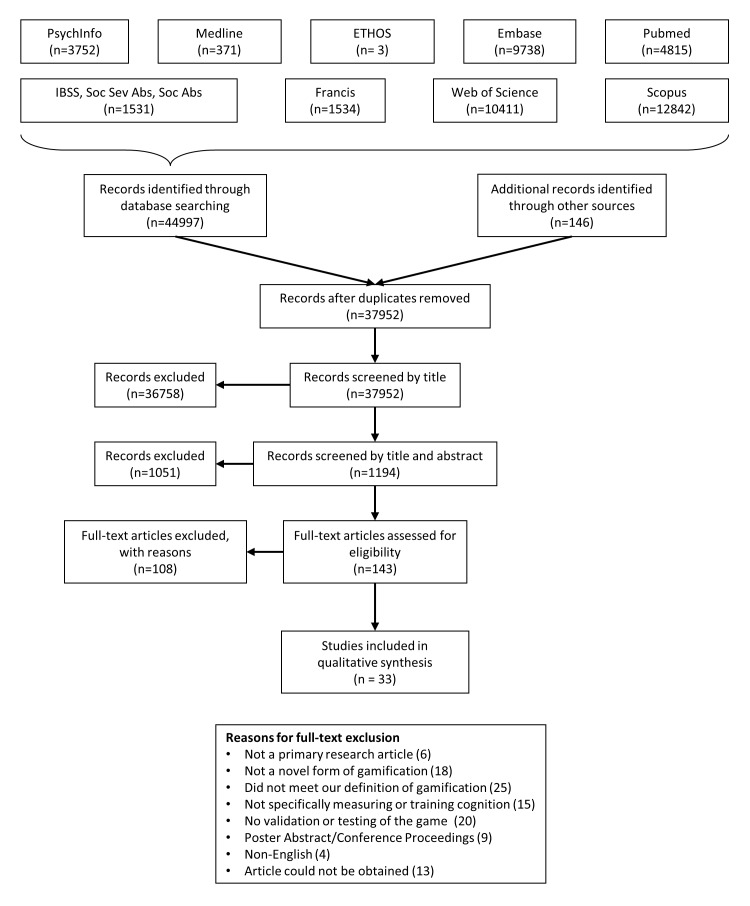
- Systematic search of PsycInfo, Medline, ETHOS, EMBASE, PubMed, IBSS, Francis, Web of Science, and Scopus using `(gamif* OR game OR games) AND (cognit* OR engag* OR behavi* OR health* OR attention OR motiv*)`, limited to English papers from January 2007 to October 2015.
- Inclusion required primary empirical research on a novel gamelike task designed to assess or train cognition and either validated or piloted; non–peer-reviewed papers, education/health-promotion/rehabilitation gamification, and non-gamelike VR/3D environments were excluded.
- Papers were screened by one reviewer (JL) in three stages, with a second reviewer (EE) rescreening 20% from the title stage onward; inter-rater agreement was moderate (k=.526, 95% CI 0.416–0.633, P<.001).
Limitations
- The paper states that the review required a narrow scope focused on cognitive training and testing, which led to some papers being excluded on the subjective basis of not being “cognitive research,” and that many included studies were preliminary, making findings tentative.
- The paper states that sample sizes were small in nearly all reviewed studies and only 5 of 33 papers described a power calculation.
- Evident from the text: many training games used only a gamified task, so the effect of gamification could not be dissociated from the intervention effect, and validation standards were heterogeneous.
Model-written summary. Check it against the paper before relying on it.
Integrity signals
Registry
Cites
Statistics
Figures
Verification
Claims the paper makes
54 Not checked yet · 28 Own result · 20 Own interpretation · 19 No basis given · 4 Own method · 1 Supported
The paper states this without a source or data behind it here, so there is nothing to check it against. The quote shows it is in the paper.
In the paper
“Gamified tests were typically validated successfully”
§ Gamification of Cognitive Assessment and Cognitive Training: A Systematic Review of Applications and Efficacy > Abstract > Results
plain- Asserted: passes — The authors put it forward as true.
- Checkable: passes — It can be checked against evidence.
- Load-bearing: passes — The paper’s conclusions depend on it.
- Based: passes — The paper gives a reason why it holds.
A result the paper reports from its own data — it cites no other source for it, so there is none to check. The quote shows it is in the paper.
In the paper
“We found that working memory and general executive functions were common targets for both gamified assessment and training.”
§ Gamification of Cognitive Assessment and Cognitive Training: A Systematic Review of Applications and Efficacy > Abstract > Results
plaincorrelational- Asserted: passes — The authors put it forward as true.
- Checkable: passes — It can be checked against evidence.
- Load-bearing: unclear — It is unclear whether the paper’s conclusions depend on it.
- Based: passes — The paper gives a reason why it holds.
The paper states this without a source or data behind it here, so there is nothing to check it against. The quote shows it is in the paper.
In the paper
“although mixed-domain measurement was a problem”
§ Gamification of Cognitive Assessment and Cognitive Training: A Systematic Review of Applications and Efficacy > Abstract > Results
plain- Asserted: passes — The authors put it forward as true.
- Checkable: passes — It can be checked against evidence.
- Load-bearing: unclear — It is unclear whether the paper’s conclusions depend on it.
- Based: passes — The paper gives a reason why it holds.
A result the paper reports from its own data — it cites no other source for it, so there is none to check. The quote shows it is in the paper.
In the paper
“mixed effects of gamification on task performance were reported”
§ Gamification of Cognitive Assessment and Cognitive Training: A Systematic Review of Applications and Efficacy > Abstract > Results
plain- Asserted: passes — The authors put it forward as true.
- Checkable: passes — It can be checked against evidence.
- Load-bearing: passes — The paper’s conclusions depend on it.
- Based: passes — The paper gives a reason why it holds.
A result the paper reports from its own data — it cites no other source for it, so there is none to check. The quote shows it is in the paper.
In the paper
“We identified 7 reasons for researchers opting to gamify their cognitive training and testing.”
§ Gamification of Cognitive Assessment and Cognitive Training: A Systematic Review of Applications and Efficacy > Abstract > Results
plain- Asserted: passes — The authors put it forward as true.
- Checkable: passes — It can be checked against evidence.
- Load-bearing: unclear — It is unclear whether the paper’s conclusions depend on it.
- Based: passes — The paper gives a reason why it holds.
The paper states this without a source or data behind it here, so there is nothing to check it against. The quote shows it is in the paper.
In the paper
“Three of the 6 games were very simplistic, with only a few specific game mechanics and carefully designed nongame controls, to make the effects of the game mechanics on the data as apparent as possible.”
§ Gamification of Cognitive Assessment and Cognitive Training: A Systematic Review of Applications and Efficacy > Results > Why Do Researchers Use Gamification?
plain- Asserted: passes — The authors put it forward as true.
- Checkable: passes — It can be checked against evidence.
- Load-bearing: unclear — It is unclear whether the paper’s conclusions depend on it.
- Based: passes — The paper gives a reason why it holds.
A result the paper reports from its own data — it cites no other source for it, so there is none to check. The quote shows it is in the paper.
In the paper
“we found 11 studies (8 games) that used gamification to reduce participant dropout rates over a protracted testing or training programme.”
§ Gamification of Cognitive Assessment and Cognitive Training: A Systematic Review of Applications and Efficacy > Results > Why Do Researchers Use Gamification?
plaindirect- Asserted: passes — The authors put it forward as true.
- Checkable: passes — It can be checked against evidence.
- Load-bearing: unclear — It is unclear whether the paper’s conclusions depend on it.
- Based: passes — The paper gives a reason why it holds.
None of the sources cited for this claim have been checked yet.
In the paper
“Six studies cited evidence that playing video games can be cognitively beneficial and/or stimulating as a key factor in their decision to gamify.”
§ Gamification of Cognitive Assessment and Cognitive Training: A Systematic Review of Applications and Efficacy > Results > Why Do Researchers Use Gamification?
plainconditional- Asserted: passes — The authors put it forward as true.
- Checkable: passes — It can be checked against evidence.
- Load-bearing: unclear — It is unclear whether the paper’s conclusions depend on it.
- Based: passes — The paper gives a reason why it holds.
In the paper
“Five other games were aimed at young children, and reframed the cognitive assessment as a game, to test the children under optimal mental conditions [41].”
§ Gamification of Cognitive Assessment and Cognitive Training: A Systematic Review of Applications and Efficacy > Results > Why Do Researchers Use Gamification?
What the sources say
- Not checked yetcites [41] source
plain- Asserted: passes — The authors put it forward as true.
- Checkable: passes — It can be checked against evidence.
- Load-bearing: unclear — It is unclear whether the paper’s conclusions depend on it.
- Based: passes — The paper gives a reason why it holds.
A result the paper reports from its own data — it cites no other source for it, so there is none to check. The quote shows it is in the paper.
In the paper
“Eleven tasks were gamified specifically to enhance appeal with a given age group”
§ Gamification of Cognitive Assessment and Cognitive Training: A Systematic Review of Applications and Efficacy > Results > Why Do Researchers Use Gamification?
plaindirect- Asserted: passes — The authors put it forward as true.
- Checkable: passes — It can be checked against evidence.
- Load-bearing: unclear — It is unclear whether the paper’s conclusions depend on it.
- Based: passes — The paper gives a reason why it holds.
None of the sources cited for this claim have been checked yet.
In the paper
“A common feature was that task sessions were kept as short as possible to make them more convenient and to increase likelihood of completion [28,32].”
§ Gamification of Cognitive Assessment and Cognitive Training: A Systematic Review of Applications and Efficacy > Results > Why Do Researchers Use Gamification?
plaindirect- Asserted: passes — The authors put it forward as true.
- Checkable: passes — It can be checked against evidence.
- Load-bearing: unclear — It is unclear whether the paper’s conclusions depend on it.
- Based: passes — The paper gives a reason why it holds.
A result the paper reports from its own data — it cites no other source for it, so there is none to check. The quote shows it is in the paper.
In the paper
“we found 6 studies (covering 4 games) designed for people with attention deficit/hyperactivity disorder (ADHD).”
§ Gamification of Cognitive Assessment and Cognitive Training: A Systematic Review of Applications and Efficacy > Results > Why Do Researchers Use Gamification?
plain- Asserted: passes — The authors put it forward as true.
- Checkable: passes — It can be checked against evidence.
- Load-bearing: unclear — It is unclear whether the paper’s conclusions depend on it.
- Based: passes — The paper gives a reason why it holds.
None of the sources cited for this claim have been checked yet.
In the paper
“Six games were designed to be suitable for the elderly”
§ Gamification of Cognitive Assessment and Cognitive Training: A Systematic Review of Applications and Efficacy > Results > Why Do Researchers Use Gamification?
plain- Asserted: passes — The authors put it forward as true.
- Checkable: passes — It can be checked against evidence.
- Load-bearing: unclear — It is unclear whether the paper’s conclusions depend on it.
- Based: passes — The paper gives a reason why it holds.
A result the paper reports from its own data — it cites no other source for it, so there is none to check. The quote shows it is in the paper.
In the paper
“Working memory was the most commonly tested domain.”
§ Gamification of Cognitive Assessment and Cognitive Training: A Systematic Review of Applications and Efficacy > Results > What Are the Application Areas of Gamification?
plain- Asserted: passes — The authors put it forward as true.
- Checkable: passes — It can be checked against evidence.
- Load-bearing: unclear — It is unclear whether the paper’s conclusions depend on it.
- Based: passes — The paper gives a reason why it holds.
A result the paper reports from its own data — it cites no other source for it, so there is none to check. The quote shows it is in the paper.
In the paper
“We identified 6 studies that used gamified tasks to test cognition in an engaging close-to-life environment or enhance transferability of learned skills.”
§ Gamification of Cognitive Assessment and Cognitive Training: A Systematic Review of Applications and Efficacy > Results > Why Do Researchers Use Gamification?
plain- Asserted: passes — The authors put it forward as true.
- Checkable: passes — It can be checked against evidence.
- Load-bearing: unclear — It is unclear whether the paper’s conclusions depend on it.
- Based: passes — The paper gives a reason why it holds.
A result the paper reports from its own data — it cites no other source for it, so there is none to check. The quote shows it is in the paper.
In the paper
“only 5 studies explicitly stated that their aim was to assess the motivational and cognitive effects of gamelike features.”
§ Gamification of Cognitive Assessment and Cognitive Training: A Systematic Review of Applications and Efficacy > Results > Why Do Researchers Use Gamification?
plain- Asserted: passes — The authors put it forward as true.
- Checkable: passes — It can be checked against evidence.
- Load-bearing: unclear — It is unclear whether the paper’s conclusions depend on it.
- Based: passes — The paper gives a reason why it holds.
None of the sources cited for this claim have been checked yet.
In the paper
“Some studies found that their gamified tests were correlated with measures of multiple cognitive domains, in other words, they were mixed-domain measures.”
§ Gamification of Cognitive Assessment and Cognitive Training: A Systematic Review of Applications and Efficacy > Results > Does Gamification Work?
plaincorrelational- Asserted: passes — The authors put it forward as true.
- Checkable: passes — It can be checked against evidence.
- Load-bearing: passes — The paper’s conclusions depend on it.
- Based: passes — The paper gives a reason why it holds.
None of the sources cited for this claim have been checked yet.
In the paper
“However, sample correlations from some of the simpler validation studies suggest intertask correlations of 0.45-0.60 [28,37,39,63].”
§ Gamification of Cognitive Assessment and Cognitive Training: A Systematic Review of Applications and Efficacy > Results > Does Gamification Work?
What the sources say
hedgedcorrelational- Asserted: passes — The authors put it forward as true.
- Checkable: passes — It can be checked against evidence.
- Load-bearing: passes — The paper’s conclusions depend on it.
- Based: passes — The paper gives a reason why it holds.
A result the paper reports from its own data — it cites no other source for it, so there is none to check. The quote shows it is in the paper.
In the paper
“We identified 21 of 33 studies that compared a gamelike task directly against a nongamified counterpart”
§ Gamification of Cognitive Assessment and Cognitive Training: A Systematic Review of Applications and Efficacy > Results > Does Gamification Work?
plain- Asserted: passes — The authors put it forward as true.
- Checkable: passes — It can be checked against evidence.
- Load-bearing: passes — The paper’s conclusions depend on it.
- Based: passes — The paper gives a reason why it holds.
In the paper
“However, a second paper detailing 2 experiments which aimed to replicate the previous finding found that Space Code’s correlations with measures of working memory, visuospatial ability, and processing speed were not stable [18].”
§ Gamification of Cognitive Assessment and Cognitive Training: A Systematic Review of Applications and Efficacy > Results > Does Gamification Work?
What the sources say
- Not checked yetcites [18] source
plaincorrelational- Asserted: passes — The authors put it forward as true.
- Checkable: passes — It can be checked against evidence.
- Load-bearing: passes — The paper’s conclusions depend on it.
- Based: passes — The paper gives a reason why it holds.
The paper states this without a source or data behind it here, so there is nothing to check it against. The quote shows it is in the paper.
In the paper
“Retirement Party was compared against the Continuous Performance Task-II in healthy controls and adults with ADHD.”
§ Gamification of Cognitive Assessment and Cognitive Training: A Systematic Review of Applications and Efficacy > Results > Does Gamification Work?
plain- Asserted: passes — The authors put it forward as true.
- Checkable: passes — It can be checked against evidence.
- Load-bearing: passes — The paper’s conclusions depend on it.
- Based: passes — The paper gives a reason why it holds.
The paper states this without a source or data behind it here, so there is nothing to check it against. The quote shows it is in the paper.
In the paper
“though mixed-domain measures were an issue”
§ Gamification of Cognitive Assessment and Cognitive Training: A Systematic Review of Applications and Efficacy > Results > Does Gamification Work?
plain- Asserted: passes — The authors put it forward as true.
- Checkable: passes — It can be checked against evidence.
- Load-bearing: unclear — It is unclear whether the paper’s conclusions depend on it.
- Based: passes — The paper gives a reason why it holds.
The paper states this without a source or data behind it here, so there is nothing to check it against. The quote shows it is in the paper.
In the paper
“Most gamified assessments were validated successfully.”
§ Gamification of Cognitive Assessment and Cognitive Training: A Systematic Review of Applications and Efficacy > Results > Does Gamification Work?
plain- Asserted: passes — The authors put it forward as true.
- Checkable: passes — It can be checked against evidence.
- Load-bearing: passes — The paper’s conclusions depend on it.
- Based: passes — The paper gives a reason why it holds.
A result the paper reports from its own data — it cites no other source for it, so there is none to check. The quote shows it is in the paper.
In the paper
“Where reported, subjective and objective measures of participant engagement were positive.”
§ Gamification of Cognitive Assessment and Cognitive Training: A Systematic Review of Applications and Efficacy > Results > Does Gamification Work?
plain- Asserted: passes — The authors put it forward as true.
- Checkable: passes — It can be checked against evidence.
- Load-bearing: unclear — It is unclear whether the paper’s conclusions depend on it.
- Based: passes — The paper gives a reason why it holds.
None of the sources cited for this claim have been checked yet.
In the paper
“Wii Tests [21], Shapebuilder [37], The Great Brain Experiment [32,39], BAM-COG [28], and Tap the Hedgehog [27] were all found to produce output measures/scores that correlated fairly well with their non–gamelike counterparts”
§ Gamification of Cognitive Assessment and Cognitive Training: A Systematic Review of Applications and Efficacy > Results > Does Gamification Work?
What the sources say
plaincorrelational- Asserted: passes — The authors put it forward as true.
- Checkable: passes — It can be checked against evidence.
- Load-bearing: passes — The paper’s conclusions depend on it.
- Based: passes — The paper gives a reason why it holds.
None of the sources cited for this claim have been checked yet.
In the paper
“Space Code [17,18] had similar problems.”
§ Gamification of Cognitive Assessment and Cognitive Training: A Systematic Review of Applications and Efficacy > Results > Does Gamification Work?
What the sources say
plaincorrelational- Asserted: passes — The authors put it forward as true.
- Checkable: passes — It can be checked against evidence.
- Load-bearing: passes — The paper’s conclusions depend on it.
- Based: passes — The paper gives a reason why it holds.
A result the paper reports from its own data — it cites no other source for it, so there is none to check. The quote shows it is in the paper.
In the paper
“All studies that measured intrinsic motivation reported that the use of gamelike tasks improved motivation, compared with nongamified versions.”
§ Gamification of Cognitive Assessment and Cognitive Training: A Systematic Review of Applications and Efficacy > Results > Does Gamification Work?
plaindirect- Asserted: passes — The authors put it forward as true.
- Checkable: passes — It can be checked against evidence.
- Load-bearing: unclear — It is unclear whether the paper’s conclusions depend on it.
- Based: passes — The paper gives a reason why it holds.
A result the paper reports from its own data — it cites no other source for it, so there is none to check. The quote shows it is in the paper.
In the paper
“We identified 7 reasons why researchers use gamification in cognitive research.”
§ Gamification of Cognitive Assessment and Cognitive Training: A Systematic Review of Applications and Efficacy > Discussion > Principal Results
plain- Asserted: passes — The authors put it forward as true.
- Checkable: passes — It can be checked against evidence.
- Load-bearing: passes — The paper’s conclusions depend on it.
- Based: passes — The paper gives a reason why it holds.
The paper states this without a source or data behind it here, so there is nothing to check it against. The quote shows it is in the paper.
In the paper
“Several studies aimed to reduce test anxiety and optimize performance in groups that traditionally dislike being tested, particularly electronically, such as elderly people and children.”
§ Gamification of Cognitive Assessment and Cognitive Training: A Systematic Review of Applications and Efficacy > Discussion > Principal Results
plaindirect- Asserted: passes — The authors put it forward as true.
- Checkable: passes — It can be checked against evidence.
- Load-bearing: passes — The paper’s conclusions depend on it.
- Based: passes — The paper gives a reason why it holds.
The paper states this without a source or data behind it here, so there is nothing to check it against. The quote shows it is in the paper.
In the paper
“Several games simply presented themselves as “puzzles” which the participant had to complete.”
§ Gamification of Cognitive Assessment and Cognitive Training: A Systematic Review of Applications and Efficacy > Discussion > Differences Between Training and Assessment Tasks
plain- Asserted: passes — The authors put it forward as true.
- Checkable: passes — It can be checked against evidence.
- Load-bearing: unclear — It is unclear whether the paper’s conclusions depend on it.
- Based: passes — The paper gives a reason why it holds.
A result the paper reports from its own data — it cites no other source for it, so there is none to check. The quote shows it is in the paper.
In the paper
“Sample sizes were small in nearly all of the studies we reviewed”
§ Gamification of Cognitive Assessment and Cognitive Training: A Systematic Review of Applications and Efficacy > Discussion > Validating Gamified Tasks
plain- Asserted: passes — The authors put it forward as true.
- Checkable: passes — It can be checked against evidence.
- Load-bearing: passes — The paper’s conclusions depend on it.
- Based: passes — The paper gives a reason why it holds.
The paper states this without a source or data behind it here, so there is nothing to check it against. The quote shows it is in the paper.
In the paper
“Typically, cognitive assessment games were validated rigorously, using correlation with similar cognitive tasks and factor analysis to determine whether they were performing as expected.”
§ Gamification of Cognitive Assessment and Cognitive Training: A Systematic Review of Applications and Efficacy > Discussion > Validating Gamified Tasks
plain- Asserted: passes — The authors put it forward as true.
- Checkable: passes — It can be checked against evidence.
- Load-bearing: unclear — It is unclear whether the paper’s conclusions depend on it.
- Based: passes — The paper gives a reason why it holds.
The paper states this without a source or data behind it here, so there is nothing to check it against. The quote shows it is in the paper.
In the paper
“Long-term goals which had to be completed over repeated sessions were also common”
§ Gamification of Cognitive Assessment and Cognitive Training: A Systematic Review of Applications and Efficacy > Discussion > Differences Between Training and Assessment Tasks
plain- Asserted: passes — The authors put it forward as true.
- Checkable: passes — It can be checked against evidence.
- Load-bearing: unclear — It is unclear whether the paper’s conclusions depend on it.
- Based: passes — The paper gives a reason why it holds.
None of the sources cited for this claim have been checked yet.
In the paper
“and there were some indications that it may actually worsen it [17,18,34,36].”
§ Gamification of Cognitive Assessment and Cognitive Training: A Systematic Review of Applications and Efficacy > Discussion > Conclusions
What the sources say
hedgedconditional- Asserted: passes — The authors put it forward as true.
- Checkable: passes — It can be checked against evidence.
- Load-bearing: passes — The paper’s conclusions depend on it.
- Based: passes — The paper gives a reason why it holds.
A result the paper reports from its own data — it cites no other source for it, so there is none to check. The quote shows it is in the paper.
In the paper
“and there was little consideration of statistical power when sample sizes were decided upon, with only 5 of 33 papers describing a power calculation.”
§ Gamification of Cognitive Assessment and Cognitive Training: A Systematic Review of Applications and Efficacy > Discussion > Validating Gamified Tasks
plain- Asserted: passes — The authors put it forward as true.
- Checkable: passes — It can be checked against evidence.
- Load-bearing: passes — The paper’s conclusions depend on it.
- Based: passes — The paper gives a reason why it holds.
None of the sources cited for this claim have been checked yet.
In the paper
“Furthermore, despite concerns that some commonly used game mechanics might reduce participant motivation [72] (such as by having a visibly low score [73]), we saw no evidence that this was the case.”
§ Gamification of Cognitive Assessment and Cognitive Training: A Systematic Review of Applications and Efficacy > Discussion > Conclusions
plain- Asserted: passes — The authors put it forward as true.
- Checkable: passes — It can be checked against evidence.
- Load-bearing: passes — The paper’s conclusions depend on it.
- Based: passes — The paper gives a reason why it holds.
A result the paper reports from its own data — it cites no other source for it, so there is none to check. The quote shows it is in the paper.
In the paper
“We found heterogeneous standards for validating gamified tasks.”
§ Gamification of Cognitive Assessment and Cognitive Training: A Systematic Review of Applications and Efficacy > Discussion > Validating Gamified Tasks
plain- Asserted: passes — The authors put it forward as true.
- Checkable: passes — It can be checked against evidence.
- Load-bearing: passes — The paper’s conclusions depend on it.
- Based: passes — The paper gives a reason why it holds.
A result the paper reports from its own data — it cites no other source for it, so there is none to check. The quote shows it is in the paper.
In the paper
“We did, however, find some evidence that gamification may be effective at enhancing cognitive training”
§ Gamification of Cognitive Assessment and Cognitive Training: A Systematic Review of Applications and Efficacy > Discussion > Conclusions
hedgedconditional- Asserted: passes — The authors put it forward as true.
- Checkable: passes — It can be checked against evidence.
- Load-bearing: passes — The paper’s conclusions depend on it.
- Based: passes — The paper gives a reason why it holds.
In the paper
“There is evidence that a lack of participant motivation has a negative impact on the quality of data collected [4]”
§ Gamification of Cognitive Assessment and Cognitive Training: A Systematic Review of Applications and Efficacy > Introduction
What the sources say
- Not checked yetcites [4] source
plaindirect- Asserted: passes — The authors put it forward as true.
- Checkable: passes — It can be checked against evidence.
- Load-bearing: passes — The paper’s conclusions depend on it.
- Based: passes — The paper gives a reason why it holds.
In the paper
“This is a particular problem for Web-based studies where participants can simply close the browser window and drop out of the study the moment they decide it is not worth their time [5].”
§ Gamification of Cognitive Assessment and Cognitive Training: A Systematic Review of Applications and Efficacy > Introduction
What the sources say
- Not checked yetcites [5] source
plaindirect- Asserted: passes — The authors put it forward as true.
- Checkable: passes — It can be checked against evidence.
- Load-bearing: passes — The paper’s conclusions depend on it.
- Based: passes — The paper gives a reason why it holds.
A conclusion the paper draws from its own results — it cites no other source for it, so there is none to check. The quote shows it is in the paper.
In the paper
“Nevertheless, careful application of gamification can provide a way to develop engaging and yet scientifically valid cognitive assessments”
§ Gamification of Cognitive Assessment and Cognitive Training: A Systematic Review of Applications and Efficacy > Abstract > Conclusions
plainconditional- Asserted: passes — The authors put it forward as true.
- Checkable: passes — It can be checked against evidence.
- Load-bearing: passes — The paper’s conclusions depend on it.
- Based: passes — The paper gives a reason why it holds.
In the paper
“It is commonly reported that ADHD patients are compulsive computer game players [23].”
§ Gamification of Cognitive Assessment and Cognitive Training: A Systematic Review of Applications and Efficacy > Results > Why Do Researchers Use Gamification?
What the sources say
- Not checked yetcites [23] source
plaincorrelational- Asserted: passes — The authors put it forward as true.
- Checkable: passes — It can be checked against evidence.
- Load-bearing: passes — The paper’s conclusions depend on it.
- Based: passes — The paper gives a reason why it holds.
None of the sources cited for this claim have been checked yet.
In the paper
“Cognitive training has often suffered from a lack of transferability [57-59]. Although participants may improve at the training task, these improvements do not generalize to the real world.”
§ Gamification of Cognitive Assessment and Cognitive Training: A Systematic Review of Applications and Efficacy > Results > Why Do Researchers Use Gamification?
What the sources say
plain- Asserted: passes — The authors put it forward as true.
- Checkable: passes — It can be checked against evidence.
- Load-bearing: passes — The paper’s conclusions depend on it.
- Based: passes — The paper gives a reason why it holds.
A conclusion the paper draws from its own results — it cites no other source for it, so there is none to check. The quote shows it is in the paper.
In the paper
“Gamification also has the potential to invalidate a task.”
§ Gamification of Cognitive Assessment and Cognitive Training: A Systematic Review of Applications and Efficacy > Results > Does Gamification Work?
hedgedconditional- Asserted: passes — The authors put it forward as true.
- Checkable: passes — It can be checked against evidence.
- Load-bearing: passes — The paper’s conclusions depend on it.
- Based: passes — The paper gives a reason why it holds.
In the paper
“and the €10 condition and the gaming condition (Megabot) prevented this decrease.”
§ Gamification of Cognitive Assessment and Cognitive Training: A Systematic Review of Applications and Efficacy > Results > Does Gamification Work?
What the sources say
- Not checked yetcites [22] source
plaindirect- Asserted: passes — The authors put it forward as true.
- Checkable: passes — It can be checked against evidence.
- Load-bearing: passes — The paper’s conclusions depend on it.
- Based: passes — The paper gives a reason why it holds.
In the paper
“These results indicate that performance problems in ADHD training might be somewhat alleviated through the use of gamelike tasks.”
§ Gamification of Cognitive Assessment and Cognitive Training: A Systematic Review of Applications and Efficacy > Results > Does Gamification Work?
What the sources say
- Not checked yetcites [22] source
hedgedconditional- Asserted: passes — The authors put it forward as true.
- Checkable: passes — It can be checked against evidence.
- Load-bearing: passes — The paper’s conclusions depend on it.
- Based: passes — The paper gives a reason why it holds.
In the paper
“with higher accuracy (69% vs 51%), when trained using a gamified working memory training task as opposed to a non–gamelike one.”
§ Gamification of Cognitive Assessment and Cognitive Training: A Systematic Review of Applications and Efficacy > Results > Does Gamification Work?
What the sources say
- Not checked yetcites [24] source
plaindirect- Asserted: passes — The authors put it forward as true.
- Checkable: passes — It can be checked against evidence.
- Load-bearing: passes — The paper’s conclusions depend on it.
- Based: passes — The paper gives a reason why it holds.
In the paper
“However, ADHD children also experienced a decrease in performance over time”
§ Gamification of Cognitive Assessment and Cognitive Training: A Systematic Review of Applications and Efficacy > Results > Does Gamification Work?
What the sources say
- Not checked yetcites [22] source
plaindirect- Asserted: passes — The authors put it forward as true.
- Checkable: passes — It can be checked against evidence.
- Load-bearing: passes — The paper’s conclusions depend on it.
- Based: passes — The paper gives a reason why it holds.
A conclusion the paper draws from its own results — it cites no other source for it, so there is none to check. The quote shows it is in the paper.
In the paper
“this likely invalidates the game as a diagnostic tool for ADHD.”
§ Gamification of Cognitive Assessment and Cognitive Training: A Systematic Review of Applications and Efficacy > Results > Does Gamification Work?
hedged- Asserted: passes — The authors put it forward as true.
- Checkable: passes — It can be checked against evidence.
- Load-bearing: passes — The paper’s conclusions depend on it.
- Based: passes — The paper gives a reason why it holds.
In the paper
“ADHD children completed more training trials (M=199.48, SD=47.46 vs M=134.43, SD=34.18)”
§ Gamification of Cognitive Assessment and Cognitive Training: A Systematic Review of Applications and Efficacy > Results > Does Gamification Work?
What the sources say
- Not checked yetcites [24] source
plaindirect- Asserted: passes — The authors put it forward as true.
- Checkable: passes — It can be checked against evidence.
- Load-bearing: passes — The paper’s conclusions depend on it.
- Based: passes — The paper gives a reason why it holds.
In the paper
“They found that regardless of incentive, ADHD children did not perform as well as healthy controls.”
§ Gamification of Cognitive Assessment and Cognitive Training: A Systematic Review of Applications and Efficacy > Results > Does Gamification Work?
What the sources say
- Not checked yetcites [22] source
plain- Asserted: passes — The authors put it forward as true.
- Checkable: passes — It can be checked against evidence.
- Load-bearing: unclear — It is unclear whether the paper’s conclusions depend on it.
- Based: passes — The paper gives a reason why it holds.
In the paper
“Points appeared to have no effect on data”
§ Gamification of Cognitive Assessment and Cognitive Training: A Systematic Review of Applications and Efficacy > Results > Does Gamification Work?
What the sources say
- Not checked yetcites [36] source
hedged- Asserted: passes — The authors put it forward as true.
- Checkable: passes — It can be checked against evidence.
- Load-bearing: unclear — It is unclear whether the paper’s conclusions depend on it.
- Based: passes — The paper gives a reason why it holds.
In the paper
“They compared training improvement across conditions and found that the greatest training effect was caused by versions with minimal motivational features.”
§ Gamification of Cognitive Assessment and Cognitive Training: A Systematic Review of Applications and Efficacy > Results > Does Gamification Work?
What the sources say
- Not checked yetcites [34] source
plaindirect- Asserted: passes — The authors put it forward as true.
- Checkable: passes — It can be checked against evidence.
- Load-bearing: unclear — It is unclear whether the paper’s conclusions depend on it.
- Based: passes — The paper gives a reason why it holds.
In the paper
“and boosted subjective engagement scores.”
§ Gamification of Cognitive Assessment and Cognitive Training: A Systematic Review of Applications and Efficacy > Results > Does Gamification Work?
What the sources say
- Not checked yetcites [36] source
plaindirect- Asserted: passes — The authors put it forward as true.
- Checkable: passes — It can be checked against evidence.
- Load-bearing: unclear — It is unclear whether the paper’s conclusions depend on it.
- Based: passes — The paper gives a reason why it holds.
In the paper
“Participants were also more willing to perform training when in the gamelike condition.”
§ Gamification of Cognitive Assessment and Cognitive Training: A Systematic Review of Applications and Efficacy > Results > Does Gamification Work?
What the sources say
- Not checked yetcites [38] source
plaindirect- Asserted: passes — The authors put it forward as true.
- Checkable: passes — It can be checked against evidence.
- Load-bearing: unclear — It is unclear whether the paper’s conclusions depend on it.
- Based: passes — The paper gives a reason why it holds.
In the paper
“These results highlight the delicate nature of designing gamified cognitive tests because something as innocuous as a few sound effects had deleterious effects on participant performance.”
§ Gamification of Cognitive Assessment and Cognitive Training: A Systematic Review of Applications and Efficacy > Results > Does Gamification Work?
What the sources say
- Not checked yetcites [36] source
plaindirect- Asserted: passes — The authors put it forward as true.
- Checkable: passes — It can be checked against evidence.
- Load-bearing: unclear — It is unclear whether the paper’s conclusions depend on it.
- Based: passes — The paper gives a reason why it holds.
In the paper
“Ninaus et al, presenting evidence that gamification can improve overall participant performance in a working memory training task [48]”
§ Gamification of Cognitive Assessment and Cognitive Training: A Systematic Review of Applications and Efficacy > Results > Does Gamification Work?
What the sources say
- Not checked yetcites [48] ErikssonBMusialikMWagnerJStudent essay20120862016-07-08Gamification - Engaging the Future https://gupea.ub.gu.se/handle/2077/30037
plaindirect- Asserted: passes — The authors put it forward as true.
- Checkable: passes — It can be checked against evidence.
- Load-bearing: passes — The paper’s conclusions depend on it.
- Based: passes — The paper gives a reason why it holds.
In the paper
“and none of the conditions made any difference on subjective motivation scores.”
§ Gamification of Cognitive Assessment and Cognitive Training: A Systematic Review of Applications and Efficacy > Results > Does Gamification Work?
What the sources say
- Not checked yetcites [34] source
plain- Asserted: passes — The authors put it forward as true.
- Checkable: passes — It can be checked against evidence.
- Load-bearing: unclear — It is unclear whether the paper’s conclusions depend on it.
- Based: passes — The paper gives a reason why it holds.
In the paper
“but that the gamelike versions were more interesting and enjoyable.”
§ Gamification of Cognitive Assessment and Cognitive Training: A Systematic Review of Applications and Efficacy > Results > Does Gamification Work?
What the sources say
- Not checked yetcites [9] source
plain- Asserted: passes — The authors put it forward as true.
- Checkable: passes — It can be checked against evidence.
- Load-bearing: passes — The paper’s conclusions depend on it.
- Based: passes — The paper gives a reason why it holds.
In the paper
“They found that sound effects led to increased reaction times”
§ Gamification of Cognitive Assessment and Cognitive Training: A Systematic Review of Applications and Efficacy > Results > Does Gamification Work?
What the sources say
- Not checked yetcites [36] source
plaindirect- Asserted: passes — The authors put it forward as true.
- Checkable: passes — It can be checked against evidence.
- Load-bearing: passes — The paper’s conclusions depend on it.
- Based: passes — The paper gives a reason why it holds.
In the paper
“Subjective ratings indicated that both versions of both tasks were equally boring and repetitive”
§ Gamification of Cognitive Assessment and Cognitive Training: A Systematic Review of Applications and Efficacy > Results > Does Gamification Work?
What the sources say
- Not checked yetcites [9] source
hedged- Asserted: passes — The authors put it forward as true.
- Checkable: passes — It can be checked against evidence.
- Load-bearing: unclear — It is unclear whether the paper’s conclusions depend on it.
- Based: passes — The paper gives a reason why it holds.
In the paper
“The fully gamified condition had one of the shallowest improvement slopes”
§ Gamification of Cognitive Assessment and Cognitive Training: A Systematic Review of Applications and Efficacy > Results > Does Gamification Work?
What the sources say
- Not checked yetcites [34] source
plaincorrelational- Asserted: passes — The authors put it forward as true.
- Checkable: passes — It can be checked against evidence.
- Load-bearing: passes — The paper’s conclusions depend on it.
- Based: passes — The paper gives a reason why it holds.
In the paper
“No difference between the data collected by the gamified versions and the nongame versions was found.”
§ Gamification of Cognitive Assessment and Cognitive Training: A Systematic Review of Applications and Efficacy > Results > Does Gamification Work?
What the sources say
- Not checked yetcites [9] source
plain- Asserted: passes — The authors put it forward as true.
- Checkable: passes — It can be checked against evidence.
- Load-bearing: passes — The paper’s conclusions depend on it.
- Based: passes — The paper gives a reason why it holds.
In the paper
“and did not improve scores of subjective engagement.”
§ Gamification of Cognitive Assessment and Cognitive Training: A Systematic Review of Applications and Efficacy > Results > Does Gamification Work?
What the sources say
- Not checked yetcites [36] source
plain- Asserted: passes — The authors put it forward as true.
- Checkable: passes — It can be checked against evidence.
- Load-bearing: unclear — It is unclear whether the paper’s conclusions depend on it.
- Based: passes — The paper gives a reason why it holds.
A conclusion the paper draws from its own results — it cites no other source for it, so there is none to check. The quote shows it is in the paper.
In the paper
“but we must take these positive training findings tentatively due to numerous methodologic problems in the studies that we reviewed.”
§ Gamification of Cognitive Assessment and Cognitive Training: A Systematic Review of Applications and Efficacy > Discussion > Conclusions
hedged- Asserted: passes — The authors put it forward as true.
- Checkable: passes — It can be checked against evidence.
- Load-bearing: passes — The paper’s conclusions depend on it.
- Based: passes — The paper gives a reason why it holds.
A conclusion the paper draws from its own results — it cites no other source for it, so there is none to check. The quote shows it is in the paper.
In the paper
“The results of this review also show that it is possible to design gamified cognitive assessments that validate well against more traditional measures, providing that caution is taken to avoid developing mixed-domain measures or masking deficits of interest.”
§ Gamification of Cognitive Assessment and Cognitive Training: A Systematic Review of Applications and Efficacy > Discussion > Conclusions
hedgedconditional- Asserted: passes — The authors put it forward as true.
- Checkable: passes — It can be checked against evidence.
- Load-bearing: passes — The paper’s conclusions depend on it.
- Based: passes — The paper gives a reason why it holds.
A conclusion the paper draws from its own results — it cites no other source for it, so there is none to check. The quote shows it is in the paper.
In the paper
“Gamified cognitive tasks are more engaging than traditional tasks”
§ Gamification of Cognitive Assessment and Cognitive Training: A Systematic Review of Applications and Efficacy > Discussion > Conclusions
plaindirect- Asserted: passes — The authors put it forward as true.
- Checkable: passes — It can be checked against evidence.
- Load-bearing: passes — The paper’s conclusions depend on it.
- Based: passes — The paper gives a reason why it holds.
None of the sources cited for this claim have been checked yet.
In the paper
“However, it is thought that playing video games can facilitate the release of extrastriatal dopamine, which plays a role in focusing attention and heightening arousal [68,69]”
§ Gamification of Cognitive Assessment and Cognitive Training: A Systematic Review of Applications and Efficacy > Discussion > Principal Results
What the sources say
hedgedconditional- Asserted: passes — The authors put it forward as true.
- Checkable: passes — It can be checked against evidence.
- Load-bearing: unclear — It is unclear whether the paper’s conclusions depend on it.
- Based: passes — The paper gives a reason why it holds.
A conclusion the paper draws from its own results — it cites no other source for it, so there is none to check. The quote shows it is in the paper.
In the paper
“Gamification is likely to play an important role in enabling this change”
§ Gamification of Cognitive Assessment and Cognitive Training: A Systematic Review of Applications and Efficacy > Discussion > Conclusions
hedgedconditional- Asserted: passes — The authors put it forward as true.
- Checkable: unclear — It is unclear whether it could be checked against evidence.
- Load-bearing: passes — The paper’s conclusions depend on it.
- Based: passes — The paper gives a reason why it holds.
- Rests on an assumption: Engagement will be the key to collecting high-quality data as cognitive research moves out of the laboratory and onto personal computers and mobile devices.
- It may state two separate claims as one. 44
- Probably not a substantial claim. 19
Every source the paper cites for this claim was checked and supports it.
In the paper
“They found that these gamelike features increased the effect of training, reducing reaction times and switch costs, compared against a non–gamelike version of the training.”
§ Gamification of Cognitive Assessment and Cognitive Training: A Systematic Review of Applications and Efficacy > Results > Does Gamification Work?
What the sources say
- Supportedcites [38] source
The Results (Training data) report smaller switch costs in the high-motivational game setting than in the low-motivational setting, with costs falling from 173 to 52 ms versus 244 to 179 ms. The Discussion (Training effects on task and switching performance) reports the greatest improvement in response latencies in the high-motivational switching group. The Results also note that these speed gains were accompanied by a slight decline in accuracy. (LLM, conf=0.90)
plaindirect- Asserted: passes — The authors put it forward as true.
- Checkable: passes — It can be checked against evidence.
- Load-bearing: passes — The paper’s conclusions depend on it.
- Based: passes — The paper gives a reason why it holds.
It may state two separate claims as one.
- Supported
The paper states this without a source or data behind it here, so there is nothing to check it against. The quote shows it is in the paper.
In the paper
“Gamified training appears to be highly engaging and does boost participant motivation”
§ Gamification of Cognitive Assessment and Cognitive Training: A Systematic Review of Applications and Efficacy > Abstract > Results
hedgeddirect- Asserted: passes — The authors put it forward as true.
- Checkable: passes — It can be checked against evidence.
- Load-bearing: passes — The paper’s conclusions depend on it.
- Based: passes — The paper gives a reason why it holds.
It may state two separate claims as one.
A result the paper reports from its own data — it cites no other source for it, so there is none to check. The quote shows it is in the paper.
In the paper
“Our review identified 33 relevant studies, covering 31 gamified cognitive tasks used across a range of disorders and cognitive domains.”
§ Gamification of Cognitive Assessment and Cognitive Training: A Systematic Review of Applications and Efficacy > Abstract > Results
plain- Asserted: passes — The authors put it forward as true.
- Checkable: passes — It can be checked against evidence.
- Load-bearing: unclear — It is unclear whether the paper’s conclusions depend on it.
- Based: passes — The paper gives a reason why it holds.
It may state two separate claims as one.
A result the paper reports from its own data — it cites no other source for it, so there is none to check. The quote shows it is in the paper.
In the paper
“we found 16 studies that explicitly used gamified tasks to measure or train cognition in a more motivating manner, and the majority (10 of 16) of these studies were assessment studies.”
§ Gamification of Cognitive Assessment and Cognitive Training: A Systematic Review of Applications and Efficacy > Results > Why Do Researchers Use Gamification?
plain- Asserted: passes — The authors put it forward as true.
- Checkable: passes — It can be checked against evidence.
- Load-bearing: unclear — It is unclear whether the paper’s conclusions depend on it.
- Based: passes — The paper gives a reason why it holds.
It may state two separate claims as one.
The paper states this without a source or data behind it here, so there is nothing to check it against. The quote shows it is in the paper.
In the paper
“Heterogeneous study designs and typically small sample sizes”
§ Gamification of Cognitive Assessment and Cognitive Training: A Systematic Review of Applications and Efficacy > Abstract > Conclusions
plain- Asserted: passes — The authors put it forward as true.
- Checkable: passes — It can be checked against evidence.
- Load-bearing: passes — The paper’s conclusions depend on it.
- Based: passes — The paper gives a reason why it holds.
It may state two separate claims as one.
The paper states this without a source or data behind it here, so there is nothing to check it against. The quote shows it is in the paper.
In the paper
“Many of these games were used in an unobserved, nonlaboratory setting; therefore, the tasks made use of motivational features that made the training and testing intrinsically more appealing and less of a burden to perform on a regular basis.”
§ Gamification of Cognitive Assessment and Cognitive Training: A Systematic Review of Applications and Efficacy > Results > Why Do Researchers Use Gamification?
plaindirect- Asserted: passes — The authors put it forward as true.
- Checkable: passes — It can be checked against evidence.
- Load-bearing: passes — The paper’s conclusions depend on it.
- Based: passes — The paper gives a reason why it holds.
It may state two separate claims as one.
None of the sources cited for this claim have been checked yet.
In the paper
“One game, Watermons [38], was designed, using Self Determination Theory [50,51], to maximize participant intrinsic motivation and make any motivational effects of game mechanics as apparent as possible.”
§ Gamification of Cognitive Assessment and Cognitive Training: A Systematic Review of Applications and Efficacy > Results > Why Do Researchers Use Gamification?
What the sources say
plaindirect- Asserted: passes — The authors put it forward as true.
- Checkable: passes — It can be checked against evidence.
- Load-bearing: unclear — It is unclear whether the paper’s conclusions depend on it.
- Based: passes — The paper gives a reason why it holds.
It may state two separate claims as one.
A result the paper reports from its own data — it cites no other source for it, so there is none to check. The quote shows it is in the paper.
In the paper
“Again, working memory was a popular target, closely followed by EF and inhibitory control training.”
§ Gamification of Cognitive Assessment and Cognitive Training: A Systematic Review of Applications and Efficacy > Results > What Are the Application Areas of Gamification?
plain- Asserted: passes — The authors put it forward as true.
- Checkable: passes — It can be checked against evidence.
- Load-bearing: unclear — It is unclear whether the paper’s conclusions depend on it.
- Based: passes — The paper gives a reason why it holds.
It may state two separate claims as one.
A result the paper reports from its own data — it cites no other source for it, so there is none to check. The quote shows it is in the paper.
In the paper
“Many games tested several cognitive domains and/or general EF, highlighting the difficulty of examining gamification effects on specific cognitive domains (and therefore comparing performance to standard cognitive tasks).”
§ Gamification of Cognitive Assessment and Cognitive Training: A Systematic Review of Applications and Efficacy > Results > What Are the Application Areas of Gamification?
plaincorrelational- Asserted: passes — The authors put it forward as true.
- Checkable: passes — It can be checked against evidence.
- Load-bearing: unclear — It is unclear whether the paper’s conclusions depend on it.
- Based: passes — The paper gives a reason why it holds.
It may state two separate claims as one.
A result the paper reports from its own data — it cites no other source for it, so there is none to check. The quote shows it is in the paper.
In the paper
“It is also worth noting that the numbers of studies investigating cognitive testing (17) and training (15) were very similar”
§ Gamification of Cognitive Assessment and Cognitive Training: A Systematic Review of Applications and Efficacy > Results > What Are the Application Areas of Gamification?
plain- Asserted: passes — The authors put it forward as true.
- Checkable: passes — It can be checked against evidence.
- Load-bearing: fails — The paper’s conclusions may not depend on it.
- Based: passes — The paper gives a reason why it holds.
Probably not a substantial claim. The paper’s conclusions may not depend on it.
A result the paper reports from its own data — it cites no other source for it, so there is none to check. The quote shows it is in the paper.
In the paper
“General executive function (EF), attention, and inhibition were also commonly tested domains.”
§ Gamification of Cognitive Assessment and Cognitive Training: A Systematic Review of Applications and Efficacy > Results > What Are the Application Areas of Gamification?
plain- Asserted: passes — The authors put it forward as true.
- Checkable: passes — It can be checked against evidence.
- Load-bearing: unclear — It is unclear whether the paper’s conclusions depend on it.
- Based: passes — The paper gives a reason why it holds.
It may state two separate claims as one.
The paper states this without a source or data behind it here, so there is nothing to check it against. The quote shows it is in the paper.
In the paper
“The Great Brain Experiment aimed to keep task sessions below 5 minutes in duration and found that the shortest task, the Stop Signal Task, was the most popular mini game.”
§ Gamification of Cognitive Assessment and Cognitive Training: A Systematic Review of Applications and Efficacy > Results > Why Do Researchers Use Gamification?
plaincorrelational- Asserted: passes — The authors put it forward as true.
- Checkable: passes — It can be checked against evidence.
- Load-bearing: fails — The paper’s conclusions may not depend on it.
- Based: passes — The paper gives a reason why it holds.
Probably not a substantial claim. The paper’s conclusions may not depend on it. It may state two separate claims as one.
A result the paper reports from its own data — it cites no other source for it, so there is none to check. The quote shows it is in the paper.
In the paper
“We found comparable numbers of games used for cognitive testing (17) and training (13), with one game that can be used for both testing and training”
§ Gamification of Cognitive Assessment and Cognitive Training: A Systematic Review of Applications and Efficacy > Results > What Are the Application Areas of Gamification?
plain- Asserted: passes — The authors put it forward as true.
- Checkable: passes — It can be checked against evidence.
- Load-bearing: unclear — It is unclear whether the paper’s conclusions depend on it.
- Based: passes — The paper gives a reason why it holds.
It may state two separate claims as one.
In the paper
“these games tended to build simple game-archetypes, such as space invaders or whack-a-mole, around an existing cognitive task; with the goal of encouraging self-motivation, improving participant enjoyment, and even reducing test anxiety [17].”
§ Gamification of Cognitive Assessment and Cognitive Training: A Systematic Review of Applications and Efficacy > Results > Why Do Researchers Use Gamification?
What the sources say
- Not checked yetcites [17] McPherson, J, 2007, Behav Res Methods source
plaindirect- Asserted: passes — The authors put it forward as true.
- Checkable: passes — It can be checked against evidence.
- Load-bearing: unclear — It is unclear whether the paper’s conclusions depend on it.
- Based: passes — The paper gives a reason why it holds.
It may state two separate claims as one.
In the paper
“For example, use of exploratory factor analysis showed that Whack-a-Mole’s primary output measure was correlated with 2 of the 3 EFs of interest: inhibition (r (22)=.60, P<.001) and updating (r (22) = .35, P<.05) [33].”
§ Gamification of Cognitive Assessment and Cognitive Training: A Systematic Review of Applications and Efficacy > Results > Does Gamification Work?
What the sources say
- Not checked yetcites [33] source
plaincorrelational- Asserted: passes — The authors put it forward as true.
- Checkable: passes — It can be checked against evidence.
- Load-bearing: passes — The paper’s conclusions depend on it.
- Based: passes — The paper gives a reason why it holds.
It may state two separate claims as one.
The paper states this without a source or data behind it here, so there is nothing to check it against. The quote shows it is in the paper.
In the paper
“Validation studies varied in their design, and some studies reported complex correlations between gamified and nongamified tasks with multiple outputs.”
§ Gamification of Cognitive Assessment and Cognitive Training: A Systematic Review of Applications and Efficacy > Results > Does Gamification Work?
plaincorrelational- Asserted: passes — The authors put it forward as true.
- Checkable: passes — It can be checked against evidence.
- Load-bearing: unclear — It is unclear whether the paper’s conclusions depend on it.
- Based: passes — The paper gives a reason why it holds.
It may state two separate claims as one.
A result the paper reports from its own data — it cites no other source for it, so there is none to check. The quote shows it is in the paper.
In the paper
“There is a smaller overlap in domains covered by cognitive training tasks; test batteries tend to test a wide range of domains, whereas training focuses on 1 or 2 domains exclusively.”
§ Gamification of Cognitive Assessment and Cognitive Training: A Systematic Review of Applications and Efficacy > Results > What Are the Application Areas of Gamification?
plaincorrelational- Asserted: passes — The authors put it forward as true.
- Checkable: passes — It can be checked against evidence.
- Load-bearing: unclear — It is unclear whether the paper’s conclusions depend on it.
- Based: passes — The paper gives a reason why it holds.
It may state two separate claims as one.
None of the sources cited for this claim have been checked yet.
In the paper
“The initial study was successful, with Space Code’s output measure correlating well with a conventional measure of processing speed (r (58)=.55, P<.001).”
§ Gamification of Cognitive Assessment and Cognitive Training: A Systematic Review of Applications and Efficacy > Results > Does Gamification Work?
boostedcorrelational- Asserted: passes — The authors put it forward as true.
- Checkable: passes — It can be checked against evidence.
- Load-bearing: unclear — It is unclear whether the paper’s conclusions depend on it.
- Based: passes — The paper gives a reason why it holds.
It may state two separate claims as one.
A result the paper reports from its own data — it cites no other source for it, so there is none to check. The quote shows it is in the paper.
In the paper
“The Continuous Performance Task-II detected more commission errors from the ADHD adults as expected (mean [M]=56, standard deviation [SD]=13 vs M=46, SD=10), but Retirement Party did not (M=14.4, SD=5.8 vs M=13.2, SD=4.3)”
§ Gamification of Cognitive Assessment and Cognitive Training: A Systematic Review of Applications and Efficacy > Results > Does Gamification Work?
plain- Asserted: passes — The authors put it forward as true.
- Checkable: passes — It can be checked against evidence.
- Load-bearing: passes — The paper’s conclusions depend on it.
- Based: passes — The paper gives a reason why it holds.
It may state two separate claims as one.
The paper states this without a source or data behind it here, so there is nothing to check it against. The quote shows it is in the paper.
In the paper
“We saw several games aimed at training and testing people with ADHD, and overall, these games appear highly engaging to users, in some cases, even increasing the time spent training.”
§ Gamification of Cognitive Assessment and Cognitive Training: A Systematic Review of Applications and Efficacy > Discussion > Principal Results
hedgeddirect- Asserted: passes — The authors put it forward as true.
- Checkable: passes — It can be checked against evidence.
- Load-bearing: unclear — It is unclear whether the paper’s conclusions depend on it.
- Based: passes — The paper gives a reason why it holds.
It may state two separate claims as one.
The paper states this without a source or data behind it here, so there is nothing to check it against. The quote shows it is in the paper.
In the paper
“Indeed, gamification was reported as both motivational and positive by study authors and participants alike.”
§ Gamification of Cognitive Assessment and Cognitive Training: A Systematic Review of Applications and Efficacy > Discussion > Conclusions
plain- Asserted: passes — The authors put it forward as true.
- Checkable: passes — It can be checked against evidence.
- Load-bearing: passes — The paper’s conclusions depend on it.
- Based: passes — The paper gives a reason why it holds.
It may state two separate claims as one.
A result the paper reports from its own data — it cites no other source for it, so there is none to check. The quote shows it is in the paper.
In the paper
“Our review found no evidence to support that gamified tests can be used to improve data quality, either by reducing between-subject noise or by improving participant performance”
§ Gamification of Cognitive Assessment and Cognitive Training: A Systematic Review of Applications and Efficacy > Discussion > Conclusions
plain- Asserted: passes — The authors put it forward as true.
- Checkable: passes — It can be checked against evidence.
- Load-bearing: passes — The paper’s conclusions depend on it.
- Based: passes — The paper gives a reason why it holds.
It may state two separate claims as one.
A result the paper reports from its own data — it cites no other source for it, so there is none to check. The quote shows it is in the paper.
In the paper
“3D graphics were quite prevalent, as was the use of avatars, points, levels, and dynamically growing game worlds”
§ Gamification of Cognitive Assessment and Cognitive Training: A Systematic Review of Applications and Efficacy > Discussion > Differences Between Training and Assessment Tasks
plain- Asserted: passes — The authors put it forward as true.
- Checkable: passes — It can be checked against evidence.
- Load-bearing: unclear — It is unclear whether the paper’s conclusions depend on it.
- Based: passes — The paper gives a reason why it holds.
It may state two separate claims as one.
The paper states this without a source or data behind it here, so there is nothing to check it against. The quote shows it is in the paper.
In the paper
“In contrast, assessment games were simpler, predominantly using 2D graphics, sound effects, score, and theme to create the appearance of a game.”
§ Gamification of Cognitive Assessment and Cognitive Training: A Systematic Review of Applications and Efficacy > Discussion > Differences Between Training and Assessment Tasks
plain- Asserted: passes — The authors put it forward as true.
- Checkable: passes — It can be checked against evidence.
- Load-bearing: unclear — It is unclear whether the paper’s conclusions depend on it.
- Based: passes — The paper gives a reason why it holds.
It may state two separate claims as one.
The paper states this without a source or data behind it here, so there is nothing to check it against. The quote shows it is in the paper.
In the paper
“Training games typically contained many features and were similar in appearance to commercial video games.”
§ Gamification of Cognitive Assessment and Cognitive Training: A Systematic Review of Applications and Efficacy > Discussion > Differences Between Training and Assessment Tasks
plain- Asserted: passes — The authors put it forward as true.
- Checkable: passes — It can be checked against evidence.
- Load-bearing: unclear — It is unclear whether the paper’s conclusions depend on it.
- Based: passes — The paper gives a reason why it holds.
It may state two separate claims as one.
- Rests on an assumption: Cognitive training normally requires several sessions to be effective.
What the paper did — it cites no source for this, so there is none to check. The quote shows it is in the paper.
In the paper
“Papers were only included in the review on the agreement of both JL and EE.”
§ Gamification of Cognitive Assessment and Cognitive Training: A Systematic Review of Applications and Efficacy > Methods > Screening
plain- Asserted: passes — The authors put it forward as true.
- Checkable: passes — It can be checked against evidence.
- Load-bearing: passes — The paper’s conclusions depend on it.
- Based: passes — The paper gives a reason why it holds.
Probably not a substantial claim.
What the paper did — it cites no source for this, so there is none to check. The quote shows it is in the paper.
In the paper
“We used Cohen K to assess inter-rater reliability of paper inclusion at the 20% data check stage (7590 papers checked). There was moderate agreement between the 2 reviewers (k=.526, 95% CI, 0.416 to 0.633, P<.001).”
§ Gamification of Cognitive Assessment and Cognitive Training: A Systematic Review of Applications and Efficacy > Results > Search Results
plain- Asserted: passes — The authors put it forward as true.
- Checkable: passes — It can be checked against evidence.
- Load-bearing: fails — The paper’s conclusions may not depend on it.
- Based: passes — The paper gives a reason why it holds.
Probably not a substantial claim. The paper’s conclusions may not depend on it.
In the paper
“Furthermore, using games as a vehicle to deliver cognitive training may also be advantageous simply because video games appear to have positive effects on a number of outcomes, including working memory, attentional capacity, problem solving, motivation, emotional control, and prosocial behaviors [6].”
§ Gamification of Cognitive Assessment and Cognitive Training: A Systematic Review of Applications and Efficacy > Introduction
What the sources say
- Not checked yetcites [6] source
hedgedconditional- Asserted: passes — The authors put it forward as true.
- Checkable: passes — It can be checked against evidence.
- Load-bearing: passes — The paper’s conclusions depend on it.
- Based: passes — The paper gives a reason why it holds.
It may state two separate claims as one.
What the paper did — it cites no source for this, so there is none to check. The quote shows it is in the paper.
In the paper
“A second reviewer (EE) rescreened 20% of the papers from the title stage onward to ensure that no relevant papers were missed.”
§ Gamification of Cognitive Assessment and Cognitive Training: A Systematic Review of Applications and Efficacy > Methods > Screening
plain- Asserted: passes — The authors put it forward as true.
- Checkable: passes — It can be checked against evidence.
- Load-bearing: fails — The paper’s conclusions may not depend on it.
- Based: passes — The paper gives a reason why it holds.
Probably not a substantial claim. The paper’s conclusions may not depend on it.
In the paper
“In a similar vein, cognitive assessment has been accused of being ecologically invalid [60].”
§ Gamification of Cognitive Assessment and Cognitive Training: A Systematic Review of Applications and Efficacy > Results > Why Do Researchers Use Gamification?
What the sources say
- Not checked yetcites [60] source
plain- Asserted: passes — The authors put it forward as true.
- Checkable: passes — It can be checked against evidence.
- Load-bearing: passes — The paper’s conclusions depend on it.
- Based: passes — The paper gives a reason why it holds.
Probably not a substantial claim.
None of the sources cited for this claim have been checked yet.
In the paper
“Furthermore, patients with ADHD react differently from controls to rewards and feedback: they prefer strong reinforcement and immediate feedback, as well as clear goals and objectives, all of which can easily be delivered in a gamelike environment [22,24,62].”
§ Gamification of Cognitive Assessment and Cognitive Training: A Systematic Review of Applications and Efficacy > Results > Why Do Researchers Use Gamification?
What the sources say
plaincorrelational- Asserted: passes — The authors put it forward as true.
- Checkable: passes — It can be checked against evidence.
- Load-bearing: passes — The paper’s conclusions depend on it.
- Based: passes — The paper gives a reason why it holds.
It may state two separate claims as one.
None of the sources cited for this claim have been checked yet.
In the paper
“There is good evidence that video game players outperform nongamers on tests of working memory [52] visual attention [53,54] and processing speed [55,56].”
§ Gamification of Cognitive Assessment and Cognitive Training: A Systematic Review of Applications and Efficacy > Results > Why Do Researchers Use Gamification?
What the sources say
boostedcorrelational- Asserted: passes — The authors put it forward as true.
- Checkable: passes — It can be checked against evidence.
- Load-bearing: passes — The paper’s conclusions depend on it.
- Based: passes — The paper gives a reason why it holds.
It may state two separate claims as one.
A conclusion the paper draws from its own results — it cites no other source for it, so there is none to check. The quote shows it is in the paper.
In the paper
“This is likely due to its ease of testing and also because working memory deficit is a common symptom in many disorders.”
§ Gamification of Cognitive Assessment and Cognitive Training: A Systematic Review of Applications and Efficacy > Results > What Are the Application Areas of Gamification?
hedgedconditional- Asserted: passes — The authors put it forward as true.
- Checkable: passes — It can be checked against evidence.
- Load-bearing: fails — The paper’s conclusions may not depend on it.
- Based: passes — The paper gives a reason why it holds.
Probably not a substantial claim. The paper’s conclusions may not depend on it. It may state two separate claims as one.
- Rests on an assumption: Working memory deficit is a common symptom in many disorders.
None of the sources cited for this claim have been checked yet.
In the paper
“As Dunbar et al explain [8], games are uniquely suited to some forms of cognitive training as they give the player freedom to make choices and experience feedback on the effects of those choices; in other words, they provide opportunities for experiential learning [61].”
§ Gamification of Cognitive Assessment and Cognitive Training: A Systematic Review of Applications and Efficacy > Results > Why Do Researchers Use Gamification?
What the sources say
- Not checked yetcites [8] source
- Not checked yetcites [61] Kolb, D, 1984, Experiential learning: experience as the source of learning and development
plaindirect- Asserted: passes — The authors put it forward as true.
- Checkable: passes — It can be checked against evidence.
- Load-bearing: passes — The paper’s conclusions depend on it.
- Based: passes — The paper gives a reason why it holds.
Probably not a substantial claim.
A conclusion the paper draws from its own results — it cites no other source for it, so there is none to check. The quote shows it is in the paper.
In the paper
“the slightly smaller proportion of games used to deliver cognitive training is likely explained by the relative recency of the field.”
§ Gamification of Cognitive Assessment and Cognitive Training: A Systematic Review of Applications and Efficacy > Results > What Are the Application Areas of Gamification?
hedgedconditional- Asserted: passes — The authors put it forward as true.
- Checkable: fails — It may be too vague to check against evidence.
- Load-bearing: fails — The paper’s conclusions may not depend on it.
- Based: fails — The paper may give no reason why it holds.
Probably not a substantial claim. It may be too vague to check against evidence. The paper’s conclusions may not depend on it. The paper may give no reason why it holds.
In the paper
“Gamification aims to increase engagement with tasks that might otherwise be perceived as demotivating [48]”
§ Gamification of Cognitive Assessment and Cognitive Training: A Systematic Review of Applications and Efficacy > Results > Why Do Researchers Use Gamification?
What the sources say
- Not checked yetcites [48] ErikssonBMusialikMWagnerJStudent essay20120862016-07-08Gamification - Engaging the Future https://gupea.ub.gu.se/handle/2077/30037
plaindirect- Asserted: passes — The authors put it forward as true.
- Checkable: passes — It can be checked against evidence.
- Load-bearing: passes — The paper’s conclusions depend on it.
- Based: passes — The paper gives a reason why it holds.
Probably not a substantial claim.
In the paper
“Commercial gamification is often used to create long-term interest around a user experience, product, or event [13].”
§ Gamification of Cognitive Assessment and Cognitive Training: A Systematic Review of Applications and Efficacy > Results > Why Do Researchers Use Gamification?
What the sources say
- Not checked yetcites [13] source
plaindirect- Asserted: passes — The authors put it forward as true.
- Checkable: passes — It can be checked against evidence.
- Load-bearing: fails — The paper’s conclusions may not depend on it.
- Based: passes — The paper gives a reason why it holds.
Probably not a substantial claim. The paper’s conclusions may not depend on it.
A conclusion the paper draws from its own results — it cites no other source for it, so there is none to check. The quote shows it is in the paper.
In the paper
“Broadly speaking, these were well-designed and well-powered studies, and together, they provide encouraging evidence that cognitive tests can be gamified and still be useful as a research tool.”
§ Gamification of Cognitive Assessment and Cognitive Training: A Systematic Review of Applications and Efficacy > Results > Does Gamification Work?
plaincorrelational- Asserted: passes — The authors put it forward as true.
- Checkable: passes — It can be checked against evidence.
- Load-bearing: passes — The paper’s conclusions depend on it.
- Based: passes — The paper gives a reason why it holds.
It may state two separate claims as one.
A conclusion the paper draws from its own results — it cites no other source for it, so there is none to check. The quote shows it is in the paper.
In the paper
“Such a performance boost resulting from gamelike elements is a disadvantage when performing cognitive assessment but is likely to be desirable in a cognitive training scenario.”
§ Gamification of Cognitive Assessment and Cognitive Training: A Systematic Review of Applications and Efficacy > Results > Does Gamification Work?
hedgeddirect- Asserted: passes — The authors put it forward as true.
- Checkable: passes — It can be checked against evidence.
- Load-bearing: passes — The paper’s conclusions depend on it.
- Based: passes — The paper gives a reason why it holds.
It may state two separate claims as one.
A conclusion the paper draws from its own results — it cites no other source for it, so there is none to check. The quote shows it is in the paper.
In the paper
“The fact that Space Code was thought to be a fairly pure measure in one study and then was shown to be mixed-domain in the next highlights the fact that designing gamified cognitive tasks is difficult, and multiple, well-powered validation studies may be required to ensure a task is measuring what is intended.”
§ Gamification of Cognitive Assessment and Cognitive Training: A Systematic Review of Applications and Efficacy > Results > Does Gamification Work?
hedgedconditional- Asserted: passes — The authors put it forward as true.
- Checkable: unclear — It is unclear whether it could be checked against evidence.
- Load-bearing: passes — The paper’s conclusions depend on it.
- Based: passes — The paper gives a reason why it holds.
It may state two separate claims as one.
In the paper
“Given the relatively large combined sample size of these studies (N=200), they provide good evidence that game mechanics can be included in cognitive tests without invalidating the data and with the desired effect of increasing motivation.”
§ Gamification of Cognitive Assessment and Cognitive Training: A Systematic Review of Applications and Efficacy > Results > Does Gamification Work?
What the sources say
- Not checked yetcites [9] source
boosteddirectn = 200- Asserted: passes — The authors put it forward as true.
- Checkable: passes — It can be checked against evidence.
- Load-bearing: passes — The paper’s conclusions depend on it.
- Based: passes — The paper gives a reason why it holds.
It may state two separate claims as one.
None of the sources cited for this claim have been checked yet.
In the paper
“The dopaminergic system is thought to be abnormal in ADHD [66,67].”
§ Gamification of Cognitive Assessment and Cognitive Training: A Systematic Review of Applications and Efficacy > Discussion > Principal Results
What the sources say
- Not checked yetcites [66] source
- Not checked yetcites [67] 1996, Mol Psychiatry
hedgedcorrelational- Asserted: passes — The authors put it forward as true.
- Checkable: passes — It can be checked against evidence.
- Load-bearing: fails — The paper’s conclusions may not depend on it.
- Based: passes — The paper gives a reason why it holds.
Probably not a substantial claim. The paper’s conclusions may not depend on it.
None of the sources cited for this claim have been checked yet.
In the paper
“Gamified tasks may be valuable for assessing ADHD patients as computer games are particularly appealing to them: with rapid rewards, immediate feedback, and time-pressure being exactly the type of stimulus the ADHD brain craves [64,65].”
§ Gamification of Cognitive Assessment and Cognitive Training: A Systematic Review of Applications and Efficacy > Discussion > Principal Results
What the sources say
- Not checked yetcites [64] Kok, A, 2002, Autism source
- Not checked yetcites [65] WebMD20122016-04-19Video Games and ADHD: What's the Link? http://www.webmd.com/add-adhd/childhood-adhd/features/adhd-and-video-games-is-there-a-link?print=true
hedgedconditional- Asserted: passes — The authors put it forward as true.
- Checkable: passes — It can be checked against evidence.
- Load-bearing: passes — The paper’s conclusions depend on it.
- Based: passes — The paper gives a reason why it holds.
It may state two separate claims as one.
None of the sources cited for this claim have been checked yet.
In the paper
“The Great Brain Experiment [39] and GAME [46] both showed gamelike tasks to be appropriate for measuring and training working memory.”
§ Gamification of Cognitive Assessment and Cognitive Training: A Systematic Review of Applications and Efficacy > Results > Does Gamification Work?
plaincorrelational- Asserted: passes — The authors put it forward as true.
- Checkable: passes — It can be checked against evidence.
- Load-bearing: unclear — It is unclear whether the paper’s conclusions depend on it.
- Based: passes — The paper gives a reason why it holds.
It may state two separate claims as one.
In the paper
“McNab and Dolan showing that data collected from 2 very different gamified and nongamified tasks could fit similar models of working memory capacity.”
§ Gamification of Cognitive Assessment and Cognitive Training: A Systematic Review of Applications and Efficacy > Results > Does Gamification Work?
What the sources say
- Not checked yetcites [39] source
hedgedcorrelational- Asserted: passes — The authors put it forward as true.
- Checkable: passes — It can be checked against evidence.
- Load-bearing: fails — The paper’s conclusions may not depend on it.
- Based: passes — The paper gives a reason why it holds.
Probably not a substantial claim. The paper’s conclusions may not depend on it.
In the paper
“Children in the gamelike condition were also more engaged and enjoyed the training more, as measured by “absence time.””
§ Gamification of Cognitive Assessment and Cognitive Training: A Systematic Review of Applications and Efficacy > Results > Does Gamification Work?
What the sources say
- Not checked yetcites [24] source
plaindirect- Asserted: passes — The authors put it forward as true.
- Checkable: passes — It can be checked against evidence.
- Load-bearing: unclear — It is unclear whether the paper’s conclusions depend on it.
- Based: passes — The paper gives a reason why it holds.
It may state two separate claims as one.
A conclusion the paper draws from its own results — it cites no other source for it, so there is none to check. The quote shows it is in the paper.
In the paper
“An additional consideration is that many of the studies reviewed were of a preliminary nature, and as such, the findings reported here should be considered tentative.”
§ Gamification of Cognitive Assessment and Cognitive Training: A Systematic Review of Applications and Efficacy > Discussion > Limitations
plain- Asserted: passes — The authors put it forward as true.
- Checkable: passes — It can be checked against evidence.
- Load-bearing: passes — The paper’s conclusions depend on it.
- Based: passes — The paper gives a reason why it holds.
Probably not a substantial claim. It may state two separate claims as one.
A conclusion the paper draws from its own results — it cites no other source for it, so there is none to check. The quote shows it is in the paper.
In the paper
“thus making the participant experience less effortful and potentially reducing drop-outs in longitudinal studies.”
§ Gamification of Cognitive Assessment and Cognitive Training: A Systematic Review of Applications and Efficacy > Discussion > Conclusions
hedgedconditional- Asserted: passes — The authors put it forward as true.
- Checkable: passes — It can be checked against evidence.
- Load-bearing: passes — The paper’s conclusions depend on it.
- Based: passes — The paper gives a reason why it holds.
It may state two separate claims as one.
A conclusion the paper draws from its own results — it cites no other source for it, so there is none to check. The quote shows it is in the paper.
In the paper
“Tasks of this nature represent gamification at its simplest, but they were well received by users, implying that minimal gamification is better than no gamification.”
§ Gamification of Cognitive Assessment and Cognitive Training: A Systematic Review of Applications and Efficacy > Discussion > Differences Between Training and Assessment Tasks
hedgeddirect- Asserted: passes — The authors put it forward as true.
- Checkable: passes — It can be checked against evidence.
- Load-bearing: fails — The paper’s conclusions may not depend on it.
- Based: fails — The paper may give no reason why it holds.
Probably not a substantial claim. The paper’s conclusions may not depend on it. The paper may give no reason why it holds. It may state two separate claims as one.
A conclusion the paper draws from its own results — it cites no other source for it, so there is none to check. The quote shows it is in the paper.
In the paper
“The simplicity of gamification employed is likely due to the constant tension between creating an engaging task and the risk of undermining the task’s scientific validity: including unknown game mechanics might have deleterious effects on the data collected.”
§ Gamification of Cognitive Assessment and Cognitive Training: A Systematic Review of Applications and Efficacy > Discussion > Differences Between Training and Assessment Tasks
hedgedconditional- Asserted: passes — The authors put it forward as true.
- Checkable: fails — It may be too vague to check against evidence.
- Load-bearing: fails — The paper’s conclusions may not depend on it.
- Based: passes — The paper gives a reason why it holds.
Probably not a substantial claim. It may be too vague to check against evidence. The paper’s conclusions may not depend on it.
A conclusion the paper draws from its own results — it cites no other source for it, so there is none to check. The quote shows it is in the paper.
In the paper
“and served to sustain engagement over a long period.”
§ Gamification of Cognitive Assessment and Cognitive Training: A Systematic Review of Applications and Efficacy > Discussion > Differences Between Training and Assessment Tasks
plaindirect- Asserted: passes — The authors put it forward as true.
- Checkable: passes — It can be checked against evidence.
- Load-bearing: fails — The paper’s conclusions may not depend on it.
- Based: passes — The paper gives a reason why it holds.
Probably not a substantial claim. The paper’s conclusions may not depend on it.
What the paper did — it cites no source for this, so there is none to check. The quote shows it is in the paper.
In the paper
“papers were only included in the review on consensus from both reviewers (JL and EE), and a 20% selection check was performed by EE on papers from the title-screening stage onward.”
§ Gamification of Cognitive Assessment and Cognitive Training: A Systematic Review of Applications and Efficacy > Discussion > Limitations
plain- Asserted: passes — The authors put it forward as true.
- Checkable: passes — It can be checked against evidence.
- Load-bearing: passes — The paper’s conclusions depend on it.
- Based: passes — The paper gives a reason why it holds.
Probably not a substantial claim. It may state two separate claims as one.
None of the sources cited for this claim have been checked yet.
In the paper
“However, Katz et al [34] and Miranda and Palmer [36] highlight that this can be difficult balancing act, with several game mechanics having unforeseen deleterious effects on performance.”
§ Gamification of Cognitive Assessment and Cognitive Training: A Systematic Review of Applications and Efficacy > Discussion > Principal Results
plaindirect- Asserted: passes — The authors put it forward as true.
- Checkable: passes — It can be checked against evidence.
- Load-bearing: passes — The paper’s conclusions depend on it.
- Based: passes — The paper gives a reason why it holds.
It may state two separate claims as one.
None of the sources cited for this claim have been checked yet.
In the paper
“The results of references [9,17,18,38], show that gamified tasks can be used to improve motivation, while still maintaining a scientifically valid task.”
§ Gamification of Cognitive Assessment and Cognitive Training: A Systematic Review of Applications and Efficacy > Discussion > Principal Results
What the sources say
plainconditional- Asserted: passes — The authors put it forward as true.
- Checkable: passes — It can be checked against evidence.
- Load-bearing: passes — The paper’s conclusions depend on it.
- Based: passes — The paper gives a reason why it holds.
It may state two separate claims as one.
A conclusion the paper draws from its own results — it cites no other source for it, so there is none to check. The quote shows it is in the paper.
In the paper
“Many training games used a gamified task only, meaning the effect of gamification cannot be dissociated from the effect of the intervention.”
§ Gamification of Cognitive Assessment and Cognitive Training: A Systematic Review of Applications and Efficacy > Discussion > Validating Gamified Tasks
plain- Asserted: passes — The authors put it forward as true.
- Checkable: passes — It can be checked against evidence.
- Load-bearing: passes — The paper’s conclusions depend on it.
- Based: passes — The paper gives a reason why it holds.
It may state two separate claims as one.
A conclusion the paper draws from its own results — it cites no other source for it, so there is none to check. The quote shows it is in the paper.
In the paper
“this may improve player performance and motivation.”
§ Gamification of Cognitive Assessment and Cognitive Training: A Systematic Review of Applications and Efficacy > Discussion > Principal Results
hedgedconditional- Asserted: passes — The authors put it forward as true.
- Checkable: passes — It can be checked against evidence.
- Load-bearing: passes — The paper’s conclusions depend on it.
- Based: passes — The paper gives a reason why it holds.
It may state two separate claims as one.
A conclusion the paper draws from its own results — it cites no other source for it, so there is none to check. The quote shows it is in the paper.
In the paper
“Gamelike tasks may also reduce feelings of test anxiety and allow alternative interfaces to cognitive tests that would otherwise be difficult to deliver in certain populations.”
§ Gamification of Cognitive Assessment and Cognitive Training: A Systematic Review of Applications and Efficacy > Discussion > Conclusions
hedgedconditional- Asserted: passes — The authors put it forward as true.
- Checkable: passes — It can be checked against evidence.
- Load-bearing: passes — The paper’s conclusions depend on it.
- Based: fails — The paper may give no reason why it holds.
Probably not a substantial claim. The paper may give no reason why it holds. It may state two separate claims as one.
The paper relies on this without support.
Cognitive tasks are typically viewed as effortful, frustrating, and repetitive.
“Cognitive tasks are typically viewed as effortful, frustrating, and repetitive, which often leads to participant disengagement.”
The paper relies on this without support.
To the authors' knowledge, there have been no systematic reviews of gamification in cognitive research.
“To our knowledge, there have been no systematic reviews of gamification in cognitive research.”
The paper relies on this without support.
The highly repetitive nature of cognitive tasks means they are ripe for improvement.
“the highly repetitive nature of cognitive tasks means they are ripe for improvement.”
The paper relies on this without support.
Cognitive tests are typically a one-off measure, and replayability is not a requirement.
“Cognitive tests are typically a one off measure, and replayability is not a requirement.”
The paper relies on this without support.
Working memory deficit is a common symptom in many disorders.
“working memory deficit is a common symptom in many disorders.”
The paper relies on this without support.
Cognitive training normally requires several sessions to be effective.
“Cognitive training normally requires several sessions to be effective”
The paper relies on this without support.
Engagement will be the key to collecting high-quality data as cognitive research moves out of the laboratory and onto personal computers and mobile devices.
“As cognitive research begins to move out of the laboratory and onto personal computers and mobile devices, engagement will be the key to collecting high-quality data.”
Claims other papers make about this one
Each is checked against this paper’s own text: does it say what the citing paper says it does?
In the citing paper
“Those authors found improvements in time management and planning/organization, and a reduction in hyperactivity symptoms in a group of students with ADHD who received an SG intervention.”
From Serious Games and Their Effect Improving Attention in Students with Learning Disabilities (2019) · cites this paper as [16]
In the citing paper
“These results are in line with previous research stating that playing videogames can increase concentration and other cognitive variables, such as processing speed or visual discrimination [12,13,14,15,16].”
From Serious Games and Their Effect Improving Attention in Students with Learning Disabilities (2019) · cites this paper as [16]
Statistics that don’t add up
Each reported p-value recomputed from its test statistic and degrees of freedom.
Rated minor: it would not touch a result — a value no result rests on, a p-value that stays on the same side of the significance level, or a conflict that is clerical, resolved elsewhere in the paper, or outside its own findings.
In the paper
“r (22) = .35, P<.05”
§ Gamification of Cognitive Assessment and Cognitive Training: A Systematic Review of Applications and Efficacy > Results > Does Gamification Work?
Reported p < .05 · recomputed p = .094
Rated minor: it would not touch a result — a value no result rests on, a p-value that stays on the same side of the significance level, or a conflict that is clerical, resolved elsewhere in the paper, or outside its own findings.
In the paper
“r (22)=.60, P<.001”
§ Gamification of Cognitive Assessment and Cognitive Training: A Systematic Review of Applications and Efficacy > Results > Does Gamification Work?
Reported p < .001 · recomputed p = .002
Statistics recomputed
Every reported test result, recomputed from its test statistic and degrees of freedom. A result shows as not adding up only once an independent check has confirmed it.
- Doesn’t add upr(22) = 0.6reported p < .001 · recomputed p = .002
“r (22)=.60, p < .001”
- Doesn’t add upr(22) = 0.35reported p < .05 · recomputed p = .094
“r (22) = .35, p < .05”
- Consistentr(58) = 0.55reported p < .001 · recomputed p < .001
“r (58)=.55, p < .001”
Self-check
Percentages, sums and reported differences re-computed from the paper’s own numbers.
Each contradiction between two passages listed here was confirmed by an independent check.
Rated minor: it would not touch a result — a value no result rests on, a p-value that stays on the same side of the significance level, or a conflict that is clerical, resolved elsewhere in the paper, or outside its own findings.
In the paper
§ Gamification of Cognitive Assessment and Cognitive Training: A Systematic Review of Applications and Efficacy > Results > Search Results
“| Trapp et al, 2008 [19] | Cognitive remediation improves cognition and good cognitive performance increases time to relapse—results of a 5-year catamnestic study in schizophrenia patients | Xcog | Training |”
§ Gamification of Cognitive Assessment and Cognitive Training: A Systematic Review of Applications and Efficacy > References
“19. Trapp W Landgrebe Michael Hoesl Katharina Lautenbacher Stefan Gallhofer Bernd Günther Wilfried Hajak Goeran Cognitive remediation improves cognition and good cognitive performance increases time to relapse--results of a 5 year catamnestic study in schizophrenia patients BMC Psychiatry 2013 13 184”
Rated minor: it would not touch a result — a value no result rests on, a p-value that stays on the same side of the significance level, or a conflict that is clerical, resolved elsewhere in the paper, or outside its own findings.
In the paper
§ Gamification of Cognitive Assessment and Cognitive Training: A Systematic Review of Applications and Efficacy > Results > Does Gamification Work?
“With Ninaus et al, presenting evidence that gamification can improve overall participant performance in a working memory training task [48]”
§ Gamification of Cognitive Assessment and Cognitive Training: A Systematic Review of Applications and Efficacy > References
“48. Eriksson B Musialik M Wagner J Student essay 2012 08 6 2016-07-08 Gamification - Engaging the Future”
Citations
Cites
Ryan, R. M., & Deci, E. L. (2000) · American Psychologist · doi:10.1037//0003-066x.55.1.68 · Cited by 54,599 · cited 1×
“One game, Watermons [38], was designed, using Self Determination Theory [50,51], to maximize participant intrinsic motivation and make any motivational effects of game mechanics as apparent as possible.”
Method(1983) · Cited by 33,192
Moral Identity and Developmental Theory
Lapsley, D. K. (2015) · Human Development · doi:10.1159/000435926 · Cited by 3,843
The motivational pull of video games: a self-determination theory approach
Ryan, R. M., Rigby, C. S., & Przybylski, A. (2006) · Motivation and Emotion · doi:10.1007/s11031-006-9051-8 · Cited by 3,332 · cited 1×
“One game, Watermons [38], was designed, using Self Determination Theory [50,51], to maximize participant intrinsic motivation and make any motivational effects of game mechanics as apparent as possible.”
MethodReality is Broken Why Games Make Us Better and How They Can Change the World
(2012) · Choice Reviews Online · doi:10.5860/choice.49-6095 · Cited by 2,933 · cited 1×
“By their nature, games present users with difficult challenges to overcome and use narrative structure, complex graphics, strategic elements, and intuitive rules to engage the user [3].”
BackgroundEysenbach, G. (2005) · Journal of Medical Internet Research · doi:10.2196/jmir.7.1.e11 · Cited by 2,524 · cited 1×
“This is a particular problem for Web-based studies where participants can simply close the browser window and drop out of the study the moment they decide it is not worth their time [5].”
BackgroundIs working memory training effective? A meta-analytic review
Melby-Lervåg, M., & Hulme, C. (2013) · Developmental Psychology · doi:10.1037/a0028228 · Cited by 1,782 · cited 1×
“Cognitive training has often suffered from a lack of transferability [57-59].”
BackgroundVideo game training enhances cognitive control in older adults
Anguera, J. A., Boccanfuso, J., Rintoul, J. L., Al-Hashimi, O., Faraji, F., Janowich, J., Kong, E., Larraburo, Y., Rolle, C., Johnston, E., et al. (2013) · Nature · doi:10.1038/nature12486 · Cited by 1,666 · cited 2×
“…of treated cases with bulimia nervosa Fagundo et al, 2013 [29] Training Neuroracer Video game training enhances cognitive control in older adults Anguera et al, 2013 [30] Training Braingame Brian A pilot study of the efficacy of a computerized executive functioning remediation training with…”
BackgroundBoyle, E. A., Hainey, T., Connolly, T. M., Gray, G., Earp, J., Ott, M., Lim, T., Ninaus, M., Ribeiro, C., & Pereira, J. (2016) · Computers & Education · doi:10.1016/j.compedu.2015.11.003 · Cited by 1,133 · cited 1×
“Furthermore, using games as a vehicle to deliver cognitive training may also be advantageous simply because video games appear to have positive effects on a number of outcomes, including working memory, attentional capacity, problem solving, motivation, emotional control, and prosocial behaviors [6].”
MethodDopamine and the regulation of cognition and attention
Nieoullon, A. (2002) · Progress in Neurobiology · doi:10.1016/s0301-0082(02)00011-4 · Cited by 1,131 · cited 1×
“However, it is thought that playing video games can facilitate the release of extrastriatal dopamine, which plays a role in focusing attention and heightening arousal [68,69]; this may improve player performance and motivation.”
Background
Research works printed but not linked: 2
- Gamberini, L, 2010, Stud Health Technol Inform, 154, 29
- 1996, Mol Psychiatry, 1, 121
Cited by
Sorted by citations
A systematic review of gamification in e-Health
Sardi, L., Idri, A., & Fernández‐Alemán, J. L. (2017) · Journal of Biomedical Informatics · doi:10.1016/j.jbi.2017.05.011 · Cited by 1,041
Pallavicini, F., Ferrari, A., & Mantovani, F. (2018) · Frontiers in Psychology · doi:10.3389/fpsyg.2018.02127 · Cited by 238
“Although several excellent reviews and meta-analyses have investigated the effect of video games training as tools for enhancing individuals well-being, in particular regarding cognitive and emotive enhancement (e.g., Boyle et al., 2016; Lumsden et al., 2016), most of them specifically focused on the effects of digita…”
BackgroundThe Effects of Gamification in Online Learning Environments: A Systematic Literature Review
Antonaci, A., Klemke, R., & Specht, M. M. (2019) · Informatics · doi:10.3390/informatics6030032 · Cited by 237
The effects of gamification on computerized cognitive training: Systematic review and meta-analysis
Vermeir, J. F., White, M. J., Johnson, D., Crombez, G., & Van Ryckeghem, D. M. L. (2020) · JMIR Serious Games · doi:10.2196/18644 · Cited by 172
“Gamification was defined and operationalized as the use of digital game elements (eg, points, avatars) in nonentertainment settings to increase motivation and engagement [10,11].”
BackgroundMethodInfluentialPotential Applications of Social Robots in Robot-Assisted Interventions for Social Anxiety
Rasouli, S., Gupta, G., Nilsen, E. S., & Dautenhahn, K. (2022) · International Journal of Social Robotics · doi:10.1007/s12369-021-00851-0 · Cited by 159
Metadata
- Authors
- Lumsden, J., Edwards, E. A., Lawrence, N. S., Coyle, D., & Munafò, M. R.
- Affiliations
- University of Bristol (GB)
- Queen Mary University of London (GB)
- University of Exeter (GB)
- University College Dublin (IE)
- Corresponding author
- Lumsden, Jim
- Venue
- JMIR Serious Games
- Publisher
- JMIR Publications Inc.
- Published
- 2016-07-15
- Volume
- 4
- Issue
- 2
- Pages
- e11
- ISSN
- 2291-9279 (ISSN-L)
- PMC
- PMC4967181
- OpenAlex
- W2465353856
- Semantic Scholar
- 4f2c6684a94d57d5dc731e41341a6b0109778428
- Cited by
- 555
- References
- 71
- Citations by year
- 2026: 57 · 2025: 77 · 2024: 74 · 2023: 52 · 2022: 61 · 2021: 56 · 2020: 70 · 2019: 43 · 2018: 37 · 2017: 22 · 2016: 6
- FWCI
- 6.76
- Type
- journal article
- Language
- en
- Open access
- gold
- doi.org
- Licence
- cc-by
- Locations
- JMIR Serious Games (publishedVersion, cc-by)
- Europe PMC (PubMed Central) (publishedVersion, cc-by)
- PubMed Central (publishedVersion, cc-by)
- PubMed (publishedVersion)
- Open Research Exeter (University of Exeter) (acceptedVersion)
- Arrow@dit (Dublin Institute of Technology) (submittedVersion)
- Bristol Research (University of Bristol) (submittedVersion, other-oa)
- Research Repository UCD (University College Dublin) (submittedVersion, cc-by-nc-nd)
- Funders
- Wellcome Trust (092731)
- United Kingdom Clinical Research Collaboration
- Cancer Research UK
- National Institute for Health and Care Research (NIHR-IPF-16-10-04)
- British Heart Foundation
- University of Bristol (092731, MC_UU_12013/6)
- Medical Research Council (MC_UU_12013, MR/K023195/1, 092731, MC_UU_12013/6)
- Economic and Social Research Council (ES/G007489/1, 1325188)
- Topics
- Social Sciences › Psychology › Developmental and Educational Psychology › Educational Games and Gamification
- Social Sciences › Psychology › Experimental and Cognitive Psychology › Cognitive Abilities and Testing
- Social Sciences › Psychology › Experimental and Cognitive Psychology › Cognitive Functions and Memory
- Keywords
- gamification, cognitive assessment, cognitive training, participant engagement, working memory, executive function, game elements, task validation, motivation, neuropsychological assessment
About these checks
Registry, retraction, Cites and statistics results are computed, not judged, with one exception: a printed reference that no index lists is read once by a model before it counts as a citation error. Claims are extracted by a model and kept only when their quote appears verbatim in the text; each cited source is then checked, with a model’s help, for whether it says what the claim relies on. Those verdicts can be wrong — read the claim’s quote and the cited source before relying on one.
A language model drew the claims from the paper on 2026-10-08, under version 3 of the claim definition (model deepseek-v4.1-flash, prompt extract-v3).
A second model labelled each claim on 2026-10-08 (model jev-1.13-20260917, definition revision gold-guideline-v0.2).
Cited sources are checked with a language model’s help (gpt-6-sol).
Statistics and arithmetic are recomputed, not judged.
Confidence bands are shown only for fields calibrated on our annotated test set. None is calibrated yet, so no band is shown.
What counts as a claim ›How we measure confidence ›How we check this ›
Are you an author, or do you see a problem with this page? Request a review
