

The DOI matches its Crossref record; 54 of the 55 references it cites were found in a registry or an index; 1 of the 52 sources its claims cite were checked for support.
Oxytocin Reduces Reward-Driven Food Intake in Humans
Open accessAbstract
Experiments in animals suggest that the neuropeptide oxytocin acts as an anorexigenic signal in the central nervous control of food intake. In humans, however, research has almost exclusively focused on the involvement of oxytocin in the regulation of social behavior. We investigated the effect of intranasal oxytocin on ingestion and metabolic function in healthy men. Food intake in the fasted state was examined 45 min after neuropeptide administration, followed by the assessment of olfaction and reward-driven snack intake in the absence of hunger. Energy expenditure was registered by indirect calorimetry, and blood was repeatedly sampled to determine concentrations of blood glucose and hormones. Oxytocin markedly reduced snack consumption, restraining, in particular, the intake of chocolate cookies by 25%. Oxytocin, moreover, attenuated basal and postprandial levels of adrenocorticotropic hormone and cortisol and curbed the meal-related rise in plasma glucose. Energy expenditure and hunger-driven food intake as well as olfactory function were not affected. Our results indicate that oxytocin, beyond its role in social bonding, regulates nonhomeostatic, reward-related energy intake, hypothalamic-pituitary-adrenal axis activity, and the glucoregulatory response to food intake in humans. These effects can be assumed to converge with the psychosocial function of oxytocin and imply possible applications in the treatment of metabolic disorders.
Overview
AI snapshot
Written from the paper’s full text.
TL;DR
Intranasal oxytocin (24 IU) in healthy men reduced reward-driven snack intake, especially chocolate cookies, without affecting hunger-driven buffet intake or energy expenditure. It also suppressed HPA-axis activity and blunted the postprandial glucose peak.
Key findings
- Oxytocin did not affect fasted breakfast-buffet intake or macronutrient proportions (all P > 0.6), but reduced total snack intake in the postprandial period (F1,19 = 5.5, P < 0.03), driven by a 25% decrease in chocolate cookie consumption (P < 0.01).
- Oxytocin reduced serum ACTH (F1,18 = 4.67, P < 0.05), plasma cortisol (F1,18 = 5.15, P < 0.04), and preprandial norepinephrine (F1,19 = 5.41, P = 0.03); cortisol reduction correlated with reduced chocolate cookie intake (r = 0.56, P = 0.012).
- The peak plasma glucose response to breakfast was reduced by 0.57 mmol/L after oxytocin vs placebo (P < 0.02), while insulin, C-peptide, total/active GLP-1, ghrelin, leptin, growth hormone, energy expenditure, olfaction, and experimenter trustworthiness were not significantly affected.
Methods
- Double-blind, placebo-controlled, cross-over within-subject study in 20 healthy, nonsmoking men (aged 26.3 ± 0.89 years; BMI 22.66 ± 0.36 kg/m²), with sessions at least 10 days apart.
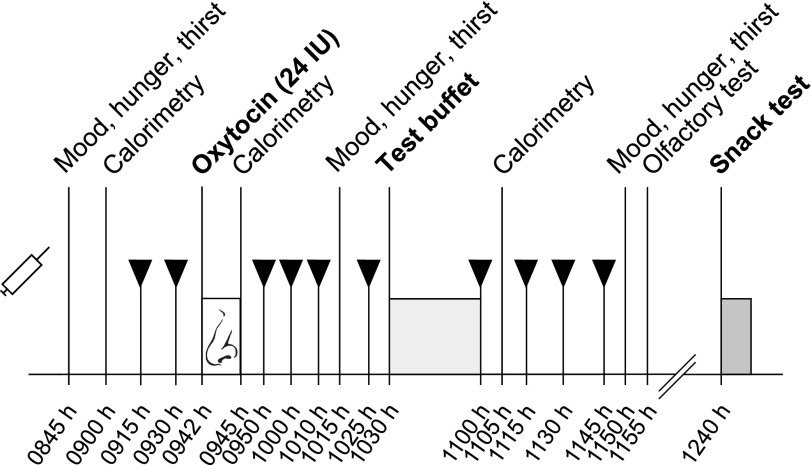
- Participants received intranasal oxytocin (24 IU; six 0.1-mL puffs) or vehicle, then ate ad libitum from a breakfast buffet 45 min later; snack intake was covertly measured 100 min after the buffet under a taste-rating pretext.
- Analyses used ANOVA with within-subject factors treatment, time, nutrient, and snack type, Greenhouse-Geisser correction, pairwise t tests, baseline adjustment, and ANCOVA for snack intake and glucose peak adjusted for breakfast calorie/carbohydrate intake; P < 0.05 was significant.
Limitations
- The paper does not include a dedicated limitations section. Evident from the text: the sample was small (n = 20), male, healthy, and normal-weight, so findings may not generalize to women, obese individuals, or clinical populations.
- Evident from the text: only acute effects of a single 24 IU intranasal dose were tested; long-term effects, weight outcomes, and mechanisms (e.g., VTA/nucleus accumbens dopamine signaling) remain speculative and require corroboration.
- Evident from the text: snack intake was assessed under a taste-test pretext, although the authors report checks for demand characteristics and experimenter trustworthiness.
Model-written summary. Check it against the paper before relying on it.
Integrity signals
Registry
Cites
Statistics
Figures
Verification
Claims the paper makes
45 Own result · 23 Not checked yet · 14 Own interpretation · 5 Own method · 1 Supported so far · 1 No basis given
A result the paper reports from its own data — it cites no other source for it, so there is none to check. The quote shows it is in the paper.
In the paper
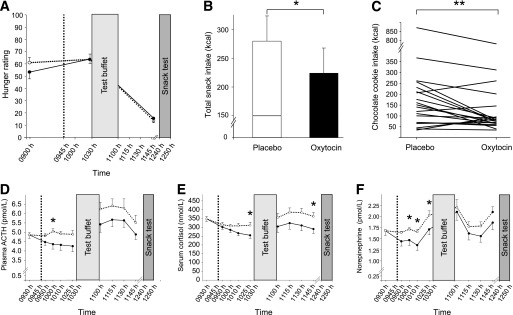
“hunger ratings (P > 0.2, two-sided t test for baseline values; Fig. 2A) were not altered by oxytocin (P > 0.9)”
§ Oxytocin Reduces Reward-Driven Food Intake in Humans > RESULTS > Oxytocin inhibits reward- but not hunger-driven eating.
plain- Asserted: passes — The authors put it forward as true.
- Checkable: passes — It can be checked against evidence.
- Load-bearing: passes — The paper’s conclusions depend on it.
- Based: passes — The paper gives a reason why it holds.
A result the paper reports from its own data — it cites no other source for it, so there is none to check. The quote shows it is in the paper.
In the paper
“Oxytocin administration did not affect food intake from the breakfast buffet in the fasted state.”
§ Oxytocin Reduces Reward-Driven Food Intake in Humans > RESULTS > Oxytocin inhibits reward- but not hunger-driven eating.
plain- Asserted: passes — The authors put it forward as true.
- Checkable: passes — It can be checked against evidence.
- Load-bearing: passes — The paper’s conclusions depend on it.
- Based: passes — The paper gives a reason why it holds.
A result the paper reports from its own data — it cites no other source for it, so there is none to check. The quote shows it is in the paper.
In the paper
“Energy expenditure assessed by indirect calorimetry was comparable between the placebo and the oxytocin condition during the entire experimental period (F1,19 = 2.12, P > 0.16 for treatment × time; F1,19 = 0.10, P > 0.75 for treatment)”
§ Oxytocin Reduces Reward-Driven Food Intake in Humans > RESULTS > Energy expenditure is not acutely affected by oxytocin administration.
plain- Asserted: passes — The authors put it forward as true.
- Checkable: passes — It can be checked against evidence.
- Load-bearing: passes — The paper’s conclusions depend on it.
- Based: passes — The paper gives a reason why it holds.
A result the paper reports from its own data — it cites no other source for it, so there is none to check. The quote shows it is in the paper.
In the paper
“The anorexigenic effect of oxytocin emerged during the postprandial period, when reward-driven eating motivation prevails, whereas energy intake in the fasted state was not affected.”
§ Oxytocin Reduces Reward-Driven Food Intake in Humans > DISCUSSION
plaindirect- Asserted: passes — The authors put it forward as true.
- Checkable: passes — It can be checked against evidence.
- Load-bearing: passes — The paper’s conclusions depend on it.
- Based: passes — The paper gives a reason why it holds.
A result the paper reports from its own data — it cites no other source for it, so there is none to check. The quote shows it is in the paper.
In the paper
“that was driven by a decrease in chocolate cookie consumption by 25% (P < 0.01, two-sided t test; Fig. 2C and Table 4).”
§ Oxytocin Reduces Reward-Driven Food Intake in Humans > RESULTS > Oxytocin inhibits reward- but not hunger-driven eating.
plaindirect- Asserted: passes — The authors put it forward as true.
- Checkable: passes — It can be checked against evidence.
- Load-bearing: passes — The paper’s conclusions depend on it.
- Based: passes — The paper gives a reason why it holds.
A result the paper reports from its own data — it cites no other source for it, so there is none to check. The quote shows it is in the paper.
In the paper
“We demonstrate that oxytocin inhibits food intake and impacts endocrine regulation in humans.”
§ Oxytocin Reduces Reward-Driven Food Intake in Humans > DISCUSSION
boosteddirect- Asserted: passes — The authors put it forward as true.
- Checkable: passes — It can be checked against evidence.
- Load-bearing: passes — The paper’s conclusions depend on it.
- Based: passes — The paper gives a reason why it holds.
A result the paper reports from its own data — it cites no other source for it, so there is none to check. The quote shows it is in the paper.
In the paper
“Whereas energy expenditure remained completely unaltered, oxytocin globally attenuated HPA axis activity and blunted the peak glucose response to food intake, suggesting an insulin-sensitizing action of the peptide.”
§ Oxytocin Reduces Reward-Driven Food Intake in Humans > DISCUSSION
plaindirect- Asserted: passes — The authors put it forward as true.
- Checkable: passes — It can be checked against evidence.
- Load-bearing: passes — The paper’s conclusions depend on it.
- Based: passes — The paper gives a reason why it holds.
A result the paper reports from its own data — it cites no other source for it, so there is none to check. The quote shows it is in the paper.
In the paper
“The anorexigenic effect of oxytocin emerged during the postprandial period, when reward-driven eating motivation prevails, whereas energy intake in the fasted state was not affected.”
§ Oxytocin Reduces Reward-Driven Food Intake in Humans > DISCUSSION
plain- Asserted: passes — The authors put it forward as true.
- Checkable: passes — It can be checked against evidence.
- Load-bearing: passes — The paper’s conclusions depend on it.
- Based: passes — The paper gives a reason why it holds.
A result the paper reports from its own data — it cites no other source for it, so there is none to check. The quote shows it is in the paper.
In the paper
“Oxytocin exerted a sustained suppressive effect on HPA axis activity, reducing serum ACTH and plasma cortisol concentrations during the entire postadministration period (F1,18 = 4.67, P < 0.05 and F1,18 = 5.15, P < 0.04, respectively, for treatment; Fig. 2D and E).”
§ Oxytocin Reduces Reward-Driven Food Intake in Humans > RESULTS > Oxytocin reduces HPA axis activity as well as norepinephrine concentrations and blunts the glucose response to food intake.
plaindirect- Asserted: passes — The authors put it forward as true.
- Checkable: passes — It can be checked against evidence.
- Load-bearing: unclear — It is unclear whether the paper’s conclusions depend on it.
- Based: passes — The paper gives a reason why it holds.
A result the paper reports from its own data — it cites no other source for it, so there is none to check. The quote shows it is in the paper.
In the paper
“Whereas energy expenditure remained completely unaltered, oxytocin globally attenuated HPA axis activity and blunted the peak glucose response to food intake, suggesting an insulin-sensitizing action of the peptide.”
§ Oxytocin Reduces Reward-Driven Food Intake in Humans > DISCUSSION
plaindirect- Asserted: passes — The authors put it forward as true.
- Checkable: passes — It can be checked against evidence.
- Load-bearing: passes — The paper’s conclusions depend on it.
- Based: passes — The paper gives a reason why it holds.
A result the paper reports from its own data — it cites no other source for it, so there is none to check. The quote shows it is in the paper.
In the paper
“Oxytocin exerted a sustained suppressive effect on HPA axis activity, reducing serum ACTH and plasma cortisol concentrations during the entire postadministration period (F1,18 = 4.67, P < 0.05 and F1,18 = 5.15, P < 0.04, respectively, for treatment; Fig. 2D and E).”
§ Oxytocin Reduces Reward-Driven Food Intake in Humans > RESULTS > Oxytocin reduces HPA axis activity as well as norepinephrine concentrations and blunts the glucose response to food intake.
plaindirect- Asserted: passes — The authors put it forward as true.
- Checkable: passes — It can be checked against evidence.
- Load-bearing: unclear — It is unclear whether the paper’s conclusions depend on it.
- Based: passes — The paper gives a reason why it holds.
A result the paper reports from its own data — it cites no other source for it, so there is none to check. The quote shows it is in the paper.
In the paper
“Whereas energy expenditure remained completely unaltered, oxytocin globally attenuated HPA axis activity and blunted the peak glucose response to food intake, suggesting an insulin-sensitizing action of the peptide.”
§ Oxytocin Reduces Reward-Driven Food Intake in Humans > DISCUSSION
plain- Asserted: passes — The authors put it forward as true.
- Checkable: passes — It can be checked against evidence.
- Load-bearing: unclear — It is unclear whether the paper’s conclusions depend on it.
- Based: passes — The paper gives a reason why it holds.
A result the paper reports from its own data — it cites no other source for it, so there is none to check. The quote shows it is in the paper.
In the paper
“We demonstrate that oxytocin inhibits food intake and impacts endocrine regulation in humans.”
§ Oxytocin Reduces Reward-Driven Food Intake in Humans > DISCUSSION
boosteddirect- Asserted: passes — The authors put it forward as true.
- Checkable: passes — It can be checked against evidence.
- Load-bearing: passes — The paper’s conclusions depend on it.
- Based: passes — The paper gives a reason why it holds.
A result the paper reports from its own data — it cites no other source for it, so there is none to check. The quote shows it is in the paper.
In the paper
“Across conditions, intake of chocolate cookies by far exceeded that of the remaining snacks (F1,23 = 9.50, P < 0.004 for snack type).”
§ Oxytocin Reduces Reward-Driven Food Intake in Humans > RESULTS > Oxytocin inhibits reward- but not hunger-driven eating.
plain- Asserted: passes — The authors put it forward as true.
- Checkable: passes — It can be checked against evidence.
- Load-bearing: unclear — It is unclear whether the paper’s conclusions depend on it.
- Based: passes — The paper gives a reason why it holds.
A result the paper reports from its own data — it cites no other source for it, so there is none to check. The quote shows it is in the paper.
In the paper
“These effects remained significant when corrected for overall calorie and carbohydrate consumption during the preceding test buffet (both P < 0.04 for treatment; P < 0.007 for the difference in chocolate cookie consumption).”
§ Oxytocin Reduces Reward-Driven Food Intake in Humans > RESULTS > Oxytocin inhibits reward- but not hunger-driven eating.
plaindirect- Asserted: passes — The authors put it forward as true.
- Checkable: passes — It can be checked against evidence.
- Load-bearing: passes — The paper’s conclusions depend on it.
- Based: passes — The paper gives a reason why it holds.
A result the paper reports from its own data — it cites no other source for it, so there is none to check. The quote shows it is in the paper.
In the paper
“In the snack test during the postprandial period, oxytocin compared with placebo induced a reduction in total snack intake (F1,19 = 5.5, P < 0.03 for treatment; Fig. 2B)”
§ Oxytocin Reduces Reward-Driven Food Intake in Humans > RESULTS > Oxytocin inhibits reward- but not hunger-driven eating.
plaindirect- Asserted: passes — The authors put it forward as true.
- Checkable: passes — It can be checked against evidence.
- Load-bearing: passes — The paper’s conclusions depend on it.
- Based: passes — The paper gives a reason why it holds.
A result the paper reports from its own data — it cites no other source for it, so there is none to check. The quote shows it is in the paper.
In the paper
“Oxytocin did not affect ratings for chocolate cookies and salt crackers (P > 0.3)”
§ Oxytocin Reduces Reward-Driven Food Intake in Humans > RESULTS > Oxytocin inhibits reward- but not hunger-driven eating.
plain- Asserted: passes — The authors put it forward as true.
- Checkable: passes — It can be checked against evidence.
- Load-bearing: passes — The paper’s conclusions depend on it.
- Based: passes — The paper gives a reason why it holds.
A result the paper reports from its own data — it cites no other source for it, so there is none to check. The quote shows it is in the paper.
In the paper
“The effect on cortisol was particularly pronounced before breakfast intake (F2,35 = 4.82, P < 0.02 for treatment × time).”
§ Oxytocin Reduces Reward-Driven Food Intake in Humans > RESULTS > Oxytocin reduces HPA axis activity as well as norepinephrine concentrations and blunts the glucose response to food intake.
plaindirect- Asserted: passes — The authors put it forward as true.
- Checkable: passes — It can be checked against evidence.
- Load-bearing: unclear — It is unclear whether the paper’s conclusions depend on it.
- Based: passes — The paper gives a reason why it holds.
A result the paper reports from its own data — it cites no other source for it, so there is none to check. The quote shows it is in the paper.
In the paper
“Supplementary analyses indicated that the oxytocin-induced decreases in cortisol concentrations (area under the curve with respect to increase 0930–1145 h) and chocolate cookie intake were significantly correlated (r = 0.56; P = 0.012, Pearson’s coefficient).”
§ Oxytocin Reduces Reward-Driven Food Intake in Humans > RESULTS > Oxytocin reduces HPA axis activity as well as norepinephrine concentrations and blunts the glucose response to food intake.
hedgedcorrelational- Asserted: passes — The authors put it forward as true.
- Checkable: passes — It can be checked against evidence.
- Load-bearing: unclear — It is unclear whether the paper’s conclusions depend on it.
- Based: passes — The paper gives a reason why it holds.
A result the paper reports from its own data — it cites no other source for it, so there is none to check. The quote shows it is in the paper.
In the paper
“During baseline, none of the blood parameters, including blood glucose, differed between conditions (all P > 0.18).”
§ Oxytocin Reduces Reward-Driven Food Intake in Humans > RESULTS > Oxytocin reduces HPA axis activity as well as norepinephrine concentrations and blunts the glucose response to food intake.
plain- Asserted: passes — The authors put it forward as true.
- Checkable: passes — It can be checked against evidence.
- Load-bearing: unclear — It is unclear whether the paper’s conclusions depend on it.
- Based: passes — The paper gives a reason why it holds.
A result the paper reports from its own data — it cites no other source for it, so there is none to check. The quote shows it is in the paper.
In the paper
“This difference was still evident when adjusted for preceding total and carbohydrate-specific breakfast intake (both P < 0.03).”
§ Oxytocin Reduces Reward-Driven Food Intake in Humans > RESULTS > Oxytocin reduces HPA axis activity as well as norepinephrine concentrations and blunts the glucose response to food intake.
plain- Asserted: passes — The authors put it forward as true.
- Checkable: passes — It can be checked against evidence.
- Load-bearing: unclear — It is unclear whether the paper’s conclusions depend on it.
- Based: passes — The paper gives a reason why it holds.
A result the paper reports from its own data — it cites no other source for it, so there is none to check. The quote shows it is in the paper.
In the paper
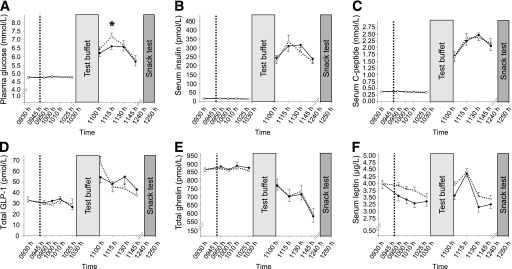
“the peak glucose response to breakfast intake (15 min after meal termination) was reduced by 0.57 mmol/L after oxytocin compared with placebo administration (P < 0.02, two-sided t test; Fig. 3A).”
§ Oxytocin Reduces Reward-Driven Food Intake in Humans > RESULTS > Oxytocin reduces HPA axis activity as well as norepinephrine concentrations and blunts the glucose response to food intake.
plaindirect- Asserted: passes — The authors put it forward as true.
- Checkable: passes — It can be checked against evidence.
- Load-bearing: passes — The paper’s conclusions depend on it.
- Based: passes — The paper gives a reason why it holds.
A result the paper reports from its own data — it cites no other source for it, so there is none to check. The quote shows it is in the paper.
In the paper
“In parallel, preprandial circulating concentrations of norepinephrine were reduced by oxytocin treatment (F1,19 = 5.41, P = 0.03 for treatment × time; Fig. 3F).”
§ Oxytocin Reduces Reward-Driven Food Intake in Humans > RESULTS > Oxytocin reduces HPA axis activity as well as norepinephrine concentrations and blunts the glucose response to food intake.
plaindirect- Asserted: passes — The authors put it forward as true.
- Checkable: passes — It can be checked against evidence.
- Load-bearing: unclear — It is unclear whether the paper’s conclusions depend on it.
- Based: passes — The paper gives a reason why it holds.
A result the paper reports from its own data — it cites no other source for it, so there is none to check. The quote shows it is in the paper.
In the paper
“The attenuating effect of oxytocin on snack intake focused on chocolate cookies that were preferentially eaten by our subjects, which underlines the reward-related component of oxytocin’s anorexigenic impact.”
§ Oxytocin Reduces Reward-Driven Food Intake in Humans > DISCUSSION
plaindirect- Asserted: passes — The authors put it forward as true.
- Checkable: passes — It can be checked against evidence.
- Load-bearing: passes — The paper’s conclusions depend on it.
- Based: passes — The paper gives a reason why it holds.
A result the paper reports from its own data — it cites no other source for it, so there is none to check. The quote shows it is in the paper.
In the paper
“but in the present experiments, we found no differences between conditions in postbreakfast hunger ratings.”
§ Oxytocin Reduces Reward-Driven Food Intake in Humans > DISCUSSION
plain- Asserted: passes — The authors put it forward as true.
- Checkable: passes — It can be checked against evidence.
- Load-bearing: passes — The paper’s conclusions depend on it.
- Based: passes — The paper gives a reason why it holds.
A result the paper reports from its own data — it cites no other source for it, so there is none to check. The quote shows it is in the paper.
In the paper
“Total calorie and macronutrient uptake from the breakfast buffet were closely comparable in both conditions, and moreover, the reduction in blood glucose concentrations was still evident after correcting the data for slight differences in these parameters.”
§ Oxytocin Reduces Reward-Driven Food Intake in Humans > DISCUSSION
plain- Asserted: passes — The authors put it forward as true.
- Checkable: passes — It can be checked against evidence.
- Load-bearing: passes — The paper’s conclusions depend on it.
- Based: passes — The paper gives a reason why it holds.
A result the paper reports from its own data — it cites no other source for it, so there is none to check. The quote shows it is in the paper.
In the paper
“Tests of olfactory function indicated that the decrease in snack intake was not mediated by effects on sensory processing.”
§ Oxytocin Reduces Reward-Driven Food Intake in Humans > DISCUSSION
hedged- Asserted: passes — The authors put it forward as true.
- Checkable: passes — It can be checked against evidence.
- Load-bearing: passes — The paper’s conclusions depend on it.
- Based: passes — The paper gives a reason why it holds.
A result the paper reports from its own data — it cites no other source for it, so there is none to check. The quote shows it is in the paper.
In the paper
“Considering that the circulating concentrations of insulin, C-peptide, and both total and active GLP-1, an incretin hormone with insulin-secretory properties, were not affected by oxytocin, this finding suggests a subtle but discernible improvement in insulin sensitivity after administration of the peptide.”
§ Oxytocin Reduces Reward-Driven Food Intake in Humans > DISCUSSION
plain- Asserted: passes — The authors put it forward as true.
- Checkable: passes — It can be checked against evidence.
- Load-bearing: passes — The paper’s conclusions depend on it.
- Based: passes — The paper gives a reason why it holds.
A result the paper reports from its own data — it cites no other source for it, so there is none to check. The quote shows it is in the paper.
In the paper
“Total calorie and macronutrient uptake from the breakfast buffet were closely comparable in both conditions, and moreover, the reduction in blood glucose concentrations was still evident after correcting the data for slight differences in these parameters.”
§ Oxytocin Reduces Reward-Driven Food Intake in Humans > DISCUSSION
plaindirect- Asserted: passes — The authors put it forward as true.
- Checkable: passes — It can be checked against evidence.
- Load-bearing: passes — The paper’s conclusions depend on it.
- Based: passes — The paper gives a reason why it holds.
A result the paper reports from its own data — it cites no other source for it, so there is none to check. The quote shows it is in the paper.
In the paper
“Oxytocin did not affect the rated palatability of chocolate cookies, which might be taken as an indication that it acted on dopaminergic pathways responding to the incentive salience of food rather than opioidergic/cannabinoid signaling assumed to process the palatability of ingested nutrients (39).”
§ Oxytocin Reduces Reward-Driven Food Intake in Humans > DISCUSSION
plain- Asserted: passes — The authors put it forward as true.
- Checkable: passes — It can be checked against evidence.
- Load-bearing: passes — The paper’s conclusions depend on it.
- Based: passes — The paper gives a reason why it holds.
The paper states this without a source or data behind it here, so there is nothing to check it against. The quote shows it is in the paper.
In the paper
“The conclusion that the inhibition of palatable snack intake by oxytocin involves a stress axis-related component (43) is supported by the positive association between the attenuating effects of oxytocin on cortisol concentrations and chocolate cookie intake.”
§ Oxytocin Reduces Reward-Driven Food Intake in Humans > DISCUSSION
plaincorrelational- Asserted: passes — The authors put it forward as true.
- Checkable: passes — It can be checked against evidence.
- Load-bearing: passes — The paper’s conclusions depend on it.
- Based: passes — The paper gives a reason why it holds.
None of the sources cited for this claim have been checked yet.
In the paper
“evidence from rodent studies indicates that the neuropeptide acts as a strong inhibitor of food intake and affects energy expenditure and glucose homeostasis (6–9).”
§ Oxytocin Reduces Reward-Driven Food Intake in Humans > Abstract
What the sources say
- Not checked yetcites [6] Arletti, 1989, Influence of oxytocin on feeding behavior in the rat, Peptides source
- Not checked yetcites [7] Morton, 2012, Peripheral oxytocin suppresses food intake and causes weight loss in diet-induced obese rats, Am J Physiol Endocrinol Metab source
- Not checked yetcites [8] Olson, 1991, Oxytocin and an oxytocin agonist administered centrally decrease food intake in rats, Peptides source
- Not checked yetcites [9] Wu, 2012, An obligate role of oxytocin neurons in diet induced energy expenditure, PLoS ONE source
hedgeddirect- Asserted: passes — The authors put it forward as true.
- Checkable: passes — It can be checked against evidence.
- Load-bearing: passes — The paper’s conclusions depend on it.
- Based: passes — The paper gives a reason why it holds.
None of the sources cited for this claim have been checked yet.
In the paper
“Reward-related eating in the absence of hunger was assessed using a snack test validated in a series of previous studies (22–24).”
§ Oxytocin Reduces Reward-Driven Food Intake in Humans > RESEARCH DESIGN AND METHODS > Assessments of food intake, hunger, thirst, mood, and olfaction.
What the sources say
- Not checked yetcites [22] Ott, 2012, Meal anticipation potentiates postprandial ghrelin suppression in humans, Psychoneuroendocrinology source
- Not checked yetcites [23] Hallschmid, 2012, Postprandial administration of intranasal insulin intensifies satiety and reduces intake of palatable snacks in women, Diabetes source
- Not checked yetcites [24] Higgs, 2008, Recall of recent lunch and its effect on subsequent snack intake, Physiol Behav source
plain- Asserted: passes — The authors put it forward as true.
- Checkable: passes — It can be checked against evidence.
- Load-bearing: passes — The paper’s conclusions depend on it.
- Based: passes — The paper gives a reason why it holds.
None of the sources cited for this claim have been checked yet.
In the paper
“evidence from rodent studies indicates that the neuropeptide acts as a strong inhibitor of food intake and affects energy expenditure and glucose homeostasis (6–9).”
§ Oxytocin Reduces Reward-Driven Food Intake in Humans > Abstract
What the sources say
- Not checked yetcites [6] Arletti, 1989, Influence of oxytocin on feeding behavior in the rat, Peptides source
- Not checked yetcites [7] Morton, 2012, Peripheral oxytocin suppresses food intake and causes weight loss in diet-induced obese rats, Am J Physiol Endocrinol Metab source
- Not checked yetcites [8] Olson, 1991, Oxytocin and an oxytocin agonist administered centrally decrease food intake in rats, Peptides source
- Not checked yetcites [9] Wu, 2012, An obligate role of oxytocin neurons in diet induced energy expenditure, PLoS ONE source
hedgeddirect- Asserted: passes — The authors put it forward as true.
- Checkable: passes — It can be checked against evidence.
- Load-bearing: unclear — It is unclear whether the paper’s conclusions depend on it.
- Based: passes — The paper gives a reason why it holds.
In the paper
“Ingestive behavior is not only regulated homeostatically (i.e., by central nervous pathways that respond to energy depletion) but also by nonhomeostatic brain circuits that process the reward-related, “hedonic” qualities of food intake (19).”
§ Oxytocin Reduces Reward-Driven Food Intake in Humans > Abstract
What the sources say
- Not checked yetcites [19] Berthoud, 2011, Food reward, hyperphagia, and obesity, Am J Physiol Regul Integr Comp Physiol source
plaindirect- Asserted: passes — The authors put it forward as true.
- Checkable: passes — It can be checked against evidence.
- Load-bearing: passes — The paper’s conclusions depend on it.
- Based: passes — The paper gives a reason why it holds.
None of the sources cited for this claim have been checked yet.
In the paper
“The assessment of respective effects of intravenous oxytocin (17) is hampered because peripheral oxytocin is not readily transported across the blood–brain barrier (18).”
§ Oxytocin Reduces Reward-Driven Food Intake in Humans > Abstract
What the sources say
- Not checked yetcites [17] Borg, 2011, Oxytocin reduces satiety scores without affecting the volume of nutrient intake or gastric emptying rate in healthy subjects, Neurogastroenterol Motil source
- Not checked yetcites [18] Kang, 2000, Brain uptake and the analgesic effect of oxytocin—its usefulness as an analgesic agent, Arch Pharm Res source
plaindirect- Asserted: passes — The authors put it forward as true.
- Checkable: passes — It can be checked against evidence.
- Load-bearing: passes — The paper’s conclusions depend on it.
- Based: passes — The paper gives a reason why it holds.
None of the sources cited for this claim have been checked yet.
In the paper
“This procedure has been repeatedly shown to enable the precise assessment of primarily hunger-driven food intake in the fasted state (20–22).”
§ Oxytocin Reduces Reward-Driven Food Intake in Humans > RESEARCH DESIGN AND METHODS > Assessments of food intake, hunger, thirst, mood, and olfaction.
What the sources say
- Not checked yetcites [20] Benedict, 2008, Differential sensitivity of men and women to anorexigenic and memory-improving effects of intranasal insulin, J Clin Endocrinol Metab source
- Not checked yetcites [21] Hallschmid, 2010, Euglycemic infusion of insulin detemir compared with human insulin appears to increase direct current brain potential response and reduces food intake while inducing similar systemic effects, Diabetes source
- Not checked yetcites [22] Ott, 2012, Meal anticipation potentiates postprandial ghrelin suppression in humans, Psychoneuroendocrinology source
boosteddirect- Asserted: passes — The authors put it forward as true.
- Checkable: passes — It can be checked against evidence.
- Load-bearing: passes — The paper’s conclusions depend on it.
- Based: passes — The paper gives a reason why it holds.
None of the sources cited for this claim have been checked yet.
In the paper
“Research in humans has almost exclusively focused on the role of oxytocin in the regulation of prosocial behavior, including trust, attachment, and sexual behavior (2–5), largely ignoring potential effects of the neuropeptide on ingestive behavior and metabolism.”
§ Oxytocin Reduces Reward-Driven Food Intake in Humans > Abstract
What the sources say
- Not checked yetcites [2] Burri, 2008, The acute effects of intranasal oxytocin administration on endocrine and sexual function in males, Psychoneuroendocrinology source
- Not checked yetcites [3] Domes, 2007, Oxytocin attenuates amygdala responses to emotional faces regardless of valence, Biol Psychiatry source
- Not checked yetcites [4] Gamer, 2010, Different amygdala subregions mediate valence-related and attentional effects of oxytocin in humans, Proc Natl Acad Sci U S A source
- Not checked yetcites [5] Kosfeld, 2005, Oxytocin increases trust in humans, Nature source
plain- Asserted: passes — The authors put it forward as true.
- Checkable: passes — It can be checked against evidence.
- Load-bearing: passes — The paper’s conclusions depend on it.
- Based: passes — The paper gives a reason why it holds.
A conclusion the paper draws from its own results — it cites no other source for it, so there is none to check. The quote shows it is in the paper.
In the paper
“These findings indicate that the oxytocin system contributes to the control of reward-related eating as well as of stress axis regulation and glucose homeostasis in humans.”
§ Oxytocin Reduces Reward-Driven Food Intake in Humans > DISCUSSION
hedgeddirect- Asserted: passes — The authors put it forward as true.
- Checkable: passes — It can be checked against evidence.
- Load-bearing: passes — The paper’s conclusions depend on it.
- Based: passes — The paper gives a reason why it holds.
- Rests on an assumption: In the postprandial period, reward-driven eating motivation prevails.
A conclusion the paper draws from its own results — it cites no other source for it, so there is none to check. The quote shows it is in the paper.
In the paper
“Whereas energy expenditure remained completely unaltered, oxytocin globally attenuated HPA axis activity and blunted the peak glucose response to food intake, suggesting an insulin-sensitizing action of the peptide.”
§ Oxytocin Reduces Reward-Driven Food Intake in Humans > DISCUSSION
hedgeddirect- Asserted: passes — The authors put it forward as true.
- Checkable: passes — It can be checked against evidence.
- Load-bearing: passes — The paper’s conclusions depend on it.
- Based: passes — The paper gives a reason why it holds.
A conclusion the paper draws from its own results — it cites no other source for it, so there is none to check. The quote shows it is in the paper.
In the paper
“These findings indicate that the oxytocin system contributes to the control of reward-related eating as well as of stress axis regulation and glucose homeostasis in humans.”
§ Oxytocin Reduces Reward-Driven Food Intake in Humans > DISCUSSION
hedgeddirect- Asserted: passes — The authors put it forward as true.
- Checkable: passes — It can be checked against evidence.
- Load-bearing: passes — The paper’s conclusions depend on it.
- Based: passes — The paper gives a reason why it holds.
A conclusion the paper draws from its own results — it cites no other source for it, so there is none to check. The quote shows it is in the paper.
In the paper
“Our results indicate that oxytocin, beyond its role in social bonding, regulates nonhomeostatic, reward-related energy intake, hypothalamic-pituitary-adrenal axis activity, and the glucoregulatory response to food intake in humans.”
§ Oxytocin Reduces Reward-Driven Food Intake in Humans > Abstract
hedgeddirect- Asserted: passes — The authors put it forward as true.
- Checkable: passes — It can be checked against evidence.
- Load-bearing: passes — The paper’s conclusions depend on it.
- Based: passes — The paper gives a reason why it holds.
A conclusion the paper draws from its own results — it cites no other source for it, so there is none to check. The quote shows it is in the paper.
In the paper
“These findings indicate that the oxytocin system contributes to the control of reward-related eating as well as of stress axis regulation and glucose homeostasis in humans.”
§ Oxytocin Reduces Reward-Driven Food Intake in Humans > DISCUSSION
hedgeddirect- Asserted: passes — The authors put it forward as true.
- Checkable: passes — It can be checked against evidence.
- Load-bearing: passes — The paper’s conclusions depend on it.
- Based: passes — The paper gives a reason why it holds.
None of the sources cited for this claim have been checked yet.
In the paper
“Furthermore, oxytocin receptor antagonists have been found to acutely hamper the anorexigenic central nervous impact of hormones such as cholecystokinin and corticotropin-releasing hormone (29,30).”
§ Oxytocin Reduces Reward-Driven Food Intake in Humans > DISCUSSION
What the sources say
- Not checked yetcites [29] Olson, 1991, Brain oxytocin receptor antagonism blunts the effects of anorexigenic treatments in rats: evidence for central oxytocin inhibition of food intake, Endocrinology source
- Not checked yetcites [30] Olson, 1991, Brain oxytocin receptors mediate corticotropin-releasing hormone-induced anorexia, Am J Physiol
plaindirect- Asserted: passes — The authors put it forward as true.
- Checkable: passes — It can be checked against evidence.
- Load-bearing: unclear — It is unclear whether the paper’s conclusions depend on it.
- Based: passes — The paper gives a reason why it holds.
A conclusion the paper draws from its own results — it cites no other source for it, so there is none to check. The quote shows it is in the paper.
In the paper
“Considering that the circulating concentrations of insulin, C-peptide, and both total and active GLP-1, an incretin hormone with insulin-secretory properties, were not affected by oxytocin, this finding suggests a subtle but discernible improvement in insulin sensitivity after administration of the peptide.”
§ Oxytocin Reduces Reward-Driven Food Intake in Humans > DISCUSSION
hedgeddirect- Asserted: passes — The authors put it forward as true.
- Checkable: passes — It can be checked against evidence.
- Load-bearing: passes — The paper’s conclusions depend on it.
- Based: passes — The paper gives a reason why it holds.
In the paper
“The intake of sugar compared with an equicaloric fat solution induces a selective, twofold increase in hypothalamic oxytocinergic neuronal activity, whereas central nervous oxytocin receptor antagonism triggers the intake of sucrose but not fat (47).”
§ Oxytocin Reduces Reward-Driven Food Intake in Humans > DISCUSSION
What the sources say
- Not checked yetcites [47] Olszewski, 2010, Molecular, immunohistochemical, and pharmacological evidence of oxytocin’s role as inhibitor of carbohydrate but not fat intake, Endocrinology source
plaindirect- Asserted: passes — The authors put it forward as true.
- Checkable: passes — It can be checked against evidence.
- Load-bearing: passes — The paper’s conclusions depend on it.
- Based: passes — The paper gives a reason why it holds.
A conclusion the paper draws from its own results — it cites no other source for it, so there is none to check. The quote shows it is in the paper.
In the paper
“The attenuating effect of oxytocin on snack intake focused on chocolate cookies that were preferentially eaten by our subjects, which underlines the reward-related component of oxytocin’s anorexigenic impact.”
§ Oxytocin Reduces Reward-Driven Food Intake in Humans > DISCUSSION
plaindirect- Asserted: passes — The authors put it forward as true.
- Checkable: passes — It can be checked against evidence.
- Load-bearing: passes — The paper’s conclusions depend on it.
- Based: passes — The paper gives a reason why it holds.
- Rests on an assumption: In the postprandial period, reward-driven eating motivation prevails.
A conclusion the paper draws from its own results — it cites no other source for it, so there is none to check. The quote shows it is in the paper.
In the paper
“Although intranasal oxytocin administration has been previously found to increase plasma concentrations of the peptide (2), this pattern moreover argues against a peripheral mediation of the observed changes in ingestive behavior.”
§ Oxytocin Reduces Reward-Driven Food Intake in Humans > DISCUSSION
hedged- Asserted: passes — The authors put it forward as true.
- Checkable: passes — It can be checked against evidence.
- Load-bearing: passes — The paper’s conclusions depend on it.
- Based: passes — The paper gives a reason why it holds.
A conclusion the paper draws from its own results — it cites no other source for it, so there is none to check. The quote shows it is in the paper.
In the paper
“Oxytocin did not affect the rated palatability of chocolate cookies, which might be taken as an indication that it acted on dopaminergic pathways responding to the incentive salience of food rather than opioidergic/cannabinoid signaling assumed to process the palatability of ingested nutrients (39).”
§ Oxytocin Reduces Reward-Driven Food Intake in Humans > DISCUSSION
hedgeddirect- Asserted: passes — The authors put it forward as true.
- Checkable: passes — It can be checked against evidence.
- Load-bearing: passes — The paper’s conclusions depend on it.
- Based: passes — The paper gives a reason why it holds.
- The authors state this as an assumption: Opioidergic/cannabinoid signaling processes the palatability of ingested nutrients.
In the paper
“Acute and chronic activation of endocrine stress axes favors the intake of “comfort food” (i.e., highly palatable food) (45).”
§ Oxytocin Reduces Reward-Driven Food Intake in Humans > DISCUSSION
What the sources say
- Not checked yetcites [45] Dallman, 2003, Chronic stress and obesity: a new view of “comfort food”, Proc Natl Acad Sci U S A source
plaindirect- Asserted: passes — The authors put it forward as true.
- Checkable: passes — It can be checked against evidence.
- Load-bearing: passes — The paper’s conclusions depend on it.
- Based: passes — The paper gives a reason why it holds.
In the paper
“In a negative feedback loop, activation of central nervous reward circuits by consuming sucrose reduces stress-induced HPA axis activity (46).”
§ Oxytocin Reduces Reward-Driven Food Intake in Humans > DISCUSSION
What the sources say
- Not checked yetcites [46] Ulrich-Lai, 2010, Pleasurable behaviors reduce stress via brain reward pathways, Proc Natl Acad Sci U S A source
plaindirect- Asserted: passes — The authors put it forward as true.
- Checkable: passes — It can be checked against evidence.
- Load-bearing: unclear — It is unclear whether the paper’s conclusions depend on it.
- Based: passes — The paper gives a reason why it holds.
In the paper
“From a clinical perspective, the conclusion that oxytocin acts on reward-processing brain circuits to suppress snack intake is in line with observations in patients with Prader-Willi syndrome, who suffer from hyperphagic obesity due to insatiable food craving and have been reported to display a 40% reduction in the number and size of oxytocin neurons (40).”
§ Oxytocin Reduces Reward-Driven Food Intake in Humans > DISCUSSION
What the sources say
- Not checked yetcites [40] Swaab, 1995, Alterations in the hypothalamic paraventricular nucleus and its oxytocin neurons (putative satiety cells) in Prader-Willi syndrome: a study of five cases, J Clin Endocrinol Metab
plaincorrelational- Asserted: passes — The authors put it forward as true.
- Checkable: passes — It can be checked against evidence.
- Load-bearing: unclear — It is unclear whether the paper’s conclusions depend on it.
- Based: passes — The paper gives a reason why it holds.
In the paper
“The conclusion that the inhibition of palatable snack intake by oxytocin involves a stress axis-related component (43) is supported by the positive association between the attenuating effects of oxytocin on cortisol concentrations and chocolate cookie intake.”
§ Oxytocin Reduces Reward-Driven Food Intake in Humans > DISCUSSION
What the sources say
- Not checked yetcites [43] Quirin, 2011, Oxytocin buffers cortisol responses to stress in individuals with impaired emotion regulation abilities, Psychoneuroendocrinology source
boosteddirect- Asserted: passes — The authors put it forward as true.
- Checkable: passes — It can be checked against evidence.
- Load-bearing: passes — The paper’s conclusions depend on it.
- Based: passes — The paper gives a reason why it holds.
A conclusion the paper draws from its own results — it cites no other source for it, so there is none to check. The quote shows it is in the paper.
In the paper
“Nevertheless, subjective ratings of chocolate and salty snacks differed in sweetness and saltiness but not palatability, suggesting that oxytocin specifically dampens the motivation to consume sweet-tasting food.”
§ Oxytocin Reduces Reward-Driven Food Intake in Humans > DISCUSSION
hedgeddirect- Asserted: passes — The authors put it forward as true.
- Checkable: passes — It can be checked against evidence.
- Load-bearing: passes — The paper’s conclusions depend on it.
- Based: passes — The paper gives a reason why it holds.
What the paper did — it cites no source for this, so there is none to check. The quote shows it is in the paper.
In the paper
“Furthermore, biasing effects on ingestive behavior related to demand characteristics and social desirability were excluded by interviews confirming unawareness of food intake measurements and by ratings of the perceived trustworthiness of the experimenter.”
§ Oxytocin Reduces Reward-Driven Food Intake in Humans > DISCUSSION
plain- Asserted: passes — The authors put it forward as true.
- Checkable: passes — It can be checked against evidence.
- Load-bearing: unclear — It is unclear whether the paper’s conclusions depend on it.
- Based: passes — The paper gives a reason why it holds.
- Probably not a substantial claim. 20
- It may state two separate claims as one. 15
- The quote only partly states this claim. 1
The sources with a verdict support this claim; the rest weren’t checked yet, have no full text we could read, or their verdicts aren’t rated yet.
In the paper
“evidence from rodent studies indicates that the neuropeptide acts as a strong inhibitor of food intake and affects energy expenditure and glucose homeostasis (6–9).”
§ Oxytocin Reduces Reward-Driven Food Intake in Humans > Abstract
What the sources say
- Not checked yetcites [6] Arletti, 1989, Influence of oxytocin on feeding behavior in the rat, Peptides source
- Not checked yetcites [7] Morton, 2012, Peripheral oxytocin suppresses food intake and causes weight loss in diet-induced obese rats, Am J Physiol Endocrinol Metab source
- Not checked yetcites [8] Olson, 1991, Oxytocin and an oxytocin agonist administered centrally decrease food intake in rats, Peptides source
- Supportedcites [9] Wu, 2012, An obligate role of oxytocin neurons in diet induced energy expenditure, PLoS ONE source
The Abstract reports that ablating oxytocin neurons in adult male mice reduced energy expenditure on a high-fat diet. The Discussion clarifies that the lesion did not affect energy expenditure on regular chow, so the observed effect is diet-dependent. (LLM, conf=0.93)
hedgeddirect- Asserted: passes — The authors put it forward as true.
- Checkable: passes — It can be checked against evidence.
- Load-bearing: fails — The paper’s conclusions may not depend on it.
- Based: passes — The paper gives a reason why it holds.
Probably not a substantial claim. The paper’s conclusions may not depend on it.
A result the paper reports from its own data — it cites no other source for it, so there is none to check. The quote shows it is in the paper.
In the paper
“Overall food consumption and the proportion of ingested macronutrients were nearly identical between conditions (all P > 0.6; Table 3).”
§ Oxytocin Reduces Reward-Driven Food Intake in Humans > RESULTS > Oxytocin inhibits reward- but not hunger-driven eating.
plain- Asserted: passes — The authors put it forward as true.
- Checkable: passes — It can be checked against evidence.
- Load-bearing: passes — The paper’s conclusions depend on it.
- Based: passes — The paper gives a reason why it holds.
It may state two separate claims as one.
A result the paper reports from its own data — it cites no other source for it, so there is none to check. The quote shows it is in the paper.
In the paper
“Total plasma concentrations of ghrelin were suppressed by breakfast intake (F2,29 = 31.62, P < 0.0001 for time), without significant treatment effects (P > 0.95; Fig. 3E).”
§ Oxytocin Reduces Reward-Driven Food Intake in Humans > RESULTS > Oxytocin reduces HPA axis activity as well as norepinephrine concentrations and blunts the glucose response to food intake.
plaindirect- Asserted: passes — The authors put it forward as true.
- Checkable: passes — It can be checked against evidence.
- Load-bearing: fails — The paper’s conclusions may not depend on it.
- Based: passes — The paper gives a reason why it holds.
Probably not a substantial claim. The paper’s conclusions may not depend on it. It may state two separate claims as one.
A result the paper reports from its own data — it cites no other source for it, so there is none to check. The quote shows it is in the paper.
In the paper
“Circulating concentrations of growth hormone and active GLP-1 (i.e., the intact form of GLP-1) were likewise comparable between conditions (all P > 0.14).”
§ Oxytocin Reduces Reward-Driven Food Intake in Humans > RESULTS > Oxytocin reduces HPA axis activity as well as norepinephrine concentrations and blunts the glucose response to food intake.
plain- Asserted: passes — The authors put it forward as true.
- Checkable: passes — It can be checked against evidence.
- Load-bearing: fails — The paper’s conclusions may not depend on it.
- Based: passes — The paper gives a reason why it holds.
Probably not a substantial claim. The paper’s conclusions may not depend on it. It may state two separate claims as one.
A result the paper reports from its own data — it cites no other source for it, so there is none to check. The quote shows it is in the paper.
In the paper
“Leptin concentrations did not differ between conditions across the whole experimental period (P > 0.38)”
§ Oxytocin Reduces Reward-Driven Food Intake in Humans > RESULTS > Oxytocin reduces HPA axis activity as well as norepinephrine concentrations and blunts the glucose response to food intake.
plain- Asserted: passes — The authors put it forward as true.
- Checkable: passes — It can be checked against evidence.
- Load-bearing: fails — The paper’s conclusions may not depend on it.
- Based: passes — The paper gives a reason why it holds.
Probably not a substantial claim. The paper’s conclusions may not depend on it.
A result the paper reports from its own data — it cites no other source for it, so there is none to check. The quote shows it is in the paper.
In the paper
“Conversely, 15 min after breakfast, serum leptin levels were increased by ∼28% compared with preprandial levels (F4,80 = 28.98, P < 0.0001 for time; Fig. 3F).”
§ Oxytocin Reduces Reward-Driven Food Intake in Humans > RESULTS > Oxytocin reduces HPA axis activity as well as norepinephrine concentrations and blunts the glucose response to food intake.
plaindirect- Asserted: passes — The authors put it forward as true.
- Checkable: passes — It can be checked against evidence.
- Load-bearing: fails — The paper’s conclusions may not depend on it.
- Based: passes — The paper gives a reason why it holds.
Probably not a substantial claim. The paper’s conclusions may not depend on it.
A result the paper reports from its own data — it cites no other source for it, so there is none to check. The quote shows it is in the paper.
In the paper
“In the olfactory task, no treatment effects on perceptual thresholds (P > 0.4), olfactory discrimination (P > 0.6), and olfactory identification (P > 0.2) emerged”
§ Oxytocin Reduces Reward-Driven Food Intake in Humans > RESULTS > Oxytocin inhibits reward- but not hunger-driven eating.
plain- Asserted: passes — The authors put it forward as true.
- Checkable: passes — It can be checked against evidence.
- Load-bearing: unclear — It is unclear whether the paper’s conclusions depend on it.
- Based: passes — The paper gives a reason why it holds.
It may state two separate claims as one.
A result the paper reports from its own data — it cites no other source for it, so there is none to check. The quote shows it is in the paper.
In the paper
“Thirst ratings and self-rated mood were likewise unaffected by oxytocin (P > 0.12 for all comparisons).”
§ Oxytocin Reduces Reward-Driven Food Intake in Humans > RESULTS > Oxytocin inhibits reward- but not hunger-driven eating.
plain- Asserted: passes — The authors put it forward as true.
- Checkable: passes — It can be checked against evidence.
- Load-bearing: unclear — It is unclear whether the paper’s conclusions depend on it.
- Based: passes — The paper gives a reason why it holds.
It may state two separate claims as one.
A result the paper reports from its own data — it cites no other source for it, so there is none to check. The quote shows it is in the paper.
In the paper
“Although levels of insulin, C-peptide, and total GLP-1 were not affected by oxytocin administration (all P > 0.16)”
§ Oxytocin Reduces Reward-Driven Food Intake in Humans > RESULTS > Oxytocin reduces HPA axis activity as well as norepinephrine concentrations and blunts the glucose response to food intake.
plain- Asserted: passes — The authors put it forward as true.
- Checkable: passes — It can be checked against evidence.
- Load-bearing: unclear — It is unclear whether the paper’s conclusions depend on it.
- Based: passes — The paper gives a reason why it holds.
It may state two separate claims as one.
A result the paper reports from its own data — it cites no other source for it, so there is none to check. The quote shows it is in the paper.
In the paper
“oxytocin administration did not affect the trustworthiness of the experimenter as perceived by the participants (P > 0.6).”
§ Oxytocin Reduces Reward-Driven Food Intake in Humans > RESULTS > Oxytocin inhibits reward- but not hunger-driven eating.
plain- Asserted: passes — The authors put it forward as true.
- Checkable: passes — It can be checked against evidence.
- Load-bearing: fails — The paper’s conclusions may not depend on it.
- Based: passes — The paper gives a reason why it holds.
Probably not a substantial claim. The paper’s conclusions may not depend on it.
A result the paper reports from its own data — it cites no other source for it, so there is none to check. The quote shows it is in the paper.
In the paper
“and even slightly increased rated palatability of rice waffles (P < 0.05; Table 4).”
§ Oxytocin Reduces Reward-Driven Food Intake in Humans > RESULTS > Oxytocin inhibits reward- but not hunger-driven eating.
plaindirect- Asserted: passes — The authors put it forward as true.
- Checkable: passes — It can be checked against evidence.
- Load-bearing: fails — The paper’s conclusions may not depend on it.
- Based: passes — The paper gives a reason why it holds.
Probably not a substantial claim. The paper’s conclusions may not depend on it.
A result the paper reports from its own data — it cites no other source for it, so there is none to check. The quote shows it is in the paper.
In the paper
“although there was a trend toward reduced preprandial leptin concentrations after oxytocin administration (F1,19 = 3.39, P = 0.08 for treatment).”
§ Oxytocin Reduces Reward-Driven Food Intake in Humans > RESULTS > Oxytocin reduces HPA axis activity as well as norepinephrine concentrations and blunts the glucose response to food intake.
hedgedconditional- Asserted: passes — The authors put it forward as true.
- Checkable: passes — It can be checked against evidence.
- Load-bearing: fails — The paper’s conclusions may not depend on it.
- Based: passes — The paper gives a reason why it holds.
Probably not a substantial claim. The paper’s conclusions may not depend on it.
A result the paper reports from its own data — it cites no other source for it, so there is none to check. The quote shows it is in the paper.
In the paper
“Also, sweetness and saltiness ratings were highest for chocolate cookies and salt crackers, respectively (F2,31 = 342.28, P < 0.0001; and F2,36 = 112.18, P < 0.0001, for snack type).”
§ Oxytocin Reduces Reward-Driven Food Intake in Humans > RESULTS > Oxytocin inhibits reward- but not hunger-driven eating.
plain- Asserted: passes — The authors put it forward as true.
- Checkable: passes — It can be checked against evidence.
- Load-bearing: fails — The paper’s conclusions may not depend on it.
- Based: passes — The paper gives a reason why it holds.
Probably not a substantial claim. The paper’s conclusions may not depend on it. It may state two separate claims as one.
A result the paper reports from its own data — it cites no other source for it, so there is none to check. The quote shows it is in the paper.
In the paper
“Considering that the anorexigenic impact of oxytocin selectively concerned the consumption of palatable snacks, it might rather be speculated that oxytocin acted on receptors expressed in the brain reward circuit, such as in the ventral tegmental area (VTA) and nucleus accumbens (33,34), that contribute to the regulation of palatable food intake (19).”
§ Oxytocin Reduces Reward-Driven Food Intake in Humans > DISCUSSION
hedgeddirect- Asserted: passes — The authors put it forward as true.
- Checkable: passes — It can be checked against evidence.
- Load-bearing: passes — The paper’s conclusions depend on it.
- Based: passes — The paper gives a reason why it holds.
Probably not a substantial claim.
A result the paper reports from its own data — it cites no other source for it, so there is none to check. The quote shows it is in the paper.
In the paper
“Nevertheless, subjective ratings of chocolate and salty snacks differed in sweetness and saltiness but not palatability, suggesting that oxytocin specifically dampens the motivation to consume sweet-tasting food.”
§ Oxytocin Reduces Reward-Driven Food Intake in Humans > DISCUSSION
hedged- Asserted: passes — The authors put it forward as true.
- Checkable: passes — It can be checked against evidence.
- Load-bearing: passes — The paper’s conclusions depend on it.
- Based: passes — The paper gives a reason why it holds.
It may state two separate claims as one.
A result the paper reports from its own data — it cites no other source for it, so there is none to check. The quote shows it is in the paper.
In the paper
“Also in our experiments, oxytocin did not affect the circulating concentrations of ghrelin and GLP-1 and induced merely nonsignificant changes in leptin, hormones known to affect energy expenditure and energy homeostasis (51).”
§ Oxytocin Reduces Reward-Driven Food Intake in Humans > DISCUSSION
plain- Asserted: passes — The authors put it forward as true.
- Checkable: passes — It can be checked against evidence.
- Load-bearing: passes — The paper’s conclusions depend on it.
- Based: passes — The paper gives a reason why it holds.
It may state two separate claims as one.
None of the sources cited for this claim have been checked yet.
In the paper
“intranasal oxytocin administration has been shown to reliably modulate neuropsychological functions in a series of studies (2–5) in the absence of relevant side effects (16).”
§ Oxytocin Reduces Reward-Driven Food Intake in Humans > Abstract
What the sources say
- Not checked yetcites [2] Burri, 2008, The acute effects of intranasal oxytocin administration on endocrine and sexual function in males, Psychoneuroendocrinology source
- Not checked yetcites [3] Domes, 2007, Oxytocin attenuates amygdala responses to emotional faces regardless of valence, Biol Psychiatry source
- Not checked yetcites [4] Gamer, 2010, Different amygdala subregions mediate valence-related and attentional effects of oxytocin in humans, Proc Natl Acad Sci U S A source
- Not checked yetcites [5] Kosfeld, 2005, Oxytocin increases trust in humans, Nature source
- Not checked yetcites [16] MacDonald, 2011, A review of safety, side-effects and subjective reactions to intranasal oxytocin in human research, Psychoneuroendocrinology source
boosteddirect- Asserted: passes — The authors put it forward as true.
- Checkable: passes — It can be checked against evidence.
- Load-bearing: passes — The paper’s conclusions depend on it.
- Based: passes — The paper gives a reason why it holds.
It may state two separate claims as one.
In the paper
“Olfactory function was tested 60 min after the test buffet with the validated Sniffin’ Sticks commercial test kit (Burghart Elektro- und Feinmechanik GmbH, Wedel, Germany) that allows for the separate characterization of the three dimensions of olfactory threshold, discrimination, and identification (26).”
§ Oxytocin Reduces Reward-Driven Food Intake in Humans > RESEARCH DESIGN AND METHODS > Assessments of food intake, hunger, thirst, mood, and olfaction.
What the sources say
- Not checked yetcites [26] Hummel, 2007, Normative data for the “Sniffin’ Sticks” including tests of odor identification, odor discrimination, and olfactory thresholds: an upgrade based on a group of more than 3,000 subjects, Eur Arch Otorhinolaryngol source
plain- Asserted: passes — The authors put it forward as true.
- Checkable: passes — It can be checked against evidence.
- Load-bearing: fails — The paper’s conclusions may not depend on it.
- Based: passes — The paper gives a reason why it holds.
Probably not a substantial claim. The paper’s conclusions may not depend on it.
What the paper did — it cites no source for this, so there is none to check. The quote shows it is in the paper.
In the paper
“The order of conditions was balanced across subjects, and the two sessions were spaced at least 10 days apart.”
§ Oxytocin Reduces Reward-Driven Food Intake in Humans > RESEARCH DESIGN AND METHODS > Design and procedure.
plain- Asserted: passes — The authors put it forward as true.
- Checkable: passes — It can be checked against evidence.
- Load-bearing: passes — The paper’s conclusions depend on it.
- Based: passes — The paper gives a reason why it holds.
Probably not a substantial claim.
What the paper did — it cites no source for this, so there is none to check. The quote shows it is in the paper.
In the paper
“Snack intake was covertly measured by weighing the snacks before and after the test.”
§ Oxytocin Reduces Reward-Driven Food Intake in Humans > RESEARCH DESIGN AND METHODS > Assessments of food intake, hunger, thirst, mood, and olfaction.
plain- Asserted: passes — The authors put it forward as true.
- Checkable: passes — It can be checked against evidence.
- Load-bearing: passes — The paper’s conclusions depend on it.
- Based: passes — The paper gives a reason why it holds.
Probably not a substantial claim.
What the paper did — it cites no source for this, so there is none to check. The quote shows it is in the paper.
In the paper
“Subjects were kept unaware of the hypothesized treatment effects on food intake and were informed that the experiments concerned the effect of oxytocin on taste preferences and energy expenditure.”
§ Oxytocin Reduces Reward-Driven Food Intake in Humans > RESEARCH DESIGN AND METHODS > Subjects.
plain- Asserted: passes — The authors put it forward as true.
- Checkable: passes — It can be checked against evidence.
- Load-bearing: passes — The paper’s conclusions depend on it.
- Based: passes — The paper gives a reason why it holds.
Probably not a substantial claim.
None of the sources cited for this claim have been checked yet.
In the paper
“The direct manipulation of neuropeptidergic central nervous signaling pathways can be achieved via the intranasal administration of peptides, which is known to bypass the blood–brain barrier and result in significant cerebrospinal fluid elevations in substance levels within 40 min, without the need for systemic infusion (14,15).”
§ Oxytocin Reduces Reward-Driven Food Intake in Humans > Abstract
What the sources say
boosteddirect- Asserted: passes — The authors put it forward as true.
- Checkable: passes — It can be checked against evidence.
- Load-bearing: passes — The paper’s conclusions depend on it.
- Based: passes — The paper gives a reason why it holds.
It may state two separate claims as one.
None of the sources cited for this claim have been checked yet.
In the paper
“Importantly, oxytocin reduces food intake not only in normal-weight rodents but also in animals with diet-induced obesity (8,12,13)”
§ Oxytocin Reduces Reward-Driven Food Intake in Humans > Abstract
What the sources say
- Not checked yetcites [8] Olson, 1991, Oxytocin and an oxytocin agonist administered centrally decrease food intake in rats, Peptides source
- Not checked yetcites [12] Maejima, 2011, Peripheral oxytocin treatment ameliorates obesity by reducing food intake and visceral fat mass, Aging (Albany, NY Online)
- Not checked yetcites [13] Zhang, 2011, Circadian intervention of obesity development via resting-stage feeding manipulation or oxytocin treatment, Am J Physiol Endocrinol Metab source
plaindirect- Asserted: passes — The authors put it forward as true.
- Checkable: passes — It can be checked against evidence.
- Load-bearing: passes — The paper’s conclusions depend on it.
- Based: passes — The paper gives a reason why it holds.
It may state two separate claims as one.
What the paper did — it cites no source for this, so there is none to check. The quote shows it is in the paper.
In the paper
“Experiments were carried out in a double-blind, cross-over, within-subject comparison.”
§ Oxytocin Reduces Reward-Driven Food Intake in Humans > RESEARCH DESIGN AND METHODS > Design and procedure.
plain- Asserted: passes — The authors put it forward as true.
- Checkable: passes — It can be checked against evidence.
- Load-bearing: passes — The paper’s conclusions depend on it.
- Based: passes — The paper gives a reason why it holds.
Probably not a substantial claim.
None of the sources cited for this claim have been checked yet.
In the paper
“Oxytocin has been shown in a number of experiments in rodents to inhibit feeding after intracerebroventricular injection (6,8).”
§ Oxytocin Reduces Reward-Driven Food Intake in Humans > DISCUSSION
What the sources say
boosteddirect- Asserted: passes — The authors put it forward as true.
- Checkable: passes — It can be checked against evidence.
- Load-bearing: fails — The paper’s conclusions may not depend on it.
- Based: passes — The paper gives a reason why it holds.
Probably not a substantial claim. The paper’s conclusions may not depend on it.
In the paper
“Vice versa, α-melanocyte–stimulating hormone, a crucial player among the catabolic messengers, triggers oxytocin release from supraoptic neurons (31).”
§ Oxytocin Reduces Reward-Driven Food Intake in Humans > DISCUSSION
What the sources say
- Not checked yetcites [31] Sabatier, 2003, Alpha-melanocyte-stimulating hormone stimulates oxytocin release from the dendrites of hypothalamic neurons while inhibiting oxytocin release from their terminals in the neurohypophysis, J Neurosci source
plaindirect- Asserted: passes — The authors put it forward as true.
- Checkable: passes — It can be checked against evidence.
- Load-bearing: fails — The paper’s conclusions may not depend on it.
- Based: passes — The paper gives a reason why it holds.
Probably not a substantial claim. The paper’s conclusions may not depend on it.
None of the sources cited for this claim have been checked yet.
In the paper
“This effect could be mimicked by the peripheral administration of high oxytocin doses that supposedly trigger hypothalamic oxytocin release in a feed-forward fashion (7,12).”
§ Oxytocin Reduces Reward-Driven Food Intake in Humans > DISCUSSION
What the sources say
- Not checked yetcites [7] Morton, 2012, Peripheral oxytocin suppresses food intake and causes weight loss in diet-induced obese rats, Am J Physiol Endocrinol Metab source
- Not checked yetcites [12] Maejima, 2011, Peripheral oxytocin treatment ameliorates obesity by reducing food intake and visceral fat mass, Aging (Albany, NY Online)
hedgedconditional- Asserted: passes — The authors put it forward as true.
- Checkable: passes — It can be checked against evidence.
- Load-bearing: fails — The paper’s conclusions may not depend on it.
- Based: passes — The paper gives a reason why it holds.
Probably not a substantial claim. The paper’s conclusions may not depend on it. It may state two separate claims as one.
None of the sources cited for this claim have been checked yet.
In the paper
“Although this conclusion is in need of corroboration in experiments focusing on glucose homeostasis, it is in line with findings that oxytocin enhances insulin sensitivity and glucose tolerance in a rodent model of diet-induced obesity independent of its effects on body weight (7,50).”
§ Oxytocin Reduces Reward-Driven Food Intake in Humans > DISCUSSION
What the sources say
- Not checked yetcites [7] Morton, 2012, Peripheral oxytocin suppresses food intake and causes weight loss in diet-induced obese rats, Am J Physiol Endocrinol Metab source
- Not checked yetcites [50] Deblon, 2011, Mechanisms of the anti-obesity effects of oxytocin in diet-induced obese rats, PLoS ONE source
plaindirect- Asserted: passes — The authors put it forward as true.
- Checkable: passes — It can be checked against evidence.
- Load-bearing: fails — The paper’s conclusions may not depend on it.
- Based: passes — The paper gives a reason why it holds.
Probably not a substantial claim. The paper’s conclusions may not depend on it.
In the paper
“Although intranasal oxytocin administration has been previously found to increase plasma concentrations of the peptide (2), this pattern moreover argues against a peripheral mediation of the observed changes in ingestive behavior.”
§ Oxytocin Reduces Reward-Driven Food Intake in Humans > DISCUSSION
What the sources say
- Not checked yetcites [2] Burri, 2008, The acute effects of intranasal oxytocin administration on endocrine and sexual function in males, Psychoneuroendocrinology source
plaindirect- Asserted: passes — The authors put it forward as true.
- Checkable: passes — It can be checked against evidence.
- Load-bearing: passes — The paper’s conclusions depend on it.
- Based: passes — The paper gives a reason why it holds.
Probably not a substantial claim.
A conclusion the paper draws from its own results — it cites no other source for it, so there is none to check. The quote shows it is in the paper.
In the paper
“From a clinical perspective, the conclusion that oxytocin acts on reward-processing brain circuits to suppress snack intake is in line with observations in patients with Prader-Willi syndrome, who suffer from hyperphagic obesity due to insatiable food craving and have been reported to display a 40% reduction in the number and size of oxytocin neurons (40).”
§ Oxytocin Reduces Reward-Driven Food Intake in Humans > DISCUSSION
hedgeddirect- Asserted: passes — The authors put it forward as true.
- Checkable: passes — It can be checked against evidence.
- Load-bearing: passes — The paper’s conclusions depend on it.
- Based: passes — The paper gives a reason why it holds.
The quote only partly states this claim.
A conclusion the paper draws from its own results — it cites no other source for it, so there is none to check. The quote shows it is in the paper.
In the paper
“Against this background, our finding suggests that rather than exerting acute effects, oxytocin contributes to the regulation of energy expenditure on a long-term basis.”
§ Oxytocin Reduces Reward-Driven Food Intake in Humans > DISCUSSION
hedgeddirect- Asserted: passes — The authors put it forward as true.
- Checkable: passes — It can be checked against evidence.
- Load-bearing: passes — The paper’s conclusions depend on it.
- Based: passes — The paper gives a reason why it holds.
It may state two separate claims as one.
In the paper
“The intake of sugar compared with an equicaloric fat solution induces a selective, twofold increase in hypothalamic oxytocinergic neuronal activity, whereas central nervous oxytocin receptor antagonism triggers the intake of sucrose but not fat (47).”
§ Oxytocin Reduces Reward-Driven Food Intake in Humans > DISCUSSION
What the sources say
- Not checked yetcites [47] Olszewski, 2010, Molecular, immunohistochemical, and pharmacological evidence of oxytocin’s role as inhibitor of carbohydrate but not fat intake, Endocrinology source
plaindirect- Asserted: passes — The authors put it forward as true.
- Checkable: passes — It can be checked against evidence.
- Load-bearing: unclear — It is unclear whether the paper’s conclusions depend on it.
- Based: passes — The paper gives a reason why it holds.
It may state two separate claims as one.
The paper relies on this without support.
The effect of intranasal oxytocin on energy metabolism, including ingestive behavior, has not been investigated in humans.
“Surprisingly, however, the effect of intranasal oxytocin on energy metabolism, including ingestive behavior, has not been investigated in humans so far.”
The paper relies on this without support.
In the postprandial period, reward-driven eating motivation prevails.
“The anorexigenic effect of oxytocin emerged during the postprandial period, when reward-driven eating motivation prevails, whereas energy intake in the fasted state was not affected.”
The authors state this as an assumption.
Opioidergic/cannabinoid signaling processes the palatability of ingested nutrients.
“Oxytocin did not affect the rated palatability of chocolate cookies, which might be taken as an indication that it acted on dopaminergic pathways responding to the incentive salience of food rather than opioidergic/cannabinoid signaling assumed to process the palatability of ingested nutrients (39).”
The paper relies on this without support.
Excessive reward-driven food intake, chronic HPA axis activation, and insulin resistance are key factors in the pathogenesis and maintenance of obesity.
“Excessive reward-driven food intake, chronic HPA axis activation, and insulin resistance are key factors in the pathogenesis and maintenance of obesity.”
Claims other papers make about this one
Each is checked against this paper’s own text: does it say what the citing paper says it does?
In the citing paper
“Notably, research indicates that intranasal oxytocin administration improves appetite regulation in humans47,48.”
From Oxytocin pathway gene networks in the human brain (2019) · cites this paper as [48]
In the citing paper
“An investigation by Ott et al. in 20 healthy men did not find an acute effect of intranasal oxytocin on caloric intake at a breakfast buffet.”
From Oxytocin reduces caloric intake in men (2015) · cites this paper as [14]
In the citing paper
“Although Ott’s study did not show an effect of oxytocin on breakfast intake, it did demonstrate reduced postprandial consumption of a snack, particularly chocolate cookies, suggesting an effect on reward-driven feeding(14).”
From Oxytocin reduces caloric intake in men (2015) · cites this paper as [14]
In the citing paper
“Ott et al. showed that intranasal oxytocin reduced postprandial glucose but not insulin levels in healthy men(14).”
From Oxytocin reduces caloric intake in men (2015) · cites this paper as [14]
Self-check
Percentages, sums and reported differences re-computed from the paper’s own numbers.
Each contradiction between two passages listed here was confirmed by an independent check.
Rated minor: it would not touch a result — a value no result rests on, a p-value that stays on the same side of the significance level, or a conflict that is clerical, resolved elsewhere in the paper, or outside its own findings.
In the paper
§ Oxytocin Reduces Reward-Driven Food Intake in Humans > RESULTS > Oxytocin inhibits reward- but not hunger-driven eating.
“Forty-five minutes post-treatment, subjects ate from a test breakfast (1000–1030 h)”
§ Oxytocin Reduces Reward-Driven Food Intake in Humans > RESEARCH DESIGN AND METHODS > Design and procedure.
“Forty-five minutes after administration, subjects were presented with a breakfast buffet from 1030–1100 h.”
Rated minor: it would not touch a result — a value no result rests on, a p-value that stays on the same side of the significance level, or a conflict that is clerical, resolved elsewhere in the paper, or outside its own findings.
In the paper
§ Oxytocin Reduces Reward-Driven Food Intake in Humans > RESULTS > Oxytocin reduces HPA axis activity as well as norepinephrine concentrations and blunts the glucose response to food intake.
“reducing serum ACTH and plasma cortisol concentrations during the entire postadministration period”
§ Oxytocin Reduces Reward-Driven Food Intake in Humans > RESULTS > Oxytocin inhibits reward- but not hunger-driven eating.
“plasma ACTH (D), serum cortisol (E), and norepinephrine (F)”
Rated minor: it would not touch a result — a value no result rests on, a p-value that stays on the same side of the significance level, or a conflict that is clerical, resolved elsewhere in the paper, or outside its own findings.
In the paper
§ Oxytocin Reduces Reward-Driven Food Intake in Humans > RESULTS > Oxytocin reduces HPA axis activity as well as norepinephrine concentrations and blunts the glucose response to food intake.
“preprandial circulating concentrations of norepinephrine were reduced by oxytocin treatment (F1,19 = 5.41, P = 0.03 for treatment × time; Fig. 3F).”
§ Oxytocin Reduces Reward-Driven Food Intake in Humans > RESULTS > Oxytocin reduces HPA axis activity as well as norepinephrine concentrations and blunts the glucose response to food intake.
“serum leptin (F) assessed before”
Citations
Cites
Oxytocin increases trust in humans
Kosfeld, M., Heinrichs, M., Zak, P. J., Fischbacher, U., & Fehr, E. (2005) · Nature · doi:10.1038/nature03701 · Cited by 3,690
Self-citationThe oxytocin receptor system: structure, function, and regulation
Gimpl, G., & Fahrenholz, F. (2001) · Physiological Reviews · doi:10.1152/physrev.2001.81.2.629 · Cited by 3,089
Heinrichs, M., Baumgartner, T., Kirschbaum, C., & Ehlert, U. (2003) · Biological Psychiatry · doi:10.1016/s0006-3223(03)00465-7 · Cited by 2,091
Self-citationOxytocin and vasopressin in the human brain: social neuropeptides for translational medicine
Meyer-Lindenberg, A., Domes, G., Kirsch, P., & Heinrichs, M. (2011) · Nature Reviews Neuroscience · doi:10.1038/nrn3044 · Cited by 1,688
Self-citationHummel, T., Kobal, G., Gudziol, H., & Mackay-Sim, A. (2007) · European Archives of Oto-Rhino-Laryngology · doi:10.1007/s00405-006-0173-0 · Cited by 1,484
Chronic stress and obesity: a new view of “comfort food”
Dallman, M. F., Pecoraro, N., Akana, S. F., la Fleur, S. E., Gomez, F., Houshyar, H., Bell, M. E., Bhatnagar, S., Laugero, K. D., & Manalo, S. (2003) · Proceedings of the National Academy of Sciences · doi:10.1073/pnas.1934666100 · Cited by 1,369
Sniffing neuropeptides: A transnasal approach to the human brain
Born, J., Lange, T., Kern, W., McGregor, G. P., Bickel, U., & Fehm, H. L. (2002) · Nature Neuroscience · doi:10.1038/nn0602-849 · Cited by 1,356
“Liking” and “wanting” food rewards: Brain substrates and roles in eating disorders
Berridge, K. C. (2009) · Physiology & Behavior · doi:10.1016/j.physbeh.2009.02.044 · Cited by 1,147
Oxytocin attenuates amygdala responses to emotional faces regardless of valence
Domes, G., Heinrichs, M., Gläscher, J., Büchel, C., Braus, D. F., & Herpertz, S. C. (2007) · Biological Psychiatry · doi:10.1016/j.biopsych.2007.03.025 · Cited by 774 · cited 1×
“assumption is not supported by previous studies indicating robust central nervous effects of the peptide within 90 min after administration (3,4,28).”
ResultSelf-citationWesterterp, K. R. (2004) · Nutrition & Metabolism · doi:10.1186/1743-7075-1-5 · Cited by 570
Cited by
Sorted by citations
Oxytocin pathway gene networks in the human brain
Quintana, D. S., Rokicki, J., van der Meer, D., Alnæs, D., Kaufmann, T., Córdova-Palomera, A., Dieset, I., Andreassen, O. A., & Westlye, L. T. (2019) · Nature Communications · doi:10.1038/s41467-019-08503-8 · Cited by 354
Beyond happiness: Building a science of discrete positive emotions.
Shiota, M. N., Campos, B., Oveis, C., Hertenstein, M. J., Simon-Thomas, E. R., & Keltner, D. J. (2017) · American Psychologist · doi:10.1037/a0040456 · Cited by 304
Pharmacotherapy of obesity: available medications and drugs under investigation.
Pilitsi, E., Farr, O. M., Polyzos, S. A., Perakakis, N., Nolen-Doerr, E., Papathanasiou, A.-E., & Mantzoros, C. S. (2019) · Metabolism · doi:10.1016/j.metabol.2018.10.010 · Cited by 248
Endocrine Effects of Relative Energy Deficiency in Sport
Elliott-Sale, K. J., Tenforde, A. S., Parziale, A. L., Holtzman, B., & Ackerman, K. E. (2018) · International Journal of Sport Nutrition and Exercise Metabolism · doi:10.1123/ijsnem.2018-0127 · Cited by 229
Oxytocin reduces caloric intake in men
Lawson, E. A., Marengi, D. A., DeSanti, R. L., Holmes, T. M., Schoenfeld, D. A., & Tolley, C. J. (2015) · Obesity · doi:10.1002/oby.21069 · Cited by 208
Metadata
- Authors
- Ott, V., Finlayson, G., Lehnert, H., Heitmann, B., Heinrichs, M., Born, J., & Hallschmid, M.
- Affiliations
- University of Lübeck (DE)
- University of Leeds (GB)
- University of Freiburg (DE)
- Department of Medical Psychology and Behavioral Neurobiology, University of Tübingen, Tübingen, Germany
- University of Tübingen (DE)
- Corresponding author
- Hallschmid, Manfred
- Venue
- Diabetes
- Publisher
- American Diabetes Association
- Published
- 2013-09-17
- Volume
- 62
- Issue
- 10
- Pages
- 3418-3425
- ISSN
- 0012-1797 (ISSN-L)
- 1939-327X
- PMC
- PMC3781467
- OpenAlex
- W2138122742
- Semantic Scholar
- fc2067091934d4f3e214da26271f2291a30e1f3e
- Cited by
- 226
- References
- 55
- Citations by year
- 2026: 5 · 2025: 17 · 2024: 7 · 2023: 9 · 2022: 11 · 2021: 26 · 2020: 22 · 2019: 20 · 2018: 33 · 2017: 25 · 2016: 26 · 2015: 18 · 2014: 6 · 2013: 1
- FWCI
- 9.16
- Type
- journal article
- Language
- en
- Open access
- hybrid
- doi.org
- Licence
- Locations
- Diabetes (publishedVersion, cc-by-nc-nd)
- Europe PMC (PubMed Central) (publishedVersion, cc-by-nc-nd)
- PubMed Central (publishedVersion, cc-by-nc-nd)
- PubMed (publishedVersion)
- White Rose Research Online (University of Leeds, The University of Sheffield, University of York) (acceptedVersion)
- Research Bank (Australian Catholic University) (submittedVersion)
- FreiDok plus (Universitätsbibliothek Freiburg) (submittedVersion)
- Site cant be reached (submittedVersion)
- Funders
- Schweizerischer Nationalfonds zur Förderung der Wissenschaftlichen Forschung (114788)
- Topics
- Life Sciences › Neuroscience › Endocrine and Autonomic Systems › Regulation of Appetite and Obesity
- Life Sciences › Neuroscience › Endocrine and Autonomic Systems › Neuroendocrine regulation and behavior
- Life Sciences › Neuroscience › Cellular and Molecular Neuroscience › Neuropeptides and Animal Physiology
- Keywords
- oxytocin, dietary intake, snacking, chocolate cookies, hypothalamic-pituitary-adrenal axis, cortisol, ACTH, energy expenditure, blood glucose, olfaction, hunger, anorexigenic peptides, metabolic disorders
- MeSH terms
- Administration, Intranasal, Adrenocorticotropic Hormone, Adult, Appetite Depressants, Blood Glucose, Calorimetry, Indirect, Eating, Energy Metabolism, Fasting, Humans, Hunger, Hydrocortisone, Hypothalamo-Hypophyseal System, Insulin, Male, Obesity, Oxytocics, Oxytocin, Pituitary-Adrenal System, Reward, Body Mass Index, Postprandial Period, Ghrelin, Snacks
About these checks
Registry, retraction, Cites and statistics results are computed, not judged, with one exception: a printed reference that no index lists is read once by a model before it counts as a citation error. Claims are extracted by a model and kept only when their quote appears verbatim in the text; each cited source is then checked, with a model’s help, for whether it says what the claim relies on. Those verdicts can be wrong — read the claim’s quote and the cited source before relying on one.
A language model drew the claims from the paper on 2026-10-09, under version 3 of the claim definition (model deepseek-v4.1-flash, prompt extract-v3).
A second model labelled each claim on 2026-10-09 (model jev-1.13-20260917, definition revision gold-guideline-v0.2).
Cited sources are checked with a language model’s help (gpt-6-sol).
Statistics and arithmetic are recomputed, not judged.
Confidence bands are shown only for fields calibrated on our annotated test set. None is calibrated yet, so no band is shown.
What counts as a claim ›How we measure confidence ›How we check this ›
Are you an author, or do you see a problem with this page? Request a review
