

The DOI matches its Crossref record; 120 of the 120 references it cites were found in a registry or an index; 51 of the 114 sources its claims cite were checked for support.
Breathing Practices for Stress and Anxiety Reduction: Conceptual Framework of Implementation Guidelines Based on a Systematic Review of the Published Literature
Open accessAbstract
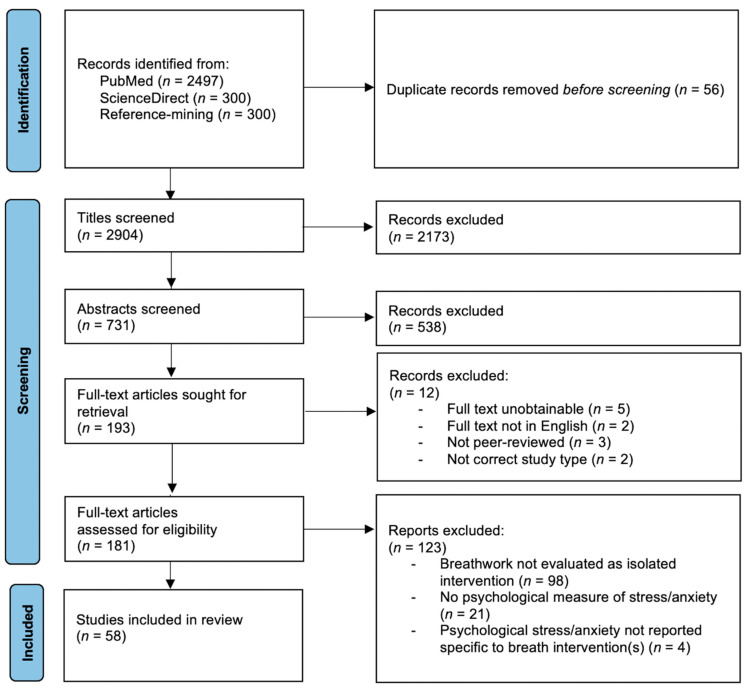
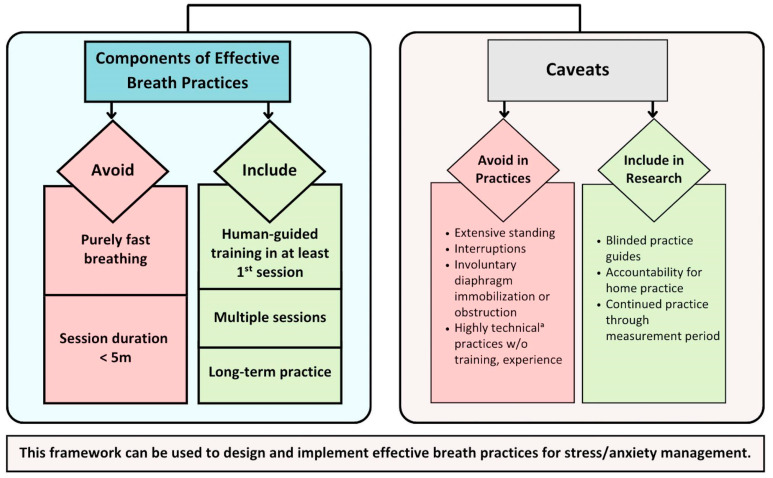
Anxiety and stress plague populations worldwide. Voluntary regulated breathing practices offer a tool to address this epidemic. We examined peer-reviewed published literature to understand effective approaches to and implementation of these practices. PubMed and ScienceDirect were searched to identify clinical trials evaluating isolated breathing-based interventions with psychometric stress/anxiety outcomes. Two independent reviewers conducted all screening and data extraction. Of 2904 unique articles, 731 abstracts, and 181 full texts screened, 58 met the inclusion criteria. Fifty-four of the studies’ 72 interventions were effective. Components of effective and ineffective interventions were evaluated to develop a conceptual framework of factors associated with stress/anxiety reduction effectiveness. Effective breath practices avoided fast-only breath paces and sessions <5 min, while including human-guided training, multiple sessions, and long-term practice. Population, other breath paces, session duration ≥5 min, and group versus individual or at-home practices were not associated with effectiveness. Analysis of interventions that did not fit this framework revealed that extensive standing, interruptions, involuntary diaphragmatic obstruction, and inadequate training for highly technical practices may render otherwise promising interventions ineffective. Following this evidence-based framework can help maximize the stress/anxiety reduction benefits of breathing practices. Future research is warranted to further refine this easily accessible intervention for stress/anxiety relief.
Overview
AI snapshot
Written from the paper’s full text.
TL;DR
This systematic review of 58 clinical studies and 72 isolated breathing interventions found that 54 interventions significantly reduced stress/anxiety. Effective practices avoided fast-only breathing and sessions <5 min, and incorporated human-guided training, multiple sessions, and/or long-term practice.
Key findings
- Of 72 breathing interventions across 58 studies, 54 significantly reduced participants’ stress/anxiety; the review included 5407 total participants (mean age 35.9 years, 43.92% female).
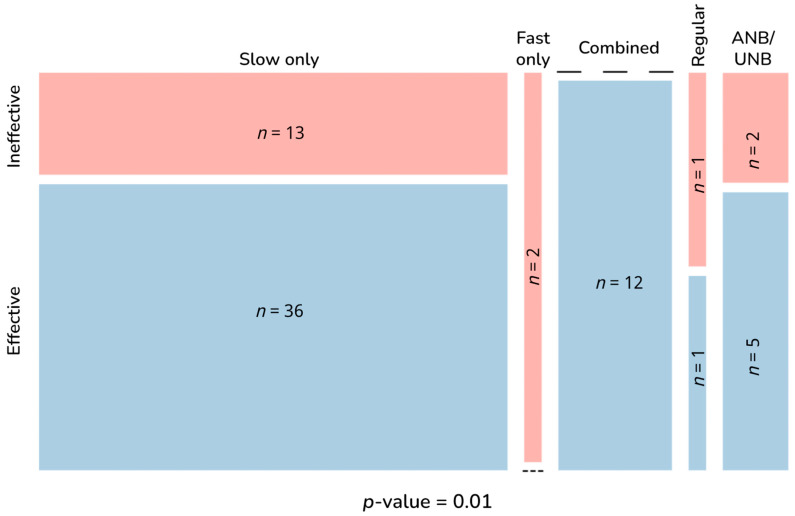
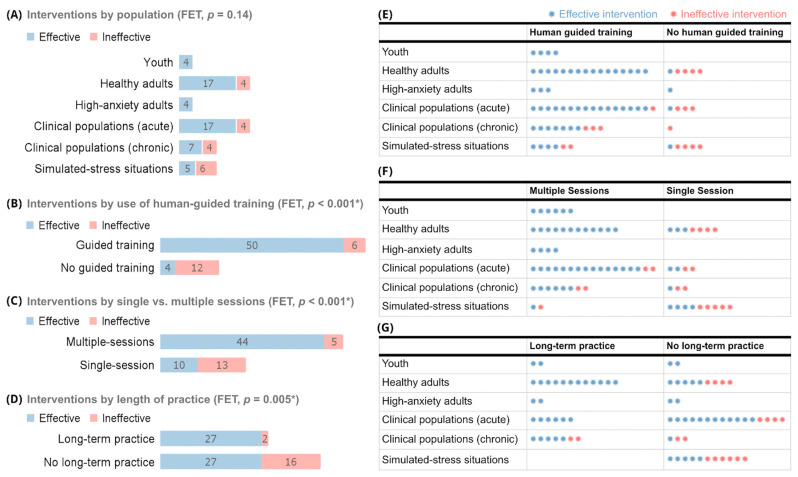
- Effectiveness was significantly associated with breath pace (p = 0.01), human-guided training (p < 0.001), number of human-guided sessions (p < 0.001), number of sessions (p < 0.001), long-term practice (p = 0.005), intervention duration (p < 0.001), and session duration <5 vs ≥5 min (p = 0.005).
- Population category (p = 0.14), session duration beyond 5 min (p = 0.81), group vs individual vs group + individual practice (p = 0.79), and at-home practice (p = 0.24) were not significantly associated with effectiveness.
- The proposed framework identifies exclusionary components (avoid fast-only breathing and sessions <5 min) and core components (human-guided training, multiple sessions, and/or long-term practice); caveats include extensive standing, interruptions, involuntary diaphragmatic obstruction, and inadequate training for highly technical practices.
Methods
- Systematic review following PRISMA; PubMed and ScienceDirect were searched through March 2023, with manual reference-mining; a protocol was not developed or registered.
- From 2904 unique articles, 731 abstracts, and 181 full texts screened, 58 studies met inclusion criteria: 41 RCTs and 17 non-randomized prospective clinical studies; 72 breathing interventions were identified.
- Two independent reviewers conducted screening and data extraction; effectiveness parameters were compared using Fisher’s exact tests in R, and six outlier interventions were explored qualitatively to refine the conceptual framework.
Limitations
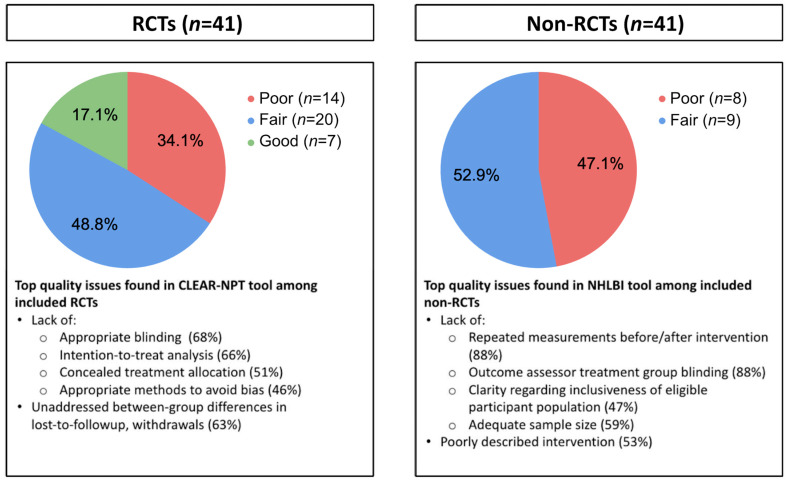
- The paper states that included studies had mediocre-at-best methodological quality, with common issues including lack of blinding, intention-to-treat analysis, concealed allocation, active controls, repeated measurements, and adequate sample size.
- The paper states that reporting was heterogeneous and often omitted key implementation details such as breath rate, compliance, and extent of human-guided training; only two databases were searched; the framework is based on associations, not causal relationships; and no meta-analysis was conducted due to heterogeneity.
- The paper states that framework caveats are hypotheses based on outlier interventions, and caution is warranted for individuals with certain clinical conditions such as epilepsy, heart conditions, or pregnancy. Evident from the text: the review excluded interventions combining breathing with yoga, meditation, tai chi, or real-time biofeedback, which may limit generalizability to those combined practices.
Model-written summary. Check it against the paper before relying on it.
Integrity signals
Registry
Cites
Statistics
Figures
Verification
Claims the paper makes
47 Own interpretation · 45 Own result · 25 Partly supported · 16 Own method · 15 No full text of the sources · 14 No basis given · 7 Supported · 4 Supported so far · 2 Not supported · 1 Mixed support · accuracy not yet measured
At least one cited source doesn’t support this claim or points to a different paper, and none confirmed it — see the verdicts below.
In the paper
“Nonetheless, interventions incorporating at-home practices should motivate and assess practice compliance, as our three ineffective interventions with at-home practice [39,50] reported either inconsistent or unknown practice compliance.”
§ Breathing Practices for Stress and Anxiety Reduction: Conceptual Framework of Implementation Guidelines Based on a Systematic Review of the Published Literature > 4. Discussion > 4.4. Components Not Associated with Effectiveness
What the sources say
- Not checked — no full text of the sourcecites [39] 2023, The Effect of Deep Breathing Exercise and 4-7-8 Breathing Techniques Applied to Patients After Bariatric Surgery on Anxiety and Quality of Life, Obes. Surg. source
- Disputedcites [50] Thomas, 2017, A Randomised Controlled Study of the Effectiveness of Breathing Retraining Exercises Taught by a Physiotherapist Either by Instructional DVD or in Face-to-Face Sessions in the Management of Asthma in Adults, Health Technol. Assess. Winch. Engl. sourceExperimental — accuracy not yet measured
The Patient engagement with the intervention in the active treatment arms section reports that practice was assessed and that most participants spent considerable time practising. The Correlates and predictors of the amount of practice section reports engagement of 98% in the DVD group and 100% in the physiotherapy group. Thus, this source does not describe practice compliance as unknown or generally inconsistent; its Conclusions also call the intervention clinically effective. (LLM, conf=0.88)
Checked by a reasoning model — may be wrong.
plaincorrelational- Asserted: passes — The authors put it forward as true.
- Checkable: passes — It can be checked against evidence.
- Load-bearing: passes — The paper’s conclusions depend on it.
- Based: passes — The paper gives a reason why it holds.
Every source the paper cites for this claim was checked and supports it.
In the paper
“Respiratory entrainment of brain rhythms offers an additional avenue through which breathing may influence neural circuit dynamics, cognition, and mood [26,27].”
§ Breathing Practices for Stress and Anxiety Reduction: Conceptual Framework of Implementation Guidelines Based on a Systematic Review of the Published Literature > 1. Introduction
What the sources say
- Supportedcites [26] Ashhad, 2022, Breathing Rhythm and Pattern and Their Influence on Emotion, Annu. Rev. Neurosci. source
In “Breathing and Emotion,” the review describes widespread breathing-modulated brain oscillations and proposes that breathing rhythms entrain networks involved in emotion and cognition, affecting neural signal processing. It also hypothesizes that changes in breathing rhythm can alter network dynamics and emotional or cognitive state. The claim’s “may” appropriately reflects that proposed mechanism. (LLM, conf=0.92)
- Supportedcites [27] Tort, 2018, Respiration-Entrained Brain Rhythms Are Global but Often Overlooked, Trends Neurosci. source
In “Potential Mechanisms and Functions of Respiration-Entrained Rhythms,” the paper proposes that nasal respiration may affect brain function by driving slow oscillations and modulating fast ones. The same section discusses cognitive function and emotional states, while the Concluding Remarks propose a role in linking distributed cell assemblies. These passages support the claim as a possible avenue, not an established effect on mood. (LLM, conf=0.87)
hedgedconditional- Asserted: passes — The authors put it forward as true.
- Checkable: passes — It can be checked against evidence.
- Load-bearing: unclear — It is unclear whether the paper’s conclusions depend on it.
- Based: passes — The paper gives a reason why it holds.
- Supported
The cited sources support only part of this claim — read each source’s verdict below.
In the paper
“One intervention was effective despite not incorporating human-guided training, multiple sessions, or long-term practice [79].”
§ Breathing Practices for Stress and Anxiety Reduction: Conceptual Framework of Implementation Guidelines Based on a Systematic Review of the Published Literature > 3. Results > 3.4. Synthesis Results
What the sources say
- Partly supportedcites [79] Schlatter, S.T., Thérond, C.C., Guillot, A., Louisy, S.P., Duclos, A., Lehot, J.-J., Rimmelé, T., Debarnot, U.S., and Lilot, M.E. (2022). Effects of Relaxing Breathing Paired with Cardiac Biofeedback on Performance and Relaxation during Critical Simulated Situations: A Prospective Randomized Controlled Trial. BMC Med. Educ., 22. sourceExperimental — accuracy not yet measured
The Discussion and Conclusion report improved simulation performance after a single five-minute breathing intervention, supporting the claim that this intervention did not require multiple sessions or a prolonged practice protocol. But the Methods (Design) say the investigator performed each intervention and stayed to verify it, and that all participants had previously received formal training in stress-management tactics. The paper therefore does not establish effectiveness without human involvement or prior training. (LLM, conf=0.88)
plaindirect- Asserted: passes — The authors put it forward as true.
- Checkable: passes — It can be checked against evidence.
- Load-bearing: unclear — It is unclear whether the paper’s conclusions depend on it.
- Based: passes — The paper gives a reason why it holds.
- Partly supported
The cited sources support only part of this claim — read each source’s verdict below.
In the paper
“Although the analysis by Fincham and colleagues attempted to investigate subgroup effects, they included only 12 studies [35].”
§ Breathing Practices for Stress and Anxiety Reduction: Conceptual Framework of Implementation Guidelines Based on a Systematic Review of the Published Literature > 4. Discussion > 4.1. Overview
What the sources say
- Partly supportedcites [35] Fincham, 2023, Effect of Breathwork on Stress and Mental Health: A Meta-Analysis of Randomised-Controlled Trials, Sci. Rep. sourceExperimental — accuracy not yet measured
The Results (Search results) state that 12 studies contributed to the stress analysis, for which subgroup effects were explored. But the same passage says the quantitative synthesis included 26 reports overall, so “included only 12 studies” needs the stress-outcome qualifier. (LLM, conf=0.88)
plain- Asserted: passes — The authors put it forward as true.
- Checkable: passes — It can be checked against evidence.
- Load-bearing: unclear — It is unclear whether the paper’s conclusions depend on it.
- Based: passes — The paper gives a reason why it holds.
- Partly supported
The cited sources support only part of this claim — read each source’s verdict below.
In the paper
“Polyvagal [108] and neurovisceral integration [109] theories favor slow over fast breathing due to its activation of the parasympathetic nervous system and accompanying effects on the mind and brain [52].”
§ Breathing Practices for Stress and Anxiety Reduction: Conceptual Framework of Implementation Guidelines Based on a Systematic Review of the Published Literature > 4. Discussion > 4.2. Exclusionary Components
What the sources say
- Partly supportedcites [108] PORGES, 2009, The Polyvagal Theory: New Insights into Adaptive Reactions of the Autonomic Nervous System, Cleve. Clin. J. Med. sourceExperimental — accuracy not yet measured
The Summary and ‘Consistency with Jacksonian Dissolution’ sections link increased vagal influence to reduced sympathetic activity and social engagement. But the paper does not say that polyvagal theory favors slow over fast breathing or that slow breathing activates those pathways; searches for breathing rate and slow breathing found no such comparison. Page numbers were not available in our copy. (LLM, conf=0.83)
- Not checked — no full text of the sourcecites [109] Thayer, 2000, A Model of Neurovisceral Integration in Emotion Regulation and Dysregulation, J. Affect. Disord. source
- Supportedcites [52] Zaccaro, 2018, How Breath-Control Can Change Your Life: A Systematic Review on Psycho-Physiological Correlates of Slow Breathing, Front. Hum. Neurosci. source
The Discussion (Summary of main findings; page unavailable) says slow breathing appears to promote parasympathetic predominance and links parasympathetic and central nervous system activity with emotional control and well-being. This supports the physiological and mind–brain effects attributed to this source; the named theories have separate citations in the citing sentence. (LLM, conf=0.89)
plaindirect- Asserted: passes — The authors put it forward as true.
- Checkable: passes — It can be checked against evidence.
- Load-bearing: passes — The paper’s conclusions depend on it.
- Based: passes — The paper gives a reason why it holds.
- Partly supported
The cited sources support only part of this claim — read each source’s verdict below.
In the paper
“Intervention effectiveness was less likely during fast-only breathing versus any other pace, consistent with other reviews finding benefits associated with slow-paced breathing practices [23,35].”
§ Breathing Practices for Stress and Anxiety Reduction: Conceptual Framework of Implementation Guidelines Based on a Systematic Review of the Published Literature > 4. Discussion > 4.2. Exclusionary Components
What the sources say
- Partly supportedcites [23] Banushi, B., Brendle, M., Ragnhildstveit, A., Murphy, T., Moore, C., Egberts, J., and Robison, R. (2023). Breathwork Interventions for Adults with Clinically Diagnosed Anxiety Disorders: A Scoping Review. Brain Sci., 13. sourceExperimental — accuracy not yet measured
The Results (section 3.6; page unavailable) report anxiety reductions in five studies using slow diaphragmatic, deep, or controlled breathing, supporting the sentence’s point about benefits associated with slower practices. The review does not report that fast-only breathing was less likely to be effective than every other pace, so it does not establish the claimed comparison. (LLM, conf=0.82)
- Partly supportedcites [35] Fincham, 2023, Effect of Breathwork on Stress and Mental Health: A Meta-Analysis of Randomised-Controlled Trials, Sci. Rep. sourceExperimental — accuracy not yet measured
The Results (Subgroup analyses for stress; page unavailable) report a significant effect for slow-paced breathwork but not fast-paced breathwork. That does not establish that fast-only breathing was less effective than other paces: the Discussion (Breathwork and stress; page unavailable) says there were no significant differences between subgroups and only two fast-paced studies, too few for a meaningful comparison. (LLM, conf=0.88)
hedgedcorrelational- Asserted: passes — The authors put it forward as true.
- Checkable: passes — It can be checked against evidence.
- Load-bearing: passes — The paper’s conclusions depend on it.
- Based: passes — The paper gives a reason why it holds.
- Partly supported
The sources with a verdict support this claim; the rest weren’t checked yet, have no full text we could read, or their verdicts aren’t rated yet.
In the paper
“Previous reviews have provided insight into the psychological and/or physiological benefits of slow breathing [52], diaphragmatic breathing [36], ANB [38], and other breath practices [23,25,35,37].”
§ Breathing Practices for Stress and Anxiety Reduction: Conceptual Framework of Implementation Guidelines Based on a Systematic Review of the Published Literature > 4. Discussion > 4.1. Overview
What the sources say
- Supportedcites [52] Zaccaro, 2018, How Breath-Control Can Change Your Life: A Systematic Review on Psycho-Physiological Correlates of Slow Breathing, Front. Hum. Neurosci. source
Citation [52] is attached to slow breathing, not the other practices in the sentence. The Objectives and research question section identifies this paper as a review of slow-breathing techniques, and the Discussion’s Summary of main findings and Conclusions describe their physiological and psychological effects. Page numbers are not provided in our copy. (LLM, conf=0.94)
- Not checked — no full text of the sourcecites [36] Hopper, 2019, Effectiveness of Diaphragmatic Breathing for Reducing Physiological and Psychological Stress in Adults: A Quantitative Systematic Review, JBI Database Syst. Rev. Implement. Rep. source
- Not checked — no full text of the sourcecites [38] Rung, 2021, Alternate Nostril Breathing to Reduce Stress: An Option for Pregnant Women Survivors of Intimate Partner Violence?, J. Holist. Nurs. Off. J. Am. Holist. Nurses Assoc. source
plaincorrelational- Asserted: passes — The authors put it forward as true.
- Checkable: passes — It can be checked against evidence.
- Load-bearing: passes — The paper’s conclusions depend on it.
- Based: passes — The paper gives a reason why it holds.
- Supported
The cited sources support only part of this claim — read each source’s verdict below.
In the paper
“We found that interventions given to groups were equally effective as those given to individuals, a finding corroborated by other recent literature [35].”
§ Breathing Practices for Stress and Anxiety Reduction: Conceptual Framework of Implementation Guidelines Based on a Systematic Review of the Published Literature > 4. Discussion > 4.4. Components Not Associated with Effectiveness
What the sources say
- Partly supportedcites [35] Fincham, 2023, Effect of Breathwork on Stress and Mental Health: A Meta-Analysis of Randomised-Controlled Trials, Sci. Rep. sourceExperimental — accuracy not yet measured
The Results (Subgroup analyses for stress; page not available) report significant effects on stress for both individually taught and group-taught breathwork. The Discussion (Breathwork and stress; page not available) says delivery style did not seem to influence results, but cautions that the small number of studies may have limited its ability to detect differences. That supports similar observed effects, not a definitive finding of equal effectiveness. (LLM, conf=0.85)
plain- Asserted: passes — The authors put it forward as true.
- Checkable: passes — It can be checked against evidence.
- Load-bearing: unclear — It is unclear whether the paper’s conclusions depend on it.
- Based: passes — The paper gives a reason why it holds.
- Partly supported
The cited sources support only part of this claim — read each source’s verdict below.
In the paper
“Deep or diaphragmatic breathing may provide minimal benefit when voluntary full diaphragmatic movement is lacking, such as during a breast biopsy [47].”
§ Breathing Practices for Stress and Anxiety Reduction: Conceptual Framework of Implementation Guidelines Based on a Systematic Review of the Published Literature > 4. Discussion > 4.5. Framework Caveats
What the sources say
- Partly supportedcites [47] Ratcliff, 2019, A Randomized Controlled Trial of Brief Mindfulness Meditation for Women Undergoing Stereotactic Breast Biopsy, J. Am. Coll. Radiol. JACR sourceExperimental — accuracy not yet measured
The Methods describe slow diaphragmatic breathing during breast biopsy, and the Results (Intervention Effect on Anxiety; page unavailable) found no significant difference in anxiety reduction between that group and standard care. The paper does not say that participants lacked voluntary full diaphragmatic movement or that restricted movement explains the result. (LLM, conf=0.85)
hedgedconditional- Asserted: passes — The authors put it forward as true.
- Checkable: passes — It can be checked against evidence.
- Load-bearing: unclear — It is unclear whether the paper’s conclusions depend on it.
- Based: passes — The paper gives a reason why it holds.
- Partly supported
The cited sources support only part of this claim — read each source’s verdict below.
In the paper
“The respiratory dysregulation and high chronic stress accompanying anxiety disorders may augment sensitivity to breath practice interventions [53].”
§ Breathing Practices for Stress and Anxiety Reduction: Conceptual Framework of Implementation Guidelines Based on a Systematic Review of the Published Literature > 4. Discussion > 4.4. Components Not Associated with Effectiveness
What the sources say
- Partly supportedcites [53] Paulus, 2013, The Breathing Conundrum–Interoceptive Sensitivity and Anxiety, Depress. Anxiety sourceExperimental — accuracy not yet measured
In “Anxiety and Breathing – The Interoceptive Connection” (page unavailable), the paper reports altered breathing characteristics in people with anxiety disorders. In “Resistive Loads – An Experimental Approach to Measure Breathing Changes in Anxiety” (page unavailable), it describes breathing modulation as a therapeutic intervention but says little is known about its effects. It does not establish that chronic stress or respiratory dysregulation increases sensitivity to breath-practice interventions. (LLM, conf=0.82)
hedgedconditional- Asserted: passes — The authors put it forward as true.
- Checkable: passes — It can be checked against evidence.
- Load-bearing: unclear — It is unclear whether the paper’s conclusions depend on it.
- Based: passes — The paper gives a reason why it holds.
- Partly supported
- It may state two separate claims as one. 82
- Probably not a substantial claim. 36
- The quote only partly states this claim. 2
At least one cited source doesn’t support this claim or points to a different paper, and none confirmed it — see the verdicts below.
In the paper
“Regarding the latter, stress reduction may have also been hindered by fast-only breathing in Watson and colleague’s intervention and by the discomfort of doing deep diaphragmatic breathing after abdominal surgery in Aktas and colleagues’ intervention [39,105].”
§ Breathing Practices for Stress and Anxiety Reduction: Conceptual Framework of Implementation Guidelines Based on a Systematic Review of the Published Literature > 4. Discussion > 4.2. Exclusionary Components
What the sources say
- Not checked — no full text of the sourcecites [39] 2023, The Effect of Deep Breathing Exercise and 4-7-8 Breathing Techniques Applied to Patients After Bariatric Surgery on Anxiety and Quality of Life, Obes. Surg. source
- Disputedcites [105] Watson, G.M., Sutherland, J., Lacey, C., and Bridgman, P.G. (2022). A Randomised Cross-over Trial of QT Response to Hyperventilation-Induced Anxiety and Diaphragmatic Breathing in Patients with Stress Cardiomyopathy and in Control Patients. PLoS ONE, 17. sourceExperimental — accuracy not yet measured
The Methods (page unavailable) describe two breathing conditions, not a fast-only intervention: hyperventilation was used to induce anxiety, while diaphragmatic breathing was used as the control because it may relieve anxiety. The Results (page unavailable) report that hyperventilation significantly increased anxiety. Watson et al. therefore do not support the proposed explanation that fast-only breathing hindered stress reduction; the separate claim about Aktas et al. is not assessed here. (LLM, conf=0.87)
Checked by a reasoning model — may be wrong.
hedgedconditional- Asserted: passes — The authors put it forward as true.
- Checkable: passes — It can be checked against evidence.
- Load-bearing: passes — The paper’s conclusions depend on it.
- Based: passes — The paper gives a reason why it holds.
It may state two separate claims as one.
Some cited sources support this claim and some don’t — read each source’s verdict below.
In the paper
“Of the 45 interventions in any population that incorporated both of these components, only four were ineffective [44,47,50], but this was likely due to taxing clinical situations [47], inadequate training or experience for a more technical practice [44], and practice discontinuation [50].”
§ Breathing Practices for Stress and Anxiety Reduction: Conceptual Framework of Implementation Guidelines Based on a Systematic Review of the Published Literature > 4. Discussion > 4.4. Components Not Associated with Effectiveness
What the sources say
- Partly supportedcites [44] Kamath, A., Urval, R.P., and Shenoy, A.K. (2017). Effect of Alternate Nostril Breathing Exercise on Experimentally Induced Anxiety in Healthy Volunteers Using the Simulated Public Speaking Model: A Randomized Controlled Pilot Study. BioMed Res. Int., 2017. sourceExperimental — accuracy not yet measured
The Conclusion reports no significant decrease in anxiety, and the Discussion suggests that participants’ limited training may have affected their performance. However, the Methods describe a single 15-minute intervention, not multiple sessions. The paper does not establish inadequate training as the cause of the nonsignificant result. (LLM, conf=0.88)
- Disputedcites [47] Ratcliff, 2019, A Randomized Controlled Trial of Brief Mindfulness Meditation for Women Undergoing Stereotactic Breast Biopsy, J. Am. Coll. Radiol. JACR sourceExperimental — accuracy not yet measured
The Results (page unavailable) report that guided mindfulness produced a steeper reduction in anxiety during biopsy than either control condition. The Discussion (page unavailable) calls it effective for reducing anxiety; it found no significant pain difference, but suggests local anesthesia and low pain ratings as possible explanations—not a taxing clinical situation. (LLM, conf=0.88)
Checked by a reasoning model — may be wrong.
- Partly supportedcites [50] Thomas, 2017, A Randomised Controlled Study of the Effectiveness of Breathing Retraining Exercises Taught by a Physiotherapist Either by Instructional DVD or in Face-to-Face Sessions in the Management of Asthma in Adults, Health Technol. Assess. Winch. Engl. sourceExperimental — accuracy not yet measured
The Process Evaluation (page unavailable) reports that 97 participants stopped regular practice, supporting the practice-discontinuation part associated with this citation. It does not say that discontinuation caused an intervention to be ineffective; Chapter 8, Conclusions (page unavailable), instead reports improved asthma-related quality of life with both breathing-retraining programmes. (LLM, conf=0.85)
hedgedconditional- Asserted: passes — The authors put it forward as true.
- Checkable: passes — It can be checked against evidence.
- Load-bearing: passes — The paper’s conclusions depend on it.
- Based: passes — The paper gives a reason why it holds.
It may state two separate claims as one.
- Partly supported
The cited sources support only part of this claim — read each source’s verdict below.
In the paper
“Voluntary regulated breathing practices may offer such a solution.”
§ Breathing Practices for Stress and Anxiety Reduction: Conceptual Framework of Implementation Guidelines Based on a Systematic Review of the Published Literature > 1. Introduction
What the sources say
- Partly supportedcites [18] Sengupta, 2012, Health Impacts of Yoga and Pranayama: A State-of-the-Art Review, Int. J. Prev. Med. sourceExperimental — accuracy not yet measured
The “Stress and anxiety” section says yoga practices may reduce stress responses and help with anxiety, and describes slow, rhythmic pranayama as producing deep relaxation. It does not establish that regulated breathing alone is accessible or risk-free; the “Risks of yoga practice” section explicitly says yoga is not entirely risk-free. Page numbers are unavailable in our copy. (LLM, conf=0.87)
- Not checked — no full text of the sourcecites [19] Cramer, 2018, Yoga for Anxiety: A Systematic Review and Meta-Analysis of Randomized Controlled Trials, Depress. Anxiety source
- Not checked yetcites [20] Sellakumar, 2015, Effect of Slow-Deep Breathing Exercise to Reduce Anxiety among Adolescent School Students in a Selected Higher Secondary School in Coimbatore, India, J. Psychol. Educ. Res. (JPER)
- Not checked — no full text of the sourcecites [21] Hunt, 2018, Positive Effects of Diaphragmatic Breathing on Physiological Stress Reactivity in Varsity Athletes, J. Clin. Sport Psychol. source
- Not checked — no full text of the sourcecites [22] Han, 1996, Influence of Breathing Therapy on Complaints, Anxiety and Breathing Pattern in Patients with Hyperventilation Syndrome and Anxiety Disorders, J. Psychosom. Res. source
hedgedconditional- Asserted: passes — The authors put it forward as true.
- Checkable: passes — It can be checked against evidence.
- Load-bearing: passes — The paper’s conclusions depend on it.
- Based: passes — The paper gives a reason why it holds.
It may state two separate claims as one.
- Partly supported
The cited sources support only part of this claim — read each source’s verdict below.
In the paper
“Breathing practices, when used in isolation, have the advantage of being universally accessible, scalable, and cost-free. They are not limited by access to healthcare services nor burdened by side effects and put potential treatment tools in the hands of the individual [23,24,25].”
§ Breathing Practices for Stress and Anxiety Reduction: Conceptual Framework of Implementation Guidelines Based on a Systematic Review of the Published Literature > 1. Introduction
What the sources say
- Partly supportedcites [23] Banushi, B., Brendle, M., Ragnhildstveit, A., Murphy, T., Moore, C., Egberts, J., and Robison, R. (2023). Breathwork Interventions for Adults with Clinically Diagnosed Anxiety Disorders: A Scoping Review. Brain Sci., 13. sourceExperimental — accuracy not yet measured
The Introduction (no page given) calls for cost-effective, self-administered therapies usable by large populations, and the Conclusions (no page given) describe breathwork options as feasible and accessible to patients with anxiety. The paper does not establish that breathing practices are universally accessible or cost-free, require no healthcare access, or have no side effects; it identifies side effects as a limitation of some existing treatments, not as an absence demonstrated for breathwork. (LLM, conf=0.84)
- Not checked — no full text of the sourcecites [24] Leyro, 2021, Respiratory Therapy for the Treatment of Anxiety: Meta-Analytic Review and Regression, Clin. Psychol. Rev. source
- Not checked — no full text of the sourcecites [25] Malviya, 2022, Identifying Alternative Mental Health Interventions: A Systematic Review of Randomized Controlled Trials of Chanting and Breathwork, J. Spiritual. Ment. Health source
plain- Asserted: passes — The authors put it forward as true.
- Checkable: passes — It can be checked against evidence.
- Load-bearing: passes — The paper’s conclusions depend on it.
- Based: passes — The paper gives a reason why it holds.
It may state two separate claims as one.
- Partly supported
The cited sources support only part of this claim — read each source’s verdict below.
In the paper
“Breathing also uniquely engages in a reciprocal relationship with stress and anxiety, whereby stress and anxiety can both affect [28,29,30,31,32,33] and be affected by [20,21,22,34] altered respiratory patterns.”
§ Breathing Practices for Stress and Anxiety Reduction: Conceptual Framework of Implementation Guidelines Based on a Systematic Review of the Published Literature > 1. Introduction
What the sources say
- Not checked — no full text of the sourcecites [28] Masaoka, 1997, Anxiety and Respiratory Patterns: Their Relationship during Mental Stress and Physical Load, Int. J. Psychophysiol. Off. J. Int. Organ. Psychophysiol. source
- Not checked — no full text of the sourcecites [29] Wilhelm, 2001, Respiratory Dysregulation in Anxiety, Functional Cardiac, and Pain Disorders. Assessment, Phenomenology, and Treatment, Behav. Modif. source
- Partly supportedcites [30] Martinez, 2001, Respiratory Variability in Panic Disorder, Depress. Anxiety sourceExperimental — accuracy not yet measured
The Discussion (article pp. 232–237) suggests that anticipatory anxiety might drive respiratory variability and that greater baseline variability may increase vulnerability to CO₂-induced panic. It says the direction of the relationship remains unclear, however, and does not establish a reciprocal relationship between breathing and stress or anxiety generally. (LLM, conf=0.86)
- Not checked — no full text of the sourcecites [31] Nardi, 2009, Panic Disorder and Control of Breathing, Respir. Physiol. Neurobiol. source
- Not checked — no full text of the sourcecites [32] Bechbache, 1979, The Effects of Hypercapnia, Hypoxia, Exercise and Anxiety on the Pattern of Breathing in Man, J. Physiol. source
- Not checked — no full text of the sourcecites [33] Grossman, 1983, Respiration, Stress, and Cardiovascular Function, Psychophysiology source
- Not checked yetcites [20] Sellakumar, 2015, Effect of Slow-Deep Breathing Exercise to Reduce Anxiety among Adolescent School Students in a Selected Higher Secondary School in Coimbatore, India, J. Psychol. Educ. Res. (JPER)
- Not checked — no full text of the sourcecites [21] Hunt, 2018, Positive Effects of Diaphragmatic Breathing on Physiological Stress Reactivity in Varsity Athletes, J. Clin. Sport Psychol. source
- Not checked — no full text of the sourcecites [22] Han, 1996, Influence of Breathing Therapy on Complaints, Anxiety and Breathing Pattern in Patients with Hyperventilation Syndrome and Anxiety Disorders, J. Psychosom. Res. source
- Not checked — no full text of the sourcecites [34] Bhimani, 2011, Effect of Pranayama on Stress and Cardiovascular Autonomic Function, Indian J. Physiol. Pharmacol.
plaindirect- Asserted: passes — The authors put it forward as true.
- Checkable: passes — It can be checked against evidence.
- Load-bearing: passes — The paper’s conclusions depend on it.
- Based: passes — The paper gives a reason why it holds.
It may state two separate claims as one.
Every source the paper cites for this claim was checked and supports it.
In the paper
“Common stress and anxiety treatments rely on external factors, such as a therapist or medication, and come with modest effect sizes [16] or unfavorable side effects [17].”
§ Breathing Practices for Stress and Anxiety Reduction: Conceptual Framework of Implementation Guidelines Based on a Systematic Review of the Published Literature > 1. Introduction
What the sources say
- Supportedcites [16] Carpenter, 2018, Cognitive Behavioral Therapy for Anxiety and Related Disorders: A Meta-Analysis of Randomized Placebo-Controlled Trials, Depress. Anxiety source
Citation [16] is attached to the claim about modest effect sizes. The Results report a moderate placebo-controlled effect of CBT on target disorder symptoms (Hedges’ g = 0.56), and the Discussion describes the effects as moderate. The unfavorable-side-effects claim is attached to a different citation, [17]. (LLM, conf=0.91)
- Supportedcites [17] Bandelow, 2017, Treatment of Anxiety Disorders, Dialogues Clin. Neurosci. source
The citation to this source is attached to the side-effects portion of the sentence, not the modest-effect-sizes portion. The Pharmacotherapy sections on SSRIs/SNRIs and benzodiazepines describe adverse effects, including increased anxiety, fatigue, dizziness, and impaired driving. The Treatment section also identifies psychotherapy and medication as common approaches (page numbers unavailable in our copy). (LLM, conf=0.90)
plain- Asserted: passes — The authors put it forward as true.
- Checkable: passes — It can be checked against evidence.
- Load-bearing: passes — The paper’s conclusions depend on it.
- Based: passes — The paper gives a reason why it holds.
It may state two separate claims as one.
- Supported
The sources with a verdict support this claim; the rest weren’t checked yet, have no full text we could read, or their verdicts aren’t rated yet.
In the paper
“RCTs were assessed using a modified form of the Boutron checklist to evaluate a report of a nonpharmacological trial (CLEAR-NPT; Appendix A.3) [51,62]. Non-RCTs were assessed using the National Heart, Lung, and Blood Institute of the National Institutes of Health (NHLBI-NIH) quality assessment tool for single-arm, pre-post, or non-randomized studies (Appendix A.4) [63].”
§ Breathing Practices for Stress and Anxiety Reduction: Conceptual Framework of Implementation Guidelines Based on a Systematic Review of the Published Literature > 2. Materials and Methods > 2.5. Assessment of Study Quality
What the sources say
- Supportedcites [51] Chen, 2012, Meditative Therapies for Reducing Anxiety: A Systematic Review and Meta-Analysis of Randomized Controlled Trials, Depress. Anxiety source
The Methods > Data Coding passage says study quality was assessed with a modified Boutron CLEAR-NPT checklist, and the paper included only RCTs. The NHLBI-NIH tool appears in a separate citing sentence attributed to [63], not to this source. (LLM, conf=0.92)
- Not checked — no full text of the sourcecites [62] Boutron, 2005, A Checklist to Evaluate a Report of a Nonpharmacological Trial (CLEAR NPT) Was Developed Using Consensus, J. Clin. Epidemiol. source
- Not checked yetcites [63] (2023, August 17). Study Quality Assessment Tools|NHLBI, NIH, Available online: https://www.nhlbi.nih.gov/health-topics/study-quality-assessment-tools.
plain- Asserted: passes — The authors put it forward as true.
- Checkable: passes — It can be checked against evidence.
- Load-bearing: fails — The paper’s conclusions may not depend on it.
- Based: passes — The paper gives a reason why it holds.
Probably not a substantial claim. The paper’s conclusions may not depend on it. It may state two separate claims as one.
- Supported
The cited sources support only part of this claim — read each source’s verdict below.
In the paper
“Although existing literature confirms the widespread benefits of slow breathing practices for stress/anxiety reduction [23,24,25,35,36,37,38], null or negative results are reported in some studies [39,40,41,42,43,44,45,46,47,48,49,50].”
§ Breathing Practices for Stress and Anxiety Reduction: Conceptual Framework of Implementation Guidelines Based on a Systematic Review of the Published Literature > 1. Introduction
What the sources say
- Supportedcites [23] Banushi, B., Brendle, M., Ragnhildstveit, A., Murphy, T., Moore, C., Egberts, J., and Robison, R. (2023). Breathwork Interventions for Adults with Clinically Diagnosed Anxiety Disorders: A Scoping Review. Brain Sci., 13. source
The Discussion reports that all reviewed studies using slow diaphragmatic breathing showed positive effects on stress reduction, while some breathwork results were contradictory. The Results (§3.6) also report a null physiological finding for slower breathing and increased anxiety and depression in two studies of other breathwork interventions. (LLM, conf=0.90)
- Not checked — no full text of the sourcecites [24] Leyro, 2021, Respiratory Therapy for the Treatment of Anxiety: Meta-Analytic Review and Regression, Clin. Psychol. Rev. source
- Not checked — no full text of the sourcecites [25] Malviya, 2022, Identifying Alternative Mental Health Interventions: A Systematic Review of Randomized Controlled Trials of Chanting and Breathwork, J. Spiritual. Ment. Health source
- Partly supportedcites [35] Fincham, 2023, Effect of Breathwork on Stress and Mental Health: A Meta-Analysis of Randomised-Controlled Trials, Sci. Rep. sourceExperimental — accuracy not yet measured
The Results (Subgroup analyses for stress) report significant stress benefits for slow-paced breathwork, and the Discussion (Breathwork, anxiety and depression) reports reduced anxiety across breathwork interventions. The Discussion (Clinical implications) also reports nonsignificant effects in mental and physical health populations and urges caution. Thus the paper supports benefits and some null findings, but not unqualified, widespread benefits or negative results specifically for slow breathing. (LLM, conf=0.85)
- Not checked — no full text of the sourcecites [36] Hopper, 2019, Effectiveness of Diaphragmatic Breathing for Reducing Physiological and Psychological Stress in Adults: A Quantitative Systematic Review, JBI Database Syst. Rev. Implement. Rep. source
- Partly supportedcites [37] Miri, 2023, Effects of Breathing Exercise Techniques on the Pain and Anxiety of Burn Patients: A Systematic Review and Meta-Analysis, Int. Wound J. sourceExperimental — accuracy not yet measured
The Results section reports that breathing exercises, including deep, slow breathing, reduced anxiety in burn patients; the Discussion likewise concludes that breathing techniques reduced anxiety during burn care (page unavailable). This supports the benefit cited in the first part of the sentence, but not a widespread stress-reduction benefit across populations. The null-or-negative-results clause has a separate set of citations and is not attributed to this source. (LLM, conf=0.84)
- Not checked — no full text of the sourcecites [38] Rung, 2021, Alternate Nostril Breathing to Reduce Stress: An Option for Pregnant Women Survivors of Intimate Partner Violence?, J. Holist. Nurs. Off. J. Am. Holist. Nurses Assoc. source
- Not checked — no full text of the sourcecites [39] 2023, The Effect of Deep Breathing Exercise and 4-7-8 Breathing Techniques Applied to Patients After Bariatric Surgery on Anxiety and Quality of Life, Obes. Surg. source
- Not checked — no full text of the sourcecites [40] Biggs, 2003, The Effects of Deep Diaphragmatic Breathing and Focused Attention on Dental Anxiety in a Private Practice Setting, J. Dent. Hyg. JDH
- Not checked — no full text of the sourcecites [41] Boaviagem, 2017, The Effectiveness of Breathing Patterns to Control Maternal Anxiety during the First Period of Labor: A Randomized Controlled Clinical Trial, Complement. Ther. Clin. Pract. source
plaindirect- Asserted: passes — The authors put it forward as true.
- Checkable: passes — It can be checked against evidence.
- Load-bearing: passes — The paper’s conclusions depend on it.
- Based: passes — The paper gives a reason why it holds.
It may state two separate claims as one.
- Supported
The cited sources support only part of this claim — read each source’s verdict below.
In the paper
“The presence of core components in the three effective interventions [39,105,106] suggests that such short sessions may be particularly sensitive to practice implementation, such that human guidance, multiple sessions, or long-term practice are required for effective stress reduction.”
§ Breathing Practices for Stress and Anxiety Reduction: Conceptual Framework of Implementation Guidelines Based on a Systematic Review of the Published Literature > 4. Discussion > 4.2. Exclusionary Components
What the sources say
- Not checked — no full text of the sourcecites [39] 2023, The Effect of Deep Breathing Exercise and 4-7-8 Breathing Techniques Applied to Patients After Bariatric Surgery on Anxiety and Quality of Life, Obes. Surg. source
- Partly supportedcites [105] Watson, G.M., Sutherland, J., Lacey, C., and Bridgman, P.G. (2022). A Randomised Cross-over Trial of QT Response to Hyperventilation-Induced Anxiety and Diaphragmatic Breathing in Patients with Stress Cardiomyopathy and in Control Patients. PLoS ONE, 17. sourceExperimental — accuracy not yet measured
Split into 2 atoms — 0 confirmed, 2 partially supported, 0 disputed, 0 misattributed, 0 unverifiable. Expand the claim to see per-atom verdicts.
- Not checked — no full text of the sourcecites [106] McCaul, 1979, Effects of Paced Respiration and Expectations on Physiological and Psychological Responses to Threat, J. Pers. Soc. Psychol. source
hedgedconditional- Asserted: passes — The authors put it forward as true.
- Checkable: passes — It can be checked against evidence.
- Load-bearing: passes — The paper’s conclusions depend on it.
- Based: passes — The paper gives a reason why it holds.
It may state two separate claims as one.
Every source the paper cites for this claim was checked and supports it.
In the paper
“Yet another interpretation resides in the connection between breathing patterns and the brain’s neural circuitry, whereby shifting breathing patterns may correspondingly shift neural circuit dynamics and thus mood and mental state [26].”
§ Breathing Practices for Stress and Anxiety Reduction: Conceptual Framework of Implementation Guidelines Based on a Systematic Review of the Published Literature > 4. Discussion > 4.2. Exclusionary Components
What the sources say
- Supportedcites [26] Ashhad, 2022, Breathing Rhythm and Pattern and Their Influence on Emotion, Annu. Rev. Neurosci. source
In “Breathing and Emotion” (page not provided), the authors hypothesize that changes in breathing modulate the temporal dynamics of interacting brain networks and produce changes in emotional or cognitive state. This supports the citing sentence’s tentative wording. (LLM, conf=0.94)
hedgedconditional- Asserted: passes — The authors put it forward as true.
- Checkable: passes — It can be checked against evidence.
- Load-bearing: fails — The paper’s conclusions may not depend on it.
- Based: passes — The paper gives a reason why it holds.
Probably not a substantial claim. The paper’s conclusions may not depend on it. It may state two separate claims as one.
- Supported
The cited sources support only part of this claim — read each source’s verdict below.
In the paper
“In addition, most reviews include breathing interventions incorporating biofeedback [23,25,35,52], which is not readily applicable to at-home practice.”
§ Breathing Practices for Stress and Anxiety Reduction: Conceptual Framework of Implementation Guidelines Based on a Systematic Review of the Published Literature > 4. Discussion > 4.1. Overview
What the sources say
- Partly supportedcites [23] Banushi, B., Brendle, M., Ragnhildstveit, A., Murphy, T., Moore, C., Egberts, J., and Robison, R. (2023). Breathwork Interventions for Adults with Clinically Diagnosed Anxiety Disorders: A Scoping Review. Brain Sci., 13. sourceExperimental — accuracy not yet measured
The Results (§3.4; page unavailable) show that this review includes biofeedback-assisted breathing interventions, supporting its use as an example of such a review. The paper does not establish that most reviews include them, and the Discussion (§4; page unavailable) describes biofeedback as implementable in real-world settings rather than saying it is unsuitable for at-home practice. (LLM, conf=0.85)
- Not checked — no full text of the sourcecites [25] Malviya, 2022, Identifying Alternative Mental Health Interventions: A Systematic Review of Randomized Controlled Trials of Chanting and Breathwork, J. Spiritual. Ment. Health source
- Partly supportedcites [35] Fincham, 2023, Effect of Breathwork on Stress and Mental Health: A Meta-Analysis of Randomised-Controlled Trials, Sci. Rep. sourceExperimental — accuracy not yet measured
The Discussion section, “Comparison to stress-reduction interventions” (page unavailable), discusses meta-analyses of HRV biofeedback and says that HRV biofeedback may be less accessible because it is routinely taught by a qualified professional. It does not establish that most breathing-intervention reviews include biofeedback or that biofeedback is not readily applicable to at-home practice; it also describes a portable biofeedback device used in two studies. (LLM, conf=0.83)
plain- Asserted: passes — The authors put it forward as true.
- Checkable: passes — It can be checked against evidence.
- Load-bearing: passes — The paper’s conclusions depend on it.
- Based: passes — The paper gives a reason why it holds.
It may state two separate claims as one.
- Partly supported
The cited sources support only part of this claim — read each source’s verdict below.
In the paper
“The other was effective, possibly due to human-guided training and its 12 bpm pace, which may have been slow enough to engender benefits [78].”
§ Breathing Practices for Stress and Anxiety Reduction: Conceptual Framework of Implementation Guidelines Based on a Systematic Review of the Published Literature > 4. Discussion > 4.2. Exclusionary Components
What the sources say
- Partly supportedcites [78] Conlon, 2022, Pulling the Trigger: The Effect of a 5-Minute Slow Diaphragmatic Breathing Intervention on Psychophysiological Stress Responses and Pressurized Pistol Shooting Performance, J. Sport Exerc. Psychol. sourceExperimental — accuracy not yet measured
The Paced breathing intervention section says an investigator trained participants at 12 breaths per minute, and the Discussion says paced breathing benefited psychological stress responses. The paper does not identify human-guided training or the 12-breath pace as the reason for those benefits; that explanation remains the citing authors’ speculation. (LLM, conf=0.83)
hedgedconditional- Asserted: passes — The authors put it forward as true.
- Checkable: passes — It can be checked against evidence.
- Load-bearing: unclear — It is unclear whether the paper’s conclusions depend on it.
- Based: passes — The paper gives a reason why it holds.
It may state two separate claims as one.
- Partly supported
Every source the paper cites for this claim was checked and supports it.
In the paper
“More human guidance may be needed in situations of clinical stress, such as undergoing a breast biopsy [47], for learning more technical practices, such as ANB and UNB, or for high-anxiety populations.”
§ Breathing Practices for Stress and Anxiety Reduction: Conceptual Framework of Implementation Guidelines Based on a Systematic Review of the Published Literature > 4. Discussion > 4.3. Core Components
What the sources say
- Supportedcites [47] Ratcliff, 2019, A Randomized Controlled Trial of Brief Mindfulness Meditation for Women Undergoing Stereotactic Breast Biopsy, J. Am. Coll. Radiol. JACR source
The Introduction identifies stereotactic breast biopsy as anxiety-laden for many patients. The Methods (Procedures; page unavailable) describe a mind-body specialist guiding participants before and throughout the biopsy, and the Discussion reports reduced anxiety with guided meditation. The citation supports the breast-biopsy example, not the uncited points about technical practices or high-anxiety populations. (LLM, conf=0.86)
hedgedconditional- Asserted: passes — The authors put it forward as true.
- Checkable: passes — It can be checked against evidence.
- Load-bearing: passes — The paper’s conclusions depend on it.
- Based: passes — The paper gives a reason why it holds.
Probably not a substantial claim. It may state two separate claims as one.
- Supported
The cited sources support only part of this claim — read each source’s verdict below.
In the paper
“The two ineffective ones had either human-guided training in a yoga-naive population [44] or no such training in a yoga-breathing-experienced population [49].”
§ Breathing Practices for Stress and Anxiety Reduction: Conceptual Framework of Implementation Guidelines Based on a Systematic Review of the Published Literature > 3. Results > 3.4. Synthesis Results
What the sources say
- Supportedcites [44] Kamath, A., Urval, R.P., and Shenoy, A.K. (2017). Effect of Alternate Nostril Breathing Exercise on Experimentally Induced Anxiety in Healthy Volunteers Using the Simulated Public Speaking Model: A Randomized Controlled Pilot Study. BioMed Res. Int., 2017. source
The Method (§2.1; page unavailable) says an author demonstrated ANB, gave instructions, and led a practice session for yoga-naïve participants. The Conclusion (§5; page unavailable) reports that the 15-minute exercise did not significantly reduce anxiety induced by simulated public speaking. This supports the portion of the sentence attributed to this source, [44]; the other intervention is attributed to [49]. (LLM, conf=0.92)
- Partly supportedcites [49] Telles, 2019, Changes in Shape and Size Discrimination and State Anxiety After Alternate-Nostril Yoga Breathing and Breath Awareness in One Session Each, Med. Sci. Monit. Basic Res. sourceExperimental — accuracy not yet measured
The Participants section (page unavailable) says volunteers had at least three months’ experience with the breathing practices, and the Discussion says alternate-nostril breathing did not reduce state anxiety. The Interventions section describes instructions but does not establish that there was no human-guided training. Calling the intervention simply “ineffective” is also broader than the paper’s finding: it improved haptic discrimination. (LLM, conf=0.85)
plaincorrelational- Asserted: passes — The authors put it forward as true.
- Checkable: passes — It can be checked against evidence.
- Load-bearing: passes — The paper’s conclusions depend on it.
- Based: passes — The paper gives a reason why it holds.
It may state two separate claims as one.
- Supported
The cited sources support only part of this claim — read each source’s verdict below.
In the paper
“The two fast-only interventions either lacked framework adherence [48] or incorporated poor study design [105].”
§ Breathing Practices for Stress and Anxiety Reduction: Conceptual Framework of Implementation Guidelines Based on a Systematic Review of the Published Literature > 4. Discussion > 4.2. Exclusionary Components
What the sources say
- Not checked — no full text of the sourcecites [48] Sakakibara, 1996, Effect of Slowed Respiration on Cardiac Parasympathetic Response to Threat, Psychosom. Med. source
- Partly supportedcites [105] Watson, G.M., Sutherland, J., Lacey, C., and Bridgman, P.G. (2022). A Randomised Cross-over Trial of QT Response to Hyperventilation-Induced Anxiety and Diaphragmatic Breathing in Patients with Stress Cardiomyopathy and in Control Patients. PLoS ONE, 17. sourceExperimental — accuracy not yet measured
The Methods describe three-minute breathing interventions and state that allocation was not hidden from participants or investigators. The Discussion identifies a study weakness: hyperventilation induced only moderate anxiety. These passages support the presence of design limitations, but the paper does not characterize its overall design as poor. (LLM, conf=0.74)
plain- Asserted: passes — The authors put it forward as true.
- Checkable: passes — It can be checked against evidence.
- Load-bearing: passes — The paper’s conclusions depend on it.
- Based: passes — The paper gives a reason why it holds.
It may state two separate claims as one.
The cited sources support only part of this claim — read each source’s verdict below.
In the paper
“Accustomed to being in learning environments, youth may easily catch on to these practices with human guidance, and their developing nervous systems may be highly receptive to interventions [119].”
§ Breathing Practices for Stress and Anxiety Reduction: Conceptual Framework of Implementation Guidelines Based on a Systematic Review of the Published Literature > 4. Discussion > 4.4. Components Not Associated with Effectiveness
What the sources say
- Partly supportedcites [119] Griffin, A. (2017). Adolescent Neurological Development and Implications for Health and Well-Being. Healthcare, 5. sourceExperimental — accuracy not yet measured
Section 3.2 says adolescence may be a useful time to intervene because the brain is still plastic and amenable to change. Section 3.1 recommends working with young people on solutions, but does not say that being accustomed to learning environments makes them quick to learn the cited practices with human guidance. The latter part of the claim is therefore not supported by this paper. (LLM, conf=0.83)
hedgedconditional- Asserted: passes — The authors put it forward as true.
- Checkable: passes — It can be checked against evidence.
- Load-bearing: unclear — It is unclear whether the paper’s conclusions depend on it.
- Based: passes — The paper gives a reason why it holds.
It may state two separate claims as one.
- Partly supported
The cited sources support only part of this claim — read each source’s verdict below.
In the paper
“Because breathing acts directly on the autonomic nervous system as a “bottom-up” approach to stress reduction [113,114,115,116,117,118], its benefits likely persist across diverse populations.”
§ Breathing Practices for Stress and Anxiety Reduction: Conceptual Framework of Implementation Guidelines Based on a Systematic Review of the Published Literature > 4. Discussion > 4.4. Components Not Associated with Effectiveness
What the sources say
- Not checked — no full text of the sourcecites [113] Driscoll, 2000, The Effects of Metronome Breathing on the Variability of Autonomic Activity Measurements, J. Manip. Physiol. Ther. source
- Partly supportedcites [114] Li, 2018, Effects of Slow Breathing Rate on Heart Rate Variability and Arterial Baroreflex Sensitivity in Essential Hypertension, Medicine sourceExperimental — accuracy not yet measured
The Discussion (page unavailable) reports that slow breathing shifted heart-rate-variability measures toward greater vagal activity in patients with essential hypertension, supporting an effect on autonomic regulation. The paper does not test stress reduction or characterize breathing as a “bottom-up” stress-reduction approach. The statement about benefits across diverse populations follows the citations as the citing authors’ inference, rather than a finding attributed specifically to this source. (LLM, conf=0.85)
- Not checked — no full text of the sourcecites [115] Kromenacker, 2018, Vagal Mediation of Low-Frequency Heart Rate Variability During Slow Yogic Breathing, Psychosom. Med. source
hedgeddirect- Asserted: passes — The authors put it forward as true.
- Checkable: passes — It can be checked against evidence.
- Load-bearing: passes — The paper’s conclusions depend on it.
- Based: passes — The paper gives a reason why it holds.
It may state two separate claims as one.
Every source the paper cites for this claim was checked and supports it.
In the paper
“This finding contrasts with those from Fincham and colleagues, whose review reported a significant benefit of breathwork on stress in non-clinical populations only [35].”
§ Breathing Practices for Stress and Anxiety Reduction: Conceptual Framework of Implementation Guidelines Based on a Systematic Review of the Published Literature > 4. Discussion > 4.4. Components Not Associated with Effectiveness
What the sources say
- Supportedcites [35] Fincham, 2023, Effect of Breathwork on Stress and Mental Health: A Meta-Analysis of Randomised-Controlled Trials, Sci. Rep. source
The Results section (Subgroup analyses for stress) reports a significant effect in nonclinical samples, but not in mental or physical health populations. The Discussion cautions that differences between subgroups were not statistically significant, so this finding does not establish that breathwork works only for nonclinical populations. (LLM, conf=0.92)
plaindirect- Asserted: passes — The authors put it forward as true.
- Checkable: passes — It can be checked against evidence.
- Load-bearing: fails — The paper’s conclusions may not depend on it.
- Based: passes — The paper gives a reason why it holds.
Probably not a substantial claim. The paper’s conclusions may not depend on it.
- Supported
Every source the paper cites for this claim was checked and supports it.
In the paper
“While Schlatter and colleagues’ effective intervention [79] lacked human guidance, their 6 bpm practice among 5th-year medical residents was guided via a screen cursor with an investigator present to ensure practice adherence.”
§ Breathing Practices for Stress and Anxiety Reduction: Conceptual Framework of Implementation Guidelines Based on a Systematic Review of the Published Literature > 4. Discussion > 4.5. Framework Caveats
What the sources say
- Supportedcites [79] Schlatter, S.T., Thérond, C.C., Guillot, A., Louisy, S.P., Duclos, A., Lehot, J.-J., Rimmelé, T., Debarnot, U.S., and Lilot, M.E. (2022). Effects of Relaxing Breathing Paired with Cardiac Biofeedback on Performance and Relaxation during Critical Simulated Situations: A Prospective Randomized Controlled Trial. BMC Med. Educ., 22. source
The Methods (Population and setting; Design) identify fifth-year anaesthesiology and critical care residents and describe five minutes of breathing at six breaths per minute, guided by a moving screen cursor. The investigator stayed in the room to verify that residents performed the intervention, rather than guiding the breathing. The Results report higher overall performance scores than the control group, supporting the description of the intervention as effective. (LLM, conf=0.90)
plain- Asserted: passes — The authors put it forward as true.
- Checkable: passes — It can be checked against evidence.
- Load-bearing: passes — The paper’s conclusions depend on it.
- Based: passes — The paper gives a reason why it holds.
It may state two separate claims as one.
- Supported
The cited sources support only part of this claim — read each source’s verdict below.
In the paper
“The 30 min of standing during Meier and colleagues’ human-guided intervention may have caused discomfort and interfered with potential benefits [46]; though perhaps shorter standing practice durations would be effective.”
§ Breathing Practices for Stress and Anxiety Reduction: Conceptual Framework of Implementation Guidelines Based on a Systematic Review of the Published Literature > 4. Discussion > 4.5. Framework Caveats
What the sources say
- Partly supportedcites [46] Meier, 2021, Laughter Yoga Reduces the Cortisol Response to Acute Stress in Healthy Individuals, Stress sourceExperimental — accuracy not yet measured
The Study procedure describes a 30-minute intervention, and Experimental groups says participants in the guided relaxation-breathing group stood during their exercises. The paper does not suggest that standing caused discomfort or interfered with benefits. If the claim refers to the laughter-yoga group, Experimental groups instead says participants lay down for the final ten minutes. (LLM, conf=0.85)
hedgedconditional- Asserted: passes — The authors put it forward as true.
- Checkable: passes — It can be checked against evidence.
- Load-bearing: unclear — It is unclear whether the paper’s conclusions depend on it.
- Based: passes — The paper gives a reason why it holds.
It may state two separate claims as one.
- Partly supported
The sources with a verdict support this claim; the rest weren’t checked yet, have no full text we could read, or their verdicts aren’t rated yet.
In the paper
“Multiple sessions took various forms, ranging from two guided individual sessions in one day [67] to five group sessions over 9 months alongside twice-daily at-home practice [71].”
§ Breathing Practices for Stress and Anxiety Reduction: Conceptual Framework of Implementation Guidelines Based on a Systematic Review of the Published Literature > 4. Discussion > 4.3. Core Components
What the sources say
- Supportedcites [67] Bargale, 2021, Comparative Evaluation of Effect of Two Relaxation Breathing Exercises on Anxiety during Buccal Infiltration Anesthesia in Children Aged 6–12 Years: A Randomized Clinical Study, J. Indian Soc. Pedod. Prev. Dent. source
The Introduction (page not provided) says each child practiced the assigned breathing exercise before and after the local-anesthesia procedure, with individual instructions. This supports the two guided practices associated with citation [67]. The five group sessions and at-home practice are attached to [71], not this source. (LLM, conf=0.87)
- Not checked — no full text of the sourcecites [71] Sundram, 2014, “Taking My Breath Away by Keeping Stress at Bay”–An Employee Assistance Program in the Automotive Assembly Plant, Iran. J. Public Health
plain- Asserted: passes — The authors put it forward as true.
- Checkable: passes — It can be checked against evidence.
- Load-bearing: fails — The paper’s conclusions may not depend on it.
- Based: passes — The paper gives a reason why it holds.
Probably not a substantial claim. The paper’s conclusions may not depend on it. It may state two separate claims as one.
- Supported
The cited sources support only part of this claim — read each source’s verdict below.
In the paper
“For example, HRV is a well-established stress measure [120].”
§ Breathing Practices for Stress and Anxiety Reduction: Conceptual Framework of Implementation Guidelines Based on a Systematic Review of the Published Literature > 4. Discussion > 4.6. Limitations and Future Directions
What the sources say
- Partly supportedcites [120] Kim, 2018, Stress and Heart Rate Variability: A Meta-Analysis and Review of the Literature, Psychiatry Investig. sourceExperimental — accuracy not yet measured
The Introduction (page not specified) says many researchers use HRV to measure stress, and the Conclusion supports its use for objective assessment. But the Introduction also says few studies had confirmed whether HRV is a good stress indicator, so “well-established” overstates the paper’s position. (LLM, conf=0.88)
boosted- Asserted: passes — The authors put it forward as true.
- Checkable: passes — It can be checked against evidence.
- Load-bearing: fails — The paper’s conclusions may not depend on it.
- Based: passes — The paper gives a reason why it holds.
Probably not a substantial claim. The paper’s conclusions may not depend on it.
- Partly supported
The cited sources support only part of this claim — read each source’s verdict below.
In the paper
“Another review found that breathwork benefits may persist for a brief period after practice ends, although practice adherence was not assessed in that study [35].”
§ Breathing Practices for Stress and Anxiety Reduction: Conceptual Framework of Implementation Guidelines Based on a Systematic Review of the Published Literature > 4. Discussion > 4.5. Framework Caveats
What the sources say
- Partly supportedcites [35] Fincham, 2023, Effect of Breathwork on Stress and Mental Health: A Meta-Analysis of Randomised-Controlled Trials, Sci. Rep. sourceExperimental — accuracy not yet measured
The Discussion (‘Breathwork and stress’; page unavailable) says home-practice compliance was not reported for many studies, so adherence could not be adequately assessed. But the Results (‘Summary of findings for stress’; page unavailable) say there were too few studies to analyse follow-up stress scores, and the Discussion notes limited scope to report follow-up effects. The review therefore does not establish that benefits persisted after practice ended. (LLM, conf=0.86)
hedgedconditional- Asserted: passes — The authors put it forward as true.
- Checkable: passes — It can be checked against evidence.
- Load-bearing: unclear — It is unclear whether the paper’s conclusions depend on it.
- Based: passes — The paper gives a reason why it holds.
It may state two separate claims as one.
- Partly supported
Every source the paper cites for this claim was checked and supports it.
In the paper
“Zaccaro and colleagues propose a checklist of data points to include in breath studies [52], including factors such as breath pace, inspiration/expiration ratio, pauses/holds duration, and others.”
§ Breathing Practices for Stress and Anxiety Reduction: Conceptual Framework of Implementation Guidelines Based on a Systematic Review of the Published Literature > 4. Discussion > 4.6. Limitations and Future Directions
What the sources say
- Supportedcites [52] Zaccaro, 2018, How Breath-Control Can Change Your Life: A Systematic Review on Psycho-Physiological Correlates of Slow Breathing, Front. Hum. Neurosci. source
The Discussion’s Limitations section explicitly proposes an expanded checklist for describing breathing techniques in scientific literature. It includes breathing frequency, the inspiration/expiration ratio, and the presence and duration of pauses, matching the cited examples. (LLM, conf=0.94)
plain- Asserted: passes — The authors put it forward as true.
- Checkable: passes — It can be checked against evidence.
- Load-bearing: fails — The paper’s conclusions may not depend on it.
- Based: passes — The paper gives a reason why it holds.
Probably not a substantial claim. The paper’s conclusions may not depend on it.
- Supported
The cited sources support only part of this claim — read each source’s verdict below.
In the paper
“Participants in Thomas and colleagues’ 2017 ineffective interventions engaged in regular practice for 6 to 8 weeks but were not practicing most days by the time of the 12-month stress measurement [50].”
§ Breathing Practices for Stress and Anxiety Reduction: Conceptual Framework of Implementation Guidelines Based on a Systematic Review of the Published Literature > 4. Discussion > 4.5. Framework Caveats
What the sources say
- Partly supportedcites [50] Thomas, 2017, A Randomised Controlled Study of the Effectiveness of Breathing Retraining Exercises Taught by a Physiotherapist Either by Instructional DVD or in Face-to-Face Sessions in the Management of Asthma in Adults, Health Technol. Assess. Winch. Engl. sourceExperimental — accuracy not yet measured
The “Impact of breathing retraining” section reports that many participants initially practised regularly, and the Process Evaluation reports that 97 stopped regular practice. But the cited passages do not establish that participants generally practised for 6–8 weeks or were not practising most days at 12 months; the 6–8-week figure appears as a response category. They also do not support describing the asthma interventions as ineffective or the 12-month follow-up as a stress measurement. Page numbers were not supplied for these passages. (LLM, conf=0.78)
plain- Asserted: passes — The authors put it forward as true.
- Checkable: passes — It can be checked against evidence.
- Load-bearing: passes — The paper’s conclusions depend on it.
- Based: passes — The paper gives a reason why it holds.
It may state two separate claims as one.
- Partly supported
The paper states this without a source or data behind it here, so there is nothing to check it against. The quote shows it is in the paper.
In the paper
“Thus, five main parameters were identified as components associated with stress reduction effectiveness, which were subdivided into exclusionary and core components.”
§ Breathing Practices for Stress and Anxiety Reduction: Conceptual Framework of Implementation Guidelines Based on a Systematic Review of the Published Literature > 3. Results > 3.4. Synthesis Results
plaincorrelational- Asserted: passes — The authors put it forward as true.
- Checkable: passes — It can be checked against evidence.
- Load-bearing: passes — The paper’s conclusions depend on it.
- Based: passes — The paper gives a reason why it holds.
It may state two separate claims as one. The quote only partly states this claim.
A result the paper reports from its own data — it cites no other source for it, so there is none to check. The quote shows it is in the paper.
In the paper
“All eight of these interventions incorporated at least one of the three core components of human-guided training, multiple sessions, and long-term practice; and none used fast-only or <5 min practices.”
§ Breathing Practices for Stress and Anxiety Reduction: Conceptual Framework of Implementation Guidelines Based on a Systematic Review of the Published Literature > 3. Results > 3.4. Synthesis Results
plain- Asserted: passes — The authors put it forward as true.
- Checkable: passes — It can be checked against evidence.
- Load-bearing: passes — The paper’s conclusions depend on it.
- Based: passes — The paper gives a reason why it holds.
It may state two separate claims as one.
A result the paper reports from its own data — it cites no other source for it, so there is none to check. The quote shows it is in the paper.
In the paper
“Of 2904 unique articles, 731 abstracts, and 181 full texts screened, 58 met the inclusion criteria.”
§ Breathing Practices for Stress and Anxiety Reduction: Conceptual Framework of Implementation Guidelines Based on a Systematic Review of the Published Literature > Abstract
plain- Asserted: passes — The authors put it forward as true.
- Checkable: passes — It can be checked against evidence.
- Load-bearing: passes — The paper’s conclusions depend on it.
- Based: passes — The paper gives a reason why it holds.
Probably not a substantial claim. It may state two separate claims as one.
A result the paper reports from its own data — it cites no other source for it, so there is none to check. The quote shows it is in the paper.
In the paper
“Adherence and compliance with at-home practice were measured and reported poorly or not at all, and reports on human-guided training lacked detail in duration, timeline, and extent of guidance.”
§ Breathing Practices for Stress and Anxiety Reduction: Conceptual Framework of Implementation Guidelines Based on a Systematic Review of the Published Literature > 3. Results > 3.3. Study and Reporting Quality
plain- Asserted: passes — The authors put it forward as true.
- Checkable: passes — It can be checked against evidence.
- Load-bearing: passes — The paper’s conclusions depend on it.
- Based: passes — The paper gives a reason why it holds.
It may state two separate claims as one.
A result the paper reports from its own data — it cites no other source for it, so there is none to check. The quote shows it is in the paper.
In the paper
“Population, other breath paces, session duration ≥5 min, and group versus individual or at-home practices were not associated with effectiveness.”
§ Breathing Practices for Stress and Anxiety Reduction: Conceptual Framework of Implementation Guidelines Based on a Systematic Review of the Published Literature > Abstract
plain- Asserted: passes — The authors put it forward as true.
- Checkable: passes — It can be checked against evidence.
- Load-bearing: passes — The paper’s conclusions depend on it.
- Based: passes — The paper gives a reason why it holds.
It may state two separate claims as one.
A result the paper reports from its own data — it cites no other source for it, so there is none to check. The quote shows it is in the paper.
In the paper
“Of the 58 included studies, 7 RCTs and 0 non-RCTs received “good” quality ratings, 20 RCTs and 9 non-RCTs received “fair” ratings, and 14 RCTs and 8 non-RCTs received “poor” ratings (Table A2).”
§ Breathing Practices for Stress and Anxiety Reduction: Conceptual Framework of Implementation Guidelines Based on a Systematic Review of the Published Literature > 3. Results > 3.3. Study and Reporting Quality
plain- Asserted: passes — The authors put it forward as true.
- Checkable: passes — It can be checked against evidence.
- Load-bearing: passes — The paper’s conclusions depend on it.
- Based: passes — The paper gives a reason why it holds.
It may state two separate claims as one.
A result the paper reports from its own data — it cites no other source for it, so there is none to check. The quote shows it is in the paper.
In the paper
“Among the fourteen ineffective interventions within those populations, seven used one or more core components; of these seven, one used <5 min sessions, and another used both fast-only and <5 min practices.”
§ Breathing Practices for Stress and Anxiety Reduction: Conceptual Framework of Implementation Guidelines Based on a Systematic Review of the Published Literature > 3. Results > 3.4. Synthesis Results
plain- Asserted: passes — The authors put it forward as true.
- Checkable: passes — It can be checked against evidence.
- Load-bearing: unclear — It is unclear whether the paper’s conclusions depend on it.
- Based: passes — The paper gives a reason why it holds.
It may state two separate claims as one.
A result the paper reports from its own data — it cites no other source for it, so there is none to check. The quote shows it is in the paper.
In the paper
“RCTs made up 72% of effective (39 of 54) and 67% of ineffective (12 of 18) interventions, with these proportions not differing significantly (p = 0.78).”
§ Breathing Practices for Stress and Anxiety Reduction: Conceptual Framework of Implementation Guidelines Based on a Systematic Review of the Published Literature > 3. Results > 3.4. Synthesis Results
plain- Asserted: passes — The authors put it forward as true.
- Checkable: passes — It can be checked against evidence.
- Load-bearing: unclear — It is unclear whether the paper’s conclusions depend on it.
- Based: passes — The paper gives a reason why it holds.
It may state two separate claims as one.
A result the paper reports from its own data — it cites no other source for it, so there is none to check. The quote shows it is in the paper.
In the paper
“Intervention effectiveness was not significantly associated with population category (p = 0.14), session duration beyond 5 min (p = 0.81), group versus individual versus group + individual practice (p = 0.79), and use of at-home practice (p = 0.24; Table 3).”
§ Breathing Practices for Stress and Anxiety Reduction: Conceptual Framework of Implementation Guidelines Based on a Systematic Review of the Published Literature > 3. Results > 3.4. Synthesis Results
plain- Asserted: passes — The authors put it forward as true.
- Checkable: passes — It can be checked against evidence.
- Load-bearing: passes — The paper’s conclusions depend on it.
- Based: passes — The paper gives a reason why it holds.
It may state two separate claims as one.
A result the paper reports from its own data — it cites no other source for it, so there is none to check. The quote shows it is in the paper.
In the paper
“Stress/anxiety was a primary outcome in 67% of effective and 61% of ineffective interventions (p = 0.67).”
§ Breathing Practices for Stress and Anxiety Reduction: Conceptual Framework of Implementation Guidelines Based on a Systematic Review of the Published Literature > 3. Results > 3.4. Synthesis Results
plain- Asserted: passes — The authors put it forward as true.
- Checkable: passes — It can be checked against evidence.
- Load-bearing: unclear — It is unclear whether the paper’s conclusions depend on it.
- Based: passes — The paper gives a reason why it holds.
It may state two separate claims as one.
A result the paper reports from its own data — it cites no other source for it, so there is none to check. The quote shows it is in the paper.
In the paper
“Many pre-post studies did not include a control group, and those that did lacked an active control.”
§ Breathing Practices for Stress and Anxiety Reduction: Conceptual Framework of Implementation Guidelines Based on a Systematic Review of the Published Literature > 3. Results > 3.3. Study and Reporting Quality
plain- Asserted: passes — The authors put it forward as true.
- Checkable: passes — It can be checked against evidence.
- Load-bearing: passes — The paper’s conclusions depend on it.
- Based: passes — The paper gives a reason why it holds.
It may state two separate claims as one.
A result the paper reports from its own data — it cites no other source for it, so there is none to check. The quote shows it is in the paper.
In the paper
“Among healthy adults, 17 of 21 (81%) interventions were effective; these numbers were 17 of 21 (81%) among acute clinical populations, 7 of 11 (64%) among chronic clinical populations, and 5 of 11 (45%) among simulated stress populations.”
§ Breathing Practices for Stress and Anxiety Reduction: Conceptual Framework of Implementation Guidelines Based on a Systematic Review of the Published Literature > 3. Results > 3.4. Synthesis Results
plaincorrelational- Asserted: passes — The authors put it forward as true.
- Checkable: passes — It can be checked against evidence.
- Load-bearing: passes — The paper’s conclusions depend on it.
- Based: passes — The paper gives a reason why it holds.
It may state two separate claims as one.
A result the paper reports from its own data — it cites no other source for it, so there is none to check. The quote shows it is in the paper.
In the paper
“Effective breath practices avoided fast-only breath paces and sessions <5 min, while including human-guided training, multiple sessions, and long-term practice.”
§ Breathing Practices for Stress and Anxiety Reduction: Conceptual Framework of Implementation Guidelines Based on a Systematic Review of the Published Literature > Abstract
plaincorrelational- Asserted: passes — The authors put it forward as true.
- Checkable: passes — It can be checked against evidence.
- Load-bearing: passes — The paper’s conclusions depend on it.
- Based: passes — The paper gives a reason why it holds.
It may state two separate claims as one.
A result the paper reports from its own data — it cites no other source for it, so there is none to check. The quote shows it is in the paper.
In the paper
“Within the 58 studies, 72 breathing interventions that met our inclusion criteria were identified, and 54 such interventions significantly reduced participants’ stress/anxiety.”
- Also stated in: § Abstract · plain
“Fifty-four of the studies’ 72 interventions were effective.”
§ Breathing Practices for Stress and Anxiety Reduction: Conceptual Framework of Implementation Guidelines Based on a Systematic Review of the Published Literature > 3. Results > 3.1. Study Selection and Characteristics
plaindirect- Asserted: passes — The authors put it forward as true.
- Checkable: passes — It can be checked against evidence.
- Load-bearing: passes — The paper’s conclusions depend on it.
- Based: passes — The paper gives a reason why it holds.
It may state two separate claims as one.
- Also stated in: § Abstract · plain
A result the paper reports from its own data — it cites no other source for it, so there is none to check. The quote shows it is in the paper.
In the paper
“Effectiveness was no longer associated with breath pace when considering any pace besides fast-only (p = 0.10) or when comparing fast-only to any other pace (p = 0.06).”
§ Breathing Practices for Stress and Anxiety Reduction: Conceptual Framework of Implementation Guidelines Based on a Systematic Review of the Published Literature > 3. Results > 3.4. Synthesis Results
plain- Asserted: passes — The authors put it forward as true.
- Checkable: passes — It can be checked against evidence.
- Load-bearing: passes — The paper’s conclusions depend on it.
- Based: passes — The paper gives a reason why it holds.
It may state two separate claims as one.
A result the paper reports from its own data — it cites no other source for it, so there is none to check. The quote shows it is in the paper.
In the paper
“The effective interventions in clinical and simulated-stress populations always used at least one core component; three used <5 min sessions.”
§ Breathing Practices for Stress and Anxiety Reduction: Conceptual Framework of Implementation Guidelines Based on a Systematic Review of the Published Literature > 3. Results > 3.4. Synthesis Results
plaincorrelational- Asserted: passes — The authors put it forward as true.
- Checkable: passes — It can be checked against evidence.
- Load-bearing: passes — The paper’s conclusions depend on it.
- Based: passes — The paper gives a reason why it holds.
It may state two separate claims as one.
A result the paper reports from its own data — it cites no other source for it, so there is none to check. The quote shows it is in the paper.
In the paper
“In healthy adults, all seventeen effective interventions incorporated at least one core component, and all four ineffective ones used zero core components and <5 min sessions.”
§ Breathing Practices for Stress and Anxiety Reduction: Conceptual Framework of Implementation Guidelines Based on a Systematic Review of the Published Literature > 3. Results > 3.4. Synthesis Results
plaincorrelational- Asserted: passes — The authors put it forward as true.
- Checkable: passes — It can be checked against evidence.
- Load-bearing: passes — The paper’s conclusions depend on it.
- Based: passes — The paper gives a reason why it holds.
It may state two separate claims as one.
A result the paper reports from its own data — it cites no other source for it, so there is none to check. The quote shows it is in the paper.
In the paper
“Fifty of the 54 effective and 1 of the 18 ineffective interventions incorporated multiple breath practice sessions throughout the intervention (Figure 5C), with up to 100+ sessions incorporated.”
§ Breathing Practices for Stress and Anxiety Reduction: Conceptual Framework of Implementation Guidelines Based on a Systematic Review of the Published Literature > 3. Results > 3.4. Synthesis Results
plaincorrelational- Asserted: passes — The authors put it forward as true.
- Checkable: passes — It can be checked against evidence.
- Load-bearing: passes — The paper’s conclusions depend on it.
- Based: passes — The paper gives a reason why it holds.
It may state two separate claims as one.
A result the paper reports from its own data — it cites no other source for it, so there is none to check. The quote shows it is in the paper.
In the paper
“The lack of significant association between effectiveness and session durations ≥5 min indicates that any session duration beyond 5 min can be effective.”
§ Breathing Practices for Stress and Anxiety Reduction: Conceptual Framework of Implementation Guidelines Based on a Systematic Review of the Published Literature > 4. Discussion > 4.2. Exclusionary Components
hedged- Asserted: passes — The authors put it forward as true.
- Checkable: passes — It can be checked against evidence.
- Load-bearing: passes — The paper’s conclusions depend on it.
- Based: passes — The paper gives a reason why it holds.
It may state two separate claims as one.
A result the paper reports from its own data — it cites no other source for it, so there is none to check. The quote shows it is in the paper.
In the paper
“Neither the population doing the practice, other breath paces besides fast-only, session duration beyond 5 min, group versus individual practice, nor setting were associated with effectiveness.”
§ Breathing Practices for Stress and Anxiety Reduction: Conceptual Framework of Implementation Guidelines Based on a Systematic Review of the Published Literature > 4. Discussion > 4.1. Overview
plaincorrelational- Asserted: passes — The authors put it forward as true.
- Checkable: passes — It can be checked against evidence.
- Load-bearing: passes — The paper’s conclusions depend on it.
- Based: passes — The paper gives a reason why it holds.
It may state two separate claims as one.
The paper states this without a source or data behind it here, so there is nothing to check it against. The quote shows it is in the paper.
In the paper
“While important, human-guided training does not guarantee stress reduction benefits, and the lack thereof does not prevent effectiveness.”
§ Breathing Practices for Stress and Anxiety Reduction: Conceptual Framework of Implementation Guidelines Based on a Systematic Review of the Published Literature > 4. Discussion > 4.3. Core Components
plain- Asserted: passes — The authors put it forward as true.
- Checkable: passes — It can be checked against evidence.
- Load-bearing: passes — The paper’s conclusions depend on it.
- Based: passes — The paper gives a reason why it holds.
It may state two separate claims as one.
A result the paper reports from its own data — it cites no other source for it, so there is none to check. The quote shows it is in the paper.
In the paper
“We identified 58 clinical studies, comprising 41 RCTs and 17 single-arm, pre-post, non-randomized trials; 5407 total participants were included, with a mean age of 35.9 years and 43.92% female.”
§ Breathing Practices for Stress and Anxiety Reduction: Conceptual Framework of Implementation Guidelines Based on a Systematic Review of the Published Literature > 4. Discussion > 4.1. Overview
plainn = 5,407- Asserted: passes — The authors put it forward as true.
- Checkable: passes — It can be checked against evidence.
- Load-bearing: passes — The paper’s conclusions depend on it.
- Based: passes — The paper gives a reason why it holds.
It may state two separate claims as one.
A claim is checked only against the cited paper’s full text, never its abstract, and none is available for its sources.
In the paper
“Of the four effective interventions that lacked such training, three included multiple sessions [39,80,106], and the other [79] may have incorporated some unreported and unintentional human guidance due to the investigator’s presence during the practice.”
§ Breathing Practices for Stress and Anxiety Reduction: Conceptual Framework of Implementation Guidelines Based on a Systematic Review of the Published Literature > 4. Discussion > 4.3. Core Components
What the sources say
- Not checked — no full text of the sourcecites [39] 2023, The Effect of Deep Breathing Exercise and 4-7-8 Breathing Techniques Applied to Patients After Bariatric Surgery on Anxiety and Quality of Life, Obes. Surg. source
- Not checked — no full text of the sourcecites [80] Clark, 1990, Effects of Paced Respiration on Anxiety Reduction in a Clinical Population, Biofeedback Self-Regul. source
- Not checked — no full text of the sourcecites [106] McCaul, 1979, Effects of Paced Respiration and Expectations on Physiological and Psychological Responses to Threat, J. Pers. Soc. Psychol. source
hedgedconditional- Asserted: passes — The authors put it forward as true.
- Checkable: passes — It can be checked against evidence.
- Load-bearing: passes — The paper’s conclusions depend on it.
- Based: passes — The paper gives a reason why it holds.
It may state two separate claims as one.
The paper states this without a source or data behind it here, so there is nothing to check it against. The quote shows it is in the paper.
In the paper
“All other ANB studies were effective in reducing stress and incorporated ≥2 of the three core components.”
§ Breathing Practices for Stress and Anxiety Reduction: Conceptual Framework of Implementation Guidelines Based on a Systematic Review of the Published Literature > 3. Results > 3.4. Synthesis Results
plaindirect- Asserted: passes — The authors put it forward as true.
- Checkable: passes — It can be checked against evidence.
- Load-bearing: passes — The paper’s conclusions depend on it.
- Based: passes — The paper gives a reason why it holds.
It may state two separate claims as one.
The paper states this without a source or data behind it here, so there is nothing to check it against. The quote shows it is in the paper.
In the paper
“Among these, however, four incorporated no core component, and the remaining two included other factors that may have influenced effectiveness.”
§ Breathing Practices for Stress and Anxiety Reduction: Conceptual Framework of Implementation Guidelines Based on a Systematic Review of the Published Literature > 4. Discussion > 4.2. Exclusionary Components
plain- Asserted: passes — The authors put it forward as true.
- Checkable: passes — It can be checked against evidence.
- Load-bearing: passes — The paper’s conclusions depend on it.
- Based: passes — The paper gives a reason why it holds.
It may state two separate claims as one.
A result the paper reports from its own data — it cites no other source for it, so there is none to check. The quote shows it is in the paper.
In the paper
“Our findings indicate that simply engaging in a breathing practice provides benefits, with sessions as short as 5 min yielding comparable benefits to longer sessions.”
§ Breathing Practices for Stress and Anxiety Reduction: Conceptual Framework of Implementation Guidelines Based on a Systematic Review of the Published Literature > 4. Discussion > 4.2. Exclusionary Components
hedgeddirect- Asserted: passes — The authors put it forward as true.
- Checkable: passes — It can be checked against evidence.
- Load-bearing: passes — The paper’s conclusions depend on it.
- Based: passes — The paper gives a reason why it holds.
It may state two separate claims as one.
In the paper
“Of the two regular-paced interventions, one was ineffective, which may relate to its lack of framework adherence [42].”
§ Breathing Practices for Stress and Anxiety Reduction: Conceptual Framework of Implementation Guidelines Based on a Systematic Review of the Published Literature > 4. Discussion > 4.2. Exclusionary Components
What the sources say
- Not checked — no full text of the sourcecites [42] Holmes, 1978, Control of Respiration as a Means of Controlling Responses to Threat, J. Pers. Soc. Psychol. source
hedgedconditional- Asserted: passes — The authors put it forward as true.
- Checkable: passes — It can be checked against evidence.
- Load-bearing: passes — The paper’s conclusions depend on it.
- Based: passes — The paper gives a reason why it holds.
It may state two separate claims as one.
A result the paper reports from its own data — it cites no other source for it, so there is none to check. The quote shows it is in the paper.
In the paper
“Our analysis further suggests that, provided fast-only practices are avoided, specific breath pace may not matter, as effectiveness was not associated with pace when fast-only practices were excluded.”
§ Breathing Practices for Stress and Anxiety Reduction: Conceptual Framework of Implementation Guidelines Based on a Systematic Review of the Published Literature > 4. Discussion > 4.2. Exclusionary Components
hedged- Asserted: passes — The authors put it forward as true.
- Checkable: passes — It can be checked against evidence.
- Load-bearing: passes — The paper’s conclusions depend on it.
- Based: passes — The paper gives a reason why it holds.
It may state two separate claims as one.
A result the paper reports from its own data — it cites no other source for it, so there is none to check. The quote shows it is in the paper.
In the paper
“Interestingly, fast breathing can successfully reduce stress when paired with slower paces or holds, as seen in the 12 fast + slow interventions, all of which were effective.”
§ Breathing Practices for Stress and Anxiety Reduction: Conceptual Framework of Implementation Guidelines Based on a Systematic Review of the Published Literature > 4. Discussion > 4.2. Exclusionary Components
plaindirect- Asserted: passes — The authors put it forward as true.
- Checkable: passes — It can be checked against evidence.
- Load-bearing: passes — The paper’s conclusions depend on it.
- Based: passes — The paper gives a reason why it holds.
It may state two separate claims as one.
The paper states this without a source or data behind it here, so there is nothing to check it against. The quote shows it is in the paper.
In the paper
“Interestingly, seven of eight single-session interventions with such simple, device-guided practices were ineffective, highlighting the importance of multiple sessions when human guidance is lacking.”
§ Breathing Practices for Stress and Anxiety Reduction: Conceptual Framework of Implementation Guidelines Based on a Systematic Review of the Published Literature > 4. Discussion > 4.3. Core Components
plaindirect- Asserted: passes — The authors put it forward as true.
- Checkable: passes — It can be checked against evidence.
- Load-bearing: passes — The paper’s conclusions depend on it.
- Based: passes — The paper gives a reason why it holds.
It may state two separate claims as one.
A result the paper reports from its own data — it cites no other source for it, so there is none to check. The quote shows it is in the paper.
In the paper
“Nevertheless, some single-session interventions were, in fact, effective, with 10 of 23 providing stress reduction benefits.”
§ Breathing Practices for Stress and Anxiety Reduction: Conceptual Framework of Implementation Guidelines Based on a Systematic Review of the Published Literature > 4. Discussion > 4.3. Core Components
plaindirect- Asserted: passes — The authors put it forward as true.
- Checkable: passes — It can be checked against evidence.
- Load-bearing: passes — The paper’s conclusions depend on it.
- Based: passes — The paper gives a reason why it holds.
It may state two separate claims as one.
The paper states this without a source or data behind it here, so there is nothing to check it against. The quote shows it is in the paper.
In the paper
“Nine of these 10 were human-guided, suggesting that adequate training may, in some cases, make up for multiple sessions in breath practice efficacy.”
§ Breathing Practices for Stress and Anxiety Reduction: Conceptual Framework of Implementation Guidelines Based on a Systematic Review of the Published Literature > 4. Discussion > 4.3. Core Components
hedgedconditional- Asserted: passes — The authors put it forward as true.
- Checkable: passes — It can be checked against evidence.
- Load-bearing: passes — The paper’s conclusions depend on it.
- Based: passes — The paper gives a reason why it holds.
It may state two separate claims as one.
The paper states this without a source or data behind it here, so there is nothing to check it against. The quote shows it is in the paper.
In the paper
“Both initial training sessions and ongoing practice sessions can be as short as 5 min.”
§ Breathing Practices for Stress and Anxiety Reduction: Conceptual Framework of Implementation Guidelines Based on a Systematic Review of the Published Literature > 4. Discussion > 4.7. Implications
plain- Asserted: passes — The authors put it forward as true.
- Checkable: passes — It can be checked against evidence.
- Load-bearing: passes — The paper’s conclusions depend on it.
- Based: fails — The paper may give no reason why it holds.
Probably not a substantial claim. The paper may give no reason why it holds. It may state two separate claims as one.
What the paper did — it cites no source for this, so there is none to check. The quote shows it is in the paper.
In the paper
“A protocol was not developed or registered.”
§ Breathing Practices for Stress and Anxiety Reduction: Conceptual Framework of Implementation Guidelines Based on a Systematic Review of the Published Literature > 2. Materials and Methods
plain- Asserted: passes — The authors put it forward as true.
- Checkable: passes — It can be checked against evidence.
- Load-bearing: fails — The paper’s conclusions may not depend on it.
- Based: passes — The paper gives a reason why it holds.
Probably not a substantial claim. The paper’s conclusions may not depend on it.
What the paper did — it cites no source for this, so there is none to check. The quote shows it is in the paper.
In the paper
“Two reviewers conducted all levels of screening and data extraction. Discrepancies were resolved through discussion or review by a third reviewer.”
- Also stated in: § Abstract · plain
“Two independent reviewers conducted all screening and data extraction.”
§ Breathing Practices for Stress and Anxiety Reduction: Conceptual Framework of Implementation Guidelines Based on a Systematic Review of the Published Literature > 2. Materials and Methods > 2.4. Article Screening and Data Extraction
plain- Asserted: passes — The authors put it forward as true.
- Checkable: passes — It can be checked against evidence.
- Load-bearing: fails — The paper’s conclusions may not depend on it.
- Based: passes — The paper gives a reason why it holds.
Probably not a substantial claim. The paper’s conclusions may not depend on it. It may state two separate claims as one.
- Also stated in: § Abstract · plain
What the paper did — it cites no source for this, so there is none to check. The quote shows it is in the paper.
In the paper
“Studies were assessed by two independent reviewers for methodological and reporting quality. Disagreements between reviewers were resolved through discussion or by a third reviewer.”
§ Breathing Practices for Stress and Anxiety Reduction: Conceptual Framework of Implementation Guidelines Based on a Systematic Review of the Published Literature > 2. Materials and Methods > 2.5. Assessment of Study Quality
plain- Asserted: passes — The authors put it forward as true.
- Checkable: passes — It can be checked against evidence.
- Load-bearing: fails — The paper’s conclusions may not depend on it.
- Based: passes — The paper gives a reason why it holds.
Probably not a substantial claim. The paper’s conclusions may not depend on it. It may state two separate claims as one.
What the paper did — it cites no source for this, so there is none to check. The quote shows it is in the paper.
In the paper
“The Preferred Reporting Items for Systematic Reviews and Meta-Analysis (PRISMA) guidelines were strictly followed throughout.”
§ Breathing Practices for Stress and Anxiety Reduction: Conceptual Framework of Implementation Guidelines Based on a Systematic Review of the Published Literature > 2. Materials and Methods
boosted- Asserted: passes — The authors put it forward as true.
- Checkable: passes — It can be checked against evidence.
- Load-bearing: fails — The paper’s conclusions may not depend on it.
- Based: passes — The paper gives a reason why it holds.
Probably not a substantial claim. The paper’s conclusions may not depend on it.
A conclusion the paper draws from its own results — it cites no other source for it, so there is none to check. The quote shows it is in the paper.
In the paper
“while incorporating the core components of human-guided training, multiple sessions, and long-term practice actively contributes to stress reduction benefits.”
§ Breathing Practices for Stress and Anxiety Reduction: Conceptual Framework of Implementation Guidelines Based on a Systematic Review of the Published Literature > 3. Results > 3.4. Synthesis Results
plaindirect- Asserted: passes — The authors put it forward as true.
- Checkable: passes — It can be checked against evidence.
- Load-bearing: passes — The paper’s conclusions depend on it.
- Based: passes — The paper gives a reason why it holds.
It may state two separate claims as one.
A conclusion the paper draws from its own results — it cites no other source for it, so there is none to check. The quote shows it is in the paper.
In the paper
“Breath pace and session duration comprised exclusionary components, in which avoiding fast-only practices and sessions <5 min appears conducive to but not sufficient for intervention effectiveness”
§ Breathing Practices for Stress and Anxiety Reduction: Conceptual Framework of Implementation Guidelines Based on a Systematic Review of the Published Literature > 3. Results > 3.4. Synthesis Results
hedgedconditional- Asserted: passes — The authors put it forward as true.
- Checkable: passes — It can be checked against evidence.
- Load-bearing: passes — The paper’s conclusions depend on it.
- Based: passes — The paper gives a reason why it holds.
It may state two separate claims as one.
What the paper did — it cites no source for this, so there is none to check. The quote shows it is in the paper.
In the paper
“All selected studies were included in data extraction and synthesis, regardless of their methodological quality, as assessed with these tools.”
§ Breathing Practices for Stress and Anxiety Reduction: Conceptual Framework of Implementation Guidelines Based on a Systematic Review of the Published Literature > 2. Materials and Methods > 2.5. Assessment of Study Quality
plain- Asserted: passes — The authors put it forward as true.
- Checkable: passes — It can be checked against evidence.
- Load-bearing: passes — The paper’s conclusions depend on it.
- Based: passes — The paper gives a reason why it holds.
Probably not a substantial claim.
A conclusion the paper draws from its own results — it cites no other source for it, so there is none to check. The quote shows it is in the paper.
In the paper
“In Ratcliff (2019), effectiveness may have been diluted by the difficulty of doing diaphragmatic breathing while lying still and face-down on a procedure table during a breast biopsy.”
§ Breathing Practices for Stress and Anxiety Reduction: Conceptual Framework of Implementation Guidelines Based on a Systematic Review of the Published Literature > 3. Results > 3.4. Synthesis Results
hedgedconditional- Asserted: passes — The authors put it forward as true.
- Checkable: passes — It can be checked against evidence.
- Load-bearing: fails — The paper’s conclusions may not depend on it.
- Based: passes — The paper gives a reason why it holds.
Probably not a substantial claim. The paper’s conclusions may not depend on it.
A conclusion the paper draws from its own results — it cites no other source for it, so there is none to check. The quote shows it is in the paper.
In the paper
“The framework also identifies caveats reflecting factors that may potentially reduce intervention effectiveness, such as extensive standing, repeated interruptions, involuntarily restricted diaphragmatic expansion, and inadequate training for highly technical practices.”
§ Breathing Practices for Stress and Anxiety Reduction: Conceptual Framework of Implementation Guidelines Based on a Systematic Review of the Published Literature > 3. Results > 3.4. Synthesis Results
hedgedconditional- Asserted: passes — The authors put it forward as true.
- Checkable: passes — It can be checked against evidence.
- Load-bearing: passes — The paper’s conclusions depend on it.
- Based: passes — The paper gives a reason why it holds.
It may state two separate claims as one.
A conclusion the paper draws from its own results — it cites no other source for it, so there is none to check. The quote shows it is in the paper.
In the paper
“The fact that this training could be live or pre-recorded and as minimal as one 5 min session implies accessibility to broad populations, although it is notable that all effective interventions among high-anxiety populations included two or more human-guided sessions.”
§ Breathing Practices for Stress and Anxiety Reduction: Conceptual Framework of Implementation Guidelines Based on a Systematic Review of the Published Literature > 4. Discussion > 4.3. Core Components
hedged- Asserted: passes — The authors put it forward as true.
- Checkable: passes — It can be checked against evidence.
- Load-bearing: fails — The paper’s conclusions may not depend on it.
- Based: passes — The paper gives a reason why it holds.
Probably not a substantial claim. The paper’s conclusions may not depend on it. It may state two separate claims as one.
In the paper
“They may, alternatively, train the autonomic nervous system to engage the parasympathetic branch more readily following high sympathetic activation [111].”
§ Breathing Practices for Stress and Anxiety Reduction: Conceptual Framework of Implementation Guidelines Based on a Systematic Review of the Published Literature > 4. Discussion > 4.2. Exclusionary Components
What the sources say
- Not checked — no full text of the sourcecites [111] Brown, 2005, Sudarshan Kriya Yogic Breathing in the Treatment of Stress, Anxiety, and Depression: Part I-Neurophysiologic Model, J. Altern. Complement. Med. source
hedgedconditional- Asserted: passes — The authors put it forward as true.
- Checkable: passes — It can be checked against evidence.
- Load-bearing: fails — The paper’s conclusions may not depend on it.
- Based: passes — The paper gives a reason why it holds.
Probably not a substantial claim. The paper’s conclusions may not depend on it.
A conclusion the paper draws from its own results — it cites no other source for it, so there is none to check. The quote shows it is in the paper.
In the paper
“Synthesis results were used to develop a conceptual framework of components associated with effective stress reduction breathing interventions (Figure 6): avoiding fast-only breathing and session durations <5 min; and including human-guided training, multiple sessions, and/or long-term practice.”
- Also stated in: § 4.1. Overview · plain
“Findings were used to develop a conceptual framework of breath practice effectiveness, specifying that stress-reducing interventions incorporated five components: avoidance of fast-only breathing and sessions <5 min; and inclusion of human-guided training, multiple sessions, and/or long-term practice.”
§ Breathing Practices for Stress and Anxiety Reduction: Conceptual Framework of Implementation Guidelines Based on a Systematic Review of the Published Literature > 3. Results > 3.4. Synthesis Results
plaincorrelational- Asserted: passes — The authors put it forward as true.
- Checkable: passes — It can be checked against evidence.
- Load-bearing: passes — The paper’s conclusions depend on it.
- Based: passes — The paper gives a reason why it holds.
It may state two separate claims as one.
- Also stated in: § 4.1. Overview · plain
What the paper did — it cites no source for this, so there is none to check. The quote shows it is in the paper.
In the paper
“Because only two interventions met our 12–20 bpm regular-paced breathing definition, we cannot definitively assess the stress-reducing effects of regulated breathing at one’s normal pace.”
§ Breathing Practices for Stress and Anxiety Reduction: Conceptual Framework of Implementation Guidelines Based on a Systematic Review of the Published Literature > 4. Discussion > 4.2. Exclusionary Components
plain- Asserted: passes — The authors put it forward as true.
- Checkable: passes — It can be checked against evidence.
- Load-bearing: passes — The paper’s conclusions depend on it.
- Based: passes — The paper gives a reason why it holds.
It may state two separate claims as one.
A conclusion the paper draws from its own results — it cites no other source for it, so there is none to check. The quote shows it is in the paper.
In the paper
“Hearing real-time instructions allows participants to receive performance cues and, in the case of live guidance, to ask questions and/or get feedback.”
§ Breathing Practices for Stress and Anxiety Reduction: Conceptual Framework of Implementation Guidelines Based on a Systematic Review of the Published Literature > 4. Discussion > 4.3. Core Components
plaindirect- Asserted: passes — The authors put it forward as true.
- Checkable: passes — It can be checked against evidence.
- Load-bearing: fails — The paper’s conclusions may not depend on it.
- Based: fails — The paper may give no reason why it holds.
Probably not a substantial claim. The paper’s conclusions may not depend on it. The paper may give no reason why it holds. It may state two separate claims as one.
A conclusion the paper draws from its own results — it cites no other source for it, so there is none to check. The quote shows it is in the paper.
In the paper
“In Meier (2020), the fact that participants were standing still for a 30 min practice and were repeatedly interrupted for stress surveys likely explains the lack of effectiveness.”
§ Breathing Practices for Stress and Anxiety Reduction: Conceptual Framework of Implementation Guidelines Based on a Systematic Review of the Published Literature > 3. Results > 3.4. Synthesis Results
hedgedconditional- Asserted: passes — The authors put it forward as true.
- Checkable: passes — It can be checked against evidence.
- Load-bearing: unclear — It is unclear whether the paper’s conclusions depend on it.
- Based: passes — The paper gives a reason why it holds.
It may state two separate claims as one.
A conclusion the paper draws from its own results — it cites no other source for it, so there is none to check. The quote shows it is in the paper.
In the paper
“Should breathwork’s benefits relate to respiration-induced neural entrainment, any breathing pace different from one’s usual pattern may offer stress relief—even fast-only practices.”
§ Breathing Practices for Stress and Anxiety Reduction: Conceptual Framework of Implementation Guidelines Based on a Systematic Review of the Published Literature > 4. Discussion > 4.2. Exclusionary Components
hedgedconditional- Asserted: passes — The authors put it forward as true.
- Checkable: passes — It can be checked against evidence.
- Load-bearing: fails — The paper’s conclusions may not depend on it.
- Based: fails — The paper may give no reason why it holds.
Probably not a substantial claim. The paper’s conclusions may not depend on it. The paper may give no reason why it holds. It may state two separate claims as one.
A conclusion the paper draws from its own results — it cites no other source for it, so there is none to check. The quote shows it is in the paper.
In the paper
“Such guidance may enhance adherence and stress reduction outcomes.”
§ Breathing Practices for Stress and Anxiety Reduction: Conceptual Framework of Implementation Guidelines Based on a Systematic Review of the Published Literature > 4. Discussion > 4.3. Core Components
hedgedconditional- Asserted: passes — The authors put it forward as true.
- Checkable: passes — It can be checked against evidence.
- Load-bearing: passes — The paper’s conclusions depend on it.
- Based: passes — The paper gives a reason why it holds.
It may state two separate claims as one.
In the paper
“Interestingly, a recent review by Strohmaier and colleagues reported similar findings about mindfulness-based programs, with larger doses of mindfulness practices no more effective than smaller ones [112].”
§ Breathing Practices for Stress and Anxiety Reduction: Conceptual Framework of Implementation Guidelines Based on a Systematic Review of the Published Literature > 4. Discussion > 4.2. Exclusionary Components
What the sources say
- Not checked — no full text of the sourcecites [112] Strohmaier, 2020, The Relationship Between Doses of Mindfulness-Based Programs and Depression, Anxiety, Stress, and Mindfulness: A Dose-Response Meta-Regression of Randomized Controlled Trials, Mindfulness source
plain- Asserted: passes — The authors put it forward as true.
- Checkable: passes — It can be checked against evidence.
- Load-bearing: fails — The paper’s conclusions may not depend on it.
- Based: passes — The paper gives a reason why it holds.
Probably not a substantial claim. The paper’s conclusions may not depend on it.
A conclusion the paper draws from its own results — it cites no other source for it, so there is none to check. The quote shows it is in the paper.
In the paper
“Fast breathing could hypothetically reduce stress by acting as an acute stressor that builds resilience over time or by providing a sense of control from learning to regulate one’s own breathing and internal state.”
§ Breathing Practices for Stress and Anxiety Reduction: Conceptual Framework of Implementation Guidelines Based on a Systematic Review of the Published Literature > 4. Discussion > 4.2. Exclusionary Components
hedgedconditional- Asserted: passes — The authors put it forward as true.
- Checkable: passes — It can be checked against evidence.
- Load-bearing: fails — The paper’s conclusions may not depend on it.
- Based: fails — The paper may give no reason why it holds.
Probably not a substantial claim. The paper’s conclusions may not depend on it. The paper may give no reason why it holds. It may state two separate claims as one.
In the paper
“Such practices may provide benefits by teaching practitioners to slow their breathing patterns and self-soothe during stressful situations; or by building CO2 tolerance, which is inversely related to symptoms of stress and anxiety [110].”
§ Breathing Practices for Stress and Anxiety Reduction: Conceptual Framework of Implementation Guidelines Based on a Systematic Review of the Published Literature > 4. Discussion > 4.2. Exclusionary Components
What the sources say
- Not checked — no full text of the sourcecites [110] Battaglia, 2014, Early-Life Risk Factors for Panic and Separation Anxiety Disorder: Insights and Outstanding Questions Arising from Human and Animal Studies of CO2 Sensitivity, Neurosci. Biobehav. Rev. source
hedgedconditional- Asserted: passes — The authors put it forward as true.
- Checkable: passes — It can be checked against evidence.
- Load-bearing: unclear — It is unclear whether the paper’s conclusions depend on it.
- Based: passes — The paper gives a reason why it holds.
It may state two separate claims as one.
A conclusion the paper draws from its own results — it cites no other source for it, so there is none to check. The quote shows it is in the paper.
In the paper
“It may be that in a highly technical practice such as ANB, multiple sessions or prior experience plus human-guided training are required for stress-reducing effects.”
§ Breathing Practices for Stress and Anxiety Reduction: Conceptual Framework of Implementation Guidelines Based on a Systematic Review of the Published Literature > 3. Results > 3.4. Synthesis Results
hedgedconditional- Asserted: passes — The authors put it forward as true.
- Checkable: passes — It can be checked against evidence.
- Load-bearing: passes — The paper’s conclusions depend on it.
- Based: passes — The paper gives a reason why it holds.
It may state two separate claims as one.
A conclusion the paper draws from its own results — it cites no other source for it, so there is none to check. The quote shows it is in the paper.
In the paper
“The observed importance of multiple sessions likely relates to greater practice familiarity and consistency.”
§ Breathing Practices for Stress and Anxiety Reduction: Conceptual Framework of Implementation Guidelines Based on a Systematic Review of the Published Literature > 4. Discussion > 4.3. Core Components
hedgedconditional- Asserted: passes — The authors put it forward as true.
- Checkable: fails — It may be too vague to check against evidence.
- Load-bearing: fails — The paper’s conclusions may not depend on it.
- Based: fails — The paper may give no reason why it holds.
Probably not a substantial claim. It may be too vague to check against evidence. The paper’s conclusions may not depend on it. The paper may give no reason why it holds.
A conclusion the paper draws from its own results — it cites no other source for it, so there is none to check. The quote shows it is in the paper.
In the paper
“Thus, human-guided training does not appear necessary beyond the first session, after which breathing practices can be carried out individually at home.”
§ Breathing Practices for Stress and Anxiety Reduction: Conceptual Framework of Implementation Guidelines Based on a Systematic Review of the Published Literature > 4. Discussion > 4.4. Components Not Associated with Effectiveness
hedged- Asserted: passes — The authors put it forward as true.
- Checkable: passes — It can be checked against evidence.
- Load-bearing: passes — The paper’s conclusions depend on it.
- Based: passes — The paper gives a reason why it holds.
It may state two separate claims as one.
A conclusion the paper draws from its own results — it cites no other source for it, so there is none to check. The quote shows it is in the paper.
In the paper
“Alternatively, the effects of breathwork may be more potent in high-anxiety populations and youth.”
§ Breathing Practices for Stress and Anxiety Reduction: Conceptual Framework of Implementation Guidelines Based on a Systematic Review of the Published Literature > 4. Discussion > 4.4. Components Not Associated with Effectiveness
hedgedconditional- Asserted: passes — The authors put it forward as true.
- Checkable: passes — It can be checked against evidence.
- Load-bearing: fails — The paper’s conclusions may not depend on it.
- Based: passes — The paper gives a reason why it holds.
Probably not a substantial claim. The paper’s conclusions may not depend on it.
A conclusion the paper draws from its own results — it cites no other source for it, so there is none to check. The quote shows it is in the paper.
In the paper
“It is more likely that long-term practice enhances intervention effectiveness when coupled with at least one human-guided session, which may help teach novice practitioners proper technique.”
§ Breathing Practices for Stress and Anxiety Reduction: Conceptual Framework of Implementation Guidelines Based on a Systematic Review of the Published Literature > 4. Discussion > 4.3. Core Components
hedgedconditional- Asserted: passes — The authors put it forward as true.
- Checkable: passes — It can be checked against evidence.
- Load-bearing: passes — The paper’s conclusions depend on it.
- Based: passes — The paper gives a reason why it holds.
It may state two separate claims as one.
A conclusion the paper draws from its own results — it cites no other source for it, so there is none to check. The quote shows it is in the paper.
In the paper
“While practicing breathing in a standing position may have influenced Meier’s findings, so could its repeated data collection interruptions, which may have reduced focus and induced sufficient stress to negate benefits.”
§ Breathing Practices for Stress and Anxiety Reduction: Conceptual Framework of Implementation Guidelines Based on a Systematic Review of the Published Literature > 4. Discussion > 4.5. Framework Caveats
hedgedconditional- Asserted: passes — The authors put it forward as true.
- Checkable: passes — It can be checked against evidence.
- Load-bearing: fails — The paper’s conclusions may not depend on it.
- Based: passes — The paper gives a reason why it holds.
Probably not a substantial claim. The paper’s conclusions may not depend on it. It may state two separate claims as one.
A conclusion the paper draws from its own results — it cites no other source for it, so there is none to check. The quote shows it is in the paper.
In the paper
“On the physical side, breath practices should be performed in a comfortable position without prolonged standing or involuntary diaphragmatic immobilization.”
§ Breathing Practices for Stress and Anxiety Reduction: Conceptual Framework of Implementation Guidelines Based on a Systematic Review of the Published Literature > 4. Discussion > 4.5. Framework Caveats
plainconditional- Asserted: passes — The authors put it forward as true.
- Checkable: passes — It can be checked against evidence.
- Load-bearing: unclear — It is unclear whether the paper’s conclusions depend on it.
- Based: passes — The paper gives a reason why it holds.
It may state two separate claims as one.
A conclusion the paper draws from its own results — it cites no other source for it, so there is none to check. The quote shows it is in the paper.
In the paper
“Perhaps this is a coincidence due to the small sample sizes of four interventions each or due to the prevalence of human-guided training and multiple sessions in these interventions.”
§ Breathing Practices for Stress and Anxiety Reduction: Conceptual Framework of Implementation Guidelines Based on a Systematic Review of the Published Literature > 4. Discussion > 4.4. Components Not Associated with Effectiveness
hedgedconditional- Asserted: passes — The authors put it forward as true.
- Checkable: passes — It can be checked against evidence.
- Load-bearing: fails — The paper’s conclusions may not depend on it.
- Based: passes — The paper gives a reason why it holds.
Probably not a substantial claim. The paper’s conclusions may not depend on it.
A conclusion the paper draws from its own results — it cites no other source for it, so there is none to check. The quote shows it is in the paper.
In the paper
“Breath practices may also be less likely to reduce stress when they include interruptions.”
§ Breathing Practices for Stress and Anxiety Reduction: Conceptual Framework of Implementation Guidelines Based on a Systematic Review of the Published Literature > 4. Discussion > 4.5. Framework Caveats
hedgedconditional- Asserted: passes — The authors put it forward as true.
- Checkable: passes — It can be checked against evidence.
- Load-bearing: fails — The paper’s conclusions may not depend on it.
- Based: fails — The paper may give no reason why it holds.
Probably not a substantial claim. The paper’s conclusions may not depend on it. The paper may give no reason why it holds.
A claim is checked only against the cited paper’s full text, never its abstract, and none is available for its sources.
In the paper
“However, given the small number of group interventions in high-anxiety and acute chronic populations, it is possible that populations with particularly dysregulated breathing [28,29,33] may fare better with one-on-one attention.”
§ Breathing Practices for Stress and Anxiety Reduction: Conceptual Framework of Implementation Guidelines Based on a Systematic Review of the Published Literature > 4. Discussion > 4.4. Components Not Associated with Effectiveness
What the sources say
- Not checked — no full text of the sourcecites [28] Masaoka, 1997, Anxiety and Respiratory Patterns: Their Relationship during Mental Stress and Physical Load, Int. J. Psychophysiol. Off. J. Int. Organ. Psychophysiol. source
- Not checked — no full text of the sourcecites [29] Wilhelm, 2001, Respiratory Dysregulation in Anxiety, Functional Cardiac, and Pain Disorders. Assessment, Phenomenology, and Treatment, Behav. Modif. source
- Not checked — no full text of the sourcecites [33] Grossman, 1983, Respiration, Stress, and Cardiovascular Function, Psychophysiology source
hedgedconditional- Asserted: passes — The authors put it forward as true.
- Checkable: passes — It can be checked against evidence.
- Load-bearing: fails — The paper’s conclusions may not depend on it.
- Based: passes — The paper gives a reason why it holds.
Probably not a substantial claim. The paper’s conclusions may not depend on it. It may state two separate claims as one.
What the paper did — it cites no source for this, so there is none to check. The quote shows it is in the paper.
In the paper
“The framework presented here is based on associations between breath practice components and effectiveness; it does not necessarily represent causal relationships.”
§ Breathing Practices for Stress and Anxiety Reduction: Conceptual Framework of Implementation Guidelines Based on a Systematic Review of the Published Literature > 4. Discussion > 4.6. Limitations and Future Directions
hedgedcorrelational- Asserted: passes — The authors put it forward as true.
- Checkable: passes — It can be checked against evidence.
- Load-bearing: passes — The paper’s conclusions depend on it.
- Based: passes — The paper gives a reason why it holds.
It may state two separate claims as one.
The paper states this without a source or data behind it here, so there is nothing to check it against. The quote shows it is in the paper.
In the paper
“Despite prior knowledge that breathing practices support stress reduction, how these effects vary across populations, breath practice types, and implementation approaches remained unclear.”
§ Breathing Practices for Stress and Anxiety Reduction: Conceptual Framework of Implementation Guidelines Based on a Systematic Review of the Published Literature > 5. Conclusions
plain- Asserted: passes — The authors put it forward as true.
- Checkable: passes — It can be checked against evidence.
- Load-bearing: passes — The paper’s conclusions depend on it.
- Based: passes — The paper gives a reason why it holds.
Probably not a substantial claim. It may state two separate claims as one.
- Rests on an assumption: How breathing practice effects vary across populations, breath practice types, and implementation approaches remained unclear before this review.
A claim is checked only against the cited paper’s full text, never its abstract, and none is available for its sources.
In the paper
“Conversely, human-guided training and long-term practice may not be necessary for exceedingly simple breathing practices, such as those at a slightly slower-than-normal pace (e.g., 10 or 8 bpm) that may be more accessible to breathwork-naive individuals [80,106].”
§ Breathing Practices for Stress and Anxiety Reduction: Conceptual Framework of Implementation Guidelines Based on a Systematic Review of the Published Literature > 4. Discussion > 4.5. Framework Caveats
What the sources say
- Not checked — no full text of the sourcecites [80] Clark, 1990, Effects of Paced Respiration on Anxiety Reduction in a Clinical Population, Biofeedback Self-Regul. source
- Not checked — no full text of the sourcecites [106] McCaul, 1979, Effects of Paced Respiration and Expectations on Physiological and Psychological Responses to Threat, J. Pers. Soc. Psychol. source
hedgedconditional- Asserted: passes — The authors put it forward as true.
- Checkable: passes — It can be checked against evidence.
- Load-bearing: passes — The paper’s conclusions depend on it.
- Based: passes — The paper gives a reason why it holds.
It may state two separate claims as one.
A conclusion the paper draws from its own results — it cites no other source for it, so there is none to check. The quote shows it is in the paper.
In the paper
“Although our results suggest that any breath pace besides fast-only can be effective when the framework criteria are applied, there may be finer distinctions among populations and specific outcomes of interest in which different practices help specific populations in different ways.”
§ Breathing Practices for Stress and Anxiety Reduction: Conceptual Framework of Implementation Guidelines Based on a Systematic Review of the Published Literature > 4. Discussion > 4.6. Limitations and Future Directions
hedgedconditional- Asserted: passes — The authors put it forward as true.
- Checkable: fails — It may be too vague to check against evidence.
- Load-bearing: fails — The paper’s conclusions may not depend on it.
- Based: passes — The paper gives a reason why it holds.
Probably not a substantial claim. It may be too vague to check against evidence. The paper’s conclusions may not depend on it.
What the paper did — it cites no source for this, so there is none to check. The quote shows it is in the paper.
In the paper
“Physiological outcomes were also not considered in our analysis.”
§ Breathing Practices for Stress and Anxiety Reduction: Conceptual Framework of Implementation Guidelines Based on a Systematic Review of the Published Literature > 4. Discussion > 4.6. Limitations and Future Directions
plain- Asserted: passes — The authors put it forward as true.
- Checkable: passes — It can be checked against evidence.
- Load-bearing: passes — The paper’s conclusions depend on it.
- Based: passes — The paper gives a reason why it holds.
Probably not a substantial claim.
What the paper did — it cites no source for this, so there is none to check. The quote shows it is in the paper.
In the paper
“Although we aimed to address breathing practices performed in isolation and accessible to broad populations, results may have differed if we had included those combined with other practices such as yoga, meditation, or biofeedback.”
§ Breathing Practices for Stress and Anxiety Reduction: Conceptual Framework of Implementation Guidelines Based on a Systematic Review of the Published Literature > 4. Discussion > 4.6. Limitations and Future Directions
hedgedconditional- Asserted: passes — The authors put it forward as true.
- Checkable: passes — It can be checked against evidence.
- Load-bearing: fails — The paper’s conclusions may not depend on it.
- Based: passes — The paper gives a reason why it holds.
Probably not a substantial claim. The paper’s conclusions may not depend on it.
What the paper did — it cites no source for this, so there is none to check. The quote shows it is in the paper.
In the paper
“The potential caveats identified in this framework are hypotheses based on data available in outlier interventions; it could be that other factors drove effectiveness in these interventions.”
§ Breathing Practices for Stress and Anxiety Reduction: Conceptual Framework of Implementation Guidelines Based on a Systematic Review of the Published Literature > 4. Discussion > 4.6. Limitations and Future Directions
hedgedconditional- Asserted: passes — The authors put it forward as true.
- Checkable: passes — It can be checked against evidence.
- Load-bearing: fails — The paper’s conclusions may not depend on it.
- Based: passes — The paper gives a reason why it holds.
Probably not a substantial claim. The paper’s conclusions may not depend on it. It may state two separate claims as one.
What the paper did — it cites no source for this, so there is none to check. The quote shows it is in the paper.
In the paper
“Only two databases were searched for this systematic review; however, the large number of identified and included studies lends credence to the conclusions presented.”
§ Breathing Practices for Stress and Anxiety Reduction: Conceptual Framework of Implementation Guidelines Based on a Systematic Review of the Published Literature > 4. Discussion > 4.6. Limitations and Future Directions
plaincorrelational- Asserted: passes — The authors put it forward as true.
- Checkable: passes — It can be checked against evidence.
- Load-bearing: unclear — It is unclear whether the paper’s conclusions depend on it.
- Based: passes — The paper gives a reason why it holds.
It may state two separate claims as one.
What the paper did — it cites no source for this, so there is none to check. The quote shows it is in the paper.
In the paper
“Due to the mediocre-at-best methodological quality of included studies, some effectiveness findings may not be as reliable or valid as assumed.”
§ Breathing Practices for Stress and Anxiety Reduction: Conceptual Framework of Implementation Guidelines Based on a Systematic Review of the Published Literature > 4. Discussion > 4.6. Limitations and Future Directions
hedgedconditional- Asserted: passes — The authors put it forward as true.
- Checkable: passes — It can be checked against evidence.
- Load-bearing: passes — The paper’s conclusions depend on it.
- Based: passes — The paper gives a reason why it holds.
It may state two separate claims as one.
A conclusion the paper draws from its own results — it cites no other source for it, so there is none to check. The quote shows it is in the paper.
In the paper
“Lastly, caution is warranted in applying these results to individuals with certain clinical conditions, such as epilepsy, heart conditions, or pregnancy, whose reactions to intense practices may vary.”
§ Breathing Practices for Stress and Anxiety Reduction: Conceptual Framework of Implementation Guidelines Based on a Systematic Review of the Published Literature > 4. Discussion > 4.6. Limitations and Future Directions
plain- Asserted: passes — The authors put it forward as true.
- Checkable: passes — It can be checked against evidence.
- Load-bearing: fails — The paper’s conclusions may not depend on it.
- Based: passes — The paper gives a reason why it holds.
Probably not a substantial claim. The paper’s conclusions may not depend on it.
A conclusion the paper draws from its own results — it cites no other source for it, so there is none to check. The quote shows it is in the paper.
In the paper
“Following the below framework criteria will increase the likelihood of beneficial stress outcomes associated with breath practices (Table 4).”
§ Breathing Practices for Stress and Anxiety Reduction: Conceptual Framework of Implementation Guidelines Based on a Systematic Review of the Published Literature > 4. Discussion > 4.8. Actionable Takeaways
hedgeddirect- Asserted: passes — The authors put it forward as true.
- Checkable: passes — It can be checked against evidence.
- Load-bearing: passes — The paper’s conclusions depend on it.
- Based: passes — The paper gives a reason why it holds.
Probably not a substantial claim. The quote only partly states this claim.
A conclusion the paper draws from its own results — it cites no other source for it, so there is none to check. The quote shows it is in the paper.
In the paper
“Extensive standing, interruptions, involuntarily restricted diaphragmatic movement, and inadequate training for highly technical practices may render otherwise promising interventions ineffective.”
§ Breathing Practices for Stress and Anxiety Reduction: Conceptual Framework of Implementation Guidelines Based on a Systematic Review of the Published Literature > 4. Discussion > 4.7. Implications
hedgedconditional- Asserted: passes — The authors put it forward as true.
- Checkable: passes — It can be checked against evidence.
- Load-bearing: passes — The paper’s conclusions depend on it.
- Based: passes — The paper gives a reason why it holds.
It may state two separate claims as one.
A conclusion the paper draws from its own results — it cites no other source for it, so there is none to check. The quote shows it is in the paper.
In the paper
“Changes in self-reported stress may differ when participants see HRV responses and modify their breath pace to achieve certain HRV outcomes.”
§ Breathing Practices for Stress and Anxiety Reduction: Conceptual Framework of Implementation Guidelines Based on a Systematic Review of the Published Literature > 4. Discussion > 4.6. Limitations and Future Directions
hedgedconditional- Asserted: passes — The authors put it forward as true.
- Checkable: passes — It can be checked against evidence.
- Load-bearing: fails — The paper’s conclusions may not depend on it.
- Based: fails — The paper may give no reason why it holds.
Probably not a substantial claim. The paper’s conclusions may not depend on it. The paper may give no reason why it holds.
A conclusion the paper draws from its own results — it cites no other source for it, so there is none to check. The quote shows it is in the paper.
In the paper
“We have identified simple yet important criteria for learning and implementing breath practices for effective stress reduction.”
§ Breathing Practices for Stress and Anxiety Reduction: Conceptual Framework of Implementation Guidelines Based on a Systematic Review of the Published Literature > 4. Discussion > 4.7. Implications
plain- Asserted: passes — The authors put it forward as true.
- Checkable: fails — It may be too vague to check against evidence.
- Load-bearing: passes — The paper’s conclusions depend on it.
- Based: passes — The paper gives a reason why it holds.
Probably not a substantial claim. It may be too vague to check against evidence.
The paper relies on this without support.
Stress and anxiety share neurophysiological underpinnings sufficient to treat them as one condition.
“Due to the shared neurophysiological underpinnings of stress and anxiety, from hereon, the term “stress” is used to encompass both conditions.”
The paper relies on this without support.
Effective breathing interventions support greater parasympathetic tone, which can counterbalance the high sympathetic activity intrinsic to stress and anxiety.
“Effective breathing interventions support greater parasympathetic tone, which can counterbalance the high sympathetic activity intrinsic to stress and anxiety.”
The paper relies on this without support.
No singular effective breathing protocol has been established and supported by scientific analyses.
“Though many breath coaches pride themselves in providing the “best” practice, no singular effective protocol has been established and supported by scientific analyses.”
The paper relies on this without support.
Consistent practice is often key to effective skill learning and adaptation.
“As with many behaviors, consistent practice is often key to effective skill learning and adaptation.”
The paper relies on this without support.
How breathing practice effects vary across populations, breath practice types, and implementation approaches remained unclear before this review.
“Despite prior knowledge that breathing practices support stress reduction, how these effects vary across populations, breath practice types, and implementation approaches remained unclear.”
Self-check
Percentages, sums and reported differences re-computed from the paper’s own numbers.
Each contradiction between two passages listed here was confirmed by an independent check.
Rated major: it would touch a result — a value a result rests on, reported and recomputed p-values on opposite sides of the significance level, two passages that conflict with no sign which is right, or a cited work retracted before this paper was published.
In the paper
§ Breathing Practices for Stress and Anxiety Reduction: Conceptual Framework of Implementation Guidelines Based on a Systematic Review of the Published Literature > 4. Discussion > 4.3. Core Components
“Of the four effective interventions that lacked such training, three included multiple sessions [39,80,106]”
§ Breathing Practices for Stress and Anxiety Reduction: Conceptual Framework of Implementation Guidelines Based on a Systematic Review of the Published Literature > 3. Results > 3.4. Synthesis Results
“Overall, 44 of the 54 effective and 10 of the 18 ineffective interventions incorporated some form of human-guided training during participants’ initial breath practice session (Figure 5B)”
Rated major: it would touch a result — a value a result rests on, reported and recomputed p-values on opposite sides of the significance level, two passages that conflict with no sign which is right, or a cited work retracted before this paper was published.
In the paper
§ Breathing Practices for Stress and Anxiety Reduction: Conceptual Framework of Implementation Guidelines Based on a Systematic Review of the Published Literature > 4. Discussion > 4.3. Core Components
“Nevertheless, some single-session interventions were, in fact, effective, with 10 of 23 providing stress reduction benefits.”
§ Breathing Practices for Stress and Anxiety Reduction: Conceptual Framework of Implementation Guidelines Based on a Systematic Review of the Published Literature > 3. Results > 3.4. Synthesis Results
“Fifty of the 54 effective and 1 of the 18 ineffective interventions incorporated multiple breath practice sessions throughout the intervention (Figure 5C)”
Rated minor: it would not touch a result — a value no result rests on, a p-value that stays on the same side of the significance level, or a conflict that is clerical, resolved elsewhere in the paper, or outside its own findings.
In the paper
§ Breathing Practices for Stress and Anxiety Reduction: Conceptual Framework of Implementation Guidelines Based on a Systematic Review of the Published Literature > 4. Discussion > 4.3. Core Components
“Although 41 of the 44 effective multi-session interventions included at least one human-guided session”
§ Breathing Practices for Stress and Anxiety Reduction: Conceptual Framework of Implementation Guidelines Based on a Systematic Review of the Published Literature > 3. Results > 3.4. Synthesis Results
“Fifty of the 54 effective and 1 of the 18 ineffective interventions incorporated multiple breath practice sessions throughout the intervention (Figure 5C)”
Rated minor: it would not touch a result — a value no result rests on, a p-value that stays on the same side of the significance level, or a conflict that is clerical, resolved elsewhere in the paper, or outside its own findings.
In the paper
“The remaining 6 settings were unclear.”
§ Breathing Practices for Stress and Anxiety Reduction: Conceptual Framework of Implementation Guidelines Based on a Systematic Review of the Published Literature > 3. Results > 3.1. Study Selection and Characteristics
Reported 58 · recomputed 57
Cited works that were retracted
Works this paper cites that were later retracted, from the retraction notices publishers deposit. Major when the notice came out before this paper was published.
A note, not an issue: for example, a cited work that was retracted only after this paper was published, which its authors could not have known.
In the paper
“Miri, 2023, Effects of Breathing Exercise Techniques on the Pain and Anxiety of Burn Patients: A Systematic Review and Meta-Analysis, Int. Wound J., 20, 2360, 10.1111/iwj.14057”
Cited work 10.1111/iwj.14057 · retracted 2025-02-25 · notice 10.1111/iwj.70236 · this paper published 2023-11-21
Citations
Cites
1 retracted
Miri, S., Hosseini, S. J., Takasi, P., Mollaei, A., Firooz, M., Falakdami, A., Osuji, J., Ghorbani Vajargah, P., & Karkhah, S. (2023) · International Wound Journal · doi:10.1111/iwj.14057 · Cited by 41
RetractedKessler, R. C., Berglund, P., Demler, O., Jin, R., Merikangas, K. R., & Walters, E. E. (2005) · Archives of General Psychiatry · doi:10.1001/archpsyc.62.6.593 · Cited by 20,391
Santomauro, D. F., Mantilla Herrera, A. M., Shadid, J., Zheng, P., Ashbaugh, C., Pigott, D. M., Abbafati, C., Adolph, C., Amlag, J. O., Aravkin, A. Y., et al. (2021) · The Lancet · doi:10.1016/s0140-6736(21)02143-7 · Cited by 5,444
A model of neurovisceral integration in emotion regulation and dysregulation
Thayer, J. F., & Lane, R. D. (2000) · Journal of Affective Disorders · doi:10.1016/s0165-0327(00)00338-4 · Cited by 3,092
Rozanski, A., Blumenthal, J. A., & Kaplan, J. (1999) · Circulation · doi:10.1161/01.cir.99.16.2192 · Cited by 2,846
Stress and Heart Rate Variability: A Meta-Analysis and Review of the Literature
Kim, H.-G., Cheon, E.-J., Bai, D.-S., Lee, Y. H., & Koo, B.-H. (2018) · Psychiatry Investigation · doi:10.30773/pi.2017.08.17 · Cited by 2,308
Stress and Health: Psychological, Behavioral, and Biological Determinants
Schneiderman, N., Ironson, G., & Siegel, S. D. (2005) · Annual Review of Clinical Psychology · doi:10.1146/annurev.clinpsy.1.102803.144141 · Cited by 2,252
McEwen, B. S. (2008) · European Journal of Pharmacology · doi:10.1016/j.ejphar.2007.11.071 · Cited by 1,864
Stress, depression, the immune system, and cancer
Reiche, E. M. V., Nunes, S. O. V., & Morimoto, H. K. (2004) · The Lancet Oncology · doi:10.1016/s1470-2045(04)01597-9 · Cited by 1,364
The impact of stress on body function
Yaribeygi, H., Panahi, Y., Sahraei, H., Johnston, T. P., & Sahebkar, A. (2017) · EXCLI journal · doi:10.17179/excli2017-480 · Cited by 1,356
Research works printed but not linked: 2
- Gupta, 2010, Anuloma-Viloma Pranayama and Anxiety and Depression among the Aged, J. Indian Acad. Appl. Psychol., 1, 159
- Eldin, 2015, Effect of Relaxation Breathing Technique among Patients with Moderate Burn on Their Pain and Anxiety at Wound Care, World J. Nurs. Sci., 1, 110
Cited by
Sorted by citations
Items 101–112 of 112
Incorporating a Mindfulness-Based Mental Health Intervention on Short-Term Mission Trips
George, T. P., Hucks, J. M., & Pressley, T. (2026) · Journal of Christian Nursing · doi:10.1097/cnj.0000000000001433
There Is No Pill for Time: The Missing Determinant of Lifestyle Medicine
Chamon, R., Margoni, L., Colodete, I. A., Santos, M. W. R., Kemp, A. M., Siano, A. K., Guolo, C. E., Gomes, C., & Smirmaul, B. P. C. (2026) · American Journal of Lifestyle Medicine · doi:10.1177/15598276261484525
Lueken, U., Dziobek, I., Havenith, M. N., Schild, M., & Daedelow, L. S. (2026) · npj Mental Health Research · doi:10.1038/s44184-026-00246-x
Dujawara, A., Ali, K., & Kumari, S. (2026) · Applied Psychophysiology and Biofeedback · doi:10.1007/s10484-026-09812-7
Crișan, A. F., Onofrei, R. R., Marițescu, A., Oancea, C., Amaricai, E. C., & Șilindean, D. (2026) · Behavioral Sciences · doi:10.3390/bs16101745
Yang, C., Wang, R., Zhao, H., Wei, S., Yu, G., Li, J., & Liu, C. (2026) · Medical & Biological Engineering & Computing · doi:10.1007/s11517-026-03680-3
Integrative options for the management of anxiety and depression in people with cancer
Carlson, L. E., Deleemans, J. M., Savard, C., Marshall, N., Irving, E. T., Petersson, J. N., Conradi, H., & Mallya, S. (2026) · Frontiers in Oncology · doi:10.3389/fonc.2026.1896549
Spizzirri, A., & Buchanan, N. (2026) · Frontiers in Psychology · doi:10.3389/fpsyg.2026.1787922
“Brief breathing practices can yield psychological benefits (Balban et al., 2023), and session duration was not associated with effectiveness among practices lasting at least 5 min (Bentley et al., 2023).”
Phillips, L. (2026) · Architecture_MPS · doi:10.14324/111.444.amps.2026v35i1.002
ТРИВОЖНІСТЬ У ПІДЛІТКІВ З ООП: ОСОБЛИВОСТІ ПРОЯВУ ТА ШЛЯХИ ПСИХОЛОГІЧНОЇ ПІДТРИМКИ
Гайдаєнко, П. Л., & Dikova-Favorska, О. М. (2026) · Інклюзія і суспільство · doi:10.32782/2787-5137-2026-2-7
O determinante ausente da medicina do estilo de vida: não há remédio para o tempo
Chamon, R., Margoni, L., Colodete, I. A., dos Santos, M. W. R., Kemp, A. M., Siano, A. K., Guolo, C. E., Gomes, C., & Smirmaul, B. P. C. (2026) · Congresso Brasileiro de Medicina do Estilo de Vida · doi:10.61661/congresso.cbmev.9.2026.254
Metadata
- Authors
- Bentley, T. G. K., D’Andrea-Penna, G., Rakic, M., Arce, N., LaFaille, M., Berman, R., Cooley, K., & Sprimont, P.
- Affiliations
- Health and Human Performance Foundation, Los Angeles, CA 90272, USA
- University of California San Diego (US)
- California State University, Fullerton (US)
- Corresponding author
- Bentley, Tanya G. K.
- Venue
- Brain Sciences
- Publisher
- MDPI AG
- Published
- 2023-11-21
- Volume
- 13
- Issue
- 12
- Pages
- 1612
- ISSN
- 2076-3425 (ISSN-L)
- PMC
- PMC10741869
- OpenAlex
- W4388859424
- Semantic Scholar
- b9ed440871b48c903451b4807b4a5c475cd643cc
- Cited by
- 111
- References
- 117
- Citations by year
- 2026: 64 · 2025: 40 · 2024: 7
- FWCI
- 6.48
- Type
- journal article
- Language
- en
- Open access
- gold
- doi.org
- Licence
- Locations
- Brain Sciences (publishedVersion, cc-by)
- PubMed (publishedVersion)
- PubMed Central (submittedVersion, cc-by)
- DOAJ (DOAJ: Directory of Open Access Journals) (submittedVersion, cc-by-sa)
- Topics
- Social Sciences › Psychology › Clinical Psychology › Mindfulness and Compassion Interventions
- Social Sciences › Psychology › Experimental and Cognitive Psychology › Anxiety, Depression, Psychometrics, Treatment, Cognitive Processes
- Social Sciences › Psychology › Applied Psychology › Digital Mental Health Interventions
- Keywords
- breathing exercises, stress reduction, anxiety reduction, intervention effectiveness, implementation guidelines, conceptual framework, session duration
About these checks
Registry, retraction, Cites and statistics results are computed, not judged, with one exception: a printed reference that no index lists is read once by a model before it counts as a citation error. Claims are extracted by a model and kept only when their quote appears verbatim in the text; each cited source is then checked, with a model’s help, for whether it says what the claim relies on. Those verdicts can be wrong — read the claim’s quote and the cited source before relying on one.
A language model drew the claims from the paper on 2026-10-22, under version 3 of the claim definition (model deepseek-v4.1-flash, prompt extract-v3).
A second model labelled each claim on 2026-10-22 (model jev-1.13-20260917, definition revision gold-guideline-v0.2).
Cited sources are checked with a language model’s help (gpt-6-sol).
Statistics and arithmetic are recomputed, not judged.
Confidence bands are shown only for fields calibrated on our annotated test set. None is calibrated yet, so no band is shown.
What counts as a claim ›How we measure confidence ›How we check this ›
Are you an author, or do you see a problem with this page? Request a review
