

Prebiotic intake reduces the waking cortisol response and alters emotional bias in healthy volunteers
Open accessThe DOI matches its Crossref record; 66 of the 69 references it cites were found in a registry or an index; 9 of the 64 sources its claims cite were checked for support.
Abstract
RATIONALE: There is now compelling evidence for a link between enteric microbiota and brain function. The ingestion of probiotics modulates the processing of information that is strongly linked to anxiety and depression, and influences the neuroendocrine stress response. We have recently demonstrated that prebiotics (soluble fibres that augment the growth of indigenous microbiota) have significant neurobiological effects in rats, but their action in humans has not been reported. OBJECTIVES: The present study explored the effects of two prebiotics on the secretion of the stress hormone, cortisol and emotional processing in healthy volunteers. METHODS: Forty-five healthy volunteers received one of two prebiotics (fructooligosaccharides, FOS, or Bimuno®-galactooligosaccharides, B-GOS) or a placebo (maltodextrin) daily for 3 weeks. The salivary cortisol awakening response was sampled before and after prebiotic/placebo administration. On the final day of treatment, participants completed a computerised task battery assessing the processing of emotionally salient information. RESULTS: The salivary cortisol awakening response was significantly lower after B-GOS intake compared with placebo. Participants also showed decreased attentional vigilance to negative versus positive information in a dot-probe task after B-GOS compared to placebo intake. No effects were found after the administration of FOS. CONCLUSION: The suppression of the neuroendocrine stress response and the increase in the processing of positive versus negative attentional vigilance in subjects supplemented with B-GOS are consistent with previous findings of endocrine and anxiolytic effects of microbiota proliferation. Further studies are therefore needed to test the utility of B-GOS supplementation in the treatment of stress-related disorders.
Overview
CoChat Summary
TL;DR
In healthy volunteers, 3 weeks of Bimuno®-galactooligosaccharides (B-GOS) lowered the salivary cortisol awakening response and reduced attentional vigilance to negative versus positive words compared with placebo. Fructooligosaccharides (FOS) showed no such effects.
Key findings
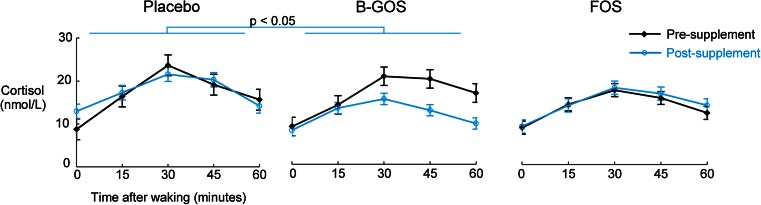
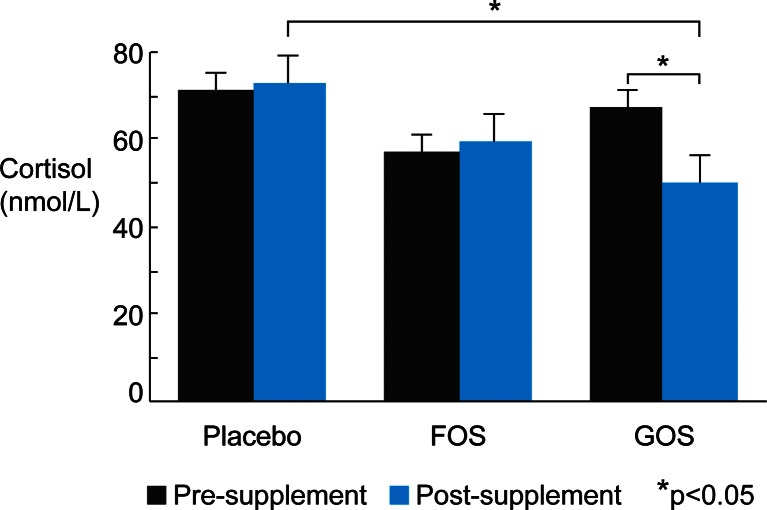
- Salivary cortisol awakening response was significantly lower after B-GOS than placebo: day 21 main effect of group F(2,41)=4.20, p<0.05; placebo vs B-GOS p=0.02. AUC-g analysis showed a day × group interaction F(2,41)=3.52, p=0.039, with post-treatment placebo vs B-GOS p=0.019.
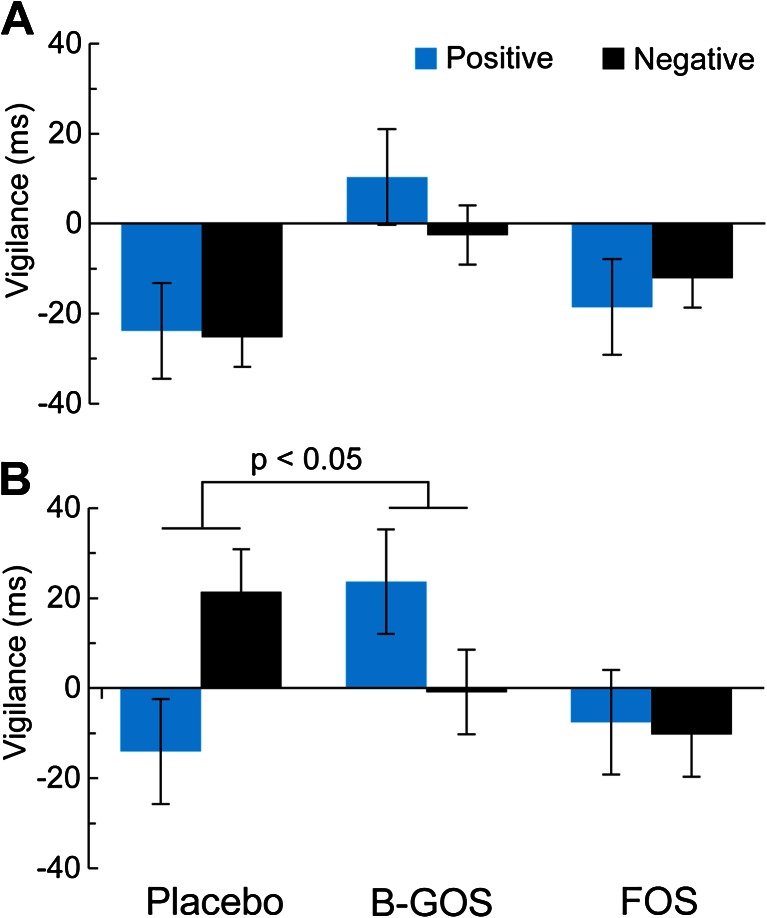
- In the unmasked dot-probe task, B-GOS produced decreased attentional vigilance to negative versus positive information compared with placebo: group × emotion × masking condition F(2,41)=3.14, p=0.05; unmasked valence × group F(2,41)=4.29, p=0.02; B-GOS vs placebo valence × group F(1,27)=6.94, p=0.014.
- FOS did not differ from placebo on cortisol or dot-probe measures (FOS vs placebo valence × group F(1,27)=3.20, n.s.; all other FOS contrasts p>0.1).
- No significant prebiotic effects were found on facial expression recognition, emotional categorisation, recall, recognition, or self-report state anxiety/perceived stress.
Methods
- Double-blind, placebo-controlled randomised study: 45 completers (22 males, 23 females) received FOS (N=15), B-GOS (N=15), or maltodextrin placebo (N=15) at 5.5 g/day orally with breakfast for 3 weeks.
- Salivary cortisol awakening response was sampled at home immediately upon waking and every 15 min for 1 h on day 0 and day 21; emotional processing was assessed on day 21 using the computerised Emotional Test Battery, including an attentional dot-probe task, facial expression recognition task, and emotional categorisation/memory tasks.
- Cortisol values were square-root transformed and analysed with mixed-design ANOVA; behavioural outcomes were analysed with mixed-design ANOVAs with treatment group as between-subjects factor and emotion/task condition as within-subjects factors.
Limitations
- Stated: the study had insufficient power to investigate gender effects; menstrual phase effects on cortisol or attention were not tested due to insufficient power; no effects were found on the remaining Emotional Test Battery tasks or on subjective anxiety/perceived stress; the authors note possible need for longer prebiotic administration and that the young healthy volunteer sample had low subclinical scores and presumably healthy gut microbiota.
- Stated: mechanisms could not be tested directly through characterisation of gut microbiota, and there was no association between cortisol and attentional performance (all p>0.1).
- Evident from the text: each treatment arm had only 15 participants, and the study did not directly measure changes in gut microbiota composition in humans.
Model-written summary. Check it against the paper before relying on it.
Integrity signals
Registry
Cites
Statistics
Figures
Verification
Claims the paper makes
8 Valid · 0 Not valid · 25 Not checked · 30 Own results and interpretations
The cited sources support only part of this claim — read each source’s verdict below.
In the paper
“Notably, the extent to which these biases can be modulated by pharmacological therapies in patients has been found to be indicative of treatment response (Sheline et al. 2001; Pizzagalli 2010)”
§ Prebiotic intake reduces the waking cortisol response and alters emotional bias in healthy volunteers > Introduction
What the sources say
- Not checked yetcites Sheline et al. 2001 matched to “Increased amygdala response to masked emotional faces in depressed subjects resolves with antidepressant treatment: an fMRI study” (2001) source
- Partly supportedcites Pizzagalli 2010 matched to “Frontocingulate Dysfunction in Depression: Toward Biomarkers of Treatment Response” (2011) sourceExperimental — accuracy not yet measured
The Functional neuroimaging studies section reports that heightened rACC responses to sad faces two weeks after antidepressant treatment began predicted poor response later. This links an early treatment-period response to emotional stimuli with outcome, but it does not show that the extent to which emotional biases were modulated by medication indicated treatment response. Page numbers are unavailable in our copy. (LLM, conf=0.82)
plainstates an association- Asserted: passes — The authors put it forward as true.
- Checkable: passes — It can be checked against evidence.
- Load-bearing: passes — The paper’s conclusions depend on it.
- Based: passes — The paper gives a reason why it holds.
The cited sources support only part of this claim — read each source’s verdict below.
In the paper
“Neural and behavioural biases in the processing of emotional information, in particular increased processing of threat-related and negatively valenced stimuli, are core functional markers of anxiety and depression (Beck 2008; Cisler and Koster 2010).”
§ Prebiotic intake reduces the waking cortisol response and alters emotional bias in healthy volunteers > Introduction
What the sources say
- Not checked yetcites Beck 2008 matched to “The Evolution of the Cognitive Model of Depression and Its Neurobiological Correlates” (2008) source
- Partly supportedcites Cisler and Koster 2010 matched to “Mechanisms of attentional biases towards threat in anxiety disorders: An integrative review” (2010) sourceExperimental — accuracy not yet measured
The review’s ‘Brief Overview of Major Findings’ describes attentional bias toward threat as robust across anxious populations, and its ‘Summary and Integration’ links threat detection to amygdala activity. It does not establish the broader claim that neural and behavioural biases toward negatively valenced information are core functional markers of both anxiety and depression; its substantive discussion focuses on threat-related attention in anxiety. The indexed passages do not provide page numbers. (LLM, conf=0.88)
plainstates an association- Asserted: passes — The authors put it forward as true.
- Checkable: passes — It can be checked against evidence.
- Load-bearing: passes — The paper’s conclusions depend on it.
- Based: passes — The paper gives a reason why it holds.
The cited sources support only part of this claim — read each source’s verdict below.
In the paper
“Convincing evidence now exists for a role of the gut microbiota composition in the regulation of the stress hormone corticosterone (cortisol in humans).”
§ Prebiotic intake reduces the waking cortisol response and alters emotional bias in healthy volunteers > Introduction
What the sources say
- Not checked yetcites Crumeyrolle-Arias et al. 2014 matched to “Absence of the gut microbiota enhances anxiety-like behavior and neuroendocrine response to acute stress in rats” (2014) source
- Not checked yetcites Sudo et al. 2004 matched to “Postnatal microbial colonization programs the hypothalamic–pituitary–adrenal system for stress response in mice” (2004) source
- Partly supportedcites Bravo et al. 2011 matched to “Ingestion of Lactobacillus strain regulates emotional behavior and central GABA receptor expression in a mouse via the vagus nerve” (2011) sourceExperimental — accuracy not yet measured
Bravo et al. (2011) do supply the core point for mice: the Results section reports that stress-induced corticosterone was significantly lower in L. rhamnosus (JB-1)-fed stressed mice than in broth-fed controls (P < 0.001), and the Discussion states that 'these data clearly indicate that in the bidirectional communication between the brain and the gut, the HPA axis is a key component that can be affected by changes in the enteric microbiota.' However, our copy contains no human or cortisol data at all — the same Discussion concedes that 'the majority of studies on the microbiome–gut–brain axis are rodent-based, and future validation ... is now warranted,' and it explicitly cautions that 'caution is needed when extrapolating from single timepoint neuroendocrine studies.' So the '(cortisol in humans)' reach and the unqualified 'convincing evidence' framing go beyond what this source demonstrates; its evidence is a single mouse strain (BALB/c males) given one Lactobacillus strain. (LLM, conf=0.70)
boostedstates a cause- Asserted: passes — The authors put it forward as true.
- Checkable: passes — It can be checked against evidence.
- Load-bearing: passes — The paper’s conclusions depend on it.
- Based: passes — The paper gives a reason why it holds.
Every source the paper cites for this claim was checked and supports it.
In the paper
“The study demonstrates that manipulations of the gut microbiota can result in measurable changes in emotional processing in the healthy brain.”
§ Prebiotic intake reduces the waking cortisol response and alters emotional bias in healthy volunteers > Introduction
What the sources say
- Supportedcites Tillisch et al. 2013 matched to “Consumption of fermented milk product with probiotic modulates brain activity” (2013) source
The Abstract (Background/Methods/Results) states the study tested whether 4 weeks of a fermented milk product with probiotic — i.e. an intentional alteration of the gut microbiota — changed brain responses to an emotional faces attention task in healthy women with no GI or psychiatric symptoms, and reports FMPP-associated reduction of a distributed network containing affective, viscerosensory and somatosensory cortices plus altered midbrain resting connectivity. The CLINICAL AT summary states directly that chronic FMPP ingestion 'can modulate the responsiveness of an extensive brain network in healthy women' and is 'the first to demonstrate an effect of FMPP intake on gut-brain communication in humans', which is exactly what the citing sentence attributes. The one qualifier worth noting is that the measured outcome is neural reactivity to emotional stimuli (proof of concept), not behavioural/emotional experience, and the sample is healthy women; the paper also hedges that downstream mood/anxiety effects remain to be established. (LLM, conf=0.85)
boostedstates a cause- Asserted: passes — The authors put it forward as true.
- Checkable: passes — It can be checked against evidence.
- Load-bearing: passes — The paper’s conclusions depend on it.
- Based: passes — The paper gives a reason why it holds.
- Supported
The cited sources support only part of this claim — read each source’s verdict below.
In the paper
“The ingestion of probiotics modulates the processing of information that is strongly linked to anxiety and depression, and influences the neuroendocrine stress response.”
§ Prebiotic intake reduces the waking cortisol response and alters emotional bias in healthy volunteers > Abstract > Rationale
What the sources say
- Not checked yetcites Sudo et al. 2004 matched to “Postnatal microbial colonization programs the hypothalamic–pituitary–adrenal system for stress response in mice” (2004) source
- Partly supportedcites Bravo et al. 2011 matched to “Ingestion of Lactobacillus strain regulates emotional behavior and central GABA receptor expression in a mouse via the vagus nerve” (2011) sourceExperimental — accuracy not yet measured
Our copy supports both clauses at the level of the single strain it tested: the Results section ('Effects of L. rhamnosus (JB-1) Administration on Stress-Induced Corticosterone Levels') reports significantly lower stress-induced corticosterone in JB-1-treated stressed mice, and the Results/Discussion on fear conditioning describe modulated 'cognitive aspects of anxiety behavior' (higher freezing in the recall phase, with the Discussion noting this 'may also be interpreted as increased anxiety behavior'). What the source does not support is the class-wide framing 'the ingestion of probiotics': the Discussion states 'probiotic effects are strain dependent' and calls JB-1 'a potential probiotic' tested in healthy mice, and it adds that 'caution is needed when extrapolating from single timepoint neuroendocrine studies', whereas the citing sentence asserts the neuroendocrine effect unqualified. (LLM, conf=0.72)
plainstates a cause- Asserted: passes — The authors put it forward as true.
- Checkable: passes — It can be checked against evidence.
- Load-bearing: passes — The paper’s conclusions depend on it.
- Based: passes — The paper gives a reason why it holds.
30 more claims
Create a free account to see all 63 claims and to verify the 55 references still open.
- Probably not a substantial claim. 24
- It may state two separate claims as one. 8
Claims other papers make about this one
Each is checked against this paper’s own text: does it say what the citing paper says it does?
The cited source doesn’t support the claim as written.
In the citing paper
“For example, B. longum 1417 modulated resting neural activity as well as neural responses to social stress, while supplementation with β-galactooligosaccharide reduced the salivary cortisol awakening response, a biochemical measure of stress, and improved emotional information processing (329), and an oligofructose-enriched inulin improved memory and mood in healthy volunteers (330).”
From Diet and the Microbiota–Gut–Brain Axis: Sowing the Seeds of Good Mental Health (2021) · cites this paper as [329]
Checked by a reasoning model — may be wrong.
Experimental — accuracy not yet measuredThe cited source says what the claim attributes to it.
In the citing paper
“Such changes were not recorded after fructooligosaccharides administration.”
From The Role of Microbiota-Gut-Brain Axis in Neuropsychiatric and Neurological Disorders (2021) · cites this paper as [158]
The cited source says what the claim attributes to it.
In the citing paper
“Schmidt et al. [391] found that Bimuno galactooligosaccharides intake decreased attentional vigilance to negative versus positive information.”
From Anxiety, depression, and the microbiome: A role for gut peptides (2018) · cites this paper as [391]
The cited source says what the claim attributes to it.
In the citing paper
“In another study, B-GOS supplementation was compared to placebo in healthy participants and found to decrease waking salivary cortisol concentrations and increase the positive processing of information in a dot-probe task (485).”
From Signalling cognition: The gut microbiota and hypothalamic-pituitary-adrenal axis (2023) · cites this paper as [485]
The cited source says what the claim attributes to it.
In the citing paper
“Administration of B-GOS® to individuals induced suppression of the neuroendocrine stress response and an increase in the processing of positive versus negative attentional vigilance, thus resulting in an early anxiolytic-like phenotype (Schmidt et al., 2015).”
From The Microbiota-Gut-Brain Axis (2019) · cites this paper as Schmidt et al., 2015
1 more claim about this paper
Create a free account to see every claim other papers make about this one.
Statistics recomputed
Every reported test result, recomputed from its test statistic and degrees of freedom. A result shows as not adding up only once an independent check has confirmed it.
- ConsistentF(1, 17) = 3.74reported p = .07 · recomputed p = .070
“F(1,17) = 3.74, p = .07”
- ConsistentF(1, 17) = 3.01reported p > .1 · recomputed p = .101
“F(1,17) = 3.01, p > .1”
- ConsistentF(2, 41) = 1.08reported n.s. · recomputed p = .349
“F(2,41) = 1.08, n.s.”
- ConsistentF(2, 41) = 4.2reported p < .05 · recomputed p = .022
“F(2,41) = 4.20, p < .05”
- ConsistentF(2.41, 98.63) = 58.61reported p < .001 · recomputed p < .001
“F(2.41,98.63) = 58.61, p < .001”
18 more recomputed tests
Create a free account to see every test the Stats check recomputed.
Self-check
Percentages, sums and reported differences re-computed from the paper’s own numbers.
Each contradiction between two passages listed here was confirmed by an independent check.
Rated minor: it would not touch a result — a value no result rests on, a p-value that stays on the same side of the significance level, or a conflict that is clerical, resolved elsewhere in the paper, or outside its own findings.
In the paper
§ Prebiotic intake reduces the waking cortisol response and alters emotional bias in healthy volunteers > Results > Emotional Test Battery
“emotion × group interaction F(8.16,773.38) = 1.10, n.s.”
§ Prebiotic intake reduces the waking cortisol response and alters emotional bias in healthy volunteers > Results > Emotional Test Battery
“main effect of group: F(2,42) = 0.53, n.s.”
Citations
Cites
An inventory for measuring depression
BECK, A. T. (1961) · Archives of General Psychiatry · doi:10.1001/archpsyc.1961.01710120031004 · Cited by 38,032 · cited 3×
“2011), subclinical symptoms of depression (Beck Depression Inventory, BDI; Beck et al. 1961) and anxiety (State-Trait Anxiety Inventory, STAI-trait; Spielberger et al.”
BackgroundA Global Measure of Perceived Stress
Cohen, S., Kamarck, T., & Mermelstein, R. (1983) · Journal of Health and Social Behavior · doi:10.2307/2136404 · Cited by 32,807 · cited 3×
“Their potential influence on the mechanisms underlying stress-related disorders such as irritable bowel syndrome (IBS), anxiety and depression is also beginning to be elucidated (Dinan et al. 2006; Rhee et al. 2009; Mayer 2011; Bravo et al. 2012).”
BackgroundDevelopment and validation of brief measures of positive and negative affect: The PANAS scales.
Watson, D., Clark, L. A., & Tellegen, A. (1988) · Journal of Personality and Social Psychology · doi:10.1037/0022-3514.54.6.1063 · Cited by 32,433 · cited 2×
“…and 21, respectively), anxiety (STAI-state) and measures of perceived stress (Perceived Stress Scale, PSS; Cohen et al. 1983) and mood (Visual Analogue Scales, VAS; Bond and Lader 1974; Positive and Negative Affect Schedules, PANAS;Watson et al. 1988) were measured using self-report questionnaires.”
Method(1970) · Cited by 24,983
Scoville, W. B. (1949) · Journal of neurosurgery · doi:10.3171/jns.1949.6.1.0065 · Cited by 7,381
How do you feel — now? The anterior insula and human awareness
(Bud) Craig, A. D. (2009) · Nature Reviews Neuroscience · doi:10.1038/nrn2555 · Cited by 6,657
Mind-altering microorganisms: the impact of the gut microbiota on brain and behaviour
Cryan, J. F., & Dinan, T. G. (2012) · Nature Reviews Neuroscience · doi:10.1038/nrn3346 · Cited by 4,572 · cited 3×
“Overall, novel evidence supports the notion that manipulations of gut microbiota show widespread effects on central functioning and behavioural phenotypes via the HPA axis, as well as the vagus nerve, serotonergic system, and immune system [1].”
BackgroundInfluentialEkman, P. (1976) · Medical Entomology and Zoology · Cited by 4,345
The Structured Clinical Interview for DSM-III-R (SCID): I: History, Rationale, and Description
Spitzer, R. L. (1992) · Archives of General Psychiatry · doi:10.1001/archpsyc.1992.01820080032005 · Cited by 4,336
Bravo, J. A., Forsythe, P., Chew, M. V., Escaravage, E., Savignac, H. M., Dinan, T. G., Bienenstock, J., & Cryan, J. F. (2011) · Proceedings of the National Academy of Sciences · doi:10.1073/pnas.1102999108 · Cited by 3,888 · cited 5×
“2004), an effect replicated in mice subjected to a stress-inducing behavioural paradigm designed to elevate corticosterone levels (Bravo et al. 2011).”
BackgroundInfluential
Research works printed but not linked: 2
- Eysenck H Eysenck S Manual of the Eysenck personality questionnaire 1975 London Hodder & Stoughton
- Nelson H The National Adult Reading Test (NART): test manual 1982 Windsor NFER-Nelson
Cited by
Items 101–200 of 561
Distant Site Effects of Ingested Prebiotics
Collins, S., & Reid, G. (2016) · Nutrients · doi:10.3390/nu8090523 · Cited by 112
“5 g of B-GOS by healthy individuals limited rapid elevations in salivary cortisol and improved attention upon exposure to a negative stimulus (Table 2) [71].”
BackgroundPrebiotic and Probiotic Modulation of the Microbiota–Gut–Brain Axis in Depression
Radford-Smith, D. E., & Anthony, D. C. (2023) · Nutrients · doi:10.3390/nu15081880 · Cited by 96
“In contrast with previous research in prebiotics [105], salivary cortisol levels were unaffected by probiotic treatment, and no changes in blood C-reactive protein (CRP) levels were identified [113].”
BackgroundResultInfluentialBeneficial effects of butyrate on brain functions: A view of epigenetic
Alpino, G. D. C. Á., Pereira-Sol, G. A., Dias, M. D. M. E., Aguiar, A. S. D., & Peluzio, M. D. C. G. (2024) · Critical Reviews in Food Science and Nutrition · doi:10.1080/10408398.2022.2137776 · Cited by 110
“Therefore, studies on microbiota modulation using pro-biotics (Steenbergen et al. 2015), prebiotics (Schmidt et al. 2015), a dietary fiber-rich diet (Cantu-Jungles, Rasmussen, and Hamaker 2019), and SCFAs supplementation in animals (sodium butyrate) have demonstrated control over inflammation,…”
BackgroundImpact of gut microbiota on neurological diseases: Diet composition and novel treatments
Larroya-García, A., Navas-Carrillo, D., & Orenes-Piñero, E. (2019) · Critical Reviews in Food Science and Nutrition · doi:10.1080/10408398.2018.1484340 · Cited by 99
Grimaldi, R., Cela, D., Swann, J. R., Vulevic, J., Gibson, G. R., Tzortzis, G., & Costabile, A. (2017) · FEMS Microbiology Ecology · doi:10.1093/femsec/fiw233 · Cited by 109
“Recently, B-GOS was also shown to reduce cortisol secretion and anxiety in healthy volunteers (Schmidt et al. 2015).”
Self-citationLin, S., Li, Q., Jiang, S., Xu, Z., Jiang, Y., Liu, L., Jiang, J., Tong, Y., & Wang, P. (2020) · Journal of Ethnopharmacology · doi:10.1016/j.jep.2020.113608 · Cited by 110
Finding the needle in the haystack: systematic identification of psychobiotics
Bambury, A., Sandhu, K., Cryan, J. F., & Dinan, T. G. (2018) · British Journal of Pharmacology · doi:10.1111/bph.14127 · Cited by 107
“Other studies involving B-GOS and FOS have established that the administration of B-GOS significantly lowers the salivary cortisol response (Schmidt et al., 2015).”
ResultMunawar, N., Ahsan, K., Muhammad, K., Ahmad, A., Anwar, M. A., Shah, I., Ameri, A. A., & Mughairbi, F. A. (2021) · International Journal of Molecular Sciences · doi:10.3390/ijms22147671 · Cited by 110
The gut microbiota as a key regulator of visceral pain
O’Mahony, S. M., Dinan, T. G., & Cryan, J. F. (2016) · Pain · doi:10.1097/j.pain.0000000000000779 · Cited by 111
Probiotics and prebiotics: focus on psychiatric disorders – a systematic review
Barbosa, R. S. D., & Vieira-Coelho, M. A. (2020) · Nutrition Reviews · doi:10.1093/nutrit/nuz080 · Cited by 93
Eltokhi, A., Janmaat, I. E., Genedi, M., Haarman, B. C. M., & Sommer, I. E. C. (2020) · Journal of Neuroscience Research · doi:10.1002/jnr.24616 · Cited by 98
Epigenetics in depression and gut-brain axis: A molecular crosstalk
Begum, N., Mandhare, A., Tryphena, K. P., Srivastava, S., Shaikh, M. F., Singh, S. B., & Khatri, D. K. (2022) · Frontiers in Aging Neuroscience · doi:10.3389/fnagi.2022.1048333 · Cited by 106
Probiotic, Prebiotic, and Brain Development
Cerdó, T., Ruíz, A., Suárez, A., & Campoy, C. (2017) · Nutrients · doi:10.3390/nu9111247 · Cited by 92
“tested the intake of fructo-oligosaccharides (FOS) and Bimuno®-galactooligosaccharides (B-GOS), and reported that only B-GOS reduced the waking-cortisol response [101].”
BackgroundThe role of prebiotics in cognition, anxiety, and depression
de Paiva, I. H. R., Duarte-Silva, E. P., & Peixoto, C. A. (2020) · European Neuropsychopharmacology · doi:10.1016/j.euroneuro.2020.03.006 · Cited by 112
Going with the grain: Fiber, cognition, and the microbiota-gut-brain-axis
Berding, K., Carbia, C., & Cryan, J. F. (2021) · Experimental Biology and Medicine · doi:10.1177/1535370221995785 · Cited by 100
Butler, M., Mörkl, S., Sandhu, K. V., Cryan, J. F., & Dinan, T. G. (2019) · The Canadian Journal of Psychiatry · doi:10.1177/0706743719874168 · Cited by 121
Targeting the gut microbiota to influence brain development and function in early life
Wang, S., Harvey, L., Martin, R., van der Beek, E. M., Knol, J., Cryan, J. F., & Renes, I. B. (2018) · Neuroscience & Biobehavioral Reviews · doi:10.1016/j.neubiorev.2018.09.002 · Cited by 91
The microbiome as a novel paradigm in studying stress and mental health.
Liu, R. T. (2017) · American Psychologist · doi:10.1037/amp0000058 · Cited by 89
“Lactis, Streptococcus thermophiles Tillisch et al. (2013) Decreased attentional bias toward negative stimuli Bimuno-galacto-oligosaccharides Schmidt et al. (2015) Note. spp. species.”
BackgroundInfluentialMan and the Microbiome: A New Theory of Everything?
Butler, M. I., Cryan, J. F., & Dinan, T. G. (2019) · Annual Review of Clinical Psychology · doi:10.1146/annurev-clinpsy-050718-095432 · Cited by 90
Fermented foods, neuroticism, and social anxiety: An interaction model
Hilimire, M. R., DeVylder, J., & Forestell, C. A. (2015) · Psychiatry Research · doi:10.1016/j.psychres.2015.04.023 · Cited by 116
Feeding melancholic microbes: MyNewGut recommendations on diet and mood
Dinan, T. G., Stanton, C., Long-Smith, C., Kennedy, P., Cryan, J. F., Cowan, C. S. M., Cenit, M. C., van der Kamp, J.-W., & Sanz, Y. (2019) · Clinical Nutrition · doi:10.1016/j.clnu.2018.11.010 · Cited by 95
“Schmidt and colleagues demonstrated that 3-week supplementation with a galactooligosaccharide (GOS) prebiotic, which has been shown to stimulate bifidobacterial growth, in healthy volunteers significantly reduced waking cortisol response, the stress hormone strongly linked to anxiety and depression [60].”
BackgroundWilliams, S., Chen, L., Savignac, H. M., Tzortzis, G., Anthony, D. C., & Burnet, P. W. (2016) · Synapse · doi:10.1002/syn.21880 · Cited by 91
“…of beneficial gut bacteria) or oligosaccharide prebiotics (nutrients for indigenous gut bacteria) has been shown to alter neurobiology and improve adult brain function in both rodents (Cryan and Dinan, 2012; Savignac et al., 2013, 2015 ) and humans (Messaoudi et al., 2011; Schmidt et al., 2015).”
BackgroundSelf-citationGao, F., Guo, R., Ma, Q., Li, Y., Wang, W., Fan, Y., Ju, Y., Zhao, B., Gao, Y., Li, Q., et al. (2022) · Journal of Affective Disorders · doi:10.1016/j.jad.2022.02.024 · Cited by 97
“In humans, probiotics also display some beneficial effects on mental health, for instance, altering emotional bias in healthy volunteers (Schmidt et al., 2015), and alleviating stress and anxiety in stressed adults (Chong et al.”
The connection between microbiome and schizophrenia
Golofast, B., & Vales, K. (2020) · Neuroscience & Biobehavioral Reviews · doi:10.1016/j.neubiorev.2019.12.011 · Cited by 92
Gut microbiota and central nervous system development
Principi, N., & Esposito, S. (2016) · Journal of Infection · doi:10.1016/j.jinf.2016.09.010 · Cited by 92
Gronier, B., Savignac, H. M., Di Miceli, M., Idriss, S. M., Tzortzis, G., Anthony, D., & Burnet, P. W. J. (2018) · European Neuropsychopharmacology · doi:10.1016/j.euroneuro.2017.11.001 · Cited by 91
“The improvement in attentional setshifting is consistent with our demonstration of improved attentional vigilance in healthy volunteers supplemented with B-GOSs (Schmidt et al., 2015), and suggests that the prebiotic has a significant influence on cortical-mediated processes.”
BackgroundResultInfluentialSelf-citationGut microbiota‐immune‐brain interactions in chemotherapy‐associated behavioral comorbidities
Jordan, K. R., Loman, B. R., Bailey, M. T., & Pyter, L. M. (2018) · Cancer · doi:10.1002/cncr.31584 · Cited by 86
The Promising Role of Probiotics in Managing the Altered Gut in Autism Spectrum Disorders
Abdellatif, B., McVeigh, C., Bendriss, G., & Chaari, A. (2020) · International Journal of Molecular Sciences · doi:10.3390/ijms21114159 · Cited by 84
Freijy, T. M., Cribb, L., Oliver, G., Metri, N., Opie, R., Jacka, F. N., Hawrelak, J. A., Rucklidge, J. J., Ng, C. H., & Sarris, J. J. (2023) · Frontiers in Neuroscience · doi:10.3389/fnins.2022.1097278 · Cited by 101
“Consistent with this, two prebiotic interventions have produced reductions in cortisol levels (Schmidt et al., 2015; Farhangi et al., 2018).”
BackgroundResultInfluentialMills, S., Lane, J. A., Smith, G. J., Grimaldi, K. A., Ross, R. P., & Stanton, C. (2019) · Nutrients · doi:10.3390/nu11071468 · Cited by 88
“Intake of Bimuno®-GOS for three weeks significantly reduced salivary cortisol awakening response in healthy volunteers [197].”
BackgroundHeym, N., Heasman, B. C., Hunter, K., Blanco, S. R., Wang, G. Y., Siegert, R., Cleare, A., Gibson, G. R., Kumari, V., & Sumich, A. L. (2019) · Psychopharmacology · doi:10.1007/s00213-019-05230-2 · Cited by 83
Johnstone, N., Milesi, C., Burn, O., van den Bogert, B., Nauta, A., Hart, K. H., Sowden, P. T., Burnet, P. W. J., & Kadosh, K. C. (2021) · Scientific Reports · doi:10.1038/s41598-021-87865-w · Cited by 97
Self-citationMarx, W., Scholey, A., Firth, J., D’Cunha, N. M., Lane, M., Hockey, M., Ashton, M. M., Cryan, J. F., O’Neil, A., Naumovski, N., et al. (2020) · Neuroscience & Biobehavioral Reviews · doi:10.1016/j.neubiorev.2020.07.036 · Cited by 87
Berding, K., Long-Smith, C. M., Carbia, C., Bastiaanssen, T. F. S., van de Wouw, M., Wiley, N., Strain, C., Fouhy, F., Stanton, C., Cryan, J. F., et al. (2020) · Psychopharmacology · doi:10.1007/s00213-020-05665-y · Cited by 94
Gut Microbiota in Bipolar Depression and Its Relationship to Brain Function: An Advanced Exploration
Lu, Q., Lai, J., Lu, H., Ng, C. H., Huang, T., Zhang, H., Ding, K., Wang, Z., Jiang, J., Hu, J., et al. (2019) · Frontiers in Psychiatry · doi:10.3389/fpsyt.2019.00784 · Cited by 91
“Hypothalamic-pituitary-adrenal axis is also influenced by gut microbiota (12), communicates with immune system (13), and is involved in emotion regulation (12).”
BackgroundHow do probiotics and prebiotics function at distant sites?
Reid, G., Abrahamsson, T., Bailey, M. T., Bindels, L. B., Bubnov, R. V., Ganguli, K. A., Martoni, C., O’Neill, C. A., Savignac, H. M., Stanton, C., et al. (2017) · Beneficial Microbes · doi:10.3920/bm2016.0222 · Cited by 90
Current evidence linking diet to gut microbiota and brain development and function
Ceppa, F., Mancini, A., & Tuohy, K. M. (2018) · International Journal of Food Sciences and Nutrition · doi:10.1080/09637486.2018.1462309 · Cited by 93
“Nutritional components, such as prebiotics (e.g. inulin, galactooligosaccharides – GOS, fructooligosaccharides – FOS), might play a neuroprotective role against white matter injury, through modulation of inflammation and infection, and may influence the microbiome-gut-brain axis (Keunen et al. 2015).”
BackgroundInfluentialGut Microbiota and Bipolar Disorder: An Overview on a Novel Biomarker for Diagnosis and Treatment
Lucidi, L., Pettorruso, M., Vellante, F., Carlo, F. D., Ceci, F., Santovito, M. C., Muzio, I. D., Fornaro, M., Ventriglio, A., Tomasetti, C., et al. (2021) · International Journal of Molecular Sciences · doi:10.3390/ijms22073723 · Cited by 89
Microbiome in brain function and mental health
Kennedy, P. J., Murphy, A., Cryan, J. F., Ross, R. P., Dinan, T. G., & Stanton, C. (2016) · Trends in Food Science & Technology · doi:10.1016/j.tifs.2016.05.001 · Cited by 90
“Nevertheless, promising results from preliminary studies with healthy control participants indicate that pre and probiotic interventions can modulate HPA axis functioning (Messaoudi et al., 2011; Schmidt et al., 2015).”
BackgroundResultInfluentialGut-brain axis: A matter of concern in neuropsychiatric disorders…!
Naveed, M., Zhou, Q.-G., Chu, X., Taleb, A., Meng, F. J., Ahmed, B., Zhang, Y., Fukunaga, K., & Han, F. (2020) · Progress in Neuro-Psychopharmacology and Biological Psychiatry · doi:10.1016/j.pnpbp.2020.110051 · Cited by 106
A biological framework for emotional dysregulation in alcohol misuse: from gut to brain
Carbia, C., Lannoy, S., Maurage, P., López‐Caneda, E., O’Riordan, K. J., Dinan, T. G., & Cryan, J. F. (2020) · Molecular Psychiatry · doi:10.1038/s41380-020-00970-6 · Cited by 89
The Microbiota–Gut–Brain Axis and Epilepsy
Yue, Q., Cai, M., Xiao, B., Zhan, Q., & Zeng, C. (2021) · Cellular and Molecular Neurobiology · doi:10.1007/s10571-021-01130-2 · Cited by 91
Neuroinflammation, Microbiota-Gut-Brain Axis, and Depression: The Vicious Circle
Reyes-Martínez, S., Segura-Real, L., Gómez-García, A. P., Tesoro-Cruz, E., Constantino-Jonapa, L. A., Amedei, A., & Aguirre‐García, M. M. (2023) · Journal of Integrative Neuroscience · doi:10.31083/j.jin2203065 · Cited by 92
“In another USA study, the patients who received fructo-oligosaccharides as prebiotics versus those treated with Bimuno®GOS (65% galacto-oligosaccharide content) showed reduced cortisol awakening response, which modulates the HPA axis and helps to increase attention to emotional stimuli [92].”
BackgroundGanci, M., Suleyman, E., Butt, H., & Ball, M. (2019) · Brain and Behavior · doi:10.1002/brb3.1408 · Cited by 85
Purton, T., Staskova, L., Lane, M. M., Dawson, S. L., West, M. L., Firth, J., Clarke, G. A., Cryan, J. F., Berk, M., O'Neil, A. E., et al. (2021) · Neuroscience & Biobehavioral Reviews · doi:10.1016/j.neubiorev.2020.12.026 · Cited by 87
Dietary fibre and the gut–brain axis: microbiota-dependent and independent mechanisms of action
Torre, D. L., Verbeke, K., & Dalile, B. (2021) · Gut Microbiome · doi:10.1017/gmb.2021.3 · Cited by 85
“…physical, or gastrointestinal disorders, and the remaining 11 conducted in healthy populations (Best et al., 2008, 2009, 2015; Childs et al., 2014; Lawton et al., 2013; Pasman et al., 2003; Ramnani et al., 2015; Schmidt et al., 2015; Smith, 2005; Smith et al., 2015; Talbott and Talbott, 2009).”
Psychobiotics as treatment for anxiety, depression, and related symptoms: a systematic review
Smith, K. S., Greene, M. W., Babu, J. R., & Frugé, A. D. (2019) · Nutritional Neuroscience · doi:10.1080/1028415x.2019.1701220 · Cited by 88
“anxiety, or stress response [34,42,65] in healthy human volunteers.”
BackgroundBoehme, M., Rémond-Derbez, N., Lerond, C., Lavalle, L., Keddani, S., Steinmann, M., Rytz, A., Dalile, B., Verbeke, K., Oudenhove, L. V., et al. (2023) · Nutrients · doi:10.3390/nu15143122 · Cited by 80
“Five saliva samples were collected at home by the participants according to the previously described procedure [23]: one sample immediately upon waking and subsequently every 15 min until 1 h post-waking.”
MethodA preliminary study of gut microbiome variation and HPA axis reactivity in healthy infants
Rosin, S., Xia, K., Azcarate-Peril, M. A., Carlson, A. L., Propper, C. B., Thompson, A. L., Grewen, K., & Knickmeyer, R. C. (2021) · Psychoneuroendocrinology · doi:10.1016/j.psyneuen.2020.105046 · Cited by 74
Gondalia, S. V., Parkinson, L., Stough, C. K. K., & Scholey, A. B. (2019) · Psychopharmacology · doi:10.1007/s00213-019-05248-6 · Cited by 77
Townsend, J. R., Bender, D., Vantrease, W. C., Sapp, P. A., Toy, A. M., Woods, C. A., & Johnson, K. D. (2018) · Sports · doi:10.3390/sports6030070 · Cited by 69
“However, one study in a non-athletic population reported lower cortisol responses in participants which received a prebiotic (soluble fiber compounds which enhance the growth of gut microbiota) supplement daily for three weeks [52].”
BackgroundGalactooligosaccharides: Synthesis, metabolism, bioactivities and food applications
Wang, K., Duan, F., Sun, T., Zhang, Y., & Lu, L. (2023) · Critical Reviews in Food Science and Nutrition · doi:10.1080/10408398.2022.2164244 · Cited by 83
“In healthy individuals, after intake of GOS, salivary cortisol awakening response, a reliable marker of hypothalamic–pituitary–adrenal axis activity that is usually increased by work stressors, is apparently reduced (Schmidt et al. 2015).”
BackgroundKazemi, A., Noorbala, A. A., Azam, K., & Djafarian, K. (2019) · Journal of Functional Foods · doi:10.1016/j.jff.2018.11.041 · Cited by 67
The role of the gut microbiome in opioid use
Ren, M., & Lotfipour, S. (2020) · Behavioural Pharmacology · doi:10.1097/fbp.0000000000000538 · Cited by 68
“, 2016), and restoring eubiosis via probiotics, SCFAs, and FMT ameliorates stress-related biomarkers and behaviors (Desbonnet et al., 2010; AitBelgnaoui et al., 2012; Liang et al., 2013; Pusceddu et al., 2015; Schmidt et al., 2015; Tarr et al., 2015).”
BackgroundLeyrolle, Q., Cserjési, R., Mulders, M. D. G. H., Zamariola, G., Hiel, S., Gianfrancesco, M. A., Portheault, D., Amadieu, C., Bindels, L. B., Leclercq, S., et al. (2021) · Brain Behavior and Immunity · doi:10.1016/j.bbi.2021.01.014 · Cited by 73
Baião, R., Capitão, L. P., Higgins, C., Browning, M., Harmer, C. J., & Burnet, P. W. J. (2022) · Psychological Medicine · doi:10.1017/s003329172100550x · Cited by 71
“The relatively short duration of the present study was based on another multi-species probiotic investigation (Steenbergen, Sellaro, van Hemert, Bosch, & Colzato, 2015) and our study of emotional processing with a prebiotic (Schmidt et al., 2015).”
BackgroundResultSelf-citationKleiman, S. C., Bulik-Sullivan, E. C., Glenny, E. M., Zerwas, S. C., Huh, E. Y., Tsilimigras, M. C. B., Fodor, A. A., Bulik, C. M., & Carroll, I. M. (2017) · PLOS ONE · doi:10.1371/journal.pone.0170208 · Cited by 54
Kadosh, K. C., Basso, M., Knytl, P., Johnstone, N., Lau, J. Y. F., & Gibson, G. R. (2021) · Translational Psychiatry · doi:10.1038/s41398-021-01422-7 · Cited by 69
“Inclusion criteria were as follows: (1) Mean age in the range of 10–24 years old; (2) healthy and clinical samples; (3) minimally measures obtained pre- and post-intervention; (4) pro- or prebiotic administration (any form); (5) published and peer-reviewed data; (6) any date of publication.”
BackgroundMethodLiu, X., Su, S., Yao, J., Zhang, X., Wu, Z., Jia, L., Liu, L., Hou, R., Farag, M. A., & Liu, L. (2024) · Food Bioscience · doi:10.1016/j.fbio.2024.103831 · Cited by 68
Probiotics, prebiotics and postbiotics for better sleep quality: a narrative review
Haarhuis, J. E., Kardinaal, A. F. M., & Kortman, G. A. M. (2022) · Beneficial Microbes · doi:10.3920/bm2021.0122 · Cited by 69
The Influence of Intestinal Microbiota on BDNF Levels
Molska, M., Mruczyk, K., Cisek-Woźniak, A., Prokopowicz, W., Szydełko, P., Jakuszewska, Z., Marzec, K., & Trocholepsza, M. (2024) · Nutrients · doi:10.3390/nu16172891 · Cited by 69
“Prebiotics also increase the concentration of the BDNF, which can cause depressive behavior when its levels are low [151,155,156].”
BackgroundImpact of Probiotics and Prebiotics on Gut Microbiome and Hormonal Regulation
Basnet, J., Eissa, M., Cardozo, L. L. Y., Romero, D. G., & Rezq, S. (2024) · Gastrointestinal Disorders · doi:10.3390/gidisord6040056 · Cited by 71
“In addition, prebiotics may help people cope with stress and mild anxiety by lowering cortisol levels, a stress hormone [73].”
De Lorenzo, A., Costacurta, M., Merra, G., Gualtieri, P., Cioccoloni, G., Marchetti, M., Varvaras, D., Docimo, R., & Di Renzo, L. (2017) · Journal of Translational Medicine · doi:10.1186/s12967-017-1236-2 · Cited by 62
“Gut composition is affected also by the resilience to environmental stress, impairing the cortisol awaking response and emotional reaction in healthy subjects [49].”
BackgroundVulevic, J., Tzortzis, G., Juric, A., & Gibson, G. R. (2018) · Neurogastroenterology & Motility · doi:10.1111/nmo.13440 · Cited by 71
Self-citationKentner, A. C., Cryan, J. F., & Brummelte, S. (2019) · Developmental Psychobiology · doi:10.1002/dev.21775 · Cited by 64
“Interestingly, prebiotic administration of bimuno-galactooligosaccharides reduced salivary cortisol awakening response in healthy individuals (Schmidt et al., 2015).”
The Microbiome-Gut-Brain axis regulates social cognition & craving in young binge drinkers
Carbia, C., Bastiaanssen, T. F. S., Iannone, L. F., García‐Cabrerizo, R., Boscaini, S., Berding, K., Strain, C., Clarke, G. A., Stanton, C., Dinan, T. G., et al. (2023) · EBioMedicine · doi:10.1016/j.ebiom.2023.104442 · Cited by 66
Evidence for Neurocognitive Improvement After Bariatric Surgery: A Systematic Review
Thiara, G., Cigliobianco, M., Muravsky, A., Paoli, R. A., Mansur, R., Hawa, R., McIntyre, R. S., & Sockalingam, S. (2017) · Psychosomatics · doi:10.1016/j.psym.2017.02.004 · Cited by 63
“In healthy subjects, treatment with probiotics and prebiotics reduces cognitive reactivity to sad mood, particularly in the areas of rumination and aggressive thoughts(67) and is associated with improvement in emotional processing, with reduced brain response to emotional faces attention task(55,68,69) and improved at…”
BackgroundAl-Khafaji, A. H., Jepsen, S. D., Christensen, K. R., & Vigsnæs, L. K. (2020) · Journal of Functional Foods · doi:10.1016/j.jff.2020.104176 · Cited by 67
Li, L., Naveed, M., Du, Z., Ding, H., Gu, K., Wei, L., Zhou, Y., Meng, F. J., Wang, C., Han, F., et al. (2021) · Human Genomics · doi:10.1186/s40246-021-00354-z · Cited by 61
“The miR-335 participates in treating severe depression by targeting glutamate metabotropic receptor 4 (GRM4) [54]. miR15b is upregulated in the medial prefrontal cortex of depression like mice [55]. miR-101 is decreased in the ventrolateral orbital cortex (VLOs) of chronic unpredictable mild stress (CUMS) rat brain an…”
BackgroundCristiano, C., Lama, A., Lembo, F., Mollica, M. P., Calignano, A., & Mattace Raso, G. (2018) · Frontiers in Physiology · doi:10.3389/fphys.2018.00184 · Cited by 58
“A study by Schmidt et al. (2015) showed a reduction of salivary cortisol secretion in healthy volunteers by fructo-oligosaccharides and Bimuno galacto-oligosaccharides treatment, indicating a suppression of neuroendocrine stress response and an increase of attention span, both events impacting ASD…”
BackgroundGut Microbiota and Neuroplasticity
Murciano-Brea, J., García-Montes, M. E., Geuna, S., & Herrera‐Rincon, C. (2021) · Cells · doi:10.3390/cells10082084 · Cited by 68
Rathour, D., Shah, S., Khan, S., Singh, P. K., Srivastava, S., Singh, S. B., & Khatri, D. K. (2022) · Behavioural Brain Research · doi:10.1016/j.bbr.2022.114081 · Cited by 61
Aslam, H., Lotfaliany, M., So, D., Berding, K., Berk, M., Rocks, T., Hockey, M., Jacka, F. N., Marx, W., Cryan, J. F., et al. (2023) · Nutrition Reviews · doi:10.1093/nutrit/nuad143 · Cited by 63
Rigo-Adrover, M. D. M., Saldaña-Ruíz, S., van Limpt, K., Knipping, K., Garssen, J., Knol, J., Franch, À., Castell, M., & Pérez-Cano, F. J. (2016) · European Journal of Nutrition · doi:10.1007/s00394-016-1213-1 · Cited by 59
“Calcium absorption is also improved with FOS and GOS supplementation in rats and infants [60–62], and several effects at the central nervous system level have been observed in rats and humans as well [63, 64].”
Fleming, S. A., Mudd, A. T., Hauser, J., Yan, J., Métairon, S., Steiner, P., Donovan, S. M., & Dilger, R. N. (2020) · Frontiers in Neuroscience · doi:10.3389/fnins.2020.00770 · Cited by 64
“While several studies have examined the effect of single oligosaccharide supplementation on cognition and brain development (Schmidt et al., 2015; Vázquez et al., 2015, 2016; Jia et al., 2016; Savignac et al., 2016; Fleming et al., 2017; Yen et al., 2017), here we explored the individual and…”
BackgroundMilk bioactives may manipulate microbes to mediate parent-offspring conflict
Allen-Blevins, C. R., Sela, D. A., & Hinde, K. (2015) · Evolution, Medicine, and Public Health · doi:10.1093/emph/eov007 · Cited by 52
Role of gut microbiota in brain function and stress-related pathology
Sudo, N. (2019) · Bioscience of Microbiota Food and Health · doi:10.12938/bmfh.19-006 · Cited by 59
Flowers, S. A., & Ellingrod, V. L. (2015) · Pharmacotherapy: The Journal of Human Pharmacology and Drug Therapy · doi:10.1002/phar.1640 · Cited by 52
Targeting Gut Microbiota Dysbiosis: Potential Intervention Strategies for Neurological Disorders
Wu, W., Kong, Q., Tian, P., Zhai, Q., Wang, G., Liu, X., Zhao, J., Zhang, H., Lee, Y. K., & Chen, W. (2020) · Engineering · doi:10.1016/j.eng.2019.07.026 · Cited by 57
“Prebiotic and probiotic interventions were also shown to normalize the HPA axis function and show beneficial psychological effects in healthy human volunteers [31,32].”
BackgroundJoshi, D., Roy, S., & Banerjee, S. (2018) · Elsevier eBooks · doi:10.1016/b978-0-08-102081-4.00019-8 · Cited by 58
MacKay, M., Yang, B. H., Dursun, S. M., & Baker, G. B. (2023) · Current Neuropharmacology · doi:10.2174/1570159x21666230222092029 · Cited by 57
Jackson, P. P. J., Wijeyesekera, A., Williams, C. M., Theis, S., Harsselaar, J. V., & Rastall, R. A. (2023) · American Journal of Clinical Nutrition · doi:10.1016/j.ajcnut.2023.08.016 · Cited by 54
“The study length (5 wk) was chosen to capture initial day-to-day fl uctuations in gastrointestinal habits prior to commencement of intervention, combined with methods previously documented in several mood state and/or gut microbiota supplementation studies [23,24,28,29].”
MethodResultEnteroendocrine cells: the gatekeepers of microbiome-gut-brain communication
Grundeken, E., & Aidy, S. E. (2025) · npj Biofilms and Microbiomes · doi:10.1038/s41522-025-00810-x · Cited by 55
“Notably, this pathway isalso in fl uenced bythemicrobiome 32 – 34 ,suggestingthatgut-derivedsignalscanmodulatethe response of the body to stress.”
The Influence of Prebiotics on Neurobiology and Behavior
Kao, A. C.-C., Harty, S., & Burnet, P. W. J. (2016) · International review of neurobiology · doi:10.1016/bs.irn.2016.08.007 · Cited by 59
Self-citationBrown, T., Sykes, D., & Allen, A. R. (2021) · Biomedicines · doi:10.3390/biomedicines9020189 · Cited by 54
“There is less research on prebiotic supplementation; however, some studies have shown evidence of improved sleep behaviors and reduction of mood comorbidities in rodents and humans respectively [108,109].”
BackgroundRode, J., Edebol Carlman, H. M. T., König, J., Hutchinson, A. N., Thunberg, P., Persson, J., & Brummer, R. J. (2022) · Cells · doi:10.3390/cells11182922 · Cited by 50
“Interestingly, one study administering prebiotics reported a lower salivary cortisol awakening response in healthy subjects after a three-week intervention [60].”
BackgroundMörkl, S., Narrath, M., Schlotmann, D., Sallmutter, M.-T., Putz, J., Lang, J., Brandstätter, A., Pilz, R., Lackner, H. K., Goswami, N., et al. (2025) · Gut Microbes · doi:10.1080/19490976.2025.2492377 · Cited by 53
“36,47,48 Also, predominant effects of the probiotic in the morning could be due to medication effects.”
Consumption of Dietary Fiber in Relation to Psychological Disorders in Adults
Saghafian, F., Sharif, N., Saneei, P., Keshteli, A. H., Hosseinzadeh‐Attar, M. J., Afshar, H., Esmaillzadeh, A., & Adibi, P. (2021) · Frontiers in Psychiatry · doi:10.3389/fpsyt.2021.587468 · Cited by 53
Skowron, K., Budzyńska, A., Wiktorczyk-Kapischke, N., Chomacka, K., Grudlewska‐Buda, K., Wilk, M., Wałecka-Zacharska, E., Andrzejewska, M., & Gospodarek-Komkowska, E. (2022) · International Journal of Molecular Sciences · doi:10.3390/ijms23147820 · Cited by 56
“The gastrointestinal microbiota are a critical factor in HPA axis regulation to reduce the concentration of the stress hormone cortisol [49,50].”
BackgroundMysonhimer, A. R., Cannavale, C. N., Bailey, M. A., Khan, N. A., & Holscher, H. D. (2023) · Journal of Nutrition · doi:10.1016/j.tjnut.2023.02.015 · Cited by 63
Grimaldi, R., Swann, J. R., Vulevic, J., Gibson, G. R., & Costabile, A. (2016) · British Journal of Nutrition · doi:10.1017/s0007114516002269 · Cited by 45
“B-GOS has also been tested in healthy volunteers, clinical conditions that have a purported microbial aetiology such as irritable bowel syndrome, traveller ’ s diarrhoea and obesity, and on cognitive functions (8 – 13) .”
Fructooligosaccharides production and the health benefits of prebiotics
Nobre, C., Simões, L. S., Gonçalves, D. A., Berni, P. R. D. A., & Teixeira, J. A. (2021) · Elsevier eBooks · doi:10.1016/b978-0-12-823506-5.00002-3 · Cited by 53
Bailey, M. T., & Cryan, J. F. (2017) · Brain Behavior and Immunity · doi:10.1016/j.bbi.2017.08.017 · Cited by 52
Is adolescence the missing developmental link in Microbiome–Gut–Brain axis communication?
Flannery, J., Callaghan, B., Sharpton, T., Fisher, P., & Pfeifer, J. (2019) · Developmental Psychobiology · doi:10.1002/dev.21821 · Cited by 44
Abreu y Abreu, A. T., Milke-García, M. P., Argüello-Arévalo, G. A., Calderón-de la Barca, A. M., Carmona-Sánchez, R. I., Consuelo-Sánchez, A., Coss-Adame, E., García-Cedillo, M. F., Hernández-Rosiles, V., Icaza-Chávez, M. E., et al. (2021) · Revista de Gastroenterología de México (English Edition) · doi:10.1016/j.rgmxen.2021.02.002 · Cited by 32
Pereira, T. D. M. C., Côco, L. Z., Ton, A. M. M., Meyrelles, S. S., Campos‐Toimil, M., Campagnaro, B. P., & Vasquez, E. C. (2021) · Antioxidants · doi:10.3390/antiox10111845 · Cited by 72
“However, it is still necessary to clarify the possible pathways involved in this complex double-way relationship that links the brain, gut microbiota, and adrenal cortex function, which are closely related [54,55].”
BackgroundJiang, J., Fu, Y., Tang, A., Gao, X., Zhang, D., Shen, Y., Mou, T., Hu, S., Gao, J., & Lai, J. (2023) · CNS Neuroscience & Therapeutics · doi:10.1111/cns.14091 · Cited by 48
Influence of Nutrition on Mental Health: Scoping Review
Suárez-López, L. M., Bru-Luna, L. M., & Vilar, M. M. (2023) · Healthcare · doi:10.3390/healthcare11152183 · Cited by 59
“Animal studies yielded favorable results for rats with prebiotic treatment and anxiolytic effects on gut microbiota proliferation [47].”
ResultSmith, L. K., & Wissel, E. F. (2019) · Perspectives on Psychological Science · doi:10.1177/1745691618809379 · Cited by 42
Perez‐Cornago, A., Sánchez‐Villegas, A., Bes‐Rastrollo, M., Gea, A., Molero, P., Lahortiga‐Ramos, F., & Martínez‐González, M. Á. (2016) · Journal of Nutrition · doi:10.3945/jn.116.233858 · Cited by 48
“A recent study in healthy volunteers showed that those supplemented with Bimuno–GOSs 232 (B-GOSs) had lower cortisol awakening reactivity (a reliable marker of HPA axis activity), while FOSs 233 administration had no effect (39).”
Background
Metadata
- Authors
- Schmidt, K., Cowen, P. J., Harmer, C. J., Tzortzis, G., Errington, S., & Burnet, P. W. J.
- Affiliations
- Warneford Hospital (GB)
- Newcastle University (GB)
- Corresponding author
- Burnet, Philip W. J.
- Venue
- Psychopharmacology
- Published
- 2014-12-03
- Volume
- 232
- Issue
- 10
- Pages
- 1793-1801
- ISSN
- 0033-3158 (ISSN-L)
- 1432-2072
- PMC
- PMC4410136
- OpenAlex
- W2095008866
- Semantic Scholar
- 65b5b76e2c6ca70869f58f439f2cee0c432b3510
- Cited by
- 522
- References
- 69
- Citations by year
- 2026: 24 · 2025: 60 · 2024: 45 · 2023: 43 · 2022: 47 · 2021: 72 · 2020: 52 · 2019: 47 · 2018: 44 · 2017: 39 · 2016: 30 · 2015: 19
- FWCI
- 27.32
- Type
- journal article
- Language
- en
- Open access
- hybrid
- doi.org
- Locations
- Psychopharmacology (publishedVersion, cc-by)
- Europe PMC (PubMed Central) (publishedVersion, cc-by)
- PubMed Central (publishedVersion, cc-by)
- PubMed (publishedVersion)
- Funders
- Wellcome Trust
- Medical Research Council
- Biotechnology and Biological Sciences Research Council
- Topics
- Health Sciences › Nursing › Nutrition and Dietetics › Microbial Metabolites in Food Biotechnology
- Life Sciences › Agricultural and Biological Sciences › Food Science › Probiotics and Fermented Foods
- Life Sciences › Neuroscience › Behavioral Neuroscience › Stress Responses and Cortisol
- Keywords
- prebiotics, galactooligosaccharides, fructooligosaccharides, salivary cortisol, cortisol awakening response, stress response, emotional processing, attentional bias, dot-probe task, gut-brain axis, enteric microbiota, anxiety, depression, stress-related disorders
- MeSH terms
- Adolescent, Adult, Animals, Double-Blind Method, Emotions, Female, Humans, Hydrocortisone, Male, Middle Aged, Oligosaccharides, Photic Stimulation, Saliva, Wakefulness, Dietary Supplements, Rats, Young Adult, Prebiotics, Healthy Volunteers
About these checks
Registry, retraction, Cites and statistics results are computed, not judged, with one exception: a printed reference that no index lists is read once by a model before it counts as a citation error. Claims are extracted by a model and kept only when their quote appears verbatim in the text; each cited source is then checked, with a model’s help, for whether it says what the claim relies on. Those verdicts can be wrong — read the claim’s quote and the cited source before relying on one.
The claim verdicts this report counts are experimental: their accuracy is not yet measured.
A language model drew the claims from the paper on 2026-10-07, under version 3 of the claim definition (model deepseek-v4.1-flash, prompt extract-v3).
A second model labelled each claim on 2026-10-07 (model jev-1.13-20260917, definition revision gold-guideline-v0.2).
Cited sources are checked with a language model’s help (gpt-6-sol and qwen3.8-omni-flash).
Statistics and arithmetic are recomputed, not judged.
Confidence bands are shown only for fields calibrated on our annotated test set. None is calibrated yet, so no band is shown.
What counts as a claim ›How we measure confidence ›How we check this ›
Are you an author, or do you see a problem with this page? Request a review
Data sources
Bibliographic data: Semantic Scholar, OpenAlex, Crossref.
Contains information from the Semantic Scholar Academic Graph Datasets, made available under the ODC Attribution License (ODC-BY 1.0).
Semantic Scholar’s data is described in: Kinney, R., et al. (2023). The Semantic Scholar Open Data Platform. arXiv:2301.10140.
