

Cognitive Architecture and Instructional Design: 20 Years Later
Open accessThe DOI matches its Crossref record; 127 of the 129 references it cites were found in a registry or an index, and 1 are not checked yet; 22 of the 116 sources its claims cite were checked for support.
Abstract
Cognitive load theory was introduced in the 1980s as an instructional design theory based on several uncontroversial aspects of human cognitive architecture. Our knowledge of many of the characteristics of working memory, long-term memory and the relations between them had been well-established for many decades prior to the introduction of the theory. Curiously, this knowledge had had a limited impact on the field of instructional design with most instructional design recommendations proceeding as though working memory and long-term memory did not exist. In contrast, cognitive load theory emphasised that all novel information first is processed by a capacity and duration limited working memory and then stored in an unlimited long-term memory for later use. Once information is stored in long-term memory, the capacity and duration limits of working memory disappear transforming our ability to function. By the late 1990s, sufficient data had been collected using the theory to warrant an extended analysis resulting in the publication of Sweller et al. (Educational Psychology Review, 10, 251–296, 1998). Extensive further theoretical and empirical work have been carried out since that time and this paper is an attempt to summarise the last 20 years of cognitive load theory and to sketch directions for future research.
Verified 2026-11-25 · 1 reference not checked yet
Overview
CoChat Summary
TL;DR
This review argues that cognitive load theory (CLT) has substantially advanced since its 1998 summary, with new theoretical grounding, new instructional effects, and improved measurement approaches. It also frames future work around working-memory resource depletion, self-regulated learning, emotions/stress/uncertainty, and human movement.
Key findings
- The paper states that the 1998 article reported 7 cognitive load effects, and that 8 new effects were added in the 1998–2018 period, including compound effects.
- It says CLT’s theoretical basis was strengthened by grounding human cognitive architecture in evolutionary psychology, especially Geary’s distinction between biologically primary and biologically secondary knowledge.
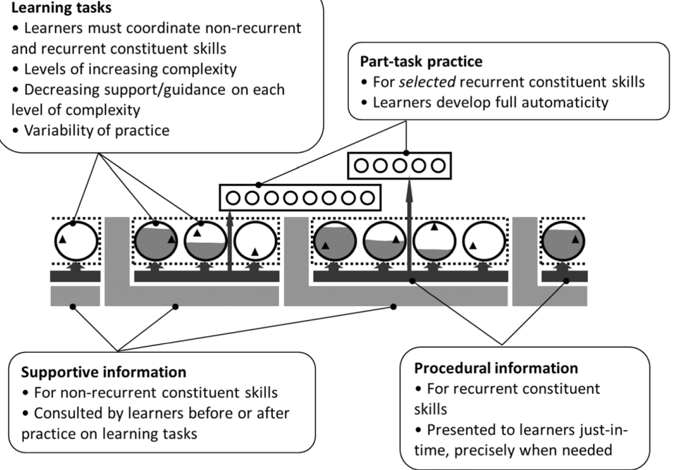
- The paper highlights 4C/ID as an extension of CLT for longer instructional programs and curricula, organized around 4 components: learning tasks, supportive information, procedural information, and part-task practice.
- It reports progress in measuring cognitive load, including a 10-item psychometric instrument that supported distinguishing intrinsic from extraneous load, and objective measures such as EEG, eye tracking, and secondary-task methods.
Methods
- This is a review article that retrospectively synthesizes CLT developments from 1998 to 2018, using the 1998 paper as a baseline and organizing the discussion into history, developments, future directions, and conclusions.
- The authors draw on prior theoretical and empirical studies and reviews cited throughout the paper; no new dataset or sample is reported in the text provided.
- Main analysis is a narrative synthesis of theoretical developments, instructional effects, and measurement approaches in CLT.
Limitations
- The paper explicitly says it is an attempt to summarise the last 20 years of CLT and sketch directions for future research, so it is a synthesis rather than a new empirical test.
- It repeatedly notes that more research is needed on cognitive-load measurement, including the optimal use of subjective rating scales, differentiating load types, and validating objective techniques.
- Evident from the text: several claims about future directions (e.g., resource depletion, self-regulated learning, emotions/stress/uncertainty, human movement) are presented as promising but not yet settled in the paper itself.
Model-written summary. Check it against the paper before relying on it.
Integrity signals
Registry
Cites
Statistics
Figures
Verification
Claims the paper makes
21 Valid · 23 Not valid · 90 Not checked · 158 Own results and interpretations
The sources with a verdict support this claim; the rest weren’t checked yet, have no full text we could read, or their verdicts aren’t rated yet.
In the paper
“Its basic premise is that human cognitive processing is heavily constrained by our limited working memory which can only process a limited number of information elements at a time.”
§ The Author(s) 2019 > Introduction
What the sources say
- Supportedcites Miller (1956) matched to “The magical number seven, plus or minus two: Some limits on our capacity for processing information.” (1956) source
The Summary says that immediate memory imposes severe limits on the information people can receive, process, and remember. The discussion of immediate memory (p. 93) specifies that its limit is the number of chunks, supporting the claim's broad paraphrase of a limited number of information elements at a time. (LLM, conf=0.91)
- Not checked — no full text of the sourcecites Peterson and Peterson (1959) matched to “Short-term retention of individual verbal items.” (1959) source
plainstates a cause- Asserted: passes — The authors put it forward as true.
- Checkable: passes — It can be checked against evidence.
- Load-bearing: passes — The paper’s conclusions depend on it.
- Based: passes — The paper gives a reason why it holds.
- Supported
The cited sources support only part of this claim — read each source’s verdict below.
In the paper
“The capacity and duration limits of working memory have been known at least since Miller (1956) and Peterson and Peterson (1959), although the fact that these limits effectively applied only to novel, not familiar information, seemed more implicit rather than explicit in most treatments.”
§ The Author(s) 2019 > Human Cognitive Architecture Used in 1998
What the sources say
- Partly supportedcites Miller (1956) matched to “The magical number seven, plus or minus two: Some limits on our capacity for processing information.” (1956) sourceExperimental — accuracy not yet measured
In the discussion of immediate memory (p. 93), Miller says its span is limited by the number of chunks and that familiar units allow more information to be packed into each chunk. That supports a distinction between novel material and familiar, recoded material, but not the claim that capacity limits apply only to novel information: the chunk limit remains. The paper also does not establish a duration limit that applies only to novel information. (LLM, conf=0.86)
- Not checked — no full text of the sourcecites Peterson and Peterson (1959) matched to “Short-term retention of individual verbal items.” (1959) source
hedged- Asserted: passes — The authors put it forward as true.
- Checkable: passes — It can be checked against evidence.
- Load-bearing: passes — The paper’s conclusions depend on it.
- Based: passes — The paper gives a reason why it holds.
- Partly supported
Every source the paper cites for this claim was checked and supports it.
In the paper
“The data summarised by Sala and Gobet (2017) provide a major justification for the post 1998 inclusion of evolutionary psychology into cognitive load theory.”
§ The Author(s) 2019 > Human Cognitive Architecture Seen Through the Prism of Evolutionary Psychology
What the sources say
- Supportedcites Sala and Gobet (2017) matched to “Does Far Transfer Exist? Negative Evidence From Chess, Music, and Working Memory Training” (2017) source
The Theoretical and Practical Implications section (page unavailable) summarises the paper’s evidence that chess, music and working-memory training do not reliably produce far transfer. The claim that these data justify a development in cognitive load theory is the citing authors’ interpretation, not a finding attributed to Sala and Gobet. (LLM, conf=0.86)
boostedstates a cause- Asserted: passes — The authors put it forward as true.
- Checkable: passes — It can be checked against evidence.
- Load-bearing: passes — The paper’s conclusions depend on it.
- Based: passes — The paper gives a reason why it holds.
- Supported
Every source the paper cites for this claim was checked and supports it.
In the paper
“The expertise reversal effect is, in essence, a variant of the more general element interactivity effect (Chen et al. 2017).”
§ The Author(s) 2019 > Instructional Effects Described After 1998
What the sources say
- Supportedcites Chen et al. 2017 matched to “The Expertise Reversal Effect is a Variant of the More General Element Interactivity Effect” (2017) source
The indexed copy lists the cited paper under the exact title “The Expertise Reversal Effect is a Variant of the More General Element Interactivity Effect.” Its title directly states the proposition attributed to it; no page number is available in the indexed passage. (LLM, conf=0.90)
plainstates a cause- Asserted: passes — The authors put it forward as true.
- Checkable: passes — It can be checked against evidence.
- Load-bearing: unclear — It is unclear whether the paper’s conclusions depend on it.
- Based: passes — The paper gives a reason why it holds.
- Supported
Every source the paper cites for this claim was checked and supports it.
In the paper
“When subsequently presented the fully integrated information, they only needed to learn how to integrate the individual elements and so more readily assimilated the entire, high element interactivity information.”
§ The Author(s) 2019 > Instructional Effects Described After 1998
What the sources say
- Supportedcites Pollock et al. 2002 matched to “Assimilating complex information” (2002) source
Split into 2 atoms — 2 confirmed, 0 partially supported, 0 disputed, 0 misattributed, 0 unverifiable. Expand the claim to see per-atom verdicts.
plainstates a cause- Asserted: passes — The authors put it forward as true.
- Checkable: passes — It can be checked against evidence.
- Load-bearing: passes — The paper’s conclusions depend on it.
- Based: passes — The paper gives a reason why it holds.
- Supported
132 more claims · 6 with their cited sources checked
Create a free account to see all 292 claims and to verify the 3 references still open.
- It may state two separate claims as one. 88
- Probably not a substantial claim. 95
Claims other papers make about this one
Each is checked against this paper’s own text: does it say what the citing paper says it does?
The source backs part of the claim, not all of it — or backs it for a different population, condition or comparison.
In the citing paper
“Another possible explanation is that the pre-training effect tends to be most effective for learners with minimal prior knowledge (Sweller et al., 2019)”
From Rethinking pre-training: cognitive load implications for learners with varying prior knowledge (2025) · cites this paper as Sweller et al., 2019
Experimental — accuracy not yet measuredThe cited source says what the claim attributes to it.
In the citing paper
“If the cognitive load imposed by a learning task is too high, it might interfere with the learner’s ability to effectively acquire and retain the skill [13, 25].”
From Teaching a single manual therapy technique at a time reduces cognitive load in physiotherapy students: a randomized controlled educational study (2025) · cites this paper as [13]
The cited source says what the claim attributes to it.
In the citing paper
“While cognitive load is often discussed in the context of instructional efficiency, it is important to note that cognitive load is not inherently detrimental. Rather, it is a natural component of learning that engages working memory resources for schema construction and automation [13].”
From Teaching a single manual therapy technique at a time reduces cognitive load in physiotherapy students: a randomized controlled educational study (2025) · cites this paper as [13]
The cited source says what the claim attributes to it.
In the citing paper
“Thus, an increased germane load is no longer believed to lead to cognitive overload and can thus no longer be assumed to be detrimental to learning performance.”
From Understanding Cognitive Load in Digital and Online Learning: a New Perspective on Extraneous Cognitive Load (2022) · cites this paper as Sweller et al., 2019
The cited source says what the claim attributes to it.
In the citing paper
“The major change from the 1998 model is that Sweller et al. (2019) have removed germane load from the additive equation of total load, but rather a dimension now called ' germane processing. '”
From Understanding Cognitive Load in Digital and Online Learning: a New Perspective on Extraneous Cognitive Load (2022) · cites this paper as Sweller et al., 2019
17 more claims about this paper
Create a free account to see every claim other papers make about this one.
Citations
Cites
The magical number seven, plus or minus two: Some limits on our capacity for processing information.
Miller, G. A. (1956) · Psychological Review · doi:10.1037/h0043158 · Cited by 17,812 · cited 1×
“The capacity and duration limits of working memory have been known at least since Miller (1956) and Peterson and Peterson (1959), although the fact that these limits effectively applied only to novel, not familiar information, seemed more implicit rather than explicit in most treatments.”
BackgroundThe magical number seven, plus or minus two: Some limits on our capacity for processing information.
Miller, G. A. (1994) · Psychological Review · doi:10.1037/0033-295x.101.2.343 · Cited by 17,161
Cognitive Load During Problem Solving: Effects on Learning
Sweller, J. (1988) · Cognitive Science · doi:10.1016/0364-0213(88)90023-7 · Cited by 11,048 · cited 4×
“Learning tasks (indicated by the big circles in Fig.”
BackgroundMethodInfluentialSelf-citationKirschner, P. A., Sweller, J., & Clark, R. E. (2006) · Educational Psychologist · doi:10.1207/s15326985ep4102_1 · Cited by 7,776
Self-citationRizzolatti, G., & Craighero, L. (2004) · Annual Review of Neuroscience · doi:10.1146/annurev.neuro.27.070203.144230 · Cited by 7,433
Cognitive Architecture and Instructional Design
Sweller, J., van Merrienboer, J. J. G., & Paas, F. G. W. C. (1998) · Educational Psychology Review · doi:10.1023/a:1022193728205 · Cited by 6,023
Self-citationCognitive load theory, learning difficulty, and instructional design
Sweller, J. (1994) · Learning and Instruction · doi:10.1016/0959-4752(94)90003-5 · Cited by 5,426 · cited 1×
“Element Interactivity Effect This effect was already known in 1998 but as a compound effect, it was not classed as a cognitive load effect (see Sweller 1994).”
BackgroundSelf-citationBaddeley, A. (1992) · Science · doi:10.1126/science.1736359 · Cited by 5,258
Ericsson, K. A., & Kintsch, W. (1995) · Psychological Review · doi:10.1037/0033-295x.102.2.211 · Cited by 3,498
Short-term retention of individual verbal items.
Peterson, L., & Peterson, M. J. (1959) · Journal of Experimental Psychology · doi:10.1037/h0049234 · Cited by 2,939 · cited 1×
“The capacity and duration limits of working memory have been known at least since Miller (1956) and Peterson and Peterson (1959), although the fact that these limits effectively applied only to novel, not familiar information, seemed more implicit rather than explicit in most treatments.”
Background
Research works printed but not linked: 4
- Centre for Education Statistics and Evaluation. (2017). Cognitive load theory: research that teachers really need to understand . Sydney: NSW Department of Education.
- Centre for Education Statistics and Evaluation. (2018). Cognitive load theory in practice . Sydney: NSW Department of Education.
- Clark, R. C. (2014). Evidence-based training methods: a guide for training professionals (2nd ed.). Alexandria: ATD Press.
- Miller, W. (1937). The picture crutch in reading. Elementary English Review, 14 , 263 -264.
Cited by
Items 1,801–1,900 of 2,268
Stelzer, F., Aydmune, Y. S., Vernucci, S., Introzzi, I. M., & Coni, A. G. (2026) · International Journal of School & Educational Psychology · doi:10.1080/21683603.2026.2641433
“Therefore, providing pedagogical resources – such as posters with mind maps and worked examples – may assist students with lower levels of prior knowledge in their learning process (Rittle-Johnson et al., 2009, 2017; Sweller et al., 2019).”
InfluentialPeltzer, N., Kuhn, J., Stadler, M. J., Cera, R., Hoyer, C., Flegr, S., Fischer, M. R., & Richters, C. (2026) · Computers & Education · doi:10.1016/j.compedu.2026.105612 · Cited by 7
Beyond Static Instruction: A Multi-agent AI Framework for Adaptive Augmented Reality Robot Training
Leins, N., Gonnermann-Müller, J., Teichmann, M. R., & Pokutta, S. (2026) · ACM/IEEE International Conference on Human-Robot Interaction (HRI) · doi:10.1145/3776734.3794542
“To do so, we ground the design of the learning environment in established instructional frameworks, including Mayer’s Multimedia Principles Mayer (2020) and cognitive load theory Sweller et al. (2019).”
Instructional Design Unlocks the Effects of Prior Knowledge Activation in Surgical Education
Storck, A., Schönefeld, E., Bellstedt, M., Barbian, B., Janssen, M., Seifert, K. E., & Darici, D. (2026) · Journal of surgical education · doi:10.1016/j.jsurg.2026.103915 · Cited by 2
Research Status of the Influence of Short Video Usage Time on Attention Span
池, 瑛. (2026) · Advances in Psychology · doi:10.12677/ap.2026.163146
Li, H., & Pan, W. (2026) · Interactive Learning Environments · doi:10.1080/10494820.2026.2627360 · Cited by 1
“It is a critical psychological variable affecting older adults’ interaction experiences and learning efficiency (Sweller et al., 2019).”
Tannoubi, A., Ouergui, I., Bonsaksen, T., Srem‐Sai, M., Hagan, J. E., Setiawan, E., & Azaiez, F. (2026) · Frontiers in Education · doi:10.3389/feduc.2026.1780194
Ariel, Y. (2026) · Information and Learning Sciences · doi:10.1108/ils-12-2025-0234 · Cited by 1
Build_PC: Mobile Augmented Reality for Supporting PC Hardware Learning With Low Mental Workload
Criollo-C, S., Guerrero-Arias, A., Guaña–Moya, J., Rawas, S., Samala, A. D., & Luján‐Mora, S. (2026) · Human Behavior and Emerging Technologies · doi:10.1155/hbe2/3687910
Liang, J., Zhang, Y., Xu, H., Zeng, M., & Luo, Y. (2026) · Systems · doi:10.3390/systems14030311 · Cited by 1
Bansal, A., Lai, R. W. Y., Liljeros, L., Singh, J., Bettiol, S., & Le, N. (2026) · Research Square · doi:10.21203/rs.3.rs-9108201/v1 · Cited by 1
Korbel, J. J., Riar, M., Ignatenko, D., Gottschalk, M., & Zarnekow, R. (2026) · International GamiFIN Conference (GamiFIN) · doi:10.1145/3789624.3789630
“Germane load occurs due to the learning process and is perceived as a redistribution function between extraneous and intrinsic load rather than a load on its own [25].”
InfluentialModeling master’s students’ competence development based on the variational principle
Игоревич, К. Н., Адамский, А. И., Drozdov, D., Zaslavskiy, A., Подболотова, М. И., & Устюгова, О. Б. (2026) · Modelling and Data Analysis · doi:10.17759/mda.2026160110
Advanced utilization of motion decomposition and visualization technology in gymnastics education
Yang, H.-L., Cheng, G., & Cheng, S. (2026) · Frontiers in Psychology · doi:10.3389/fpsyg.2026.1794257 · Cited by 8
“…viewing angles, velocity, and students’ observational capacities, complicating the comprehensive presentation of movement intricacies (Mayer, 2024; Sweller et al., 2019); instructors encounter challenges in delivering individualized corrections for each learner (Herrebrøden et al., 2024); and…”
Bridging the gap: How technology facilitates conceptual understanding in mathematics
Fauzi, A., Hardyanti, H., & Suryaningsih, S. (2026) · Indonesian Journal of Science and Mathematics Education · doi:10.24042/ijsme.v9i1.28655 · Cited by 1
Adding pedagogical agents who point or trace to children's instructional videos
Cheng, M., Qiao, P., Ni, H., Xie, H., Mayer, R. E., & Wang, F. (2026) · Computers & Education · doi:10.1016/j.compedu.2026.105618 · Cited by 2
Gordan, M., & Ayala–Cabrera, D. (2026) · International Conference on Knowledge and Smart Technology · doi:10.1109/kst67832.2026.11432280
Boehlke, E., Huber, S. E., Kiili, K. J. M., & Ninaus, M. (2026) · International GamiFIN Conference (GamiFIN) · doi:10.1145/3789624.3789627
“…a minimally more elaborated narrative framing (high-narrative versions) could evoke immersion and narrative transportation more effectively than the low-narrative versions, as adopting a minimal approach would be ideal for preventing cognitive overload and maintaining learning performance [25].”
InfluentialGonçalves, G., Romão, M., Peixoto, B., Cabral, L., & Melo, M. (2026) · IEEE Revista Iberoamericana de Tecnologias del Aprendizaje · doi:10.1109/rita.2026.3675805
“From a cognitive perspective, the detailed visual features of the RA may have functioned as an “extraneous cognitive load” [37], a form of visual noise that distracted from the task without adding to the sense of being there.”
InfluentialDarejeh, A., Marcus, N., Mohammadi, G., & Sweller, J. (2026) · Human Factors The Journal of the Human Factors and Ergonomics Society · doi:10.1177/00187208261427867 · Cited by 61
Self-citationNgu, B. H., Tay, E. G., Phan, H. P., & Usop, H. H. (2026) · International Journal of Mathematical Education in Science and Technology · doi:10.1080/0020739x.2026.2633245
Effects of physically embodied educational robots on children's learning outcomes: A meta-analysis
Shu, L., Xie, S., & Lin, H. (2026) · Acta Psychologica · doi:10.1016/j.actpsy.2026.106576 · Cited by 2
Qian, L., Li, L., Li, W., Wang, X., & Xia, M. (2026) · Interactive Learning Environments · doi:10.1080/10494820.2026.2644625
“These patterns indicate that cognitive load is modulated by emotional design and contextual factors, thereby extending CLT by underscoring the interactive role of affect in immersion-related extraneous processing.”
InfluentialTransforming Dental Education Through Team-Based Learning and Artificial Intelligence
Hamzah, T. T., Goh, Y., & Malik, A. S. (2026) · Springer eBooks · doi:10.1007/978-981-97-0275-6_21-1
Çelik, A. A., Balcıoğlu, Y. S., & Altındağ, E. (2026) · Discover Education · doi:10.1007/s44217-026-01382-4
Sezgin, H., Ada, T., & Akın, A. (2026) · Thinking Skills and Creativity · doi:10.1016/j.tsc.2026.102202 · Cited by 1
Kangshu, X. (2026) · Frontiers in Psychology · doi:10.3389/fpsyg.2026.1796834 · Cited by 1
“Compared with other subjects, Chinese language teaching involves a triple cognitive load stemming from textual polysemy, subjective assessment, and rapid technological iteration (Sweller et al., 2019).”
Piu, A., Testa, S., Angelini, C., Dodman, M., & Marini, A. (2026) · CADMO · doi:10.3280/cad2025-002003 · Cited by 1
Yin, L., Zhang, H., & He, R. (2026) · Journal of Eye Movement Research · doi:10.3390/jemr19020034 · Cited by 1
“According to cognitive load theory [46], individuals have limited working memory capacity and can only process a finite amount of information at any given time.”
ForeSightVR: Forecasting Cybersickness and Cognitive Overload in VR Multitasking
Setu, J. N., Islam, R., & Quarles, J. P. (2026) · IEEE International Conference on Artificial Intelligence and eXtended and Virtual Reality (AIxVR) · doi:10.1109/aixvr67263.2026.00047 · Cited by 1
“Cognitive load includes intrinsic, extraneous, and germane components [42], assessed by Paas Scale [3], [41] or NASA TLX. Prediction relies on EEG [17], [31], though eye and head tracking provide additional promise [30]; VR-specific studies remain limited [6].”
Cyber Behavior and Cognitive Outcomes: Navigating Digital Engagement in Modern Education
ElSayary, A., & Ragab, K. (2026) · Advances in computational intelligence and robotics book series · doi:10.4018/979-8-3373-4222-1.ch001
Sibarani, B. E. (2026) · American Journal of Distance Education · doi:10.1080/08923647.2026.2650245 · Cited by 1
Torres, A. P., & Toplak, M. E. (2026) · Journal of Attention Disorders · doi:10.1177/10870547261428879 · Cited by 1
“According to Cognitive Load Theory (CLT), cognitive load represents the demands that performing a particular task imposes on the learner’s cognitive system, with an emphasis on working memory limitations (F. Paas & Van Merriënboer, 1994; Sweller et al., 2019).”
Better together? Effects of task complexity and social setting on performance and cognitive load
Nederhand, M. L., Kervers, F., Fitriyadi, L., Noordover, I., & de Koning, B. B. (2026) · Frontiers in Psychology · doi:10.3389/fpsyg.2026.1766737
“In the most recent conceptualization of CLT, germane cognitive load is assumed to not impose a load on its own but rather makes sure that working memory resources are spent on intrinsic aspects of the learning task so that cognitive activities are employed that are directly relevant to learning (Sweller et al., 2019).”
InfluentialXu, K., Zhang, Q., Zhang, Y., Xu, H., Pi, Z., & Yang, J. (2026) · British Journal of Educational Technology · doi:10.1111/bjet.70064
Zhang, G., & Ren, Z. (2026) · Education and Information Technologies · doi:10.1007/s10639-026-13976-4
“These two items were rated by the participants on a 5-point scale ranging from 1 (very low cognitive load) to 5 (very high cognitive load), and this scale has been widely adopted in the field of multimedia learning (Sweller et al., 2019).”
Pimenta, C. C. D. C., de Cádiz, D. C. G. T., Mogollón, J. Á. A., et al. (2026) · Journal of Lifestyle and SDGs Review · doi:10.47172/2965-730x.sdgsreview.v6.n03.pe08222
Laera, R. (2026) · Research Square · doi:10.21203/rs.3.rs-9255100/v1
Do Generative AI Tools Change How Developers Comment and Document Code?
Ebiwonjumi, O., Ahakonye, L. A. C., & Kim, D.-S. (2026) · Digital Signal Processing and Signal Processing Education Workshop · doi:10.1109/icaiic68212.2026.11454326 · Cited by 1
Roßnagel, C. S. (2026) · PLoS ONE · doi:10.1371/journal.pone.0343971 · Cited by 1
Designing Inclusive Hybrid Pedagogies in Physical Science With AI From Classroom to Cloud
Devaki, V., Suresh, C., Vidya, V., & Boopathi, L. (2026) · Advances in computational intelligence and robotics book series · doi:10.4018/979-8-3373-7462-8.ch009 · Cited by 1
Mas, M. (2020) · theses.fr (ABES) · doi:10.70675/2acbede7ze0d9z4b79z92d2zac21e057d5b5 · Cited by 1
Xie, H., Ginns, P., Liu, X., Sun, S., Wang, F., & Chen, C. (2026) · Learning and Instruction · doi:10.1016/j.learninstruc.2026.102372
Benaroch, C. (2021) · theses.fr (ABES) · doi:10.70675/c2704384z058az4affza403z92acc3ec08f8 · Cited by 2
Moschetti-Rome, S. (2022) · theses.fr (ABES) · doi:10.70675/1cbbc40fz47aaz4635z9303z4a41c10a7bfb
Mahfoudh, H. B. (2022) · theses.fr (ABES) · doi:10.70675/9c412d3azd9dcz4cb3zaae5zfd9a7897d6eb
A Framework for Understanding Teaching and Learning Across Cultures
Chew, S. L., & Cerbin, W. J. (2026) · International and cultural psychology/International and cultural psychology series · doi:10.1007/978-3-032-09977-8_11
Rodríguez, M., Krush, M. T., Deeter‐Schmelz, D. R., & Walker, D. (2026) · The Journal of Marketing Theory and Practice · doi:10.1080/10696679.2026.2656319 · Cited by 1
Apprentissage de scènes tactiques par imagination : Impacts de l'expertise et du moment du test
Mguidich, H. (2024) · theses.fr (ABES) · doi:10.70675/8134c7b9z0155z4b05z8d3dz3fb980301100
Marquina, P., Fernández, R. C., & Sotomayor, M. (2026) · Cogent Education · doi:10.1080/2331186x.2026.2653323
Investigating causal factors of early linguistic competency : a daycare intervention study
Crimon, C. (2024) · theses.fr (ABES) · doi:10.70675/169471b5z51d3z4f2dz9b66z0b1ecfa2d742 · Cited by 1
The hedonic expectancy gap: a framework for understanding intention failure in precontemplation
Burge, J. (2026) · Frontiers in Psychology · doi:10.3389/fpsyg.2026.1789958
“Cognitive load theory (CLT) explains how perceived effort is shaped by working-memory constraints and task demands (Sweller, 1988; Sweller et al., 2019).”
Sigayret, K. (2023) · theses.fr (ABES) · doi:10.70675/9cb0cb60zec7cz498dza89azb44af6fbb070 · Cited by 1
Delaney, B., Walsh, J. F., Blankenship, J. C., & Luz, H. P. (2026) · Education Sciences · doi:10.3390/educsci16040598
Larraga-García, B., Bejerano, V. R., Blanco, P., Navarro, S., Álvarez, M., Oregui, X., Álvarez, F., & Gutiérrez, Á. (2026) · Displays · doi:10.1016/j.displa.2026.103463
Optimising goal-setting strategies in worked-example learning for intellectual and motor skills
He, F., Yang, Y., Yu, Z., & Lin, H. (2026) · Educational Psychology · doi:10.1080/01443410.2026.2655882
Huangfu, Q., Wang, Z. K., Li, Y., Zhu, L., & Guo, Y. (2026) · Instructional Science · doi:10.1007/s11251-026-09795-2 · Cited by 1
“Such processing may consume resources that would otherwise be available for germane cognitive load (GL; resources devoted to schema construction; Paas et al., 2003; Sweller et al., 2019).”
XR for Challenging Environments - Enabling Human Performance and Agency under Stress
Schatz, R., Schrom-Feiertag, H., Papagni, G., Steinicke, F., Skorin‐Kapov, L., Billinghurst, M., Oppermann, L., & Aumayr, G. (2026) · CHI Conference Extended Abstracts on Human Factors in Computing Systems (CHI EA) · doi:10.1145/3772363.3778704
Hülsmann, M., & Wilde, M. (2026) · Frontiers in Psychology · doi:10.3389/fpsyg.2026.1754081
“To evaluate this assumption, two constructs are particularly relevant. eCL indicates the extent of unnecessary cognitive effort caused by ineffective task designs and can be reduced through well-designed guidance (Paas and van Merriënboer, 2020; Sweller et al., 2019).”
InfluentialStress dynamics of architecture students during jury presentations: an exploratory EDA study
Er, İ. E., Heyik, M. A., Taştan, H., & Arabacıoğlu, F. P. (2026) · International Journal of Technology and Design Education · doi:10.1007/s10798-026-10087-6
Authenticity and Complexity in Game-Based Learning
Azhar, F. (2026) · Medical Science Educator · doi:10.1007/s40670-026-02728-1
Li, Q., & Ding, D. (2026) · Early Child Development and Care · doi:10.1080/03004430.2026.2657934 · Cited by 1
“Similarly, cognitive load theory suggests that diverse experiences may overwhelm children unless guided processing is available to help them organize these experiences into knowledge structures (Sweller et al., 2019).”
Ophuis‐Cox, F. H. A., Catrysse, L., & Camp, G. (2026) · Learning and Instruction · doi:10.1016/j.learninstruc.2026.102377
AI as a Creative Partner in Instructional Design: Strategies for Effective Course Development
Huck, C., & Cisneroz, A. (2026) · Lecture notes in networks and systems · doi:10.1007/978-3-032-09905-1_20
Translating solar geometry through stereographic sun-path diagrams: a physical modelling approach
Esposito, L. G., & Rossi, M. M. (2026) · Ambiente Construído · doi:10.1590/s1678-86212026000100965
Chen, P. P., & Bonner, S. M. (2026) · The Journal of Experimental Education · doi:10.1080/00220973.2026.2652845
Jecha, J., Liang, Y., Han, J., & Nassor, H. (2026) · Research Square · doi:10.21203/rs.3.rs-9461812/v1 · Cited by 2
Hines, K., & Wood, C. L. (2026) · Topics in Language Disorders · doi:10.1097/tld.0000000000000382
Digital Media Practices to Support Middle Grade Students’ Health and Well-Being
Sproul, J. (2026) · Emerald Group Publishing Limited eBooks · doi:10.1108/978-1-80686-351-820261012
van Rijnsoever, F. J., de Jongh, L., & Baggen, Y. (2026) · Assessment & Evaluation in Higher Education · doi:10.1080/02602938.2026.2653883 · Cited by 2
Zhang, J., Gu, Q., Sun, Z., & Zhao, C. (2026) · SSRN Electronic Journal · doi:10.2139/ssrn.6638055
Peng, Q., Qin, Q., & Zhao, W. (2025) · doi:10.1145/3797552.3797626 · Cited by 1
From Digital Assistants to Cognitive Crutches: AI Overdependence in Pedagogical Practice
Irfan, M. (2026) · Advances in computational intelligence and robotics book series · doi:10.4018/979-8-3373-7097-2.ch006
Altamura, L., Stadtler, M., & Salmerón, L. (2026) · Metacognition and Learning · doi:10.1007/s11409-026-09466-0 · Cited by 2
Ratniyom, J., Boonphadung, S., Intaraprasit, M., & Chumkaeo, P. (2026) · Chemistry Teacher International · doi:10.1515/cti-2025-0097 · Cited by 2
“29,30 This approach aligns with the sca ff olding process of reduction in degrees of freedom, in which content complexity is deliberately constrained by breaking down complex concepts into smaller, sequential, and more manageable components.”
The effects of non-native accented speech on learning and anxiety: a role for working memory?
McClure, K. L., Was, C. A., & HAMRICK, P. J. J. (2026) · Journal of Cognitive Psychology · doi:10.1080/20445911.2026.2662616
“…challenging if participants do not have additional working memory (WM) resources to be able to rehearse and encode the information they are receiving (Chan et al., 2019; Paas et al., 2010; Sweller, 1994, 2010; Sweller & Chandler, 1991; Sweller et al., 2019), resulting in lower recall performance.”
Calalang, E. F. (2026) · European Modern Studies Journal · doi:10.59573/emsj.10(1).2026.55
AlAlawi, N. R., Gningue, S. M., Jarrah, A. M., & Almarashdi, H. S. (2026) · Education Sciences · doi:10.3390/educsci16050715 · Cited by 3
Roach, Q. E., & Cobern, W. W. (2026) · Journal of Geoscience Education · doi:10.1080/10899995.2026.2660360
Hunas, S., Puspitasari, E., Rozak, R. W. A., & Rusmana, N. (2026) · Journal Evaluation in Education (JEE) · doi:10.37251/jee.v7i2.2810 · Cited by 1
“…with carrying, borrowing, and word problems — effectively managed intrinsic cognitive load by presenting information in manageable, ISSN: 2716-4160 Effective Drill-Based Arithmetic Training for Improving Numeracy Literacy: A Quasi-… (Safiru Hunas) 563 sequentially organized chunks [48], [49].”
Polydoros, G., Vasileiou, I., Krokou, Z., & Antoniou, A.-S. (2026) · Encyclopedia · doi:10.3390/encyclopedia6050098
Pimblett, C., Rowe, L., & Fenton, A. (2026) · Studies in Continuing Education · doi:10.1080/0158037x.2026.2667829
Informations- und Wissensmanagement in Organisationen
Sakschewski, T., & Paul, S. (2026) · Springer eBooks · doi:10.1007/978-3-658-50978-1_3
Enhancing Open Learning Environments Through Multimodal AI-Based Learning Analytics
Chen, N. (2026) · International Conference on Electronics Technology and Artificial Intelligence (ETAI) · doi:10.1109/etai68332.2026.11485374
“…sum ensuring predictive accuracy and pedagogical validity: Where ℒ theory encapsulates constraints like: “If physiological data indicates high cognitive load AND behavioral data shows rapid topic switching, penalize predictions of ‘effective monitoring’” (violating cognitive load theory [11]).”
Xiao, W. (2026) · Learning and analytics in intelligent systems · doi:10.1007/978-3-032-08195-7_2
Purba, J. P., Pasaribu, S. T., Maibang, D. F., Tarigan, C. O. B., & Sitorus, N. K. (2025) · COMPETITOR Jurnal Pendidikan Kepelatihan Olahraga · doi:10.26858/cpjok.v17i3.651
Beyond the left-right brain divide: a framework for dual-domain cognitive fluency
Affognon, D. A. (2026) · Frontiers in Cognition · doi:10.3389/fcogn.2026.1727422 · Cited by 1
“Additional indicators, such as cognitive load perception and learner confidence, can provide insight into how integrative reasoning develops experientially (Schneider et al., 2011; Sweller et al., 2019).”
McCorry, L. (2026) · Journal of Nursing Education · doi:10.3928/01484834-20260403-07
Kurniawan, Y., Degeng, I. N., Kuswandi, D., & Degeng, M. D. K. (2026) · Journal of Applied Research in Higher Education · doi:10.1108/jarhe-11-2025-0971
Samsudin, A., Zahran, M., & Kapıcı, H. Ö. (2026) · Computers in the Schools · doi:10.1080/07380569.2026.2655613
Pramartha, I. N. B., Hendriyanto, A., & Muhaimin, L. H. (2026) · Indonesian Journal of Science and Mathematics Education · doi:10.24042/ijsme.v9i1.30923
When arousal meets cognitive load: affective arousal and germane processing in a Stroop-like task
Koerber, S., & Park, B. (2026) · Frontiers in Psychology · doi:10.3389/fpsyg.2026.1804728 · Cited by 1
“…however, has refined this interpretation by emphasizing that the germane component of cognitive load does not constitute an additional burden on working memory, but rather reflects how learners actively invest available cognitive resources during task engagement (Sweller, 2010; Sweller et al., 2019).”
The Democratization of Computational Thinking: Education, Practice, and Our AI-Augmented Future
Schmidt, D., & Runfola, D. M. (2026) · Software · doi:10.3390/software5020020
“As shown conceptually in Figure 9, there may be an ‘optimal zone’ in which AI-augmented learning enhances engagement and productivity without displacing the productive struggle needed for durable learning [26,27].”
The Impact of Physical Activity-Integrated Learning on College Student Engagement and Well-Being
Khati, A., Das, A., Saha, S., & Bhutia, T. O. (2026) · IGI Global eBooks · doi:10.4018/979-8-3373-6846-7.ch005 · Cited by 1
Qin, Y., Wang, X., Zhang, B., Zhang, Y., Xie, X., Mao, S., Wang, J., & Yang, Y. (2026) · PLoS ONE · doi:10.1371/journal.pone.0349225
“The structural and cognitive barriers they face may increase the difficulty of English learning [20,21,29].”
Influential
Metadata
- Authors
- Sweller, J., van Merriënboer, J. J. G., & Paas, F.
- Affiliations
- UNSW Sydney (AU)
- University of Wollongong (AU)
- Corresponding author
- Sweller, John
- Venue
- Educational Psychology Review
- Published
- 2019-01-22
- Volume
- 31
- Issue
- 2
- Pages
- 261-292
- ISSN
- 1040-726X (ISSN-L)
- 1573-336X
- OpenAlex
- W2913144876
- Semantic Scholar
- e28d73214751d51c3f46a867920be41c49c45130
- Cited by
- 2,337
- References
- 129
- Citations by year
- 2026: 713 · 2025: 466 · 2024: 331 · 2023: 268 · 2022: 212 · 2021: 190 · 2020: 114 · 2019: 37
- FWCI
- 162.54
- Type
- journal article
- Language
- en
- Open access
- hybrid
- doi.org
- Licence
- cc-by
- creativecommons.org/licenses/by/4.0 (tdm)
- Locations
- Educational Psychology Review (publishedVersion, cc-by)
- EUR Research Repository (Erasmus University Rotterdam) (publishedVersion, other-oa)
- Research Online (University of Wollongong) (submittedVersion)
- EUR Research Repository (Erasmus University Rotterdam) (submittedVersion)
- Research Publications (Maastricht University) (submittedVersion, cc-by)
- Figshare (submittedVersion, cc-by)
- Research Publications (Maastricht University) (submittedVersion, other-oa)
- Topics
- Social Sciences › Psychology › Experimental and Cognitive Psychology › Visual and Cognitive Learning Processes
- Social Sciences › Psychology › Developmental and Educational Psychology › Innovative Teaching and Learning Methods
- Life Sciences › Neuroscience › Cognitive Neuroscience › Neuroscience, Education and Cognitive Function
- Keywords
- cognitive load theory, cognitive architecture, working memory, long-term memory, instructional design
About these checks
Registry, retraction, Cites and statistics results are computed, not judged, with one exception: a printed reference that no index lists is read once by a model before it counts as a citation error. Claims are extracted by a model and kept only when their quote appears verbatim in the text; each cited source is then checked, with a model’s help, for whether it says what the claim relies on. Those verdicts can be wrong — read the claim’s quote and the cited source before relying on one.
The claim verdicts this report counts are experimental: their accuracy is not yet measured.
A language model drew the claims from the paper on 2026-10-10, under version 3 of the claim definition (model deepseek-v4.1-flash, prompt extract-v3).
A second model labelled each claim on 2026-10-10 (model jev-1.13-20260917, definition revision gold-guideline-v0.2).
Cited sources are checked with a language model’s help (gpt-6-sol).
Statistics and arithmetic are recomputed, not judged.
Confidence bands are shown only for fields calibrated on our annotated test set. None is calibrated yet, so no band is shown.
What counts as a claim ›How we measure confidence ›How we check this ›
Are you an author, or do you see a problem with this page? Request a review
Data sources
Bibliographic data: Semantic Scholar, OpenAlex, Crossref.
Contains information from the Semantic Scholar Academic Graph Datasets, made available under the ODC Attribution License (ODC-BY 1.0).
Semantic Scholar’s data is described in: Kinney, R., et al. (2023). The Semantic Scholar Open Data Platform. arXiv:2301.10140.
