

Cognitive Architecture and Instructional Design: 20 Years Later
Open accessThe DOI matches its Crossref record; 127 of the 129 references it cites were found in a registry or an index, and 1 are not checked yet; 22 of the 116 sources its claims cite were checked for support.
Abstract
Cognitive load theory was introduced in the 1980s as an instructional design theory based on several uncontroversial aspects of human cognitive architecture. Our knowledge of many of the characteristics of working memory, long-term memory and the relations between them had been well-established for many decades prior to the introduction of the theory. Curiously, this knowledge had had a limited impact on the field of instructional design with most instructional design recommendations proceeding as though working memory and long-term memory did not exist. In contrast, cognitive load theory emphasised that all novel information first is processed by a capacity and duration limited working memory and then stored in an unlimited long-term memory for later use. Once information is stored in long-term memory, the capacity and duration limits of working memory disappear transforming our ability to function. By the late 1990s, sufficient data had been collected using the theory to warrant an extended analysis resulting in the publication of Sweller et al. (Educational Psychology Review, 10, 251–296, 1998). Extensive further theoretical and empirical work have been carried out since that time and this paper is an attempt to summarise the last 20 years of cognitive load theory and to sketch directions for future research.
Verified 2026-11-25 · 1 reference not checked yet
Overview
CoChat Summary
TL;DR
This review argues that cognitive load theory (CLT) has substantially advanced since its 1998 summary, with new theoretical grounding, new instructional effects, and improved measurement approaches. It also frames future work around working-memory resource depletion, self-regulated learning, emotions/stress/uncertainty, and human movement.
Key findings
- The paper states that the 1998 article reported 7 cognitive load effects, and that 8 new effects were added in the 1998–2018 period, including compound effects.
- It says CLT’s theoretical basis was strengthened by grounding human cognitive architecture in evolutionary psychology, especially Geary’s distinction between biologically primary and biologically secondary knowledge.
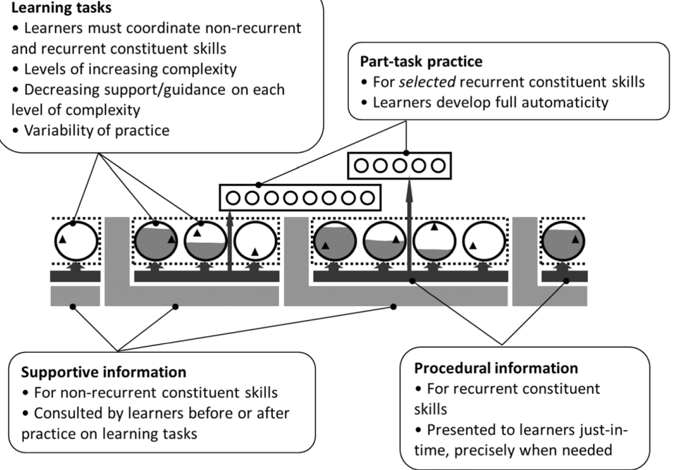
- The paper highlights 4C/ID as an extension of CLT for longer instructional programs and curricula, organized around 4 components: learning tasks, supportive information, procedural information, and part-task practice.
- It reports progress in measuring cognitive load, including a 10-item psychometric instrument that supported distinguishing intrinsic from extraneous load, and objective measures such as EEG, eye tracking, and secondary-task methods.
Methods
- This is a review article that retrospectively synthesizes CLT developments from 1998 to 2018, using the 1998 paper as a baseline and organizing the discussion into history, developments, future directions, and conclusions.
- The authors draw on prior theoretical and empirical studies and reviews cited throughout the paper; no new dataset or sample is reported in the text provided.
- Main analysis is a narrative synthesis of theoretical developments, instructional effects, and measurement approaches in CLT.
Limitations
- The paper explicitly says it is an attempt to summarise the last 20 years of CLT and sketch directions for future research, so it is a synthesis rather than a new empirical test.
- It repeatedly notes that more research is needed on cognitive-load measurement, including the optimal use of subjective rating scales, differentiating load types, and validating objective techniques.
- Evident from the text: several claims about future directions (e.g., resource depletion, self-regulated learning, emotions/stress/uncertainty, human movement) are presented as promising but not yet settled in the paper itself.
Model-written summary. Check it against the paper before relying on it.
Integrity signals
Registry
Cites
Statistics
Figures
Verification
Claims the paper makes
21 Valid · 23 Not valid · 90 Not checked · 158 Own results and interpretations
The sources with a verdict support this claim; the rest weren’t checked yet, have no full text we could read, or their verdicts aren’t rated yet.
In the paper
“Its basic premise is that human cognitive processing is heavily constrained by our limited working memory which can only process a limited number of information elements at a time.”
§ The Author(s) 2019 > Introduction
What the sources say
- Supportedcites Miller (1956) matched to “The magical number seven, plus or minus two: Some limits on our capacity for processing information.” (1956) source
The Summary says that immediate memory imposes severe limits on the information people can receive, process, and remember. The discussion of immediate memory (p. 93) specifies that its limit is the number of chunks, supporting the claim's broad paraphrase of a limited number of information elements at a time. (LLM, conf=0.91)
- Not checked — no full text of the sourcecites Peterson and Peterson (1959) matched to “Short-term retention of individual verbal items.” (1959) source
plainstates a cause- Asserted: passes — The authors put it forward as true.
- Checkable: passes — It can be checked against evidence.
- Load-bearing: passes — The paper’s conclusions depend on it.
- Based: passes — The paper gives a reason why it holds.
- Supported
The cited sources support only part of this claim — read each source’s verdict below.
In the paper
“The capacity and duration limits of working memory have been known at least since Miller (1956) and Peterson and Peterson (1959), although the fact that these limits effectively applied only to novel, not familiar information, seemed more implicit rather than explicit in most treatments.”
§ The Author(s) 2019 > Human Cognitive Architecture Used in 1998
What the sources say
- Partly supportedcites Miller (1956) matched to “The magical number seven, plus or minus two: Some limits on our capacity for processing information.” (1956) sourceExperimental — accuracy not yet measured
In the discussion of immediate memory (p. 93), Miller says its span is limited by the number of chunks and that familiar units allow more information to be packed into each chunk. That supports a distinction between novel material and familiar, recoded material, but not the claim that capacity limits apply only to novel information: the chunk limit remains. The paper also does not establish a duration limit that applies only to novel information. (LLM, conf=0.86)
- Not checked — no full text of the sourcecites Peterson and Peterson (1959) matched to “Short-term retention of individual verbal items.” (1959) source
hedged- Asserted: passes — The authors put it forward as true.
- Checkable: passes — It can be checked against evidence.
- Load-bearing: passes — The paper’s conclusions depend on it.
- Based: passes — The paper gives a reason why it holds.
- Partly supported
Every source the paper cites for this claim was checked and supports it.
In the paper
“The data summarised by Sala and Gobet (2017) provide a major justification for the post 1998 inclusion of evolutionary psychology into cognitive load theory.”
§ The Author(s) 2019 > Human Cognitive Architecture Seen Through the Prism of Evolutionary Psychology
What the sources say
- Supportedcites Sala and Gobet (2017) matched to “Does Far Transfer Exist? Negative Evidence From Chess, Music, and Working Memory Training” (2017) source
The Theoretical and Practical Implications section (page unavailable) summarises the paper’s evidence that chess, music and working-memory training do not reliably produce far transfer. The claim that these data justify a development in cognitive load theory is the citing authors’ interpretation, not a finding attributed to Sala and Gobet. (LLM, conf=0.86)
boostedstates a cause- Asserted: passes — The authors put it forward as true.
- Checkable: passes — It can be checked against evidence.
- Load-bearing: passes — The paper’s conclusions depend on it.
- Based: passes — The paper gives a reason why it holds.
- Supported
Every source the paper cites for this claim was checked and supports it.
In the paper
“The expertise reversal effect is, in essence, a variant of the more general element interactivity effect (Chen et al. 2017).”
§ The Author(s) 2019 > Instructional Effects Described After 1998
What the sources say
- Supportedcites Chen et al. 2017 matched to “The Expertise Reversal Effect is a Variant of the More General Element Interactivity Effect” (2017) source
The indexed copy lists the cited paper under the exact title “The Expertise Reversal Effect is a Variant of the More General Element Interactivity Effect.” Its title directly states the proposition attributed to it; no page number is available in the indexed passage. (LLM, conf=0.90)
plainstates a cause- Asserted: passes — The authors put it forward as true.
- Checkable: passes — It can be checked against evidence.
- Load-bearing: unclear — It is unclear whether the paper’s conclusions depend on it.
- Based: passes — The paper gives a reason why it holds.
- Supported
Every source the paper cites for this claim was checked and supports it.
In the paper
“When subsequently presented the fully integrated information, they only needed to learn how to integrate the individual elements and so more readily assimilated the entire, high element interactivity information.”
§ The Author(s) 2019 > Instructional Effects Described After 1998
What the sources say
- Supportedcites Pollock et al. 2002 matched to “Assimilating complex information” (2002) source
Split into 2 atoms — 2 confirmed, 0 partially supported, 0 disputed, 0 misattributed, 0 unverifiable. Expand the claim to see per-atom verdicts.
plainstates a cause- Asserted: passes — The authors put it forward as true.
- Checkable: passes — It can be checked against evidence.
- Load-bearing: passes — The paper’s conclusions depend on it.
- Based: passes — The paper gives a reason why it holds.
- Supported
132 more claims · 6 with their cited sources checked
Create a free account to see all 292 claims and to verify the 3 references still open.
- It may state two separate claims as one. 88
- Probably not a substantial claim. 95
Claims other papers make about this one
Each is checked against this paper’s own text: does it say what the citing paper says it does?
The source backs part of the claim, not all of it — or backs it for a different population, condition or comparison.
In the citing paper
“Another possible explanation is that the pre-training effect tends to be most effective for learners with minimal prior knowledge (Sweller et al., 2019)”
From Rethinking pre-training: cognitive load implications for learners with varying prior knowledge (2025) · cites this paper as Sweller et al., 2019
Experimental — accuracy not yet measuredThe cited source says what the claim attributes to it.
In the citing paper
“If the cognitive load imposed by a learning task is too high, it might interfere with the learner’s ability to effectively acquire and retain the skill [13, 25].”
From Teaching a single manual therapy technique at a time reduces cognitive load in physiotherapy students: a randomized controlled educational study (2025) · cites this paper as [13]
The cited source says what the claim attributes to it.
In the citing paper
“While cognitive load is often discussed in the context of instructional efficiency, it is important to note that cognitive load is not inherently detrimental. Rather, it is a natural component of learning that engages working memory resources for schema construction and automation [13].”
From Teaching a single manual therapy technique at a time reduces cognitive load in physiotherapy students: a randomized controlled educational study (2025) · cites this paper as [13]
The cited source says what the claim attributes to it.
In the citing paper
“Thus, an increased germane load is no longer believed to lead to cognitive overload and can thus no longer be assumed to be detrimental to learning performance.”
From Understanding Cognitive Load in Digital and Online Learning: a New Perspective on Extraneous Cognitive Load (2022) · cites this paper as Sweller et al., 2019
The cited source says what the claim attributes to it.
In the citing paper
“The major change from the 1998 model is that Sweller et al. (2019) have removed germane load from the additive equation of total load, but rather a dimension now called ' germane processing. '”
From Understanding Cognitive Load in Digital and Online Learning: a New Perspective on Extraneous Cognitive Load (2022) · cites this paper as Sweller et al., 2019
17 more claims about this paper
Create a free account to see every claim other papers make about this one.
Citations
Cites
The magical number seven, plus or minus two: Some limits on our capacity for processing information.
Miller, G. A. (1956) · Psychological Review · doi:10.1037/h0043158 · Cited by 17,812 · cited 1×
“The capacity and duration limits of working memory have been known at least since Miller (1956) and Peterson and Peterson (1959), although the fact that these limits effectively applied only to novel, not familiar information, seemed more implicit rather than explicit in most treatments.”
BackgroundThe magical number seven, plus or minus two: Some limits on our capacity for processing information.
Miller, G. A. (1994) · Psychological Review · doi:10.1037/0033-295x.101.2.343 · Cited by 17,161
Cognitive Load During Problem Solving: Effects on Learning
Sweller, J. (1988) · Cognitive Science · doi:10.1016/0364-0213(88)90023-7 · Cited by 11,048 · cited 4×
“Learning tasks (indicated by the big circles in Fig.”
BackgroundMethodInfluentialSelf-citationKirschner, P. A., Sweller, J., & Clark, R. E. (2006) · Educational Psychologist · doi:10.1207/s15326985ep4102_1 · Cited by 7,776
Self-citationRizzolatti, G., & Craighero, L. (2004) · Annual Review of Neuroscience · doi:10.1146/annurev.neuro.27.070203.144230 · Cited by 7,433
Cognitive Architecture and Instructional Design
Sweller, J., van Merrienboer, J. J. G., & Paas, F. G. W. C. (1998) · Educational Psychology Review · doi:10.1023/a:1022193728205 · Cited by 6,023
Self-citationCognitive load theory, learning difficulty, and instructional design
Sweller, J. (1994) · Learning and Instruction · doi:10.1016/0959-4752(94)90003-5 · Cited by 5,426 · cited 1×
“Element Interactivity Effect This effect was already known in 1998 but as a compound effect, it was not classed as a cognitive load effect (see Sweller 1994).”
BackgroundSelf-citationBaddeley, A. (1992) · Science · doi:10.1126/science.1736359 · Cited by 5,258
Ericsson, K. A., & Kintsch, W. (1995) · Psychological Review · doi:10.1037/0033-295x.102.2.211 · Cited by 3,498
Short-term retention of individual verbal items.
Peterson, L., & Peterson, M. J. (1959) · Journal of Experimental Psychology · doi:10.1037/h0049234 · Cited by 2,939 · cited 1×
“The capacity and duration limits of working memory have been known at least since Miller (1956) and Peterson and Peterson (1959), although the fact that these limits effectively applied only to novel, not familiar information, seemed more implicit rather than explicit in most treatments.”
Background
Research works printed but not linked: 4
- Centre for Education Statistics and Evaluation. (2017). Cognitive load theory: research that teachers really need to understand . Sydney: NSW Department of Education.
- Centre for Education Statistics and Evaluation. (2018). Cognitive load theory in practice . Sydney: NSW Department of Education.
- Clark, R. C. (2014). Evidence-based training methods: a guide for training professionals (2nd ed.). Alexandria: ATD Press.
- Miller, W. (1937). The picture crutch in reading. Elementary English Review, 14 , 263 -264.
Cited by
Items 1,701–1,800 of 2,268
Lehren und Lernen mit Multimedia
Richter, J. (2025) · Springer eBooks · doi:10.1007/978-3-658-48999-1_10 · Cited by 1
Tonhão, S. D. F., de Souza, J. C., Colanzi, T. E., Wiese, I., & Steinmacher, I. (2025) · Computer Science Education · doi:10.1080/08993408.2025.2587039
Rost, M., & Lembens, A. (2025) · Chemistry Teacher International · doi:10.1515/cti-2025-0036 · Cited by 3
Five-Step English Learning Model in Improving English of High School Students in Jinan, China
Li, J., Boon, Z. H. J., Cheong, T. H., & Singh, P. (2025) · Environment-Behaviour Proceedings Journal · doi:10.21834/e-bpj.v10i34.7356
Barzegar, K. (2025) · Research Square · doi:10.21203/rs.3.rs-7875001/v1
Improving post-pandemic online learning experiences for minority students: An exploratory study
Cramer, E. M., Kwitonda, J. C., Sun, W., & Hazzazi, N. (2025) · Learning Environments Research · doi:10.1007/s10984-025-09562-z · Cited by 1
“…study findings are largely consistent with the previous research linking extraneous cognitive load in online learning to academic outcomes and satisfaction with online learning (e.g. Sweller et al., 2019), predictive causal claims cannot be made with tests of associations employed in this study.”
Brown Adam, C., Ferguson, S., & Duffy Melissa, C. (2025) · Emerald Group Publishing Limited eBooks · doi:10.1108/979-8-88730-879-120251012
Rolling to win: Game-based vocabulary and schemas elevate third-grade math problem solving
Raveh, M., Nevo, E., & Klemer, A. (2025) · The Journal of Educational Research · doi:10.1080/00220671.2025.2601147 · Cited by 1
“Taken together, this combined approach of schema-based instruction, vocabulary practice, and a game-based format may have contributed to the intervention’s effectiveness and can be interpreted through the lens of Cognitive Load Theory (Sweller et al., 2011, 2019).”
İŞCAN, G., & Gürdal, O. (2025) · BMC Medical Education · doi:10.1186/s12909-025-08397-9
Quan, Z., Wu, J., & Zhang, J. (2025) · Asia Pacific Journal of Education · doi:10.1080/02188791.2025.2596922 · Cited by 1
Additional file 1 of Learning with a digital escape room game: before or after instruction?
Buchner, J., Rüter, M., & Kerres, M. (2022) · Figshare · doi:10.6084/m9.figshare.19359948
Fischer, K., Sullivan, A. M., Cohen, A., King, R. W., Cockrill, B. A., & Besche, H. C. (2023) · Figshare · doi:10.6084/m9.figshare.22914470
Digital learning design : designing effective online and blended learning
Müller, C. (2025) · Zürcher Hochschule für Angewandte Wissenschaften digital collection (Zurich University of Applied Sciences) · doi:10.21256/zhaw-33303
Fischer, K., Sullivan, A. M., Cohen, A., King, R. W., Cockrill, B. A., & Besche, H. C. (2023) · Figshare · doi:10.6084/m9.figshare.22914461
Faber, T. J. E., Dankbaar, M. E. W., van den Broek, W. W., Bruinink, L. J., Hogeveen, M., & van Merriënboer, J. J. G. (2024) · Figshare · doi:10.6084/m9.figshare.26944065
Self-citationDo, M., Sanford, K., Roseff, S. D., Hovaguimian, A., Besche, H. C., & Fischer, K. (2023) · Figshare · doi:10.6084/m9.figshare.24819638
Faber, T. J. E., Dankbaar, M. E. W., van den Broek, W. W., Bruinink, L. J., Hogeveen, M., & van Merriënboer, J. J. G. (2024) · Figshare · doi:10.6084/m9.figshare.26944068
Self-citationFischer, K., Sullivan, A. M., Cohen, A., King, R. W., Cockrill, B. A., & Besche, H. C. (2023) · Figshare · doi:10.6084/m9.figshare.22914464
Fischer, K., Sullivan, A. M., Cohen, A., King, R. W., Cockrill, B. A., & Besche, H. C. (2023) · Figshare · doi:10.6084/m9.figshare.22914467
Assassi, T. (2025) · SSRN Electronic Journal · doi:10.2139/ssrn.5766999
Symbolic elevation theory: How groups gate the ascent of individual understanding
Hansen, T. (2025) · New Ideas in Psychology · doi:10.1016/j.newideapsych.2025.101220 · Cited by 1
Embracing embodiment: the value of infographics for diverse sports coaching students
Kaitell, E. (2025) · Sport Education and Society · doi:10.1080/13573322.2025.2602589
Isolated or integrated? – Instructional approaches to foster professional vision of teaching quality
Bauersfeld, J. L., Bourcevet, P., Hahn, H., & Gold, B. (2025) · Learning and Instruction · doi:10.1016/j.learninstruc.2025.102301 · Cited by 1
Psychological foundations of technology-mediated educational process management: a narrative review
Пінська, О. Л., Шокалюк, С. В., Alieka, H. I., & Закарлюка, І. С. (2025) · Educational Technology Quarterly · doi:10.55056/etq.1213 · Cited by 2
Raza, A., Jameel, A., & Azmat, F. (2025) · Education Sciences · doi:10.3390/educsci16010022
“A key objective of this system is to reduce the cognitive load associated with information overload in learning (Sweller et al., 2019), and its design offers specific advantages over existing approaches.”
DevTales: A Tool for Providing Narrative Code Histories into Developer Workflows
Allen, J., Park, S., & Kelleher, C. L. (2025) · IEEE Symposium on Visual Languages and Human-Centric Computing (VL/HCC) · doi:10.1109/vl-hcc65237.2025.00013 · Cited by 1
Sidorova, T. A., Pozdnyakova, E. M., & Klepikov, O. E. (2025) · Professional Discourse & Communication · doi:10.24833/2687-0126-2025-7-4-56-82
Rethinking classroom design to improve learning
dos Santos, J. C. C. (2025) · Nature Human Behaviour · doi:10.1038/s41562-025-02386-0
Lee, J., Lee, J., Ahn, S. J., & Walter, N. (2025) · Media Psychology · doi:10.1080/15213269.2025.2602619 · Cited by 1
Common Challenges in Coding Education: A Cognitive Load Theory Perspective
SABUNCU, F. H., & Dönmez, O. (2025) · IGI Global eBooks · doi:10.4018/979-8-3373-2660-3.ch003
Xi, Y., & Zhou, L. (2025) · Language Teaching Research · doi:10.1177/13621688251397542
Pastrakis, F., Konstantakis, M., & Caridakis, G. (2025) · International Workshop on Semantic and Social Media Adaptation and Personalization (SMAP) · doi:10.1109/smap66932.2025.00047
“Research in cognitive load theory demonstrates that poorly designed interfaces can significantly increase the mental effort required for travel planning, leading to decision fatigue and suboptimal choices [27].”
Gopal, A. D. (2025) · The African Journal of Information and Communication (AJIC) · doi:10.23962/ajic.i36.23095 · Cited by 1
“CLT posits that the human brain has limited working memory resources, and the way information is presented can either hinder or facilitate learning and task performance (Darejeh et al., 2024; Sweller, 2011; Sweller et al., 2011, 2019).”
RetractedDesign for Social Impact Persuasion and Social Change
Bakan, U., Bakan, U., & Dursun, R. Z. A. (2025) · IGI Global eBooks · doi:10.4018/979-8-3373-1315-3.ch004
Tlili, S., Mahfoudh, H. B., & Zoudji, B. (2026) · Vision · doi:10.3390/vision10010002
Junfithrana, A. P., Suryana, A., Saputri, U. S., Hasbullah, D., Langlangbuana, M. L., Mahamad, A. K., Utomo, W. M., Onn, C. W., & Korkmaz, H. B. (2025) · Journal of Educational Technology and Learning Creativity · doi:10.37251/jetlc.v3i2.2497 · Cited by 1
“It implements pedagogical principles including experiential learning, immediate feedback, safe failure environments, and progressive skill building [75].”
Li, P., Zhu, W., & Ou, Z. (2026) · SSRN Electronic Journal · doi:10.2139/ssrn.6026015
Beege, M., Mengelkamp, C., & Nebel, S. (2026) · Frontiers in Education · doi:10.3389/feduc.2025.1731080
Saleem, A., & Jeelani, I. (2026) · IEEE Transactions on Education · doi:10.1109/te.2025.3647526
“Grounded in the cognitive theory of multimedia learning and theories on cognitive architecture [43], [44], TMEG utilizes dual-channel processing by presenting information through both visual and auditory means, enhancing comprehension and retention of instructional content.”
Guided by humans or technology? Tour mode effects on children's long-term learning outcomes
Chen, M., Li, S., Zhou, X., 胡传东, & Wang, Y. (2026) · Tourism Management · doi:10.1016/j.tourman.2026.105394
Modelo VMEEA: marco integral para la enseñanza efectiva de las Matemáticas
Rivera, E. R. (2026) · Revista Multidisciplinar Epistemología de las Ciencias · doi:10.71112/jts98c87
Cultivating Reasoning Through Example-Based Or Self-explanation-based Teaching (CREST)?
Yip, C. C., Thng, Z. X., Yang, F. P., Gan, N. Y., Yap, A. S.-J., & Ding, J. (2026) · Medical Science Educator · doi:10.1007/s40670-025-02612-4
“Grounded in Cognitive Load Theory (CLT), EBT is more effi - cient than problem-solving approaches because it directs cognitive resources toward learning and schema formation rather than inefficient trial-and-error reasoning [ 23, 27].”
Hasan, B., Pratiwi, S., Listiawati, E., Nur Aini, S., & Wijayanti, R. R. (2026) · Proceeding International Conference on Digital Education and Social Science · doi:10.55506/icdess.v3i1.131
Who moved my text? Assessing whether ChatGPT can write better abstracts than humans
Albuquerque, F., & dos Santos, P. G. (2026) · Cogent Education · doi:10.1080/2331186x.2026.2616858 · Cited by 3
The Influence of the Cute Features of AI on Customers’ Continuous Usage Intention
郝, 哲. (2026) · Advances in Psychology · doi:10.12677/ap.2026.161037
Ding, J., Liu, H., & Slotta, J. D. (2026) · Interactive Learning Environments · doi:10.1080/10494820.2026.2616415 · Cited by 2
“Grounded in cognitive architecture (Sweller et al., 2019), the 4C/ID model aims to optimize cognitive processing while supporting transfer and application.”
Qing, Opie, J., Brookshaw, T., Erro, E., BLANDFORD, A. E., & Selden, C. (2026) · JMIR Human Factors · doi:10.2196/82405
Xie, X., & Hu, X. (2026) · Research Square · doi:10.21203/rs.3.rs-8627679/v1
Müller, A. H. (2026) · Springer eBooks · doi:10.1007/978-3-658-50476-2_19
GAGA: Game Asset Generative AI Pipeline
Li, T., Tim, T., Sun, R., Ng, Q. T., & Bhojan, A. (2025) · IEEE International Conference on Teaching, Assessment, and Learning for Engineering · doi:10.1109/tale66047.2025.11346631
Middendorf, M., Saeedi-Givi, C., Daling, L. M., Abdelrazeq, A., Schmitt, R., Bohné, T., & Tadeja, S. (2025) · Conference proceedings/Conference proceedings - IEEE International Conference on Systems, Man, and Cybernetics · doi:10.1109/smc58881.2025.11343382
Adaptation and task progress in minimalistic immersive virtual reality
Laine, J., Pavloff-Pelkonen, E., Rastas, E., Seitamaa, A., Hakkarainen, K., & Korhonen, T. (2026) · Virtual Reality · doi:10.1007/s10055-025-01296-w
“…development may benefit from incorporating evidence-based information processing effects and instruc - tional principles from cognitive load theory (Sweller et al. 2019) in conjunction with an understanding of how gestures and other sensorimotor interactions mitigate learning through the…”
Liu, D., Zhen, W., Yi, S., Jin, Y., Lin, Y., & Yang, R. (2026) · Frontiers in Public Health · doi:10.3389/fpubh.2026.1715936
“This also suggests that insufficient human-media interaction may become a key bottleneck in current online teaching, restricting the improvement of the overall teaching effect (45).”
PRINCIPIOS PEDAGÓGICOS CLAVE PARA LA INNOVACIÓN EDUCATIVA: UNA REVISIÓN SISTEMÁTICA
Cabrera, P. R. (2025) · Investigación y Postgrado · doi:10.56219/investigacinypostgrado.v40i2.4457 · Cited by 1
“Más allá del conocimiento previo, factores como el contexto cultural, la autopercepción como aprendiz y la motivación influyen directamente en la manera en que los estudiantes procesan nueva información (McDaniel y Einstein, 2020; Sweller et al., 2019).”
Tomori, M., Ofori, J. N. A., Ogunseiju, O. R., Wen, J., Yang, E., Franklin, K. M., & Tummalapudi, M. (2026) · International Journal of Human-Computer Interaction · doi:10.1080/10447318.2026.2619627
“Similarly, the MRLE has such good interactivity and good sensory, it can allow for an increased GCL and reduced ECL, resulting in proper engagement and focus (Poupard et al., 2025).”
InfluentialSong, Q., Wang, Y., & Zhang, Y. (2026) · BMC Psychology · doi:10.1186/s40359-026-04085-5
“First, cred-ible institutional commitments reduce cognitive load associated with uncertainty management, freeing mental resources for creative problem-solving and mutual adaptation [21].”
Usabilidade e Engajamento em Jogos Casuais Diários: Estudo de Caso do Guess Of Dreams
de Sousa, A. R., Barros, C. H. S., & Sousa, C. S. (2025) · doi:10.5753/erigo.2025.16981
Gaze patterns reveal difficulty levels in the resolution of mathematical tasks
Díaz-Chang, T., & Arredondo, E. H. (2026) · Teaching Mathematics and its Applications An International Journal of the IMA · doi:10.1093/teamat/hrag001
Usabilidade e Engajamento em Jogos Casuais Diários: Estudo de Caso do Guess Of Dreams
de Sousa, A. R., Sousa, C. S., & Barros, C. H. S. (2025) · doi:10.5753/erigo.2025.16908
“Do ponto de vista da experiˆencia do usu´ario, as mecˆanicas de adivinhac¸˜ao com pistas sucessivas se traduzem em dinˆamicas de curiosidade e tentativa–erro que favorecem estados de envolvimento cont´ınuo, alinhados a discuss˜oes sobre flow e motivac¸˜ao em jogos casu-ais [Sweller et al. 2019].”
InfluentialDilek, H. (2025) · DergiPark (Istanbul University)
Partnering With AI for Case Study and Simulation-Based Learning in Social Work Education
Salmon, R., & Campbell, C. (2026) · Advances in computational intelligence and robotics book series · doi:10.4018/979-8-3373-4362-4.ch006
Sulasmono, B., Friska, Y., & Prasetyono, H. (2026) · Jurnal Penelitian Pendidikan IPA · doi:10.29303/jppipa.v12i1.13669
“Cognitive Load Theory (Sweller et al., 2019) and the Expertise Reversal Effect (Kalyuga et al., 2011) show that learning interventions effective for beginners may be ineffective (or even hindering) for experts, and vice versa.”
AR Tunnel: An augmented-reality digital twin for immersive learning of wind tunnel laboratories
Park, J., Ho, C. Y., & Li, L. K. B. (2026) · Computers & Education X Reality · doi:10.1016/j.cexr.2026.100139 · Cited by 4
Chen, H., Yang, J., & Zhang, Y. (2026) · International Journal of Science Education · doi:10.1080/09500693.2026.2617919
Skau, S., Karlsson, J., Johnels, J. Å., & Helenius, O. (2026) · Frontiers in Psychology · doi:10.3389/fpsyg.2026.1722948 · Cited by 2
Moshaver, S., & Mehdizadeh, S. (2026) · Discover Education · doi:10.1007/s44217-026-01216-3 · Cited by 2
Gong, C., & Kang, Z. (2026) · International Journal of Human-Computer Interaction · doi:10.1080/10447318.2026.2622592 · Cited by 1
“As stated above, CL theory suggests that when cognitive resources are heavily taxed, people are more likely to rely on heuristics or cognitive approaches for judgment (Sweller et al., 2019).”
Hynek, N., & Albert, D. (2026) · Frontiers in Psychology · doi:10.3389/fpsyg.2026.1684634
“From a cognitive load perspective, this pattern shows that perceptual alignment decreases extraneous load by enabling users to compare related knowledge elements within a single, integrated view (Sweller et al., 2019; Keller and Grimm, 2005).”
InfluentialChen, X.-Y., & Gao, D. (2026) · SSRN Electronic Journal · doi:10.2139/ssrn.6221151
Ma, T., & Zhang, W. (2026) · Frontiers in Psychology · doi:10.3389/fpsyg.2026.1744734 · Cited by 5
“The distraction effect of the cognitive load theory indicates that when two complementary information sources are independently presented to scholars, the psychological integration of scholars will bring a higher cognitive load (Sweller et al., 2019).”
InfluentialTahir, N. S. M., Lee, C. C., & Abidin, N. Z. (2025) · International Journal of Modern Education · doi:10.35631/ijmoe.728035
Structured AI Integration for Equitable STEM Writing: A Pilot Study of the DISCO Framework
Brian, B., Denise, K., & Lagna, G. (2026) · The journal of college science teaching · doi:10.1080/0047231x.2026.2625111
The role of working memory for learning with context-personalized tasks in elementary school
Laufs, A.-K., Meyer, A., Krüger, M., & Kempert, S. (2026) · Frontiers in Psychology · doi:10.3389/fpsyg.2026.1671810 · Cited by 1
Dano, M. A., Bandong, S. N., Cabalhug, M. K. B., Caraca, S. B., Donguines, H. D., Elpedez, E. I., Lajera, S. N., Lazarraga, M. J., Puchero, J. A., Radoc, J. L., et al. (2026) · Journal of Advanced Studies in Aviation Aerospace and Management · doi:10.70838/jasaam.010408 · Cited by 1
Gai, W. (2025) · International Conference on Educational Technology (ICET) · doi:10.1109/icet67421.2025.11380752
Herman, K., Yang, M., Shifflett, J., & Glaser, N. J. (2026) · Journal of Computing in Higher Education · doi:10.1007/s12528-025-09484-y · Cited by 1
“Cognitive load theory, which underpins CTML, posits that the resources available in working memory depend on the complexity of the material and the number of interactional elements (Sweller, 2020; Sweller et al., 1998, 2019).”
Machkour, M., Gharbaoui, H., Lamalif, L., Faris, S., & Mansouri, K. (2026) · Frontiers in Education · doi:10.3389/feduc.2026.1742242 · Cited by 2
Immersive sensemaking for binary reverse engineering: a survey and synthesis
Brown, D., Mulder, E., & Mulder, S. (2026) · Frontiers in Virtual Reality · doi:10.3389/frvir.2026.1613269 · Cited by 1
ED-Triage-Agent: A Framework for Human-AI Collaborative Emergency TriagePreprint
Sharma, K., Sivadas, H., & Reddy, S. (2026) · medRxiv · doi:10.64898/2026.02.17.26346501
Enhancing Mobile-Based Instant Feedback for Soft Skills Development: A User Experience Analysis
Heikkinen, S., & Myyryläinen, H. (2025) · International Conference on Education Technology and Computer · doi:10.1109/icetc66579.2025.11387370
Repurposing Generative AI for Learning A Topic Modeling Approach Beyond EdTech
Saffari, S., & Lin, M. P.-C. (2025) · IEEE Smart World Congress (SWC) · doi:10.1109/swc65939.2025.00071
The more, the worse? The influence of the seductive detail amount on learning
Wesenberg, L., Jansen, S., Krieglstein, F., Meusel, F., Schneider, S., Valtin, G., & Rey, G. D. (2026) · Instructional Science · doi:10.1007/s11251-026-09781-8
“Following CLT, both types of cognitive load are additive to each other and form the total cognitive load that demands the limited working memory capacity (Sweller, 2010; Sweller et al., 2019).”
Biagioni, G. (2026) · Communications in computer and information science · doi:10.1007/978-3-032-17915-9_14
Wen, M., Liu, Y., & Guo, Q. (2026) · International Journal of Educational Development · doi:10.1016/j.ijedudev.2026.103546
Presentaciones electrónicas efectivas en clases sincrónicas virtuales:
Dominico, R. H., & Cabrera, A. O. (2026) · Revista de Investigación Latinoamericana en Competitividad Organizacional · doi:10.51896/rilco.v8i29.1163
صالح, س., & Mohammed, S. A. S. (2026) · Al-Qurtas · doi:10.66045/hjkhyju987689
Shawalludin, S., Sanmugam, M., Mohamed, H., et al. (2025) · IEEE International Conference on Engineering Education (ICEED) · doi:10.1109/iceed66794.2025.11400017
Liao, J., & Wahlberg, K. J. (2026) · Cardiology in Review · doi:10.1097/crd.0000000000001210
Discharge as a supervised management moment: the SAFE-DC communication tool
Katz, S. S., Choi, J. J., & Greisman, L. (2026) · Academic Medicine · doi:10.1093/acamed/wvag050
Lukianenko, N. (2025) · The Scientific Notes of the Pedagogical Department · doi:10.26565/2074-8167-2025-56-10 · Cited by 1
Self-directed entrepreneurial learning
du Toit, A., van Zyl, S., Golightly, A., Morris, T. H., Kruger, D., Tselepis, T., Schachtebeck, C., Nieuwenhuizen, C., McCarthy-Kettledas, F., TONDER, D. V., et al. (2026) · NWU self-directed learning series · doi:10.4102/aosis.2025.bk545
Effects of Augmented Reality-Enhanced Storytelling in Tertiary Philology Education
Πέλλας, Ν. (2026) · Journal of Educational Computing Research · doi:10.1177/07356331261430158 · Cited by 3
“Drawing on Cognitive Load Theory (Sweller et al., 2019) and Dual Coding Theory (Moreno & Mayer, 2007), AR applications should be intentionally designed to reduce extraneous load while strengthening connections between verbal and visual information.”
InfluentialPräsentation und Kommunikation
Kufner, A. F. (2026) · Springer eBooks · doi:10.1007/978-3-662-71991-6_2
Yakob, Z., Ali, N. M., Salim, M. H. M., & Nayan, N. M. (2026) · Multimodal Technologies and Interaction · doi:10.3390/mti10030025 · Cited by 1
“Additionally, different AR platforms with advanced features (gesture-based interfaces, haptic feedback) might produce different effects on creativity components [12,13], potentially mediated by cognitive load and multimedia learning principles [16,44].”
InfluentialXu, Y., Song, Y., Gezgin, D. M., Liu, M., & Zheng, W. (2026) · International Journal of Human-Computer Interaction · doi:10.1080/10447318.2026.2628150 · Cited by 1
Bu, L., Zhang, W., Liu, Y., Qiao, S., & Li, H. (2026) · International Journal of Human-Computer Interaction · doi:10.1080/10447318.2026.2628137
“This finding indicates that excessive cognitive demand hinders task execution efficiency and accuracy, consistent with Cognitive Load Theory, which posits that overloaded working memory reduces the resources available for behavioral performance.”
InfluentialInteractive SQL Tutoring with LLM-Based Data Augmentation
He, X., Yao, H., Li, C., Sun, X., Xu, Z., Zeng, H., Chu, S., & Zhang, B. (2025) · International Conference on Educational Technology Management (ICETM) · doi:10.1109/icetm67477.2025.11413303
“Sweller [17] proposes a cognitive load theory to reduce the cognitive burden of beginners.”
The Impact of AI Tools on Cross-Border E-Commerce English Learning Effectiveness
Liang, M., Liang, L. Y., Tan, Z., & Xing, L. (2025) · International Conference on Educational Technology Management (ICETM) · doi:10.1109/icetm67477.2025.11413566
Virtual Teams from Emotion and Behavior Perspective: A Theoretical Review
Zeynel, E. (2025) · Emerald Group Publishing Limited eBooks · doi:10.1108/978-1-83662-906-120251006
Metadata
- Authors
- Sweller, J., van Merriënboer, J. J. G., & Paas, F.
- Affiliations
- UNSW Sydney (AU)
- University of Wollongong (AU)
- Corresponding author
- Sweller, John
- Venue
- Educational Psychology Review
- Published
- 2019-01-22
- Volume
- 31
- Issue
- 2
- Pages
- 261-292
- ISSN
- 1040-726X (ISSN-L)
- 1573-336X
- OpenAlex
- W2913144876
- Semantic Scholar
- e28d73214751d51c3f46a867920be41c49c45130
- Cited by
- 2,337
- References
- 129
- Citations by year
- 2026: 713 · 2025: 466 · 2024: 331 · 2023: 268 · 2022: 212 · 2021: 190 · 2020: 114 · 2019: 37
- FWCI
- 162.54
- Type
- journal article
- Language
- en
- Open access
- hybrid
- doi.org
- Licence
- cc-by
- creativecommons.org/licenses/by/4.0 (tdm)
- Locations
- Educational Psychology Review (publishedVersion, cc-by)
- EUR Research Repository (Erasmus University Rotterdam) (publishedVersion, other-oa)
- Research Online (University of Wollongong) (submittedVersion)
- EUR Research Repository (Erasmus University Rotterdam) (submittedVersion)
- Research Publications (Maastricht University) (submittedVersion, cc-by)
- Figshare (submittedVersion, cc-by)
- Research Publications (Maastricht University) (submittedVersion, other-oa)
- Topics
- Social Sciences › Psychology › Experimental and Cognitive Psychology › Visual and Cognitive Learning Processes
- Social Sciences › Psychology › Developmental and Educational Psychology › Innovative Teaching and Learning Methods
- Life Sciences › Neuroscience › Cognitive Neuroscience › Neuroscience, Education and Cognitive Function
- Keywords
- cognitive load theory, cognitive architecture, working memory, long-term memory, instructional design
About these checks
Registry, retraction, Cites and statistics results are computed, not judged, with one exception: a printed reference that no index lists is read once by a model before it counts as a citation error. Claims are extracted by a model and kept only when their quote appears verbatim in the text; each cited source is then checked, with a model’s help, for whether it says what the claim relies on. Those verdicts can be wrong — read the claim’s quote and the cited source before relying on one.
The claim verdicts this report counts are experimental: their accuracy is not yet measured.
A language model drew the claims from the paper on 2026-10-10, under version 3 of the claim definition (model deepseek-v4.1-flash, prompt extract-v3).
A second model labelled each claim on 2026-10-10 (model jev-1.13-20260917, definition revision gold-guideline-v0.2).
Cited sources are checked with a language model’s help (gpt-6-sol).
Statistics and arithmetic are recomputed, not judged.
Confidence bands are shown only for fields calibrated on our annotated test set. None is calibrated yet, so no band is shown.
What counts as a claim ›How we measure confidence ›How we check this ›
Are you an author, or do you see a problem with this page? Request a review
Data sources
Bibliographic data: Semantic Scholar, OpenAlex, Crossref.
Contains information from the Semantic Scholar Academic Graph Datasets, made available under the ODC Attribution License (ODC-BY 1.0).
Semantic Scholar’s data is described in: Kinney, R., et al. (2023). The Semantic Scholar Open Data Platform. arXiv:2301.10140.
