

Cognitive Architecture and Instructional Design: 20 Years Later
Open accessThe DOI matches its Crossref record; 127 of the 129 references it cites were found in a registry or an index, and 1 are not checked yet; 22 of the 116 sources its claims cite were checked for support.
Abstract
Cognitive load theory was introduced in the 1980s as an instructional design theory based on several uncontroversial aspects of human cognitive architecture. Our knowledge of many of the characteristics of working memory, long-term memory and the relations between them had been well-established for many decades prior to the introduction of the theory. Curiously, this knowledge had had a limited impact on the field of instructional design with most instructional design recommendations proceeding as though working memory and long-term memory did not exist. In contrast, cognitive load theory emphasised that all novel information first is processed by a capacity and duration limited working memory and then stored in an unlimited long-term memory for later use. Once information is stored in long-term memory, the capacity and duration limits of working memory disappear transforming our ability to function. By the late 1990s, sufficient data had been collected using the theory to warrant an extended analysis resulting in the publication of Sweller et al. (Educational Psychology Review, 10, 251–296, 1998). Extensive further theoretical and empirical work have been carried out since that time and this paper is an attempt to summarise the last 20 years of cognitive load theory and to sketch directions for future research.
Verified 2026-11-25 · 1 reference not checked yet
Overview
CoChat Summary
TL;DR
This review argues that cognitive load theory (CLT) has substantially advanced since its 1998 summary, with new theoretical grounding, new instructional effects, and improved measurement approaches. It also frames future work around working-memory resource depletion, self-regulated learning, emotions/stress/uncertainty, and human movement.
Key findings
- The paper states that the 1998 article reported 7 cognitive load effects, and that 8 new effects were added in the 1998–2018 period, including compound effects.
- It says CLT’s theoretical basis was strengthened by grounding human cognitive architecture in evolutionary psychology, especially Geary’s distinction between biologically primary and biologically secondary knowledge.
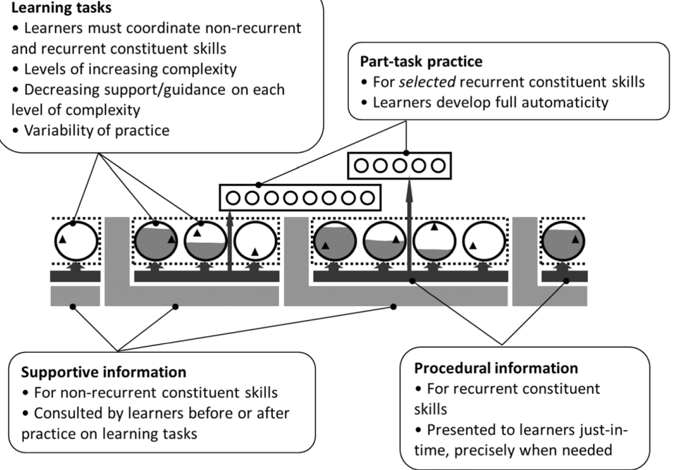
- The paper highlights 4C/ID as an extension of CLT for longer instructional programs and curricula, organized around 4 components: learning tasks, supportive information, procedural information, and part-task practice.
- It reports progress in measuring cognitive load, including a 10-item psychometric instrument that supported distinguishing intrinsic from extraneous load, and objective measures such as EEG, eye tracking, and secondary-task methods.
Methods
- This is a review article that retrospectively synthesizes CLT developments from 1998 to 2018, using the 1998 paper as a baseline and organizing the discussion into history, developments, future directions, and conclusions.
- The authors draw on prior theoretical and empirical studies and reviews cited throughout the paper; no new dataset or sample is reported in the text provided.
- Main analysis is a narrative synthesis of theoretical developments, instructional effects, and measurement approaches in CLT.
Limitations
- The paper explicitly says it is an attempt to summarise the last 20 years of CLT and sketch directions for future research, so it is a synthesis rather than a new empirical test.
- It repeatedly notes that more research is needed on cognitive-load measurement, including the optimal use of subjective rating scales, differentiating load types, and validating objective techniques.
- Evident from the text: several claims about future directions (e.g., resource depletion, self-regulated learning, emotions/stress/uncertainty, human movement) are presented as promising but not yet settled in the paper itself.
Model-written summary. Check it against the paper before relying on it.
Integrity signals
Registry
Cites
Statistics
Figures
Verification
Claims the paper makes
21 Valid · 23 Not valid · 90 Not checked · 158 Own results and interpretations
The sources with a verdict support this claim; the rest weren’t checked yet, have no full text we could read, or their verdicts aren’t rated yet.
In the paper
“Its basic premise is that human cognitive processing is heavily constrained by our limited working memory which can only process a limited number of information elements at a time.”
§ The Author(s) 2019 > Introduction
What the sources say
- Supportedcites Miller (1956) matched to “The magical number seven, plus or minus two: Some limits on our capacity for processing information.” (1956) source
The Summary says that immediate memory imposes severe limits on the information people can receive, process, and remember. The discussion of immediate memory (p. 93) specifies that its limit is the number of chunks, supporting the claim's broad paraphrase of a limited number of information elements at a time. (LLM, conf=0.91)
- Not checked — no full text of the sourcecites Peterson and Peterson (1959) matched to “Short-term retention of individual verbal items.” (1959) source
plainstates a cause- Asserted: passes — The authors put it forward as true.
- Checkable: passes — It can be checked against evidence.
- Load-bearing: passes — The paper’s conclusions depend on it.
- Based: passes — The paper gives a reason why it holds.
- Supported
The cited sources support only part of this claim — read each source’s verdict below.
In the paper
“The capacity and duration limits of working memory have been known at least since Miller (1956) and Peterson and Peterson (1959), although the fact that these limits effectively applied only to novel, not familiar information, seemed more implicit rather than explicit in most treatments.”
§ The Author(s) 2019 > Human Cognitive Architecture Used in 1998
What the sources say
- Partly supportedcites Miller (1956) matched to “The magical number seven, plus or minus two: Some limits on our capacity for processing information.” (1956) sourceExperimental — accuracy not yet measured
In the discussion of immediate memory (p. 93), Miller says its span is limited by the number of chunks and that familiar units allow more information to be packed into each chunk. That supports a distinction between novel material and familiar, recoded material, but not the claim that capacity limits apply only to novel information: the chunk limit remains. The paper also does not establish a duration limit that applies only to novel information. (LLM, conf=0.86)
- Not checked — no full text of the sourcecites Peterson and Peterson (1959) matched to “Short-term retention of individual verbal items.” (1959) source
hedged- Asserted: passes — The authors put it forward as true.
- Checkable: passes — It can be checked against evidence.
- Load-bearing: passes — The paper’s conclusions depend on it.
- Based: passes — The paper gives a reason why it holds.
- Partly supported
Every source the paper cites for this claim was checked and supports it.
In the paper
“The data summarised by Sala and Gobet (2017) provide a major justification for the post 1998 inclusion of evolutionary psychology into cognitive load theory.”
§ The Author(s) 2019 > Human Cognitive Architecture Seen Through the Prism of Evolutionary Psychology
What the sources say
- Supportedcites Sala and Gobet (2017) matched to “Does Far Transfer Exist? Negative Evidence From Chess, Music, and Working Memory Training” (2017) source
The Theoretical and Practical Implications section (page unavailable) summarises the paper’s evidence that chess, music and working-memory training do not reliably produce far transfer. The claim that these data justify a development in cognitive load theory is the citing authors’ interpretation, not a finding attributed to Sala and Gobet. (LLM, conf=0.86)
boostedstates a cause- Asserted: passes — The authors put it forward as true.
- Checkable: passes — It can be checked against evidence.
- Load-bearing: passes — The paper’s conclusions depend on it.
- Based: passes — The paper gives a reason why it holds.
- Supported
Every source the paper cites for this claim was checked and supports it.
In the paper
“The expertise reversal effect is, in essence, a variant of the more general element interactivity effect (Chen et al. 2017).”
§ The Author(s) 2019 > Instructional Effects Described After 1998
What the sources say
- Supportedcites Chen et al. 2017 matched to “The Expertise Reversal Effect is a Variant of the More General Element Interactivity Effect” (2017) source
The indexed copy lists the cited paper under the exact title “The Expertise Reversal Effect is a Variant of the More General Element Interactivity Effect.” Its title directly states the proposition attributed to it; no page number is available in the indexed passage. (LLM, conf=0.90)
plainstates a cause- Asserted: passes — The authors put it forward as true.
- Checkable: passes — It can be checked against evidence.
- Load-bearing: unclear — It is unclear whether the paper’s conclusions depend on it.
- Based: passes — The paper gives a reason why it holds.
- Supported
Every source the paper cites for this claim was checked and supports it.
In the paper
“When subsequently presented the fully integrated information, they only needed to learn how to integrate the individual elements and so more readily assimilated the entire, high element interactivity information.”
§ The Author(s) 2019 > Instructional Effects Described After 1998
What the sources say
- Supportedcites Pollock et al. 2002 matched to “Assimilating complex information” (2002) source
Split into 2 atoms — 2 confirmed, 0 partially supported, 0 disputed, 0 misattributed, 0 unverifiable. Expand the claim to see per-atom verdicts.
plainstates a cause- Asserted: passes — The authors put it forward as true.
- Checkable: passes — It can be checked against evidence.
- Load-bearing: passes — The paper’s conclusions depend on it.
- Based: passes — The paper gives a reason why it holds.
- Supported
132 more claims · 6 with their cited sources checked
Create a free account to see all 292 claims and to verify the 3 references still open.
- It may state two separate claims as one. 88
- Probably not a substantial claim. 95
Claims other papers make about this one
Each is checked against this paper’s own text: does it say what the citing paper says it does?
The source backs part of the claim, not all of it — or backs it for a different population, condition or comparison.
In the citing paper
“Another possible explanation is that the pre-training effect tends to be most effective for learners with minimal prior knowledge (Sweller et al., 2019)”
From Rethinking pre-training: cognitive load implications for learners with varying prior knowledge (2025) · cites this paper as Sweller et al., 2019
Experimental — accuracy not yet measuredThe cited source says what the claim attributes to it.
In the citing paper
“If the cognitive load imposed by a learning task is too high, it might interfere with the learner’s ability to effectively acquire and retain the skill [13, 25].”
From Teaching a single manual therapy technique at a time reduces cognitive load in physiotherapy students: a randomized controlled educational study (2025) · cites this paper as [13]
The cited source says what the claim attributes to it.
In the citing paper
“While cognitive load is often discussed in the context of instructional efficiency, it is important to note that cognitive load is not inherently detrimental. Rather, it is a natural component of learning that engages working memory resources for schema construction and automation [13].”
From Teaching a single manual therapy technique at a time reduces cognitive load in physiotherapy students: a randomized controlled educational study (2025) · cites this paper as [13]
The cited source says what the claim attributes to it.
In the citing paper
“Thus, an increased germane load is no longer believed to lead to cognitive overload and can thus no longer be assumed to be detrimental to learning performance.”
From Understanding Cognitive Load in Digital and Online Learning: a New Perspective on Extraneous Cognitive Load (2022) · cites this paper as Sweller et al., 2019
The cited source says what the claim attributes to it.
In the citing paper
“The major change from the 1998 model is that Sweller et al. (2019) have removed germane load from the additive equation of total load, but rather a dimension now called ' germane processing. '”
From Understanding Cognitive Load in Digital and Online Learning: a New Perspective on Extraneous Cognitive Load (2022) · cites this paper as Sweller et al., 2019
17 more claims about this paper
Create a free account to see every claim other papers make about this one.
Citations
Cites
The magical number seven, plus or minus two: Some limits on our capacity for processing information.
Miller, G. A. (1956) · Psychological Review · doi:10.1037/h0043158 · Cited by 17,812 · cited 1×
“The capacity and duration limits of working memory have been known at least since Miller (1956) and Peterson and Peterson (1959), although the fact that these limits effectively applied only to novel, not familiar information, seemed more implicit rather than explicit in most treatments.”
BackgroundThe magical number seven, plus or minus two: Some limits on our capacity for processing information.
Miller, G. A. (1994) · Psychological Review · doi:10.1037/0033-295x.101.2.343 · Cited by 17,161
Cognitive Load During Problem Solving: Effects on Learning
Sweller, J. (1988) · Cognitive Science · doi:10.1016/0364-0213(88)90023-7 · Cited by 11,048 · cited 4×
“Learning tasks (indicated by the big circles in Fig.”
BackgroundMethodInfluentialSelf-citationKirschner, P. A., Sweller, J., & Clark, R. E. (2006) · Educational Psychologist · doi:10.1207/s15326985ep4102_1 · Cited by 7,776
Self-citationRizzolatti, G., & Craighero, L. (2004) · Annual Review of Neuroscience · doi:10.1146/annurev.neuro.27.070203.144230 · Cited by 7,433
Cognitive Architecture and Instructional Design
Sweller, J., van Merrienboer, J. J. G., & Paas, F. G. W. C. (1998) · Educational Psychology Review · doi:10.1023/a:1022193728205 · Cited by 6,023
Self-citationCognitive load theory, learning difficulty, and instructional design
Sweller, J. (1994) · Learning and Instruction · doi:10.1016/0959-4752(94)90003-5 · Cited by 5,426 · cited 1×
“Element Interactivity Effect This effect was already known in 1998 but as a compound effect, it was not classed as a cognitive load effect (see Sweller 1994).”
BackgroundSelf-citationBaddeley, A. (1992) · Science · doi:10.1126/science.1736359 · Cited by 5,258
Ericsson, K. A., & Kintsch, W. (1995) · Psychological Review · doi:10.1037/0033-295x.102.2.211 · Cited by 3,498
Short-term retention of individual verbal items.
Peterson, L., & Peterson, M. J. (1959) · Journal of Experimental Psychology · doi:10.1037/h0049234 · Cited by 2,939 · cited 1×
“The capacity and duration limits of working memory have been known at least since Miller (1956) and Peterson and Peterson (1959), although the fact that these limits effectively applied only to novel, not familiar information, seemed more implicit rather than explicit in most treatments.”
Background
Research works printed but not linked: 4
- Centre for Education Statistics and Evaluation. (2017). Cognitive load theory: research that teachers really need to understand . Sydney: NSW Department of Education.
- Centre for Education Statistics and Evaluation. (2018). Cognitive load theory in practice . Sydney: NSW Department of Education.
- Clark, R. C. (2014). Evidence-based training methods: a guide for training professionals (2nd ed.). Alexandria: ATD Press.
- Miller, W. (1937). The picture crutch in reading. Elementary English Review, 14 , 263 -264.
Cited by
Items 1,601–1,700 of 2,268
Wang, Z., Zhang, Y., de Koning, B. B., Wong, R. M., & Chen, S. (2025) · Contemporary Educational Psychology · doi:10.1016/j.cedpsych.2025.102368 · Cited by 1
Cai, X., Zhou, X., & Zhao, G. (2025) · Communications in computer and information science · doi:10.1007/978-981-96-4090-4_3 · Cited by 1
Enhancing Web Page Reading Environment by Using Visual Cues to Reduce Extraneous Cognitive Load
Paul, A., & Basu, A. (2025) · Springer tracts in human-centered computing · doi:10.1007/978-981-96-1761-6_24
The Impact of Emotional Pedagogical Agents on Multimedia Learning: A Meta-Analysis
宋, 迎. (2025) · Advances in Psychology · doi:10.12677/ap.2025.155272
Lernförderlichkeit von Mixed Reality als innovative Bildungstechnologie in der Hochschullehre
Kockord, R., Wiersig, N., & Bodensiek, O. (2025) · Zeitschrift für Hochschulentwicklung · doi:10.21240/zfhe/20-1/09
Wang, C., Wang, X., Sun, H., Chen, J., & Ji, F. (2025) · Interactive Learning Environments · doi:10.1080/10494820.2025.2508916 · Cited by 1
“With respect to the instructional design of multimedia learning, several cognitive load effects are posited by cognitive load theory (Sweller et al., 2019), including the worked example effect, the split-attention effect, the modality effect, the transient information effect, the redundancy effect,…”
An EEG Study of Cognitive Load and Fatigue During Learning with a Computer Simulation
Parent, G., & Mercier, J. (2025) · Lecture notes in computer science · doi:10.1007/978-3-031-93727-9_9 · Cited by 1
Derre, B. F., Bruyckere, P. D., & Weggeman, M. (2025) · Contributions to management science · doi:10.1007/978-3-031-82251-3_5 · Cited by 2
Belay, H., & Kabtyimer, M. T. (2025) · Higher Education Research · doi:10.11648/j.her.20251003.11
Principles of Cognitive Science
Müller, C. (2025) · Springer briefs in education · doi:10.1007/978-3-031-89045-1_2
Ritter, F., & Standl, B. (2025) · IEEE Global Engineering Education Conference (EDUCON) · doi:10.1109/educon62633.2025.11016370
Nugroho, Y. S., Bourguet, M.-L., Soyel, H., & Mareschal, I. (2025) · IEEE Global Engineering Education Conference (EDUCON) · doi:10.1109/educon62633.2025.11016555
Qi, F., Hu, Y., Hu, H., & Yang, P. (2025) · Interactive Learning Environments · doi:10.1080/10494820.2025.2511250
“Full captions may induce cognitive overload through redundant text elements (Sweller et al., 2019), forcing learners to engage in inefficient attentional switching between textual and visual channels.”
Alajlan, S. M., Boughattas, W., Aljohani, O. H., & Znazen, H. (2025) · Scientific Reports · doi:10.1038/s41598-025-04594-0
Signaling Information into Storybooks: The Effects on Preschool Children’s Comprehension
Colliot, T. (2025) · The Journal of Experimental Education · doi:10.1080/00220973.2025.2513251 · Cited by 1
Teachers’ Lived Experiences on the One Month Uninterrupted Vacation: A Phenomenological Exploration
Merto, J., & Mañacap, T. G. (2025) · Psychology and Education A Multidisciplinary Journal · doi:10.70838/pemj.390809
Benz, G., Ludwig, T., & Vorholzer, A. (2025) · Science Education · doi:10.1002/sce.21985 · Cited by 2
Castillo, J. M., Parenthoën, M., & Louveton, N. (2025) · Lecture notes in computer science · doi:10.1007/978-3-031-92833-8_12
Programação sem Sobrecarga: Otimizando o Ensino através da Teoria da Carga Cognitiva
Berssanette, J. H. (2025) · doi:10.5753/educomp_estendido.2025.6308 · Cited by 1
How do I plan for effective teaching and learning?
Weatherby-Fell, N., & James, S. (2025) · Cambridge University Press eBooks · doi:10.1017/9781009571234.008
Kollewe, T., Ochsendorf, F. R., & Sennekamp, M. (2025) · Springer eBooks · doi:10.1007/978-3-662-70777-7_1 · Cited by 1
Kumar, S. (2025) · Technix International Journal for Engineering Research · doi:10.56975/tijer.v12i6.158594
Ayasrah, M. N., & Khasawneh, M. A. S. (2025) · Journal of Research on Technology in Education · doi:10.1080/15391523.2025.2520214
O impacto de fatores da complexidade da tarefa na performance na tomada de decisão
Bender, C. S., Löbler, M. L., & Lehnhart, E. D. R. (2025) · Revista de Administração da UFSM · doi:10.5902/1983465989667 · Cited by 1
Instructors' Continuous Happy Facial Expressions Enhance Learning in Instructional Videos
Pi, Z., Li, X., Tong, M., Zhao, X., Wang, J., Li, X., & Guo, X. (2025) · Journal of Computer Assisted Learning · doi:10.1111/jcal.70086 · Cited by 1
Student-Driven Anatomy: A Practical Guide to Enhancing Learning through Extracurricular Dissection
Koelker-Wolfe, E., Gelman, J., Moye, S. C., Stearns, D. A., Hildebrandt, S., Cullinane, D. M., & Fischer, K. (2025) · Journal of Medical Education and Curricular Development · doi:10.1177/23821205251350867 · Cited by 2
Борисенко, Н. А., Ganicheva, A., Mironova, K. V., et al. (2025) · Psychological Science and Education · doi:10.17759/pse.2025300309
Ostadi, M., Golmohamadian, M., Bosaghzadeh, A., Amiri, S. H., & Ebrahimpour, R. (2025) · Scientific Reports · doi:10.1038/s41598-025-08611-0 · Cited by 3
Ma’ali, I., Budiharjo, E., & Abidin, Z. (2025) · Journal of Scientific Research Education and Technology (JSRET) · doi:10.58526/jsret.v4i2.761
Ai Tutors vs. Tenacious Myths: Evidence from Personalised Dialogue Interventions in EducationPreprint
Corbett, B. J., & Tangen, J. M. (2025) · SSRN Electronic Journal · doi:10.2139/ssrn.5342794
NGUYEN, P. T., Dinh, V. T., & Pham, C. K. T. (2024) · International Conference on Education and E-Learning (ICEEL) · doi:10.1145/3719487.3719527 · Cited by 2
Lopetegi, E., & Azkue, J. J. (2025) · Biomedical visualization · doi:10.1007/978-3-031-91849-0_7
Trails, Barriers, and Proposed Solutions in the Implementation of Continuous Improvement Project
Subala, V. (2025) · Psychology and Education A Multidisciplinary Journal · doi:10.70838/pemj.420203
Insights into Creating Effective and Efficient Reskilling and Upskilling Measures
Gruenewald, H., & Mueller, M. (2025) · Future of business and finance · doi:10.1007/978-3-658-48384-5_5
Marsh, H. W., Wu, J., Guo, J., Reeve, J., Pekrun, R. H., Dicke, T., Jang, H.-R., & Basarkod, G. (2025) · SSRN Electronic Journal · doi:10.2139/ssrn.5349200
(2025) · Vandenhoeck & Ruprecht eBooks · doi:10.13109/9783666703416.227
Yu, S., & Xue, Q. (2025) · Research Square · doi:10.21203/rs.3.rs-6782865/v1 · Cited by 2
Exploring the Impact of Using GenAI Applications on MIS Students’ Learning in System Analysis
Huang, Y.-W., & Wang, W. (2025) · Lecture notes in computer science · doi:10.1007/978-3-031-98185-2_18
Secondary Mathematics Complexity Decomposed and Fitted Through Five Reliable Variables
Miró, À., Alier, M., Serrano, J. M., Benavides, A., & Catasús, P. (2025) · Lecture notes in educational technology · doi:10.1007/978-981-96-5658-5_93
Vo, M., NGUYEN, H. D., & Nguyen, D. (2025) · Journal Health and Technology - JHT · doi:10.71328/jht.v6i1.64
“Germane load, however, represents the cognitive effort that promotes learning and mastery, enabling users to internalize system functionalities over time (Sweller et al., 2019).”
InfluentialPlayful Learning in Computer Graphics
Jewst, A., Eisemann, M., Magnor, M. A., et al. (2025) · IEEE Computer Graphics and Applications · doi:10.1109/mcg.2025.3549614
An experimental investigation of the split-attention effect on endoscopic surgical performance
Özçelik, E., Topallı, D., & Çağıltay, N. E. (2025) · Journal of Minimal Access Surgery · doi:10.4103/jmas.jmas_5_25
Transforming Assessment Practices: Effective Digital Tools for Meaningful Feedback
Kaddouri, M., Jmad, S., Azzimani, T., Mhamdi, K., & Abbadi, Z. (2025) · IGI Global eBooks · doi:10.4018/979-8-3373-6013-3.ch006
Lexical Asymmetries in Pakistani ESL Textbooks: Corpus Evidence and Pedagogical PathwaysPreprint
Qayyum, T., Tahir, A., Khalique, S., Hamid, N., & Gardazi, S. A. A. (2025) · Research Square · doi:10.21203/rs.3.rs-7246214/v1
Instructional design unlocks the effects of prior knowledge activation in multimedia learningPreprint
Storck, A., Schönefeld, E., Bellstedt, M., Barbian, B., Janssen, M., Seifert, K. E., & Darici, D. (2025) · Research Square · doi:10.21203/rs.3.rs-7231966/v1
Bende, H. (2025) · SSRN Electronic Journal · doi:10.2139/ssrn.5379394
Digital Cognitive Apprenticeship: Scaling Rigorous Machine Learning Education in High Schools
Perach, S., & Alexandron, G. (2025) · ACM Conference on Learning @ Scale (L@S) · doi:10.1145/3698205.3733941
“This structured approach is designed to manage the cognitive load by separating content learning from the development of self-learning strategies [12, 14].”
West-Newman, S., Sale, M. V., Forbes, R., & Attrill, S. (2025) · Physiotherapy Theory and Practice · doi:10.1080/09593985.2025.2544191 · Cited by 1
“Cognitive Load Theory (CLT) was utilized as an interpretive framework as students on placements are known to experience high levels of cognitive load to manage the significant number of novel learning experiences they encounter (Sewell et al, 2019; Sweller, van Merriënboer, and Paas, 2019).”
Bogchelman, J. H., Boetje, J., & Bruyckere, P. D. (2025) · The Journal of Academic Librarianship · doi:10.1016/j.acalib.2025.103106 · Cited by 5
Integrated (Goal-Driven) Approach
Kalyuga, S., & Plass, J. L. (2025) · Oxford University Press eBooks · doi:10.1093/9780190078539.003.0005
Basics of Cognitive Load Theory (CLT)
Kalyuga, S., & Plass, J. L. (2025) · Oxford University Press eBooks · doi:10.1093/9780190078539.003.0002 · Cited by 2
Conclusions: Implications for Future Research and Practice
Kalyuga, S., & Plass, J. L. (2025) · Oxford University Press eBooks · doi:10.1093/9780190078539.003.0008
Armour, H., & Baumbach, S. (2025) · Literature · doi:10.3390/literature5030020
Wolden, B., Palm, D., & Wolden, M. (2025) · Journal of Physical Therapy Education · doi:10.1097/jte.0000000000000440 · Cited by 4
Rague, J., Feldon, D., Feng, Z., & Litson, K. (2025) · Educational Psychology · doi:10.1080/01443410.2026.2667882
“Cognitive load can be defined as the overall imposition of processing demand on learners’ working memory (Sweller et al., 2019).”
InfluentialPatterns and Progress in Idiom Use: A Longitudinal Analysis of Thai EFL Learners'Writing
Dokchandra, D., & Boonnoon, S. (2025) · Forum for Linguistic Studies · doi:10.30564/fls.v7i8.10576 · Cited by 1
“Transparent idioms (e.g., “ break the ice ”) impose lower cognitive loads as their meanings are partially inferable from literal components, whereas opaque idioms (e.g., “ spill the beans ”) require cultural and figu-rative knowledge that may overwhelm learners’ working memory [52] .”
Pozzan, G., Bollin, A., & Vardanega, T. (2025) · Lecture notes in computer science · doi:10.1007/978-3-032-01222-7_12
Khatwani, M., & Raj, P. V. V. (2025) · SSRN Electronic Journal · doi:10.2139/ssrn.5388933
Nwigboji, E., & Nwoke, N. (2025) · Innovation · doi:10.11648/j.innov.20250603.16
Fosbre, R., Thiessen, D. B., Wie, B. V., Adesope, O., Dutta, P., Rahimi, F., & Islam, M. S. (2025) · ASEE Annual Conference & Exposition · doi:10.18260/1-2--55656
Dyke, G. V., McCall, C., Secules, S., Kali, M. B., & Tran, V. (2025) · ASEE Annual Conference & Exposition · doi:10.18260/1-2--56144
Yin, L., Liu, X., Lin, L., Jin, Q., & Dai, S. (2025) · Journal of Multidisciplinary Healthcare · doi:10.2147/jmdh.s530409
Izhraqi, M. A., Mian, M. N., Marcus, N., & Mohammadi, G. (2025) · Research Square · doi:10.21203/rs.3.rs-6888326/v1
Mamalampay, S. M. (2025) · Psychology and Education A Multidisciplinary Journal · doi:10.70838/pemj.451004
Storck, A., Römer, C. G., Ansorge, S., Schönefeld, E., Bellstedt, M., Barbian, B., Janssen, M., Seifert, K. E., & Darici, D. (2025) · Research Square · doi:10.21203/rs.3.rs-7433821/v1
Ontong, N., & Apas, G. (2025) · Psychology and Education A Multidisciplinary Journal · doi:10.70838/pemj.460305
Eyal, L., & Ronit, N. (2025) · Research Square · doi:10.21203/rs.3.rs-7506066/v1
Emotional intelligence: the key to managing cognitive overload and enhancing quality of life
Mohamed, D. A. A., & Shehata, G. M. (2025) · Management & Sustainability An Arab Review · doi:10.1108/msar-02-2025-0049 · Cited by 1
Бабин, Ю. М. (2025) · Management of Education · doi:10.25726/f7198-1101-3315-s
Microdynamics of discussions that support the growth of causal reasoning
Ma, S., Anderson, R. C., Lin, T., Morris, J. A., & Sun, J. (2025) · Contemporary Educational Psychology · doi:10.1016/j.cedpsych.2025.102416 · Cited by 1
Melwani, D., Silber, R. M., Asencio, A., Whitmill, M. A., & Rehman, S. (2025) · doi:10.2196/preprints.84398
Wu, H., Wen, B., Liu, J., et al. (2025) · Frontiers in Surgery · doi:10.3389/fsurg.2025.1555251
Hu, R., & Wang, C. (2025) · SAGE Open · doi:10.1177/21582440251382023 · Cited by 1
“If individuals have too great of a mental load, then their function of learning, transferring, and constructing knowledge in the long-term memory will be negatively affected (Sweller et al., 2019).”
Lee, K.-J., & Song, C. (2025) · Physical therapy rehabilitation science · doi:10.14474/ptrs.2025.14.3.334
Effects of emotional visual and auditory cues on Chinese poetry learning: An eye-tracking studyPreprint
Wang, Y., Zhang, M., Xia, Z., Zhou, Z., & PAAS, F. G. W. C. (2025) · Research Square · doi:10.21203/rs.3.rs-7731687/v1 · Cited by 1
Self-citationMaielfi, D., Kharisma, A., Nurpatri, Y., Hayati, R., Gusteti, M. U., & Sepri, D. (2025) · Salud Ciencia y Tecnología · doi:10.56294/saludcyt20252242
Var, E., Cam, Y., Pektas, E., & Küden, C. (2025) · BMC Medical Education · doi:10.1186/s12909-025-07957-3 · Cited by 2
Note-taking moderates the relationship between invested mental effort and solving chirality tasks
Schuessler, K., Giese, M., & Walpuski, M. (2026) · Chemistry Education Research and Practice · doi:10.1039/d5rp00256g
Li, G., Pan, Z., Wang, J., & Lu, Y. (2025) · International Conference on Power, Grid and Energy Storage (PGES) · doi:10.1109/pges66344.2025.11193437
Tian, F., & Umar, I. N. (2025) · Advances in computational intelligence and robotics book series · doi:10.4018/979-8-3373-7508-3.ch010 · Cited by 1
Adebiyi, E. B., Ukoh, E. E., & Adeduyigbe, A. M. (2025) · Physics Education · doi:10.1088/1361-6552/ae0d3c · Cited by 2
“Cognitive load theory (CLT) provides a theoretical basis for ESL’s potential effectiveness (Sweller 1988, Sweller et al 2019).”
Surwanti, D., Loyens, S. M. M., Burke, M., Hikmah, I., Gemilang, A. V., & Rikers, R. M. J. P. (2025) · Education Sciences · doi:10.3390/educsci15101392 · Cited by 2
“The collective working memory effect works by distributing cognitive demands across members, thereby overcoming the limitations of individual working memory (F. Kirschner et al., 2009; Sweller et al., 2019).”
InfluentialAI Avatars in Immersive Environments for Communication Skill Training
Joseph, T. S., Kunnumpurath, B., Bhojan, A., & Mahalakshmi, J. (2025) · Wiley eBooks · doi:10.1002/9781394336081.ch12 · Cited by 1
Lignée, P. (2025) · Médiations et médiatisations · doi:10.52358/mm.vi21.458
The Impact of generative artificial intelligence on students and teachers in the educational process
Čolić, V., & Sukić, E. (2025) · EAI Endorsed Transactions on Digital Transformation of Industrial Processes · doi:10.4108/dtip.9052
“Cognitive Load Theory demonstrates how GAI optimizes learning by managing intrinsic, extraneous, and germane cognitive loads, helping students allocate their mental resources more efficiently during complex learning tasks [ 4 ].”
Teaching Machine Learning to Undergraduate Electrical Engineering Students
Fudge, G. L., Rimu, A. J., Zorn, W., Ringle, J., & Barnett, C. (2025) · Computers · doi:10.3390/computers14110465 · Cited by 4
“…et al., cognitive load includes (1) intrinsic load based on the inherent complexity of the material, including how many interactive elements a learner must process simultaneously; and (2) extraneous load based on complexity of the learning environment, including poor material presentation [28,29].”
ПРИЛОЖЕНИЕ ТЕОРИИ КОГНИТИВНОЙ НАГРУЗКИ К ОБУЧЕНИЮ ШКОЛЬНИКОВ МАТЕМАТИКЕ
Шмигирилова, И. Б., & Костина, А. А. (2025) · Habaršy. Fizika-matematikalyķ ġylymdary seriâsy · doi:10.51889/2959-5894.2025.91.3.012
Liu, Z., & Jiao, L. (2025) · Journal of Intelligence · doi:10.3390/jintelligence13110137
“This cognitive overload can reduce the availability of cognitive resources necessary for effective word acquisition and subsequent consolidation (Arztmann et al. 2025; Sweller et al. 2019).”
InfluentialRobinson, D., Agius, S. J., & Warren, A. (2025) · Health Care Analysis · doi:10.1007/s10728-025-00546-x · Cited by 1
Leveraging simulation to understand nursing student learning in technologically complex environments
Rojas, D. E., Dingley, C., Holt, K. E., Morgan, J. J., & Serafica, R. C. (2025) · Clinical Simulation in Nursing · doi:10.1016/j.ecns.2025.101841
Comprehension strategy instruction for Hispanic children with mathematical learning difficulties
Orosco, M. J., Mamedova, S., & Abdulrahim, N. A. (2025) · Frontiers in Psychology · doi:10.3389/fpsyg.2025.1645323 · Cited by 4
“Given the role of WM in problem-solving, instructional scaffolds such as chunking, multimodal supports, and worked examples can help mitigate cognitive overload, particularly for children with lower WM capacity (Swanson and Gerber, 2013; Sweller et al., 2019).”
The Cognitive Science of Deep Learning: Neural Networks in Educational Achievement
Charly, S. (2025) · International Journal of Teacher Education Research Studies (IJTERS) · doi:10.63090/ijters/3049.1614.0020
Sateei, S., Gustafsson, M., Roupé, M., & Johansson, M. (2025) · Lecture notes in civil engineering · doi:10.1007/978-981-96-8761-9_21
Nusratulloevich, Y. A., Ubaydullaeva, A., Musaev, M., Хаётовна, М. М., Vosiev, J., & Temirov, R. (2025) · International Conference on Technology Enhanced Learning in Higher Education (TELE) · doi:10.1109/tele66816.2025.11212102 · Cited by 1
Research on the Application of Artificial Intelligence in Operator Customer Service
何, 畅. (2025) · Artificial Intelligence and Robotics Research · doi:10.12677/airr.2025.146126
Zhou, Y., Tang, Y., Zhu, J., & Chen, X. (2025) · Language Teaching Research · doi:10.1177/13621688251378445
Causal Path of EWE-SL Model in Improving Physics Problem-Solving AbilityPreprint
Kurniawan, Y., Degeng, I. N. S., Kuswandi, D., & Degeng, I. N. S. (2025) · Research Square · doi:10.21203/rs.3.rs-7612991/v1
Multisensory teaching techniques in kindergarten classrooms: The case of Suyo District
Benito, M. D., & Azarias, R. A. (2025) · International Journal of Research Studies in Education · doi:10.5861/ijrse.2025.25310
What makes a good quantum outreach video? An evaluation framework for a quantum video playlist
Anttila, D., Bitzenbauer, P., Scheer, S., Tartaglia, D., Folkers, B., Goorney, S., Vartak, S., Sherson, J. F., & Toninelli, C. (2026) · EPJ Quantum Technology · doi:10.21203/rs.3.rs-8047505/v1 · Cited by 1
Metadata
- Authors
- Sweller, J., van Merriënboer, J. J. G., & Paas, F.
- Affiliations
- UNSW Sydney (AU)
- University of Wollongong (AU)
- Corresponding author
- Sweller, John
- Venue
- Educational Psychology Review
- Published
- 2019-01-22
- Volume
- 31
- Issue
- 2
- Pages
- 261-292
- ISSN
- 1040-726X (ISSN-L)
- 1573-336X
- OpenAlex
- W2913144876
- Semantic Scholar
- e28d73214751d51c3f46a867920be41c49c45130
- Cited by
- 2,337
- References
- 129
- Citations by year
- 2026: 713 · 2025: 466 · 2024: 331 · 2023: 268 · 2022: 212 · 2021: 190 · 2020: 114 · 2019: 37
- FWCI
- 162.54
- Type
- journal article
- Language
- en
- Open access
- hybrid
- doi.org
- Licence
- cc-by
- creativecommons.org/licenses/by/4.0 (tdm)
- Locations
- Educational Psychology Review (publishedVersion, cc-by)
- EUR Research Repository (Erasmus University Rotterdam) (publishedVersion, other-oa)
- Research Online (University of Wollongong) (submittedVersion)
- EUR Research Repository (Erasmus University Rotterdam) (submittedVersion)
- Research Publications (Maastricht University) (submittedVersion, cc-by)
- Figshare (submittedVersion, cc-by)
- Research Publications (Maastricht University) (submittedVersion, other-oa)
- Topics
- Social Sciences › Psychology › Experimental and Cognitive Psychology › Visual and Cognitive Learning Processes
- Social Sciences › Psychology › Developmental and Educational Psychology › Innovative Teaching and Learning Methods
- Life Sciences › Neuroscience › Cognitive Neuroscience › Neuroscience, Education and Cognitive Function
- Keywords
- cognitive load theory, cognitive architecture, working memory, long-term memory, instructional design
About these checks
Registry, retraction, Cites and statistics results are computed, not judged, with one exception: a printed reference that no index lists is read once by a model before it counts as a citation error. Claims are extracted by a model and kept only when their quote appears verbatim in the text; each cited source is then checked, with a model’s help, for whether it says what the claim relies on. Those verdicts can be wrong — read the claim’s quote and the cited source before relying on one.
The claim verdicts this report counts are experimental: their accuracy is not yet measured.
A language model drew the claims from the paper on 2026-10-10, under version 3 of the claim definition (model deepseek-v4.1-flash, prompt extract-v3).
A second model labelled each claim on 2026-10-10 (model jev-1.13-20260917, definition revision gold-guideline-v0.2).
Cited sources are checked with a language model’s help (gpt-6-sol).
Statistics and arithmetic are recomputed, not judged.
Confidence bands are shown only for fields calibrated on our annotated test set. None is calibrated yet, so no band is shown.
What counts as a claim ›How we measure confidence ›How we check this ›
Are you an author, or do you see a problem with this page? Request a review
Data sources
Bibliographic data: Semantic Scholar, OpenAlex, Crossref.
Contains information from the Semantic Scholar Academic Graph Datasets, made available under the ODC Attribution License (ODC-BY 1.0).
Semantic Scholar’s data is described in: Kinney, R., et al. (2023). The Semantic Scholar Open Data Platform. arXiv:2301.10140.
