

Cognitive Architecture and Instructional Design: 20 Years Later
Open accessThe DOI matches its Crossref record; 127 of the 129 references it cites were found in a registry or an index, and 1 are not checked yet; 22 of the 116 sources its claims cite were checked for support.
Abstract
Cognitive load theory was introduced in the 1980s as an instructional design theory based on several uncontroversial aspects of human cognitive architecture. Our knowledge of many of the characteristics of working memory, long-term memory and the relations between them had been well-established for many decades prior to the introduction of the theory. Curiously, this knowledge had had a limited impact on the field of instructional design with most instructional design recommendations proceeding as though working memory and long-term memory did not exist. In contrast, cognitive load theory emphasised that all novel information first is processed by a capacity and duration limited working memory and then stored in an unlimited long-term memory for later use. Once information is stored in long-term memory, the capacity and duration limits of working memory disappear transforming our ability to function. By the late 1990s, sufficient data had been collected using the theory to warrant an extended analysis resulting in the publication of Sweller et al. (Educational Psychology Review, 10, 251–296, 1998). Extensive further theoretical and empirical work have been carried out since that time and this paper is an attempt to summarise the last 20 years of cognitive load theory and to sketch directions for future research.
Verified 2026-11-25 · 1 reference not checked yet
Overview
CoChat Summary
TL;DR
This review argues that cognitive load theory (CLT) has substantially advanced since its 1998 summary, with new theoretical grounding, new instructional effects, and improved measurement approaches. It also frames future work around working-memory resource depletion, self-regulated learning, emotions/stress/uncertainty, and human movement.
Key findings
- The paper states that the 1998 article reported 7 cognitive load effects, and that 8 new effects were added in the 1998–2018 period, including compound effects.
- It says CLT’s theoretical basis was strengthened by grounding human cognitive architecture in evolutionary psychology, especially Geary’s distinction between biologically primary and biologically secondary knowledge.
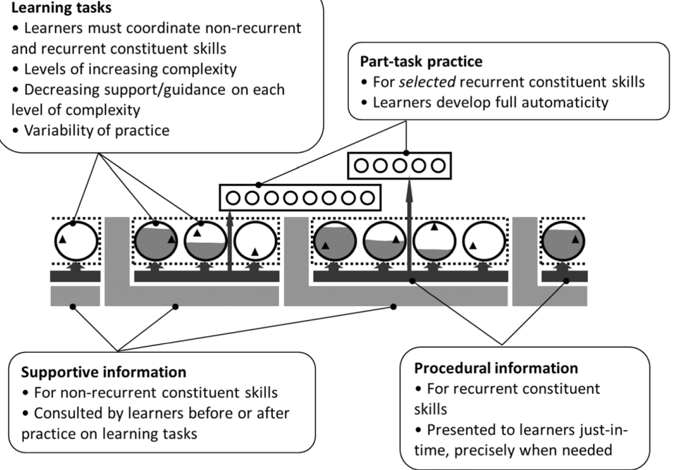
- The paper highlights 4C/ID as an extension of CLT for longer instructional programs and curricula, organized around 4 components: learning tasks, supportive information, procedural information, and part-task practice.
- It reports progress in measuring cognitive load, including a 10-item psychometric instrument that supported distinguishing intrinsic from extraneous load, and objective measures such as EEG, eye tracking, and secondary-task methods.
Methods
- This is a review article that retrospectively synthesizes CLT developments from 1998 to 2018, using the 1998 paper as a baseline and organizing the discussion into history, developments, future directions, and conclusions.
- The authors draw on prior theoretical and empirical studies and reviews cited throughout the paper; no new dataset or sample is reported in the text provided.
- Main analysis is a narrative synthesis of theoretical developments, instructional effects, and measurement approaches in CLT.
Limitations
- The paper explicitly says it is an attempt to summarise the last 20 years of CLT and sketch directions for future research, so it is a synthesis rather than a new empirical test.
- It repeatedly notes that more research is needed on cognitive-load measurement, including the optimal use of subjective rating scales, differentiating load types, and validating objective techniques.
- Evident from the text: several claims about future directions (e.g., resource depletion, self-regulated learning, emotions/stress/uncertainty, human movement) are presented as promising but not yet settled in the paper itself.
Model-written summary. Check it against the paper before relying on it.
Integrity signals
Registry
Cites
Statistics
Figures
Verification
Claims the paper makes
21 Valid · 23 Not valid · 90 Not checked · 158 Own results and interpretations
The sources with a verdict support this claim; the rest weren’t checked yet, have no full text we could read, or their verdicts aren’t rated yet.
In the paper
“Its basic premise is that human cognitive processing is heavily constrained by our limited working memory which can only process a limited number of information elements at a time.”
§ The Author(s) 2019 > Introduction
What the sources say
- Supportedcites Miller (1956) matched to “The magical number seven, plus or minus two: Some limits on our capacity for processing information.” (1956) source
The Summary says that immediate memory imposes severe limits on the information people can receive, process, and remember. The discussion of immediate memory (p. 93) specifies that its limit is the number of chunks, supporting the claim's broad paraphrase of a limited number of information elements at a time. (LLM, conf=0.91)
- Not checked — no full text of the sourcecites Peterson and Peterson (1959) matched to “Short-term retention of individual verbal items.” (1959) source
plainstates a cause- Asserted: passes — The authors put it forward as true.
- Checkable: passes — It can be checked against evidence.
- Load-bearing: passes — The paper’s conclusions depend on it.
- Based: passes — The paper gives a reason why it holds.
- Supported
The cited sources support only part of this claim — read each source’s verdict below.
In the paper
“The capacity and duration limits of working memory have been known at least since Miller (1956) and Peterson and Peterson (1959), although the fact that these limits effectively applied only to novel, not familiar information, seemed more implicit rather than explicit in most treatments.”
§ The Author(s) 2019 > Human Cognitive Architecture Used in 1998
What the sources say
- Partly supportedcites Miller (1956) matched to “The magical number seven, plus or minus two: Some limits on our capacity for processing information.” (1956) sourceExperimental — accuracy not yet measured
In the discussion of immediate memory (p. 93), Miller says its span is limited by the number of chunks and that familiar units allow more information to be packed into each chunk. That supports a distinction between novel material and familiar, recoded material, but not the claim that capacity limits apply only to novel information: the chunk limit remains. The paper also does not establish a duration limit that applies only to novel information. (LLM, conf=0.86)
- Not checked — no full text of the sourcecites Peterson and Peterson (1959) matched to “Short-term retention of individual verbal items.” (1959) source
hedged- Asserted: passes — The authors put it forward as true.
- Checkable: passes — It can be checked against evidence.
- Load-bearing: passes — The paper’s conclusions depend on it.
- Based: passes — The paper gives a reason why it holds.
- Partly supported
Every source the paper cites for this claim was checked and supports it.
In the paper
“The data summarised by Sala and Gobet (2017) provide a major justification for the post 1998 inclusion of evolutionary psychology into cognitive load theory.”
§ The Author(s) 2019 > Human Cognitive Architecture Seen Through the Prism of Evolutionary Psychology
What the sources say
- Supportedcites Sala and Gobet (2017) matched to “Does Far Transfer Exist? Negative Evidence From Chess, Music, and Working Memory Training” (2017) source
The Theoretical and Practical Implications section (page unavailable) summarises the paper’s evidence that chess, music and working-memory training do not reliably produce far transfer. The claim that these data justify a development in cognitive load theory is the citing authors’ interpretation, not a finding attributed to Sala and Gobet. (LLM, conf=0.86)
boostedstates a cause- Asserted: passes — The authors put it forward as true.
- Checkable: passes — It can be checked against evidence.
- Load-bearing: passes — The paper’s conclusions depend on it.
- Based: passes — The paper gives a reason why it holds.
- Supported
Every source the paper cites for this claim was checked and supports it.
In the paper
“The expertise reversal effect is, in essence, a variant of the more general element interactivity effect (Chen et al. 2017).”
§ The Author(s) 2019 > Instructional Effects Described After 1998
What the sources say
- Supportedcites Chen et al. 2017 matched to “The Expertise Reversal Effect is a Variant of the More General Element Interactivity Effect” (2017) source
The indexed copy lists the cited paper under the exact title “The Expertise Reversal Effect is a Variant of the More General Element Interactivity Effect.” Its title directly states the proposition attributed to it; no page number is available in the indexed passage. (LLM, conf=0.90)
plainstates a cause- Asserted: passes — The authors put it forward as true.
- Checkable: passes — It can be checked against evidence.
- Load-bearing: unclear — It is unclear whether the paper’s conclusions depend on it.
- Based: passes — The paper gives a reason why it holds.
- Supported
Every source the paper cites for this claim was checked and supports it.
In the paper
“When subsequently presented the fully integrated information, they only needed to learn how to integrate the individual elements and so more readily assimilated the entire, high element interactivity information.”
§ The Author(s) 2019 > Instructional Effects Described After 1998
What the sources say
- Supportedcites Pollock et al. 2002 matched to “Assimilating complex information” (2002) source
Split into 2 atoms — 2 confirmed, 0 partially supported, 0 disputed, 0 misattributed, 0 unverifiable. Expand the claim to see per-atom verdicts.
plainstates a cause- Asserted: passes — The authors put it forward as true.
- Checkable: passes — It can be checked against evidence.
- Load-bearing: passes — The paper’s conclusions depend on it.
- Based: passes — The paper gives a reason why it holds.
- Supported
132 more claims · 6 with their cited sources checked
Create a free account to see all 292 claims and to verify the 3 references still open.
- It may state two separate claims as one. 88
- Probably not a substantial claim. 95
Claims other papers make about this one
Each is checked against this paper’s own text: does it say what the citing paper says it does?
The source backs part of the claim, not all of it — or backs it for a different population, condition or comparison.
In the citing paper
“Another possible explanation is that the pre-training effect tends to be most effective for learners with minimal prior knowledge (Sweller et al., 2019)”
From Rethinking pre-training: cognitive load implications for learners with varying prior knowledge (2025) · cites this paper as Sweller et al., 2019
Experimental — accuracy not yet measuredThe cited source says what the claim attributes to it.
In the citing paper
“If the cognitive load imposed by a learning task is too high, it might interfere with the learner’s ability to effectively acquire and retain the skill [13, 25].”
From Teaching a single manual therapy technique at a time reduces cognitive load in physiotherapy students: a randomized controlled educational study (2025) · cites this paper as [13]
The cited source says what the claim attributes to it.
In the citing paper
“While cognitive load is often discussed in the context of instructional efficiency, it is important to note that cognitive load is not inherently detrimental. Rather, it is a natural component of learning that engages working memory resources for schema construction and automation [13].”
From Teaching a single manual therapy technique at a time reduces cognitive load in physiotherapy students: a randomized controlled educational study (2025) · cites this paper as [13]
The cited source says what the claim attributes to it.
In the citing paper
“Thus, an increased germane load is no longer believed to lead to cognitive overload and can thus no longer be assumed to be detrimental to learning performance.”
From Understanding Cognitive Load in Digital and Online Learning: a New Perspective on Extraneous Cognitive Load (2022) · cites this paper as Sweller et al., 2019
The cited source says what the claim attributes to it.
In the citing paper
“The major change from the 1998 model is that Sweller et al. (2019) have removed germane load from the additive equation of total load, but rather a dimension now called ' germane processing. '”
From Understanding Cognitive Load in Digital and Online Learning: a New Perspective on Extraneous Cognitive Load (2022) · cites this paper as Sweller et al., 2019
17 more claims about this paper
Create a free account to see every claim other papers make about this one.
Citations
Cites
The magical number seven, plus or minus two: Some limits on our capacity for processing information.
Miller, G. A. (1956) · Psychological Review · doi:10.1037/h0043158 · Cited by 17,812 · cited 1×
“The capacity and duration limits of working memory have been known at least since Miller (1956) and Peterson and Peterson (1959), although the fact that these limits effectively applied only to novel, not familiar information, seemed more implicit rather than explicit in most treatments.”
BackgroundThe magical number seven, plus or minus two: Some limits on our capacity for processing information.
Miller, G. A. (1994) · Psychological Review · doi:10.1037/0033-295x.101.2.343 · Cited by 17,161
Cognitive Load During Problem Solving: Effects on Learning
Sweller, J. (1988) · Cognitive Science · doi:10.1016/0364-0213(88)90023-7 · Cited by 11,048 · cited 4×
“Learning tasks (indicated by the big circles in Fig.”
BackgroundMethodInfluentialSelf-citationKirschner, P. A., Sweller, J., & Clark, R. E. (2006) · Educational Psychologist · doi:10.1207/s15326985ep4102_1 · Cited by 7,776
Self-citationRizzolatti, G., & Craighero, L. (2004) · Annual Review of Neuroscience · doi:10.1146/annurev.neuro.27.070203.144230 · Cited by 7,433
Cognitive Architecture and Instructional Design
Sweller, J., van Merrienboer, J. J. G., & Paas, F. G. W. C. (1998) · Educational Psychology Review · doi:10.1023/a:1022193728205 · Cited by 6,023
Self-citationCognitive load theory, learning difficulty, and instructional design
Sweller, J. (1994) · Learning and Instruction · doi:10.1016/0959-4752(94)90003-5 · Cited by 5,426 · cited 1×
“Element Interactivity Effect This effect was already known in 1998 but as a compound effect, it was not classed as a cognitive load effect (see Sweller 1994).”
BackgroundSelf-citationBaddeley, A. (1992) · Science · doi:10.1126/science.1736359 · Cited by 5,258
Ericsson, K. A., & Kintsch, W. (1995) · Psychological Review · doi:10.1037/0033-295x.102.2.211 · Cited by 3,498
Short-term retention of individual verbal items.
Peterson, L., & Peterson, M. J. (1959) · Journal of Experimental Psychology · doi:10.1037/h0049234 · Cited by 2,939 · cited 1×
“The capacity and duration limits of working memory have been known at least since Miller (1956) and Peterson and Peterson (1959), although the fact that these limits effectively applied only to novel, not familiar information, seemed more implicit rather than explicit in most treatments.”
Background
Research works printed but not linked: 4
- Centre for Education Statistics and Evaluation. (2017). Cognitive load theory: research that teachers really need to understand . Sydney: NSW Department of Education.
- Centre for Education Statistics and Evaluation. (2018). Cognitive load theory in practice . Sydney: NSW Department of Education.
- Clark, R. C. (2014). Evidence-based training methods: a guide for training professionals (2nd ed.). Alexandria: ATD Press.
- Miller, W. (1937). The picture crutch in reading. Elementary English Review, 14 , 263 -264.
Cited by
Sweller, J., Ayres, P., & Kalyuga, S. (2011) · doi:10.1007/978-1-4419-8126-4 · Cited by 5,531
Self-citationSweller, J. (2011) · Psychology of Learning and Motivation · doi:10.1016/b978-0-12-387691-1.00002-8 · Cited by 4,856
Self-citationSweller, J. (2012) · Encyclopedia of the Sciences of Learning · doi:10.1007/978-1-4419-1428-6_446 · Cited by 4,405
Self-citationCognitive load theory and educational technology
Sweller, J. (2020) · Educational Technology Research and Development · doi:10.1007/s11423-019-09701-3 · Cited by 1,688
Self-citationSkulmowski, A., & Xu, K. M. (2022) · Educational Psychology Review · doi:10.1007/s10648-021-09624-7 · Cited by 678
Cognitive-Load Theory: Methods to Manage Working Memory Load in the Learning of Complex Tasks
Paas, F., & van Merriënboer, J. J. G. (2020) · Current Directions in Psychological Science · doi:10.1177/0963721420922183 · Cited by 461
“For a recent overview of the resulting effects, see Sweller et al. (2019).”
BackgroundSelf-citationThe impact of augmented reality on cognitive load and performance: A systematic review
Buchner, J., Buntins, K., & Kerres, M. (2022) · Journal of Computer Assisted Learning · doi:10.1111/jcal.12617 · Cited by 388
“…to explain cognitive processing of information (for an overview see de Jong, 2010; Kalyuga, 2011) resulting in a re-definition of GCL as having a ‘ redistributive function from extraneous to intrinsic aspects of the task rather than imposing a load in its own right ’ (Sweller et al., 2019, p. 264).”
BackgroundEffects of augmented reality on learning and cognitive load in university physics laboratory courses
Thees, M., Kapp, S., Strzys, M. P., Beil, F., Lukowicz, P., & Kuhn, J. (2020) · Computers in Human Behavior · doi:10.1016/j.chb.2020.106316 · Cited by 351
Studying the effect of AI Code Generators on Supporting Novice Learners in Introductory Programming
Kazemitabaar, M., Chow, J., Ma, C. K. T., Ericson, B. J., Weintrop, D., & Grossman, T. (2023) · Proceedings of the 2023 CHI Conference on Human Factors in Computing Systems · doi:10.1145/3544548.3580919 · Cited by 366
“Cognitive load theory defines the demand that a situation or task places on a learner’s working memory [80] and is based in part on the learner’s prior knowledge and the complexity of the task or material [22].”
The Role of Background Knowledge in Reading Comprehension: A Critical Review
Smith, R., Snow, P., Serry, T., & Hammond, L. (2021) · Reading Psychology · doi:10.1080/02702711.2021.1888348 · Cited by 326
“Cognitive Load Theory (CLT) incorporates a model of how working memory functions during learning tasks, including reading (Sweller, 1994; Sweller, van Merri € enboer, & Paas, 2019).”
BackgroundInfluentialCognitive load in multimedia learning environments: A systematic review
Mutlu-Bayraktar, D., Cosgun, V., & Altan, T. (2019) · Computers & Education · doi:10.1016/j.compedu.2019.103618 · Cited by 304
Castro-Alonso, J. C., de Koning, B. B., Fiorella, L., & Paas, F. (2021) · Educational Psychology Review · doi:10.1007/s10648-021-09606-9 · Cited by 278
“5b), in order to allow working memory to replenish before additional information is shown (cf. Chen et al., 2018; Leahy & Sweller, 2019).”
BackgroundSelf-citationThe Cognitive-Affective-Social Theory of Learning in digital Environments (CASTLE)
Schneider, S., Beege, M., Nebel, S., Schnaubert, L., & Rey, G. D. (2022) · Educational Psychology Review · doi:10.1007/s10648-021-09626-5 · Cited by 277
Stadler, M., Bannert, M., & Sailer, M. (2024) · Computers in Human Behavior · doi:10.1016/j.chb.2024.108386 · Cited by 262
Design and Design Thinking in STEM Education
Li, Y., Schoenfeld, A. H., diSessa, A. A., Graesser, A. C., Benson, L. C., English, L. D., & Duschl, R. A. (2019) · Journal for STEM Education Research · doi:10.1007/s41979-019-00020-z · Cited by 258
A Framework for the Use of Immersive Virtual Reality in Learning Environments
Mulders, M., Buchner, J., & Kerres, M. (2020) · International Journal of Emerging Technologies in Learning (iJET) · doi:10.3991/ijet.v15i24.16615 · Cited by 229
“Others are not visible, like linking prior knowledge with newly acquired information which is based on human cognitive architecture [32, 87].”
BackgroundThe Validity of Physiological Measures to Identify Differences in Intrinsic Cognitive Load
Ayres, P., Lee, J. Y., Paas, F., & van Merriënboer, J. J. G. (2021) · Frontiers in Psychology · doi:10.3389/fpsyg.2021.702538 · Cited by 222
“According to CLT intrinsic cognitive load is generated by the element interactivity (elements that need to be processed simultaneously) of the task (Sweller et al., 2011); whereas in instructional settings, cognitive load can also be generated by learners dealing with the instructional designs (extraneous cognitive lo…”
BackgroundInfluentialSelf-citationSweller, J. (2023) · Educational Psychology Review · doi:10.1007/s10648-023-09817-2 · Cited by 220
Self-citationCognitive load theory and individual differences
Sweller, J. (2024) · Learning and Individual Differences · doi:10.1016/j.lindif.2024.102423 · Cited by 214
Self-citationNückles, M., Roelle, J., Glogger-Frey, I., Waldeyer, J., & Renkl, A. (2020) · Educational Psychology Review · doi:10.1007/s10648-020-09541-1 · Cited by 213
“We suggest that the genre-free principle in journal writing can be considered, at least on a more general level, as a particular variant of the goal-free effect in cognitive load theory (e.g., Paas andKirschner 2012; Sweller et al. 2019).”
BackgroundMethodInfluentialChen, O., Paas, F., & Sweller, J. (2023) · Educational Psychology Review · doi:10.1007/s10648-023-09782-w · Cited by 224
Self-citationBell, R., & Bell, H. (2020) · Journal of Small Business and Enterprise Development · doi:10.1108/jsbed-01-2020-0012 · Cited by 211
Altmeyer, K., Kapp, S., Thees, M., Malone, S., Kuhn, J., & Brünken, R. (2020) · British Journal of Educational Technology · doi:10.1111/bjet.12900 · Cited by 201
“In recent years, 614 British Journal of Educational Technology Vol 51 No 3 2020 researchers have suggested a realignment towards a two-factor ICL/ECL model, in which GCL is an indicator of the effectiveness of the individual learning process (Sweller et al ., 2019).”
BackgroundThe cognitive challenges of effective teaching
Chew, S. L., & Cerbin, W. J. (2021) · The Journal of Economic Education · doi:10.1080/00220485.2020.1845266 · Cited by 189
From Theory to Practice: The Application of Cognitive Load Theory to the Practice of Medicine
Szulewski, A., Howes, D., van Merriënboer, J. J. G., & Sweller, J. (2021) · Academic Medicine · doi:10.1097/acm.0000000000003524 · Cited by 171
Self-citationKeep it Coherent: A Meta-Analysis of the Seductive Details Effect
Sundararajan, N., & Adesope, O. (2020) · Educational Psychology Review · doi:10.1007/s10648-020-09522-4 · Cited by 163
Effectiveness of Multimedia Pedagogical Agents Predicted by Diverse Theories: a Meta-Analysis
Castro-Alonso, J. C., Wong, R. M., Adesope, O. O., & Paas, F. (2021) · Educational Psychology Review · doi:10.1007/s10648-020-09587-1 · Cited by 162
Self-citationEffective Teacher Professional Development: New Theory and a Meta-Analytic Test
Sims, S., Fletcher-Wood, H., O’Mara-Eves, A., Cottingham, S., Stansfield, C., Goodrich, J., Van Herwegen, J., & Anders, J. (2025) · Review of Educational Research · doi:10.3102/00346543231217480 · Cited by 168
“Instruction works by eliminating ambiguity about what is required to successfully use a procedure and has been shown to be beneficial in science education and medical training contexts (Kirschner et al., 2006; Sweller et al., 2019).”
(2023) · doi:10.3102/00346543221105550 · Cited by 159
“These principles, as well as the evidence base regarding human learning in technologically based settings (e.g., Sweller, 2020; Sweller et al., 2019), should form the basis for teacher preparation programs that aim to prepare teachers for online instruction (e.g., Moore-Adams et al., 2016; Trust &…”
BackgroundMetaverse in Education: Contributors, Cooperations, and Research Themes
Chen, X., Zou, D., Xie, H., & Wang, F. L. (2023) · IEEE Transactions on Learning Technologies · doi:10.1109/tlt.2023.3277952 · Cited by 158
Multimedia Design for Learning: An Overview of Reviews With Meta-Meta-Analysis
Noetel, M., Griffith, S., Delaney, O., Harris, N. R., Sanders, T., Parker, P., del Pozo Cruz, B., & Lonsdale, C. (2022) · Review of Educational Research · doi:10.3102/00346543211052329 · Cited by 148
“Cognitive load can be influenced by many factors, from the goals given to learners, to the presence of worked examples, to the skills of the learner (Sweller et al., 1998; Sweller et al., 2019; Van Gog et al., 2005; van Merriënboer & Sweller, 2005).”
InfluentialClimate change education: the problem with walking away from disciplines
Eilam, E. (2022) · Studies in Science Education · doi:10.1080/03057267.2021.2011589 · Cited by 218
You, S., Yang, C. L., & Li, X. (2022) · Journal of Management Information Systems · doi:10.1080/07421222.2022.2063553 · Cited by 137
“an aggregated PPF or no performance presentation) on cognitive load, because the amount of performance information does not differ between an algorithmic and human advisor contingent on each PPF [61].”
BackgroundKrieglstein, F., Beege, M., Rey, G. D., Sanchez-Stockhammer, C., & Schneider, S. (2023) · Educational Psychology Review · doi:10.1007/s10648-023-09738-0 · Cited by 139
“All items were formulated very close to the theoretical assumptions of CLT, taking up both the foundational and the more recent literature (Sweller, 1988, 1994, 2021; Sweller et al., 2019).”
BackgroundMaking Sense of Generative Learning
Fiorella, L. (2023) · Educational Psychology Review · doi:10.1007/s10648-023-09769-7 · Cited by 135
“…on individual GLAs (e.g., Fiorella & Zhang, 2018; McNamara, 2017) and are analogous to guidance recommendations derived by cognitive load theory (Sweller et al., 2019) : progressing from explicit instruction (worked examples) to scaffolded practice (partial problems) to independent practice…”
BackgroundMethodInfluentialThe synergy of embodied cognition and cognitive load theory for optimized learning
Zou, L., Zhang, Z., Mavilidi, M., Chen, Y., Herold, F., Ouwehand, K., & Paas, F. (2025) · Nature Human Behaviour · doi:10.1038/s41562-025-02152-2 · Cited by 131
“Germane load refers to cognitive resources that are appropriately directed towards information processing aimed at enhancing learning and actively integrating newly learned material into pre-existing knowledge frameworks 4 .”
InfluentialSelf-citationVertical integration in medical education: the broader perspective
Wijnen‐Meijer, M., van den Broek, S., Koens, F., & ten Cate, O. (2020) · BMC Medical Education · doi:10.1186/s12909-020-02433-6 · Cited by 171
Poupard, M., Larrue, F., Sauzeon, H., & Tricot, A. (2022) · HAL · doi:10.1111/bjet.13503 · Cited by 10
Using mobile devices to enhance inquiry-based learning processes
Becker, S., Klein, P., Gößling, A., & Kuhn, J. (2020) · Learning and Instruction · doi:10.1016/j.learninstruc.2020.101350 · Cited by 123
Effects of prior knowledge on collaborative and individual learning
Zambrano R., J., Kirschner, F., Sweller, J., & Kirschner, P. A. (2019) · Learning and Instruction · doi:10.1016/j.learninstruc.2019.05.011 · Cited by 121
Self-citationCai, Z., Mao, P., Wang, D., He, J., Chen, X., & Fan, X. (2022) · Educational Psychology Review · doi:10.1007/s10648-021-09655-0 · Cited by 185
“…were included in the CLT model (Jiang & Kalyuga, 2020; Kalyuga, 2011;Sweller, 2010 ; Sweller et al., 2019), and GCL purely redistributed cognitive resources to activities related to the learning task rather than being an independent source of cognitive load (Sweller, 2010; Sweller et al., 2019).”
MethodKrieglstein, F., Beege, M., Rey, G. D., Ginns, P., Krell, M., & Schneider, S. (2022) · Educational Psychology Review · doi:10.1007/s10648-022-09683-4 · Cited by 118
“On the one hand, several design recommendations have been made regarding how best to support learners to transfer new information into long-term memory and integrate it with pre-existing knowledge (Sweller et al., 2019).”
BackgroundInfluentialNudging in education: from theory towards guidelines for successful implementation
Weijers, R. J., de Koning, B. B., & PAAS, F. G. W. C. (2020) · European Journal of Psychology of Education · doi:10.1007/s10212-020-00495-0 · Cited by 154
“To explain this preference for Type 1 nudges in these situations, we rely on cognitive load theory, a theoretical framework concerned with the optimal design of instructions which makes use of the limitations of the human cognitive system (Sweller et al. 2019).”
Self-citationDai, C.-P., Ke, F., Pan, Y., Moon, J., & Liu, Z. (2024) · Educational Psychology Review · doi:10.1007/s10648-024-09855-4 · Cited by 116
“The multimodal forms of computer-based simulations for learning can also increase learners’ cognitive load (Sweller et al., 2019).”
Sweller, J. (2021) · Educational Psychology Review · doi:10.1007/s10648-021-09647-0 · Cited by 179
Self-citationSailer, M., Bauer, E., Hofmann, R., Kiesewetter, J., Glas, J., Gurevych, I., & Fischer, F. (2023) · Learning and Instruction · doi:10.1016/j.learninstruc.2022.101620 · Cited by 106
Tzafilkou, K., Perifanou, M., & Economides, A. A. (2021) · Education and Information Technologies · doi:10.1007/s10639-021-10604-1 · Cited by 106
Problem-solving or Explicit Instruction: Which Should Go First When Element Interactivity Is High?
Ashman, G., Kalyuga, S., & Sweller, J. (2020) · Educational Psychology Review · doi:10.1007/s10648-019-09500-5 · Cited by 103
Self-citationCoelho, F., Rando, B., Aparício, D., Pontífice-Sousa, P., Gonçalves, D., & Abreu, A. M. (2026) · Journal of Computers in Education · doi:10.1007/s40692-025-00366-x · Cited by 102
“Gamification should align pedagogy with design, as cognitive load is related to unnecessary learning demands (Sweller et al., 2019).”
InfluentialThe Relation Between Students’ Effort and Monitoring Judgments During Learning: A Meta-analysis
Baars, M., Wijnia, L., de Bruin, A., & Paas, F. (2020) · Educational Psychology Review · doi:10.1007/s10648-020-09569-3 · Cited by 101
“…and monitoring accuracy are investigated in the same analysis (see Dunlosky et al., 2016).1 Furthermore, according to cognitive load theory (CLT; Sweller et al., 1998, 2019), two main types of cognitive load are affecting the learning processes differently, i.e., intrinsic and extraneous…”
BackgroundSelf-citationMangaroska, K., Sharma, K., Gašević, D., & Giannakos, M. (2022) · Journal of Computer Assisted Learning · doi:10.1111/jcal.12590 · Cited by 100
Cognitive load in immersive media settings: the role of spatial presence and cybersickness
Breves, P. L., & Stein, J. (2022) · Virtual Reality · doi:10.1007/s10055-022-00697-5 · Cited by 132
“The well-established Cognitive Load Theory (CLT; for a recent overview see Sweller et al. 2019) further differentiates between three different subtypes of cognitive load: (a) intrinsic load , i.e., the inherent difficulty of the task, (b) extraneous load , i.e., mental efforts required due to the…”
BackgroundMethodImplications of Cognitive Load Theory for Multimedia Learning
Paas, F., & Sweller, J. (2021) · The Cambridge Handbook of Multimedia Learning · doi:10.1017/9781108894333.009 · Cited by 94
Self-citationvan Nooijen, C. C. A., de Koning, B. B., Bramer, W. M., Isahakyan, A., Asoodar, M., Kok, E. M., van Merriënboer, J. J. G., & PAAS, F. G. W. C. (2024) · Educational Psychology Review · doi:10.1007/s10648-024-09848-3 · Cited by 204
“We centre cognitive load theory (CLT) in our approach (Choi et al., 2014; Paas et al., 2003a, 2003b; Sweller, 1988; Sweller et al., 1998, 2019; Van Merriënboer & Sweller, 2010).”
Self-citationAn Interactive Layers Model of Self-Regulated Learning and Cognitive Load
Wirth, J., Stebner, F., Trypke, M., Schuster, C., & Leutner, D. (2020) · Educational Psychology Review · doi:10.1007/s10648-020-09568-4 · Cited by 93
Cognitive Load Theory in Computing Education Research: A Review
Duran, R., Zavgorodniaia, A., & Sorva, J. (2022) · ACM Transactions on Computing Education · doi:10.1145/3483843 · Cited by 92
“One is championed by CLT’s creators as the simplest and most current version of the theory, another builds on the concept of germane cognitive load that was introduced to CLT in 1998 but has since fallen out of favor with CLT’s creators [100, 103].”
BackgroundMethodInfluentialHochberg, K., Becker, S., Louis, M., Klein, P., & Kühn, J. (2020) · Journal of Science Education and Technology · doi:10.1007/s10956-020-09816-w · Cited by 128
Chauncey, S. A., & McKenna, H. P. (2023) · Computers and Education: Artificial Intelligence · doi:10.1016/j.caeai.2023.100182 · Cited by 91
Measuring Cognitive Load: Are There More Valid Alternatives to Likert Rating Scales?
Ouwehand, K., Kroef, A. V. D., Wong, J., & Paas, F. (2021) · Frontiers in Education · doi:10.3389/feduc.2021.702616 · Cited by 90
Self-citationHaryana, M. R. A., Warsono, S., Achjari, D., & Nahartyo, E. (2022) · The International Journal of Management Education · doi:10.1016/j.ijme.2022.100657 · Cited by 149
Schneider, S., Krieglstein, F., Beege, M., & Rey, G. D. (2021) · Computers & Education · doi:10.1016/j.compedu.2021.104350 · Cited by 111
There is an Evidence Crisis in Science Educational Policy
Zhang, L., Kirschner, P. A., Cobern, W. W., & Sweller, J. (2022) · Educational Psychology Review · doi:10.1007/s10648-021-09646-1 · Cited by 87
Self-citationSailer, M., Maier, R., Berger, S., Kastorff, T., & Stegmann, K. (2024) · Learning and Individual Differences · doi:10.1016/j.lindif.2024.102446 · Cited by 204
Immersive virtual reality in higher education: a systematic review of the scientific literature
Stracke, C. M., Bothe, P., Adler, S., Heller, E. S., Deuchler, J., Pomino, J., & Wölfel, M. (2025) · Virtual Reality · doi:10.1007/s10055-025-01136-x · Cited by 162
“…unable to verify these expectations through sound and verifiable results, such that the highlighted poten - tials of IVR are only suggested but not proven. neglects independent germane load (Sweller et al. 2019) and refutes the one-dimensional Cognitive Load Scale (Leppink 2020) in recent studies.”
Cognitive Load Management: An Invaluable Tool for Safe and Effective Surgical Training
Howie, E. E., Dharanikota, H., Gunn, E., Ambler, O., DIAS, R. D., Wigmore, S. J., Skipworth, R. J. E., & Yule, S. (2023) · Journal of surgical education · doi:10.1016/j.jsurg.2022.12.010 · Cited by 104
Tseng, H., Kuo, Y.-C., & Walsh, E. J. (2020) · Educational Technology Research and Development · doi:10.1007/s11423-020-09774-5 · Cited by 106
Instructional Visualizations, Cognitive Load Theory, and Visuospatial Processing
Castro-Alonso, J. C., Ayres, P., & Sweller, J. (2019) · Springer eBooks · doi:10.1007/978-3-030-20969-8_5 · Cited by 114
Self-citationLee, J. Y., Donkers, J., Jarodzka, H., & van Merriënboer, J. J. G. (2019) · Computers in Human Behavior · doi:10.1016/j.chb.2019.05.035 · Cited by 65
“This can be done either by reducing the cognitive load itself (e.g., providing pauses during the game or presenting less complex scenarios), or facilitate self-regulation of students to manage their own cognitive load (Sweller et al., 2019).”
BackgroundMethodSelf-citationA Systematic review of instructor presence in instructional videos: Effects on learning and affect
Henderson, M. L., & Schroeder, N. L. (2021) · Computers and Education Open · doi:10.1016/j.caeo.2021.100059 · Cited by 94
The search for deep learning: a curriculum coherence model
McPhail, G. J. (2020) · Journal of Curriculum Studies · doi:10.1080/00220272.2020.1748231 · Cited by 132
“The more the curriculum design, teaching methods, and learning activities reflect the conceptual knowledge structures, the more likely it is that the student will understand the increasing complexity of the knowledge (Sweller et al., 2019).”
BackgroundMultimodal learning analytics to investigate cognitive load during online problem solving
Larmuseau, C., Cornelis, J. P., Lancieri, L., Desmet, P., & Depaepe, F. (2020) · British Journal of Educational Technology · doi:10.1111/bjet.12958 · Cited by 99
Learning with augmented reality: Impact of dimensionality and spatial abilities
Krüger, J. M., Palzer, K., & Bodemer, D. (2021) · Computers and Education Open · doi:10.1016/j.caeo.2021.100065 · Cited by 129
Video Game Design for Learning to Learn
Pasqualotto, A., Parong, J. A., Green, C. S., & Bavelier, D. (2022) · International Journal of Human-Computer Interaction · doi:10.1080/10447318.2022.2110684 · Cited by 108
“Sweller et al. (2019) categorized cognitive load into three categories: intrinsic, extraneous, and germane.”
BackgroundInfluentialThe Assessment Burden in Competency-Based Medical Education: How Programs Are Adapting
Szulewski, A., Braund, H., Dagnone, D., McEwen, L., Dalgarno, N., Schultz, K., & Hall, A. K. (2023) · Academic Medicine · doi:10.1097/acm.0000000000005305 · Cited by 94
“The additional burden placed on both residents and faculty can be partially explained by considering elements of cognitive load theory, 42 in particular, the constraints of human working memory.”
BackgroundGame‐based learning has good chemistry with chemistry education: A three‐level meta‐analysis
Hu, Y., Gallagher, T. J., Wouters, P., van der Schaaf, M. F., & Kester, L. (2022) · Journal of Research in Science Teaching · doi:10.1002/tea.21765 · Cited by 128
Cezar, B. G. D. S., & Maçada, A. C. G. (2023) · Information Processing & Management · doi:10.1016/j.ipm.2023.103482 · Cited by 119
The role of cognitive factors in second language writing and writing to learn a second language
Kormos, J. (2023) · Studies in Second Language Acquisition · doi:10.1017/s0272263122000481 · Cited by 140
“…and their burden on WM resources may depend on the intrinsic cognitive load of a task, which, according to Cognitive Load Theory, is jointly determined by the complexity of the information to be processed and the knowledge base of the learner (for a recent overview see Sweller et al., 2019).”
InfluentialZhang, L., Carter, R. A., Greene, J. A., & Bernacki, M. L. (2024) · Educational Psychology Review · doi:10.1007/s10648-024-09860-7 · Cited by 183
“…derived from its underlying assumptions offer extensive guidance on designing instruction to facilitate intricate information processing (e.g., selecting, organizing, and integrating information in dual channels) and knowledge construction (e.g., Sweller et al., 2019; Mayer & Moreno, 2003).”
A systematic map of research characteristics in studies on augmented reality and cognitive load
Buchner, J., Buntins, K., & Kerres, M. (2021) · Computers and Education Open · doi:10.1016/j.caeo.2021.100036 · Cited by 87
Jiang, D., & Zhang, L. J. (2020) · Computers & Education · doi:10.1016/j.compedu.2020.103841 · Cited by 91
The Cognitive Architecture of Digital Externalization
Skulmowski, A. (2023) · Educational Psychology Review · doi:10.1007/s10648-023-09818-1 · Cited by 76
“One of the most influential theories of instruction is cognitive load theory (CLT; Sweller et al., 1998, 2019).”
BackgroundMethodInfluentialBerssanette, J. H., & de Francisco, A. C. (2021) · IEEE Transactions on Education · doi:10.1109/te.2021.3127215 · Cited by 102
The effects of affective pedagogical agent in multimedia learning environments: A meta-analysis
Wang, Y., Gong, S., Cao, Y., Lang, Y., & Xu, X. (2022) · Educational Research Review · doi:10.1016/j.edurev.2022.100506 · Cited by 94
Faber, T. J. E., Dankbaar, M. E. W., van den Broek, W. W., Bruinink, L. J., Hogeveen, M., & van Merriënboer, J. J. G. (2024) · BMC Medical Education · doi:10.1186/s12909-024-05698-3 · Cited by 137
Self-citationMeasuring cognitive load in augmented reality with physiological methods: A systematic review
Suzuki, Y., Wild, F., & Scanlon, E. (2023) · Journal of Computer Assisted Learning · doi:10.1111/jcal.12882 · Cited by 108
“As an alternative to those mentioned above, physiological methods have been suggested as more objective measures of cognitive load (Anmarkrud et al., 2019; Mayer, 2019; Mutlu-Bayraktar et al., 2019; Parasuraman & Rizzo, 2007; Sweller et al., 2019).”
Eitel, A., Endres, T., & Renkl, A. (2020) · Educational Psychology Review · doi:10.1007/s10648-020-09559-5 · Cited by 97
“…important aspects to consider based on cognitive load theory are (1) to choose a level of complexity (i.e., element interactivity of the contents; Sweller et al. 1998, 2019) that is not too high and in accordance with students’ prior knowledge levels and (2) to structure, sequence, and arrange…”
BackgroundInfluentialVirtual reality assisted engineering education: A multimedia learning perspective
Oje, A. V., Hunsu, N. J., & May, D. (2023) · Computers & Education X Reality · doi:10.1016/j.cexr.2023.100033 · Cited by 124
Looking at Mental Effort Appraisals through a Metacognitive Lens: Are they Biased?
Scheiter, K., Ackerman, R., & Hoogerheide, V. (2020) · Educational Psychology Review · doi:10.1007/s10648-020-09555-9 · Cited by 63
“Readers interested in recently introduced alternatives to this assumption are referred to Sweller et al. 2019 3 We refer in this review to the body of Metacognitive research dealing with monitoring and control of regulatory decisions.”
BackgroundChen, O., Paas, F., & Sweller, J. (2021) · Educational Psychology Review · doi:10.1007/s10648-021-09613-w · Cited by 62
Self-citationMo, C.-Y., Wang, C., Dai, J., & Jin, P. (2022) · Frontiers in Psychology · doi:10.3389/fpsyg.2022.839982 · Cited by 88
“Then, the students will not forget what they know because of the long explanation time and the cognitive load will not hinder them from processing the received information flow in time (Sweller et al., 2019; Curum and Khedo, 2021).”
BackgroundElford, D., Lancaster, S. J., & Jones, G. A. (2022) · Journal of Science Education and Technology · doi:10.1007/s10956-022-09957-0 · Cited by 117
“Therefore, instructional methods should avoid exceeding these limitations to avoid cognitive overload (Sweller et al., 2019).”
Krüger, J. M., & Bodemer, D. (2022) · Information · doi:10.3390/info13020074 · Cited by 97
“This is closely related to assumptions in cognitive load theory (CLT), which also postulates duration and capacity limitations of working memory [8,9].”
BackgroundHow Does Cognitive Load Interact with Self-Regulated Learning? A Dynamic and Integrative Model
Wang, T., & Lajoie, S. P. (2023) · Educational Psychology Review · doi:10.1007/s10648-023-09794-6 · Cited by 95
Effects of adaptive feedback generated by a large language model: A case study in teacher education
Kinder, A., Briese, F. J., Jacobs, M., Dern, N., Glodny, N., Jacobs, S., & Leßmann, S. (2024) · Computers and Education Artificial Intelligence · doi:10.1016/j.caeai.2024.100349 · Cited by 135
Wang, H., Wang, C., Chen, Z., Liu, F., Bao, C., & Xu, X. (2025) · Education and Information Technologies · doi:10.1007/s10639-025-13487-8 · Cited by 105
“Mental load refers to the cognitive demand placed on learners due to the requirements of the task itself (Mo et al., 2022; Skulmowski & Xu, 2022), whereas mental effort represents the actual cognitive resources and effort that learners invest to meet these task demands (Sweller et al., 2019).”
Kiemer, K., & Kollar, I. (2021) · Zeitschrift für Pädagogische Psychologie · doi:10.1024/1010-0652/a000302 · Cited by 79
Alessa, F. M., Alhaag, M. H., Al-harkan, I. M., Ramadan, M. Z., & Alqahtani, F. M. (2023) · Sensors · doi:10.3390/s23187698 · Cited by 60
“The need for addressing cognitive load during training is based on CLT and on the idea of the human cognitive model, which consists of sensory input, working memory with a limited capacity, and long-term memory with an infinite storage capacity [18,19].”
BackgroundMinkley, N., Xu, M. K., & Krell, M. (2021) · Frontiers in Education · doi:10.3389/feduc.2021.632907 · Cited by 77
Márquez, R., BARRIOS, N. A., Vera, R. E., Mendez, M. E., Tolosa, L. I., Zambrano, F., & Li, Y. (2023) · Education for Chemical Engineers · doi:10.1016/j.ece.2023.05.005 · Cited by 86
Baxter, K. A., Sachdeva, N., & Baker, S. (2025) · Health Education & Behavior · doi:10.1177/10901981251327185 · Cited by 111
“Affective factors, such as emotional state, stress, and anxiety, are thought to contribute to cognitive load, thereby depleting working memory (de Almeida et al., 2024; Sweller et al., 2019).”
Metadata
- Authors
- Sweller, J., van Merriënboer, J. J. G., & Paas, F.
- Affiliations
- UNSW Sydney (AU)
- University of Wollongong (AU)
- Corresponding author
- Sweller, John
- Venue
- Educational Psychology Review
- Published
- 2019-01-22
- Volume
- 31
- Issue
- 2
- Pages
- 261-292
- ISSN
- 1040-726X (ISSN-L)
- 1573-336X
- OpenAlex
- W2913144876
- Semantic Scholar
- e28d73214751d51c3f46a867920be41c49c45130
- Cited by
- 2,337
- References
- 129
- Citations by year
- 2026: 713 · 2025: 466 · 2024: 331 · 2023: 268 · 2022: 212 · 2021: 190 · 2020: 114 · 2019: 37
- FWCI
- 162.54
- Type
- journal article
- Language
- en
- Open access
- hybrid
- doi.org
- Licence
- cc-by
- creativecommons.org/licenses/by/4.0 (tdm)
- Locations
- Educational Psychology Review (publishedVersion, cc-by)
- EUR Research Repository (Erasmus University Rotterdam) (publishedVersion, other-oa)
- Research Online (University of Wollongong) (submittedVersion)
- EUR Research Repository (Erasmus University Rotterdam) (submittedVersion)
- Research Publications (Maastricht University) (submittedVersion, cc-by)
- Figshare (submittedVersion, cc-by)
- Research Publications (Maastricht University) (submittedVersion, other-oa)
- Topics
- Social Sciences › Psychology › Experimental and Cognitive Psychology › Visual and Cognitive Learning Processes
- Social Sciences › Psychology › Developmental and Educational Psychology › Innovative Teaching and Learning Methods
- Life Sciences › Neuroscience › Cognitive Neuroscience › Neuroscience, Education and Cognitive Function
- Keywords
- cognitive load theory, cognitive architecture, working memory, long-term memory, instructional design
About these checks
Registry, retraction, Cites and statistics results are computed, not judged, with one exception: a printed reference that no index lists is read once by a model before it counts as a citation error. Claims are extracted by a model and kept only when their quote appears verbatim in the text; each cited source is then checked, with a model’s help, for whether it says what the claim relies on. Those verdicts can be wrong — read the claim’s quote and the cited source before relying on one.
The claim verdicts this report counts are experimental: their accuracy is not yet measured.
A language model drew the claims from the paper on 2026-10-10, under version 3 of the claim definition (model deepseek-v4.1-flash, prompt extract-v3).
A second model labelled each claim on 2026-10-10 (model jev-1.13-20260917, definition revision gold-guideline-v0.2).
Cited sources are checked with a language model’s help (gpt-6-sol).
Statistics and arithmetic are recomputed, not judged.
Confidence bands are shown only for fields calibrated on our annotated test set. None is calibrated yet, so no band is shown.
What counts as a claim ›How we measure confidence ›How we check this ›
Are you an author, or do you see a problem with this page? Request a review
Data sources
Bibliographic data: Semantic Scholar, OpenAlex, Crossref.
Contains information from the Semantic Scholar Academic Graph Datasets, made available under the ODC Attribution License (ODC-BY 1.0).
Semantic Scholar’s data is described in: Kinney, R., et al. (2023). The Semantic Scholar Open Data Platform. arXiv:2301.10140.
