

Cognitive Architecture and Instructional Design: 20 Years Later
Open accessThe DOI matches its Crossref record; 127 of the 129 references it cites were found in a registry or an index, and 1 are not checked yet; 22 of the 116 sources its claims cite were checked for support.
Abstract
Cognitive load theory was introduced in the 1980s as an instructional design theory based on several uncontroversial aspects of human cognitive architecture. Our knowledge of many of the characteristics of working memory, long-term memory and the relations between them had been well-established for many decades prior to the introduction of the theory. Curiously, this knowledge had had a limited impact on the field of instructional design with most instructional design recommendations proceeding as though working memory and long-term memory did not exist. In contrast, cognitive load theory emphasised that all novel information first is processed by a capacity and duration limited working memory and then stored in an unlimited long-term memory for later use. Once information is stored in long-term memory, the capacity and duration limits of working memory disappear transforming our ability to function. By the late 1990s, sufficient data had been collected using the theory to warrant an extended analysis resulting in the publication of Sweller et al. (Educational Psychology Review, 10, 251–296, 1998). Extensive further theoretical and empirical work have been carried out since that time and this paper is an attempt to summarise the last 20 years of cognitive load theory and to sketch directions for future research.
Verified 2026-11-25 · 1 reference not checked yet
Overview
CoChat Summary
TL;DR
This review argues that cognitive load theory (CLT) has substantially advanced since its 1998 summary, with new theoretical grounding, new instructional effects, and improved measurement approaches. It also frames future work around working-memory resource depletion, self-regulated learning, emotions/stress/uncertainty, and human movement.
Key findings
- The paper states that the 1998 article reported 7 cognitive load effects, and that 8 new effects were added in the 1998–2018 period, including compound effects.
- It says CLT’s theoretical basis was strengthened by grounding human cognitive architecture in evolutionary psychology, especially Geary’s distinction between biologically primary and biologically secondary knowledge.
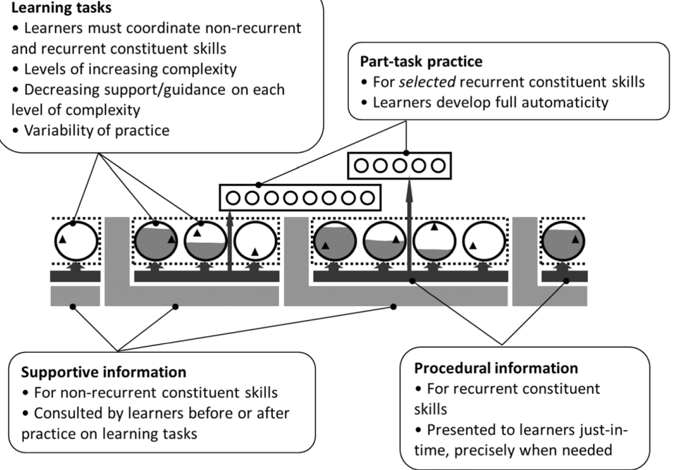
- The paper highlights 4C/ID as an extension of CLT for longer instructional programs and curricula, organized around 4 components: learning tasks, supportive information, procedural information, and part-task practice.
- It reports progress in measuring cognitive load, including a 10-item psychometric instrument that supported distinguishing intrinsic from extraneous load, and objective measures such as EEG, eye tracking, and secondary-task methods.
Methods
- This is a review article that retrospectively synthesizes CLT developments from 1998 to 2018, using the 1998 paper as a baseline and organizing the discussion into history, developments, future directions, and conclusions.
- The authors draw on prior theoretical and empirical studies and reviews cited throughout the paper; no new dataset or sample is reported in the text provided.
- Main analysis is a narrative synthesis of theoretical developments, instructional effects, and measurement approaches in CLT.
Limitations
- The paper explicitly says it is an attempt to summarise the last 20 years of CLT and sketch directions for future research, so it is a synthesis rather than a new empirical test.
- It repeatedly notes that more research is needed on cognitive-load measurement, including the optimal use of subjective rating scales, differentiating load types, and validating objective techniques.
- Evident from the text: several claims about future directions (e.g., resource depletion, self-regulated learning, emotions/stress/uncertainty, human movement) are presented as promising but not yet settled in the paper itself.
Model-written summary. Check it against the paper before relying on it.
Integrity signals
Registry
Cites
Statistics
Figures
Verification
Claims the paper makes
21 Valid · 23 Not valid · 90 Not checked · 158 Own results and interpretations
The sources with a verdict support this claim; the rest weren’t checked yet, have no full text we could read, or their verdicts aren’t rated yet.
In the paper
“Its basic premise is that human cognitive processing is heavily constrained by our limited working memory which can only process a limited number of information elements at a time.”
§ The Author(s) 2019 > Introduction
What the sources say
- Supportedcites Miller (1956) matched to “The magical number seven, plus or minus two: Some limits on our capacity for processing information.” (1956) source
The Summary says that immediate memory imposes severe limits on the information people can receive, process, and remember. The discussion of immediate memory (p. 93) specifies that its limit is the number of chunks, supporting the claim's broad paraphrase of a limited number of information elements at a time. (LLM, conf=0.91)
- Not checked — no full text of the sourcecites Peterson and Peterson (1959) matched to “Short-term retention of individual verbal items.” (1959) source
plainstates a cause- Asserted: passes — The authors put it forward as true.
- Checkable: passes — It can be checked against evidence.
- Load-bearing: passes — The paper’s conclusions depend on it.
- Based: passes — The paper gives a reason why it holds.
- Supported
The cited sources support only part of this claim — read each source’s verdict below.
In the paper
“The capacity and duration limits of working memory have been known at least since Miller (1956) and Peterson and Peterson (1959), although the fact that these limits effectively applied only to novel, not familiar information, seemed more implicit rather than explicit in most treatments.”
§ The Author(s) 2019 > Human Cognitive Architecture Used in 1998
What the sources say
- Partly supportedcites Miller (1956) matched to “The magical number seven, plus or minus two: Some limits on our capacity for processing information.” (1956) sourceExperimental — accuracy not yet measured
In the discussion of immediate memory (p. 93), Miller says its span is limited by the number of chunks and that familiar units allow more information to be packed into each chunk. That supports a distinction between novel material and familiar, recoded material, but not the claim that capacity limits apply only to novel information: the chunk limit remains. The paper also does not establish a duration limit that applies only to novel information. (LLM, conf=0.86)
- Not checked — no full text of the sourcecites Peterson and Peterson (1959) matched to “Short-term retention of individual verbal items.” (1959) source
hedged- Asserted: passes — The authors put it forward as true.
- Checkable: passes — It can be checked against evidence.
- Load-bearing: passes — The paper’s conclusions depend on it.
- Based: passes — The paper gives a reason why it holds.
- Partly supported
Every source the paper cites for this claim was checked and supports it.
In the paper
“The data summarised by Sala and Gobet (2017) provide a major justification for the post 1998 inclusion of evolutionary psychology into cognitive load theory.”
§ The Author(s) 2019 > Human Cognitive Architecture Seen Through the Prism of Evolutionary Psychology
What the sources say
- Supportedcites Sala and Gobet (2017) matched to “Does Far Transfer Exist? Negative Evidence From Chess, Music, and Working Memory Training” (2017) source
The Theoretical and Practical Implications section (page unavailable) summarises the paper’s evidence that chess, music and working-memory training do not reliably produce far transfer. The claim that these data justify a development in cognitive load theory is the citing authors’ interpretation, not a finding attributed to Sala and Gobet. (LLM, conf=0.86)
boostedstates a cause- Asserted: passes — The authors put it forward as true.
- Checkable: passes — It can be checked against evidence.
- Load-bearing: passes — The paper’s conclusions depend on it.
- Based: passes — The paper gives a reason why it holds.
- Supported
Every source the paper cites for this claim was checked and supports it.
In the paper
“The expertise reversal effect is, in essence, a variant of the more general element interactivity effect (Chen et al. 2017).”
§ The Author(s) 2019 > Instructional Effects Described After 1998
What the sources say
- Supportedcites Chen et al. 2017 matched to “The Expertise Reversal Effect is a Variant of the More General Element Interactivity Effect” (2017) source
The indexed copy lists the cited paper under the exact title “The Expertise Reversal Effect is a Variant of the More General Element Interactivity Effect.” Its title directly states the proposition attributed to it; no page number is available in the indexed passage. (LLM, conf=0.90)
plainstates a cause- Asserted: passes — The authors put it forward as true.
- Checkable: passes — It can be checked against evidence.
- Load-bearing: unclear — It is unclear whether the paper’s conclusions depend on it.
- Based: passes — The paper gives a reason why it holds.
- Supported
Every source the paper cites for this claim was checked and supports it.
In the paper
“When subsequently presented the fully integrated information, they only needed to learn how to integrate the individual elements and so more readily assimilated the entire, high element interactivity information.”
§ The Author(s) 2019 > Instructional Effects Described After 1998
What the sources say
- Supportedcites Pollock et al. 2002 matched to “Assimilating complex information” (2002) source
Split into 2 atoms — 2 confirmed, 0 partially supported, 0 disputed, 0 misattributed, 0 unverifiable. Expand the claim to see per-atom verdicts.
plainstates a cause- Asserted: passes — The authors put it forward as true.
- Checkable: passes — It can be checked against evidence.
- Load-bearing: passes — The paper’s conclusions depend on it.
- Based: passes — The paper gives a reason why it holds.
- Supported
132 more claims · 6 with their cited sources checked
Create a free account to see all 292 claims and to verify the 3 references still open.
- It may state two separate claims as one. 88
- Probably not a substantial claim. 95
Claims other papers make about this one
Each is checked against this paper’s own text: does it say what the citing paper says it does?
The source backs part of the claim, not all of it — or backs it for a different population, condition or comparison.
In the citing paper
“Another possible explanation is that the pre-training effect tends to be most effective for learners with minimal prior knowledge (Sweller et al., 2019)”
From Rethinking pre-training: cognitive load implications for learners with varying prior knowledge (2025) · cites this paper as Sweller et al., 2019
Experimental — accuracy not yet measuredThe cited source says what the claim attributes to it.
In the citing paper
“If the cognitive load imposed by a learning task is too high, it might interfere with the learner’s ability to effectively acquire and retain the skill [13, 25].”
From Teaching a single manual therapy technique at a time reduces cognitive load in physiotherapy students: a randomized controlled educational study (2025) · cites this paper as [13]
The cited source says what the claim attributes to it.
In the citing paper
“While cognitive load is often discussed in the context of instructional efficiency, it is important to note that cognitive load is not inherently detrimental. Rather, it is a natural component of learning that engages working memory resources for schema construction and automation [13].”
From Teaching a single manual therapy technique at a time reduces cognitive load in physiotherapy students: a randomized controlled educational study (2025) · cites this paper as [13]
The cited source says what the claim attributes to it.
In the citing paper
“Thus, an increased germane load is no longer believed to lead to cognitive overload and can thus no longer be assumed to be detrimental to learning performance.”
From Understanding Cognitive Load in Digital and Online Learning: a New Perspective on Extraneous Cognitive Load (2022) · cites this paper as Sweller et al., 2019
The cited source says what the claim attributes to it.
In the citing paper
“The major change from the 1998 model is that Sweller et al. (2019) have removed germane load from the additive equation of total load, but rather a dimension now called ' germane processing. '”
From Understanding Cognitive Load in Digital and Online Learning: a New Perspective on Extraneous Cognitive Load (2022) · cites this paper as Sweller et al., 2019
17 more claims about this paper
Create a free account to see every claim other papers make about this one.
Citations
Cites
The magical number seven, plus or minus two: Some limits on our capacity for processing information.
Miller, G. A. (1956) · Psychological Review · doi:10.1037/h0043158 · Cited by 17,812 · cited 1×
“The capacity and duration limits of working memory have been known at least since Miller (1956) and Peterson and Peterson (1959), although the fact that these limits effectively applied only to novel, not familiar information, seemed more implicit rather than explicit in most treatments.”
BackgroundThe magical number seven, plus or minus two: Some limits on our capacity for processing information.
Miller, G. A. (1994) · Psychological Review · doi:10.1037/0033-295x.101.2.343 · Cited by 17,161
Cognitive Load During Problem Solving: Effects on Learning
Sweller, J. (1988) · Cognitive Science · doi:10.1016/0364-0213(88)90023-7 · Cited by 11,048 · cited 4×
“Learning tasks (indicated by the big circles in Fig.”
BackgroundMethodInfluentialSelf-citationKirschner, P. A., Sweller, J., & Clark, R. E. (2006) · Educational Psychologist · doi:10.1207/s15326985ep4102_1 · Cited by 7,776
Self-citationRizzolatti, G., & Craighero, L. (2004) · Annual Review of Neuroscience · doi:10.1146/annurev.neuro.27.070203.144230 · Cited by 7,433
Cognitive Architecture and Instructional Design
Sweller, J., van Merrienboer, J. J. G., & Paas, F. G. W. C. (1998) · Educational Psychology Review · doi:10.1023/a:1022193728205 · Cited by 6,023
Self-citationCognitive load theory, learning difficulty, and instructional design
Sweller, J. (1994) · Learning and Instruction · doi:10.1016/0959-4752(94)90003-5 · Cited by 5,426 · cited 1×
“Element Interactivity Effect This effect was already known in 1998 but as a compound effect, it was not classed as a cognitive load effect (see Sweller 1994).”
BackgroundSelf-citationBaddeley, A. (1992) · Science · doi:10.1126/science.1736359 · Cited by 5,258
Ericsson, K. A., & Kintsch, W. (1995) · Psychological Review · doi:10.1037/0033-295x.102.2.211 · Cited by 3,498
Short-term retention of individual verbal items.
Peterson, L., & Peterson, M. J. (1959) · Journal of Experimental Psychology · doi:10.1037/h0049234 · Cited by 2,939 · cited 1×
“The capacity and duration limits of working memory have been known at least since Miller (1956) and Peterson and Peterson (1959), although the fact that these limits effectively applied only to novel, not familiar information, seemed more implicit rather than explicit in most treatments.”
Background
Research works printed but not linked: 4
- Centre for Education Statistics and Evaluation. (2017). Cognitive load theory: research that teachers really need to understand . Sydney: NSW Department of Education.
- Centre for Education Statistics and Evaluation. (2018). Cognitive load theory in practice . Sydney: NSW Department of Education.
- Clark, R. C. (2014). Evidence-based training methods: a guide for training professionals (2nd ed.). Alexandria: ATD Press.
- Miller, W. (1937). The picture crutch in reading. Elementary English Review, 14 , 263 -264.
Cited by
Items 2,001–2,100 of 2,268
Математичне моделювання адаптивної інтелектуальної системи для персоналізованого навчання
Kovaliuk, T., & Kobets, N. (2026) · Науковий вісник НЛТУ України · doi:10.36930/40360311
Worked Example–Problem Unit Presentation Formats: The Role of Unit Number and Learner ExpertisePreprint
He, F., Lin, H., Bai, H., Yang, C., & Yang, Y. (2026) · SSRN Electronic Journal · doi:10.2139/ssrn.7049788
Hu, H., Wang, J., Wang, X., Chen, Y., Zhao, J., & Wang, S. (2026) · Journal of Medical Education and Curricular Development · doi:10.1177/23821205261466025
Java vs. Kotlin in Introductory OOP: Effects on Student Performance and Motivation
Dobrynin, A., & Kohls, C. (2026) · ACM Conference on Innovation and Technology in Computer Science Education (ITiCSE) · doi:10.1145/3803400.3809333
“This study adopts the modern version of CLT, which distinguishes between intrinsic load (the inherent complexity of the material) and extraneous load (the load generated by instructional design) [38].”
We assume students see pictures in their minds as they learn. But not everyone can
Martin, A., Pearson, J., Ginns, P., Burns, E., & Kennett, R. (2026) · The Conversation · doi:10.64628/aa.3kmvdx4vh
Yu, Y., Mofreh, S. A. M., Salem, S., et al. (2026) · Innovation in Language Learning and Teaching · doi:10.1080/17501229.2026.2692482
Learning the Ropes: Rethinking Interactive Training for Safety-Critical Work
Shanmugalingam, J., Mogavi, R. H., Lario, D., Nacke, L. E., & Zhao, W. (2026) · Lecture notes in computer science · doi:10.1007/978-3-032-30405-6_8
Exploring OpenClaw’s potential for adaptive, self-hosted educational AI
Baradziej, S., & Pal, R. (2026) · Frontiers in Education · doi:10.3389/feduc.2026.1859178
I am too stressed to speak up! Does financial stress impact employee voice?
Jawahar, I. M. “. (2026) · Personnel Review · doi:10.1108/pr-05-2025-0519
Reinwarth, L. M., & Wallach, D. (2026) · Lecture notes in computer science · doi:10.1007/978-3-032-30542-8_31
How matters more than whether: generative AI role paradigms and learning in K–12 education
Li, Z., & Xu, Y. (2026) · Interactive Learning Environments · doi:10.1080/10494820.2026.2692615
Validity of Eye-Tracking Measures in Immersive Virtual Reality: Using Cognitive Theories of Learning
Lee, J. Y., Moon, J., PAAS, F. G. W. C., Cho, M., Darejeh, A., Holmer, S., & Ayres, P. (2026) · Educational Psychology Review · doi:10.1007/s10648-026-10186-9
“…2021), which offers targeted insights into IVR-specific affordances and learning constructs, and (3) Cognitive Load Theory (CLT) (Sweller, 2011 ; Sweller et al., 2019), which explains cognitive mechanisms in IVR by linking cognitive load to related learning constructs such as motivation and…”
Self-citationNoviyanti, M., Sudirman, S., Kandaga, T., Nurhayati, S., & Isnawan, M. G. (2026) · European Journal of STEM Education · doi:10.20897/ejsteme/18921
“This pattern is consistent with the updated cognitive load framework articulated by Sweller et al. (2019), which distinguishes between extraneous load — arising from poorly designed learning environments — and germane load — the cognitive resource available for schema construction and genuine…”
Not just when, but how: An exploratory dual-control approach to video feedback in motor learning
Khacharem, A. (2026) · Human Movement Science · doi:10.1016/j.humov.2026.103506
Alghabban, W. G. (2026) · Lecture notes in computer science · doi:10.1007/978-3-032-30542-8_1
Harrington, R. N. (2026) · International Journal of Kinesiology in Higher Education · doi:10.1080/24711616.2026.2696904
Khomokhoana, P. J., & Fouché, R. C. (2026) · Discover Education · doi:10.1007/s44217-026-01829-8
“Thus, cognitive difficulty is not only a property of the diagram itself, but also of how learners interpret spatial organisation, hierarchy, and notation based on prior exposure and experience [8, 43].”
Theoretical Foundations of Translational Pedagogy in Computing Education
Guan, F. (2026) · IGI Global eBooks · doi:10.4018/979-8-2600-1811-8.ch002
Foreign language effect and neuromyth discernibility: Framing and information richness as moderators
Zhang, Z., Xu, B., Tamim, M., & Shao, H. (2026) · Bilingualism Language and Cognition · doi:10.1017/s1366728926101503
Wu, Y. (2026) · Frontiers in Psychology · doi:10.3389/fpsyg.2026.1881131 · Cited by 1
Cai, Z.-X., Dong, Y.-T., Huang, Y., Bao, X.-L., Zhang, J.-J., He, Y.-N., Yu, H., Dong, L., Wang, S.-G., & Qiu, K. (2026) · Applied Sciences · doi:10.3390/app16146888
Thomsen, D., Hilfert‐Rüppell, D., & Büssing, A. G. (2026) · Computers & Education X Reality · doi:10.1016/j.cexr.2026.100173
Desarrollo de un cuestionario de autopercepción para evaluar el diseño de secuencias didácticas
Pizà-Mir, B. (2026) · Revista de educación/Revista de educación · doi:10.66757/1988-592x-re-2026-413-743
Mayer, C., Findeisen, S., Guggemos, J., & Seifried, J. (2026) · The Journal of Economic Education · doi:10.1080/00220485.2026.2696951 · Cited by 1
Zhang, L., Chen, Q., Zhang, B., Fang, J., Mo, X., & Zhang, S. (2026) · Academic Radiology · doi:10.1016/j.acra.2026.06.022
Omeh, C. B., Valentine Joseph Owan, P. D., Sanusi, I. T., & Olade, I. (2026) · Discover Artificial Intelligence · doi:10.1007/s44163-026-01707-0 · Cited by 2
“ML is an aspect of AI, as it influences sectors like health care, banking, security and education [3, 4].”
Hu, Y., Zhang, H., & Wu, B. (2026) · Educational Technology Research and Development · doi:10.1007/s11423-026-10673-4
Levy-Shimon, S., & Yokel, I. (2026) · Journal of Jewish Education · doi:10.1080/15244113.2026.2681516
Liu, D., & Paracha, S. (2026) · Innovations in Education and Teaching International · doi:10.1080/14703297.2026.2703709
Thode, M., & Paliokas, I. (2026) · Computers · doi:10.3390/computers15070443
Decristan, J., & Dumont, H. (2026) · Learning and Instruction · doi:10.1016/j.learninstruc.2026.102419
Linguistic Resistance to AI Writing Tools: A Review and Conceptual FrameworkPreprint
Isaev, S. (2026) · Research Square · doi:10.21203/rs.3.rs-10348445/v1
Measuring Learners’ Cognitive Load When Engaged with an Algorithm Visualization Tool
Fathi, R., Teresco, J. D., & Regan, K. W. (2023) · Journal of Information Systems Applied Research and Analytics · doi:10.62273/hgfg9707 · Cited by 1
“When the load imposed by the design is ineffective or detrimental for learning, it is called extraneous cognitive load; when it is effective for learning it is referred to as germane cognitive load (Sweller et al. 2019).”
BackgroundMoon, J. (2026) · Interactive Learning Environments · doi:10.1080/10494820.2026.2690104
Augmented accounting education using machine learning and decision-making in higher education
Romero-Carazas, R., Ticona-Apaza, V. T., Serruto-Huanca, T. M., de Manchego, V. T., Suclla-Revilla, J. L., Torres-Sánchez, J. A., Talavera, J. J. D., & Portilla-Linares, M. M. (2026) · Frontiers in Education · doi:10.3389/feduc.2026.1861202 · Cited by 2
Hsieh, C., & Huang, J.-W. (2026) · Lecture notes in computer science · doi:10.1007/978-3-032-31308-9_10
Teaching Meets Technology in Developing a MOOC
Escudeiro, P. M., Carvalho, P., & Resende, S. (2026) · Lecture notes in networks and systems · doi:10.1007/978-3-032-32029-2_32
Thongsong, P., Samat, C., Wattanachai, S., & Chen, G. (2026) · Lecture notes in computer science · doi:10.1007/978-3-032-32112-1_33
Gong, Z., Shao, J., Rahman, N., Su, L. Y.-F., & Wang, Y. (2026) · Internet Research · doi:10.1108/intr-07-2025-1004 · Cited by 1
Ahmad, C. M., Ngo, A. L., Kastle, R.-A., Rufino, L., Amin, S., Evan, B., & Zolnierz, M. S. (2026) · Cureus · doi:10.7759/cureus.112844
“Moderate levels of perceived task demand have been proposed to accompany effortful processing and strategic problem-solving, whereas excessive or poorly calibrated workload may impair learning and performance [23].”
Lu, Y., Li, W., & Cai, Y. (2026) · Systems · doi:10.3390/systems14070846 · Cited by 1
Platt, L. S., Zeinali, A., Bosch, S. J., & Park, N. (2026) · Smart and Sustainable Built Environment · doi:10.1108/sasbe-08-2025-0525
Alharthi, S. M. (2026) · Education and Information Technologies · doi:10.1007/s10639-026-14099-6
Ani, A. I. C., Abdullah, M. H. R. O., Rosli, A. D., Sihab, N., Zanal, A., & Hamid, M. S. A. (2026) · International Journal of Modern Education · doi:10.35631/ijmoe.830043
Braga, A. N., Neto, A. A. M., Filho, S. C. F. P., Braga, A. N., de Souza, N. P. C., & Alves, D. T. (2026) · Ciência & Educação (Bauru) · doi:10.1590/1516-731320260020
Vicentini, G., Raccanello, D., & Burro, R. (2026) · Assessment · doi:10.1177/10731911261464544
Din, D. C., & Yahya, S. Y. (2026) · International Journal of Education Psychology and Counseling · doi:10.35631/ijepc.1163074
Affective Dimensions of LLM-Supported Writing Instruction in EFL Contexts: Anxiety and Enjoyment
Zhang, A., & Jiang, C. (2026) · SAGE Open · doi:10.1177/21582440261468821 · Cited by 1
Ntirenganya, T., Qin, Z., & Mugeni, F. (2026) · International Journal of Early Childhood · doi:10.1007/s13158-026-00532-x
Transparent AI Feedback via Process-Aware Modeling: An Educational Middleware Approach
Ardimento, P., Scalera, M., & Scalera, M. (2026) · International Conference on Emerging and Intelligent Technologies and Systems (EITS) · doi:10.1109/eits70066.2026.11609624
“This helps reduce skepticism toward automated suggestions and addresses known challenges in AI in education related to trust and acceptance [6].”
An empirical study of ChatGPT use in engineering education: Prompting and performance
Domínguez, L. G. I., Robles-Gómez, A., & Pastor-Vargas, R. (2026) · The Internet and Higher Education · doi:10.1016/j.iheduc.2026.101105 · Cited by 3
Wong, L. (2026) · Journal of Higher Education Policy and Management · doi:10.1080/1360080x.2026.2708377
Anugrah, S., Kurnia, R., Hendri, N., & Rayendra, R. (2026) · European Journal of Educational Research · doi:10.12973/eu-jer.15.4.1131
Shu, C., Peng, Y., Wang, B., Chen, H., & Bai, S. (2026) · Frontiers in Psychology · doi:10.3389/fpsyg.2026.1911467
Popa, D. I., Levai, C. M., Buleu, F. N., Burtic, S.-R., Militaru, M., Jugănaru, I., & Bratu, M. L. (2026) · International Medical Education · doi:10.3390/ime5030066 · Cited by 2
Li, Y., & Du, X. (2026) · Frontiers in Psychology · doi:10.3389/fpsyg.2026.1848365
“This scale, which has been widely used to measure students’ cognitive load in instructional video lectures, was employed to calculate cognitive load scores based on the summed ratings of its two items (Hong et al., 2018; Sweller et al., 2019).”
Exploring the Impact of Cognitive Style and Perceived Difficulty on 2D and 3D Sketching
Kim, E. Y., & Choi, B. (2026) · Journal of Interior Design · doi:10.1177/10717641261439721 · Cited by 1
“42 As Suwa and Tversky reported, architectural knowledge supports the design process when using sketches, highlighting the role of prior knowledge in working memory.”
Pi, Z., Ma, Y., Zhao, X., Cao, W., & Li, X. (2026) · SSRN Electronic Journal · doi:10.2139/ssrn.7177630
Wang, J., & Li, H. (2026) · Education and Information Technologies · doi:10.1007/s10639-026-14109-7
Belano, H. D., Jueves, J., & Langam, R. T. (2026) · Journal of Education and Learning Reviews · doi:10.60027/jelr.2026.e3272
Exploring the potential of generative AI and teacher collaboration in evaluating academic papers
Zhong, Q., Ji, H., Liu, T., Li, F., & Wang, X. (2026) · Education and Information Technologies · doi:10.1007/s10639-025-13864-3
Liu, Y., Liao, W., He, Y., Peng, M., & Li, T. (2026) · Global Medical Education · doi:10.1515/gme-2026-0005
Chang, C., Su, Y.-N., Hwang, G., Chen, S.-C., & Ou, L.-S. (2026) · Educational Technology Research and Development · doi:10.1007/s11423-026-10667-2
Applying Cognitive Load Theory to Best Practices in Pharmacy Education: A Narrative Review
Islam, M. A., Yang, S., Kim, L., & Talukder, R. M. (2026) · American Journal of Pharmaceutical Education · doi:10.1016/j.ajpe.2026.102060 · Cited by 1
Buciuman, C.-F., & POTRA, S. (2026) · Proceedings of the ... International Conference on Business Excellence · doi:10.2478/picbe-2026-0206
“Sweller et al. (2019) emphasised that no single measure adequately captures the multidimensional nature of CLT; therefore, we examined this claim.”
InfluentialPoon, K., & Sweller, J. (2026) · The Educational and Developmental Psychologist · doi:10.1080/20590776.2026.2698717
Self-citationAlothman, A. A., Didden, R., & Ebrahim, M. T. (2026) · Journal of Disability Research · doi:10.57197/jdr-2026-0943
Learning in Different Ways: Virtual Reality vs. Traditional
Sindonen, E., & Luotonen, M. (2026) · Springer eBooks · doi:10.1007/978-981-92-1935-3_16
Bian, X., Brown, A., & Marques, B. (2026) · Frontiers in Psychology · doi:10.3389/fpsyg.2026.1893526 · Cited by 6
“This is consistent with principles of multimedia learning and CLT (Sweller et al., 2019).”
InfluentialKayumova, A. R., & Rodionova, E. A. (2026) · Pedagogy Theory & Practice · doi:10.30853/ped20260171
Danışman, Ş., & Acar, F. E. (2026) · Journal of Intelligence · doi:10.3390/jintelligence14080154 · Cited by 3
Ekizer, F. N., & Asma, B. (2026) · Hacettepe University Journal of Education · doi:10.16986/hunefd.1755298 · Cited by 3
Hoecke, S. M. V., Schrijver, I., Robert, I., & Kruger, J.-L. (2026) · Technology Knowledge and Learning · doi:10.1007/s10758-026-10000-z
The Future of Tech Infused Chinese Language Education
Yu, D. (2026) · Springer eBooks · doi:10.1007/978-981-92-0978-1_13
The AI-Driven Future of Global Chinese Education—A Synthesis of Innovation, Equity, and Geopolitics
Yu, D. (2026) · Springer eBooks · doi:10.1007/978-981-92-0978-1_14
Evaluating Effectiveness and Assessment in EdTech for Chinese Language Learning
Yu, D. (2026) · Springer eBooks · doi:10.1007/978-981-92-0978-1_12
Du, X., & Sun, P. (2026) · Frontiers in Psychology · doi:10.3389/fpsyg.2026.1902439
“Germane cognitive load represents the cognitive resources that learners actively allocate to schema construction, abstraction, and the deeper integration of knowledge (Klepsch et al., 2017; Sweller et al., 2019).”
InfluentialYu, Y., Huang, Z., & Hao, Y. (2026) · Interactive Learning Environments · doi:10.1080/10494820.2026.2699326 · Cited by 1
Ponce, O. Z. T., & González, M. D. L. N. L. (2026) · ASCE MAGAZINE · doi:10.70577/asce.v5i3.1043
Fatigue Monitoring and Prediction Based on Gamma Progressive Index (GPI) Learning
Zeng, Z., Chang, D.-M., & Hsu, T.-C. (2026) · International Symposium on System Security, Safety, and Reliability (ISSSR) · doi:10.1109/isssr69973.2026.00029
Susanti, A., Firdaus, R., Saputra, B., Nurwahidin, M., & Fitri, D. M. (2026) · Al-Athfaal Jurnal Ilmiah Pendidikan Anak Usia Dini · doi:10.24042/al-athfaal.v91.30367
Zhao, Y., Li, X., Loumeng, Z., Li, Q., Sun, W., Tian, X., Gao, B., & Li, R. (2026) · Frontiers in Aging Neuroscience · doi:10.3389/fnagi.2026.1861129
“This pre-intervention calibration approach is consistent with Cognitive Load Theory, which conceptualizes intrinsic cognitive load as being determined by both task complexity and the learner’s prior knowledge or expertise (Sweller et al., 2019).”
Christ, K. L., Burritt, R. L., & Schaltegger, S. (2026) · Meditari Accountancy Research · doi:10.1108/medar-03-2026-3852 · Cited by 1
Bornand, C. E. I., Kunkel, M. E., Martins, L. E. G., Molléri, J. S., & Autio, E. (2026) · Research Square · doi:10.21203/rs.3.rs-10156547/v1
Abraham, A. Y., Arthur, F., & Inkoom, M. (2026) · Advances in computational intelligence and robotics book series · doi:10.4018/979-8-3373-9484-8.ch016
A translational cross-modal control-cost framework for executive breakdown
Zhang, Y. (2026) · Frontiers in Neuroscience · doi:10.3389/fnins.2026.1837760
“Cognitive load theory (Sweller, 1988; Sweller et al., 2019) evidenced the demands placed on working memory during learning and task execution.”
Kalelıoğlu, F., & Keskinkılıç, F. (2026) · Ankara Universitesi Egitim Bilimleri Fakultesi Dergisi · doi:10.30964/auebfd.1703365 · Cited by 4
Nugroho, R. A., Taufik, I. N., Puspita, Y., & Noh, N. M. (2026) · IJORER International Journal of Recent Educational Research · doi:10.46245/ijorer.v7i4.1241
“In many countries, multimedia resources and digital platforms are increasingly being used to enhance engagement, deepen understanding, and customize instruction to meet the diverse needs of learners (Mayer, 2009; Sweller et al., 2019).”
Meylani, R., & Kaya, İ. (2026) · Frontiers in Psychology · doi:10.3389/fpsyg.2026.1800998 · Cited by 1
“Cognitive load theory synthesizes evidence showing that working-memory limitations constrain novel problem solving and that instruction supports learning by promoting schema acquisition in long-term memory (Ginns and Leppink, 2019; Sweller et al., 2019).”
InfluentialChiang, S. B., Lin, F.-S., & Hou, J.-Y. (2026) · Clinical Gerontologist · doi:10.1080/07317115.2026.2712294
Digital Tool‐Supported Problem‐Based Assessment for Teaching Process Integration
Patil, M. P., & Suryawanshi, P. G. (2026) · Computer Applications in Engineering Education · doi:10.1002/cae.70253
“The suggestion for diagram templates and solved examples could be addressed via solved examples provided by the built‐in example library in HINT [49], and providing guidance on solved examples may help learners learn even more [50].”
A design blueprint for supporting voluntary retrieval practice during gaps in instruction
van de Sande, C. (2026) · Educational Technology Research and Development · doi:10.1007/s11423-026-10627-w
“Increased challenge supports learning only when learners have sufficient grounding to engage meaningfully with it (Sweller et al., 2019).”
Rambal-Rivaldo, L. I., Mayorga, H. E. R., Garzón-Umerenkova, A., & de la Fuente, J. (2026) · Acta Psychologica · doi:10.1016/j.actpsy.2026.107583 · Cited by 1
Nahas, C., Gandit, M., & Monfort, E. (2026) · medRxiv · doi:10.64898/2026.08.04.26359741
From Output to Input: Using Echo-STT Rehearsal to Enhance L2 Listening Comprehension
Yang, C.-J. (2026) · LEARN Journal : Language Education and Acquisition Research Network · doi:10.70730/yphe8665
Metadata
- Authors
- Sweller, J., van Merriënboer, J. J. G., & Paas, F.
- Affiliations
- UNSW Sydney (AU)
- University of Wollongong (AU)
- Corresponding author
- Sweller, John
- Venue
- Educational Psychology Review
- Published
- 2019-01-22
- Volume
- 31
- Issue
- 2
- Pages
- 261-292
- ISSN
- 1040-726X (ISSN-L)
- 1573-336X
- OpenAlex
- W2913144876
- Semantic Scholar
- e28d73214751d51c3f46a867920be41c49c45130
- Cited by
- 2,337
- References
- 129
- Citations by year
- 2026: 713 · 2025: 466 · 2024: 331 · 2023: 268 · 2022: 212 · 2021: 190 · 2020: 114 · 2019: 37
- FWCI
- 162.54
- Type
- journal article
- Language
- en
- Open access
- hybrid
- doi.org
- Licence
- cc-by
- creativecommons.org/licenses/by/4.0 (tdm)
- Locations
- Educational Psychology Review (publishedVersion, cc-by)
- EUR Research Repository (Erasmus University Rotterdam) (publishedVersion, other-oa)
- Research Online (University of Wollongong) (submittedVersion)
- EUR Research Repository (Erasmus University Rotterdam) (submittedVersion)
- Research Publications (Maastricht University) (submittedVersion, cc-by)
- Figshare (submittedVersion, cc-by)
- Research Publications (Maastricht University) (submittedVersion, other-oa)
- Topics
- Social Sciences › Psychology › Experimental and Cognitive Psychology › Visual and Cognitive Learning Processes
- Social Sciences › Psychology › Developmental and Educational Psychology › Innovative Teaching and Learning Methods
- Life Sciences › Neuroscience › Cognitive Neuroscience › Neuroscience, Education and Cognitive Function
- Keywords
- cognitive load theory, cognitive architecture, working memory, long-term memory, instructional design
About these checks
Registry, retraction, Cites and statistics results are computed, not judged, with one exception: a printed reference that no index lists is read once by a model before it counts as a citation error. Claims are extracted by a model and kept only when their quote appears verbatim in the text; each cited source is then checked, with a model’s help, for whether it says what the claim relies on. Those verdicts can be wrong — read the claim’s quote and the cited source before relying on one.
The claim verdicts this report counts are experimental: their accuracy is not yet measured.
A language model drew the claims from the paper on 2026-10-10, under version 3 of the claim definition (model deepseek-v4.1-flash, prompt extract-v3).
A second model labelled each claim on 2026-10-10 (model jev-1.13-20260917, definition revision gold-guideline-v0.2).
Cited sources are checked with a language model’s help (gpt-6-sol).
Statistics and arithmetic are recomputed, not judged.
Confidence bands are shown only for fields calibrated on our annotated test set. None is calibrated yet, so no band is shown.
What counts as a claim ›How we measure confidence ›How we check this ›
Are you an author, or do you see a problem with this page? Request a review
Data sources
Bibliographic data: Semantic Scholar, OpenAlex, Crossref.
Contains information from the Semantic Scholar Academic Graph Datasets, made available under the ODC Attribution License (ODC-BY 1.0).
Semantic Scholar’s data is described in: Kinney, R., et al. (2023). The Semantic Scholar Open Data Platform. arXiv:2301.10140.
