

Cognitive Architecture and Instructional Design: 20 Years Later
Open accessThe DOI matches its Crossref record; 126 of the 129 references it cites were found in a registry or an index, and 2 are not checked yet; 22 of the 116 sources its claims cite were checked for support.
Abstract
Cognitive load theory was introduced in the 1980s as an instructional design theory based on several uncontroversial aspects of human cognitive architecture. Our knowledge of many of the characteristics of working memory, long-term memory and the relations between them had been well-established for many decades prior to the introduction of the theory. Curiously, this knowledge had had a limited impact on the field of instructional design with most instructional design recommendations proceeding as though working memory and long-term memory did not exist. In contrast, cognitive load theory emphasised that all novel information first is processed by a capacity and duration limited working memory and then stored in an unlimited long-term memory for later use. Once information is stored in long-term memory, the capacity and duration limits of working memory disappear transforming our ability to function. By the late 1990s, sufficient data had been collected using the theory to warrant an extended analysis resulting in the publication of Sweller et al. (Educational Psychology Review, 10, 251–296, 1998). Extensive further theoretical and empirical work have been carried out since that time and this paper is an attempt to summarise the last 20 years of cognitive load theory and to sketch directions for future research.
Verified 2026-11-22 · 2 references not checked yet
Overview
CoChat Summary
TL;DR
This review argues that cognitive load theory (CLT) has substantially advanced since its 1998 summary, with new theoretical grounding, new instructional effects, and improved measurement approaches. It also frames future work around working-memory resource depletion, self-regulated learning, emotions/stress/uncertainty, and human movement.
Key findings
- The paper states that the 1998 article reported 7 cognitive load effects, and that 8 new effects were added in the 1998–2018 period, including compound effects.
- It says CLT’s theoretical basis was strengthened by grounding human cognitive architecture in evolutionary psychology, especially Geary’s distinction between biologically primary and biologically secondary knowledge.
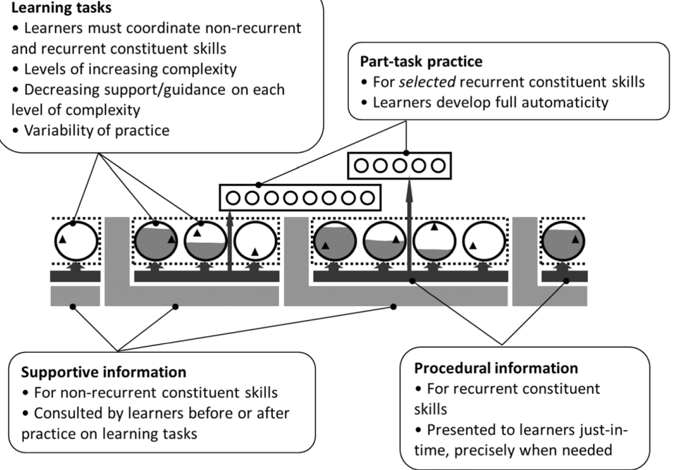
- The paper highlights 4C/ID as an extension of CLT for longer instructional programs and curricula, organized around 4 components: learning tasks, supportive information, procedural information, and part-task practice.
- It reports progress in measuring cognitive load, including a 10-item psychometric instrument that supported distinguishing intrinsic from extraneous load, and objective measures such as EEG, eye tracking, and secondary-task methods.
Methods
- This is a review article that retrospectively synthesizes CLT developments from 1998 to 2018, using the 1998 paper as a baseline and organizing the discussion into history, developments, future directions, and conclusions.
- The authors draw on prior theoretical and empirical studies and reviews cited throughout the paper; no new dataset or sample is reported in the text provided.
- Main analysis is a narrative synthesis of theoretical developments, instructional effects, and measurement approaches in CLT.
Limitations
- The paper explicitly says it is an attempt to summarise the last 20 years of CLT and sketch directions for future research, so it is a synthesis rather than a new empirical test.
- It repeatedly notes that more research is needed on cognitive-load measurement, including the optimal use of subjective rating scales, differentiating load types, and validating objective techniques.
- Evident from the text: several claims about future directions (e.g., resource depletion, self-regulated learning, emotions/stress/uncertainty, human movement) are presented as promising but not yet settled in the paper itself.
Model-written summary. Check it against the paper before relying on it.
Integrity signals
Registry
Cites
Statistics
Figures
Verification
Claims the paper makes
21 Valid · 23 Not valid · 90 Not checked · 158 Own results and interpretations
The sources with a verdict support this claim; the rest weren’t checked yet, have no full text we could read, or their verdicts aren’t rated yet.
In the paper
“Its basic premise is that human cognitive processing is heavily constrained by our limited working memory which can only process a limited number of information elements at a time.”
§ The Author(s) 2019 > Introduction
What the sources say
- Supportedcites Miller (1956) matched to “The magical number seven, plus or minus two: Some limits on our capacity for processing information.” (1956) source
The Summary says that immediate memory imposes severe limits on the information people can receive, process, and remember. The discussion of immediate memory (p. 93) specifies that its limit is the number of chunks, supporting the claim's broad paraphrase of a limited number of information elements at a time. (LLM, conf=0.91)
- Not checked — no full text of the sourcecites Peterson and Peterson (1959) matched to “Short-term retention of individual verbal items.” (1959) source
plainstates a cause- Asserted: passes — The authors put it forward as true.
- Checkable: passes — It can be checked against evidence.
- Load-bearing: passes — The paper’s conclusions depend on it.
- Based: passes — The paper gives a reason why it holds.
- Supported
The cited sources support only part of this claim — read each source’s verdict below.
In the paper
“The capacity and duration limits of working memory have been known at least since Miller (1956) and Peterson and Peterson (1959), although the fact that these limits effectively applied only to novel, not familiar information, seemed more implicit rather than explicit in most treatments.”
§ The Author(s) 2019 > Human Cognitive Architecture Used in 1998
What the sources say
- Partly supportedcites Miller (1956) matched to “The magical number seven, plus or minus two: Some limits on our capacity for processing information.” (1956) sourceExperimental — accuracy not yet measured
In the discussion of immediate memory (p. 93), Miller says its span is limited by the number of chunks and that familiar units allow more information to be packed into each chunk. That supports a distinction between novel material and familiar, recoded material, but not the claim that capacity limits apply only to novel information: the chunk limit remains. The paper also does not establish a duration limit that applies only to novel information. (LLM, conf=0.86)
- Not checked — no full text of the sourcecites Peterson and Peterson (1959) matched to “Short-term retention of individual verbal items.” (1959) source
hedged- Asserted: passes — The authors put it forward as true.
- Checkable: passes — It can be checked against evidence.
- Load-bearing: passes — The paper’s conclusions depend on it.
- Based: passes — The paper gives a reason why it holds.
- Partly supported
Every source the paper cites for this claim was checked and supports it.
In the paper
“The data summarised by Sala and Gobet (2017) provide a major justification for the post 1998 inclusion of evolutionary psychology into cognitive load theory.”
§ The Author(s) 2019 > Human Cognitive Architecture Seen Through the Prism of Evolutionary Psychology
What the sources say
- Supportedcites Sala and Gobet (2017) matched to “Does Far Transfer Exist? Negative Evidence From Chess, Music, and Working Memory Training” (2017) source
The Theoretical and Practical Implications section (page unavailable) summarises the paper’s evidence that chess, music and working-memory training do not reliably produce far transfer. The claim that these data justify a development in cognitive load theory is the citing authors’ interpretation, not a finding attributed to Sala and Gobet. (LLM, conf=0.86)
boostedstates a cause- Asserted: passes — The authors put it forward as true.
- Checkable: passes — It can be checked against evidence.
- Load-bearing: passes — The paper’s conclusions depend on it.
- Based: passes — The paper gives a reason why it holds.
- Supported
Every source the paper cites for this claim was checked and supports it.
In the paper
“The expertise reversal effect is, in essence, a variant of the more general element interactivity effect (Chen et al. 2017).”
§ The Author(s) 2019 > Instructional Effects Described After 1998
What the sources say
- Supportedcites Chen et al. 2017 matched to “The Expertise Reversal Effect is a Variant of the More General Element Interactivity Effect” (2017) source
The indexed copy lists the cited paper under the exact title “The Expertise Reversal Effect is a Variant of the More General Element Interactivity Effect.” Its title directly states the proposition attributed to it; no page number is available in the indexed passage. (LLM, conf=0.90)
plainstates a cause- Asserted: passes — The authors put it forward as true.
- Checkable: passes — It can be checked against evidence.
- Load-bearing: unclear — It is unclear whether the paper’s conclusions depend on it.
- Based: passes — The paper gives a reason why it holds.
- Supported
Every source the paper cites for this claim was checked and supports it.
In the paper
“When subsequently presented the fully integrated information, they only needed to learn how to integrate the individual elements and so more readily assimilated the entire, high element interactivity information.”
§ The Author(s) 2019 > Instructional Effects Described After 1998
What the sources say
- Supportedcites Pollock et al. 2002 matched to “Assimilating complex information” (2002) source
Split into 2 atoms — 2 confirmed, 0 partially supported, 0 disputed, 0 misattributed, 0 unverifiable. Expand the claim to see per-atom verdicts.
plainstates a cause- Asserted: passes — The authors put it forward as true.
- Checkable: passes — It can be checked against evidence.
- Load-bearing: passes — The paper’s conclusions depend on it.
- Based: passes — The paper gives a reason why it holds.
- Supported
132 more claims · 6 with their cited sources checked
Create a free account to see all 292 claims and to verify the 3 references still open.
- It may state two separate claims as one. 88
- Probably not a substantial claim. 95
Claims other papers make about this one
Each is checked against this paper’s own text: does it say what the citing paper says it does?
The source backs part of the claim, not all of it — or backs it for a different population, condition or comparison.
In the citing paper
“Another possible explanation is that the pre-training effect tends to be most effective for learners with minimal prior knowledge (Sweller et al., 2019)”
From Rethinking pre-training: cognitive load implications for learners with varying prior knowledge (2025) · cites this paper as Sweller et al., 2019
Experimental — accuracy not yet measuredThe cited source says what the claim attributes to it.
In the citing paper
“If the cognitive load imposed by a learning task is too high, it might interfere with the learner’s ability to effectively acquire and retain the skill [13, 25].”
From Teaching a single manual therapy technique at a time reduces cognitive load in physiotherapy students: a randomized controlled educational study (2025) · cites this paper as [13]
The cited source says what the claim attributes to it.
In the citing paper
“While cognitive load is often discussed in the context of instructional efficiency, it is important to note that cognitive load is not inherently detrimental. Rather, it is a natural component of learning that engages working memory resources for schema construction and automation [13].”
From Teaching a single manual therapy technique at a time reduces cognitive load in physiotherapy students: a randomized controlled educational study (2025) · cites this paper as [13]
The cited source says what the claim attributes to it.
In the citing paper
“Thus, an increased germane load is no longer believed to lead to cognitive overload and can thus no longer be assumed to be detrimental to learning performance.”
From Understanding Cognitive Load in Digital and Online Learning: a New Perspective on Extraneous Cognitive Load (2022) · cites this paper as Sweller et al., 2019
The cited source says what the claim attributes to it.
In the citing paper
“The major change from the 1998 model is that Sweller et al. (2019) have removed germane load from the additive equation of total load, but rather a dimension now called ' germane processing. '”
From Understanding Cognitive Load in Digital and Online Learning: a New Perspective on Extraneous Cognitive Load (2022) · cites this paper as Sweller et al., 2019
17 more claims about this paper
Create a free account to see every claim other papers make about this one.
Citations
Cites
The magical number seven, plus or minus two: Some limits on our capacity for processing information.
Miller, G. A. (1956) · Psychological Review · doi:10.1037/h0043158 · Cited by 17,812 · cited 1×
“The capacity and duration limits of working memory have been known at least since Miller (1956) and Peterson and Peterson (1959), although the fact that these limits effectively applied only to novel, not familiar information, seemed more implicit rather than explicit in most treatments.”
BackgroundThe magical number seven, plus or minus two: Some limits on our capacity for processing information.
Miller, G. A. (1994) · Psychological Review · doi:10.1037/0033-295x.101.2.343 · Cited by 17,161
Cognitive Load During Problem Solving: Effects on Learning
Sweller, J. (1988) · Cognitive Science · doi:10.1016/0364-0213(88)90023-7 · Cited by 11,048 · cited 4×
“Learning tasks (indicated by the big circles in Fig.”
BackgroundMethodInfluentialSelf-citationKirschner, P. A., Sweller, J., & Clark, R. E. (2006) · Educational Psychologist · doi:10.1207/s15326985ep4102_1 · Cited by 7,776
Self-citationRizzolatti, G., & Craighero, L. (2004) · Annual Review of Neuroscience · doi:10.1146/annurev.neuro.27.070203.144230 · Cited by 7,433
Cognitive Architecture and Instructional Design
Sweller, J., van Merrienboer, J. J. G., & Paas, F. G. W. C. (1998) · Educational Psychology Review · doi:10.1023/a:1022193728205 · Cited by 6,023
Self-citationBaddeley, A. (1992) · Science · doi:10.1126/science.1736359 · Cited by 5,258
Cognitive load theory, learning difficulty, and instructional design
Sweller, J. (1994) · Learning and Instruction · doi:10.1016/0959-4752(94)90003-5 · Cited by 3,801 · cited 1×
“Element Interactivity Effect This effect was already known in 1998 but as a compound effect, it was not classed as a cognitive load effect (see Sweller 1994).”
BackgroundSelf-citationEricsson, K. A., & Kintsch, W. (1995) · Psychological Review · doi:10.1037/0033-295x.102.2.211 · Cited by 3,498
Short-term retention of individual verbal items.
Peterson, L., & Peterson, M. J. (1959) · Journal of Experimental Psychology · doi:10.1037/h0049234 · Cited by 2,939 · cited 1×
“The capacity and duration limits of working memory have been known at least since Miller (1956) and Peterson and Peterson (1959), although the fact that these limits effectively applied only to novel, not familiar information, seemed more implicit rather than explicit in most treatments.”
Background
Research works printed but not linked: 4
- Centre for Education Statistics and Evaluation. (2017). Cognitive load theory: research that teachers really need to understand . Sydney: NSW Department of Education.
- Centre for Education Statistics and Evaluation. (2018). Cognitive load theory in practice . Sydney: NSW Department of Education.
- Clark, R. C. (2014). Evidence-based training methods: a guide for training professionals (2nd ed.). Alexandria: ATD Press.
- Miller, W. (1937). The picture crutch in reading. Elementary English Review, 14 , 263 -264.
Cited by
Items 2,101–2,200 of 2,268
Lohar, D., Sen, B., & Basu, A. (2026) · Journal on Multimodal User Interfaces · doi:10.1007/s12193-026-00483-6
How (and How Not) Do Code Complexity Measures Predict Cognitive Load?
Thorgeirsson, S., & Vahrenhold, J. (2026) · ACM Conference on International Computing Education Research (ICER) · doi:10.1145/3765964.3811665
PATHOS: A Pedagogical Method for Sequencing Instruction in Multi-Foundational Machine Learning
Garrido, D. R., Thorgeirsson, S., Meier, D., Pizza, L., Goswami, L., Solano, J., Cotrini, C., & Su, Z. (2026) · ACM Conference on International Computing Education Research (ICER) · doi:10.1145/3765964.3811657
Clarà, M. (2026) · Journal for the Study of Education and Development Infancia y Aprendizaje · doi:10.1177/02103702261472192
Can Planning with Diagrams Help Students Think more Critically about Moral Questions?
Manalo, E., Cheruvalath, R., & Ayabe, H. (2026) · Lecture notes in computer science · doi:10.1007/978-3-032-34178-5_23
Padmavathi, T., Rajavel Murugan, P., Sethuraman, K. R., & Judson Neslin, J. (2026) · Cureus · doi:10.7759/cureus.114362
“All these mechanisms may have contributed to long-term retention noted following AI-assisted learning [23,24].”
Ventura, O. (2025) · QualiSearch Journal of Educational Research and Practice · doi:10.66437/qjerp.v1i5.015
Lima, A. J. S., Ligcuban, M. M., Llerin, E. M. N., et al. (2026) · International Conference on e-Education, e-Business, e-Management and e-Learning · doi:10.1109/ic4e69618.2026.11631546
Елистратова, К. А. (2026) · Современные наукоемкие технологии (Modern High Technologies) · doi:10.17513/snt.40882
The Socratic E-Systems Framework: Innovating Teaching Approaches in AI-Driven E-Learning
Ebron, J. P. G. (2026) · International Conference on e-Education, e-Business, e-Management and e-Learning · doi:10.1109/ic4e69618.2026.11631381
“While students may present outputs that reflect competence, their underlying understanding may remain fragile — a condition that can be described as an “illusion of wisdom” [4][9].”
Berame, J. S., Boholst, K. A., & Tawagon, R. R. (2026) · International Conference on e-Education, e-Business, e-Management and e-Learning · doi:10.1109/ic4e69618.2026.11631571
“Lastly , the “Moving Towards Mastery” level is consistent with Cognitive Load Theory, which suggests that high-intrinsic-load topics like photosynthesis require instruction that minimizes extraneous load and supports schema construction [8].”
Jiang, X., & Huang, X. (2026) · Behavioral Sciences · doi:10.3390/bs16081387
“This pattern is consistent with cognitive-load and attentional-control perspectives, which may help explain why students’ perceived exposure to safety risks was associated with creative thinking performance (Eysenck et al., 2007; Sweller et al., 2019).”
Zeng, J., Zhang, Y., Wen, N., & He, S. (2026) · Frontiers in Psychology · doi:10.3389/fpsyg.2026.1902066 · Cited by 1
“…of high-stakes competition, athletes often show a profile characterized by persistent sympathetic activation, intrusive performance-related cognition, and reduced executive bandwidth, making effortful top-down strategies difficult to deploy effectively (Fuster et al., 2021; Sweller et al., 2019).”
InfluentialAPRENDER NA ERA DIGITAL: NEUROCIÊNCIA, COGNIÇÃO E PLATAFORMAS INTERATIVAS NA EDUCAÇÃO
Vidor, S. R. (2026) · Aurum Revista Multidisciplinar · doi:10.63330/armv2n7-030
From Theory to Practice: Applying Cognitive Load Theory in Multilingual Early Childhood Education
Al-Sayed, N. A. (2026) · Springer eBooks · doi:10.1007/978-981-95-9563-1_19
Reynaert, V., Pascart, T., Walenczak, S., & Witte, B. D. (2026) · Lecture notes in computer science · doi:10.1007/978-3-032-33500-5_23
He, X., Wu, D., Lin, J., Tong, X., & Li, X. (2026) · International Journal of Human-Computer Interaction · doi:10.1080/10447318.2026.2706939
Newton, M. H., Annetta, L. A., & Cacace, R. M. (2026) · Journal of Science Education and Technology · doi:10.1007/s10956-026-10358-w
Explaining success in Bayesian reasoning with the adaptive toolbox and expertise
Fenwick, H., Campitelli, G., & Thompson, M. B. (2026) · Psychonomic Bulletin & Review · doi:10.3758/s13423-026-02986-5
“Instructional design research demonstrates that reducing extraneous processing demands improves complex problem solving, while expertise develops through the acquisition of knowledge structures that support efficient performance (Mayer, 2008; Sweller et al., 2019; van Merriënboer & Sweller, 2005).”
Nair, K., Jayasimha, K. R., & Sivakumar, K. (2026) · SSRN Electronic Journal · doi:10.2139/ssrn.7307622
Cho, H. (2026) · Educational Psychology Review · doi:10.1007/s10648-026-10210-y · Cited by 4
“In current formulations, germane load is not a separate, additive source of load but the working-memory resources actually devoted to processing intrinsic load, that is, to schema construction (Sweller et al., 2019).”
Effects of Instructional Guidance on Modeling Causal Loop Diagrams in Climate Change Education
Tuncel, N., Beege, M., & Rieß, W. (2026) · Education Sciences · doi:10.3390/educsci16081326
“Cognitive load theory (Sweller et al., 2019) makes the underlying mechanism explicit and connects the present argument to the load related limitations of simulation-based learning outlined above.”
InfluentialBecker, E., Wünsche, J., Veith, J. M., Schrader, J., & Bitzenbauer, P. (2026) · Physical Review Physics Education Research · doi:10.1103/nvf1-zrq8 · Cited by 10
Meşe, S., Yanjun, P. A. N., Meşe, C., & SIRGANCI, G. (2026) · Nurse Education in Practice · doi:10.1016/j.nepr.2026.104949
Zhou, X., Zhang, X., Qi, L., et al. (2026) · International Conference on Computer Science and Technologies in Education (CSTE) · doi:10.1109/cste69562.2026.11649744
“…operations, immediate feedback, and problem-solving tasks, VR games perfectly align with this cycle, supporting learners in learning by doing; cognitive load theory [4] suggests that effective instruction should optimize the allocation of cognitive resources in learners ’ working memory.”
Aref, E., Aljabr, B., Aljasem, M., & Kluse, C. J. (2026) · ASEE Annual Conference & Exposition · doi:10.18260/1-2--58700
Idem, U., Hess, J. L., & Loweth, R. P. (2026) · ASEE Annual Conference & Exposition · doi:10.18260/1-2--60655
Chen, Q., & Zhao, L. (2026) · International Conference on Computer Science and Technologies in Education (CSTE) · doi:10.1109/cste69562.2026.11649623
“…nature of the concept itself, which can easily lead to cognitive overload and comprehension difficulties for students during the learning process [2]; The significant individual differences among students make uniform teaching methods ineffective and may even exacerbate existing learning…”
Chen, C.-X., Cao, J., Yan, Y., & Xu, M. (2026) · International Conference on Computer Science and Technologies in Education (CSTE) · doi:10.1109/cste69562.2026.11649593
The “Mindset Evolution” Path of Young Adults Under Verbal Violence in Competitive Video Games
Wang, Z. (2026) · SHS Web of Conferences · doi:10.1051/shsconf/202623604008
Yılar, M. B., Başaran, M., Batdı, V., Aydın, S., Yıldırım, F., & YILAR, R. (2026) · SAGE Open · doi:10.1177/21582440261480592
Cezar, B. G. D. S., de Medeiros, M. M., & Maçada, A. C. G. (2026) · Quality & Quantity · doi:10.1007/s11135-026-03002-7
Bergmann, A., & Knippels, M. P. J. (2026) · Journal of Biological Education · doi:10.1080/00219266.2026.2719536
柴, 晓. (2026) · Advances in Education · doi:10.12677/ae.2026.1681766
Cao, H., Zhang, Q., Zeng, G., Dong, C., & Li, F. (2026) · IEEE International Conference on Innovation, Ethics & Emerging Tech in Engineering and Computing Education (IE2C) · doi:10.1109/ie2c69620.2026.11663043
Tatar, N., & İdgü, M. (2026) · Van Yüzüncü Yıl Üniversitesi Eğitim Fakültesi dergisi/Yüzüncü Yıl Üniversitesi Eğitim Fakültesi dergisi · doi:10.33711/yyuefd.1826943
Abraham, Y. S., Olanipekun, O. I., Sharma, D. K., Chen, J., Nnaji, C. A., & Akanmu, A. A. (2026) · ASCE Construction Research Congress (CRC) · doi:10.1061/9780784486993.064
Cheng, Y., Xie, Y. X., Wang, R., Que, R., & Qiao, A. (2026) · Interactive Learning Environments · doi:10.1080/10494820.2026.2721387 · Cited by 1
He, Y., Niu, T., & Ashari, Z. M. (2026) · Frontiers in Education · doi:10.3389/feduc.2026.1926173 · Cited by 1
Zhu, H., Liu, W., & Shi, Q. (2026) · Frontiers in Education · doi:10.3389/feduc.2026.1874510
Generative AI as a Scaffold in Travel Decision-Making: A Conceptual Framework
Kim, Y., Tussyadiah, I. P., & Kim, B. (2026) · Journal of Travel Research · doi:10.1177/00472875261484157 · Cited by 2
Baba, M. A., Bouzit, M., Mahlaq, S., Mohamed, M., & Ahmed, K. (2026) · Teaching and learning in nursing · doi:10.1016/j.teln.2026.08.005
Sathya, M., Alamelu, R., Raja, P., Christina, J. L., & Blessy, M. I. (2026) · Advances in computational intelligence and robotics book series · doi:10.4018/979-8-2600-1735-7.ch006
Rico, F. M. E., & Fernández, L. P. (2026) · International Journal of Educational Research · doi:10.1016/j.ijer.2026.103092
Suparjan, S., Purwanta, E., Salido, A., Ismiyani, N., Akbar, A., Kiptiyah, S. M., Nurzaman, I., & Sesmiyanti, S. (2026) · International Journal of Learning Teaching and Educational Research · doi:10.26803/ijlter.25.8.46
Zhang, Y., & Deng, J. (2026) · International Conference on Distance Education and Learning (ICDEL) · doi:10.1109/icdel70250.2026.11663683 · Cited by 1
“…is theoretically anchored in three pillars: Cognitive Load Theory (CLT): Effective instruction must manage intrinsic load (complexity of the material), minimize extraneous load (poor instructional design), and optimize germane load (effort devoted to schema construction) (Sweller et al., 2019)[6].”
Yusri, A. Y., Rahmat, M., Paris, S., Abdal, N. M., & Setialaksana, W. (2026) · Learning and Motivation · doi:10.1016/j.lmot.2026.102342
Parhana, R., Santhanalakshmi, K., Selvakumar, M. M., Kumar, B. S., Ajay, V. K., & Sathya, V. (2026) · Journal of Computers Mechanical and Management · doi:10.57159/jcmm.5.4.261000
“…complexity of the content and its interaction with prior knowledge; extraneous load, generated by poor instructional design that consumes working memory without contributing to learning; and germane load, the effortful processing that produces schema formation and knowledge consolidation [27].”
Şan, İ., & Orhan-Karsak, H. G. (2026) · International Journal of Educational Technology in Higher Education · doi:10.1186/s41239-026-00621-w
“This sequencing logic is supported by cognitive load theory (Sweller et al., 2019).”
Li, J., 黎志远, Pan, H., Yi, J., & Cai, H. (2026) · Journal of surgical education · doi:10.1016/j.jsurg.2026.104165
Beyond Problem-Solving: Interactive Worked Examples as Pathways to Dual Teacher Expertise
Ovadiya, T. (2026) · Journal of Intelligence · doi:10.3390/jintelligence14090203 · Cited by 1
“Finally, Sweller et al. (2019), summarizing twenty years of research on CL, pointed out that students at all levels can be taught to apply CL theory principles to manage their CL.”
Mahmudah, G. N., Fajrussalam, H., & Hikmatunisa, N. P. (2026) · Jurnal Penelitian Pendidikan IPA · doi:10.29303/jppipa.v12i8.15898
“(Sweller et al., 2019) explain that working memory has a limited capacity for processing novel information, meaning that learners may experience difficulties when instructional information requires substantial cognitive processing.”
Guerra, J. (2026) · International Journal of Mathematical Education in Science and Technology · doi:10.1080/0020739x.2026.2719550
Liu, S., Zhu, Y., Marmolejo‐Ramos, F., Wang, J., & Wang, R. (2026) · Journal of Cognitive Psychology · doi:10.1080/20445911.2026.2726279
Lu, X., Lu, Y., Ren, S., & Zhang, D. (2026) · International Journal of Science Education · doi:10.1080/09500693.2026.2701381
Ali, S. N. A., & Farah, R. I. (2026) · Discover Education · doi:10.1007/s44217-026-02116-2
“This gradient suggests that AI models are most sensitive to features that drive intrinsic load: the number of inferential steps and visual integration demands within a task [26].”
Metaverse Built Structures for Gamified Immersive Virtual Environments and Students' Outcomes
Palem, G., & Dasari, A. (2026) · IGI Global eBooks · doi:10.4018/979-8-2600-1771-5.ch016
Ghosh, S., & Raj, R. (2026) · IGI Global eBooks · doi:10.4018/979-8-3373-6581-7.ch001
Sun, Y., Li, H., Tao, X., Zhou, X., Gururajan, R., & Zhang, J. (2026) · Computers and Education: Artificial Intelligence · doi:10.1016/j.caeai.2026.100675
Kamrozzaman, N. A., & Elias, S. (2026) · Open Journal of Social Sciences · doi:10.4236/jss.2026.149010
Manalo, C. (2026) · QualiSearch Journal of Educational Research and Practice · doi:10.66437/qjerp.v2i8.016
Wenzel, B., Decristan, J., & Tetzlaff, L. (2026) · Social Psychology of Education · doi:10.1007/s11218-026-10278-y
“By structuring tasks and providing clear guidance, instructional support can reduce cognitive load and enhance information processing and retention (Sweller et al., 2019 ).”
Resulbegoviq, H., Hlebec, V., Bach, M. P., & Stamatović, I. (2026) · Journal of Eye Movement Research · doi:10.3390/jemr19050097 · Cited by 1
Teaching Algorithms and Data Structures with a Test-Driven Development Framework
任骆一 (2026) · International Conference on Machine Intelligence and Digital Applications (MIDA) · doi:10.1145/3801438.3802324
戴, 圣. (2026) · Advances in Education · doi:10.12677/ae.2026.1691896
Enhancing Pilot Skills: The Effectiveness of Preflight Simulation Training
Baguio, J. D. (2026) · International Journal of Sustainable and Integrated Studies · doi:10.65339/ijsis.v1.i2.62
“Sweller et al. (2019) emphasized that instructional design should consider the limitations of working memory while helping learners develop organized knowledge structures.”
Measuring cognitive load using non-invasive techniques: a systematic review
Gittins, E., Sahoo, D., Jenkinson-Garner, M., & Ahmad, M. I. (2026) · Journal on Multimodal User Interfaces · doi:10.1007/s12193-026-00482-7
Long-term impact of ChatGPT feedback on EFL students' writing skills development accross genres
Fatmawati, Basthomi, Y., Suryati, N., Laksmi, E. D., & Hassan, I. (2026) · Multidisciplinary Science Journal · doi:10.31893/multiscience.2027179
“This duality, greater independence paired with cognitive overload, is consistent with Sweller et al. (2019) cognitive load theory, which proposes a temporary decline in performance when learners engage with unfamiliar and cognitively demanding tasks.”
Siougioudi, V., & Stamati, T. (2026) · Lecture notes in computer science · doi:10.1007/978-3-032-36676-4_8
Nababan, S., & Gultom, E. S. (2026) · ETDC Indonesian Journal of Research and Educational Review · doi:10.51574/ijrer.v6i1.5449
Lim, J., Lim, J., Lee, Y., & Lee, Y. (2026) · Archives of Design Research · doi:10.15187/adr.2026.08.39.3.283
Kotze, C. (2026) · Journal of ExoTechnology and Education · doi:10.36615/k5bt2774
Student Engagement in the School Music Ensemble: A Review of Literature
Droe, K. L. (2026) · Update Applications of Research in Music Education · doi:10.1177/87551233261484592
Meyer, A., & Friege, G. (2026) · Frontiers in Education · doi:10.3389/feduc.2026.1894519
Li, X., & Razak, R. A. (2026) · Interactive Learning Environments · doi:10.1080/10494820.2026.2729788 · Cited by 1
Learning and Autonomy in Clinical Simulation: an Integrative Conceptual Framework
Gutiérrez, R. A., Cabrera, J., & Arancibia, J. M. (2026) · Journal of Nursing Care & Reports · doi:10.47485/3065-7636.1053
Bankole, H. B., & Ramnarain, U. D. (2026) · Frontiers in Education · doi:10.3389/feduc.2026.1844306
Chen, P., Lee, H., Huang, Y., & Wu, T. (2026) · Journal of Educational Computing Research · doi:10.1177/07356331261486324
Cui, D.-Z., & Kim, Y.-E. (2026) · Journal of Digital Contents Society · doi:10.9728/dcs.2026.27.8.2345
Biriș, G. M., Cazan, A., & Neagu, S. N. (2026) · Frontiers in Psychology · doi:10.3389/fpsyg.2026.1946367
“According to Cognitive Load Theory, the integration of complex and interdependent information can exceed students’ available cognitive capacity, especially when they have not yet developed effective strategies for processing and self-regulating their learning (Sweller et al., 2019).”
Worked Examples and Transfer: An Integrative Review, Design Framework, and Practitioner Checklist
Bourgaux, L., Tricot, A., & PAAS, F. G. W. C. (2026) · Educational Psychology Review · doi:10.1007/s10648-026-10206-8
“In some cases, individuals learning with worked examples outperformed those in collaborative conditions, a finding consistent with Cognitive Load Theory (Sweller et al., 2011; Zambrano et al., 2020).”
InfluentialSelf-citationAtienza, L. C. (2026) · International Journal of Sustainable and Integrated Studies · doi:10.65339/ijsis.v1.i2.79
“Students must process unfamiliar words while understanding complex concepts (Sweller et al., 2021), which may encourage superficial comprehension (Othman, 2024).”
Rethinking AI in clinical decision support: a framework for reciprocal human-AI interaction
Greengrass, C. J. (2026) · Frontiers in Digital Health · doi:10.3389/fdgth.2026.1887161 · Cited by 2
Xie, X., & Hu, X. (2026) · Educational Technology Research and Development · doi:10.1007/s11423-026-10715-x
The Influence of Context-Aware Mobile Interaction on Concentration in Art Appreciation Teaching
Zhang, Q., & Hao, Y. (2026) · International Journal of Mobile Human Computer Interaction · doi:10.4018/ijmhci.422095
Padang, A. T., Nalle, M. D. S., & Christian, G. P. (2026) · International Journal of Social Learning (IJSL) · doi:10.47134/ijsl.v6i3.622
Borkowski, A. S. (2026) · European Journal of Engineering Education · doi:10.1080/03043797.2026.2730643
Finger tracing or stylus tracing? Investigating the tracing effect on a computer screen
Lin, L. (2026) · Educational Technology Research and Development · doi:10.1007/s11423-026-10714-y
Emergent classroom dynamics: Minimal complexity models for educational researchPreprint
Rost, M. (2026) · Research Square · doi:10.21203/rs.3.rs-11048353/v1
Song, W., & Hayashi, T. (2026) · Journal on Computing and Cultural Heritage · doi:10.1145/3847115
“…sequence into a single trigger pull (Section 5.1) reduces extraneous cognitive load and allows attention to focus on the firing mechanism itself [58]; this is consistent with established findings that immersive media can either help or hinder learning depending on how cognitive load is managed…”
InfluentialHuang, K.-L., Sun, H.-J., & Lyu, X. (2026) · International Journal of Human-Computer Interaction · doi:10.1080/10447318.2026.2719174
Li, X., & Chen, L. (2026) · Frontiers in Psychology · doi:10.3389/fpsyg.2026.1831165
“…fundamental principles of cognitive load theory, according to which the educational usefulness of technological tools can not just be defined by the perceived value of the tools but is also limited by the fact that the limited cognitive resources of learners are distributed (Sweller et al., 2019).”
Liu, Z., & Yang, X. (2026) · Science Communication · doi:10.1177/10755470261484088
Aziz, J., & Nurhayati, S. R. (2026) · Academia Open · doi:10.21070/acopen.11.2026.15168
Supporting Deaf Student Communication Using Low Tech Augmentative And Alternative Communication
Astuti, A., & Ningrum, E. S. C. (2026) · Academia Open · doi:10.21070/acopen.11.2026.15162
Pan, D., Long, T., Zhu, X., & Li, J. (2026) · Thinking Skills and Creativity · doi:10.1016/j.tsc.2026.102380 · Cited by 2
Priono, J., Lestari, D. A., & Kurniati, R. (2026) · COMPETITOR Jurnal Pendidikan Kepelatihan Olahraga · doi:10.67322/cpjok.v18i2.1137
Metadata
- Authors
- Sweller, J., van Merriënboer, J. J. G., & Paas, F.
- Affiliations
- UNSW Sydney (AU)
- University of Wollongong (AU)
- Corresponding author
- Sweller, John
- Venue
- Educational Psychology Review
- Published
- 2019-01-22
- Volume
- 31
- Issue
- 2
- Pages
- 261-292
- ISSN
- 1040-726X (ISSN-L)
- 1573-336X
- OpenAlex
- W2913144876
- Cited by
- 2,337
- References
- 129
- Citations by year
- 2026: 713 · 2025: 466 · 2024: 331 · 2023: 268 · 2022: 212 · 2021: 190 · 2020: 114 · 2019: 37
- FWCI
- 162.54
- Type
- journal article
- Language
- en
- Open access
- hybrid
- doi.org
- Licence
- cc-by
- creativecommons.org/licenses/by/4.0 (tdm)
- Locations
- Educational Psychology Review (publishedVersion, cc-by)
- EUR Research Repository (Erasmus University Rotterdam) (publishedVersion, other-oa)
- Research Online (University of Wollongong) (submittedVersion)
- EUR Research Repository (Erasmus University Rotterdam) (submittedVersion)
- Research Publications (Maastricht University) (submittedVersion, cc-by)
- Figshare (submittedVersion, cc-by)
- Research Publications (Maastricht University) (submittedVersion, other-oa)
- Topics
- Social Sciences › Psychology › Experimental and Cognitive Psychology › Visual and Cognitive Learning Processes
- Social Sciences › Psychology › Developmental and Educational Psychology › Innovative Teaching and Learning Methods
- Life Sciences › Neuroscience › Cognitive Neuroscience › Neuroscience, Education and Cognitive Function
- Keywords
- cognitive load theory, cognitive architecture, working memory, long-term memory, instructional design
About these checks
Registry, retraction, Cites and statistics results are computed, not judged, with one exception: a printed reference that no index lists is read once by a model before it counts as a citation error. Claims are extracted by a model and kept only when their quote appears verbatim in the text; each cited source is then checked, with a model’s help, for whether it says what the claim relies on. Those verdicts can be wrong — read the claim’s quote and the cited source before relying on one.
The claim verdicts this report counts are experimental: their accuracy is not yet measured.
A language model drew the claims from the paper on 2026-10-10, under version 3 of the claim definition (model deepseek-v4.1-flash, prompt extract-v3).
A second model labelled each claim on 2026-10-10 (model jev-1.13-20260917, definition revision gold-guideline-v0.2).
Cited sources are checked with a language model’s help (gpt-6-sol).
Statistics and arithmetic are recomputed, not judged.
Confidence bands are shown only for fields calibrated on our annotated test set. None is calibrated yet, so no band is shown.
What counts as a claim ›How we measure confidence ›How we check this ›
Are you an author, or do you see a problem with this page? Request a review
Data sources
Bibliographic data: Semantic Scholar, OpenAlex, Crossref.
Contains information from the Semantic Scholar Academic Graph Datasets, made available under the ODC Attribution License (ODC-BY 1.0).
Semantic Scholar’s data is described in: Kinney, R., et al. (2023). The Semantic Scholar Open Data Platform. arXiv:2301.10140.
