

Cognitive Architecture and Instructional Design: 20 Years Later
Open accessThe DOI matches its Crossref record; 127 of the 129 references it cites were found in a registry or an index, and 1 are not checked yet; 22 of the 116 sources its claims cite were checked for support.
Abstract
Cognitive load theory was introduced in the 1980s as an instructional design theory based on several uncontroversial aspects of human cognitive architecture. Our knowledge of many of the characteristics of working memory, long-term memory and the relations between them had been well-established for many decades prior to the introduction of the theory. Curiously, this knowledge had had a limited impact on the field of instructional design with most instructional design recommendations proceeding as though working memory and long-term memory did not exist. In contrast, cognitive load theory emphasised that all novel information first is processed by a capacity and duration limited working memory and then stored in an unlimited long-term memory for later use. Once information is stored in long-term memory, the capacity and duration limits of working memory disappear transforming our ability to function. By the late 1990s, sufficient data had been collected using the theory to warrant an extended analysis resulting in the publication of Sweller et al. (Educational Psychology Review, 10, 251–296, 1998). Extensive further theoretical and empirical work have been carried out since that time and this paper is an attempt to summarise the last 20 years of cognitive load theory and to sketch directions for future research.
Verified 2026-11-25 · 1 reference not checked yet
Overview
CoChat Summary
TL;DR
This review argues that cognitive load theory (CLT) has substantially advanced since its 1998 summary, with new theoretical grounding, new instructional effects, and improved measurement approaches. It also frames future work around working-memory resource depletion, self-regulated learning, emotions/stress/uncertainty, and human movement.
Key findings
- The paper states that the 1998 article reported 7 cognitive load effects, and that 8 new effects were added in the 1998–2018 period, including compound effects.
- It says CLT’s theoretical basis was strengthened by grounding human cognitive architecture in evolutionary psychology, especially Geary’s distinction between biologically primary and biologically secondary knowledge.
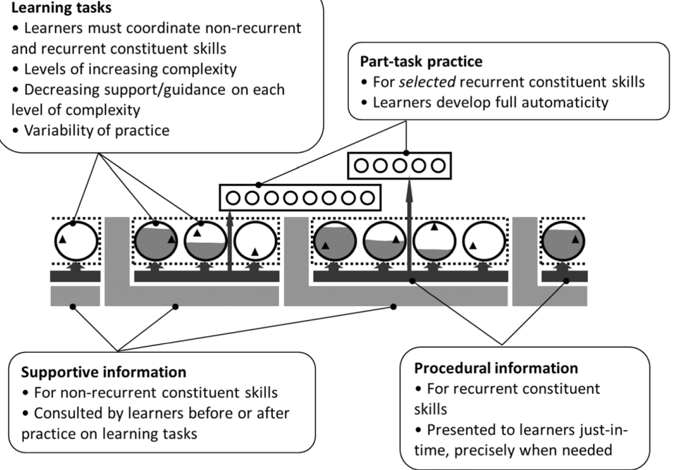
- The paper highlights 4C/ID as an extension of CLT for longer instructional programs and curricula, organized around 4 components: learning tasks, supportive information, procedural information, and part-task practice.
- It reports progress in measuring cognitive load, including a 10-item psychometric instrument that supported distinguishing intrinsic from extraneous load, and objective measures such as EEG, eye tracking, and secondary-task methods.
Methods
- This is a review article that retrospectively synthesizes CLT developments from 1998 to 2018, using the 1998 paper as a baseline and organizing the discussion into history, developments, future directions, and conclusions.
- The authors draw on prior theoretical and empirical studies and reviews cited throughout the paper; no new dataset or sample is reported in the text provided.
- Main analysis is a narrative synthesis of theoretical developments, instructional effects, and measurement approaches in CLT.
Limitations
- The paper explicitly says it is an attempt to summarise the last 20 years of CLT and sketch directions for future research, so it is a synthesis rather than a new empirical test.
- It repeatedly notes that more research is needed on cognitive-load measurement, including the optimal use of subjective rating scales, differentiating load types, and validating objective techniques.
- Evident from the text: several claims about future directions (e.g., resource depletion, self-regulated learning, emotions/stress/uncertainty, human movement) are presented as promising but not yet settled in the paper itself.
Model-written summary. Check it against the paper before relying on it.
Integrity signals
Registry
Cites
Statistics
Figures
Verification
Claims the paper makes
21 Valid · 23 Not valid · 90 Not checked · 158 Own results and interpretations
The sources with a verdict support this claim; the rest weren’t checked yet, have no full text we could read, or their verdicts aren’t rated yet.
In the paper
“Its basic premise is that human cognitive processing is heavily constrained by our limited working memory which can only process a limited number of information elements at a time.”
§ The Author(s) 2019 > Introduction
What the sources say
- Supportedcites Miller (1956) matched to “The magical number seven, plus or minus two: Some limits on our capacity for processing information.” (1956) source
The Summary says that immediate memory imposes severe limits on the information people can receive, process, and remember. The discussion of immediate memory (p. 93) specifies that its limit is the number of chunks, supporting the claim's broad paraphrase of a limited number of information elements at a time. (LLM, conf=0.91)
- Not checked — no full text of the sourcecites Peterson and Peterson (1959) matched to “Short-term retention of individual verbal items.” (1959) source
plainstates a cause- Asserted: passes — The authors put it forward as true.
- Checkable: passes — It can be checked against evidence.
- Load-bearing: passes — The paper’s conclusions depend on it.
- Based: passes — The paper gives a reason why it holds.
- Supported
The cited sources support only part of this claim — read each source’s verdict below.
In the paper
“The capacity and duration limits of working memory have been known at least since Miller (1956) and Peterson and Peterson (1959), although the fact that these limits effectively applied only to novel, not familiar information, seemed more implicit rather than explicit in most treatments.”
§ The Author(s) 2019 > Human Cognitive Architecture Used in 1998
What the sources say
- Partly supportedcites Miller (1956) matched to “The magical number seven, plus or minus two: Some limits on our capacity for processing information.” (1956) sourceExperimental — accuracy not yet measured
In the discussion of immediate memory (p. 93), Miller says its span is limited by the number of chunks and that familiar units allow more information to be packed into each chunk. That supports a distinction between novel material and familiar, recoded material, but not the claim that capacity limits apply only to novel information: the chunk limit remains. The paper also does not establish a duration limit that applies only to novel information. (LLM, conf=0.86)
- Not checked — no full text of the sourcecites Peterson and Peterson (1959) matched to “Short-term retention of individual verbal items.” (1959) source
hedged- Asserted: passes — The authors put it forward as true.
- Checkable: passes — It can be checked against evidence.
- Load-bearing: passes — The paper’s conclusions depend on it.
- Based: passes — The paper gives a reason why it holds.
- Partly supported
Every source the paper cites for this claim was checked and supports it.
In the paper
“The data summarised by Sala and Gobet (2017) provide a major justification for the post 1998 inclusion of evolutionary psychology into cognitive load theory.”
§ The Author(s) 2019 > Human Cognitive Architecture Seen Through the Prism of Evolutionary Psychology
What the sources say
- Supportedcites Sala and Gobet (2017) matched to “Does Far Transfer Exist? Negative Evidence From Chess, Music, and Working Memory Training” (2017) source
The Theoretical and Practical Implications section (page unavailable) summarises the paper’s evidence that chess, music and working-memory training do not reliably produce far transfer. The claim that these data justify a development in cognitive load theory is the citing authors’ interpretation, not a finding attributed to Sala and Gobet. (LLM, conf=0.86)
boostedstates a cause- Asserted: passes — The authors put it forward as true.
- Checkable: passes — It can be checked against evidence.
- Load-bearing: passes — The paper’s conclusions depend on it.
- Based: passes — The paper gives a reason why it holds.
- Supported
Every source the paper cites for this claim was checked and supports it.
In the paper
“The expertise reversal effect is, in essence, a variant of the more general element interactivity effect (Chen et al. 2017).”
§ The Author(s) 2019 > Instructional Effects Described After 1998
What the sources say
- Supportedcites Chen et al. 2017 matched to “The Expertise Reversal Effect is a Variant of the More General Element Interactivity Effect” (2017) source
The indexed copy lists the cited paper under the exact title “The Expertise Reversal Effect is a Variant of the More General Element Interactivity Effect.” Its title directly states the proposition attributed to it; no page number is available in the indexed passage. (LLM, conf=0.90)
plainstates a cause- Asserted: passes — The authors put it forward as true.
- Checkable: passes — It can be checked against evidence.
- Load-bearing: unclear — It is unclear whether the paper’s conclusions depend on it.
- Based: passes — The paper gives a reason why it holds.
- Supported
Every source the paper cites for this claim was checked and supports it.
In the paper
“When subsequently presented the fully integrated information, they only needed to learn how to integrate the individual elements and so more readily assimilated the entire, high element interactivity information.”
§ The Author(s) 2019 > Instructional Effects Described After 1998
What the sources say
- Supportedcites Pollock et al. 2002 matched to “Assimilating complex information” (2002) source
Split into 2 atoms — 2 confirmed, 0 partially supported, 0 disputed, 0 misattributed, 0 unverifiable. Expand the claim to see per-atom verdicts.
plainstates a cause- Asserted: passes — The authors put it forward as true.
- Checkable: passes — It can be checked against evidence.
- Load-bearing: passes — The paper’s conclusions depend on it.
- Based: passes — The paper gives a reason why it holds.
- Supported
132 more claims · 6 with their cited sources checked
Create a free account to see all 292 claims and to verify the 3 references still open.
- It may state two separate claims as one. 88
- Probably not a substantial claim. 95
Claims other papers make about this one
Each is checked against this paper’s own text: does it say what the citing paper says it does?
The source backs part of the claim, not all of it — or backs it for a different population, condition or comparison.
In the citing paper
“Another possible explanation is that the pre-training effect tends to be most effective for learners with minimal prior knowledge (Sweller et al., 2019)”
From Rethinking pre-training: cognitive load implications for learners with varying prior knowledge (2025) · cites this paper as Sweller et al., 2019
Experimental — accuracy not yet measuredThe cited source says what the claim attributes to it.
In the citing paper
“If the cognitive load imposed by a learning task is too high, it might interfere with the learner’s ability to effectively acquire and retain the skill [13, 25].”
From Teaching a single manual therapy technique at a time reduces cognitive load in physiotherapy students: a randomized controlled educational study (2025) · cites this paper as [13]
The cited source says what the claim attributes to it.
In the citing paper
“While cognitive load is often discussed in the context of instructional efficiency, it is important to note that cognitive load is not inherently detrimental. Rather, it is a natural component of learning that engages working memory resources for schema construction and automation [13].”
From Teaching a single manual therapy technique at a time reduces cognitive load in physiotherapy students: a randomized controlled educational study (2025) · cites this paper as [13]
The cited source says what the claim attributes to it.
In the citing paper
“Thus, an increased germane load is no longer believed to lead to cognitive overload and can thus no longer be assumed to be detrimental to learning performance.”
From Understanding Cognitive Load in Digital and Online Learning: a New Perspective on Extraneous Cognitive Load (2022) · cites this paper as Sweller et al., 2019
The cited source says what the claim attributes to it.
In the citing paper
“The major change from the 1998 model is that Sweller et al. (2019) have removed germane load from the additive equation of total load, but rather a dimension now called ' germane processing. '”
From Understanding Cognitive Load in Digital and Online Learning: a New Perspective on Extraneous Cognitive Load (2022) · cites this paper as Sweller et al., 2019
17 more claims about this paper
Create a free account to see every claim other papers make about this one.
Citations
Cites
The magical number seven, plus or minus two: Some limits on our capacity for processing information.
Miller, G. A. (1956) · Psychological Review · doi:10.1037/h0043158 · Cited by 17,812 · cited 1×
“The capacity and duration limits of working memory have been known at least since Miller (1956) and Peterson and Peterson (1959), although the fact that these limits effectively applied only to novel, not familiar information, seemed more implicit rather than explicit in most treatments.”
BackgroundThe magical number seven, plus or minus two: Some limits on our capacity for processing information.
Miller, G. A. (1994) · Psychological Review · doi:10.1037/0033-295x.101.2.343 · Cited by 17,161
Cognitive Load During Problem Solving: Effects on Learning
Sweller, J. (1988) · Cognitive Science · doi:10.1016/0364-0213(88)90023-7 · Cited by 11,048 · cited 4×
“Learning tasks (indicated by the big circles in Fig.”
BackgroundMethodInfluentialSelf-citationKirschner, P. A., Sweller, J., & Clark, R. E. (2006) · Educational Psychologist · doi:10.1207/s15326985ep4102_1 · Cited by 7,776
Self-citationRizzolatti, G., & Craighero, L. (2004) · Annual Review of Neuroscience · doi:10.1146/annurev.neuro.27.070203.144230 · Cited by 7,433
Cognitive Architecture and Instructional Design
Sweller, J., van Merrienboer, J. J. G., & Paas, F. G. W. C. (1998) · Educational Psychology Review · doi:10.1023/a:1022193728205 · Cited by 6,023
Self-citationCognitive load theory, learning difficulty, and instructional design
Sweller, J. (1994) · Learning and Instruction · doi:10.1016/0959-4752(94)90003-5 · Cited by 5,426 · cited 1×
“Element Interactivity Effect This effect was already known in 1998 but as a compound effect, it was not classed as a cognitive load effect (see Sweller 1994).”
BackgroundSelf-citationBaddeley, A. (1992) · Science · doi:10.1126/science.1736359 · Cited by 5,258
Ericsson, K. A., & Kintsch, W. (1995) · Psychological Review · doi:10.1037/0033-295x.102.2.211 · Cited by 3,498
Short-term retention of individual verbal items.
Peterson, L., & Peterson, M. J. (1959) · Journal of Experimental Psychology · doi:10.1037/h0049234 · Cited by 2,939 · cited 1×
“The capacity and duration limits of working memory have been known at least since Miller (1956) and Peterson and Peterson (1959), although the fact that these limits effectively applied only to novel, not familiar information, seemed more implicit rather than explicit in most treatments.”
Background
Research works printed but not linked: 4
- Centre for Education Statistics and Evaluation. (2017). Cognitive load theory: research that teachers really need to understand . Sydney: NSW Department of Education.
- Centre for Education Statistics and Evaluation. (2018). Cognitive load theory in practice . Sydney: NSW Department of Education.
- Clark, R. C. (2014). Evidence-based training methods: a guide for training professionals (2nd ed.). Alexandria: ATD Press.
- Miller, W. (1937). The picture crutch in reading. Elementary English Review, 14 , 263 -264.
Cited by
Items 2,201–2,268 of 2,268
Niegemann, H., Weinberger, A., Korbach, A., & Malone, S. (2026) · Springer eBooks · doi:10.1007/978-3-662-73355-4_8
Zhang, C., Shaharom, M. S. N., Yue, W. S., & Zhao, W. (2026) · IEEE Access · doi:10.1109/access.2026.3734526
Koudsia, S. (2026) · Journal of Higher Education Theory and Practice · doi:10.33423/se3cty90
“…stream encompasses cognitive load theory and cognitive load management, which explain how learners process complex information within the limits of working memory and how learning is shaped by prior knowledge, task complexity, and cognitive architecture (Sweller, 1988, 2024; Sweller et al., 2019).”
InfluentialLiu, M., Zhang, P., Wu, Y., Pan, L., & Li, L. (2026) · Nursing Open · doi:10.1002/nop2.70855
“Notably, extra-neous cognitive load did not directly predict learning engagement, suggesting that its influence is realized indirectly through its impact on learners' experiential states (Gutiérrez Maquilón et al. 2024; Sweller et al. 2019).”
Zhao, W., Guo, Z., Zhou, Y., Tu, Y., Huang, C., & Huang, Q. (2026) · International Journal of STEM Education · doi:10.1186/s40594-026-00647-6
“Cognitive Load Theory suggests that instructional design should promote learning-relevant processing while minimizing extrane-ous processing imposed by the instructional design itself (Paas & van Merriënboer, 2020; Sweller et al., 2019).”
Mendonça, P. C., Quintal, F., Figueiredo, M., & Mendonça, F. (2026) · Frontiers in Education · doi:10.3389/feduc.2026.1934069
Lee, H. C., Weng, S., Lee, K. T., Su, M., & Lai, J. C.-T. (2026) · Teaching and learning in nursing · doi:10.1016/j.teln.2026.08.023
Setiawati, A. S., Rokhman, F., Zulaeha, I., & Supriatnanigsih, R. (2026) · Languages · doi:10.3390/languages11090195
Wang, Y., Zhang, H., & Cui, Y. (2026) · SAGE Open · doi:10.1177/21582440261491028
A quasi-experimental study of music-based instruction for cranial nerve learning in nursing students
Sundari, S., Kresnayana, M. Y., & Purbohadi, D. (2026) · Discover Education · doi:10.1007/s44217-026-02184-4
“The theory draws attention to the fact that working memory has limited capacity, and that content without a clear organizing structure forces learners to expend much of that capacity on managing the material rather than understanding this [30].”
Gao, L., & Zhang, F. (2026) · Frontiers in Psychology · doi:10.3389/fpsyg.2026.1893472
ИСПОЛЬЗОВАНИЕ ТЕХНОЛОГИИ МИКРООБУЧЕНИЯ В ВУЗАХ МЧС РОССИИ
Стефаненко, П. В. (2026) · Vestnik of Russian New University Series Man in the modern world · doi:10.18137/rnu.v925x.26.03.p.074
Apostolidi, A., Fortis, S. P., Liossi, S., Papageorgiou, E., & Kriebardis, A. G. (2026) · Education Sciences · doi:10.3390/educsci16101578
Zhou, H., Liu, D., & Zhang, Y. (2026) · Frontiers in Psychology · doi:10.3389/fpsyg.2026.1908358
“So that athletes can pay more attention to the key information related to the movement (Kalyuga, 2014; Sweller et al., 2019).”
Pando, C. R., Melgarejo, T. F. V., Ruíz, F. A. Z., Marcelo, A. I. C., Lovatón, R. M., Dávila, V. L. A., Apolinario, U. E., Martínez, R. A. L., Melgarejo, P. L. V., Vásquez, W. N. G., et al. (2026) · Multimodal Technologies and Interaction · doi:10.3390/mti10100099
Core practices as anchors for grounding teaching in research on learning and instruction
Nückles, M., & Hipp, H. (2026) · Frontiers in Education · doi:10.3389/feduc.2026.1819272
Chauncey, S. A. (2026) · Frontiers in Computer Science · doi:10.3389/fcomp.2026.1947835 · Cited by 1
Yavuz, M. (2026) · İnönü Üniversitesi Eğitim Bilimleri Enstitüsü Dergisi · doi:10.29129/inujgse.1969285
Kravchenko, K., & Nosko, K. (2026) · Visnyk Taras Shevchenko National University of Kyiv Military-Special Sciences · doi:10.17721/1728-2217.2026.67.13-25
Beyer-Soto, A., Faunes, F., & Pérez-Alzola, L. P. (2026) · Frontiers in Education · doi:10.3389/feduc.2026.1937896
“Whitin this theoretical framework, optimizing germane cognitive load, the mental effort dedicated to schema construction and automation, reduces working memory strain during high-stakes evaluations, aligning with superior academic performance (Sweller et al., 2019).”
Köçeri, K., Akçay, A., Aydıntürk, A., & Arslan, A. (2026) · Research Square · doi:10.21203/rs.3.rs-11132963/v1
Explanation Transparency and Trust Perception After Generative AI Failure: A Dual-Path Model
Yang, Q., & Dong, H. (2026) · International Journal of Human-Computer Interaction · doi:10.1080/10447318.2026.2734323
Sánchez, C. X. M., Sánchez, N. K. M., & Merino, M. J. M. (2026) · Revista Multidisciplinaria Voces de América y el Caribe · doi:10.69821/remuvac.v3i4.419
Zhou, X., Wu, Y., & Wu, P. (2026) · Ain Shams Engineering Journal · doi:10.1016/j.asej.2026.104476
An Interactive E-Module for Expository Writing Skills and Motivation in Elementary Students
Indana, N., Bahri, A., & Arif, T. A. (2026) · Jurnal Pembelajaran Bimbingan dan Pengelolaan Pendidikan · doi:10.17977/um065.v7.i3.2027.11
“…audio narration, the Coherence Principle through exclusion of irrelevant elements, and the Contiguity Principle through spatial-temporal co-location of text and illustrations, an approach intended to reduce extraneous cognitive load and support durable mental representations (Sweller et al., 2019).”
ALNasser, M. N. (2026) · Frontiers in Psychology · doi:10.3389/fpsyg.2026.1866788
Yi, K., Xing, Y., Guo, Y., Wang, Y., & Li, Z. (2026) · Acta Psychologica · doi:10.1016/j.actpsy.2026.107896 · Cited by 2
Interactive pathology teaching on Instagram: Engagement outcomes from a 4‐week pilot study
Hindes, M. T., Ung, B. S. ‐., & Caruso, M. C. (2026) · Anatomical Sciences Education · doi:10.1002/ase.70362
Leaning into risk: How slanted typeface logos increase perceived risk of efficacious products
Zhou, G., & Chen, L. (2026) · Journal of Retailing and Consumer Services · doi:10.1016/j.jretconser.2026.105115
Metabolic reality of cognitive load
Zou, L., Wang, P., Yin, J., Ouwehand, K., & PAAS, F. G. W. C. (2026) · Behavioral and Brain Sciences · doi:10.1017/s0140525x26106050
Self-citationGomar-Rodrigo, C., Simeón, R., Agenjos-Moreno, A., & Bautista, A. S. (2026) · Applied Sciences · doi:10.3390/app16199594
Zhang, X., Wang, Y., & Li, C. (2026) · Sustainability · doi:10.3390/su18199871
Nasrullah, A., Suryadi, D., Prabawanto, S., Hendriyanto, A., Muhaimin, L. H., & Dewi, D. (2026) · Discover Education · doi:10.1007/s44217-026-02064-x
The Moderating Role of Perceptions in Online Learning Towards Student Satisfaction and Engagement
Lopez-Lim, M., & Nebria, E. L. (2026) · Psychology and Education A Multidisciplinary Journal · doi:10.70838/pemj.620802
Kurnia, F. A., & Syahansyah, Z. (2026) · Jurnal Pembelajaran Bimbingan dan Pengelolaan Pendidikan · doi:10.17977/um065.v7.i3.2027.7
“This dual academic burden can be understood through the perspective of Cognitive Load Theory, which asserts that the accumulation of information from two curriculum systems simultaneously risks overloading students' working memory (Sweller et al., 2019).”
Глухов, А. П., & Станиславовна, С. Е. (2026) · Вестник Томского государственного педагогического университета · doi:10.23951/1609-624x-2026-5-46-55
Birgin, O., & Resil, Z. (2026) · International Journal of Educational Research · doi:10.1016/j.ijer.2026.103129
Digitale Professionalisierung des betrieblichen Ausbildungspersonals im digitalen Wandel
Deininger, N., & Anselmann, S. (2026) · Zeitschrift für Weiterbildungsforschung · doi:10.1007/s40955-026-00371-2
Profiling Difficulty and Interpretability in Industrial AI Fault Diagnostics
Alsanousi, M. M., Huang, P.-C., & Prabhu, V. (2026) · IFIP advances in information and communication technology · doi:10.1007/978-3-032-38614-4_14
Enhancing Student Engagement Through Project-Based and Experiential Learning in Digital Environments
Yadav, P., & Kumari, J. (2026) · Advances in computational intelligence and robotics book series · doi:10.4018/979-8-3373-8735-2.ch008
Artificial intelligence in STEM education — Innovations, pedagogy, ethics, and equity
Biçer, A., Papadakis, S., Aldemir, T., & Mutalib, A. B. A. (2026) · European Journal of STEM Education · doi:10.20897/ejsteme/18917
Díaz-López, M. M., Gómez, L. A., Ordoñez, P. D., & Bustos, R. (2026) · Computers · doi:10.3390/computers15100664
The Role of Artificial Intelligence in E-Mentoring
Baciu, C., & Brazelton, B. (2026) · Emerald Group Publishing Limited eBooks · doi:10.1108/978-1-80686-347-120261015
Rahman, D. H., & Ubaidah (2026) · International Conference on ICT for Smart Society (ICISS) · doi:10.1109/iciss71466.2026.11715211
Rasool, U. (2026) · IntechOpen eBooks · doi:10.5772/intechopen.1016205
Enhancing Chemistry Learning through an Android-Based Virtual Laboratory on Acid-Base Titration
Sihaloho, M., Thayban, T., Kurniawati, E., & Munandar, H. (2026) · Jurnal Penelitian Pendidikan IPA · doi:10.29303/jppipa.v12i10.11659
“…design principles by combining verbal and pictorial channels, segmenting the procedure into discrete steps, and providing feedback at each stage (Jaeggi et al., 2017; Mayer, 2024; Sweller et al., 2019), the validators encountered a product whose content and structure were internally coherent.”
InfluentialAfter Integration: A Framework for Designed AI Withdrawal in Higher Education
Anderson, J. E. (2026) · Innovative Higher Education · doi:10.1007/s10755-026-09963-9
DeCaro, M. S., Bego, C. R., Thompson, A. K., & Patrick, R. J. (2026) · Educational Psychology Review · doi:10.1007/s10648-026-10223-7
“Task complexity can increase when the content is presented in a way that makes processing more difficult (e.g., by including too much irrelevant information) (Sweller et al., 2019 ; Chen & Kalyuga, 2020; Chen et al., 2023).”
Chonillo-Sislema, L. O. (2026) · Revista Andina de Educación · doi:10.32719/26312816.6389
Mangangantung, J., & Tuerah, R. M. S. (2026) · IJORER International Journal of Recent Educational Research · doi:10.46245/ijorer.v7i5.1620
“From the perspective of Cognitive Load Theory, novel and poorly structured demands can consume limited working-memory resources that are also needed for conceptual reasoning (Sweller et al., 2019).”
Poupard, M., Larrue, F., Bertrand, M. M., Liguoro, D., Sauzeon, H., & Tricot, A. (2026) · Journal of Computing in Higher Education · doi:10.1007/s12528-026-09506-3 · Cited by 4
张振兴, Wang, Z., Bai, O., Nachiangmai, S., & Luo, W. (2026) · Futurity Education · doi:10.57125/fed.2026.09.14
Sari, E. S., Wulandari, E., Wardani, R., & Ghaluh, B. M. (2026) · Educational Technology Research and Development · doi:10.1007/s11423-026-10736-6
Chen, H., Wang, N., 陈冲, Zhang, D., & Dang, X. (2026) · Frontiers in Psychology · doi:10.3389/fpsyg.2026.1962005
Oje, A. V., & Hunsu, N. J. (2026) · Educational Technology Research and Development · doi:10.1007/s11423-026-10722-y
Alrashed, M. A. (2026) · Sustainability · doi:10.3390/su181910171
Dockray, E., Callcott, E. T., Edwards, S., Heller, J., Stanley, F., Walton, A., & Rotne, R. (2026) · Australian Veterinary Journal · doi:10.1111/avj.70143
A systems approach to address cognitive dimensions through design deliberation
Stefaniak, J. E. (2026) · Educational Technology Research and Development · doi:10.1007/s11423-026-10738-4 · Cited by 2
Nurbekova, Z. K., Kemelbek, M. N., Sagimbayeva, A., Zhaxylykov, A., Zhamkeeva, A., & Abduvaliyev, R. (2026) · Frontiers in Education · doi:10.3389/feduc.2026.1996990
The effects of depth and placement of Prequestions on video learning
Kuang, Z., & Leng, X. (2026) · The Internet and Higher Education · doi:10.1016/j.iheduc.2026.101118
Cognitive Environmental Load Design: Calibrating What Buildings Require of Their Occupants
Lippi, F., Capaccioli, F., Guglielmino, D., Miani, A., Mandarini, M., Mariani, D., White, R., & Greco, E. (2026) · Buildings · doi:10.3390/buildings16193959 · Cited by 2
Han, F., & Wang, Z. (2026) · Behavioral Sciences · doi:10.3390/bs16101837 · Cited by 1
Huang, F.-H. (2026) · SSRN Electronic Journal · doi:10.2139/ssrn.7585187
Zhu, L., Qian, Y., & Wang, M. (2026) · ACM Turing Celebration Conference - China (ACM TURC) · doi:10.1145/3833142.3833154
“From a Cognitive Load Theory perspective, programming requires novices to coordinate multiple information elements, including syntax, task requirements, and program logic [11, 20, 21].”
Generative AI in vocational ICT education: Implications for teaching, learning, and assessment
Gunathilake, W., & Liyanage, S. (2026) · STEM Education · doi:10.3934/steme.2026041
Cognitive Function and Beliefs in Luck in the Consumer ContextPreprint
McManus, J. F. (2014) · SSRN Electronic Journal · doi:10.2139/ssrn.2521071 · Cited by 1
Effects of Partial vs. Full Cognitive Offloading with Generative AI on Learning Retention
Alamri, J. M., & Alhalafawy, W. S. (2026) · International Journal of Technology in Education · doi:10.46328/ijte.8779
The Ergonomics of Learning: A Proposed Update to Bloom’s Taxonomy
Curtis, A., & Johansson, A. (2025) · Intersection: A Journal at the Intersection of Assessment and Learning · doi:10.61669/001c.142595
Metadata
- Authors
- Sweller, J., van Merriënboer, J. J. G., & Paas, F.
- Affiliations
- UNSW Sydney (AU)
- University of Wollongong (AU)
- Corresponding author
- Sweller, John
- Venue
- Educational Psychology Review
- Published
- 2019-01-22
- Volume
- 31
- Issue
- 2
- Pages
- 261-292
- ISSN
- 1040-726X (ISSN-L)
- 1573-336X
- OpenAlex
- W2913144876
- Semantic Scholar
- e28d73214751d51c3f46a867920be41c49c45130
- Cited by
- 2,337
- References
- 129
- Citations by year
- 2026: 713 · 2025: 466 · 2024: 331 · 2023: 268 · 2022: 212 · 2021: 190 · 2020: 114 · 2019: 37
- FWCI
- 162.54
- Type
- journal article
- Language
- en
- Open access
- hybrid
- doi.org
- Licence
- cc-by
- creativecommons.org/licenses/by/4.0 (tdm)
- Locations
- Educational Psychology Review (publishedVersion, cc-by)
- EUR Research Repository (Erasmus University Rotterdam) (publishedVersion, other-oa)
- Research Online (University of Wollongong) (submittedVersion)
- EUR Research Repository (Erasmus University Rotterdam) (submittedVersion)
- Research Publications (Maastricht University) (submittedVersion, cc-by)
- Figshare (submittedVersion, cc-by)
- Research Publications (Maastricht University) (submittedVersion, other-oa)
- Topics
- Social Sciences › Psychology › Experimental and Cognitive Psychology › Visual and Cognitive Learning Processes
- Social Sciences › Psychology › Developmental and Educational Psychology › Innovative Teaching and Learning Methods
- Life Sciences › Neuroscience › Cognitive Neuroscience › Neuroscience, Education and Cognitive Function
- Keywords
- cognitive load theory, cognitive architecture, working memory, long-term memory, instructional design
About these checks
Registry, retraction, Cites and statistics results are computed, not judged, with one exception: a printed reference that no index lists is read once by a model before it counts as a citation error. Claims are extracted by a model and kept only when their quote appears verbatim in the text; each cited source is then checked, with a model’s help, for whether it says what the claim relies on. Those verdicts can be wrong — read the claim’s quote and the cited source before relying on one.
The claim verdicts this report counts are experimental: their accuracy is not yet measured.
A language model drew the claims from the paper on 2026-10-10, under version 3 of the claim definition (model deepseek-v4.1-flash, prompt extract-v3).
A second model labelled each claim on 2026-10-10 (model jev-1.13-20260917, definition revision gold-guideline-v0.2).
Cited sources are checked with a language model’s help (gpt-6-sol).
Statistics and arithmetic are recomputed, not judged.
Confidence bands are shown only for fields calibrated on our annotated test set. None is calibrated yet, so no band is shown.
What counts as a claim ›How we measure confidence ›How we check this ›
Are you an author, or do you see a problem with this page? Request a review
Data sources
Bibliographic data: Semantic Scholar, OpenAlex, Crossref.
Contains information from the Semantic Scholar Academic Graph Datasets, made available under the ODC Attribution License (ODC-BY 1.0).
Semantic Scholar’s data is described in: Kinney, R., et al. (2023). The Semantic Scholar Open Data Platform. arXiv:2301.10140.
