

Cognitive Architecture and Instructional Design: 20 Years Later
Open accessThe DOI matches its Crossref record; 127 of the 129 references it cites were found in a registry or an index, and 1 are not checked yet; 22 of the 116 sources its claims cite were checked for support.
Abstract
Cognitive load theory was introduced in the 1980s as an instructional design theory based on several uncontroversial aspects of human cognitive architecture. Our knowledge of many of the characteristics of working memory, long-term memory and the relations between them had been well-established for many decades prior to the introduction of the theory. Curiously, this knowledge had had a limited impact on the field of instructional design with most instructional design recommendations proceeding as though working memory and long-term memory did not exist. In contrast, cognitive load theory emphasised that all novel information first is processed by a capacity and duration limited working memory and then stored in an unlimited long-term memory for later use. Once information is stored in long-term memory, the capacity and duration limits of working memory disappear transforming our ability to function. By the late 1990s, sufficient data had been collected using the theory to warrant an extended analysis resulting in the publication of Sweller et al. (Educational Psychology Review, 10, 251–296, 1998). Extensive further theoretical and empirical work have been carried out since that time and this paper is an attempt to summarise the last 20 years of cognitive load theory and to sketch directions for future research.
Verified 2026-11-25 · 1 reference not checked yet
Overview
CoChat Summary
TL;DR
This review argues that cognitive load theory (CLT) has substantially advanced since its 1998 summary, with new theoretical grounding, new instructional effects, and improved measurement approaches. It also frames future work around working-memory resource depletion, self-regulated learning, emotions/stress/uncertainty, and human movement.
Key findings
- The paper states that the 1998 article reported 7 cognitive load effects, and that 8 new effects were added in the 1998–2018 period, including compound effects.
- It says CLT’s theoretical basis was strengthened by grounding human cognitive architecture in evolutionary psychology, especially Geary’s distinction between biologically primary and biologically secondary knowledge.
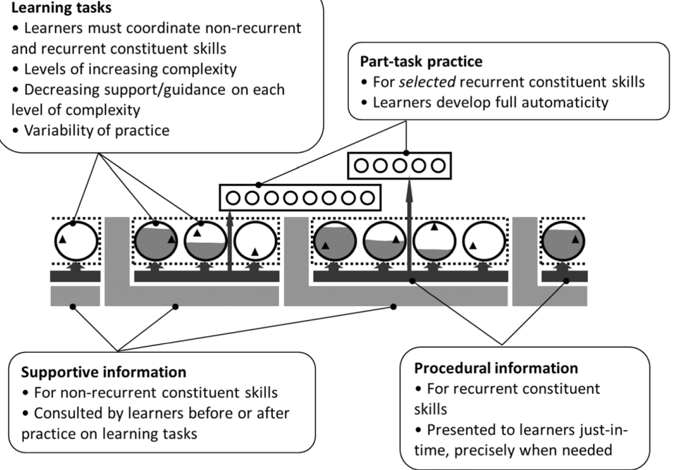
- The paper highlights 4C/ID as an extension of CLT for longer instructional programs and curricula, organized around 4 components: learning tasks, supportive information, procedural information, and part-task practice.
- It reports progress in measuring cognitive load, including a 10-item psychometric instrument that supported distinguishing intrinsic from extraneous load, and objective measures such as EEG, eye tracking, and secondary-task methods.
Methods
- This is a review article that retrospectively synthesizes CLT developments from 1998 to 2018, using the 1998 paper as a baseline and organizing the discussion into history, developments, future directions, and conclusions.
- The authors draw on prior theoretical and empirical studies and reviews cited throughout the paper; no new dataset or sample is reported in the text provided.
- Main analysis is a narrative synthesis of theoretical developments, instructional effects, and measurement approaches in CLT.
Limitations
- The paper explicitly says it is an attempt to summarise the last 20 years of CLT and sketch directions for future research, so it is a synthesis rather than a new empirical test.
- It repeatedly notes that more research is needed on cognitive-load measurement, including the optimal use of subjective rating scales, differentiating load types, and validating objective techniques.
- Evident from the text: several claims about future directions (e.g., resource depletion, self-regulated learning, emotions/stress/uncertainty, human movement) are presented as promising but not yet settled in the paper itself.
Model-written summary. Check it against the paper before relying on it.
Integrity signals
Registry
Cites
Statistics
Figures
Verification
Claims the paper makes
21 Valid · 23 Not valid · 90 Not checked · 158 Own results and interpretations
The sources with a verdict support this claim; the rest weren’t checked yet, have no full text we could read, or their verdicts aren’t rated yet.
In the paper
“Its basic premise is that human cognitive processing is heavily constrained by our limited working memory which can only process a limited number of information elements at a time.”
§ The Author(s) 2019 > Introduction
What the sources say
- Supportedcites Miller (1956) matched to “The magical number seven, plus or minus two: Some limits on our capacity for processing information.” (1956) source
The Summary says that immediate memory imposes severe limits on the information people can receive, process, and remember. The discussion of immediate memory (p. 93) specifies that its limit is the number of chunks, supporting the claim's broad paraphrase of a limited number of information elements at a time. (LLM, conf=0.91)
- Not checked — no full text of the sourcecites Peterson and Peterson (1959) matched to “Short-term retention of individual verbal items.” (1959) source
plainstates a cause- Asserted: passes — The authors put it forward as true.
- Checkable: passes — It can be checked against evidence.
- Load-bearing: passes — The paper’s conclusions depend on it.
- Based: passes — The paper gives a reason why it holds.
- Supported
The cited sources support only part of this claim — read each source’s verdict below.
In the paper
“The capacity and duration limits of working memory have been known at least since Miller (1956) and Peterson and Peterson (1959), although the fact that these limits effectively applied only to novel, not familiar information, seemed more implicit rather than explicit in most treatments.”
§ The Author(s) 2019 > Human Cognitive Architecture Used in 1998
What the sources say
- Partly supportedcites Miller (1956) matched to “The magical number seven, plus or minus two: Some limits on our capacity for processing information.” (1956) sourceExperimental — accuracy not yet measured
In the discussion of immediate memory (p. 93), Miller says its span is limited by the number of chunks and that familiar units allow more information to be packed into each chunk. That supports a distinction between novel material and familiar, recoded material, but not the claim that capacity limits apply only to novel information: the chunk limit remains. The paper also does not establish a duration limit that applies only to novel information. (LLM, conf=0.86)
- Not checked — no full text of the sourcecites Peterson and Peterson (1959) matched to “Short-term retention of individual verbal items.” (1959) source
hedged- Asserted: passes — The authors put it forward as true.
- Checkable: passes — It can be checked against evidence.
- Load-bearing: passes — The paper’s conclusions depend on it.
- Based: passes — The paper gives a reason why it holds.
- Partly supported
Every source the paper cites for this claim was checked and supports it.
In the paper
“The data summarised by Sala and Gobet (2017) provide a major justification for the post 1998 inclusion of evolutionary psychology into cognitive load theory.”
§ The Author(s) 2019 > Human Cognitive Architecture Seen Through the Prism of Evolutionary Psychology
What the sources say
- Supportedcites Sala and Gobet (2017) matched to “Does Far Transfer Exist? Negative Evidence From Chess, Music, and Working Memory Training” (2017) source
The Theoretical and Practical Implications section (page unavailable) summarises the paper’s evidence that chess, music and working-memory training do not reliably produce far transfer. The claim that these data justify a development in cognitive load theory is the citing authors’ interpretation, not a finding attributed to Sala and Gobet. (LLM, conf=0.86)
boostedstates a cause- Asserted: passes — The authors put it forward as true.
- Checkable: passes — It can be checked against evidence.
- Load-bearing: passes — The paper’s conclusions depend on it.
- Based: passes — The paper gives a reason why it holds.
- Supported
Every source the paper cites for this claim was checked and supports it.
In the paper
“The expertise reversal effect is, in essence, a variant of the more general element interactivity effect (Chen et al. 2017).”
§ The Author(s) 2019 > Instructional Effects Described After 1998
What the sources say
- Supportedcites Chen et al. 2017 matched to “The Expertise Reversal Effect is a Variant of the More General Element Interactivity Effect” (2017) source
The indexed copy lists the cited paper under the exact title “The Expertise Reversal Effect is a Variant of the More General Element Interactivity Effect.” Its title directly states the proposition attributed to it; no page number is available in the indexed passage. (LLM, conf=0.90)
plainstates a cause- Asserted: passes — The authors put it forward as true.
- Checkable: passes — It can be checked against evidence.
- Load-bearing: unclear — It is unclear whether the paper’s conclusions depend on it.
- Based: passes — The paper gives a reason why it holds.
- Supported
Every source the paper cites for this claim was checked and supports it.
In the paper
“When subsequently presented the fully integrated information, they only needed to learn how to integrate the individual elements and so more readily assimilated the entire, high element interactivity information.”
§ The Author(s) 2019 > Instructional Effects Described After 1998
What the sources say
- Supportedcites Pollock et al. 2002 matched to “Assimilating complex information” (2002) source
Split into 2 atoms — 2 confirmed, 0 partially supported, 0 disputed, 0 misattributed, 0 unverifiable. Expand the claim to see per-atom verdicts.
plainstates a cause- Asserted: passes — The authors put it forward as true.
- Checkable: passes — It can be checked against evidence.
- Load-bearing: passes — The paper’s conclusions depend on it.
- Based: passes — The paper gives a reason why it holds.
- Supported
132 more claims · 6 with their cited sources checked
Create a free account to see all 292 claims and to verify the 3 references still open.
- It may state two separate claims as one. 88
- Probably not a substantial claim. 95
Claims other papers make about this one
Each is checked against this paper’s own text: does it say what the citing paper says it does?
The source backs part of the claim, not all of it — or backs it for a different population, condition or comparison.
In the citing paper
“Another possible explanation is that the pre-training effect tends to be most effective for learners with minimal prior knowledge (Sweller et al., 2019)”
From Rethinking pre-training: cognitive load implications for learners with varying prior knowledge (2025) · cites this paper as Sweller et al., 2019
Experimental — accuracy not yet measuredThe cited source says what the claim attributes to it.
In the citing paper
“If the cognitive load imposed by a learning task is too high, it might interfere with the learner’s ability to effectively acquire and retain the skill [13, 25].”
From Teaching a single manual therapy technique at a time reduces cognitive load in physiotherapy students: a randomized controlled educational study (2025) · cites this paper as [13]
The cited source says what the claim attributes to it.
In the citing paper
“While cognitive load is often discussed in the context of instructional efficiency, it is important to note that cognitive load is not inherently detrimental. Rather, it is a natural component of learning that engages working memory resources for schema construction and automation [13].”
From Teaching a single manual therapy technique at a time reduces cognitive load in physiotherapy students: a randomized controlled educational study (2025) · cites this paper as [13]
The cited source says what the claim attributes to it.
In the citing paper
“Thus, an increased germane load is no longer believed to lead to cognitive overload and can thus no longer be assumed to be detrimental to learning performance.”
From Understanding Cognitive Load in Digital and Online Learning: a New Perspective on Extraneous Cognitive Load (2022) · cites this paper as Sweller et al., 2019
The cited source says what the claim attributes to it.
In the citing paper
“The major change from the 1998 model is that Sweller et al. (2019) have removed germane load from the additive equation of total load, but rather a dimension now called ' germane processing. '”
From Understanding Cognitive Load in Digital and Online Learning: a New Perspective on Extraneous Cognitive Load (2022) · cites this paper as Sweller et al., 2019
17 more claims about this paper
Create a free account to see every claim other papers make about this one.
Citations
Cites
The magical number seven, plus or minus two: Some limits on our capacity for processing information.
Miller, G. A. (1956) · Psychological Review · doi:10.1037/h0043158 · Cited by 17,812 · cited 1×
“The capacity and duration limits of working memory have been known at least since Miller (1956) and Peterson and Peterson (1959), although the fact that these limits effectively applied only to novel, not familiar information, seemed more implicit rather than explicit in most treatments.”
BackgroundThe magical number seven, plus or minus two: Some limits on our capacity for processing information.
Miller, G. A. (1994) · Psychological Review · doi:10.1037/0033-295x.101.2.343 · Cited by 17,161
Cognitive Load During Problem Solving: Effects on Learning
Sweller, J. (1988) · Cognitive Science · doi:10.1016/0364-0213(88)90023-7 · Cited by 11,048 · cited 4×
“Learning tasks (indicated by the big circles in Fig.”
BackgroundMethodInfluentialSelf-citationKirschner, P. A., Sweller, J., & Clark, R. E. (2006) · Educational Psychologist · doi:10.1207/s15326985ep4102_1 · Cited by 7,776
Self-citationRizzolatti, G., & Craighero, L. (2004) · Annual Review of Neuroscience · doi:10.1146/annurev.neuro.27.070203.144230 · Cited by 7,433
Cognitive Architecture and Instructional Design
Sweller, J., van Merrienboer, J. J. G., & Paas, F. G. W. C. (1998) · Educational Psychology Review · doi:10.1023/a:1022193728205 · Cited by 6,023
Self-citationCognitive load theory, learning difficulty, and instructional design
Sweller, J. (1994) · Learning and Instruction · doi:10.1016/0959-4752(94)90003-5 · Cited by 5,426 · cited 1×
“Element Interactivity Effect This effect was already known in 1998 but as a compound effect, it was not classed as a cognitive load effect (see Sweller 1994).”
BackgroundSelf-citationBaddeley, A. (1992) · Science · doi:10.1126/science.1736359 · Cited by 5,258
Ericsson, K. A., & Kintsch, W. (1995) · Psychological Review · doi:10.1037/0033-295x.102.2.211 · Cited by 3,498
Short-term retention of individual verbal items.
Peterson, L., & Peterson, M. J. (1959) · Journal of Experimental Psychology · doi:10.1037/h0049234 · Cited by 2,939 · cited 1×
“The capacity and duration limits of working memory have been known at least since Miller (1956) and Peterson and Peterson (1959), although the fact that these limits effectively applied only to novel, not familiar information, seemed more implicit rather than explicit in most treatments.”
Background
Research works printed but not linked: 4
- Centre for Education Statistics and Evaluation. (2017). Cognitive load theory: research that teachers really need to understand . Sydney: NSW Department of Education.
- Centre for Education Statistics and Evaluation. (2018). Cognitive load theory in practice . Sydney: NSW Department of Education.
- Clark, R. C. (2014). Evidence-based training methods: a guide for training professionals (2nd ed.). Alexandria: ATD Press.
- Miller, W. (1937). The picture crutch in reading. Elementary English Review, 14 , 263 -264.
Cited by
Items 1,401–1,500 of 2,268
Cognitive Load Theory Principles for Designing a Virtual Physics Environment
Holmer, S., Zander, D., Waye, J., & Jakobsson, K. (2024) · Interaction design & architecture(s)/ID&A Interaction design & architecture(s) · doi:10.55612/s-5002-063-002 · Cited by 2
Guilmois, C., Rohmer, T., & Popa-Roch, M. (2025) · School Effectiveness and School Improvement · doi:10.1080/09243453.2025.2536485 · Cited by 2
“…that for novice learners, studying worked examples demonstrating the solutions of problems in a complex subject matter usually resulted in superior performance over conventionally used classroom practices to find the solution to the same problems (Ashman et al., 2020; Sweller et al., 2019).”
Kalyuga, S., & Plass, J. L. (2025) · Oxford University Press eBooks · doi:10.1093/9780190078539.003.0001 · Cited by 2
Al-Khafaji, M. H., Alabdalhussein, A., Al-Dabbagh, S., Altalaa, A., Alhumairi, G., Abdulwahid, Z., Al-Hasani, A., Baban, J., Al-Ogaidi, M., Hamid, E., et al. (2025) · Healthcare · doi:10.3390/healthcare13222886 · Cited by 2
“Cognitive load theory supports chunked steps, close guidance, and graded complexity, which is why focused skills stations tend to outperform passive lectures for procedures such as nasal cautery or peritonsillar abscess drainage [40,41].”
Bridging theory and practice: enhancing teacher preparation through collaborative partnerships
Coen, A. N., Grove, R., Graybeal, C. D., & Calo, K. M. (2025) · PDS Partners Bridging Research to Practice · doi:10.1108/pdsp-05-2025-0009 · Cited by 1
席, 尊. (2025) · Advances in Education · doi:10.12677/ae.2025.1591746 · Cited by 1
Schnepel, S., Gresch, C., Böhme, K., Lüke, T., & Grosche, M. (2025) · Edition ZfE · doi:10.1007/978-3-658-48603-7_7 · Cited by 1
van Merriënboer, J. J. G., Schaper, N., Hellmann, K., & Kreutz, J. (2019) · Springer eBooks · doi:10.1007/978-3-658-25046-1_4 · Cited by 1
Self-citationConsiderations when designing educational experiences
Woolliscroft, J. O. (2020) · Elsevier eBooks · doi:10.1016/b978-0-12-819620-5.00019-9 · Cited by 1
Visuospatial Processing Decline Due to Cannabis Consumption in Nondependent High School Students
Rodrigo Goycolea, M., Castro-Alonso, J. C., & Dörr, A. P. (2020) · Educational Psychology Review · doi:10.1007/s10648-020-09564-8 · Cited by 5
“Different lapses of time between using cannabis and attempting a cognitive task could also be investigated, considering that stressed or depleted working memory can be replenished after resting (see Chen et al. 2018; see also Leahy and Sweller 2019).”
BackgroundManouchehri, K., Hassanabadi, H., Aghabarary, M., & Kavousian, J. (2020) · Biannual Journal of Contemporary Psychology · doi:10.29252/bjcp.14.2.1 · Cited by 7
Goletti, O. (2021) · ACM Conference on International Computing Education Research (ICER) · doi:10.1145/3446871.3469776 · Cited by 3
“A lot of effects and instructional impact have been proposed by CLT proponents [14].”
BackgroundZhang, Z., Yu, J., Huang, Y., Huang, Y., & Liu, X. (2021) · Lecture notes in computer science · doi:10.1007/978-3-030-92836-0_27 · Cited by 2
Deveci, T., & Saleem, M. (2022) · English language education · doi:10.1007/978-3-030-91881-1_3 · Cited by 4
Designing Multimedia for Improved Student Engagement and Learning: Video Lectures
Singh, K. (2022) · Advances in mobile and distance learning book series · doi:10.4018/978-1-7998-9706-4.ch001 · Cited by 2
Educational time out: A fine line when it comes to Cognitive Load Theory
Wong, K., & Shada, A. L. (2022) · The American Journal of Surgery · doi:10.1016/j.amjsurg.2022.05.038 · Cited by 1
A Review for Neuroimaging Techniques in Multimedia Learning: Methodological Framework
Özel, P., Bayraktar, D. M., Altan, T., Coşkun, V., & Olamat, A. (2022) · Advances in bioinformatics and biomedical engineering book series · doi:10.4018/978-1-6684-3947-0.ch004 · Cited by 1
Learning About Credition: Exploring the Barriers Between Basic and Applied Research
Madzarevic, D. (2022) · Frontiers in Psychology · doi:10.3389/fpsyg.2022.943376 · Cited by 1
Behaviour of True Artificial Peers
Weißkirchen, N., & Böck, R. (2022) · Multimodal Technologies and Interaction · doi:10.3390/mti6080064 · Cited by 1
Schreiter, S., Vogel, M., Rehm, M., & Dörfler, T. (2022) · Springer eBooks · doi:10.1007/978-3-662-63214-7_10 · Cited by 1
Krüger, J. M., Schacht, F., & Bodemer, D. (2023) · MedienPädagogik Zeitschrift für Theorie und Praxis der Medienbildung · doi:10.21240/mpaed/51/2023.01.25.x · Cited by 1
Annotationstools für die kollaborative Arbeit mit Unterrichtsvideos: Eine Übersicht
Dähling, C., & Standop, J. (2021) · BzL - Beiträge zur Lehrerinnen- und Lehrerbildung · doi:10.36950/bzl.39.2021.9230 · Cited by 6
Monitoring and control of the program comprehension teaching in a computer class environment
Gagarin, A. P. (2023) · Perspectives of science and education · doi:10.32744/pse.2023.1.29 · Cited by 3
Widodo, B., Nurhasan, N., Suroto, S., et al. (2023) · IJORER International Journal of Recent Educational Research · doi:10.46245/ijorer.v4i4.337 · Cited by 1
“So the development of cognition is a gradual and orderly change that causes mental processes to become increasingly complex and sophisticated (S. Chen et al., 2021; Gunawardena & Wilson, 2021; Sweller et al., 2019).”
BackgroundEDUCATIONAL EXPERIENCES IN THE RAILWAY INDUSTRY
Farkas, A., Filep, R., & Dajnoki, K. (2023) · Annals of Faculty of Economics · doi:10.47535/1991auoes32(1)053 · Cited by 1
Jaques, P. A. (2023) · Tecnologias Sociedade e Conhecimento · doi:10.20396/tsc.v10i2.18382 · Cited by 3
Wang, J., Du, Y., & Jin, Q. (2026) · Computers and Education Artificial Intelligence · doi:10.1016/j.caeai.2026.100676 · Cited by 1
Lee, B. (2019) · Carleton University's Institutional Repository (MacOdrum Library, Carleton University) · doi:10.22215/etd/2019-13787 · Cited by 1
Pearce, J. (2020) · University of Canterbury Research Repository (University of Canterbury) · doi:10.26021/928 · Cited by 2
Cognitive resilience in bilinguals and its potentiality in dealing with cognitive loadPreprint
Doroud, S., Saeedi, Z., & Radman, N. (2020) · bioRxiv (Cold Spring Harbor Laboratory) · doi:10.1101/2020.09.17.301606 · Cited by 2
“of automaticity, while the complex task requires more complex processes to be performed (Sweller et al., 2019).”
BackgroundWu, C., Liu, Y., Guo, X., Ma, W.-F., & Zhu, T. (2021) · PsyArXiv (OSF Preprints) · doi:10.31234/osf.io/aryud · Cited by 2
Kaufmann, K. (2021) · Institutional Repository (IHS Vienna) · doi:10.26041/fhnw-3740 · Cited by 1
Mayer, R. E., & Fiorella, L. (2021) · Cambridge University Press eBooks · doi:10.1017/9781108894333.007 · Cited by 3
A Case Study in Applying the Learning Sciences to MOOC DesignPreprint
Gordon, D. G., & Wiltrout, M. E. (2019) · EdArXiv (OSF Preprints) · doi:10.35542/osf.io/5eqm3 · Cited by 1
Stereotypes Disrupt Probabilistic Category LearningPreprint
Derreumaux, Y., Elder, J., Suri, G., et al. (2021) · doi:10.31234/osf.io/qr95k · Cited by 1
Romine, W. L., Schroeder, N. L., Edwards, A., & Banerjee, T. (2021) · doi:10.36227/techrxiv.13607291 · Cited by 1
From Movement to Learning: Leveraging Vr Behavioral Metrics to Evaluate Cognitive Load and CuriosityPreprint
Poupard, M., Larrue, F., Bertrand, M. M., et al. (2025) · SSRN Electronic Journal · doi:10.2139/ssrn.5168402 · Cited by 1
Beyond the Screen: Why Immersive Learning Transforms Educational OutcomesPreprint
Westover, J. (2025) · Preprints.org · doi:10.20944/preprints202507.0784.v1 · Cited by 1
Kundu, R. K., Ahmed, I., & Hoque, K. A. (2025) · ACM Symposium on Virtual Reality Software and Technology (VRST) · doi:10.1145/3756884.3766044 · Cited by 2
Cognitive-Aware Plugin for Vulnerability Feedback
Sanders, A. L., Walia, G., & Cordova, L. P. (2025) · Conference on Information Technology Education · doi:10.1145/3769694.3771158
Munz, L. P. M., Neef, C., Preusser, I., & Richert, A. (2025) · International Conference on Human-Agent Interaction (HAI) · doi:10.1145/3765766.3765779 · Cited by 3
Hoerler, R., Christen, J., Bättig-Frey, P., Chow, N., Duce, A. D., Heeb, N., Kaschlik, A., Siegwart, M., Zapata, J., & West, M. (2026) · Research Square · doi:10.21203/rs.3.rs-8506341/v1 · Cited by 1
Études des facteurs cognitifs liés aux outils numériques pour les phases amont de la conception
MILLE, C. (2021) · theses.fr (ABES) · doi:10.70675/e68b85b7ze739z4a22za418zb366d29fc15e · Cited by 1
Weidmann, T. B., Thorgeirsson, S., Weidmann, K.-H., Wang, A. Y., & Su, Z. (2026) · CHI Conference on Human Factors in Computing Systems · doi:10.1145/3772318.3791667 · Cited by 1
From Assistance to Cognition: How Generative AI Reshapes Self-Regulated Learning in Higher EducationPreprint
Chen, P. (2026) · SSRN Electronic Journal · doi:10.2139/ssrn.6584984 · Cited by 1
The Many Faces of Documentation Burden
Doherty, K. (2026) · The American Journal of Bioethics · doi:10.1080/15265161.2026.2690933 · Cited by 1
“…by John Sweller, posits that meaningful learning occurs through the successful codification of information from working memory, the cognitive structures related to immediate processing, to long-term memory, the cognitive structures related to effectively storing information (Sweller et al. 2019).”
Collaborative learning strategies in software engineering course
Chawla, S. (2019) · ResearchOnline - JCU (James Cook University) · Cited by 2
MiNDesign: Toward a Modeling, Simulation and Evaluation Platform for Human Cognitive Performance
Tian, Z., Zhang, L., Wang, X. E., Liu, Y., Li, J., Fu, F., Liao, Z., & Liu, Y. (2020) · Advances in intelligent systems and computing · doi:10.1007/978-3-030-51064-0_25
Infection Prevention and Control Training-Design of a Workbook Prototype
Tamim, S. R., Homsi, M. R., Happ, B., & Caniza, M. A. (2020) · Advances in medical education, research, and ethics (AMERE) book series · doi:10.4018/978-1-7998-5092-2.ch003
What Do I Know and Where Do I Go? The Effects of Guidance on Task Selection
Nugteren, M. L. (2020) · Utrecht University Repository (Utrecht University) · doi:10.33540/85 · Cited by 6
Teaching practice for pandemic times and the empowerment of audiovisual didactic sequences
Rodrigues, C. D. D. S., Sachete, A. D. S., & Rossi, F. (2021) · International Journal for Innovation Education and Research · doi:10.31686/ijier.vol9.iss1.2888
“Instructional design (ID) (Sweller et al., 2019) is an area of activity linked to Education, more precisely, to teaching materials.”
BackgroundChang, P.-H., Cheng, S.-F., Cheng, C.-W., & Tzeng, C.-B. (2020) · IEEE International Conference on Teaching, Assessment, and Learning for Engineering · doi:10.1109/tale48869.2020.9368370 · Cited by 1
“Paas [14] presented that the example-problem pairs conditions significantly outperform the problemexample pairs conditions on the retention and transfer test.”
BackgroundInfluentialKrieglstein, F., Schneider, S., Beege, M., & Rey, G. D. (2021) · Research Square · doi:10.21203/rs.3.rs-467941/v1
“Cognitive load subsumes two additive types: intrinsic and extraneous cognitive load (Jiang & Kalyuga, 2020; Sweller et al., 2019).”
BackgroundCarr-White, N. (2021) · Research Online (Edith Cowan University) · Cited by 1
Implementing regulations to a fleet of vessels
Wideman, K. L. (2021) · Theseus (Ammattikorkeakoulujen)
An Innovative Method of Evaluating Collaborative Learning Design Quality
Zheng, L. (2021) · Lecture notes in educational technology · doi:10.1007/978-981-16-1718-8_9
FASB Disclosure and Bank Loan Contracting: Evidence from Derivative and Hedging FootnotesPreprint
Chen, Y., Zhou, Q., & Han, J. (2021) · SSRN Electronic Journal · doi:10.2139/ssrn.3879459
The Tracing Effect and Its Theoretical Explanations
左, 跟. (2021) · Advances in Psychology · doi:10.12677/ap.2021.119240
حسن, ا. ح. (2021) · تکنولوجيا التعليم سلسلة دراسات وبحوث · doi:10.21608/tesr.2021.196154
Buffering – Please Be Patient! Does the Attribution of Pauses to Technical Issues Hamper Learning?
Merkt, M. (2021) · Frontiers in Psychology · doi:10.3389/fpsyg.2021.771394 · Cited by 2
Moss, B. G., & Garnsey, B. (2021) · Community College Journal of Research and Practice · doi:10.1080/10668926.2021.1990162 · Cited by 1
“And, the overall length of the video was short, which significantly reduced students’ extraneous cognitive load, and included worked examples that have been linked to enhanced learning (Sweller, 2006; Sweller et al., 1998, 2019).”
BackgroundEducational audiovisual text design: empirical evidence and new research perspectives
Ganino, G. (2021) · Research on Education and Media · doi:10.2478/rem-2021-0010 · Cited by 1
“The theories on cognitive load and multimedia learning recall a long tradition of study, which can be placed within the discipline of instructional design (Clark & Lyons, 2010; Mayer, 2009; Sweller, 1988; Sweller et al., 1998, 2019),”
BackgroundMayer, R. E., & Fiorella, L. (2021) · Cambridge University Press eBooks · doi:10.1017/9781108894333.002 · Cited by 2
Students’ Perception of Cognitive Load in an Accelerated DPT Program with a Blended Curriculum
Marinas, R., Groff, S. L., Panesar-Aguilar, S., & Bobbio, T. G. (2022) · Global Journal of Health Science · doi:10.5539/gjhs.v14n2p52 · Cited by 2
“The ability to process information may be determined by how it is organized, indicating that instruction has a significant impact while utilizing extensive cognitive processing can impact the ability to acquire new knowledge (Sweller et al., 2019; Sweller, 1988).”
BackgroundSchlag, M. (2021) · Cerveau & Psycho · doi:10.3917/cerpsy.131.0072
Mukherjee, M., Le, N. T., Tibben, W. J., Thorncharoensri, P., & Shen, J. (2021) · IEEE International Conference on Teaching, Assessment, and Learning for Engineering · doi:10.1109/tale52509.2021.9678607
Learning How to Use a Digital Workbench: Guided or Explorative?
Buchner, J., Vonarx, A.-C., Pfänder, P., & Kerres, M. (2022) · Cognition and exploratory learning in the digital age · doi:10.1007/978-3-030-90944-4_2
“Stored information can then be used in working memory, for example, when new tasks have to be solved (Sweller et al., 1998, 2019).”
Assessing Players’ Cognitive Load in Digital Games with a Time-Based Resource Sharing Memory ModelPreprint
Ramos, A., Couto, M., & Martinho, C. (2022) · SSRN Electronic Journal · doi:10.2139/ssrn.4046419
Distance education: A ruin of health
Razumowsky, A. (2022) · Revista Amazonia Investiga · doi:10.34069/ai/2022.50.02.27 · Cited by 1
Efficiency of using AR-assistant for teaching drawing skills
Гаврилова, Т. А., Bazhina, P. S., Kuprienko, A. A., & Fisun, T. V. (2022) · Perspectives of science and education · doi:10.32744/pse.2022.1.36
Theories of Blended Learning: A Novel Approach to Tertiary Neuroanatomy
Whiting, H., Blackmore, C., Vitali, J., Langfield, T., Colthorpe, K. L., Ernst, H., & Ainscough, L. (2022) · International Journal of Higher Education · doi:10.5430/ijhe.v11n4p192
Buchner, J., Vonarx, A.-C., & Kerres, P. P. A. M. (2020) · Cognition and Exploratory Learning in Digital Age · doi:10.33965/celda2020_202014l003
“This is especially relevant for beginners who have little prior knowledge of a certain domain (Sweller, 1988; Sweller et al., 2019).”
Visual Instructional Design for Effective Learning
(2020) · Advances in educational technologies and instructional design book series · doi:10.4018/978-1-7998-3946-0.ch002
Romine, W. L., Schroeder, N. L., Edwards, A., & Banerjee, T. (2021) · doi:10.36227/techrxiv.13607291.v1 · Cited by 1
Leppink, J. (2020) · Springer texts in education · doi:10.1007/978-3-030-43082-5_1 · Cited by 2
ECLECTICISMO BASADO EN EVIDENCIAS EN LA ENSEÑANZA DE INGLÉS COMO LENGUA EXTRANJERA
Molero-Ramírez, F. J. (2022) · PARADIGMA · doi:10.37618/paradigma.1011-2251.2022.p740-760.id1151
How weak are Romanian clitic pronouns?
Gerstenberger, C.-V. (2022) · Nordlyd · doi:10.7557/12.6341
“A possible explanation is the reduction of cognitive load in language processing, more precisely, the reduction of extraneous (or extrinsic) cognitive load, the cognitive load resulting from the way in which something is presented (cf. Sweller et al. 2019).”
Backgroundالله, د. م. ع. ا. م. ع., & القن, س. د. م. (2021) · بحوث عربية فى مجالات التربية النوعية · doi:10.21608/raes.2021.255490
Scott, K. H. (2022) · MOspace Institutional Repository (University of Missouri) · doi:10.32469/10355/91623 · Cited by 1
Step-by-Step Guide to Creating CBCL Modules
Besche, H. C., Schwartzstein, R. M., King, R. W., Hoenig, M. P., & Cockrill, B. A. (2022) · IAMSE manuals · doi:10.1007/978-3-031-14440-0_2
Orak, C., Küçük, S., & Gülcü, A. (2022) · Research Square · doi:10.21203/rs.3.rs-2079838/v1
Terriault, P., Kozanitis, A., & Farand, P. (2022) · Proceedings of the Canadian Engineering Education Association (CEEA) · doi:10.24908/pceea.vi.15869
“[12]”
Developing an Academic Logistics Course Using the Action Research Approach
Talmor, I., & Reshef, A. (2022) · International Journal of Higher Education · doi:10.5430/ijhe.v11n6p28
Cognitive WarfarePreprint
Pastor, A. (2022) · OSF Preprints (OSF Preprints) · doi:10.31219/osf.io/ynfzr
أبوسريع, ع. أ. (2023) · Al-Mağallah Al-ʿArabiyyaẗ Lil-Qiyās wa Al-Taqwīm · doi:10.21608/ajme.2023.270017
Developing Video Resources in Engineering Education
Dart, S., Cunningham, S., & Gregg, A. (2022) · CRC Press eBooks · doi:10.1201/9781003263180-5
Hefter, M. H., Roelle, J., Renkl, A., & Berthold, K. (2022) · Research and Practice in Technology Enhanced Learning · doi:10.58459/rptel.2023.18008 · Cited by 1
العبء المعرفي وعلاقته بقوة السيطرة المعرفية لدى طالبات جامعة أم القرى
العتيبي, أ. خ., & الحربي, ن. م. س. (2023) · مجلة العلوم التربوية و النفسية · doi:10.26389/ajsrp.r031022 · Cited by 1
Dickson-Deane, C., Heggart, K., & Vanderburg, R. M. (2023) · Springer eBooks · doi:10.1007/978-3-031-23152-0_8 · Cited by 2
Helligsø, A. (2023) · Journal of Problem Based Learning in Higher Education · doi:10.54337/ojs.jpblhe.v11i1.7807
Duchi, L., Servant-Miklos, V. F. C., Kooij, L., & Noordegraaf‐Eelens, L. (2023) · Journal of Problem Based Learning in Higher Education · doi:10.54337/ojs.jpblhe.v11i1.7370 · Cited by 1
Peñaranda, C., & Atienzar, E. A. (2023) · doi:10.7176/jep/14-15-08
Nursing Students’ Learning Support, Outcome, and Satisfaction Towards Online Learning
Ariningpraja, R. T., & Wisnasari, S. (2023) · Jurnal Ilmu Keperawatan (Journal of Nursing Science) · doi:10.21776/ub.jik.2023.011.01.3 · Cited by 2
The Theory of Learning in Micro
Bal, I., Duha, M. S. U., Arslan, O., Collier, J., Marcelle, P., Dolowitz, A. R., Bernhardt, J. B., Swanson, M., & Dash, M. (2022) · doi:10.59668/534.11963 · Cited by 4
Key pedagogical implications of learning sciences research for higher education teaching
López, N. (2023) · The Proceedings of the International Conference on Research in Education, Teaching and Learning. · doi:10.33422/6th.icetl.2023.02.003
Predicting Guesses and Slips Through Question Encoding with Complexity Hints
Carlon, M. K. J., Moon, S., Okazaki, N., & Cross, J. S. (2022) · IEEE International Conference on Teaching, Assessment, and Learning for Engineering · doi:10.1109/tale54877.2022.00054 · Cited by 1
Κριτήρια Ποιότητας Βίντεο για τα Μαζικά Ανοικτά Διαδικτυακά Μαθήματα (MOOCs)
Γιασιράνης, Σ., Σοφός, Α., & Κώστας, Α. (2023) · Open Journal of Animation Film and Interactive Media in Education and Culture [AFIMinEC] · doi:10.12681/afiinmec.34574 · Cited by 2
Cognitive warfarePreprint
Pastor, A. (2023) · PsyArXiv (OSF Preprints) · doi:10.31234/osf.io/zgsej · Cited by 1
Lee, H., Choi, Y., & Kim, T. (2023) · Asia-pacific Journal of Convergent Research Interchange · doi:10.47116/apjcri.2023.06.43
Metadata
- Authors
- Sweller, J., van Merriënboer, J. J. G., & Paas, F.
- Affiliations
- UNSW Sydney (AU)
- University of Wollongong (AU)
- Corresponding author
- Sweller, John
- Venue
- Educational Psychology Review
- Published
- 2019-01-22
- Volume
- 31
- Issue
- 2
- Pages
- 261-292
- ISSN
- 1040-726X (ISSN-L)
- 1573-336X
- OpenAlex
- W2913144876
- Semantic Scholar
- e28d73214751d51c3f46a867920be41c49c45130
- Cited by
- 2,337
- References
- 129
- Citations by year
- 2026: 713 · 2025: 466 · 2024: 331 · 2023: 268 · 2022: 212 · 2021: 190 · 2020: 114 · 2019: 37
- FWCI
- 162.54
- Type
- journal article
- Language
- en
- Open access
- hybrid
- doi.org
- Licence
- cc-by
- creativecommons.org/licenses/by/4.0 (tdm)
- Locations
- Educational Psychology Review (publishedVersion, cc-by)
- EUR Research Repository (Erasmus University Rotterdam) (publishedVersion, other-oa)
- Research Online (University of Wollongong) (submittedVersion)
- EUR Research Repository (Erasmus University Rotterdam) (submittedVersion)
- Research Publications (Maastricht University) (submittedVersion, cc-by)
- Figshare (submittedVersion, cc-by)
- Research Publications (Maastricht University) (submittedVersion, other-oa)
- Topics
- Social Sciences › Psychology › Experimental and Cognitive Psychology › Visual and Cognitive Learning Processes
- Social Sciences › Psychology › Developmental and Educational Psychology › Innovative Teaching and Learning Methods
- Life Sciences › Neuroscience › Cognitive Neuroscience › Neuroscience, Education and Cognitive Function
- Keywords
- cognitive load theory, cognitive architecture, working memory, long-term memory, instructional design
About these checks
Registry, retraction, Cites and statistics results are computed, not judged, with one exception: a printed reference that no index lists is read once by a model before it counts as a citation error. Claims are extracted by a model and kept only when their quote appears verbatim in the text; each cited source is then checked, with a model’s help, for whether it says what the claim relies on. Those verdicts can be wrong — read the claim’s quote and the cited source before relying on one.
The claim verdicts this report counts are experimental: their accuracy is not yet measured.
A language model drew the claims from the paper on 2026-10-10, under version 3 of the claim definition (model deepseek-v4.1-flash, prompt extract-v3).
A second model labelled each claim on 2026-10-10 (model jev-1.13-20260917, definition revision gold-guideline-v0.2).
Cited sources are checked with a language model’s help (gpt-6-sol).
Statistics and arithmetic are recomputed, not judged.
Confidence bands are shown only for fields calibrated on our annotated test set. None is calibrated yet, so no band is shown.
What counts as a claim ›How we measure confidence ›How we check this ›
Are you an author, or do you see a problem with this page? Request a review
Data sources
Bibliographic data: Semantic Scholar, OpenAlex, Crossref.
Contains information from the Semantic Scholar Academic Graph Datasets, made available under the ODC Attribution License (ODC-BY 1.0).
Semantic Scholar’s data is described in: Kinney, R., et al. (2023). The Semantic Scholar Open Data Platform. arXiv:2301.10140.
