

Cognitive Architecture and Instructional Design: 20 Years Later
Open accessThe DOI matches its Crossref record; 127 of the 129 references it cites were found in a registry or an index, and 1 are not checked yet; 22 of the 116 sources its claims cite were checked for support.
Abstract
Cognitive load theory was introduced in the 1980s as an instructional design theory based on several uncontroversial aspects of human cognitive architecture. Our knowledge of many of the characteristics of working memory, long-term memory and the relations between them had been well-established for many decades prior to the introduction of the theory. Curiously, this knowledge had had a limited impact on the field of instructional design with most instructional design recommendations proceeding as though working memory and long-term memory did not exist. In contrast, cognitive load theory emphasised that all novel information first is processed by a capacity and duration limited working memory and then stored in an unlimited long-term memory for later use. Once information is stored in long-term memory, the capacity and duration limits of working memory disappear transforming our ability to function. By the late 1990s, sufficient data had been collected using the theory to warrant an extended analysis resulting in the publication of Sweller et al. (Educational Psychology Review, 10, 251–296, 1998). Extensive further theoretical and empirical work have been carried out since that time and this paper is an attempt to summarise the last 20 years of cognitive load theory and to sketch directions for future research.
Verified 2026-11-25 · 1 reference not checked yet
Overview
CoChat Summary
TL;DR
This review argues that cognitive load theory (CLT) has substantially advanced since its 1998 summary, with new theoretical grounding, new instructional effects, and improved measurement approaches. It also frames future work around working-memory resource depletion, self-regulated learning, emotions/stress/uncertainty, and human movement.
Key findings
- The paper states that the 1998 article reported 7 cognitive load effects, and that 8 new effects were added in the 1998–2018 period, including compound effects.
- It says CLT’s theoretical basis was strengthened by grounding human cognitive architecture in evolutionary psychology, especially Geary’s distinction between biologically primary and biologically secondary knowledge.
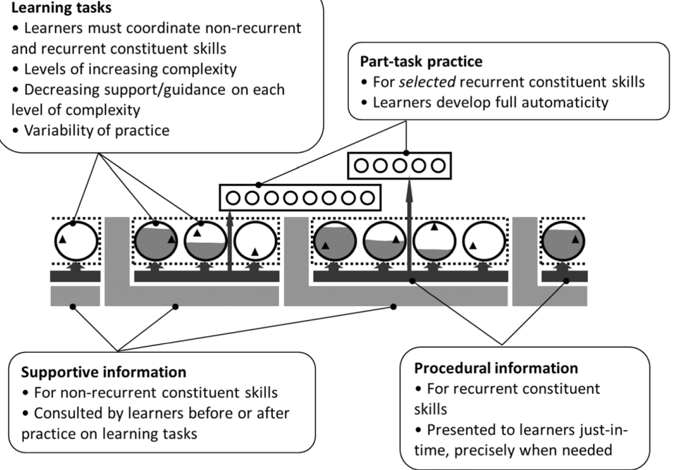
- The paper highlights 4C/ID as an extension of CLT for longer instructional programs and curricula, organized around 4 components: learning tasks, supportive information, procedural information, and part-task practice.
- It reports progress in measuring cognitive load, including a 10-item psychometric instrument that supported distinguishing intrinsic from extraneous load, and objective measures such as EEG, eye tracking, and secondary-task methods.
Methods
- This is a review article that retrospectively synthesizes CLT developments from 1998 to 2018, using the 1998 paper as a baseline and organizing the discussion into history, developments, future directions, and conclusions.
- The authors draw on prior theoretical and empirical studies and reviews cited throughout the paper; no new dataset or sample is reported in the text provided.
- Main analysis is a narrative synthesis of theoretical developments, instructional effects, and measurement approaches in CLT.
Limitations
- The paper explicitly says it is an attempt to summarise the last 20 years of CLT and sketch directions for future research, so it is a synthesis rather than a new empirical test.
- It repeatedly notes that more research is needed on cognitive-load measurement, including the optimal use of subjective rating scales, differentiating load types, and validating objective techniques.
- Evident from the text: several claims about future directions (e.g., resource depletion, self-regulated learning, emotions/stress/uncertainty, human movement) are presented as promising but not yet settled in the paper itself.
Model-written summary. Check it against the paper before relying on it.
Integrity signals
Registry
Cites
Statistics
Figures
Verification
Claims the paper makes
21 Valid · 23 Not valid · 90 Not checked · 158 Own results and interpretations
The sources with a verdict support this claim; the rest weren’t checked yet, have no full text we could read, or their verdicts aren’t rated yet.
In the paper
“Its basic premise is that human cognitive processing is heavily constrained by our limited working memory which can only process a limited number of information elements at a time.”
§ The Author(s) 2019 > Introduction
What the sources say
- Supportedcites Miller (1956) matched to “The magical number seven, plus or minus two: Some limits on our capacity for processing information.” (1956) source
The Summary says that immediate memory imposes severe limits on the information people can receive, process, and remember. The discussion of immediate memory (p. 93) specifies that its limit is the number of chunks, supporting the claim's broad paraphrase of a limited number of information elements at a time. (LLM, conf=0.91)
- Not checked — no full text of the sourcecites Peterson and Peterson (1959) matched to “Short-term retention of individual verbal items.” (1959) source
plainstates a cause- Asserted: passes — The authors put it forward as true.
- Checkable: passes — It can be checked against evidence.
- Load-bearing: passes — The paper’s conclusions depend on it.
- Based: passes — The paper gives a reason why it holds.
- Supported
The cited sources support only part of this claim — read each source’s verdict below.
In the paper
“The capacity and duration limits of working memory have been known at least since Miller (1956) and Peterson and Peterson (1959), although the fact that these limits effectively applied only to novel, not familiar information, seemed more implicit rather than explicit in most treatments.”
§ The Author(s) 2019 > Human Cognitive Architecture Used in 1998
What the sources say
- Partly supportedcites Miller (1956) matched to “The magical number seven, plus or minus two: Some limits on our capacity for processing information.” (1956) sourceExperimental — accuracy not yet measured
In the discussion of immediate memory (p. 93), Miller says its span is limited by the number of chunks and that familiar units allow more information to be packed into each chunk. That supports a distinction between novel material and familiar, recoded material, but not the claim that capacity limits apply only to novel information: the chunk limit remains. The paper also does not establish a duration limit that applies only to novel information. (LLM, conf=0.86)
- Not checked — no full text of the sourcecites Peterson and Peterson (1959) matched to “Short-term retention of individual verbal items.” (1959) source
hedged- Asserted: passes — The authors put it forward as true.
- Checkable: passes — It can be checked against evidence.
- Load-bearing: passes — The paper’s conclusions depend on it.
- Based: passes — The paper gives a reason why it holds.
- Partly supported
Every source the paper cites for this claim was checked and supports it.
In the paper
“The data summarised by Sala and Gobet (2017) provide a major justification for the post 1998 inclusion of evolutionary psychology into cognitive load theory.”
§ The Author(s) 2019 > Human Cognitive Architecture Seen Through the Prism of Evolutionary Psychology
What the sources say
- Supportedcites Sala and Gobet (2017) matched to “Does Far Transfer Exist? Negative Evidence From Chess, Music, and Working Memory Training” (2017) source
The Theoretical and Practical Implications section (page unavailable) summarises the paper’s evidence that chess, music and working-memory training do not reliably produce far transfer. The claim that these data justify a development in cognitive load theory is the citing authors’ interpretation, not a finding attributed to Sala and Gobet. (LLM, conf=0.86)
boostedstates a cause- Asserted: passes — The authors put it forward as true.
- Checkable: passes — It can be checked against evidence.
- Load-bearing: passes — The paper’s conclusions depend on it.
- Based: passes — The paper gives a reason why it holds.
- Supported
Every source the paper cites for this claim was checked and supports it.
In the paper
“The expertise reversal effect is, in essence, a variant of the more general element interactivity effect (Chen et al. 2017).”
§ The Author(s) 2019 > Instructional Effects Described After 1998
What the sources say
- Supportedcites Chen et al. 2017 matched to “The Expertise Reversal Effect is a Variant of the More General Element Interactivity Effect” (2017) source
The indexed copy lists the cited paper under the exact title “The Expertise Reversal Effect is a Variant of the More General Element Interactivity Effect.” Its title directly states the proposition attributed to it; no page number is available in the indexed passage. (LLM, conf=0.90)
plainstates a cause- Asserted: passes — The authors put it forward as true.
- Checkable: passes — It can be checked against evidence.
- Load-bearing: unclear — It is unclear whether the paper’s conclusions depend on it.
- Based: passes — The paper gives a reason why it holds.
- Supported
Every source the paper cites for this claim was checked and supports it.
In the paper
“When subsequently presented the fully integrated information, they only needed to learn how to integrate the individual elements and so more readily assimilated the entire, high element interactivity information.”
§ The Author(s) 2019 > Instructional Effects Described After 1998
What the sources say
- Supportedcites Pollock et al. 2002 matched to “Assimilating complex information” (2002) source
Split into 2 atoms — 2 confirmed, 0 partially supported, 0 disputed, 0 misattributed, 0 unverifiable. Expand the claim to see per-atom verdicts.
plainstates a cause- Asserted: passes — The authors put it forward as true.
- Checkable: passes — It can be checked against evidence.
- Load-bearing: passes — The paper’s conclusions depend on it.
- Based: passes — The paper gives a reason why it holds.
- Supported
132 more claims · 6 with their cited sources checked
Create a free account to see all 292 claims and to verify the 3 references still open.
- It may state two separate claims as one. 88
- Probably not a substantial claim. 95
Claims other papers make about this one
Each is checked against this paper’s own text: does it say what the citing paper says it does?
The source backs part of the claim, not all of it — or backs it for a different population, condition or comparison.
In the citing paper
“Another possible explanation is that the pre-training effect tends to be most effective for learners with minimal prior knowledge (Sweller et al., 2019)”
From Rethinking pre-training: cognitive load implications for learners with varying prior knowledge (2025) · cites this paper as Sweller et al., 2019
Experimental — accuracy not yet measuredThe cited source says what the claim attributes to it.
In the citing paper
“If the cognitive load imposed by a learning task is too high, it might interfere with the learner’s ability to effectively acquire and retain the skill [13, 25].”
From Teaching a single manual therapy technique at a time reduces cognitive load in physiotherapy students: a randomized controlled educational study (2025) · cites this paper as [13]
The cited source says what the claim attributes to it.
In the citing paper
“While cognitive load is often discussed in the context of instructional efficiency, it is important to note that cognitive load is not inherently detrimental. Rather, it is a natural component of learning that engages working memory resources for schema construction and automation [13].”
From Teaching a single manual therapy technique at a time reduces cognitive load in physiotherapy students: a randomized controlled educational study (2025) · cites this paper as [13]
The cited source says what the claim attributes to it.
In the citing paper
“Thus, an increased germane load is no longer believed to lead to cognitive overload and can thus no longer be assumed to be detrimental to learning performance.”
From Understanding Cognitive Load in Digital and Online Learning: a New Perspective on Extraneous Cognitive Load (2022) · cites this paper as Sweller et al., 2019
The cited source says what the claim attributes to it.
In the citing paper
“The major change from the 1998 model is that Sweller et al. (2019) have removed germane load from the additive equation of total load, but rather a dimension now called ' germane processing. '”
From Understanding Cognitive Load in Digital and Online Learning: a New Perspective on Extraneous Cognitive Load (2022) · cites this paper as Sweller et al., 2019
17 more claims about this paper
Create a free account to see every claim other papers make about this one.
Citations
Cites
The magical number seven, plus or minus two: Some limits on our capacity for processing information.
Miller, G. A. (1956) · Psychological Review · doi:10.1037/h0043158 · Cited by 17,812 · cited 1×
“The capacity and duration limits of working memory have been known at least since Miller (1956) and Peterson and Peterson (1959), although the fact that these limits effectively applied only to novel, not familiar information, seemed more implicit rather than explicit in most treatments.”
BackgroundThe magical number seven, plus or minus two: Some limits on our capacity for processing information.
Miller, G. A. (1994) · Psychological Review · doi:10.1037/0033-295x.101.2.343 · Cited by 17,161
Cognitive Load During Problem Solving: Effects on Learning
Sweller, J. (1988) · Cognitive Science · doi:10.1016/0364-0213(88)90023-7 · Cited by 11,048 · cited 4×
“Learning tasks (indicated by the big circles in Fig.”
BackgroundMethodInfluentialSelf-citationKirschner, P. A., Sweller, J., & Clark, R. E. (2006) · Educational Psychologist · doi:10.1207/s15326985ep4102_1 · Cited by 7,776
Self-citationRizzolatti, G., & Craighero, L. (2004) · Annual Review of Neuroscience · doi:10.1146/annurev.neuro.27.070203.144230 · Cited by 7,433
Cognitive Architecture and Instructional Design
Sweller, J., van Merrienboer, J. J. G., & Paas, F. G. W. C. (1998) · Educational Psychology Review · doi:10.1023/a:1022193728205 · Cited by 6,023
Self-citationCognitive load theory, learning difficulty, and instructional design
Sweller, J. (1994) · Learning and Instruction · doi:10.1016/0959-4752(94)90003-5 · Cited by 5,426 · cited 1×
“Element Interactivity Effect This effect was already known in 1998 but as a compound effect, it was not classed as a cognitive load effect (see Sweller 1994).”
BackgroundSelf-citationBaddeley, A. (1992) · Science · doi:10.1126/science.1736359 · Cited by 5,258
Ericsson, K. A., & Kintsch, W. (1995) · Psychological Review · doi:10.1037/0033-295x.102.2.211 · Cited by 3,498
Short-term retention of individual verbal items.
Peterson, L., & Peterson, M. J. (1959) · Journal of Experimental Psychology · doi:10.1037/h0049234 · Cited by 2,939 · cited 1×
“The capacity and duration limits of working memory have been known at least since Miller (1956) and Peterson and Peterson (1959), although the fact that these limits effectively applied only to novel, not familiar information, seemed more implicit rather than explicit in most treatments.”
Background
Research works printed but not linked: 4
- Centre for Education Statistics and Evaluation. (2017). Cognitive load theory: research that teachers really need to understand . Sydney: NSW Department of Education.
- Centre for Education Statistics and Evaluation. (2018). Cognitive load theory in practice . Sydney: NSW Department of Education.
- Clark, R. C. (2014). Evidence-based training methods: a guide for training professionals (2nd ed.). Alexandria: ATD Press.
- Miller, W. (1937). The picture crutch in reading. Elementary English Review, 14 , 263 -264.
Cited by
Items 1,501–1,600 of 2,268
Creative Reasoning Ability of Students Based on Intrinsic Cognitive Load
Agusti, F. A., & Suhendra, S. (2023) · Jurnal Analisa · doi:10.15575/ja.v9i1.26527
“Sweller et al. (2019) state that a high level of interactive elements in the problem-solving process increases a person's cognitive load, so he has difficulty understanding learning material.”
Backgroundأحمد, ب. م. م., إبراهيم, أ. ج. أ., & محمـــــــــــــد, خ. ا. ع. (2023) · التربية (الأزهر) مجلة علمية محکمة للبحوث التربوية والنفسية والاجتماعية) · doi:10.21608/jsrep.2023.310595
Aldabbas, A. H. M., Al-Omari, O., Bisharah, M. M., et al. (2023) · Civil Engineering and Architecture · doi:10.13189/cea.2023.110517
Design and Development of Hybrid Instructional Materials: A Theoretical Framework
Şendurur, E., & Şendurur, P. (2023) · Advances in higher education and professional development book series · doi:10.4018/978-1-6684-8656-6.ch002 · Cited by 1
Forschungssynthesen in der Mediendidaktik Ansätze und Herausforderungen
Bedenlier, S., Buntins, K., Wilmers, A., & Kerres, M. (2023) · MedienPädagogik Zeitschrift für Theorie und Praxis der Medienbildung · doi:10.21240/mpaed/54.x
Trilisiana, N., Haryanto, H., Pujiriyanto, P., Kurniawati, W., & Sulaimon, J. T. (2023) · Jurnal Inovasi Teknologi Pendidikan · doi:10.21831/jitp.v10i2.61752 · Cited by 2
“Information presented without regard to the characteristics of working memory can increase the extraneous load, forcing students to give extra effort to stay focused, concentrated, and motivated in learning (Sweller et al., 2019).”
BackgroundHarnessing open science practices to teach ecology and evolution using interactive tutorialsPreprint
Griffith, J., Houghton, E., Slein, M. A., Franco, M. F., Chávez, J., Forsythe, A. B., Glynn, V. M., Katkov, E., Palmier, K. M., Sang, Z., et al. (2023) · doi:10.32942/x25c80
Jahrbuch der berufs- und wirtschaftspädagogischen Forschung 2023
:null (2023) · Verlag Barbara Budrich eBooks · doi:10.3224/84742719 · Cited by 3
Advantages and limitations of immerisve virtual reality educational applications in learning
Cruz, D. C. (2022) · Repositorio Institucional de la Universidad de Burgos (University of Burgos) · doi:10.36443/10259/7785
Ngu, B. H., Phan, H. P., Hong, K. S., & Usop, H. H. (2023) · Asian Journal for Mathematics Education · doi:10.1177/27527263231194470 · Cited by 3
“Multiple empirical studies have af fi rmed the merit of worked examples to facilitate learning across different discipline areas (Hoogerheide & Roelle, 2020; Renkl, 2017; Sweller et al., 2019).”
BackgroundMethodInfluentialJahrbuch der berufs- und wirtschaftspädagogischen Forschung 2023
Kögler, K., Kremer, H.-H., & Herkner, V. (2023) · Verlag Barbara Budrich eBooks · doi:10.2307/jj.7418738 · Cited by 3
Cognitive Load measurement by using a concurrent multitasking simulation game
Larraga-García, B., Bejerano, V. R., & Gutiérrez, Á. (2023) · RUC (Universidade Da Coruña) · doi:10.17979/spudc.9788497498609.059
van Dooren, E. (2020) · Architecture and the Built Environment · doi:10.59490/abe.2020.17.5351
Orak, C., Küçük, S., & Gülcü, A. (2023) · Öğretim Teknolojisi ve Hayat Boyu Öğrenme Dergisi - Instructional Technology and Lifelong Learning · doi:10.52911/itall.1344964
اليقظة العقلية والعبء المعرفي لدى التلاميذ ذوي صعوبات القراءة والعاديين (دراسة ارتباطية مقارنة)
البهنساوي, أ. ك., الله, ا. إ. م. ح., & الحليم, أ. ع. ع. ا. ع. (2023) · مجلة الإرشاد النفسی · doi:10.21608/cpc.2023.331265
Χατζηνικόλα, Χ., Markouzis, D., & Παπαβασιλείου, Β. (2023) · 13o Πανελλήνιο Συνέδριο της Διδακτικής των Φυσικών Επιστημών και Νέων Τεχνολογιών στην Εκπαίδευση · doi:10.12681/codiste.5276
Mengelkamp, C. (2023) · Springer eBooks · doi:10.1007/978-3-662-66608-1_9
Ünal, E. (2023) · International Journal of Languages Education · doi:10.29228/ijlet.73882 · Cited by 1
الكفاءة السيكومترية لمقياس العبء المعرفي المدرك لدى طلاب المدارس الاعدادية بمحافظة الوادي الجديد
احمد, أ. ر. ع. م., & جادالله, أ. م. د. ش. م. (2023) · Maǧallaẗ Kulliyyaẗ Al-Adāb bi Al-Wadī Al-Ǧadīd/Maǧallaẗ Kulliyyaẗ Al-Adāb bi Al-Wadī Al-Ǧadīd · doi:10.21608/mkwn.2023.331995
Barros, D. M. V., Nobre, A., Mora, A. C., et al. (2024) · Advances in human resources management and organizational development book series · doi:10.4018/979-8-3693-0556-0.ch011
Qualitative Descriptive Study on the Use of Instructional Videos by Undergraduate StudentsPreprint
McFerren, B. P. (2024) · Research Square · doi:10.21203/rs.3.rs-3832576/v1
Khan, S. U. D., Hameed, R. M., Zahid, N., & Raja, A. R. M. (2023) · Bulletin of Business and Economics (BBE) · doi:10.61506/01.00082 · Cited by 6
Meier, J., Hesse, P., Abele, S., Renkl, A., & Glogger‐Frey, I. (2024) · doi:10.31234/osf.io/jd7pz
Zhou, J., & Zhong, L. (2024) · Journal of Cognitive Psychology · doi:10.1080/20445911.2024.2314976
“Previous studies have demonstrated the interaction between recurrent skills and non-recurrent skills, which in fl uence students ’ cognitive load and capacity (Sweller et al., 2019; Van Merriënboer, 2013; Zhong & Xu, 2019).”
BackgroundThe VAST Collaborative Multimodal Annotation Platform: Annotating Values
Petasis, G., Ruskov, M., Gradou, A., & Kokol, M. (2024) · Lecture notes in networks and systems · doi:10.1007/978-3-031-45651-0_21
محمد, م. م. (2023) · مجلة دراسات تربوية واجتماعية · doi:10.21608/jsu.2023.341720
Pinchas‐Mizrachi, R., Zalcman, B. G., Bakshi, R., et al. (2024) · Nurse Education Today · doi:10.1016/j.nedt.2024.106149
A vasútszakmai oktatás fejlesztési lehetőségei
Farkas, A., Filep, R., & Dajnoki, K. (2023) · Studia Mundi - Economica · doi:10.18531/sme.vol.10.no.4.pp.58-70
Березнер, Т., & Горбунова, Е. (2022) · The Russian Journal of Cognitive Science · doi:10.47010/22.3-4.1
Preposiciones espacio-temporales en inglés como L2 desde la corporeidad
Kartsevski, M., & Lazcano, Í. (2024) · Revista de Estudios y Experiencias en Educación · doi:10.21703/rexe.v23i51.1708 · Cited by 1
Xi, H., & Sakti, S. (2023) · Conference of the Oriental COCOSDA International Committee for the Co-ordination and Standardisation of Speech Databases and Assessment Techniques (O-COCOSDA) · doi:10.1109/o-cocosda60357.2023.10482968
Bendig, H. (2024) · ACM International Conference on Intelligent User Interfaces (IUI) · doi:10.1145/3640544.3645244
“An example could be the reduction of factors to prevent cognitive overload [19].”
BackgroundHahn, L. (2024) · eDiss (Georg-August-Universität Göttingen) · doi:10.53846/goediss-10447 · Cited by 1
Ganino, G., & Agrati, L. S. (2024) · Advances in information quality and management · doi:10.4018/978-1-6684-7366-5.ch081
Demetrion, G. (2024) · Springer eBooks · doi:10.1007/978-3-031-57069-8_3
Underlying Theories and Operative Assumptions of M. David Merrill
Demetrion, G. (2024) · Springer eBooks · doi:10.1007/978-3-031-57069-8_2
Ressourcenorientiert Testen? Effekte des Instruktionsdesigns auf die Testleistung
Schulze, S., & Kühl, J. (2024) · Zeitschrift für Pädagogische Psychologie · doi:10.1024/1010-0652/a000386 · Cited by 1
Li, X., Tse, Y. K., & Bu, X. (2024) · SSRN Electronic Journal · doi:10.2139/ssrn.4846297
Salim, C. A. (2024) · Logos Verlag Berlin eBooks · doi:10.30819/5787
(2024) · Tourism social science series · doi:10.1108/s1571-504320240000027032
Krüger, J. M., & Ramm, S. (2024) · International Conference of the Immersive Learning Research Network (iLRN) · doi:10.56198/5m1rh5seq · Cited by 2
Research on the Impact of New Media Literacy on Vr Journalism Learning EffectPreprint
Ma, Z., & Wu, H. (2024) · SSRN Electronic Journal · doi:10.2139/ssrn.4860907
Fostering Academic Honesty for E-Content
Saluja, S., Singh, A., & Sharma, S. (2024) · Advances in educational technologies and instructional design book series · doi:10.4018/979-8-3693-3015-9.ch005 · Cited by 1
The Influence of Single-Channel Disfluency in Two-Channel Video Learning Materials
熊, 雪. (2024) · Advances in Social Sciences · doi:10.12677/ass.2024.136503
Measles, S. (2024) · University of North Texas Digital Library (University of North Texas) · doi:10.12794/metadc2332652 · Cited by 1
Krieglstein, F., Schmitz, M., Wesenberg, L., Spitzer, M., & Rey, G. D. (2024) · Research Square · doi:10.21203/rs.3.rs-4598970/v1
Noticeability of Stencils: The Case of Kadıköy Caferağa
Çıtak, K., & Tüker, Ç. (2024) · Visual Communication Quarterly · doi:10.1080/15551393.2024.2382071
Gupta, R. (2023) · International Journal of Complementary & Alternative Medicine · doi:10.15406/ijcam.2023.16.00650 · Cited by 1
Online Instructional Videos: Effects of Presentation Format on Comprehension and Metacomprehension
Burín, D. I., González, F., Marrujo, J. G., & Martínez, M. A. (2024) · The Journal of Experimental Education · doi:10.1080/00220973.2024.2376606
“…are beneficial for learning has been qualified and questioned through extensive experimental research in multimedia learning within the Cognitive Theory of Multimedia Learning (Mayer, 2021, 2022) and Cognitive Load Theory (Paas & Sweller, 2022; Sweller et al., 2019), which we will review below.”
InfluentialDesenvolvimento de vídeos curtos em Biologia Celular e Molecular: Um estudo de caso
Lima, D. N. E., & Araújo-Santos, T. (2024) · Revista de Ensino de Bioquímica · doi:10.16923/reb.v22i1.1079
Augmented Reality for Education: A Bibliometric Analysis Using VOSviewer
Astuti, R. D. (2024) · Nusantara Journal of Education and Social Science · doi:10.69959/nujess.v1i2.57
“Psychological aspects in teaching include mental skills, instructional design, and motor skills as well as psychological learning aspects based on cognitive strategies (Sweller et al., 2019).”
BackgroundHilliger, I., Castro, M., Torres, E., et al. (2024) · ASEE Annual Conference & Exposition · doi:10.18260/1-2--48209
High School Students’ Perspectives on Mathematical Modeling in the Engineering Design Process (RTP)
Wu, J., Léger, N., & Klein-Gardner, S. S. (2024) · ASEE Annual Conference & Exposition · doi:10.18260/1-2--47528
The MKM: Identify and Assess Complexity and Prior Knowledge in Your Math Didactics
Miró, À., Alier, M., & Serrano, J. M. (2024) · Lecture notes in educational technology · doi:10.1007/978-981-97-1814-6_110
The Role of Reflection in Educational Games. Developing Skills for This New Millennium
Pacheco-Velazquez, E. A., Glasserman‐Morales, L. D., Ramirez-Echeverri, S., & Carlos-Arroyo, M. (2024) · Lecture notes in educational technology · doi:10.1007/978-981-97-1814-6_4
Lee, W. L., Jayaveloo, V. D., Chai, S. T., Ibrahim, R., & Mulud, Z. A. (2024) · Educational Gerontology · doi:10.1080/03601277.2024.2389356
“This outcome aligns with the Cognitive Load Theory, which suggests that the effectiveness of learning modalities (e.g., visual, auditory, or kinesthetics) is influenced by the cognitive demands placed on learners (O’Connor et al., 2022; Sweller et al., 2019).”
Self-Regulated Learning Theory and Its Teaching Practice
黎, 泳. (2024) · Advances in Psychology · doi:10.12677/ap.2024.148611
Morineau, T., & Jaffrelot, M. (2024) · Wiley eBooks · doi:10.1002/9781394317219.refs
The effect of cumulative eye movements’ guidance of experts on transition from novice to expert
Çalişkan, N. Y., & Şendurur, E. (2024) · Educational Technology Research and Development · doi:10.1007/s11423-024-10414-5 · Cited by 2
“Germane load, in its earlier form, was considered a contributor to total cognitive load, but in its recent form, it is assumed to be a redistributor of working memory resources (Sweller et al., 2019).”
InfluentialChoi, S., Kim, D., & Song, J. (2024) · Educational Technology Research and Development · doi:10.1007/s11423-024-10421-6 · Cited by 1
“Sweller et al. (2019) proposed a traditional method of regulating interactions among the constituent skills.”
InfluentialThe Impact of Stored Color Knowledge on Learning and Cognitive Load in a Multimedia Context
Knox, A. (2024) · University of North Texas Digital Library (University of North Texas) · doi:10.12794/metadc2356143
Anatomy of Educational Innovations Based on Learning by Discovery in Higher Education
Ruisoto, P., Contador, I., Quintero-Ponce, E., López, J. C., Álvarez, B., Cacho, R., & Fernández‐Calvo, B. (2024) · Papeles del Psicólogo - Psychologist Papers · doi:10.23923/pap.psicol.3044 · Cited by 1
Goletti, O., Mens, K., & Hermans, F. (2024) · ACM SIGPLAN International Symposium on SPLASH-E (SPLASH-E) · doi:10.1145/3689493.3689986
“Based on educational theories of cognitive load theory [31, 32] and learning transfer [4, 34] and their impact on instruction design [16, 33], we decided to integrate subgoal learning (SL) [5, 18] in a CS1 programming course that uses a problem-based learning methodology.”
Comprendere un testo su carta o su schermo: il ruolo delle Funzioni Esecutive in età scolare
Ruffini, C. (2024) · Studies on adult learning and education/Studies on Adult Learning and Education · doi:10.36253/979-12-215-0504-7.11
Reducing Cognitive Load Through Content Architecture in VR
Horváth, I., Berki, B., Sudár, A., Csapó, Á., & Bárányi, P. (2024) · Studies in big data · doi:10.1007/978-3-031-68130-1_12 · Cited by 2
Pivneva, S. V., Grebennikova, V. M., Nikitina, N. I., et al. (2024) · Samara Journal of Science · doi:10.55355/snv2024132309
Kautzmann, T. R., Ramos, G. D. O., & Jaques, P. A. (2024) · Revista Brasileira de Informática na Educação · doi:10.5753/rbie.2024.3437
Bartonicek, A., Urbanek, S., & Murrell, P. R. (2025) · Journal of Computational and Graphical Statistics · doi:10.1080/10618600.2024.2429708 · Cited by 2
Blinova, E. N., & Shcherbakova, O. (2024) · Psikhologicheskii zhurnal · doi:10.31857/s0205959224050052 · Cited by 2
Beyond the "Wow" factor: Using Generative AI for Increasing Generative Sense-MakingPreprint
Makransky, G., Shiwalia, B. M., Herlau, T., et al. (2024) · Research Square · doi:10.21203/rs.3.rs-5622133/v1
Developing Self-Regulated Higher-Order Learning in Educational Settings and Workplace
Sung, J. (2024) · Springer eBooks · doi:10.1007/978-981-97-8584-1_10
AI Against 'I' Hiraeth Poiesis or Mimesis: A Critical Re/Account/Ability
Vicars, M., & Arantes, J. A. (2024) · Advances in human and social aspects of technology book series · doi:10.4018/979-8-3693-7235-7.ch017
Husnul, N. R. I., & Rusnaeni, N. (2024) · Jurnal Kependidikan Jurnal Hasil Penelitian dan Kajian Kepustakaan di Bidang Pendidikan Pengajaran dan Pembelajaran · doi:10.33394/jk.v10i4.13294
Innovative Pedagogies for a Digital World
Javed, F. (2024) · Advances in logistics, operations, and management science book series · doi:10.4018/979-8-3693-8357-5.ch009 · Cited by 3
Çoruh, L., & Tepecik, A. (2024) · Erciyes Akademi · doi:10.48070/erciyesakademi.1542839
Frank, F., Stolzenberger, C., & Trefzger, T. (2024) · Springer eBooks · doi:10.1007/978-3-658-45088-5_2 · Cited by 1
Evaluation and implementation of Modern Arnis learning packets
Vargas, E., & Gomez, O. (2025) · Brazilian Journal of Development · doi:10.34117/bjdv11n1-028
Online learning at the post-graduate level: Interpretations through Bloom’s revised taxonomy
Kınık, F. Ş. F., & Sarıkaya, A. K. (2025) · Turkish Journal of Education · doi:10.19128/turje.1454562 · Cited by 2
mito de los estilos de aprendizaje
Mercado, C. A. A., Andrade, E. L. M., & Solano-Romo, L. I. (2025) · DOCERE · doi:10.33064/2024docere317855
Ngajie, B. N., Su, C., Li, Y., & Tiruneh, D. T. (2025) · Thinking Skills and Creativity · doi:10.1016/j.tsc.2025.101786 · Cited by 2
Capelo, C., & Pereira, R. (2025) · International Journal of Information Technology & Decision Making · doi:10.1142/s021962202550021x
Instructional Design Process: Interactive Visual Designs in the Context of Higher Learning Systems
Nath, N. (2024) · Design science and innovation · doi:10.1007/978-981-97-9206-1_6
Tlili, S., Zoudji, B., & Mahfoudh, H. B. (2025) · Journal of Imagery Research in Sport and Physical Activity · doi:10.1515/jirspa-2024-0031 · Cited by 1
Alfaro, J. L. D., Arztmann, M., & Jeuring, J. T. (2025) · Communications in computer and information science · doi:10.1007/978-3-031-80475-5_22 · Cited by 1
Space in Movies: Continuity and Perceptual Load Guide Spatial Judgements
Şimşek, A. C., Aydın, T., Demirgüneş, E. A., & Şafak, P. S. (2025) · Art & Perception · doi:10.1163/22134913-bja10068 · Cited by 1
WIP: Bridging the Data Gap - Introducing Unplugged Data Science
Arboleda, M., Vieira, C., & Chiu, J. L. (2024) · IEEE Frontiers in Education Conference (FIE) · doi:10.1109/fie61694.2024.10893521
COGNITIVE LOAD CHANGE IN CHEMICAL CONCEPT LEARNING: INSIGHTS FROM EVENT-RELATED POTENTIALS
Ye, J., Gao, J., Lin, T., He, K., & Chen, D. (2025) · Journal of Baltic Science Education · doi:10.33225/jbse/25.24.92 · Cited by 2
Zhang, E., Ye, Y., & Ni, S. (2025) · The Asia-Pacific Education Researcher · doi:10.1007/s40299-025-00983-1 · Cited by 2
“Our study aligns with CLT assumptions in some areas, such as procedure-based feedback reduces ECL as expected by the worked example effect (Sweller et al., 2019).”
InfluentialMostafaei, F., Nazari, F., & Moyedfar, H. (2025) · مجله علمی دانشگاه علوم پزشکی رفسنجان · doi:10.61186/jrums.23.11.990
The Design of Self-Paced Learning for Structured Learning Environments
Englmeier, K. (2025) · Procedia Computer Science · doi:10.1016/j.procs.2025.02.097 · Cited by 2
Stanevskiy, A. G., & Lubovsky, D. V. (2025) · Psychological-Educational Studies · doi:10.17759/psyedu.2025170105 · Cited by 4
Díaz-Chang, T., & Arredondo, E. H. (2025) · Revista RETOS XXI · doi:10.30827/retosxxi.9.2025.31195
Comparing physical analogue and traditional videos for learning and emotional engagement
Zhu, T., Engineer, R., Prempeh, X., Ly, A., Craig, M., & Petersen, A. (2025) · Discover Education · doi:10.1007/s44217-025-00454-1 · Cited by 1
“Cognitive load theory recommends that educators reduce unnecessary cognitive load as much as possible so that learners’ cognitive systems have the opportunity to focus on the relevant cognitive load of a task [60].”
Programming Cocktail Analysis Based on the Cognitive Load Theory, a First Approach
Neto, A. C., Pereira, M. J. V., & Henriques, P. R. (2025) · Lecture notes in business information processing · doi:10.1007/978-3-031-84913-8_6 · Cited by 1
E-books and their impact on the educational sector
Turgunbayev, I. Y., Ramazan, A., Satybaldy, A. N., & Akhmet, A. N. (2025) · Herald of journalism · doi:10.26577/hj202575109 · Cited by 1
“Compared to printed books, skimming the content and not paying steady attention resulted in less attentiveness (Sweller, van Merriënboer, Paas, 2019: 261-292).”
Incentive Contracts and the Timing to Introduce Overriding on Employee LearningPreprint
Ma, F., Masschelein, S., & Chong, V. K. (2025) · SSRN Electronic Journal · doi:10.2139/ssrn.5207428
Crime and Policing in the 19th century: A study of Crime, Colonial Police and Justice in Bengal
Chowdhury, D. R. (2025) · International Journal of Humanities & social Science studies (IJHSSS) · doi:10.29032/ijhsss.vol.11.issue.02w.023
Utilization and Validation of SOLO-Based Learning Activity Sheet (LAS) in Science
Romano, A. R., & Soriano, J. T. (2025) · Formosa Journal of Science and Technology · doi:10.55927/fjst.v4i3.48
“Visual aids, such as diagrams and images, can improve memory retention and facilitate deeper comprehension of the content (Sweller, van Merriënboer, & Paas, 2019).”
Bichler, S., Stadler, M. J., Bühner, M., Greiff, S., & Fischer, F. (2025) · SSRN Electronic Journal · doi:10.2139/ssrn.5201128 · Cited by 1
Metadata
- Authors
- Sweller, J., van Merriënboer, J. J. G., & Paas, F.
- Affiliations
- UNSW Sydney (AU)
- University of Wollongong (AU)
- Corresponding author
- Sweller, John
- Venue
- Educational Psychology Review
- Published
- 2019-01-22
- Volume
- 31
- Issue
- 2
- Pages
- 261-292
- ISSN
- 1040-726X (ISSN-L)
- 1573-336X
- OpenAlex
- W2913144876
- Semantic Scholar
- e28d73214751d51c3f46a867920be41c49c45130
- Cited by
- 2,337
- References
- 129
- Citations by year
- 2026: 713 · 2025: 466 · 2024: 331 · 2023: 268 · 2022: 212 · 2021: 190 · 2020: 114 · 2019: 37
- FWCI
- 162.54
- Type
- journal article
- Language
- en
- Open access
- hybrid
- doi.org
- Licence
- cc-by
- creativecommons.org/licenses/by/4.0 (tdm)
- Locations
- Educational Psychology Review (publishedVersion, cc-by)
- EUR Research Repository (Erasmus University Rotterdam) (publishedVersion, other-oa)
- Research Online (University of Wollongong) (submittedVersion)
- EUR Research Repository (Erasmus University Rotterdam) (submittedVersion)
- Research Publications (Maastricht University) (submittedVersion, cc-by)
- Figshare (submittedVersion, cc-by)
- Research Publications (Maastricht University) (submittedVersion, other-oa)
- Topics
- Social Sciences › Psychology › Experimental and Cognitive Psychology › Visual and Cognitive Learning Processes
- Social Sciences › Psychology › Developmental and Educational Psychology › Innovative Teaching and Learning Methods
- Life Sciences › Neuroscience › Cognitive Neuroscience › Neuroscience, Education and Cognitive Function
- Keywords
- cognitive load theory, cognitive architecture, working memory, long-term memory, instructional design
About these checks
Registry, retraction, Cites and statistics results are computed, not judged, with one exception: a printed reference that no index lists is read once by a model before it counts as a citation error. Claims are extracted by a model and kept only when their quote appears verbatim in the text; each cited source is then checked, with a model’s help, for whether it says what the claim relies on. Those verdicts can be wrong — read the claim’s quote and the cited source before relying on one.
The claim verdicts this report counts are experimental: their accuracy is not yet measured.
A language model drew the claims from the paper on 2026-10-10, under version 3 of the claim definition (model deepseek-v4.1-flash, prompt extract-v3).
A second model labelled each claim on 2026-10-10 (model jev-1.13-20260917, definition revision gold-guideline-v0.2).
Cited sources are checked with a language model’s help (gpt-6-sol).
Statistics and arithmetic are recomputed, not judged.
Confidence bands are shown only for fields calibrated on our annotated test set. None is calibrated yet, so no band is shown.
What counts as a claim ›How we measure confidence ›How we check this ›
Are you an author, or do you see a problem with this page? Request a review
Data sources
Bibliographic data: Semantic Scholar, OpenAlex, Crossref.
Contains information from the Semantic Scholar Academic Graph Datasets, made available under the ODC Attribution License (ODC-BY 1.0).
Semantic Scholar’s data is described in: Kinney, R., et al. (2023). The Semantic Scholar Open Data Platform. arXiv:2301.10140.
