

Cognitive Architecture and Instructional Design: 20 Years Later
Open accessThe DOI matches its Crossref record; 126 of the 129 references it cites were found in a registry or an index, and 2 are not checked yet; 22 of the 116 sources its claims cite were checked for support.
Abstract
Cognitive load theory was introduced in the 1980s as an instructional design theory based on several uncontroversial aspects of human cognitive architecture. Our knowledge of many of the characteristics of working memory, long-term memory and the relations between them had been well-established for many decades prior to the introduction of the theory. Curiously, this knowledge had had a limited impact on the field of instructional design with most instructional design recommendations proceeding as though working memory and long-term memory did not exist. In contrast, cognitive load theory emphasised that all novel information first is processed by a capacity and duration limited working memory and then stored in an unlimited long-term memory for later use. Once information is stored in long-term memory, the capacity and duration limits of working memory disappear transforming our ability to function. By the late 1990s, sufficient data had been collected using the theory to warrant an extended analysis resulting in the publication of Sweller et al. (Educational Psychology Review, 10, 251–296, 1998). Extensive further theoretical and empirical work have been carried out since that time and this paper is an attempt to summarise the last 20 years of cognitive load theory and to sketch directions for future research.
Verified 2026-11-22 · 2 references not checked yet
Overview
CoChat Summary
TL;DR
This review argues that cognitive load theory (CLT) has substantially advanced since its 1998 summary, with new theoretical grounding, new instructional effects, and improved measurement approaches. It also frames future work around working-memory resource depletion, self-regulated learning, emotions/stress/uncertainty, and human movement.
Key findings
- The paper states that the 1998 article reported 7 cognitive load effects, and that 8 new effects were added in the 1998–2018 period, including compound effects.
- It says CLT’s theoretical basis was strengthened by grounding human cognitive architecture in evolutionary psychology, especially Geary’s distinction between biologically primary and biologically secondary knowledge.
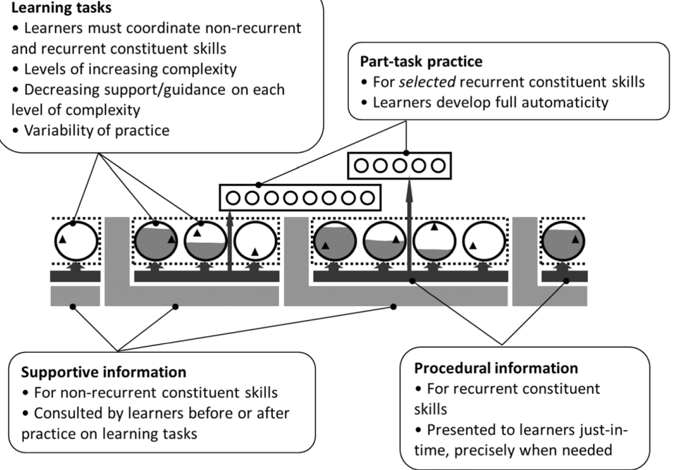
- The paper highlights 4C/ID as an extension of CLT for longer instructional programs and curricula, organized around 4 components: learning tasks, supportive information, procedural information, and part-task practice.
- It reports progress in measuring cognitive load, including a 10-item psychometric instrument that supported distinguishing intrinsic from extraneous load, and objective measures such as EEG, eye tracking, and secondary-task methods.
Methods
- This is a review article that retrospectively synthesizes CLT developments from 1998 to 2018, using the 1998 paper as a baseline and organizing the discussion into history, developments, future directions, and conclusions.
- The authors draw on prior theoretical and empirical studies and reviews cited throughout the paper; no new dataset or sample is reported in the text provided.
- Main analysis is a narrative synthesis of theoretical developments, instructional effects, and measurement approaches in CLT.
Limitations
- The paper explicitly says it is an attempt to summarise the last 20 years of CLT and sketch directions for future research, so it is a synthesis rather than a new empirical test.
- It repeatedly notes that more research is needed on cognitive-load measurement, including the optimal use of subjective rating scales, differentiating load types, and validating objective techniques.
- Evident from the text: several claims about future directions (e.g., resource depletion, self-regulated learning, emotions/stress/uncertainty, human movement) are presented as promising but not yet settled in the paper itself.
Model-written summary. Check it against the paper before relying on it.
Integrity signals
Registry
Cites
Statistics
Figures
Verification
Claims the paper makes
21 Valid · 23 Not valid · 90 Not checked · 158 Own results and interpretations
The sources with a verdict support this claim; the rest weren’t checked yet, have no full text we could read, or their verdicts aren’t rated yet.
In the paper
“Its basic premise is that human cognitive processing is heavily constrained by our limited working memory which can only process a limited number of information elements at a time.”
§ The Author(s) 2019 > Introduction
What the sources say
- Supportedcites Miller (1956) matched to “The magical number seven, plus or minus two: Some limits on our capacity for processing information.” (1956) source
The Summary says that immediate memory imposes severe limits on the information people can receive, process, and remember. The discussion of immediate memory (p. 93) specifies that its limit is the number of chunks, supporting the claim's broad paraphrase of a limited number of information elements at a time. (LLM, conf=0.91)
- Not checked — no full text of the sourcecites Peterson and Peterson (1959) matched to “Short-term retention of individual verbal items.” (1959) source
plainstates a cause- Asserted: passes — The authors put it forward as true.
- Checkable: passes — It can be checked against evidence.
- Load-bearing: passes — The paper’s conclusions depend on it.
- Based: passes — The paper gives a reason why it holds.
- Supported
The cited sources support only part of this claim — read each source’s verdict below.
In the paper
“The capacity and duration limits of working memory have been known at least since Miller (1956) and Peterson and Peterson (1959), although the fact that these limits effectively applied only to novel, not familiar information, seemed more implicit rather than explicit in most treatments.”
§ The Author(s) 2019 > Human Cognitive Architecture Used in 1998
What the sources say
- Partly supportedcites Miller (1956) matched to “The magical number seven, plus or minus two: Some limits on our capacity for processing information.” (1956) sourceExperimental — accuracy not yet measured
In the discussion of immediate memory (p. 93), Miller says its span is limited by the number of chunks and that familiar units allow more information to be packed into each chunk. That supports a distinction between novel material and familiar, recoded material, but not the claim that capacity limits apply only to novel information: the chunk limit remains. The paper also does not establish a duration limit that applies only to novel information. (LLM, conf=0.86)
- Not checked — no full text of the sourcecites Peterson and Peterson (1959) matched to “Short-term retention of individual verbal items.” (1959) source
hedged- Asserted: passes — The authors put it forward as true.
- Checkable: passes — It can be checked against evidence.
- Load-bearing: passes — The paper’s conclusions depend on it.
- Based: passes — The paper gives a reason why it holds.
- Partly supported
Every source the paper cites for this claim was checked and supports it.
In the paper
“The data summarised by Sala and Gobet (2017) provide a major justification for the post 1998 inclusion of evolutionary psychology into cognitive load theory.”
§ The Author(s) 2019 > Human Cognitive Architecture Seen Through the Prism of Evolutionary Psychology
What the sources say
- Supportedcites Sala and Gobet (2017) matched to “Does Far Transfer Exist? Negative Evidence From Chess, Music, and Working Memory Training” (2017) source
The Theoretical and Practical Implications section (page unavailable) summarises the paper’s evidence that chess, music and working-memory training do not reliably produce far transfer. The claim that these data justify a development in cognitive load theory is the citing authors’ interpretation, not a finding attributed to Sala and Gobet. (LLM, conf=0.86)
boostedstates a cause- Asserted: passes — The authors put it forward as true.
- Checkable: passes — It can be checked against evidence.
- Load-bearing: passes — The paper’s conclusions depend on it.
- Based: passes — The paper gives a reason why it holds.
- Supported
Every source the paper cites for this claim was checked and supports it.
In the paper
“The expertise reversal effect is, in essence, a variant of the more general element interactivity effect (Chen et al. 2017).”
§ The Author(s) 2019 > Instructional Effects Described After 1998
What the sources say
- Supportedcites Chen et al. 2017 matched to “The Expertise Reversal Effect is a Variant of the More General Element Interactivity Effect” (2017) source
The indexed copy lists the cited paper under the exact title “The Expertise Reversal Effect is a Variant of the More General Element Interactivity Effect.” Its title directly states the proposition attributed to it; no page number is available in the indexed passage. (LLM, conf=0.90)
plainstates a cause- Asserted: passes — The authors put it forward as true.
- Checkable: passes — It can be checked against evidence.
- Load-bearing: unclear — It is unclear whether the paper’s conclusions depend on it.
- Based: passes — The paper gives a reason why it holds.
- Supported
Every source the paper cites for this claim was checked and supports it.
In the paper
“When subsequently presented the fully integrated information, they only needed to learn how to integrate the individual elements and so more readily assimilated the entire, high element interactivity information.”
§ The Author(s) 2019 > Instructional Effects Described After 1998
What the sources say
- Supportedcites Pollock et al. 2002 matched to “Assimilating complex information” (2002) source
Split into 2 atoms — 2 confirmed, 0 partially supported, 0 disputed, 0 misattributed, 0 unverifiable. Expand the claim to see per-atom verdicts.
plainstates a cause- Asserted: passes — The authors put it forward as true.
- Checkable: passes — It can be checked against evidence.
- Load-bearing: passes — The paper’s conclusions depend on it.
- Based: passes — The paper gives a reason why it holds.
- Supported
132 more claims · 6 with their cited sources checked
Create a free account to see all 292 claims and to verify the 3 references still open.
- It may state two separate claims as one. 88
- Probably not a substantial claim. 95
Claims other papers make about this one
Each is checked against this paper’s own text: does it say what the citing paper says it does?
The source backs part of the claim, not all of it — or backs it for a different population, condition or comparison.
In the citing paper
“Another possible explanation is that the pre-training effect tends to be most effective for learners with minimal prior knowledge (Sweller et al., 2019)”
From Rethinking pre-training: cognitive load implications for learners with varying prior knowledge (2025) · cites this paper as Sweller et al., 2019
Experimental — accuracy not yet measuredThe cited source says what the claim attributes to it.
In the citing paper
“If the cognitive load imposed by a learning task is too high, it might interfere with the learner’s ability to effectively acquire and retain the skill [13, 25].”
From Teaching a single manual therapy technique at a time reduces cognitive load in physiotherapy students: a randomized controlled educational study (2025) · cites this paper as [13]
The cited source says what the claim attributes to it.
In the citing paper
“While cognitive load is often discussed in the context of instructional efficiency, it is important to note that cognitive load is not inherently detrimental. Rather, it is a natural component of learning that engages working memory resources for schema construction and automation [13].”
From Teaching a single manual therapy technique at a time reduces cognitive load in physiotherapy students: a randomized controlled educational study (2025) · cites this paper as [13]
The cited source says what the claim attributes to it.
In the citing paper
“Thus, an increased germane load is no longer believed to lead to cognitive overload and can thus no longer be assumed to be detrimental to learning performance.”
From Understanding Cognitive Load in Digital and Online Learning: a New Perspective on Extraneous Cognitive Load (2022) · cites this paper as Sweller et al., 2019
The cited source says what the claim attributes to it.
In the citing paper
“The major change from the 1998 model is that Sweller et al. (2019) have removed germane load from the additive equation of total load, but rather a dimension now called ' germane processing. '”
From Understanding Cognitive Load in Digital and Online Learning: a New Perspective on Extraneous Cognitive Load (2022) · cites this paper as Sweller et al., 2019
17 more claims about this paper
Create a free account to see every claim other papers make about this one.
Citations
Cites
The magical number seven, plus or minus two: Some limits on our capacity for processing information.
Miller, G. A. (1956) · Psychological Review · doi:10.1037/h0043158 · Cited by 17,812 · cited 1×
“The capacity and duration limits of working memory have been known at least since Miller (1956) and Peterson and Peterson (1959), although the fact that these limits effectively applied only to novel, not familiar information, seemed more implicit rather than explicit in most treatments.”
BackgroundThe magical number seven, plus or minus two: Some limits on our capacity for processing information.
Miller, G. A. (1994) · Psychological Review · doi:10.1037/0033-295x.101.2.343 · Cited by 17,161
Cognitive Load During Problem Solving: Effects on Learning
Sweller, J. (1988) · Cognitive Science · doi:10.1016/0364-0213(88)90023-7 · Cited by 11,048 · cited 4×
“Learning tasks (indicated by the big circles in Fig.”
BackgroundMethodInfluentialSelf-citationKirschner, P. A., Sweller, J., & Clark, R. E. (2006) · Educational Psychologist · doi:10.1207/s15326985ep4102_1 · Cited by 7,776
Self-citationRizzolatti, G., & Craighero, L. (2004) · Annual Review of Neuroscience · doi:10.1146/annurev.neuro.27.070203.144230 · Cited by 7,433
Cognitive Architecture and Instructional Design
Sweller, J., van Merrienboer, J. J. G., & Paas, F. G. W. C. (1998) · Educational Psychology Review · doi:10.1023/a:1022193728205 · Cited by 6,023
Self-citationBaddeley, A. (1992) · Science · doi:10.1126/science.1736359 · Cited by 5,258
Cognitive load theory, learning difficulty, and instructional design
Sweller, J. (1994) · Learning and Instruction · doi:10.1016/0959-4752(94)90003-5 · Cited by 3,801 · cited 1×
“Element Interactivity Effect This effect was already known in 1998 but as a compound effect, it was not classed as a cognitive load effect (see Sweller 1994).”
BackgroundSelf-citationEricsson, K. A., & Kintsch, W. (1995) · Psychological Review · doi:10.1037/0033-295x.102.2.211 · Cited by 3,498
Short-term retention of individual verbal items.
Peterson, L., & Peterson, M. J. (1959) · Journal of Experimental Psychology · doi:10.1037/h0049234 · Cited by 2,939 · cited 1×
“The capacity and duration limits of working memory have been known at least since Miller (1956) and Peterson and Peterson (1959), although the fact that these limits effectively applied only to novel, not familiar information, seemed more implicit rather than explicit in most treatments.”
BackgroundCognitive Load Theory and the Format of Instruction
Chandler, P., & Sweller, J. (1991) · Cognition and Instruction · doi:10.1207/s1532690xci0804_2 · Cited by 2,894
Self-citationCognitive Load Measurement as a Means to Advance Cognitive Load Theory
Paas, F., Tuovinen, J. E., Tabbers, H., & Van Gerven, P. W. M. (2003) · Educational Psychologist · doi:10.1207/s15326985ep3801_8 · Cited by 2,527
Self-citationThe Cambridge handbook of multimedia learning
(2006) · Choice Reviews Online · doi:10.5860/choice.43-5643 · Cited by 2,313
Cognitive Load Theory and Complex Learning: Recent Developments and Future Directions
van Merriënboer, J. J. G., & Sweller, J. (2005) · Educational Psychology Review · doi:10.1007/s10648-005-3951-0 · Cited by 2,206
Self-citationMultiple Resources and Mental Workload
Wickens, C. D. (2008) · Human Factors: The Journal of the Human Factors and Ergonomics Society · doi:10.1518/001872008x288394 · Cited by 2,164 · cited 1×
“…several of its principles with mental workload models, which focus on workplace performance rather than learning and instructional design (e.g. Wickens 2008), and with the cognitive theory of multimedia learning, which has an exclusive focus on the design of multimedia materials (CTML; Mayer…”
BackgroundPaas, F. G. W. C. (1992) · Journal of Educational Psychology · doi:10.1037/0022-0663.84.4.429 · Cited by 2,150 · cited 1×
“The first important development is related to the further specification of the subjective measurement technique that was originally introduced by Paas (1992) to provide an overall measure of cognitive load.”
BackgroundSelf-citationElement Interactivity and Intrinsic, Extraneous, and Germane Cognitive Load
Sweller, J. (2010) · Educational Psychology Review · doi:10.1007/s10648-010-9128-5 · Cited by 2,020 · cited 2×
“A similar effect is provided by simple-to-complex sequencing, where learners first practice simple, low element interactivity versions of a task and only later increasingly more complex versions of this task (van Merriënboer et al. 2003; van Merriënboer and Sweller 2005, 2010).”
BackgroundSelf-citationKalyuga, S., Ayres, P., Chandler, P., & Sweller, J. (2003) · Educational Psychologist · doi:10.1207/s15326985ep3801_4 · Cited by 1,927
Self-citation(1978) · De Gruyter eBooks · doi:10.1515/9783110800647 · Cited by 1,847
Self‐Explanations: How Students Study and Use Examples in Learning to Solve Problems
Chi, M. T. H., Bassok, M., Lewis, M. W., Reimann, P., & Glaser, R. (1989) · Cognitive Science · doi:10.1207/s15516709cog1302_1 · Cited by 1,714
The Cambridge Handbook of Multimedia Learning
(2014) · Cambridge University Press eBooks · doi:10.1017/cbo9781139547369 · Cited by 1,533
Cognitive load theory in health professional education: design principles and strategies
Van Merriënboer, J. J. G., & Sweller, J. (2010) · Medical Education · doi:10.1111/j.1365-2923.2009.03498.x · Cited by 1,511
Self-citationRisko, E. F., & Gilbert, S. J. (2016) · Trends in Cognitive Sciences · doi:10.1016/j.tics.2016.07.002 · Cited by 1,502
Self-Regulated Learning: Beliefs, Techniques, and Illusions
Bjork, R. A., Dunlosky, J., & Kornell, N. (2013) · Annual Review of Psychology · doi:10.1146/annurev-psych-113011-143823 · Cited by 1,468
Monitoring one’s own knowledge during study: A cue-utilization approach to judgments of learning
Koriat, A. (1997) · Journal of Experimental Psychology: General · doi:10.1037/0096-3445.126.4.349 · Cited by 1,363
Brook, C. V., & de Groot, A. D. (1966) · The American Journal of Psychology · doi:10.2307/1421155 · Cited by 1,284
The Use of Worked Examples as a Substitute for Problem Solving in Learning Algebra
Sweller, J., & Cooper, G. A. (1985) · Cognition and Instruction · doi:10.1207/s1532690xci0201_3 · Cited by 1,214
Self-citationPaas, F. G. W. C., & Van Merriënboer, J. J. G. (1994) · Journal of Educational Psychology · doi:10.1037/0022-0663.86.1.122 · Cited by 1,198
Self-citationDevelopment of an instrument for measuring different types of cognitive load
Leppink, J., Paas, F., Van der Vleuten, C. P. M., Van Gog, T., & Van Merriënboer, J. J. G. (2013) · Behavior Research Methods · doi:10.3758/s13428-013-0334-1 · Cited by 1,066
Self-citationMayer, R. E., & Anderson, R. B. (1992) · Journal of Educational Psychology · doi:10.1037/0022-0663.84.4.444 · Cited by 1,000
Reducing cognitive load by mixing auditory and visual presentation modes.
Mousavi, S. Y., Low, R., & Sweller, J. (1995) · Journal of Educational Psychology · doi:10.1037/0022-0663.87.2.319 · Cited by 995
Self-citationInstructional animation versus static pictures: A meta-analysis
Höffler, T. N., & Leutner, D. (2007) · Learning and Instruction · doi:10.1016/j.learninstruc.2007.09.013 · Cited by 992
Instructional control of cognitive load in the training of complex cognitive tasks
Paas, F. G. W. C., & Van Merriënboer, J. J. G. (1994) · Educational Psychology Review · doi:10.1007/bf02213420 · Cited by 968
Self-citationCognitive Load Theory: Implications for medical education: AMEE Guide No. 86
Young, J. Q., Van Merrienboer, J., Durning, S., & Ten Cate, O. (2014) · Medical Teacher · doi:10.3109/0142159x.2014.889290 · Cited by 935
Taking the Load Off a Learner's Mind: Instructional Design for Complex Learning
van Merrienboer, J. J. G., Kirschner, P. A., & Kester, L. (2003) · Educational Psychologist · doi:10.1207/s15326985ep3801_2 · Cited by 857
Self-citationExplaining Math: Gesturing Lightens the Load
Goldin-Meadow, S., Nusbaum, H., Kelly, S. D., & Wagner, S. (2001) · Psychological Science · doi:10.1111/1467-9280.00395 · Cited by 842
Anxiety and working memory capacity: A meta-analysis and narrative review.
Moran, T. P. (2016) · Psychological Bulletin · doi:10.1037/bul0000051 · Cited by 776 · cited 1×
“The basic assumption is that stress, emotions and uncertainty may restrict the capacity of working memory by competing with task-relevant processes; thus, they increase cognitive load, hamper learning and decrease transfer (Moran 2016).”
BackgroundMayer, R. E., & Chandler, P. (2001) · Journal of Educational Psychology · doi:10.1037/0022-0663.93.2.390 · Cited by 762
Using Electroencephalography to Measure Cognitive Load
Antonenko, P., Paas, F., Grabner, R., & van Gog, T. (2010) · Educational Psychology Review · doi:10.1007/s10648-010-9130-y · Cited by 742
Self-citationAssimilating complex information
Pollock, E., Chandler, P., & Sweller, J. (2002) · Learning and Instruction · doi:10.1016/s0959-4752(01)00016-0 · Cited by 692
Self-citation(1997) · University of Twente Research Information · Cited by 661
Self-citationSchmeichel, B. J. (2007) · Journal of Experimental Psychology: General · doi:10.1037/0096-3445.136.2.241 · Cited by 644 · cited 1×
“With regard to general depletion effects, Schmeichel (2007) showed that engaging in self-control tasks can lower performance on subsequent working memory tests.”
BackgroundPerceptions of perceptual symbols
Barsalou, L. W. (1999) · Behavioral and Brain Sciences · doi:10.1017/s0140525x99532147 · Cited by 620
Ten Steps to Complex Learning: A Systematic Approach to Four-Component Instructional Design
van Merriënboer, J. J. G., Kirschner, P. A., & Frèrejean, J. (2024) · Research Publications (Maastricht University) · doi:10.4324/9781003322481 · Cited by 579
Self-citationA Cognitive Load Approach to Collaborative Learning: United Brains for Complex Tasks
Kirschner, F., Paas, F., & Kirschner, P. A. (2009) · Educational Psychology Review · doi:10.1007/s10648-008-9095-2 · Cited by 547
Self-citationMeta-analysis of the modality effect
Ginns, P. (2005) · Learning and Instruction · doi:10.1016/j.learninstruc.2005.07.001 · Cited by 547 · cited 3×
“Ginns (2005a) provided a meta-analysis of the modality effect that is still worth reading.”
BackgroundRenkl, A., & Atkinson, R. K. (2003) · Educational Psychologist · doi:10.1207/s15326985ep3801_3 · Cited by 540
Effects of pairs of problems and examples on task performance and different types of cognitive load
Leppink, J., Paas, F., van Gog, T., van der Vleuten, C. P. M., & van Merriënboer, J. J. G. (2014) · Learning and Instruction · doi:10.1016/j.learninstruc.2013.12.001 · Cited by 520
Self-citationToward an Instructionally Oriented Theory of Example‐Based Learning
Renkl, A. (2014) · Cognitive Science · doi:10.1111/cogs.12086 · Cited by 509 · cited 1×
“A review of studies on learning from examples is provided by Renkl (2013).”
BackgroundPaas, F., & Sweller, J. (2012) · Educational Psychology Review · doi:10.1007/s10648-011-9179-2 · Cited by 502
Self-citationInstructional Efficiency: Revisiting the Original Construct in Educational Research
van Gog, T., & Paas, F. (2008) · Educational Psychologist · doi:10.1080/00461520701756248 · Cited by 473
Self-citationThe Split-Attention Principle in Multimedia Learning
Ayres, P., & Sweller, J. (2005) · The Cambridge Handbook of Multimedia Learning · doi:10.1017/cbo9780511816819.009 · Cited by 472
Self-citationGuidance during mathematical problem solving.
Tarmizi, R. A., & Sweller, J. (1988) · Journal of Educational Psychology · doi:10.1037/0022-0663.80.4.424 · Cited by 464
Self-citationWhy Minimally Guided Teaching Techniques Do Not Work: A Reply to Commentaries
SWELLER, J., KIRSCHNER, P. A., & CLARK, R. E. (2007) · Educational Psychologist · doi:10.1080/00461520701263426 · Cited by 434
Self-citationChoi, H.-H., van Merriënboer, J. J. G., & Paas, F. (2014) · Educational Psychology Review · doi:10.1007/s10648-014-9262-6 · Cited by 413
Self-citationCierniak, G., Scheiter, K., & Gerjets, P. (2009) · Computers in Human Behavior · doi:10.1016/j.chb.2008.12.020 · Cited by 412
Paas, F., Tuovinen, J. E., van Merriënboer, J. J. G., & Aubteen Darabi, A. (2005) · Educational Technology Research and Development · doi:10.1007/bf02504795 · Cited by 401
Self-citationUsing subjective measures to detect variations of intrinsic cognitive load within problems
Ayres, P. (2006) · Learning and Instruction · doi:10.1016/j.learninstruc.2006.09.001 · Cited by 381 · cited 1×
“Whereas several researchers have tried to measure only changes in one specific type of cognitive load (e.g. Ayres 2006), others have investigated methods to measure the different types of cognitive load (e.g. Cierniak et al. 2009).”
MethodEmotional Design in Digital Media for Learning
Plass, J. L., & Kaplan, U. (2016) · Emotions, Technology, Design, and Learning · doi:10.1016/b978-0-12-801856-9.00007-4 · Cited by 377
Learning from Worked-Out Examples: The Effects of Example Variability and Elicited Self-Explanations
Renkl, A., Stark, R., Gruber, H., & Mandl, H. (1998) · Contemporary Educational Psychology · doi:10.1006/ceps.1997.0959 · Cited by 374
Cognitive load theory, modality of presentation and the transient information effect
Leahy, W., & Sweller, J. (2011) · Applied Cognitive Psychology · doi:10.1002/acp.1787 · Cited by 344
Self-citationAn Evolutionarily Informed Education Science
GEARY, D. C. (2008) · Educational Psychologist · doi:10.1080/00461520802392133 · Cited by 324 · cited 2×
“Biologically primary knowledge is modular with little relation between the cognitive processes associated with one skill and another (Geary 2008, 2012).”
Backgroundvan Merriënboer, J. J. G., Kester, L., & Paas, F. (2006) · Applied Cognitive Psychology · doi:10.1002/acp.1250 · Cited by 320
Self-citationDoes Far Transfer Exist? Negative Evidence From Chess, Music, and Working Memory Training
Sala, G., & Gobet, F. (2017) · Current Directions in Psychological Science · doi:10.1177/0963721417712760 · Cited by 309
APA Educational Psychology Handbook
Genesee, F. H., & Lindholm-Leary, K. J. (2011) · Cited by 301
Memory load and the cognitive pupillary response in aging
Van Gerven, P. W. M., Paas, F., Van Merriënboer, J. J. G., & Schmidt, H. G. (2004) · Psychophysiology · doi:10.1111/j.1469-8986.2003.00148.x · Cited by 292
Self-citationvan Gog, T., Paas, F., Marcus, N., Ayres, P., & Sweller, J. (2009) · Educational Psychology Review · doi:10.1007/s10648-008-9094-3 · Cited by 284
Self-citationCognitive load theory, the transient information effect and e-learning
Wong, A., Leahy, W., Marcus, N., & Sweller, J. (2012) · Learning and Instruction · doi:10.1016/j.learninstruc.2012.05.004 · Cited by 281
Self-citationNatural Information Processing Systems
Sweller, J., & Sweller, S. (2006) · Evolutionary Psychology · doi:10.1177/147470490600400135 · Cited by 279 · cited 1×
“Together, the processes mimic the information processing procedures of biological evolution (Sweller and Sweller 2006) and can be described as constituting a natural information processing system.”
BackgroundSelf-citationDomain-Specific Knowledge and Why Teaching Generic Skills Does Not Work
Tricot, A., & Sweller, J. (2014) · Educational Psychology Review · doi:10.1007/s10648-013-9243-1 · Cited by 273
Self-citationvan Merriënboer, J. J. G., Jelsma, O., & Paas, F. G. W. C. (1992) · Educational Technology Research and Development · doi:10.1007/bf02297047 · Cited by 265
Self-citationChen, O., Castro-Alonso, J. C., Paas, F., & Sweller, J. (2018) · Educational Psychology Review · doi:10.1007/s10648-017-9426-2 · Cited by 239
Self-citationThe Split-Attention Principle in Multimedia Learning
Ayres, P., & Sweller, J. (2014) · The Cambridge Handbook of Multimedia Learning · doi:10.1017/cbo9781139547369.011 · Cited by 234
Self-citationGesturing Saves Cognitive Resources When Talking About Nonpresent Objects
Ping, R., & Goldin‐Meadow, S. (2010) · Cognitive Science · doi:10.1111/j.1551-6709.2010.01102.x · Cited by 230
Kirschner, F., Paas, F., & Kirschner, P. A. (2011) · Applied Cognitive Psychology · doi:10.1002/acp.1730 · Cited by 219
Self-citationMotivational consequences of environmental stress
Evans, G. W., & Stecker, R. (2004) · Journal of Environmental Psychology · doi:10.1016/s0272-4944(03)00076-8 · Cited by 207
Schmeck, A., Opfermann, M., van Gog, T., Paas, F., & Leutner, D. (2015) · Instructional Science · doi:10.1007/s11251-014-9328-3 · Cited by 206
Self-citationThe Expertise Reversal Effect is a Variant of the More General Element Interactivity Effect
Chen, O., Kalyuga, S., & Sweller, J. (2017) · Educational Psychology Review · doi:10.1007/s10648-016-9359-1 · Cited by 200
Self-citationWorking Memory, Long-term Memory, and Instructional Design
Sweller, J. (2016) · Journal of Applied Research in Memory and Cognition · doi:10.1016/j.jarmac.2015.12.002 · Cited by 192 · cited 4×
“In contrast to the generic-cognitive skills associated with most biologically primary knowledge, biologically secondary knowledge is heavily domain-specific (Sweller 2015, 2016b; Tricot and Sweller 2014).”
BackgroundInfluentialSelf-citationGestures, but not meaningless movements, lighten working memory load when explaining math
Cook, S. W., Yip, T. K., & Goldin-Meadow, S. (2012) · Language and Cognitive Processes · doi:10.1080/01690965.2011.567074 · Cited by 192
Cooper, G., Tindall-Ford, S., Chandler, P., & Sweller, J. (2001) · Journal of Experimental Psychology: Applied · doi:10.1037/1076-898x.7.1.68 · Cited by 191 · cited 1×
“Once information can be adequately imagined, imagination instructions are superior to study instructions (Cooper et al. 2001).”
Self-citationAyres, P., Marcus, N., Chan, C., & Qian, N. (2009) · Computers in Human Behavior · doi:10.1016/j.chb.2008.12.013 · Cited by 191
van Gog, T., Paas, F., & van Merriënboer, J. J. G. (2008) · Learning and Instruction · doi:10.1016/j.learninstruc.2007.03.003 · Cited by 190
Self-citationPerspectives on problem solving and instruction
van Merriënboer, J. J. G. (2013) · Computers & Education · doi:10.1016/j.compedu.2012.11.025 · Cited by 187
Effects of goal specificity on means–ends analysis and learning.
Sweller, J., & Levine, M. (1982) · Journal of Experimental Psychology: Learning, Memory, and Cognition · doi:10.1037/0278-7393.8.5.463 · Cited by 182 · cited 2×
“It is the oldest effect studied in the context of cognitive load theory (Sweller and Levine 1982).”
BackgroundSelf-citationAn updated meta-analysis of the ego depletion effect
Dang, J. (2018) · Psychological Research · doi:10.1007/s00426-017-0862-x · Cited by 179 · cited 1×
“The vast differences in ego depletion tasks possibly contributes to doubts concerning the effects of ego depletion (see Etherton et al. 2018, and Dang 2018, for conflicting meta-analyses).”
BackgroundAn expertise reversal effect of segmentation in learning from animated worked-out examples
Spanjers, I. A. E., Wouters, P., van Gog, T., & van Merriënboer, J. J. G. (2011) · Computers in Human Behavior · doi:10.1016/j.chb.2010.05.011 · Cited by 175
Cognitive Load Theory and Human Movement: Towards an Integrated Model of Working Memory
Sepp, S., Howard, S. J., Tindall-Ford, S., Agostinho, S., & Paas, F. (2019) · Educational Psychology Review · doi:10.1007/s10648-019-09461-9 · Cited by 174
Self-citationCollaborative Communication: Integrating SBAR to Improve Quality/Patient Safety Outcomes
Beckett, C. D., & Kipnis, G. (2009) · Journal for Healthcare Quality · doi:10.1111/j.1945-1474.2009.00043.x · Cited by 170
The worked example effect, the generation effect, and element interactivity.
Chen, O., Kalyuga, S., & Sweller, J. (2015) · Journal of Educational Psychology · doi:10.1037/edu0000018 · Cited by 167
Self-citationKalyuga, S., Rikers, R. M. J. P., & PAAS, F. G. W. C. (2012) · Educational Psychology Review · doi:10.1007/s10648-012-9195-x · Cited by 166
Self-citationNeuroimaging of cognitive load in instructional multimedia
Whelan, R. R. (2007) · Educational Research Review · doi:10.1016/j.edurev.2006.11.001 · Cited by 165 · cited 1×
“Whereas several researchers have proposed to use neuroimaging techniques, such as functional magnetic resonance imaging (fMRI; e.g. Whelan 2007), a technique that has actually been used in cognitive load research is electroencephalography (EEG; Antonenko and Niederhauser 2010; Antonenko et al.…”
Methodvan Merriënboer, J. J. G., & Sluijsmans, D. M. A. (2009) · Educational Psychology Review · doi:10.1007/s10648-008-9092-5 · Cited by 156
The influence of leads on cognitive load and learning in a hypertext environment
Antonenko, P. D., & Niederhauser, D. S. (2010) · Computers in Human Behavior · doi:10.1016/j.chb.2009.10.014 · Cited by 154
The Influence of Symbolic Rehearsal upon the Retention of a Maze Habit
Sackett, R. S. (1934) · The Journal of General Psychology · doi:10.1080/00221309.1934.9917742 · Cited by 146 · cited 1×
“Imagination Effect It has been known for some time that when learners are asked to mentally rehearse a motor task, learning is improved (Sackett 1934).”
Backgroundde Bruin, A. B. H., & van Merriënboer, J. J. G. (2017) · Learning and Instruction · doi:10.1016/j.learninstruc.2017.06.001 · Cited by 146
Mental Practice: Effective Stress Management Training for Novice Surgeons
Arora, S., Aggarwal, R., Moran, A., Sirimanna, P., Crochet, P., Darzi, A., Kneebone, R., & Sevdalis, N. (2011) · Journal of the American College of Surgeons · doi:10.1016/j.jamcollsurg.2010.09.025 · Cited by 140
Timing and Frequency of Mental Effort Measurement: Evidence in Favour of Repeated Measures
van Gog, T., Kirschner, F., Kester, L., & Paas, F. (2012) · Applied Cognitive Psychology · doi:10.1002/acp.2883 · Cited by 130
Self-citationCognitive Load Theory: New Directions and Challenges
Ayres, P., & Paas, F. (2012) · Applied Cognitive Psychology · doi:10.1002/acp.2882 · Cited by 127
Self-citationGetting the point: Tracing worked examples enhances learning
Hu, F., Ginns, P., & Bobis, J. (2014) · Learning and Instruction · doi:10.1016/j.learninstruc.2014.10.002 · Cited by 125
van Merriënboer, J. J. G., & Krammer, H. P. M. (1987) · Instructional Science · doi:10.1007/bf00120253 · Cited by 120
Self-citationEvolutionary educational psychology.
Geary, D. C. (2011) · American Psychological Association eBooks · doi:10.1037/13273-020 · Cited by 114 · cited 3×
“Biologically primary knowledge is modular with little relation between the cognitive processes associated with one skill and another (Geary 2008, 2012).”
BackgroundIntrinsic and Extraneous Cognitive Load
Sweller, J., Ayres, P., & Kalyuga, S. (2011) · Cognitive Load Theory · doi:10.1007/978-1-4419-8126-4_5 · Cited by 107 · cited 2×
“Transient Information Effect Transient information is information that is presented to learners but disappears after a few seconds, for example, in spoken text or in instructional video or animation (Leahy and Sweller 2011).”
BackgroundSelf-citationThe Rhythm Method: A New Method for Measuring Cognitive Load—An Experimental Dual‐Task Study
Park, B., & Brünken, R. (2015) · Applied Cognitive Psychology · doi:10.1002/acp.3100 · Cited by 102
Evolution and Children’s Cognitive and Academic Development
Geary, D. C., & Berch, D. B. (2016) · Evolutionary Psychology · doi:10.1007/978-3-319-29986-0_9 · Cited by 101
Measurement of cognitive load in multimedia learning: a comparison of different objective measures
Korbach, A., Brünken, R., & Park, B. (2017) · Instructional Science · doi:10.1007/s11251-017-9413-5 · Cited by 98
Cognitive load theory and the effects of transient information on the modality effect
Leahy, W., & Sweller, J. (2016) · Instructional Science · doi:10.1007/s11251-015-9362-9 · Cited by 97
Self-citationCognitive Load Theory, Evolutionary Educational Psychology, and Instructional Design
Sweller, J. (2016) · Evolutionary Psychology · doi:10.1007/978-3-319-29986-0_12 · Cited by 97 · cited 4×
“In contrast to the generic-cognitive skills associated with most biologically primary knowledge, biologically secondary knowledge is heavily domain-specific (Sweller 2015, 2016b; Tricot and Sweller 2014).”
BackgroundInfluentialSelf-citationGiving Learning a Helping Hand: Finger Tracing of Temperature Graphs on an iPad
Agostinho, S., Tindall-Ford, S., Ginns, P., Howard, S. J., Leahy, W., & Paas, F. (2015) · Educational Psychology Review · doi:10.1007/s10648-015-9315-5 · Cited by 94
Self-citationMeasuring physician cognitive load: validity evidence for a physiologic and a psychometric tool
Szulewski, A., Gegenfurtner, A., Howes, D. W., Sivilotti, M. L. A., & van Merriënboer, J. J. G. (2017) · Advances in Health Sciences Education · doi:10.1007/s10459-016-9725-2 · Cited by 94
Recent innovations in educational technology that facilitate student learning
Robinson, D. H., & Schraw, G. J. (2008) · Cited by 92
In Academe, What Is Learned, and How Is It Learned?
Sweller, J. (2015) · Current Directions in Psychological Science · doi:10.1177/0963721415569570 · Cited by 85 · cited 2×
“In contrast to the generic-cognitive skills associated with most biologically primary knowledge, biologically secondary knowledge is heavily domain-specific (Sweller 2015, 2016b; Tricot and Sweller 2014).”
BackgroundSelf-citationRelations between the worked example and generation effects on immediate and delayed tests
Chen, O., Kalyuga, S., & Sweller, J. (2016) · Learning and Instruction · doi:10.1016/j.learninstruc.2016.06.007 · Cited by 82
Self-citationComparing the effects of worked examples and modeling examples on learning
Hoogerheide, V., Loyens, S. M. M., & van Gog, T. (2014) · Computers in Human Behavior · doi:10.1016/j.chb.2014.09.013 · Cited by 73
Managing One's Own Cognitive Load when Evidence of Split Attention is Present
Roodenrys, K., Agostinho, S., Roodenrys, S., & Chandler, P. (2012) · Applied Cognitive Psychology · doi:10.1002/acp.2889 · Cited by 70
Research on Instruction : Design and Effects
Dijkstra, S., van Hout‐Wolters, B. H. A. M., & van der Sijde, P. (1990) · University of Twente Research Information · Cited by 62
Assessment of Cognitive Load in Multimedia Learning: Theory, Methods and Applications
Paas, F., Ayres, P., & Pachman, M. (2008) · Emerald Group Publishing Limited eBooks · doi:10.1108/978-1-60752-942-220251003 · Cited by 57
Self-citationShould self-regulated learning be integrated with cognitive load theory? A commentary
Sweller, J., & Paas, F. (2017) · Learning and Instruction · doi:10.1016/j.learninstruc.2017.05.005 · Cited by 54
Self-citation4C/ID in the Context of Instructional Design and the Learning Sciences
van Merriënboer, J. J. G., & Kirschner, P. A. (2018) · International Handbook of the Learning Sciences · doi:10.4324/9781315617572-17 · Cited by 49
Nugteren, M. L., Jarodzka, H., Kester, L., & van Merriënboer, J. J. G. (2018) · Instructional Science · doi:10.1007/s11251-018-9448-2 · Cited by 46
Self-citationBenefits of guided self-management of attention on learning accounting.
Sithole, S. T. M., Chandler, P., Abeysekera, I., & Paas, F. (2017) · Journal of Educational Psychology · doi:10.1037/edu0000127 · Cited by 42
Self-citationBayesian analysis of multimethod ego‐depletion studies favours the null hypothesis
Etherton, J. L., Osborne, R. E., Stephenson, K., Grace, M., Jones, C., & Nadai, A. S. D. (2018) · British Journal of Social Psychology · doi:10.1111/bjso.12236 · Cited by 36
The stability of working memory: Do previous tasks influence complex span?
Healey, M. K., Hasher, L., & Danilova, E. (2011) · Journal of Experimental Psychology: General · doi:10.1037/a0024587 · Cited by 33
The 'completion strategy' in programming instruction : theoretical and empirical support
van Merriënboer, J. J. G., & Krammer, H. P. M. (1990) · University of Twente Research Information · Cited by 27
Self-citationUsing a general problem-solving strategy to promote transfer.
Youssef-Shalala, A., Ayres, P., Schubert, C., & Sweller, J. (2014) · Journal of Experimental Psychology: Applied · doi:10.1037/xap0000021 · Cited by 25 · cited 2×
“A recent review of the split-attention effect is provided by Ayres and Sweller (2014).”
BackgroundSelf-citationImagining Instructions: Mental Practice in Highly Cognitive Domains
Ginns, P. (2005) · Australian Journal of Education · doi:10.1177/000494410504900202 · Cited by 15 · cited 3×
“Ginns (2005a) provided a meta-analysis of the modality effect that is still worth reading.”
BackgroundRenkl, A. (2012) · Springer eBooks · doi:10.1007/978-1-4419-1428-6_335 · Cited by 10
van Merriënboer, J. J. G., & Kirschner, P. A. (2017) · Ten Steps to Complex Learning · doi:10.4324/9781315113210-3
Research works printed but not linked: 4
- Centre for Education Statistics and Evaluation. (2017). Cognitive load theory: research that teachers really need to understand . Sydney: NSW Department of Education.
- Centre for Education Statistics and Evaluation. (2018). Cognitive load theory in practice . Sydney: NSW Department of Education.
- Clark, R. C. (2014). Evidence-based training methods: a guide for training professionals (2nd ed.). Alexandria: ATD Press.
- Miller, W. (1937). The picture crutch in reading. Elementary English Review, 14 , 263 -264.
Cited by
Sweller, J., Ayres, P., & Kalyuga, S. (2011) · doi:10.1007/978-1-4419-8126-4 · Cited by 5,531
Self-citationSweller, J. (2011) · Psychology of Learning and Motivation · doi:10.1016/b978-0-12-387691-1.00002-8 · Cited by 4,856
Self-citationSweller, J. (2012) · Encyclopedia of the Sciences of Learning · doi:10.1007/978-1-4419-1428-6_446 · Cited by 4,405
Self-citationCognitive load theory and educational technology
Sweller, J. (2020) · Educational Technology Research and Development · doi:10.1007/s11423-019-09701-3 · Cited by 911
Self-citationSkulmowski, A., & Xu, K. M. (2022) · Educational Psychology Review · doi:10.1007/s10648-021-09624-7 · Cited by 678
Metadata
- Authors
- Sweller, J., van Merriënboer, J. J. G., & Paas, F.
- Affiliations
- UNSW Sydney (AU)
- University of Wollongong (AU)
- Corresponding author
- Sweller, John
- Venue
- Educational Psychology Review
- Published
- 2019-01-22
- Volume
- 31
- Issue
- 2
- Pages
- 261-292
- ISSN
- 1040-726X (ISSN-L)
- 1573-336X
- OpenAlex
- W2913144876
- Cited by
- 2,337
- References
- 129
- Citations by year
- 2026: 713 · 2025: 466 · 2024: 331 · 2023: 268 · 2022: 212 · 2021: 190 · 2020: 114 · 2019: 37
- FWCI
- 162.54
- Type
- journal article
- Language
- en
- Open access
- hybrid
- doi.org
- Licence
- cc-by
- creativecommons.org/licenses/by/4.0 (tdm)
- Locations
- Educational Psychology Review (publishedVersion, cc-by)
- EUR Research Repository (Erasmus University Rotterdam) (publishedVersion, other-oa)
- Research Online (University of Wollongong) (submittedVersion)
- EUR Research Repository (Erasmus University Rotterdam) (submittedVersion)
- Research Publications (Maastricht University) (submittedVersion, cc-by)
- Figshare (submittedVersion, cc-by)
- Research Publications (Maastricht University) (submittedVersion, other-oa)
- Topics
- Social Sciences › Psychology › Experimental and Cognitive Psychology › Visual and Cognitive Learning Processes
- Social Sciences › Psychology › Developmental and Educational Psychology › Innovative Teaching and Learning Methods
- Life Sciences › Neuroscience › Cognitive Neuroscience › Neuroscience, Education and Cognitive Function
- Keywords
- cognitive load theory, cognitive architecture, working memory, long-term memory, instructional design
About these checks
Registry, retraction, Cites and statistics results are computed, not judged, with one exception: a printed reference that no index lists is read once by a model before it counts as a citation error. Claims are extracted by a model and kept only when their quote appears verbatim in the text; each cited source is then checked, with a model’s help, for whether it says what the claim relies on. Those verdicts can be wrong — read the claim’s quote and the cited source before relying on one.
The claim verdicts this report counts are experimental: their accuracy is not yet measured.
A language model drew the claims from the paper on 2026-10-10, under version 3 of the claim definition (model deepseek-v4.1-flash, prompt extract-v3).
A second model labelled each claim on 2026-10-10 (model jev-1.13-20260917, definition revision gold-guideline-v0.2).
Cited sources are checked with a language model’s help (gpt-6-sol).
Statistics and arithmetic are recomputed, not judged.
Confidence bands are shown only for fields calibrated on our annotated test set. None is calibrated yet, so no band is shown.
What counts as a claim ›How we measure confidence ›How we check this ›
Are you an author, or do you see a problem with this page? Request a review
Data sources
Bibliographic data: Semantic Scholar, OpenAlex, Crossref.
Contains information from the Semantic Scholar Academic Graph Datasets, made available under the ODC Attribution License (ODC-BY 1.0).
Semantic Scholar’s data is described in: Kinney, R., et al. (2023). The Semantic Scholar Open Data Platform. arXiv:2301.10140.
