

The DOI matches its Crossref record; 75 of the 81 references it cites were found in a registry or an index; 1 of the 115 sources its claims cite were checked for support.
Septic systems as sources of organic wastewater compounds in domestic drinking water wells in a shallow sand and gravel aquifer
Open accessAbstract
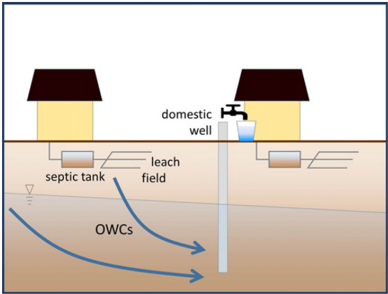
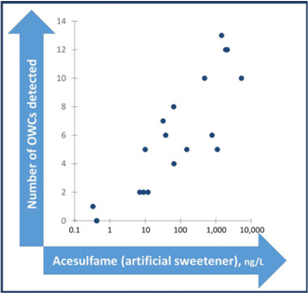
Domestic drinking water wells serve 44 million people in the US and are common globally. They are often located in areas served by onsite wastewater treatment systems, including septic systems, which can be sources of biological and chemical pollutants to groundwater. In this study we tested 20 domestic drinking water wells in a sand and gravel aquifer on Cape Cod, Massachusetts, USA, for 117 organic wastewater compounds (OWCs) and for inorganic markers of septic system impact. We detected 27 OWCs, including 12 pharmaceuticals, five per- and polyfluoroalkyl substances (PFASs), four organophosphate flame retardants, and an artificial sweetener (acesulfame). Maximum concentrations of several PFASs and pharmaceuticals were relatively high compared to public drinking water supplies in the US. The number of detected OWCs and total concentrations of pharmaceuticals and of PFASs were positively correlated with nitrate, boron, and acesulfame and negatively correlated with well depth. These wells were all located in areas served exclusively by onsite wastewater treatment systems, which are likely the main source of the OWCs in these wells, although landfill leachate may also be a source. Our results suggest that current regulations to protect domestic wells from pathogens in septic system discharges do not prevent OWCs from reaching domestic wells, and that nitrate, a commonly measured drinking water contaminant, is a useful screening tool for OWCs in domestic wells. Nitrate concentrations of 1mg/L NO3-N, which are tenfold higher than local background and tenfold lower than the US federal drinking water standard, were associated with wastewater impacts from OWCs in this study.
Overview
AI snapshot
Written from the paper’s full text.
TL;DR
In 20 domestic drinking water wells in a shallow sand and gravel aquifer on Cape Cod, Massachusetts, 85% contained at least one organic wastewater compound, with acesulfame, PFASs, and pharmaceuticals most frequently detected. The authors conclude septic systems are likely the main source, with landfill or commercial wastewater also possible for some PFAS detections.
Key findings
- Of 117 OWCs analyzed, 27 (23%) were detected in at least one well; 17 of 20 wells (85%) had ≥1 OWC, with a maximum of 13 OWCs in one well. Acesulfame was detected in 17 wells (85%), maximum 5300 ng/L; 12 pharmaceuticals were detected, and 13 wells (65%) had ≥1 pharmaceutical, including sulfamethoxazole in 9 wells (maximum 60 ng/L) and carbamazepine in 5 wells (maximum 62 ng/L).
- Four PFASs (PFOS, PFHxS, PFBS, PFHxA) were detected in ≥50% of wells, and PFHpA in 30%; maximum concentrations were PFHxS 41 ng/L, PFBS 23 ng/L, PFOS 7 ng/L, and PFHxA 2 ng/L. PFOA was detected in blanks near sample levels; five wells had PFOA at 2–3 ng/L after subtracting the field blank.
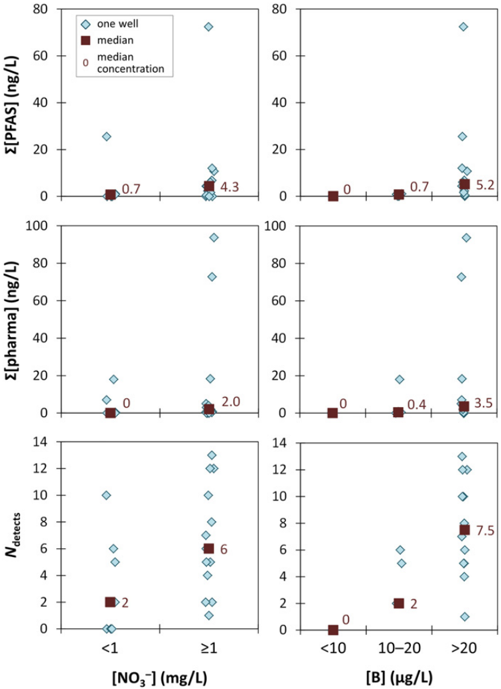
- OWC presence was correlated with nitrate, boron, and acesulfame and inversely correlated with well depth. Wells <15 m had higher median N detects (8 vs. 4 compounds), Σ[pharma] (5.0 vs. 0.4 ng/L), and Σ[PFAS] (6.0 vs. 0.5 ng/L) than deeper wells. Wells with >20 µg/L boron had 3.8 times more detectable OWCs, 7.4 times higher Σ[PFAS], and 8.8 times higher Σ[pharma] than wells with 10–20 µg/L boron.
- Septic systems were the likely main source, but two wells with the highest Σ[PFAS] (72 and 26 ng/L) departed from the nitrate relationship, suggesting landfill or commercial sources; one well 3.2 km from a capped landfill had the highest acesulfame concentration (5300 ng/L) and PFHxS concentration (47 ng/L).
Methods
- Recruited 110 volunteer wells, used GIS capture-zone land-use analysis plus nitrate and boron testing to select 20 domestic wells in Barnstable County, Cape Cod, Massachusetts, in areas served exclusively by onsite wastewater treatment systems; raw water samples were collected in February 2011.
- Analyzed 117 target OWCs using solid-phase extraction with LC-MS/MS for PPCPs, hormones, PFASs, alkylphenols, and herbicides, and large-volume injection GC/MS for organophosphate flame retardants; nitrate was measured by ion chromatography, boron by ICP-MS, sodium by ICP-AES, and total nitrogen and TOC by combustion.
- Used Spearman rank correlations (p < 0.05) between septic-impact indicators (nitrate, total N, boron, acesulfame, residential density, well depth) and three OWC metrics: total number of OWCs detected, sum of detected pharmaceutical concentrations, and sum of detected PFAS concentrations.
Limitations
- Stated in the paper: well selection was not designed to be a statistical representation of domestic wells across Cape Cod; capture-zone estimates have considerable uncertainty without site-specific hydrogeological data; TOC correlations could not be tested because TOC was detectable in only five wells; PFOA was detected in laboratory and field blanks at levels close to sample concentrations; alkylphenol method detection limits were relatively high (10–92 ng/L); health-based guideline values were available for only 10 of the 27 detected OWCs, and toxicological data are limited.
- Evident from the text: the study has a small sample (20 wells), a single sampling event in February 2011, and one region/aquifer, and it lacks isotopic or other source-confirmation analyses, limiting generalizability and causal attribution.
Model-written summary. Check it against the paper before relying on it.
Integrity signals
Registry
Cites
Statistics
Figures

Verification
Claims the paper makes
77 Not checked yet · 56 Own result · 44 Own interpretation · 7 No basis given · 3 Own method · 1 Partly supported · accuracy not yet measured
A result the paper reports from its own data — it cites no other source for it, so there is none to check. The quote shows it is in the paper.
In the paper
“One well was above US EPA's Maximum Contaminant Level (MCL) of 10 mg/L.”
§ Septic systems as sources of organic wastewater compounds in domestic drinking water wells in a shallow sand and gravel aquifer > 3.1. Inorganic contaminants
plainSingle case- Asserted: passes — The authors put it forward as true.
- Checkable: passes — It can be checked against evidence.
- Load-bearing: unclear — It is unclear whether the paper’s conclusions depend on it.
- Based: passes — The paper gives a reason why it holds.
A result the paper reports from its own data — it cites no other source for it, so there is none to check. The quote shows it is in the paper.
In the paper
“On average, 89% of TN was present as NO 3 -(range: 75-96%)”
§ Septic systems as sources of organic wastewater compounds in domestic drinking water wells in a shallow sand and gravel aquifer > 3.1. Inorganic contaminants
plain- Asserted: passes — The authors put it forward as true.
- Checkable: passes — It can be checked against evidence.
- Load-bearing: passes — The paper’s conclusions depend on it.
- Based: passes — The paper gives a reason why it holds.
A result the paper reports from its own data — it cites no other source for it, so there is none to check. The quote shows it is in the paper.
In the paper
“PFASs, pharmaceuticals, and an artificial sweetener were most frequently detected.”
§ Septic systems as sources of organic wastewater compounds in domestic drinking water wells in a shallow sand and gravel aquifer > Abstract
plain- Asserted: passes — The authors put it forward as true.
- Checkable: passes — It can be checked against evidence.
- Load-bearing: passes — The paper’s conclusions depend on it.
- Based: passes — The paper gives a reason why it holds.
A result the paper reports from its own data — it cites no other source for it, so there is none to check. The quote shows it is in the paper.
In the paper
“Several classes of target analytes were detected in ≤ 25% of wells tested, including organophosphate flame retardants (OPFRs), hormones, and alkylphenols.”
§ Septic systems as sources of organic wastewater compounds in domestic drinking water wells in a shallow sand and gravel aquifer > 3.2.4. Infrequently detected OWCs
plain- Asserted: passes — The authors put it forward as true.
- Checkable: passes — It can be checked against evidence.
- Load-bearing: unclear — It is unclear whether the paper’s conclusions depend on it.
- Based: passes — The paper gives a reason why it holds.
A result the paper reports from its own data — it cites no other source for it, so there is none to check. The quote shows it is in the paper.
In the paper
“By contrast, maximum concentrations of PFOS and several perfluoroalkyl carboxylates in Cape Cod wells were substantially lower than those reported for raw water samples in the same five studies.”
§ Septic systems as sources of organic wastewater compounds in domestic drinking water wells in a shallow sand and gravel aquifer > 3.2.3. PFASs
plain- Asserted: passes — The authors put it forward as true.
- Checkable: passes — It can be checked against evidence.
- Load-bearing: passes — The paper’s conclusions depend on it.
- Based: passes — The paper gives a reason why it holds.
A result the paper reports from its own data — it cites no other source for it, so there is none to check. The quote shows it is in the paper.
In the paper
“Five wells (25%) had detectable concentrations of one of four non-halogenated OPFRs ranging from 11 to 38 ng/L.”
§ Septic systems as sources of organic wastewater compounds in domestic drinking water wells in a shallow sand and gravel aquifer > 3.2.4. Infrequently detected OWCs
plain- Asserted: passes — The authors put it forward as true.
- Checkable: passes — It can be checked against evidence.
- Load-bearing: unclear — It is unclear whether the paper’s conclusions depend on it.
- Based: passes — The paper gives a reason why it holds.
A result the paper reports from its own data — it cites no other source for it, so there is none to check. The quote shows it is in the paper.
In the paper
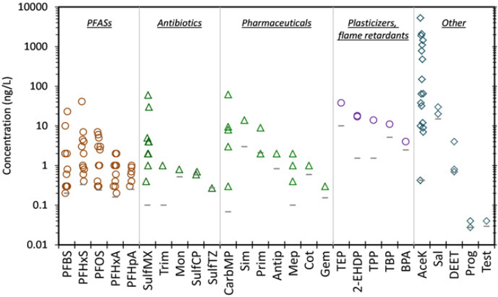
“Of the 117 OWCs that we analyzed, 27 compounds (23%) were detected in at least one well (Table 2, Fig. 1).”
§ Septic systems as sources of organic wastewater compounds in domestic drinking water wells in a shallow sand and gravel aquifer > 3.2. Occurrence of OWCs
plain- Asserted: passes — The authors put it forward as true.
- Checkable: passes — It can be checked against evidence.
- Load-bearing: passes — The paper’s conclusions depend on it.
- Based: passes — The paper gives a reason why it holds.
A result the paper reports from its own data — it cites no other source for it, so there is none to check. The quote shows it is in the paper.
In the paper
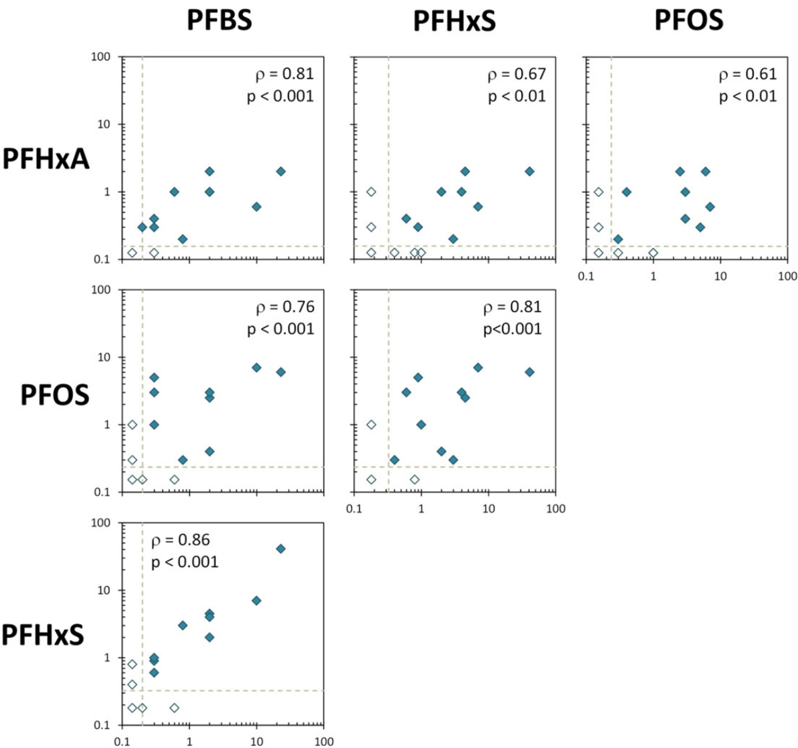
“Significant correlations were observed among the four most frequently detected PFASs, with Spearman rank correlation coefficients (ρ) ranging from 0.61 to 0.86 (p b 0.01 for all; Fig. 2).”
§ Septic systems as sources of organic wastewater compounds in domestic drinking water wells in a shallow sand and gravel aquifer > 3.2.3. PFASs
plaincorrelational- Asserted: passes — The authors put it forward as true.
- Checkable: passes — It can be checked against evidence.
- Load-bearing: unclear — It is unclear whether the paper’s conclusions depend on it.
- Based: passes — The paper gives a reason why it holds.
A result the paper reports from its own data — it cites no other source for it, so there is none to check. The quote shows it is in the paper.
In the paper
“PFOA was detected in laboratory method blanks (2.9, 3.2 ng/L) and field blanks (4 ng/L, n = 2) at levels close to the maximum concentration in field samples (7 ng/L).”
§ Septic systems as sources of organic wastewater compounds in domestic drinking water wells in a shallow sand and gravel aquifer > 3.2.3. PFASs
plainn = 2- Asserted: passes — The authors put it forward as true.
- Checkable: passes — It can be checked against evidence.
- Load-bearing: unclear — It is unclear whether the paper’s conclusions depend on it.
- Based: passes — The paper gives a reason why it holds.
A result the paper reports from its own data — it cites no other source for it, so there is none to check. The quote shows it is in the paper.
In the paper
“Seven OWCs were detected in at least one-quarter of wells tested: an artificial sweetener (acesulfame), four per-and polyfluoroalkyl substances (PFASs), and two pharmaceuticals (sulfamethoxazole, carbamazepine).”
§ Septic systems as sources of organic wastewater compounds in domestic drinking water wells in a shallow sand and gravel aquifer > 3.2. Occurrence of OWCs
plain- Asserted: passes — The authors put it forward as true.
- Checkable: passes — It can be checked against evidence.
- Load-bearing: passes — The paper’s conclusions depend on it.
- Based: passes — The paper gives a reason why it holds.
- Probably not a substantial claim. 47
- It may state two separate claims as one. 86
- The quote only partly states this claim. 1
The cited sources support only part of this claim — read each source’s verdict below.
In the paper
“PFAS concentrations in landfill leachate range from low ng/L to 100s of ng/L (Eggen et al., 2010;Huset et al., 2011;Clarke et al., 2015).”
§ Septic systems as sources of organic wastewater compounds in domestic drinking water wells in a shallow sand and gravel aquifer > 3.4. Other sources of OWCs
What the sources say
- Not checked yetcites Eggen et al., 2010 source
- Partly supportedcites Huset et al., 2011 sourceExperimental — accuracy not yet measured
Section 3.2 reports landfill-leachate fluorochemicals in the hundreds of ng/L, supporting that portion of the range. But it reports individual concentrations up to 2,800 ng/L, beyond the claimed upper end, and does not establish low single-digit ng/L concentrations in leachate. The low ng/L figures in section 3.1 are method detection limits, not measured concentrations. (LLM, conf=0.88)
- Not checked yetcites Clarke et al., 2015 source
plain- Asserted: passes — The authors put it forward as true.
- Checkable: passes — It can be checked against evidence.
- Load-bearing: fails — The paper’s conclusions may not depend on it.
- Based: passes — The paper gives a reason why it holds.
Probably not a substantial claim. The paper’s conclusions may not depend on it.
A result the paper reports from its own data — it cites no other source for it, so there is none to check. The quote shows it is in the paper.
In the paper
“The two wells with the highest [B] (250 and 91 μg/L) also had two of the three highest [NO 3 -] (≥5 mg/L), consistent with septic systems as the main source.”
§ Septic systems as sources of organic wastewater compounds in domestic drinking water wells in a shallow sand and gravel aquifer > 3.1. Inorganic contaminants
plaincorrelational- Asserted: passes — The authors put it forward as true.
- Checkable: passes — It can be checked against evidence.
- Load-bearing: passes — The paper’s conclusions depend on it.
- Based: passes — The paper gives a reason why it holds.
It may state two separate claims as one.
In the paper
“The four wells with non-detectable NO 3 -had ≤13 μg/L B, consistent with background concentrations in Cape Cod groundwater (~10 μg/L B; Schaider et al., 2014).”
§ Septic systems as sources of organic wastewater compounds in domestic drinking water wells in a shallow sand and gravel aquifer > 3.1. Inorganic contaminants
What the sources say
- Not checked yetcites Schaider et al., 2014 source
plain- Asserted: passes — The authors put it forward as true.
- Checkable: passes — It can be checked against evidence.
- Load-bearing: passes — The paper’s conclusions depend on it.
- Based: passes — The paper gives a reason why it holds.
It may state two separate claims as one.
A result the paper reports from its own data — it cites no other source for it, so there is none to check. The quote shows it is in the paper.
In the paper
“Among the 20 wells that we tested for OWCs, concentrations of nitrate (NO 3 -) varied by more than a factor of 100, and total nitrogen (TN) and boron (B) concentrations ranged by more than a factor of 25 (Table 1).”
§ Septic systems as sources of organic wastewater compounds in domestic drinking water wells in a shallow sand and gravel aquifer > 3.1. Inorganic contaminants
plain- Asserted: passes — The authors put it forward as true.
- Checkable: passes — It can be checked against evidence.
- Load-bearing: unclear — It is unclear whether the paper’s conclusions depend on it.
- Based: passes — The paper gives a reason why it holds.
It may state two separate claims as one.
A result the paper reports from its own data — it cites no other source for it, so there is none to check. The quote shows it is in the paper.
In the paper
“Five wells had [NO 3 -] consistent with background or minimal anthropogenic impact (b0.5 mg/L), five wells showed moderate impact (0.5-2.5 mg/L), and 10 were highly impacted (N 2.5 mg/L).”
§ Septic systems as sources of organic wastewater compounds in domestic drinking water wells in a shallow sand and gravel aquifer > 3.1. Inorganic contaminants
plain- Asserted: passes — The authors put it forward as true.
- Checkable: passes — It can be checked against evidence.
- Load-bearing: unclear — It is unclear whether the paper’s conclusions depend on it.
- Based: passes — The paper gives a reason why it holds.
It may state two separate claims as one.
A result the paper reports from its own data — it cites no other source for it, so there is none to check. The quote shows it is in the paper.
In the paper
“Boron (B) concentrations ranged from 6.3 to 250 μg/L.”
§ Septic systems as sources of organic wastewater compounds in domestic drinking water wells in a shallow sand and gravel aquifer > 3.1. Inorganic contaminants
plain- Asserted: passes — The authors put it forward as true.
- Checkable: passes — It can be checked against evidence.
- Load-bearing: unclear — It is unclear whether the paper’s conclusions depend on it.
- Based: passes — The paper gives a reason why it holds.
The quote only partly states this claim.
A result the paper reports from its own data — it cites no other source for it, so there is none to check. The quote shows it is in the paper.
In the paper
“Nitrate, boron, and well depth were all correlated with PFASs and pharmaceuticals.”
§ Septic systems as sources of organic wastewater compounds in domestic drinking water wells in a shallow sand and gravel aquifer > Abstract
plaincorrelational- Asserted: passes — The authors put it forward as true.
- Checkable: passes — It can be checked against evidence.
- Load-bearing: passes — The paper’s conclusions depend on it.
- Based: passes — The paper gives a reason why it holds.
It may state two separate claims as one.
None of the sources cited for this claim have been checked yet.
In the paper
“We did not detect chlorinated OPFRs, including three that we detected in public wells on Cape Cod (TCEP, TDCPP, TCPP; Schaider et al., 2014), even though they tend to be more resistant to biodegradation than non-halogenated OPFRs (Meyer and Bester, 2004).”
§ Septic systems as sources of organic wastewater compounds in domestic drinking water wells in a shallow sand and gravel aquifer > 3.2.4. Infrequently detected OWCs
What the sources say
- Not checked yetcites Schaider et al., 2014 source
- Not checked yetcites Meyer and Bester, 2004
plain- Asserted: passes — The authors put it forward as true.
- Checkable: passes — It can be checked against evidence.
- Load-bearing: unclear — It is unclear whether the paper’s conclusions depend on it.
- Based: passes — The paper gives a reason why it holds.
It may state two separate claims as one.
A result the paper reports from its own data — it cites no other source for it, so there is none to check. The quote shows it is in the paper.
In the paper
“Simvastatin was detected in one well (14 ng/L), the first reported detection in drinking water.”
§ Septic systems as sources of organic wastewater compounds in domestic drinking water wells in a shallow sand and gravel aquifer > 3.2.2. Pharmaceuticals
plainSingle case- Asserted: passes — The authors put it forward as true.
- Checkable: passes — It can be checked against evidence.
- Load-bearing: unclear — It is unclear whether the paper’s conclusions depend on it.
- Based: passes — The paper gives a reason why it holds.
It may state two separate claims as one.
A result the paper reports from its own data — it cites no other source for it, so there is none to check. The quote shows it is in the paper.
In the paper
“PFBS and PFHxS had the strongest correlation and most linear relationship, suggesting a common source, although temporal trends in production of these PFASs vary.”
§ Septic systems as sources of organic wastewater compounds in domestic drinking water wells in a shallow sand and gravel aquifer > 3.2.3. PFASs
hedgedcorrelational- Asserted: passes — The authors put it forward as true.
- Checkable: passes — It can be checked against evidence.
- Load-bearing: unclear — It is unclear whether the paper’s conclusions depend on it.
- Based: passes — The paper gives a reason why it holds.
It may state two separate claims as one.
The paper states this without a source or data behind it here, so there is nothing to check it against. The quote shows it is in the paper.
In the paper
“Nine pharmaceuticals were detected in only one or two wells, consistent with a high degree of heterogeneity in groundwater pharmaceutical concentrations.”
§ Septic systems as sources of organic wastewater compounds in domestic drinking water wells in a shallow sand and gravel aquifer > 3.2.2. Pharmaceuticals
plaincorrelational- Asserted: passes — The authors put it forward as true.
- Checkable: passes — It can be checked against evidence.
- Load-bearing: unclear — It is unclear whether the paper’s conclusions depend on it.
- Based: passes — The paper gives a reason why it holds.
It may state two separate claims as one.
A result the paper reports from its own data — it cites no other source for it, so there is none to check. The quote shows it is in the paper.
In the paper
“We did not detect nonylphenol (NP), octylphenol (OP), NP ethoxycarboxylates (NPECs), or NP ethoxylates (NPEOs) in the current study.”
§ Septic systems as sources of organic wastewater compounds in domestic drinking water wells in a shallow sand and gravel aquifer > 3.2.4. Infrequently detected OWCs
plain- Asserted: passes — The authors put it forward as true.
- Checkable: passes — It can be checked against evidence.
- Load-bearing: unclear — It is unclear whether the paper’s conclusions depend on it.
- Based: passes — The paper gives a reason why it holds.
It may state two separate claims as one.
A result the paper reports from its own data — it cites no other source for it, so there is none to check. The quote shows it is in the paper.
In the paper
“We did not detect PFNA (b0.45 ng/L) or PFDA (b 0.28 ng/L) in any of the samples tested on Cape Cod.”
§ Septic systems as sources of organic wastewater compounds in domestic drinking water wells in a shallow sand and gravel aquifer > 3.2.3. PFASs
plain- Asserted: passes — The authors put it forward as true.
- Checkable: passes — It can be checked against evidence.
- Load-bearing: passes — The paper’s conclusions depend on it.
- Based: passes — The paper gives a reason why it holds.
It may state two separate claims as one.
A result the paper reports from its own data — it cites no other source for it, so there is none to check. The quote shows it is in the paper.
In the paper
“Seventy-seven percent of OWCs were not detected in any sample, including all tested alkylphenols and herbicides.”
§ Septic systems as sources of organic wastewater compounds in domestic drinking water wells in a shallow sand and gravel aquifer > 3.2. Occurrence of OWCs
plain- Asserted: passes — The authors put it forward as true.
- Checkable: passes — It can be checked against evidence.
- Load-bearing: unclear — It is unclear whether the paper’s conclusions depend on it.
- Based: passes — The paper gives a reason why it holds.
It may state two separate claims as one.
A result the paper reports from its own data — it cites no other source for it, so there is none to check. The quote shows it is in the paper.
In the paper
“We detected twelve pharmaceuticals, including five antibiotics, out of a total of 59 pharmaceutical analytes, and 13 wells (65%) had detectable concentrations of at least one pharmaceutical.”
§ Septic systems as sources of organic wastewater compounds in domestic drinking water wells in a shallow sand and gravel aquifer > 3.2.2. Pharmaceuticals
plain- Asserted: passes — The authors put it forward as true.
- Checkable: passes — It can be checked against evidence.
- Load-bearing: passes — The paper’s conclusions depend on it.
- Based: passes — The paper gives a reason why it holds.
It may state two separate claims as one.
A result the paper reports from its own data — it cites no other source for it, so there is none to check. The quote shows it is in the paper.
In the paper
“The maximum concentrations of two perfluoroalkane sulfonates, PFHxS and PFBS, on Cape Cod were generally higher than those reported in the other studies and were within a factor of two of the maximum concentrations reported in these studies (Table 2).”
§ Septic systems as sources of organic wastewater compounds in domestic drinking water wells in a shallow sand and gravel aquifer > 3.2.3. PFASs
plain- Asserted: passes — The authors put it forward as true.
- Checkable: passes — It can be checked against evidence.
- Load-bearing: unclear — It is unclear whether the paper’s conclusions depend on it.
- Based: passes — The paper gives a reason why it holds.
It may state two separate claims as one.
A result the paper reports from its own data — it cites no other source for it, so there is none to check. The quote shows it is in the paper.
In the paper
“While PFOA concentrations in most wells were ≤4 ng/L, five wells had PFOA concentrations of 2-3 ng/L after subtracting the field blank concentration; these five wells were among the six with detectable concentrations of five other PFASs.”
§ Septic systems as sources of organic wastewater compounds in domestic drinking water wells in a shallow sand and gravel aquifer > 3.2.3. PFASs
plaincorrelational- Asserted: passes — The authors put it forward as true.
- Checkable: passes — It can be checked against evidence.
- Load-bearing: unclear — It is unclear whether the paper’s conclusions depend on it.
- Based: passes — The paper gives a reason why it holds.
It may state two separate claims as one.
A result the paper reports from its own data — it cites no other source for it, so there is none to check. The quote shows it is in the paper.
In the paper
“The two most frequently detected pharmaceuticals, which also had the highest maximum concentrations, were sulfamethoxazole (9 wells above 0.1 ng/L; maximum 60 ng/L) and carbamazepine (5 wells above 0.07 ng/L; maximum 62 ng/L).”
§ Septic systems as sources of organic wastewater compounds in domestic drinking water wells in a shallow sand and gravel aquifer > 3.2.2. Pharmaceuticals
plain- Asserted: passes — The authors put it forward as true.
- Checkable: passes — It can be checked against evidence.
- Load-bearing: unclear — It is unclear whether the paper’s conclusions depend on it.
- Based: passes — The paper gives a reason why it holds.
It may state two separate claims as one.
A result the paper reports from its own data — it cites no other source for it, so there is none to check. The quote shows it is in the paper.
In the paper
“Four PFASs (PFOS, PFHxS, PFBS, and PFHxA) were detected in ≥50% of wells we tested, and another (PFHpA) was detected in 30% of wells.”
§ Septic systems as sources of organic wastewater compounds in domestic drinking water wells in a shallow sand and gravel aquifer > 3.2.3. PFASs
plain- Asserted: passes — The authors put it forward as true.
- Checkable: passes — It can be checked against evidence.
- Load-bearing: passes — The paper’s conclusions depend on it.
- Based: passes — The paper gives a reason why it holds.
It may state two separate claims as one.
None of the sources cited for this claim have been checked yet.
In the paper
“The maximum sulfamethoxazole concentration in this study matched or exceeded the maximum concentration in five drinking water studies (Zimmerman, 2005;Stackelberg et al., 2007;Focazio et al., 2008;Illinois EPA, 2008;Tabe, 2010), and was within a factor of 3 of the maximum concentration in five other studies (Verstraeten et al., 2005;Benotti et al., 2009;Fram and Belitz, 2011;Erickson et al., 2014;”
§ Septic systems as sources of organic wastewater compounds in domestic drinking water wells in a shallow sand and gravel aquifer > 3.2.2. Pharmaceuticals
What the sources say
plain- Asserted: passes — The authors put it forward as true.
- Checkable: passes — It can be checked against evidence.
- Load-bearing: unclear — It is unclear whether the paper’s conclusions depend on it.
- Based: passes — The paper gives a reason why it holds.
It may state two separate claims as one.
A result the paper reports from its own data — it cites no other source for it, so there is none to check. The quote shows it is in the paper.
In the paper
“Acesulfame (or Ace K), an artificial sweetener, was the most frequently detected OWC, found in 17 wells (85%).”
§ Septic systems as sources of organic wastewater compounds in domestic drinking water wells in a shallow sand and gravel aquifer > 3.2.1. Acesulfame
plain- Asserted: passes — The authors put it forward as true.
- Checkable: passes — It can be checked against evidence.
- Load-bearing: unclear — It is unclear whether the paper’s conclusions depend on it.
- Based: passes — The paper gives a reason why it holds.
It may state two separate claims as one.
A result the paper reports from its own data — it cites no other source for it, so there is none to check. The quote shows it is in the paper.
In the paper
“Seventeen wells (85%) contained detectable concentrations of at least one OWC, with a maximum of 13 OWCs detected in a single well.”
§ Septic systems as sources of organic wastewater compounds in domestic drinking water wells in a shallow sand and gravel aquifer > 3.2. Occurrence of OWCs
plain- Asserted: passes — The authors put it forward as true.
- Checkable: passes — It can be checked against evidence.
- Load-bearing: passes — The paper’s conclusions depend on it.
- Based: passes — The paper gives a reason why it holds.
It may state two separate claims as one.
A result the paper reports from its own data — it cites no other source for it, so there is none to check. The quote shows it is in the paper.
In the paper
“Among the nine hormone target analytes, only two were detected (progesterone and cis-testosterone), at relatively low concentrations (0.02-0.04 ng/L), in a total of four wells (20%).”
§ Septic systems as sources of organic wastewater compounds in domestic drinking water wells in a shallow sand and gravel aquifer > 3.2.4. Infrequently detected OWCs
plain- Asserted: passes — The authors put it forward as true.
- Checkable: passes — It can be checked against evidence.
- Load-bearing: unclear — It is unclear whether the paper’s conclusions depend on it.
- Based: passes — The paper gives a reason why it holds.
It may state two separate claims as one.
A result the paper reports from its own data — it cites no other source for it, so there is none to check. The quote shows it is in the paper.
In the paper
“Six wells had detectable concentrations of all five of these PFASs, and one well had the highest concentrations of PFHxS (41 ng/L), PFBS (23 ng/L), and PFHxA (2 ng/L).”
§ Septic systems as sources of organic wastewater compounds in domestic drinking water wells in a shallow sand and gravel aquifer > 3.2.3. PFASs
plain- Asserted: passes — The authors put it forward as true.
- Checkable: passes — It can be checked against evidence.
- Load-bearing: unclear — It is unclear whether the paper’s conclusions depend on it.
- Based: passes — The paper gives a reason why it holds.
It may state two separate claims as one.
The paper states this without a source or data behind it here, so there is nothing to check it against. The quote shows it is in the paper.
In the paper
“Compared to wells N15 m in depth, wells b15 m had higher median N detects (8 vs. 4 compounds), Σ[pharma] (5.0 vs. 0.4 ng/L) and Σ[PFAS] (6.0 vs. 0.5 ng/L).”
§ Septic systems as sources of organic wastewater compounds in domestic drinking water wells in a shallow sand and gravel aquifer > 3.3.1. Well depth
plaincorrelational- Asserted: passes — The authors put it forward as true.
- Checkable: passes — It can be checked against evidence.
- Load-bearing: passes — The paper’s conclusions depend on it.
- Based: passes — The paper gives a reason why it holds.
It may state two separate claims as one.
A result the paper reports from its own data — it cites no other source for it, so there is none to check. The quote shows it is in the paper.
In the paper
“Compared to wells with b1 mg/L NO 3 , wells with N 1 mg/L NO 3 had three times as many detectable OWCs, 6.2 times higher Σ[PFAS] and higher Σ[pharma] (2 vs. 0 ng/L).”
§ Septic systems as sources of organic wastewater compounds in domestic drinking water wells in a shallow sand and gravel aquifer > 3.3.3. Nitrogen, boron, and TOC
plaincorrelational- Asserted: passes — The authors put it forward as true.
- Checkable: passes — It can be checked against evidence.
- Load-bearing: passes — The paper’s conclusions depend on it.
- Based: passes — The paper gives a reason why it holds.
It may state two separate claims as one.
A result the paper reports from its own data — it cites no other source for it, so there is none to check. The quote shows it is in the paper.
In the paper
“Wells with N 20 μg/L B had 3.8 times more detectable OWCs, 7.4 times higher Σ[PFAS], and 8.8 times higher Σ[pharma] than wells with 10-20 μg/L B (Fig. 3).”
§ Septic systems as sources of organic wastewater compounds in domestic drinking water wells in a shallow sand and gravel aquifer > 3.3.3. Nitrogen, boron, and TOC
plaincorrelational- Asserted: passes — The authors put it forward as true.
- Checkable: passes — It can be checked against evidence.
- Load-bearing: passes — The paper’s conclusions depend on it.
- Based: passes — The paper gives a reason why it holds.
It may state two separate claims as one.
A result the paper reports from its own data — it cites no other source for it, so there is none to check. The quote shows it is in the paper.
In the paper
“For instance, the well with second highest [NO 3 -] (8 mg/L) had 21 μg/L [B] (just below the median) and ~0.4 ng/L acesulfame (lowest detected concentration), and no other detected OWCs, suggesting that the relatively high [NO 3 -] came from another source.”
§ Septic systems as sources of organic wastewater compounds in domestic drinking water wells in a shallow sand and gravel aquifer > 3.3.3. Nitrogen, boron, and TOC
hedgedSingle case- Asserted: passes — The authors put it forward as true.
- Checkable: passes — It can be checked against evidence.
- Load-bearing: unclear — It is unclear whether the paper’s conclusions depend on it.
- Based: passes — The paper gives a reason why it holds.
It may state two separate claims as one.
A result the paper reports from its own data — it cites no other source for it, so there is none to check. The quote shows it is in the paper.
In the paper
“Wells with TOC N 1 mg/L had higher median N detects (10 vs. 5 compounds), Σ[pharma] (7 vs. 0.4 ng/L), and Σ[PFAS] (11 vs. 0.8 ng/L) compared to wells with TOC b 1 mg/L.”
§ Septic systems as sources of organic wastewater compounds in domestic drinking water wells in a shallow sand and gravel aquifer > 3.3.3. Nitrogen, boron, and TOC
plaincorrelational- Asserted: passes — The authors put it forward as true.
- Checkable: passes — It can be checked against evidence.
- Load-bearing: passes — The paper’s conclusions depend on it.
- Based: passes — The paper gives a reason why it holds.
It may state two separate claims as one.
A result the paper reports from its own data — it cites no other source for it, so there is none to check. The quote shows it is in the paper.
In the paper
“Some wells, particularly those in close proximity to the coastline, may have derived some of their B from seawater intrusion or coastal flooding ([B] in seawater: ~4.4 mg/L); concentrations of B and sodium (Na) were correlated (ρ = 0.68, p b 0.001).”
§ Septic systems as sources of organic wastewater compounds in domestic drinking water wells in a shallow sand and gravel aquifer > 3.3.3. Nitrogen, boron, and TOC
hedgedconditional- Asserted: passes — The authors put it forward as true.
- Checkable: passes — It can be checked against evidence.
- Load-bearing: unclear — It is unclear whether the paper’s conclusions depend on it.
- Based: passes — The paper gives a reason why it holds.
It may state two separate claims as one.
A result the paper reports from its own data — it cites no other source for it, so there is none to check. The quote shows it is in the paper.
In the paper
“This well had the highest acesulfame concentration (5300 ng/L) and the highest concentration of three PFASs (PFHxS, PFBS, PFHxA).”
§ Septic systems as sources of organic wastewater compounds in domestic drinking water wells in a shallow sand and gravel aquifer > 3.4. Other sources of OWCs
plainSingle case- Asserted: passes — The authors put it forward as true.
- Checkable: passes — It can be checked against evidence.
- Load-bearing: passes — The paper’s conclusions depend on it.
- Based: passes — The paper gives a reason why it holds.
It may state two separate claims as one.
The paper states this without a source or data behind it here, so there is nothing to check it against. The quote shows it is in the paper.
In the paper
“One of these two wells, W09, was located 3.2 km from a capped landfill, although the well was not directly downgradient of the landfill.”
§ Septic systems as sources of organic wastewater compounds in domestic drinking water wells in a shallow sand and gravel aquifer > 3.4. Other sources of OWCs
plainSingle case- Asserted: passes — The authors put it forward as true.
- Checkable: passes — It can be checked against evidence.
- Load-bearing: fails — The paper’s conclusions may not depend on it.
- Based: passes — The paper gives a reason why it holds.
Probably not a substantial claim. The paper’s conclusions may not depend on it. It may state two separate claims as one.
A result the paper reports from its own data — it cites no other source for it, so there is none to check. The quote shows it is in the paper.
In the paper
“Another well (W03) with elevated Σ[PFAS] (26 ng/L) and relatively low [NO 3 -] (0.8 mg/L) did not appear to be located downgradient of a landfill.”
§ Septic systems as sources of organic wastewater compounds in domestic drinking water wells in a shallow sand and gravel aquifer > 3.4. Other sources of OWCs
hedgedSingle case- Asserted: passes — The authors put it forward as true.
- Checkable: passes — It can be checked against evidence.
- Load-bearing: unclear — It is unclear whether the paper’s conclusions depend on it.
- Based: passes — The paper gives a reason why it holds.
It may state two separate claims as one.
A result the paper reports from its own data — it cites no other source for it, so there is none to check. The quote shows it is in the paper.
In the paper
“The presence of OWCs was correlated with concentrations of nitrate, boron, and acesulfame (artificial sweetener), and inversely correlated with well depth.”
§ Septic systems as sources of organic wastewater compounds in domestic drinking water wells in a shallow sand and gravel aquifer > 4. Conclusions
plaincorrelational- Asserted: passes — The authors put it forward as true.
- Checkable: passes — It can be checked against evidence.
- Load-bearing: passes — The paper’s conclusions depend on it.
- Based: passes — The paper gives a reason why it holds.
It may state two separate claims as one.
In the paper
“Coliform bacteria counts and nitrate and phosphate concentrations were higher in domestic wells closer to septic tanks in Florida (Arnade, 1999)”
§ Septic systems as sources of organic wastewater compounds in domestic drinking water wells in a shallow sand and gravel aquifer > 1. Introduction
What the sources say
- Not checked yetcites Arnade, 1999 source
plaincorrelational- Asserted: passes — The authors put it forward as true.
- Checkable: passes — It can be checked against evidence.
- Load-bearing: passes — The paper’s conclusions depend on it.
- Based: passes — The paper gives a reason why it holds.
Probably not a substantial claim.
In the paper
“Among 3465 domestic wells tested throughout the US (Focazio et al., 2006), 90% had N0.01 mg/L NO 3 -(compared with 80% in our study), 8% had N 10 mg/L NO 3 -(compared with 5% in our study), and the mean concentration was 3.6 mg/L (compared with 2.9 mg/L in our study).”
§ Septic systems as sources of organic wastewater compounds in domestic drinking water wells in a shallow sand and gravel aquifer > 3.1. Inorganic contaminants
What the sources say
- Not checked yetcites Focazio et al., 2006 source
plain- Asserted: passes — The authors put it forward as true.
- Checkable: passes — It can be checked against evidence.
- Load-bearing: fails — The paper’s conclusions may not depend on it.
- Based: passes — The paper gives a reason why it holds.
Probably not a substantial claim. The paper’s conclusions may not depend on it. It may state two separate claims as one.
In the paper
“In a sampling of over 3800 domestic wells in Wisconsin, USA, 47% exceeded at least one health guideline for nitrate, coliform bacteria, fluoride, or metals (Knobeloch et al., 2013)”
§ Septic systems as sources of organic wastewater compounds in domestic drinking water wells in a shallow sand and gravel aquifer > 1. Introduction
What the sources say
- Not checked yetcites Knobeloch et al., 2013
plain- Asserted: passes — The authors put it forward as true.
- Checkable: passes — It can be checked against evidence.
- Load-bearing: fails — The paper’s conclusions may not depend on it.
- Based: passes — The paper gives a reason why it holds.
Probably not a substantial claim. The paper’s conclusions may not depend on it.
In the paper
“In Nebraska wells ≤ 15 m from septic systems, concentrations of NH 4 + exceeded those of NO 3 -, indicating reducing conditions.”
§ Septic systems as sources of organic wastewater compounds in domestic drinking water wells in a shallow sand and gravel aquifer > 3.1. Inorganic contaminants
What the sources say
- Not checked yetcites Verstraeten et al., 2005 source
hedgedcorrelational- Asserted: passes — The authors put it forward as true.
- Checkable: passes — It can be checked against evidence.
- Load-bearing: unclear — It is unclear whether the paper’s conclusions depend on it.
- Based: passes — The paper gives a reason why it holds.
It may state two separate claims as one.
In the paper
“a compilation of domestic well testing throughout the US showed exceedances of drinking water standards in 8.4% of wells for nitrate and 11% of wells for arsenic (Focazio et al., 2006)”
§ Septic systems as sources of organic wastewater compounds in domestic drinking water wells in a shallow sand and gravel aquifer > 1. Introduction
What the sources say
- Not checked yetcites Focazio et al., 2006 source
plain- Asserted: passes — The authors put it forward as true.
- Checkable: passes — It can be checked against evidence.
- Load-bearing: fails — The paper’s conclusions may not depend on it.
- Based: passes — The paper gives a reason why it holds.
Probably not a substantial claim. The paper’s conclusions may not depend on it. It may state two separate claims as one.
In the paper
“in a study of 26 shallow wells in Nebraska, USA, the median [NO 3 -] was b 0.05 mg/L and the maximum was 39 mg/L (Verstraeten et al., 2005).”
§ Septic systems as sources of organic wastewater compounds in domestic drinking water wells in a shallow sand and gravel aquifer > 3.1. Inorganic contaminants
What the sources say
- Not checked yetcites Verstraeten et al., 2005 source
plain- Asserted: passes — The authors put it forward as true.
- Checkable: passes — It can be checked against evidence.
- Load-bearing: fails — The paper’s conclusions may not depend on it.
- Based: passes — The paper gives a reason why it holds.
Probably not a substantial claim. The paper’s conclusions may not depend on it. It may state two separate claims as one.
A conclusion the paper draws from its own results — it cites no other source for it, so there is none to check. The quote shows it is in the paper.
In the paper
“Septic systems are likely the main source; landfills may also affect some wells.”
§ Septic systems as sources of organic wastewater compounds in domestic drinking water wells in a shallow sand and gravel aquifer > Abstract
hedgedconditional- Asserted: passes — The authors put it forward as true.
- Checkable: passes — It can be checked against evidence.
- Load-bearing: passes — The paper’s conclusions depend on it.
- Based: passes — The paper gives a reason why it holds.
It may state two separate claims as one.
A conclusion the paper draws from its own results — it cites no other source for it, so there is none to check. The quote shows it is in the paper.
In the paper
“an indication of oxic conditions in all groundwater samples and minimal contributions from ammonia (NH 4 + ), organic N, or other N species.”
§ Septic systems as sources of organic wastewater compounds in domestic drinking water wells in a shallow sand and gravel aquifer > 3.1. Inorganic contaminants
hedgeddirect- Asserted: passes — The authors put it forward as true.
- Checkable: passes — It can be checked against evidence.
- Load-bearing: passes — The paper’s conclusions depend on it.
- Based: passes — The paper gives a reason why it holds.
It may state two separate claims as one.
In the paper
“diarrheal disease in children was associated with density of nearby septic systems in Wisconsin (Borchardt et al., 2003).”
§ Septic systems as sources of organic wastewater compounds in domestic drinking water wells in a shallow sand and gravel aquifer > 1. Introduction
What the sources say
- Not checked yetcites Borchardt et al., 2003 source
plaincorrelational- Asserted: passes — The authors put it forward as true.
- Checkable: passes — It can be checked against evidence.
- Load-bearing: fails — The paper’s conclusions may not depend on it.
- Based: passes — The paper gives a reason why it holds.
Probably not a substantial claim. The paper’s conclusions may not depend on it.
In the paper
“Verstraeten et al. (2005) detected 14 pharmaceuticals in domestic wells in a shallow sand and gravel aquifer in central US”
§ Septic systems as sources of organic wastewater compounds in domestic drinking water wells in a shallow sand and gravel aquifer > 1. Introduction
What the sources say
- Not checked yetcites Verstraeten et al., 2005 source
plain- Asserted: passes — The authors put it forward as true.
- Checkable: passes — It can be checked against evidence.
- Load-bearing: fails — The paper’s conclusions may not depend on it.
- Based: passes — The paper gives a reason why it holds.
Probably not a substantial claim. The paper’s conclusions may not depend on it.
In the paper
“Erickson et al. (2014) detected several pharmaceuticals in domestic wells in both glacial and bedrock aquifers.”
§ Septic systems as sources of organic wastewater compounds in domestic drinking water wells in a shallow sand and gravel aquifer > 1. Introduction
What the sources say
- Not checked yetcites Erickson et al., 2014
plain- Asserted: passes — The authors put it forward as true.
- Checkable: passes — It can be checked against evidence.
- Load-bearing: fails — The paper’s conclusions may not depend on it.
- Based: passes — The paper gives a reason why it holds.
Probably not a substantial claim. The paper’s conclusions may not depend on it.
In the paper
“This comparison suggests that the distribution of [NO 3 -] in our study was similar to that of Focazio et al.'s broader nationwide study, although their sampling was not part of a nationally representative sampling design.”
§ Septic systems as sources of organic wastewater compounds in domestic drinking water wells in a shallow sand and gravel aquifer > 3.1. Inorganic contaminants
What the sources say
- Not checked yetcites Focazio et al., 2006 source
hedged- Asserted: passes — The authors put it forward as true.
- Checkable: passes — It can be checked against evidence.
- Load-bearing: unclear — It is unclear whether the paper’s conclusions depend on it.
- Based: passes — The paper gives a reason why it holds.
It may state two separate claims as one.
In the paper
“The range of well depths was similar in both studies (5- 30 m in Nebraska, 3-40 m on Cape Cod).”
§ Septic systems as sources of organic wastewater compounds in domestic drinking water wells in a shallow sand and gravel aquifer > 3.2.2. Pharmaceuticals
What the sources say
- Not checked yetcites Verstraeten et al., 2005 source
plain- Asserted: passes — The authors put it forward as true.
- Checkable: passes — It can be checked against evidence.
- Load-bearing: fails — The paper’s conclusions may not depend on it.
- Based: passes — The paper gives a reason why it holds.
Probably not a substantial claim. The paper’s conclusions may not depend on it.
None of the sources cited for this claim have been checked yet.
In the paper
“Production of PFOS, PFHxS, and PFOA has declined in the US since the early 2000s following a phase-out of POSF-related chemicals by 3M and subsequent stewardship plans by US EPA, and this has resulted in declines in blood serum concentrations of these three PFASs in Americans (Calafat et al., 2007;Olsen et al., 2008).”
§ Septic systems as sources of organic wastewater compounds in domestic drinking water wells in a shallow sand and gravel aquifer > 3.2.3. PFASs
What the sources say
plaindirect- Asserted: passes — The authors put it forward as true.
- Checkable: passes — It can be checked against evidence.
- Load-bearing: fails — The paper’s conclusions may not depend on it.
- Based: passes — The paper gives a reason why it holds.
Probably not a substantial claim. The paper’s conclusions may not depend on it. It may state two separate claims as one.
None of the sources cited for this claim have been checked yet.
In the paper
“Although we previously found three endogenous hormones in groundwater-fed ponds on Cape Cod (3-6.5 ng/L; Standley et al., 2008), we did not detect hormones in 20 public wells on Cape Cod (MRLs 0.1-0.5 ng/L; Schaider et al., 2014).”
§ Septic systems as sources of organic wastewater compounds in domestic drinking water wells in a shallow sand and gravel aquifer > 3.2.4. Infrequently detected OWCs
What the sources say
plain- Asserted: passes — The authors put it forward as true.
- Checkable: passes — It can be checked against evidence.
- Load-bearing: unclear — It is unclear whether the paper’s conclusions depend on it.
- Based: passes — The paper gives a reason why it holds.
It may state two separate claims as one.
A conclusion the paper draws from its own results — it cites no other source for it, so there is none to check. The quote shows it is in the paper.
In the paper
“As domestic wells have much smaller recharge areas than public supply wells, the presence of prescription medications depended on whether the well pulled from an area where a resident was using that medication and the persistence of the compound in groundwater.”
§ Septic systems as sources of organic wastewater compounds in domestic drinking water wells in a shallow sand and gravel aquifer > 3.2.2. Pharmaceuticals
plainconditional- Asserted: passes — The authors put it forward as true.
- Checkable: passes — It can be checked against evidence.
- Load-bearing: passes — The paper’s conclusions depend on it.
- Based: passes — The paper gives a reason why it holds.
It may state two separate claims as one.
None of the sources cited for this claim have been checked yet.
In the paper
“While these two longer chain carboxylates are often less frequently detected than shorter-chain PFASs, maximum concentrations of PFNA (96 ng/L; Post et al., 2013) and PFDA (3.3 ng/L: Quiñones and Snyder, 2009) were much higher in other studies.”
§ Septic systems as sources of organic wastewater compounds in domestic drinking water wells in a shallow sand and gravel aquifer > 3.2.3. PFASs
What the sources say
- Not checked yetcites Post et al., 2013 source
- Not checked yetcites Quiñones and Snyder, 2009
plain- Asserted: passes — The authors put it forward as true.
- Checkable: passes — It can be checked against evidence.
- Load-bearing: fails — The paper’s conclusions may not depend on it.
- Based: passes — The paper gives a reason why it holds.
Probably not a substantial claim. The paper’s conclusions may not depend on it. It may state two separate claims as one.
None of the sources cited for this claim have been checked yet.
In the paper
“Sulfamethoxazole and carbamazepine have been among the most frequently detected OWCs in drinking water and groundwater (Barnes et al., 2008;Benotti et al., 2009;Erickson et al., 2014;Schaider et al., 2014).”
§ Septic systems as sources of organic wastewater compounds in domestic drinking water wells in a shallow sand and gravel aquifer > 3.2.2. Pharmaceuticals
What the sources say
plain- Asserted: passes — The authors put it forward as true.
- Checkable: passes — It can be checked against evidence.
- Load-bearing: fails — The paper’s conclusions may not depend on it.
- Based: passes — The paper gives a reason why it holds.
Probably not a substantial claim. The paper’s conclusions may not depend on it.
In the paper
“By contrast, PFBS is used as a replacement for POSF-related chemicals (e.g., PFOS and PFHxS) and PFHxA is used as a shorter-chain analog of PFOA (Wang et al., 2013).”
§ Septic systems as sources of organic wastewater compounds in domestic drinking water wells in a shallow sand and gravel aquifer > 3.2.3. PFASs
What the sources say
- Not checked yetcites Wang et al., 2013 source
plain- Asserted: passes — The authors put it forward as true.
- Checkable: passes — It can be checked against evidence.
- Load-bearing: fails — The paper’s conclusions may not depend on it.
- Based: passes — The paper gives a reason why it holds.
Probably not a substantial claim. The paper’s conclusions may not depend on it. It may state two separate claims as one.
In the paper
“Phillips et al. (2015) reported 20 μg/L TBEP in groundwater downgradient of a septic system serving an elder care facility where the most likely source was floor wax.”
§ Septic systems as sources of organic wastewater compounds in domestic drinking water wells in a shallow sand and gravel aquifer > 3.2.4. Infrequently detected OWCs
What the sources say
- Not checked yetcites Phillips et al., 2015 source
hedgeddirectSingle case- Asserted: passes — The authors put it forward as true.
- Checkable: passes — It can be checked against evidence.
- Load-bearing: fails — The paper’s conclusions may not depend on it.
- Based: passes — The paper gives a reason why it holds.
Probably not a substantial claim. The paper’s conclusions may not depend on it.
None of the sources cited for this claim have been checked yet.
In the paper
“Aerobic sand filters in onsite wastewater treatment systems were shown to remove N 90% of steroid estrogens (Stanford and Weinberg, 2010) and mass loss of 17βestradiol was observed in a wastewater treatment plant plume on Cape Cod (Barber et al., 2009).”
§ Septic systems as sources of organic wastewater compounds in domestic drinking water wells in a shallow sand and gravel aquifer > 3.2.4. Infrequently detected OWCs
What the sources say
- Not checked yetcites Stanford and Weinberg, 2010
- Not checked yetcites Barber et al., 2009 source
plaindirect- Asserted: passes — The authors put it forward as true.
- Checkable: passes — It can be checked against evidence.
- Load-bearing: unclear — It is unclear whether the paper’s conclusions depend on it.
- Based: passes — The paper gives a reason why it holds.
It may state two separate claims as one.
A conclusion the paper draws from its own results — it cites no other source for it, so there is none to check. The quote shows it is in the paper.
In the paper
“Thus the presence of reducing conditions in the Nebraska aquifer likely promoted greater persistence of pharmaceuticals and other OWCs, whereas oxic conditions in the Cape Cod aquifer promoted greater microbial degradation.”
§ Septic systems as sources of organic wastewater compounds in domestic drinking water wells in a shallow sand and gravel aquifer > 3.2.2. Pharmaceuticals
hedgedconditional- Asserted: passes — The authors put it forward as true.
- Checkable: passes — It can be checked against evidence.
- Load-bearing: passes — The paper’s conclusions depend on it.
- Based: passes — The paper gives a reason why it holds.
It may state two separate claims as one.
None of the sources cited for this claim have been checked yet.
In the paper
“Several OWCs detected in the Nebraska wells but not in the Cape Cod wells (acetaminophen, caffeine, paraxanthine) are well-removed in septic system leach fields (Wilcox et al., 2009;Katz et al., 2010) and typically only persist in anoxic groundwater (Swartz et al., 2006).”
§ Septic systems as sources of organic wastewater compounds in domestic drinking water wells in a shallow sand and gravel aquifer > 3.2.2. Pharmaceuticals
What the sources say
boosteddirect- Asserted: passes — The authors put it forward as true.
- Checkable: passes — It can be checked against evidence.
- Load-bearing: passes — The paper’s conclusions depend on it.
- Based: passes — The paper gives a reason why it holds.
It may state two separate claims as one.
None of the sources cited for this claim have been checked yet.
In the paper
“It was not detected in 20 public wells on Cape Cod (b5 ng/L, Schaider et al., 2014), in 19 US drinking water sources (b 1 ng/L, Benotti et al., 2009), or in 5 drinking water sources in Illinois (b1 ng/L, Illinois EPA, 2008).”
§ Septic systems as sources of organic wastewater compounds in domestic drinking water wells in a shallow sand and gravel aquifer > 3.2.2. Pharmaceuticals
What the sources say
plain- Asserted: passes — The authors put it forward as true.
- Checkable: passes — It can be checked against evidence.
- Load-bearing: unclear — It is unclear whether the paper’s conclusions depend on it.
- Based: passes — The paper gives a reason why it holds.
It may state two separate claims as one.
A conclusion the paper draws from its own results — it cites no other source for it, so there is none to check. The quote shows it is in the paper.
In the paper
“The low detection frequencies for OPFRs in Cape Cod wells may reflect relatively low concentrations in domestic wastewater compared to wastewater in other locations with greater industrial, commercial, or institutional inputs.”
§ Septic systems as sources of organic wastewater compounds in domestic drinking water wells in a shallow sand and gravel aquifer > 3.2.4. Infrequently detected OWCs
hedgedconditional- Asserted: passes — The authors put it forward as true.
- Checkable: passes — It can be checked against evidence.
- Load-bearing: fails — The paper’s conclusions may not depend on it.
- Based: passes — The paper gives a reason why it holds.
Probably not a substantial claim. The paper’s conclusions may not depend on it.
A conclusion the paper draws from its own results — it cites no other source for it, so there is none to check. The quote shows it is in the paper.
In the paper
“The relatively high concentrations in the Nebraska wells may be due to closer proximity between wells and septic systems or to older, less effective onsite treatment systems.”
§ Septic systems as sources of organic wastewater compounds in domestic drinking water wells in a shallow sand and gravel aquifer > 3.2.2. Pharmaceuticals
hedgedconditional- Asserted: passes — The authors put it forward as true.
- Checkable: passes — It can be checked against evidence.
- Load-bearing: fails — The paper’s conclusions may not depend on it.
- Based: passes — The paper gives a reason why it holds.
Probably not a substantial claim. The paper’s conclusions may not depend on it. It may state two separate claims as one.
In the paper
“NP, NPEOs, and NPECs were persistent in anoxic groundwater in a plume from a septic system leach pit but were not detected in oxic groundwater within the same plume (Swartz et al., 2006).”
§ Septic systems as sources of organic wastewater compounds in domestic drinking water wells in a shallow sand and gravel aquifer > 3.2.4. Infrequently detected OWCs
What the sources say
- Not checked yetcites Swartz et al., 2006 source
plaincorrelational- Asserted: passes — The authors put it forward as true.
- Checkable: passes — It can be checked against evidence.
- Load-bearing: passes — The paper’s conclusions depend on it.
- Based: passes — The paper gives a reason why it holds.
Probably not a substantial claim. It may state two separate claims as one.
None of the sources cited for this claim have been checked yet.
In the paper
“Shallower wells have previously been found to show the greatest impact from septic systems and other pollution sources.”
§ Septic systems as sources of organic wastewater compounds in domestic drinking water wells in a shallow sand and gravel aquifer > 3.3.1. Well depth
plaincorrelational- Asserted: passes — The authors put it forward as true.
- Checkable: passes — It can be checked against evidence.
- Load-bearing: fails — The paper’s conclusions may not depend on it.
- Based: passes — The paper gives a reason why it holds.
Probably not a substantial claim. The paper’s conclusions may not depend on it.
In the paper
“In a survey of OWCs in 47 US wells suspected to be impacted by septic systems, landfills, animal feedlots, and other contamination sources (Barnes et al., 2008), well depth was negatively correlated with N detects , and the median N detects was more than twice as high in shallow wells (b10 m) compared to deeper wells (N50 m).”
§ Septic systems as sources of organic wastewater compounds in domestic drinking water wells in a shallow sand and gravel aquifer > 3.3.1. Well depth
What the sources say
- Not checked yetcites Barnes et al., 2008 source
plaincorrelational- Asserted: passes — The authors put it forward as true.
- Checkable: passes — It can be checked against evidence.
- Load-bearing: unclear — It is unclear whether the paper’s conclusions depend on it.
- Based: passes — The paper gives a reason why it holds.
It may state two separate claims as one.
In the paper
“Among 29 domestic wells in Minnesota, USA, deeper bedrock wells (33-87 m) tended to have higher concentrations of sulfamethoxazole and carbamazepine than shallower wells (9-34 m) in a glacial sand and gravel aquifer (Erickson et al., 2014).”
§ Septic systems as sources of organic wastewater compounds in domestic drinking water wells in a shallow sand and gravel aquifer > 3.3.1. Well depth
What the sources say
- Not checked yetcites Erickson et al., 2014
hedgedcorrelational- Asserted: passes — The authors put it forward as true.
- Checkable: passes — It can be checked against evidence.
- Load-bearing: fails — The paper’s conclusions may not depend on it.
- Based: passes — The paper gives a reason why it holds.
Probably not a substantial claim. The paper’s conclusions may not depend on it.
In the paper
“In general, shallower wells pull younger groundwater more recently in contact with the atmosphere (Plummer and Friedman, 1999) with shorter flow paths that allow less time for sorption and biodegradation processes.”
§ Septic systems as sources of organic wastewater compounds in domestic drinking water wells in a shallow sand and gravel aquifer > 3.3.1. Well depth
What the sources say
- Not checked yetcites Plummer and Friedman, 1999
plaindirect- Asserted: passes — The authors put it forward as true.
- Checkable: passes — It can be checked against evidence.
- Load-bearing: passes — The paper’s conclusions depend on it.
- Based: passes — The paper gives a reason why it holds.
It may state two separate claims as one.
None of the sources cited for this claim have been checked yet.
In the paper
“In some shallow groundwater systems close to septic system discharges where reducing conditions predominate, the majority of TN can be present as NH 4 + (Verstraeten et al., 2005;Swartz et al., 2006).”
§ Septic systems as sources of organic wastewater compounds in domestic drinking water wells in a shallow sand and gravel aquifer > 3.3.3. Nitrogen, boron, and TOC
What the sources say
plaincorrelational- Asserted: passes — The authors put it forward as true.
- Checkable: passes — It can be checked against evidence.
- Load-bearing: fails — The paper’s conclusions may not depend on it.
- Based: passes — The paper gives a reason why it holds.
Probably not a substantial claim. The paper’s conclusions may not depend on it.
In the paper
“The Cape Cod aquifer has six groundwater lenses, with their maximum elevations along the midpoint of the peninsula.”
§ Septic systems as sources of organic wastewater compounds in domestic drinking water wells in a shallow sand and gravel aquifer > 3.3.2. Land use
What the sources say
- Not checked yetcites Masterson and Walter, 2009
plain- Asserted: passes — The authors put it forward as true.
- Checkable: passes — It can be checked against evidence.
- Load-bearing: unclear — It is unclear whether the paper’s conclusions depend on it.
- Based: passes — The paper gives a reason why it holds.
It may state two separate claims as one.
A result the paper reports from its own data — it cites no other source for it, so there is none to check. The quote shows it is in the paper.
In the paper
“The California wells were much deeper than the wells we tested on Cape Cod (median depth: 134 m versus 18 m).”
§ Septic systems as sources of organic wastewater compounds in domestic drinking water wells in a shallow sand and gravel aquifer > 3.3.1. Well depth
plain- Asserted: passes — The authors put it forward as true.
- Checkable: passes — It can be checked against evidence.
- Load-bearing: fails — The paper’s conclusions may not depend on it.
- Based: passes — The paper gives a reason why it holds.
Probably not a substantial claim. The paper’s conclusions may not depend on it.
In the paper
“However, capture zones for domestic wells are smaller due to their smaller pumping volumes, and because passive wells such as domestic wells tend not to draw down the water table (Cole and Silliman, 1997), they are expected to extend primarily in an upgradient direction.”
§ Septic systems as sources of organic wastewater compounds in domestic drinking water wells in a shallow sand and gravel aquifer > 3.3.2. Land use
What the sources say
- Not checked yetcites Cole and Silliman, 1997
hedgeddirect- Asserted: passes — The authors put it forward as true.
- Checkable: passes — It can be checked against evidence.
- Load-bearing: passes — The paper’s conclusions depend on it.
- Based: passes — The paper gives a reason why it holds.
It may state two separate claims as one.
A conclusion the paper draws from its own results — it cites no other source for it, so there is none to check. The quote shows it is in the paper.
In the paper
“While [B] and [NO 3 -] were strongly correlated (Spearman ρ = 0.7, p b 0.001), the combination of both [B] and [NO 3 -] can help distinguish wells that receive NO 3 -or B from other sources.”
§ Septic systems as sources of organic wastewater compounds in domestic drinking water wells in a shallow sand and gravel aquifer > 3.3.3. Nitrogen, boron, and TOC
plaincorrelational- Asserted: passes — The authors put it forward as true.
- Checkable: passes — It can be checked against evidence.
- Load-bearing: passes — The paper’s conclusions depend on it.
- Based: passes — The paper gives a reason why it holds.
It may state two separate claims as one.
What the paper did — it cites no source for this, so there is none to check. The quote shows it is in the paper.
In the paper
“We were unable to test for correlations between TOC and metrics of OWC concentrations because TOC was only detectable in five wells.”
§ Septic systems as sources of organic wastewater compounds in domestic drinking water wells in a shallow sand and gravel aquifer > 3.3.3. Nitrogen, boron, and TOC
plain- Asserted: passes — The authors put it forward as true.
- Checkable: passes — It can be checked against evidence.
- Load-bearing: fails — The paper’s conclusions may not depend on it.
- Based: passes — The paper gives a reason why it holds.
Probably not a substantial claim. The paper’s conclusions may not depend on it.
A conclusion the paper draws from its own results — it cites no other source for it, so there is none to check. The quote shows it is in the paper.
In the paper
“In addition, since capture zones for domestic wells are relatively small, they receive inputs from a limited number of individual homes, so chemical concentrations may be more variable depending on the characteristics of the wastewater from those individual homes.”
§ Septic systems as sources of organic wastewater compounds in domestic drinking water wells in a shallow sand and gravel aquifer > 3.3.2. Land use
hedgedconditional- Asserted: passes — The authors put it forward as true.
- Checkable: passes — It can be checked against evidence.
- Load-bearing: unclear — It is unclear whether the paper’s conclusions depend on it.
- Based: passes — The paper gives a reason why it holds.
It may state two separate claims as one.
None of the sources cited for this claim have been checked yet.
In the paper
“Heterogeneity in hydraulic conductivity can lead to small-scale variations in groundwater velocity and direction of groundwater flow (Cole and Silliman, 1997;Francke et al., 1998).”
§ Septic systems as sources of organic wastewater compounds in domestic drinking water wells in a shallow sand and gravel aquifer > 3.3.2. Land use
What the sources say
- Not checked yetcites Cole and Silliman, 1997
- Not checked yetcites Francke et al., 1998
plaindirect- Asserted: passes — The authors put it forward as true.
- Checkable: passes — It can be checked against evidence.
- Load-bearing: fails — The paper’s conclusions may not depend on it.
- Based: passes — The paper gives a reason why it holds.
Probably not a substantial claim. The paper’s conclusions may not depend on it.
None of the sources cited for this claim have been checked yet.
In the paper
“While NP and NPEOs have been measured at 10s to 100s of μg/L in septic tanks (Hinkle et al., 2005;Stanford and Weinberg, 2010), some studies have found N90% removal in septic system drainfields (Huntsman et al., 2006).”
§ Septic systems as sources of organic wastewater compounds in domestic drinking water wells in a shallow sand and gravel aquifer > 3.2.4. Infrequently detected OWCs
What the sources say
plaindirect- Asserted: passes — The authors put it forward as true.
- Checkable: passes — It can be checked against evidence.
- Load-bearing: unclear — It is unclear whether the paper’s conclusions depend on it.
- Based: passes — The paper gives a reason why it holds.
It may state two separate claims as one.
In the paper
“In 26 shallow domestic wells in a sand and gravel aquifer, shallower wells (≤ 8 m) had higher concentrations of pharmaceuticals and were more likely to have reducing conditions (Verstraeten et al., 2005).”
§ Septic systems as sources of organic wastewater compounds in domestic drinking water wells in a shallow sand and gravel aquifer > 3.3.1. Well depth
What the sources say
- Not checked yetcites Verstraeten et al., 2005 source
plaincorrelational- Asserted: passes — The authors put it forward as true.
- Checkable: passes — It can be checked against evidence.
- Load-bearing: fails — The paper’s conclusions may not depend on it.
- Based: passes — The paper gives a reason why it holds.
Probably not a substantial claim. The paper’s conclusions may not depend on it. It may state two separate claims as one.
In the paper
“For wells near the center of each lens, capture zones are likely to be relatively close, since groundwater primarily flows in a vertical direction (Masterson and Walter, 2009), whereas for wells near the edges of each lens, capture zones are likely to more distant, since the groundwater flows in a primarily horizontal direction.”
§ Septic systems as sources of organic wastewater compounds in domestic drinking water wells in a shallow sand and gravel aquifer > 3.3.2. Land use
What the sources say
- Not checked yetcites Masterson and Walter, 2009
hedgedconditional- Asserted: passes — The authors put it forward as true.
- Checkable: passes — It can be checked against evidence.
- Load-bearing: passes — The paper’s conclusions depend on it.
- Based: passes — The paper gives a reason why it holds.
It may state two separate claims as one.
A conclusion the paper draws from its own results — it cites no other source for it, so there is none to check. The quote shows it is in the paper.
In the paper
“Nevertheless, the weaker correlations between OWC presence and [NO 3 -] suggests that while septic systems are the largest source of NO 3 -inputs into Cape Cod groundwater, there may be additional sources of NO 3 -to groundwater in the vicinity of some wells.”
§ Septic systems as sources of organic wastewater compounds in domestic drinking water wells in a shallow sand and gravel aquifer > 3.3.3. Nitrogen, boron, and TOC
hedgedcorrelational- Asserted: passes — The authors put it forward as true.
- Checkable: passes — It can be checked against evidence.
- Load-bearing: passes — The paper’s conclusions depend on it.
- Based: passes — The paper gives a reason why it holds.
It may state two separate claims as one.
A conclusion the paper draws from its own results — it cites no other source for it, so there is none to check. The quote shows it is in the paper.
In the paper
“Thus, while some studies have found inverse associations between well depth and OWC detections, well depth may not be a good predictor of OWCs in deeper well systems and when comparing multiple aquifer types.”
§ Septic systems as sources of organic wastewater compounds in domestic drinking water wells in a shallow sand and gravel aquifer > 3.3.1. Well depth
hedged- Asserted: passes — The authors put it forward as true.
- Checkable: passes — It can be checked against evidence.
- Load-bearing: unclear — It is unclear whether the paper’s conclusions depend on it.
- Based: passes — The paper gives a reason why it holds.
It may state two separate claims as one.
A conclusion the paper draws from its own results — it cites no other source for it, so there is none to check. The quote shows it is in the paper.
In the paper
“However, the two wells with the highest sodium concentrations (44, 45 mg/L) were not the wells with the highest [B], and the strong correlation between [B] and OWCs suggests that saltwater was the primary major source of B to the wells tested in this study.”
§ Septic systems as sources of organic wastewater compounds in domestic drinking water wells in a shallow sand and gravel aquifer > 3.3.3. Nitrogen, boron, and TOC
hedgeddirect- Asserted: passes — The authors put it forward as true.
- Checkable: passes — It can be checked against evidence.
- Load-bearing: passes — The paper’s conclusions depend on it.
- Based: unclear — It is unclear why the paper says it holds.
It may state two separate claims as one.
In the paper
“In public supply wells, 500-m radius circular zones have been used to relate land use to concentrations of pollutants, such as volatile organic compounds (Johnson and Belitz, 2009).”
§ Septic systems as sources of organic wastewater compounds in domestic drinking water wells in a shallow sand and gravel aquifer > 3.3.2. Land use
What the sources say
- Not checked yetcites Johnson and Belitz, 2009
plaincorrelational- Asserted: passes — The authors put it forward as true.
- Checkable: passes — It can be checked against evidence.
- Load-bearing: fails — The paper’s conclusions may not depend on it.
- Based: passes — The paper gives a reason why it holds.
Probably not a substantial claim. The paper’s conclusions may not depend on it.
In the paper
“Among over 3800 domestic wells in Wisconsin, USA, deeper wells tended to have lower [NO 3 -] (Knobeloch et al., 2013).”
§ Septic systems as sources of organic wastewater compounds in domestic drinking water wells in a shallow sand and gravel aquifer > 3.3.1. Well depth
What the sources say
- Not checked yetcites Knobeloch et al., 2013
hedgedcorrelational- Asserted: passes — The authors put it forward as true.
- Checkable: passes — It can be checked against evidence.
- Load-bearing: fails — The paper’s conclusions may not depend on it.
- Based: passes — The paper gives a reason why it holds.
Probably not a substantial claim. The paper’s conclusions may not depend on it.
A conclusion the paper draws from its own results — it cites no other source for it, so there is none to check. The quote shows it is in the paper.
In the paper
“While 1 mg/L NO 3 is just one-tenth of the US drinking water standard, our findings suggest significant presence of OWCs even in water with [NO 3 -] well below the drinking water standard.”
§ Septic systems as sources of organic wastewater compounds in domestic drinking water wells in a shallow sand and gravel aquifer > 3.3.3. Nitrogen, boron, and TOC
hedgedcorrelational- Asserted: passes — The authors put it forward as true.
- Checkable: passes — It can be checked against evidence.
- Load-bearing: passes — The paper’s conclusions depend on it.
- Based: passes — The paper gives a reason why it holds.
It may state two separate claims as one.
None of the sources cited for this claim have been checked yet.
In the paper
“Acesulfame concentrations have previously been correlated with concentrations of: PFASs in Swiss rivers (Müller et al., 2011); three pharmaceuticals (carbamazepine, gemfibrozil, naproxen) in a wastewater-impacted river in Canada (Liu et al., 2014); two pharmaceuticals (carbamazepine, sulfamethoxazole) in groundwater impacted by septic systems; and two pharmaceuticals (carbamazepine, primidone) and”
§ Septic systems as sources of organic wastewater compounds in domestic drinking water wells in a shallow sand and gravel aquifer > 3.3.4. Acesulfame
What the sources say
plaincorrelational- Asserted: passes — The authors put it forward as true.
- Checkable: passes — It can be checked against evidence.
- Load-bearing: fails — The paper’s conclusions may not depend on it.
- Based: passes — The paper gives a reason why it holds.
Probably not a substantial claim. The paper’s conclusions may not depend on it. It may state two separate claims as one.
The paper states this without a source or data behind it here, so there is nothing to check it against. The quote shows it is in the paper.
In the paper
“Direction of groundwater flow can vary seasonally and can be influenced by pumping withdrawals from an aquifer.”
§ Septic systems as sources of organic wastewater compounds in domestic drinking water wells in a shallow sand and gravel aquifer > 3.3.2. Land use
plainconditional- Asserted: passes — The authors put it forward as true.
- Checkable: passes — It can be checked against evidence.
- Load-bearing: fails — The paper’s conclusions may not depend on it.
- Based: fails — The paper may give no reason why it holds.
Probably not a substantial claim. The paper’s conclusions may not depend on it. The paper may give no reason why it holds. It may state two separate claims as one.
In the paper
“The method we used to develop capture zones was based on typical groundwater conditions on Cape Cod and accounted for fluctuations in flow paths up to 30° (Kerfoot and Horsley, 1988).”
§ Septic systems as sources of organic wastewater compounds in domestic drinking water wells in a shallow sand and gravel aquifer > 3.3.2. Land use
What the sources say
- Not checked yetcites Kerfoot and Horsley, 1988
plain- Asserted: passes — The authors put it forward as true.
- Checkable: passes — It can be checked against evidence.
- Load-bearing: fails — The paper’s conclusions may not depend on it.
- Based: passes — The paper gives a reason why it holds.
Probably not a substantial claim. The paper’s conclusions may not depend on it. It may state two separate claims as one.
A conclusion the paper draws from its own results — it cites no other source for it, so there is none to check. The quote shows it is in the paper.
In the paper
“The results from our wells show the complex interactions among multiple sources of OWCs and the limitations of attributing pollution to specific sources based on a single chemical indicator.”
§ Septic systems as sources of organic wastewater compounds in domestic drinking water wells in a shallow sand and gravel aquifer > 3.4. Other sources of OWCs
plain- Asserted: passes — The authors put it forward as true.
- Checkable: passes — It can be checked against evidence.
- Load-bearing: passes — The paper’s conclusions depend on it.
- Based: passes — The paper gives a reason why it holds.
It may state two separate claims as one.
A conclusion the paper draws from its own results — it cites no other source for it, so there is none to check. The quote shows it is in the paper.
In the paper
“Thus in groundwater systems with multiple possible sources of OWCs into drinking water wells, a combination of indicators are needed to distinguish multiple sources.”
§ Septic systems as sources of organic wastewater compounds in domestic drinking water wells in a shallow sand and gravel aquifer > 3.4. Other sources of OWCs
plain- Asserted: passes — The authors put it forward as true.
- Checkable: fails — It may be too vague to check against evidence.
- Load-bearing: passes — The paper’s conclusions depend on it.
- Based: passes — The paper gives a reason why it holds.
Probably not a substantial claim. It may be too vague to check against evidence.
In the paper
“Detailed hydrogeological models that account for small-scale variations in hydraulic conductivity and flow direction can be used to model flow paths for water pumped from domestic wells, but these detailed models often are not available to planners and developers making decisions about siting domestic wells (Wilcox et al., 2010).”
§ Septic systems as sources of organic wastewater compounds in domestic drinking water wells in a shallow sand and gravel aquifer > 3.5. Implications
What the sources say
- Not checked yetcites Wilcox et al., 2010 source
plain- Asserted: passes — The authors put it forward as true.
- Checkable: passes — It can be checked against evidence.
- Load-bearing: fails — The paper’s conclusions may not depend on it.
- Based: passes — The paper gives a reason why it holds.
Probably not a substantial claim. The paper’s conclusions may not depend on it. It may state two separate claims as one.
In the paper
“In addition to domestic wastewater, sources of OWCs into groundwater include landfill leachate, stormwater runoff, and wastewater from commercial and industrial sources (Erickson et al., 2014).”
§ Septic systems as sources of organic wastewater compounds in domestic drinking water wells in a shallow sand and gravel aquifer > 3.4. Other sources of OWCs
What the sources say
- Not checked yetcites Erickson et al., 2014
plaindirect- Asserted: passes — The authors put it forward as true.
- Checkable: passes — It can be checked against evidence.
- Load-bearing: fails — The paper’s conclusions may not depend on it.
- Based: passes — The paper gives a reason why it holds.
Probably not a substantial claim. The paper’s conclusions may not depend on it. It may state two separate claims as one.
In the paper
“Epidemiological studies have shown associations between septic system density and diarrheal disease in children (Borchardt et al., 2003) and have found septic systems to be a common contributing factor to disease outbreaks associated with untreated groundwater in the”
§ Septic systems as sources of organic wastewater compounds in domestic drinking water wells in a shallow sand and gravel aquifer > 3.5. Implications
What the sources say
- Not checked yetcites Borchardt et al., 2003 source
plaincorrelational- Asserted: passes — The authors put it forward as true.
- Checkable: passes — It can be checked against evidence.
- Load-bearing: fails — The paper’s conclusions may not depend on it.
- Based: passes — The paper gives a reason why it holds.
Probably not a substantial claim. The paper’s conclusions may not depend on it.
In the paper
“Pharmaceuticals, personal care product ingredients, OPFRs, and PFASs have all been found in landfill leachates, with concentrations often varying by several orders of magnitude across locations (Clarke et al., 2015).”
§ Septic systems as sources of organic wastewater compounds in domestic drinking water wells in a shallow sand and gravel aquifer > 3.4. Other sources of OWCs
What the sources say
- Not checked yetcites Clarke et al., 2015 source
plain- Asserted: passes — The authors put it forward as true.
- Checkable: passes — It can be checked against evidence.
- Load-bearing: fails — The paper’s conclusions may not depend on it.
- Based: passes — The paper gives a reason why it holds.
Probably not a substantial claim. The paper’s conclusions may not depend on it. It may state two separate claims as one.
In the paper
“Acesulfame was persistent for at least 15 years in a septic system plume, with concentrations of 8000-18,000 ng/L 200 m from the leach field (Robertson et al., 2013).”
§ Septic systems as sources of organic wastewater compounds in domestic drinking water wells in a shallow sand and gravel aquifer > 3.3.4. Acesulfame
What the sources say
- Not checked yetcites Robertson et al., 2013 source
plain- Asserted: passes — The authors put it forward as true.
- Checkable: passes — It can be checked against evidence.
- Load-bearing: passes — The paper’s conclusions depend on it.
- Based: passes — The paper gives a reason why it holds.
It may state two separate claims as one.
In the paper
“While acesulfame and sucralose have been considered specific markers of wastewater in aquatic systems (Buerge et al., 2009), artificial sweeteners are also common in landfill leachate, with concentrations up to 85 μg/L acesulfame (Roy et al., 2014) and 620 μg/L sucralose (Clarke et al., 2015).”
§ Septic systems as sources of organic wastewater compounds in domestic drinking water wells in a shallow sand and gravel aquifer > 3.4. Other sources of OWCs
What the sources say
- Not checked yetcites Buerge et al., 2009 source
hedgedcorrelational- Asserted: passes — The authors put it forward as true.
- Checkable: passes — It can be checked against evidence.
- Load-bearing: fails — The paper’s conclusions may not depend on it.
- Based: passes — The paper gives a reason why it holds.
Probably not a substantial claim. The paper’s conclusions may not depend on it.
In the paper
“and have found septic systems to be a common contributing factor to disease outbreaks associated with untreated groundwater in the US (Wallender et al., 2014).”
§ Septic systems as sources of organic wastewater compounds in domestic drinking water wells in a shallow sand and gravel aquifer > 3.5. Implications
What the sources say
- Not checked yetcites Wallender et al., 2014 source
plaincorrelational- Asserted: passes — The authors put it forward as true.
- Checkable: passes — It can be checked against evidence.
- Load-bearing: fails — The paper’s conclusions may not depend on it.
- Based: passes — The paper gives a reason why it holds.
Probably not a substantial claim. The paper’s conclusions may not depend on it.
A conclusion the paper draws from its own results — it cites no other source for it, so there is none to check. The quote shows it is in the paper.
In the paper
“In short, acesulfame is a sensitive marker of septic system impact and can be used as an indicator compound to identify wells that are likely impacted by other OWCs from domestic wastewater.”
§ Septic systems as sources of organic wastewater compounds in domestic drinking water wells in a shallow sand and gravel aquifer > 3.3.4. Acesulfame
plaincorrelational- Asserted: passes — The authors put it forward as true.
- Checkable: passes — It can be checked against evidence.
- Load-bearing: passes — The paper’s conclusions depend on it.
- Based: passes — The paper gives a reason why it holds.
It may state two separate claims as one.
A conclusion the paper draws from its own results — it cites no other source for it, so there is none to check. The quote shows it is in the paper.
In the paper
“This well was located near an unsewered commercial area; wastewater from local businesses that use PFASs in paints, textiles coatings, or floor waxes may have been a source of PFASs to this well.”
§ Septic systems as sources of organic wastewater compounds in domestic drinking water wells in a shallow sand and gravel aquifer > 3.4. Other sources of OWCs
hedgedconditionalSingle case- Asserted: passes — The authors put it forward as true.
- Checkable: passes — It can be checked against evidence.
- Load-bearing: fails — The paper’s conclusions may not depend on it.
- Based: passes — The paper gives a reason why it holds.
Probably not a substantial claim. The paper’s conclusions may not depend on it.
None of the sources cited for this claim have been checked yet.
In the paper
“Acesulfame and another artificial sweetener, sucralose, underwent negligible removal during wastewater treatment and groundwater transport, whereas two other artificial sweeteners, cyclamate and saccharin, showed ≥ 90% removal in wastewater treatment plants (Buerge et al., 2009), in a septic system plume (Robertson et al., 2013), and during riverbank filtration and artificial groundwater recharge”
§ Septic systems as sources of organic wastewater compounds in domestic drinking water wells in a shallow sand and gravel aquifer > 3.3.4. Acesulfame
What the sources say
plain- Asserted: passes — The authors put it forward as true.
- Checkable: passes — It can be checked against evidence.
- Load-bearing: passes — The paper’s conclusions depend on it.
- Based: passes — The paper gives a reason why it holds.
It may state two separate claims as one.
In the paper
“Regulations provide minimum well-casing depths and minimum setback distances between wells and septic system tanks and leach fields (in the US, typically 15 m from septic tanks and 30 m from leach fields; Wilcox et al., 2010).”
§ Septic systems as sources of organic wastewater compounds in domestic drinking water wells in a shallow sand and gravel aquifer > 3.5. Implications
What the sources say
- Not checked yetcites Wilcox et al., 2010 source
plain- Asserted: passes — The authors put it forward as true.
- Checkable: passes — It can be checked against evidence.
- Load-bearing: fails — The paper’s conclusions may not depend on it.
- Based: passes — The paper gives a reason why it holds.
Probably not a substantial claim. The paper’s conclusions may not depend on it.
None of the sources cited for this claim have been checked yet.
In the paper
“Combining information about when specific artificial sweeteners were introduced or withdrawn and the years of operation of a landfill can help distinguish multiple sources of OWCs in groundwater and can also be used to age-date landfill plumes (Van Stempvoort et al., 2011;Roy et al., 2014).”
§ Septic systems as sources of organic wastewater compounds in domestic drinking water wells in a shallow sand and gravel aquifer > 3.4. Other sources of OWCs
What the sources say
plaindirect- Asserted: passes — The authors put it forward as true.
- Checkable: passes — It can be checked against evidence.
- Load-bearing: fails — The paper’s conclusions may not depend on it.
- Based: passes — The paper gives a reason why it holds.
Probably not a substantial claim. The paper’s conclusions may not depend on it. It may state two separate claims as one.
None of the sources cited for this claim have been checked yet.
In the paper
“The median [B] in a study of landfill leachate was 4700 μg/L (Clark and Piskin, 1977), which is ~20 times higher than septic tank effluent (Swartz et al., 2006), whereas the median concentration of total N (NO 3 -+ NH 4 + ) was 82 mg/L (Clark and Piskin, 1977), which is only around twice typical TN concentrations in septic tank effluent (Katz et al., 2010).”
§ Septic systems as sources of organic wastewater compounds in domestic drinking water wells in a shallow sand and gravel aquifer > 3.4. Other sources of OWCs
What the sources say
- Not checked yetcites Clark and Piskin, 1977
- Not checked yetcites Swartz et al., 2006 source
plain- Asserted: passes — The authors put it forward as true.
- Checkable: passes — It can be checked against evidence.
- Load-bearing: unclear — It is unclear whether the paper’s conclusions depend on it.
- Based: passes — The paper gives a reason why it holds.
It may state two separate claims as one.
In the paper
“Among these four artificial sweeteners, acesulfame was detected at the highest concentrations in Swiss groundwater and surface waters (Buerge et al., 2009).”
§ Septic systems as sources of organic wastewater compounds in domestic drinking water wells in a shallow sand and gravel aquifer > 3.3.4. Acesulfame
What the sources say
- Not checked yetcites Buerge et al., 2009 source
plain- Asserted: passes — The authors put it forward as true.
- Checkable: passes — It can be checked against evidence.
- Load-bearing: fails — The paper’s conclusions may not depend on it.
- Based: passes — The paper gives a reason why it holds.
Probably not a substantial claim. The paper’s conclusions may not depend on it.
None of the sources cited for this claim have been checked yet.
In the paper
“These studies show that in general, perfluorocarboxylic acids (e.g., PFOA) are more abundant than perfluorosulfonic acids (e.g., PFOS) and shorter-chain PFASs are more abundant than longer-chain, although individual landfills have different relative abundances.”
§ Septic systems as sources of organic wastewater compounds in domestic drinking water wells in a shallow sand and gravel aquifer > 3.4. Other sources of OWCs
What the sources say
plaincorrelational- Asserted: passes — The authors put it forward as true.
- Checkable: passes — It can be checked against evidence.
- Load-bearing: fails — The paper’s conclusions may not depend on it.
- Based: passes — The paper gives a reason why it holds.
Probably not a substantial claim. The paper’s conclusions may not depend on it. It may state two separate claims as one.
In the paper
“Acesulfame is commonly used in beverages, food, and toothpastes (Buerge et al., 2009) and can enter domestic wastewater through excretion and direct product disposal (e.g., pouring out unconsumed beverages).”
§ Septic systems as sources of organic wastewater compounds in domestic drinking water wells in a shallow sand and gravel aquifer > 3.3.4. Acesulfame
What the sources say
- Not checked yetcites Buerge et al., 2009 source
plaindirect- Asserted: passes — The authors put it forward as true.
- Checkable: passes — It can be checked against evidence.
- Load-bearing: fails — The paper’s conclusions may not depend on it.
- Based: passes — The paper gives a reason why it holds.
Probably not a substantial claim. The paper’s conclusions may not depend on it. It may state two separate claims as one.
None of the sources cited for this claim have been checked yet.
In the paper
“While acesulfame and sucralose have been considered specific markers of wastewater in aquatic systems (Buerge et al., 2009), artificial sweeteners are also common in landfill leachate, with concentrations up to 85 μg/L acesulfame (Roy et al., 2014) and 620 μg/L sucralose (Clarke et al., 2015).”
§ Septic systems as sources of organic wastewater compounds in domestic drinking water wells in a shallow sand and gravel aquifer > 3.4. Other sources of OWCs
What the sources say
plain- Asserted: passes — The authors put it forward as true.
- Checkable: passes — It can be checked against evidence.
- Load-bearing: fails — The paper’s conclusions may not depend on it.
- Based: passes — The paper gives a reason why it holds.
Probably not a substantial claim. The paper’s conclusions may not depend on it.
None of the sources cited for this claim have been checked yet.
In the paper
“whereas two other artificial sweeteners, cyclamate and saccharin, showed ≥ 90% removal in wastewater treatment plants (Buerge et al., 2009), in a septic system plume (Robertson et al., 2013), and during riverbank filtration and artificial groundwater recharge (Scheurer et al., 2010).”
§ Septic systems as sources of organic wastewater compounds in domestic drinking water wells in a shallow sand and gravel aquifer > 3.3.4. Acesulfame
What the sources say
plaindirect- Asserted: passes — The authors put it forward as true.
- Checkable: passes — It can be checked against evidence.
- Load-bearing: passes — The paper’s conclusions depend on it.
- Based: passes — The paper gives a reason why it holds.
It may state two separate claims as one.
In the paper
“While little toxicological information is available for other PFASs, there is growing recognition that unidentified PFAS precursors in contaminated groundwater can undergo transformation to form PFOS and PFOA (Houtz et al., 2013).”
§ Septic systems as sources of organic wastewater compounds in domestic drinking water wells in a shallow sand and gravel aquifer > 3.5. Implications
What the sources say
- Not checked yetcites Houtz et al., 2013 source
plaindirect- Asserted: passes — The authors put it forward as true.
- Checkable: passes — It can be checked against evidence.
- Load-bearing: fails — The paper’s conclusions may not depend on it.
- Based: passes — The paper gives a reason why it holds.
Probably not a substantial claim. The paper’s conclusions may not depend on it.
A conclusion the paper draws from its own results — it cites no other source for it, so there is none to check. The quote shows it is in the paper.
In the paper
“In addition to septic systems, landfill leachate and wastewater from commercial development also may be sources of PFASs and other OWCs.”
§ Septic systems as sources of organic wastewater compounds in domestic drinking water wells in a shallow sand and gravel aquifer > 4. Conclusions
hedgedconditional- Asserted: passes — The authors put it forward as true.
- Checkable: passes — It can be checked against evidence.
- Load-bearing: unclear — It is unclear whether the paper’s conclusions depend on it.
- Based: passes — The paper gives a reason why it holds.
It may state two separate claims as one.
A conclusion the paper draws from its own results — it cites no other source for it, so there is none to check. The quote shows it is in the paper.
In the paper
“Our results demonstrate the likelihood of OWC contamination in drinking water supplies in sand and gravel aquifers where groundwater discharges of wastewater are prevalent, especially in wells with elevated concentrations of nitrate and boron.”
§ Septic systems as sources of organic wastewater compounds in domestic drinking water wells in a shallow sand and gravel aquifer > 4. Conclusions
boostedcorrelational- Asserted: passes — The authors put it forward as true.
- Checkable: passes — It can be checked against evidence.
- Load-bearing: passes — The paper’s conclusions depend on it.
- Based: passes — The paper gives a reason why it holds.
It may state two separate claims as one.
A conclusion the paper draws from its own results — it cites no other source for it, so there is none to check. The quote shows it is in the paper.
In the paper
“The presence of OWCs in drinking water raises human health concerns, but a full evaluation of potential risks is limited by a lack of health-based guidelines and toxicological assessments.”
§ Septic systems as sources of organic wastewater compounds in domestic drinking water wells in a shallow sand and gravel aquifer > 4. Conclusions
plain- Asserted: passes — The authors put it forward as true.
- Checkable: passes — It can be checked against evidence.
- Load-bearing: passes — The paper’s conclusions depend on it.
- Based: passes — The paper gives a reason why it holds.
It may state two separate claims as one.
In the paper
“However, these guidelines were developed for short-term exposures; the state of New Jersey has set a PFOA guideline for drinking water that is ten times lower (Post et al., 2009).”
§ Septic systems as sources of organic wastewater compounds in domestic drinking water wells in a shallow sand and gravel aquifer > 3.5. Implications
What the sources say
- Not checked yetcites Post et al., 2009 source
plain- Asserted: passes — The authors put it forward as true.
- Checkable: passes — It can be checked against evidence.
- Load-bearing: passes — The paper’s conclusions depend on it.
- Based: passes — The paper gives a reason why it holds.
It may state two separate claims as one.
In the paper
“However, few guidelines for pharmaceuticals have been developed on the basis of toxicity studies, and toxicity assessment for pharmaceuticals may not include rigorous assessment of developmental toxicity, neuro-or immunotoxicity, endocrine toxicity, and carcinogenicity (ICH, 2013).”
§ Septic systems as sources of organic wastewater compounds in domestic drinking water wells in a shallow sand and gravel aquifer > 3.5. Implications
What the sources say
- Not checked yetcites ICH, 2013
hedged- Asserted: passes — The authors put it forward as true.
- Checkable: passes — It can be checked against evidence.
- Load-bearing: unclear — It is unclear whether the paper’s conclusions depend on it.
- Based: passes — The paper gives a reason why it holds.
It may state two separate claims as one.
A conclusion the paper draws from its own results — it cites no other source for it, so there is none to check. The quote shows it is in the paper.
In the paper
“Nitrate testing is an inexpensive marker of OWCs in aerobic conditions and is readily available for domestic well owners and local boards of health, who can use the results to identify vulnerable wells for additional testing and enhanced source water protection.”
§ Septic systems as sources of organic wastewater compounds in domestic drinking water wells in a shallow sand and gravel aquifer > 4. Conclusions
plaincorrelational- Asserted: passes — The authors put it forward as true.
- Checkable: passes — It can be checked against evidence.
- Load-bearing: passes — The paper’s conclusions depend on it.
- Based: passes — The paper gives a reason why it holds.
It may state two separate claims as one.
A conclusion the paper draws from its own results — it cites no other source for it, so there is none to check. The quote shows it is in the paper.
In the paper
“Elevated nitrate levels can indicate wastewater impact in aerobic conditions, while under anaerobic conditions other indicators, such as total nitrogen, boron, and artificial sweeteners, are more appropriate.”
§ Septic systems as sources of organic wastewater compounds in domestic drinking water wells in a shallow sand and gravel aquifer > 3.5. Implications
plaincorrelational- Asserted: passes — The authors put it forward as true.
- Checkable: passes — It can be checked against evidence.
- Load-bearing: passes — The paper’s conclusions depend on it.
- Based: passes — The paper gives a reason why it holds.
It may state two separate claims as one.
A conclusion the paper draws from its own results — it cites no other source for it, so there is none to check. The quote shows it is in the paper.
In the paper
“Since nitrate is a commonly measured drinking water contaminant, it is a useful screening tool for OWCs in domestic wells and target nitrate levels can be established to prioritize wells for additional water quality testing and enhanced source water protection.”
§ Septic systems as sources of organic wastewater compounds in domestic drinking water wells in a shallow sand and gravel aquifer > 3.5. Implications
plaincorrelational- Asserted: passes — The authors put it forward as true.
- Checkable: passes — It can be checked against evidence.
- Load-bearing: passes — The paper’s conclusions depend on it.
- Based: passes — The paper gives a reason why it holds.
Probably not a substantial claim. It may state two separate claims as one.
- Rests on an assumption: Local background nitrate concentration is tenfold lower than 1 mg/L NO3-N.
The paper relies on this without support.
Eighty-five percent of Cape Cod residents are served by onsite wastewater treatment systems and 20% rely on domestic drinking water wells.
“Eighty-five percent of Cape Cod residents are served by onsite wastewater treatment systems and 20% rely on domestic drinking water wells.”
The paper relies on this without support.
Incomplete degradation or sorption during treatment in septic tanks and leach fields, as well as leaks of poorly treated sewage from aging and failing systems, allow some organic wastewater compounds to percolate through vadose zone soils and enter groundwater.
“Incomplete degradation or sorption during treatment in septic tanks and leach fields, as well as leaks of poorly treated sewage from aging and failing systems, allow some OWCs to percolate through vadose zone soils and enter groundwater.”
The paper relies on this without support.
Septic systems may be a source of PFASs in groundwater because household wastewater can contain PFASs that have leached from food packaging, cookware, upholstery, apparel, and other household products.
“Septic systems may be a source of PFASs in groundwater because household wastewater can contain PFASs that have leached from food packaging, cookware, upholstery, apparel, and other household products.”
The paper relies on this without support.
N detects may include organic wastewater compounds that originate from multiple pollution sources, whereas pharmaceuticals likely originate primarily from household wastewater.
“N detects may include OWCs that originate from multiple pollution sources, whereas pharmaceuticals likely originate primarily from household wastewater.”
The paper relies on this without support.
Domestic wells are often shallower than large volume public supply wells and thus more vulnerable to contaminants, which often exceed drinking water standards.
“They are often shallower than large volume public supply wells and thus more vulnerable to contaminants, which often exceed drinking water standards.”
The paper relies on this without support.
Domestic wells are commonly used in communities that are served by onsite wastewater treatment systems (e.g., septic systems, cesspools), which can be sources of pathogens and chemical contaminants to groundwater.
“Domestic wells are commonly used in communities that are served by onsite wastewater treatment systems (e.g., septic systems, cesspools), which can be sources of pathogens and chemical contaminants to groundwater.”
The paper relies on this without support.
Septic systems and other onsite wastewater treatment systems are the major source of nitrogen to Cape Cod groundwater.
“Septic systems and other onsite wastewater treatment systems are the major source of nitrogen to Cape Cod groundwater and are the likely source for many of the OWCs that we detected in domestic wells.”
The paper relies on this without support.
Onsite wastewater treatment systems can discharge OWCs into groundwater.
“All of the sampled wells are located in areas served exclusively by onsite wastewater treatment systems; these systems can discharge OWCs into groundwater.”
The paper relies on this without support.
The OWCs detected in Cape Cod domestic wells are not currently regulated by enforceable drinking water standards.
“The OWCs we detected in Cape Cod domestic wells are not currently regulated by enforceable drinking water standards and health-based guideline values are only available for 10 of the 27 OWCs we detected.”
The paper relies on this without support.
Local background nitrate concentration is tenfold lower than 1 mg/L NO3-N.
“We found that nitrate concentrations of 1 mg/L NO 3 -N, which are tenfold higher than local background and tenfold lower than the US federal drinking water standard, were associated with wastewater impacts from OWCs.”
Claims other papers make about this one
Each is checked against this paper’s own text: does it say what the citing paper says it does?
In the citing paper
“Septic systems are a suspected source of PFAS in groundwater.52”
From Perfluoroalkyl and Polyfluoroalkyl Substances in Groundwater Used as a Source of Drinking Water in the Eastern United States (2022) · cites this paper as [52]
In the citing paper
“The overall dataset also appears to be consistent with at least some PFAS in the samples with co-occurring PFAS and pharmaceutical detections being associated with septic/landfill leachate, wastewater effluent, or stormwater runoff.52,54,56,57”
From Perfluoroalkyl and Polyfluoroalkyl Substances in Groundwater Used as a Source of Drinking Water in the Eastern United States (2022) · cites this paper as [52]
Self-check
Percentages, sums and reported differences re-computed from the paper’s own numbers.
Each contradiction between two passages listed here was confirmed by an independent check.
Rated minor: it would not touch a result — a value no result rests on, a p-value that stays on the same side of the significance level, or a conflict that is clerical, resolved elsewhere in the paper, or outside its own findings.
In the paper
§ Septic systems as sources of organic wastewater compounds in domestic drinking water wells in a shallow sand and gravel aquifer > 3.3.3. Nitrogen, boron, and TOC
“the strong correlation between [B] and OWCs suggests that saltwater was the primary major source of B to the wells tested in this study.”
§ Septic systems as sources of organic wastewater compounds in domestic drinking water wells in a shallow sand and gravel aquifer > 3.1. Inorganic contaminants
“The two wells with the highest [B] (250 and 91 μg/L) also had two of the three highest [NO 3 -] (≥5 mg/L), consistent with septic systems as the main source.”
Rated minor: it would not touch a result — a value no result rests on, a p-value that stays on the same side of the significance level, or a conflict that is clerical, resolved elsewhere in the paper, or outside its own findings.
In the paper
§ Septic systems as sources of organic wastewater compounds in domestic drinking water wells in a shallow sand and gravel aquifer > 4. Conclusions
“| NO 3 -N (mg/L) | 2.9 | 2.3 | b0.1 | 11 | 4 | | Total N (mg/L) | 2.8 | 2.5 | b0.5 | 13 | 4 |”
§ Septic systems as sources of organic wastewater compounds in domestic drinking water wells in a shallow sand and gravel aquifer > 3.1. Inorganic contaminants
“On average, 89% of TN was present as NO 3 -(range: 75-96%)”
Rated minor: it would not touch a result — a value no result rests on, a p-value that stays on the same side of the significance level, or a conflict that is clerical, resolved elsewhere in the paper, or outside its own findings.
In the paper
§ Septic systems as sources of organic wastewater compounds in domestic drinking water wells in a shallow sand and gravel aquifer > 3.2.3. PFASs
“one well had the highest concentrations of PFHxS (41 ng/L), PFBS (23 ng/L), and PFHxA (2 ng/L).”
§ Septic systems as sources of organic wastewater compounds in domestic drinking water wells in a shallow sand and gravel aquifer > 3.4. Other sources of OWCs
“Furthermore, the PFHxS concentration in well W09 (47 ng/L) was higher than the maximum concentrations reported in effluent from 23 US wastewater treatment plants”
Citations
Cites
Pharmaceuticals and endocrine disrupting compounds in U.S. drinking water
Benotti, M. J., Trenholm, R. A., Vanderford, B. J., Holady, J. C., Stanford, B. D., & Snyder, S. A. (2009) · Environmental Science & Technology · doi:10.1021/es801845a · Cited by 1,681
State-of-the-science of endocrine disrupting chemicals, 2012
Bergman, Å., Heindel, J., Jobling, S., Kidd, K., & Zoeller, R. T. (2012) · Toxicology Letters · doi:10.1016/j.toxlet.2012.03.020 · Cited by 1,388
Calafat, A. M., Wong, L.-Y., Kuklenyik, Z., Reidy, J. A., & Needham, L. L. (2007) · Environmental Health Perspectives · doi:10.1289/ehp.10598 · Cited by 1,247
Wang, Z., Cousins, I. T., Scheringer, M., & Hungerbühler, K. (2013) · Environment International · doi:10.1016/j.envint.2013.08.021 · Cited by 924
Persistence of Perfluoroalkyl Acid Precursors in AFFF-Impacted Groundwater and Soil
Houtz, E. F., Higgins, C. P., Field, J. A., & Sedlak, D. L. (2013) · Environmental Science & Technology · doi:10.1021/es4018877 · Cited by 849
Focazio, M. J., Kolpin, D. W., Barnes, K. K., Furlong, E. T., Meyer, M. T., Zaugg, S. D., Barber, L. B., & Thurman, M. E. (2008) · Science of The Total Environment · doi:10.1016/j.scitotenv.2008.02.021 · Cited by 843
Stackelberg, P. E., Gibs, J., Furlong, E. T., Meyer, M. T., Zaugg, S. D., & Lippincott, R. L. (2007) · Science of The Total Environment · doi:10.1016/j.scitotenv.2007.01.095 · Cited by 749
Barnes, K. K., Kolpin, D. W., Furlong, E. T., Zaugg, S. D., Meyer, M. T., & Barber, L. B. (2008) · Science of The Total Environment · doi:10.1016/j.scitotenv.2008.04.028 · Cited by 741
Treatment of poly- and perfluoroalkyl substances in U.S. full-scale water treatment systems
Appleman, T. D., Higgins, C. P., Quiñones, O., Vanderford, B. J., Kolstad, C., Zeigler-Holady, J. C., & Dickenson, E. R. V. (2014) · Water Research · doi:10.1016/j.watres.2013.10.067 · Cited by 585
Mass Loading and Fate of Perfluoroalkyl Surfactants in Wastewater Treatment Plants
Sinclair, E., & Kannan, K. (2006) · Environmental Science & Technology · doi:10.1021/es051798v · Cited by 547
Cited by
Sorted by citations
Fluorinated Compounds in U.S. Fast Food Packaging
Schaider, L. A., Balan, S. A., Blum, A., Andrews, D. Q., Strynar, M. J., Dickinson, M. E., Lunderberg, D. M., Lang, J. R., & Peaslee, G. F. (2017) · Environmental Science & Technology Letters · doi:10.1021/acs.estlett.6b00435 · Cited by 620
Self-citationA review of the occurrence of pharmaceuticals and personal care products in Indian water bodies
Balakrishna, K., Rath, A., Praveenkumarreddy, Y., Guruge, K. S., & Subedi, B. (2016) · Ecotoxicology and Environmental Safety · doi:10.1016/j.ecoenv.2016.11.014 · Cited by 556
Bexfield, L. M., Toccalino, P. L., Belitz, K., Foreman, W. T., & Furlong, E. T. (2019) · Environmental Science & Technology · doi:10.1021/acs.est.8b05592 · Cited by 301
Yu, X., Sui, Q., Lyu, S., Zhao, W., Liu, J., Cai, Z., Yu, G., & Barceló, . (2020) · Environmental Science & Technology · doi:10.1021/acs.est.0c00565 · Cited by 272
Peña, O. I. G., Zavala, M. Á. L., & Ruelas, H. C. (2021) · International Journal of Environmental Research and Public Health · doi:10.3390/ijerph18052532 · Cited by 290
Metadata
- Authors
- Schaider, L. A., Ackerman, J. M., & Rudel, R. A.
- Affiliations
- Silent Spring Institute (US)
- Corresponding author
- Schaider, Laurel A.
- Venue
- Science of The Total Environment
- Publisher
- Elsevier BV
- Published
- 2016-03
- Volume
- 547
- Pages
- 470-481
- ISSN
- 0048-9697 (ISSN-L)
- OpenAlex
- W2287549042
- Semantic Scholar
- 53364dcc6e3718afda3b30231466b97793b50da2
- Cited by
- 182
- References
- 81
- Citations by year
- 2026: 16 · 2025: 24 · 2024: 19 · 2023: 13 · 2022: 16 · 2021: 16 · 2020: 19 · 2019: 24 · 2018: 15 · 2017: 14 · 2016: 6
- FWCI
- 10.72
- Type
- journal article
- Language
- en
- Open access
- hybrid
- doi.org
- Licence
- Locations
- The Science of The Total Environment (publishedVersion, cc-by-nc-nd)
- PubMed (publishedVersion)
- Funders
- Massachusetts Environmental Trust
- Centers for Disease Control and Prevention (1H75EH000732-01)
- Cape Cod Foundation
- Topics
- Physical Sciences › Environmental Science › Pollution › Pharmaceutical and Antibiotic Environmental Impacts
- Physical Sciences › Environmental Science › Water Science and Technology › Fecal contamination and water quality
- Physical Sciences › Environmental Science › Waste Management and Disposal › Wastewater Treatment and Reuse
- Keywords
- septic systems, groundwater contamination, pharmaceuticals, per- and polyfluoroalkyl substances, organophosphate flame retardants, acesulfame, nitrate, boron, on-site wastewater treatment, sand and gravel aquifers, Cape Cod, landfill leachate, drinking water regulation
- MeSH terms
- Environmental Monitoring, Massachusetts, Organic Chemicals, Waste Disposal, Fluid, Groundwater, Drinking Water, Water Wells, Wastewater
About these checks
Registry, retraction, Cites and statistics results are computed, not judged, with one exception: a printed reference that no index lists is read once by a model before it counts as a citation error. Claims are extracted by a model and kept only when their quote appears verbatim in the text; each cited source is then checked, with a model’s help, for whether it says what the claim relies on. Those verdicts can be wrong — read the claim’s quote and the cited source before relying on one.
A language model drew the claims from the paper on 2026-10-07, under version 3 of the claim definition (model deepseek-v4.1-flash, prompt extract-v3).
A second model labelled each claim on 2026-10-07 (model jev-1.13-20260917, definition revision gold-guideline-v0.2).
Cited sources are checked with a language model’s help (gpt-6-sol).
Statistics and arithmetic are recomputed, not judged.
Confidence bands are shown only for fields calibrated on our annotated test set. None is calibrated yet, so no band is shown.
What counts as a claim ›How we measure confidence ›How we check this ›
Are you an author, or do you see a problem with this page? Request a review
