

The DOI matches its Crossref record; 91 of the 95 references it cites were found in a registry or an index; 8 of the 100 sources its claims cite were checked for support.
Layer 4 of mouse neocortex differs in cell types and circuit organization between sensory areas
Open accessPublished version of a preprint
Abstract
Layer 4 (L4) of mammalian neocortex plays a crucial role in cortical information processing, yet a complete census of its cell types and connectivity remains elusive. Using whole-cell recordings with morphological recovery, we identified one major excitatory and seven inhibitory types of neurons in L4 of adult mouse visual cortex (V1). Nearly all excitatory neurons were pyramidal and all somatostatin-positive (SOM + ) non-fast-spiking interneurons were Martinotti cells. In contrast, in somatosensory cortex (S1), excitatory neurons were mostly stellate and SOM + interneurons were non-Martinotti. These morphologically distinct SOM + interneurons corresponded to different transcriptomic cell types and were differentially integrated into the local circuit with only S1 neurons receiving local excitatory input. We propose that cell type specific circuit motifs, such as the Martinotti/pyramidal and non-Martinotti/stellate pairs, are used across the cortex as building blocks to assemble cortical circuits.
Overview
AI snapshot
Written from the paper’s full text.
TL;DR
In adult mouse layer 4 (L4), visual cortex (V1) is dominated by pyramidal excitatory neurons and somatostatin-positive (SOM+) Martinotti cells, whereas somatosensory cortex (S1) is dominated by spiny stellate excitatory neurons and SOM+ non-Martinotti cells. These area-specific cell types correspond to different transcriptomic types and differ in local excitatory-to-SOM+ connectivity.
Key findings
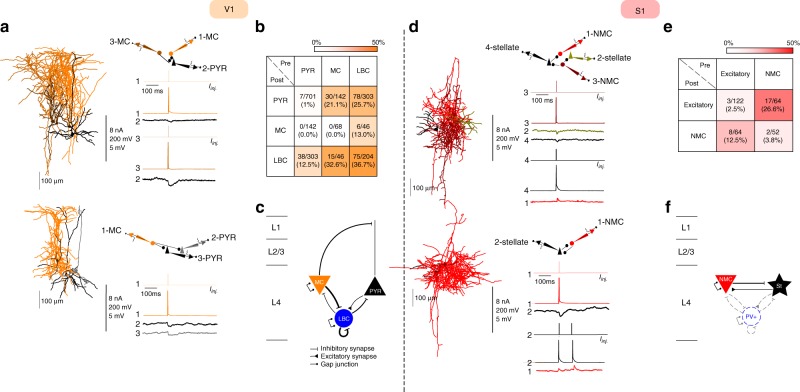
- In V1 L4, 99.1% of recovered excitatory neurons were pyramidal (573/578) and only 0.9% were spiny stellate (5/578); among Viaat-labeled interneurons, SOM+ non-fast-spiking cells were Martinotti cells (20.1%, 47/234), with no non-Martinotti cells found.
- In S1 L4, 76.6% of recovered spiny neurons were spiny stellate (85/111), and 96.2% of recovered SOM+ neurons were non-Martinotti cells (76/79); both differences from V1 were significant (Fisher’s exact test, p < 0.0001).
- Patch-seq mapping showed L4 SOM+ cells mostly assigned to Sst Calb2 Pdlim in V1 and Sst Hpse Cbln4 in S1 (S1: 27/29 Hpse; V1: 21/33 Calb2; p < 0.0001), with V1 Hpse cells electrophysiologically intermediate between V1 Calb2 Martinotti cells and S1 non-Martinotti cells.
- Local excitatory input to SOM+ cells was present in S1 (12.5%, 8/64) but absent in V1 (0%, 0/142; p = 0.0002); SOM+ to excitatory connection probabilities were high in both areas (21.1%, 30/142 in V1; 26.6%, 17/64 in S1), while excitatory-excitatory connectivity was low (1.0%, 7/701 in V1; 2.5%, 3/122 in S1).
Methods
- Whole-cell patch-clamp recordings with post-hoc morphological recovery in adult mice (V1: n = 129 mice, median age 71 days; 1174 recovered neurons: 578 excitatory, 596 inhibitory), using Cre reporter lines including Viaat-Cre/Ai9, SOM-Cre/Ai9, PV-Cre/Ai9, VIP-Cre/Ai9, and Scnn1a-Cre/Ai9.
- Simultaneous multi-cell recordings up to eight cells to measure unitary synaptic connections, paired-pulse ratios, and gap-junction coupling, with inter-soma distances generally <150 µm.
- Patch-seq combined patch-clamp electrophysiology with single-cell RNA sequencing (V1 L4 n = 42, S1 L4 n = 35 after QC, plus L5 cells), mapped to the Tasic et al. transcriptomic atlas; morphological and electrophysiological features were analyzed with regularized logistic regression, t-SNE, and sparse reduced-rank regression.
Limitations
- Stated: slice electrophysiology can sever neuronal structures, potentially underestimating morphology and connectivity; somatic recordings may fail to detect synapses formed in distal dendrites; low classification accuracy for some morphological pairs (e.g., SBC/HBC) may reflect insufficient sample size.
- Stated: initial S1 connectivity measurements did not ensure cells were within the same barrel, though a separate intra-barrel experiment was performed.
- Evident: transcriptomic profiling was limited to SOM+ neurons, not all L4 cell types; morphological classification relied on expert-defined types with some overlapping classes; Patch-seq sample sizes were modest, and the age range was broad (55–330 days in V1 recordings).
Model-written summary. Check it against the paper before relying on it.
Integrity signals
Registry
Cites
Statistics
Figures
Verification
Claims the paper makes
65 Own result · 45 Not checked yet · 19 Own interpretation · 18 Own method · 2 Partly supported · 2 No basis given · 1 Supported so far · accuracy not yet measured
None of the sources cited for this claim have been checked yet.
In the paper
“all labeled neurons recorded in Scnn1a-Cre/Ai9 mice (n = 5), a transgenic mouse line that preferentially labels excitatory neurons in L436,37, were morphologically confirmed as PYRs (100%, 30/30).”
§ Layer 4 of mouse neocortex differs in cell types and circuit organization between sensory areas > Results > Morphological cell types in L4 of adult mouse visual cortex
What the sources say
- Not checked yetcites [36] Xue, M., Atallah, B. V. & Scanziani, M. Equalizing excitation–inhibition ratios across visual cortical neurons. Nature 511, 596–600 (2014). source
- Not checked yetcites [37] Harris, J. A. et al. Anatomical characterization of Cre driver mice for neural circuit mapping and manipulation. Front. Neural Circuits 8, 76 (2014). source
plainn = 5- Asserted: passes — The authors put it forward as true.
- Checkable: passes — It can be checked against evidence.
- Load-bearing: unclear — It is unclear whether the paper’s conclusions depend on it.
- Based: passes — The paper gives a reason why it holds.
A result the paper reports from its own data — it cites no other source for it, so there is none to check. The quote shows it is in the paper.
In the paper
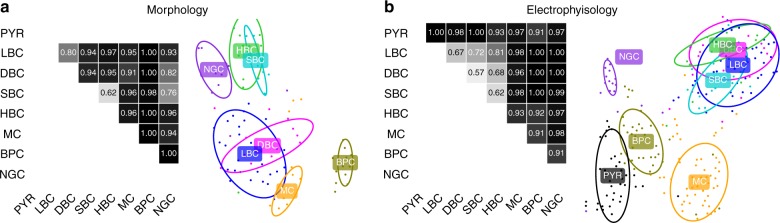
“However, SBC/HBC pair showed only ~0.6 classification accuracy.”
§ Layer 4 of mouse neocortex differs in cell types and circuit organization between sensory areas > Results > Morphological cell types in L4 of adult mouse visual cortex
plainn = 92- Asserted: passes — The authors put it forward as true.
- Checkable: passes — It can be checked against evidence.
- Load-bearing: unclear — It is unclear whether the paper’s conclusions depend on it.
- Based: passes — The paper gives a reason why it holds.
A result the paper reports from its own data — it cites no other source for it, so there is none to check. The quote shows it is in the paper.
In the paper
“the average cross-validated classification accuracy between the FS types was only 0.67, while the average accuracy across all other pairs was 0.98.”
§ Layer 4 of mouse neocortex differs in cell types and circuit organization between sensory areas > Results > Morphological cell types in L4 of adult mouse visual cortex
plainn = 235- Asserted: passes — The authors put it forward as true.
- Checkable: passes — It can be checked against evidence.
- Load-bearing: unclear — It is unclear whether the paper’s conclusions depend on it.
- Based: passes — The paper gives a reason why it holds.
A result the paper reports from its own data — it cites no other source for it, so there is none to check. The quote shows it is in the paper.
In the paper
“Most features exhibited strong differences between cell types (Supplementary Fig. 5).”
§ Layer 4 of mouse neocortex differs in cell types and circuit organization between sensory areas > Results > Morphological cell types in L4 of adult mouse visual cortex
boostedcorrelationaln = 235- Asserted: passes — The authors put it forward as true.
- Checkable: passes — It can be checked against evidence.
- Load-bearing: passes — The paper’s conclusions depend on it.
- Based: passes — The paper gives a reason why it holds.
A result the paper reports from its own data — it cites no other source for it, so there is none to check. The quote shows it is in the paper.
In the paper
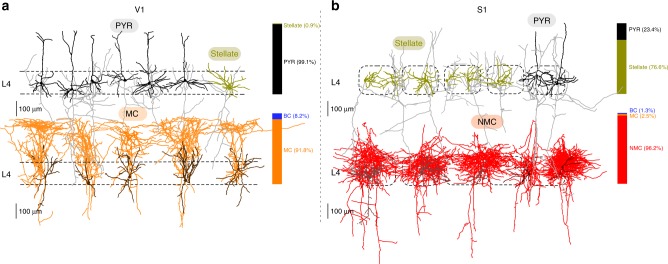
“We found that indeed 76.6% (85/111) of the recovered spiny neurons did not have a clear apical dendrite and were thus classified as spiny stellate cells (Fig. 3b), while the remaining 23.4% were pyramidal cells.”
§ Layer 4 of mouse neocortex differs in cell types and circuit organization between sensory areas > Results > V1 differs from S1 in major L4 cell types
plainn = 24- Asserted: passes — The authors put it forward as true.
- Checkable: passes — It can be checked against evidence.
- Load-bearing: passes — The paper’s conclusions depend on it.
- Based: passes — The paper gives a reason why it holds.
A result the paper reports from its own data — it cites no other source for it, so there is none to check. The quote shows it is in the paper.
In the paper
“This confirms that, unlike in V1, spiny stellate cells are the predominant excitatory population in L4 of adult mouse S1 (Fisher’s exact test for difference in the fraction of spiny stellate cells between V1 and S1: p < 0.0001; 85/111 vs. 5/578).”
§ Layer 4 of mouse neocortex differs in cell types and circuit organization between sensory areas > Results > V1 differs from S1 in major L4 cell types
boostedn = 24- Asserted: passes — The authors put it forward as true.
- Checkable: passes — It can be checked against evidence.
- Load-bearing: passes — The paper’s conclusions depend on it.
- Based: passes — The paper gives a reason why it holds.
A result the paper reports from its own data — it cites no other source for it, so there is none to check. The quote shows it is in the paper.
In the paper
“The last type were neurogliaform cells (NGCs; 11.5%, 27/234), characterized by a very thin axon highly ramifying around the soma and a late-spiking firing pattern with a large AP width.”
§ Layer 4 of mouse neocortex differs in cell types and circuit organization between sensory areas > Results > Morphological cell types in L4 of adult mouse visual cortex
plain- Asserted: passes — The authors put it forward as true.
- Checkable: passes — It can be checked against evidence.
- Load-bearing: unclear — It is unclear whether the paper’s conclusions depend on it.
- Based: passes — The paper gives a reason why it holds.
A result the paper reports from its own data — it cites no other source for it, so there is none to check. The quote shows it is in the paper.
In the paper
“Only five (0.9%) of the excitatory neurons were classified as spiny stellate cells”
§ Layer 4 of mouse neocortex differs in cell types and circuit organization between sensory areas > Results > Morphological cell types in L4 of adult mouse visual cortex
plain- Asserted: passes — The authors put it forward as true.
- Checkable: passes — It can be checked against evidence.
- Load-bearing: passes — The paper’s conclusions depend on it.
- Based: passes — The paper gives a reason why it holds.
A result the paper reports from its own data — it cites no other source for it, so there is none to check. The quote shows it is in the paper.
In the paper
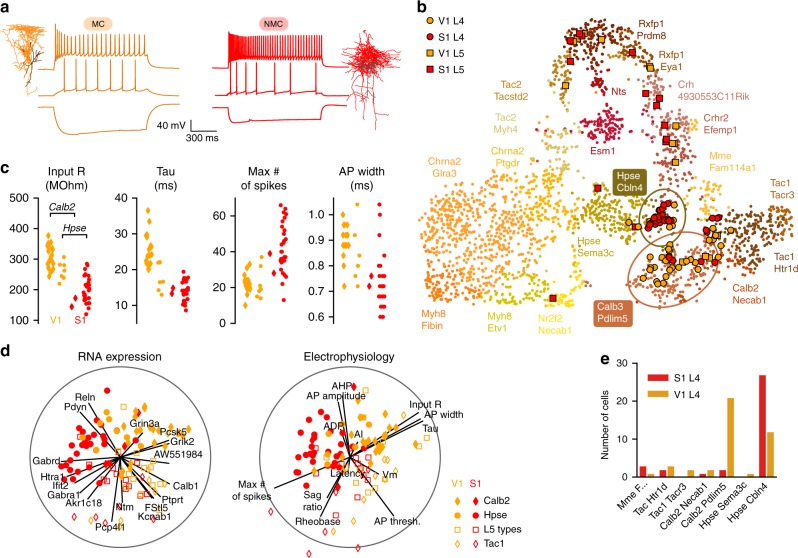
“Comparison of electrophysiological features between MCs, NMCs, and FS cells revealed that NMCs were in between MCs and FS cells in terms of their firing patterns and intrinsic membrane properties (Supplementary Figs. 5, 6).”
§ Layer 4 of mouse neocortex differs in cell types and circuit organization between sensory areas > Results > V1 differs from S1 in major L4 cell types
plaincorrelational- Asserted: passes — The authors put it forward as true.
- Checkable: passes — It can be checked against evidence.
- Load-bearing: unclear — It is unclear whether the paper’s conclusions depend on it.
- Based: passes — The paper gives a reason why it holds.
A result the paper reports from its own data — it cites no other source for it, so there is none to check. The quote shows it is in the paper.
In the paper
“all unlabeled L4 neurons (n = 133) were morphologically confirmed as excitatory neurons”
§ Layer 4 of mouse neocortex differs in cell types and circuit organization between sensory areas > Results > Morphological cell types in L4 of adult mouse visual cortex
plainn = 133- Asserted: passes — The authors put it forward as true.
- Checkable: passes — It can be checked against evidence.
- Load-bearing: passes — The paper’s conclusions depend on it.
- Based: passes — The paper gives a reason why it holds.
None of the sources cited for this claim have been checked yet.
In the paper
“Using whole-cell recordings with morphological recovery, we identified one major excitatory and seven inhibitory types of neurons in L4 of adult mouse visual cortex (V1).”
- Also stated in: § Morphological cell types in L4 of adult mouse visual cortex · plain
“We identified seven GABAergic cell types (Fig. 1a) based on their morphology, following a widely used classification scheme based on the axonal geometry and projection patterns29,39–41.”
§ Layer 4 of mouse neocortex differs in cell types and circuit organization between sensory areas > Abstract
What the sources say
- Not checked yetcites [29] Jiang, X. et al. Principles of connectivity among morphologically defined cell types in adult neocortex. Science 350, aac9462–aac9462 (2015). source
- Not checked yetcites [39] Markram, H. et al. Interneurons of the neocortical inhibitory system. Nat. Rev. Neurosci. 5, 793–807 (2004). source
- Not checked yetcites [40] Petilla Interneuron Nomenclature Group. et al. Petilla terminology: nomenclature of features of GABAergic interneurons of the cerebral cortex. Nat. Rev. Neurosci. 9, 557–568 (2008). source
- Not checked yetcites [41] DeFelipe, J. et al. New insights into the classification and nomenclature of cortical GABAergic interneurons. Nat. Rev. Neurosci. 14, 202–216 (2013). source
plain- Asserted: passes — The authors put it forward as true.
- Checkable: passes — It can be checked against evidence.
- Load-bearing: passes — The paper’s conclusions depend on it.
- Based: passes — The paper gives a reason why it holds.
- Also stated in: § Morphological cell types in L4 of adult mouse visual cortex · plain
A result the paper reports from its own data — it cites no other source for it, so there is none to check. The quote shows it is in the paper.
In the paper
“Almost all labeled L4 neurons recorded from these mice (95.5%, 234/245) were morphologically confirmed as interneurons.”
§ Layer 4 of mouse neocortex differs in cell types and circuit organization between sensory areas > Results > Morphological cell types in L4 of adult mouse visual cortex
plainn = 47- Asserted: passes — The authors put it forward as true.
- Checkable: passes — It can be checked against evidence.
- Load-bearing: passes — The paper’s conclusions depend on it.
- Based: passes — The paper gives a reason why it holds.
A result the paper reports from its own data — it cites no other source for it, so there is none to check. The quote shows it is in the paper.
In the paper
“for two of them (input resistance and membrane time constant) V1 cells belonging to the Hpse type had values more similar to the S1 cells than to the V1 cells from the Calb2 type (Fig. 4c).”
§ Layer 4 of mouse neocortex differs in cell types and circuit organization between sensory areas > Results > V1 differs from S1 in major L4 cell types
plaincorrelational- Asserted: passes — The authors put it forward as true.
- Checkable: passes — It can be checked against evidence.
- Load-bearing: passes — The paper’s conclusions depend on it.
- Based: passes — The paper gives a reason why it holds.
None of the sources cited for this claim have been checked yet.
In the paper
“These neurons did not show a complex dendritic arborization in L1, differing from typical layer 5 (L5) pyramidal neurons, which generally have a prominent tuft in L133–35”
§ Layer 4 of mouse neocortex differs in cell types and circuit organization between sensory areas > Results > Morphological cell types in L4 of adult mouse visual cortex
What the sources say
- Not checked yetcites [33] Ramaswamy, S. & Markram, H. Anatomy and physiology of the thick-tufted layer 5 pyramidal neuron. Front. Cell. Neurosci. 9, 233 (2015).
- Not checked yetcites [34] Romand, S., Wang, Y., Toledo-Rodriguez, M. & Markram, H. Morphological development of thick-tufted layer V pyramidal cells in the rat somatosensory cortex. Front. Neuroanat. 5, 5 (2011). source
- Not checked yetcites [35] Kim, E. J., Juavinett, A. L., Kyubwa, E. M., Jacobs, M. W. & Callaway, E. M. Three types of cortical layer 5 neurons that differ in brain-wide connectivity and function. Neuron 88, 1253–1267 (2015). source
plain- Asserted: passes — The authors put it forward as true.
- Checkable: passes — It can be checked against evidence.
- Load-bearing: unclear — It is unclear whether the paper’s conclusions depend on it.
- Based: passes — The paper gives a reason why it holds.
A result the paper reports from its own data — it cites no other source for it, so there is none to check. The quote shows it is in the paper.
In the paper
“This analysis supports our conclusion that V1 Hpse MCs are in between Calb2 MCs and NMCs in terms of electrophysiology.”
§ Layer 4 of mouse neocortex differs in cell types and circuit organization between sensory areas > Results > V1 differs from S1 in major L4 cell types
plaincorrelational- Asserted: passes — The authors put it forward as true.
- Checkable: passes — It can be checked against evidence.
- Load-bearing: passes — The paper’s conclusions depend on it.
- Based: passes — The paper gives a reason why it holds.
A result the paper reports from its own data — it cites no other source for it, so there is none to check. The quote shows it is in the paper.
In the paper
“which was larger than the value reported above (2.5%, 3/122)”
§ Layer 4 of mouse neocortex differs in cell types and circuit organization between sensory areas > Results > Connectivity among excitatory and SOM+ neurons
plainn = 8- Asserted: passes — The authors put it forward as true.
- Checkable: passes — It can be checked against evidence.
- Load-bearing: unclear — It is unclear whether the paper’s conclusions depend on it.
- Based: passes — The paper gives a reason why it holds.
None of the sources cited for this claim have been checked yet.
In the paper
“Both estimates are substantially lower than the existing estimates of intra-barrel connectivity obtained in young animals (30–35%)3,4,55”
§ Layer 4 of mouse neocortex differs in cell types and circuit organization between sensory areas > Results > Connectivity among excitatory and SOM+ neurons
What the sources say
- Not checked yetcites [3] Feldmeyer, D., Egger, V., Lübke, J. & Sakmann, B. Reliable synaptic connections between pairs of excitatory layer 4 neurones within a single ‘barrel’ of developing rat somatosensory cortex. J. Physiol. 521, 169–190 (1999). source
- Not checked yetcites [4] Petersen, C. C. H. & Sakmann, B. The excitatory neuronal network of rat layer 4 barrel cortex. J. Neurosci. 20, 7579–7586 (2000). source
- Not checked yetcites [55] Lefort, S., Tomm, C., Floyd Sarria, J.-C. & Petersen, C. C. H. The excitatory neuronal network of the C2 barrel column in mouse primary somatosensory cortex. Neuron 61, 301–316 (2009). source
plainn = 8- Asserted: passes — The authors put it forward as true.
- Checkable: passes — It can be checked against evidence.
- Load-bearing: passes — The paper’s conclusions depend on it.
- Based: passes — The paper gives a reason why it holds.
None of the sources cited for this claim have been checked yet.
In the paper
“In V1, axons of L4 MCs primarily projected to L1 where they are potentially able to synapse onto the tuft of L4 PYRs, similar to the pattern described in other cortical layers58,59.”
§ Layer 4 of mouse neocortex differs in cell types and circuit organization between sensory areas > Discussion
What the sources say
- Not checked yetcites [58] Larkum, M. A cellular mechanism for cortical associations: an organizing principle for the cerebral cortex. Trends Neurosci. 36, 141–151 (2013). source
- Not checked yetcites [59] Lovett-Barron, M. et al. Regulation of neuronal input transformations by tunable dendritic inhibition. Nat. Neurosci. 15, S1–S3 (2012). source
hedgedconditional- Asserted: passes — The authors put it forward as true.
- Checkable: passes — It can be checked against evidence.
- Load-bearing: passes — The paper’s conclusions depend on it.
- Based: passes — The paper gives a reason why it holds.
A result the paper reports from its own data — it cites no other source for it, so there is none to check. The quote shows it is in the paper.
In the paper
“We described eight morphological cell types in L4 of primary visual cortex (V1) in adult mice”
§ Layer 4 of mouse neocortex differs in cell types and circuit organization between sensory areas > Discussion
plain- Asserted: passes — The authors put it forward as true.
- Checkable: passes — It can be checked against evidence.
- Load-bearing: passes — The paper’s conclusions depend on it.
- Based: passes — The paper gives a reason why it holds.
A result the paper reports from its own data — it cites no other source for it, so there is none to check. The quote shows it is in the paper.
In the paper
“We found that certain connectivity patterns between them are very similar across both areas (Fig. 5).”
§ Layer 4 of mouse neocortex differs in cell types and circuit organization between sensory areas > Results > Connectivity among excitatory and SOM+ neurons
plain- Asserted: passes — The authors put it forward as true.
- Checkable: passes — It can be checked against evidence.
- Load-bearing: passes — The paper’s conclusions depend on it.
- Based: passes — The paper gives a reason why it holds.
A result the paper reports from its own data — it cites no other source for it, so there is none to check. The quote shows it is in the paper.
In the paper
“The measured connection probability was 5.2% (5/104)”
§ Layer 4 of mouse neocortex differs in cell types and circuit organization between sensory areas > Results > Connectivity among excitatory and SOM+ neurons
plainn = 8- Asserted: passes — The authors put it forward as true.
- Checkable: passes — It can be checked against evidence.
- Load-bearing: passes — The paper’s conclusions depend on it.
- Based: passes — The paper gives a reason why it holds.
A result the paper reports from its own data — it cites no other source for it, so there is none to check. The quote shows it is in the paper.
In the paper
“In agreement with that, we found that L5 SOM+ cells had electrophysiological features similar to L4 MCs (Fig. 4d).”
§ Layer 4 of mouse neocortex differs in cell types and circuit organization between sensory areas > Results > V1 differs from S1 in major L4 cell types
plaincorrelational- Asserted: passes — The authors put it forward as true.
- Checkable: passes — It can be checked against evidence.
- Load-bearing: unclear — It is unclear whether the paper’s conclusions depend on it.
- Based: passes — The paper gives a reason why it holds.
A result the paper reports from its own data — it cites no other source for it, so there is none to check. The quote shows it is in the paper.
In the paper
“both MCs in V1 and NMCs in S1 were similarly often interconnected by gap junctions (MCs: 23.5%, 8/34; NMCs: 30.7%, 8/26; Supplementary Fig. 8).”
§ Layer 4 of mouse neocortex differs in cell types and circuit organization between sensory areas > Results > Connectivity among excitatory and SOM+ neurons
plain- Asserted: passes — The authors put it forward as true.
- Checkable: passes — It can be checked against evidence.
- Load-bearing: unclear — It is unclear whether the paper’s conclusions depend on it.
- Based: passes — The paper gives a reason why it holds.
A result the paper reports from its own data — it cites no other source for it, so there is none to check. The quote shows it is in the paper.
In the paper
“We found that nearly all excitatory neurons in V1 L4 are pyramidal cells”
§ Layer 4 of mouse neocortex differs in cell types and circuit organization between sensory areas > Discussion
plain- Asserted: passes — The authors put it forward as true.
- Checkable: passes — It can be checked against evidence.
- Load-bearing: passes — The paper’s conclusions depend on it.
- Based: passes — The paper gives a reason why it holds.
The paper states this without a source or data behind it here, so there is nothing to check it against. The quote shows it is in the paper.
In the paper
“both MCs in V1 and NMCs in S1 avoided connecting to each other (apart from forming gap junctions)”
§ Layer 4 of mouse neocortex differs in cell types and circuit organization between sensory areas > Discussion
plain- Asserted: passes — The authors put it forward as true.
- Checkable: passes — It can be checked against evidence.
- Load-bearing: passes — The paper’s conclusions depend on it.
- Based: passes — The paper gives a reason why it holds.
A result the paper reports from its own data — it cites no other source for it, so there is none to check. The quote shows it is in the paper.
In the paper
“this analysis also showed that some of the cells assigned to the Tac1 and Mme types had a distinct fast-spiking-like firing pattern, which was different from firing patterns of MCs and NMCs (but was not as sustained as the proper FS pattern).”
§ Layer 4 of mouse neocortex differs in cell types and circuit organization between sensory areas > Results > V1 differs from S1 in major L4 cell types
plaincorrelational- Asserted: passes — The authors put it forward as true.
- Checkable: passes — It can be checked against evidence.
- Load-bearing: unclear — It is unclear whether the paper’s conclusions depend on it.
- Based: passes — The paper gives a reason why it holds.
A result the paper reports from its own data — it cites no other source for it, so there is none to check. The quote shows it is in the paper.
In the paper
“We found that the connection probability monotonically decreased with age (Supplementary Fig. 11): from 13.2% in P15-20 (15/114) to 5.1% in P30-40 (8/156) to 1.0% (7/701) reported above for the P55+ mice with median age P71.”
§ Layer 4 of mouse neocortex differs in cell types and circuit organization between sensory areas > Results > Connectivity among excitatory and SOM+ neurons
plaincorrelationaln = 5- Asserted: passes — The authors put it forward as true.
- Checkable: passes — It can be checked against evidence.
- Load-bearing: passes — The paper’s conclusions depend on it.
- Based: passes — The paper gives a reason why it holds.
A result the paper reports from its own data — it cites no other source for it, so there is none to check. The quote shows it is in the paper.
In the paper
“the axonal morphologies of these two cell types seemed to match the respective dendritic morphologies of their excitatory neuronal targets.”
§ Layer 4 of mouse neocortex differs in cell types and circuit organization between sensory areas > Discussion
hedgedcorrelational- Asserted: passes — The authors put it forward as true.
- Checkable: passes — It can be checked against evidence.
- Load-bearing: passes — The paper’s conclusions depend on it.
- Based: passes — The paper gives a reason why it holds.
A result the paper reports from its own data — it cites no other source for it, so there is none to check. The quote shows it is in the paper.
In the paper
“Second, the connection probabilities between SOM+ cells were also low in both areas (0%, 0/68 in V1; 3.8%, 2/52 in S1).”
§ Layer 4 of mouse neocortex differs in cell types and circuit organization between sensory areas > Results > Connectivity among excitatory and SOM+ neurons
plain- Asserted: passes — The authors put it forward as true.
- Checkable: passes — It can be checked against evidence.
- Load-bearing: unclear — It is unclear whether the paper’s conclusions depend on it.
- Based: passes — The paper gives a reason why it holds.
In the paper
“Using Patch-seq, we showed that SOM+ MCs in V1 L4 and SOM+ NMCs in S1 L4 correspond to two different transcriptomic cell types (Sst Calb2 Pdlim and Sst Hpse Cbln4 respectively) previously identified in a large-scale transcriptomic cell atlas25.”
§ Layer 4 of mouse neocortex differs in cell types and circuit organization between sensory areas > Discussion
What the sources say
- Not checked yetcites [25] Tasic, B. et al. Shared and distinct transcriptomic cell types across neocortical areas. Nature 563, 72–78 (2018). source
boostedcorrelational- Asserted: passes — The authors put it forward as true.
- Checkable: passes — It can be checked against evidence.
- Load-bearing: passes — The paper’s conclusions depend on it.
- Based: passes — The paper gives a reason why it holds.
A result the paper reports from its own data — it cites no other source for it, so there is none to check. The quote shows it is in the paper.
In the paper
“First, the connection probabilities among excitatory cells were low in both areas (1.0%, 7/701 in V1; 2.5%, 3/122 in S1).”
§ Layer 4 of mouse neocortex differs in cell types and circuit organization between sensory areas > Results > Connectivity among excitatory and SOM+ neurons
plain- Asserted: passes — The authors put it forward as true.
- Checkable: passes — It can be checked against evidence.
- Load-bearing: unclear — It is unclear whether the paper’s conclusions depend on it.
- Based: passes — The paper gives a reason why it holds.
A result the paper reports from its own data — it cites no other source for it, so there is none to check. The quote shows it is in the paper.
In the paper
“as well as the connectivity between the three most abundant cell types.”
§ Layer 4 of mouse neocortex differs in cell types and circuit organization between sensory areas > Discussion
plain- Asserted: passes — The authors put it forward as true.
- Checkable: passes — It can be checked against evidence.
- Load-bearing: passes — The paper’s conclusions depend on it.
- Based: passes — The paper gives a reason why it holds.
A result the paper reports from its own data — it cites no other source for it, so there is none to check. The quote shows it is in the paper.
In the paper
“here we demonstrated that the difference is not confined to the excitatory neurons, but extends to the somatostatin-positive interneurons and their connectivity.”
§ Layer 4 of mouse neocortex differs in cell types and circuit organization between sensory areas > Discussion
boostedcorrelational- Asserted: passes — The authors put it forward as true.
- Checkable: passes — It can be checked against evidence.
- Load-bearing: passes — The paper’s conclusions depend on it.
- Based: passes — The paper gives a reason why it holds.
A result the paper reports from its own data — it cites no other source for it, so there is none to check. The quote shows it is in the paper.
In the paper
“we found that around a third of MCs from V1 had transcriptomic profile mapping to this type.”
§ Layer 4 of mouse neocortex differs in cell types and circuit organization between sensory areas > Discussion
plain- Asserted: passes — The authors put it forward as true.
- Checkable: passes — It can be checked against evidence.
- Load-bearing: passes — The paper’s conclusions depend on it.
- Based: passes — The paper gives a reason why it holds.
A result the paper reports from its own data — it cites no other source for it, so there is none to check. The quote shows it is in the paper.
In the paper
“Even though we did not identify any NMCs in V1”
§ Layer 4 of mouse neocortex differs in cell types and circuit organization between sensory areas > Discussion
plain- Asserted: passes — The authors put it forward as true.
- Checkable: passes — It can be checked against evidence.
- Load-bearing: passes — The paper’s conclusions depend on it.
- Based: passes — The paper gives a reason why it holds.
A result the paper reports from its own data — it cites no other source for it, so there is none to check. The quote shows it is in the paper.
In the paper
“Third, the connection probabilities from SOM+ cells to excitatory cells were high in both areas (21.1%, 30/142 in V1, 26.6%, 17/64 in S1).”
§ Layer 4 of mouse neocortex differs in cell types and circuit organization between sensory areas > Results > Connectivity among excitatory and SOM+ neurons
plain- Asserted: passes — The authors put it forward as true.
- Checkable: passes — It can be checked against evidence.
- Load-bearing: passes — The paper’s conclusions depend on it.
- Based: passes — The paper gives a reason why it holds.
None of the sources cited for this claim have been checked yet.
In the paper
“In S1, NMCs received facilitating synaptic connections from local excitatory neurons (12.5%, 8/64), in line with previous studies in young rodents15,17.”
§ Layer 4 of mouse neocortex differs in cell types and circuit organization between sensory areas > Results > Connectivity among excitatory and SOM+ neurons
What the sources say
- Not checked yetcites [15] Xu, H., Jeong, H.-Y., Tremblay, R. & Rudy, B. Neocortical somatostatin-expressing GABAergic interneurons disinhibit the thalamorecipient layer 4. Neuron 77, 155–167 (2013). source
- Not checked yetcites [17] Beierlein, M., Gibson, J. R. & Connors, B. W. Two dynamically distinct inhibitory networks in layer 4 of the neocortex. J. Neurophysiol. 90, 2987–3000 (2003). source
plaincorrelational- Asserted: passes — The authors put it forward as true.
- Checkable: passes — It can be checked against evidence.
- Load-bearing: passes — The paper’s conclusions depend on it.
- Based: passes — The paper gives a reason why it holds.
A result the paper reports from its own data — it cites no other source for it, so there is none to check. The quote shows it is in the paper.
In the paper
“Our data indicate that non-fast-spiking SOM+ neurons in V1 L4 are predominantly Martinotti cells”
§ Layer 4 of mouse neocortex differs in cell types and circuit organization between sensory areas > Discussion
hedgedcorrelational- Asserted: passes — The authors put it forward as true.
- Checkable: passes — It can be checked against evidence.
- Load-bearing: passes — The paper’s conclusions depend on it.
- Based: passes — The paper gives a reason why it holds.
In the paper
“which was consistent with the findings in V1 L2/3 and V1 L5 of adult mice29”
§ Layer 4 of mouse neocortex differs in cell types and circuit organization between sensory areas > Discussion
What the sources say
- Not checked yetcites [29] Jiang, X. et al. Principles of connectivity among morphologically defined cell types in adult neocortex. Science 350, aac9462–aac9462 (2015). source
plaincorrelational- Asserted: passes — The authors put it forward as true.
- Checkable: passes — It can be checked against evidence.
- Load-bearing: unclear — It is unclear whether the paper’s conclusions depend on it.
- Based: passes — The paper gives a reason why it holds.
None of the sources cited for this claim have been checked yet.
In the paper
“but much lower than what was reported in young animals65,66.”
§ Layer 4 of mouse neocortex differs in cell types and circuit organization between sensory areas > Discussion
What the sources say
- Not checked yetcites [65] Jiang, X. et al. Response to Comment on ‘Principles of connectivity among morphologically defined cell types in adult neocortex’. Science 353, 1108 (2016). source
- Not checked yetcites [66] Barth, A. et al. Comment on ‘Principles of connectivity among morphologically defined cell types in adult neocortex’. Science 353, 1108 (2016). source
plain- Asserted: passes — The authors put it forward as true.
- Checkable: passes — It can be checked against evidence.
- Load-bearing: passes — The paper’s conclusions depend on it.
- Based: passes — The paper gives a reason why it holds.
A result the paper reports from its own data — it cites no other source for it, so there is none to check. The quote shows it is in the paper.
In the paper
“we did not detect any connections from L4 PYRs to L4 MCs in V1.”
§ Layer 4 of mouse neocortex differs in cell types and circuit organization between sensory areas > Discussion
plain- Asserted: passes — The authors put it forward as true.
- Checkable: passes — It can be checked against evidence.
- Load-bearing: passes — The paper’s conclusions depend on it.
- Based: passes — The paper gives a reason why it holds.
A result the paper reports from its own data — it cites no other source for it, so there is none to check. The quote shows it is in the paper.
In the paper
“and revealed another striking cellular difference between V1 and S1 of adult mice: morphology of L4 SOM+ interneurons.”
§ Layer 4 of mouse neocortex differs in cell types and circuit organization between sensory areas > Discussion
boostedcorrelational- Asserted: passes — The authors put it forward as true.
- Checkable: passes — It can be checked against evidence.
- Load-bearing: passes — The paper’s conclusions depend on it.
- Based: passes — The paper gives a reason why it holds.
A result the paper reports from its own data — it cites no other source for it, so there is none to check. The quote shows it is in the paper.
In the paper
“In each area, the morphology of SOM+ interneurons matched that of the excitatory neurons”
§ Layer 4 of mouse neocortex differs in cell types and circuit organization between sensory areas > Discussion
plaincorrelational- Asserted: passes — The authors put it forward as true.
- Checkable: passes — It can be checked against evidence.
- Load-bearing: passes — The paper’s conclusions depend on it.
- Based: passes — The paper gives a reason why it holds.
A result the paper reports from its own data — it cites no other source for it, so there is none to check. The quote shows it is in the paper.
In the paper
“We found very low connection probability between PYRs in V1 L4”
§ Layer 4 of mouse neocortex differs in cell types and circuit organization between sensory areas > Discussion
plain- Asserted: passes — The authors put it forward as true.
- Checkable: passes — It can be checked against evidence.
- Load-bearing: passes — The paper’s conclusions depend on it.
- Based: passes — The paper gives a reason why it holds.
A result the paper reports from its own data — it cites no other source for it, so there is none to check. The quote shows it is in the paper.
In the paper
“four PV+ types could not be distinguished on the basis of their firing as they were all fast-spiking.”
§ Layer 4 of mouse neocortex differs in cell types and circuit organization between sensory areas > Discussion
hedged- Asserted: passes — The authors put it forward as true.
- Checkable: passes — It can be checked against evidence.
- Load-bearing: passes — The paper’s conclusions depend on it.
- Based: passes — The paper gives a reason why it holds.
A result the paper reports from its own data — it cites no other source for it, so there is none to check. The quote shows it is in the paper.
In the paper
“Indeed, the recovered morphology (i.e., pyramidal neurons vs. interneurons) and EPSP vs. IPSP always matched.”
§ Layer 4 of mouse neocortex differs in cell types and circuit organization between sensory areas > Methods > Electrophysiological recordings
plaincorrelational- Asserted: passes — The authors put it forward as true.
- Checkable: passes — It can be checked against evidence.
- Load-bearing: passes — The paper’s conclusions depend on it.
- Based: passes — The paper gives a reason why it holds.
A result the paper reports from its own data — it cites no other source for it, so there is none to check. The quote shows it is in the paper.
In the paper
“while we found that SOM+ cells received inputs from local excitatory neurons in S1 L4”
§ Layer 4 of mouse neocortex differs in cell types and circuit organization between sensory areas > Discussion
plaindirect- Asserted: passes — The authors put it forward as true.
- Checkable: passes — It can be checked against evidence.
- Load-bearing: passes — The paper’s conclusions depend on it.
- Based: passes — The paper gives a reason why it holds.
A result the paper reports from its own data — it cites no other source for it, so there is none to check. The quote shows it is in the paper.
In the paper
“In conclusion, we confirmed the difference in morphology of L4 principal cells”
§ Layer 4 of mouse neocortex differs in cell types and circuit organization between sensory areas > Discussion
boostedcorrelational- Asserted: passes — The authors put it forward as true.
- Checkable: passes — It can be checked against evidence.
- Load-bearing: passes — The paper’s conclusions depend on it.
- Based: passes — The paper gives a reason why it holds.
A result the paper reports from its own data — it cites no other source for it, so there is none to check. The quote shows it is in the paper.
In the paper
“We directly showed that this difference in connection probability among excitatory neurons is due to the age of the animal (Supplementary Fig. 11).”
§ Layer 4 of mouse neocortex differs in cell types and circuit organization between sensory areas > Discussion
boosteddirect- Asserted: passes — The authors put it forward as true.
- Checkable: passes — It can be checked against evidence.
- Load-bearing: passes — The paper’s conclusions depend on it.
- Based: passes — The paper gives a reason why it holds.
A result the paper reports from its own data — it cites no other source for it, so there is none to check. The quote shows it is in the paper.
In the paper
“we found that one of the SOM+ t-types (Sst Hpse Cbln4) exhibited markedly different morphology and electrophysiology depending on the cortical area.”
§ Layer 4 of mouse neocortex differs in cell types and circuit organization between sensory areas > Discussion
plaincorrelational- Asserted: passes — The authors put it forward as true.
- Checkable: passes — It can be checked against evidence.
- Load-bearing: passes — The paper’s conclusions depend on it.
- Based: passes — The paper gives a reason why it holds.
None of the sources cited for this claim have been checked yet.
In the paper
“Spiny stellate cells have been reported to be the dominant excitatory cell type, both in rat2–6 and in mouse7”
- Also stated in: § V1 differs from S1 in major L4 cell types · boosted
“spiny stellate cells are known to be abundant in S1 L4 of rats and mice2–8”
§ Layer 4 of mouse neocortex differs in cell types and circuit organization between sensory areas > Introduction
What the sources say
- Not checked yetcites [2] Simons, D. J. & Woolsey, T. A. Morphology of Golgi-Cox-impregnated barrel neurons in rat SmI cortex. J. Comp. Neurol. 230, 119–132 (1984). source
- Not checked yetcites [3] Feldmeyer, D., Egger, V., Lübke, J. & Sakmann, B. Reliable synaptic connections between pairs of excitatory layer 4 neurones within a single ‘barrel’ of developing rat somatosensory cortex. J. Physiol. 521, 169–190 (1999). source
- Not checked yetcites [4] Petersen, C. C. H. & Sakmann, B. The excitatory neuronal network of rat layer 4 barrel cortex. J. Neurosci. 20, 7579–7586 (2000). source
- Not checked yetcites [5] Schubert, D., Kötter, R., Zilles, K., Luhmann, H. J. & Staiger, J. F. Cell type-specific circuits of cortical layer IV spiny neurons. J. Neurosci. 23, 2961–2970 (2003). source
- Not checked yetcites [6] Staiger, J. F. Functional diversity of layer IV spiny neurons in rat somatosensory cortex: quantitative morphology of electrophysiologically characterized and biocytin labeled cells. Cereb. Cortex 14, 690–701 (2004). source
- Not checked yetcites [7] Woolsey, T. A., Dierker, M. L. & Wann, D. F. Mouse SmI cortex: qualitative and quantitative classification of golgi-impregnated barrel neurons. Proc. Natl Acad. Sci. USA 72, 2165–2169 (1975). source
- Not checked yetcites [8] Callaway, E. M. & Borrell, V. Developmental sculpting of dendritic morphology of layer 4 neurons in visual cortex: influence of retinal input. J. Neurosci. 31, 7456–7470 (2011). source
boostedn = 24- Asserted: passes — The authors put it forward as true.
- Checkable: passes — It can be checked against evidence.
- Load-bearing: passes — The paper’s conclusions depend on it.
- Based: passes — The paper gives a reason why it holds.
- Also stated in: § V1 differs from S1 in major L4 cell types · boosted
A conclusion the paper draws from its own results — it cites no other source for it, so there is none to check. The quote shows it is in the paper.
In the paper
“suggesting that the entire population of interneurons in L4 was labeled in this Cre line.”
§ Layer 4 of mouse neocortex differs in cell types and circuit organization between sensory areas > Results > Morphological cell types in L4 of adult mouse visual cortex
hedgedn = 47- Asserted: passes — The authors put it forward as true.
- Checkable: passes — It can be checked against evidence.
- Load-bearing: passes — The paper’s conclusions depend on it.
- Based: passes — The paper gives a reason why it holds.
A conclusion the paper draws from its own results — it cites no other source for it, so there is none to check. The quote shows it is in the paper.
In the paper
“These morphologically distinct SOM+ interneurons corresponded to different transcriptomic cell types”
§ Layer 4 of mouse neocortex differs in cell types and circuit organization between sensory areas > Abstract
plaincorrelational- Asserted: passes — The authors put it forward as true.
- Checkable: passes — It can be checked against evidence.
- Load-bearing: passes — The paper’s conclusions depend on it.
- Based: passes — The paper gives a reason why it holds.
A conclusion the paper draws from its own results — it cites no other source for it, so there is none to check. The quote shows it is in the paper.
In the paper
“We propose that cell type specific circuit motifs, such as the Martinotti/pyramidal and non-Martinotti/stellate pairs, are used across the cortex as building blocks to assemble cortical circuits.”
§ Layer 4 of mouse neocortex differs in cell types and circuit organization between sensory areas > Abstract
hedgeddirect- Asserted: passes — The authors put it forward as true.
- Checkable: passes — It can be checked against evidence.
- Load-bearing: passes — The paper’s conclusions depend on it.
- Based: passes — The paper gives a reason why it holds.
A conclusion the paper draws from its own results — it cites no other source for it, so there is none to check. The quote shows it is in the paper.
In the paper
“This suggests that electrophysiologically, V1 Hpse MC cells are in between V1 Calb2 MC cells and S1 NMC cells.”
§ Layer 4 of mouse neocortex differs in cell types and circuit organization between sensory areas > Results > V1 differs from S1 in major L4 cell types
hedgedcorrelational- Asserted: passes — The authors put it forward as true.
- Checkable: passes — It can be checked against evidence.
- Load-bearing: passes — The paper’s conclusions depend on it.
- Based: passes — The paper gives a reason why it holds.
None of the sources cited for this claim have been checked yet.
In the paper
“In line with this, it has been shown that excitatory cells in L4 of mouse and rat primary visual cortex (V1) are pyramidal27,28, in contrast to L4 in S1.”
§ Layer 4 of mouse neocortex differs in cell types and circuit organization between sensory areas > Introduction
What the sources say
- Not checked yetcites [27] Peters, A. & Kara, D. A. The neuronal composition of area 17 of rat visual cortex. I. The pyramidal cells. J. Comp. Neurol. 234, 218–241 (1985). source
- Not checked yetcites [28] Xu, X. et al. Primary visual cortex shows laminar-specific and balanced circuit organization of excitatory and inhibitory synaptic connectivity. J. Physiol. 594, 1891–1910 (2016). source
plain- Asserted: passes — The authors put it forward as true.
- Checkable: passes — It can be checked against evidence.
- Load-bearing: passes — The paper’s conclusions depend on it.
- Based: passes — The paper gives a reason why it holds.
A conclusion the paper draws from its own results — it cites no other source for it, so there is none to check. The quote shows it is in the paper.
In the paper
“Our findings indicate that this does not necessarily imply that morphological types are also all shared.”
§ Layer 4 of mouse neocortex differs in cell types and circuit organization between sensory areas > Discussion
hedged- Asserted: passes — The authors put it forward as true.
- Checkable: passes — It can be checked against evidence.
- Load-bearing: passes — The paper’s conclusions depend on it.
- Based: passes — The paper gives a reason why it holds.
In the paper
“the transcriptomic reference dataset25 contained many V1 cells from the Sst Hpse Cbln4 type”
§ Layer 4 of mouse neocortex differs in cell types and circuit organization between sensory areas > Discussion
What the sources say
- Not checked yetcites [25] Tasic, B. et al. Shared and distinct transcriptomic cell types across neocortical areas. Nature 563, 72–78 (2018). source
plain- Asserted: passes — The authors put it forward as true.
- Checkable: passes — It can be checked against evidence.
- Load-bearing: passes — The paper’s conclusions depend on it.
- Based: passes — The paper gives a reason why it holds.
A conclusion the paper draws from its own results — it cites no other source for it, so there is none to check. The quote shows it is in the paper.
In the paper
“which is in line with the decrease in local excitatory connectivity with age discussed above for V1 (Supplementary Fig. 11).”
§ Layer 4 of mouse neocortex differs in cell types and circuit organization between sensory areas > Results > Connectivity among excitatory and SOM+ neurons
plaincorrelationaln = 8- Asserted: passes — The authors put it forward as true.
- Checkable: passes — It can be checked against evidence.
- Load-bearing: unclear — It is unclear whether the paper’s conclusions depend on it.
- Based: passes — The paper gives a reason why it holds.
None of the sources cited for this claim have been checked yet.
In the paper
“which is in contrast to S1 L4 where almost all SOM+ neurons are non-Martinotti14,15.”
§ Layer 4 of mouse neocortex differs in cell types and circuit organization between sensory areas > Discussion
What the sources say
- Not checked yetcites [14] Ma, Y., Hu, H., Berrebi, A. S., Mathers, P. H. & Agmon, A. Distinct subtypes of somatostatin-containing neocortical interneurons revealed in transgenic mice. J. Neurosci. 26, 5069–5082 (2006). source
- Not checked yetcites [15] Xu, H., Jeong, H.-Y., Tremblay, R. & Rudy, B. Neocortical somatostatin-expressing GABAergic interneurons disinhibit the thalamorecipient layer 4. Neuron 77, 155–167 (2013). source
plain- Asserted: passes — The authors put it forward as true.
- Checkable: passes — It can be checked against evidence.
- Load-bearing: passes — The paper’s conclusions depend on it.
- Based: passes — The paper gives a reason why it holds.
A conclusion the paper draws from its own results — it cites no other source for it, so there is none to check. The quote shows it is in the paper.
In the paper
“The near absence of spiny stellate cells in V1 L4 of adult mice (as old as 11 months in our experiments) suggests a different developmental path in this case.”
§ Layer 4 of mouse neocortex differs in cell types and circuit organization between sensory areas > Discussion
hedgedcorrelational- Asserted: passes — The authors put it forward as true.
- Checkable: passes — It can be checked against evidence.
- Load-bearing: passes — The paper’s conclusions depend on it.
- Based: passes — The paper gives a reason why it holds.
None of the sources cited for this claim have been checked yet.
In the paper
“in stark contrast to S1 L4 where the majority of excitatory neurons are spiny stellate cells6,8,57.”
§ Layer 4 of mouse neocortex differs in cell types and circuit organization between sensory areas > Discussion
What the sources say
- Not checked yetcites [6] Staiger, J. F. Functional diversity of layer IV spiny neurons in rat somatosensory cortex: quantitative morphology of electrophysiologically characterized and biocytin labeled cells. Cereb. Cortex 14, 690–701 (2004). source
- Not checked yetcites [8] Callaway, E. M. & Borrell, V. Developmental sculpting of dendritic morphology of layer 4 neurons in visual cortex: influence of retinal input. J. Neurosci. 31, 7456–7470 (2011). source
- Not checked yetcites [57] Feldmeyer, D., Roth, A. & Sakmann, B. Monosynaptic connections between pairs of spiny stellate cells in layer 4 and pyramidal cells in layer 5A indicate that lemniscal and paralemniscal afferent pathways converge in the infragranular somatosensory cortex. J. Neurosci. 25, 3423–3431 (2005). source
plain- Asserted: passes — The authors put it forward as true.
- Checkable: passes — It can be checked against evidence.
- Load-bearing: passes — The paper’s conclusions depend on it.
- Based: passes — The paper gives a reason why it holds.
In the paper
“Notably, L4 spiny stellate cells in ferret V1 and mouse S1 develop postnatally from neurons that resemble pyramidal cells with an upward projecting apical dendrite8.”
§ Layer 4 of mouse neocortex differs in cell types and circuit organization between sensory areas > Discussion
What the sources say
- Not checked yetcites [8] Callaway, E. M. & Borrell, V. Developmental sculpting of dendritic morphology of layer 4 neurons in visual cortex: influence of retinal input. J. Neurosci. 31, 7456–7470 (2011). source
plaindirect- Asserted: passes — The authors put it forward as true.
- Checkable: passes — It can be checked against evidence.
- Load-bearing: unclear — It is unclear whether the paper’s conclusions depend on it.
- Based: passes — The paper gives a reason why it holds.
A conclusion the paper draws from its own results — it cites no other source for it, so there is none to check. The quote shows it is in the paper.
In the paper
“This example suggests that cells from the same transcriptomic type can exhibit different phenotypes in terms of morphology and electrophysiology, depending on the cortical area.”
§ Layer 4 of mouse neocortex differs in cell types and circuit organization between sensory areas > Discussion
hedgedcorrelational- Asserted: passes — The authors put it forward as true.
- Checkable: passes — It can be checked against evidence.
- Load-bearing: passes — The paper’s conclusions depend on it.
- Based: passes — The paper gives a reason why it holds.
A conclusion the paper draws from its own results — it cites no other source for it, so there is none to check. The quote shows it is in the paper.
In the paper
“and so we do not think that our findings can be an artefact caused by this issue.”
§ Layer 4 of mouse neocortex differs in cell types and circuit organization between sensory areas > Discussion
hedged- Asserted: passes — The authors put it forward as true.
- Checkable: passes — It can be checked against evidence.
- Load-bearing: passes — The paper’s conclusions depend on it.
- Based: passes — The paper gives a reason why it holds.
A conclusion the paper draws from its own results — it cites no other source for it, so there is none to check. The quote shows it is in the paper.
In the paper
“To the best of our knowledge, this is the first such example in the literature.”
§ Layer 4 of mouse neocortex differs in cell types and circuit organization between sensory areas > Discussion
hedgedcorrelationalSingle case- Asserted: passes — The authors put it forward as true.
- Checkable: passes — It can be checked against evidence.
- Load-bearing: passes — The paper’s conclusions depend on it.
- Based: passes — The paper gives a reason why it holds.
A conclusion the paper draws from its own results — it cites no other source for it, so there is none to check. The quote shows it is in the paper.
In the paper
“It suggests that the t-types cannot be taken as the ground truth for cell types”
§ Layer 4 of mouse neocortex differs in cell types and circuit organization between sensory areas > Discussion
hedgedSingle case- Asserted: passes — The authors put it forward as true.
- Checkable: passes — It can be checked against evidence.
- Load-bearing: passes — The paper’s conclusions depend on it.
- Based: passes — The paper gives a reason why it holds.
In the paper
“in S1 L5, where the principal excitatory cells are pyramidal and SOM+ interneurons are either L5 MC or L5 NMC, L5 pyramidal cells are preferentially innervated by L5 MCs, not L5 NMCs47.”
§ Layer 4 of mouse neocortex differs in cell types and circuit organization between sensory areas > Discussion
What the sources say
- Not checked yetcites [47] Naka, A. et al. Complementary networks of cortical somatostatin interneurons enforce layer specific control. eLife 8, e43696 (2019). source
plaincorrelational- Asserted: passes — The authors put it forward as true.
- Checkable: passes — It can be checked against evidence.
- Load-bearing: passes — The paper’s conclusions depend on it.
- Based: passes — The paper gives a reason why it holds.
A conclusion the paper draws from its own results — it cites no other source for it, so there is none to check. The quote shows it is in the paper.
In the paper
“suggesting that one of them might adapt to another.”
§ Layer 4 of mouse neocortex differs in cell types and circuit organization between sensory areas > Discussion
hedgedconditional- Asserted: passes — The authors put it forward as true.
- Checkable: passes — It can be checked against evidence.
- Load-bearing: unclear — It is unclear whether the paper’s conclusions depend on it.
- Based: passes — The paper gives a reason why it holds.
A conclusion the paper draws from its own results — it cites no other source for it, so there is none to check. The quote shows it is in the paper.
In the paper
“which together with our findings, suggests that even across layers, spiny stellate cells do not target MCs but only NMCs.”
§ Layer 4 of mouse neocortex differs in cell types and circuit organization between sensory areas > Discussion
hedged- Asserted: passes — The authors put it forward as true.
- Checkable: passes — It can be checked against evidence.
- Load-bearing: passes — The paper’s conclusions depend on it.
- Based: passes — The paper gives a reason why it holds.
A conclusion the paper draws from its own results — it cites no other source for it, so there is none to check. The quote shows it is in the paper.
In the paper
“These results support the view that cell-type-specific circuit motifs, such as the Martinotti/pyramidal and non-Martinotti/stellate pairs, are used as building blocks to assemble the neocortex.”
§ Layer 4 of mouse neocortex differs in cell types and circuit organization between sensory areas > Discussion
plaindirect- Asserted: passes — The authors put it forward as true.
- Checkable: passes — It can be checked against evidence.
- Load-bearing: passes — The paper’s conclusions depend on it.
- Based: passes — The paper gives a reason why it holds.
A conclusion the paper draws from its own results — it cites no other source for it, so there is none to check. The quote shows it is in the paper.
In the paper
“our data suggest that the same transcriptomic cell type can exhibit different morphological and electrophysiological phenotypes depending on the cortical area”
§ Layer 4 of mouse neocortex differs in cell types and circuit organization between sensory areas > Discussion
hedgedcorrelational- Asserted: passes — The authors put it forward as true.
- Checkable: passes — It can be checked against evidence.
- Load-bearing: passes — The paper’s conclusions depend on it.
- Based: passes — The paper gives a reason why it holds.
A conclusion the paper draws from its own results — it cites no other source for it, so there is none to check. The quote shows it is in the paper.
In the paper
“suggesting a different functional role of SOM+ interneurons in different cortical areas.”
§ Layer 4 of mouse neocortex differs in cell types and circuit organization between sensory areas > Discussion
hedgedconditional- Asserted: passes — The authors put it forward as true.
- Checkable: passes — It can be checked against evidence.
- Load-bearing: passes — The paper’s conclusions depend on it.
- Based: passes — The paper gives a reason why it holds.
- Probably not a substantial claim. 44
- It may state two separate claims as one. 43
- The quote only partly states this claim. 3
The sources with a verdict support this claim; the rest weren’t checked yet, have no full text we could read, or their verdicts aren’t rated yet.
In the paper
“For example, PV+ FS interneurons receive strong thalamic inputs16–20 while SOM+ non-FS interneurons receive weaker thalamic inputs21,22.”
§ Layer 4 of mouse neocortex differs in cell types and circuit organization between sensory areas > Introduction
What the sources say
- Supportedcites [16] Cruikshank, S. J., Lewis, T. J. & Connors, B. W. Synaptic basis for intense thalamocortical activation of feedforward inhibitory cells in neocortex. Nat. Neurosci. 10, 462–468 (2007). source
The citation to this paper is attached to the PV+ FS clause, not the separately cited SOM+ clause. The Methods (p. 7) identify a subset of the studied FS cells as parvalbumin-expressing, and the Results (p. 3) report strong thalamically evoked excitation in FS cells. (LLM, conf=0.92)
- Not checked yetcites [17] Beierlein, M., Gibson, J. R. & Connors, B. W. Two dynamically distinct inhibitory networks in layer 4 of the neocortex. J. Neurophysiol. 90, 2987–3000 (2003). source
- Could not verifycites [18] Higley, M. J. & Contreras, D. Balanced excitation and inhibition determine spike timing during frequency adaptation. J. Neurosci. 26, 448–457 (2006). sourceExperimental — accuracy not yet measured
The Discussion (page unavailable) describes thalamocortical excitation triggering strong feedforward inhibition in layer 4, but does not compare thalamic input strengths across interneuron types. Searches for PV+, SOM+, fast-spiking interneurons, and weaker thalamic inputs found no passage addressing the claimed comparison. (LLM, conf=0.72)
- Not checked yetcites [19] Gabernet, L., Jadhav, S. P., Feldman, D. E., Carandini, M. & Scanziani, M. Somatosensory integration controlled by dynamic thalamocortical feed-forward inhibition. Neuron 48, 315–327 (2005). source
- Not checked yetcites [20] Kloc, M. & Maffei, A. Target-specific properties of thalamocortical synapses onto layer 4 of mouse primary visual cortex. J. Neurosci. 34, 15455–15465 (2014). source
- Supportedcites [21] Cruikshank, S. J., Urabe, H., Nurmikko, A. V. & Connors, B. W. Pathway-specific feedforward circuits between thalamus and neocortex revealed by selective optical stimulation of axons. Neuron 65, 230–245 (2010). source
The citation is attached to the SOM+ non-FS clause. In Results, “Optically evoked TC responses of different neuronal subtypes” (page unavailable), the paper reports that somatostatin-expressing GIN interneurons had much weaker thalamocortical responses than FS cells. The Discussion, “TC circuitry” (page unavailable), likewise describes their responses to thalamic input as much weaker. (LLM, conf=0.92)
- Supportedcites [22] Ji, X.-Y. et al. Thalamocortical innervation pattern in mouse auditory and visual cortex: laminar and cell-type specificity. Cereb. Cortex 26, 2612–2625 (2016). source
The section ‘A Matching Pattern of Thalamocortical Innervation of PV Neurons’ reports strong direct thalamic drive to PV neurons. ‘Laminar Patterns of Thalamocortical Innervation of A1 Inhibitory Neurons’ reports much weaker inputs to SOM neurons, with most outside layer 4 receiving essentially none. No page numbers are available in our copy. (LLM, conf=0.93)
plaincorrelational- Asserted: passes — The authors put it forward as true.
- Checkable: passes — It can be checked against evidence.
- Load-bearing: fails — The paper’s conclusions may not depend on it.
- Based: passes — The paper gives a reason why it holds.
Probably not a substantial claim. The paper’s conclusions may not depend on it. It may state two separate claims as one.
- Supported
The cited sources support only part of this claim — read each source’s verdict below.
In the paper
“Recent evidence indicates that most, if not all, L4 SOM+ cells in mouse S1 have axons mostly localized within L4, in stark contrast to typical MCs15, and have been called non-Martinotti cells (NMCs)13.”
§ Layer 4 of mouse neocortex differs in cell types and circuit organization between sensory areas > Results > V1 differs from S1 in major L4 cell types
What the sources say
- Partly supportedcites [15] Xu, H., Jeong, H.-Y., Tremblay, R. & Rudy, B. Neocortical somatostatin-expressing GABAergic interneurons disinhibit the thalamorecipient layer 4. Neuron 77, 155–167 (2013). sourceExperimental — accuracy not yet measured
The Results section (‘Layer 4 SOM INs Mainly Target Layer 4’; page unavailable) says that most, if not all, layer 4 SOM interneurons in mouse somatosensory cortex preferentially target layer 4, unlike Martinotti cells. Our copy describes them as ‘X94-cell like’ but does not show that this paper calls them ‘non-Martinotti cells.’ (LLM, conf=0.83)
- Supportedcites [13] Yavorska, I. & Wehr, M. Somatostatin-expressing inhibitory interneurons in cortical circuits. Front. Neural Circuits 10, 76 (2016). source
The Layer 4 section says most L4 SOM cells differ from typical Martinotti cells and usually keep their axons within the same layer. The section on distinct SOM-cell types calls the locally projecting X94 cells non-Martinotti and says other L4 SOM cells have similarly local axons. The paper notes sparse L4 Martinotti cells in rat, consistent with the claim’s qualification about mouse S1. (LLM, conf=0.91)
hedgedn = 19- Asserted: passes — The authors put it forward as true.
- Checkable: passes — It can be checked against evidence.
- Load-bearing: passes — The paper’s conclusions depend on it.
- Based: passes — The paper gives a reason why it holds.
It may state two separate claims as one.
- Partly supported
The cited sources support only part of this claim — read each source’s verdict below.
In the paper
“However, this did not seem to strongly affect the studies of local circuits in the past29,78.”
§ Layer 4 of mouse neocortex differs in cell types and circuit organization between sensory areas > Methods > Electrophysiological recordings
What the sources say
- Could not verifycites [29] Jiang, X. et al. Principles of connectivity among morphologically defined cell types in adult neocortex. Science 350, aac9462–aac9462 (2015). sourceExperimental — accuracy not yet measured
The Introduction describes earlier studies of local-circuit connectivity, and the Conclusion compares this study’s findings with earlier work. Neither section says that a potential underestimation had little effect on past studies. Searches for underestimation and slice-related connectivity bias found no passage addressing that assessment. (LLM, conf=0.72)
- Supportedcites [78] Qi, G., Radnikow, G. & Feldmeyer, D. Electrophysiological and morphological characterization of neuronal microcircuits in acute brain slices using paired patch-clamp recordings. J. Vis. Exp. 95, e52358 (2015). source
The Discussion (page unavailable) says local axonal projections in acute slices, particularly those of local interneurons, undergo relatively little truncation and yield largely correct connectivity estimates. This supports the hedged claim for local circuits; the paper contrasts them with longer-range connections, for which connectivity estimates are problematic. (LLM, conf=0.86)
hedged- Asserted: passes — The authors put it forward as true.
- Checkable: passes — It can be checked against evidence.
- Load-bearing: fails — The paper’s conclusions may not depend on it.
- Based: passes — The paper gives a reason why it holds.
Probably not a substantial claim. The paper’s conclusions may not depend on it.
- Could not verify
A result the paper reports from its own data — it cites no other source for it, so there is none to check. The quote shows it is in the paper.
In the paper
“and were differentially integrated into the local circuit with only S1 neurons receiving local excitatory input.”
§ Layer 4 of mouse neocortex differs in cell types and circuit organization between sensory areas > Abstract
plaincorrelational- Asserted: passes — The authors put it forward as true.
- Checkable: passes — It can be checked against evidence.
- Load-bearing: passes — The paper’s conclusions depend on it.
- Based: passes — The paper gives a reason why it holds.
It may state two separate claims as one.
A result the paper reports from its own data — it cites no other source for it, so there is none to check. The quote shows it is in the paper.
In the paper
“Across all 21 pairs, the average cross-validated classification accuracy was 0.92, with most pairs discriminated almost perfectly (Fig. 2a, left).”
§ Layer 4 of mouse neocortex differs in cell types and circuit organization between sensory areas > Results > Morphological cell types in L4 of adult mouse visual cortex
plaincorrelationaln = 92- Asserted: passes — The authors put it forward as true.
- Checkable: passes — It can be checked against evidence.
- Load-bearing: passes — The paper’s conclusions depend on it.
- Based: passes — The paper gives a reason why it holds.
It may state two separate claims as one.
A result the paper reports from its own data — it cites no other source for it, so there is none to check. The quote shows it is in the paper.
In the paper
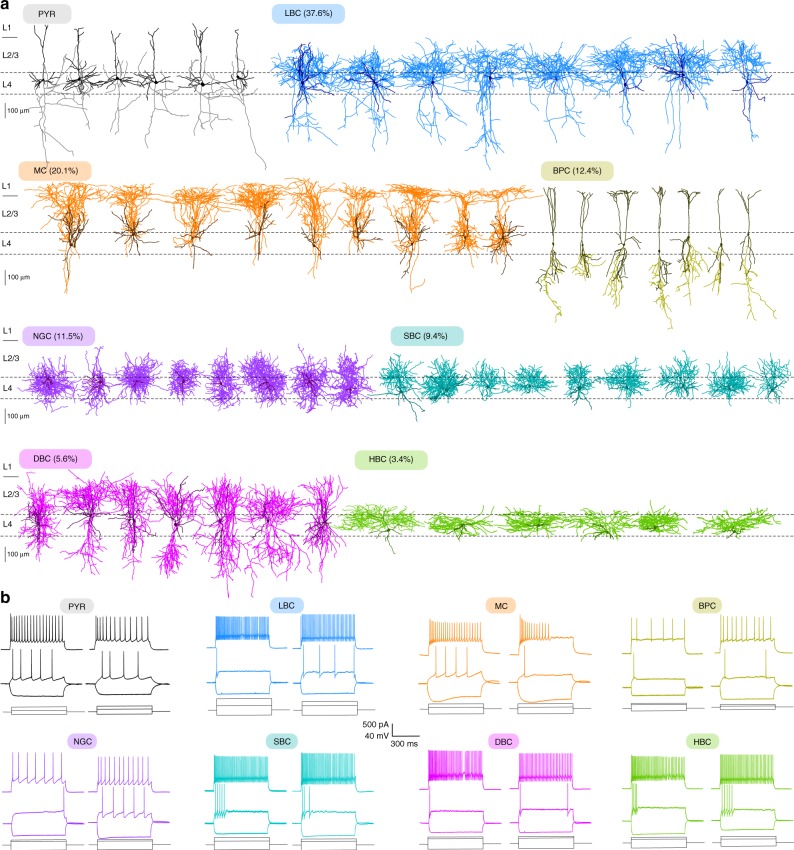
“Two-dimensional visualization of this dataset using t-SNE (Fig. 2b) showed that all four PV+ cell types overlapped in one group of electrophysiologically similar FS neurons, while the other four types (PYR, NGC, BPC, and MC) each had distinct firing patterns.”
§ Layer 4 of mouse neocortex differs in cell types and circuit organization between sensory areas > Results > Morphological cell types in L4 of adult mouse visual cortex
plaincorrelationaln = 235- Asserted: passes — The authors put it forward as true.
- Checkable: passes — It can be checked against evidence.
- Load-bearing: passes — The paper’s conclusions depend on it.
- Based: passes — The paper gives a reason why it holds.
It may state two separate claims as one.
A result the paper reports from its own data — it cites no other source for it, so there is none to check. The quote shows it is in the paper.
In the paper
“The NMCs also differed in their firing pattern from MCs recorded in V1: they had a higher maximal firing rate, a lower AP width, and a lower membrane time constant (Fig. 4a, Supplementary Fig. 5).”
§ Layer 4 of mouse neocortex differs in cell types and circuit organization between sensory areas > Results > V1 differs from S1 in major L4 cell types
plaincorrelational- Asserted: passes — The authors put it forward as true.
- Checkable: passes — It can be checked against evidence.
- Load-bearing: passes — The paper’s conclusions depend on it.
- Based: passes — The paper gives a reason why it holds.
It may state two separate claims as one.
A result the paper reports from its own data — it cites no other source for it, so there is none to check. The quote shows it is in the paper.
In the paper
“all somatostatin-positive (SOM+) non-fast-spiking interneurons were Martinotti cells”
- Also stated in: § Morphological cell types in L4 of adult mouse visual cortex · plain
“Martinotti cells (MCs; 20.1%, 47/234), characterized by an ascending axon that projected to L1 and by the large membrane time constant, were the only SOM+ cell type.”
§ Layer 4 of mouse neocortex differs in cell types and circuit organization between sensory areas > Abstract
plain- Asserted: passes — The authors put it forward as true.
- Checkable: passes — It can be checked against evidence.
- Load-bearing: passes — The paper’s conclusions depend on it.
- Based: passes — The paper gives a reason why it holds.
It may state two separate claims as one.
- Also stated in: § Morphological cell types in L4 of adult mouse visual cortex · plain
A result the paper reports from its own data — it cites no other source for it, so there is none to check. The quote shows it is in the paper.
In the paper
“VIP+ neurons were represented by the bipolar cells (BPCs; 12.4%, 29/234) with a small soma, dendrites extending to L1 and L5, an axon projecting mostly downward to L5, and an irregular firing pattern.”
§ Layer 4 of mouse neocortex differs in cell types and circuit organization between sensory areas > Results > Morphological cell types in L4 of adult mouse visual cortex
plain- Asserted: passes — The authors put it forward as true.
- Checkable: passes — It can be checked against evidence.
- Load-bearing: unclear — It is unclear whether the paper’s conclusions depend on it.
- Based: passes — The paper gives a reason why it holds.
It may state two separate claims as one.
A result the paper reports from its own data — it cites no other source for it, so there is none to check. The quote shows it is in the paper.
In the paper
“the most common were large basket cells (LBCs; 37.6% among the interneurons labeled in Viaat-Cre, 88/234), followed by small basket cells (SBCs; 9.4%, 22/234), double-bouquet basket cells (DBCs; 5.6%, 13/234), and horizontally elongated basket cells (HBCs; 3.4%, 8/234).”
§ Layer 4 of mouse neocortex differs in cell types and circuit organization between sensory areas > Results > Morphological cell types in L4 of adult mouse visual cortex
plain- Asserted: passes — The authors put it forward as true.
- Checkable: passes — It can be checked against evidence.
- Load-bearing: unclear — It is unclear whether the paper’s conclusions depend on it.
- Based: passes — The paper gives a reason why it holds.
It may state two separate claims as one.
- The authors state this as an assumption: All four PV+ fast-spiking cell types were basket cells with different axonal morphologies.
A result the paper reports from its own data — it cites no other source for it, so there is none to check. The quote shows it is in the paper.
In the paper
“We found four distinct types of PV+, fast-spiking (FS) cells with narrow AP width, high maximal firing rate, and thick axons.”
§ Layer 4 of mouse neocortex differs in cell types and circuit organization between sensory areas > Results > Morphological cell types in L4 of adult mouse visual cortex
plain- Asserted: passes — The authors put it forward as true.
- Checkable: passes — It can be checked against evidence.
- Load-bearing: passes — The paper’s conclusions depend on it.
- Based: passes — The paper gives a reason why it holds.
It may state two separate claims as one.
None of the sources cited for this claim have been checked yet.
In the paper
“Previous literature suggested that Martinotti cells in L5 form two groups with different morphology and/or electrophysiology29,42, but we did not observe such heterogeneity in L4: in particular, none of the MCs showed a rebound firing after stimulation offset42.”
§ Layer 4 of mouse neocortex differs in cell types and circuit organization between sensory areas > Results > Morphological cell types in L4 of adult mouse visual cortex
What the sources say
- Not checked yetcites [29] Jiang, X. et al. Principles of connectivity among morphologically defined cell types in adult neocortex. Science 350, aac9462–aac9462 (2015). source
- Not checked yetcites [42] Nigro, M. J., Hashikawa-Yamasaki, Y. & Rudy, B. Diversity and connectivity of layer 5 somatostatin-expressing interneurons in the mouse barrel cortex. J. Neurosci. 38, 1622–1633 (2018). source
plain- Asserted: passes — The authors put it forward as true.
- Checkable: passes — It can be checked against evidence.
- Load-bearing: unclear — It is unclear whether the paper’s conclusions depend on it.
- Based: passes — The paper gives a reason why it holds.
It may state two separate claims as one.
A result the paper reports from its own data — it cites no other source for it, so there is none to check. The quote shows it is in the paper.
In the paper
“Most L4 cells (81%, 62/77) were assigned to Sst Calb2 Pdlim and Sst Hpse Cbln4 transcriptomic types (Fig. 4b, e), with S1 cells falling almost exclusively into the Hpse type (27/29) and V1 cells falling preferentially into the Calb2 type (21/33) (p < 0.0001, Fisher’s exact test).”
§ Layer 4 of mouse neocortex differs in cell types and circuit organization between sensory areas > Results > V1 differs from S1 in major L4 cell types
plaincorrelational- Asserted: passes — The authors put it forward as true.
- Checkable: passes — It can be checked against evidence.
- Load-bearing: passes — The paper’s conclusions depend on it.
- Based: passes — The paper gives a reason why it holds.
It may state two separate claims as one.
A result the paper reports from its own data — it cites no other source for it, so there is none to check. The quote shows it is in the paper.
In the paper
“Indeed, we found that in S1, almost all L4 SOM+ neurons we recovered (96.2%, 76/79, from n = 19 SOM-Cre/Ai9 mice) had NMC morphology characterized by a thin, highly ramifying axon mostly residing within L4 (Fig. 3b). Only two cells showed an ascending axon projecting to L1 typical of MCs (2.5%, 2/79) and one was characterized by a thick axon branching similarly to LBC with a FS firing pattern (1.3”
§ Layer 4 of mouse neocortex differs in cell types and circuit organization between sensory areas > Results > V1 differs from S1 in major L4 cell types
plainn = 19- Asserted: passes — The authors put it forward as true.
- Checkable: passes — It can be checked against evidence.
- Load-bearing: passes — The paper’s conclusions depend on it.
- Based: passes — The paper gives a reason why it holds.
It may state two separate claims as one.
None of the sources cited for this claim have been checked yet.
In the paper
“A small fraction of SOM+ neurons exhibited an FS firing pattern and their morphological features matched those of LBCs (8.2%, 5/61; Supplementary Fig. 2), in agreement with the previous reports that due to potential off-target recombination, ~5–20% of neurons labeled in SOM-Cre line are FS29,43,44 and PV+/SOM− at the protein level43.”
§ Layer 4 of mouse neocortex differs in cell types and circuit organization between sensory areas > Results > Morphological cell types in L4 of adult mouse visual cortex
What the sources say
- Not checked yetcites [29] Jiang, X. et al. Principles of connectivity among morphologically defined cell types in adult neocortex. Science 350, aac9462–aac9462 (2015). source
- Not checked yetcites [43] Hu, H., Cavendish, J. Z. & Agmon, A. Not all that glitters is gold: off-target recombination in the somatostatin–IRES-Cre mouse line labels a subset of fast-spiking interneurons. Front. Neural Circuits 7, 195 (2013). source
- Not checked yetcites [44] Reimer, J. et al. Pupil fluctuations track fast switching of cortical states during quiet wakefulness. Neuron 84, 355–362 (2014). source
plaincorrelational- Asserted: passes — The authors put it forward as true.
- Checkable: passes — It can be checked against evidence.
- Load-bearing: unclear — It is unclear whether the paper’s conclusions depend on it.
- Based: passes — The paper gives a reason why it holds.
It may state two separate claims as one.
- The authors state this as an assumption: All four PV+ fast-spiking cell types were basket cells with different axonal morphologies.
A result the paper reports from its own data — it cites no other source for it, so there is none to check. The quote shows it is in the paper.
In the paper
“PYRs exhibited large action potential (AP) width, high AP amplitude, and shallow afterhyperpolarization (AHP), which clearly discriminated them from GABAergic interneurons”
§ Layer 4 of mouse neocortex differs in cell types and circuit organization between sensory areas > Results > Morphological cell types in L4 of adult mouse visual cortex
boostedcorrelational- Asserted: passes — The authors put it forward as true.
- Checkable: passes — It can be checked against evidence.
- Load-bearing: unclear — It is unclear whether the paper’s conclusions depend on it.
- Based: passes — The paper gives a reason why it holds.
It may state two separate claims as one.
A result the paper reports from its own data — it cites no other source for it, so there is none to check. The quote shows it is in the paper.
In the paper
“Nearly all excitatory neurons were pyramidal”
- Also stated in: § Morphological cell types in L4 of adult mouse visual cortex · plain
“Out of the 578 excitatory cells, 573 (99.1%) were pyramidal neurons (PYR), characterized by apical dendrites extending into layer 1 (L1)”
§ Layer 4 of mouse neocortex differs in cell types and circuit organization between sensory areas > Abstract
plain- Asserted: passes — The authors put it forward as true.
- Checkable: passes — It can be checked against evidence.
- Load-bearing: passes — The paper’s conclusions depend on it.
- Based: passes — The paper gives a reason why it holds.
It may state two separate claims as one.
- Also stated in: § Morphological cell types in L4 of adult mouse visual cortex · plain
A result the paper reports from its own data — it cites no other source for it, so there is none to check. The quote shows it is in the paper.
In the paper
“Visualization of this dataset with t-SNE (Fig. 2a, right) indicated that SBC/HBC types were partially overlapping, as well as LBC/DBC.”
§ Layer 4 of mouse neocortex differs in cell types and circuit organization between sensory areas > Results > Morphological cell types in L4 of adult mouse visual cortex
hedgedcorrelationaln = 92- Asserted: passes — The authors put it forward as true.
- Checkable: passes — It can be checked against evidence.
- Load-bearing: unclear — It is unclear whether the paper’s conclusions depend on it.
- Based: passes — The paper gives a reason why it holds.
It may state two separate claims as one.
The paper states this without a source or data behind it here, so there is nothing to check it against. The quote shows it is in the paper.
In the paper
“In S1, by contrast, axons of L4 NMCs were more localized, matching the more compact dendritic structure of spiny stellate cells.”
§ Layer 4 of mouse neocortex differs in cell types and circuit organization between sensory areas > Discussion
plaincorrelational- Asserted: passes — The authors put it forward as true.
- Checkable: passes — It can be checked against evidence.
- Load-bearing: passes — The paper’s conclusions depend on it.
- Based: passes — The paper gives a reason why it holds.
It may state two separate claims as one.
A result the paper reports from its own data — it cites no other source for it, so there is none to check. The quote shows it is in the paper.
In the paper
“The L5 SOM+ cells that we sequenced in both areas mostly mapped to a different set of transcriptomic types than the L4 SOM+ cells, but there were no apparent differences between S1 and V1 in terms of transcriptomic cell types (Fig. 4b).”
§ Layer 4 of mouse neocortex differs in cell types and circuit organization between sensory areas > Results > V1 differs from S1 in major L4 cell types
hedged- Asserted: passes — The authors put it forward as true.
- Checkable: passes — It can be checked against evidence.
- Load-bearing: unclear — It is unclear whether the paper’s conclusions depend on it.
- Based: passes — The paper gives a reason why it holds.
It may state two separate claims as one.
None of the sources cited for this claim have been checked yet.
In the paper
“We found that LBCs followed the same connectivity rules as previously found in other layers29,49. PYRs connected to LBCs with probability 12.5% (38/303), MCs inhibited LBCs with probability 32.6% (15/46), and LBCs inhibited each other (36.7%, 75/204), MCs (13.0%, 6/46) and PYRs (25.7%, 78/303).”
§ Layer 4 of mouse neocortex differs in cell types and circuit organization between sensory areas > Results > Connectivity among excitatory and SOM+ neurons
What the sources say
- Not checked yetcites [29] Jiang, X. et al. Principles of connectivity among morphologically defined cell types in adult neocortex. Science 350, aac9462–aac9462 (2015). source
- Not checked yetcites [49] Pfeffer, C. K., Xue, M., He, M., Huang, Z. J. & Scanziani, M. Inhibition of inhibition in visual cortex: the logic of connections between molecularly distinct interneurons. Nat. Neurosci. 16, 1068–1076 (2013). source
plaincorrelational- Asserted: passes — The authors put it forward as true.
- Checkable: passes — It can be checked against evidence.
- Load-bearing: passes — The paper’s conclusions depend on it.
- Based: passes — The paper gives a reason why it holds.
It may state two separate claims as one.
- The authors state this as an assumption: All four PV+ fast-spiking cell types were basket cells with different axonal morphologies.
None of the sources cited for this claim have been checked yet.
In the paper
“Notably, the connection probability between PYRs in V1 L4 was very low, consistent with our previous work in other layers in adult animals29, but in contrast to the findings in young and juvenile rodents51,52.”
§ Layer 4 of mouse neocortex differs in cell types and circuit organization between sensory areas > Results > Connectivity among excitatory and SOM+ neurons
What the sources say
- Not checked yetcites [29] Jiang, X. et al. Principles of connectivity among morphologically defined cell types in adult neocortex. Science 350, aac9462–aac9462 (2015). source
- Not checked yetcites [51] Markram, H., Lübke, J., Frotscher, M., Roth, A. & Sakmann, B. Physiology and anatomy of synaptic connections between thick tufted pyramidal neurones in the developing rat neocortex. J. Physiol. 500, 409–440 (1997). source
- Not checked yetcites [52] Song, S., Sjöström, P. J., Reigl, M., Nelson, S. & Chklovskii, D. B. Correction: highly nonrandom features of synaptic connectivity in local cortical circuits. PLoS Biol. 3, e350 (2005). source
plain- Asserted: passes — The authors put it forward as true.
- Checkable: passes — It can be checked against evidence.
- Load-bearing: unclear — It is unclear whether the paper’s conclusions depend on it.
- Based: passes — The paper gives a reason why it holds.
It may state two separate claims as one.
A result the paper reports from its own data — it cites no other source for it, so there is none to check. The quote shows it is in the paper.
In the paper
“In contrast, we did not find any connections (0%, 0/142) from local excitatory neurons to MCs in V1 (p = 0.0002, Fisher’s exact text).”
§ Layer 4 of mouse neocortex differs in cell types and circuit organization between sensory areas > Results > Connectivity among excitatory and SOM+ neurons
plain- Asserted: passes — The authors put it forward as true.
- Checkable: passes — It can be checked against evidence.
- Load-bearing: passes — The paper’s conclusions depend on it.
- Based: passes — The paper gives a reason why it holds.
It may state two separate claims as one.
A result the paper reports from its own data — it cites no other source for it, so there is none to check. The quote shows it is in the paper.
In the paper
“but not significantly different from it (p = 0.48, Fisher’s exact test)”
§ Layer 4 of mouse neocortex differs in cell types and circuit organization between sensory areas > Results > Connectivity among excitatory and SOM+ neurons
plainn = 8- Asserted: passes — The authors put it forward as true.
- Checkable: passes — It can be checked against evidence.
- Load-bearing: passes — The paper’s conclusions depend on it.
- Based: passes — The paper gives a reason why it holds.
The quote only partly states this claim.
A result the paper reports from its own data — it cites no other source for it, so there is none to check. The quote shows it is in the paper.
In the paper
“These cells show an electrophysiological profile intermediate between MCs and NMCs, but morphologically correspond to MCs based on our data.”
§ Layer 4 of mouse neocortex differs in cell types and circuit organization between sensory areas > Discussion
plaincorrelational- Asserted: passes — The authors put it forward as true.
- Checkable: passes — It can be checked against evidence.
- Load-bearing: passes — The paper’s conclusions depend on it.
- Based: passes — The paper gives a reason why it holds.
It may state two separate claims as one.
In the paper
“We also found that LBCs were electrically coupled to each other with probability 27.5% (28/102) but were never electrically coupled to MCs (0/23), in agreement with previous findings that gap junctions exist between inhibitory cells of the same type50.”
§ Layer 4 of mouse neocortex differs in cell types and circuit organization between sensory areas > Results > Connectivity among excitatory and SOM+ neurons
What the sources say
- Not checked yetcites [50] Galarreta, M. & Hestrin, S. Electrical synapses between GABA-releasing interneurons. Nat. Rev. Neurosci. 2, 425–433 (2001). source
plain- Asserted: passes — The authors put it forward as true.
- Checkable: passes — It can be checked against evidence.
- Load-bearing: unclear — It is unclear whether the paper’s conclusions depend on it.
- Based: passes — The paper gives a reason why it holds.
It may state two separate claims as one.
- The authors state this as an assumption: All four PV+ fast-spiking cell types were basket cells with different axonal morphologies.
A result the paper reports from its own data — it cites no other source for it, so there is none to check. The quote shows it is in the paper.
In the paper
“and projected to excitatory population in L4.”
§ Layer 4 of mouse neocortex differs in cell types and circuit organization between sensory areas > Discussion
plaincorrelational- Asserted: passes — The authors put it forward as true.
- Checkable: passes — It can be checked against evidence.
- Load-bearing: passes — The paper’s conclusions depend on it.
- Based: passes — The paper gives a reason why it holds.
It may state two separate claims as one.
A result the paper reports from its own data — it cites no other source for it, so there is none to check. The quote shows it is in the paper.
In the paper
“Across genes, there was a clear inverse relationship between μ and τ, that roughly followed exponential law τ ≈ exp(−1.5⋅μ + a) for some horizontal offset a.”
§ Layer 4 of mouse neocortex differs in cell types and circuit organization between sensory areas > Methods > Data analysis of the RNA-seq data
boostedcorrelational- Asserted: passes — The authors put it forward as true.
- Checkable: passes — It can be checked against evidence.
- Load-bearing: fails — The paper’s conclusions may not depend on it.
- Based: passes — The paper gives a reason why it holds.
Probably not a substantial claim. The paper’s conclusions may not depend on it.
A result the paper reports from its own data — it cites no other source for it, so there is none to check. The quote shows it is in the paper.
In the paper
“All the remaining n = 110 cells mapped to the Sst types.”
§ Layer 4 of mouse neocortex differs in cell types and circuit organization between sensory areas > Methods > Data analysis of the RNA-seq data
plainn = 110- Asserted: passes — The authors put it forward as true.
- Checkable: passes — It can be checked against evidence.
- Load-bearing: fails — The paper’s conclusions may not depend on it.
- Based: passes — The paper gives a reason why it holds.
Probably not a substantial claim. The paper’s conclusions may not depend on it.
None of the sources cited for this claim have been checked yet.
In the paper
“Tissue shrinkage due to the fixation and staining procedures was about 10–20%, consistent with previous studies29,51.”
§ Layer 4 of mouse neocortex differs in cell types and circuit organization between sensory areas > Methods > Staining and morphology recovery
What the sources say
- Not checked yetcites [29] Jiang, X. et al. Principles of connectivity among morphologically defined cell types in adult neocortex. Science 350, aac9462–aac9462 (2015). source
- Not checked yetcites [51] Markram, H., Lübke, J., Frotscher, M., Roth, A. & Sakmann, B. Physiology and anatomy of synaptic connections between thick tufted pyramidal neurones in the developing rat neocortex. J. Physiol. 500, 409–440 (1997). source
plaindirect- Asserted: passes — The authors put it forward as true.
- Checkable: passes — It can be checked against evidence.
- Load-bearing: fails — The paper’s conclusions may not depend on it.
- Based: passes — The paper gives a reason why it holds.
Probably not a substantial claim. The paper’s conclusions may not depend on it.
A result the paper reports from its own data — it cites no other source for it, so there is none to check. The quote shows it is in the paper.
In the paper
“ADP because it was equal to zero for most neurons”
§ Layer 4 of mouse neocortex differs in cell types and circuit organization between sensory areas > Methods > Data analysis of the electrophysiological features
plain- Asserted: passes — The authors put it forward as true.
- Checkable: passes — It can be checked against evidence.
- Load-bearing: fails — The paper’s conclusions may not depend on it.
- Based: passes — The paper gives a reason why it holds.
Probably not a substantial claim. The paper’s conclusions may not depend on it.
In the paper
“The remaining n = 114 cells were mapped to the full set of 133 transcriptomic types identified in Tasic et al.25”
§ Layer 4 of mouse neocortex differs in cell types and circuit organization between sensory areas > Methods > Data analysis of the RNA-seq data
What the sources say
- Not checked yetcites Tasic et al.25 Tasic, B. et al. Shared and distinct transcriptomic cell types across neocortical areas. Nature 563, 72–78 (2018). source
plainn = 114- Asserted: passes — The authors put it forward as true.
- Checkable: passes — It can be checked against evidence.
- Load-bearing: fails — The paper’s conclusions may not depend on it.
- Based: passes — The paper gives a reason why it holds.
Probably not a substantial claim. The paper’s conclusions may not depend on it.
A result the paper reports from its own data — it cites no other source for it, so there is none to check. The quote shows it is in the paper.
In the paper
“Furthermore, we found differences in the connections from excitatory neurons to SOM+ interneurons”
§ Layer 4 of mouse neocortex differs in cell types and circuit organization between sensory areas > Discussion
plaincorrelational- Asserted: passes — The authors put it forward as true.
- Checkable: passes — It can be checked against evidence.
- Load-bearing: passes — The paper’s conclusions depend on it.
- Based: passes — The paper gives a reason why it holds.
The quote only partly states this claim.
A result the paper reports from its own data — it cites no other source for it, so there is none to check. The quote shows it is in the paper.
In the paper
“In our V1 L4 dataset, we identified seven morphological types of interneurons but only four electrophysiological types (Fig. 2)”
§ Layer 4 of mouse neocortex differs in cell types and circuit organization between sensory areas > Discussion
plain- Asserted: passes — The authors put it forward as true.
- Checkable: passes — It can be checked against evidence.
- Load-bearing: passes — The paper’s conclusions depend on it.
- Based: passes — The paper gives a reason why it holds.
It may state two separate claims as one.
A result the paper reports from its own data — it cites no other source for it, so there is none to check. The quote shows it is in the paper.
In the paper
“latency because it had high outliers among the FS types”
§ Layer 4 of mouse neocortex differs in cell types and circuit organization between sensory areas > Methods > Data analysis of the electrophysiological features
plaincorrelational- Asserted: passes — The authors put it forward as true.
- Checkable: passes — It can be checked against evidence.
- Load-bearing: fails — The paper’s conclusions may not depend on it.
- Based: passes — The paper gives a reason why it holds.
Probably not a substantial claim. The paper’s conclusions may not depend on it.
A result the paper reports from its own data — it cites no other source for it, so there is none to check. The quote shows it is in the paper.
In the paper
“The total number of sequenced cells was n = 118.”
§ Layer 4 of mouse neocortex differs in cell types and circuit organization between sensory areas > Methods > Data analysis of the RNA-seq data
plainn = 118- Asserted: passes — The authors put it forward as true.
- Checkable: passes — It can be checked against evidence.
- Load-bearing: fails — The paper’s conclusions may not depend on it.
- Based: passes — The paper gives a reason why it holds.
Probably not a substantial claim. The paper’s conclusions may not depend on it.
None of the sources cited for this claim have been checked yet.
In the paper
“Several recent studies revealed that the somatostatin-positive (SOM+) interneurons form a single morphological population that has been called non-Martinotti cells13 since their axons mainly target L414,15, in contrast to typical Martinotti cells, which target L1.”
§ Layer 4 of mouse neocortex differs in cell types and circuit organization between sensory areas > Introduction
What the sources say
- Not checked yetcites [13] Yavorska, I. & Wehr, M. Somatostatin-expressing inhibitory interneurons in cortical circuits. Front. Neural Circuits 10, 76 (2016). source
- Not checked yetcites [14] Ma, Y., Hu, H., Berrebi, A. S., Mathers, P. H. & Agmon, A. Distinct subtypes of somatostatin-containing neocortical interneurons revealed in transgenic mice. J. Neurosci. 26, 5069–5082 (2006). source
- Not checked yetcites [15] Xu, H., Jeong, H.-Y., Tremblay, R. & Rudy, B. Neocortical somatostatin-expressing GABAergic interneurons disinhibit the thalamorecipient layer 4. Neuron 77, 155–167 (2013). source
plain- Asserted: passes — The authors put it forward as true.
- Checkable: passes — It can be checked against evidence.
- Load-bearing: fails — The paper’s conclusions may not depend on it.
- Based: passes — The paper gives a reason why it holds.
Probably not a substantial claim. The paper’s conclusions may not depend on it. It may state two separate claims as one.
In the paper
“In this stereotypical architecture, layer 4 (L4) is the main direct target of sensory inputs coming from the thalamus, thus acting as the first level of cortical processing for sensory signals1.”
§ Layer 4 of mouse neocortex differs in cell types and circuit organization between sensory areas > Introduction
What the sources say
- Not checked yetcites [1] Harris, K. D. & Shepherd, G. M. G. The neocortical circuit: themes and variations. Nat. Neurosci. 18, 170–181 (2015). source
plaindirect- Asserted: passes — The authors put it forward as true.
- Checkable: passes — It can be checked against evidence.
- Load-bearing: passes — The paper’s conclusions depend on it.
- Based: passes — The paper gives a reason why it holds.
Probably not a substantial claim. It may state two separate claims as one.
In the paper
“In contrast, inhibitory interneurons are highly diverse in terms of their genetic markers, morphologies and electrophysiological properties10.”
§ Layer 4 of mouse neocortex differs in cell types and circuit organization between sensory areas > Introduction
What the sources say
- Not checked yetcites [10] Tremblay, R., Lee, S. & Rudy, B. GABAergic interneurons in the neocortex: from cellular properties to circuits. Neuron 91, 260–292 (2016). source
plain- Asserted: passes — The authors put it forward as true.
- Checkable: passes — It can be checked against evidence.
- Load-bearing: fails — The paper’s conclusions may not depend on it.
- Based: passes — The paper gives a reason why it holds.
Probably not a substantial claim. The paper’s conclusions may not depend on it.
None of the sources cited for this claim have been checked yet.
In the paper
“Previous studies have reported three types of fast-spiking (FS), parvalbumin-positive (PV+) interneurons11 and five types of non-FS interneurons12, all of which have distinct morphologies.”
§ Layer 4 of mouse neocortex differs in cell types and circuit organization between sensory areas > Introduction
What the sources say
- Not checked yetcites [11] Koelbl, C., Helmstaedter, M., Lübke, J. & Feldmeyer, D. A Barrel-related interneuron in layer 4 of rat somatosensory cortex with a high intrabarrel connectivity. Cereb. Cortex 25, 713–725 (2013). source
- Not checked yetcites [12] Emmenegger, V., Qi, G., Wang, H. & Feldmeyer, D. Morphological and functional characterization of non-fast-spiking GABAergic interneurons in layer 4 microcircuitry of rat barrel cortex. Cereb. Cortex 28, 1439–1457 (2018). source
plain- Asserted: passes — The authors put it forward as true.
- Checkable: passes — It can be checked against evidence.
- Load-bearing: fails — The paper’s conclusions may not depend on it.
- Based: passes — The paper gives a reason why it holds.
Probably not a substantial claim. The paper’s conclusions may not depend on it. It may state two separate claims as one.
In the paper
“Three cells (excluded from the cell counts given above and from further analysis) had fast-spiking firing pattern and mapped to Pvalb Reln Itm2a transcriptomic type, likely corresponding to the basket cells that we found labeled in the SOM-Cre line (Fig. 3). These three cells did not express SOM (zero read count), suggesting that they could have transiently expressed it during development, as hyp”
§ Layer 4 of mouse neocortex differs in cell types and circuit organization between sensory areas > Results > V1 differs from S1 in major L4 cell types
What the sources say
- Not checked yetcites [43] Hu, H., Cavendish, J. Z. & Agmon, A. Not all that glitters is gold: off-target recombination in the somatostatin–IRES-Cre mouse line labels a subset of fast-spiking interneurons. Front. Neural Circuits 7, 195 (2013). source
hedgedcorrelational- Asserted: passes — The authors put it forward as true.
- Checkable: passes — It can be checked against evidence.
- Load-bearing: fails — The paper’s conclusions may not depend on it.
- Based: passes — The paper gives a reason why it holds.
Probably not a substantial claim. The paper’s conclusions may not depend on it. It may state two separate claims as one.
In the paper
“We did not encounter any labeled NGCs in PV-Cre, SST-Cre, or VIP-Cre lines, suggesting that they belonged to the Lamp5 transcriptomic family25.”
§ Layer 4 of mouse neocortex differs in cell types and circuit organization between sensory areas > Results > Morphological cell types in L4 of adult mouse visual cortex
What the sources say
- Not checked yetcites [25] Tasic, B. et al. Shared and distinct transcriptomic cell types across neocortical areas. Nature 563, 72–78 (2018). source
hedged- Asserted: passes — The authors put it forward as true.
- Checkable: passes — It can be checked against evidence.
- Load-bearing: unclear — It is unclear whether the paper’s conclusions depend on it.
- Based: passes — The paper gives a reason why it holds.
It may state two separate claims as one.
None of the sources cited for this claim have been checked yet.
In the paper
“The quality of the mapping was equally good for V1 and S1 cells (Supplementary Fig. 7), suggesting that the V1 + ALM dataset is a reasonable reference for S1 interneurons, in agreement with the idea that inhibitory transcriptomic cell types are shared across cortical regions25,26.”
§ Layer 4 of mouse neocortex differs in cell types and circuit organization between sensory areas > Results > V1 differs from S1 in major L4 cell types
What the sources say
- Not checked yetcites [25] Tasic, B. et al. Shared and distinct transcriptomic cell types across neocortical areas. Nature 563, 72–78 (2018). source
- Not checked yetcites [26] Nowakowski, T. J. et al. Regulation of cell-type-specific transcriptomes by microRNA networks during human brain development. Nat. Neurosci. 21, 1784–1792 (2018). source
hedgedn = 35- Asserted: passes — The authors put it forward as true.
- Checkable: passes — It can be checked against evidence.
- Load-bearing: passes — The paper’s conclusions depend on it.
- Based: passes — The paper gives a reason why it holds.
It may state two separate claims as one.
None of the sources cited for this claim have been checked yet.
In the paper
“Recent large-scale studies of transcriptomic cell types in mouse and human cortex showed that most interneuron types are shared between cortical areas while the excitatory types are predominantly area-specific25,26.”
§ Layer 4 of mouse neocortex differs in cell types and circuit organization between sensory areas > Introduction
What the sources say
- Not checked yetcites [25] Tasic, B. et al. Shared and distinct transcriptomic cell types across neocortical areas. Nature 563, 72–78 (2018). source
- Not checked yetcites [26] Nowakowski, T. J. et al. Regulation of cell-type-specific transcriptomes by microRNA networks during human brain development. Nat. Neurosci. 21, 1784–1792 (2018). source
plaincorrelational- Asserted: passes — The authors put it forward as true.
- Checkable: passes — It can be checked against evidence.
- Load-bearing: passes — The paper’s conclusions depend on it.
- Based: passes — The paper gives a reason why it holds.
Probably not a substantial claim. It may state two separate claims as one.
A conclusion the paper draws from its own results — it cites no other source for it, so there is none to check. The quote shows it is in the paper.
In the paper
“Overall, this analysis suggests that while most morphological classes can be very well discriminated, some may be partially overlapping.”
§ Layer 4 of mouse neocortex differs in cell types and circuit organization between sensory areas > Results > Morphological cell types in L4 of adult mouse visual cortex
hedgedn = 92- Asserted: passes — The authors put it forward as true.
- Checkable: passes — It can be checked against evidence.
- Load-bearing: unclear — It is unclear whether the paper’s conclusions depend on it.
- Based: passes — The paper gives a reason why it holds.
It may state two separate claims as one.
None of the sources cited for this claim have been checked yet.
In the paper
“This suggests that Sst Calb2 Pdlim is a MC type, in agreement with the conclusions of Tasic et al.25 based on the data from Paul et al.46, and that Sst Hpse Cbln4 is a NMC type, in agreement with Naka et al.47.”
§ Layer 4 of mouse neocortex differs in cell types and circuit organization between sensory areas > Results > V1 differs from S1 in major L4 cell types
What the sources say
- Not checked yetcites [25] Tasic, B. et al. Shared and distinct transcriptomic cell types across neocortical areas. Nature 563, 72–78 (2018). source
- Not checked yetcites [46] Paul, A. et al. Transcriptional architecture of synaptic communication delineates GABAergic neuron identity. Cell 171, 522–539.e20 (2017). source
- Not checked yetcites [47] Naka, A. et al. Complementary networks of cortical somatostatin interneurons enforce layer specific control. eLife 8, e43696 (2019). source
hedged- Asserted: passes — The authors put it forward as true.
- Checkable: passes — It can be checked against evidence.
- Load-bearing: passes — The paper’s conclusions depend on it.
- Based: passes — The paper gives a reason why it holds.
It may state two separate claims as one.
In the paper
“in agreement with previous findings that gap junctions exist between inhibitory cells of the same type50.”
§ Layer 4 of mouse neocortex differs in cell types and circuit organization between sensory areas > Results > Connectivity among excitatory and SOM+ neurons
What the sources say
- Not checked yetcites [50] Galarreta, M. & Hestrin, S. Electrical synapses between GABA-releasing interneurons. Nat. Rev. Neurosci. 2, 425–433 (2001). source
plaincorrelational- Asserted: passes — The authors put it forward as true.
- Checkable: passes — It can be checked against evidence.
- Load-bearing: fails — The paper’s conclusions may not depend on it.
- Based: passes — The paper gives a reason why it holds.
Probably not a substantial claim. The paper’s conclusions may not depend on it.
None of the sources cited for this claim have been checked yet.
In the paper
“it is known that cells in S1 L4 preferentially make intra-barrel connections3,4.”
§ Layer 4 of mouse neocortex differs in cell types and circuit organization between sensory areas > Results > Connectivity among excitatory and SOM+ neurons
What the sources say
- Not checked yetcites [3] Feldmeyer, D., Egger, V., Lübke, J. & Sakmann, B. Reliable synaptic connections between pairs of excitatory layer 4 neurones within a single ‘barrel’ of developing rat somatosensory cortex. J. Physiol. 521, 169–190 (1999). source
- Not checked yetcites [4] Petersen, C. C. H. & Sakmann, B. The excitatory neuronal network of rat layer 4 barrel cortex. J. Neurosci. 20, 7579–7586 (2000). source
boostedcorrelational- Asserted: passes — The authors put it forward as true.
- Checkable: passes — It can be checked against evidence.
- Load-bearing: passes — The paper’s conclusions depend on it.
- Based: passes — The paper gives a reason why it holds.
Probably not a substantial claim.
In the paper
“This was also in stark contrast to MCs in L2/3 and L5 of adult mouse V1, which receive strong facilitating synaptic inputs from local PYRs in the same layers29”
§ Layer 4 of mouse neocortex differs in cell types and circuit organization between sensory areas > Results > Connectivity among excitatory and SOM+ neurons
What the sources say
- Not checked yetcites [29] Jiang, X. et al. Principles of connectivity among morphologically defined cell types in adult neocortex. Science 350, aac9462–aac9462 (2015). source
boostedcorrelational- Asserted: passes — The authors put it forward as true.
- Checkable: passes — It can be checked against evidence.
- Load-bearing: fails — The paper’s conclusions may not depend on it.
- Based: passes — The paper gives a reason why it holds.
Probably not a substantial claim. The paper’s conclusions may not depend on it.
In the paper
“This is in agreement with a recent study that found 6.3% (20/315) connection probability in V1 L4 of P46 mice53.”
§ Layer 4 of mouse neocortex differs in cell types and circuit organization between sensory areas > Results > Connectivity among excitatory and SOM+ neurons
What the sources say
- Not checked yetcites [53] Seeman, S. C. et al. Sparse recurrent excitatory connectivity in the microcircuit of the adult mouse and human cortex. Elife 7, e37349 (2018). source
plain- Asserted: passes — The authors put it forward as true.
- Checkable: passes — It can be checked against evidence.
- Load-bearing: fails — The paper’s conclusions may not depend on it.
- Based: passes — The paper gives a reason why it holds.
Probably not a substantial claim. The paper’s conclusions may not depend on it.
In the paper
“All of these connection patterns have also been reported in S1 L4 of young mice24.”
§ Layer 4 of mouse neocortex differs in cell types and circuit organization between sensory areas > Results > Connectivity among excitatory and SOM+ neurons
What the sources say
- Not checked yetcites [24] Ma, Y., Hu, H. & Agmon, A. Short-term plasticity of unitary inhibitory-to-inhibitory synapses depends on the presynaptic interneuron subtype. J. Neurosci. 32, 983–988 (2012). source
plain- Asserted: passes — The authors put it forward as true.
- Checkable: passes — It can be checked against evidence.
- Load-bearing: fails — The paper’s conclusions may not depend on it.
- Based: passes — The paper gives a reason why it holds.
Probably not a substantial claim. The paper’s conclusions may not depend on it.
None of the sources cited for this claim have been checked yet.
In the paper
“Morphologically, all non-fast-spiking SOM+ cells in V1 L529,47 and the majority of SOM+ cells in S1 L522,29,42,47 are known to be MCs.”
§ Layer 4 of mouse neocortex differs in cell types and circuit organization between sensory areas > Results > V1 differs from S1 in major L4 cell types
What the sources say
- Not checked yetcites [29] Jiang, X. et al. Principles of connectivity among morphologically defined cell types in adult neocortex. Science 350, aac9462–aac9462 (2015). source
- Not checked yetcites [47] Naka, A. et al. Complementary networks of cortical somatostatin interneurons enforce layer specific control. eLife 8, e43696 (2019). source
- Not checked yetcites [22] Ji, X.-Y. et al. Thalamocortical innervation pattern in mouse auditory and visual cortex: laminar and cell-type specificity. Cereb. Cortex 26, 2612–2625 (2016). source
- Not checked yetcites [42] Nigro, M. J., Hashikawa-Yamasaki, Y. & Rudy, B. Diversity and connectivity of layer 5 somatostatin-expressing interneurons in the mouse barrel cortex. J. Neurosci. 38, 1622–1633 (2018). source
boosted- Asserted: passes — The authors put it forward as true.
- Checkable: passes — It can be checked against evidence.
- Load-bearing: unclear — It is unclear whether the paper’s conclusions depend on it.
- Based: passes — The paper gives a reason why it holds.
It may state two separate claims as one.
None of the sources cited for this claim have been checked yet.
In the paper
“This observation is in line with previous findings that the excitatory identity controls the survival and wiring of local interneurons60,61.”
§ Layer 4 of mouse neocortex differs in cell types and circuit organization between sensory areas > Discussion
What the sources say
- Not checked yetcites [60] Lodato, S. et al. Excitatory projection neuron subtypes control the distribution of local inhibitory interneurons in the cerebral cortex. Neuron 69, 763–779 (2011). source
- Not checked yetcites [61] Wong, F. K. et al. Pyramidal cell regulation of interneuron survival sculpts cortical networks. Nature 557, 668–673 (2018). source
plaindirect- Asserted: passes — The authors put it forward as true.
- Checkable: passes — It can be checked against evidence.
- Load-bearing: fails — The paper’s conclusions may not depend on it.
- Based: passes — The paper gives a reason why it holds.
Probably not a substantial claim. The paper’s conclusions may not depend on it.
In the paper
“Tasic et al.25 showed that the majority of transcriptomic inhibitory types are shared between two very different cortical areas (V1 and ALM).”
§ Layer 4 of mouse neocortex differs in cell types and circuit organization between sensory areas > Discussion
What the sources say
- Not checked yetcites [25] Tasic, B. et al. Shared and distinct transcriptomic cell types across neocortical areas. Nature 563, 72–78 (2018). source
plain- Asserted: passes — The authors put it forward as true.
- Checkable: passes — It can be checked against evidence.
- Load-bearing: passes — The paper’s conclusions depend on it.
- Based: passes — The paper gives a reason why it holds.
Probably not a substantial claim.
What the paper did — it cites no source for this, so there is none to check. The quote shows it is in the paper.
In the paper
“Importantly, neuronal structures can be severed (a limitation of all slice electrophysiology experiments) due to the slicing procedure, introducing a potential underestimation of neuronal morphology and connectivity.”
§ Layer 4 of mouse neocortex differs in cell types and circuit organization between sensory areas > Methods > Electrophysiological recordings
hedgedconditional- Asserted: passes — The authors put it forward as true.
- Checkable: passes — It can be checked against evidence.
- Load-bearing: fails — The paper’s conclusions may not depend on it.
- Based: passes — The paper gives a reason why it holds.
Probably not a substantial claim. The paper’s conclusions may not depend on it.
What the paper did — it cites no source for this, so there is none to check. The quote shows it is in the paper.
In the paper
“For pairwise classification, we used exactly the same procedure as described above for pairwise classification using the reconstructed morphologies (nested cross-validation with logistic regression regularized with elastic net).”
§ Layer 4 of mouse neocortex differs in cell types and circuit organization between sensory areas > Methods > Data analysis of the electrophysiological features
plain- Asserted: passes — The authors put it forward as true.
- Checkable: passes — It can be checked against evidence.
- Load-bearing: fails — The paper’s conclusions may not depend on it.
- Based: passes — The paper gives a reason why it holds.
Probably not a substantial claim. The paper’s conclusions may not depend on it. It may state two separate claims as one.
What the paper did — it cites no source for this, so there is none to check. The quote shows it is in the paper.
In the paper
“Investigators were blinded to cell type of Patch-seq samples during library construction and sequencing.”
§ Layer 4 of mouse neocortex differs in cell types and circuit organization between sensory areas > Methods > Patch-seq procedure and sequencing
plain- Asserted: passes — The authors put it forward as true.
- Checkable: passes — It can be checked against evidence.
- Load-bearing: fails — The paper’s conclusions may not depend on it.
- Based: passes — The paper gives a reason why it holds.
Probably not a substantial claim. The paper’s conclusions may not depend on it.
What the paper did — it cites no source for this, so there is none to check. The quote shows it is in the paper.
In the paper
“Four cells were excluded because the sum of counts across all genes was below 1500”
§ Layer 4 of mouse neocortex differs in cell types and circuit organization between sensory areas > Methods > Data analysis of the RNA-seq data
plaindirectn = 118- Asserted: passes — The authors put it forward as true.
- Checkable: passes — It can be checked against evidence.
- Load-bearing: fails — The paper’s conclusions may not depend on it.
- Based: passes — The paper gives a reason why it holds.
Probably not a substantial claim. The paper’s conclusions may not depend on it.
In the paper
“Within S1, Naka et al.47 showed that L4 excitatory neurons connect to NMCs in L5 but not to MCs in L5”
§ Layer 4 of mouse neocortex differs in cell types and circuit organization between sensory areas > Discussion
What the sources say
- Not checked yetcites [47] Naka, A. et al. Complementary networks of cortical somatostatin interneurons enforce layer specific control. eLife 8, e43696 (2019). source
plaindirect- Asserted: passes — The authors put it forward as true.
- Checkable: passes — It can be checked against evidence.
- Load-bearing: passes — The paper’s conclusions depend on it.
- Based: passes — The paper gives a reason why it holds.
It may state two separate claims as one.
What the paper did — it cites no source for this, so there is none to check. The quote shows it is in the paper.
In the paper
“Among those, eight cells did not have good electrophysiological recordings (the recordings were either lost or were of bad quality) and were excluded from all downstream analyses that required electrophysiological data (leaving n = 102 cells).”
§ Layer 4 of mouse neocortex differs in cell types and circuit organization between sensory areas > Methods > Data analysis of the RNA-seq data
plainn = 102- Asserted: passes — The authors put it forward as true.
- Checkable: passes — It can be checked against evidence.
- Load-bearing: fails — The paper’s conclusions may not depend on it.
- Based: passes — The paper gives a reason why it holds.
Probably not a substantial claim. The paper’s conclusions may not depend on it. It may state two separate claims as one.
A conclusion the paper draws from its own results — it cites no other source for it, so there is none to check. The quote shows it is in the paper.
In the paper
“However, our results suggest that L4 MCs in V1 behave differently.”
§ Layer 4 of mouse neocortex differs in cell types and circuit organization between sensory areas > Discussion
hedged- Asserted: passes — The authors put it forward as true.
- Checkable: passes — It can be checked against evidence.
- Load-bearing: passes — The paper’s conclusions depend on it.
- Based: passes — The paper gives a reason why it holds.
The quote only partly states this claim.
What the paper did — it cites no source for this, so there is none to check. The quote shows it is in the paper.
In the paper
“Neurons were assigned to L4 based on the neocortical layer boundaries and the small somata that characterize this layer, which were clearly visible in the micrograph under the bright-field microscope. The layer identity of each neuron was also confirmed by the visualization of their position after the staining.”
§ Layer 4 of mouse neocortex differs in cell types and circuit organization between sensory areas > Methods > Electrophysiological recordings
boosted- Asserted: passes — The authors put it forward as true.
- Checkable: passes — It can be checked against evidence.
- Load-bearing: passes — The paper’s conclusions depend on it.
- Based: passes — The paper gives a reason why it holds.
Probably not a substantial claim. It may state two separate claims as one.
What the paper did — it cites no source for this, so there is none to check. The quote shows it is in the paper.
In the paper
“Animal preparation procedures for animals maintenance and surgeries were performed according to protocols approved by the Institutional Animal Care and Use Committee (IACUC) of Baylor College of Medicine.”
§ Layer 4 of mouse neocortex differs in cell types and circuit organization between sensory areas > Methods > Animals
plain- Asserted: passes — The authors put it forward as true.
- Checkable: passes — It can be checked against evidence.
- Load-bearing: fails — The paper’s conclusions may not depend on it.
- Based: passes — The paper gives a reason why it holds.
Probably not a substantial claim. The paper’s conclusions may not depend on it.
What the paper did — it cites no source for this, so there is none to check. The quote shows it is in the paper.
In the paper
“We used 10-fold cross-validation to select the values of alpha and lambda regularization parameters that would maximize the predicted R-squared.”
§ Layer 4 of mouse neocortex differs in cell types and circuit organization between sensory areas > Methods > Data analysis of the RNA-seq data
plainn = 102- Asserted: passes — The authors put it forward as true.
- Checkable: passes — It can be checked against evidence.
- Load-bearing: fails — The paper’s conclusions may not depend on it.
- Based: passes — The paper gives a reason why it holds.
Probably not a substantial claim. The paper’s conclusions may not depend on it.
What the paper did — it cites no source for this, so there is none to check. The quote shows it is in the paper.
In the paper
“One possible caveat here is that our recordings were done at the soma and could have failed to detect synaptic connections formed in the distal dendrites.”
§ Layer 4 of mouse neocortex differs in cell types and circuit organization between sensory areas > Discussion
hedgedconditional- Asserted: passes — The authors put it forward as true.
- Checkable: passes — It can be checked against evidence.
- Load-bearing: fails — The paper’s conclusions may not depend on it.
- Based: passes — The paper gives a reason why it holds.
Probably not a substantial claim. The paper’s conclusions may not depend on it.
What the paper did — it cites no source for this, so there is none to check. The quote shows it is in the paper.
In the paper
“To make sure that the identified connections were monosynaptic, we recovered the morphology of the presynaptic neurons and made sure that the morphology and electrophysiology of the presynaptic neuron for each connection (i.e., pyramidal neurons vs. interneurons) matched the nature of connections (i.e., EPSP vs. IPSP).”
§ Layer 4 of mouse neocortex differs in cell types and circuit organization between sensory areas > Methods > Electrophysiological recordings
plain- Asserted: passes — The authors put it forward as true.
- Checkable: passes — It can be checked against evidence.
- Load-bearing: passes — The paper’s conclusions depend on it.
- Based: passes — The paper gives a reason why it holds.
It may state two separate claims as one.
In the paper
“Because the synaptic connectivity strongly depends on the inter-soma distance29, we took special care to record from groups of neurons with inter-soma distances less than 150 µm.”
§ Layer 4 of mouse neocortex differs in cell types and circuit organization between sensory areas > Methods > Electrophysiological recordings
What the sources say
- Not checked yetcites [29] Jiang, X. et al. Principles of connectivity among morphologically defined cell types in adult neocortex. Science 350, aac9462–aac9462 (2015). source
boosteddirect- Asserted: passes — The authors put it forward as true.
- Checkable: passes — It can be checked against evidence.
- Load-bearing: passes — The paper’s conclusions depend on it.
- Based: passes — The paper gives a reason why it holds.
Probably not a substantial claim. It may state two separate claims as one.
What the paper did — it cites no source for this, so there is none to check. The quote shows it is in the paper.
In the paper
“Outer-loop performance was assessed via test-set accuracy.”
§ Layer 4 of mouse neocortex differs in cell types and circuit organization between sensory areas > Methods > Data analysis of the morphological reconstructions
plain- Asserted: passes — The authors put it forward as true.
- Checkable: passes — It can be checked against evidence.
- Load-bearing: fails — The paper’s conclusions may not depend on it.
- Based: passes — The paper gives a reason why it holds.
Probably not a substantial claim. The paper’s conclusions may not depend on it.
What the paper did — it cites no source for this, so there is none to check. The quote shows it is in the paper.
In the paper
“three cells were excluded because they mapped to Pvalb Reln Itm2a type (and were fast-spiking)”
§ Layer 4 of mouse neocortex differs in cell types and circuit organization between sensory areas > Methods > Data analysis of the RNA-seq data
plain- Asserted: passes — The authors put it forward as true.
- Checkable: passes — It can be checked against evidence.
- Load-bearing: fails — The paper’s conclusions may not depend on it.
- Based: passes — The paper gives a reason why it holds.
Probably not a substantial claim. The paper’s conclusions may not depend on it.
What the paper did — it cites no source for this, so there is none to check. The quote shows it is in the paper.
In the paper
“For the analysis shown in Fig. 4e, we selected 1000 most variable genes as described above, using n = 102 Patch-seq cells with high-quality electrophysiological recordings.”
§ Layer 4 of mouse neocortex differs in cell types and circuit organization between sensory areas > Methods > Data analysis of the RNA-seq data
plainn = 102- Asserted: passes — The authors put it forward as true.
- Checkable: passes — It can be checked against evidence.
- Load-bearing: fails — The paper’s conclusions may not depend on it.
- Based: passes — The paper gives a reason why it holds.
Probably not a substantial claim. The paper’s conclusions may not depend on it.
What the paper did — it cites no source for this, so there is none to check. The quote shows it is in the paper.
In the paper
“One cell was excluded because it mapped to one of the excitatory types”
§ Layer 4 of mouse neocortex differs in cell types and circuit organization between sensory areas > Methods > Data analysis of the RNA-seq data
plainSingle case- Asserted: passes — The authors put it forward as true.
- Checkable: passes — It can be checked against evidence.
- Load-bearing: fails — The paper’s conclusions may not depend on it.
- Based: passes — The paper gives a reason why it holds.
Probably not a substantial claim. The paper’s conclusions may not depend on it.
In the paper
“This is in qualitative agreement with the findings of Gowens et al.76, who, in a parallel work based on unsupervised clustering, identified twice as many morphological types (m-types) as electrophysiological ones (e-types).”
§ Layer 4 of mouse neocortex differs in cell types and circuit organization between sensory areas > Discussion
What the sources say
- Not checked yetcites [76] Gouwens, N. W. et al. Classification of electrophysiological and morphological neuron types in the mouse visual cortex. Nat. Neurosci. 22, 1182–1195 (2019). source
plaincorrelational- Asserted: passes — The authors put it forward as true.
- Checkable: passes — It can be checked against evidence.
- Load-bearing: fails — The paper’s conclusions may not depend on it.
- Based: passes — The paper gives a reason why it holds.
Probably not a substantial claim. The paper’s conclusions may not depend on it.
What the paper did — it cites no source for this, so there is none to check. The quote shows it is in the paper.
In the paper
“The shrinkage was not compensated for the morphology visualization and analysis.”
§ Layer 4 of mouse neocortex differs in cell types and circuit organization between sensory areas > Methods > Staining and morphology recovery
plain- Asserted: passes — The authors put it forward as true.
- Checkable: passes — It can be checked against evidence.
- Load-bearing: fails — The paper’s conclusions may not depend on it.
- Based: passes — The paper gives a reason why it holds.
Probably not a substantial claim. The paper’s conclusions may not depend on it.
What the paper did — it cites no source for this, so there is none to check. The quote shows it is in the paper.
In the paper
“However, we see no reason to believe that this problem would be more severe in adult animals compared to the young ones (P15–20)”
§ Layer 4 of mouse neocortex differs in cell types and circuit organization between sensory areas > Discussion
hedged- Asserted: passes — The authors put it forward as true.
- Checkable: passes — It can be checked against evidence.
- Load-bearing: passes — The paper’s conclusions depend on it.
- Based: fails — The paper may give no reason why it holds.
Probably not a substantial claim. The paper may give no reason why it holds.
None of the sources cited for this claim have been checked yet.
In the paper
“previous studies have shown that in V1, L4 MCs also receive weak inputs from the thalamus compared to other interneuron types21,22.”
§ Layer 4 of mouse neocortex differs in cell types and circuit organization between sensory areas > Discussion
What the sources say
- Not checked yetcites [21] Cruikshank, S. J., Urabe, H., Nurmikko, A. V. & Connors, B. W. Pathway-specific feedforward circuits between thalamus and neocortex revealed by selective optical stimulation of axons. Neuron 65, 230–245 (2010). source
- Not checked yetcites [22] Ji, X.-Y. et al. Thalamocortical innervation pattern in mouse auditory and visual cortex: laminar and cell-type specificity. Cereb. Cortex 26, 2612–2625 (2016). source
plaincorrelational- Asserted: passes — The authors put it forward as true.
- Checkable: passes — It can be checked against evidence.
- Load-bearing: fails — The paper’s conclusions may not depend on it.
- Based: passes — The paper gives a reason why it holds.
Probably not a substantial claim. The paper’s conclusions may not depend on it.
What the paper did — it cites no source for this, so there is none to check. The quote shows it is in the paper.
In the paper
“special care was taken to select only slices that had a cutting plane parallel to the apical dendrites to ensure preservation of both axonal and dendritic arborization structures.”
§ Layer 4 of mouse neocortex differs in cell types and circuit organization between sensory areas > Methods > Slice preparation
plaindirect- Asserted: passes — The authors put it forward as true.
- Checkable: passes — It can be checked against evidence.
- Load-bearing: fails — The paper’s conclusions may not depend on it.
- Based: passes — The paper gives a reason why it holds.
Probably not a substantial claim. The paper’s conclusions may not depend on it.
A conclusion the paper draws from its own results — it cites no other source for it, so there is none to check. The quote shows it is in the paper.
In the paper
“We suggest that the difference in the morphology of SOM+ neurons between these two cortical areas might be a result of the difference in dendritic arborization of the targeted excitatory neurons.”
§ Layer 4 of mouse neocortex differs in cell types and circuit organization between sensory areas > Discussion
hedgedconditional- Asserted: passes — The authors put it forward as true.
- Checkable: passes — It can be checked against evidence.
- Load-bearing: fails — The paper’s conclusions may not depend on it.
- Based: passes — The paper gives a reason why it holds.
Probably not a substantial claim. The paper’s conclusions may not depend on it.
None of the sources cited for this claim have been checked yet.
In the paper
“SOM+ MCs in other layers are known to receive facilitating excitatory inputs from local principal neurons in both S162,63 and V129,64.”
§ Layer 4 of mouse neocortex differs in cell types and circuit organization between sensory areas > Discussion
What the sources say
- Not checked yetcites [62] Kapfer, C., Glickfeld, L. L., Atallah, B. V. & Scanziani, M. Supralinear increase of recurrent inhibition during sparse activity in the somatosensory cortex. Nat. Neurosci. 10, 743–753 (2007). source
- Not checked yetcites [63] Silberberg, G. & Markram, H. Disynaptic inhibition between neocortical pyramidal cells mediated by Martinotti cells. Neuron 53, 735–746 (2007). source
- Not checked yetcites [29] Jiang, X. et al. Principles of connectivity among morphologically defined cell types in adult neocortex. Science 350, aac9462–aac9462 (2015). source
- Not checked yetcites [64] Adesnik, H., Bruns, W., Taniguchi, H., Huang, Z. J. & Scanziani, M. A neural circuit for spatial summation in visual cortex. Nature 490, 226–231 (2012). source
boosteddirect- Asserted: passes — The authors put it forward as true.
- Checkable: passes — It can be checked against evidence.
- Load-bearing: fails — The paper’s conclusions may not depend on it.
- Based: passes — The paper gives a reason why it holds.
Probably not a substantial claim. The paper’s conclusions may not depend on it.
What the paper did — it cites no source for this, so there is none to check. The quote shows it is in the paper.
In the paper
“We used nested cross-validation to choose the optimal value of the regularization parameter lambda and to obtain an unbiased estimate of the performance.”
§ Layer 4 of mouse neocortex differs in cell types and circuit organization between sensory areas > Methods > Data analysis of the morphological reconstructions
plain- Asserted: passes — The authors put it forward as true.
- Checkable: passes — It can be checked against evidence.
- Load-bearing: passes — The paper’s conclusions depend on it.
- Based: passes — The paper gives a reason why it holds.
Probably not a substantial claim. It may state two separate claims as one.
The authors state this as an assumption.
All four PV+ fast-spiking cell types were basket cells with different axonal morphologies.
“None of them had chandelier-like axonal structures, so we assumed that all four types were basket cells with different axonal morphologies10”
The paper relies on this without support.
There has been no systematic comparison of anatomical and electrophysiological properties as well as connectivity profiles between L4 of different cortical areas.
“However, there has been no systematic comparisons of anatomical and electrophysiological properties as well as connectivity profiles between L4 of different cortical areas, leaving an open question about the similarity in their cellular components and circuitry.”
Claims other papers make about this one
Each is checked against this paper’s own text: does it say what the citing paper says it does?
In the citing paper
“Another finding was that the Sst Pvalb Calb2 type, which is transcriptomically in between the Sst and Pvalb subclasses, was also in between these subclasses in terms of its morpho-electric phenotype28.”
From Phenotypic variation of transcriptomic cell types in mouse motor cortex (2021) · cites this paper as [28]
In the citing paper
“Consistently with previous studies, tissue shrinkage due to the fixation and staining procedures was about 10–20%5,28,49.”
From Phenotypic variation of transcriptomic cell types in mouse motor cortex (2021) · cites this paper as [28]
In the citing paper
“Recent evidence also suggests that different morphological phenotypes correspond to differential synaptic connectivity profiles (Nigro et al., 2018; Naka et al., 2019; Scala et al., 2019).”
From Integrated Morphoelectric and Transcriptomic Classification of Cortical GABAergic Cells (2020) · cites this paper as Scala et al., 2019
Self-check
Percentages, sums and reported differences re-computed from the paper’s own numbers.
Rated minor: it would not touch a result — a value no result rests on, a p-value that stays on the same side of the significance level, or a conflict that is clerical, resolved elsewhere in the paper, or outside its own findings.
In the paper
“The measured connection probability was 5.2% (5/104)”
§ Layer 4 of mouse neocortex differs in cell types and circuit organization between sensory areas > Results > Connectivity among excitatory and SOM+ neurons
Reported 5.2 · recomputed 4.807692
Citations
Cites
Regularization Paths for Generalized Linear Models via Coordinate Descent
Friedman, J., Hastie, T., & Tibshirani, R. (2010) · Journal of Statistical Software · doi:10.18637/jss.v033.i01 · Cited by 19,927
Shrestha, S., & Offer, S. M. (2016) · Medical Epigenetics · doi:10.1159/000444713 · Cited by 8,951
Full-length RNA-seq from single cells using Smart-seq2
Picelli, S., Faridani, O. R., Björklund, Å. K., Winberg, G., Sagasser, S., & Sandberg, R. (2014) · Nature Protocols · doi:10.1038/nprot.2014.006 · Cited by 4,137
Self-citationInterneurons of the neocortical inhibitory system
Markram, H., Toledo-Rodriguez, M., Wang, Y., Gupta, A., Silberberg, G., & Wu, C. (2004) · Nature Reviews Neuroscience · doi:10.1038/nrn1519 · Cited by 2,954
GABAergic Interneurons in the Neocortex: From Cellular Properties to Circuits
Tremblay, R., Lee, S., & Rudy, B. (2016) · Neuron · doi:10.1016/j.neuron.2016.06.033 · Cited by 2,033
Shared and distinct transcriptomic cell types across neocortical areas
Tasic, B., Yao, Z., Graybuck, L. T., Smith, K. A., Nguyen, T. N., Bertagnolli, D., Goldy, J., Garren, E., Economo, M. N., Viswanathan, S., et al. (2018) · Nature · doi:10.1038/s41586-018-0654-5 · Cited by 1,746
Highly nonrandom features of synaptic connectivity in local cortical circuits
Song, S., Sjöström, P. J., Reigl, M., Nelson, S., & Chklovskii, D. B. (2005) · PLoS Biology · doi:10.1371/journal.pbio.0030068 · Cited by 1,512
Petilla terminology: nomenclature of features of GABAergic interneurons of the cerebral cortex
The Petilla Interneuron Nomenclature Group (PING) (2008) · Nature Reviews Neuroscience · doi:10.1038/nrn2402 · Cited by 1,491
GABAergic cell subtypes and their synaptic connections in rat frontal cortex
Kawaguchi, Y. (1997) · Cerebral Cortex · doi:10.1093/cercor/7.6.476 · Cited by 1,416
Two networks of electrically coupled inhibitory neurons in neocortex
Gibson, J. R., Beierlein, M., & Connors, B. W. (1999) · Nature · doi:10.1038/47035 · Cited by 1,404
Cited by
Sorted by citations
Integrated Morphoelectric and Transcriptomic Classification of Cortical GABAergic Cells
Gouwens, N. W., Sorensen, S. A., Baftizadeh, F., Budzillo, A., Lee, B. R., Jarsky, T., Alfiler, L., Baker, K., Barkan, E., Berry, K., et al. (2020) · Cell · doi:10.1016/j.cell.2020.09.057 · Cited by 538
“A previous study also observed that cells of this t-type had fast-spiking-like firing properties (Scala et al., 2019).”
Phenotypic variation of transcriptomic cell types in mouse motor cortex
Scala, F., Kobak, D., Bernabucci, M., Bernaerts, Y., Cadwell, C. R., Castro, J. R., Hartmanis, L., Jiang, X., Laturnus, S., Miranda, E., et al. (2021) · Nature · doi:10.1038/s41586-020-2907-3 · Cited by 398
“Consistently with previous studies, tissue shrinkage due to the fixation and staining procedures was about 10–20% 5,28,49 .”
InfluentialSelf-citationLocal connectivity and synaptic dynamics in mouse and human neocortex
Campagnola, L., Seeman, S. C., Chartrand, T., Kim, L., Hoggarth, A., Gamlin, C., Ito, S., Trinh, J., Davoudian, P., Radaelli, C., et al. (2022) · Science · doi:10.1126/science.abj5861 · Cited by 363
“Sst and Vip cells are often described as lacking recurrent connections (36, 37, 48, 61) despite some evidence to the contrary (6, 62).”
BackgroundResultCircuitry Underlying Experience-Dependent Plasticity in the Mouse Visual System
Hooks, B. M., & Chen, C. (2020) · Neuron · doi:10.1016/j.neuron.2020.01.031 · Cited by 176
Neuronal circuits in barrel cortex for whisker sensory perception
Staiger, J. F., & Petersen, C. C. H. (2021) · Physiological Reviews · doi:10.1152/physrev.00019.2019 · Cited by 165
Metadata
- Authors
- Scala, F., Kobak, D., Shan, S., Bernaerts, Y., Laturnus, S., Cadwell, C. R., Hartmanis, L., Froudarakis, E., Castro, J. R., Tan, Z. H., Papadopoulos, S., Patel, S. S., Sandberg, R., Berens, P., Jiang, X., & Tolias, A. S.
- Affiliations
- Baylor College of Medicine (US)
- University of Tübingen (DE)
- Karolinska Institutet (SE)
- Corresponding author
- Jiang, Xiaolong
- Tolias, Andreas Savas
- ORCID
- Venue
- Nature Communications
- Published
- 2019-09-13
- Volume
- 10
- Issue
- 1
- Pages
- 4174-4174
- ISSN
- 2041-1723 (ISSN-L)
- PMC
- PMC6744474
- OpenAlex
- W2973144132
- Semantic Scholar
- 37f874c21f68b57cf82e9d67a01769a259bbe382
- Cited by
- 193
- References
- 95
- Citations by year
- 2026: 16 · 2025: 37 · 2024: 27 · 2023: 42 · 2022: 31 · 2021: 20 · 2020: 13 · 2019: 6
- FWCI
- 8.36
- Type
- journal article
- Language
- en
- Update notices
- correction (2019-11-04)
- Open access
- gold
- doi.org
- Locations
- Nature Communications (publishedVersion, cc-by)
- bioRxiv (Cold Spring Harbor Laboratory) (acceptedVersion)
- PubMed Central (publishedVersion, cc-by)
- PubMed (publishedVersion)
- RePEc: Research Papers in Economics (submittedVersion)
- DOAJ (DOAJ: Directory of Open Access Journals) (submittedVersion, cc-by-sa)
- DOAJ (DOAJ: Directory of Open Access Journals) (submittedVersion)
- eScholarship (California Digital Library) (submittedVersion, cc-by)
- Funders
- National Science Foundation (1707359)
- Deutsche Forschungsgemeinschaft (EXC2064, (BE5601/4-1, 276693517, 390727645, SFB1233)
- Bundesministerium für Bildung und Forschung (FKZ 01GQ1601, 01GQ1601)
- National Institutes of Health
- Intelligence Advanced Research Projects Activity (D16PC00003)
- Interior Business Center
- National Institute of Mental Health (R01MH109556, R01MH120404, MH109556, R01MH122169, U19MH114830)
- National Institute of Neurological Disorders and Stroke
- Topics
- Life Sciences › Neuroscience › Cellular and Molecular Neuroscience › Neuroscience and Neuropharmacology Research
- Life Sciences › Neuroscience › Cognitive Neuroscience › Neural dynamics and brain function
- Life Sciences › Neuroscience › Cognitive Neuroscience › Visual perception and processing mechanisms
- Keywords
- layer 4, neocortex, mouse visual cortex, somatosensory cortex, cortical cell types, Martinotti cells, somatostatin interneurons, pyramidal neurons, stellate neurons, inhibitory interneurons, excitatory-inhibitory connectivity
- MeSH terms
- Animals, Electrophysiology, Female, Interneurons, Male, Neurons, Somatosensory Cortex, Somatostatin, Neocortex, Mice
About these checks
Registry, retraction, Cites and statistics results are computed, not judged, with one exception: a printed reference that no index lists is read once by a model before it counts as a citation error. Claims are extracted by a model and kept only when their quote appears verbatim in the text; each cited source is then checked, with a model’s help, for whether it says what the claim relies on. Those verdicts can be wrong — read the claim’s quote and the cited source before relying on one.
A language model drew the claims from the paper on 2026-10-07, under version 3 of the claim definition (model deepseek-v4.1-flash, prompt extract-v3).
A second model labelled each claim on 2026-10-07 (model jev-1.13-20260917, definition revision gold-guideline-v0.2).
Cited sources are checked with a language model’s help (gpt-6-sol).
Statistics and arithmetic are recomputed, not judged.
Confidence bands are shown only for fields calibrated on our annotated test set. None is calibrated yet, so no band is shown.
What counts as a claim ›How we measure confidence ›How we check this ›
Are you an author, or do you see a problem with this page? Request a review
