

The Red Sea Deep Water is a potent source of atmospheric ethane and propane
Open accessThe DOI matches its Crossref record; 74 of the 75 references it cites were found in a registry or an index; 18 of the 44 sources its claims cite were checked for support.
Abstract
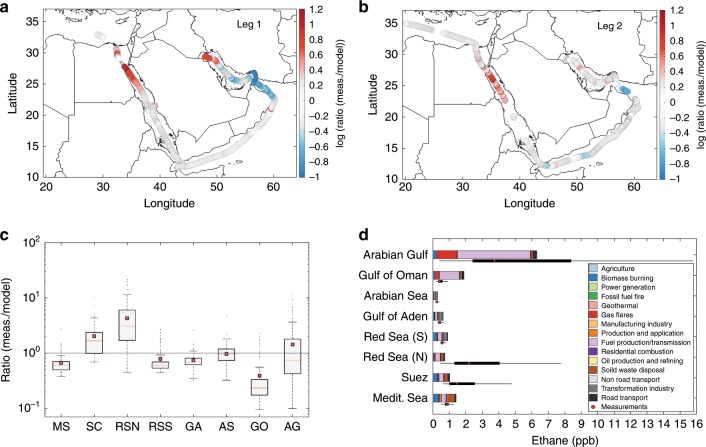
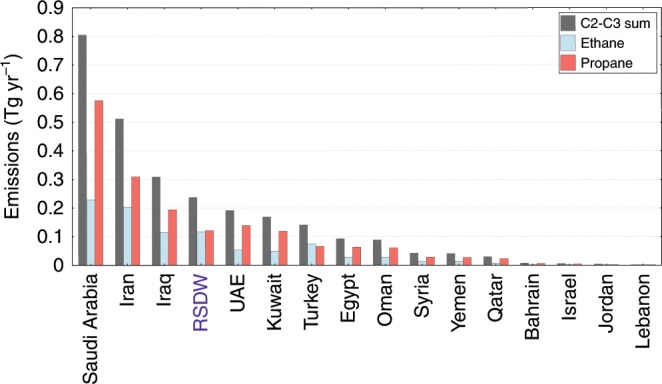
Non-methane hydrocarbons (NMHCs) such as ethane and propane are significant atmospheric pollutants and precursors of tropospheric ozone, while the Middle East is a global emission hotspot due to extensive oil and gas production. Here we compare in situ hydrocarbon measurements, performed around the Arabian Peninsula, with global model simulations that include current emission inventories (EDGAR) and state-of-the-art atmospheric circulation and chemistry mechanisms (EMAC model). While measurements of high mixing ratios over the Arabian Gulf are adequately simulated, strong underprediction by the model was found over the northern Red Sea. By examining the individual sources in the model and by utilizing air mass back-trajectory investigations and Positive Matrix Factorization (PMF) analysis, we deduce that Red Sea Deep Water (RSDW) is an unexpected, potent source of atmospheric NMHCs. This overlooked underwater source is comparable with total anthropogenic emissions from entire Middle Eastern countries, and significantly impacts the regional atmospheric chemistry.
Overview
CoChat Summary
## TL;DR
The paper reports that ethane and propane measurements around the Arabian Peninsula were generally reproduced by a global chemistry model, except over the northern Red Sea where observed levels were far higher than predicted. Using back-trajectories and PMF, the authors attribute this mismatch to a previously unrecognized marine source from Red Sea Deep Water (RSDW), with major implications for regional air quality.
## Key findings
- Ethane and propane varied by three orders of magnitude around the Arabian Peninsula, from background values over the Arabian Sea of 0.18 ± 0.02 ppb ethane and 0.02 ± 0.01 ppb propane to maxima of ~50 ppb over the Arabian Gulf.
- Over the northern Red Sea, measured ethane and propane were underpredicted by the model by up to about 20-fold for ethane (average ± SD = 4.3 ± 3.8) and 40-fold for propane (average ± SD = 7.8 ± 5.9).
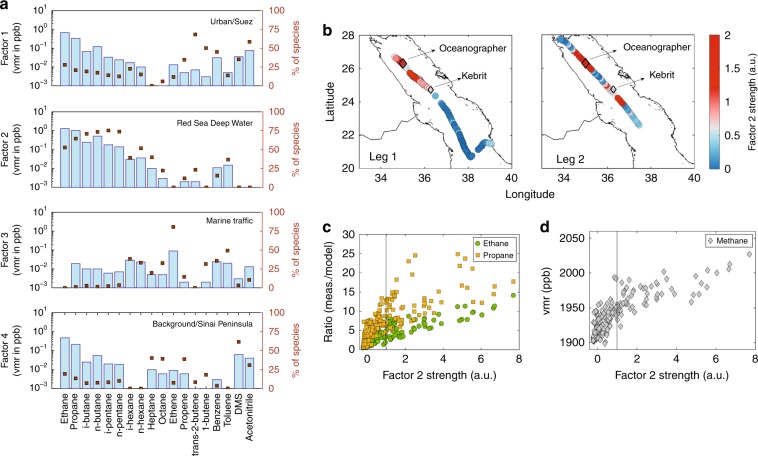
- PMF on the northern Red Sea data identified 4 distinct factors; the key missing source was a factor with exceptionally high alkane concentrations, negligible alkenes, and no acetonitrile, consistent with a non-anthropogenic source.
- After adding inferred RSDW emissions to the model, the authors estimate emission rates of 0.12 ± 0.06 Tg yr−1 ethane, 0.12 ± 0.06 Tg yr−1 propane, 0.03 ± 0.03 Tg yr−1 i-butane, and 0.07 ± 0.06 Tg yr−1 n-butane; the associated methane source was estimated at ca. 1.3 Tg CH4 yr−1.
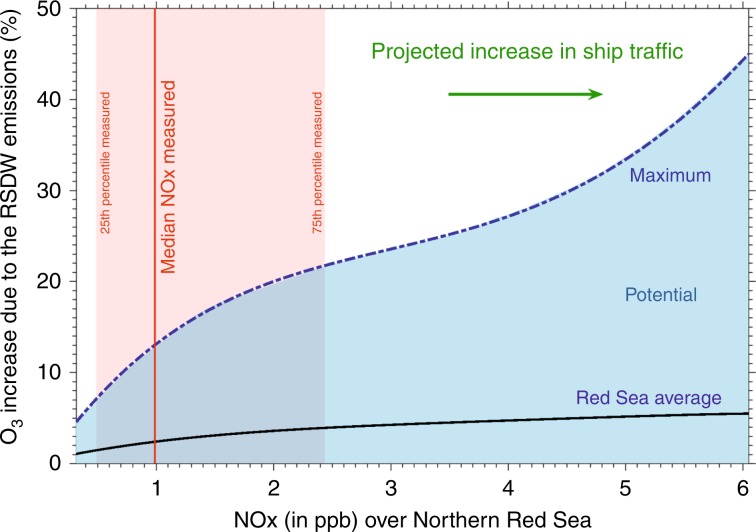
- Including the RSDW source changed modeled chemistry over the northern Red Sea: summertime average OH decreased by ~40% over degassing spots (max −70%), ozone increased up to 11%, and PAN increased by ~102% (max 750%).
## Methods
- Design/sample: AQABA ship campaign measurements collected during July–August 2017 aboard the research vessel *Kommandor Iona*, which sailed around the Arabian Peninsula over 60 days and covered 20,000 km.
- Data collection: In situ NMHCs (C2–C8) were measured with two coupled GC-FID instruments; sampling resolution was typically 50 min per measurement.
- Analysis: Observations were compared with EMAC model simulations using EDGAR v4.3.2 emissions (with added gas flares and geothermal sources); source apportionment used Positive Matrix Factorization (US EPA PMF 5.0) and air-mass back-trajectory analysis.
## Limitations
- The authors state that the relative significance of the various submarine hydrocarbon sources cannot be ascertained; they treat their cumulative contribution as the missing source.
- They note that the RSDW emission estimates have uncertainties from water-current circulation with depth, exact location of degassing points, seasonality, wind speeds, and potential temporal variability (including possible seismic triggering).
- Evident from the text: the PMF application to data from a moving platform (ship) “might introduce a small bias,” and the background was not removed because it changes as the ship travels.
Model-written summary. Check it against the paper before relying on it.
Integrity signals
Registry
Cites
Statistics
Figures
Verification
Claims the paper makes
13 Valid · 2 Not valid · 13 Not checked · 47 Own results and interpretations
The cited sources support only part of this claim — read each source’s verdict below.
In the paper
“While in much of the Middle East NOx abundance is a rate-limiting factor in oxidant photochemistry12, it could be expected that over the Red Sea NMHCs are rate limiting due to small upwind anthropogenic sources.”
§ The Red Sea Deep Water is a potent source of atmospheric ethane and propane > Results and discussion > Implications
What the sources say
- Partly supportedcites [12] Lelieveld J Severe ozone air pollution in the Persian Gulf region Atmos. Chem. Phys. 2009 9 1393 1406 10.5194/acp-9-1393-2009 sourceExperimental — accuracy not yet measured
The citation is attached to the claim that NOx limits oxidant photochemistry in much of the Middle East, not to the citing authors’ expectation about the Red Sea. The Introduction describes ozone formation as catalyzed by NOx, and §3 calls NOx a particularly important ozone precursor, but neither passage establishes that NOx abundance is rate-limiting across much of the region. (LLM, conf=0.78)
hedgedstates a cause- Asserted: passes — The authors put it forward as true.
- Checkable: passes — It can be checked against evidence.
- Load-bearing: passes — The paper’s conclusions depend on it.
- Based: passes — The paper gives a reason why it holds.
- Partly supported
The cited sources support only part of this claim — read each source’s verdict below.
In the paper
“The transfer from deep water to the surface can be relatively rapid due to the exceptionally effective vertical mixing of the Red Sea deep water and the outflows from the Gulfs of Suez and Aqaba that have been considered to be important for the RSDW renewal in the period 1982–200132,41,42.”
§ The Red Sea Deep Water is a potent source of atmospheric ethane and propane > Results and discussion > Red Sea Deep Water
What the sources say
- Partly supportedcites [32] Yao F Hoteit I Rapid Red Sea Deep Water renewals caused by volcanic eruptions and the North Atlantic Oscillation Sci. Adv. 2018 4 eaar5637 10.1126/sciadv.aar5637 29963625 PMC6021143 sourceExperimental — accuracy not yet measured
The Results (Model results; page unavailable) describe bottom-reaching vertical mixing during deep convection and identify outflows from the Gulfs of Suez and Aqaba as contributors to Red Sea Deep Water renewal in 1982–2001. They do not establish relatively rapid transfer from deep water to the surface; the described outflows carry water toward the deep basin, and deep convection is the dominant renewal source in the largest events. (LLM, conf=0.85)
- Partly supportedcites [41] Yao F Seasonal overturning circulation in the Red Sea: 1. Model validation and summer circulation J. Geophys. Res. 2014 119 2238 2262 10.1002/2013JC009004 sourceExperimental — accuracy not yet measured
The Introduction (page not available) discusses a deep overturning cell linked to Gulf of Suez overflows and observations indicating that the Gulf of Aqaba supplies the densest northern Red Sea water. It does not say that exceptionally effective mixing rapidly transfers deep water to the surface. Its discussion of vertical mixing in §4.1 concerns exchange flow in the strait, not that proposed deep-to-surface transfer. (LLM, conf=0.84)
- Partly supportedcites [42] Osipov S Stenchikov G Regional effects of the Mount Pinatubo eruption on the Middle East and the Red Sea J. Geophys. Res. 2017 122 8894 8912 10.1002/2017JC013182 sourceExperimental — accuracy not yet measured
The Introduction identifies the Gulfs of Suez and Aqaba as contributors to Red Sea deep-water formation, and §3.2 describes fast convective mixing between upper and deep waters. But the paper describes surface cooling penetrating downward into deep water, not rapid transfer of deep water to the surface; it also does not establish the claim's specific 1982–2001 renewal period. Page numbers are unavailable in our copy. (LLM, conf=0.82)
plainstates a cause- Asserted: passes — The authors put it forward as true.
- Checkable: passes — It can be checked against evidence.
- Load-bearing: passes — The paper’s conclusions depend on it.
- Based: passes — The paper gives a reason why it holds.
- Partly supported
Every source the paper cites for this claim was checked and supports it.
In the paper
“While this rate is only a small fraction of the global natural methane sources (238–484 Tg CH4 yr−1)51, it is responsible for the high ambient methane mixing ratios observed over the northern Red Sea (average = 1.94 ± 0.03 ppm).”
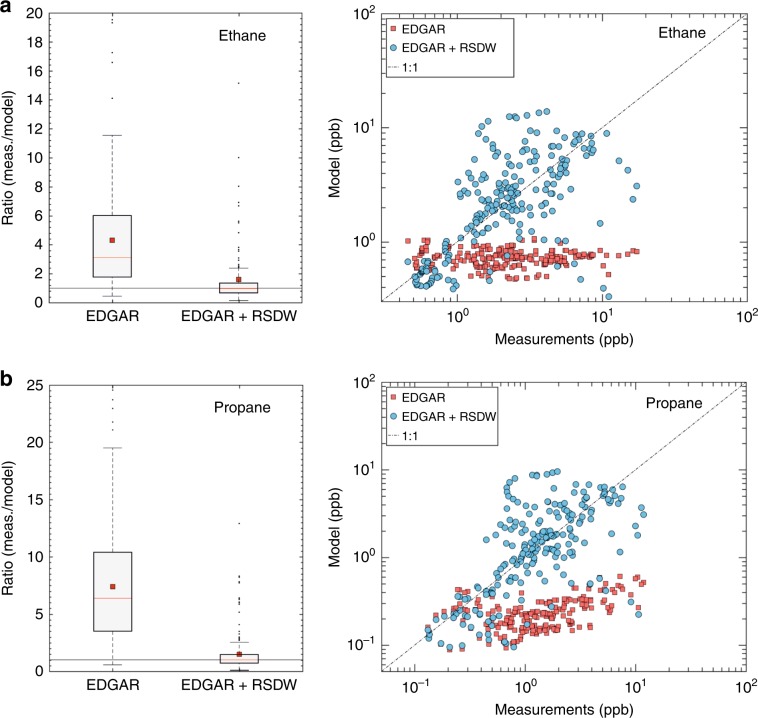
§ The Red Sea Deep Water is a potent source of atmospheric ethane and propane > Results and discussion > Flux calculations To test this hypothesis, two source points (over two model resolution grids (1.1 × 1.1°) with intensity 2:1 from north to south) were added to the model simulation as additional point sources from the ocean surface at the location of the type I brine pools. While Type I brine pools were chosen as the reference location, the emission points cover a large area and thereby include emissions from all aforementioned potential sources. Initially, approximate emission rates that match the factor 2 signature were imported. The measurement to model ratio output for NMHCs was substantially improved with median values deviating from unity by only ca. ±30%. Therefore, the emission rates were fine-tuned so that the measurement/model median ratio was equal to 1, and hence the emission strength of the RSDW could be ascertained. This resulted in predicted emission rates for ethane (0.12 ± 0.06 Tg yr−1), propane (0.12 ± 0.06 Tg yr−1), i-butane = 0.03 ± 0.03 Tg yr−1, and n-butane = 0.07 ± 0.06 Tg yr−1 (uncertainties are based on the standard deviation of the measurement/model ratio values within the 25th and 75th percentile). Increasing uncertainties will be introduced when considering the seasonality of the deep-water circulation, the wind speeds at the air–sea interface, and the potential temporal variability of the emissions (i.e., triggered events by the increased seismic activity in the region48). As a final step, the derived emission rates were added to the model and the simulations were repeated. The inclusion of the RSDW emissions in the emission inventory significantly improves the model-measurement comparison, making it equivalent to the agreement seen elsewhere on the route (Fig. 3; Supplementary Fig. 12, Supplementary Fig. 6q). The uncertainties here are likely associated with water current circulation with depth and the exact location of the degassing points. Furthermore, the seabed emissions are likely higher than those reported due to oxidation and bacterial degraders in the water column49,50. Considering the linearity between the measured ethane and methane mixing ratios (Supplementary Fig. 13) and by assuming common source origin, an emission rate of ca. 1.3 Tg CH4 yr−1 is derived. While this rate is only a small fraction of the global natural methane sources (238–484 Tg CH4 yr−1)51, it is responsible for the high ambient methane mixing ratios observed over the northern Red Sea (average = 1.94 ± 0.03 ppm).
What the sources say
- Supportedcites [51] Kirschke S Three decades of global methane sources and sinks Nat. Geosci. 2013 6 813 10.1038/ngeo1955 source
Table 1 (Global budget uncertainty; page not provided) gives the 2000–2009 bottom-up estimate for global natural methane sources as 347 [238–484] Tg CH₄ yr⁻¹. The citation supports that comparison figure; the Red Sea mixing-ratio observation is not attributed to this source. (LLM, conf=0.95)
plain- Asserted: passes — The authors put it forward as true.
- Checkable: passes — It can be checked against evidence.
- Load-bearing: unclear — It is unclear whether the paper’s conclusions depend on it.
- Based: passes — The paper gives a reason why it holds.
- Supported
The sources with a verdict support this claim; the rest weren’t checked yet, have no full text we could read, or their verdicts aren’t rated yet.
In the paper
“Due to the weak stratification of the water column in the northern part of the basin, the convective mixing can be especially deep and reaches the sea floor42,44,45.”
§ The Red Sea Deep Water is a potent source of atmospheric ethane and propane > Results and discussion > Red Sea Deep Water
What the sources say
- Supportedcites [42] Osipov S Stenchikov G Regional effects of the Mount Pinatubo eruption on the Middle East and the Red Sea J. Geophys. Res. 2017 122 8894 8912 10.1002/2017JC013182 source
The Figure 10 caption says stratification weakens in the northern Red Sea and describes deep convective mixing of the entire water column north of 24°N. Mixing of the entire column supports the claim that it can reach the sea floor. (LLM, conf=0.91)
- Not checked — no full text of the sourcecites [44] Genin A Lazar B Brenner S Vertical mixing and coral death in the Red Sea following the eruption of Mount Pinatubo Nature 1995 377 507 510 10.1038/377507a0 source
- Not checked — no full text of the sourcecites [45] Woelk S Quadfasel D Renewal of deep water in the Red Sea during 1982–1987 J. Geophys. Res. 1996 101 C8 18155 18165 10.1029/96JC01148 source
hedgedstates a cause- Asserted: passes — The authors put it forward as true.
- Checkable: passes — It can be checked against evidence.
- Load-bearing: passes — The paper’s conclusions depend on it.
- Based: passes — The paper gives a reason why it holds.
- Supported
Every source the paper cites for this claim was checked and supports it.
In the paper
“While this rate is only a small fraction of the global natural methane sources (238–484 Tg CH4 yr−1)51, it is responsible for the high ambient methane mixing ratios observed over the northern Red Sea (average = 1.94 ± 0.03 ppm).”
§ The Red Sea Deep Water is a potent source of atmospheric ethane and propane > Results and discussion > Flux calculations To test this hypothesis, two source points (over two model resolution grids (1.1 × 1.1°) with intensity 2:1 from north to south) were added to the model simulation as additional point sources from the ocean surface at the location of the type I brine pools. While Type I brine pools were chosen as the reference location, the emission points cover a large area and thereby include emissions from all aforementioned potential sources. Initially, approximate emission rates that match the factor 2 signature were imported. The measurement to model ratio output for NMHCs was substantially improved with median values deviating from unity by only ca. ±30%. Therefore, the emission rates were fine-tuned so that the measurement/model median ratio was equal to 1, and hence the emission strength of the RSDW could be ascertained. This resulted in predicted emission rates for ethane (0.12 ± 0.06 Tg yr−1), propane (0.12 ± 0.06 Tg yr−1), i-butane = 0.03 ± 0.03 Tg yr−1, and n-butane = 0.07 ± 0.06 Tg yr−1 (uncertainties are based on the standard deviation of the measurement/model ratio values within the 25th and 75th percentile). Increasing uncertainties will be introduced when considering the seasonality of the deep-water circulation, the wind speeds at the air–sea interface, and the potential temporal variability of the emissions (i.e., triggered events by the increased seismic activity in the region48). As a final step, the derived emission rates were added to the model and the simulations were repeated. The inclusion of the RSDW emissions in the emission inventory significantly improves the model-measurement comparison, making it equivalent to the agreement seen elsewhere on the route (Fig. 3; Supplementary Fig. 12, Supplementary Fig. 6q). The uncertainties here are likely associated with water current circulation with depth and the exact location of the degassing points. Furthermore, the seabed emissions are likely higher than those reported due to oxidation and bacterial degraders in the water column49,50. Considering the linearity between the measured ethane and methane mixing ratios (Supplementary Fig. 13) and by assuming common source origin, an emission rate of ca. 1.3 Tg CH4 yr−1 is derived. While this rate is only a small fraction of the global natural methane sources (238–484 Tg CH4 yr−1)51, it is responsible for the high ambient methane mixing ratios observed over the northern Red Sea (average = 1.94 ± 0.03 ppm).
What the sources say
- Supportedcites [51] Kirschke S Three decades of global methane sources and sinks Nat. Geosci. 2013 6 813 10.1038/ngeo1955 source
Table 1 in the Global budget uncertainty section gives a bottom-up estimate of 347 [238–484] Tg CH₄ yr⁻¹ for global natural methane sources in 2000–2009. The citation is attached to that global comparison; the subsequent statement about methane over the northern Red Sea is the citing authors’ conclusion, not a finding attributed to this source. (LLM, conf=0.95)
plainstates a cause- Asserted: passes — The authors put it forward as true.
- Checkable: passes — It can be checked against evidence.
- Load-bearing: passes — The paper’s conclusions depend on it.
- Based: passes — The paper gives a reason why it holds.
- Rests on an assumption not shown here.
- Supported
40 more claims
Create a free account to see all 75 claims and every source verdict.
- It may state two separate claims as one. 24
- Probably not a substantial claim. 10
Self-check
Percentages, sums and reported differences re-computed from the paper’s own numbers.
Rated major: it would touch a result — a value a result rests on, reported and recomputed p-values on opposite sides of the significance level, two passages that conflict with no sign which is right, or a cited work retracted before this paper was published.
In the paper
“with a subflow of 2.5 L m−1. The air passed through a PTFE filter (5-μm pore size, Sartorius Corporate Administration GmbH, Germany) and heated (40 °C) Teflon lines before it was drawn into the instruments with a flow of 90 sccm”
§ The Red Sea Deep Water is a potent source of atmospheric ethane and propane > Methods > Non-methane hydrocarbon measurements
Reported 1 · recomputed 0.027778
Citations
Cites
The ERA‐Interim reanalysis: configuration and performance of the data assimilation system
Dee, D. P., Uppala, S. M., Simmons, A. J., Berrisford, P., Poli, P., Kobayashi, S., Andrae, U., Balmaseda, M. A., Balsamo, G., Bauer, P., et al. (2011) · Quarterly Journal of the Royal Meteorological Society · doi:10.1002/qj.828 · Cited by 24,480
Paatero, P., & Tapper, U. (1994) · Environmetrics · doi:10.1002/env.3170050203 · Cited by 6,023
The contribution of outdoor air pollution sources to premature mortality on a global scale
Lelieveld, J., Evans, J. S., Fnais, M., Giannadaki, D., & Pozzer, A. (2015) · Nature · doi:10.1038/nature15371 · Cited by 5,977
Self-citationRelationship between wind speed and gas exchange over the ocean
Wanninkhof, R. (1992) · Journal of Geophysical Research: Oceans · doi:10.1029/92jc00188 · Cited by 4,737
Three decades of global methane sources and sinks
Kirschke, S., Bousquet, P., Ciais, P., Saunois, M., Canadell, J. G., Dlugokencky, E. J., Bergamaschi, P., Bergmann, D., Blake, D. R., Bruhwiler, L., et al. (2013) · Nature Geoscience · doi:10.1038/ngeo1955 · Cited by 2,247
Self-citationKaiser, J. W., Heil, A., Andreae, M. O., Benedetti, A., Chubarova, N., Jones, L., Morcrette, J.-J., Razinger, M., Schultz, M. G., Suttie, M., et al. (2012) · Biogeosciences · doi:10.5194/bg-9-527-2012 · Cited by 1,518
Assessment of methane emissions from the U.S. oil and gas supply chain
Alvarez, R. A., Zavala-Araiza, D., Lyon, D. R., Allen, D. T., Barkley, Z. R., Brandt, A. R., Davis, K. J., Herndon, S. C., Jacob, D. J., Karion, A., et al. (2018) · Science · doi:10.1126/science.aar7204 · Cited by 1,187 · cited 1×
“(2)), and the interrelationship investigations between the predicted and observed volume mixing ratios.”
BackgroundRoeckner, E., Brokopf, R., Esch, M., Giorgetta, M., Hagemann, S., Kornblueh, L., Manzini, E., Schlese, U., & Schulzweida, U. (2006) · Journal of Climate · doi:10.1175/jcli3824.1 · Cited by 1,183
Atmospheric aerosol over Alaska: 2. Elemental composition and sources
Polissar, A. V., Hopke, P. K., Paatero, P., Malm, W. C., & Sisler, J. F. (1998) · Journal of Geophysical Research: Atmospheres · doi:10.1029/98jd01212 · Cited by 926
Gridded emissions of air pollutants for the period 1970–2012 within EDGAR v4.3.2
Crippa, M., Guizzardi, D., Muntean, M., Schaaf, E., Dentener, F., van Aardenne, J. A., Monni, S., Doering, U., Olivier, J. G. J., Pagliari, V., et al. (2018) · Earth System Science Data · doi:10.5194/essd-10-1987-2018 · Cited by 889
Chemistry and Physiology of Los Angeles Smog
Haagen-Smit, A. J. (1952) · Industrial & Engineering Chemistry · doi:10.1021/ie50510a045 · Cited by 834
A unified mechanism of action for volatile isoprenoids in plant abiotic stress
Vickers, C. E., Gershenzon, J., Lerdau, M. T., & Loreto, F. (2009) · Nature Chemical Biology · doi:10.1038/nchembio.158 · Cited by 760
A cubic relationship between air‐sea CO2 exchange and wind speed
Wanninkhof, R., & McGillis, W. R. (1999) · Geophysical Research Letters · doi:10.1029/1999gl900363 · Cited by 674
Methods for estimating uncertainty in factor analytic solutions
Paatero, P., Eberly, S., Brown, S. G., & Norris, G. A. (2014) · Atmospheric Measurement Techniques · doi:10.5194/amt-7-781-2014 · Cited by 571
Development cycle 2 of the Modular Earth Submodel System (MESSy2)
Jöckel, P., Kerkweg, A., Pozzer, A., Sander, R., Tost, H., Riede, H., Baumgaertner, A., Gromov, S., & Kern, B. (2010) · Geoscientific Model Development · doi:10.5194/gmd-3-717-2010 · Cited by 551
Self-citationGlobal tropospheric hydroxyl distribution, budget and reactivity
Lelieveld, J., Gromov, S., Pozzer, A., & Taraborrelli, D. (2016) · Atmospheric Chemistry and Physics · doi:10.5194/acp-16-12477-2016 · Cited by 508
Self-citationHot Brines and Recent Heavy Metal Deposits in the Red Sea
(1969) · doi:10.1007/978-3-662-28603-6 · Cited by 480
The atmospheric chemistry of organic nitrates
Roberts, J. M. (1990) · Atmospheric Environment. Part A. General Topics · doi:10.1016/0960-1686(90)90108-y · Cited by 470
Propane Respiration Jump-Starts Microbial Response to a Deep Oil Spill
Valentine, D. L., Kessler, J. D., Redmond, M. C., Mendes, S. D., Heintz, M. B., Farwell, C., Hu, L., Kinnaman, F. S., Yvon-Lewis, S., Du, M., et al. (2010) · Science · doi:10.1126/science.1196830 · Cited by 446
Understanding and controlling rotations in factor analytic models
Paatero, P., Hopke, P. K., Song, X.-H., & Ramadan, Z. (2002) · Chemometrics and Intelligent Laboratory Systems · doi:10.1016/s0169-7439(01)00200-3 · Cited by 422
High winter ozone pollution from carbonyl photolysis in an oil and gas basin
Edwards, P. M., Brown, S. S., Roberts, J. M., Ahmadov, R., Banta, R. M., deGouw, J. A., Dubé, W. P., Field, R. A., Flynn, J. H., Gilman, J. B., et al. (2014) · Nature · doi:10.1038/nature13767 · Cited by 404
Crippa, M., Canonaco, F., Lanz, V. A., Äijälä, M., Allan, J. D., Carbone, S., Capes, G., Ceburnis, D., Dall'Osto, M., Day, D. A., et al. (2014) · Atmospheric Chemistry and Physics · doi:10.5194/acp-14-6159-2014 · Cited by 382
Holzinger, R., Warneke, C., Hansel, A., Jordan, A., Lindinger, W., Scharffe, D. H., Schade, G., & Crutzen, P. J. (1999) · Geophysical Research Letters · doi:10.1029/1999gl900156 · Cited by 343
Vertical mixing and coral death in the Red Sea following the eruption of Mount Pinatubo
Genin, A., Lazar, B., & Brenner, S. (1995) · Nature · doi:10.1038/377507a0 · Cited by 313
Fossil CO2 and GHG emissions of all world countries
(2017) · Joint Research Centre (European Commission) · doi:10.2760/709792 · Cited by 284
Baudic, A., Gros, V., Sauvage, S., Locoge, N., Sanchez, O., Sarda-Estève, R., Kalogridis, C., Petit, J.-E., Bonnaire, N., Baisnée, D., et al. (2016) · Atmospheric Chemistry and Physics · doi:10.5194/acp-16-11961-2016 · Cited by 245
Source apportionment of VOCs in the Los Angeles area using positive matrix factorization
Brown, S. G., Frankel, A., & Hafner, H. R. (2007) · Atmospheric Environment · doi:10.1016/j.atmosenv.2006.08.021 · Cited by 234
Seasonal emissions of isoprene and other reactive hydrocarbon gases from the ocean
Broadgate, W. J., Liss, P. S., & Penkett, S. A. (1997) · Geophysical Research Letters · doi:10.1029/97gl02736 · Cited by 219
Helmig, D., Rossabi, S., Hueber, J., Tans, P., Montzka, S. A., Masarie, K., Thoning, K., Plass-Duelmer, C., Claude, A., Carpenter, L. J., et al. (2016) · Nature Geoscience · doi:10.1038/ngeo2721 · Cited by 217
Self-citationSource apportionment of indoor and outdoor volatile organic compounds at homes in Edmonton, Canada
Bari, M. A., Kindzierski, W. B., Wheeler, A. J., Héroux, M.-È., & Wallace, L. A. (2015) · Building and Environment · doi:10.1016/j.buildenv.2015.03.023 · Cited by 208
Earth's Degassing: A Missing Ethane and Propane Source
Etiope, G., & Ciccioli, P. (2009) · Science · doi:10.1126/science.1165904 · Cited by 176
Recent decreases in fossil-fuel emissions of ethane and methane derived from firn air
Aydin, M., Verhulst, K. R., Saltzman, E. S., Battle, M. O., Montzka, S. A., Blake, D. R., Tang, Q., & Prather, M. J. (2011) · Nature · doi:10.1038/nature10352 · Cited by 174
Microbiology of the Red Sea (and other) deep‐sea anoxic brine lakes
Antunes, A., Ngugi, D. K., & Stingl, U. (2011) · Environmental Microbiology Reports · doi:10.1111/j.1758-2229.2011.00264.x · Cited by 173
The community atmospheric chemistry box model CAABA/MECCA-4.0
Sander, R., Baumgaertner, A., Cabrera-Perez, D., Frank, F., Gromov, S., Grooß, J.-U., Harder, H., Huijnen, V., Jöckel, P., Karydis, V. A., et al. (2019) · Geoscientific Model Development · doi:10.5194/gmd-12-1365-2019 · Cited by 166
Self-citationSeasonal overturning circulation in the Red Sea: 1. Model validation and summer circulation
Yao, F., Hoteit, I., Pratt, L. J., Bower, A. S., Zhai, P., Köhl, A., & Gopalakrishnan, G. (2014) · Journal of Geophysical Research: Oceans · doi:10.1002/2013jc009004 · Cited by 165
Novel 16S rRNA gene sequences retrieved from highly saline brine sediments of Kebrit Deep, Red Sea
Eder, W., Ludwig, W., & Huber, R. (1999) · Archives of Microbiology · doi:10.1007/s002030050762 · Cited by 155
Importance of Peroxyacetyl Nitrate (PAN) as a Phytotoxic Air Pollutant
Taylor, O. C. (1969) · Journal of the Air Pollution Control Association · doi:10.1080/00022470.1969.10466498 · Cited by 150
New Deeps with Brines and Metalliferous Sediments in the Red Sea
BACKER, H., & SCHOELL, M. (1972) · Nature Physical Science · doi:10.1038/physci240153a0 · Cited by 148
Severe ozone air pollution in the Persian Gulf region
Lelieveld, J., Hoor, P., Jöckel, P., Pozzer, A., Hadjinicolaou, P., Cammas, J.-P., & Beirle, S. (2009) · Atmospheric Chemistry and Physics · doi:10.5194/acp-9-1393-2009 · Cited by 141
Self-citationEder, W., Jahnke, L. L., Schmidt, M., & Huber, R. (2001) · Applied and Environmental Microbiology · doi:10.1128/aem.67.7.3077-3085.2001 · Cited by 140
Pozzer, A., de Meij, A., Pringle, K. J., Tost, H., Doering, U. M., van Aardenne, J., & Lelieveld, J. (2012) · Atmospheric Chemistry and Physics · doi:10.5194/acp-12-961-2012 · Cited by 133
Self-citationImpact of remotely generated eddies on plume dispersion at abyssal mining sites in the Pacific
Aleynik, D., Inall, M. E., Dale, A., & Vink, A. (2017) · Scientific Reports · doi:10.1038/s41598-017-16912-2 · Cited by 131
The Red Sea: The Formation, Morphology, Oceanography and Environment of a Young Ocean Basin
(2015) · Springer Earth System Sciences · doi:10.1007/978-3-662-45201-1 · Cited by 130
Observed and simulated global distribution and budget of atmospheric C 2 -C 5 alkanes
Pozzer, A., Pollmann, J., Taraborrelli, D., Jöckel, P., Helmig, D., Tans, P., Hueber, J., & Lelieveld, J. (2010) · Atmospheric Chemistry and Physics · doi:10.5194/acp-10-4403-2010 · Cited by 112
Self-citationDalsøren, S. B., Myhre, G., Hodnebrog, Ø., Myhre, C. L., Stohl, A., Pisso, I., Schwietzke, S., Höglund-Isaksson, L., Helmig, D., Reimann, S., et al. (2018) · Nature Geoscience · doi:10.1038/s41561-018-0073-0 · Cited by 109
Light nonmethane hydrocarbons in seawater
Plass‐Dülmer, C., Koppmann, R., Ratte, M., & Rudolph, J. (1995) · Global Biogeochemical Cycles · doi:10.1029/94gb02416 · Cited by 107
Discovery of a large brine deep in the northern Red Sea
Pautot, G., Guennoc, P., Coutelle, A., & Lybéris, N. (1984) · Nature · doi:10.1038/310133a0 · Cited by 96
Pfannerstill, E. Y., Wang, N., Edtbauer, A., Bourtsoukidis, E., Crowley, J. N., Dienhart, D., Eger, P., Ernle, L., Fischer, H., Hottmann, B., et al. (2019) · Atmospheric chemistry and physics · doi:10.5194/acp-19-11501-2019 · Cited by 95
Self-citationNon-methane hydrocarbon (C 2 –C 8 ) sources and sinks around the Arabian Peninsula
Bourtsoukidis, E., Ernle, L., Crowley, J. N., Lelieveld, J., Paris, J.-D., Pozzer, A., Walter, D., & Williams, J. (2019) · Atmospheric Chemistry and Physics · doi:10.5194/acp-19-7209-2019 · Cited by 85
Self-citationRenewal of deep water in the Red Sea during 1982–1987
Woelk, S., & Quadfasel, D. (1996) · Journal of Geophysical Research: Oceans · doi:10.1029/96jc01148 · Cited by 83
Hodnebrog, Ø., Dalsøren, S. B., & Myhre, G. (2018) · Atmospheric Science Letters · doi:10.1002/asl.804 · Cited by 78
Production mechanism of C2‐C4 hydrocarbons in seawater: Field measurements and experiments
Ratte, M., Plass‐Dülmer, C., Koppmann, R., Rudolph, J., & Denga, J. (1993) · Global Biogeochemical Cycles · doi:10.1029/93gb00054 · Cited by 75
Ozone stress as a driving force of sesquiterpene emissions: a suggested parameterisation
Bourtsoukidis, E., Bonn, B., Dittmann, A., Hakola, H., Hellén, H., & Jacobi, S. (2012) · Biogeosciences · doi:10.5194/bg-9-4337-2012 · Cited by 74
Self-citationEger, P., Friedrich, N., Schuladen, J. B., Shenolikar, J., Fischer, H., Tadić, I., Harder, H., Martínez, M., Rohloff, R., Tauer, S., et al. (2019) · Atmospheric chemistry and physics · doi:10.5194/acp-19-12121-2019 · Cited by 70
Self-citationWilberforce‐Bell, H. (1940) · Journal of The Royal Central Asian Society · doi:10.1080/03068374008730983 · Cited by 63
Al‐Ahmadi, K., Alamri, A. M., & See, L. (2013) · Arabian Journal of Geosciences · doi:10.1007/s12517-013-0974-6 · Cited by 61
Characterizing Upward Lightning With and Without a Terrestrial Gamma Ray Flash
Smith, D., Bowers, G., Kamogawa, M., et al. (2018) · eScholarship (California Digital Library) · Cited by 60
Characterizing Upward Lightning With and Without a Terrestrial Gamma Ray Flash
Smith, D. M., Bowers, G. S., Kamogawa, M., Wang, D., Ushio, T., Ortberg, J., Dwyer, J. R., & Stock, M. (2018) · Journal of Geophysical Research Atmospheres · doi:10.1029/2018jd029105 · Cited by 60
Three‐Dimensional Signature of the Red Sea Eddies and Eddy‐Induced Transport
Zhan, P., Krokos, G., Guo, D., & Hoteit, I. (2019) · Geophysical Research Letters · doi:10.1029/2018gl081387 · Cited by 59
Indoor and Outdoor Levels and Sources of Submicron Particles (PM1) at Homes in Edmonton, Canada
Bari, M. A., Kindzierski, W. B., Wallace, L. A., Wheeler, A. J., MacNeill, M., & Héroux, M.-È. (2015) · Environmental Science & Technology · doi:10.1021/acs.est.5b01173 · Cited by 58
Oil and natural gas prospects: Middle East and North Africa
Khatib, H. (2013) · Energy Policy · doi:10.1016/j.enpol.2013.07.091 · Cited by 57
Rapid Red Sea Deep Water renewals caused by volcanic eruptions and the North Atlantic Oscillation
Yao, F., & Hoteit, I. (2018) · Science Advances · doi:10.1126/sciadv.aar5637 · Cited by 56
Caseiro, A., Gehrke, B., Rücker, G., Leimbach, D., & Kaiser, J. W. (2020) · Earth system science data · doi:10.5194/essd-12-2137-2020 · Cited by 48
Morino, Y., Ohara, T., Yokouchi, Y., et al. (2011) · Journal of Geophysical Research Atmospheres · doi:10.1029/2010jd014762 · Cited by 45
Schmidt, M., Botz, R., Faber, E., Schmitt, M., Poggenburg, J., Garbe-Schönberg, D., & Stoffers, P. (2003) · Chemical Geology · doi:10.1016/s0009-2541(03)00206-7 · Cited by 44
Peroxyacetyl nitrate (PAN) in the urban atmosphere
Lee, J.-B., Yoon, J.-S., Jung, K., Eom, S.-W., Chae, Y.-Z., Cho, S.-J., Kim, S.-D., Sohn, J. R., & Kim, K.-H. (2013) · Chemosphere · doi:10.1016/j.chemosphere.2013.06.019 · Cited by 39
Leuchner, M., Gubo, S., Schunk, C., Wastl, C., Kirchner, M., Menzel, A., & Plaß-Dülmer, C. (2015) · Atmospheric chemistry and physics · doi:10.5194/acp-15-1221-2015 · Cited by 29
Monks, S. A., Wilson, C., Emmons, L. K., Hannigan, J. W., Helmig, D., Blake, N. J., & Blake, D. R. (2018) · Journal of Geophysical Research: Atmospheres · doi:10.1029/2017jd028112 · Cited by 28
Simulating the Regional Impact of Dust on the Middle East Climate and the Red Sea
Osipov, S., & Stenchikov, G. (2018) · Journal of Geophysical Research: Oceans · doi:10.1002/2017jc013335 · Cited by 27
Self-citationOrganic-rich sediments in brine-filled Shaban- and Kebrit deeps, northern Red Sea
Botz, R., Schmidt, M., Wehner, H., Hufnagel, H., & Stoffers, P. (2007) · Chemical Geology · doi:10.1016/j.chemgeo.2007.07.004 · Cited by 24
Red Sea deep water circulation and ventilation rate deduced from the 3He and 14C tracer fields
Jean-Baptiste, P., Fourré, E., Metzl, N., Ternon, J. F., & Poisson, A. (2004) · Journal of Marine Systems · doi:10.1016/j.jmarsys.2003.07.001 · Cited by 16
Gas flaring activity and black carbon emissions in 2017 derived from Sentinel-3A SLSTRPreprint
Caseiro, A., Gehrke, B., Rücker, G., et al. (2019) · doi:10.5194/essd-2019-99 · Cited by 16
Regional Effects of the Mount Pinatubo Eruption on the Middle East and the Red Sea
Osipov, S., & Stenchikov, G. (2017) · Journal of Geophysical Research: Oceans · doi:10.1002/2017jc013182 · Cited by 15
Self-citation(2016) · OAR@UM (University of Malta) · Cited by 6
Research works printed but not linked: 4
- Rasul Najeeb M.A. Stewart Ian C.F. The Red Sea 2015 Berlin, Heidelberg Springer Berlin Heidelberg
- Rasul Najeeb M.A. Stewart Ian C.F. The Red Sea 2015 Berlin, Heidelberg Springer Berlin Heidelberg
- Schmidt, M., Al-Farawati, R. & Botz, R. The Red Sea. (Springer, Berlin, Heidelberg, 2015). https://doi.org/10.1007/978-3-662-45201-1. · DOI · Paper page
- Bonatti E Geophysical, geological and oceanographic surveys in the Northern Red Sea ISMAR Bologna Techn. Rep. 2005 94 1 40
Cited by
Climate Change and Weather Extremes in the Eastern Mediterranean and Middle East
Zittis, G., Almazroui, M., Alpert, P., Ciais, P., Cramer, W., Dahdal, Y., Fnais, M., Francis, D., Hadjinicolaou, P., Howari, F., et al. (2022) · Reviews of Geophysics · doi:10.1029/2021rg000762 · Cited by 704
“…of the EMME region, exploring sources and sinks of non-methane hydrocarbons, ozone chemistry, OH reactivity, emissions of NO x , methane sulfonamide, and formation of ClNO 2 (Bourtsoukidis et al., 2019, 2020; Edtbauer et al., 2020; Eger et al., 2019; Pfannerstill et al., 2019; Tadic et al., 2020).”
BackgroundSelf-citationMatthaios, V. N., Lawrence, J. E., Martins, M. A., Ferguson, S. T., Wolfson, J. M., Harrison, R. M., & Koutrakis, P. (2022) · The Science of The Total Environment · doi:10.1016/j.scitotenv.2022.155368 · Cited by 104
Self-citationKezoudi, M., Keleshis, C., Antoniou, P., Biskos, G., Bronz, M., Constantinides, C., Desservettaz, M., Gao, R. S., Girdwood, J., Harnetiaux, J., et al. (2021) · Atmosphere · doi:10.3390/atmos12081042 · Cited by 87
Self-citationEdtbauer, A., Stönner, C., Pfannerstill, E. Y., Berasategui, M., Walter, D., Crowley, J. N., Lelieveld, J., & Williams, J. (2020) · Atmospheric chemistry and physics · doi:10.5194/acp-20-6081-2020 · Cited by 69
Self-citationYuan, X., Li, L., Shi, Z., Liang, H., Li, S., & Qiao, Z. (2021) · Advanced Powder Materials · doi:10.1016/j.apmate.2021.12.002 · Cited by 61
Metadata
- Authors
- Bourtsoukidis, E., Pozzer, A., Sattler, T., Matthaios, V. N., Ernle, L., Edtbauer, A., Fischer, H., Könemann, T., Osipov, S., Paris, J.-D., Pfannerstill, E. Y., Stönner, C., Tadic, I., Walter, D., Wang, N., Lelieveld, J., & Williams, J.
- Affiliations
- Max Planck Institute for Chemistry (DE)
- University of Birmingham (GB)
- Centre National de la Recherche Scientifique (FR)
- Cyprus Institute (CY)
- Corresponding author
- Bourtsoukidis, E.
- ORCID
- Venue
- Nature Communications
- Published
- 2020-01-28
- Volume
- 11
- Issue
- 1
- Pages
- 447-447
- ISSN
- 2041-1723 (ISSN-L)
- PMC
- PMC6987153
- OpenAlex
- W3003402795
- Cited by
- 59
- References
- 73
- Citations by year
- 2026: 5 · 2025: 3 · 2024: 7 · 2023: 5 · 2022: 21 · 2021: 15 · 2020: 3
- FWCI
- 3.40
- Type
- journal article
- Language
- en
- Open access
- gold
- doi.org
- Licence
- cc-by
- creativecommons.org/licenses/by/4.0 (tdm)
- creativecommons.org/licenses/by/4.0 (vor)
- Locations
- Nature Communications (publishedVersion, cc-by)
- PubMed Central (publishedVersion, cc-by)
- PubMed (publishedVersion)
- HAL (submittedVersion, cc-by-nc)
- RePEc: Research Papers in Economics (submittedVersion)
- DOAJ (DOAJ: Directory of Open Access Journals) (submittedVersion, cc-by-sa)
- DOAJ (DOAJ: Directory of Open Access Journals) (submittedVersion)
- MPG.PuRe (Max Planck Society) (submittedVersion, other-oa)
- MPG.PuRe (Max Planck Society) (submittedVersion)
- King Abdullah University of Science and Technology Repository (King Abdullah University of Science and Technology) (submittedVersion)
- Funders
- European Commission (674911, HORIZON2020, 856612)
- King Abdullah University of Science and Technology
- Kuwait Institute for Scientific Research
- Topics
- Physical Sciences › Earth and Planetary Sciences › Atmospheric Science › Atmospheric chemistry and aerosols
- Physical Sciences › Environmental Science › Global and Planetary Change › Atmospheric and Environmental Gas Dynamics
- Physical Sciences › Earth and Planetary Sciences › Atmospheric Science › Atmospheric Ozone and Climate
- Keywords
- non-methane hydrocarbons, ethane, propane, Persian Gulf, tropospheric ozone precursors, air mass back-trajectory analysis, positive matrix factorization
About these checks
Registry, retraction, Cites and statistics results are computed, not judged, with one exception: a printed reference that no index lists is read once by a model before it counts as a citation error. Claims are extracted by a model and kept only when their quote appears verbatim in the text; each cited source is then checked, with a model’s help, for whether it says what the claim relies on. Those verdicts can be wrong — read the claim’s quote and the cited source before relying on one.
The claim verdicts this report counts are experimental: their accuracy is not yet measured.
A language model drew the claims from the paper on 2026-10-11, under version 3 of the claim definition (model deepseek-v4.1-flash, prompt extract-v3).
A second model labelled each claim on 2026-10-11 (model jev-1.13-20260917, definition revision gold-guideline-v0.2).
Cited sources are checked with a language model’s help (gpt-6-sol).
Statistics and arithmetic are recomputed, not judged.
Confidence bands are shown only for fields calibrated on our annotated test set. None is calibrated yet, so no band is shown.
What counts as a claim ›How we measure confidence ›How we check this ›
Are you an author, or do you see a problem with this page? Request a review
Data sources
Bibliographic data: Semantic Scholar, OpenAlex, Crossref.
Contains information from the Semantic Scholar Academic Graph Datasets, made available under the ODC Attribution License (ODC-BY 1.0).
Semantic Scholar’s data is described in: Kinney, R., et al. (2023). The Semantic Scholar Open Data Platform. arXiv:2301.10140.
