

Single-cell transcriptomics identifies an effectorness gradient shaping the response of CD4+ T cells to cytokines
Open accessPublished version of a preprint
The DOI matches its Crossref record; 89 of the 89 references it cites were found in a registry or an index.
Abstract
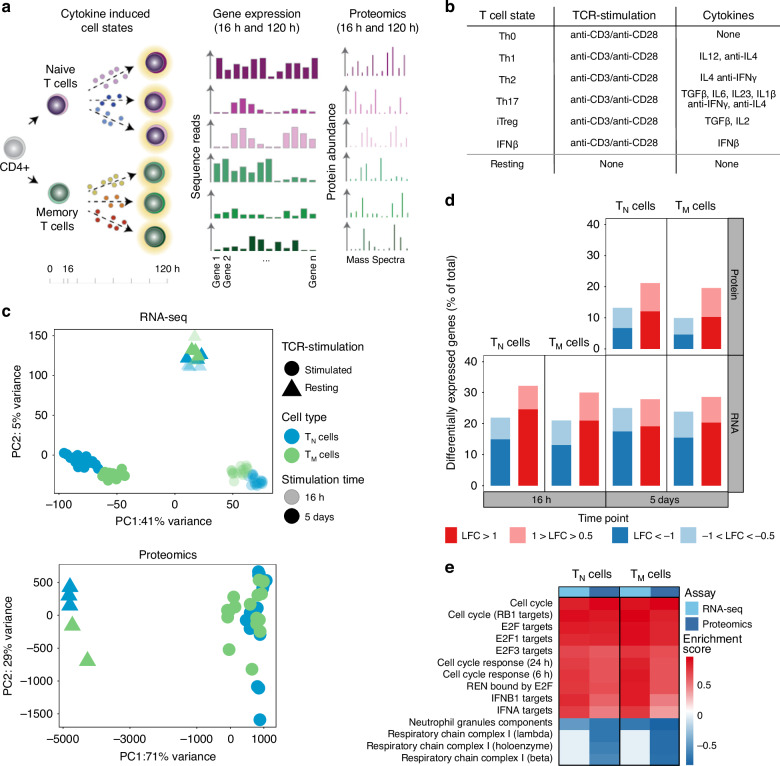
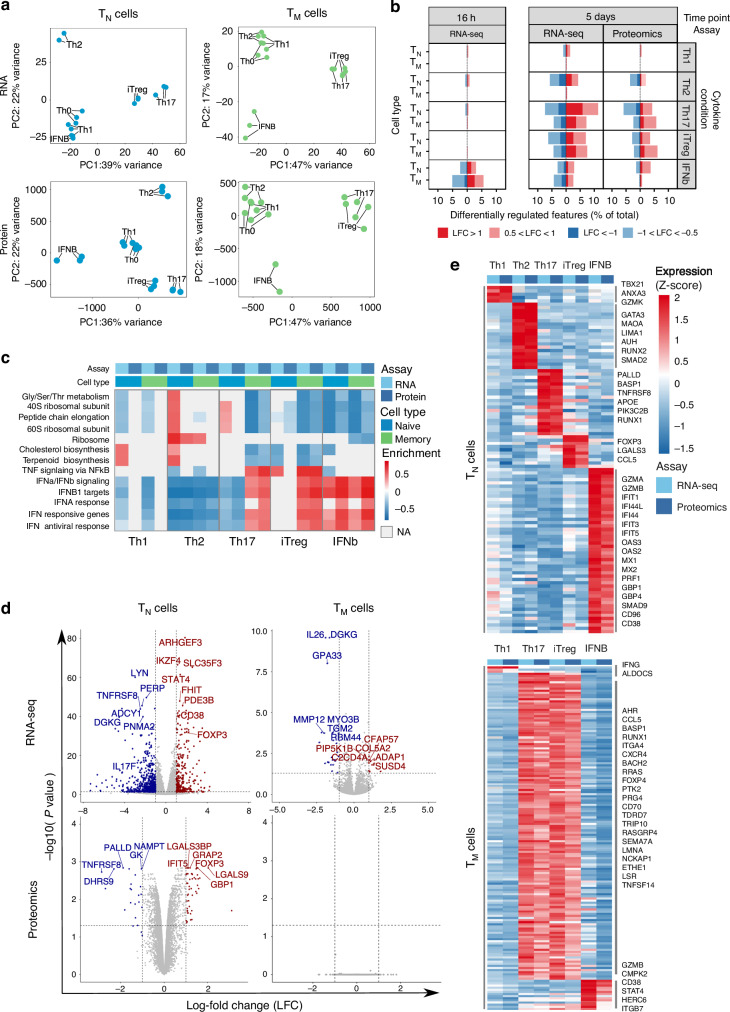
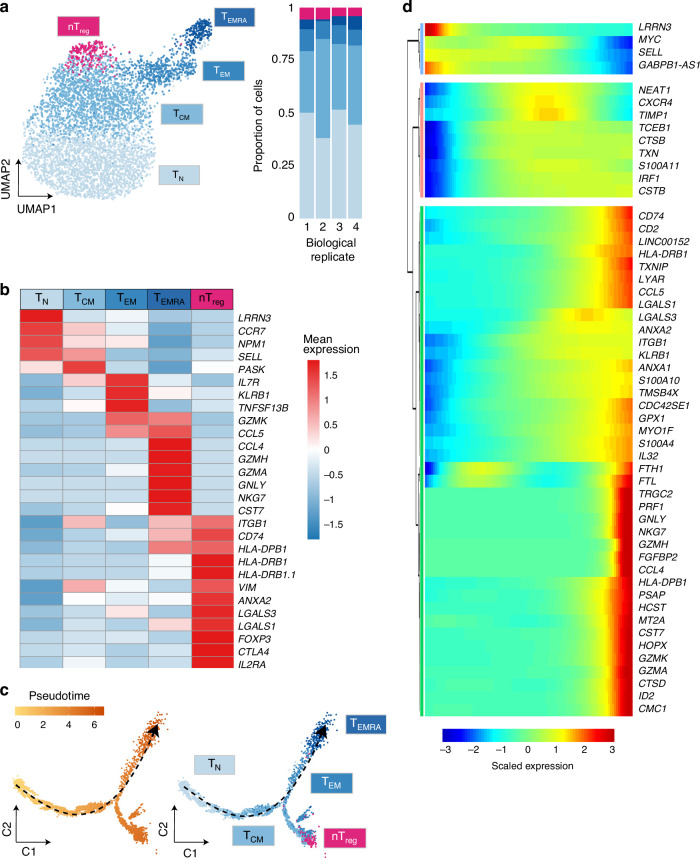
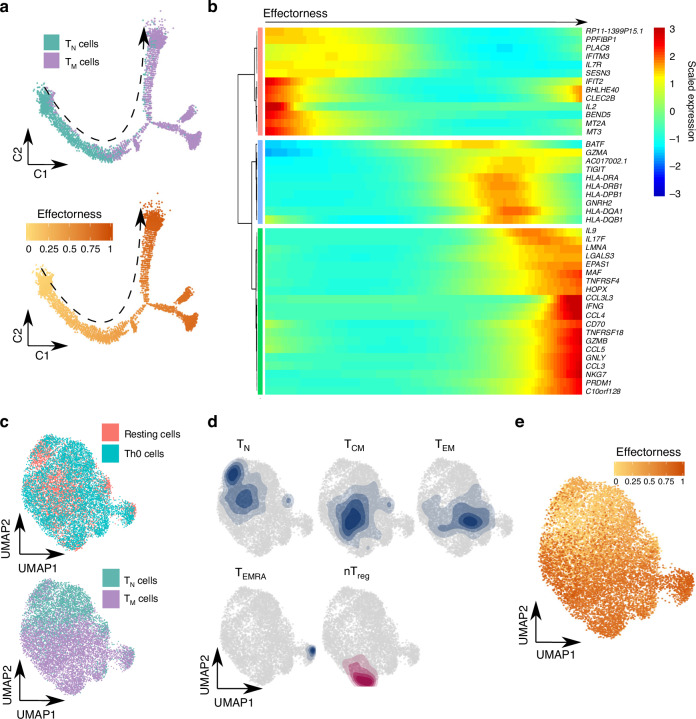
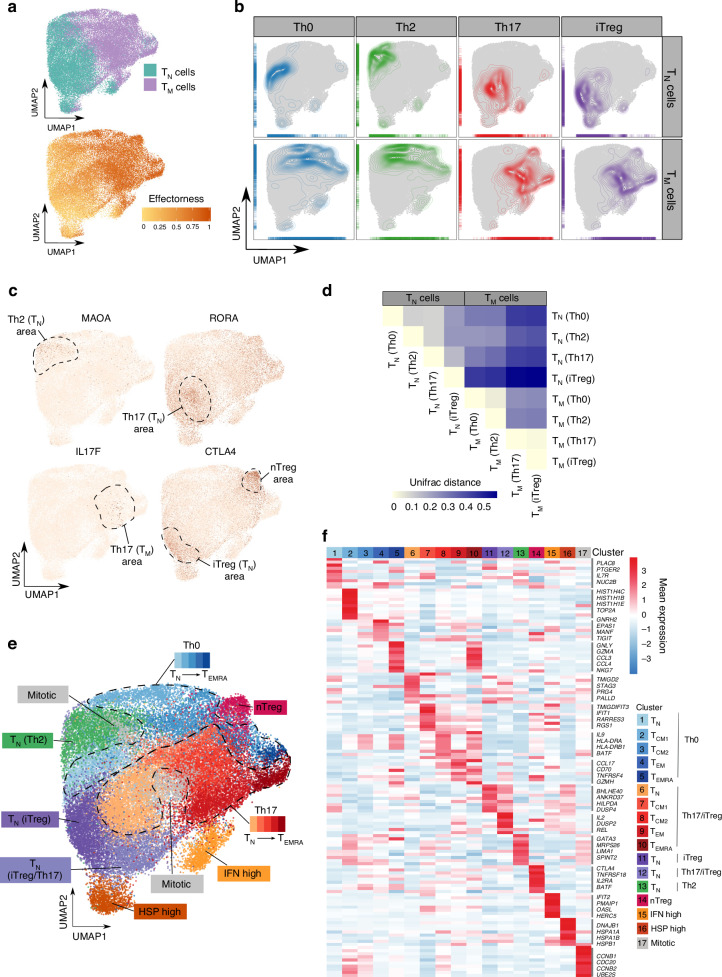
Naïve CD4 + T cells coordinate the immune response by acquiring an effector phenotype in response to cytokines. However, the cytokine responses in memory T cells remain largely understudied. Here we use quantitative proteomics, bulk RNA-seq, and single-cell RNA-seq of over 40,000 human naïve and memory CD4 + T cells to show that responses to cytokines differ substantially between these cell types. Memory T cells are unable to differentiate into the Th2 phenotype, and acquire a Th17-like phenotype in response to iTreg polarization. Single-cell analyses show that T cells constitute a transcriptional continuum that progresses from naïve to central and effector memory T cells, forming an effectorness gradient accompanied by an increase in the expression of chemokines and cytokines. Finally, we show that T cell activation and cytokine responses are influenced by the effectorness gradient. Our results illustrate the heterogeneity of T cell responses, furthering our understanding of inflammation.
Overview
The claims and statistics of this paper haven’t been checked yet.
Free: it reads the open-access text and checks the first 5 claims that cite a source we can check. Create a free account to check every claim.
Integrity signals
Registry
Cites
Statistics
Figures
Verification
Claims the paper makes
The claims and statistics of this paper haven’t been checked yet.
Free: it reads the open-access text and checks the first 5 claims that cite a source we can check. Create a free account to check every claim.
Claims other papers make about this one
Each is checked against this paper’s own text: does it say what the citing paper says it does?
The cited source says what the claim attributes to it.
In the citing paper
“Moreover, comparisons to matching proteomics data 13 revealed that pseudobulk methods also more accurately predicted changes in protein abundance (Supplementary Fig. 1e-f ).”
From Confronting false discoveries in single-cell differential expression (2021) · cites this paper as [13]
The cited source says what the claim attributes to it.
In the citing paper
“An extensive survey of the literature identified a total of eighteen ‘gold standard’ datasets that met these criteria (Fig. 1a ) 12 – 15 .”
From Confronting false discoveries in single-cell differential expression (2021) · cites this paper as [13]
The cited source says what the claim attributes to it.
In the citing paper
“An extensive survey of the literature identified a total of eighteen ‘gold standard’ datasets that met these criteria (Fig. 1a)12–15.”
From Confronting false discoveries in single-cell differential expression (2021) · cites this paper as [14]
Self-check
Percentages, sums and reported differences re-computed from the paper’s own numbers.
The self-check needs the paper’s full text.
Citations
Cites
Controlling the False Discovery Rate: A Practical and Powerful Approach to Multiple Testing
Benjamini, Y., & Hochberg, Y. (1995) · Journal of the Royal Statistical Society Series B: Statistical Methodology · doi:10.1111/j.2517-6161.1995.tb02031.x · Cited by 109,482 · cited 2×
“Multiple testing correction was performed using the Benjamini-Hochberg procedure 57 .”
Moderated estimation of fold change and dispersion for RNA-seq data with DESeq2
Love, M. I., Huber, W., & Anders, S. (2014) · Genome Biology · doi:10.1186/s13059-014-0550-8 · Cited by 95,106
STAR: ultrafast universal RNA-seq aligner
Dobin, A., Davis, C. A., Schlesinger, F., Drenkow, J., Zaleski, C., Jha, S., Batut, P., Chaisson, M., & Gingeras, T. R. (2013) · Bioinformatics · doi:10.1093/bioinformatics/bts635 · Cited by 51,709 · cited 2×
“Sequencing reads were aligned to the reference human genome using STAR 53 (v2.”
limma powers differential expression analyses for RNA-sequencing and microarray studies
Ritchie, M. E., Phipson, B., Wu, D., Hu, Y., Law, C. W., Shi, W., & Smyth, G. K. (2015) · Nucleic Acids Research · doi:10.1093/nar/gkv007 · Cited by 40,458
KEGG: Kyoto Encyclopedia of Genes and Genomes
Kanehisa, M. (2000) · Nucleic Acids Research · doi:10.1093/nar/28.1.27 · Cited by 37,077
KEGG: Kyoto Encyclopedia of Genes and Genomes
Ogata, H., Goto, S., Sato, K., Fujibuchi, W., Bono, H., & Kanehisa, M. (1999) · Nucleic Acids Research · doi:10.1093/nar/27.1.29 · Cited by 31,232
featureCounts: an efficient general purpose program for assigning sequence reads to genomic features
Liao, Y., Smyth, G. K., & Shi, W. (2014) · Bioinformatics · doi:10.1093/bioinformatics/btt656 · Cited by 27,219
Integrating single-cell transcriptomic data across different conditions, technologies, and species
Butler, A., Hoffman, P., Smibert, P., Papalexi, E., & Satija, R. (2018) · Nature Biotechnology · doi:10.1038/nbt.4096 · Cited by 13,174
UMAP: Uniform Manifold Approximation and Projection
McInnes, L., Healy, J., Saul, N., & Großberger, L. (2018) · Journal of Open Source Software · doi:10.21105/joss.00861 · Cited by 9,826
Analysis of protein-coding genetic variation in 60,706 humans
Exome Aggregation Consortium, Lek, M., Karczewski, K. J., Minikel, E. V., Samocha, K. E., Banks, E., Fennell, T., O’Donnell-Luria, A. H., Ware, J. S., Hill, A. J., et al. (2016) · Nature · doi:10.1038/nature19057 · Cited by 9,587
The Perseus computational platform for comprehensive analysis of (prote)omics data
Tyanova, S., Temu, T., Sinitcyn, P., Carlson, A., Hein, M. Y., Geiger, T., Mann, M., & Cox, J. (2016) · Nature Methods · doi:10.1038/nmeth.3901 · Cited by 8,803 · cited 1×
“Finally, pathway enrichment analysis was performed independently in the RNA and protein data using the Perseus software 58 (v1.”
UniFrac: a New Phylogenetic Method for Comparing Microbial Communities
Lozupone, C., & Knight, R. (2005) · Applied and Environmental Microbiology · doi:10.1128/aem.71.12.8228-8235.2005 · Cited by 8,227
Mosmann, T. R., Cherwinski, H., Bond, M. W., Giedlin, M. A., & Coffman, R. L. (1986) · The Journal of Immunology · doi:10.4049/jimmunol.136.7.2348 · Cited by 7,506 · cited 2×
“These secrete IFN-γ , IL-4, and IL-17, respectively 3 – 6 .”
UniProt: the Universal Protein knowledgebase
Apweiler, R. (2004) · Nucleic Acids Research · doi:10.1093/nar/gkh131 · Cited by 7,498
Massively parallel digital transcriptional profiling of single cells
Zheng, G. X. Y., Terry, J. M., Belgrader, P., Ryvkin, P., Bent, Z. W., Wilson, R., Ziraldo, S. B., Wheeler, T. D., McDermott, G. P., Zhu, J., et al. (2017) · Nature Communications · doi:10.1038/ncomms14049 · Cited by 7,353 · cited 3×
“Single-cell RNA-sequencing data were processed using the Cell Ranger Single-Cell Software Suite 33 (v2.”
InfluentialUMAP: Uniform Manifold Approximation and Projection for Dimension Reduction
McInnes, L., Healy, J., & Melville, J. (2018) · arXiv · doi:10.48550/arxiv.1802.03426 · Cited by 7,101 · cited 8×
“Namely, highly variable genes were estimated and used for dimensionality reduction, UMAP embedding and unsupervised ordering of cells in branched pseudotime trajectories.”
InfluentialTwo subsets of memory T lymphocytes with distinct homing potentials and effector functions
Sallusto, F., Lenig, D., Förster, R., Lipp, M., & Lanzavecchia, A. (1999) · Nature · doi:10.1038/44385 · Cited by 5,846 · cited 1×
“However, studying the effects of cytokines on memory T cells is challenging because memory cells comprise multiple subpopulations 26 – 28 .”
The Reactome pathway Knowledgebase
Fabregat, A., Sidiropoulos, K., Garapati, P., Gillespie, M., Hausmann, K., Haw, R., Jassal, B., Jupe, S., Korninger, F., McKay, S., et al. (2016) · Nucleic Acids Research · doi:10.1093/nar/gkv1351 · Cited by 5,605 · cited 1×
“This selection included all pathways with an absolute enrichment score higher than 0.7, an FDR 0.05 which were included in either Reactome, KEGG or CORUM 60 – 62 and were of relevance to CD4 + T cell biology.”
InfluentialReversed graph embedding resolves complex single-cell trajectories
Qiu, X., Mao, Q., Tang, Y., Wang, L., Chawla, R., Pliner, H. A., & Trapnell, C. (2017) · Nature Methods · doi:10.1038/nmeth.4402 · Cited by 5,070 · cited 1×
“To investigate the relationships between these states we applied pseudotime analysis 35 and observed that the cells formed a continuous progression starting in T N and gradually progressing towards T M (Fig.”
Harrington, L. E., Hatton, R. D., Mangan, P. R., Turner, H., Murphy, T. L., Murphy, K. M., & Weaver, C. T. (2005) · Nature Immunology · doi:10.1038/ni1254 · Cited by 4,742
Chen, W., Jin, W., Hardegen, N., Lei, K.-J., Li, L., Marinos, N., McGrady, G., & Wahl, S. M. (2003) · The Journal of Experimental Medicine · doi:10.1084/jem.20030152 · Cited by 4,699
UniProt: the universal protein knowledgebase
The UniProt Consortium (2017) · Nucleic Acids Research · doi:10.1093/nar/gkw1099 · Cited by 4,436
A distinct lineage of CD4 T cells regulates tissue inflammation by producing interleukin 17
Park, H., Li, Z., Yang, X. O., Chang, S. H., Nurieva, R., Wang, Y.-H., Wang, Y., Hood, L., Zhu, Z., Tian, Q., et al. (2005) · Nature Immunology · doi:10.1038/ni1261 · Cited by 4,265 · cited 3×
“These secrete IFN-γ , IL-4, and IL-17, respectively 3 – 6 .”
A Novel Transcription Factor, T-bet, Directs Th1 Lineage Commitment
Szabo, S. J., Kim, S. T., Costa, G. L., Zhang, X., Fathman, C. G., & Glimcher, L. H. (2000) · Cell · doi:10.1016/s0092-8674(00)80702-3 · Cited by 3,589
Differentiation of Effector CD4 T Cell Populations
Zhu, J., Yamane, H., & Paul, W. E. (2010) · Annual Review of Immunology · doi:10.1146/annurev-immunol-030409-101212 · Cited by 3,452 · cited 2×
“T helper cells in turn coordinate the downstream response of other immune cells (e.g. CD8 + T cells, macrophages and B cells) 7 .”
Central Memory and Effector Memory T Cell Subsets: Function, Generation, and Maintenance
Sallusto, F., Geginat, J., & Lanzavecchia, A. (2004) · Annual Review of Immunology · doi:10.1146/annurev.immunol.22.012703.104702 · Cited by 3,067 · cited 1×
“However, studying the effects of cytokines on memory T cells is challenging because memory cells comprise multiple subpopulations 26 – 28 .”
Zheng, W.-P., & Flavell, R. A. (1997) · Cell · doi:10.1016/s0092-8674(00)80240-8 · Cited by 2,384 · cited 1×
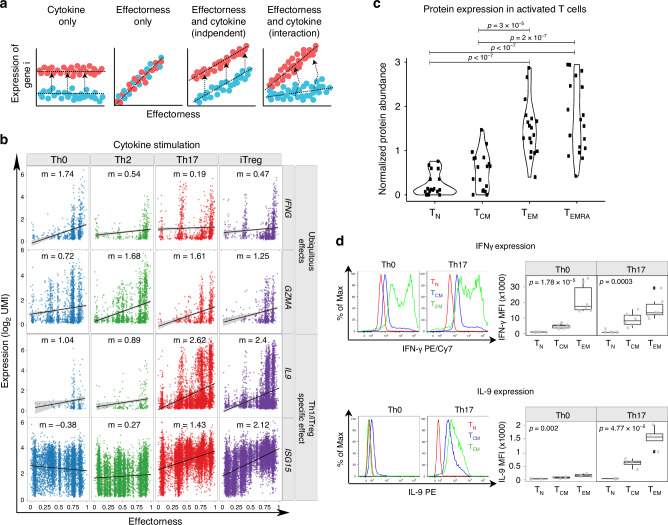
“Within the genes with interaction effects, 12 showed an effectorness dependency only in the presence of a given cytokine, while 179 showed effectorness dependency ubiquitously (across all cytokine conditions, Supplementary Data 8), with the strength of this effect regulated by cytokines.”
Cytokines and chemokines: At the crossroads of cell signalling and inflammatory disease
Turner, M. D., Nedjai, B., Hurst, T., & Pennington, D. J. (2014) · Biochimica et Biophysica Acta (BBA) - Molecular Cell Research · doi:10.1016/j.bbamcr.2014.05.014 · Cited by 2,162 · cited 1×
“These secrete IFN-γ , IL-4, and IL-17, respectively 3 – 6 .”
Interferon-inducible antiviral effectors
Sadler, A. J., & Williams, B. R. G. (2008) · Nature Reviews Immunology · doi:10.1038/nri2314 · Cited by 2,160 · cited 1×
“Both T N and T M upregulated genes involved in RNAse L induction ( OAS2 , OAS3 ) 42 , GTPase activity ( MX1 , MX2 ) 43 , as well as cell lysis ( GZMA , GZMB ) 32 .”
Ebers, G. C. (1998) · The Lancet · doi:10.1016/s0140-6736(98)03334-0 · Cited by 2,073
Paty, D. W., Li, D. K. B., the UBC MS/MRI Study Group, & the IFNB Multiple Sclerosis Study Group (1993) · Neurology · doi:10.1212/wnl.43.4.662 · Cited by 1,967
T Helper 17 Lineage Differentiation Is Programmed by Orphan Nuclear Receptors RORα and RORγ
Yang, X. O., Pappu, B. P., Nurieva, R., Akimzhanov, A., Kang, H. S., Chung, Y., Ma, L., Shah, B., Panopoulos, A. D., Schluns, K. S., et al. (2008) · Immunity · doi:10.1016/j.immuni.2007.11.016 · Cited by 1,605
Randall, R. E., & Goodbourn, S. (2008) · Journal of General Virology · doi:10.1099/vir.0.83391-0 · Cited by 1,571 · cited 2×
“The T N IFN-β signature contained known antiviral genes involved in RNAse L induction ( OAS2 , OAS3 ), GTPase activity ( MX1 , MX2 ) and cell lysis ( GZMA , GZMB ) 32 .”
Lineage tracking reveals dynamic relationships of T cells in colorectal cancer
Zhang, L., Yu, X., Zheng, L., Zhang, Y., Li, Y., Fang, Q., Gao, R., Kang, B., Zhang, Q., Huang, J. Y., et al. (2018) · Nature · doi:10.1038/s41586-018-0694-x · Cited by 1,505 · cited 3×
“We tested this using a public data set containing matched single-cell transcriptomes and paired TCR-sequences of CD4 + T cells from peripheral blood of colorectal cancer patients 36 (Methods).”
CORUM: the comprehensive resource of mammalian protein complexes—2009
Ruepp, A., Waegele, B., Lechner, M., Brauner, B., Dunger-Kaltenbach, I., Fobo, G., Frishman, G., Montrone, C., & Mewes, H.-W. (2010) · Nucleic Acids Research · doi:10.1093/nar/gkp914 · Cited by 1,310
zoo : S3 Infrastructure for Regular and Irregular Time Series
Zeileis, A., & Grothendieck, G. (2005) · Journal of Statistical Software · doi:10.18637/jss.v014.i06 · Cited by 1,243
Veldhoen, M., Uyttenhove, C., van Snick, J., Helmby, H., Westendorf, A., Buer, J., Martin, B., Wilhelm, C., & Stockinger, B. (2008) · Nature Immunology · doi:10.1038/ni.1659 · Cited by 1,213 · cited 2×
“T M are known to upregulate IL-9 in response to TGF-β 48 , a cytokine which reprograms Th2 cells to an IL-9 secreting phenotype 19 .”
Pathogenic conversion of Foxp3+ T cells into TH17 cells in autoimmune arthritis
Komatsu, N., Okamoto, K., Sawa, S., Nakashima, T., Oh-hora, M., Kodama, T., Tanaka, S., Bluestone, J. A., & Takayanagi, H. (2014) · Nature Medicine · doi:10.1038/nm.3432 · Cited by 1,153 · cited 2×
“Polarization to both of these cell states requires the presence of TGF-β and there is evidence of interconversion between them 20 .”
Fantini, M. C., Becker, C., Monteleone, G., Pallone, F., Galle, P. R., & Neurath, M. F. (2004) · The Journal of Immunology · doi:10.4049/jimmunol.172.9.5149 · Cited by 1,135
Identifying specificity groups in the T cell receptor repertoire
Glanville, J., Huang, H., Nau, A., Hatton, O., Wagar, L. E., Rubelt, F., Ji, X., Han, A., Krams, S. M., Pettus, C., et al. (2017) · Nature · doi:10.1038/nature22976 · Cited by 1,026
Skewed maturation of memory HIV-specific CD8 T lymphocytes
Champagne, P., Ogg, G. S., King, A. S., Knabenhans, C., Ellefsen, K., Nobile, M., Appay, V., Rizzardi, G. P., Fleury, S., Lipp, M., et al. (2001) · Nature · doi:10.1038/35065118 · Cited by 1,004 · cited 1×
“Moreover, previous studies suggest this process could be impaired in HIV 45,46 .”
Le Gros, G., Ben-Sasson, S. Z., Seder, R., Finkelman, F. D., & Paul, W. E. (1990) · The Journal of experimental medicine · doi:10.1084/jem.172.3.921 · Cited by 954
Massively parallel digital transcriptional profiling of single cellsPreprint
Zheng, G. X. Y., Terry, J. M., Belgrader, P., et al. (2016) · bioRxiv (Cold Spring Harbor Laboratory) · doi:10.1101/065912 · Cited by 897
HIV-specific CD8(+) T cells produce antiviral cytokines but are impaired in cytolytic function
Appay, V., Nixon, D. F., Donahoe, S. M., Gillespie, G. M. A., Dong, T., King, A., Ogg, G. S., Spiegel, H. M. L., Conlon, C., Spina, C. A., et al. (2000) · The Journal of Experimental Medicine · doi:10.1084/jem.192.1.63 · Cited by 871
Kowalczyk, M. S., Tirosh, I., Heckl, D., Rao, T. N., Dixit, A., Haas, B. J., Schneider, R. K., Wagers, A. J., Ebert, B. L., & Regev, A. (2015) · Genome Research · doi:10.1101/gr.192237.115 · Cited by 778 · cited 1×
“Next, a publicly available list of cell cycle genes 67 was used to perform cell cycle scoring and assign cells to their respective stage of the cell cycle.”
Cox, J., & Mann, M. (2012) · BMC Bioinformatics · doi:10.1186/1471-2105-13-s16-s12 · Cited by 626 · cited 1×
“6) and the 1D-annotation enrichment method 59 .”
Chromatin marks identify critical cell types for fine mapping complex trait variants
Trynka, G., Sandor, C., Han, B., Xu, H., Stranger, B. E., Liu, X. S., & Raychaudhuri, S. (2013) · Nature Genetics · doi:10.1038/ng.2504 · Cited by 580
Self-citationMenk, A. V., Scharping, N. E., Moreci, R. S., Zeng, X., Guy, C., Salvatore, S., Bae, H., Xie, J., Young, H. A., Wendell, S. G., et al. (2018) · Cell Reports · doi:10.1016/j.celrep.2018.01.040 · Cited by 484 · cited 1×
“1e), in line with previous observations that T cell activation induces proliferation and metabolic changes to support effector responses 31 .”
Foxp3 Exploits a Pre-Existent Enhancer Landscape for Regulatory T Cell Lineage Specification
Samstein, R. M., Arvey, A., Josefowicz, S. Z., Peng, X., Reynolds, A., Sandstrom, R., Neph, S., Sabo, P., Kim, J. M., Liao, W., et al. (2012) · Cell · doi:10.1016/j.cell.2012.06.053 · Cited by 472 · cited 1×
“These observations highlight the plasticity of CD4 + T cells and suggest that memory cells respond to cytokines.”
Th17 plasticity in human autoimmune arthritis is driven by the inflammatory environment
Nistala, K., Adams, S., Cambrook, H., Ursu, S., Olivito, B., de Jager, W., Evans, J. G., Cimaz, R., Bajaj-Elliott, M., & Wedderburn, L. R. (2010) · Proceedings of the National Academy of Sciences · doi:10.1073/pnas.1003852107 · Cited by 443 · cited 2×
“Recent studies have challenged this idea, showing that cytokines can reprogram previously polarized cells 2,18,19 .”
T cell fate and clonality inference from single-cell transcriptomes
(2016) · doi:10.1038/nmeth.3800 · Cited by 434 · cited 1×
“Finally, the amino acid sequence of the TCR β 1 CDR3 region of each cell 71 was retrieved from the study supplementary data.”
Social network architecture of human immune cells unveiled by quantitative proteomics
Rieckmann, J. C., Geiger, R., Hornburg, D., Wolf, T., Kveler, K., Jarrossay, D., Sallusto, F., Shen-Orr, S. S., Lanzavecchia, A., Mann, M., et al. (2017) · Nature Immunology · doi:10.1038/ni.3693 · Cited by 385 · cited 1×
“We then assessed their expression levels in a proteomics study which pro fi led resting and activated immune cell populations 40 .”
STATs Shape the Active Enhancer Landscape of T Cell Populations
Vahedi, G., Takahashi, H., Nakayamada, S., Sun, H.-W., Sartorelli, V., Kanno, Y., & O’Shea, J. J. (2012) · Cell · doi:10.1016/j.cell.2012.09.044 · Cited by 367
Saule, P., Trauet, J., Dutriez, V., Lekeux, V., Dessaint, J.-P., & Labalette, M. (2006) · Mechanisms of Ageing and Development · doi:10.1016/j.mad.2005.11.001 · Cited by 367
CORUM: the comprehensive resource of mammalian protein complexes
Ruepp, A., Brauner, B., Dunger-Kaltenbach, I., Frishman, G., Montrone, C., Stransky, M., Waegele, B., Schmidt, T., Doudieu, O. N., Stumpflen, V., et al. (2007) · Nucleic Acids Research · doi:10.1093/nar/gkm936 · Cited by 350
Vireo: Bayesian demultiplexing of pooled single-cell RNA-seq data without genotype reference
Huang, Y., McCarthy, D. J., & Stegle, O. (2019) · Genome Biology · doi:10.1186/s13059-019-1865-2 · Cited by 348
Kanhere, A., Hertweck, A., Bhatia, U., Gökmen, M. R., Perucha, E., Jackson, I., Lord, G. M., & Jenner, R. G. (2012) · Nature Communications · doi:10.1038/ncomms2260 · Cited by 345
Treatment of multiple sclerosis — success from bench to bedside
Tintore, M., Vidal-Jordana, A., & Sastre-Garriga, J. (2019) · Nature Reviews Neurology · doi:10.1038/s41582-018-0082-z · Cited by 343 · cited 1×
“Our results provide a new framework for studying naive and memory T cell activation.”
Heterogeneity of Human CD4 + T Cells Against Microbes
Sallusto, F. (2016) · Annual Review of Immunology · doi:10.1146/annurev-immunol-032414-112056 · Cited by 336
Overview of methodologies for T-cell receptor repertoire analysis
Rosati, E., Dowds, C. M., Liaskou, E., Henriksen, E. K. K., Karlsen, T. H., & Franke, A. (2017) · BMC Biotechnology · doi:10.1186/s12896-017-0379-9 · Cited by 322 · cited 1×
“…used to estimate three diversity metrics: (1) the fraction of unique clones (i.e. the number of unique TCR clonotypes divided by the total number of clonotypes), (2) the Shannon entropy 69 , and (3) the expansion index (de fi ned as 1 - Shannon entropy) 36 at different ranges of T cell effectorness.”
The Intestine Harbors Functionally Distinct Homeostatic Tissue-Resident and Inflammatory Th17 Cells
Omenetti, S., Bussi, C., Metidji, A., Iseppon, A., Lee, S., Tolaini, M., Li, Y., Kelly, G., Chakravarty, P., Shoaie, S., et al. (2019) · Immunity · doi:10.1016/j.immuni.2019.05.004 · Cited by 317 · cited 2×
“Furthermore, Th17 cells upregulate TBX21 and IFN-γ in response to Th1-polarizing cytokines 21 , and infection-induced Th17 cells can secrete Th1 cytokines 22 .”
Unique phenotypes and clonal expansions of human CD4 effector memory T cells re-expressing CD45RA
Tian, Y., Babor, M., Lane, J., Schulten, V., Patil, V. S., Seumois, G., Rosales, S. L., Fu, Z., Picarda, G., Burel, J., et al. (2017) · Nature Communications · doi:10.1038/s41467-017-01728-5 · Cited by 272 · cited 1×
“PRF1 , CCL4 , GZMA , GZMH ), consistent with previous observations 27 .”
Verhelst, J., Parthoens, E., Schepens, B., Fiers, W., & Saelens, X. (2012) · Journal of Virology · doi:10.1128/jvi.01682-12 · Cited by 242
A Roadmap for Human Liver Differentiation from Pluripotent Stem Cells
Ang, L. T., Tan, A. K. Y., Autio, M. I., Goh, S. H., Choo, S. H., Lee, K. L., Tan, J., Pan, B., Lee, J. J. H., Lum, J. J., et al. (2018) · Cell Reports · doi:10.1016/j.celrep.2018.01.087 · Cited by 239
Gutierrez-Arcelus, M., Teslovich, N., Mola, A. R., Polidoro, R. B., Nathan, A., Kim, H., Hannes, S., Slowikowski, K., Watts, G. F. M., Korsunsky, I., et al. (2019) · Nature Communications · doi:10.1038/s41467-019-08604-4 · Cited by 176 · cited 1×
“A similar gradient is present in innate T cells, as shown by a recent study where higher expression of cytokines, chemokines and granzymes negatively correlated with ribosome synthesis and proliferative capacity 44 .”
Memory CD4+ T cells are generated in the human fetal intestine
Li, N., van Unen, V., Abdelaal, T., Guo, N., Kasatskaya, S. A., Ladell, K., McLaren, J. E., Egorov, E. S., Izraelson, M., Chuva de Sousa Lopes, S. M., et al. (2019) · Nature Immunology · doi:10.1038/s41590-018-0294-9 · Cited by 168 · cited 1×
“A previous study described the generation of memory T cells in the fetal intestine, with an equivalent trajectory from T N to T M 47 , accompanied by downregulation of CCR7 and upregulation of cytokines like IL32 .”
Hu, X., Kim, H., Stahl, E., Plenge, R., Daly, M., & Raychaudhuri, S. (2011) · The American Journal of Human Genetics · doi:10.1016/j.ajhg.2011.09.002 · Cited by 162 · cited 2×
“Furthermore, genetic studies have implicated memory T cells in many complex immune diseases 23 – 25 , making it crucial to understand their response to cytokines.”
Lin, C.-C., & Edelson, B. T. (2017) · The Journal of Immunology · doi:10.4049/jimmunol.1700263 · Cited by 157
Chromatin activity at GWAS loci identifies T cell states driving complex immune diseases
Soskic, B., Cano-Gamez, K., Smyth, D. J., Rowan, W. C., Nakic, N., Esparza-Gordillo, J., Bossini-Castillo, L., Tough, D. F., Larminie, C. G. C., Bronson, P. G., et al. (2019) · Nature Genetics · doi:10.1038/s41588-019-0493-9 · Cited by 130 · cited 1×
“Furthermore, genetic studies have implicated memory T cells in many complex immune diseases 23 – 25 , making it crucial to understand their response to cytokines.”
Self-citationLow-strength T-cell activation promotes Th17 responses
Purvis, H. A., Stoop, J. N., Mann, J., Woods, S., Kozijn, A. E., Hambleton, S., Robinson, J. H., Isaacs, J. D., Anderson, A. E., & Hilkens, C. M. U. (2010) · Blood · doi:10.1182/blood-2010-03-272153 · Cited by 126
Cohen, C. J., Crome, S. Q., MacDonald, K. G., Dai, E. L., Mager, D. L., & Levings, M. K. (2011) · The Journal of Immunology · doi:10.4049/jimmunol.1101058 · Cited by 112 · cited 1×
“Furthermore, Th17 cells upregulate TBX21 and IFN-γ in response to Th1-polarizing cytokines 21 , and infection-induced Th17 cells can secrete Th1 cytokines 22 .”
Trzupek, D., Dunstan, M., Cutler, A. J., Lee, M., Godfrey, L., Jarvis, L., Rainbow, D. B., Aschenbrenner, D., Jones, J. L., Uhlig, H. H., et al. (2020) · Genome Medicine · doi:10.1186/s13073-020-00756-z · Cited by 105
Jamshidian, A., Shaygannejad, V., Pourazar, A., Zarkesh‐Esfahani, S. H., & Gharagozloo, M. (2013) · Journal of Neuroimmunology · doi:10.1016/j.jneuroim.2013.06.007 · Cited by 103 · cited 1×
“Understanding this will be key in the development of drug targets for autoimmune disease, as Th17-cytokines are known to promote in fl ammation in multiple sclerosis 49 – 51 .”
Dubey, D., Kieseier, B. C., Hartung, H. P., Hemmer, B., Warnke, C., Menge, T., Miller-Little, W. A., & Stüve, O. (2015) · Expert Review of Neurotherapeutics · doi:10.1586/14737175.2015.1025755 · Cited by 95 · cited 1×
“Our results provide a new framework for studying naive and memory T cell activation.”
OX40 Costimulatory Signals Potentiate the Memory Commitment of Effector CD8+ T Cells
Mousavi, S. F., Soroosh, P., Takahashi, T., Yoshikai, Y., Shen, H., Lefrançois, L., Borst, J. G., Sugamura, K., & Ishii, N. (2008) · The Journal of Immunology · doi:10.4049/jimmunol.181.9.5990 · Cited by 88 · cited 1×
“These included TNFRSF4 (encoding for OX40), which is known to be critical in the maintenance of memory T cell responses 39 , as well as effector molecules such as granulysin ( GNLY ), GMZA , CCL3 and IFNG (Fig.”
Ullah, U., Andrabi, S. B. A., Tripathi, S. K., Dirasantha, O., Kanduri, K., Rautio, S., Groß, C. C., Lehtimäki, S., Bala, K., Tuomisto, J. E. E., et al. (2018) · Cell Reports · doi:10.1016/j.celrep.2018.01.070 · Cited by 77
Human CD4+ Memory T Cells Can Become CD4+IL-9+ T Cells
Putheti, P., Awasthi, A., Popoola, J., Gao, W., & Strom, T. B. (2010) · PLoS ONE · doi:10.1371/journal.pone.0008706 · Cited by 67 · cited 5×
“T M are known to upregulate IL-9 in response to TGF-β 48 , a cytokine which reprograms Th2 cells to an IL-9 secreting phenotype 19 .”
InfluentialQuantitative assessment of cell population diversity in single-cell landscapes
Liu, Q., Herring, C. A., Sheng, Q., Ping, J., Simmons, A. J., Chen, B., Banerjee, A., Li, W., Gu, G., Coffey, R. J., et al. (2018) · PLOS Biology · doi:10.1371/journal.pbio.2006687 · Cited by 38 · cited 1×
“9.6) 68 was used as it was speci fi cally adapted to deal with scRNA-seq data.”
InfluentialÄijö, T., Edelman, S., Lönnberg, T., Larjo, A., Kallionpää, H., Tuomela, S., Engström, E., Lahesmaa, R., & Lähdesmäki, H. J. (2012) · BMC Genomics · doi:10.1186/1471-2164-13-572 · Cited by 38 · cited 6×
“6b and Supplementary Data 8).”
InfluentialIncreased IL-17A but decreased IL-27 serum levels in patients with multiple sclerosis.
Babaloo, Z., Yeganeh, R. K., Farhoodi, M., Baradaran, B., Bonyadi, M., & Leili, A. M. (2013) · Iranian journal of immunology · doi:10.22034/iji.2013.16804 · Cited by 37
Ebers, G. C. (1998) · Cited by 33
Gros, G. S. L., Ben-Sasson, S. Z., Seder, R. A., Finkelman, F. D., & Paul, W. E. (2008) · PubMed · Cited by 16
McCarthy, D. J., Rostom, R., Huang, Y., Kunz, D. J., Danecek, P., Bonder, M. J., Hagai, T., HipSci Consortium, Wang, W., Gaffney, D. J., et al. (2018) · bioRxiv (Cold Spring Harbor Laboratory) · doi:10.1101/413047 · Cited by 13
Prevalence of trachoma in a single community, 1975–2007
Taylor, H. R., English, D. R., Field, B. A., Spicer, P. E., & Graham, D. M. (2011) · Clinical and Experimental Ophthalmology · doi:10.1111/j.1442-9071.2011.02672.x · Cited by 12
Chromatin activity at GWAS loci identifies T cell states driving complex immune diseasesPreprint
Soskic, B., Cano-Gamez, E., Smyth, D. J., et al. (2019) · bioRxiv (Cold Spring Harbor Laboratory) · doi:10.1101/566810 · Cited by 11
Self-citationTang, S., Hemberg, M., Cansızoğlu, A. E., Belin, S., Kosik, K. S., Kreiman, G., Steen, H., & Steen, J. A. J. (2016) · Nucleic Acids Research · doi:10.1093/nar/gkw157 · Cited by 8 · cited 1×
“Next, the f-divergence cut-off index (fCI) method 63 was used to identify genes (RNA-protein pairs) with signi fi cant evidence of differential expression given their RNA counts and protein abundances.”
Vireo: Bayesian demultiplexing of pooled single-cell RNA-seq data without genotype referencePreprint
Huang, Y., McCarthy, D. J., & Stegle, O. (2019) · bioRxiv (Cold Spring Harbor Laboratory) · doi:10.1101/598748 · Cited by 6
Quantitative assessment of cell population diversity in single-cell landscapesPreprint
Liu, Q., Herring, C. A., Sheng, Q., et al. (2018) · bioRxiv (Cold Spring Harbor Laboratory) · doi:10.1101/333393 · Cited by 6
(2006) · Medical Entomology and Zoology
Cited by
Confronting false discoveries in single-cell differential expression
Squair, J. W., Gautier, M., Kathe, C., Anderson, M. A., James, N. D., Hutson, T. H., Hudelle, R., Qaiser, T., Matson, K. J. E., Barraud, Q., et al. (2021) · doi:10.1101/2021.03.12.435024 · Cited by 1,086
Bifidobacteria-mediated immune system imprinting early in life
Henrick, B. M., Rodriguez, L., Lakshmikanth, T., Pou, C., Henckel, E., Arzoomand, A., Olin, A., Wang, J., Mikes, J., Tan, Z., et al. (2021) · Cell · doi:10.1016/j.cell.2021.05.030 · Cited by 800
Single-cell eQTL mapping identifies cell type–specific genetic control of autoimmune disease
Yazar, S., Alquicira-Hernandez, J., Wing, K., Senabouth, A., Gordon, M. G., Andersen, S., Lu, Q., Rowson, A., Taylor, T. R. P., Clarke, L., et al. (2022) · Science · doi:10.1126/science.abf3041 · Cited by 682
The immunology of multiple sclerosis
Attfield, K. E., Jensen, L. T., Kaufmann, M., Friese, M. A., & Fugger, L. (2022) · Nature Reviews Immunology · doi:10.1038/s41577-022-00718-z · Cited by 380
Zhang, M. J., Hou, K., Dey, K. K., Sakaue, S., Jagadeesh, K. A., Weinand, K., Taychameekiatchai, A., Rao, P., Pisco, A. O., Zou, J., et al. (2022) · Nature Genetics · doi:10.1038/s41588-022-01167-z · Cited by 302
Metadata
- Authors
- Cano-Gamez, K., Soskic, B., Roumeliotis, T. I., So, E., Smyth, D. J., Baldrighi, M., Willé, D., Nakic, N., Esparza-Gordillo, J., Larminie, C. G. C., Bronson, P. G., Tough, D. F., Rowan, W. C., Choudhary, J. S., & Trynka, G.
- Affiliations
- Wellcome Sanger Institute (GB)
- Institute of Cancer Research (GB)
- GlaxoSmithKline Research & Development Limited (United Kingdom) (GB)
- Biogen (United States) (US)
- GlaxoSmithKline (United Kingdom) (GB)
- Corresponding author
- Soskic, Blagoje
- Trynka, Gosia
- ORCID
- Venue
- Nature Communications
- Published
- 2020-04-14
- Volume
- 11
- Issue
- 1
- Pages
- 1801-1801
- ISSN
- 2041-1723 (ISSN-L)
- PMC
- PMC7156481
- OpenAlex
- W3015671642
- Cited by
- 274
- References
- 88
- Citations by year
- 2026: 15 · 2025: 46 · 2024: 73 · 2023: 47 · 2022: 49 · 2021: 28 · 2020: 16
- FWCI
- 13.03
- Type
- journal article
- Language
- en
- Open access
- gold
- doi.org
- Licence
- cc-by
- creativecommons.org/licenses/by/4.0 (tdm)
- creativecommons.org/licenses/by/4.0 (vor)
- Locations
- Nature Communications (publishedVersion, cc-by)
- bioRxiv (Cold Spring Harbor Laboratory) (acceptedVersion, cc-by)
- PubMed Central (publishedVersion, cc-by)
- PubMed (publishedVersion)
- RePEc: Research Papers in Economics (submittedVersion)
- DOAJ (DOAJ: Directory of Open Access Journals) (submittedVersion, cc-by-sa)
- Funders
- Wellcome Trust (WT206194)
- Topics
- Life Sciences › Immunology and Microbiology › Immunology › T-cell and B-cell Immunology
- Life Sciences › Immunology and Microbiology › Immunology › Psoriasis: Treatment and Pathogenesis
- Life Sciences › Biochemistry, Genetics and Molecular Biology › Molecular Biology › Single-cell and spatial transcriptomics
- Keywords
- CD4+ T cells, memory T cells, naive T cells, cytokine response, Th17 polarization, Th2 differentiation, central memory T cells, effector memory T cells, transcriptional heterogeneity, chemokine expression, T cell activation, inflammation
- MeSH terms
- Gene Expression Regulation, Humans, Lymphocyte Activation, Male, Middle Aged, Receptors, Antigen, T-Cell, CD4-Positive T-Lymphocytes, Cytokines, Cell Polarity, CD28 Antigens, Proteome, Principal Component Analysis, Single-Cell Analysis, Transcriptome
About these checks
Registry, retraction, Cites and statistics results are computed, not judged, with one exception: a printed reference that no index lists is read once by a model before it counts as a citation error. Claims are extracted by a model and kept only when their quote appears verbatim in the text; each cited source is then checked, with a model’s help, for whether it says what the claim relies on. Those verdicts can be wrong — read the claim’s quote and the cited source before relying on one.
Statistics and arithmetic are recomputed, not judged.
Confidence bands are shown only for fields calibrated on our annotated test set. None is calibrated yet, so no band is shown.
What counts as a claim ›How we measure confidence ›How we check this ›
Are you an author, or do you see a problem with this page? Request a review
Data sources
Bibliographic data: Semantic Scholar, OpenAlex, Crossref.
Contains information from the Semantic Scholar Academic Graph Datasets, made available under the ODC Attribution License (ODC-BY 1.0).
Semantic Scholar’s data is described in: Kinney, R., et al. (2023). The Semantic Scholar Open Data Platform. arXiv:2301.10140.
