

Large language models encode clinical knowledge
Open accessThe DOI matches its Crossref record; 115 of the 116 references it cites were found in a registry or an index.
Abstract
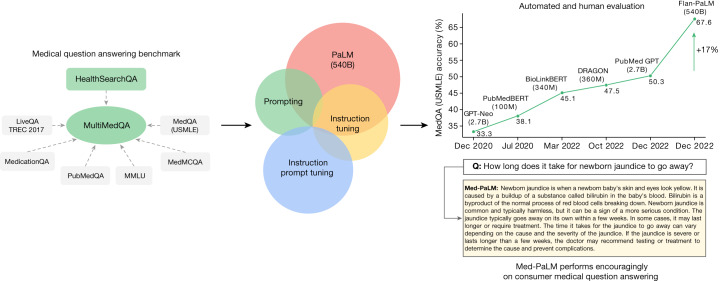
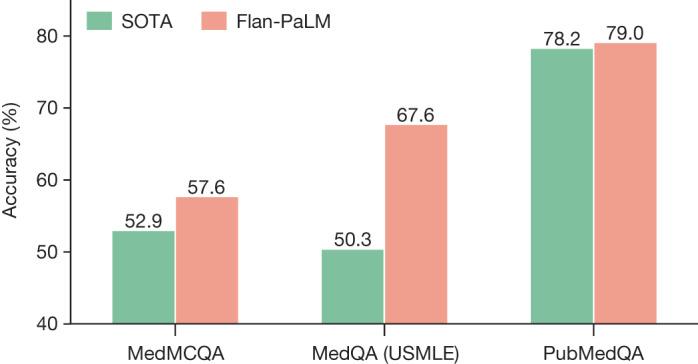
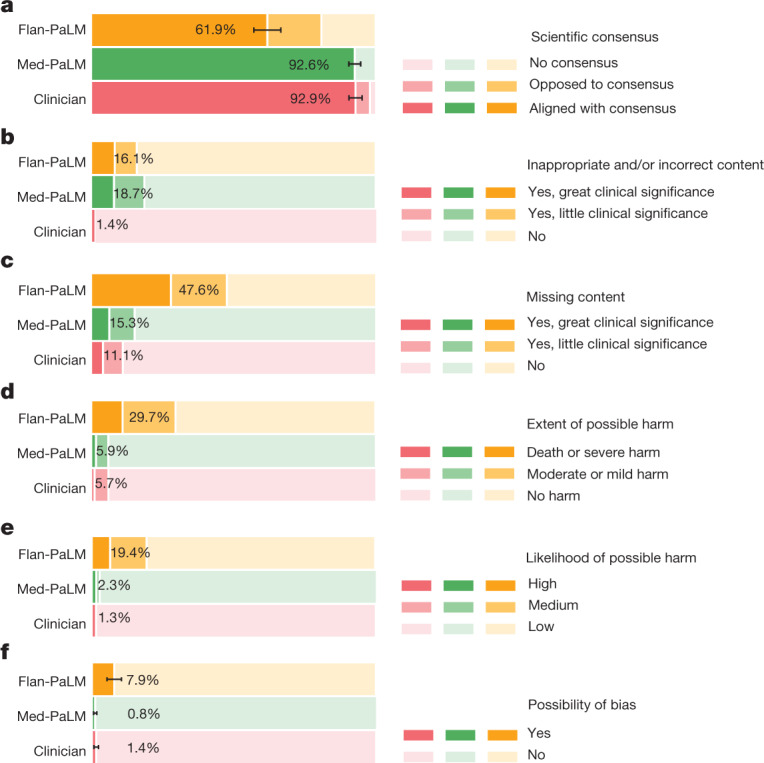
Large language models (LLMs) have demonstrated impressive capabilities, but the bar for clinical applications is high. Attempts to assess the clinical knowledge of models typically rely on automated evaluations based on limited benchmarks. Here, to address these limitations, we present MultiMedQA, a benchmark combining six existing medical question answering datasets spanning professional medicine, research and consumer queries and a new dataset of medical questions searched online, HealthSearchQA. We propose a human evaluation framework for model answers along multiple axes including factuality, comprehension, reasoning, possible harm and bias. In addition, we evaluate Pathways Language Model 1 (PaLM, a 540-billion parameter LLM) and its instruction-tuned variant, Flan-PaLM 2 on MultiMedQA. Using a combination of prompting strategies, Flan-PaLM achieves state-of-the-art accuracy on every MultiMedQA multiple-choice dataset (MedQA 3 , MedMCQA 4 , PubMedQA 5 and Measuring Massive Multitask Language Understanding (MMLU) clinical topics 6 ), including 67.6% accuracy on MedQA (US Medical Licensing Exam-style questions), surpassing the prior state of the art by more than 17%. However, human evaluation reveals key gaps. To resolve this, we introduce instruction prompt tuning, a parameter-efficient approach for aligning LLMs to new domains using a few exemplars. The resulting model, Med-PaLM, performs encouragingly, but remains inferior to clinicians. We show that comprehension, knowledge recall and reasoning improve with model scale and instruction prompt tuning, suggesting the potential utility of LLMs in medicine. Our human evaluations reveal limitations of today’s models, reinforcing the importance of both evaluation frameworks and method development in creating safe, helpful LLMs for clinical applications.
Overview
The claims and statistics of this paper haven’t been checked yet.
Free: it reads the open-access text and checks the first 5 claims that cite a source we can check. Create a free account to check every claim.
Integrity signals
Registry
Cites
Statistics
Figures
Verification
Claims the paper makes
The claims and statistics of this paper haven’t been checked yet.
Free: it reads the open-access text and checks the first 5 claims that cite a source we can check. Create a free account to check every claim.
Claims other papers make about this one
Each is checked against this paper’s own text: does it say what the citing paper says it does?
The cited source doesn’t support the claim as written.
In the citing paper
“Notably, in healthcare, medical NLP benchmarks like MedQA7, PubMedQA8 and the Massive Multitask Language Understanding (MMLU) serve as the de-facto reporting standard for state-of-the-art medical LLMs9–11 with claims of ‘superhuman’ performance in patient-facing tasks12.”
From Medical large language models are vulnerable to data-poisoning attacks (2025) · cites this paper as [9]
Checked by a reasoning model — may be wrong.
Experimental — accuracy not yet measuredThe cited source doesn’t support the claim as written.
In the citing paper
“Med-PaLM achieved a passing score of 67.6% on USMLE-style MedQA questions”
From Trustworthy Medical Question Answering: An Evaluation-Centric Survey (2025) · cites this paper as Singhal et al., 2023
Checked by a reasoning model — may be wrong.
Experimental — accuracy not yet measuredThe source backs part of the claim, not all of it — or backs it for a different population, condition or comparison.
In the citing paper
“Previous work has demonstrated potential across clinical NLP tasks22,23, adapting to the medical domain by training a new model24,25, fine-tuning an existing model26,27 or supplying task-specific examples in the model prompt27,28.”
From Adapted large language models can outperform medical experts in clinical text summarization (2024) · cites this paper as [24]
Experimental — accuracy not yet measuredThe source backs part of the claim, not all of it — or backs it for a different population, condition or comparison.
In the citing paper
“For example, Google’s Med-PaLM 2 demonstrated proficiency in medical question answering, achieving performance comparable to clinical experts on medical licensing examinations and performing better than generalist physicians in real-world medical questions.70”
From A foundational architecture for AI agents in healthcare (2025) · cites this paper as [70]
Experimental — accuracy not yet measuredThe source backs part of the claim, not all of it — or backs it for a different population, condition or comparison.
In the citing paper
“Large language models (LLMs) and multimodal foundation models now exhibit enhanced reasoning capabilities, natural language understanding, and the ability to interact with external tools such as calculators, databases, and application programming interfaces.”
From Medical AI Agents for Clinical Decision Support: Viewpoint Using the Planning, Action, Reflection, and Memory (PARM) Analytical Lens (2026) · cites this paper as [8]
Experimental — accuracy not yet measured
40 more claims about this paper
Create a free account to see every claim other papers make about this one.
Self-check
Percentages, sums and reported differences re-computed from the paper’s own numbers.
The self-check needs the paper’s full text.
Citations
Cites
Vaswani, A., Shazeer, N., Parmar, N., Uszkoreit, J., Jones, L., Gomez, A. N., Kaiser, L., & Polosukhin, I. (2017) · arXiv · doi:10.48550/arxiv.1706.03762 · Cited by 120,404 · cited 1×
“They owe their success to scaling up the training of transformer-based models [84].”
BackgroundExploring the Limits of Transfer Learning with a Unified Text-to-Text Transformer
Raffel, C., Shazeer, N., Roberts, A., Lee, K., Narang, S., Matena, M., Zhou, Y., Li, W., & Liu, P. J. (2019) · arXiv · doi:10.48550/arxiv.1910.10683 · Cited by 31,859 · cited 1×
“Large language models (LLMs) Over the past few years, LLMs have shown impressive performance on natural language processing (NLP) tasks [12, 14, 15, 30, 69, 70, 73, 89, 91, 99].”
BackgroundLanguage Models are Few-Shot Learners
Brown, T. B., Mann, B., Ryder, N., Subbiah, M., Kaplan, J., Dhariwal, P., Neelakantan, A., Shyam, P., Sastry, G., Askell, A., et al. (2020) · arXiv · doi:10.48550/arxiv.2005.14165 · Cited by 23,372
BLEU: a method for automatic evaluation of machine translation
Papineni, K., Roukos, S., Ward, T., & Zhu, W.-J. (2001) · Proceedings of the 40th Annual Meeting on Association for Computational Linguistics - ACL '02 · doi:10.3115/1073083.1073135 · Cited by 21,344
Decoupled Weight Decay Regularization
Loshchilov, I., & Hutter, F. (2017) · arXiv · doi:10.48550/arxiv.1711.05101 · Cited by 12,522
Scaling Laws for Neural Language Models
Kaplan, J., McCandlish, S., Henighan, T., Brown, T. B., Chess, B., Child, R., Gray, S., Radford, A., Wu, J., & Amodei, D. (2020) · arXiv · doi:10.48550/arxiv.2001.08361 · Cited by 9,550 · cited 1×
“It has been shown that model performance and data-efficiency scales with model size and dataset size [37].”
BioBERT: a pre-trained biomedical language representation model for biomedical text mining
Lee, J., Yoon, W., Kim, S., Kim, D., Kim, S., So, C. H., & Kang, J. (2020) · Bioinformatics · doi:10.1093/bioinformatics/btz682 · Cited by 7,218
Boateng, G. O., Neilands, T. B., Frongillo, E. A., Melgar-Quiñonez, H. R., & Young, S. L. (2018) · Frontiers in Public Health · doi:10.3389/fpubh.2018.00149 · Cited by 5,925
Chain-Of-Thought Prompting Elicits Reasoning in Large Language Models
Wei, J., Wang, X., Schuurmans, D., Bosma, M., Ichter, B., Xia, F., Chi, E., Le, Q. V., & Zhou, D. (2022) · Advances in Neural Information Processing Systems 35 · doi:10.52202/068431-1800 · Cited by 4,505
Self-citationLiu, P., Yuan, W., Fu, J., Jiang, Z., Hayashi, H., & Neubig, G. (2023) · ACM Computing Surveys · doi:10.1145/3560815 · Cited by 4,361
Research works printed but not linked: 2
- Abacha, A. B. et al. in Studies in Health Technology and Informatics (eds Ohno-Machado, L. & Séroussi, B.) 25–29 (IOS Press, 2019).
- Matheny, M., Israni, S. T., Ahmed, M. & Whicher, D. eds. Artificial Intelligence in Health Care: The Hope, the Hype, the Promise, the Peril (National Academy of Medicine, 2022). 39146448
Cited by
Items 901–1,000 of 1,129
Improving Patient Pre-screening for Clinical Trials: Assisting Physicians with Large Language ModelsPreprint
den Hamer, D. M., Schoor, P., Polak, T. B., & Kapitan, D. (2023) · arXiv (Cornell University) · doi:10.48550/arxiv.2304.07396 · Cited by 36
Promise and Perils of Large Language Models for Cancer Survivorship and Supportive Care
Bitterman, D. S., Downing, A., Maués, J., & Lustberg, M. B. (2024) · Journal of Clinical Oncology · doi:10.1200/jco.23.02439 · Cited by 31
Toward Clinical-Grade Evaluation of Large Language Models
Moreno, A. C., & Bitterman, D. S. (2024) · International Journal of Radiation Oncology*Biology*Physics · doi:10.1016/j.ijrobp.2023.11.012 · Cited by 28
HealthBench: Evaluating Large Language Models Towards Improved Human Health
Arora, R. K., Wei, J., Hicks, R. S., Bowman, P., Quiñonero-Candela, J., Tsimpourlas, F., Sharman, M., Shah, M., Vallone, A., Beutel, A., et al. (2025) · arXiv · doi:10.48550/arxiv.2505.08775 · Cited by 654
“More recent works have evaluated short, closed-form model responses (Kanjee et al., 2023; McDuff et al., 2025) and longer, open-ended model responses (Singhal et al., 2023; Fleming et al., 2024; Singhal et al., 2025; Tu et al., 2025).”
InfluentialSelf-citationMashatian, S., Armstrong, D. G., Ritter, A., Robbins, J., Aziz, S., Alenabi, I., Huo, M., Anand, T., & Tavakolian, K. (2025) · Journal of Diabetes Science and Technology · doi:10.1177/19322968241253568 · Cited by 28
Assessing Racial and Ethnic Bias in Text Generation for Healthcare-Related Tasks by ChatGPT 1
Hanna, J. J., Wakene, A. D., Lehmann, C. U., & Medford, R. J. (2023) · doi:10.1101/2023.08.28.23294730 · Cited by 28
Lin, W.-C., Chen, A., Song, X. B., Weiskopf, N. G., Chiang, M. F., & Hribar, M. R. (2023) · Journal of the American Medical Informatics Association · doi:10.1093/jamia/ocad213 · Cited by 32
Al-hammuri, K., Gebali, F., & Kanan, A. (2024) · AI · doi:10.3390/ai5030055 · Cited by 38
“Med-PaLM [39], introduced by Google and trained on high-quality medical data, meets the expert level for answering medical questions.”
BackgroundFoundation models for bioinformatics
Chen, Z., Wei, L., & Gao, G. (2024) · Quant. Biol. · doi:10.1002/qub2.69 · Cited by 71
“In particular, it has been well demonstrated that biomedical ‐ tailored LLMs trained over medical literature are able to better understand and answer domain ‐ specific questions [24–26].”
Pompili, D., Richa, Y., Collins, P., Richards, H. L., & Hennessey, D. B. (2024) · World Journal of Urology · doi:10.1007/s00345-024-05146-3 · Cited by 28
Guo, T., Bardhan, I. R., Ding, Y., & Zhang, S. (2024) · Information Systems Research · doi:10.1287/isre.2023.0029 · Cited by 33
Large language models for diabetes training: a prospective study
Li, H., Jiang, Z., Guan, Z., Bao, Y., Liu, Y., Hu, T., Li, J., Liu, R., Wu, L., Cheng, D., et al. (2025) · Science Bulletin · doi:10.1016/j.scib.2025.01.034 · Cited by 35
Self-citationGu, Z., Jia, W., Piccardi, M., & Yu, P. (2025) · Artificial Intelligence in Medicine · doi:10.1016/j.artmed.2025.103078 · Cited by 32
Stroke Diagnosis and Prediction Tool Using ChatGLM: Development and Validation Study
Song, X., Wang, J., He, F., Yin, W. H., Ma, W., & Wu, J. (2025) · Journal of Medical Internet Research · doi:10.2196/67010 · Cited by 33
“For example, the Med-PaLM model illustrates the capabilities of LLMs in enhancing medical decision-making, achieving performance levels comparable to those required for US medical licensing examinations [16].”
DALL-M: Context-aware clinical data augmentation with large language models
Hsieh, C., Moreira, C., Nobre, I. B., Sousa, S. C., Ouyang, C., Brereton, M. F., Jorge, J. A., & Nascimento, J. C. (2025) · Computers in Biology and Medicine · doi:10.1016/j.compbiomed.2025.110022 · Cited by 34
Guellec, B. L., Bruge, C., Chalhoub, N., Chaton, V., Sousa, E. D., Gaillandre, Y., Hanafi, R., Masy, M., Vannod‐Michel, Q., Hamroun, A., et al. (2025) · Diagnostic and Interventional Imaging · doi:10.1016/j.diii.2025.04.006 · Cited by 31
Engineering artificial intelligence: framework, challenges, and future direction
Lee, J., Su, H., Ji, D.-Y., & Minami, T. (2025) · Machine Learning Engineering · doi:10.1088/3049-4761/adce0d · Cited by 30
“…engineering fields, such as manufacturing [17, 51], predictive maintenance [12, 56], energy [68, 19], transportation [62, 70], healthcare [72, 53], design [64, 71], computer vision (CV) [13, 26], natural language processing (NLP) [43, 29], construction [66, 6], robotics and automation [49,…”
Multimodal integration strategies for clinical application in oncology
Zhang, B., Wan, Z., Luo, Y., Zhao, X., Samayoa, J. A., Zhao, W., & Wu, S. (2025) · Frontiers in Pharmacology · doi:10.3389/fphar.2025.1609079 · Cited by 36
Xu, B., Wu, G., Li, Z., Xu, G., Zeng, H., Tong, R., & Ng, H. Y. (2025) · npj Clean Water · doi:10.1038/s41545-025-00509-8 · Cited by 37
“For instance, when querying the “ effect of extended sludge retention time (SRT) on enhanced biological phosphorus removal (EBPR) systems, ” GPT-4 failed to address the potential competitive advantage of glycogen-accumulating organisms (GAOs) over polyphosphate-accumulating organisms (PAOs).”
Applications of ChatGPT and Large Language Models in Medicine and Health Care: Benefits and Pitfalls
Borkowski, A., Jakey, C. E., Mastorides, S., Kraus, A. L., Vidyarthi, G., Viswanadhan, N., & Lezama, J. L. (2023) · Federal Practitioner · doi:10.12788/fp.0386 · Cited by 32
Benchmarking the symptom-checking capabilities of ChatGPT for a broad range of diseases
Chen, A., Chen, D. O., & Tian, L. (2024) · Journal of the American Medical Informatics Association · doi:10.1093/jamia/ocad245 · Cited by 26
Large Language Models Improve Alzheimer's Disease Diagnosis Using Multi-Modality Data
Feng, Y., Xu, X., Zhuang, Y., & Zhang, M. (2023) · IEEE International Conference on Medical Artificial Intelligence (MedAI) · doi:10.1109/medai59581.2023.00016 · Cited by 44
“ChatGPT has successfully passed part of the US medical licensing exams [17], showcasing its potential to augment medical professionals in delivering care.”
BackgroundLee, K., Paek, H., Huang, L., Hilton, C. B., Datta, S., Higashi, J., Ofoegbu, N., Wang, J., Rubinstein, S. M., Cowan, A. J., et al. (2024) · Informatics in Medicine Unlocked · doi:10.1016/j.imu.2024.101589 · Cited by 31
“Recently, large language models (LLMs) have demonstrated exceptional proficiency in contextual understanding and textual data processing [15–17].”
BackgroundExploring Temperature Effects on Large Language Models Across Various Clinical TasksPreprint
Patel, D. D., Timsina, P., Raut, G., Freeman, R., Levin, M. A., Nadkarni, G. N., Glicksberg, B. S., & Klang, E. (2024) · medRxiv · doi:10.1101/2024.07.22.24310824 · Cited by 38
He, K., Mao, R., Lin, Q., Ruan, Y., Lan, X., Feng, M., & Cambria, E. (2023) · arXiv · doi:10.48550/arxiv.2310.05694 · Cited by 27
“For such reason, they proposed MultiMedQA benchmark, consisting of LiveQA TREC 2017 [210], MedicationQA [211], PubMedQA [101], MMLU [102], MedMCQA [100], USMLE [205] and HealthSearchQA [99].”
InfluentialPotential uses of AI for perioperative nursing handoffs: a qualitative study
King, C. R., Shambe, A., & Abraham, J. (2023) · JAMIA Open · doi:10.1093/jamiaopen/ooad015 · Cited by 27
“AI using EHR data has become much more general and accurate in the last few years, 35,36 allowing prediction of perioperative events 37–41 and learning effective treatment strategies.”
MethodKim, J., Lee, S., Jeon, H., Lee, K., Bae, H., Kim, B., & Seo, J. (2024) · IEEE Transactions on Visualization and Computer Graphics · doi:10.1109/tvcg.2024.3456215 · Cited by 36
“Especially after the introduction of GPT-3 [7] and GPT-4 [1], several LLMs have emerged that can achieve expert-level performance in the medical domain [47,48].”
BackgroundTaylor, N., Kormilitzin, A., Lorge, I., Nevado‐Holgado, A. J., Cipriani, A., & Joyce, D. W. (2024) · Artificial Intelligence in Medicine · doi:10.1016/j.artmed.2024.102988 · Cited by 30
Li, S., Mou, Y., & Xu, J. (2024) · International Journal of Human-Computer Interaction · doi:10.1080/10447318.2024.2411619 · Cited by 28
“According to a recent study published in Nature (Singhal et al., 2023), AI doctors have achieved a diagnostic accuracy rate comparable to that of human expert doctors.”
Leveraging foundation and large language models in medical artificial intelligence
Wong, I. N., Monteiro, O., Baptista‐Hon, D. T., Wang, K., Lu, W.-Y., Sun, Z., Nie, S., & Yin, Y. (2024) · Chinese Medical Journal · doi:10.1097/cm9.0000000000003302 · Cited by 31
Large language models in neurosurgery: a systematic review and meta-analysis
Patil, A., Serrato, P., Chisvo, N. S., Arnaout, O. M., See, P. A., & Huang, K. T. (2024) · Acta Neurochirurgica · doi:10.1007/s00701-024-06372-9 · Cited by 32
“In addition, performance of various LLMs on medical board exams has demonstrated that LLMs encode clinical knowledge and score highly on neurosurgical board exam questions, establishing precedent for their utility in neurosurgical care and research [2, 17, 26, 54].”
Large Language Models in Psychiatry: Current Applications, Limitations, and Future Scope
Liu, Z., Bao, Y., Zeng, S., Qian, R., Deng, M., Gu, A., Li, J., Wang, W., Cai, W., Li, W., et al. (2024) · Big Data Mining and Analytics · doi:10.26599/bdma.2024.9020046 · Cited by 32
Timilsina, M., Buosi, S., Razzaq, M. A., Haque, R., Judge, C. S., & Curry, E. (2025) · Computers in Biology and Medicine · doi:10.1016/j.compbiomed.2025.109925 · Cited by 32
Sun, Y., Wen, X., Zhang, Y., Jin, L., Yang, C., Zhang, Q., Jiang, M. C., Xu, Z., Guo, W., Su, J., et al. (2025) · Computer Methods and Programs in Biomedicine · doi:10.1016/j.cmpb.2025.108870 · Cited by 38
Le, T.-D., Nguyen, T. T., Ha, V. N., Chatzinotas, S., Jouvet, P. A., & Noumeir, R. (2025) · IEEE Access · doi:10.1109/access.2025.3582037 · Cited by 32
Value of artificial intelligence in neuro-oncology
Voigtlaender, S., Nelson, T. A., Karschnia, P., Vaios, E., Kim, M. M., Lohmann, P., Galldiks, N., Filbin, M. G., Azizi, S., Natarajan, V., et al. (2025) · The Lancet Digital Health · doi:10.1016/j.landig.2025.100876 · Cited by 30
Self-citationVatsal, S., Dubey, H., & Singh, A. (2026) · IEEE Access · doi:10.1109/access.2026.3651218 · Cited by 31
“Similarly, LLM-based decision support systems have been applied to medical question answering, achieving expert level performance in interpreting complex medical literature and clinical guidelines [16].”
Developing ChatGPT for biology and medicine: a complete review of biomedical question answering
Li, Q., Li, L., & Li, Y. (2024) · Biophysics Reports · doi:10.52601/bpr.2024.240004 · Cited by 36
“These models have been instrumental in a variety of tasks, such as reading comprehension, sentiment analysis, and conversational AI.”
BackgroundLarge Language Models in Oncology: Revolution or Cause for Concern?
Caglayan, A., Slusarczyk, W., Rabbani, R. D., Ghose, A., Papadopoulos, V. P., & Boussios, S. (2024) · Current Oncology · doi:10.3390/curroncol31040137 · Cited by 30
“It will also be important for oncologists and patients to be involved in the development of human evaluation frameworks and LLM response evaluation frameworks, thus supporting researchers to measure progress and identify and mitigate potential harm [78].”
BackgroundMethodShojaee-Mend, H., Mohebbati, R., Amiri, M., & Atarodi, A. (2024) · Scientific Reports · doi:10.1038/s41598-024-60405-y · Cited by 32
“This lack of uniformity implies knowledge gaps and variances in the training of the distinct models 21 .”
BackgroundDing, N., Yuan, Z., Ma, Z., Wu, Y., & Yin, L. (2024) · Molecules · doi:10.3390/molecules29153512 · Cited by 30
Moglia, A., Georgiou, K. E., Cerveri, P., Mainardi, L. T., Satava, R. M., & Cuschieri, A. (2024) · Artificial Intelligence Review · doi:10.1007/s10462-024-10849-5 · Cited by 31
Exact and Efficient Unlearning for Large Language Model-Based Recommendation
Hu, Z., Zhang, Y., Xiao, M., Wang, W., Feng, F., & He, X. (2025) · IEEE Transactions on Knowledge and Data Engineering · doi:10.1109/tkde.2025.3594687 · Cited by 38
“To safeguardtheprivacyofusers,particularlyvulnerablepopula-tions,LLMRecunlearningbecomescrucial,whichtargetsthe timelyandeffectiveremovalofsomepersonaldata[12](termed unusable data [13]) from developed LLMRec models.”
Generative Artificial Intelligence in Health Care
Cacciamani, G. E., Siemens, D. R., & Gill, I. S. (2023) · The Journal of Urology · doi:10.1097/ju.0000000000003703 · Cited by 28
MatTools: Benchmarking Large Language Models for Materials Science ToolsPreprint
Liu, S., Hu, B., Ye, B., Xu, J. M., Srolovitz, D. J., & Wen, T. (2025) · arXiv (Cornell University) · doi:10.48550/arxiv.2505.10852 · Cited by 32
Flaharty, K. A., Hu, P., Hanchard, S. L., Ripper, M. E., Duong, D., Waikel, R. L., & Solomon, B. D. (2024) · The American Journal of Human Genetics · doi:10.1016/j.ajhg.2024.07.011 · Cited by 26
Artificial Intelligence in Perioperative Care: Opportunities and Challenges
Han, L., Char, D. S., Aghaeepour, N., & The Stanford Anesthesia AI Working Group (2024) · Anesthesiology · doi:10.1097/aln.0000000000005013 · Cited by 31
“37 41 The advent of generative artificial intelligence including large language models such as ChatGPT (OpenAI, Inc., USA) 42 and those trained on clinical expertise such as Med-PaLM (Med-Pathways Language Model, Alphabet Inc., USA) 43 have the potential to greatly augment clinical practice.”
Integrating large language models in care, research, and education in multiple sclerosis management
Inojosa, H., Voigt, I., Wenk, J., Ferber, D., Wiest, I. C., Antweiler, D., Weicken, E., Gilbert, S., Kather, J. N., Akgün, K., et al. (2024) · Multiple Sclerosis Journal · doi:10.1177/13524585241277376 · Cited by 29
Urban mobility foundation model: A literature review and hierarchical perspective
Zhou, Z., Gu, Z., Qu, X., Liu, P., Liu, Z.-Y., & Yu, W. (2024) · Transportation Research Part E: Logistics and Transportation Review · doi:10.1016/j.tre.2024.103795 · Cited by 27
Jin, H., Guo, J., Lin, Q., Wu, S., Hu, W., & Li, X. (2024) · Frontiers in Digital Health · doi:10.3389/fdgth.2024.1456911 · Cited by 31
Evaluating ChatGPT’s diagnostic potential for pathology images
Ding, L., Fan, L., Shen, M., Wang, Y., Sheng, K., Zou, Z., An, H., & Jiang, Z. (2025) · Frontiers in Medicine · doi:10.3389/fmed.2024.1507203 · Cited by 30
A large language model framework for literature-based disease–gene association prediction
Li, P.-H., Sun, Y.-Y., Juan, H., Chen, C., Tsai, H., & Huang, J. (2024) · Briefings in Bioinformatics · doi:10.1093/bib/bbaf070 · Cited by 29
Decoding the mind: A RAG-LLM on ICD-11 for decision support in psychology
Cremaschi, M., Ditolve, D., Curcio, C., Panzeri, A., Spoto, A., & Maurino, A. (2025) · Expert Systems with Applications · doi:10.1016/j.eswa.2025.127191 · Cited by 32
Utilizing large language models for gastroenterology research: a conceptual framework
Berry, P., Dhanakshirur, R. R., & Khanna, S. (2025) · Therapeutic Advances in Gastroenterology · doi:10.1177/17562848251328577 · Cited by 29
“20 Similarly, BioGPT excels in biomedical literature mining, while UCSF-BERT has demonstrated > 88% accuracy in detecting treatment-emergent adverse events from electronic health records (EHRs).”
Synthetic medical education in dermatology leveraging generative artificial intelligence
Rao, A. S., Kim, J., Mu, A., Young, C. C., Kalmowitz, E., Senter-Zapata, M. J., Whitehead, D. C., Garibyan, L., Landman, A., & Succi, M. D. (2025) · npj Digital Medicine · doi:10.1038/s41746-025-01650-x · Cited by 31
Prompt Engineering for Large Language Models in Interventional Radiology
Dietrich, N. T., Bradbury, N., & Loh, C. (2025) · American Journal of Roentgenology · doi:10.2214/ajr.25.32956 · Cited by 29
Winder, P. D., Hildebrand, C., & Hartmann, J. (2025) · PLoS ONE · doi:10.1371/journal.pone.0325459 · Cited by 37
“This finding is important in light of prior work showing that LLM advice is often perceived as strikingly more positive even though the advice might carry inherent bias or when the advice is objectively worse compared to expert humans [27,82–86].”
A Systematic Literature Review of Large Language Model Applications in Industry
Moenks, N., Penava, P., & Buettner, R. (2025) · IEEE Access · doi:10.1109/access.2025.3608650 · Cited by 34
“Their ability to process large volumes of unstructured data and provide contextual insights makes them particularly suitable for data-driven and knowledge-intensive tasks [1], [2].”
InfluentialYang, X., Xiao, Y., Liu, D., Deng, H., Huang, J., Zhou, Y., Liang, M., Dong, L., Yuan, Z., Yao, J., et al. (2025) · Journal of Medical Internet Research · doi:10.2196/84918 · Cited by 32
A pre-trained large generative model for translating single-cell transcriptomes to proteomes
Liu, L., Li, W., Wang, F., Li, Y., Huang, L.-K., Wong, K., Yang, F., & Yao, J. (2025) · Nature Biomedical Engineering · doi:10.1038/s41551-025-01528-z · Cited by 35
Artificial intelligence in bioinformatics: a survey
Jiang, J., Li, Y., Cao, S., Shan, Y., Liu, Y., Fei, T., Yu, Y., Feng, Y., Li, Y., Li, Y., et al. (2025) · Briefings in Bioinformatics · doi:10.1093/bib/bbaf576 · Cited by 35
Self-citationLarge language models for frontline healthcare support in low-resource settings
Rutunda, S., Williams, G., Kabanda, K., Nkurunziza, F., Uwiduhaye, S., Rugegamanzi, E., Nshimiyimana, C., Menon, V., Emmanuel-Fabula, M., Denniston, A. K., et al. (2026) · Nature Health · doi:10.1038/s44360-025-00038-1 · Cited by 26
A multimodal vision-language model for comprehensive dental diagnosis and enhanced clinical practice
Meng, Z., Hao, J., Dai, X., Feng, Y., Liu, J., Feng, B., Wu, H., Gai, X., Zhu, H., Hu, T., et al. (2026) · Nature Communications · doi:10.1038/s41467-026-75718-x · Cited by 28
The Rise of AI Chatbots in Hearing Health Care
Swanepoel, D. W., Manchaiah, V. K. C., & Wasmann, J.-W. A. (2023) · The Hearing Journal · doi:10.1097/01.hj.0000927336.03567.3e · Cited by 26
Cung, M., Sosa, B. R., Yang, H. S., McDonald, M. M., Matthews, B. G., Veldhuis‐Vlug, A. G., Imel, E. A., Wein, M. N., Stein, E. M., & Greenblatt, M. B. (2024) · Journal of Bone and Mineral Research · doi:10.1093/jbmr/zjad007 · Cited by 29
Fisch, U., Kliem, P. S. C., Grzonka, P., & Sutter, R. (2024) · BMJ Health & Care Informatics · doi:10.1136/bmjhci-2023-100978 · Cited by 33
Prediction of outcomes after cardiac arrest by a generative artificial intelligence model
Amacher, S. A., Arpagaus, A., Sahmer, C., Becker, C., Groß, S., Urben, T., Tisljar, K., Sutter, R., Marsch, S. C. U., & Hunziker, S. (2024) · Resuscitation Plus · doi:10.1016/j.resplu.2024.100587 · Cited by 27
“15,16 16–24 Unlike other large language models (LLM), 25 the sys-tem was not developed for healthcare purposes.”
BackgroundOikonomou, E. K., & Khera, R. (2024) · Hellenic Journal of Cardiology · doi:10.1016/j.hjc.2024.07.003 · Cited by 36
Generalization in Healthcare AI: Evaluation of a Clinical Large Language ModelPreprint
Rahman, S., Jiang, L. Y., Gabriel, S., Aphinyanaphongs, Y., Oermann, E. K., & Chunara, R. (2024) · arXiv (Cornell University) · doi:10.48550/arxiv.2402.10965 · Cited by 34
“Research on clinical Large Language Models (LLMs) highlights their state-of-the-art performance and potential in handling medical tasks such as predicting readmission, mortality, medical question-answering, and diagnostic assistance [18, 22, 28].”
BackgroundPesapane, F., Cuocolo, R., & Sardanelli, F. (2024) · European Radiology Experimental · doi:10.1186/s41747-024-00485-7 · Cited by 27
“…steps towards creating AI tools attuned to the intricacies of healthcare that are showing promise but still falls short of clinician performance [2], calling for improvements through a collaborative research approach and the adoption of open science practices, including sharing models, code,…”
BackgroundConversational Medical AI: Ready for PracticePreprint
Lizée, A., Beaucoté, P.-A., Whitbeck, J., Doumeingts, M., Beaugnon, A., & Feldhaus, I. (2024) · arXiv (Cornell University) · doi:10.48550/arxiv.2411.12808 · Cited by 33
“Retrospective and modeling analyses show that AI agents perform increasingly well on metrics evaluating diagnostic accuracy, answers to patient-directed medical questions, knowledge recall, and medical reasoning [10, 11, 12, 13].”
RadAdapt: Radiology Report Summarization via Lightweight Domain Adaptation of Large Language Models
Van Veen, D., Van Uden, C., Attias, M., Pareek, A., Bluethgen, C., Polacin, M., Chiu, W., Delbrouck, J.-B., Zambrano Chaves, J., Langlotz, C., et al. (2023) · The 22nd Workshop on Biomedical Natural Language Processing and BioNLP Shared Tasks · doi:10.18653/v1/2023.bionlp-1.42 · Cited by 25
Tang, X., Tran, A., Tan, J. T. C., & Gerstein, M. (2024) · Bioinformatics · doi:10.1093/bioinformatics/btae260 · Cited by 44
“…led to promising outcomes in the biomedical field, particularly in tasks such as molecular property prediction and chemical structure generation, indicating strong potential for artificial intelligence in biomolecular studies (Gu et al. 2021, Xia et al. 2022, Luo et al. 2022a, Singhal et al. 2023).”
Beck, S. M., Kuhner, M., Haar, M., Daubmann, A., Semmann, M., & Kluge, S. (2024) · Scandinavian Journal of Trauma Resuscitation and Emergency Medicine · doi:10.1186/s13049-024-01266-2 · Cited by 35
“…two-thirds of the key messages is in line with studies that highlight the limited ability of LLMs to conform with the current scientific consensus [9] Although the official knowledge cut-off of ChatGPT version 3 was September 2021, the LLM was not trained with the guideline text and other texts…”
BackgroundXu, J., Zhang, H., Zhang, H., Lu, J., & Xiao, G. (2024) · IEEE Access · doi:10.1109/access.2024.3485877 · Cited by 32
CadVLM: Bridging Language and Vision in the Generation of Parametric CAD Sketches
Wu, S., Khasahmadi, A. H., Katz, M., Jayaraman, P. K., Pu, Y., Willis, K. D. D., & Liu, B. (2024) · Lecture notes in computer science · doi:10.1007/978-3-031-72897-6_21 · Cited by 65
Kuerbanjiang, W., Peng, S., Jiamaliding, Y., & Yi, Y. (2025) · Journal of Medical Internet Research · doi:10.2196/63626 · Cited by 29
“Compared with generic language models, medical-specialized models—fine-tuned on domain-specific data sets and subjected to specialized adjustments—have achieved equivalent or superior performance [12].”
The Future Hospital in Global Health Systems: The Future Hospital as an Entity
Sebire, N. J., Adams, A. M., Arpiainen, L., Celi, L. A., Charlesworth, A., Görgens, M., Gorsky, M., Magrabi, F., Nagasawa, Y., Onoka, C. A., et al. (2025) · The International Journal of Health Planning and Management · doi:10.1002/hpm.3893 · Cited by 27
Chen, C., Li, S., So, A. D., Xu, Y., Guo, Z., Wang, X., Graham, D. W., & Zhu, Y. (2025) · Environmental Science & Technology · doi:10.1021/acs.est.4c07842 · Cited by 27
Evaluating interactions of patients with large language models for medical information
Carl, N., Haggenmüller, S., Wies, C., Nguyen, L., Winterstein, J. T., Hetz, M. J., Mangold, M. H., Hartung, F. O., Grüne, B., Holland‐Letz, T., et al. (2025) · British Journal of Urology · doi:10.1111/bju.16676 · Cited by 30
“These powerful capabilities stem from their embedded medical knowledge, which has captivated researchers and industry professionals alike [6,7].”
Natural Language Processing for Digital Health in the Era of Large Language Models
Sarker, A., Zhang, R., Wang, Y., Xiao, Y., Das, S., Schutte, D., Oniani, D., Xie, Q., & Xu, H. (2024) · Yearbook of Medical Informatics · doi:10.1055/s-0044-1800750 · Cited by 39
“Among them, MedPaLM [24], Med-PaLM2 [42], ChatDoctor [25], MedAlpaca [26], Clinical Camel [28], AlpaCare [34], LLaVA-Med [31], MMedLM 2 [37] and Med-Flamingo [33] adopted the instruction tuning strategy.”
Patient agency and large language models in worldwide encoding of equity
Armoundas, A. A., & Loscalzo, J. (2025) · npj Digital Medicine · doi:10.1038/s41746-025-01598-y · Cited by 27
“While digital technologies have enabled and facilitated increased access to health-information and healthcare applications, not all individuals will have the knowledge or the capacity to access them effectively 24 .”
Opportunities and Challenges of Foundation Models in Industrial Manufacturing
Ayyat, M., Osman, M., & Nadeem, T. (2025) · IEEE Access · doi:10.1109/access.2025.3589777 · Cited by 32
Rollwage, M., McFadyen, J., Juechems, K., Balogh, A., Pisupati, S., Mircea, M.-T., Hauser, T. U., Prichard, G., & Harper, R. J. (2026) · Nature Medicine · doi:10.1038/s41591-026-04278-w · Cited by 32
Integrating domain knowledge for biomedical text analysis into deep learning: A survey
Cai, L., Li, J., Lv, H., Liu, W., Niu, H., & Wang, Z. (2023) · Journal of Biomedical Informatics · doi:10.1016/j.jbi.2023.104418 · Cited by 28
Enhancing single-cell biology through advanced AI-powered microfluidics
Gao, Z., & Li, Y. (2023) · Biomicrofluidics · doi:10.1063/5.0170050 · Cited by 27
Kafkas, Ş., Abdelhakim, M., Althagafi, A., Toonsi, S., Alghamdi, M. A., Schofield, P. N., & Hoehndorf, R. (2025) · Scientific Reports · doi:10.1038/s41598-025-99539-y · Cited by 31
“They have been applied successfully to a wide range of tasks, including clinical question answering [24], medical reasoning, record keeping, and patient facing interactions [25].”
Evaluating generative AI responses to real-world drug-related questions
Giorgi, S., Isman, K., Liu, T., Fried, Z., Sedoc, J., & Curtis, B. (2024) · Psychiatry Research · doi:10.1016/j.psychres.2024.116058 · Cited by 24
“When examining public health questions, including those re-lated to addiction and substance use, Ayers et al. (2023) found that ChatGPT consistently responded with evidence-based answers.”
InfluentialXin, Q., Kong, Q., Ji, H., Shen, Y., Liu, Y., Sun, Y., Zhang, Z., Li, Z., Xia, X., Deng, B., et al. (2024) · doi:10.1101/2024.05.22.595240 · Cited by 24
“Thankfully, the development of AI technologies, especially Large Language Models (LLMs) [8, 9, 10] with strong reasoning, adequate knowledge reserve and excellent coding capabilities [11], is reshaping the paradigms and precepts of how people leverage bioinformatics data.”
BackgroundSelf-citationYu, Q., Shen, X., Yi, L., Liang, M., Li, G., Guan, Z., Wu, X., Castel, H., Hu, B., Yin, P., et al. (2024) · ACS Sensors · doi:10.1021/acssensors.4c00149 · Cited by 27
Huang, T.-Y., Hsieh, P. H., & Chang, Y. (2024) · JMIR Medical Education · doi:10.2196/59902 · Cited by 26
“Recent research in medical fields has consistently demonstrated the effectiveness of LLMs [3-5], particularly in comparison with human counterparts.”
Hanna, J. J., Wakene, A. D., Johnson, A. O., Lehmann, C. U., & Medford, R. J. (2025) · Journal of Medical Internet Research · doi:10.2196/57257 · Cited by 37
“LLMs not only produce realistic text responses, but they also encode clinical and other knowledge as demonstrated by ChatGPT performing at or near passing threshold for 3 steps of the United States Medical Licensing Exam and the Clinical Informatics examination [4,12,13].”
Taming Unleashed Large Language Models With Blockchain for Massive Personalized Reliable Healthcare
Sun, L., Liu, D., Wang, M., Han, Y., Zhang, Y., Zhou, B., Ren, Y. C., & zhu, P. (2025) · IEEE Journal of Biomedical and Health Informatics · doi:10.1109/jbhi.2025.3528526 · Cited by 28
“However, recent research has highlighted several emergingchallenges[7].”
Large Language Model-Informed ECG Dual Attention Network for Heart Failure Risk Prediction
Chen, C., Li, L., Beetz, M., Banerjee, A., Gupta, R., & Grau, V. (2025) · IEEE Transactions on Big Data · doi:10.1109/tbdata.2025.3536922 · Cited by 24
“They can answer questions, provide summaries or translations, and create stories or poems [27].”
Which curriculum components do medical students find most helpful for evaluating AI outputs?
Waldock, W. J., Lam, G., Baptista, A., Walls, R., & Sam, A. H. (2025) · BMC Medical Education · doi:10.1186/s12909-025-06735-5 · Cited by 26
“This leads to biased and convincing medical misinformation [14] with potential adverse consequences for patient care.”
Large Language Models in peri-implant disease: How well do they perform?
Koidou, V. P., Chatzopoulos, G. S., Tsalikis, L., & Kaklamanos, E. G. (2025) · Journal of Prosthetic Dentistry · doi:10.1016/j.prosdent.2025.02.008 · Cited by 27
RePower: An LLM-driven autonomous platform for power system data-guided research
Liu, Y., Jia, M., Zhang, Y., Wang, J., He, G., Zhong, S., & Dang, Z. (2025) · Patterns · doi:10.1016/j.patter.2025.101211 · Cited by 24
Self-citationPrompting large language model for multi-location multi-step zero-shot wind power forecasting
Duan, Z., Bian, C., Yang, S., & Li, C. (2025) · Expert Systems with Applications · doi:10.1016/j.eswa.2025.127436 · Cited by 27
Radiomics for lung cancer diagnosis, management, and future prospects
Martell, M. B., Linton‐Reid, K., Chen, M., & Aboagye, E. O. (2025) · Clinical Radiology · doi:10.1016/j.crad.2025.106926 · Cited by 29
Generative Artificial Intelligence in Clinical Medicine and Impact on Gastroenterology
Soroush, A., Giuffrè, M., Chung, S., & Shung, D. L. (2025) · Gastroenterology · doi:10.1053/j.gastro.2025.03.038 · Cited by 27
Metadata
- Authors
- Singhal, K., Azizi, S., Tu, T., Mahdavi, S. S., Wei, J., Chung, H. W., Scales, N., Tanwani, A., Cole-Lewis, H., Pfohl, S., Payne, P., Seneviratne, M., Gamble, P., Kelly, C., Babiker, A., Schärli, N., Chowdhery, A., Mansfield, P., Demner-Fushman, D., Agüera y Arcas, B., Webster, D., Corrado, G. S., Matias, Y., Chou, K., Gottweis, J., Tomasev, N., Liu, Y., Rajkomar, A., Barral, J., Semturs, C., Karthikesalingam, A., & Natarajan, V.
- Affiliations
- Google (United States) (US)
- Corresponding author
- Singhal, Karan
- Azizi, Shekoofeh
- Karthikesalingam, Alan
- Natarajan, Vivek
- ORCID
- Singhal, Karan
- Azizi, Shekoofeh
- Mahdavi, S. Sara
- Chung, Hyung Won
- Tanwani, Ajay
- Cole-Lewis, Heather
- Seneviratne, Martin
- Kelly, Chris
- Chowdhery, Aakanksha
- Mansfield, Philip
- Webster, Dale
- Corrado, Greg S.
- Matias, Yossi
- Chou, Katherine
- Gottweis, Juraj
- Tomasev, Nenad
- Liu, Yun
- Rajkomar, Alvin
- Barral, Joelle
- Semturs, Christopher
- Karthikesalingam, Alan
- Natarajan, Vivek
- Venue
- Nature
- Published
- 2023-07-12
- Volume
- 620
- Issue
- 7972
- Pages
- 172-180
- ISSN
- 0028-0836 (ISSN-L)
- 1476-4687
- PMC
- PMC10396962
- OpenAlex
- W4384071683
- Semantic Scholar
- 6052486bc9144dc1730c12bf35323af3792a1fd0
- Cited by
- 4,083
- References
- 85
- Citations by year
- 2026: 1627 · 2025: 1275 · 2024: 933 · 2023: 247
- FWCI
- 162.53
- Type
- journal article
- Language
- en
- Update notices
- correction (2023-07-27)
- Open access
- hybrid
- doi.org
- Licence
- cc-by
- creativecommons.org/licenses/by/4.0 (tdm)
- creativecommons.org/licenses/by/4.0 (vor)
- Locations
- Nature (publishedVersion, cc-by)
- PubMed Central (publishedVersion, cc-by)
- PubMed (publishedVersion)
- arXiv (Cornell University) (submittedVersion)
- RePEc: Research Papers in Economics (submittedVersion)
- arXiv (Cornell University) (cc-by)
- Funders
- DeepMind
- U.S. National Library of Medicine
- Topics
- Health Sciences › Medicine › Health Informatics › Artificial Intelligence in Healthcare and Education
- Physical Sciences › Computer Science › Artificial Intelligence › Topic Modeling
- Physical Sciences › Computer Science › Artificial Intelligence › Machine Learning in Healthcare
- Keywords
- large language models, clinical knowledge, medical question answering, human evaluation, Arecaceae, MedQA, MedMCQA, PubMedQA, MMLU, clinical reasoning
- MeSH terms
- Clinical Competence, Computer Simulation, Humans, Licensure, Medicine, Natural Language Processing, Physicians, Bias, Knowledge, Benchmarking, Comprehension, Patient Safety, Datasets as Topic
About these checks
Registry, retraction, Cites and statistics results are computed, not judged, with one exception: a printed reference that no index lists is read once by a model before it counts as a citation error. Claims are extracted by a model and kept only when their quote appears verbatim in the text; each cited source is then checked, with a model’s help, for whether it says what the claim relies on. Those verdicts can be wrong — read the claim’s quote and the cited source before relying on one.
Statistics and arithmetic are recomputed, not judged.
Confidence bands are shown only for fields calibrated on our annotated test set. None is calibrated yet, so no band is shown.
What counts as a claim ›How we measure confidence ›How we check this ›
Are you an author, or do you see a problem with this page? Request a review
Data sources
Bibliographic data: Semantic Scholar, OpenAlex, Crossref.
Contains information from the Semantic Scholar Academic Graph Datasets, made available under the ODC Attribution License (ODC-BY 1.0).
Semantic Scholar’s data is described in: Kinney, R., et al. (2023). The Semantic Scholar Open Data Platform. arXiv:2301.10140.
