

Large language models encode clinical knowledge
Open accessThe DOI matches its Crossref record; 115 of the 116 references it cites were found in a registry or an index.
Abstract
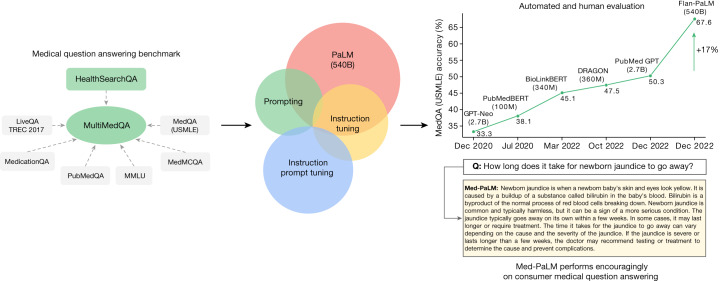
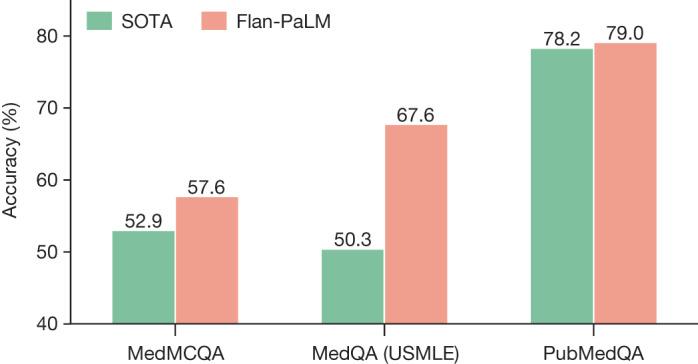
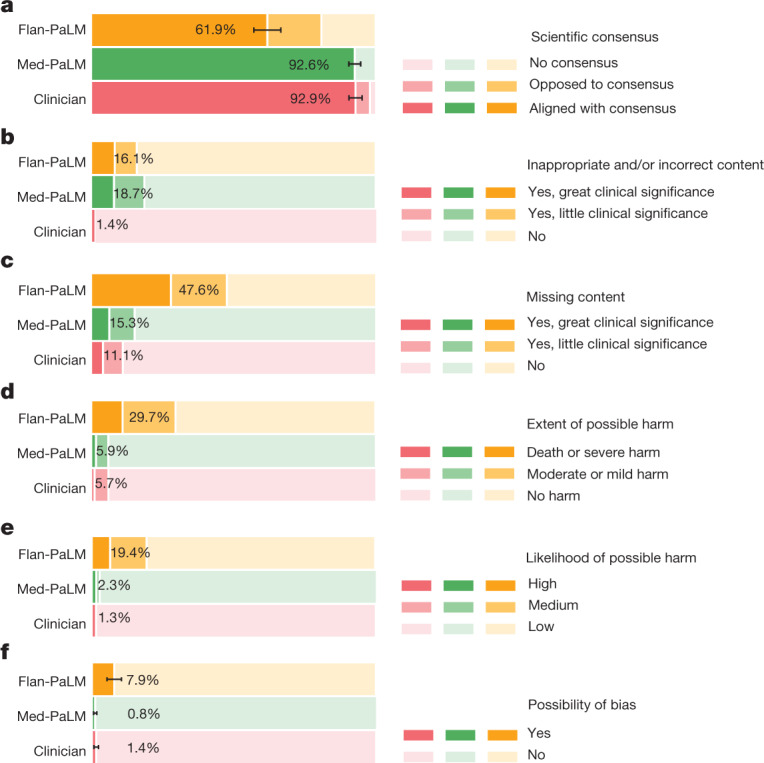
Large language models (LLMs) have demonstrated impressive capabilities, but the bar for clinical applications is high. Attempts to assess the clinical knowledge of models typically rely on automated evaluations based on limited benchmarks. Here, to address these limitations, we present MultiMedQA, a benchmark combining six existing medical question answering datasets spanning professional medicine, research and consumer queries and a new dataset of medical questions searched online, HealthSearchQA. We propose a human evaluation framework for model answers along multiple axes including factuality, comprehension, reasoning, possible harm and bias. In addition, we evaluate Pathways Language Model 1 (PaLM, a 540-billion parameter LLM) and its instruction-tuned variant, Flan-PaLM 2 on MultiMedQA. Using a combination of prompting strategies, Flan-PaLM achieves state-of-the-art accuracy on every MultiMedQA multiple-choice dataset (MedQA 3 , MedMCQA 4 , PubMedQA 5 and Measuring Massive Multitask Language Understanding (MMLU) clinical topics 6 ), including 67.6% accuracy on MedQA (US Medical Licensing Exam-style questions), surpassing the prior state of the art by more than 17%. However, human evaluation reveals key gaps. To resolve this, we introduce instruction prompt tuning, a parameter-efficient approach for aligning LLMs to new domains using a few exemplars. The resulting model, Med-PaLM, performs encouragingly, but remains inferior to clinicians. We show that comprehension, knowledge recall and reasoning improve with model scale and instruction prompt tuning, suggesting the potential utility of LLMs in medicine. Our human evaluations reveal limitations of today’s models, reinforcing the importance of both evaluation frameworks and method development in creating safe, helpful LLMs for clinical applications.
Overview
The claims and statistics of this paper haven’t been checked yet.
Free: it reads the open-access text and checks the first 5 claims that cite a source we can check. Create a free account to check every claim.
Integrity signals
Registry
Cites
Statistics
Figures
Verification
Claims the paper makes
The claims and statistics of this paper haven’t been checked yet.
Free: it reads the open-access text and checks the first 5 claims that cite a source we can check. Create a free account to check every claim.
Claims other papers make about this one
Each is checked against this paper’s own text: does it say what the citing paper says it does?
The cited source doesn’t support the claim as written.
In the citing paper
“Notably, in healthcare, medical NLP benchmarks like MedQA7, PubMedQA8 and the Massive Multitask Language Understanding (MMLU) serve as the de-facto reporting standard for state-of-the-art medical LLMs9–11 with claims of ‘superhuman’ performance in patient-facing tasks12.”
From Medical large language models are vulnerable to data-poisoning attacks (2025) · cites this paper as [9]
Checked by a reasoning model — may be wrong.
Experimental — accuracy not yet measuredThe cited source doesn’t support the claim as written.
In the citing paper
“Med-PaLM achieved a passing score of 67.6% on USMLE-style MedQA questions”
From Trustworthy Medical Question Answering: An Evaluation-Centric Survey (2025) · cites this paper as Singhal et al., 2023
Checked by a reasoning model — may be wrong.
Experimental — accuracy not yet measuredThe source backs part of the claim, not all of it — or backs it for a different population, condition or comparison.
In the citing paper
“Previous work has demonstrated potential across clinical NLP tasks22,23, adapting to the medical domain by training a new model24,25, fine-tuning an existing model26,27 or supplying task-specific examples in the model prompt27,28.”
From Adapted large language models can outperform medical experts in clinical text summarization (2024) · cites this paper as [24]
Experimental — accuracy not yet measuredThe source backs part of the claim, not all of it — or backs it for a different population, condition or comparison.
In the citing paper
“For example, Google’s Med-PaLM 2 demonstrated proficiency in medical question answering, achieving performance comparable to clinical experts on medical licensing examinations and performing better than generalist physicians in real-world medical questions.70”
From A foundational architecture for AI agents in healthcare (2025) · cites this paper as [70]
Experimental — accuracy not yet measuredThe source backs part of the claim, not all of it — or backs it for a different population, condition or comparison.
In the citing paper
“Large language models (LLMs) and multimodal foundation models now exhibit enhanced reasoning capabilities, natural language understanding, and the ability to interact with external tools such as calculators, databases, and application programming interfaces.”
From Medical AI Agents for Clinical Decision Support: Viewpoint Using the Planning, Action, Reflection, and Memory (PARM) Analytical Lens (2026) · cites this paper as [8]
Experimental — accuracy not yet measured
40 more claims about this paper
Create a free account to see every claim other papers make about this one.
Self-check
Percentages, sums and reported differences re-computed from the paper’s own numbers.
The self-check needs the paper’s full text.
Citations
Cites
Vaswani, A., Shazeer, N., Parmar, N., Uszkoreit, J., Jones, L., Gomez, A. N., Kaiser, L., & Polosukhin, I. (2017) · arXiv · doi:10.48550/arxiv.1706.03762 · Cited by 120,404 · cited 1×
“They owe their success to scaling up the training of transformer-based models [84].”
BackgroundExploring the Limits of Transfer Learning with a Unified Text-to-Text Transformer
Raffel, C., Shazeer, N., Roberts, A., Lee, K., Narang, S., Matena, M., Zhou, Y., Li, W., & Liu, P. J. (2019) · arXiv · doi:10.48550/arxiv.1910.10683 · Cited by 31,859 · cited 1×
“Large language models (LLMs) Over the past few years, LLMs have shown impressive performance on natural language processing (NLP) tasks [12, 14, 15, 30, 69, 70, 73, 89, 91, 99].”
BackgroundLanguage Models are Few-Shot Learners
Brown, T. B., Mann, B., Ryder, N., Subbiah, M., Kaplan, J., Dhariwal, P., Neelakantan, A., Shyam, P., Sastry, G., Askell, A., et al. (2020) · arXiv · doi:10.48550/arxiv.2005.14165 · Cited by 23,372
BLEU: a method for automatic evaluation of machine translation
Papineni, K., Roukos, S., Ward, T., & Zhu, W.-J. (2001) · Proceedings of the 40th Annual Meeting on Association for Computational Linguistics - ACL '02 · doi:10.3115/1073083.1073135 · Cited by 21,344
Decoupled Weight Decay Regularization
Loshchilov, I., & Hutter, F. (2017) · arXiv · doi:10.48550/arxiv.1711.05101 · Cited by 12,522
Scaling Laws for Neural Language Models
Kaplan, J., McCandlish, S., Henighan, T., Brown, T. B., Chess, B., Child, R., Gray, S., Radford, A., Wu, J., & Amodei, D. (2020) · arXiv · doi:10.48550/arxiv.2001.08361 · Cited by 9,550 · cited 1×
“It has been shown that model performance and data-efficiency scales with model size and dataset size [37].”
BioBERT: a pre-trained biomedical language representation model for biomedical text mining
Lee, J., Yoon, W., Kim, S., Kim, D., Kim, S., So, C. H., & Kang, J. (2020) · Bioinformatics · doi:10.1093/bioinformatics/btz682 · Cited by 7,218
Boateng, G. O., Neilands, T. B., Frongillo, E. A., Melgar-Quiñonez, H. R., & Young, S. L. (2018) · Frontiers in Public Health · doi:10.3389/fpubh.2018.00149 · Cited by 5,925
Chain-Of-Thought Prompting Elicits Reasoning in Large Language Models
Wei, J., Wang, X., Schuurmans, D., Bosma, M., Ichter, B., Xia, F., Chi, E., Le, Q. V., & Zhou, D. (2022) · Advances in Neural Information Processing Systems 35 · doi:10.52202/068431-1800 · Cited by 4,505
Self-citationLiu, P., Yuan, W., Fu, J., Jiang, Z., Hayashi, H., & Neubig, G. (2023) · ACM Computing Surveys · doi:10.1145/3560815 · Cited by 4,361
Research works printed but not linked: 2
- Abacha, A. B. et al. in Studies in Health Technology and Informatics (eds Ohno-Machado, L. & Séroussi, B.) 25–29 (IOS Press, 2019).
- Matheny, M., Israni, S. T., Ahmed, M. & Whicher, D. eds. Artificial Intelligence in Health Care: The Hope, the Hype, the Promise, the Peril (National Academy of Medicine, 2022). 39146448
Cited by
Items 1,001–1,100 of 1,129
A survey on biomedical automatic text summarization with large language models
Huang, Z., Chen, X., Wang, Y., Huang, J., & Zhao, X. (2025) · Information Processing & Management · doi:10.1016/j.ipm.2025.104216 · Cited by 27
Bentegeac, R., Guellec, B. L., Kuchcinski, G., Amouyel, P., & Hamroun, A. (2025) · Journal of Medical Internet Research · doi:10.2196/64348 · Cited by 40
Rapid review: Growing usage of Multimodal Large Language Models in healthcare
Gupta, P., Zhang, Z., Song, M., Michalowski, M., Hu, X., Štiglic, G., & Topaz, M. (2025) · Journal of Biomedical Informatics · doi:10.1016/j.jbi.2025.104875 · Cited by 29
A longitudinal analysis of declining medical safety messaging in generative AI models
Sharma, S., Alaa, A. M., & Daneshjou, R. (2025) · npj Digital Medicine · doi:10.1038/s41746-025-01943-1 · Cited by 36
“This may lead to the deprioritization or exclusion of explicit medical disclaimers unless programmed to be fl agged by the developers 13 .”
Kumar, H., Yoo, S., Bernuy, A. Z., Shi, J., Luo, H., Williams, J. J., Kuzminykh, A., Anderson, A., & Kornfield, R. (2025) · Proceedings of the ACM on Human-Computer Interaction · doi:10.1145/3757619 · Cited by 29
“These improvements may stem from Mindy’s engagement with users in articulating their experiences, thereby refining their ability to observe and describe subtle aspects of these experiences.”
Implementation of large language models in electronic health records
Griot, M., Vanderdonckt, J., & Yuksel, D. (2025) · PLOS Digital Health · doi:10.1371/journal.pdig.0001141 · Cited by 23
Efficient and Personalized Mobile Health Event Prediction via Small Language Models
Wang, X., Dang, T., Kostakos, V., & Jia, H. (2024) · Proceedings of the 30th Annual International Conference on Mobile Computing and Networking · doi:10.1145/3636534.3698123 · Cited by 22
“PaLM2 [19] demonstrated the effectiveness of LLMs by combining various strategies, achieving superior performance across different datasets in medical domains.”
MethodGill, G. S., Tsai, J., Moxam, J., Sanghvi, H. A., & Gupta, S. (2024) · Cureus · doi:10.7759/cureus.69612 · Cited by 22
“LLMs, when trained appropriately, can analyze questions for such biases and recommend alternative phrasing or content to ensure a more equitable assessment [13].”
BackgroundInfluentialBenchmark Data Contamination of Large Language Models: A Survey
Xu, C., Guan, S., Greene, D., & Kechadi, M.-T. (2024) · arXiv · doi:10.48550/arxiv.2406.04244 · Cited by 22
“Human evaluations often follow principles like the 3H rule (Helpfulness, Honesty, Harmlessness [5]) or specific criteria Chang et al. [21] such as accuracy [131], relevance [177], fluency [141], transparency [157], safety [68], and human alignment [110].”
BackgroundLiu, F., Zhou, H., Wang, K., Yu, Y., Gao, Y., Sun, Z., Liu, S., Sun, S., Zou, Z., Li, Z., et al. (2025) · Cell Reports Medicine · doi:10.1016/j.xcrm.2025.102056 · Cited by 22
Self-citationBest Practices and Lessons Learned on Synthetic Data
Liu, R., Wei, J., Liu, F., Si, C., Zhang, Y., Rao, J., Zheng, S., Peng, D., Yang, D., Zhou, D., et al. (2024) · arXiv · doi:10.48550/arxiv.2404.07503 · Cited by 21
“…of artificial intelligence (AI) technologies has led to their widespread adoption across numerous domains, from assistant agents (e.g., ACT-1, from Adept AI 1 ) and software development (e.g., Devin, from Cognition Lab 2 ) to healthcare (Singhal et al., 2022) and finance (Zheng et al., 2022).”
BackgroundSelf-citationLarge Language Models in Critical Care Medicine: Scoping Review
Shi, T., Ma, J., Yu, Z., Xu, H., Yang, R., Xiong, M., Xiao, M., Li, Y., Zhao, H., & Kong, G. (2025) · JMIR Medical Informatics · doi:10.2196/76326 · Cited by 21
“In the ICU, biased outputs could result in suboptimal or even harmful decisions.”
Opportunities and challenges for biomarker discovery using electronic health record data
Singhal, P., Tan, A. L. M., Drivas, T. G., Johnson, K. B., Ritchie, M. D., & Beaulieu-Jones, B. K. (2023) · Trends in Molecular Medicine · doi:10.1016/j.molmed.2023.06.006 · Cited by 21
Questionable practices in machine learning
Leech, G., Vazquez, J. J., Kupper, N., Yagudin, M., & Aitchison, L. (2024) · arXiv · doi:10.48550/arxiv.2407.12220 · Cited by 21
“The sheer power of prompting is demonstrated in [Nori et al., 2023], which showed that GPT-4 can achieve SOTA performance on the MultiMedQA benchmark suite [Singhal et al., 2022] (a 4% absolute improvement) by just tuning the prompt without any additional finetuning of weights.”
BackgroundDronkers, E. A. C., Geneid, A., al Yaghchi, C., & Lechien, J. R. (2025) · Journal of Voice · doi:10.1016/j.jvoice.2024.02.020 · Cited by 20
Explainable differential diagnosis with dual-inference large language models
Zhou, S., Lin, M., Ding, S., Wang, J., Chen, C., Melton, G. B., Zou, J., & Zhang, R. (2025) · npj Health Systems · doi:10.1038/s44401-025-00015-6 · Cited by 20
“Errorswerecategorizedasmissingcontent(missingatleasttwopiecesof evidence),factualerrors(medicallyincorrect),orlowrelevance(evidence nothighlypertinent)basedonpriorstudies 30,31 .”
Strasser, L. M., Anschuetz, W., Dennstädt, F., & Hastings, J. (2026) · JMIR Medical Education · doi:10.2196/81399 · Cited by 20
BioAgents: Bridging the gap in bioinformatics analysis with multi-agent systems
Mehandru, N., Hall, A. K., Melnichenko, O., Dubinina, Y., Tsirulnikov, D., Bamman, D., Alaa, A., Saponas, S., & Malladi, V. S. (2025) · Scientific Reports · doi:10.1038/s41598-025-25919-z · Cited by 19
Ke, Y. H., Yang Ong, B. S., Jin, L., Sim, J. X. L., Chan, C. H., Soh, C. R., Wong, D. J. N., Liu, N., Sng, B. L., Ting, D. S. W., et al. (2025) · npj Digital Medicine · doi:10.1038/s41746-025-01858-x · Cited by 19
“Straightforward cases (Complexity 1) likely afforded little room for improvement, while highly complex cases (Complexity 3) may have involved nuanced decision-making beyond the current capabilities of LLM summarization 14 .”
Multimodal Large Language Models are Generalist Medical Image Interpreters
Han, T., Adams, L. C., Nebelung, S., Kather, J. N., Bressem, K. K., & Truhn, D. (2023) · doi:10.1101/2023.12.21.23300146 · Cited by 18
“In addition, their inherent knowledge and ability to process information from other domains can facilitate the linking of different domains within the medical field and the incorporation of existing knowledge 18,26 .”
BackgroundMethodHuman Digital Twin-based interactive dashboards for informal caregivers of stroke patients
Lauer-Schmaltz, M. W., Kerim, I., Hansen, J. P., Gulyás, G. M., & Andersen, H. B. (2023) · Proceedings of the 16th International Conference on PErvasive Technologies Related to Assistive Environments · doi:10.1145/3594806.3594824 · Cited by 18
Prompt-based Extraction of Social Determinants of Health Using Few-shot Learning
Ramachandran, G. K., Fu, Y., Han, B., Lybarger, K., Dobbins, N., Uzuner, O., & Yetisgen, M. (2023) · Proceedings of the 5th Clinical Natural Language Processing Workshop · doi:10.18653/v1/2023.clinicalnlp-1.41 · Cited by 18
Promptology: enhancing human-AI interaction in large language models
Olla, P., Elliott, L., Abumeeiz, M., Mihelich, K., & Olson, J. (2024) · Information · doi:10.3390/info15100634 · Cited by 17
Beyond Accuracy: Investigating Error Types in GPT-4 Responses to USMLE Questions
Roy, S., Khatua, A., Ghoochani, F., Hadler, U., Nejdl, W., & Ganguly, N. (2024) · Proceedings of the 47th International ACM SIGIR Conference on Research and Development in Information Retrieval · doi:10.1145/3626772.3657882 · Cited by 17
LAB-Bench: Measuring Capabilities of Language Models for Biology Research
Laurent, J. M., Janizek, J. D., Ruzo, M., Hinks, M. M., Hammerling, M. J., Narayanan, S., Ponnapati, M., White, A. D., & Rodriques, S. G. (2024) · arXiv · doi:10.48550/arxiv.2407.10362 · Cited by 21
“…data (i.e. a huge fraction of the internet), and the scale of such training has allowed even general models to demonstrate emergent abilities to solve complex problems they were not explicitly trained for, including in medicine [25, 48], law [22], writing code [43], or other broad capabilities [7].”
BackgroundPolaris: A Safety-focused LLM Constellation Architecture for Healthcare
Mukherjee, S., Gamble, P., Ausin, M. S., Kant, N., Aggarwal, K., Manjunath, N., Datta, D., Liu, Z., Ding, J., Busacca, S., et al. (2024) · arXiv · doi:10.48550/arxiv.2403.13313 · Cited by 17
Self-citationCan Large Language Models Safely Address Patient Questions Following Cataract Surgery?
Chowdhury, M., Lim, E., Higham, A., McKinnon, R., Ventoura, N., He, Y., & De Pennington, N. (2023) · Proceedings of the 5th Clinical Natural Language Processing Workshop · doi:10.18653/v1/2023.clinicalnlp-1.17 · Cited by 17
Are Large Language Models Moral Hypocrites? A Study Based on Moral Foundations
Nunes, J. L., Almeida, G. F. C. F., Araujo, M. D., & Barbosa, S. D. J. (2024) · Proceedings of the AAAI/ACM Conference on AI, Ethics, and Society · doi:10.1609/aies.v7i1.31704 · Cited by 17
Bejan, C. A., Wang, M., Venkateswaran, S., Bergmann, E. A., Hiles, L., Xu, Y., Chandler, G. S., Brondfield, S., Silverstein, J., Wright, F., et al. (2026) · eBioMedicine · doi:10.1016/j.ebiom.2026.106227 · Cited by 24
“…nature of this comparison between GPT models and an open-source LLM, future investigations utilising a broader range of open-source models or models pre-trained on biomedical or clinical corpora, such as Llama, 39,40 BioGPT, 41 or Med-PaLM, 42 may offer deeper insights into irAE identification.”
International AI Safety Report
Bengio, Y., Mindermann, S., Privitera, D., Besiroglu, T., Bommasani, R., Casper, S., Choi, Y., Fox, P., Garfinkel, B., Goldfarb, D., et al. (2025) · arXiv · doi:10.48550/arxiv.2501.17805 · Cited by 16
Tzanis, E., Adams, L. C., Akinci D’Antonoli, T., Bressem, K. K., Cuocolo, R., Kocak, B., Malamateniou, C., & Klontzas, M. E. (2026) · Diagnostic and Interventional Imaging · doi:10.1016/j.diii.2025.10.002 · Cited by 16
Variation in Large Language Model Recommendations in Challenging Inpatient Management Scenarios
Landon, S., Savage, T., Greysen, S. R., & Bressman, E. (2026) · Journal of General Internal Medicine · doi:10.1007/s11606-025-09888-7 · Cited by 16
Accuracy of large language models in answering ophthalmology board-style questions: A meta-analysis
Wu, J.-H., Nishida, T., & Liu, T. Y. A. (2024) · Asia-Pacific Journal of Ophthalmology · doi:10.1016/j.apjo.2024.100106 · Cited by 16
Quantum many-body physics calculations with large language models
Pan, H., Mudur, N., Taranto, W., Tikhanovskaya, M., Venugopalan, S., Bahri, Y., Brenner, M. P., & Kim, E.-A. (2025) · Communications Physics · doi:10.1038/s42005-025-01956-y · Cited by 15
“These models have demonstrated impressive capabilities across diverse domains, including multidisciplinary benchmarks [5], undergraduate-level math and science [6, 7], coding [8, 9], medicine [10, 11] and chemistry[12].”
Zhang, H., Li, J., Wang, Y., & Song, Y. (2023) · 2023 IEEE International Conference on Bioinformatics and Biomedicine (BIBM) · doi:10.1109/bibm58861.2023.10385557 · Cited by 15
“Aswe know, generative large language models (LLMs, e.g., ChatGPT) [8] have revolted the computer science area and expressed strong reasoning capabilities like Chain-of-Thought [9] ability.”
BackgroundCarl, N., Nguyen, L., Haggenmüller, S., Joachim Hetz, M., Theres Winterstein, J., Otto Hartung, F., Gruene, B., Nikolas Kather, J., Holland-Letz, T., Stephan Michel, M., et al. (2024) · European Urology Open Science · doi:10.1016/j.euros.2024.10.009 · Cited by 15
“LLMs are arti-ficial neural networks with billions of parameters trained on a vast spectrum of texts sourced from the Internet, which includes medical sources [3,4].”
BackgroundMedical multimodal large language models: A systematic review
Hu, Y., Xu, C., Lin, B., Yang, W., & Tang, Y. Y. (2025) · Intelligent Oncology · doi:10.1016/j.intonc.2025.09.005 · Cited by 14
Cusumano, G., D'arrigo, S., Terminella, A., & Lococo, F. (2024) · doi:10.20944/preprints202405.0759.v1 · Cited by 14
Synoptic reporting by summarizing cancer pathology reports using large language models
Rajaganapathy, S., Chowdhury, S., Li, X., Buchner, V., He, Z., Zhang, R., Jiang, X., Yang, P., Cerhan, J. R., & Zong, N. (2025) · npj Health Systems · doi:10.1038/s44401-025-00013-8 · Cited by 14
Adaptation with Self-Evaluation to Improve Selective Prediction in LLMs
Chen, J., Yoon, J., Ebrahimi, S., Arik, S., Pfister, T., & Jha, S. (2023) · Findings of the Association for Computational Linguistics: EMNLP 2023 · doi:10.18653/v1/2023.findings-emnlp.345 · Cited by 13
Pattern Recognition or Medical Knowledge? The Problem with Multiple-Choice Questions in Medicine
Griot, M., Vanderdonckt, J., Yuksel, D., & Hemptinne, C. (2024) · arXiv · doi:10.48550/arxiv.2406.02394 · Cited by 13
“Google introduced MultiMedQA with its Med-PaLM model, which combines several existing medical benchmarks and has become a standard for evaluating medical proficiency in AI models (Singhal et al., 2023; Pal et al., 2024).”
Yao, Z., Parashar, A., Zhou, H., Jang, W. S., Ouyang, F., Yang, Z., & Yu, H. (2025) · Proceedings of the 2025 Conference of the Nations of the Americas Chapter of the Association for Computational Linguistics: Human Language Technologies (Volume 1: Long Papers) · doi:10.18653/v1/2025.naacl-long.538 · Cited by 27
Pattern Recognition or Medical Knowledge? The Problem with Multiple-Choice Questions in Medicine
Griot, M., Vanderdonckt, J., Yuksel, D., & Hemptinne, C. (2025) · Proceedings of the 63rd Annual Meeting of the Association for Computational Linguistics (Volume 1: Long Papers) · doi:10.18653/v1/2025.acl-long.266 · Cited by 13
“Google introduced MultiMedQA with its Med-PaLM model, which combines several existing medical benchmarks and has become a standard for evaluating medical proficiency in AI models (Singhal et al., 2023; Pal et al., 2024).”
Leon, M., Ruaengsri, C., Pelletier, G., Bethencourt, D., Shibata, M., Flores, M. Q., & Shudo, Y. (2024) · Journal of Clinical Medicine · doi:10.3390/jcm13216543 · Cited by 12
“…internet, these models excel in answering questions, summarizing information, translating text, and generating creative content [7]. on vast datasets sourced from the internet, these models excel in answering questions, summarizing information, translating text, and generating creative content [7].”
BackgroundMedFuzz: Exploring the Robustness of Large Language Models in Medical Question Answering
Ness, R. O., Matton, K., Helm, H., Zhang, S., Bajwa, J., Priebe, C. E., & Horvitz, E. (2024) · arXiv · doi:10.48550/arxiv.2406.06573 · Cited by 12
“Cutting-edge large language models (LLMs) have attained human competitive performance on medical question and answering benchmarks [21, 22, 13, 14, 23].”
BackgroundHolzer, M.-T., Meinecke, A., Müller, F., Haase, I., Morf, H., Witte, T., Labinsky, H., Klemm, P., Knitza, J., & Krusche, M. (2024) · Therapeutic Advances in Musculoskeletal Disease · doi:10.1177/1759720x241275818 · Cited by 12
Lechner, F., Kuhn, S., & Knitza, J. (2025) · International Journal of Rheumatic Diseases · doi:10.1111/1756-185x.70124 · Cited by 11
“By integrating large, diverse knowledge sources—from clinical guidelines to authoritative research publications [18]—these models can maintain extensive contextual understanding and dynamically incorporate new information.”
Large Language Model Uncertainty Measurement and Calibration for Medical Diagnosis and Treatment
Savage, T., Wang, J., Gallo, R., Boukil, A., Patel, V., Ahmad Safavi-Naini, S. A., Soroush, A., & Chen, J. H. (2024) · doi:10.1101/2024.06.06.24308399 · Cited by 11
“3,17,23,45 This allowed for a unique evaluation of calibration measurement that more closely simulated clinical practice.”
BackgroundEstevez, M., Singh, N., Dyson, L., Adamson, B., Krismer, K., Magee, K., Yuan, Q., Hildner, M. W., Fidyk, E., Williams, T., et al. (2026) · JCO Clinical Cancer Informatics · doi:10.1200/cci-25-00215 · Cited by 11
Benchmarking the Confidence of Large Language Models in Clinical Questions
Omar, M., Agbareia, R., Glicksberg, B. S., Nadkarni, G. N., & Klang, E. (2024) · doi:10.1101/2024.08.11.24311810 · Cited by 10
LLM Task Interference: An Initial Study on the Impact of Task-Switch in Conversational History
Gupta, A., Sheth, I., Raina, V., Gales, M., & Fritz, M. (2024) · Proceedings of the 2024 Conference on Empirical Methods in Natural Language Processing · doi:10.18653/v1/2024.emnlp-main.811 · Cited by 10
Jain, A., Nimonkar, P., & Jadhav, P. (2025) · Journal of Cranio-Maxillofacial Surgery · doi:10.1016/j.jcms.2025.08.004 · Cited by 10
Bedi, P., Thukral, A., & Dhiman, S. (2025) · Knowledge and Information Systems · doi:10.1007/s10115-025-02465-8 · Cited by 10
Thieme, A., Rajamohan, A., Cooper, B., Groombridge, H., Simister, R., Wong, B., Woznitza, N., Pinnock, M. A., Wetscherek, M. T., Morrison, C., et al. (2024) · arXiv · doi:10.48550/arxiv.2405.05299 · Cited by 10
Wang, Y., Zhang, X., Yao, K., Zeng, Z., Song, K., Lin, J., & Shen, Z. (2026) · arXiv · doi:10.48550/arxiv.2606.05241 · Cited by 10
Feng, H., Ronzano, F., LaFleur, J., Garber, M., de Oliveira, R., Rough, K., Roth, K., Nanavati, J., El Abidine, K. Z., & Mack, C. (2024) · doi:10.1101/2024.05.17.24307411 · Cited by 9
Evaluating large language models for selection of statistical test for research: A pilot study
Mondal, H., Mondal, S., & Mittal, P. (2024) · Perspectives in Clinical Research · doi:10.4103/picr.picr_275_23 · Cited by 9
Language-Models-as-a-Service: Overview of a New Paradigm and its Challenges
La Malfa, E., Petrov, A., Frieder, S., Weinhuber, C., Burnell, R., Nazar, R., Cohn, A., Shadbolt, N., & Wooldridge, M. (2024) · Journal of Artificial Intelligence Research · doi:10.1613/jair.1.15865 · Cited by 9
“…been high-profile claims that some of the most advanced LMaaS exhibit impressive emergent capabilities (Bubeck et al., 2023; Huang et al., 2023a; Singhal et al., 2023), i.e., capabilities not explicitly programmed or anticipated during their development that manifest when a model reaches a…”
BackgroundKumar, H., Yoo, S., Bernuy, A., Shi, J., Luo, H., Williams, J. J., Kuzminykh, A., Anderson, A., & Kornfield, R. (2024) · doi:10.2139/ssrn.4892998 · Cited by 9
West, M., Cheng, Y., He, Y., Leng, Y., Magdamo, C., Hyman, B. T., Dickson, J. R., Serrano-Pozo, A., Blacker, D., & Das, S. (2025) · JMIR Aging · doi:10.2196/65178 · Cited by 8
From Medprompt to o1: Exploration of Run-Time Strategies for Medical Challenge Problems and Beyond
Nori, H., Usuyama, N., King, N., McKinney, S. M., Fernandes, X., Zhang, S., & Horvitz, E. (2024) · arXiv · doi:10.48550/arxiv.2411.03590 · Cited by 9
“Generalist LLMs have demonstrated remarkable capabilities for challenging problems in the health and life sciences, often surpassing models constructed with significant domain-specific training and fine-tuning [NKM + 23, SAT + 22].”
BackgroundBejan, C. A., Reed, A. M., Mikula, M., Zhang, S., Xu, Y., Fabbri, D., Embí, P. J., & Hsi, R. S. (2025) · Scientific Reports · doi:10.1038/s41598-025-86632-5 · Cited by 8
Physics of Language Models: Part 3.2, Knowledge Manipulation
Allen-Zhu, Z., & Li, Y. (2025) · doi:10.2139/ssrn.5250621 · Cited by 8
Trust Me, I'm Wrong: LLMs Hallucinate with Certainty Despite Knowing the Answer
Simhi, A., Itzhak, I., Barez, F., Stanovsky, G., & Belinkov, Y. (2025) · arXiv · doi:10.48550/arxiv.2502.12964 · Cited by 8
LLM-augmented multi-agent cooperative framework for medical case retrieval in cardiology
Deng, L., Hu, H., Lu, K., & He, P. (2025) · Journal of King Saud University Computer and Information Sciences · doi:10.1007/s44443-025-00311-z · Cited by 8
“In the medical domain, Singhal et al. (2023) presented Med-PaLM (an adaptation of GPT-4) and found that providing retrieval capability could help the model handle questions it otherwise answered incorrectly.”
Reese, J. T., Chimirri, L., Bridges, Y., Danis, D., Caufield, J. H., Gargano, M. A., Kroll, C., Schmeder, A., Liu, F., Wissink, K., et al. (2024) · doi:10.1101/2024.07.22.24310816 · Cited by 8
Adoption of Generative AI by Academic Biomedical Researchers
Ruediger, D., McCracken, C., & Skinner, M. (2024) · doi:10.18665/sr.321415 · Cited by 8
Agentic AI in Healthcare: Opportunities, Challenges, and Future Directions
Gridach, M., Nanavati, J., Zine El Abidine, K., Yacoubian, C., & Mack, C. (2026) · ACM Computing Surveys · doi:10.1145/3809164 · Cited by 8
Artificial Intelligence in Clinical Oncology: From Productivity Enhancement to Creative Discovery
Kuno, M., Osumi, H., Udagawa, S., Yoshikawa, K., Ooki, A., Shinozaki, E., Ishikawa, T., Oba, J., Yamaguchi, K., & Sakurada, K. (2025) · Current Oncology · doi:10.3390/curroncol32110588 · Cited by 7
Miao, Y., Wen, J., Luo, Y., & Li, J. (2026) · International Journal of Medical Informatics · doi:10.1016/j.ijmedinf.2025.106136 · Cited by 10
Gautam, S., Chandra, M., De, A., Chakravorti, T., Malik, G., & De Choudhury, M. (2025) · arXiv · doi:10.48550/arxiv.2508.06849 · Cited by 7
“The Problem Prior work have increasingly focused on developing and evaluating diagnostic AI systems for single-turn question answering or knowledge retrieval, often benchmarking AI models against medical exams or clinical QA datasets (Singhal et al. 2023; Jin et al. 2024; Singhal et al. 2025).”
Long Term Memory: The Foundation of AI Self-Evolution
Jiang, X., Li, F., Zhao, H., Qiu, J., Wang, J., Shao, J., Xu, S., Zhang, S., Chen, W., Tang, X., et al. (2024) · arXiv · doi:10.48550/arxiv.2410.15665 · Cited by 7
MeshAgent: enabling reliable network management with large language models
Zhou, Y., Hsieh, K., Mani, S. K., Kandula, S., & Liu, Z. (2025) · Proceedings of the ACM on Measurement and Analysis of Computing Systems · doi:10.1145/3771567 · Cited by 7
Wang, A., Ruparel, R., Iurchenko, A., Jhun, P., Séguin, J. A., Strachan, P., Wong, R., Karthikesalingam, A., Matias, Y., Hassidim, A., et al. (2025) · Proceedings of the Extended Abstracts of the CHI Conference on Human Factors in Computing Systems · doi:10.1145/3706599.3721208 · Cited by 6
“Various LLMs have demonstrated remarkable capabilities answering medical questions similar to those found on the USMLE Step 1 [10, 32].”
Self-citationUnlocking electronic health records: a hybrid graph RAG approach to safe clinical AI for patient QA
Thio, S., Lewis, M., Denaxas, S., & Dobson, R. J. B. (2026) · Frontiers in Digital Health · doi:10.3389/fdgth.2026.1780700 · Cited by 6
AI Paradox in Higher Education: Understanding Over-Reliance, Its Impact, and Sustainable Integration
Khlaif, Z. N., Hamamra, B., & Hussein, E. T. (2025) · doi:10.21203/rs.3.rs-6127885/v1 · Cited by 5
Cloud Platforms for Developing Generative AI Solutions: A Scoping Review of Tools and Services
Patel, D., Raut, G., Cheetirala, S. N., Nadkarni, G. N., Freeman, R., Glicksberg, B. S., Klang, E., & Timsina, P. (2024) · arXiv · doi:10.48550/arxiv.2412.06044 · Cited by 5
Large Language Models in Spine Surgery: A Promising Technology
Shah, R., & Schwab, J. H. (2025) · HSS Journal®: The Musculoskeletal Journal of Hospital for Special Surgery · doi:10.1177/15563316251340696 · Cited by 5
AI agents can coordinate beyond human scale
De Marzo, G., Castellano, C., & Garcia, D. (2024) · arXiv · doi:10.48550/arxiv.2409.02822 · Cited by 4
Lingshu: A Generalist Foundation Model for Unified Multimodal Medical Understanding and Reasoning
Xu, W., Chan, H. P., Li, L., Aljunied, M., Yuan, R., Wang, J., Xiao, C., Chen, G., Liu, C., Li, Z., et al. (2025) · arXiv · doi:10.48550/arxiv.2506.07044 · Cited by 4
“Overall, Lingshu-Med and MedEvalKit provide a high-performing model, a robust evaluation toolkit, and empirically grounded guidelines on data curation, staged training, and evaluation.”
AI4Research: a survey of artificial intelligence for scientific research
Chen, Q., Yang, M., Qin, L., Liu, J., Yan, Z., Guan, J., Peng, D., Ji, Y., Li, H., Hu, M., et al. (2026) · Science China Information Sciences · doi:10.1007/s11432-025-5000-y · Cited by 4
AutoRAG: Grounding text and symbols
Schulz, T., Luttermann, M., & Möller, R. (2024) · KI - Künstliche Intelligenz · doi:10.1007/s13218-024-00850-z · Cited by 4
“…preferences, as it is called in [19], they are widely used for chat purposes [18], even in safety-critical application domains such as medical question answering: Med-PaLM [29] or even Google’s most evolved Med-PaLM version [30] have indeed shown strong helpfulness and low probability of harm.”
Oami, T., Okada, Y., Maeda, K., & Nakada, T.-A. (2026) · Frontiers in Digital Health · doi:10.3389/fdgth.2026.1799623 · Cited by 4
“Recent advances in natural language processing have led to the development of large language models (LLMs) that can process and generate complex text ( 6–8), offering new opportunities to support and streamline systematic review processes (9–11).”
Zhu, Y., Sui, D., Wang, Z., Hu, X., Gu, L., Qi, Y., Wu, T., Wang, L., Wei, Y., Tang, W., et al. (2026) · Proceedings of the 2026 CHI Conference on Human Factors in Computing Systems · doi:10.1145/3772318.3791458 · Cited by 3
“Recent Large Language Models (LLMs) and deep learning architectures often match or exceed human experts in diagnostic tasks ranging from radiology to medical licensing examinations [20, 50, 58].”
SciCode: A Research Coding Benchmark Curated by Scientists
Tian, M., Gao, L., Zhang, S. D., Chen, X., Fan, C., Guo, X., Haas, R., Ji, P., Krongchon, K., Li, Y., et al. (2024) · arXiv · doi:10.48550/arxiv.2407.13168 · Cited by 15
“Many models focus on one single domain or task, like math (e.g., Minerva [43] and Deepseek-Math [78] ), protein structure prediction (e.g., ESM-2 [48]), medical reasoning (e.g., Med-PaLM [80], BioGPT [53]), and others.”
BackgroundAutomatic Interactive Evaluation for Large Language Models with State Aware Patient Simulator
Liao, Y., Meng, Y., Wang, Y., Liu, H., Wang, Y., & Wang, Y. (2024) · arXiv · doi:10.48550/arxiv.2403.08495 · Cited by 15
“…for the medical field—such as Medalpaca Han et al. (2023), Huatuo Wang et al. (2023), ChatDoctor Yunxiang et al. (2023), and DoctorGLM Xiong et al. (2023)—widespread practical deployment in clinical environments has not been achieved, with the notable exception of Med-PaLM 2 Singhal et al. (2023).”
BackgroundCha, S., Park, J., Choi, H., Ryu, H., & Seo, K. (2025) · Proceedings of the Extended Abstracts of the CHI Conference on Human Factors in Computing Systems · doi:10.1145/3706599.3720111 · Cited by 3
Wölflein, G., Ferber, D., Truhn, D., Arandjelović, O., & Kather, J. N. (2025) · arXiv · doi:10.48550/arxiv.2502.11705 · Cited by 3
Physician in the Loop Design of Interactive Agents
Griot, M., Vanderdonckt, J., Yuksel, D., & Hemptinne, C. (2025) · Lecture Notes in Computer Science · doi:10.1007/978-3-031-91760-8_7 · Cited by 2
Mobility functional status ascertainment in electronic health records using large language models
Liu, X., Garg, M., Jia, H., Sauver, J. S., Pagali, S. R., & Sohn, S. (2026) · Scientific Reports · doi:10.1038/s41598-026-37025-9 · Cited by 2
“LLMs, with their advanced capabilities in natural language understanding and generation, offer a powerful means of processing and interpreting complex textual data 14,15 .”
Akkus Yildirim, B., Tutun, B., Durak, G., Yildirim, E. B., Uysal, E., Erturk, S. M., & Bagci, U. (2025) · Communications Medicine · doi:10.1038/s43856-025-01315-6 · Cited by 2
“LLMsareincreasinglycapableofprocessingand synthesizing vast amounts of medical information, potentially offering context-speci fi c and detail-oriented interpretations of complex guideline recommendations 20 .”
AI-driven abstract generating: evaluating LLMs with a tailored prompt under the PRISMA-A framework
Demi̇r, G. B., Gökmen, Ş., Süküt, Y., Topsakal, K. G., & Görgülü, S. (2025) · BMC Oral Health · doi:10.1186/s12903-025-06982-4 · Cited by 2
“By leveraging transformer architectures, these models assign weighted importance to different parts of a text, allowing them to prioritise key information while maintaining coherence and logical flow [4, 5].”
Dinc, R., & Ardic, N. (2026) · JMIR Medical Informatics · doi:10.2196/92584 · Cited by 2
“Recent advances in foundation models and tool-assisted architectures have begun to address these limitations [8].”
Auditing medical multi-agent AI reveals risks of false consensus
Zhu, Y., Gu, L., Wang, Z., Sang, H., Sui, D., Tang, W., Mi, L., Wang, Y., Gao, J., Yao, L., et al. (2025) · arXiv · doi:10.48550/arxiv.2510.10185 · Cited by 17
Structured reasoning failures compromise LLM interpretation of clinical oncology notes
Kenaston, M. W., Ayub, U., Parmar, M., Kumar, P., Anjum, M. U., Naqvi, S. A. A., Chaudhuri, A. A., Zakharia, Y., Heath, E. I., Bekaii-Saab, T. S., et al. (2026) · npj Digital Medicine · doi:10.1038/s41746-026-02951-5 · Cited by 2
Coevolution of large language models with physical models boosts advanced battery research
Li, J.-H., Hu, Y., Xia, G., Mo, W., Li, B., Jia, Y., Gao, Y., Xuan, F., Liu, H., & Lian, C. (2025) · Cell Reports Physical Science · doi:10.1016/j.xcrp.2025.102553 · Cited by 2
GraphRouter: A Graph-based Router for LLM Selections
Feng, T., Shen, Y., & You, J. (2024) · arXiv · doi:10.48550/arxiv.2410.03834 · Cited by 2
“Additionally, LLMs demonstrate varied performance across different types of queries and tasks (Ahmed et al., 2024; Zhang et al., 2024), especially with the development of domain-specific LLMs (Singhal et al., 2022; Luo et al., 2022).”
Sun, X., Hong, Q., Zhang, M., Li, Y., Chen, T., Huang, Z., Liang, G., Tang, W., Xu, S., Ni, X., et al. (2026) · Cell Reports Medicine · doi:10.1016/j.xcrm.2025.102547 · Cited by 3
Imaezue, G. C., Maram, K. V., Ajayi, D., Alohali, I., & Butta, R. K. (2026) · Journal of Speech, Language, and Hearing Research · doi:10.1044/2026_jslhr-26-00031 · Cited by 1
NurValues: Real-World Nursing Values Evaluation for Large Language Models in Clinical Context
Yao, B., Li, Q., Zhang, Y., Yang, S., Zhang, B., Tiwari, P., & Qin, J. (2025) · arXiv · doi:10.48550/arxiv.2505.08734 · Cited by 1
“Through post-training on synthetic medical data, large language models (LLMs) have gained the understanding and conversational ability in the medical domain [31, 44, 46].”
Metadata
- Authors
- Singhal, K., Azizi, S., Tu, T., Mahdavi, S. S., Wei, J., Chung, H. W., Scales, N., Tanwani, A., Cole-Lewis, H., Pfohl, S., Payne, P., Seneviratne, M., Gamble, P., Kelly, C., Babiker, A., Schärli, N., Chowdhery, A., Mansfield, P., Demner-Fushman, D., Agüera y Arcas, B., Webster, D., Corrado, G. S., Matias, Y., Chou, K., Gottweis, J., Tomasev, N., Liu, Y., Rajkomar, A., Barral, J., Semturs, C., Karthikesalingam, A., & Natarajan, V.
- Affiliations
- Google (United States) (US)
- Corresponding author
- Singhal, Karan
- Azizi, Shekoofeh
- Karthikesalingam, Alan
- Natarajan, Vivek
- ORCID
- Singhal, Karan
- Azizi, Shekoofeh
- Mahdavi, S. Sara
- Chung, Hyung Won
- Tanwani, Ajay
- Cole-Lewis, Heather
- Seneviratne, Martin
- Kelly, Chris
- Chowdhery, Aakanksha
- Mansfield, Philip
- Webster, Dale
- Corrado, Greg S.
- Matias, Yossi
- Chou, Katherine
- Gottweis, Juraj
- Tomasev, Nenad
- Liu, Yun
- Rajkomar, Alvin
- Barral, Joelle
- Semturs, Christopher
- Karthikesalingam, Alan
- Natarajan, Vivek
- Venue
- Nature
- Published
- 2023-07-12
- Volume
- 620
- Issue
- 7972
- Pages
- 172-180
- ISSN
- 0028-0836 (ISSN-L)
- 1476-4687
- PMC
- PMC10396962
- OpenAlex
- W4384071683
- Semantic Scholar
- 6052486bc9144dc1730c12bf35323af3792a1fd0
- Cited by
- 4,083
- References
- 85
- Citations by year
- 2026: 1627 · 2025: 1275 · 2024: 933 · 2023: 247
- FWCI
- 162.53
- Type
- journal article
- Language
- en
- Update notices
- correction (2023-07-27)
- Open access
- hybrid
- doi.org
- Licence
- cc-by
- creativecommons.org/licenses/by/4.0 (tdm)
- creativecommons.org/licenses/by/4.0 (vor)
- Locations
- Nature (publishedVersion, cc-by)
- PubMed Central (publishedVersion, cc-by)
- PubMed (publishedVersion)
- arXiv (Cornell University) (submittedVersion)
- RePEc: Research Papers in Economics (submittedVersion)
- arXiv (Cornell University) (cc-by)
- Funders
- DeepMind
- U.S. National Library of Medicine
- Topics
- Health Sciences › Medicine › Health Informatics › Artificial Intelligence in Healthcare and Education
- Physical Sciences › Computer Science › Artificial Intelligence › Topic Modeling
- Physical Sciences › Computer Science › Artificial Intelligence › Machine Learning in Healthcare
- Keywords
- large language models, clinical knowledge, medical question answering, human evaluation, Arecaceae, MedQA, MedMCQA, PubMedQA, MMLU, clinical reasoning
- MeSH terms
- Clinical Competence, Computer Simulation, Humans, Licensure, Medicine, Natural Language Processing, Physicians, Bias, Knowledge, Benchmarking, Comprehension, Patient Safety, Datasets as Topic
About these checks
Registry, retraction, Cites and statistics results are computed, not judged, with one exception: a printed reference that no index lists is read once by a model before it counts as a citation error. Claims are extracted by a model and kept only when their quote appears verbatim in the text; each cited source is then checked, with a model’s help, for whether it says what the claim relies on. Those verdicts can be wrong — read the claim’s quote and the cited source before relying on one.
Statistics and arithmetic are recomputed, not judged.
Confidence bands are shown only for fields calibrated on our annotated test set. None is calibrated yet, so no band is shown.
What counts as a claim ›How we measure confidence ›How we check this ›
Are you an author, or do you see a problem with this page? Request a review
Data sources
Bibliographic data: Semantic Scholar, OpenAlex, Crossref.
Contains information from the Semantic Scholar Academic Graph Datasets, made available under the ODC Attribution License (ODC-BY 1.0).
Semantic Scholar’s data is described in: Kinney, R., et al. (2023). The Semantic Scholar Open Data Platform. arXiv:2301.10140.
