

Large language models encode clinical knowledge
Open accessThe DOI matches its Crossref record; 115 of the 116 references it cites were found in a registry or an index.
Abstract
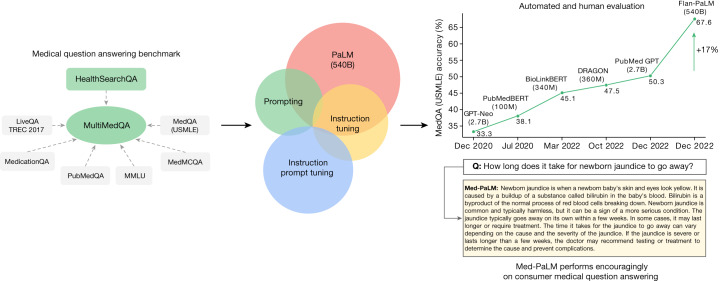
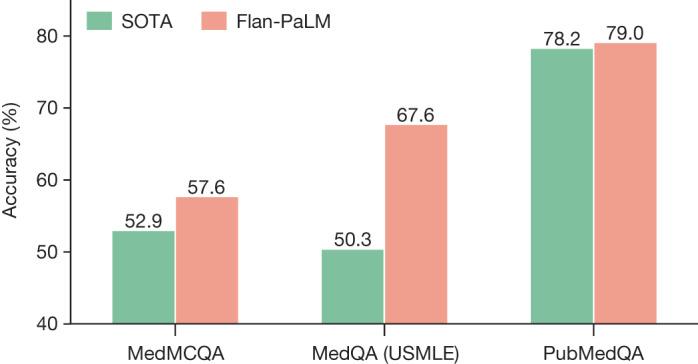
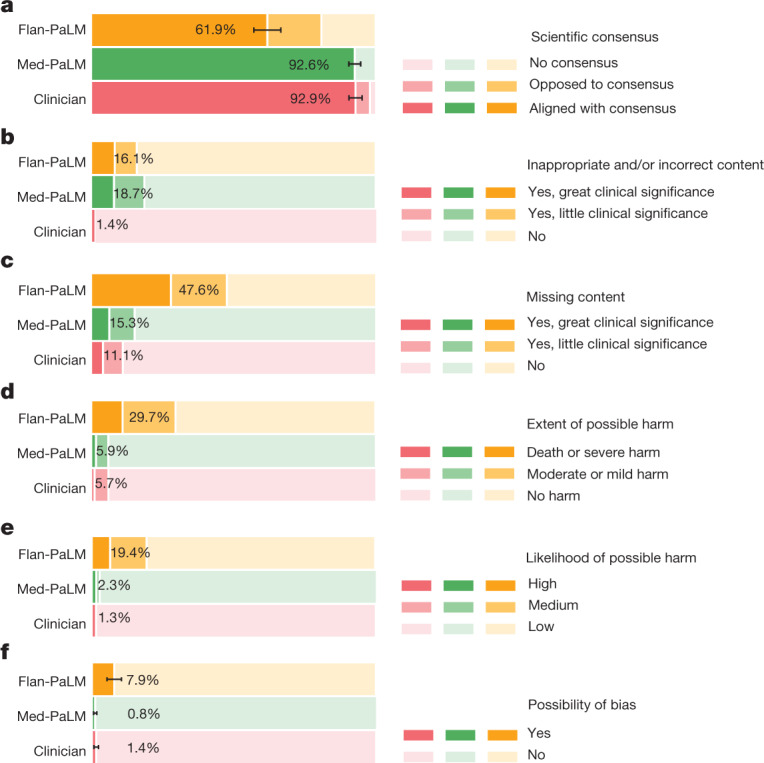
Large language models (LLMs) have demonstrated impressive capabilities, but the bar for clinical applications is high. Attempts to assess the clinical knowledge of models typically rely on automated evaluations based on limited benchmarks. Here, to address these limitations, we present MultiMedQA, a benchmark combining six existing medical question answering datasets spanning professional medicine, research and consumer queries and a new dataset of medical questions searched online, HealthSearchQA. We propose a human evaluation framework for model answers along multiple axes including factuality, comprehension, reasoning, possible harm and bias. In addition, we evaluate Pathways Language Model 1 (PaLM, a 540-billion parameter LLM) and its instruction-tuned variant, Flan-PaLM 2 on MultiMedQA. Using a combination of prompting strategies, Flan-PaLM achieves state-of-the-art accuracy on every MultiMedQA multiple-choice dataset (MedQA 3 , MedMCQA 4 , PubMedQA 5 and Measuring Massive Multitask Language Understanding (MMLU) clinical topics 6 ), including 67.6% accuracy on MedQA (US Medical Licensing Exam-style questions), surpassing the prior state of the art by more than 17%. However, human evaluation reveals key gaps. To resolve this, we introduce instruction prompt tuning, a parameter-efficient approach for aligning LLMs to new domains using a few exemplars. The resulting model, Med-PaLM, performs encouragingly, but remains inferior to clinicians. We show that comprehension, knowledge recall and reasoning improve with model scale and instruction prompt tuning, suggesting the potential utility of LLMs in medicine. Our human evaluations reveal limitations of today’s models, reinforcing the importance of both evaluation frameworks and method development in creating safe, helpful LLMs for clinical applications.
Overview
The claims and statistics of this paper haven’t been checked yet.
Free: it reads the open-access text and checks the first 5 claims that cite a source we can check. Create a free account to check every claim.
Integrity signals
Registry
Cites
Statistics
Figures
Verification
Claims the paper makes
The claims and statistics of this paper haven’t been checked yet.
Free: it reads the open-access text and checks the first 5 claims that cite a source we can check. Create a free account to check every claim.
Claims other papers make about this one
Each is checked against this paper’s own text: does it say what the citing paper says it does?
The cited source doesn’t support the claim as written.
In the citing paper
“Notably, in healthcare, medical NLP benchmarks like MedQA7, PubMedQA8 and the Massive Multitask Language Understanding (MMLU) serve as the de-facto reporting standard for state-of-the-art medical LLMs9–11 with claims of ‘superhuman’ performance in patient-facing tasks12.”
From Medical large language models are vulnerable to data-poisoning attacks (2025) · cites this paper as [9]
Checked by a reasoning model — may be wrong.
Experimental — accuracy not yet measuredThe cited source doesn’t support the claim as written.
In the citing paper
“Med-PaLM achieved a passing score of 67.6% on USMLE-style MedQA questions”
From Trustworthy Medical Question Answering: An Evaluation-Centric Survey (2025) · cites this paper as Singhal et al., 2023
Checked by a reasoning model — may be wrong.
Experimental — accuracy not yet measuredThe source backs part of the claim, not all of it — or backs it for a different population, condition or comparison.
In the citing paper
“Previous work has demonstrated potential across clinical NLP tasks22,23, adapting to the medical domain by training a new model24,25, fine-tuning an existing model26,27 or supplying task-specific examples in the model prompt27,28.”
From Adapted large language models can outperform medical experts in clinical text summarization (2024) · cites this paper as [24]
Experimental — accuracy not yet measuredThe source backs part of the claim, not all of it — or backs it for a different population, condition or comparison.
In the citing paper
“For example, Google’s Med-PaLM 2 demonstrated proficiency in medical question answering, achieving performance comparable to clinical experts on medical licensing examinations and performing better than generalist physicians in real-world medical questions.70”
From A foundational architecture for AI agents in healthcare (2025) · cites this paper as [70]
Experimental — accuracy not yet measuredThe source backs part of the claim, not all of it — or backs it for a different population, condition or comparison.
In the citing paper
“Large language models (LLMs) and multimodal foundation models now exhibit enhanced reasoning capabilities, natural language understanding, and the ability to interact with external tools such as calculators, databases, and application programming interfaces.”
From Medical AI Agents for Clinical Decision Support: Viewpoint Using the Planning, Action, Reflection, and Memory (PARM) Analytical Lens (2026) · cites this paper as [8]
Experimental — accuracy not yet measured
40 more claims about this paper
Create a free account to see every claim other papers make about this one.
Self-check
Percentages, sums and reported differences re-computed from the paper’s own numbers.
The self-check needs the paper’s full text.
Citations
Cites
Vaswani, A., Shazeer, N., Parmar, N., Uszkoreit, J., Jones, L., Gomez, A. N., Kaiser, L., & Polosukhin, I. (2017) · arXiv · doi:10.48550/arxiv.1706.03762 · Cited by 120,404 · cited 1×
“They owe their success to scaling up the training of transformer-based models [84].”
BackgroundExploring the Limits of Transfer Learning with a Unified Text-to-Text Transformer
Raffel, C., Shazeer, N., Roberts, A., Lee, K., Narang, S., Matena, M., Zhou, Y., Li, W., & Liu, P. J. (2019) · arXiv · doi:10.48550/arxiv.1910.10683 · Cited by 31,859 · cited 1×
“Large language models (LLMs) Over the past few years, LLMs have shown impressive performance on natural language processing (NLP) tasks [12, 14, 15, 30, 69, 70, 73, 89, 91, 99].”
BackgroundLanguage Models are Few-Shot Learners
Brown, T. B., Mann, B., Ryder, N., Subbiah, M., Kaplan, J., Dhariwal, P., Neelakantan, A., Shyam, P., Sastry, G., Askell, A., et al. (2020) · arXiv · doi:10.48550/arxiv.2005.14165 · Cited by 23,372
BLEU: a method for automatic evaluation of machine translation
Papineni, K., Roukos, S., Ward, T., & Zhu, W.-J. (2001) · Proceedings of the 40th Annual Meeting on Association for Computational Linguistics - ACL '02 · doi:10.3115/1073083.1073135 · Cited by 21,344
Decoupled Weight Decay Regularization
Loshchilov, I., & Hutter, F. (2017) · arXiv · doi:10.48550/arxiv.1711.05101 · Cited by 12,522
Scaling Laws for Neural Language Models
Kaplan, J., McCandlish, S., Henighan, T., Brown, T. B., Chess, B., Child, R., Gray, S., Radford, A., Wu, J., & Amodei, D. (2020) · arXiv · doi:10.48550/arxiv.2001.08361 · Cited by 9,550 · cited 1×
“It has been shown that model performance and data-efficiency scales with model size and dataset size [37].”
BioBERT: a pre-trained biomedical language representation model for biomedical text mining
Lee, J., Yoon, W., Kim, S., Kim, D., Kim, S., So, C. H., & Kang, J. (2020) · Bioinformatics · doi:10.1093/bioinformatics/btz682 · Cited by 7,218
Boateng, G. O., Neilands, T. B., Frongillo, E. A., Melgar-Quiñonez, H. R., & Young, S. L. (2018) · Frontiers in Public Health · doi:10.3389/fpubh.2018.00149 · Cited by 5,925
Chain-Of-Thought Prompting Elicits Reasoning in Large Language Models
Wei, J., Wang, X., Schuurmans, D., Bosma, M., Ichter, B., Xia, F., Chi, E., Le, Q. V., & Zhou, D. (2022) · Advances in Neural Information Processing Systems 35 · doi:10.52202/068431-1800 · Cited by 4,505
Self-citationLiu, P., Yuan, W., Fu, J., Jiang, Z., Hayashi, H., & Neubig, G. (2023) · ACM Computing Surveys · doi:10.1145/3560815 · Cited by 4,361
Research works printed but not linked: 2
- Abacha, A. B. et al. in Studies in Health Technology and Informatics (eds Ohno-Machado, L. & Séroussi, B.) 25–29 (IOS Press, 2019).
- Matheny, M., Israni, S. T., Ahmed, M. & Whicher, D. eds. Artificial Intelligence in Health Care: The Hope, the Hype, the Promise, the Peril (National Academy of Medicine, 2022). 39146448
Cited by
Items 601–700 of 1,129
Evaluating the robustness and readiness of large frontier models in health AI applications
池谷, 裕., Fu, J., Liu, X., Valanarasu, J. M. J., Codella, N., Tan, R., Liu, Q., Jin, Y., Zhang, S., Wang, J., et al. (2026) · Nature Medicine · doi:10.1038/s41591-026-04501-8 · Cited by 60
“1–6); and they frequently produce fabricated reasoning chains, generating confident but incorrect explanations that mask underlying shortcut behaviors (stress test 6; see examples in Extended Data Figs.”
Chen, X., Wang, L., You, M., Liu, W., Fu, Y., Xu, J., Zhang, S., Chen, G., Li, K., & Li, J. (2024) · Journal of Medical Internet Research · doi:10.2196/58158 · Cited by 48
“The rapid development of large language models (LLMs) has shown promising potential in the medical field, as demonstrated by their ability to pass the United States Medical Licensing Examination and diagnose clinical conditions [1-3].”
InfluentialLarge language model agents can use tools to perform clinical calculations
Goodell, A. J., Chu, S. N., Rouholiman, D., & Chu, L. F. (2025) · npj Digital Medicine · doi:10.1038/s41746-025-01475-8 · Cited by 48
Can ChatGPT improve communication in hospitals?
Santandreu-Calonge, D., Medina-Aguerrebere, P., Hultberg, P., & Shah, M.-A. (2023) · El Profesional de la información · doi:10.3145/epi.2023.mar.19 · Cited by 39
Han, C., Kim, D. W., Kim, S., You, S. C., Park, J. Y., Bae, S., & Yoon, D. (2024) · iScience · doi:10.1016/j.isci.2024.109022 · Cited by 63
“32,33 This milestone was rapidly surpassed many times, and by December 2022, the Flan-PaLM model achieved an accuracy of 67.6%.”
BackgroundInfluentialLarge language models: a primer and gastroenterology applications
Shahab, O., Kurdi, B. E., Shaukat, A., Nadkarni, G. N., & Soroush, A. (2024) · Therapeutic Advances in Gastroenterology · doi:10.1177/17562848241227031 · Cited by 48
“7 However, LLMs remain intrinsically unable to handle certain tasks without external assistance.”
He, W., Zhang, W., Jin, Y., Zhou, Q., Zhang, H., & Xia, Q. (2024) · Journal of Medical Internet Research · doi:10.2196/54706 · Cited by 53
“A significant advancement in this realm is the emergence of large language models (LLMs), which have enabled the development of versatile digital assistants capable of understanding and generating human language [3-5].”
Long, C., Subburam, D., Lowe, K., dos Santos, A., Zhang, J., Hwang, S., Saduka, N., Horev, Y., Su, T., Côté, D. W. J., et al. (2024) · Otolaryngology–Head and Neck Surgery · doi:10.1002/ohn.864 · Cited by 46
“19 Jeblick et al focused on exploring LLMs' potential in simplifying intricate medical reports in the context of radiology.”
LEAP: LLM instruction-example adaptive prompting framework for biomedical relation extraction
Zhou, H., Li, M., Xiao, Y., Yang, H., & Zhang, R. (2024) · Journal of the American Medical Informatics Association · doi:10.1093/jamia/ocae147 · Cited by 54
Weakly Supervised Deep Learning in Radiology
Misera, L., Müller‐Franzes, G. A., Truhn, D., & Kather, J. N. (2024) · Radiology · doi:10.1148/radiol.232085 · Cited by 53
Xu, Y., Tang, J., Men, A., & Chen, Q. (2024) · IEEE Transactions on Image Processing · doi:10.1109/tip.2024.3482175 · Cited by 56
“When fine-tuned on medical data, these foundation models have also shown significant advancements in understanding patient inquiries and offering precise guidance [38], [39], [40].”
MethodGupta, N., Khatri, K., Malik, Y., Lakhani, A., Kanwal, A., Aggarwal, S., & Dahuja, A. (2024) · BMC Medical Education · doi:10.1186/s12909-024-06592-8 · Cited by 58
“Notably, in pairwise evaluations, Med-PaLM 2’s answers were often preferred over physician-generated ones for scientific accuracy, reasoning, and precision [68].”
Opportunities and Challenges for Large Language Models in Primary Health Care
Qin, H., & Tong, Y. (2025) · Journal of Primary Care & Community Health · doi:10.1177/21501319241312571 · Cited by 54
“13 Recently, multimodal large language models have begun to demonstrate their potential impact in health care, with notable examples such as GPT-4, Med-PaLM M, and Gemini series, which can process various types of data, including medical images and genomic data.”
Stop Reasoning! When Multimodal LLM with Chain-of-Thought Reasoning Meets Adversarial ImagePreprint
Wang, Z., Han, Z. Y., Chen, S., Xue, F., Ding, Z., Xiao, X., Tresp, V., Torr, P. H. S., & Gu, J. (2024) · arXiv (Cornell University) · doi:10.48550/arxiv.2402.14899 · Cited by 66
“This approach not only improves model’s inference performance but also adds ex-plainability to the prediction through the rationale, which is essential in critical domains such as clinical decision-making (Singhal et al., 2022).”
BackgroundDeveloping ChemDFM as a large language foundation model for chemistry
Zhao, Z., Ma, D., Chen, L., Sun, L., Li, Z., Xia, Y., Chen, B., Xu, H., Zhu, Z., Zhu, S., et al. (2024) · arXiv · doi:10.48550/arxiv.2401.14818 · Cited by 48
Rajendran, S., Pan, W., Sabuncu, M. R., Chen, Y., Zhou, J., & Wang, F. (2024) · Patterns · doi:10.1016/j.patter.2023.100913 · Cited by 47
“79,101,102 These models demonstrate the potential for LLMs to support solutions in C 4 by addressing modality incongruity and data connectivity challenges.”
BackgroundECG-LM: Understanding Electrocardiogram with a Large Language Model
Yang, K., Hong, M., Zhang, J., Luo, Y., Zhao, S., Zhang, O., Yu, X., Zhou, J., Yang, L., Zhang, P., et al. (2025) · Health Data Science · doi:10.34133/hds.0221 · Cited by 68
Shashikumar, S. P., Mohammadi, S., Krishnamoorthy, R., Patel, A., Wardi, G., Ahn, J. C., Singh, K., Aronoff-Spencer, E. S., & Nemati, S. (2025) · npj Digital Medicine · doi:10.1038/s41746-025-01689-w · Cited by 59
“Initial investigations have demonstrated successful applications of LLMs in identifying social determinants of health 30 , assigning diagnosis-related groups 31 , answering medical questions 32 , drafting clinical notes 33 , and drafting clinician responses to patient inquiries 34,35 .”
Shekar, S., Pataranutaporn, P., Sarabu, C. R., Cecchi, G., & Maes, P. (2024) · arXiv (Cornell University) · doi:10.48550/arxiv.2408.15266 · Cited by 54
“Studies have shown notable performances of LLMs on passing medical exams 4,18,34,40,42,44 .”
BackgroundLarge Language Model Benchmarks in Medical TasksPreprint
Yan, L. K. Q., Li, M., Zhang, Y., Yin, C. H., Fei, C., Peng, B., Bi, Z., Feng, P., Chen, K., Liu, J., et al. (2024) · OSF Preprints (OSF Preprints) · doi:10.31219/osf.io/8j7d3 · Cited by 54
Yang, Z., Tian, T., Kong, J., & Chen, H. (2025) · Analytical Chemistry · doi:10.1021/acs.analchem.4c06677 · Cited by 46
Large language models: an overview of foundational architectures, recent trends, and a new taxonomy
Mienye, I. D., Jere, N., Obaido, G., Ogunruku, O. O., Esenogho, E., & Modisane, C. (2025) · Discover Applied Sciences · doi:10.1007/s42452-025-07668-w · Cited by 46
“LLMs such as MedPaLM have been developed to process and interpret medical records, summarize diagnostic findings, and assist healthcare professionals in identifying potential treatment options as shown by Singhal et al. [116].”
AI: Bridging Ancient Wisdom and Modern Innovation in Traditional Chinese Medicine
Lu, L., Lu, T., Tian, C., & Zhang, X. (2024) · JMIR Medical Informatics · doi:10.2196/58491 · Cited by 58
“The fine-tuning of LLMs is essential for transforming these general-purpose models into specialized models that are adept at handling TCM EHRs [18].”
Wang, Z., Lin, R., Li, Y., Zeng, J., Chen, Y., Ouyang, W., Li, H., Jia, X., Lai, Z., Yu, Y., et al. (2024) · Precision Clinical Medicine · doi:10.1093/pcmedi/pbae012 · Cited by 55
“While deep learning models in the medical domain have gained considerable attention, few have seamlessly integrated histopathological data, molecular data, and clinicogenomic features into a genuinely multi-modal model [ 36 , 37 , 38 ].”
Ramoni, D., Sgura, C., Liberale, L., Montecucco, F., Ioannidis, J. P. A., & Carbone, F. (2024) · European Journal of Internal Medicine · doi:10.1016/j.ejim.2024.07.012 · Cited by 46
Multimodal Integration in Health Care: Development With Applications in Disease Management
Hao, Y., Cheng, C., Li, J., Li, H., Di, X., Zeng, X., Jin, S., Han, X., Liu, C., Wang, Q., et al. (2025) · Journal of Medical Internet Research · doi:10.2196/76557 · Cited by 65
“Large language models (LLMs) are foundational pretrained AI systems capable of processing and generating human-like text [126].”
Controlling risks of AI in chemical science with agents
He, J., Guan, H., Feng, W., Min, Y., Yi, J., Tang, K., Li, S. C., Zhang, J., Chen, K., Zhou, W., et al. (2025) · AI for Science · doi:10.1088/3050-287x/adfee5 · Cited by 49
CancerLLM: a large language model in cancer domain
Li, M., Zhan, Z., Huang, J., Yeung, J., Ding, K., Blaes, A. H., Johnson, S., Liu, H., Xu, H., & Zhang, R. (2026) · npj Digital Medicine · doi:10.1038/s41746-026-02441-8 · Cited by 63
“While much attention has been given to these models ’ capabilities in the general domain, it ’ s evident thatspecialistmodelshave the potential tosigni fi cantly help clinical and biomedical research 13 .”
Adegoke, K., Adegoke, A., Dawodu, D., Adekoya, A., Bayowa, A., Kayode, T., & Singh, M. (2025) · International Journal of Environmental Research and Public Health · doi:10.3390/ijerph22101535 · Cited by 45
Training Data Extraction From Pre-trained Language Models: A Survey
Ishihara, S. (2023) · Workshop on Trustworthy Natural Language Processing (TrustNLP) · doi:10.18653/v1/2023.trustnlp-1.23 · Cited by 85
Tailor, P. D., Dalvin, L. A., Chen, J. J.-W., Iezzi, R., Olsen, T. W., Scruggs, B. A., Barkmeier, A. J., Bakri, S. J., Ryan, E. H., Tang, P. H., et al. (2024) · Ophthalmology Science · doi:10.1016/j.xops.2024.100485 · Cited by 49
“Singhal et al 17 determined an LLM performed similar to human experts in scienti fi c consensus and reasoning which is consistent with our fi nding in quality.”
MethodToken-Mixer: Bind Image and Text in One Embedding Space for Medical Image Reporting
Yang, Y. Q., Yu, J., Fu, Z., Zhang, K., Yu, T., Wang, X., Jiang, H., Lv, J., Huang, Q., & Han, W. (2024) · IEEE Transactions on Medical Imaging · doi:10.1109/tmi.2024.3412402 · Cited by 60
“Recently, there has been a prevailing trend towards employing large language models [41], [42] for multi-modal tasks.”
BackgroundArtificial intelligence in rheumatology research: what is it good for?
Sequí-Sabater, J. M., & Benavent, D. (2025) · RMD Open · doi:10.1136/rmdopen-2024-004309 · Cited by 50
Lai, X., Chen, J., Lai, Y., Huang, S., Cai, Y., Sun, Z., Wang, X. P., Pan, K., Gao, Q., & Huang, C. (2025) · JMIR Medical Informatics · doi:10.2196/59309 · Cited by 50
“In ERs and PA, real-world trials can validate the practical effectiveness of LLMs, assess their generalizability, and ensure that their integration into clinical practice is both feasible and scalable, ultimately enhancing personalized health interventions [35] .”
A comprehensive overview of Generative AI (GAI): Technologies, applications, and challenges
Zhang, Z.-J., Zhang, J., Zhang, X., & Mai, W.-J. (2025) · Neurocomputing · doi:10.1016/j.neucom.2025.129645 · Cited by 40
Medical accuracy of artificial intelligence chatbots in oncology: a scoping review
Chen, D. J., Avison, K., Alnassar, S., Huang, R. S., & Raman, S. (2025) · The Oncologist · doi:10.1093/oncolo/oyaf038 · Cited by 50
Fundamental Capabilities and Applications of Large Language Models: A Survey
Li, J., Gao, Y., Yang, Y., Bai, Y., Zhou, X., Li, Y., Sun, H., Liu, Y., Si, X., Ye, Y., et al. (2025) · ACM Computing Surveys · doi:10.1145/3735632 · Cited by 86
“The recent emergence of powerful LLMs [209] has further advanced related research, bringing new research paradigms and impressive abilities.”
Self-citationHein, D., Christie, A. L., Holcomb, M. J., Xie, B., Jain, A., Vento, J. A., Rakheja, N., Shakur, A. H., Christley, S., Cowell, L. G., et al. (2025) · npj Digital Medicine · doi:10.1038/s41746-025-01686-z · Cited by 56
AfriMed-QA: A Pan-African, Multi-Specialty, Medical Question-Answering Benchmark Dataset
Nimo, C., Olatunji, T., Owodunni, A. T., Abdullahi, T., Ayodele, E., Sanni, M., Aka, E. C., Omofoye, F., Yuehgoh, F., Faniran, T., et al. (2025) · Proceedings of the conference - Association for Computational Linguistics. Meeting · doi:10.18653/v1/2025.acl-long.96 · Cited by 72
“…the Chinese National Medical Licensing Examination offers MCQs with detailed annotations, while Q-Pain (Log’e et al., 2021), Medication QA (Abacha et al., 2019), LiveQA (Liu et al., 2020), MultiMedQA (Singhal et al., 2022a), and EquityMedQA (Pfohl et al., 2024) cover various medical QA challenges.”
Belkhouribchia, J., & Pen, J. J. (2025) · Frontiers in Nutrition · doi:10.3389/fnut.2025.1635682 · Cited by 51
Liu, Y., Pei, C., Xu, L., Chen, B., Sun, M., Zhang, Z., Sun, Y., Zhang, S., Kun, W., Zhang, H., et al. (2025) · ACM Joint European Software Engineering Conference and Symposium on the Foundations of Software Engineering (ESEC/FSE) · doi:10.1145/3696630.3728572 · Cited by 55
“Finally, we evaluated LLMs on the dataset using various prompt engineering techniques.”
Self-citationTIMER: temporal instruction modeling and evaluation for longitudinal clinical records
Cui, H., Unell, A., Chen, B., Fries, J., Alsentzer, E., Koyejo, S., & Shah, N. H. (2025) · npj Digital Medicine · doi:10.1038/s41746-025-01965-9 · Cited by 81
“As shown in Table 1, even the strongest medical model baseline achieves just 30.85% correctness and 13.93% completeness in temporal reasoning evaluations.”
InfluentialKarakurt, E., & Akbulut, A. (2025) · Applied Sciences · doi:10.3390/app16010368 · Cited by 66
PharmacyGPT: The AI PharmacistPreprint
Liu, Z., Wu, Z., Hu, M., Zhao, B., Zhao, L., Zhang, T., Dai, H., Chen, X., Shen, Y., Li, S., et al. (2023) · arXiv · doi:10.48550/arxiv.2307.10432 · Cited by 61
“The recent development of very large language models (LLMs) grounded in the transformer architecture but built on a much grander scale, including ChatGPT and GPT-4 [3], Bloomz [23], LLAMA [24] and Med-PaLM 2 [25] has gained momentum.”
BackgroundArtificial intelligence in the neonatal intensive care unit: the time is now
Beam, K., Sharma, P., Levy, P. T., & Beam, A. L. (2023) · Journal of Perinatology · doi:10.1038/s41372-023-01719-z · Cited by 61
“…learning techniques known as large language models (LLMs), which includes OpenAI ’ s ChatGPT [55, 56] and Google ’ s Bard [57], have demonstrated the capacity for complex medical reasoning [56, 58], providing compelling evidence of their potential to pass various medical licensing exams [59, 60].”
Reliability in Machine Learning
Grote, T., Genin, K., & Sullivan, E. (2024) · Philosophy Compass · doi:10.1111/phc3.12974 · Cited by 59
“Another interesting development in the technical literature is to test the knowledge of foundation models in exam ‐ style questions (for example, see Singhal et al., 2023).”
BackgroundVision-Enabled Large Language and Deep Learning Models for Image-Based Emotion Recognition
Nadeem, M., Sohail, S. S., Javed, L., Anwer, F., Saudagar, A. K. J., & Muhammad, K. (2024) · Cognitive Computation · doi:10.1007/s12559-024-10281-5 · Cited by 48
Sohn, J.-S., Lee, E., Kim, J., Oh, H.-K., & Kim, E. J. (2025) · Frontiers in Psychiatry · doi:10.3389/fpsyt.2025.1628216 · Cited by 49
Large Language Models for Computer-Aided Design: A Survey
Zhang, L.-C., Le, B., Akhtar, N., Lam, S.-K., & Ngo, D. (2025) · ACM Computing Surveys · doi:10.1145/3787499 · Cited by 51
“It delivers superior reasoning and multilingual capabilities while reducing training and inference costs.”
Holistic Safety and Responsibility Evaluations of Advanced AI ModelsPreprint
Weidinger, L., Barnhart, J. N., Brennan, J., Butterfield, C., Young, S., Hawkins, W., Hendricks, L. A., Comanescu, R., Chang, O., Rodriguez, M. D., et al. (2024) · arXiv (Cornell University) · doi:10.48550/arxiv.2404.14068 · Cited by 51
“Generative artificial intelligence (AI) systems bear the potential of creating significant benefit and utility across tasks such as summarising information, generating creative text and images, and predicting protein structures (Nori et al., 2023; Pentina et al., 2023; Singhal et al., 2022).”
BackgroundOmar, M., Nassar, S., Hijazi, K., Glicksberg, B. S., Nadkarni, G. N., & Klang, E. (2025) · Computers in Biology and Medicine · doi:10.1016/j.compbiomed.2024.109545 · Cited by 43
Observe, inspect, modify: Three conditions for generative AI governance
Ferrari, F., van Dijck, J., & van den Bosch, A. (2025) · New Media & Society · doi:10.1177/14614448231214811 · Cited by 43
“…Google’s Med-PaLM, where Google has been open about which databases were used for fine-tuning PaLM for medical purposes, including more than 200,000 question-answer sets from medical exams, and consumer questions and reference answers by the US National Institute of Health (Singhal et al., 2023).”
Kedia, N., Sanjeev, S., Ong, J., & Chhablani, J. K. (2024) · Eye · doi:10.1038/s41433-023-02915-z · Cited by 50
“One approach has been to incorporate a framework for human evaluation and prompt tuning when designing new LLMs, although these results have still been found to be inferior to human clinicians [58].”
AI Impact on Health Equity for Marginalized, Racial, and Ethnic Minorities
Iloanusi, N.-J. R., & Chun, S. A. (2024) · Annual International Conference on Digital Government Research · doi:10.1145/3657054.3657152 · Cited by 54
“Despite accurately answering many medical questions [24, 38], analysis shows ChatGPT retains problematic biases potentially improperly influencing care for marginalized groups [8].”
BackgroundZhou, Z., Jin, Y., Ye, H., Zhang, X., Liu, J., & Zhang, W. (2024) · BMC Medical Imaging · doi:10.1186/s12880-024-01347-9 · Cited by 50
“(4) Introducing large-language pretraining models : Influenced by the research trend of large-language models (LLM) [65], how to improve the recognition accuracy of specific tasks with the help of the prior weights of LLM is one of the current research hot - spots.”
BackgroundMedSyn: LLM-Based Synthetic Medical Text Generation Framework
Kumichev, G., Blinov, P. D., Kuzkina, Y., Goncharov, V., Zubkova, G., Zenovkin, N., Goncharov, A., & Савченко, А. А. (2024) · Lecture notes in computer science · doi:10.1007/978-3-031-70381-2_14 · Cited by 90
“LLMs are increasingly utilized in the medical domain; they are primarily implemented for English [23,34,39] and Chinese [45,42], evaluated for medical QA tasks, and used as medical chatbots.”
BackgroundChatzopoulos, G. S., Koidou, V. P., Tsalikis, L., & Kaklamanos, E. G. (2024) · Journal of Prosthetic Dentistry · doi:10.1016/j.prosdent.2024.10.020 · Cited by 50
Accelerated optimization in deep learning with a proportional-integral-derivative controller
Chen, S., Liu, J., Wang, P., Xu, C., Cai, S., & Chu, J. (2024) · Nature Communications · doi:10.1038/s41467-024-54451-3 · Cited by 64
Ethical Application of Generative Artificial Intelligence in Medicine
Hasan, S. S., Fury, M. S., Woo, J. J., Kunze, K. N., & Ramkumar, P. N. (2024) · Arthroscopy The Journal of Arthroscopic and Related Surgery · doi:10.1016/j.arthro.2024.12.011 · Cited by 52
Zhu, S., Pan, L., Jian, D., & Xiong, D. (2025) · Information Processing & Management · doi:10.1016/j.ipm.2025.104078 · Cited by 62
RadVLM: a multitask conversational vision-language model for radiology
Deperrois, N., Matsuo, H., Ruipérez-Campillo, S., Vandenhirtz, M., Laguna, S., Ryser, A., Fujimoto, K., Nishio, M., Sutter, T. M., Vogt, J. E., et al. (2026) · Scientific Reports · doi:10.1038/s41598-026-66181-1 · Cited by 50
“The advent of autoregressive large language models (LLMs) based on the transformer architecture 24 and pre-trained on vast text corpora 25,26 has provided the possibility to perform a wide range of language-based downstream tasks.”
Evaluating Hospital Course Summarization by an Electronic Health Record–Based Large Language Model
Small, W. R., Austrian, J. S., O’Donnell, L., Burk‐Rafel, J., Hochman, K. A., Goodman, A. J., Zaretsky, J., Martin, J. A., Johnson, S. B., Major, V. J., et al. (2025) · JAMA Network Open · doi:10.1001/jamanetworkopen.2025.26339 · Cited by 54
Performance of a large language model on practice questions for the neonatal board examination.
Beam, K., Sharma, P., Kumar, B., Wang, C., Brodsky, D., Martin, C. R., & Beam, A. (2023) · JAMA Pediatrics · doi:10.1001/jamapediatrics.2023.2373 · Cited by 43
Segment Anything Model (SAM) for Radiation OncologyPreprint
Zhang, L., Liu, Z., Zhang, L., Wu, Z., Yu, X., Holmes, J., Feng, H., Dai, H., Li, X., Li, Q., et al. (2023) · arXiv · doi:10.48550/arxiv.2306.11730 · Cited by 55
“Another promising direction for enhancing SAM involves integrating it with language prompts and language model encoder [88, 89, 90].”
BackgroundLi, Y., Yao, J., Bunyi, J., Frank, A. C., Hwang, A. H., & Liu, R. (2026) · International Conference on Learning Representations · doi:10.48550/arxiv.2506.08584 · Cited by 58
A Reasoning and Value Alignment Test to Assess Advanced GPT Reasoning
Mcintosh, T. R., Liu, T., Susnjak, T., Watters, P., & Halgamuge, M. N. (2024) · ACM Transactions on Interactive Intelligent Systems · doi:10.1145/3670691 · Cited by 42
“In our Test, the Interrogator also assumes the role of the Human Participant , when the interrogator generates and evaluates responses, mirrors scenarios in legal and medical judgments, emphasizing the efficacy of individual expert analysis guided by specific criteria [19, 49].”
InfluentialMedBench: A Large-Scale Chinese Benchmark for Evaluating Medical Large Language Models
Cai, Y., Wang, L., Wang, Y., De Melo, G., Zhang, Y., Wang, Y., & He, L. (2024) · Proceedings of the AAAI Conference on Artificial Intelligence · doi:10.1609/aaai.v38i16.29723 · Cited by 42
It’s Time to Bench the Medical Exam Benchmark
Raji, I. D., Daneshjou, R., & Alsentzer, E. (2025) · NEJM AI · doi:10.1056/aie2401235 · Cited by 42
Exploring large language model for next generation of artificial intelligence in ophthalmology
Jin, K., Lu, Y., Wu, H., Grzybowski, A. E., & Ye, J. (2023) · Frontiers in Medicine · doi:10.3389/fmed.2023.1291404 · Cited by 51
“They can make processes such as curriculum design, testing of knowledge base, and continuing medical education more dynamic (4).”
BackgroundExploring the Boundaries of GPT-4 in Radiology
Liu, Q., Hyland, S. L., Bannur, S., Bouzid, K., Castro, D. C., Wetscherek, M. T., Tinn, R., Sharma, H., Pérez‐García, F., Schwaighofer, A., et al. (2023) · Conference on Empirical Methods in Natural Language Processing (EMNLP) · doi:10.18653/v1/2023.emnlp-main.891 · Cited by 59
Sevgi, M., Antaki, F., & Keane, P. A. (2024) · British Journal of Ophthalmology · doi:10.1136/bjo-2023-325046 · Cited by 47
Assessing GPT-4’s Performance in Delivering Medical Advice: Comparative Analysis With Human Experts
Jo, E., Song, S., Kim, J.-H., Lim, S., Kim, J. H., Cha, J.-J., Kim, Y.-M., & Joo, H. J. (2024) · JMIR Medical Education · doi:10.2196/51282 · Cited by 39
“Therefore, it is crucial to develop auditing procedures capable of capturing the intricacies of LLM-associated risks, necessitating a balanced evaluation of the potential benefits and risks inherent in LLMs [17,18].”
BackgroundPashangpour, S., & Nejat, G. (2024) · Robotics · doi:10.3390/robotics13080112 · Cited by 50
Enhancing Postmarketing Surveillance of Medical Products With Large Language Models
Matheny, M. E., Yang, J., Smith, J. C., Walsh, C. G., Al-Garadi, M. A., Davis, S. E., Marsolo, K. A., Fabbri, D., Reeves, R. R., Johnson, K. B., et al. (2024) · JAMA Network Open · doi:10.1001/jamanetworkopen.2024.28276 · Cited by 38
Zhu, S., Hu, W., Zhi, Y., Yan, J., & Zhang, F. (2025) · JMIR Medical Informatics · doi:10.2196/63731 · Cited by 48
Empowering Generalist Material Intelligence with Large Language Models
Yuan, W., Chen, G., Wang, Z., & You, F. (2025) · Advanced Materials · doi:10.1002/adma.202502771 · Cited by 54
Kumbhar, S., Mishra, V., Coutinho, K., Handa, D., Iquebal, A. S., & Baral, C. R. (2025) · Findings of the Association for Computational Linguistics: NAACL · doi:10.18653/v1/2025.findings-naacl.420 · Cited by 52
Chatbots and mental health: a scoping review of reviews
Mayor, E. (2025) · Current Psychology · doi:10.1007/s12144-025-08094-2 · Cited by 51
Large language model-based biological age prediction in large-scale populations
Li, Y., Huang, Q. Z., Jiang, J., Du, X., Xiang, W., Zhang, S., Pan, Z., Zhao, L., Cui, Y., Ke, L., et al. (2025) · Nature Medicine · doi:10.1038/s41591-025-03856-8 · Cited by 53
“The strength of our approach lies in the LLMs’ adaptability to differences in variable design, nomenclature, units of measurement and language, allowing them to focus on knowledge embedded in medical texts 26,48 .”
Self-citationA comprehensive taxonomy of prompt engineering techniques for large language models
Liu, Y.-Y., Zheng, Z., Zhang, F., Feng, J.-C., Fu, Y.-Y., Zhai, J.-D., He, B.-S., Zhang, X., & Du, X.-Y. (2026) · Frontiers of Computer Science · doi:10.1007/s11704-025-50058-z · Cited by 37
Self-citationEnhancing Activity Prediction Models in Drug Discovery with the Ability to Understand Human LanguagePreprint
Seidl, P., Vall, A., Hochreiter, S., & Klambauer, G. (2023) · arXiv (Cornell University) · doi:10.48550/arxiv.2303.03363 · Cited by 81
“Some of these large language models have been also trained on scientific literature (Taylor et al., 2022; Beltagy et al., 2019; Singhal et al., 2022; Edwards et al., 2022), and concretely on biomedical texts (Zeng et al.”
BackgroundZhang, X., Talukdar, N., Vemulapalli, S., Ahn, S., Wang, J., Han, M., Murtaza, S. M. B., Leshchiner, D. R., Dave, A. A., Joseph, D. F., et al. (2024) · medRxiv · doi:10.1101/2024.02.07.24302444 · Cited by 77
“For example, Med-PaLM was a fine-tuned model from PaLM for biomedical research and performed considerably well but remained inferior to clinicians 9 .”
MethodFew shot chain-of-thought driven reasoning to prompt LLMs for open ended medical question answeringPreprint
Nachane, S. S., Gramopadhye, O., Chanda, P., Ramakrishnan, G., Jadhav, K. S., Nandwani, Y., Raghu, D., & Joshi, S. (2024) · arXiv (Cornell University) · doi:10.48550/arxiv.2403.04890 · Cited by 49
“Advanced LLMs, such as Med-Palm2 (Singhal et al., 2022), and Flan-Palm (Chung et al., 2022), have further raised the bar for performance, although their limited availability poses challenges for widespread research and application in the medical field.”
BackgroundWu, J., Liu, X., Li, M., Li, W., Su, Z., Lin, S., Garay, L., Zhang, Z., Zhang, Y., Zeng, Q., et al. (2024) · NEJM AI · doi:10.1056/aira2400012 · Cited by 41
Wu, J., Wu, X., Qiu, Z., Li, M., Lin, S., Zhang, Y., Zheng, Y., Yuan, C., & Yang, J. (2024) · Journal of the American Medical Informatics Association · doi:10.1093/jamia/ocae079 · Cited by 41
“This stems from the fact that some large GPT models, such as Med-PaLM(Google), have not yet been available.”
BackgroundMethodInfluentialA foundational architecture for AI agents in healthcare
Liu, F., Niu, Y., Zhang, Q., Wang, K., Dong, Z., Wong, I. N., Cheng, L., Li, T., Duan, L., Li, K., et al. (2025) · Cell Reports Medicine · doi:10.1016/j.xcrm.2025.102374 · Cited by 41
“70 In sepsis detection, AI agents like those deployed at Johns Hopkins Hospital continuously monitor patient vital signs and laboratory values, alerting clinicians to early sepsis indicators with promising sensitivity rates and potential for reducing mortality rates.”
Liu, M., Hu, W., Ding, J., Xu, J., Li, X., Zhu, L., Bai, Z., Shi, X., Wang, B., Song, H., et al. (2024) · Big Data Mining and Analytics · doi:10.26599/bdma.2024.9020044 · Cited by 41
The Evolution of Large Language Model: Models, Applications and Challenges
B., S., P, P., B., S. M., & S, K. (2024) · 2024 International Conference on Current Trends in Advanced Computing (ICCTAC) · doi:10.1109/icctac61556.2024.10581180 · Cited by 48
“Research into improving their ability to follow long sequences and conversations is ongoing[67].”
BackgroundA question-answering framework for automated abstract screening using large language models
Akinseloyin, O., Jiang, X., & Palade, V. (2024) · Journal of the American Medical Informatics Association · doi:10.1093/jamia/ocae166 · Cited by 28
LAMBO: Large AI Model Empowered Edge Intelligence
Li, D., Jiang, F., Peng, Y., Wang, K., Yang, K., Pan, C., & Schober, R. (2024) · IEEE Communications Magazine · doi:10.1109/mcom.001.2400076 · Cited by 44
“Furthermore, with its billions of parameters, LAM surpasses traditional deep learning approaches in logical analysis and decision-making for complex optimization problems [3].”
BackgroundGenerative AI in Medicine and Healthcare: Moving Beyond the ‘Peak of Inflated Expectations’
Zhang, P., Shi, J., & Boulos, M. N. K. (2024) · Future Internet · doi:10.3390/fi16120462 · Cited by 44
Hyper-RAG: combating LLM hallucinations using hypergraph-driven retrieval-augmented generation
Feng, Y., Hu, H., Ying, S., Hou, X., Liu, S., Yang, M., Li, J., Du, S., Zheng, N., Hu, H., et al. (2026) · Nature Communications · doi:10.1038/s41467-026-71411-1 · Cited by 61
“In medical contexts, for example, graphs can depict binary interactions between drugs but fail to capture the complex interactions involving multiple medications simultaneously 27 – 29 .”
Applications of large language models in cardiovascular disease: a systematic review
Santos, J. F., Ladeiras‐Lopes, R., Leite, F., & Dores, H. (2025) · European Heart Journal - Digital Health · doi:10.1093/ehjdh/ztaf028 · Cited by 48
“56 This systematic review has several limitations that should be considered.”
Almanac: Retrieval-Augmented Language Models for Clinical Medicine
Hiesinger, W., Zakka, C., Chaurasia, A., Shad, R., Dalal, A., Kim, J., Moor, M., Alexander, K., Ashley, E., Boyd, J., et al. (2023) · Research Square · doi:10.21203/rs.3.rs-2883198/v1 · Cited by 36
“While existing datasets such as MultiMedQA, MedMCQA, and PubMedQA [31, 36, 37] serve as valid benchmarks for evaluating reading comprehension and knowledge recall of biomedical LMs, they fail to capture the scope of actual clinical scenarios faced by physicians and medical professionals alike.”
BackgroundMethodInfluentialHow well do LLMs cite relevant medical references? An evaluation framework and analyses
Wu, K., Wu, E., Cassasola, A., Zhang, A., Wei, K., Nguyen, T., Riantawan, S., Riantawan, P. S., Ho, D. E., & Zou, J. (2024) · arXiv · doi:10.48550/arxiv.2402.02008 · Cited by 41
“…FDA for use in medical decision support settings (Gilbert et al., 2023), top-performing LLMs like GPT-4, Claude, and Med-PaLM have nonetheless demonstrated superior performance over clinicians on medical exams like the US Medical Licensing Exam (USMLE) (Brin et al., 2023; Singhal et al., 2023a;b).”
MethodLeveraging generative AI for clinical evidence synthesis needs to ensure trustworthiness
Zhang, G., Jin, Q., Jered McInerney, D., Chen, Y., Wang, F., Cole, C. L., Yang, Q., Wang, Y., Malin, B. A., Peleg, M., et al. (2024) · Journal of Biomedical Informatics · doi:10.1016/j.jbi.2024.104640 · Cited by 40
Artificial intelligence in rheumatoid arthritis: potential applications and future implications
Gilvaz, V. J., & Reginato, A. M. (2023) · Frontiers in Medicine · doi:10.3389/fmed.2023.1280312 · Cited by 42
“Recent iteration of these models has shown promise in answering USMLE (United States Medical Licensing Examination) style questions with great accuracy (52) and are being tested for they ability to serve as clinical decision support systems (CDSS).”
MethodKhan, A. A., Yunus, R. A., Sohail, M., Rehman, T. A. Z. U., Saeed, S., Bu, Y., Jackson, C. D., Sharkey, A. M., Mahmood, F. U., & Matyal, R. (2024) · Journal of Cardiothoracic and Vascular Anesthesia · doi:10.1053/j.jvca.2024.01.032 · Cited by 42
Karaoğlan, K. M. (2024) · Neurocomputing · doi:10.1016/j.neucom.2024.128263 · Cited by 44
A review of ophthalmology education in the era of generative artificial intelligence
Heinke, A., Radgoudarzi, N., Huang, B. B., & Baxter, S. L. (2024) · Asia-Pacific Journal of Ophthalmology · doi:10.1016/j.apjo.2024.100089 · Cited by 49
Metadata
- Authors
- Singhal, K., Azizi, S., Tu, T., Mahdavi, S. S., Wei, J., Chung, H. W., Scales, N., Tanwani, A., Cole-Lewis, H., Pfohl, S., Payne, P., Seneviratne, M., Gamble, P., Kelly, C., Babiker, A., Schärli, N., Chowdhery, A., Mansfield, P., Demner-Fushman, D., Agüera y Arcas, B., Webster, D., Corrado, G. S., Matias, Y., Chou, K., Gottweis, J., Tomasev, N., Liu, Y., Rajkomar, A., Barral, J., Semturs, C., Karthikesalingam, A., & Natarajan, V.
- Affiliations
- Google (United States) (US)
- Corresponding author
- Singhal, Karan
- Azizi, Shekoofeh
- Karthikesalingam, Alan
- Natarajan, Vivek
- ORCID
- Singhal, Karan
- Azizi, Shekoofeh
- Mahdavi, S. Sara
- Chung, Hyung Won
- Tanwani, Ajay
- Cole-Lewis, Heather
- Seneviratne, Martin
- Kelly, Chris
- Chowdhery, Aakanksha
- Mansfield, Philip
- Webster, Dale
- Corrado, Greg S.
- Matias, Yossi
- Chou, Katherine
- Gottweis, Juraj
- Tomasev, Nenad
- Liu, Yun
- Rajkomar, Alvin
- Barral, Joelle
- Semturs, Christopher
- Karthikesalingam, Alan
- Natarajan, Vivek
- Venue
- Nature
- Published
- 2023-07-12
- Volume
- 620
- Issue
- 7972
- Pages
- 172-180
- ISSN
- 0028-0836 (ISSN-L)
- 1476-4687
- PMC
- PMC10396962
- OpenAlex
- W4384071683
- Semantic Scholar
- 6052486bc9144dc1730c12bf35323af3792a1fd0
- Cited by
- 4,083
- References
- 85
- Citations by year
- 2026: 1627 · 2025: 1275 · 2024: 933 · 2023: 247
- FWCI
- 162.53
- Type
- journal article
- Language
- en
- Update notices
- correction (2023-07-27)
- Open access
- hybrid
- doi.org
- Licence
- cc-by
- creativecommons.org/licenses/by/4.0 (tdm)
- creativecommons.org/licenses/by/4.0 (vor)
- Locations
- Nature (publishedVersion, cc-by)
- PubMed Central (publishedVersion, cc-by)
- PubMed (publishedVersion)
- arXiv (Cornell University) (submittedVersion)
- RePEc: Research Papers in Economics (submittedVersion)
- arXiv (Cornell University) (cc-by)
- Funders
- DeepMind
- U.S. National Library of Medicine
- Topics
- Health Sciences › Medicine › Health Informatics › Artificial Intelligence in Healthcare and Education
- Physical Sciences › Computer Science › Artificial Intelligence › Topic Modeling
- Physical Sciences › Computer Science › Artificial Intelligence › Machine Learning in Healthcare
- Keywords
- large language models, clinical knowledge, medical question answering, human evaluation, Arecaceae, MedQA, MedMCQA, PubMedQA, MMLU, clinical reasoning
- MeSH terms
- Clinical Competence, Computer Simulation, Humans, Licensure, Medicine, Natural Language Processing, Physicians, Bias, Knowledge, Benchmarking, Comprehension, Patient Safety, Datasets as Topic
About these checks
Registry, retraction, Cites and statistics results are computed, not judged, with one exception: a printed reference that no index lists is read once by a model before it counts as a citation error. Claims are extracted by a model and kept only when their quote appears verbatim in the text; each cited source is then checked, with a model’s help, for whether it says what the claim relies on. Those verdicts can be wrong — read the claim’s quote and the cited source before relying on one.
Statistics and arithmetic are recomputed, not judged.
Confidence bands are shown only for fields calibrated on our annotated test set. None is calibrated yet, so no band is shown.
What counts as a claim ›How we measure confidence ›How we check this ›
Are you an author, or do you see a problem with this page? Request a review
Data sources
Bibliographic data: Semantic Scholar, OpenAlex, Crossref.
Contains information from the Semantic Scholar Academic Graph Datasets, made available under the ODC Attribution License (ODC-BY 1.0).
Semantic Scholar’s data is described in: Kinney, R., et al. (2023). The Semantic Scholar Open Data Platform. arXiv:2301.10140.
